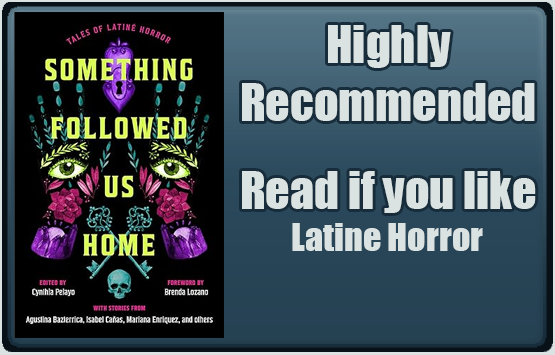
Something Followed Us Home edited by Cynthia Pelayo

Something Followed Us Home edited by Cynthia Pelayo

Formats: Print, audio, digital

Publisher: Atria/Primero Sueno Press

Genre: Comedy Horror, Dark Fantasy, Historic Horror, Monster, Myth and Folklore, Vampire, Zombie

Audience: Adult

Diversity: Latiné, Puerto Rican, Mexican, Ecuadorian, Columbian, Argentinian

Content Warnings (Highlight to view): Alcohol Abuse, Amputation, Animal Abuse, Body Shaming, Bullying, Child Abuse, Child Death, Classism, Death, Drug Use/Abuse, Illness, Incest, Physical Abuse, Racism, Rape/Sexual Assault, Slut-Shaming, Suicide, Victim Blaming, Violence

Blurb

Dive into the chilling depths of Latiné horror with this groundbreaking anthology, edited by Bram Stoker Award winner Cynthia Pelayo, where each story reimagines immigration, colonization, faith, and folklore as the fears we inherit and carry across borders and generations.

Something followed us home. It crawled in with our prayers, slipped into our beds, watched from mirrors, waited in water, and learned our names.

Gathering chilling work from some of today’s most acclaimed Latiné voices, this horror anthology moves through haunted households, brutal landscapes, sacred spaces turned dangerous, and bodies claimed by forces both ancient and intimate. The dead murmur behind locked doors. Bones rebuild themselves under merciless suns. Love becomes a doorway for demonic hunger. Blood, devotion, and memory intertwine as the past presses back with teeth.

Something Followed Us Home is an unnerving, visceral, and impossible-to-shake collection that proves that what is carried forward does not remain quiet, and what follows us rarely leaves without taking something in return.

I received this product for free in return for providing an honest and unbiased review. I received no other compensation. I am disclosing this in accordance with the Federal Trade Commission’s 16 CFR, Part 255: Guides Concerning the Use of Endorsements and Testimonials in Advertising.

I liked that both the English and Spanish language versions of the book are being released on the same day. Readers of Lo que nos siguió a casa will be able to read some of the stories in their original Spanish, while English readers will have some stories that were translated. Because the authors come from across the Latiné diaspora, there may be something new for everyone, while also including more universal themes like feminism, colonization, and family.

While I was familiar with authors such as Cynthia Pelayo (who also edited the collection), Ann Dávila Cardina, Agustina Bazterrica, Zoraida Cordova and Isabel Cañas I was delighted to also be introduced to new authors such as Carolina Flórez-Cerchiaro and Ananda Lima. I couldn’t believe how good all the stories were! There were really only one or two that I didn’t vibe with. I liked the stories that included figures from folklore like la Huesera (The Hand that Feeds by Isabel Cañas) and El Silbón (Fidelity by Alex Segura). El Jíbaro de Puerto Rico by Cynthia Pelayo was definitely one of my favorites, a bittersweet ghost story that teaches readers about the dark history in Puerto Rico, from its colonization by the Spanish, to slavery, to the American invasion. Her First Cruise Ship by Ann Dávila Cardinal was another, a humorous zombie story about undead tourists in Puerto Rico that critiques the tourism industry. It also has themes of classism and privilege. It will definitely make you think twice about how you behave when visiting another country!

While all the countries in Latin America each have their own unique cultures and histories one thing they share is a history of colonization by the Spanish and the Portuguese. These European invaders forced their languages and religion on the Indigenous people living there and brought disease, violence, slavery, destruction and later political and financial instability and war. That’s not even counting the damage done by the United States during the 19th and 20th centuries. Colonialism in Latin American countries is a reoccurring theme throughout the anthology explored in stories like the previously mentioned El Jíbaro de Puerto Rico and The Return of La Muelona by Carolina Flórez-Cerchiaro. This story is about how banana plantation owners continue the history of exploitation that began with the Spanish conquerors and how one woman gets her revenge. Other tales of revenge include Whispers from the Root by Lilliam Rivera and We are Gathered Here Together by Diana Rodriguez Wallace which address the corruption and cruelty of the wealthy and bullying, respectively. All were intensely satisfying to read as I’m a sucker for a good revenge story.

Many of the stories aren’t what I’d typically think of as “horror.” Some are more magical realism or speculative fiction like Pomelo and The World from Above and the World from Down Below. The Hand that Feeds is closer to a dark fairy tale. There are also some horror comedies like We are Gathered Here Together, My Boyfriend, and Her First Cruise Ship. However, stories like Luz Y Fer, Blue Flowers, and Specter are what I would think of as more “traditional” horror stories. I liked that every author has their own idea of what makes a story horror. There were traditional horror staples like vampires, killers, ghosts and zombies, but also religious mania, greed, sexism, and loneliness which can be equally, if not more, horrifying. The stories ranged from straight forward to more experimental. Some of the stories address the immigrant experience, while others take place in the main character’s home country, whether that be the United States or somewhere in Latin America. Settings include NYC, Puerto Rico, and Mexico City.  I have to say, I really liked how much variety there was, emphasizing the many experiences across the diaspora.  This creepy collection will have something for everyone, whether it be secret cults of children’s authors, plagues of spontaneous pregnancies, or a desperate father trying to bring back his dead daughter.
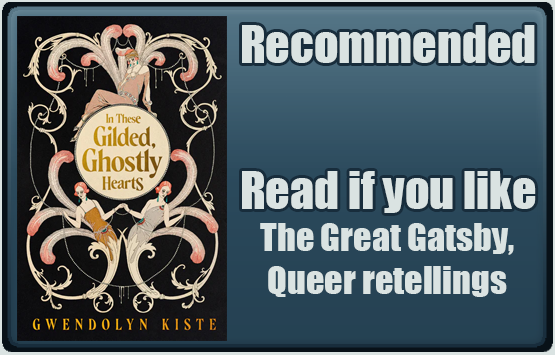
In These Gilded, Ghostly Hearts by Gwendolyn Kiste

In These Gilded, Ghostly Hearts by Gwendolyn Kiste

Formats: Print, audio, digital

Publisher: Creature Publishing

Genre: Ghosts/Haunting, Gothic, Historic Horror, Romance

Audience: Adult

Diversity: Lesbian main character and bisexual side character

Takes Place in: New York

Content Warnings (Highlight to view): Alcohol Abuse, Child Abuse, Death,  Forced Captivity, Homophobia, Suicide

Blurb

In 1955, Daisy Buchanan is found dead in an abandoned West Egg mansion, but her daughter Mel knows she’s really been gone for years. No one knows whether Daisy was murdered, or if it was a simpler, slower death: her yearslong spiral of alcohol, abuse, and helplessness. But when Mel enters the estate, she finds Daisy’s ghost, somehow frozen at twenty-three, and a charming, bleeding phantom that used to be Jay Gatsby.

To free her mother, Mel must carve a path through family secrets and decaying revelers: deep into Gatsby’s starving house as it gorges itself on unfulfilled love and grows stronger every night.

I received this product for free in return for providing an honest and unbiased review. I received no other compensation. I am disclosing this in accordance with the Federal Trade Commission’s 16 CFR, Part 255: Guides Concerning the Use of Endorsements and Testimonials in Advertising.

The year is 1955. Daisy Buchanan is dead, her body discovered in Jay Gatsby’s abandoned estate in West Egg. Daisy’s now adult daughter, Pamela “Mel” Buchanan, and one of Daisy’s few remaining friends, Jordan Baker, travel from New York City to investigate the mysterious death. They learn that Daisy was working with a predatory spiritualist named Harrison to summon the ghost of her lost lover, Jay Gatsby. Harrison convinces the two women to return to Gatsby’s old home, now dripping with ectoplasm, and complete the séance with him. Soon the mansion is filled with ghosts, partygoers from bygone days, Gatsby himself, and Daisy. The partygoers are Stone Tape hauntings, a mere echo of the past. Gatsby’s ghost, on the other hand, is an intelligent haunting who is able to interact with Mel, who soon learns his obsession with Daisy has continued after his death.

Mel and Daisy have a complicated mother/daughter relationship. No matter how badly their mother treats them, children still crave their mother’s love. Mel is parentified by Daisy who is helpless and broken after losing her lover Gatsby, her husband Tom, and her lifestyle. Mel explains “Once the cash dried up and she wasn’t a rich girl anymore, she practically dissolved into sea foam before my eyes.” Daisy is not a resilient woman–understandable since she was raised to be a pretty bauble on a rich man’s arm. Daisy was a fairly passive character in Fitzgerald’s novel, a beautiful woman for Gatsby to idolize and Tom to possess. It was satisfying, however, to read that toxic alpha-male Tom threw himself off the Brooklyn Bridge after losing everything in the stock market crash of ’29. A fitting end to an awful man. Unfortunately, it means he leaves his wife and daughter penniless and alone. Kiste often writes books for “lost” women and girls who are trapped in the past and mistreated by an uncaring society who doesn’t understand them. The Marys in Pretty Marys All in a Row, the Rust Maidens in the novel of the same name, Talitha Velkwood and her friends in The Haunting of Velkwood, and now Mel and Daisy Buchanan.

You don’t necessarily have to have any knowledge of The Great Gatsby prior to reading In These Gilded, Ghostly Hearts but it does certainly help to be able to familiarize yourself with the characters and themes. There are also lots of fun little callbacks to the original book, like Gatsby’s automatic orange juicer machine. Just don’t make the same mistake I did and try and compare the writing in the two. I re-read F. Scott Fitzgerald’s famous work right before Kiste’s so I’d have a refresher and I do think it made me more judgmental of the writing in the latter. Don’t get me wrong, I generally love Kiste’s writing, two of my favorites being Pretty Marys All in a Row and The Haunting of Velkwood. I’m not at all implying that this is not a well-written story. But very few books are going to be able to stand up to one of the “Great American Novels” and trying to compare the two is a disservice to Kiste’s novella.

While Gatsby is written as a sympathetic character in the original book, I like how Kiste points out how incredibly creepy his obsession with Daisy is. Some might view his grand gestures as romantic but honestly, they always felt like borderline incel behavior to me. Gatsby views Daisy as a prize to be won rather than a person, and if he has enough money of course she’ll leave Tom for him. The main reason we’re sympathetic to Gatsby is because Tom is portrayed as the bigger asshole with no redeeming qualities, and because Nick sees Gatsby as sympathetic. Daisy is “supposed” to choose the heroic Gatsby over the brutish Tom, and when she doesn’t, she’s cast as the villain. Yet, does she really have a choice?  Herstory and Daisy Buchanan by Leland S. Person, Jr. quotes the numerous men who have described Daisy as “vulgar and inhuman,” a “Dark Destroyer,” and the “anti-virgin…the prototype of the blasphemous portraits of the Fair Goddess as bitch” who “preyed on” Gatsby. Yikes! But Person viewed Daisy as more victim than conniving, selfish woman. She’s a woman in the 1920s, from an old money family who’s expected to marry an old money man, not some nouveau riche who may or may not have a criminal history. Daisy has no way of earning a living herself, she’s completely dependent on men for her financial security, and always had been. She’s also under immense societal expectations; she can’t simply leave her husband to have the life she wants with Gatsby. We also known Tom is abusive, as shown when he breaks his mistress’ nose.Leaving him was unlikely to be easy. I don’t think any of that necessarily makes her a good person; she’s just an imperfect victim. And this seems to be the characterization that Kiste goes with. Daisy wasn’t a good mother, but that doesn’t mean she doesn’t deserve sympathy or Gatsby’s obsessive idolization. Similarly, as a lesbian, Mel is also unable to be with the ones she loves, first Jordan and then her coworker, Vera.

I loved how queer Kiste’s book was. Mel is gay, Jordan bisexual, and Tom’s implied crush on Gatsby is no longer subtext. In These Gilded, Ghostly Hearts takes place during the Lavender Scare of the 1950s, an anti-LGBTQ+ witch hunt, so Mel lives in constant fear of having her sexuality discovered. At one point she and Jordan go to the Bagatelle on University Place. The Bag, as it was more commonly known, was a real lesbian bar that was popular in the 1950s. I love that little bit of realism that Kiste added to the story. Audre Lorde and Ann Bannon both wrote about the bar and how it shaped their pre-Stonewall experience. The Bag was owned by the mafia and frequently raided by police. A red light would go off to warn patrons when they vice squad showed up, which happens to Mel at the bag one night.

Kiste is not the first to write about the Great Gatsby through a queer lens. In 1963 Lionel Trilling characterized Jordan Baker as “vaguely guilty, vaguely homosexual.” Nearly thirty years later The International Fiction Review published The Sexual Drama of Nick and Gatsby by Edward Wasiolek who argued that Nick has “homosexual  leanings” and intense feelings for Gatsby. The Chosen and the Beautiful by Nghi Vo (author of The Empress of Salt and Fortune) also imagines Jordan and Gatsby as bisexual, and Nick and Gatsby have a fling. Self-Made Boys: A Great Gatsby Remix by Anna-Marie McLemore and The Pursued and the Pursuing by AJ Odasso explore a queer relationship between Gatsby and Nick.

Kiste’s writing can best be described as “haunting;” beautiful, unsettling, nostalgic, and melancholy, lending itself well to a ghost story. Her stories are less “in your face” horror with gore and blood and instead rely on atmosphere to create a general sense of unease commonly found in gothic horror. For some readers, it may feel like the pacing is dragging, as there’s no sense of urgency and not a lot of action because this isn’t that kind of book. This is a novella meant to be savored rather than rushed through. So, while it won’t be everyone’s cup of tea, I think fans of slow burn horror and character driven story will enjoy In These Gilded Ghostly Hearts.

I did feel like the book needed a little more show and a little less tell. It seemed like Mel was constantly explaining things to the audience that didn’t necessarily need to be spelled out. At the same time, I thought it was awesome that Mel was middle aged and Jordan in her fifties. It’s so rare to find older women protagonists in fiction. Male protagonists have a wide range of ages, but women seem to always skew young. What’s more, neither character is a wife or mother. While I don’t think In These Gilded, Ghostly Hearts is as strong as some of Kiste’s other novels and novellas, it’s still a solid, spooky read perfect for autumn.


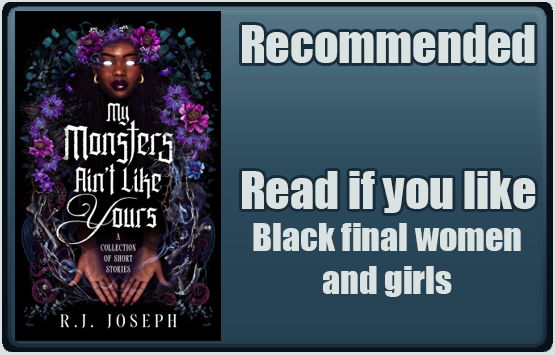
My Monsters Ain’t Like Yours by R.J. Joseph

My Monsters Ain’t Like Yours by R.J. Joseph

Formats: Print, audio, digital

Publisher: Quill & Crow Publishing House

Genre: Eldritch Horror, Folk Horror, Ghosts/Haunting, Historic Horror, Monster, Zombie

Audience: Adult

Diversity: Black, African/American characters and author, queer and bisexual characters

Takes Place in: Texas

Content Warnings (Highlight to view): Animal Abuse, Animal Death, Body Shaming, Cannibalism, Child Abuse, Child Death, Child Endangerment, Childbirth, Death, Drug Use/Abuse, Forced Captivity, Incest, Miscarriage, Oppression, Pedophilia, Physical Abuse, Racism, Rape/Sexual Assault, Sexism, Sexual Abuse, Slut-Shaming, Suicide, Torture, Verbal/Emotional Abuse, Violence, Vomit 

Blurb

At its core, the horror genre is an effective vehicle for exploring human behavior. From within its terrifying boundaries, and lack thereof, we can examine monstrosity. We can determine how monsters are labeled, analyze the actions of those deemed monstrous, and prophesy the impacts this labeling and actions have on the world around us.

Monsters are personal. Monsters are universal. These facts create an intriguing juxtaposition where the things deemed monstrous or frightening can be shaped by personal experiences, while also representing many aspects of the human condition; our fears are much more similar than dissimilar. This means my monsters are absolutely like yours: they are our collective nightmares.

My Monsters Ain’t Like Yours reflects this irony through Black feminist intersectional horror at its rawest.

I received this product for free in return for providing an honest and unbiased review. I received no other compensation. I am disclosing this in accordance with the Federal Trade Commission’s 16 CFR, Part 255: Guides Concerning the Use of Endorsements and Testimonials in Advertising.

While many of the monsters in the collection are supernatural (Suffer the Little Children, The Crazy   with Daisy, Higher Education, Something Wicked Came for Me, Welcome, Skinny Minnie, Sweet Sunday Supper Smile, etc.) the most terrifying ones are the human monsters (Regrets Never Die, The Collector, Sweet Sunday Supper Smile, Her Heart’s Desire, No Tricks Only Treats, The Preying Family, Sad, Spooky Sally, etc.). Interestingly, some of the supernatural monsters are friendly and helpful creatures/spirits who protect the protagonists from other monsters, both literal and figurative. Humans, after all, are much worse than some imagined creature. Then there are the metaphorical “monsters” of grief, loneliness, and trauma that haunt the protagonists.

There are a lot of bad heterosexual relationships in the anthology.  These range from Where the Horizon Kisses the Sky in which the husband is neglectful, Endless Possibilities where he’s a selfish loser, to Her Heart’s Desire where he’s outright abusive towards his wife. In all these stories the wife yearns for something better and uses supernatural means to get it, with varying degrees of success. In The Badly Terrible, Absolute Worst she doesn’t even get that chance. But queer relationships, like in The Crazy with Daisy and Witness Bearer, are shown in a more positive light.  A report by the Institute for Women’s Policy Research and the National Domestic Worker’s Alliance states that “More than 40 percent of Black women experience physical violence by an intimate partner during their lifetimes (41.2 percent), compared with 31.5 percent of all women.” And a study published in the Lancet reported that Black women are also nearly six times as likely to be murdered than white women. Thankfully there are resources like Ujima that support Black women who are in domestic violence situations, even as the justice system continues to fail them.

In Endless Possibilities and Her Heart’s Desire the wife herself becomes a monster to escape her bad marriage, and in the latter, get revenge on her horrible husband. Then there’s Tanita in The Collector, a serial killer who murders for the fun of it. There’s something incredibly satisfying about women embracing their monstrosity and rage, especially Black women. Those with marginalized identities are often cast as monsters in other people’s stories so why not reclaim the title? I especially like that feminine monstrosity in Endless Possibilities and Her Heart’s Desire is not tied to sexuality. While I appreciate women like Tanita reclaiming their sexuality and using it to seduce and murder men à la Jennifer’s Body (2009) and The Hunger (1983) sometimes it feels like the majority of female monsters are temptresses ( leading men to their death. And it can start to get a little old.

Can’t they just be horrible and violent without wanting to have sex with their victim? Plus, there’s the unfortunate implication that women who have sex on their own terms are evil and they go against the natural order of things by overpowering men. So, I appreciated that Joseph gave us some nice variety. The book even has monstrous children (#GIRLMOM and Suffer the Little Children) though in both cases the children are embraced by the main character rather than shunned for the monstrosity.

Sweet Sunday Supper Smile and No Tricks Only Treats are stories containing child abuse, though the abusers get their comeuppance in both. Then there’s Sad, Spooky Sally which is especially disturbing, so much so that it comes with its own set of content warnings before the chapter, rather than in the index. It’s an absolutely heart-breaking story with a bittersweet ending and one of my favorites in the collection. But it’s also very triggering, so make sure you check out those content warnings before reading it. The same goes for Regrets Never Die and Witness Bearer. They’re both very dark, with the latter being about a girl who can see the worst things a person has ever done. She witnesses some truly awful memories, so I appreciate that Joseph included content warnings for all the stories in the book’s index.

Those who Teach Pay Knowledge Forward stood out in the collection, as it was sweet rather than scary, A ghost story where the ghosts aren’t the source of fear. It also had a nice message about helping to educate the next generation so they can succeed. I love how so many of the Black women in the collection are intelligent and well educated, ranging from college students (The Collector) and graduate students (Whole New World), to teachers (Those Who Teach Pay Knowledge Forward) and college professors (Grand Opening, Higher Education, Something Wicked Came for Me). The young woman in Important Things is sent on an all expenses paid trip to Palm Springs for a symposium because she excels in her high school classes. In 1995 14% of Black women between 25 to 34 held a bachelor’s degree compared to 38% in 2024 according to the Pew Research Center.

There are so many great stories in the collection, I’d be pressed to pick a favorite, though I did especially enjoy Regrets Never Die, #GIRLMOM, Endless Possibilities, Those Who Teach Pay Knowledge Forward, and Something Wicked Came for Me. While Black women and children’s trauma is a reoccurring theme of My Monsters Ain’t Like Yours, it’s not the only focus of the anthology. If every story were about Black trauma and abuse, it honestly may have been too much for me. Instead, Joseph includes a bunch of fun, spooky stories to offset the heavier stuff so the collection never feels too dark and depressing. Instead, we get a nice balance.

I really liked this because while horror is a great way to process trauma, Black horror shouldn’t be pigeonholed into stories of Black pain. I love Get Out (2017), it’s one of my favorite films, but if that was the only kind of Black horror story told by Hollywood, it would start to feel like the suffering of Black people was being fetishized for entertainment. There’s a reason why Peele’s next two films, Us (2019) and Nope (2022) aren’t rooted in Black trauma. So, while there are plenty of stories about abuse, bad relationships, and the general mistreatment of Black women and children, there are also enough tales about living mannequins, small fanged creatures, and ghosts to offer the reader a breather.

These Bodies Ain’t Broken Edited by Madeline Dyer

These Bodies Ain’t Broken Edited by Madeline Dyer

Formats: Print, digital

Publisher: Page Street Publishing

Genre: Body Horror, Demon, Historic Horror, Monster, Myths and Folklore, Romance, Vampire

Audience: Young Adult

Diversity: Authors and characters with disabilities including ADHD, anxiety, agoraphobia, Autism, celiac disease, chronic pain, Crohn’s disease, diabetes, Down syndrome, Ehlers-Danlos syndrome, Fibromyalgia, mast cell activation syndrome (MCAS), neurofibromatosis, postural orthostatic tachycardia syndrome (POTS), PTSD, and substance use disorder. Non-binary main character and author, agender main character, biracial Haitian side character, bisexual main character.

Content Warnings (Highlight to view): Ableism, Amputation,  Animal Death, Body Shaming, Bullying, Cannibalism, Child Abuse, Child Death, Classism, Death, Drug Use/Abuse, Forced Captivity, Gore, Homophobia, Illness, Kidnapping, Medical Procedures, Oppression, Mental Illness, Physical Abuse, Self-Harm, Sexism, Slurs,  Suicide, Verbal/Emotional Abuse, Victim Blaming, Violence

Blurb

A monstrous transformation within your own body.
A sacrificial imprisonment.
A fight to the death against an ancient evil.

These stories showcase disabled characters winning against all odds.

Outsmarting deadly video games, hunting the predatory monster in the woods, rooting out evil within their community, finding love and revenge with their newly turned vampire friend—this anthology upends expectations of the roles disabled people can play in horror. With visibly and invisibly disabled characters whose illnesses include Ehlers-Danlos syndrome, Crohn’s disease, diabetes, PTSD, and more, each entry also includes a short essay from the author about the conditions portrayed in their stories to further contextualize their characters’ perspectives. From breaking ancient curses to defying death itself, these 13 horror stories cast disabled characters as heroes we can all root for.

Contributors include bestselling and award-winning as well as emerging authors: Dana Mele, Lillie Lainoff, Soumi Roy, Anandi, Fin Leary, S.E. Anderson, K. Ancrum, Pintip Dunn, Lily Meade, Mo Netz, P.H. Low, and Carly Nugent.

I received this product for free in return for providing an honest and unbiased review. I received no other compensation. I am disclosing this in accordance with the Federal Trade Commission’s 16 CFR, Part 255: Guides Concerning the Use of Endorsements and Testimonials in Advertising.

Horror isn’t exactly known for having good disability rep, so it was great having an anthology written by authors with disabilities because there was so much variety in representation. There was everything from Crohn’s disease to Ehlers-Danlos syndrome to PTSD. In some stories, a character’s disability played a huge role (Baby Teeth, Within the Walls, The Worst of It), and it’s only mentioned in passing in others (When the Night Calls, Kissed by Death). At the end of each story, the author would write about how they chose to represent disability in their work, and some even shared their experiences with their own disabilities and how they related to their stories.

I loved that both invisible and visible disabilities were featured. I have invisible disabilities myself (ADHD and mental illness), but for a long time I didn’t consider myself disabled because, like many people, I thought the only disabilities that existed were visible. This caused me a great deal of stress because I was always trying to compare myself to neurotypical people. It never occurred to me to ask for accommodations because I thought I should be able to “power through” any challenges on willpower alone. Engaging with the disability community online helped me be more accepting of my own disability. I learned that I wasn’t “broken,” the difficulties I had were not moral failings, and having a disability is not a “bad” thing. I discovered that the things I struggled with due to ADHD and mental illness were not my fault, it was just a difference in brain chemistry that I was born with. Accepting my disability meant I also accepted help and learned to function with my disability instead of always fighting against it. It was empowering. So, reading stories about ADHD and mental health in a disability anthology felt incredibly validating. Not only that, but these characters with disabilities got to be the heroes. It was awesome reading about a woman with ADHD get revenge on the men who wronged her and a non-binary person whose mental illness was not the source of horror in the story. Another great thing about These Bodies Ain’t Broken is the amount of intersectionality. There were queer characters, non-binary characters, Asian characters, etc.

This review would be unreasonably long if I examined every story in the collection I will focus on a few that stood out to me. When the Night Calls by Soumi Roy takes place in 19th century Bengal. Charu is a newly married 16-year-old girl whose best friend Malati, an educated city girl who is fiercely independent, has disappeared without a trace. Malati’s cold husband claims that his wife was lured into the forest and taken by the Nishi Daak for being so willful. He says it was Malati’s own fault she was taken, but Charu isn’t sure what to believe. Malati always told her the Nishi Daak was just a story told to keep women in line. Although Charu does her best to be an obedient wife and daughter-in-law her curiosity gets the better of her and she stumbles across the terrible secret kept by the village men; the reason women and girls of the village keep disappearing. This bloody story of feminine vengeance and Bengali monsters was an extremely satisfying read. I also enjoyed it as Charu and I share a disability, ADHD (although it’s not named it the story the author reveals that Charu is neurodiverse). I related to the frustration of making mistakes, even when you’re trying your hardest, and how painful it is when people around you attribute this to laziness or “just not paying attention.”

The first line of Thy Creature by Lillie Lainoff draws you in immediately. “The hardest thing about coming back to life is remembering how to breathe.” Told in the second person, this Frankenstein inspired tale tells the story of a girl brought back to life by her college boyfriend, Cal, after she dies in a hiking accident. Despite being a mediocre boyfriend at best, the protagonist seems perfectly happy to settle and set her expectations low when it comes to Cal, especially since she now owes him for bringing her back to life. The story reminded me so much of all the straight women who settle for awful men because they don’t think they deserve better. Hey, there’s a reason single women are happier.

Dating while disabled comes with its own set of challenges especially when dating someone without a disability. The non-disabled person may only date someone with a disability out of pity or because they fetishize their disability. This also applies to anyone who isn’t skinny, white, cisgender, etc. (aka has their own category on Pornhub), so heaven help you if you belong to more than one of those marginalized groups (intersectionality). Then there’s all the misconceptions, like the assumption that people with disabilities aren’t sexual (obviously Ace people with disabilities exist, but that’s a sexual orientation, and has nothing to do with their disabilities). As Lainoff’s protagonist slowly builds confidence, she also learns she doesn’t have to settle just because she has a disability and that maybe her boyfriend isn’t all that great.

In Ravenous by Carly Nugent, the protagonist, Linden, is struggling with depression and passive suicidal ideation. She refuses to monitor her blood sugar or manage her diabetes which has already landed her in the ER once. Linden has decided she’s just going not to accept her diabetes, forcing her mother to help her manage most of it, and she’d rather die from it than live with it. I like that Nugent wrote about the difficulty someone with a chronic illness goes through when they’re first diagnosed. Linden is still in the denial and depression stages of her grief after learning her life will never be the same. But over the course of the story, she learns to accept that she has diabetes, and it doesn’t mean her life is over. I love that the author didn’t portray disability in a negative light while also acknowledging that yes, finding out that you’re going to have to manage a chronic illness for the rest of your life can really suck.

Another story I really liked was House of Hades by Dana Mele. House of Hades is a virtual world filled with gamers and virtual replicas of the dead. The tech was originally funded by some billionaire who wanted to live forever. But when he learned that you can’t really become an immortal machine, he sold the program, which was used it to create House of Hades. They call the digital clones “ghosts,” which include historical figures like Shakespeare and Marie Antoinette. The game is so realistic that if you die in the game you can die in real life (so Matrix rules) unless you “wake up,” which is why the game requires a buddy system. The voice command “wake up” triggers the exit protocol. Unfortunately, you need someone else to trigger it for you, you can’t exit yourself, which seems like a serious design flaw.

Ode and Era are two gamers who like to hang out in House of Hades. Ode is currently grounded, and isn’t supposed to be playing the game because they’ve been abusing pills and recently had an overdose on a drug called V (aka Viper, the story’s fictional drug). Their parents recently got divorced and they’re struggling with it. When they go back to Hades with Era, Ode is shocked to discover they’ve been separated. Now Ode is all alone in a dark little town, seemingly empty, but something is watching them. They are forced to solve puzzles and play the town’s strange game to try and find Era and a way out.

I thought the setting was very creative, and I like that the protagonist was non-binary like me. In the story notes Mele explains how she didn’t like the way horror villains were always portrayed as mentally ill. As someone with my own mental illness and who has spent time inpatient at mental health hospitals (or as I like to call it “a grippy sock vacation”) it hurts when I hear people talk about the “dangerous crazies” in the psych ward or explain away a person’s terrible behavior (racism, violence, abuse, etc.) by saying “they’re crazy.” They’re not mentally ill, they’re just awful people! And mentally ill people are more likely to be the victims of violent crime than commit it. Only a very small percent of violent crimes (around 5%) are committed by people with mental illness. Yet the myth of the “crazed killer” prevails in horror. So, I appreciate that Mele made her protagonist mentally ill.

One of my favorite stories in the collection was The Weepers and Washer-Women of Lake Lomond by Madeline Dyer (the editor of the anthology), though I think the story would have worked better if it was a full-length novel. It was like I was being served this amazing meal, but I had to shove it in my mouth in five minutes when I really wanted to savor it. It didn’t necessarily feel rushed, I just think I would have enjoyed it more if I had had more time with the characters, the setting, and the lore because it was all so great! In the story the protagonist, Bianca, who has multiple disabilities including Ehlers-Danlos, POTS, and MCAS, is pretending to be her twin sister, Remi, so she can take part in the World Kickboxing Championship on the island of Loch Lomond. Bianca is convinced the island had something to do with the death or their cousin, Mari, who competed on Loch Lomond a ten years prior. Remi’s boyfriend, Blake, does not think this is a good idea, but Bianca, who hates being treated like she’s “broken,” is determined. She’s thought of everything; Remi faked an injury months ago to explain away Bianca’s crutches. The competition takes place in pitch dark, the organizers claiming that it’s to make it more fair for blind and low-vision competitors (a blind girl won the championship last time), so no one will see Bianca using a mobility aid. And she only needs to stay in the competition long enough to find out what happened to Mari, so Bianca doesn’t necessarily have to win her first match.

I can understand Blake’s hesitation to help Bianca go through with her plan, because at first, I thought Bianca was foolish to try and pretend to be her sister. While both sister’s have Ehlers-Danlos, Remi only got stretchy joints, while Bianca got the whole shebang that can come with the condition. How would Bianca be able to compete in such a physically demanding competition? And immediately after arriving on the island,things start to go wrong. There’s no food that Bianca can safely eat, and the training masters confiscate her medication and medical drinks claiming it will give her an “unfair advantage.” Dizzy with fatigue and illness she tries to bow out of the championship, but is forced to compete. And when she enters the dark arena, the training master takes Bianca’s crutches. Worst of all, her opponent doesn’t seem quite human. I thought she was guaranteed to be monster chow. But then her disability ends up being the reason she survives. *spoiler* Because Bianca’s crutches (presumably made of durable steel, which contains iron) can hurt her adversaries. As Bianca says at the end of the story “I’m Bianca. And that’s how I’m alive. Because I’m disabled. Because I need mobility aids. Because I fought with my crutch.” *spoiler ends* I absolutely love this twist. Disabilities are often to assumed to be a “weakness” but it ends up being Bianca’s strength.

Three of the stories used the second person point of view, which is when the story addresses the reader directly using the pronoun “you” when describing the protagonists’ actions (i.e. you shook in fear when faced with the monster from your dreams). This is a tricky to do, and doesn’t always work well, as you’re basically telling the reader what they’re doing and feeling. But it’s also more intimate and the reader gets a greater feel for what the protagonist is going through. I liked that some of the authors used this for their storytelling. It gives  you more of a feel for what it’s was like living with a specific disability.

While not all the stories in the collection were as strong as others, I think this is a solid anthology. It was great to both see myself in characters and learn about different types of disabilities, as there’s so much variation. I also love that the stories defied stereotypes like disabled people not being worthy of love, or mentally ill people being dangerous. The only thing that surprised me was that there were no stories by authors who were blind, low vision, or Deaf/deaf, and there was only one story with a character who used a wheelchair. Perhaps Madeline Dyer wanted to focus on disabilities which don’t get as much media attention or she simply wasn’t able to get authors to represent those disabilities. This isn’t really a criticism, just something that surprised me. Perhaps I just need to reexamine my own biases when it comes to disabilities.

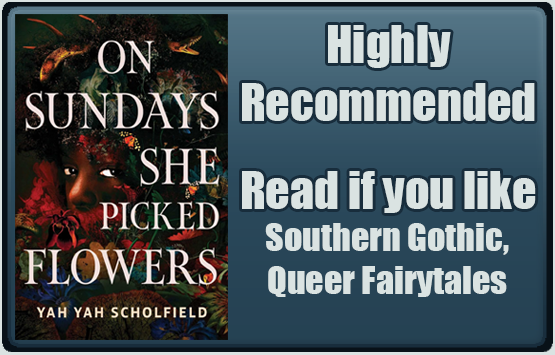
On Sunday She Picked Flowers by Yah Yah Scholfield

On Sunday She Picked Flowers by Yah Yah Scholfield

Formats: Print, audio, digital

Publisher: Saga Press

Genre: Gothic, Historic Horror, Werebeast

Audience: Adult

Diversity: Black characters and author, Queer main character and author

Takes Place in: Georgia, USA

Content Warnings (Highlight to view): Alcohol Abuse, Animal Death, Body Shaming, Cannibalism, Child Death, Childbirth, Death, Gore, Homophobia, Incest, Miscarriage, Physical Abuse, Racism, Rape/Sexual Assault, Self-Harm, Sexual Abuse, Slurs, Slut-Shaming, Verbal/Emotional Abuse, Violence, Vomit

Blurb

When Judith Rice fled her childhood home, she thought she’d severed her abusive mother’s hold on her. She didn’t have a plan or destination, just a desperate need to escape. Drawn to the forests of southern Georgia, Jude finds shelter in a house as haunted by its violent history as she is by her own.

Jude embraces the eccentricities of the dilapidated house, soothing its ghosts and haints, honoring its blood-soaked land. And over the next thirteen years, Jude blossoms from her bitter beginnings into a wisewoman, a healer.

But her hard-won peace is threatened when an enigmatic woman shows up on her doorstep. The woman is beautiful but unsettling, captivating but uncanny. Ensnared by her desire for this stranger, Jude is caught off guard by brutal urges suddenly simmering beneath her skin. As the woman stirs up memories of her escape years ago, Jude must confront the calls of violence rooted in her bloodline.

Haunting and thought-provoking, On Sunday She Picked Flowers explores retribution, family trauma, and the power of building oneself back up after breaking down.

I received this product for free in return for providing an honest and unbiased review. I received no other compensation. I am disclosing this in accordance with the Federal Trade Commission’s 16 CFR, Part 255: Guides Concerning the Use of Endorsements and Testimonials in Advertising.

Jude (short for Judith) does what I’m sure many women have dreamed of doing. After killing her abuser she runs away from her terrible life to live alone in a haunted house in the forest where she becomes a wisewoman/healer and takes a mysterious lover who may or not be a beast. On Sunday She Picked Flowers reads like a Southern Gothic fairytale, if “Once Upon a Time” were 1965 and “a land far away” was Georgia. This is not a pretty story with a pure, fair maiden who is rescued from her miserable life. Instead, our heroine, 41-year-old Jude, is described as “too fat, too Black, too tall, and too damn ugly” (at least by her teachers and classmates) and is forced to save herself from her wicked mother and the curse of transgenerational trauma.

Jude has lived with her abusive, religious mother for her entire life. She doesn’t understand why her mother, whom she calls Ma’am, hates her so much, only that she does. Ma’am will beat her daughter for the smallest offense then turn around and act like nothing happened (this is known as the cycle of abuse). Her two aunts, Phyillis and Vivian, tell Jude it’s her own fault she’s abused for being “difficult” and she should be grateful for all her mother has sacrificed for her.

Jude keeps a packed bag and a tin of money hidden under her bed so she can leave one day. She’s tried to run away before but people in the town always bring her back. Eventually Jude realizes the only way she’ll ever be free is to kill her mother. One night Jude is making dinner when Ma’am announces she found the packed bag under Jude’s bed. Ma’am tried to guilt trip Jude before telling her daughter that she’ll never let her leave. Something snaps in Jude and she starts hitting her mother and the two end up on the floor. Ma’am tries to strangle her but Jude grabs a meat cleaver on the floor and buries it in her mother’s face. She attempts to call her aunt Phyllis for help and to confess what she’s done, the only one of Ma’am’s two sisters who might show her compassion, but is rebuffed. Realizing she can’t stay in that house Jude runs away and ends up in an abandoned haunted house in the middle of the woods that she names Candle.

In many ways transgenerational trauma can feel like a family curse that passes from parent to child. The controversial field of epigenetics claims that trauma can change your DNA to the point that it’s passed down genetically to your offspring, with descendants of Holocaust survivors, Residential School Survivors, and enslaved Africans continuing to experience the symptoms of trauma (depression, anxiety, substance misuse, etc.). Dr. Joy DeGruy, who holds advanced degrees in both clinical psychology and social work research, came up with the term “post traumatic slave syndrome” to describe the transgenerational trauma experienced by African Americans as a result of the Atlantic slave trade, in addition continued discrimination in the present day. While the American Psychological Association (APA) awarded Dr. DeGruy a Presidential Citation in 2023 her theory is not without its critics. Dr. Ibram X. Kendi, a historian and anti-racism scholar, argues that the idea of post traumatic slave syndrome is itself racist as it implies that Black people are inherently dysfunctional as a group.

Some studies have shown that when someone experiences abuse as a child and is unable to learn healthy coping methods, they are more likely to abuse their own children, with one study stating that abuse and neglect victims are three times more likely to be abusive themselves. Rates of domestic violence are higher in the Black community, with Black women at the greatest risk, most likely due to a combination of racism and poverty. Black parents also have a complex relationship with the corporal punishment of children, especially in the South. When my siblings and I were little my Black grandmother thought it was very amusing that my white mother didn’t believe in spanking, and joked about how the beatings she gave my aunt and father would get her sent to prison now.

But she did what she did to protect them from something worse. She knew white people would use any excuse to hurt, arrest, or even kill a Black person, even if they were a child so Black children had to always be obedient if they wanted to survive. They did not have the same opportunities as white children to make youthful mistakes. Child advocate Dr. Stacey Patton, who is herself a child abuse survivor, explained in an interview with Ebony that “People think that hitting a child is a form of teaching. We think it will protect them.” In another interview with the Touré Show podcast  Dr. Patton stated “There was this idea that ‘Well if I beat you, you’re gonna be alive at the end of the day, whereas if the Klan gets their hands on you, you’re dead’… And so we fast forward to this century, and you have Black people saying, ‘If I don’t beat my child, then the police will kill them.’” Of course, the belief that all Black parents are inherently abusive or “bad” parents is rooted in racism.

Ma’am was horribly abused by her own father, and ended up taking her pain out on her daughter. Jude’s beatings were treated as acceptable “punishments” by her aunts who had been beaten similarly as children. But this does NOT mean that an abused child is guaranteed to be abusive themselves. Jude is able to break free and learns to love herself and that she’s more than what was done to her, just as many Black parents today are moving away from “tough love” and embracing gentle parenting. In fact, corporal punishment is quickly falling out of favor in the Black community.

Scholfield’s prose is gorgeous, one my favorite lines in the book is, “Jude entered the verdant maw of the woods, past its bark teeth and down its mossy throat, down into its humid green bowels.” What a great description, both foreboding and beautiful. It’s also a perfect example of the book’s reoccurring theme of transformation as Jude leaves civilization behind and enters the enchanted world of the forest (appropriate, as the forest has long been a metaphor for transformation in both fairytales and folklore). Ma’am prefers nature small and tamable because she had too much of it as a child working on a plantation (one of the reasons my grandmother left Tennessee and moved to Chicago) and four generations of Ma’am’s family slaved away on a plantation, even after emancipation. But Jude loves the beauty of nature and its wildness, and is willing to work the land if she’s working it for herself and not another. For in the forest, she is truly free.

Judediscovers safety and strength in her solitude, that is until she meets Nemoira, a strange and beautiful woman who enters Candle and immediately makes herself at home. Jude falls hard and fast for the mysterious Nemoira, who may or may not be the beast that’s been leaving meat on her doorstep. Their relationship reminds me of classic stories like Bluebeard, Tsuru no Ongaeshi (Crane’s Return of a Favor), and Beauty and the Beast. I loved that this book was about an older woman rather than a 20-something. Of course there’s nothing wrong with younger heroines, but it can get repetitive always reading about women half my age in books supposedly aimed at adults. It’s easy to find older men in media, but creators seem afraid to make their women older than 30 or so. Jude, on the other hand, starts the story out at 41 and is in her sixties by the end of it. She’s also able to change and develop as a character despite being older. It’s wonderful to watch Jude go from terrified and helpless to fearless and self-sufficient over the course of the story. Best of all, she gets to have a romance and hot sex! Media makes it seem like women stop having sex the minute they hit 40, but while age can change how you have sex, older adults are still sexually active. So it’s nice to see that represented here and not treated as a punchline or something gross.

This was an achingly beautiful and haunting story. Despite its supernatural and fairy tale-like elements, the book’s depictions of abuse are still realistic. I appreciated how Scholfield humanizes Ma’am without excusing her abuse of Judith. Ma’am’s treatment of her daughter is inexcusable, even though Judith is not a “perfect victim” (a harmful myth that often prevents abuse survivors from getting help). Judith’s relationship with Nemoira is similarly complex, with Judith trying to love a monster without herself becoming monstrous and learning to stand up for herself. Scholfield’s descriptions are lush: you can practically see, smell, and hear the forest. On Sunday She Picked Flowers feels like in takes place in a liminal space between fantasy and cold reality, the “real” world, and the world of the forest. While reading it, I always felt like I was just on the edge of a dream.

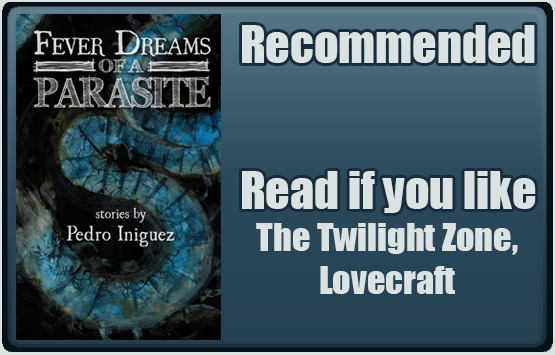
Fever Dreams of a Parasite by Pedro Íñiguez

Fever Dreams of a Parasite by Pedro Íñiguez

Formats: Print, digital

Publisher: Raw Dog Screaming Press

Genre: Body Horror, Eco Horror, Eldritch Horror, Folk Horror, Ghosts/Haunting, Historic Horror, Killer/Slasher, Monster, Sci-Fi Horror, Zombie

Audience: Adult

Diversity: Mexican American author and characters, Mexican characters

Takes Place in: Mainly Mexico and California

Content Warnings (Highlight to view): Ableism, Alcohol Abuse, Amputation, Animal Abuse, Animal Death, Body Shaming, Cannibalism, Child Death, Child Endangerment, Childbirth, Death, Drug Use/Abuse, Gore, Kidnapping, Miscarriage, Mental Illness, Physical Abuse, Racism, Rape/Sexual Assault, Sexism, Stalking, Suicide, Torture, Verbal/Emotional Abuse, Violence, Xenophobia

Blurb

Íñiguez weaves haunting tales that traverse worlds both familiar and alien in Fever Dreams of a Parasite. Paying homage to Lovecraft, Ligotti, and Langan, these cosmic horror, weird fiction, and folk-inspired stories explore tales of outsiders, killers, and tormented souls as they struggle to survive the lurking terrors of a cold and cruel universe. With symbolism and metaphor pulled from his Latino roots, Iniguez cuts deep into the political undercurrent to expose an America rarely presented in fiction. Whether it’s the desperation of poverty, the fear of deportation or the countless daily slights endured by immigrants, every story is precisely rendered, often with a twist that allows us to see the mundane with fresh eyes.

I received this product for free in return for providing an honest and unbiased review. I received no other compensation. I am disclosing this in accordance with the Federal Trade Commission’s 16 CFR, Part 255: Guides Concerning the Use of Endorsements and Testimonials in Advertising.

Most of the stories in this anthology fall in the cosmic horror genre, but each story is entirely unique. There are, however, a few repeated themes; families, poverty and classism, people down on their luck, and those who take advantage of them. Monsters are a staple throughout the book, though most of the stories don’t really explain what the monster is. Are the dog-creatures werewolves? Is the blood sucking child a vampire? What in the world are those maggot monsters in Midnight Frequencies? What the hell is the old man with the fangs? Who knows! I can guess, but sometimes it’s scarier not to know. Even with all the different strange creatures, there’s often a human enabling it, once again proving that humans are the worst monsters of all. The anthology explores various themes and contemporary issues like the California wildfires, environmental destruction, addiction, the damage done by both the cartel and the US in the poverty-stricken areas of Mexico, how desperate immigrants are exploited, predatory landlords, and even increasingly adversarial political TV commentators.

The first story, titled Nightmare of a Million Faces, is about Anastasia Mendez, an unemployed porn star who just left an abusive relationship with her ex-boyfriend/manager/fellow porn star, Robert. Even without the monster appearing at the end the story is already disturbing as it focuses on how women’s bodies are often controlled. In Anastasia’s case, Robert decides(as her manager) who she has sex with and what roles she takes, and as her boyfriend, he coerces her into having an abortion she doesn’t want when he gets her pregnant. Even though the story is short, much of it focuses on fleshing out Anastasia’s character so you feel invested in her survival by the end of it.

I liked that Nightmare of a Million Faces focused on the flaws in the mainstream porn industry without condemning sex work itself. And while Robert was controlling, Anastasia chose to work in porn before she met him, and even after they broke up, sex work wasn’t something she was forced to do. It’s also very pro-choice, despite focusing on an abortion Anastasia didn’t want. People with uteruses shouldn’t be forced to abort any more than they should be forced to give birth. Women of color like Anastasia are at especially high risk of reproductive coercion.

Birthday Boy is one of my favorite stories in the collection. It’s about a child whose fantasies shield him from the horrors around him and the atrocities committed about his father. The story is quite short, but effective, and the ending feels like a gut punch. Many of the characters are either parents or about to become parents, and there’s a certain horror in knowing they must protect their children from the monsters. Some are men whose wives have left them and taken their children, like in Midnight Shoeshine. Others, like the father in Postcards from Saguaroland, have left on their own to try and secure a better life for their families. Then, there’s Frank from Roots in Kon Tum, who abandoned the woman he impregnated in Vietnam and started a new family in the US. Effigies of Monstrous Things is about a single father trying to raise his daughters after his wife’s disappearance. Shantytown and Caravan are both stories about single mothers living in poverty struggling to take care of their only child, and The Body Booth is about an expectant mother who has chosen to raise her child alone. The House of Laments is one of the few stories with a happily married couple in which Rodrigo and Julia are expecting a baby after suffering multiple miscarriages. Some of the stories are focused on other types of familial relationships, like the grieving siblings in The Cellar and the seal hunting uncle and nephew in Skins.

The story from which the anthology gets its title is written like a magazine profile on an elderly fashion designer named Alberto Madrigal, whose designs are based on traditional Mexican fashion. When he first immigrated to the United States, before he became famous, other designers called him a “parasite” and accused him of stealing jobs. But now he’s hired by famous celebrities, like heavy metal star Kane Krieger, who has just had his directorial debut. His horror film, called Fever Dreams of a Parasite, is about a man tormented by dreams that may come from another world and slowly drive him to madness. The critics have panned Krieger’s film at advanced screenings, and he wants to wear something to the premiere that will be a big “fuck you” to the critics. Madrigal struggles to create a suit until he’s inspired by a nightmare and the fleas on his dog’s back. I liked the unique epistolary style of this story.  Postcards from Saguaroland is another notable example of Íñiguez deviating from his typical story structure, with a non-linear story that starts with the reveal of the monster.

There was one story I had a few issues with, The Savage Night. When I first started reading it I thought it was about an unnamed Indigenous tribe, because the main character was referred to as the tribe’s medicine man, in which case many of the tropes used in the story and the title would have been problematic. Fortunately, it turned out to be about Paleolithic humans in which case a writer has a lot more creative freedom. Still, I would have used a different term for the tribes’ spiritual healer as “medicine man” seems to be specific to American Indians.

The Last Train out of Calico is much better in terms of representation. Although Lakota train robber Warren Blackhawk has hints of “the stoic Indian” it’s nice to see a morally gray American Indian character. American Indians are usually painted as either the “noble savage” or someone on horseback whooping and killing cowboys. So, it’s nice to see a sympathetic character who’s just a guy who robs trains with his friends.

Other things I liked: Black was capitalized when referring to race and the Spanish wasn’t italicized. A woman with substance use disorder was portrayed sympathetically as a struggling mom who loves her child but is also battling a disease, rather than a weak and immoral person.

The anthology felt like Lovecraft meets the Twilight Zone, which I loved. It’s full of fun, bite-size horror stories full of tragic characters struggling against an uncaring world, whose desperation and hopelessness you can really feel. Íñiguez’s collection is bleak with a strange, dream-like quality to it, full of the weird and grotesque.

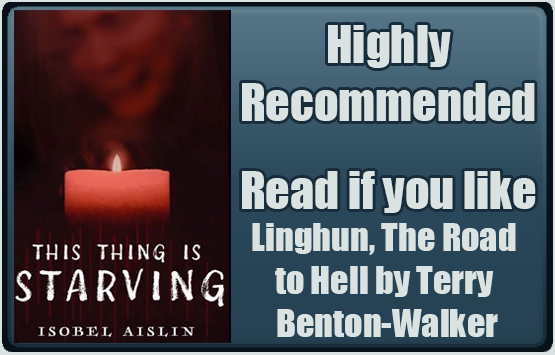
This Thing is Starving Isobel Aislin


This Thing is Starving by Isobel Aislin. Highly Recommended. Read if you like Linghun, The Road to Hell by Terry Benton-Walker

Formats: Print, digital

Publisher: Independently Published

Genre: Ghosts/Haunting, Historic Horror

Audience: Adult/Mature

Diversity: Asexual main character, trans man character, lesbian character

Takes Place in: Pennsylvania

Content Warnings (Highlight to view): Alcohol Abuse, Child Abuse, Child Death, Death, Drug Use/Abuse, Forced Captivity, Gaslighting, Homophobia, Medical Procedure, Mental Illness, Pedophilia, Rape/Sexual Assault, Self-Harm, Sexism, Slurs, Slut-Shaming, Suicide, Transphobia, Victim Blaming, Violence

Blurb

It’s just a house, right? Houses can’t hurt. Houses can’t bleed.

But this house wants you to.

When the Waite family moves into their new home, they don’t bargain on being unwanted guests. But this house has deep-rooted, blood soaked history, and it’s angry. This Thing is Starving is an unflinchingly feminist love letter to the abused, bursting with feminine rage and told from the perspective of a haunted house.

Warning, this review discusses abuse, rape, and the sexual abuse of minors.

The house on 4377 N. Oscar St is haunted. But this is not your typical haunted house story. This story is told from the house’s point of view as it witnesses the tragedies that befall its owners throughout the year. The house is haunted by four women and one trans boy. The first, and oldest, is Lillian. She lived in the house with her husband in the 1920s and is the most unstable of the five ghosts. Jason was a teenaged, closeted trans boy from the 1950s. Lila was a lesbian from 1975 who hated her queerness. In 2002 the house was owned by a woman named Karissa, a child abuse survivor who struggles with low self-esteem. The final ghost is Kay, a teenaged girl who died in the house after it was abandoned by Karissa in the early 2000s. All the ghosts are victims of abuse, sexual assault, or other forms of violence at the hands of men, and they all met with tragic ends either by their own hand or at the hands of others.

Veronica Waite and her family are the house’s most recent inhabitants. Her mother, Louise, moved them there after escaping an abusive partner and is doing her best to start over. The house immediately takes a disliking to the family, with its wild and grubby children and Louise who it immediately labels a “bad mother” due to her love of wine, parentification of Veronica, and inability to keep track of all her children. The only exception to the house’s ire is Veronica, whom the house feels strangely drawn to. It views her as “a splotch of brightness amongst the gloom” and tries its best to communicate with the eldest Waite child. Veronica certainly seems happy in the beginning. She finds a new friend quickly, makes the cheerleading team, and even lands a hot, football playing boyfriend. She creates beautiful art to hang in her attic room. But then things start to unravel for the family, and the house can do little to stop it. As Veronica struggles with her asexuality and trying to take care of her siblings, she slowly learns how cruel the world can be to women and girls.

Most of the men in this story are horrible, even an old man whose obituary Louise is editing. I’m sure the “not all men” crowd will object to the fact that almost all the cisgender men (and boys) in the story are awful human beings (admittedly sometimes to the point of feeling like caricatures), but I believe this is intentional. The story is being told from the point of view of the house, and the house hates men. Because the house can only witness what happens within its walls, or the lives of the unhappy ghosts who haunt it, the house rarely gets to see the good parts of humanity. Statistically, the majority or murders and rapes are committed by men, so of course the ghosts are more likely to be victims of male violence, leading to the house believing  that all men are inherently bad. Toward the end of the book, a character named Owen shows up who is devoid of the toxic traits shown by most of the other male characters. While he clearly has a crush on his female coworker, he respects her boundaries, supports her decisions, and keeps his desire to protect her in check. But of course, the house can’t recognize that he’s a good man like the audience can, and immediately hates Owen.

Ironically, the house is reinforcing harmful gender stereotypes because it doesn’t understand the complexities and nuances of abuse. It can only see people as innocent victims (women, girls, and AFAB people) or evil perpetrators (cisgender men and boys). But characterizing men as inherently evil gives them permission to behave horribly, as it rejects the notion that they have control over their actions. Essentially, it’s a more insidious form of “boys will be boys.”  But men can, and need to, do better. The house also conveniently ignores the fact that women can not only support the harmful actions of men, but can be perpetrators themselves, and that men can be victims, but Aislin does not. Lillian is abused by her serial killer husband, but when she finally snaps and kills him, she doesn’t free the women he has chained in the basement. Instead, she replaces her husband as the predator in the house and kills them. She even slut shames her husband’s victims, justifying their rapes and murders to herself. Veronica’s younger twin brothers, Charlie and Sawyer, are also revealed to be victims of their father’s abuse (especially Sawyer). Sadly, like Lillian, Sawyer becomes an abuser himself, acting out what he experienced at the hands of his father on his little sister Leslie. The house makes an exception for Jason, a trans man, another victim of male violence, but not for the twins. I suspect that’s because the house is mildly transphobic, and sees Jason as a woman, even though he’s clearly a man and his ghost has a male-presenting form.

While the house feels a fierce protectiveness of Veronica and her baby sister, it shows a cold indifference to their brothers. Interestingly, Louise was also abused by her husband, yet the house doesn’t group her in with other victims. Instead, it views her with scorn for “failing” to protect her girls (but not the boys). This is another sign that the house is not entirely free from its own sexist bias and doesn’t fully understand how abuse works. The house’s hatred of Louise is understandable, with its strong desire to protect, it cannot comprehend a mother “failing” to do so. The problem is that the house expects her to be perfect just because she’s a mom, even though Louise is a victim herself and doing the best she can under the circumstances. She loves her children, and tries her best to protect them, even when the police fail to.

Sadly, judging mothers who are being abused is not an uncommon occurrence. In an interview with NPR, Mother Jones reporter Samantha Michaels explains “It’s basically sexism. Most of the legal experts that I talked with said that it comes down to a cultural expectation that women are responsible for what happens in the home. There’s an expectation that they should be the moral center of the family, that they should reign in the man’s worst impulses, and that they should do whatever they can to protect their child, even if it means, you know, sacrificing themselves.” Mothers can have their children taken from them, and are even sent to prison due to Draconian “failure to protect” laws. Kerry King is one such mother, who is serving a 30-year sentence in prison for not protecting her daughter from their abuser, John Purdy, who is only serving 18 years for abusing King and her daughter. On October 26, 2004 in the case of Nicholson v. Williams the New York Court of Appeals ruled that children who witnessed abuse were wrongfully removed from their mother’s care, and that their non-abusive mothers had not been “neglectful” simply because they were unable to protect their children from witnessing domestic abuse.

This Thing is Starving starts with statistics about the rape, exploitation, and abuse of women and girls. Aislin states that the story is dedicated to the women who never get justice and whose stories are never heard. The book reminds me of rape revenge films without the sensationalism/exploitation common for the genre, similar to Promising Young Woman and Revenge (both films notably have female directors). Except, in this story, most of the victims don’t get revenge. Revenge against an abuser may be satisfying in fiction, but it rarely happens in real life where men often get away with hurting women. This makes the book feel more realistic. And when the house, full of pain and rage, lashes out and tries to hurt abusers and rapists, it usually hurts the innocent as well.

For example, when the house violently kills the teen boys who attempt to rape Kay, she also gets caught in the crossfire and is killed. Hate and anger rarely hurt just the intended target, but others as well. As Maddie Oatman so eloquently puts in her rape revenge article for Mother Jones “These stories offer a retributive vision of justice, the violence of the man mirrored back onto him. Traditional gender roles are flipped—the woman is the predator, and the man is the prey—but the basic shape of the conventional revenge story is unchanged. Witnessing women take revenge in film and fiction may offer a cathartic thrill, but the trope can also function as a trap; vengeance replicates the same power structure the avenger wishes to hold accountable.” She further goes on to explain “But justice can and should mean something other than the balancing of harms, as prison and police abolitionists and other activists have argued. In resisting the carceral approach to punishment, they advocate a politics of structural change, of experimentation and openness to new social forms. These ideas demand a radical artistic approach to match, a breaking free of the traps of the revenge plot. A couple of recent works give us a sense of this. Call it the reparative mode.”

Aislin shows us that there are other, healthier ways to heal from trauma than hunting down and killing your rapist (something victims are sadly arrested for in real life). And honestly, I really appreciate that Aislin presents more realistic ways that survivors can heal from trauma, like leaning on others they trust for support and opening up about what happened.  Instead of perpetuating the cycle of violence like the house does, the survivors heal by breaking free of it. This Thing is Starving is certainly a difficult and heart-wrenching read that contains abortion, rape, revenge porn, conversion therapy, drug addiction, suicidal thoughts, an infant’s death, pedophilia, trauma, a minor doing sex work, and transphobia. But Aislin doesan amazing job handling the difficult topics of abuse, sexual assault, and trauma without making the story feel like trauma porn.

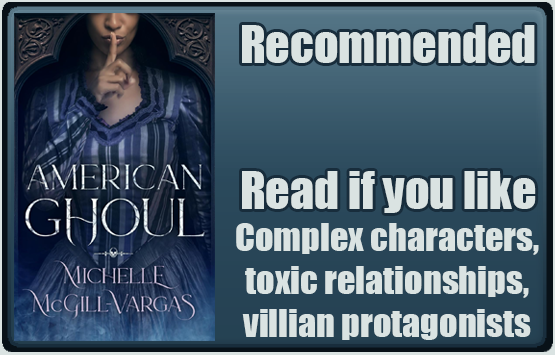
American Ghoul by Michelle McGill-Vargas

American Ghoul by Michelle McGill-Vargas

Formats: Print, audio, digital

Publisher: Blackstone Publishing, Inc

Genre: Historic Horror, Vampire

Audience: Adult/Mature

Diversity: Black main character, Black side characters, Black/Native side character, Black author

Takes Place in: Georgia and Indiana

Content Warnings (Highlight to view): Alcohol Abuse, Child Abuse, Child Death, Death, Drug Use/Abuse, Forced Captivity, Oppression, Pedophilia, Police Harassment, Physical Abuse, Racism, Self-Harm, Slurs, Suicide, Verbal/Emotional Abuse, Violence, Vomit, Xenophobia

Blurb

You can’t kill someone already dead.

That’s what Lavinia keeps telling her jailer after—allegedly—killing her mistress, Simone Arceaneau. But how could Simone be dead when she was taking callers just a few minutes before? And why was her house always so dark?

Lavinia, a recently freed slave, met Simone, a recently undead vampire, on a plantation in post-Civil War Georgia. With nothing remaining for either woman in the South, the two form a fast friendship and head north. However, Lavinia quickly learns that teaming up with this white woman may be more than she bargained for.

Simone is reckless and impulsive—which would’ve been bad enough on its own, but when combined with her particular diet Lavinia finds herself in way over her head. As she is forced to repeatedly compromise her morals and struggle to make lasting human connections, Lavinia begins to wonder if is she truly free or if has she merely exchanged one form of enslavement for another. As bodies pile up in the small Indiana town they’ve settled in, people start to take a second look at the two newcomers, and Simone and Lavinia’s relationship is stretched to its breaking point…

I received this product for free in return for providing an honest and unbiased review. I received no other compensation. I am disclosing this in accordance with the Federal Trade Commission’s 16 CFR, Part 255: Guides Concerning the Use of Endorsements and Testimonials in Advertising.

American Ghoul is a unique historical novel with dark humor sprinkled throughout about a free Black woman, her white vampire companion, and all the trouble they get into. Lavinia, the forementioned free woman, hardly feels free after being released from her enslavement after the Civil War. With limited options and too afraid to leave the only home she’s ever known, Lavinia stays at the plantation where she was enslaved, helping her former mistress, Miss Tillie, run it as a brothel. It’s unpleasant work, but Lavina doesn’t dare hope for something better. That is, until she meets a strange white girl named Simone whom she rescues from burning up in the sun. Later she finds Simone drinking the blood of one of the brothel regulars.

Lavinia is an interesting character, as she’s an unlikeable victim who defies the mistaken belief that a victim must also be a good person. What happened to her both during and after her enslavement is horrific, and she’s certainly sympathetic, but Lavinia also does terrible things without feeling particularly guilty about it. She justifies what she does by saying she never killed anyone herself: she just helped Simone do it (which is hardly better). Personally, I love that she’s such a complicated character and gets to be an anti-villain. It’s clear she doesn’t think what she’s doing is that bad, as Lavinia does try to choose immoral people for her vampire friend to bleed dry. But other times, she just picks victims who have things she needs, like a new pair of boots. Lavinia is brave, no-nonsense, and blunt, and doesn’t have a lot of patience for Simone’s nonsense. While Simone is well-educated, Lavinia is clearly the smarter and more practical of the two, and it’s a miracle Simone even managed to survive a year on her own.

With the exception of Lavinia’s love interest, King, and a little girl that Simone murders, very few of the characters are fully good or bad. Take Miss Tillie, Lavinia’s former mistress, for example. She never beat Lavinia, gave her a new dress for Christmas, and speaks to her rather than at her, which causes Lavinia a small pang of guilt when Simone kills her. But while Miss Tillie is a far cry from Simon Legree, she was still complicit in the enslavement other human beings, an unforgiveable sin definitely worthy of making her a vampire’s dinner.

Simone is similar in that she’s not a good person and thinks that helping Lavinia makes up for the fact that she’s also controlling and doesn’t seem to care about anyone but herself (although she claims to love Lavinia). While you can’t help but feel bad for Simone for being turned into a monster against her will, it doesn’t justify the way she treats Lavinia. She wants her friend all to herself, gets extremely jealous if Lavinia spends time with anyone else, and will read her mind without consent to figure out what she’s been doing and where she’s been. Their relationship is toxic at best, and abusive at worst. With Simone’s possessiveness and their shared mental link, Lavinia eventually realizes their connection is almost as bad as the one that tethered her to Miss Tillie.

And of course, there’s the fact a vampire will kill anyone, even children, for food, especially if she’s hungry. Simone’s recklessness when it comes to food often leaves a mess for Lavinia to clean up and gets them both in trouble on numerous occasions. Simone is a spoiled white girl who claims she’s less racist than other white people, but as we learn more about her past it’s revealed that she’s not the white savior she claims to be. This is hinted at early on when Simone refers to Lavinia as her “chocolate savior” (ew), is completely unaware of how dangerous it is to be a Black woman walking around a white town on her own, and laughs when Lavinia doesn’t know how to read a globe. Because Simone also had a troubled past, she thinks she and Lavinia are similar, not realizing her white girl problems are nothing compared to being enslaved. Sometimes it feels like Lavinia is sacrificing everything for a white woman because of some misplaced sense of loyalty.

While the two women make their way to Chicago (a popular destination for formerly enslaved people) Lavinia meets a Romanian couple named Valerica and Victor Radut who own a store where she sells the belongings of Simone’s victims.  The couple recognize Simone as a vampire immediately, and believe Lavinia can protect them from her, since Simone (sort of) does what she says. They believe that in order to kill a vampire you must cut off the head, burn the heart, then drink the ashes for protection (like they did to the body of poor Mercy Brown in 1892). Despite claiming Valerica as a friend, Lavinia is ultimately unmoved by the unfortunate fate that befalls the Raduts because, as she puts it, “Simone was my priority. Maybe the only friend I needed.” Other people who make the mistake of getting close to Lavinia suffer similar fates. It’s hard to decide whether you want the them to face justice or not, or if you want them to get away with all the horrible things they’ve done.

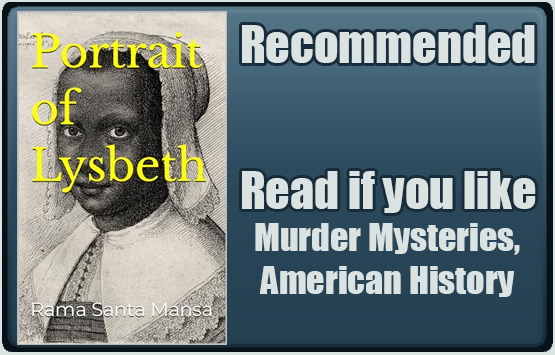
Portrait of Lysbeth : A Gothic Novella by Rama Santa Mansa

Portrait of Lysbeth : A Gothic Novella by Rama Santa Mansa

Formats: digital

Publisher: Lingeer Press

Genre: Demon, Gothic, Historic Horror

Audience: Adult/Mature

Diversity: Black (African American) main character and author, minor gay character

Takes Place in: Sleepy Hollow, NY

Content Warnings (Highlight to view): Antisemitism, Child Abuse, Child Sexual Abuse, Childbirth, Death, Forced Captivity, Homophobia, Kidnapping, Medical Procedures, Oppression, Pedophilia, Physical Abuse, Racism, Rape/Sexual Assault, Sexism, Sexual Abuse, Slurs, Slut-Shaming, Verbal/Emotional Abuse, Xenophobia

Blurb

The year is 1676. We meet Lysbeth Luanda, a second-generation African freedwoman in New York, the former Dutch colony seized by the English, who, in a mere decade, have passed more cruel and oppressive restrictions on the free African community already living in the colony.After being orphaned at age 13, Lysbeth is forced to restart life all on her own––while working as a tavern waitress in Dutch and German-owned taverns along the banks of the Delaware and Hudson rivers. In this multinational milieu, she learns cosmopolitan skills and street philosophy from lovable lowlifes, brash buccaneers, African dreamers, indigenous heroines, and globetrotting Scandinavians. Lysbeth eventually finds a mentor in a Sephardi Jewish medical doctor from Curaçao, under whom she studies surgery and anatomy.

As the gloomy autumn season begins in 1676, the gruesome murders of three European women, by an unknown assailant in the isolated village of Sleepy Hollow, shocks the whole of New York.

Lysbeth’s mentor convinces the New York High Sheriff to appoint Lysbeth to go investigate the victims’ inexplicable cause of death and bring back a written coroner’s report. After an initial frosty reception by the villagers of Sleepy Hollow, Lysbeth gains new allies who assist her in her investigation

I received this product for free in return for providing an honest and unbiased review. I received no other compensation. I am disclosing this in accordance with the Federal Trade Commission’s 16 CFR, Part 255: Guides Concerning the Use of Endorsements and Testimonials in Advertising.

The Portrait of Lysbeth is set in Sleepy Hollow, but don’t expect mentions of the Headless Horseman or Ichabod Crane in this book. This story takes place about 100 years before the Revolutionary War and centers around Lysbeth, a free born Black woman, sent to investigate a serial killer (although that term wasn’t coined until the 20th century) in Sleepy Hollow, New York.

Lisbeth Anthonijsen, was a real person born around 1650 into the free Black community of New Amsterdam (what is now New York City). She started working as a servant for white colonists at a young age. In June 1661 she was accused of stealing wampum from the house where she was employed and the court ordered her to be beaten with a rod as punishment. In the winter of 1663, Lisbeth was spotted running away from a housefire at the Cregier household where she was employed. She was blamed for starting the fire and the court sentenced her to be enslaved by the Cregier family. Young Lisbeth was never given a chance. Mansa’s mission, as she puts it, was to get justice for Lisbeth by writing The Portrait of Lysbeth. She did a ton of research for this book, and it really adds to the story. I appreciate the time and effort Mansa put in to creating the setting and her main character, Lysbeth.

The fictional Lysbeth Luanda is an educated freed woman who becomes an indentured servant at the age of 13, after the death or her parents. She’s forced to work as a tavern waitress for the next 22 years, where she learns about the world from her diverse clientele.  Eventually, Lysbeth makes her way back to New Amsterdam where she apprentices for a Sephardic Jewish doctor, who sends her to Sleepy Hollow to act as coroner.

Some parts of the book are written in third person present perfect tense, which I felt was an interesting, if uncommon, choice. It’s fine, it just took a little while to get used to. It also jumps around quite a bit, from Lysbeth’s childhood to her time studying under the physician then back to the murder investigation. It can get a little confusing. But once I got used to it, the story flowed much more smoothly. I found the more fanciful elements genuinely creepy, like when a maid becomes possessed and chases Lysbeth through the house. The entire murder investigation has an eerie feeling, and not just because of the way the townsfolk stare at her. There seem to be things lurking in the woods, things Lysbeth, as a woman of science, refuses to believe in.

 I appreciated how Mansa not only avoids common racist literary tropes but makes a point to subvert them. In the beginning of the book, Mansa describes an unpleasant white man’s complexion as “milk cream.” I was amused to see, for the first time, a white person’s skin compared to food, something that routinely happens to Black characters written by white authors. It was also a nice change of pace to not have the color black associated with evil, but with spiritual strength and protection from evil. This is seen both is Lysbeth’s horse and the spirit wolf that protects her. Instead, Lysbeth believes that it is white animals that are to feared as they lack the spiritual protection of blackness. I also liked that the enslaved Africans were referred to as “enslaved,” rather than “slaves.” A seemingly small change, but to me a powerful one. By calling someone a slave, their identity is reduced to their circumstance. It dehumanizes them. An enslaved person is a person first, who has had slavery forced upon them.

In the book, both Native and African characters were referred to by their nations and not all lumped into the same group. For example, Lisbeth’s father is Kongolese, a people originally found in what is modern day northern Angola. The man who gave Lysbeth her witch gun is Mbundu. It was also refreshing to see Native history, which is often erased, acknowledged in the story, such as the Wampanoag leader Metacom (also known by the English name King Philip) defending his lands from the Puritans and the Moravian massacre. However, the Native representation did leave me questioning some of the author’s choices. There’s a rather brutal description of the 1643 Pavonia massacre, where the Dutch invaded what is now called Manhattan and massacred scores of Lenape people. I appreciate that it’s made clear that the settlers are living on stolen land (Lenapehoking) and that attention is brought to Native history, however, I felt weird about having a non-Native author write about Native trauma. If this were a white author doing it, it would be a more clear-cut example of exploitation of a marginalized group’s suffering. White people have been stealing from and exploiting Natives for hundreds of years, even though it’s not always done maliciously. As Debbie Reese, a Nambé Owingeh Pueblo scholar and educator, explains on her blog American Indians in Children’s Literature:

“…the history of White people taking from Native people is also filled with White people who befriend us because they have found themselves living in or near our communities.

Of that latter group, I wish they could form those friendships without saying “look at me and my Native friend.” Or, “look at the good I do for my Native friends!” Or, “I worked with them and they asked me to write this story about them.” Or, “I taught their kids and I learned from them and so, I am able to write books about them that you should buy because I know what I’m talking about.” Or, “Look! My book has a note inside from my Native friend or colleague. You can trust what you read in my book.”

They mean well. But I wish they could see past their good intentions. What they’re doing is exploitation.”

But Rama Santa Mansa isn’t white. She is a Black woman who wants to use her book to honor the untold stories of marginalized groups in what is now called the United States, but is that enough to give her a pass? Does her race make the story less problematic? It’s clear that Mansa did her best to portray the Lenape’s plight with respect, and wanted to include them as the first inhabitants of what is now called New York. There’s no colonialism being enforced, as Mansa is a Black author. She also did a significant amount of research for her book, but it left me wondering if she had reached out to Lenape or other Native scholars when writing it. There are certainly no Native books listed in her bibliography, no Native professors that she thanks in the acknowledgement, not even a reference to Indian 101 for writers.

I feel like at the very least a Native sensitivity reader would have been warranted. As Debbie Reese writes in her criticism of Justina Ireland’s book Dread Nation (another historic novel by a Black author), “It became clear to me that the reason her book fails in its representations of Native peoples is because she relied heavily on archival research. The “primary sources” she used are items in government archives–that are heavily biased.” This underlines the importance of using Native sources when discussing Native issues in addition to actually speaking to Native people. It’s also serves as a good reminder that just because a writer belongs to one marginalized group, it doesn’t mean they are qualified to write about another.

Despite the issues mentioned above I found the book overall enjoyable, with a highly detailed and well-researched setting and a strong Black woman protagonist. 

Never Whistle at Night edited by Shane Hawk and Theodore C. Van Alst Jr.

Never Whistle at Night edited by Shane Hawk and Theodore C. Van Alst Jr.

Formats: Print, audio, digital

Publisher: Vintage

Genre: Ghosts/Haunting, Historic Horror, Killer/Slasher, Monster, Myth and Folklore, Occult, Psychological Horror

Audience: Adult/Mature

Diversity: Indigenous American (Alaskan Native, Pueblo, Comanche, White Earth Nation, Cree, Georgian Bay Metis, Mohawk, Cheyenne-Arapaho, Hidatsa Mi’kmaw, Cherokee, Tłı̨chǫ Dene, Hidasta, Mandan, Sosore, Sioux Penobscot, Chickasaw, Choctaw, Sicangu Lakota, Edisto Natchez-Kusso, Lipan Apache, Anishinaabe)

Content Warnings (Highlight to view): Alcohol Abuse, Animal Death, Child Abuse, Child Endangerment, Death, Drug Use/Abuse, Forced Captivity, Gaslighting, Gore, Illness, Oppression, Mental Illness, Pedophilia, Racism, Rape/Sexual Assault, Sexual Abuse, Slurs, Torture, Verbal/Emotional Abuse, Violence

Blurb

Many Indigenous people believe that one should never whistle at night. This belief takes many forms: for instance, Native Hawaiians believe it summons the Hukai’po, the spirits of ancient warriors, and Native Mexicans say it calls Lechuza, a witch that can transform into an owl. But what all these legends hold in common is the certainty that whistling at night can cause evil spirits to appear—and even follow you home.

These wholly original and shiver-inducing tales introduce readers to ghosts, curses, hauntings, monstrous creatures, complex family legacies, desperate deeds, and chilling acts of revenge. Introduced and contextualized by bestselling author Stephen Graham Jones, these stories are a celebration of Indigenous peoples’ survival and imagination, and a glorious reveling in all the things an ill-advised whistle might summon.

 received this product for free in return for providing an honest and unbiased review. I received no other compensation. I am disclosing this in accordance with the Federal Trade Commission’s 16 CFR, Part 255: Guides Concerning the Use of Endorsements and Testimonials in Advertising.

There are many recognizable names in this collection: Rebecca Roanhorse, Richard Van Camp, Cherie Dimaline, Mona Susan Power, Darcie Little Badger, and Waubgeshig Rice. There’s even a foreword by Stephen Graham Jones. But I was especially excited to be introduced to some new (to me) Indigenous authors.

The stories in the anthology vary from fun campfire stories about werewolves (Night Moves by Andrea L. Rogers) and ghosts (Night in the Chrysalis by Tiffany Morris) to more serious and disturbing tales about residential school sexual abuse (Sundays by David Heska Wanbli Weiden), mental health (The Prepper by Morgan Talty), stolen land (Limbs by Waubgeshig Rice), and missing and murdered Indigenous women (The Ones who Killed Us by Brandon Hobson). There were bits of Native languages sprinkled throughout the various stories, for example I learned Uguku is “owl” in Cherokee, Kwe’ is “hello” in Mi’kmaq, and Mahsi’ cho is “thank you” in Gwich’in. This felt especially nice to see since so many Native languages are endangered. I can’t possible review all the amazing stories within the collection (and they are all amazing), so I’ll focus on a few of my favorites.

Kushtuka by Mathilda Zeller is about an Alaskan Native woman named Tapeesa. Recently an obnoxious White man named Hank Ferryman and his son Buck have moved to the area to build a monstrous lodge full of stolen Native artifacts. Tapessa is sent to the lodge cook for one of Hank’s parties and on the way the grotesque man asks her to tell him a “Native story.” Tapeesa warns that telling stories after dark could catch the attention of a spirit, but Hank laughs this off as silly superstition. She tells him the story of the Kushtuka, a shape-shifter that can take human form and tries to lure people away. As predicted, the story summons a Kushtuka which attacks Hank’s lodge. We also see this idea of attracting the attention of evil spirits in Before I Go by Norris Black, where a woman’s grieving causes the Night Mother to appear and offer to bring back her dead husband (it doesn’t end well).  

One of the things I related to in Kushtuka was Tapessa being called “basically White” by Hank because her dad is White. As a biracial person myself, having others (especially White people) try and tell you your identity isa pet peeve of mine. Historically, I would’ve been considered Black since my father is Black (due to the “one-drop” rule which I discuss below), despite having light skin. Yet these days most White people label me White because I’m White-passing. In both cases, White people choose my identity for me without listening to what I have to say, much like Hank does for Tapessa.

In White Hills by Rebecca Roanhorse, a White woman named Marissa is judged for having “too much” Native blood by her White in-laws. Marissa is your typical rich, White woman. She’s married to a wealthy business man named Andrew, is very concerned with her appearance, and lives in an HOA neighborhood in a big house. After going to the country club to announce her pregnancy to her husband, Marrissa makes the mistake of mentioning she’s a small percentage of Native (in reference to not being offended by a racist mascot) and her husband becomes visibly upset. The next day Elayne, Andrew’s mother, takes Marissa to a “specialist” who has racist phrenology drawings on the wall. Elayne explains that she doesn’t want a “mutt” grandbaby who may be dark skinned and “savage” (despite Marissa being white). The way in which Elayne views Marissa’s child is very reminiscent of the “one drop” rule. The one-drop rule was a legal principle based on a form of hypodescent, the assignment of a mixed-race child to the ethnic group considered “lower status.” In other words, anyone with Black ancestry (no matter how far back) was considered Black. There were strict classifications for mixed-race individuals that were given offensive names like “Mulatto” and “octoroon,” I discuss more about how this racist system allowed the US to hold up White supremacy here. I mentioned above how annoying it is when other people (especially White people) decide my identity for me, butit’s even worse when the government does it.

And this leads me to blood quantum. Blood quantum is highly controversial and personal, and since I’m not Indigenous and therefore shouldn’t weigh in on such a heated debate I will tread carefully and stick to the facts as best I can. If you’re not familiar, Blood Quantum laws were enacted by the United States government to determine if someone was considered Native or not dependent on their degree of Native ancestry. The first “Indian Blood law” was originally created in 1705 when the Virginia government wanted to limit the civil rights of Native people and people of Native descent. Some Native tribes continue to use blood quantum to determine who can enroll for tribal membership, others do not. Leah Myers, a member of the Jamestown S’Klallam tribe, gives an example of the importance of tribal enrollment in her Atlantic essay:

“Tribal citizenship is more than symbolic. It determines eligibility for educational assistance, medical care, and other social benefits. Plus, only members can attend citizen meetings and vote in tribal elections. If my future children don’t meet the blood requirements for my tribe, they could still participate in events, cultivate plants in the traditional-foods garden, and take Klallam-language courses. But no matter how much they served the community in love and time, they would be deemed a ‘descendant’ and marked as separate.”

Here’s a guide to Blood Quantum that gives both the arguments for and against blood quantum (full transparency, most Native sources I looked up were against these laws). Basically, blood quantum proponents argue that getting rid of blood quantum rules will make scarce resources even scarcer due to population growth and that it will allow disconnected outsiders and pretendians to join the tribe, which will erode their culture. Opponents of blood quantum argue that statistically it will eradicate Native nations, and point to the law’s racist origins which were intended to control and erase Indigenous people. It also makes relationships complicated, as Indigenous people must calculate their potential children’s percentage of Native blood and if they can enroll or not, which can put a strain on families. Blood quantum also conflicts with traditional Indigenous ideas about kinship and has“no basis in Native American traditions.” Essentially, both proponents and opponents disagree on the best way to preserve their tribal nations.

This idea is explored more fully in the story Quantum by Nick Medina. A woman named Amber is so obsessed with blood quantum and getting her children on the tribal roll that she favors her son Grayson, who’s 5/16 Native, while ignoring his brother Sam, who is only 1/8 Native, to the point where Sam is practically feral. She even tries to steal blood from a deceased Native man from their tribe so she can inject it into Sam.

Another story I enjoyed is Collections by Amber Blaeser-Wardzala, an incredibly creepy story about collecting human remains. Professor Smith, a liberal White woman, collects the heads of all the students she’s helped. She’s very proud of her collection: she has all the sexualities and genders, all the religions, and almost all the races. An Indigenous head would be her “white whale.” Megis (called Meg by the White professor) is understandably horrified by the collection, as is one of her Black classmates, but none of her white classmates seem to be. Professor Smith implies she wants to help Megis so she can have her head for her collection. Megis, the first person in her family to go to college, is desperate to stay on Professor Smith’s good side so she can maintain her scholarship and get a good job, and therefore doesn’t have much choice but to stay in the house of horrors. While an extreme example, the story underlines how troubling it is when museums collect human remains without consent and how academics will treat bodies as mere curiosities. 

“When [Native American artifacts and human remains] were acquired, collectors weren’t thinking of Indigenous peoples as human beings. People were resources, and human remains were to be preserved alongside pots” says Jacquetta Swift, the repatriation manager for the National Museum of the American Indian and member of the Comanche and Fort Sill Apache tribes. It’s the unfortunate reality that most human remains on display and in private collections, are unethically sourced from BIPOCs against their wishes.

This theme is also lightly touched on in Navajos Don’t Wear Elk Teeth by Conley Lyons where a Native man named Joe has a summer fling with White man named Cam. Cam collects teeth, some of which turn out to be human (he claims his last boyfriend was a Navajo man who gave him an elk tooth for “good luck” which Joe is dubious about). One of Joe’s friends refers to this as “bad medicine” and suggest Joe get an elder to sage his house. 

Not all the stories are quite so dark, however. Snakes are Born in the Dark by D. H. Trujillo felt like a Goosebumps book or a fun story kids tell to scare each other, and I thoroughly enjoyed it. In the story, an Alaskan Native boy named Peter goes hiking in the woods with his white cousin Maddie and her rude boyfriend Adam. They come across Native petroglyphs in the Four Corners desert which Maddie and Adam both immediately touch. Peter warns them not to touch the carvings but Adam continues to do so while mocking him. Unsurprisingly both Maddie and Adam suffer unpleasant (though non-lethal and impermanent) fates which results in a humorous ending. It’s a fun twist on the classic “Indian curse” where we (and Peter) are rooting for the White people to get their comeuppance.

I could go on and on about the stories in the anthology, like Hunger by Phoenix Boudreau where two Cree college girls, Summer and Rain, outsmart a Wehtigo. Or Scariest. Story. Ever. By Richard Van Camp that touches on who gets to tell Native stories and how to share culture without stealing it. They’re all great. I also felt like I learned a lot while reading the anthology.

Navigation

Social Media

Search by Tags

To learn more about the Age Group, Diversity, and Genre tags, click here.

Age Groups

Diversity

Genre

Support the Blog

Search

Links

Something Followed Us Home edited by Cynthia Pelayo

Something Followed Us Home edited by Cynthia Pelayo

Formats: Print, audio, digital

Publisher: Atria/Primero Sueno Press

Genre: Comedy Horror, Dark Fantasy, Historic Horror, Monster, Myth and Folklore, Vampire, Zombie

Audience: Adult

Diversity: Latiné, Puerto Rican, Mexican, Ecuadorian, Columbian, Argentinian

Content Warnings (Highlight to view): Alcohol Abuse, Amputation, Animal Abuse, Body Shaming, Bullying, Child Abuse, Child Death, Classism, Death, Drug Use/Abuse, Illness, Incest, Physical Abuse, Racism, Rape/Sexual Assault, Slut-Shaming, Suicide, Victim Blaming, Violence

Blurb

Dive into the chilling depths of Latiné horror with this groundbreaking anthology, edited by Bram Stoker Award winner Cynthia Pelayo, where each story reimagines immigration, colonization, faith, and folklore as the fears we inherit and carry across borders and generations.

Something followed us home. It crawled in with our prayers, slipped into our beds, watched from mirrors, waited in water, and learned our names.

Gathering chilling work from some of today’s most acclaimed Latiné voices, this horror anthology moves through haunted households, brutal landscapes, sacred spaces turned dangerous, and bodies claimed by forces both ancient and intimate. The dead murmur behind locked doors. Bones rebuild themselves under merciless suns. Love becomes a doorway for demonic hunger. Blood, devotion, and memory intertwine as the past presses back with teeth.

Something Followed Us Home is an unnerving, visceral, and impossible-to-shake collection that proves that what is carried forward does not remain quiet, and what follows us rarely leaves without taking something in return.

I received this product for free in return for providing an honest and unbiased review. I received no other compensation. I am disclosing this in accordance with the Federal Trade Commission’s 16 CFR, Part 255: Guides Concerning the Use of Endorsements and Testimonials in Advertising.

I liked that both the English and Spanish language versions of the book are being released on the same day. Readers of Lo que nos siguió a casa will be able to read some of the stories in their original Spanish, while English readers will have some stories that were translated. Because the authors come from across the Latiné diaspora, there may be something new for everyone, while also including more universal themes like feminism, colonization, and family.

While I was familiar with authors such as Cynthia Pelayo (who also edited the collection), Ann Dávila Cardina, Agustina Bazterrica, Zoraida Cordova and Isabel Cañas I was delighted to also be introduced to new authors such as Carolina Flórez-Cerchiaro and Ananda Lima. I couldn’t believe how good all the stories were! There were really only one or two that I didn’t vibe with. I liked the stories that included figures from folklore like la Huesera (The Hand that Feeds by Isabel Cañas) and El Silbón (Fidelity by Alex Segura). El Jíbaro de Puerto Rico by Cynthia Pelayo was definitely one of my favorites, a bittersweet ghost story that teaches readers about the dark history in Puerto Rico, from its colonization by the Spanish, to slavery, to the American invasion. Her First Cruise Ship by Ann Dávila Cardinal was another, a humorous zombie story about undead tourists in Puerto Rico that critiques the tourism industry. It also has themes of classism and privilege. It will definitely make you think twice about how you behave when visiting another country!

While all the countries in Latin America each have their own unique cultures and histories one thing they share is a history of colonization by the Spanish and the Portuguese. These European invaders forced their languages and religion on the Indigenous people living there and brought disease, violence, slavery, destruction and later political and financial instability and war. That’s not even counting the damage done by the United States during the 19th and 20th centuries. Colonialism in Latin American countries is a reoccurring theme throughout the anthology explored in stories like the previously mentioned El Jíbaro de Puerto Rico and The Return of La Muelona by Carolina Flórez-Cerchiaro. This story is about how banana plantation owners continue the history of exploitation that began with the Spanish conquerors and how one woman gets her revenge. Other tales of revenge include Whispers from the Root by Lilliam Rivera and We are Gathered Here Together by Diana Rodriguez Wallace which address the corruption and cruelty of the wealthy and bullying, respectively. All were intensely satisfying to read as I’m a sucker for a good revenge story.

Many of the stories aren’t what I’d typically think of as “horror.” Some are more magical realism or speculative fiction like Pomelo and The World from Above and the World from Down Below. The Hand that Feeds is closer to a dark fairy tale. There are also some horror comedies like We are Gathered Here Together, My Boyfriend, and Her First Cruise Ship. However, stories like Luz Y Fer, Blue Flowers, and Specter are what I would think of as more “traditional” horror stories. I liked that every author has their own idea of what makes a story horror. There were traditional horror staples like vampires, killers, ghosts and zombies, but also religious mania, greed, sexism, and loneliness which can be equally, if not more, horrifying. The stories ranged from straight forward to more experimental. Some of the stories address the immigrant experience, while others take place in the main character’s home country, whether that be the United States or somewhere in Latin America. Settings include NYC, Puerto Rico, and Mexico City.  I have to say, I really liked how much variety there was, emphasizing the many experiences across the diaspora.  This creepy collection will have something for everyone, whether it be secret cults of children’s authors, plagues of spontaneous pregnancies, or a desperate father trying to bring back his dead daughter.

In These Gilded, Ghostly Hearts by Gwendolyn Kiste

In These Gilded, Ghostly Hearts by Gwendolyn Kiste

Formats: Print, audio, digital

Publisher: Creature Publishing

Genre: Ghosts/Haunting, Gothic, Historic Horror, Romance

Audience: Adult

Diversity: Lesbian main character and bisexual side character

Takes Place in: New York

Content Warnings (Highlight to view): Alcohol Abuse, Child Abuse, Death,  Forced Captivity, Homophobia, Suicide

Blurb

In 1955, Daisy Buchanan is found dead in an abandoned West Egg mansion, but her daughter Mel knows she’s really been gone for years. No one knows whether Daisy was murdered, or if it was a simpler, slower death: her yearslong spiral of alcohol, abuse, and helplessness. But when Mel enters the estate, she finds Daisy’s ghost, somehow frozen at twenty-three, and a charming, bleeding phantom that used to be Jay Gatsby.

To free her mother, Mel must carve a path through family secrets and decaying revelers: deep into Gatsby’s starving house as it gorges itself on unfulfilled love and grows stronger every night.

I received this product for free in return for providing an honest and unbiased review. I received no other compensation. I am disclosing this in accordance with the Federal Trade Commission’s 16 CFR, Part 255: Guides Concerning the Use of Endorsements and Testimonials in Advertising.

The year is 1955. Daisy Buchanan is dead, her body discovered in Jay Gatsby’s abandoned estate in West Egg. Daisy’s now adult daughter, Pamela “Mel” Buchanan, and one of Daisy’s few remaining friends, Jordan Baker, travel from New York City to investigate the mysterious death. They learn that Daisy was working with a predatory spiritualist named Harrison to summon the ghost of her lost lover, Jay Gatsby. Harrison convinces the two women to return to Gatsby’s old home, now dripping with ectoplasm, and complete the séance with him. Soon the mansion is filled with ghosts, partygoers from bygone days, Gatsby himself, and Daisy. The partygoers are Stone Tape hauntings, a mere echo of the past. Gatsby’s ghost, on the other hand, is an intelligent haunting who is able to interact with Mel, who soon learns his obsession with Daisy has continued after his death.

Mel and Daisy have a complicated mother/daughter relationship. No matter how badly their mother treats them, children still crave their mother’s love. Mel is parentified by Daisy who is helpless and broken after losing her lover Gatsby, her husband Tom, and her lifestyle. Mel explains “Once the cash dried up and she wasn’t a rich girl anymore, she practically dissolved into sea foam before my eyes.” Daisy is not a resilient woman–understandable since she was raised to be a pretty bauble on a rich man’s arm. Daisy was a fairly passive character in Fitzgerald’s novel, a beautiful woman for Gatsby to idolize and Tom to possess. It was satisfying, however, to read that toxic alpha-male Tom threw himself off the Brooklyn Bridge after losing everything in the stock market crash of ’29. A fitting end to an awful man. Unfortunately, it means he leaves his wife and daughter penniless and alone. Kiste often writes books for “lost” women and girls who are trapped in the past and mistreated by an uncaring society who doesn’t understand them. The Marys in Pretty Marys All in a Row, the Rust Maidens in the novel of the same name, Talitha Velkwood and her friends in The Haunting of Velkwood, and now Mel and Daisy Buchanan.

You don’t necessarily have to have any knowledge of The Great Gatsby prior to reading In These Gilded, Ghostly Hearts but it does certainly help to be able to familiarize yourself with the characters and themes. There are also lots of fun little callbacks to the original book, like Gatsby’s automatic orange juicer machine. Just don’t make the same mistake I did and try and compare the writing in the two. I re-read F. Scott Fitzgerald’s famous work right before Kiste’s so I’d have a refresher and I do think it made me more judgmental of the writing in the latter. Don’t get me wrong, I generally love Kiste’s writing, two of my favorites being Pretty Marys All in a Row and The Haunting of Velkwood. I’m not at all implying that this is not a well-written story. But very few books are going to be able to stand up to one of the “Great American Novels” and trying to compare the two is a disservice to Kiste’s novella.

While Gatsby is written as a sympathetic character in the original book, I like how Kiste points out how incredibly creepy his obsession with Daisy is. Some might view his grand gestures as romantic but honestly, they always felt like borderline incel behavior to me. Gatsby views Daisy as a prize to be won rather than a person, and if he has enough money of course she’ll leave Tom for him. The main reason we’re sympathetic to Gatsby is because Tom is portrayed as the bigger asshole with no redeeming qualities, and because Nick sees Gatsby as sympathetic. Daisy is “supposed” to choose the heroic Gatsby over the brutish Tom, and when she doesn’t, she’s cast as the villain. Yet, does she really have a choice?  Herstory and Daisy Buchanan by Leland S. Person, Jr. quotes the numerous men who have described Daisy as “vulgar and inhuman,” a “Dark Destroyer,” and the “anti-virgin…the prototype of the blasphemous portraits of the Fair Goddess as bitch” who “preyed on” Gatsby. Yikes! But Person viewed Daisy as more victim than conniving, selfish woman. She’s a woman in the 1920s, from an old money family who’s expected to marry an old money man, not some nouveau riche who may or may not have a criminal history. Daisy has no way of earning a living herself, she’s completely dependent on men for her financial security, and always had been. She’s also under immense societal expectations; she can’t simply leave her husband to have the life she wants with Gatsby. We also known Tom is abusive, as shown when he breaks his mistress’ nose.Leaving him was unlikely to be easy. I don’t think any of that necessarily makes her a good person; she’s just an imperfect victim. And this seems to be the characterization that Kiste goes with. Daisy wasn’t a good mother, but that doesn’t mean she doesn’t deserve sympathy or Gatsby’s obsessive idolization. Similarly, as a lesbian, Mel is also unable to be with the ones she loves, first Jordan and then her coworker, Vera.

I loved how queer Kiste’s book was. Mel is gay, Jordan bisexual, and Tom’s implied crush on Gatsby is no longer subtext. In These Gilded, Ghostly Hearts takes place during the Lavender Scare of the 1950s, an anti-LGBTQ+ witch hunt, so Mel lives in constant fear of having her sexuality discovered. At one point she and Jordan go to the Bagatelle on University Place. The Bag, as it was more commonly known, was a real lesbian bar that was popular in the 1950s. I love that little bit of realism that Kiste added to the story. Audre Lorde and Ann Bannon both wrote about the bar and how it shaped their pre-Stonewall experience. The Bag was owned by the mafia and frequently raided by police. A red light would go off to warn patrons when they vice squad showed up, which happens to Mel at the bag one night.

Kiste is not the first to write about the Great Gatsby through a queer lens. In 1963 Lionel Trilling characterized Jordan Baker as “vaguely guilty, vaguely homosexual.” Nearly thirty years later The International Fiction Review published The Sexual Drama of Nick and Gatsby by Edward Wasiolek who argued that Nick has “homosexual  leanings” and intense feelings for Gatsby. The Chosen and the Beautiful by Nghi Vo (author of The Empress of Salt and Fortune) also imagines Jordan and Gatsby as bisexual, and Nick and Gatsby have a fling. Self-Made Boys: A Great Gatsby Remix by Anna-Marie McLemore and The Pursued and the Pursuing by AJ Odasso explore a queer relationship between Gatsby and Nick.

Kiste’s writing can best be described as “haunting;” beautiful, unsettling, nostalgic, and melancholy, lending itself well to a ghost story. Her stories are less “in your face” horror with gore and blood and instead rely on atmosphere to create a general sense of unease commonly found in gothic horror. For some readers, it may feel like the pacing is dragging, as there’s no sense of urgency and not a lot of action because this isn’t that kind of book. This is a novella meant to be savored rather than rushed through. So, while it won’t be everyone’s cup of tea, I think fans of slow burn horror and character driven story will enjoy In These Gilded Ghostly Hearts.

I did feel like the book needed a little more show and a little less tell. It seemed like Mel was constantly explaining things to the audience that didn’t necessarily need to be spelled out. At the same time, I thought it was awesome that Mel was middle aged and Jordan in her fifties. It’s so rare to find older women protagonists in fiction. Male protagonists have a wide range of ages, but women seem to always skew young. What’s more, neither character is a wife or mother. While I don’t think In These Gilded, Ghostly Hearts is as strong as some of Kiste’s other novels and novellas, it’s still a solid, spooky read perfect for autumn.


My Monsters Ain’t Like Yours by R.J. Joseph

My Monsters Ain’t Like Yours by R.J. Joseph

Formats: Print, audio, digital

Publisher: Quill & Crow Publishing House

Genre: Eldritch Horror, Folk Horror, Ghosts/Haunting, Historic Horror, Monster, Zombie

Audience: Adult

Diversity: Black, African/American characters and author, queer and bisexual characters

Takes Place in: Texas

Content Warnings (Highlight to view): Animal Abuse, Animal Death, Body Shaming, Cannibalism, Child Abuse, Child Death, Child Endangerment, Childbirth, Death, Drug Use/Abuse, Forced Captivity, Incest, Miscarriage, Oppression, Pedophilia, Physical Abuse, Racism, Rape/Sexual Assault, Sexism, Sexual Abuse, Slut-Shaming, Suicide, Torture, Verbal/Emotional Abuse, Violence, Vomit 

Blurb

At its core, the horror genre is an effective vehicle for exploring human behavior. From within its terrifying boundaries, and lack thereof, we can examine monstrosity. We can determine how monsters are labeled, analyze the actions of those deemed monstrous, and prophesy the impacts this labeling and actions have on the world around us.

Monsters are personal. Monsters are universal. These facts create an intriguing juxtaposition where the things deemed monstrous or frightening can be shaped by personal experiences, while also representing many aspects of the human condition; our fears are much more similar than dissimilar. This means my monsters are absolutely like yours: they are our collective nightmares.

My Monsters Ain’t Like Yours reflects this irony through Black feminist intersectional horror at its rawest.

I received this product for free in return for providing an honest and unbiased review. I received no other compensation. I am disclosing this in accordance with the Federal Trade Commission’s 16 CFR, Part 255: Guides Concerning the Use of Endorsements and Testimonials in Advertising.

While many of the monsters in the collection are supernatural (Suffer the Little Children, The Crazy   with Daisy, Higher Education, Something Wicked Came for Me, Welcome, Skinny Minnie, Sweet Sunday Supper Smile, etc.) the most terrifying ones are the human monsters (Regrets Never Die, The Collector, Sweet Sunday Supper Smile, Her Heart’s Desire, No Tricks Only Treats, The Preying Family, Sad, Spooky Sally, etc.). Interestingly, some of the supernatural monsters are friendly and helpful creatures/spirits who protect the protagonists from other monsters, both literal and figurative. Humans, after all, are much worse than some imagined creature. Then there are the metaphorical “monsters” of grief, loneliness, and trauma that haunt the protagonists.

There are a lot of bad heterosexual relationships in the anthology.  These range from Where the Horizon Kisses the Sky in which the husband is neglectful, Endless Possibilities where he’s a selfish loser, to Her Heart’s Desire where he’s outright abusive towards his wife. In all these stories the wife yearns for something better and uses supernatural means to get it, with varying degrees of success. In The Badly Terrible, Absolute Worst she doesn’t even get that chance. But queer relationships, like in The Crazy with Daisy and Witness Bearer, are shown in a more positive light.  A report by the Institute for Women’s Policy Research and the National Domestic Worker’s Alliance states that “More than 40 percent of Black women experience physical violence by an intimate partner during their lifetimes (41.2 percent), compared with 31.5 percent of all women.” And a study published in the Lancet reported that Black women are also nearly six times as likely to be murdered than white women. Thankfully there are resources like Ujima that support Black women who are in domestic violence situations, even as the justice system continues to fail them.

In Endless Possibilities and Her Heart’s Desire the wife herself becomes a monster to escape her bad marriage, and in the latter, get revenge on her horrible husband. Then there’s Tanita in The Collector, a serial killer who murders for the fun of it. There’s something incredibly satisfying about women embracing their monstrosity and rage, especially Black women. Those with marginalized identities are often cast as monsters in other people’s stories so why not reclaim the title? I especially like that feminine monstrosity in Endless Possibilities and Her Heart’s Desire is not tied to sexuality. While I appreciate women like Tanita reclaiming their sexuality and using it to seduce and murder men à la Jennifer’s Body (2009) and The Hunger (1983) sometimes it feels like the majority of female monsters are temptresses ( leading men to their death. And it can start to get a little old.

Can’t they just be horrible and violent without wanting to have sex with their victim? Plus, there’s the unfortunate implication that women who have sex on their own terms are evil and they go against the natural order of things by overpowering men. So, I appreciated that Joseph gave us some nice variety. The book even has monstrous children (#GIRLMOM and Suffer the Little Children) though in both cases the children are embraced by the main character rather than shunned for the monstrosity.

Sweet Sunday Supper Smile and No Tricks Only Treats are stories containing child abuse, though the abusers get their comeuppance in both. Then there’s Sad, Spooky Sally which is especially disturbing, so much so that it comes with its own set of content warnings before the chapter, rather than in the index. It’s an absolutely heart-breaking story with a bittersweet ending and one of my favorites in the collection. But it’s also very triggering, so make sure you check out those content warnings before reading it. The same goes for Regrets Never Die and Witness Bearer. They’re both very dark, with the latter being about a girl who can see the worst things a person has ever done. She witnesses some truly awful memories, so I appreciate that Joseph included content warnings for all the stories in the book’s index.

Those who Teach Pay Knowledge Forward stood out in the collection, as it was sweet rather than scary, A ghost story where the ghosts aren’t the source of fear. It also had a nice message about helping to educate the next generation so they can succeed. I love how so many of the Black women in the collection are intelligent and well educated, ranging from college students (The Collector) and graduate students (Whole New World), to teachers (Those Who Teach Pay Knowledge Forward) and college professors (Grand Opening, Higher Education, Something Wicked Came for Me). The young woman in Important Things is sent on an all expenses paid trip to Palm Springs for a symposium because she excels in her high school classes. In 1995 14% of Black women between 25 to 34 held a bachelor’s degree compared to 38% in 2024 according to the Pew Research Center.

There are so many great stories in the collection, I’d be pressed to pick a favorite, though I did especially enjoy Regrets Never Die, #GIRLMOM, Endless Possibilities, Those Who Teach Pay Knowledge Forward, and Something Wicked Came for Me. While Black women and children’s trauma is a reoccurring theme of My Monsters Ain’t Like Yours, it’s not the only focus of the anthology. If every story were about Black trauma and abuse, it honestly may have been too much for me. Instead, Joseph includes a bunch of fun, spooky stories to offset the heavier stuff so the collection never feels too dark and depressing. Instead, we get a nice balance.

I really liked this because while horror is a great way to process trauma, Black horror shouldn’t be pigeonholed into stories of Black pain. I love Get Out (2017), it’s one of my favorite films, but if that was the only kind of Black horror story told by Hollywood, it would start to feel like the suffering of Black people was being fetishized for entertainment. There’s a reason why Peele’s next two films, Us (2019) and Nope (2022) aren’t rooted in Black trauma. So, while there are plenty of stories about abuse, bad relationships, and the general mistreatment of Black women and children, there are also enough tales about living mannequins, small fanged creatures, and ghosts to offer the reader a breather.

These Bodies Ain’t Broken Edited by Madeline Dyer

These Bodies Ain’t Broken Edited by Madeline Dyer

Formats: Print, digital

Publisher: Page Street Publishing

Genre: Body Horror, Demon, Historic Horror, Monster, Myths and Folklore, Romance, Vampire

Audience: Young Adult

Diversity: Authors and characters with disabilities including ADHD, anxiety, agoraphobia, Autism, celiac disease, chronic pain, Crohn’s disease, diabetes, Down syndrome, Ehlers-Danlos syndrome, Fibromyalgia, mast cell activation syndrome (MCAS), neurofibromatosis, postural orthostatic tachycardia syndrome (POTS), PTSD, and substance use disorder. Non-binary main character and author, agender main character, biracial Haitian side character, bisexual main character.

Content Warnings (Highlight to view): Ableism, Amputation,  Animal Death, Body Shaming, Bullying, Cannibalism, Child Abuse, Child Death, Classism, Death, Drug Use/Abuse, Forced Captivity, Gore, Homophobia, Illness, Kidnapping, Medical Procedures, Oppression, Mental Illness, Physical Abuse, Self-Harm, Sexism, Slurs,  Suicide, Verbal/Emotional Abuse, Victim Blaming, Violence

Blurb

A monstrous transformation within your own body.
A sacrificial imprisonment.
A fight to the death against an ancient evil.

These stories showcase disabled characters winning against all odds.

Outsmarting deadly video games, hunting the predatory monster in the woods, rooting out evil within their community, finding love and revenge with their newly turned vampire friend—this anthology upends expectations of the roles disabled people can play in horror. With visibly and invisibly disabled characters whose illnesses include Ehlers-Danlos syndrome, Crohn’s disease, diabetes, PTSD, and more, each entry also includes a short essay from the author about the conditions portrayed in their stories to further contextualize their characters’ perspectives. From breaking ancient curses to defying death itself, these 13 horror stories cast disabled characters as heroes we can all root for.

Contributors include bestselling and award-winning as well as emerging authors: Dana Mele, Lillie Lainoff, Soumi Roy, Anandi, Fin Leary, S.E. Anderson, K. Ancrum, Pintip Dunn, Lily Meade, Mo Netz, P.H. Low, and Carly Nugent.

I received this product for free in return for providing an honest and unbiased review. I received no other compensation. I am disclosing this in accordance with the Federal Trade Commission’s 16 CFR, Part 255: Guides Concerning the Use of Endorsements and Testimonials in Advertising.

Horror isn’t exactly known for having good disability rep, so it was great having an anthology written by authors with disabilities because there was so much variety in representation. There was everything from Crohn’s disease to Ehlers-Danlos syndrome to PTSD. In some stories, a character’s disability played a huge role (Baby Teeth, Within the Walls, The Worst of It), and it’s only mentioned in passing in others (When the Night Calls, Kissed by Death). At the end of each story, the author would write about how they chose to represent disability in their work, and some even shared their experiences with their own disabilities and how they related to their stories.

I loved that both invisible and visible disabilities were featured. I have invisible disabilities myself (ADHD and mental illness), but for a long time I didn’t consider myself disabled because, like many people, I thought the only disabilities that existed were visible. This caused me a great deal of stress because I was always trying to compare myself to neurotypical people. It never occurred to me to ask for accommodations because I thought I should be able to “power through” any challenges on willpower alone. Engaging with the disability community online helped me be more accepting of my own disability. I learned that I wasn’t “broken,” the difficulties I had were not moral failings, and having a disability is not a “bad” thing. I discovered that the things I struggled with due to ADHD and mental illness were not my fault, it was just a difference in brain chemistry that I was born with. Accepting my disability meant I also accepted help and learned to function with my disability instead of always fighting against it. It was empowering. So, reading stories about ADHD and mental health in a disability anthology felt incredibly validating. Not only that, but these characters with disabilities got to be the heroes. It was awesome reading about a woman with ADHD get revenge on the men who wronged her and a non-binary person whose mental illness was not the source of horror in the story. Another great thing about These Bodies Ain’t Broken is the amount of intersectionality. There were queer characters, non-binary characters, Asian characters, etc.

This review would be unreasonably long if I examined every story in the collection I will focus on a few that stood out to me. When the Night Calls by Soumi Roy takes place in 19th century Bengal. Charu is a newly married 16-year-old girl whose best friend Malati, an educated city girl who is fiercely independent, has disappeared without a trace. Malati’s cold husband claims that his wife was lured into the forest and taken by the Nishi Daak for being so willful. He says it was Malati’s own fault she was taken, but Charu isn’t sure what to believe. Malati always told her the Nishi Daak was just a story told to keep women in line. Although Charu does her best to be an obedient wife and daughter-in-law her curiosity gets the better of her and she stumbles across the terrible secret kept by the village men; the reason women and girls of the village keep disappearing. This bloody story of feminine vengeance and Bengali monsters was an extremely satisfying read. I also enjoyed it as Charu and I share a disability, ADHD (although it’s not named it the story the author reveals that Charu is neurodiverse). I related to the frustration of making mistakes, even when you’re trying your hardest, and how painful it is when people around you attribute this to laziness or “just not paying attention.”

The first line of Thy Creature by Lillie Lainoff draws you in immediately. “The hardest thing about coming back to life is remembering how to breathe.” Told in the second person, this Frankenstein inspired tale tells the story of a girl brought back to life by her college boyfriend, Cal, after she dies in a hiking accident. Despite being a mediocre boyfriend at best, the protagonist seems perfectly happy to settle and set her expectations low when it comes to Cal, especially since she now owes him for bringing her back to life. The story reminded me so much of all the straight women who settle for awful men because they don’t think they deserve better. Hey, there’s a reason single women are happier.

Dating while disabled comes with its own set of challenges especially when dating someone without a disability. The non-disabled person may only date someone with a disability out of pity or because they fetishize their disability. This also applies to anyone who isn’t skinny, white, cisgender, etc. (aka has their own category on Pornhub), so heaven help you if you belong to more than one of those marginalized groups (intersectionality). Then there’s all the misconceptions, like the assumption that people with disabilities aren’t sexual (obviously Ace people with disabilities exist, but that’s a sexual orientation, and has nothing to do with their disabilities). As Lainoff’s protagonist slowly builds confidence, she also learns she doesn’t have to settle just because she has a disability and that maybe her boyfriend isn’t all that great.

In Ravenous by Carly Nugent, the protagonist, Linden, is struggling with depression and passive suicidal ideation. She refuses to monitor her blood sugar or manage her diabetes which has already landed her in the ER once. Linden has decided she’s just going not to accept her diabetes, forcing her mother to help her manage most of it, and she’d rather die from it than live with it. I like that Nugent wrote about the difficulty someone with a chronic illness goes through when they’re first diagnosed. Linden is still in the denial and depression stages of her grief after learning her life will never be the same. But over the course of the story, she learns to accept that she has diabetes, and it doesn’t mean her life is over. I love that the author didn’t portray disability in a negative light while also acknowledging that yes, finding out that you’re going to have to manage a chronic illness for the rest of your life can really suck.

Another story I really liked was House of Hades by Dana Mele. House of Hades is a virtual world filled with gamers and virtual replicas of the dead. The tech was originally funded by some billionaire who wanted to live forever. But when he learned that you can’t really become an immortal machine, he sold the program, which was used it to create House of Hades. They call the digital clones “ghosts,” which include historical figures like Shakespeare and Marie Antoinette. The game is so realistic that if you die in the game you can die in real life (so Matrix rules) unless you “wake up,” which is why the game requires a buddy system. The voice command “wake up” triggers the exit protocol. Unfortunately, you need someone else to trigger it for you, you can’t exit yourself, which seems like a serious design flaw.

Ode and Era are two gamers who like to hang out in House of Hades. Ode is currently grounded, and isn’t supposed to be playing the game because they’ve been abusing pills and recently had an overdose on a drug called V (aka Viper, the story’s fictional drug). Their parents recently got divorced and they’re struggling with it. When they go back to Hades with Era, Ode is shocked to discover they’ve been separated. Now Ode is all alone in a dark little town, seemingly empty, but something is watching them. They are forced to solve puzzles and play the town’s strange game to try and find Era and a way out.

I thought the setting was very creative, and I like that the protagonist was non-binary like me. In the story notes Mele explains how she didn’t like the way horror villains were always portrayed as mentally ill. As someone with my own mental illness and who has spent time inpatient at mental health hospitals (or as I like to call it “a grippy sock vacation”) it hurts when I hear people talk about the “dangerous crazies” in the psych ward or explain away a person’s terrible behavior (racism, violence, abuse, etc.) by saying “they’re crazy.” They’re not mentally ill, they’re just awful people! And mentally ill people are more likely to be the victims of violent crime than commit it. Only a very small percent of violent crimes (around 5%) are committed by people with mental illness. Yet the myth of the “crazed killer” prevails in horror. So, I appreciate that Mele made her protagonist mentally ill.

One of my favorite stories in the collection was The Weepers and Washer-Women of Lake Lomond by Madeline Dyer (the editor of the anthology), though I think the story would have worked better if it was a full-length novel. It was like I was being served this amazing meal, but I had to shove it in my mouth in five minutes when I really wanted to savor it. It didn’t necessarily feel rushed, I just think I would have enjoyed it more if I had had more time with the characters, the setting, and the lore because it was all so great! In the story the protagonist, Bianca, who has multiple disabilities including Ehlers-Danlos, POTS, and MCAS, is pretending to be her twin sister, Remi, so she can take part in the World Kickboxing Championship on the island of Loch Lomond. Bianca is convinced the island had something to do with the death or their cousin, Mari, who competed on Loch Lomond a ten years prior. Remi’s boyfriend, Blake, does not think this is a good idea, but Bianca, who hates being treated like she’s “broken,” is determined. She’s thought of everything; Remi faked an injury months ago to explain away Bianca’s crutches. The competition takes place in pitch dark, the organizers claiming that it’s to make it more fair for blind and low-vision competitors (a blind girl won the championship last time), so no one will see Bianca using a mobility aid. And she only needs to stay in the competition long enough to find out what happened to Mari, so Bianca doesn’t necessarily have to win her first match.

I can understand Blake’s hesitation to help Bianca go through with her plan, because at first, I thought Bianca was foolish to try and pretend to be her sister. While both sister’s have Ehlers-Danlos, Remi only got stretchy joints, while Bianca got the whole shebang that can come with the condition. How would Bianca be able to compete in such a physically demanding competition? And immediately after arriving on the island,things start to go wrong. There’s no food that Bianca can safely eat, and the training masters confiscate her medication and medical drinks claiming it will give her an “unfair advantage.” Dizzy with fatigue and illness she tries to bow out of the championship, but is forced to compete. And when she enters the dark arena, the training master takes Bianca’s crutches. Worst of all, her opponent doesn’t seem quite human. I thought she was guaranteed to be monster chow. But then her disability ends up being the reason she survives. *spoiler* Because Bianca’s crutches (presumably made of durable steel, which contains iron) can hurt her adversaries. As Bianca says at the end of the story “I’m Bianca. And that’s how I’m alive. Because I’m disabled. Because I need mobility aids. Because I fought with my crutch.” *spoiler ends* I absolutely love this twist. Disabilities are often to assumed to be a “weakness” but it ends up being Bianca’s strength.

Three of the stories used the second person point of view, which is when the story addresses the reader directly using the pronoun “you” when describing the protagonists’ actions (i.e. you shook in fear when faced with the monster from your dreams). This is a tricky to do, and doesn’t always work well, as you’re basically telling the reader what they’re doing and feeling. But it’s also more intimate and the reader gets a greater feel for what the protagonist is going through. I liked that some of the authors used this for their storytelling. It gives  you more of a feel for what it’s was like living with a specific disability.

While not all the stories in the collection were as strong as others, I think this is a solid anthology. It was great to both see myself in characters and learn about different types of disabilities, as there’s so much variation. I also love that the stories defied stereotypes like disabled people not being worthy of love, or mentally ill people being dangerous. The only thing that surprised me was that there were no stories by authors who were blind, low vision, or Deaf/deaf, and there was only one story with a character who used a wheelchair. Perhaps Madeline Dyer wanted to focus on disabilities which don’t get as much media attention or she simply wasn’t able to get authors to represent those disabilities. This isn’t really a criticism, just something that surprised me. Perhaps I just need to reexamine my own biases when it comes to disabilities.

On Sunday She Picked Flowers by Yah Yah Scholfield

On Sunday She Picked Flowers by Yah Yah Scholfield

Formats: Print, audio, digital

Publisher: Saga Press

Genre: Gothic, Historic Horror, Werebeast

Audience: Adult

Diversity: Black characters and author, Queer main character and author

Takes Place in: Georgia, USA

Content Warnings (Highlight to view): Alcohol Abuse, Animal Death, Body Shaming, Cannibalism, Child Death, Childbirth, Death, Gore, Homophobia, Incest, Miscarriage, Physical Abuse, Racism, Rape/Sexual Assault, Self-Harm, Sexual Abuse, Slurs, Slut-Shaming, Verbal/Emotional Abuse, Violence, Vomit

Blurb

When Judith Rice fled her childhood home, she thought she’d severed her abusive mother’s hold on her. She didn’t have a plan or destination, just a desperate need to escape. Drawn to the forests of southern Georgia, Jude finds shelter in a house as haunted by its violent history as she is by her own.

Jude embraces the eccentricities of the dilapidated house, soothing its ghosts and haints, honoring its blood-soaked land. And over the next thirteen years, Jude blossoms from her bitter beginnings into a wisewoman, a healer.

But her hard-won peace is threatened when an enigmatic woman shows up on her doorstep. The woman is beautiful but unsettling, captivating but uncanny. Ensnared by her desire for this stranger, Jude is caught off guard by brutal urges suddenly simmering beneath her skin. As the woman stirs up memories of her escape years ago, Jude must confront the calls of violence rooted in her bloodline.

Haunting and thought-provoking, On Sunday She Picked Flowers explores retribution, family trauma, and the power of building oneself back up after breaking down.

I received this product for free in return for providing an honest and unbiased review. I received no other compensation. I am disclosing this in accordance with the Federal Trade Commission’s 16 CFR, Part 255: Guides Concerning the Use of Endorsements and Testimonials in Advertising.

Jude (short for Judith) does what I’m sure many women have dreamed of doing. After killing her abuser she runs away from her terrible life to live alone in a haunted house in the forest where she becomes a wisewoman/healer and takes a mysterious lover who may or not be a beast. On Sunday She Picked Flowers reads like a Southern Gothic fairytale, if “Once Upon a Time” were 1965 and “a land far away” was Georgia. This is not a pretty story with a pure, fair maiden who is rescued from her miserable life. Instead, our heroine, 41-year-old Jude, is described as “too fat, too Black, too tall, and too damn ugly” (at least by her teachers and classmates) and is forced to save herself from her wicked mother and the curse of transgenerational trauma.

Jude has lived with her abusive, religious mother for her entire life. She doesn’t understand why her mother, whom she calls Ma’am, hates her so much, only that she does. Ma’am will beat her daughter for the smallest offense then turn around and act like nothing happened (this is known as the cycle of abuse). Her two aunts, Phyillis and Vivian, tell Jude it’s her own fault she’s abused for being “difficult” and she should be grateful for all her mother has sacrificed for her.

Jude keeps a packed bag and a tin of money hidden under her bed so she can leave one day. She’s tried to run away before but people in the town always bring her back. Eventually Jude realizes the only way she’ll ever be free is to kill her mother. One night Jude is making dinner when Ma’am announces she found the packed bag under Jude’s bed. Ma’am tried to guilt trip Jude before telling her daughter that she’ll never let her leave. Something snaps in Jude and she starts hitting her mother and the two end up on the floor. Ma’am tries to strangle her but Jude grabs a meat cleaver on the floor and buries it in her mother’s face. She attempts to call her aunt Phyllis for help and to confess what she’s done, the only one of Ma’am’s two sisters who might show her compassion, but is rebuffed. Realizing she can’t stay in that house Jude runs away and ends up in an abandoned haunted house in the middle of the woods that she names Candle.

In many ways transgenerational trauma can feel like a family curse that passes from parent to child. The controversial field of epigenetics claims that trauma can change your DNA to the point that it’s passed down genetically to your offspring, with descendants of Holocaust survivors, Residential School Survivors, and enslaved Africans continuing to experience the symptoms of trauma (depression, anxiety, substance misuse, etc.). Dr. Joy DeGruy, who holds advanced degrees in both clinical psychology and social work research, came up with the term “post traumatic slave syndrome” to describe the transgenerational trauma experienced by African Americans as a result of the Atlantic slave trade, in addition continued discrimination in the present day. While the American Psychological Association (APA) awarded Dr. DeGruy a Presidential Citation in 2023 her theory is not without its critics. Dr. Ibram X. Kendi, a historian and anti-racism scholar, argues that the idea of post traumatic slave syndrome is itself racist as it implies that Black people are inherently dysfunctional as a group.

Some studies have shown that when someone experiences abuse as a child and is unable to learn healthy coping methods, they are more likely to abuse their own children, with one study stating that abuse and neglect victims are three times more likely to be abusive themselves. Rates of domestic violence are higher in the Black community, with Black women at the greatest risk, most likely due to a combination of racism and poverty. Black parents also have a complex relationship with the corporal punishment of children, especially in the South. When my siblings and I were little my Black grandmother thought it was very amusing that my white mother didn’t believe in spanking, and joked about how the beatings she gave my aunt and father would get her sent to prison now.

But she did what she did to protect them from something worse. She knew white people would use any excuse to hurt, arrest, or even kill a Black person, even if they were a child so Black children had to always be obedient if they wanted to survive. They did not have the same opportunities as white children to make youthful mistakes. Child advocate Dr. Stacey Patton, who is herself a child abuse survivor, explained in an interview with Ebony that “People think that hitting a child is a form of teaching. We think it will protect them.” In another interview with the Touré Show podcast  Dr. Patton stated “There was this idea that ‘Well if I beat you, you’re gonna be alive at the end of the day, whereas if the Klan gets their hands on you, you’re dead’… And so we fast forward to this century, and you have Black people saying, ‘If I don’t beat my child, then the police will kill them.’” Of course, the belief that all Black parents are inherently abusive or “bad” parents is rooted in racism.

Ma’am was horribly abused by her own father, and ended up taking her pain out on her daughter. Jude’s beatings were treated as acceptable “punishments” by her aunts who had been beaten similarly as children. But this does NOT mean that an abused child is guaranteed to be abusive themselves. Jude is able to break free and learns to love herself and that she’s more than what was done to her, just as many Black parents today are moving away from “tough love” and embracing gentle parenting. In fact, corporal punishment is quickly falling out of favor in the Black community.

Scholfield’s prose is gorgeous, one my favorite lines in the book is, “Jude entered the verdant maw of the woods, past its bark teeth and down its mossy throat, down into its humid green bowels.” What a great description, both foreboding and beautiful. It’s also a perfect example of the book’s reoccurring theme of transformation as Jude leaves civilization behind and enters the enchanted world of the forest (appropriate, as the forest has long been a metaphor for transformation in both fairytales and folklore). Ma’am prefers nature small and tamable because she had too much of it as a child working on a plantation (one of the reasons my grandmother left Tennessee and moved to Chicago) and four generations of Ma’am’s family slaved away on a plantation, even after emancipation. But Jude loves the beauty of nature and its wildness, and is willing to work the land if she’s working it for herself and not another. For in the forest, she is truly free.

Judediscovers safety and strength in her solitude, that is until she meets Nemoira, a strange and beautiful woman who enters Candle and immediately makes herself at home. Jude falls hard and fast for the mysterious Nemoira, who may or may not be the beast that’s been leaving meat on her doorstep. Their relationship reminds me of classic stories like Bluebeard, Tsuru no Ongaeshi (Crane’s Return of a Favor), and Beauty and the Beast. I loved that this book was about an older woman rather than a 20-something. Of course there’s nothing wrong with younger heroines, but it can get repetitive always reading about women half my age in books supposedly aimed at adults. It’s easy to find older men in media, but creators seem afraid to make their women older than 30 or so. Jude, on the other hand, starts the story out at 41 and is in her sixties by the end of it. She’s also able to change and develop as a character despite being older. It’s wonderful to watch Jude go from terrified and helpless to fearless and self-sufficient over the course of the story. Best of all, she gets to have a romance and hot sex! Media makes it seem like women stop having sex the minute they hit 40, but while age can change how you have sex, older adults are still sexually active. So it’s nice to see that represented here and not treated as a punchline or something gross.

This was an achingly beautiful and haunting story. Despite its supernatural and fairy tale-like elements, the book’s depictions of abuse are still realistic. I appreciated how Scholfield humanizes Ma’am without excusing her abuse of Judith. Ma’am’s treatment of her daughter is inexcusable, even though Judith is not a “perfect victim” (a harmful myth that often prevents abuse survivors from getting help). Judith’s relationship with Nemoira is similarly complex, with Judith trying to love a monster without herself becoming monstrous and learning to stand up for herself. Scholfield’s descriptions are lush: you can practically see, smell, and hear the forest. On Sunday She Picked Flowers feels like in takes place in a liminal space between fantasy and cold reality, the “real” world, and the world of the forest. While reading it, I always felt like I was just on the edge of a dream.

Fever Dreams of a Parasite by Pedro Íñiguez

Fever Dreams of a Parasite by Pedro Íñiguez

Formats: Print, digital

Publisher: Raw Dog Screaming Press

Genre: Body Horror, Eco Horror, Eldritch Horror, Folk Horror, Ghosts/Haunting, Historic Horror, Killer/Slasher, Monster, Sci-Fi Horror, Zombie

Audience: Adult

Diversity: Mexican American author and characters, Mexican characters

Takes Place in: Mainly Mexico and California

Content Warnings (Highlight to view): Ableism, Alcohol Abuse, Amputation, Animal Abuse, Animal Death, Body Shaming, Cannibalism, Child Death, Child Endangerment, Childbirth, Death, Drug Use/Abuse, Gore, Kidnapping, Miscarriage, Mental Illness, Physical Abuse, Racism, Rape/Sexual Assault, Sexism, Stalking, Suicide, Torture, Verbal/Emotional Abuse, Violence, Xenophobia

Blurb

Íñiguez weaves haunting tales that traverse worlds both familiar and alien in Fever Dreams of a Parasite. Paying homage to Lovecraft, Ligotti, and Langan, these cosmic horror, weird fiction, and folk-inspired stories explore tales of outsiders, killers, and tormented souls as they struggle to survive the lurking terrors of a cold and cruel universe. With symbolism and metaphor pulled from his Latino roots, Iniguez cuts deep into the political undercurrent to expose an America rarely presented in fiction. Whether it’s the desperation of poverty, the fear of deportation or the countless daily slights endured by immigrants, every story is precisely rendered, often with a twist that allows us to see the mundane with fresh eyes.

I received this product for free in return for providing an honest and unbiased review. I received no other compensation. I am disclosing this in accordance with the Federal Trade Commission’s 16 CFR, Part 255: Guides Concerning the Use of Endorsements and Testimonials in Advertising.

Most of the stories in this anthology fall in the cosmic horror genre, but each story is entirely unique. There are, however, a few repeated themes; families, poverty and classism, people down on their luck, and those who take advantage of them. Monsters are a staple throughout the book, though most of the stories don’t really explain what the monster is. Are the dog-creatures werewolves? Is the blood sucking child a vampire? What in the world are those maggot monsters in Midnight Frequencies? What the hell is the old man with the fangs? Who knows! I can guess, but sometimes it’s scarier not to know. Even with all the different strange creatures, there’s often a human enabling it, once again proving that humans are the worst monsters of all. The anthology explores various themes and contemporary issues like the California wildfires, environmental destruction, addiction, the damage done by both the cartel and the US in the poverty-stricken areas of Mexico, how desperate immigrants are exploited, predatory landlords, and even increasingly adversarial political TV commentators.

The first story, titled Nightmare of a Million Faces, is about Anastasia Mendez, an unemployed porn star who just left an abusive relationship with her ex-boyfriend/manager/fellow porn star, Robert. Even without the monster appearing at the end the story is already disturbing as it focuses on how women’s bodies are often controlled. In Anastasia’s case, Robert decides(as her manager) who she has sex with and what roles she takes, and as her boyfriend, he coerces her into having an abortion she doesn’t want when he gets her pregnant. Even though the story is short, much of it focuses on fleshing out Anastasia’s character so you feel invested in her survival by the end of it.

I liked that Nightmare of a Million Faces focused on the flaws in the mainstream porn industry without condemning sex work itself. And while Robert was controlling, Anastasia chose to work in porn before she met him, and even after they broke up, sex work wasn’t something she was forced to do. It’s also very pro-choice, despite focusing on an abortion Anastasia didn’t want. People with uteruses shouldn’t be forced to abort any more than they should be forced to give birth. Women of color like Anastasia are at especially high risk of reproductive coercion.

Birthday Boy is one of my favorite stories in the collection. It’s about a child whose fantasies shield him from the horrors around him and the atrocities committed about his father. The story is quite short, but effective, and the ending feels like a gut punch. Many of the characters are either parents or about to become parents, and there’s a certain horror in knowing they must protect their children from the monsters. Some are men whose wives have left them and taken their children, like in Midnight Shoeshine. Others, like the father in Postcards from Saguaroland, have left on their own to try and secure a better life for their families. Then, there’s Frank from Roots in Kon Tum, who abandoned the woman he impregnated in Vietnam and started a new family in the US. Effigies of Monstrous Things is about a single father trying to raise his daughters after his wife’s disappearance. Shantytown and Caravan are both stories about single mothers living in poverty struggling to take care of their only child, and The Body Booth is about an expectant mother who has chosen to raise her child alone. The House of Laments is one of the few stories with a happily married couple in which Rodrigo and Julia are expecting a baby after suffering multiple miscarriages. Some of the stories are focused on other types of familial relationships, like the grieving siblings in The Cellar and the seal hunting uncle and nephew in Skins.

The story from which the anthology gets its title is written like a magazine profile on an elderly fashion designer named Alberto Madrigal, whose designs are based on traditional Mexican fashion. When he first immigrated to the United States, before he became famous, other designers called him a “parasite” and accused him of stealing jobs. But now he’s hired by famous celebrities, like heavy metal star Kane Krieger, who has just had his directorial debut. His horror film, called Fever Dreams of a Parasite, is about a man tormented by dreams that may come from another world and slowly drive him to madness. The critics have panned Krieger’s film at advanced screenings, and he wants to wear something to the premiere that will be a big “fuck you” to the critics. Madrigal struggles to create a suit until he’s inspired by a nightmare and the fleas on his dog’s back. I liked the unique epistolary style of this story.  Postcards from Saguaroland is another notable example of Íñiguez deviating from his typical story structure, with a non-linear story that starts with the reveal of the monster.

There was one story I had a few issues with, The Savage Night. When I first started reading it I thought it was about an unnamed Indigenous tribe, because the main character was referred to as the tribe’s medicine man, in which case many of the tropes used in the story and the title would have been problematic. Fortunately, it turned out to be about Paleolithic humans in which case a writer has a lot more creative freedom. Still, I would have used a different term for the tribes’ spiritual healer as “medicine man” seems to be specific to American Indians.

The Last Train out of Calico is much better in terms of representation. Although Lakota train robber Warren Blackhawk has hints of “the stoic Indian” it’s nice to see a morally gray American Indian character. American Indians are usually painted as either the “noble savage” or someone on horseback whooping and killing cowboys. So, it’s nice to see a sympathetic character who’s just a guy who robs trains with his friends.

Other things I liked: Black was capitalized when referring to race and the Spanish wasn’t italicized. A woman with substance use disorder was portrayed sympathetically as a struggling mom who loves her child but is also battling a disease, rather than a weak and immoral person.

The anthology felt like Lovecraft meets the Twilight Zone, which I loved. It’s full of fun, bite-size horror stories full of tragic characters struggling against an uncaring world, whose desperation and hopelessness you can really feel. Íñiguez’s collection is bleak with a strange, dream-like quality to it, full of the weird and grotesque.

This Thing is Starving Isobel Aislin


This Thing is Starving by Isobel Aislin. Highly Recommended. Read if you like Linghun, The Road to Hell by Terry Benton-Walker

Formats: Print, digital

Publisher: Independently Published

Genre: Ghosts/Haunting, Historic Horror

Audience: Adult/Mature

Diversity: Asexual main character, trans man character, lesbian character

Takes Place in: Pennsylvania

Content Warnings (Highlight to view): Alcohol Abuse, Child Abuse, Child Death, Death, Drug Use/Abuse, Forced Captivity, Gaslighting, Homophobia, Medical Procedure, Mental Illness, Pedophilia, Rape/Sexual Assault, Self-Harm, Sexism, Slurs, Slut-Shaming, Suicide, Transphobia, Victim Blaming, Violence

Blurb

It’s just a house, right? Houses can’t hurt. Houses can’t bleed.

But this house wants you to.

When the Waite family moves into their new home, they don’t bargain on being unwanted guests. But this house has deep-rooted, blood soaked history, and it’s angry. This Thing is Starving is an unflinchingly feminist love letter to the abused, bursting with feminine rage and told from the perspective of a haunted house.

Warning, this review discusses abuse, rape, and the sexual abuse of minors.

The house on 4377 N. Oscar St is haunted. But this is not your typical haunted house story. This story is told from the house’s point of view as it witnesses the tragedies that befall its owners throughout the year. The house is haunted by four women and one trans boy. The first, and oldest, is Lillian. She lived in the house with her husband in the 1920s and is the most unstable of the five ghosts. Jason was a teenaged, closeted trans boy from the 1950s. Lila was a lesbian from 1975 who hated her queerness. In 2002 the house was owned by a woman named Karissa, a child abuse survivor who struggles with low self-esteem. The final ghost is Kay, a teenaged girl who died in the house after it was abandoned by Karissa in the early 2000s. All the ghosts are victims of abuse, sexual assault, or other forms of violence at the hands of men, and they all met with tragic ends either by their own hand or at the hands of others.

Veronica Waite and her family are the house’s most recent inhabitants. Her mother, Louise, moved them there after escaping an abusive partner and is doing her best to start over. The house immediately takes a disliking to the family, with its wild and grubby children and Louise who it immediately labels a “bad mother” due to her love of wine, parentification of Veronica, and inability to keep track of all her children. The only exception to the house’s ire is Veronica, whom the house feels strangely drawn to. It views her as “a splotch of brightness amongst the gloom” and tries its best to communicate with the eldest Waite child. Veronica certainly seems happy in the beginning. She finds a new friend quickly, makes the cheerleading team, and even lands a hot, football playing boyfriend. She creates beautiful art to hang in her attic room. But then things start to unravel for the family, and the house can do little to stop it. As Veronica struggles with her asexuality and trying to take care of her siblings, she slowly learns how cruel the world can be to women and girls.

Most of the men in this story are horrible, even an old man whose obituary Louise is editing. I’m sure the “not all men” crowd will object to the fact that almost all the cisgender men (and boys) in the story are awful human beings (admittedly sometimes to the point of feeling like caricatures), but I believe this is intentional. The story is being told from the point of view of the house, and the house hates men. Because the house can only witness what happens within its walls, or the lives of the unhappy ghosts who haunt it, the house rarely gets to see the good parts of humanity. Statistically, the majority or murders and rapes are committed by men, so of course the ghosts are more likely to be victims of male violence, leading to the house believing  that all men are inherently bad. Toward the end of the book, a character named Owen shows up who is devoid of the toxic traits shown by most of the other male characters. While he clearly has a crush on his female coworker, he respects her boundaries, supports her decisions, and keeps his desire to protect her in check. But of course, the house can’t recognize that he’s a good man like the audience can, and immediately hates Owen.

Ironically, the house is reinforcing harmful gender stereotypes because it doesn’t understand the complexities and nuances of abuse. It can only see people as innocent victims (women, girls, and AFAB people) or evil perpetrators (cisgender men and boys). But characterizing men as inherently evil gives them permission to behave horribly, as it rejects the notion that they have control over their actions. Essentially, it’s a more insidious form of “boys will be boys.”  But men can, and need to, do better. The house also conveniently ignores the fact that women can not only support the harmful actions of men, but can be perpetrators themselves, and that men can be victims, but Aislin does not. Lillian is abused by her serial killer husband, but when she finally snaps and kills him, she doesn’t free the women he has chained in the basement. Instead, she replaces her husband as the predator in the house and kills them. She even slut shames her husband’s victims, justifying their rapes and murders to herself. Veronica’s younger twin brothers, Charlie and Sawyer, are also revealed to be victims of their father’s abuse (especially Sawyer). Sadly, like Lillian, Sawyer becomes an abuser himself, acting out what he experienced at the hands of his father on his little sister Leslie. The house makes an exception for Jason, a trans man, another victim of male violence, but not for the twins. I suspect that’s because the house is mildly transphobic, and sees Jason as a woman, even though he’s clearly a man and his ghost has a male-presenting form.

While the house feels a fierce protectiveness of Veronica and her baby sister, it shows a cold indifference to their brothers. Interestingly, Louise was also abused by her husband, yet the house doesn’t group her in with other victims. Instead, it views her with scorn for “failing” to protect her girls (but not the boys). This is another sign that the house is not entirely free from its own sexist bias and doesn’t fully understand how abuse works. The house’s hatred of Louise is understandable, with its strong desire to protect, it cannot comprehend a mother “failing” to do so. The problem is that the house expects her to be perfect just because she’s a mom, even though Louise is a victim herself and doing the best she can under the circumstances. She loves her children, and tries her best to protect them, even when the police fail to.

Sadly, judging mothers who are being abused is not an uncommon occurrence. In an interview with NPR, Mother Jones reporter Samantha Michaels explains “It’s basically sexism. Most of the legal experts that I talked with said that it comes down to a cultural expectation that women are responsible for what happens in the home. There’s an expectation that they should be the moral center of the family, that they should reign in the man’s worst impulses, and that they should do whatever they can to protect their child, even if it means, you know, sacrificing themselves.” Mothers can have their children taken from them, and are even sent to prison due to Draconian “failure to protect” laws. Kerry King is one such mother, who is serving a 30-year sentence in prison for not protecting her daughter from their abuser, John Purdy, who is only serving 18 years for abusing King and her daughter. On October 26, 2004 in the case of Nicholson v. Williams the New York Court of Appeals ruled that children who witnessed abuse were wrongfully removed from their mother’s care, and that their non-abusive mothers had not been “neglectful” simply because they were unable to protect their children from witnessing domestic abuse.

This Thing is Starving starts with statistics about the rape, exploitation, and abuse of women and girls. Aislin states that the story is dedicated to the women who never get justice and whose stories are never heard. The book reminds me of rape revenge films without the sensationalism/exploitation common for the genre, similar to Promising Young Woman and Revenge (both films notably have female directors). Except, in this story, most of the victims don’t get revenge. Revenge against an abuser may be satisfying in fiction, but it rarely happens in real life where men often get away with hurting women. This makes the book feel more realistic. And when the house, full of pain and rage, lashes out and tries to hurt abusers and rapists, it usually hurts the innocent as well.

For example, when the house violently kills the teen boys who attempt to rape Kay, she also gets caught in the crossfire and is killed. Hate and anger rarely hurt just the intended target, but others as well. As Maddie Oatman so eloquently puts in her rape revenge article for Mother Jones “These stories offer a retributive vision of justice, the violence of the man mirrored back onto him. Traditional gender roles are flipped—the woman is the predator, and the man is the prey—but the basic shape of the conventional revenge story is unchanged. Witnessing women take revenge in film and fiction may offer a cathartic thrill, but the trope can also function as a trap; vengeance replicates the same power structure the avenger wishes to hold accountable.” She further goes on to explain “But justice can and should mean something other than the balancing of harms, as prison and police abolitionists and other activists have argued. In resisting the carceral approach to punishment, they advocate a politics of structural change, of experimentation and openness to new social forms. These ideas demand a radical artistic approach to match, a breaking free of the traps of the revenge plot. A couple of recent works give us a sense of this. Call it the reparative mode.”

Aislin shows us that there are other, healthier ways to heal from trauma than hunting down and killing your rapist (something victims are sadly arrested for in real life). And honestly, I really appreciate that Aislin presents more realistic ways that survivors can heal from trauma, like leaning on others they trust for support and opening up about what happened.  Instead of perpetuating the cycle of violence like the house does, the survivors heal by breaking free of it. This Thing is Starving is certainly a difficult and heart-wrenching read that contains abortion, rape, revenge porn, conversion therapy, drug addiction, suicidal thoughts, an infant’s death, pedophilia, trauma, a minor doing sex work, and transphobia. But Aislin doesan amazing job handling the difficult topics of abuse, sexual assault, and trauma without making the story feel like trauma porn.

American Ghoul by Michelle McGill-Vargas

American Ghoul by Michelle McGill-Vargas

Formats: Print, audio, digital

Publisher: Blackstone Publishing, Inc

Genre: Historic Horror, Vampire

Audience: Adult/Mature

Diversity: Black main character, Black side characters, Black/Native side character, Black author

Takes Place in: Georgia and Indiana

Content Warnings (Highlight to view): Alcohol Abuse, Child Abuse, Child Death, Death, Drug Use/Abuse, Forced Captivity, Oppression, Pedophilia, Police Harassment, Physical Abuse, Racism, Self-Harm, Slurs, Suicide, Verbal/Emotional Abuse, Violence, Vomit, Xenophobia

Blurb

You can’t kill someone already dead.

That’s what Lavinia keeps telling her jailer after—allegedly—killing her mistress, Simone Arceaneau. But how could Simone be dead when she was taking callers just a few minutes before? And why was her house always so dark?

Lavinia, a recently freed slave, met Simone, a recently undead vampire, on a plantation in post-Civil War Georgia. With nothing remaining for either woman in the South, the two form a fast friendship and head north. However, Lavinia quickly learns that teaming up with this white woman may be more than she bargained for.

Simone is reckless and impulsive—which would’ve been bad enough on its own, but when combined with her particular diet Lavinia finds herself in way over her head. As she is forced to repeatedly compromise her morals and struggle to make lasting human connections, Lavinia begins to wonder if is she truly free or if has she merely exchanged one form of enslavement for another. As bodies pile up in the small Indiana town they’ve settled in, people start to take a second look at the two newcomers, and Simone and Lavinia’s relationship is stretched to its breaking point…

I received this product for free in return for providing an honest and unbiased review. I received no other compensation. I am disclosing this in accordance with the Federal Trade Commission’s 16 CFR, Part 255: Guides Concerning the Use of Endorsements and Testimonials in Advertising.

American Ghoul is a unique historical novel with dark humor sprinkled throughout about a free Black woman, her white vampire companion, and all the trouble they get into. Lavinia, the forementioned free woman, hardly feels free after being released from her enslavement after the Civil War. With limited options and too afraid to leave the only home she’s ever known, Lavinia stays at the plantation where she was enslaved, helping her former mistress, Miss Tillie, run it as a brothel. It’s unpleasant work, but Lavina doesn’t dare hope for something better. That is, until she meets a strange white girl named Simone whom she rescues from burning up in the sun. Later she finds Simone drinking the blood of one of the brothel regulars.

Lavinia is an interesting character, as she’s an unlikeable victim who defies the mistaken belief that a victim must also be a good person. What happened to her both during and after her enslavement is horrific, and she’s certainly sympathetic, but Lavinia also does terrible things without feeling particularly guilty about it. She justifies what she does by saying she never killed anyone herself: she just helped Simone do it (which is hardly better). Personally, I love that she’s such a complicated character and gets to be an anti-villain. It’s clear she doesn’t think what she’s doing is that bad, as Lavinia does try to choose immoral people for her vampire friend to bleed dry. But other times, she just picks victims who have things she needs, like a new pair of boots. Lavinia is brave, no-nonsense, and blunt, and doesn’t have a lot of patience for Simone’s nonsense. While Simone is well-educated, Lavinia is clearly the smarter and more practical of the two, and it’s a miracle Simone even managed to survive a year on her own.

With the exception of Lavinia’s love interest, King, and a little girl that Simone murders, very few of the characters are fully good or bad. Take Miss Tillie, Lavinia’s former mistress, for example. She never beat Lavinia, gave her a new dress for Christmas, and speaks to her rather than at her, which causes Lavinia a small pang of guilt when Simone kills her. But while Miss Tillie is a far cry from Simon Legree, she was still complicit in the enslavement other human beings, an unforgiveable sin definitely worthy of making her a vampire’s dinner.

Simone is similar in that she’s not a good person and thinks that helping Lavinia makes up for the fact that she’s also controlling and doesn’t seem to care about anyone but herself (although she claims to love Lavinia). While you can’t help but feel bad for Simone for being turned into a monster against her will, it doesn’t justify the way she treats Lavinia. She wants her friend all to herself, gets extremely jealous if Lavinia spends time with anyone else, and will read her mind without consent to figure out what she’s been doing and where she’s been. Their relationship is toxic at best, and abusive at worst. With Simone’s possessiveness and their shared mental link, Lavinia eventually realizes their connection is almost as bad as the one that tethered her to Miss Tillie.

And of course, there’s the fact a vampire will kill anyone, even children, for food, especially if she’s hungry. Simone’s recklessness when it comes to food often leaves a mess for Lavinia to clean up and gets them both in trouble on numerous occasions. Simone is a spoiled white girl who claims she’s less racist than other white people, but as we learn more about her past it’s revealed that she’s not the white savior she claims to be. This is hinted at early on when Simone refers to Lavinia as her “chocolate savior” (ew), is completely unaware of how dangerous it is to be a Black woman walking around a white town on her own, and laughs when Lavinia doesn’t know how to read a globe. Because Simone also had a troubled past, she thinks she and Lavinia are similar, not realizing her white girl problems are nothing compared to being enslaved. Sometimes it feels like Lavinia is sacrificing everything for a white woman because of some misplaced sense of loyalty.

While the two women make their way to Chicago (a popular destination for formerly enslaved people) Lavinia meets a Romanian couple named Valerica and Victor Radut who own a store where she sells the belongings of Simone’s victims.  The couple recognize Simone as a vampire immediately, and believe Lavinia can protect them from her, since Simone (sort of) does what she says. They believe that in order to kill a vampire you must cut off the head, burn the heart, then drink the ashes for protection (like they did to the body of poor Mercy Brown in 1892). Despite claiming Valerica as a friend, Lavinia is ultimately unmoved by the unfortunate fate that befalls the Raduts because, as she puts it, “Simone was my priority. Maybe the only friend I needed.” Other people who make the mistake of getting close to Lavinia suffer similar fates. It’s hard to decide whether you want the them to face justice or not, or if you want them to get away with all the horrible things they’ve done.

Portrait of Lysbeth : A Gothic Novella by Rama Santa Mansa

Portrait of Lysbeth : A Gothic Novella by Rama Santa Mansa

Formats: digital

Publisher: Lingeer Press

Genre: Demon, Gothic, Historic Horror

Audience: Adult/Mature

Diversity: Black (African American) main character and author, minor gay character

Takes Place in: Sleepy Hollow, NY

Content Warnings (Highlight to view): Antisemitism, Child Abuse, Child Sexual Abuse, Childbirth, Death, Forced Captivity, Homophobia, Kidnapping, Medical Procedures, Oppression, Pedophilia, Physical Abuse, Racism, Rape/Sexual Assault, Sexism, Sexual Abuse, Slurs, Slut-Shaming, Verbal/Emotional Abuse, Xenophobia

Blurb

The year is 1676. We meet Lysbeth Luanda, a second-generation African freedwoman in New York, the former Dutch colony seized by the English, who, in a mere decade, have passed more cruel and oppressive restrictions on the free African community already living in the colony.After being orphaned at age 13, Lysbeth is forced to restart life all on her own––while working as a tavern waitress in Dutch and German-owned taverns along the banks of the Delaware and Hudson rivers. In this multinational milieu, she learns cosmopolitan skills and street philosophy from lovable lowlifes, brash buccaneers, African dreamers, indigenous heroines, and globetrotting Scandinavians. Lysbeth eventually finds a mentor in a Sephardi Jewish medical doctor from Curaçao, under whom she studies surgery and anatomy.

As the gloomy autumn season begins in 1676, the gruesome murders of three European women, by an unknown assailant in the isolated village of Sleepy Hollow, shocks the whole of New York.

Lysbeth’s mentor convinces the New York High Sheriff to appoint Lysbeth to go investigate the victims’ inexplicable cause of death and bring back a written coroner’s report. After an initial frosty reception by the villagers of Sleepy Hollow, Lysbeth gains new allies who assist her in her investigation

I received this product for free in return for providing an honest and unbiased review. I received no other compensation. I am disclosing this in accordance with the Federal Trade Commission’s 16 CFR, Part 255: Guides Concerning the Use of Endorsements and Testimonials in Advertising.

The Portrait of Lysbeth is set in Sleepy Hollow, but don’t expect mentions of the Headless Horseman or Ichabod Crane in this book. This story takes place about 100 years before the Revolutionary War and centers around Lysbeth, a free born Black woman, sent to investigate a serial killer (although that term wasn’t coined until the 20th century) in Sleepy Hollow, New York.

Lisbeth Anthonijsen, was a real person born around 1650 into the free Black community of New Amsterdam (what is now New York City). She started working as a servant for white colonists at a young age. In June 1661 she was accused of stealing wampum from the house where she was employed and the court ordered her to be beaten with a rod as punishment. In the winter of 1663, Lisbeth was spotted running away from a housefire at the Cregier household where she was employed. She was blamed for starting the fire and the court sentenced her to be enslaved by the Cregier family. Young Lisbeth was never given a chance. Mansa’s mission, as she puts it, was to get justice for Lisbeth by writing The Portrait of Lysbeth. She did a ton of research for this book, and it really adds to the story. I appreciate the time and effort Mansa put in to creating the setting and her main character, Lysbeth.

The fictional Lysbeth Luanda is an educated freed woman who becomes an indentured servant at the age of 13, after the death or her parents. She’s forced to work as a tavern waitress for the next 22 years, where she learns about the world from her diverse clientele.  Eventually, Lysbeth makes her way back to New Amsterdam where she apprentices for a Sephardic Jewish doctor, who sends her to Sleepy Hollow to act as coroner.

Some parts of the book are written in third person present perfect tense, which I felt was an interesting, if uncommon, choice. It’s fine, it just took a little while to get used to. It also jumps around quite a bit, from Lysbeth’s childhood to her time studying under the physician then back to the murder investigation. It can get a little confusing. But once I got used to it, the story flowed much more smoothly. I found the more fanciful elements genuinely creepy, like when a maid becomes possessed and chases Lysbeth through the house. The entire murder investigation has an eerie feeling, and not just because of the way the townsfolk stare at her. There seem to be things lurking in the woods, things Lysbeth, as a woman of science, refuses to believe in.

 I appreciated how Mansa not only avoids common racist literary tropes but makes a point to subvert them. In the beginning of the book, Mansa describes an unpleasant white man’s complexion as “milk cream.” I was amused to see, for the first time, a white person’s skin compared to food, something that routinely happens to Black characters written by white authors. It was also a nice change of pace to not have the color black associated with evil, but with spiritual strength and protection from evil. This is seen both is Lysbeth’s horse and the spirit wolf that protects her. Instead, Lysbeth believes that it is white animals that are to feared as they lack the spiritual protection of blackness. I also liked that the enslaved Africans were referred to as “enslaved,” rather than “slaves.” A seemingly small change, but to me a powerful one. By calling someone a slave, their identity is reduced to their circumstance. It dehumanizes them. An enslaved person is a person first, who has had slavery forced upon them.

In the book, both Native and African characters were referred to by their nations and not all lumped into the same group. For example, Lisbeth’s father is Kongolese, a people originally found in what is modern day northern Angola. The man who gave Lysbeth her witch gun is Mbundu. It was also refreshing to see Native history, which is often erased, acknowledged in the story, such as the Wampanoag leader Metacom (also known by the English name King Philip) defending his lands from the Puritans and the Moravian massacre. However, the Native representation did leave me questioning some of the author’s choices. There’s a rather brutal description of the 1643 Pavonia massacre, where the Dutch invaded what is now called Manhattan and massacred scores of Lenape people. I appreciate that it’s made clear that the settlers are living on stolen land (Lenapehoking) and that attention is brought to Native history, however, I felt weird about having a non-Native author write about Native trauma. If this were a white author doing it, it would be a more clear-cut example of exploitation of a marginalized group’s suffering. White people have been stealing from and exploiting Natives for hundreds of years, even though it’s not always done maliciously. As Debbie Reese, a Nambé Owingeh Pueblo scholar and educator, explains on her blog American Indians in Children’s Literature:

“…the history of White people taking from Native people is also filled with White people who befriend us because they have found themselves living in or near our communities.

Of that latter group, I wish they could form those friendships without saying “look at me and my Native friend.” Or, “look at the good I do for my Native friends!” Or, “I worked with them and they asked me to write this story about them.” Or, “I taught their kids and I learned from them and so, I am able to write books about them that you should buy because I know what I’m talking about.” Or, “Look! My book has a note inside from my Native friend or colleague. You can trust what you read in my book.”

They mean well. But I wish they could see past their good intentions. What they’re doing is exploitation.”

But Rama Santa Mansa isn’t white. She is a Black woman who wants to use her book to honor the untold stories of marginalized groups in what is now called the United States, but is that enough to give her a pass? Does her race make the story less problematic? It’s clear that Mansa did her best to portray the Lenape’s plight with respect, and wanted to include them as the first inhabitants of what is now called New York. There’s no colonialism being enforced, as Mansa is a Black author. She also did a significant amount of research for her book, but it left me wondering if she had reached out to Lenape or other Native scholars when writing it. There are certainly no Native books listed in her bibliography, no Native professors that she thanks in the acknowledgement, not even a reference to Indian 101 for writers.

I feel like at the very least a Native sensitivity reader would have been warranted. As Debbie Reese writes in her criticism of Justina Ireland’s book Dread Nation (another historic novel by a Black author), “It became clear to me that the reason her book fails in its representations of Native peoples is because she relied heavily on archival research. The “primary sources” she used are items in government archives–that are heavily biased.” This underlines the importance of using Native sources when discussing Native issues in addition to actually speaking to Native people. It’s also serves as a good reminder that just because a writer belongs to one marginalized group, it doesn’t mean they are qualified to write about another.

Despite the issues mentioned above I found the book overall enjoyable, with a highly detailed and well-researched setting and a strong Black woman protagonist. 

Never Whistle at Night edited by Shane Hawk and Theodore C. Van Alst Jr.

Never Whistle at Night edited by Shane Hawk and Theodore C. Van Alst Jr.

Formats: Print, audio, digital

Publisher: Vintage

Genre: Ghosts/Haunting, Historic Horror, Killer/Slasher, Monster, Myth and Folklore, Occult, Psychological Horror

Audience: Adult/Mature

Diversity: Indigenous American (Alaskan Native, Pueblo, Comanche, White Earth Nation, Cree, Georgian Bay Metis, Mohawk, Cheyenne-Arapaho, Hidatsa Mi’kmaw, Cherokee, Tłı̨chǫ Dene, Hidasta, Mandan, Sosore, Sioux Penobscot, Chickasaw, Choctaw, Sicangu Lakota, Edisto Natchez-Kusso, Lipan Apache, Anishinaabe)

Content Warnings (Highlight to view): Alcohol Abuse, Animal Death, Child Abuse, Child Endangerment, Death, Drug Use/Abuse, Forced Captivity, Gaslighting, Gore, Illness, Oppression, Mental Illness, Pedophilia, Racism, Rape/Sexual Assault, Sexual Abuse, Slurs, Torture, Verbal/Emotional Abuse, Violence

Blurb

Many Indigenous people believe that one should never whistle at night. This belief takes many forms: for instance, Native Hawaiians believe it summons the Hukai’po, the spirits of ancient warriors, and Native Mexicans say it calls Lechuza, a witch that can transform into an owl. But what all these legends hold in common is the certainty that whistling at night can cause evil spirits to appear—and even follow you home.

These wholly original and shiver-inducing tales introduce readers to ghosts, curses, hauntings, monstrous creatures, complex family legacies, desperate deeds, and chilling acts of revenge. Introduced and contextualized by bestselling author Stephen Graham Jones, these stories are a celebration of Indigenous peoples’ survival and imagination, and a glorious reveling in all the things an ill-advised whistle might summon.

 received this product for free in return for providing an honest and unbiased review. I received no other compensation. I am disclosing this in accordance with the Federal Trade Commission’s 16 CFR, Part 255: Guides Concerning the Use of Endorsements and Testimonials in Advertising.

There are many recognizable names in this collection: Rebecca Roanhorse, Richard Van Camp, Cherie Dimaline, Mona Susan Power, Darcie Little Badger, and Waubgeshig Rice. There’s even a foreword by Stephen Graham Jones. But I was especially excited to be introduced to some new (to me) Indigenous authors.

The stories in the anthology vary from fun campfire stories about werewolves (Night Moves by Andrea L. Rogers) and ghosts (Night in the Chrysalis by Tiffany Morris) to more serious and disturbing tales about residential school sexual abuse (Sundays by David Heska Wanbli Weiden), mental health (The Prepper by Morgan Talty), stolen land (Limbs by Waubgeshig Rice), and missing and murdered Indigenous women (The Ones who Killed Us by Brandon Hobson). There were bits of Native languages sprinkled throughout the various stories, for example I learned Uguku is “owl” in Cherokee, Kwe’ is “hello” in Mi’kmaq, and Mahsi’ cho is “thank you” in Gwich’in. This felt especially nice to see since so many Native languages are endangered. I can’t possible review all the amazing stories within the collection (and they are all amazing), so I’ll focus on a few of my favorites.

Kushtuka by Mathilda Zeller is about an Alaskan Native woman named Tapeesa. Recently an obnoxious White man named Hank Ferryman and his son Buck have moved to the area to build a monstrous lodge full of stolen Native artifacts. Tapessa is sent to the lodge cook for one of Hank’s parties and on the way the grotesque man asks her to tell him a “Native story.” Tapeesa warns that telling stories after dark could catch the attention of a spirit, but Hank laughs this off as silly superstition. She tells him the story of the Kushtuka, a shape-shifter that can take human form and tries to lure people away. As predicted, the story summons a Kushtuka which attacks Hank’s lodge. We also see this idea of attracting the attention of evil spirits in Before I Go by Norris Black, where a woman’s grieving causes the Night Mother to appear and offer to bring back her dead husband (it doesn’t end well).  

One of the things I related to in Kushtuka was Tapessa being called “basically White” by Hank because her dad is White. As a biracial person myself, having others (especially White people) try and tell you your identity isa pet peeve of mine. Historically, I would’ve been considered Black since my father is Black (due to the “one-drop” rule which I discuss below), despite having light skin. Yet these days most White people label me White because I’m White-passing. In both cases, White people choose my identity for me without listening to what I have to say, much like Hank does for Tapessa.

In White Hills by Rebecca Roanhorse, a White woman named Marissa is judged for having “too much” Native blood by her White in-laws. Marissa is your typical rich, White woman. She’s married to a wealthy business man named Andrew, is very concerned with her appearance, and lives in an HOA neighborhood in a big house. After going to the country club to announce her pregnancy to her husband, Marrissa makes the mistake of mentioning she’s a small percentage of Native (in reference to not being offended by a racist mascot) and her husband becomes visibly upset. The next day Elayne, Andrew’s mother, takes Marissa to a “specialist” who has racist phrenology drawings on the wall. Elayne explains that she doesn’t want a “mutt” grandbaby who may be dark skinned and “savage” (despite Marissa being white). The way in which Elayne views Marissa’s child is very reminiscent of the “one drop” rule. The one-drop rule was a legal principle based on a form of hypodescent, the assignment of a mixed-race child to the ethnic group considered “lower status.” In other words, anyone with Black ancestry (no matter how far back) was considered Black. There were strict classifications for mixed-race individuals that were given offensive names like “Mulatto” and “octoroon,” I discuss more about how this racist system allowed the US to hold up White supremacy here. I mentioned above how annoying it is when other people (especially White people) decide my identity for me, butit’s even worse when the government does it.

And this leads me to blood quantum. Blood quantum is highly controversial and personal, and since I’m not Indigenous and therefore shouldn’t weigh in on such a heated debate I will tread carefully and stick to the facts as best I can. If you’re not familiar, Blood Quantum laws were enacted by the United States government to determine if someone was considered Native or not dependent on their degree of Native ancestry. The first “Indian Blood law” was originally created in 1705 when the Virginia government wanted to limit the civil rights of Native people and people of Native descent. Some Native tribes continue to use blood quantum to determine who can enroll for tribal membership, others do not. Leah Myers, a member of the Jamestown S’Klallam tribe, gives an example of the importance of tribal enrollment in her Atlantic essay:

“Tribal citizenship is more than symbolic. It determines eligibility for educational assistance, medical care, and other social benefits. Plus, only members can attend citizen meetings and vote in tribal elections. If my future children don’t meet the blood requirements for my tribe, they could still participate in events, cultivate plants in the traditional-foods garden, and take Klallam-language courses. But no matter how much they served the community in love and time, they would be deemed a ‘descendant’ and marked as separate.”

Here’s a guide to Blood Quantum that gives both the arguments for and against blood quantum (full transparency, most Native sources I looked up were against these laws). Basically, blood quantum proponents argue that getting rid of blood quantum rules will make scarce resources even scarcer due to population growth and that it will allow disconnected outsiders and pretendians to join the tribe, which will erode their culture. Opponents of blood quantum argue that statistically it will eradicate Native nations, and point to the law’s racist origins which were intended to control and erase Indigenous people. It also makes relationships complicated, as Indigenous people must calculate their potential children’s percentage of Native blood and if they can enroll or not, which can put a strain on families. Blood quantum also conflicts with traditional Indigenous ideas about kinship and has“no basis in Native American traditions.” Essentially, both proponents and opponents disagree on the best way to preserve their tribal nations.

This idea is explored more fully in the story Quantum by Nick Medina. A woman named Amber is so obsessed with blood quantum and getting her children on the tribal roll that she favors her son Grayson, who’s 5/16 Native, while ignoring his brother Sam, who is only 1/8 Native, to the point where Sam is practically feral. She even tries to steal blood from a deceased Native man from their tribe so she can inject it into Sam.

Another story I enjoyed is Collections by Amber Blaeser-Wardzala, an incredibly creepy story about collecting human remains. Professor Smith, a liberal White woman, collects the heads of all the students she’s helped. She’s very proud of her collection: she has all the sexualities and genders, all the religions, and almost all the races. An Indigenous head would be her “white whale.” Megis (called Meg by the White professor) is understandably horrified by the collection, as is one of her Black classmates, but none of her white classmates seem to be. Professor Smith implies she wants to help Megis so she can have her head for her collection. Megis, the first person in her family to go to college, is desperate to stay on Professor Smith’s good side so she can maintain her scholarship and get a good job, and therefore doesn’t have much choice but to stay in the house of horrors. While an extreme example, the story underlines how troubling it is when museums collect human remains without consent and how academics will treat bodies as mere curiosities. 

“When [Native American artifacts and human remains] were acquired, collectors weren’t thinking of Indigenous peoples as human beings. People were resources, and human remains were to be preserved alongside pots” says Jacquetta Swift, the repatriation manager for the National Museum of the American Indian and member of the Comanche and Fort Sill Apache tribes. It’s the unfortunate reality that most human remains on display and in private collections, are unethically sourced from BIPOCs against their wishes.

This theme is also lightly touched on in Navajos Don’t Wear Elk Teeth by Conley Lyons where a Native man named Joe has a summer fling with White man named Cam. Cam collects teeth, some of which turn out to be human (he claims his last boyfriend was a Navajo man who gave him an elk tooth for “good luck” which Joe is dubious about). One of Joe’s friends refers to this as “bad medicine” and suggest Joe get an elder to sage his house. 

Not all the stories are quite so dark, however. Snakes are Born in the Dark by D. H. Trujillo felt like a Goosebumps book or a fun story kids tell to scare each other, and I thoroughly enjoyed it. In the story, an Alaskan Native boy named Peter goes hiking in the woods with his white cousin Maddie and her rude boyfriend Adam. They come across Native petroglyphs in the Four Corners desert which Maddie and Adam both immediately touch. Peter warns them not to touch the carvings but Adam continues to do so while mocking him. Unsurprisingly both Maddie and Adam suffer unpleasant (though non-lethal and impermanent) fates which results in a humorous ending. It’s a fun twist on the classic “Indian curse” where we (and Peter) are rooting for the White people to get their comeuppance.

I could go on and on about the stories in the anthology, like Hunger by Phoenix Boudreau where two Cree college girls, Summer and Rain, outsmart a Wehtigo. Or Scariest. Story. Ever. By Richard Van Camp that touches on who gets to tell Native stories and how to share culture without stealing it. They’re all great. I also felt like I learned a lot while reading the anthology.

Navigation

Social Media

Search by Tags

To learn more about the Age Group, Diversity, and Genre tags, click here.

Age Groups

Diversity

Genre

Support the Blog

Search

Links