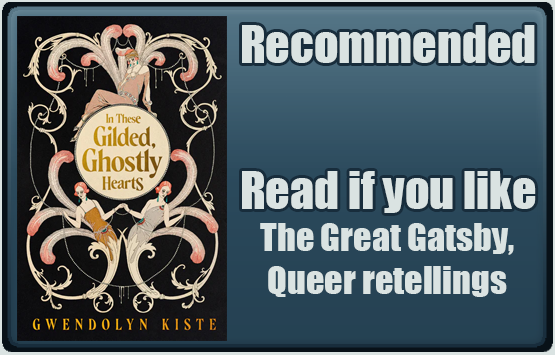
In These Gilded, Ghostly Hearts by Gwendolyn Kiste

In These Gilded, Ghostly Hearts by Gwendolyn Kiste

Formats: Print, audio, digital

Publisher: Creature Publishing

Genre: Ghosts/Haunting, Gothic, Historic Horror, Romance

Audience: Adult

Diversity: Lesbian main character and bisexual side character

Takes Place in: New York

Content Warnings (Highlight to view): Alcohol Abuse, Child Abuse, Death,  Forced Captivity, Homophobia, Suicide

Blurb

In 1955, Daisy Buchanan is found dead in an abandoned West Egg mansion, but her daughter Mel knows she’s really been gone for years. No one knows whether Daisy was murdered, or if it was a simpler, slower death: her yearslong spiral of alcohol, abuse, and helplessness. But when Mel enters the estate, she finds Daisy’s ghost, somehow frozen at twenty-three, and a charming, bleeding phantom that used to be Jay Gatsby.

To free her mother, Mel must carve a path through family secrets and decaying revelers: deep into Gatsby’s starving house as it gorges itself on unfulfilled love and grows stronger every night.

I received this product for free in return for providing an honest and unbiased review. I received no other compensation. I am disclosing this in accordance with the Federal Trade Commission’s 16 CFR, Part 255: Guides Concerning the Use of Endorsements and Testimonials in Advertising.

The year is 1955. Daisy Buchanan is dead, her body discovered in Jay Gatsby’s abandoned estate in West Egg. Daisy’s now adult daughter, Pamela “Mel” Buchanan, and one of Daisy’s few remaining friends, Jordan Baker, travel from New York City to investigate the mysterious death. They learn that Daisy was working with a predatory spiritualist named Harrison to summon the ghost of her lost lover, Jay Gatsby. Harrison convinces the two women to return to Gatsby’s old home, now dripping with ectoplasm, and complete the séance with him. Soon the mansion is filled with ghosts, partygoers from bygone days, Gatsby himself, and Daisy. The partygoers are Stone Tape hauntings, a mere echo of the past. Gatsby’s ghost, on the other hand, is an intelligent haunting who is able to interact with Mel, who soon learns his obsession with Daisy has continued after his death.

Mel and Daisy have a complicated mother/daughter relationship. No matter how badly their mother treats them, children still crave their mother’s love. Mel is parentified by Daisy who is helpless and broken after losing her lover Gatsby, her husband Tom, and her lifestyle. Mel explains “Once the cash dried up and she wasn’t a rich girl anymore, she practically dissolved into sea foam before my eyes.” Daisy is not a resilient woman–understandable since she was raised to be a pretty bauble on a rich man’s arm. Daisy was a fairly passive character in Fitzgerald’s novel, a beautiful woman for Gatsby to idolize and Tom to possess. It was satisfying, however, to read that toxic alpha-male Tom threw himself off the Brooklyn Bridge after losing everything in the stock market crash of ’29. A fitting end to an awful man. Unfortunately, it means he leaves his wife and daughter penniless and alone. Kiste often writes books for “lost” women and girls who are trapped in the past and mistreated by an uncaring society who doesn’t understand them. The Marys in Pretty Marys All in a Row, the Rust Maidens in the novel of the same name, Talitha Velkwood and her friends in The Haunting of Velkwood, and now Mel and Daisy Buchanan.

You don’t necessarily have to have any knowledge of The Great Gatsby prior to reading In These Gilded, Ghostly Hearts but it does certainly help to be able to familiarize yourself with the characters and themes. There are also lots of fun little callbacks to the original book, like Gatsby’s automatic orange juicer machine. Just don’t make the same mistake I did and try and compare the writing in the two. I re-read F. Scott Fitzgerald’s famous work right before Kiste’s so I’d have a refresher and I do think it made me more judgmental of the writing in the latter. Don’t get me wrong, I generally love Kiste’s writing, two of my favorites being Pretty Marys All in a Row and The Haunting of Velkwood. I’m not at all implying that this is not a well-written story. But very few books are going to be able to stand up to one of the “Great American Novels” and trying to compare the two is a disservice to Kiste’s novella.

While Gatsby is written as a sympathetic character in the original book, I like how Kiste points out how incredibly creepy his obsession with Daisy is. Some might view his grand gestures as romantic but honestly, they always felt like borderline incel behavior to me. Gatsby views Daisy as a prize to be won rather than a person, and if he has enough money of course she’ll leave Tom for him. The main reason we’re sympathetic to Gatsby is because Tom is portrayed as the bigger asshole with no redeeming qualities, and because Nick sees Gatsby as sympathetic. Daisy is “supposed” to choose the heroic Gatsby over the brutish Tom, and when she doesn’t, she’s cast as the villain. Yet, does she really have a choice?  Herstory and Daisy Buchanan by Leland S. Person, Jr. quotes the numerous men who have described Daisy as “vulgar and inhuman,” a “Dark Destroyer,” and the “anti-virgin…the prototype of the blasphemous portraits of the Fair Goddess as bitch” who “preyed on” Gatsby. Yikes! But Person viewed Daisy as more victim than conniving, selfish woman. She’s a woman in the 1920s, from an old money family who’s expected to marry an old money man, not some nouveau riche who may or may not have a criminal history. Daisy has no way of earning a living herself, she’s completely dependent on men for her financial security, and always had been. She’s also under immense societal expectations; she can’t simply leave her husband to have the life she wants with Gatsby. We also known Tom is abusive, as shown when he breaks his mistress’ nose.Leaving him was unlikely to be easy. I don’t think any of that necessarily makes her a good person; she’s just an imperfect victim. And this seems to be the characterization that Kiste goes with. Daisy wasn’t a good mother, but that doesn’t mean she doesn’t deserve sympathy or Gatsby’s obsessive idolization. Similarly, as a lesbian, Mel is also unable to be with the ones she loves, first Jordan and then her coworker, Vera.

I loved how queer Kiste’s book was. Mel is gay, Jordan bisexual, and Tom’s implied crush on Gatsby is no longer subtext. In These Gilded, Ghostly Hearts takes place during the Lavender Scare of the 1950s, an anti-LGBTQ+ witch hunt, so Mel lives in constant fear of having her sexuality discovered. At one point she and Jordan go to the Bagatelle on University Place. The Bag, as it was more commonly known, was a real lesbian bar that was popular in the 1950s. I love that little bit of realism that Kiste added to the story. Audre Lorde and Ann Bannon both wrote about the bar and how it shaped their pre-Stonewall experience. The Bag was owned by the mafia and frequently raided by police. A red light would go off to warn patrons when they vice squad showed up, which happens to Mel at the bag one night.

Kiste is not the first to write about the Great Gatsby through a queer lens. In 1963 Lionel Trilling characterized Jordan Baker as “vaguely guilty, vaguely homosexual.” Nearly thirty years later The International Fiction Review published The Sexual Drama of Nick and Gatsby by Edward Wasiolek who argued that Nick has “homosexual  leanings” and intense feelings for Gatsby. The Chosen and the Beautiful by Nghi Vo (author of The Empress of Salt and Fortune) also imagines Jordan and Gatsby as bisexual, and Nick and Gatsby have a fling. Self-Made Boys: A Great Gatsby Remix by Anna-Marie McLemore and The Pursued and the Pursuing by AJ Odasso explore a queer relationship between Gatsby and Nick.

Kiste’s writing can best be described as “haunting;” beautiful, unsettling, nostalgic, and melancholy, lending itself well to a ghost story. Her stories are less “in your face” horror with gore and blood and instead rely on atmosphere to create a general sense of unease commonly found in gothic horror. For some readers, it may feel like the pacing is dragging, as there’s no sense of urgency and not a lot of action because this isn’t that kind of book. This is a novella meant to be savored rather than rushed through. So, while it won’t be everyone’s cup of tea, I think fans of slow burn horror and character driven story will enjoy In These Gilded Ghostly Hearts.

I did feel like the book needed a little more show and a little less tell. It seemed like Mel was constantly explaining things to the audience that didn’t necessarily need to be spelled out. At the same time, I thought it was awesome that Mel was middle aged and Jordan in her fifties. It’s so rare to find older women protagonists in fiction. Male protagonists have a wide range of ages, but women seem to always skew young. What’s more, neither character is a wife or mother. While I don’t think In These Gilded, Ghostly Hearts is as strong as some of Kiste’s other novels and novellas, it’s still a solid, spooky read perfect for autumn.
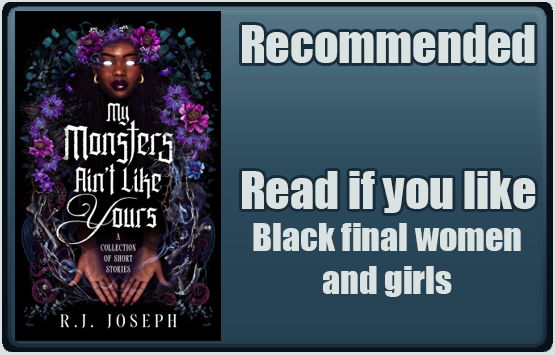
 

My Monsters Ain’t Like Yours by R.J. Joseph

My Monsters Ain’t Like Yours by R.J. Joseph

Formats: Print, audio, digital

Publisher: Quill & Crow Publishing House

Genre: Eldritch Horror, Folk Horror, Ghosts/Haunting, Historic Horror, Monster, Zombie

Audience: Adult

Diversity: Black, African/American characters and author, queer and bisexual characters

Takes Place in: Texas

Content Warnings (Highlight to view): Animal Abuse, Animal Death, Body Shaming, Cannibalism, Child Abuse, Child Death, Child Endangerment, Childbirth, Death, Drug Use/Abuse, Forced Captivity, Incest, Miscarriage, Oppression, Pedophilia, Physical Abuse, Racism, Rape/Sexual Assault, Sexism, Sexual Abuse, Slut-Shaming, Suicide, Torture, Verbal/Emotional Abuse, Violence, Vomit 

Blurb

At its core, the horror genre is an effective vehicle for exploring human behavior. From within its terrifying boundaries, and lack thereof, we can examine monstrosity. We can determine how monsters are labeled, analyze the actions of those deemed monstrous, and prophesy the impacts this labeling and actions have on the world around us.

Monsters are personal. Monsters are universal. These facts create an intriguing juxtaposition where the things deemed monstrous or frightening can be shaped by personal experiences, while also representing many aspects of the human condition; our fears are much more similar than dissimilar. This means my monsters are absolutely like yours: they are our collective nightmares.

My Monsters Ain’t Like Yours reflects this irony through Black feminist intersectional horror at its rawest.

I received this product for free in return for providing an honest and unbiased review. I received no other compensation. I am disclosing this in accordance with the Federal Trade Commission’s 16 CFR, Part 255: Guides Concerning the Use of Endorsements and Testimonials in Advertising.

While many of the monsters in the collection are supernatural (Suffer the Little Children, The Crazy   with Daisy, Higher Education, Something Wicked Came for Me, Welcome, Skinny Minnie, Sweet Sunday Supper Smile, etc.) the most terrifying ones are the human monsters (Regrets Never Die, The Collector, Sweet Sunday Supper Smile, Her Heart’s Desire, No Tricks Only Treats, The Preying Family, Sad, Spooky Sally, etc.). Interestingly, some of the supernatural monsters are friendly and helpful creatures/spirits who protect the protagonists from other monsters, both literal and figurative. Humans, after all, are much worse than some imagined creature. Then there are the metaphorical “monsters” of grief, loneliness, and trauma that haunt the protagonists.

There are a lot of bad heterosexual relationships in the anthology.  These range from Where the Horizon Kisses the Sky in which the husband is neglectful, Endless Possibilities where he’s a selfish loser, to Her Heart’s Desire where he’s outright abusive towards his wife. In all these stories the wife yearns for something better and uses supernatural means to get it, with varying degrees of success. In The Badly Terrible, Absolute Worst she doesn’t even get that chance. But queer relationships, like in The Crazy with Daisy and Witness Bearer, are shown in a more positive light.  A report by the Institute for Women’s Policy Research and the National Domestic Worker’s Alliance states that “More than 40 percent of Black women experience physical violence by an intimate partner during their lifetimes (41.2 percent), compared with 31.5 percent of all women.” And a study published in the Lancet reported that Black women are also nearly six times as likely to be murdered than white women. Thankfully there are resources like Ujima that support Black women who are in domestic violence situations, even as the justice system continues to fail them.

In Endless Possibilities and Her Heart’s Desire the wife herself becomes a monster to escape her bad marriage, and in the latter, get revenge on her horrible husband. Then there’s Tanita in The Collector, a serial killer who murders for the fun of it. There’s something incredibly satisfying about women embracing their monstrosity and rage, especially Black women. Those with marginalized identities are often cast as monsters in other people’s stories so why not reclaim the title? I especially like that feminine monstrosity in Endless Possibilities and Her Heart’s Desire is not tied to sexuality. While I appreciate women like Tanita reclaiming their sexuality and using it to seduce and murder men à la Jennifer’s Body (2009) and The Hunger (1983) sometimes it feels like the majority of female monsters are temptresses ( leading men to their death. And it can start to get a little old.

Can’t they just be horrible and violent without wanting to have sex with their victim? Plus, there’s the unfortunate implication that women who have sex on their own terms are evil and they go against the natural order of things by overpowering men. So, I appreciated that Joseph gave us some nice variety. The book even has monstrous children (#GIRLMOM and Suffer the Little Children) though in both cases the children are embraced by the main character rather than shunned for the monstrosity.

Sweet Sunday Supper Smile and No Tricks Only Treats are stories containing child abuse, though the abusers get their comeuppance in both. Then there’s Sad, Spooky Sally which is especially disturbing, so much so that it comes with its own set of content warnings before the chapter, rather than in the index. It’s an absolutely heart-breaking story with a bittersweet ending and one of my favorites in the collection. But it’s also very triggering, so make sure you check out those content warnings before reading it. The same goes for Regrets Never Die and Witness Bearer. They’re both very dark, with the latter being about a girl who can see the worst things a person has ever done. She witnesses some truly awful memories, so I appreciate that Joseph included content warnings for all the stories in the book’s index.

Those who Teach Pay Knowledge Forward stood out in the collection, as it was sweet rather than scary, A ghost story where the ghosts aren’t the source of fear. It also had a nice message about helping to educate the next generation so they can succeed. I love how so many of the Black women in the collection are intelligent and well educated, ranging from college students (The Collector) and graduate students (Whole New World), to teachers (Those Who Teach Pay Knowledge Forward) and college professors (Grand Opening, Higher Education, Something Wicked Came for Me). The young woman in Important Things is sent on an all expenses paid trip to Palm Springs for a symposium because she excels in her high school classes. In 1995 14% of Black women between 25 to 34 held a bachelor’s degree compared to 38% in 2024 according to the Pew Research Center.

There are so many great stories in the collection, I’d be pressed to pick a favorite, though I did especially enjoy Regrets Never Die, #GIRLMOM, Endless Possibilities, Those Who Teach Pay Knowledge Forward, and Something Wicked Came for Me. While Black women and children’s trauma is a reoccurring theme of My Monsters Ain’t Like Yours, it’s not the only focus of the anthology. If every story were about Black trauma and abuse, it honestly may have been too much for me. Instead, Joseph includes a bunch of fun, spooky stories to offset the heavier stuff so the collection never feels too dark and depressing. Instead, we get a nice balance.

I really liked this because while horror is a great way to process trauma, Black horror shouldn’t be pigeonholed into stories of Black pain. I love Get Out (2017), it’s one of my favorite films, but if that was the only kind of Black horror story told by Hollywood, it would start to feel like the suffering of Black people was being fetishized for entertainment. There’s a reason why Peele’s next two films, Us (2019) and Nope (2022) aren’t rooted in Black trauma. So, while there are plenty of stories about abuse, bad relationships, and the general mistreatment of Black women and children, there are also enough tales about living mannequins, small fanged creatures, and ghosts to offer the reader a breather.

Until the Last Light Goes Out by Courtney Gould

Until the Last Light Goes Out by Courtney Gould

Formats: Print, audio, digital

Publisher: Wednesday Books

Genre: Ghosts/Haunting, Gothic

Audience: Young Adult

Diversity: Queer main character and side characters

Takes Place in: Miami

Content Warnings (Highlight to view): Alcohol Abuse, Bullying, Child Death, Child Endangerment, Childbirth, Death, Forced Captivity, Gaslighting, Homophobia, Violence

Blurb

You may not escape, but the truth will.

Twenty-five years ago, the Ripley Memorial High School senior class entered the luxurious Kaleidoscope Key resort deep in the remote Florida Keys. Despite international intrigue and years of investigation, no one truly knows how the 183 students died. And they never will, since the five survivors of the massacre have never spoken a word about what happened to them that night.

Paige Keller, daughter of one of the Kaleidoscope Key Massacre’s infamous survivors, has grown up determined to steer her life away from the resort and the unsolved mysteries her ex-best friend, KJ, can’t leave alone. Paige has moved to a fancy new college and it seems that, finally, she’s banished the shadows of Kaleidoscope Key completely. But when she’s called home on the 25th anniversary of the massacre, she finds that KJ has gone missing.

Paige knows there’s only one place KJ could be: her obsession, the now-abandoned resort. When Paige and the remaining Survivors’ Kids go in after her, they’re forced to confront their―and their parents―pasts once and for all.

Kaleidoscope Key is waiting, and it’s starving. Once they find their way inside, there may not be a way out. And one way or another, the truth of the massacre will come to light.

Captivating and chilling, Courtney Gould’s Until The Last Light Goes Out is a horror story, a love story, and an ode to the pain passed between generations that you won’t soon forget.

On May 21st, 2001, the senior class at Ripley Memorial high school, along with staff and chaperones, were found dead in their beds at the newly opened Kaleidoscope resort. Only five students survived. Too traumatized to explain what happened, the “Kaleidoscope Massacre” (as it came to be called) remained a mystery for 25 years. Thirteen years later, Casey, one of the massacre’s survivors, returns to the Kaleidoscope for reasons unknown and is found dead inside the resort the next day leaving her daughter, Paige, all alone.

Cut to the present day. Paige, now in college, has returned to Miami for the 25-year memorial of the massacre. When speaking to the children of the other four survivors Paige learns her former best friend, KJ, has been missing for a month. Even though the two had a falling out, Paige will do anything in her power to find KJ, even if it means returning to the site of her mother’s murder. She gets her chance when the son of the Kaleidoscope’s current owner tells Paige that he’s headed there to film some urban exploring videos. But what she discovers at the abandoned hotel is much more than she bargained for.

Patented in 1817 by Scottish inventor David Brewster, the kaleidoscope is a toy made of mirrors enclosed in a cardboard tube that when turned creates ever-changing mandala-like patterns by reflecting the colored glass at one end of the tube. The name kaleidoscope, derived from ancient Greek, translates roughly as “to look at beautiful forms.” An appropriate name for the resort, as the Kaleidoscope is itself dynamic, constantly morphing into something new. But, beneath its surface, beauty hides something sinister and hungry. A neon gothic nightmare that feeds on pain and plays mind games, the Kaleidoscope resort is its own character. Fans of liminal space stories such as Backrooms and Exit 8 will enjoy the never-ending maze that is the Kaleidoscope.

Paige, who’s pragmatic and logical with a need to always be right, deals with the Kaleidoscope by simply ignoring its existence and trying to get as far away as possible. Paige is also the last to admit that something supernatural is going on, much to KJ’s frustration. On the opposite end on the spectrum is KJ who’s obsessed with discovering the resort’s secrets to try and help her mother Tess, who was completely broken from her experience there. Neither has a healthy coping mechanism for the generational trauma they’ve been burdened with. Both girls need to find a healthy middle ground so they can work together to try and find a way out.

I found myself very emotionally invested in the fates of Paige and KJ and loved watching them grow as characters. The sons of the other survivors? Not so much. It was hard to care about the boys being in danger when we never really got the chance to know them, mostly through Paige’s descriptions of them rather than learning for ourselves through their dialogue and actions. It also meant we couldn’t tell if their behavior was “out of character” or just the hotel making them behave a certain way.

The story bounces back and forth between the past, when Casey and her friends first visit the Kaleidoscope for senior night, and the present, when their children are trapped. As the book progresses, the timelines start to blur, emphasizing the liminal space within which they find themselves trapped. Casey’s story focuses on her relationship with her best friend, Tess, who’s rebellious and desperate to be one of the popular girls. Then there’s her other best friend, Summer, an introverted “good girl” who’s been recently outed as a lesbian, leading to her being bullied. Casey is torn between her loyalties to both friends as Tess tries to push Summer out of their friend group for being “uncool.” Instead of standing up to Tess like she should, Casey simply does nothing, unwilling to lose Summer, but not wanting to lose Tess either. Friendship and loyalty are major themes in Until the Last Light Goes Out, with both Casey and Paige fighting to keep their friendships with Summer and KJ respectively after abandoning them. To Gould’s credit, the relationships never feel reduced to superficial “teen drama,” and you can feel the emotional impact they have on their characters. 

When I first read that the mass deaths in 2001 were called “the Kaleidoscope massacre” I was expecting blood and body parts everywhere, but no, everyone just died in their sleep. The story is pretty safe for more squeamish horror fans, or those just looking for a haunted house (or in this case hotel) story. There are a few scenes where people get stabbed or killed, but the gore isn’t excessive or described in great detail, and a lot of it happens “off screen.”

The story is suspenseful and, for the most part, managed to hold my attention for long periods of time. Towards the middle, things started to feel a little repetitive (you can only wander down so many endless corridors before things start to drag) and the pacing suffered for it. I think the book would have benefited from some tightening up in the second act, but otherwise things moved along well, and towards the end I found I couldn’t put it down. I personally felt that the last chapter, which elaborated on the ending, was unneeded and it would’ve worked better if things were left vague. I believe most readers could’ve inferred what happened on their own. Maybe some editor decided that teens lack media literacy and needed an explanation spoon-fed to them. Despite a few flaws, Until the Last Light Goes Out is deeply moving and has the emotional depth that young adults deserve, but that so much Y/A is lacking.


Dead First by Johnny Compton

Dead First by Johnny Compton

Formats: Print, audio, digital

Publisher: G.P. Putnam’s Son

Genre:  Ghosts & Hauntings, Mystery, Occult

Audience: Adult

Diversity: Black author and main character, bisexual main character, Korean-American side character

Takes Place in: Texas

Content Warnings (Highlight to view): Alcohol Abuse, Amputation, Child Death, Death, Drug Use/Abuse, Forced Captivity, Gore, Kidnapping, Mental Illness, Police Harassment, Racism, Self-Harm, Suicide, Torture, Violence

Blurb

When private investigator Shyla Sinclair is invited to the looming mansion of mysterious Texan tycoon Saxton Braith, she’s more than a little suspicious. The last thing she expects to see that night is Braith’s assistant driving an iron rod straight through the back of his skull. Scratch that—the last thing she expects to see is Braith’s resurrection afterward.

Braith can’t die, it turns out, but he has no explanation for his immortality, and very few intact memories of his past. Which is why he wants to pay Shyla millions to investigate him, and bring his long-buried history to light.

Shyla can’t help but be intrigued, but she’s also trapped by the offer. Braith has made it clear that he knows she’s the only person he can trust with his secret, because he knows all about hers.

Bold, atmospheric, and utterly frightening, Johnny Compton’s Dead First is spine-chilling supernatural horror about the pursuit of power and the undying need for reckoning.

Private investigator Shyla has just finished a case for a man named Massimo Dante, who thought he was the antichrist. He paid her well enough that she was able to buy herself a house and help her cousins out financially. She doesn’t need to accept billionaire Sexton Braith’s case, but curiosity gets the better of her. Braith wants Shyla to determine why he’s immortal, which his trusted chauffer, Remy, demonstrates by shoving a fire poker through his skull. Thoroughly freaked out, Shyla is ready to turn him down. Yet, Braith implies he knows her biggest secret–that she killed a man when she was young–and will bring it to light if she doesn’t help him. Little does Shyla know that Braith is hiding his own, much darker, secrets.

I was instantly hooked by the premise for Dead First. I’m a sucker for horror mysteries. While the first half of the book felt a bit slow for my taste, the pace really picks by the midpoint, and each reveal feels more horrific than the last. What starts out as a supernatural mystery eventually morphs into full blown horror. Interesting to note, Dead First seems to take place in the same world as Compton’s Bram Stoker Award nominated novel The Spite House, as there’s a passing reference to The Spite House at the very end of the book.

I liked how Shyla was more morally ambiguous than most protagonists. She’s willing to do some pretty messed up stuff for the ones she loves and to protect her secret. She’s driven by revenge and you can tell her anger is poisoning her, but she’s unwilling to let go of it. Shyla has trouble opening up to others and past experiences have hardened her. This is part of why she broke up with her girlfriend, Jinh. Shyla’s relationship with Jinh is complicated, to say the least. The two clearly still care for each other, but Shyla seems scared to get too close. Shyla first met her ex when she went on Jinh’s podcast, a blend of true crime and supernatural lore that has fans all over the world. Jinh has the ability to speak to the dead, though Shyla doesn’t really believe in Jinh’s power. While I liked Jinh, I felt like her character could have used more development.

I appreciated how the racism in the book is very subtle. You’re not hit over the head with it, but it’s there, hinted at and never outright stated.  For example, Shyla is always concerned about being harassed by the police. If you are a non-Black person who was somehow in a coma all through 2020, or just completely unaware of how cops treat Black people, you might not pick up on it. But it’s obvious Shyla must worry about cops and the busybodies who call them because she’s Black, even if it’s never spelled out for the audience. I liked that Dead First doesn’t feel like it’s written for non-Black people to learn about the horrors of racism. Instead, it assumes the reader is already aware of the systemic racism Black people deal with every day and Compton doesn’t have to delve in to it because it’s not part of the story. As much as I appreciate racism as horror stories, it’s also nice to read Black stories that aren’t focused on racism and Black trauma. Shyla does have trauma, but it has nothing to do with her race (other than the police not working as hard to find a missing Black child).

While the book initially feels more like a supernatural mystery thriller than straight horror, there’s still plenty of gore and some genuinely frightening moments in the second half of the book.  I personally enjoyed it, but I can see the mystery crowd being turned off by the violence and torture, while horror fans may not want to wait through the detective procedural parts of the story to get to the scary stuff. But I believe readers will enjoy the tense, haunted atmosphere, one of the story’s strongest points.


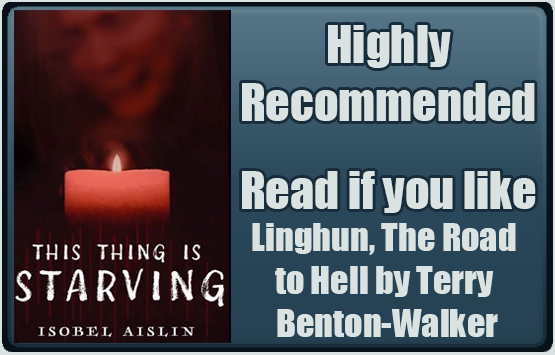
This Thing is Starving Isobel Aislin


This Thing is Starving by Isobel Aislin. Highly Recommended. Read if you like Linghun, The Road to Hell by Terry Benton-Walker

Formats: Print, digital

Publisher: Independently Published

Genre: Ghosts/Haunting, Historic Horror

Audience: Adult/Mature

Diversity: Asexual main character, trans man character, lesbian character

Takes Place in: Pennsylvania

Content Warnings (Highlight to view): Alcohol Abuse, Child Abuse, Child Death, Death, Drug Use/Abuse, Forced Captivity, Gaslighting, Homophobia, Medical Procedure, Mental Illness, Pedophilia, Rape/Sexual Assault, Self-Harm, Sexism, Slurs, Slut-Shaming, Suicide, Transphobia, Victim Blaming, Violence

Blurb

It’s just a house, right? Houses can’t hurt. Houses can’t bleed.

But this house wants you to.

When the Waite family moves into their new home, they don’t bargain on being unwanted guests. But this house has deep-rooted, blood soaked history, and it’s angry. This Thing is Starving is an unflinchingly feminist love letter to the abused, bursting with feminine rage and told from the perspective of a haunted house.

Warning, this review discusses abuse, rape, and the sexual abuse of minors.

The house on 4377 N. Oscar St is haunted. But this is not your typical haunted house story. This story is told from the house’s point of view as it witnesses the tragedies that befall its owners throughout the year. The house is haunted by four women and one trans boy. The first, and oldest, is Lillian. She lived in the house with her husband in the 1920s and is the most unstable of the five ghosts. Jason was a teenaged, closeted trans boy from the 1950s. Lila was a lesbian from 1975 who hated her queerness. In 2002 the house was owned by a woman named Karissa, a child abuse survivor who struggles with low self-esteem. The final ghost is Kay, a teenaged girl who died in the house after it was abandoned by Karissa in the early 2000s. All the ghosts are victims of abuse, sexual assault, or other forms of violence at the hands of men, and they all met with tragic ends either by their own hand or at the hands of others.

Veronica Waite and her family are the house’s most recent inhabitants. Her mother, Louise, moved them there after escaping an abusive partner and is doing her best to start over. The house immediately takes a disliking to the family, with its wild and grubby children and Louise who it immediately labels a “bad mother” due to her love of wine, parentification of Veronica, and inability to keep track of all her children. The only exception to the house’s ire is Veronica, whom the house feels strangely drawn to. It views her as “a splotch of brightness amongst the gloom” and tries its best to communicate with the eldest Waite child. Veronica certainly seems happy in the beginning. She finds a new friend quickly, makes the cheerleading team, and even lands a hot, football playing boyfriend. She creates beautiful art to hang in her attic room. But then things start to unravel for the family, and the house can do little to stop it. As Veronica struggles with her asexuality and trying to take care of her siblings, she slowly learns how cruel the world can be to women and girls.

Most of the men in this story are horrible, even an old man whose obituary Louise is editing. I’m sure the “not all men” crowd will object to the fact that almost all the cisgender men (and boys) in the story are awful human beings (admittedly sometimes to the point of feeling like caricatures), but I believe this is intentional. The story is being told from the point of view of the house, and the house hates men. Because the house can only witness what happens within its walls, or the lives of the unhappy ghosts who haunt it, the house rarely gets to see the good parts of humanity. Statistically, the majority or murders and rapes are committed by men, so of course the ghosts are more likely to be victims of male violence, leading to the house believing  that all men are inherently bad. Toward the end of the book, a character named Owen shows up who is devoid of the toxic traits shown by most of the other male characters. While he clearly has a crush on his female coworker, he respects her boundaries, supports her decisions, and keeps his desire to protect her in check. But of course, the house can’t recognize that he’s a good man like the audience can, and immediately hates Owen.

Ironically, the house is reinforcing harmful gender stereotypes because it doesn’t understand the complexities and nuances of abuse. It can only see people as innocent victims (women, girls, and AFAB people) or evil perpetrators (cisgender men and boys). But characterizing men as inherently evil gives them permission to behave horribly, as it rejects the notion that they have control over their actions. Essentially, it’s a more insidious form of “boys will be boys.”  But men can, and need to, do better. The house also conveniently ignores the fact that women can not only support the harmful actions of men, but can be perpetrators themselves, and that men can be victims, but Aislin does not. Lillian is abused by her serial killer husband, but when she finally snaps and kills him, she doesn’t free the women he has chained in the basement. Instead, she replaces her husband as the predator in the house and kills them. She even slut shames her husband’s victims, justifying their rapes and murders to herself. Veronica’s younger twin brothers, Charlie and Sawyer, are also revealed to be victims of their father’s abuse (especially Sawyer). Sadly, like Lillian, Sawyer becomes an abuser himself, acting out what he experienced at the hands of his father on his little sister Leslie. The house makes an exception for Jason, a trans man, another victim of male violence, but not for the twins. I suspect that’s because the house is mildly transphobic, and sees Jason as a woman, even though he’s clearly a man and his ghost has a male-presenting form.

While the house feels a fierce protectiveness of Veronica and her baby sister, it shows a cold indifference to their brothers. Interestingly, Louise was also abused by her husband, yet the house doesn’t group her in with other victims. Instead, it views her with scorn for “failing” to protect her girls (but not the boys). This is another sign that the house is not entirely free from its own sexist bias and doesn’t fully understand how abuse works. The house’s hatred of Louise is understandable, with its strong desire to protect, it cannot comprehend a mother “failing” to do so. The problem is that the house expects her to be perfect just because she’s a mom, even though Louise is a victim herself and doing the best she can under the circumstances. She loves her children, and tries her best to protect them, even when the police fail to.

Sadly, judging mothers who are being abused is not an uncommon occurrence. In an interview with NPR, Mother Jones reporter Samantha Michaels explains “It’s basically sexism. Most of the legal experts that I talked with said that it comes down to a cultural expectation that women are responsible for what happens in the home. There’s an expectation that they should be the moral center of the family, that they should reign in the man’s worst impulses, and that they should do whatever they can to protect their child, even if it means, you know, sacrificing themselves.” Mothers can have their children taken from them, and are even sent to prison due to Draconian “failure to protect” laws. Kerry King is one such mother, who is serving a 30-year sentence in prison for not protecting her daughter from their abuser, John Purdy, who is only serving 18 years for abusing King and her daughter. On October 26, 2004 in the case of Nicholson v. Williams the New York Court of Appeals ruled that children who witnessed abuse were wrongfully removed from their mother’s care, and that their non-abusive mothers had not been “neglectful” simply because they were unable to protect their children from witnessing domestic abuse.

This Thing is Starving starts with statistics about the rape, exploitation, and abuse of women and girls. Aislin states that the story is dedicated to the women who never get justice and whose stories are never heard. The book reminds me of rape revenge films without the sensationalism/exploitation common for the genre, similar to Promising Young Woman and Revenge (both films notably have female directors). Except, in this story, most of the victims don’t get revenge. Revenge against an abuser may be satisfying in fiction, but it rarely happens in real life where men often get away with hurting women. This makes the book feel more realistic. And when the house, full of pain and rage, lashes out and tries to hurt abusers and rapists, it usually hurts the innocent as well.

For example, when the house violently kills the teen boys who attempt to rape Kay, she also gets caught in the crossfire and is killed. Hate and anger rarely hurt just the intended target, but others as well. As Maddie Oatman so eloquently puts in her rape revenge article for Mother Jones “These stories offer a retributive vision of justice, the violence of the man mirrored back onto him. Traditional gender roles are flipped—the woman is the predator, and the man is the prey—but the basic shape of the conventional revenge story is unchanged. Witnessing women take revenge in film and fiction may offer a cathartic thrill, but the trope can also function as a trap; vengeance replicates the same power structure the avenger wishes to hold accountable.” She further goes on to explain “But justice can and should mean something other than the balancing of harms, as prison and police abolitionists and other activists have argued. In resisting the carceral approach to punishment, they advocate a politics of structural change, of experimentation and openness to new social forms. These ideas demand a radical artistic approach to match, a breaking free of the traps of the revenge plot. A couple of recent works give us a sense of this. Call it the reparative mode.”

Aislin shows us that there are other, healthier ways to heal from trauma than hunting down and killing your rapist (something victims are sadly arrested for in real life). And honestly, I really appreciate that Aislin presents more realistic ways that survivors can heal from trauma, like leaning on others they trust for support and opening up about what happened.  Instead of perpetuating the cycle of violence like the house does, the survivors heal by breaking free of it. This Thing is Starving is certainly a difficult and heart-wrenching read that contains abortion, rape, revenge porn, conversion therapy, drug addiction, suicidal thoughts, an infant’s death, pedophilia, trauma, a minor doing sex work, and transphobia. But Aislin doesan amazing job handling the difficult topics of abuse, sexual assault, and trauma without making the story feel like trauma porn.

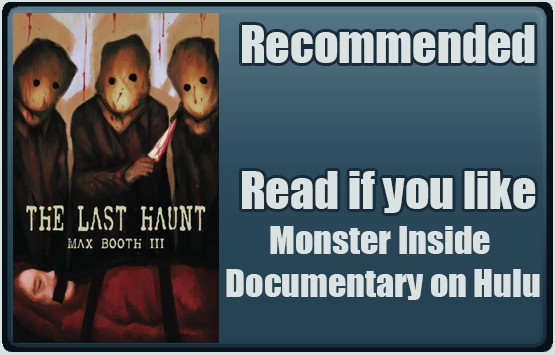
The Last Haunt by Max Booth III

The Last Haunt by Max Booth III

Formats: Print, digital

Publisher: Cemetery Gates Media

Genre: Ghosts/Haunting, Psychological Horror

Audience: Adult/Mature

Diversity: Non-binary author

Takes Place in: Texas

Content Warnings (Highlight to view): Ableism, Animal Death, Death, Forced Captivity, Medical Procedures, Physical Abuse, Racism, Slurs Torture, Verbal/Emotional Abuse, Vomit

Blurb

On the one-year anniversary of a young woman’s tragic death, an extreme haunted house attraction reopened its doors to the public. What happened next would forever traumatize a small Texas town. The Last Haunt is an attempt to make sense of the mysterious brutality that occurred on that fateful Halloween night. Constructed from interviews with the survivors, this oral history is the closest anyone has ever come to documenting the truth behind the McKinley Manor massacre.

I received this product for free in return for providing an honest and unbiased review. I received no other compensation. I am disclosing this in accordance with the Federal Trade Commission’s 16 CFR, Part 255: Guides Concerning the Use of Endorsements and Testimonials in Advertising.

I’m a big fan of haunted houses. I get really into them and let the scare actors do whatever they want to me (tie me up, tickle me, “drill” my teeth, lead me away from the group, etc.). My mother, sister, and I plan an October trip every year and the haunted houses we visit are always my favorite part. But they don’t really scare me. Of course, I don’t really expect them to. I’ve been hardened by horror and I’m difficult to frighten. But that’s okay with me, I still enjoy the creepy atmosphere and it never fails to make me giggle whenever I get startled by a scare actor. I still have fun. But some folks don’t get anything out of typical family-friendly “boo haunts.” They want something more intense. And that’s where “extreme haunts” like Blackout, Stag, and Miasma come in. These haunts are usually 18 and up (many of them contain nudity, sexual situations, and even simulated sexual assault), require a waiver and give you a safe word to use if things get to be too much. Actors are allowed to touch you and even manhandle you. Participants might be dunked in cold water, shocked, or have a bag put over their head, to name a few of the unpleasant experiences to expect.

Gus McKinely loves horror and scaring people. He was a horror fan growing up and his obsession with fear only grew as he became older. As an adult, he used to put on haunted houses for the neighborhood kids with his wife every year. But when an internet troll named Betty Rocksteady (who later becomes his lover and biggest fan) makes fun of his boo haunt, Gus becomes obsessed with creating the scariest haunted house ever. So, he creates McKinley Manor, the scariest and most extreme haunt in the country.

McKinley Manor is a play on McKamey Manor, a real-life extreme haunt put on by Russ McKamey. Several of the details are the same, such as donating a bag of dog food instead of paying an entrance fee, the haunt being year-round, the no-swearing rule, a promised cash reward if you can complete the haunt (which apparently doesn’t really exist), and the lack of a safe word (although McKamey reports he now uses a safe word or phrase). Even Gus McKinely is based on Russ McKamey, with both being former military who now work at Walmart. The biggest similarity to McKamey Manor, of course, is that this haunt isn’t really a haunted house with scare actors, but more of an endurance test where you get waterboarded in some guy’s backyard. Except no one has been killed participating in McKamey Manor.

Booth’s story is about taking something that’s supposed to be fun and twisting it into something ugly. McKinley is no longer interested in creating an enjoyable, scary experience; he just wants a reason to make people suffer. It’s implied he’s always been a bit of a sadist, trying to gross out his dad while he was eating and playing scary pranks on the other ensigns. These were people who didn’t want to be disgusted or scared. And while participants at McKinley Manor do consent to the experience, by not providing a safe word Gus essentially removes their ability to withdraw their consent at any time, meaning he’s just straight up abusing people. And he clearly loves abusing people, no matter what his former employee Zach Chapman, or his obsessive girlfriend, Betty say. In fact, Betty even admits to getting off on the torture herself. She even goes so far as to masturbate to a video of a girl named Jessica (who she refers to as “that bitch”) drowning at the Manor when a waterboarding session goes wrong. Of course, if anyone tries to criticize Gus, including Jessica’s grieving brother, he labels them as “haters” and sends his rabid fans after them. While the story has supernatural elements, it’s Gus and his followers that provide the real scares.

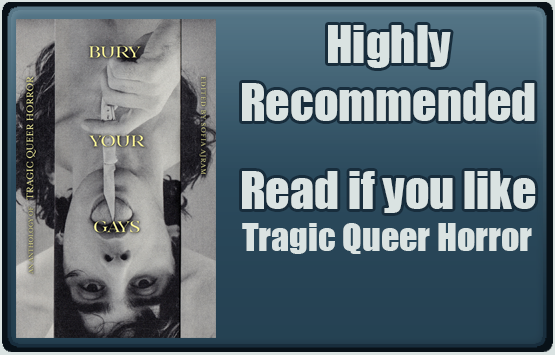
Bury Your Gays: An Anthology of Tragic Queer Horror edited by Sofia Ajram

Bury Your Gays: An Anthology of Tragic Queer Horror edited by Sofia Ajram

Formats: Print, digital

Publisher: Ghoulish Books

Genre: Anthology, Body Horror, Ghosts/Haunting, Killer/Slasher, Monster, Romance

Audience: Adult/Mature

Diversity: Queer and trans authors and characters

Content Warnings (Highlight to view): Alcohol Abuse, Body Shaming, Bullying, Death, Drug Use/Abuse, Eating Disorder, Homophobia, Medical Torture/Abuse, Medical Procedures, Necrophilia, Police Harassment, Rape/Sexual Assault, Slurs, Suicide, Torture, Transphobia, Violence

Blurb

A manifestation of ecstasy, heartache, horror and suffering rendered in feverish lyrical prose. Inside are sixteen new stories by some of the genre’s most visionary queer writers. Young lovers find themselves deliriously lost in an expanding garden labyrinth. The porter of a sentient hotel is haunted within a liminal time loop. A soldier and his abusive commanding officer escape a war in the trenches but discover themselves in an even greater nightmare. Parasites chase each other across time-space in hungry desperation to never be apart. A graduate student with violent tendencies falls into step with a seemingly walking corpse. Featuring stories from Cassandra Khaw, Joe Koch, Gretchen Felker-Martin, Robbie Banfitch, August Clarke, Son M., Jonathan Louis Duckworth, M.V. Pine, Ed Kurtz, LC Von Hessen, Matteo L. Cerilli, November Rush, Meredith Rose, Charlene Adhiambo, Violet, and Thomas Kearnes.

I received this product for free in return for providing an honest and unbiased review. I received no other compensation. I am disclosing this in accordance with the Federal Trade Commission’s 16 CFR, Part 255: Guides Concerning the Use of Endorsements and Testimonials in Advertising.

An exquisite anthology of queer horror that boasts such talented authors as Cassandra Khaw, August Clarke, and Gretchen Felker-Martin, this collection contains something for everyone. In its pages, you’ll find alien fungi, body horror, dark fairytales, undead lovers, and lonely ghosts. Named for the common trope where gay characters often meet with untimely ends in mainstream media, this anthology subverts the trope by putting it in the hands of queer writers.

In Your Honor, I’d Like to Put You in the Shoes of One of Dr. Morehouse’s Thirty Proven Clients by M. V. Pine, a trans woman (although she’s never referred to as such) struggles to find gender-affirming care. It’s the 1970s and she’s been dishonorably discharged from the army for “mental health” reasons. Her family doesn’t support her. She refers to her genitals as “a tumor.” A tumor that’s benign (hence, no doctor will remove it for her) but still mortifying. Because she’d do anything to be rid of it, she becomes an easy mark for Dr. Morehouse, who performs dangerous back-alley vaginoplasties on trans women. His surgical room is dirty and he runs out of anesthesia halfway through the procedure. He doesn’t provide antibiotics or pain medication. But the woman would rather die than go another day living with her “tumor.”

This is a story is about what happens when people don’t have access to safe, gender-affirming care. In 2017 a trans woman known only as “Jane Doe” underwent a back-alley orchiectomy which caused her to lose large amounts of blood. Police arrested James Lowell Pennington, who had performed the procedure without a medical license. Doe defended Pennington stating “Arranging a back-alley surgery was out of pure desperation due to a system that failed me.” Why would someone risk their life for what seems like an elective procedure? A study published in JAMA that followed trans and non-binary youths ages 13 to 20 showed 60% reduction of depression and 73% reduction of suicidality in participants who had initiated puberty blockers and gender-affirming hormones compared to those who had not. Another study published in JAMA on gender-affirming surgeries among 27,715 trans and gender diverse adults showed a 42% reduction in psychological distress and a 44% reduction in suicidal ideation among those who were able to receive gender-affirming surgery compared to those who wanted to but could not. There are many such studies that show similar results. Access to safe, gender-affirming care is quite literally lifesaving and immensely improves quality of life for trans and gender diverse people.

Another story that touches on the desperation many trans people feel just to have access to gender-affirming care is Worth the Dying Shame by Matteo L. Cerilli. In it, trans men are being infected by tainted, counterfiet testosterone with a disease that causes their bodies to decay as if dead (a clear parallel to AIDS). They hide their Body Rot under heavy clothing, dark glasses, and face masks. This causes an already unaccepting public to further turn on trans men. With jobs drying up, friends abandoning them, and doctors no longer willing to prescribe testosterone, the men who are able togo back in the closet. Others are forced to buy their T on the black market since doctors are no longer willing to prescribe the real stuff, which carries an even greater risk of infection. The story follows two trans men who have become infected, Dimeshine and Rictus. Rictus chose to detransition because he can still pass for a girl, but Dimeshine continues to inject T despite the risk of decaying faster. Both turn to the dark web to try and slow their Body Rot, trusting the community more than they do hospitals (understandable considering how often healthcare fails trans people). The two argue over whether Dimeshine’s little brother, Ratty, who is still early in his transition, should use testosterone or not. Dimeshine is firmly against it, worried Ratty might become infected like he was, but Rictus argues that he can’t blame Ratty for wanting to die for something they both would have killed for. These stories are a solemn reminder of what happens when the healthcare system fails LGBTQIA+ patients. As someone who works in healthcare, I held both stories especially heartbreaking.

Surprisingly for a horror anthology, many of the stories were love stories. Editor Sofia Ajram states the collection “was created out of a desire to read stories about tragic queer love. Love that is broken, love that is toxic, and obsessive, and ill-fated. Love that is thwarted, as viewed through the lens of authors who are queer-identifying themselves.” Abusive relationships are too often played off as romantic (think Twilight and Hush Hush), so it’s nice to see those sorts of relationships being shown for what they are, even when the characters themselves can’t recognize it. While horrific in real life, villain protagonists and toxic relationships can be fascinating studies in fiction. I also enjoyed having imperfect, even villainous queer characters whose character faults aren’t tied to their sexuality.

In American Gothic by LC von Hessen, villain protagonist John Smith is a serial killer (although he’d never refer to himself as such since “those guys are losers”) who has an unfortunate habit of murdering his dates. It’s not premeditated, it just seems to happen. But one day, one of his victims, who he dubs “L,” comes back to life. Or rather, he reanimates, as he’s still technically dead. L has no memory of his time alive, so John weaves an ever changing, fictional history of their romance. As L slowly rots away, John falls deeper in love with him. As shown with his past crushes, John is more in love with the fantasy he conjures then the men themselves. L allows him to project his ideal partner on to a blank slate he can fall in love with, like some sort of twisted Pygmalion, whereas living men would frequently reject him for being unemotional or creepy. John is a selfish lover, viewing his partners only by what they can do for him rather than their needs. He stalks and harasses one of his exes to the point they delete all their social media, but John still views himself as the victim and wonders why he didn’t kill his ex. John wants L to live, not for L’s sake, but for his own. He even tells him, “I won’t let you die. You’re not allowed to die unless I want you to die.” His selfishness and obsessiveness reminded me of male stalkers who feel they’re owed something by the object of their affection and can’t understand the word “no.”

This Body is Not Your Home by Son M., Love Like Ours by C M Violet, and Fortune Favors Grief by Cassandra Khaw are also stories of men who kill their lovers. Domestic violence against men is rarely examined. Even though 1 in 10 men will experience intimate partner violence or stalking in their lifetime, DV is usually thought of as a women’s issue only. Research on domestic violence among LGBTQIA+ people is even more sparse, even though gay men experience higher rates of physical violence then straight men. So, it’s refreshing to see stories that focus on intimate partner violence in gay relationships. Some of the stories focus more on mental and emotional abuse rather than physical. Both Sardines by Gretchen Felker-Martin and Zero Tolerance by M. F. Rose deal with queer teenage girls who are bullied. The former is a body horror story about a fat girl struggling with her sexuality and the latter is about cyber bullying. In this case, it’s their non-romantic relationships that are toxic.

Cleodora by August Clarke is a more lighthearted tale that follows the romance between a beautiful sea monster and a sea captain. The Captain discovers the monster and claims her as her bride, naming her Cleodora after a prophetic river nymph (The Captain seems to conflate the nymph Cleodroa with Andromeda, a princess who was offered as a sacrifice to a sea monster and rescued by the Greek hero Perseus). She sees Cleodora as helpless, which may explain why the Captain has no qualms about marrying a monster, happily feeding her new bride live eels and listening to her stories of drowning men. Cleodora feels equally unthreatened, stating “It’s fortunate my true love is a woman, because women do not hurt each other.” Ironic, considering how the story ends. The story feels like the original, darker version of a German fairytale, with hints of selkie wife folklore and siren myths.

Not all the romances involve toxic relationships or unrequited love. Bad Axe by Ed Kurtz is a tragic love story wherein John loses his lover, Eric, to the lake at Bad Axe in Minnesota. They’re never able to recover the body, so John goes back to Bad Axe to drown himself so he can be with Eric again. A touching yet morbid story it shares similarities with the myth of Hero and Leander. Hero, a priestess of Aphrodite, throws herself out of her tower after her lover, Leander, drowns trying to swim to her. The tragedy in Bad Axe is that John and Eric have a beautiful relationship that was tragically taken from them and now John must try and navigate the world through his immense grief. Black Hole, a sci-fi story by November Rush, also centers around a beautiful relationship that’s torn apart, but this time it’s between two parasitic, sentient fungi. Despite not being human, their love is no less pure and real. Lost and Found by Charlene Adhiambo also deals with lovers being united in death, but in this case they didn’t know each other before they died. 

It’s an intense read– many of the stories handle dark themes like transphobic healthcare systems, bullying, drug abuse, suicide and AIDS analogies–but a beautiful one, full of romance and tragedy. Remarkably, each one of the stories in Bury Your Gays is as strong as the last, and I’d be hard pressed to pick a favorite. Some broke my heart, others chilled me to the bone, and yet others were touching in a bittersweet way. But all left a lasting impression.

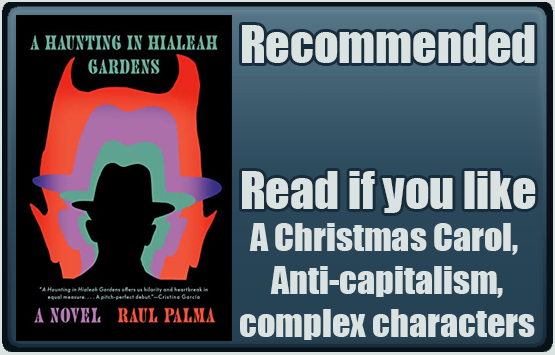
A Haunting in Hialeah Gardens by Raul Palma

A Haunting in Hialeah Gardens by Raul Palma

Formats: Print, audio, digital

Publisher: Dutton

Genre: Demon, Ghosts/Haunting, Myth and Folklore

Audience: Adult/Mature

Diversity: Cuban characters and author, Bolivian character

Takes Place in: Miami, Florida

Content Warnings (Highlight to view): Alcohol Abuse, Animal Death, Child Abuse, Child Death, Child Endangerment, Death, Illness, Medical Procedures, Oppression, Mental Illness, Racism, Suicide, Violence, Xenophobia

Blurb

A genre-bending debut with a fiercely political heart, A Haunting in Hialeah Gardens explores the weight of the devil’s bargain, following the lengths one man will go to for the promise of freedom.

Hugo Contreras’s world in Miami has shrunk. Since his wife died, Hugo’s debt from her medical bills has become insurmountable. He shuffles between his efficiency apartment, La Carreta (his favorite place for a cafecito), and a botanica in a strip mall where he works as the resident babaláwo.

One day, Hugo’s nemesis calls. Alexi Ramirez is a debt collector who has been hounding Hugo for years, and Hugo assumes this call is just more of the same. Except this time Alexi is calling because he needs spiritual help. His house is haunted. Alexi proposes a deal: If Hugo can successfully cleanse his home before Noche Buena, Alexi will forgive Hugo’s debt. Hugo reluctantly accepts, but there’s one issue: Despite being a babaláwo, he doesn’t believe in spirits.

Hugo plans to do what he’s done with dozens of clients before: use sleight of hand and amateur psychology to convince Alexi the spirits have departed. But when the job turns out to be more than Hugo bargained for, Hugo’s old tricks don’t work. Memories of his past—his childhood in the Bolivian silver mines and a fraught crossing into the United States as a boy—collide with Alexi’s demons in an explosive climax.

Equal parts hilarious and heartbreaking, A Haunting in Hialeah Gardens explores questions of visibility, migration, and what we owe—to ourselves, our families, and our histories.

I received this product for free in return for providing an honest and unbiased review. I received no other compensation. I am disclosing this in accordance with the Federal Trade Commission’s 16 CFR, Part 255: Guides Concerning the Use of Endorsements and Testimonials in Advertising.

It’s Christmas time in Miami and Hugo is anything but merry. His wife, Meli, recently passed away and Hugo wasn’t even able to pay for her funeral. Like most Americans he’s been drowning in debt most of his adult life, and Meli’s medical bills have only added to that. His indebtedness feels like a physical weight, crushing the life out of him, following him wherever he goes. Debt collectors hound him every day and garnish his wages. Hugo may not be a perfect person but he doesn’t deserve the hand he’s been dealt. All of Hugo’s life has been hard. He never knew his father, a white Spainard, and his mother abandoned them when he was young. During his childhood in Bolivia, Hugo and his brother worked in the mines after school. His brother would pray and offer sacrifices to El Tío, the god of the mountain, but the mountain still took his life. Hugo was always a non-believer, but his brother’s death shook his faith even further. Ironically, Hugo now works at a Botanica and is a practicing Babalawo. Although he has great respect for Lourdes, his boss, and even has a knack for knowing what people need, he still thinks it’s all hokum. He is especially talented at ridding people’s homes of ghosts, using both psychology and showmanship to make them believe their specters have vanished. Hugo may not believe in what he does, but the result is the same: his customers are happy and the “hauntings” end.

The attorney in charge of Hugo’s debt, Alexi, calls out of the blue and asks for his help. At first, Hugo is hesitant to help the devil who’s made his life miserable, but when Alexi promises to clear his debt, he acquiesces. We learn that Alexi, the son of Cuban immigrant parents (part of the Cuban exodus when affluent Cubans were fleeing Castro), is obsessed with money. Instead of following his passion of becoming a painter he chose a field that would make him wealthy because money is more important to him. He loves to show off his wealth, but as Hugo notes, he lacks taste and his choices in home décor are gaudy. Alexi is also a racist, as is evident by the “All Lives Matter” sign in his yard and the way he speaks about his Haitian laborers. Hugo is conflicted about helping the awful man, but the promise of being debt-free is too good to pass up. Of course, Hugo is hardly perfect himself, and we learn of the many mistakes he’s made that still haunt him. With each chapter, the mystery of Hugo’s life is revealed, and the reader gains an increased understanding of the deeply flawed protagonist. Hugo is a well-developed, complicated character. He isn’t perfect and  makes lots of mistakes, but he loves his wife and does his best, making him relatable. I couldn’t help but be drawn to Hugo. I just felt sorry for the poor guy. Even as I was horrified by some of the things he did, I still wanted him to win.

A Haunting in Hialeah Gardens is a unique take on ghosts and haunting. While Alexi seems to be plagued by a literal ghost, Hugo is haunted by the ghosts of his past and his debt which keep him from happiness and living his life. As the story unfolds, we learn that Hugo is also indebted in ways that aren’t financial that have haunted him since childhood. Underneath the ghost story is a horror tale about Capitalism and its exploitative nature. While the ways in which it hurts Hugo are obvious, Alexi’s unchecked greed has caused him to give up on his dreams because he was raised to belief happiness can only be earned through the accumulation of wealth.

Palma’s descriptions of Miami make the city feel like its own character, a place filled with both beauty and pain and even a little bit of magic. While the story is filled with grief and suffering, it does end on a hopeful note. It reminds me of the Latin phrase “dum spiro spero,” or “while I breathe, I hope.” It may be too late for his wife and brother, but as long as Hugo is still alive there’s always the chance for things to get better for him, even when things are at their worse. While it’s not your typical horror story, the descriptions of hopelessness and grief still left me with a sense of dread. Overall, A Haunting in Hialeah is a strong debut from a talented new horror author.

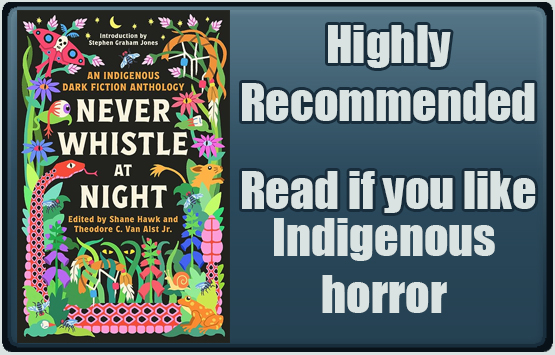
Never Whistle at Night edited by Shane Hawk and Theodore C. Van Alst Jr.

Never Whistle at Night edited by Shane Hawk and Theodore C. Van Alst Jr.

Formats: Print, audio, digital

Publisher: Vintage

Genre: Ghosts/Haunting, Historic Horror, Killer/Slasher, Monster, Myth and Folklore, Occult, Psychological Horror

Audience: Adult/Mature

Diversity: Indigenous American (Alaskan Native, Pueblo, Comanche, White Earth Nation, Cree, Georgian Bay Metis, Mohawk, Cheyenne-Arapaho, Hidatsa Mi’kmaw, Cherokee, Tłı̨chǫ Dene, Hidasta, Mandan, Sosore, Sioux Penobscot, Chickasaw, Choctaw, Sicangu Lakota, Edisto Natchez-Kusso, Lipan Apache, Anishinaabe)

Content Warnings (Highlight to view): Alcohol Abuse, Animal Death, Child Abuse, Child Endangerment, Death, Drug Use/Abuse, Forced Captivity, Gaslighting, Gore, Illness, Oppression, Mental Illness, Pedophilia, Racism, Rape/Sexual Assault, Sexual Abuse, Slurs, Torture, Verbal/Emotional Abuse, Violence

Blurb

Many Indigenous people believe that one should never whistle at night. This belief takes many forms: for instance, Native Hawaiians believe it summons the Hukai’po, the spirits of ancient warriors, and Native Mexicans say it calls Lechuza, a witch that can transform into an owl. But what all these legends hold in common is the certainty that whistling at night can cause evil spirits to appear—and even follow you home.

These wholly original and shiver-inducing tales introduce readers to ghosts, curses, hauntings, monstrous creatures, complex family legacies, desperate deeds, and chilling acts of revenge. Introduced and contextualized by bestselling author Stephen Graham Jones, these stories are a celebration of Indigenous peoples’ survival and imagination, and a glorious reveling in all the things an ill-advised whistle might summon.

 received this product for free in return for providing an honest and unbiased review. I received no other compensation. I am disclosing this in accordance with the Federal Trade Commission’s 16 CFR, Part 255: Guides Concerning the Use of Endorsements and Testimonials in Advertising.

There are many recognizable names in this collection: Rebecca Roanhorse, Richard Van Camp, Cherie Dimaline, Mona Susan Power, Darcie Little Badger, and Waubgeshig Rice. There’s even a foreword by Stephen Graham Jones. But I was especially excited to be introduced to some new (to me) Indigenous authors.

The stories in the anthology vary from fun campfire stories about werewolves (Night Moves by Andrea L. Rogers) and ghosts (Night in the Chrysalis by Tiffany Morris) to more serious and disturbing tales about residential school sexual abuse (Sundays by David Heska Wanbli Weiden), mental health (The Prepper by Morgan Talty), stolen land (Limbs by Waubgeshig Rice), and missing and murdered Indigenous women (The Ones who Killed Us by Brandon Hobson). There were bits of Native languages sprinkled throughout the various stories, for example I learned Uguku is “owl” in Cherokee, Kwe’ is “hello” in Mi’kmaq, and Mahsi’ cho is “thank you” in Gwich’in. This felt especially nice to see since so many Native languages are endangered. I can’t possible review all the amazing stories within the collection (and they are all amazing), so I’ll focus on a few of my favorites.

Kushtuka by Mathilda Zeller is about an Alaskan Native woman named Tapeesa. Recently an obnoxious White man named Hank Ferryman and his son Buck have moved to the area to build a monstrous lodge full of stolen Native artifacts. Tapessa is sent to the lodge cook for one of Hank’s parties and on the way the grotesque man asks her to tell him a “Native story.” Tapeesa warns that telling stories after dark could catch the attention of a spirit, but Hank laughs this off as silly superstition. She tells him the story of the Kushtuka, a shape-shifter that can take human form and tries to lure people away. As predicted, the story summons a Kushtuka which attacks Hank’s lodge. We also see this idea of attracting the attention of evil spirits in Before I Go by Norris Black, where a woman’s grieving causes the Night Mother to appear and offer to bring back her dead husband (it doesn’t end well).  

One of the things I related to in Kushtuka was Tapessa being called “basically White” by Hank because her dad is White. As a biracial person myself, having others (especially White people) try and tell you your identity isa pet peeve of mine. Historically, I would’ve been considered Black since my father is Black (due to the “one-drop” rule which I discuss below), despite having light skin. Yet these days most White people label me White because I’m White-passing. In both cases, White people choose my identity for me without listening to what I have to say, much like Hank does for Tapessa.

In White Hills by Rebecca Roanhorse, a White woman named Marissa is judged for having “too much” Native blood by her White in-laws. Marissa is your typical rich, White woman. She’s married to a wealthy business man named Andrew, is very concerned with her appearance, and lives in an HOA neighborhood in a big house. After going to the country club to announce her pregnancy to her husband, Marrissa makes the mistake of mentioning she’s a small percentage of Native (in reference to not being offended by a racist mascot) and her husband becomes visibly upset. The next day Elayne, Andrew’s mother, takes Marissa to a “specialist” who has racist phrenology drawings on the wall. Elayne explains that she doesn’t want a “mutt” grandbaby who may be dark skinned and “savage” (despite Marissa being white). The way in which Elayne views Marissa’s child is very reminiscent of the “one drop” rule. The one-drop rule was a legal principle based on a form of hypodescent, the assignment of a mixed-race child to the ethnic group considered “lower status.” In other words, anyone with Black ancestry (no matter how far back) was considered Black. There were strict classifications for mixed-race individuals that were given offensive names like “Mulatto” and “octoroon,” I discuss more about how this racist system allowed the US to hold up White supremacy here. I mentioned above how annoying it is when other people (especially White people) decide my identity for me, butit’s even worse when the government does it.

And this leads me to blood quantum. Blood quantum is highly controversial and personal, and since I’m not Indigenous and therefore shouldn’t weigh in on such a heated debate I will tread carefully and stick to the facts as best I can. If you’re not familiar, Blood Quantum laws were enacted by the United States government to determine if someone was considered Native or not dependent on their degree of Native ancestry. The first “Indian Blood law” was originally created in 1705 when the Virginia government wanted to limit the civil rights of Native people and people of Native descent. Some Native tribes continue to use blood quantum to determine who can enroll for tribal membership, others do not. Leah Myers, a member of the Jamestown S’Klallam tribe, gives an example of the importance of tribal enrollment in her Atlantic essay:

“Tribal citizenship is more than symbolic. It determines eligibility for educational assistance, medical care, and other social benefits. Plus, only members can attend citizen meetings and vote in tribal elections. If my future children don’t meet the blood requirements for my tribe, they could still participate in events, cultivate plants in the traditional-foods garden, and take Klallam-language courses. But no matter how much they served the community in love and time, they would be deemed a ‘descendant’ and marked as separate.”

Here’s a guide to Blood Quantum that gives both the arguments for and against blood quantum (full transparency, most Native sources I looked up were against these laws). Basically, blood quantum proponents argue that getting rid of blood quantum rules will make scarce resources even scarcer due to population growth and that it will allow disconnected outsiders and pretendians to join the tribe, which will erode their culture. Opponents of blood quantum argue that statistically it will eradicate Native nations, and point to the law’s racist origins which were intended to control and erase Indigenous people. It also makes relationships complicated, as Indigenous people must calculate their potential children’s percentage of Native blood and if they can enroll or not, which can put a strain on families. Blood quantum also conflicts with traditional Indigenous ideas about kinship and has“no basis in Native American traditions.” Essentially, both proponents and opponents disagree on the best way to preserve their tribal nations.

This idea is explored more fully in the story Quantum by Nick Medina. A woman named Amber is so obsessed with blood quantum and getting her children on the tribal roll that she favors her son Grayson, who’s 5/16 Native, while ignoring his brother Sam, who is only 1/8 Native, to the point where Sam is practically feral. She even tries to steal blood from a deceased Native man from their tribe so she can inject it into Sam.

Another story I enjoyed is Collections by Amber Blaeser-Wardzala, an incredibly creepy story about collecting human remains. Professor Smith, a liberal White woman, collects the heads of all the students she’s helped. She’s very proud of her collection: she has all the sexualities and genders, all the religions, and almost all the races. An Indigenous head would be her “white whale.” Megis (called Meg by the White professor) is understandably horrified by the collection, as is one of her Black classmates, but none of her white classmates seem to be. Professor Smith implies she wants to help Megis so she can have her head for her collection. Megis, the first person in her family to go to college, is desperate to stay on Professor Smith’s good side so she can maintain her scholarship and get a good job, and therefore doesn’t have much choice but to stay in the house of horrors. While an extreme example, the story underlines how troubling it is when museums collect human remains without consent and how academics will treat bodies as mere curiosities

“When [Native American artifacts and human remains] were acquired, collectors weren’t thinking of Indigenous peoples as human beings. People were resources, and human remains were to be preserved alongside pots” says Jacquetta Swift, the repatriation manager for the National Museum of the American Indian and member of the Comanche and Fort Sill Apache tribes. It’s the unfortunate reality that most human remains on display and in private collections, are unethically sourced from BIPOCs against their wishes.

This theme is also lightly touched on in Navajos Don’t Wear Elk Teeth by Conley Lyons where a Native man named Joe has a summer fling with White man named Cam. Cam collects teeth, some of which turn out to be human (he claims his last boyfriend was a Navajo man who gave him an elk tooth for “good luck” which Joe is dubious about). One of Joe’s friends refers to this as “bad medicine” and suggest Joe get an elder to sage his house. 

Not all the stories are quite so dark, however. Snakes are Born in the Dark by D. H. Trujillo felt like a Goosebumps book or a fun story kids tell to scare each other, and I thoroughly enjoyed it. In the story, an Alaskan Native boy named Peter goes hiking in the woods with his white cousin Maddie and her rude boyfriend Adam. They come across Native petroglyphs in the Four Corners desert which Maddie and Adam both immediately touch. Peter warns them not to touch the carvings but Adam continues to do so while mocking him. Unsurprisingly both Maddie and Adam suffer unpleasant (though non-lethal and impermanent) fates which results in a humorous ending. It’s a fun twist on the classic “Indian curse” where we (and Peter) are rooting for the White people to get their comeuppance.

I could go on and on about the stories in the anthology, like Hunger by Phoenix Boudreau where two Cree college girls, Summer and Rain, outsmart a Wehtigo. Or Scariest. Story. Ever. By Richard Van Camp that touches on who gets to tell Native stories and how to share culture without stealing it. They’re all great. I also felt like I learned a lot while reading the anthology.

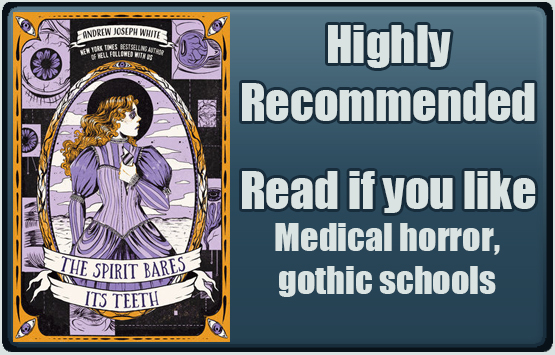
The Spirit Bares Its Teeth by Andrew Joseph White

The Spirit Bares Its Teeth by Andrew Joseph White

Formats: Print, audio, digital

Publisher:Peachtree Teen

Genre: Blood & Guts, Body Horror, Ghosts/Haunting, Mystery, Gothic

Audience: Young Adult

Diversity: Neurodiversity (Autism), transgender characters, queer character

Takes Place in: LA, California

Content Warnings (Highlight to view): Abelism, Animal Death, Bullying, Child Abuse, Child Death, Child Endangerment, Death, Forced Captivity, Gaslighting, Gore, Homophobia, Kidnapping, Medical Torture/Abuse, Medical Procedures, Miscarriage, Oppression, Pedophilia, Physical Abuse, Rape/Sexual Assault, Self-Harm, Sexism, Slurs, Slut-Shaming, Torture, Transphobia, Verbal/Emotional Abuse, Victim Blaming, Violence

Blurb

Mors vincit omnia. Death conquers all.

London, 1883. The Veil between the living and dead has thinned. Violet-eyed mediums commune with spirits under the watchful eye of the Royal Speaker Society, and sixteen-year-old Silas Bell would rather rip out his violet eyes than become an obedient Speaker wife. According to Mother, he’ll be married by the end of the year. It doesn’t matter that he’s needed a decade of tutors to hide his autism; that he practices surgery on slaughtered pigs; that he is a boy, not the girl the world insists on seeing.

After a failed attempt to escape an arranged marriage, Silas is diagnosed with Veil sickness—a mysterious disease sending violet-eyed women into madness—and shipped away to Braxton’s Finishing School and Sanitorium. The facility is cold, the instructors merciless, and the students either bloom into eligible wives or disappear. When the ghosts of missing students start begging Silas for help, he decides to reach into Braxton’s innards and expose its guts to the world—if the school doesn’t break him first.

Featuring an autistic trans protagonist in a historical setting, Andrew Joseph White’s much-anticipated sophomore novel does not back down from exposing the violence of the patriarchy and the harm inflicted on trans youth who are forced into conformity.

I received this product for free in return for providing an honest and unbiased review. I received no other compensation. I am disclosing this in accordance with the Federal Trade Commission’s 16 CFR, Part 255: Guides Concerning the Use of Endorsements and Testimonials in Advertising.

Silas is an autistic trans boy living in Victorian London who wants nothing more than to be a surgeon like his brother, George, and his idol James Barry. Unfortunately for Silas, the world still sees him as a young girl with violet eyes.

In White’s alternative history people born with violet eyes are Speakers, those who can open the Veil that separates the living and dead to communicate with ghosts. But only violet-eyed men are permitted to be mediums. It is believed that women who tamper with the Veil will become unstable and a threat to themselves and others. Veil sickness is said to be the result of violet-eyed women coming into contact with the Veil and is blamed for a wide range of symptoms from promiscuity to anger, but is really just the result of women who don’t obediently follow social norms. Thus, England has made it strictly illegal for women to engage in spirit work. After Silas’ failed attempt to run away and live as a man, he is diagnosed with Veil sickness and carted off to Braxton’s Finishing School and Sanitorium to be transformed into an obedient wife. Braxton’s is your typical gothic school filled with sad waifs and dangerous secrets, namely that girls keep disappearing. The headmaster is a creep and his methods for curing young girls are abusive. Despite the danger, Silas is determined to get to the bottom of the mysterious disappearances and find justice for the missing girls.

Violet-eyed women are highly valued as wives who can produce violet-eyed sons and are in high demand among the elite. Silas is no different, and his parents are eager to marry him off to any man with money. If being made to live as a girl weren’t bad enough, the idea of being forced to bear children is even more horrific to Silas. As someone who struggles with Tokophobia myself, I found White’s descriptions of forced pregnancy to be a terrifying and especially disturbing form of body horror. Because of Silas’ obsession with medicine, the entire book is filled with medical body horror. There are detailed descriptions of injuries and surgeries, medical torture, and an at-home c-section/abortion. Personally, I loved all the grossness and the detailed descriptions of anatomy and medical procedures. But The Spirit Bares its Teeth is most definitely not for the squeamish or easily grossed-out. I appreciated that in the afterword White made a point of mentioning that in the real world, it was usually racial minorities who were the subject of medical experimentation (rather than wealthy White women), and then recommended the books Medical Apartheid by Harriet A. Washington and Medical Bondage by Deirdre Cooper Owens for readers to learn more.

I was also happy to see an autistic character written by an autistic author. Stories about Autistic individuals often are told by neurotypical people who characterize autism as “tragic” or as an illness that needs to be cured. In The Spirit Bares its Teeth, neurodiversity is humanized and we see how harmful a lack of acceptance and understanding of autism is. Silas is forced to mask by society, and we see how difficult and harmful masking is to him. He is taught by his tutors to ignore his own needs in favor of acting the way others want. They reinforce the idea that acting “normal” (i.e. neurotypical) is the only way anyone will tolerate him. Silas’ tutors use methods similar to the highly controversial Applied Behavior Analysis (ABA) to force him to behave in a manner they deem appropriate. He is not allowed to flap his hands, pace or cover his ears at loud noises, and is forced into uncomfortable clothing that hurts his skin and to eat food that makes him sick. He is mocked for taking things literally and punished if he can’t sit still and keep quiet. It’s horrible and heartbreaking.

Although I’m not autistic, I do have Attention Deficit Disorder (ADD), a condition which has many overlapping symptoms with autism, including being easily overstimulated by sensory input. I have texture issues and White’s description of the uncomfortable clothing Silas is forced into made my skin itch in sympathy. It sounded like pure hell, and poor Silas can’t even distract himself with stimming so he just has to sit there and endure it. After meeting a non-verbal indentured servant whose autistic traits are much more noticeable, he also acknowledges that his ability to mask gains him certain privileges as he can “pass” as neurotypical (even though he should never have to pass in the first place and doing so is extremely harmful to his wellbeing).

In addition to its positive autism representation, White also does an excellent job portraying the struggles of being a trans person forced to live as their assigned gender. Interestingly, this is the first book with a transgender main character I’ve read where said character isn’t fully out or living as their true gender. Part of the horror of the story is that Silas can’t transition as he’s in an unsupportive and abusive environment. I also found it interesting that Silas is both trans and autistic as there’s an overlap between autism and gender identity/diversity.

The Spirit Bares its Teeth is a suspenseful and deeply disturbing gothic horror story about misogyny, ableism, and how society tries and controls women. I was absolutely glued to this story and could not put it down, no easy feat when my ADD demands constant distraction. Each revelation was more horrifying than the last and by the end I was terrified of what secrets Silas would uncover next. 

Navigation

Social Media

Search by Tags

To learn more about the Age Group, Diversity, and Genre tags, click here.

Age Groups

Diversity

Genre

Support the Blog

Search

Links

In These Gilded, Ghostly Hearts by Gwendolyn Kiste

In These Gilded, Ghostly Hearts by Gwendolyn Kiste

Formats: Print, audio, digital

Publisher: Creature Publishing

Genre: Ghosts/Haunting, Gothic, Historic Horror, Romance

Audience: Adult

Diversity: Lesbian main character and bisexual side character

Takes Place in: New York

Content Warnings (Highlight to view): Alcohol Abuse, Child Abuse, Death,  Forced Captivity, Homophobia, Suicide

Blurb

In 1955, Daisy Buchanan is found dead in an abandoned West Egg mansion, but her daughter Mel knows she’s really been gone for years. No one knows whether Daisy was murdered, or if it was a simpler, slower death: her yearslong spiral of alcohol, abuse, and helplessness. But when Mel enters the estate, she finds Daisy’s ghost, somehow frozen at twenty-three, and a charming, bleeding phantom that used to be Jay Gatsby.

To free her mother, Mel must carve a path through family secrets and decaying revelers: deep into Gatsby’s starving house as it gorges itself on unfulfilled love and grows stronger every night.

I received this product for free in return for providing an honest and unbiased review. I received no other compensation. I am disclosing this in accordance with the Federal Trade Commission’s 16 CFR, Part 255: Guides Concerning the Use of Endorsements and Testimonials in Advertising.

The year is 1955. Daisy Buchanan is dead, her body discovered in Jay Gatsby’s abandoned estate in West Egg. Daisy’s now adult daughter, Pamela “Mel” Buchanan, and one of Daisy’s few remaining friends, Jordan Baker, travel from New York City to investigate the mysterious death. They learn that Daisy was working with a predatory spiritualist named Harrison to summon the ghost of her lost lover, Jay Gatsby. Harrison convinces the two women to return to Gatsby’s old home, now dripping with ectoplasm, and complete the séance with him. Soon the mansion is filled with ghosts, partygoers from bygone days, Gatsby himself, and Daisy. The partygoers are Stone Tape hauntings, a mere echo of the past. Gatsby’s ghost, on the other hand, is an intelligent haunting who is able to interact with Mel, who soon learns his obsession with Daisy has continued after his death.

Mel and Daisy have a complicated mother/daughter relationship. No matter how badly their mother treats them, children still crave their mother’s love. Mel is parentified by Daisy who is helpless and broken after losing her lover Gatsby, her husband Tom, and her lifestyle. Mel explains “Once the cash dried up and she wasn’t a rich girl anymore, she practically dissolved into sea foam before my eyes.” Daisy is not a resilient woman–understandable since she was raised to be a pretty bauble on a rich man’s arm. Daisy was a fairly passive character in Fitzgerald’s novel, a beautiful woman for Gatsby to idolize and Tom to possess. It was satisfying, however, to read that toxic alpha-male Tom threw himself off the Brooklyn Bridge after losing everything in the stock market crash of ’29. A fitting end to an awful man. Unfortunately, it means he leaves his wife and daughter penniless and alone. Kiste often writes books for “lost” women and girls who are trapped in the past and mistreated by an uncaring society who doesn’t understand them. The Marys in Pretty Marys All in a Row, the Rust Maidens in the novel of the same name, Talitha Velkwood and her friends in The Haunting of Velkwood, and now Mel and Daisy Buchanan.

You don’t necessarily have to have any knowledge of The Great Gatsby prior to reading In These Gilded, Ghostly Hearts but it does certainly help to be able to familiarize yourself with the characters and themes. There are also lots of fun little callbacks to the original book, like Gatsby’s automatic orange juicer machine. Just don’t make the same mistake I did and try and compare the writing in the two. I re-read F. Scott Fitzgerald’s famous work right before Kiste’s so I’d have a refresher and I do think it made me more judgmental of the writing in the latter. Don’t get me wrong, I generally love Kiste’s writing, two of my favorites being Pretty Marys All in a Row and The Haunting of Velkwood. I’m not at all implying that this is not a well-written story. But very few books are going to be able to stand up to one of the “Great American Novels” and trying to compare the two is a disservice to Kiste’s novella.

While Gatsby is written as a sympathetic character in the original book, I like how Kiste points out how incredibly creepy his obsession with Daisy is. Some might view his grand gestures as romantic but honestly, they always felt like borderline incel behavior to me. Gatsby views Daisy as a prize to be won rather than a person, and if he has enough money of course she’ll leave Tom for him. The main reason we’re sympathetic to Gatsby is because Tom is portrayed as the bigger asshole with no redeeming qualities, and because Nick sees Gatsby as sympathetic. Daisy is “supposed” to choose the heroic Gatsby over the brutish Tom, and when she doesn’t, she’s cast as the villain. Yet, does she really have a choice?  Herstory and Daisy Buchanan by Leland S. Person, Jr. quotes the numerous men who have described Daisy as “vulgar and inhuman,” a “Dark Destroyer,” and the “anti-virgin…the prototype of the blasphemous portraits of the Fair Goddess as bitch” who “preyed on” Gatsby. Yikes! But Person viewed Daisy as more victim than conniving, selfish woman. She’s a woman in the 1920s, from an old money family who’s expected to marry an old money man, not some nouveau riche who may or may not have a criminal history. Daisy has no way of earning a living herself, she’s completely dependent on men for her financial security, and always had been. She’s also under immense societal expectations; she can’t simply leave her husband to have the life she wants with Gatsby. We also known Tom is abusive, as shown when he breaks his mistress’ nose.Leaving him was unlikely to be easy. I don’t think any of that necessarily makes her a good person; she’s just an imperfect victim. And this seems to be the characterization that Kiste goes with. Daisy wasn’t a good mother, but that doesn’t mean she doesn’t deserve sympathy or Gatsby’s obsessive idolization. Similarly, as a lesbian, Mel is also unable to be with the ones she loves, first Jordan and then her coworker, Vera.

I loved how queer Kiste’s book was. Mel is gay, Jordan bisexual, and Tom’s implied crush on Gatsby is no longer subtext. In These Gilded, Ghostly Hearts takes place during the Lavender Scare of the 1950s, an anti-LGBTQ+ witch hunt, so Mel lives in constant fear of having her sexuality discovered. At one point she and Jordan go to the Bagatelle on University Place. The Bag, as it was more commonly known, was a real lesbian bar that was popular in the 1950s. I love that little bit of realism that Kiste added to the story. Audre Lorde and Ann Bannon both wrote about the bar and how it shaped their pre-Stonewall experience. The Bag was owned by the mafia and frequently raided by police. A red light would go off to warn patrons when they vice squad showed up, which happens to Mel at the bag one night.

Kiste is not the first to write about the Great Gatsby through a queer lens. In 1963 Lionel Trilling characterized Jordan Baker as “vaguely guilty, vaguely homosexual.” Nearly thirty years later The International Fiction Review published The Sexual Drama of Nick and Gatsby by Edward Wasiolek who argued that Nick has “homosexual  leanings” and intense feelings for Gatsby. The Chosen and the Beautiful by Nghi Vo (author of The Empress of Salt and Fortune) also imagines Jordan and Gatsby as bisexual, and Nick and Gatsby have a fling. Self-Made Boys: A Great Gatsby Remix by Anna-Marie McLemore and The Pursued and the Pursuing by AJ Odasso explore a queer relationship between Gatsby and Nick.

Kiste’s writing can best be described as “haunting;” beautiful, unsettling, nostalgic, and melancholy, lending itself well to a ghost story. Her stories are less “in your face” horror with gore and blood and instead rely on atmosphere to create a general sense of unease commonly found in gothic horror. For some readers, it may feel like the pacing is dragging, as there’s no sense of urgency and not a lot of action because this isn’t that kind of book. This is a novella meant to be savored rather than rushed through. So, while it won’t be everyone’s cup of tea, I think fans of slow burn horror and character driven story will enjoy In These Gilded Ghostly Hearts.

I did feel like the book needed a little more show and a little less tell. It seemed like Mel was constantly explaining things to the audience that didn’t necessarily need to be spelled out. At the same time, I thought it was awesome that Mel was middle aged and Jordan in her fifties. It’s so rare to find older women protagonists in fiction. Male protagonists have a wide range of ages, but women seem to always skew young. What’s more, neither character is a wife or mother. While I don’t think In These Gilded, Ghostly Hearts is as strong as some of Kiste’s other novels and novellas, it’s still a solid, spooky read perfect for autumn.
 

My Monsters Ain’t Like Yours by R.J. Joseph

My Monsters Ain’t Like Yours by R.J. Joseph

Formats: Print, audio, digital

Publisher: Quill & Crow Publishing House

Genre: Eldritch Horror, Folk Horror, Ghosts/Haunting, Historic Horror, Monster, Zombie

Audience: Adult

Diversity: Black, African/American characters and author, queer and bisexual characters

Takes Place in: Texas

Content Warnings (Highlight to view): Animal Abuse, Animal Death, Body Shaming, Cannibalism, Child Abuse, Child Death, Child Endangerment, Childbirth, Death, Drug Use/Abuse, Forced Captivity, Incest, Miscarriage, Oppression, Pedophilia, Physical Abuse, Racism, Rape/Sexual Assault, Sexism, Sexual Abuse, Slut-Shaming, Suicide, Torture, Verbal/Emotional Abuse, Violence, Vomit 

Blurb

At its core, the horror genre is an effective vehicle for exploring human behavior. From within its terrifying boundaries, and lack thereof, we can examine monstrosity. We can determine how monsters are labeled, analyze the actions of those deemed monstrous, and prophesy the impacts this labeling and actions have on the world around us.

Monsters are personal. Monsters are universal. These facts create an intriguing juxtaposition where the things deemed monstrous or frightening can be shaped by personal experiences, while also representing many aspects of the human condition; our fears are much more similar than dissimilar. This means my monsters are absolutely like yours: they are our collective nightmares.

My Monsters Ain’t Like Yours reflects this irony through Black feminist intersectional horror at its rawest.

I received this product for free in return for providing an honest and unbiased review. I received no other compensation. I am disclosing this in accordance with the Federal Trade Commission’s 16 CFR, Part 255: Guides Concerning the Use of Endorsements and Testimonials in Advertising.

While many of the monsters in the collection are supernatural (Suffer the Little Children, The Crazy   with Daisy, Higher Education, Something Wicked Came for Me, Welcome, Skinny Minnie, Sweet Sunday Supper Smile, etc.) the most terrifying ones are the human monsters (Regrets Never Die, The Collector, Sweet Sunday Supper Smile, Her Heart’s Desire, No Tricks Only Treats, The Preying Family, Sad, Spooky Sally, etc.). Interestingly, some of the supernatural monsters are friendly and helpful creatures/spirits who protect the protagonists from other monsters, both literal and figurative. Humans, after all, are much worse than some imagined creature. Then there are the metaphorical “monsters” of grief, loneliness, and trauma that haunt the protagonists.

There are a lot of bad heterosexual relationships in the anthology.  These range from Where the Horizon Kisses the Sky in which the husband is neglectful, Endless Possibilities where he’s a selfish loser, to Her Heart’s Desire where he’s outright abusive towards his wife. In all these stories the wife yearns for something better and uses supernatural means to get it, with varying degrees of success. In The Badly Terrible, Absolute Worst she doesn’t even get that chance. But queer relationships, like in The Crazy with Daisy and Witness Bearer, are shown in a more positive light.  A report by the Institute for Women’s Policy Research and the National Domestic Worker’s Alliance states that “More than 40 percent of Black women experience physical violence by an intimate partner during their lifetimes (41.2 percent), compared with 31.5 percent of all women.” And a study published in the Lancet reported that Black women are also nearly six times as likely to be murdered than white women. Thankfully there are resources like Ujima that support Black women who are in domestic violence situations, even as the justice system continues to fail them.

In Endless Possibilities and Her Heart’s Desire the wife herself becomes a monster to escape her bad marriage, and in the latter, get revenge on her horrible husband. Then there’s Tanita in The Collector, a serial killer who murders for the fun of it. There’s something incredibly satisfying about women embracing their monstrosity and rage, especially Black women. Those with marginalized identities are often cast as monsters in other people’s stories so why not reclaim the title? I especially like that feminine monstrosity in Endless Possibilities and Her Heart’s Desire is not tied to sexuality. While I appreciate women like Tanita reclaiming their sexuality and using it to seduce and murder men à la Jennifer’s Body (2009) and The Hunger (1983) sometimes it feels like the majority of female monsters are temptresses ( leading men to their death. And it can start to get a little old.

Can’t they just be horrible and violent without wanting to have sex with their victim? Plus, there’s the unfortunate implication that women who have sex on their own terms are evil and they go against the natural order of things by overpowering men. So, I appreciated that Joseph gave us some nice variety. The book even has monstrous children (#GIRLMOM and Suffer the Little Children) though in both cases the children are embraced by the main character rather than shunned for the monstrosity.

Sweet Sunday Supper Smile and No Tricks Only Treats are stories containing child abuse, though the abusers get their comeuppance in both. Then there’s Sad, Spooky Sally which is especially disturbing, so much so that it comes with its own set of content warnings before the chapter, rather than in the index. It’s an absolutely heart-breaking story with a bittersweet ending and one of my favorites in the collection. But it’s also very triggering, so make sure you check out those content warnings before reading it. The same goes for Regrets Never Die and Witness Bearer. They’re both very dark, with the latter being about a girl who can see the worst things a person has ever done. She witnesses some truly awful memories, so I appreciate that Joseph included content warnings for all the stories in the book’s index.

Those who Teach Pay Knowledge Forward stood out in the collection, as it was sweet rather than scary, A ghost story where the ghosts aren’t the source of fear. It also had a nice message about helping to educate the next generation so they can succeed. I love how so many of the Black women in the collection are intelligent and well educated, ranging from college students (The Collector) and graduate students (Whole New World), to teachers (Those Who Teach Pay Knowledge Forward) and college professors (Grand Opening, Higher Education, Something Wicked Came for Me). The young woman in Important Things is sent on an all expenses paid trip to Palm Springs for a symposium because she excels in her high school classes. In 1995 14% of Black women between 25 to 34 held a bachelor’s degree compared to 38% in 2024 according to the Pew Research Center.

There are so many great stories in the collection, I’d be pressed to pick a favorite, though I did especially enjoy Regrets Never Die, #GIRLMOM, Endless Possibilities, Those Who Teach Pay Knowledge Forward, and Something Wicked Came for Me. While Black women and children’s trauma is a reoccurring theme of My Monsters Ain’t Like Yours, it’s not the only focus of the anthology. If every story were about Black trauma and abuse, it honestly may have been too much for me. Instead, Joseph includes a bunch of fun, spooky stories to offset the heavier stuff so the collection never feels too dark and depressing. Instead, we get a nice balance.

I really liked this because while horror is a great way to process trauma, Black horror shouldn’t be pigeonholed into stories of Black pain. I love Get Out (2017), it’s one of my favorite films, but if that was the only kind of Black horror story told by Hollywood, it would start to feel like the suffering of Black people was being fetishized for entertainment. There’s a reason why Peele’s next two films, Us (2019) and Nope (2022) aren’t rooted in Black trauma. So, while there are plenty of stories about abuse, bad relationships, and the general mistreatment of Black women and children, there are also enough tales about living mannequins, small fanged creatures, and ghosts to offer the reader a breather.

Until the Last Light Goes Out by Courtney Gould

Until the Last Light Goes Out by Courtney Gould

Formats: Print, audio, digital

Publisher: Wednesday Books

Genre: Ghosts/Haunting, Gothic

Audience: Young Adult

Diversity: Queer main character and side characters

Takes Place in: Miami

Content Warnings (Highlight to view): Alcohol Abuse, Bullying, Child Death, Child Endangerment, Childbirth, Death, Forced Captivity, Gaslighting, Homophobia, Violence

Blurb

You may not escape, but the truth will.

Twenty-five years ago, the Ripley Memorial High School senior class entered the luxurious Kaleidoscope Key resort deep in the remote Florida Keys. Despite international intrigue and years of investigation, no one truly knows how the 183 students died. And they never will, since the five survivors of the massacre have never spoken a word about what happened to them that night.

Paige Keller, daughter of one of the Kaleidoscope Key Massacre’s infamous survivors, has grown up determined to steer her life away from the resort and the unsolved mysteries her ex-best friend, KJ, can’t leave alone. Paige has moved to a fancy new college and it seems that, finally, she’s banished the shadows of Kaleidoscope Key completely. But when she’s called home on the 25th anniversary of the massacre, she finds that KJ has gone missing.

Paige knows there’s only one place KJ could be: her obsession, the now-abandoned resort. When Paige and the remaining Survivors’ Kids go in after her, they’re forced to confront their―and their parents―pasts once and for all.

Kaleidoscope Key is waiting, and it’s starving. Once they find their way inside, there may not be a way out. And one way or another, the truth of the massacre will come to light.

Captivating and chilling, Courtney Gould’s Until The Last Light Goes Out is a horror story, a love story, and an ode to the pain passed between generations that you won’t soon forget.

On May 21st, 2001, the senior class at Ripley Memorial high school, along with staff and chaperones, were found dead in their beds at the newly opened Kaleidoscope resort. Only five students survived. Too traumatized to explain what happened, the “Kaleidoscope Massacre” (as it came to be called) remained a mystery for 25 years. Thirteen years later, Casey, one of the massacre’s survivors, returns to the Kaleidoscope for reasons unknown and is found dead inside the resort the next day leaving her daughter, Paige, all alone.

Cut to the present day. Paige, now in college, has returned to Miami for the 25-year memorial of the massacre. When speaking to the children of the other four survivors Paige learns her former best friend, KJ, has been missing for a month. Even though the two had a falling out, Paige will do anything in her power to find KJ, even if it means returning to the site of her mother’s murder. She gets her chance when the son of the Kaleidoscope’s current owner tells Paige that he’s headed there to film some urban exploring videos. But what she discovers at the abandoned hotel is much more than she bargained for.

Patented in 1817 by Scottish inventor David Brewster, the kaleidoscope is a toy made of mirrors enclosed in a cardboard tube that when turned creates ever-changing mandala-like patterns by reflecting the colored glass at one end of the tube. The name kaleidoscope, derived from ancient Greek, translates roughly as “to look at beautiful forms.” An appropriate name for the resort, as the Kaleidoscope is itself dynamic, constantly morphing into something new. But, beneath its surface, beauty hides something sinister and hungry. A neon gothic nightmare that feeds on pain and plays mind games, the Kaleidoscope resort is its own character. Fans of liminal space stories such as Backrooms and Exit 8 will enjoy the never-ending maze that is the Kaleidoscope.

Paige, who’s pragmatic and logical with a need to always be right, deals with the Kaleidoscope by simply ignoring its existence and trying to get as far away as possible. Paige is also the last to admit that something supernatural is going on, much to KJ’s frustration. On the opposite end on the spectrum is KJ who’s obsessed with discovering the resort’s secrets to try and help her mother Tess, who was completely broken from her experience there. Neither has a healthy coping mechanism for the generational trauma they’ve been burdened with. Both girls need to find a healthy middle ground so they can work together to try and find a way out.

I found myself very emotionally invested in the fates of Paige and KJ and loved watching them grow as characters. The sons of the other survivors? Not so much. It was hard to care about the boys being in danger when we never really got the chance to know them, mostly through Paige’s descriptions of them rather than learning for ourselves through their dialogue and actions. It also meant we couldn’t tell if their behavior was “out of character” or just the hotel making them behave a certain way.

The story bounces back and forth between the past, when Casey and her friends first visit the Kaleidoscope for senior night, and the present, when their children are trapped. As the book progresses, the timelines start to blur, emphasizing the liminal space within which they find themselves trapped. Casey’s story focuses on her relationship with her best friend, Tess, who’s rebellious and desperate to be one of the popular girls. Then there’s her other best friend, Summer, an introverted “good girl” who’s been recently outed as a lesbian, leading to her being bullied. Casey is torn between her loyalties to both friends as Tess tries to push Summer out of their friend group for being “uncool.” Instead of standing up to Tess like she should, Casey simply does nothing, unwilling to lose Summer, but not wanting to lose Tess either. Friendship and loyalty are major themes in Until the Last Light Goes Out, with both Casey and Paige fighting to keep their friendships with Summer and KJ respectively after abandoning them. To Gould’s credit, the relationships never feel reduced to superficial “teen drama,” and you can feel the emotional impact they have on their characters. 

When I first read that the mass deaths in 2001 were called “the Kaleidoscope massacre” I was expecting blood and body parts everywhere, but no, everyone just died in their sleep. The story is pretty safe for more squeamish horror fans, or those just looking for a haunted house (or in this case hotel) story. There are a few scenes where people get stabbed or killed, but the gore isn’t excessive or described in great detail, and a lot of it happens “off screen.”

The story is suspenseful and, for the most part, managed to hold my attention for long periods of time. Towards the middle, things started to feel a little repetitive (you can only wander down so many endless corridors before things start to drag) and the pacing suffered for it. I think the book would have benefited from some tightening up in the second act, but otherwise things moved along well, and towards the end I found I couldn’t put it down. I personally felt that the last chapter, which elaborated on the ending, was unneeded and it would’ve worked better if things were left vague. I believe most readers could’ve inferred what happened on their own. Maybe some editor decided that teens lack media literacy and needed an explanation spoon-fed to them. Despite a few flaws, Until the Last Light Goes Out is deeply moving and has the emotional depth that young adults deserve, but that so much Y/A is lacking.


Dead First by Johnny Compton

Dead First by Johnny Compton

Formats: Print, audio, digital

Publisher: G.P. Putnam’s Son

Genre:  Ghosts & Hauntings, Mystery, Occult

Audience: Adult

Diversity: Black author and main character, bisexual main character, Korean-American side character

Takes Place in: Texas

Content Warnings (Highlight to view): Alcohol Abuse, Amputation, Child Death, Death, Drug Use/Abuse, Forced Captivity, Gore, Kidnapping, Mental Illness, Police Harassment, Racism, Self-Harm, Suicide, Torture, Violence

Blurb

When private investigator Shyla Sinclair is invited to the looming mansion of mysterious Texan tycoon Saxton Braith, she’s more than a little suspicious. The last thing she expects to see that night is Braith’s assistant driving an iron rod straight through the back of his skull. Scratch that—the last thing she expects to see is Braith’s resurrection afterward.

Braith can’t die, it turns out, but he has no explanation for his immortality, and very few intact memories of his past. Which is why he wants to pay Shyla millions to investigate him, and bring his long-buried history to light.

Shyla can’t help but be intrigued, but she’s also trapped by the offer. Braith has made it clear that he knows she’s the only person he can trust with his secret, because he knows all about hers.

Bold, atmospheric, and utterly frightening, Johnny Compton’s Dead First is spine-chilling supernatural horror about the pursuit of power and the undying need for reckoning.

Private investigator Shyla has just finished a case for a man named Massimo Dante, who thought he was the antichrist. He paid her well enough that she was able to buy herself a house and help her cousins out financially. She doesn’t need to accept billionaire Sexton Braith’s case, but curiosity gets the better of her. Braith wants Shyla to determine why he’s immortal, which his trusted chauffer, Remy, demonstrates by shoving a fire poker through his skull. Thoroughly freaked out, Shyla is ready to turn him down. Yet, Braith implies he knows her biggest secret–that she killed a man when she was young–and will bring it to light if she doesn’t help him. Little does Shyla know that Braith is hiding his own, much darker, secrets.

I was instantly hooked by the premise for Dead First. I’m a sucker for horror mysteries. While the first half of the book felt a bit slow for my taste, the pace really picks by the midpoint, and each reveal feels more horrific than the last. What starts out as a supernatural mystery eventually morphs into full blown horror. Interesting to note, Dead First seems to take place in the same world as Compton’s Bram Stoker Award nominated novel The Spite House, as there’s a passing reference to The Spite House at the very end of the book.

I liked how Shyla was more morally ambiguous than most protagonists. She’s willing to do some pretty messed up stuff for the ones she loves and to protect her secret. She’s driven by revenge and you can tell her anger is poisoning her, but she’s unwilling to let go of it. Shyla has trouble opening up to others and past experiences have hardened her. This is part of why she broke up with her girlfriend, Jinh. Shyla’s relationship with Jinh is complicated, to say the least. The two clearly still care for each other, but Shyla seems scared to get too close. Shyla first met her ex when she went on Jinh’s podcast, a blend of true crime and supernatural lore that has fans all over the world. Jinh has the ability to speak to the dead, though Shyla doesn’t really believe in Jinh’s power. While I liked Jinh, I felt like her character could have used more development.

I appreciated how the racism in the book is very subtle. You’re not hit over the head with it, but it’s there, hinted at and never outright stated.  For example, Shyla is always concerned about being harassed by the police. If you are a non-Black person who was somehow in a coma all through 2020, or just completely unaware of how cops treat Black people, you might not pick up on it. But it’s obvious Shyla must worry about cops and the busybodies who call them because she’s Black, even if it’s never spelled out for the audience. I liked that Dead First doesn’t feel like it’s written for non-Black people to learn about the horrors of racism. Instead, it assumes the reader is already aware of the systemic racism Black people deal with every day and Compton doesn’t have to delve in to it because it’s not part of the story. As much as I appreciate racism as horror stories, it’s also nice to read Black stories that aren’t focused on racism and Black trauma. Shyla does have trauma, but it has nothing to do with her race (other than the police not working as hard to find a missing Black child).

While the book initially feels more like a supernatural mystery thriller than straight horror, there’s still plenty of gore and some genuinely frightening moments in the second half of the book.  I personally enjoyed it, but I can see the mystery crowd being turned off by the violence and torture, while horror fans may not want to wait through the detective procedural parts of the story to get to the scary stuff. But I believe readers will enjoy the tense, haunted atmosphere, one of the story’s strongest points.


This Thing is Starving Isobel Aislin


This Thing is Starving by Isobel Aislin. Highly Recommended. Read if you like Linghun, The Road to Hell by Terry Benton-Walker

Formats: Print, digital

Publisher: Independently Published

Genre: Ghosts/Haunting, Historic Horror

Audience: Adult/Mature

Diversity: Asexual main character, trans man character, lesbian character

Takes Place in: Pennsylvania

Content Warnings (Highlight to view): Alcohol Abuse, Child Abuse, Child Death, Death, Drug Use/Abuse, Forced Captivity, Gaslighting, Homophobia, Medical Procedure, Mental Illness, Pedophilia, Rape/Sexual Assault, Self-Harm, Sexism, Slurs, Slut-Shaming, Suicide, Transphobia, Victim Blaming, Violence

Blurb

It’s just a house, right? Houses can’t hurt. Houses can’t bleed.

But this house wants you to.

When the Waite family moves into their new home, they don’t bargain on being unwanted guests. But this house has deep-rooted, blood soaked history, and it’s angry. This Thing is Starving is an unflinchingly feminist love letter to the abused, bursting with feminine rage and told from the perspective of a haunted house.

Warning, this review discusses abuse, rape, and the sexual abuse of minors.

The house on 4377 N. Oscar St is haunted. But this is not your typical haunted house story. This story is told from the house’s point of view as it witnesses the tragedies that befall its owners throughout the year. The house is haunted by four women and one trans boy. The first, and oldest, is Lillian. She lived in the house with her husband in the 1920s and is the most unstable of the five ghosts. Jason was a teenaged, closeted trans boy from the 1950s. Lila was a lesbian from 1975 who hated her queerness. In 2002 the house was owned by a woman named Karissa, a child abuse survivor who struggles with low self-esteem. The final ghost is Kay, a teenaged girl who died in the house after it was abandoned by Karissa in the early 2000s. All the ghosts are victims of abuse, sexual assault, or other forms of violence at the hands of men, and they all met with tragic ends either by their own hand or at the hands of others.

Veronica Waite and her family are the house’s most recent inhabitants. Her mother, Louise, moved them there after escaping an abusive partner and is doing her best to start over. The house immediately takes a disliking to the family, with its wild and grubby children and Louise who it immediately labels a “bad mother” due to her love of wine, parentification of Veronica, and inability to keep track of all her children. The only exception to the house’s ire is Veronica, whom the house feels strangely drawn to. It views her as “a splotch of brightness amongst the gloom” and tries its best to communicate with the eldest Waite child. Veronica certainly seems happy in the beginning. She finds a new friend quickly, makes the cheerleading team, and even lands a hot, football playing boyfriend. She creates beautiful art to hang in her attic room. But then things start to unravel for the family, and the house can do little to stop it. As Veronica struggles with her asexuality and trying to take care of her siblings, she slowly learns how cruel the world can be to women and girls.

Most of the men in this story are horrible, even an old man whose obituary Louise is editing. I’m sure the “not all men” crowd will object to the fact that almost all the cisgender men (and boys) in the story are awful human beings (admittedly sometimes to the point of feeling like caricatures), but I believe this is intentional. The story is being told from the point of view of the house, and the house hates men. Because the house can only witness what happens within its walls, or the lives of the unhappy ghosts who haunt it, the house rarely gets to see the good parts of humanity. Statistically, the majority or murders and rapes are committed by men, so of course the ghosts are more likely to be victims of male violence, leading to the house believing  that all men are inherently bad. Toward the end of the book, a character named Owen shows up who is devoid of the toxic traits shown by most of the other male characters. While he clearly has a crush on his female coworker, he respects her boundaries, supports her decisions, and keeps his desire to protect her in check. But of course, the house can’t recognize that he’s a good man like the audience can, and immediately hates Owen.

Ironically, the house is reinforcing harmful gender stereotypes because it doesn’t understand the complexities and nuances of abuse. It can only see people as innocent victims (women, girls, and AFAB people) or evil perpetrators (cisgender men and boys). But characterizing men as inherently evil gives them permission to behave horribly, as it rejects the notion that they have control over their actions. Essentially, it’s a more insidious form of “boys will be boys.”  But men can, and need to, do better. The house also conveniently ignores the fact that women can not only support the harmful actions of men, but can be perpetrators themselves, and that men can be victims, but Aislin does not. Lillian is abused by her serial killer husband, but when she finally snaps and kills him, she doesn’t free the women he has chained in the basement. Instead, she replaces her husband as the predator in the house and kills them. She even slut shames her husband’s victims, justifying their rapes and murders to herself. Veronica’s younger twin brothers, Charlie and Sawyer, are also revealed to be victims of their father’s abuse (especially Sawyer). Sadly, like Lillian, Sawyer becomes an abuser himself, acting out what he experienced at the hands of his father on his little sister Leslie. The house makes an exception for Jason, a trans man, another victim of male violence, but not for the twins. I suspect that’s because the house is mildly transphobic, and sees Jason as a woman, even though he’s clearly a man and his ghost has a male-presenting form.

While the house feels a fierce protectiveness of Veronica and her baby sister, it shows a cold indifference to their brothers. Interestingly, Louise was also abused by her husband, yet the house doesn’t group her in with other victims. Instead, it views her with scorn for “failing” to protect her girls (but not the boys). This is another sign that the house is not entirely free from its own sexist bias and doesn’t fully understand how abuse works. The house’s hatred of Louise is understandable, with its strong desire to protect, it cannot comprehend a mother “failing” to do so. The problem is that the house expects her to be perfect just because she’s a mom, even though Louise is a victim herself and doing the best she can under the circumstances. She loves her children, and tries her best to protect them, even when the police fail to.

Sadly, judging mothers who are being abused is not an uncommon occurrence. In an interview with NPR, Mother Jones reporter Samantha Michaels explains “It’s basically sexism. Most of the legal experts that I talked with said that it comes down to a cultural expectation that women are responsible for what happens in the home. There’s an expectation that they should be the moral center of the family, that they should reign in the man’s worst impulses, and that they should do whatever they can to protect their child, even if it means, you know, sacrificing themselves.” Mothers can have their children taken from them, and are even sent to prison due to Draconian “failure to protect” laws. Kerry King is one such mother, who is serving a 30-year sentence in prison for not protecting her daughter from their abuser, John Purdy, who is only serving 18 years for abusing King and her daughter. On October 26, 2004 in the case of Nicholson v. Williams the New York Court of Appeals ruled that children who witnessed abuse were wrongfully removed from their mother’s care, and that their non-abusive mothers had not been “neglectful” simply because they were unable to protect their children from witnessing domestic abuse.

This Thing is Starving starts with statistics about the rape, exploitation, and abuse of women and girls. Aislin states that the story is dedicated to the women who never get justice and whose stories are never heard. The book reminds me of rape revenge films without the sensationalism/exploitation common for the genre, similar to Promising Young Woman and Revenge (both films notably have female directors). Except, in this story, most of the victims don’t get revenge. Revenge against an abuser may be satisfying in fiction, but it rarely happens in real life where men often get away with hurting women. This makes the book feel more realistic. And when the house, full of pain and rage, lashes out and tries to hurt abusers and rapists, it usually hurts the innocent as well.

For example, when the house violently kills the teen boys who attempt to rape Kay, she also gets caught in the crossfire and is killed. Hate and anger rarely hurt just the intended target, but others as well. As Maddie Oatman so eloquently puts in her rape revenge article for Mother Jones “These stories offer a retributive vision of justice, the violence of the man mirrored back onto him. Traditional gender roles are flipped—the woman is the predator, and the man is the prey—but the basic shape of the conventional revenge story is unchanged. Witnessing women take revenge in film and fiction may offer a cathartic thrill, but the trope can also function as a trap; vengeance replicates the same power structure the avenger wishes to hold accountable.” She further goes on to explain “But justice can and should mean something other than the balancing of harms, as prison and police abolitionists and other activists have argued. In resisting the carceral approach to punishment, they advocate a politics of structural change, of experimentation and openness to new social forms. These ideas demand a radical artistic approach to match, a breaking free of the traps of the revenge plot. A couple of recent works give us a sense of this. Call it the reparative mode.”

Aislin shows us that there are other, healthier ways to heal from trauma than hunting down and killing your rapist (something victims are sadly arrested for in real life). And honestly, I really appreciate that Aislin presents more realistic ways that survivors can heal from trauma, like leaning on others they trust for support and opening up about what happened.  Instead of perpetuating the cycle of violence like the house does, the survivors heal by breaking free of it. This Thing is Starving is certainly a difficult and heart-wrenching read that contains abortion, rape, revenge porn, conversion therapy, drug addiction, suicidal thoughts, an infant’s death, pedophilia, trauma, a minor doing sex work, and transphobia. But Aislin doesan amazing job handling the difficult topics of abuse, sexual assault, and trauma without making the story feel like trauma porn.

The Last Haunt by Max Booth III

The Last Haunt by Max Booth III

Formats: Print, digital

Publisher: Cemetery Gates Media

Genre: Ghosts/Haunting, Psychological Horror

Audience: Adult/Mature

Diversity: Non-binary author

Takes Place in: Texas

Content Warnings (Highlight to view): Ableism, Animal Death, Death, Forced Captivity, Medical Procedures, Physical Abuse, Racism, Slurs Torture, Verbal/Emotional Abuse, Vomit

Blurb

On the one-year anniversary of a young woman’s tragic death, an extreme haunted house attraction reopened its doors to the public. What happened next would forever traumatize a small Texas town. The Last Haunt is an attempt to make sense of the mysterious brutality that occurred on that fateful Halloween night. Constructed from interviews with the survivors, this oral history is the closest anyone has ever come to documenting the truth behind the McKinley Manor massacre.

I received this product for free in return for providing an honest and unbiased review. I received no other compensation. I am disclosing this in accordance with the Federal Trade Commission’s 16 CFR, Part 255: Guides Concerning the Use of Endorsements and Testimonials in Advertising.

I’m a big fan of haunted houses. I get really into them and let the scare actors do whatever they want to me (tie me up, tickle me, “drill” my teeth, lead me away from the group, etc.). My mother, sister, and I plan an October trip every year and the haunted houses we visit are always my favorite part. But they don’t really scare me. Of course, I don’t really expect them to. I’ve been hardened by horror and I’m difficult to frighten. But that’s okay with me, I still enjoy the creepy atmosphere and it never fails to make me giggle whenever I get startled by a scare actor. I still have fun. But some folks don’t get anything out of typical family-friendly “boo haunts.” They want something more intense. And that’s where “extreme haunts” like Blackout, Stag, and Miasma come in. These haunts are usually 18 and up (many of them contain nudity, sexual situations, and even simulated sexual assault), require a waiver and give you a safe word to use if things get to be too much. Actors are allowed to touch you and even manhandle you. Participants might be dunked in cold water, shocked, or have a bag put over their head, to name a few of the unpleasant experiences to expect.

Gus McKinely loves horror and scaring people. He was a horror fan growing up and his obsession with fear only grew as he became older. As an adult, he used to put on haunted houses for the neighborhood kids with his wife every year. But when an internet troll named Betty Rocksteady (who later becomes his lover and biggest fan) makes fun of his boo haunt, Gus becomes obsessed with creating the scariest haunted house ever. So, he creates McKinley Manor, the scariest and most extreme haunt in the country.

McKinley Manor is a play on McKamey Manor, a real-life extreme haunt put on by Russ McKamey. Several of the details are the same, such as donating a bag of dog food instead of paying an entrance fee, the haunt being year-round, the no-swearing rule, a promised cash reward if you can complete the haunt (which apparently doesn’t really exist), and the lack of a safe word (although McKamey reports he now uses a safe word or phrase). Even Gus McKinely is based on Russ McKamey, with both being former military who now work at Walmart. The biggest similarity to McKamey Manor, of course, is that this haunt isn’t really a haunted house with scare actors, but more of an endurance test where you get waterboarded in some guy’s backyard. Except no one has been killed participating in McKamey Manor.

Booth’s story is about taking something that’s supposed to be fun and twisting it into something ugly. McKinley is no longer interested in creating an enjoyable, scary experience; he just wants a reason to make people suffer. It’s implied he’s always been a bit of a sadist, trying to gross out his dad while he was eating and playing scary pranks on the other ensigns. These were people who didn’t want to be disgusted or scared. And while participants at McKinley Manor do consent to the experience, by not providing a safe word Gus essentially removes their ability to withdraw their consent at any time, meaning he’s just straight up abusing people. And he clearly loves abusing people, no matter what his former employee Zach Chapman, or his obsessive girlfriend, Betty say. In fact, Betty even admits to getting off on the torture herself. She even goes so far as to masturbate to a video of a girl named Jessica (who she refers to as “that bitch”) drowning at the Manor when a waterboarding session goes wrong. Of course, if anyone tries to criticize Gus, including Jessica’s grieving brother, he labels them as “haters” and sends his rabid fans after them. While the story has supernatural elements, it’s Gus and his followers that provide the real scares.

Bury Your Gays: An Anthology of Tragic Queer Horror edited by Sofia Ajram

Bury Your Gays: An Anthology of Tragic Queer Horror edited by Sofia Ajram

Formats: Print, digital

Publisher: Ghoulish Books

Genre: Anthology, Body Horror, Ghosts/Haunting, Killer/Slasher, Monster, Romance

Audience: Adult/Mature

Diversity: Queer and trans authors and characters

Content Warnings (Highlight to view): Alcohol Abuse, Body Shaming, Bullying, Death, Drug Use/Abuse, Eating Disorder, Homophobia, Medical Torture/Abuse, Medical Procedures, Necrophilia, Police Harassment, Rape/Sexual Assault, Slurs, Suicide, Torture, Transphobia, Violence

Blurb

A manifestation of ecstasy, heartache, horror and suffering rendered in feverish lyrical prose. Inside are sixteen new stories by some of the genre’s most visionary queer writers. Young lovers find themselves deliriously lost in an expanding garden labyrinth. The porter of a sentient hotel is haunted within a liminal time loop. A soldier and his abusive commanding officer escape a war in the trenches but discover themselves in an even greater nightmare. Parasites chase each other across time-space in hungry desperation to never be apart. A graduate student with violent tendencies falls into step with a seemingly walking corpse. Featuring stories from Cassandra Khaw, Joe Koch, Gretchen Felker-Martin, Robbie Banfitch, August Clarke, Son M., Jonathan Louis Duckworth, M.V. Pine, Ed Kurtz, LC Von Hessen, Matteo L. Cerilli, November Rush, Meredith Rose, Charlene Adhiambo, Violet, and Thomas Kearnes.

I received this product for free in return for providing an honest and unbiased review. I received no other compensation. I am disclosing this in accordance with the Federal Trade Commission’s 16 CFR, Part 255: Guides Concerning the Use of Endorsements and Testimonials in Advertising.

An exquisite anthology of queer horror that boasts such talented authors as Cassandra Khaw, August Clarke, and Gretchen Felker-Martin, this collection contains something for everyone. In its pages, you’ll find alien fungi, body horror, dark fairytales, undead lovers, and lonely ghosts. Named for the common trope where gay characters often meet with untimely ends in mainstream media, this anthology subverts the trope by putting it in the hands of queer writers.

In Your Honor, I’d Like to Put You in the Shoes of One of Dr. Morehouse’s Thirty Proven Clients by M. V. Pine, a trans woman (although she’s never referred to as such) struggles to find gender-affirming care. It’s the 1970s and she’s been dishonorably discharged from the army for “mental health” reasons. Her family doesn’t support her. She refers to her genitals as “a tumor.” A tumor that’s benign (hence, no doctor will remove it for her) but still mortifying. Because she’d do anything to be rid of it, she becomes an easy mark for Dr. Morehouse, who performs dangerous back-alley vaginoplasties on trans women. His surgical room is dirty and he runs out of anesthesia halfway through the procedure. He doesn’t provide antibiotics or pain medication. But the woman would rather die than go another day living with her “tumor.”

This is a story is about what happens when people don’t have access to safe, gender-affirming care. In 2017 a trans woman known only as “Jane Doe” underwent a back-alley orchiectomy which caused her to lose large amounts of blood. Police arrested James Lowell Pennington, who had performed the procedure without a medical license. Doe defended Pennington stating “Arranging a back-alley surgery was out of pure desperation due to a system that failed me.” Why would someone risk their life for what seems like an elective procedure? A study published in JAMA that followed trans and non-binary youths ages 13 to 20 showed 60% reduction of depression and 73% reduction of suicidality in participants who had initiated puberty blockers and gender-affirming hormones compared to those who had not. Another study published in JAMA on gender-affirming surgeries among 27,715 trans and gender diverse adults showed a 42% reduction in psychological distress and a 44% reduction in suicidal ideation among those who were able to receive gender-affirming surgery compared to those who wanted to but could not. There are many such studies that show similar results. Access to safe, gender-affirming care is quite literally lifesaving and immensely improves quality of life for trans and gender diverse people.

Another story that touches on the desperation many trans people feel just to have access to gender-affirming care is Worth the Dying Shame by Matteo L. Cerilli. In it, trans men are being infected by tainted, counterfiet testosterone with a disease that causes their bodies to decay as if dead (a clear parallel to AIDS). They hide their Body Rot under heavy clothing, dark glasses, and face masks. This causes an already unaccepting public to further turn on trans men. With jobs drying up, friends abandoning them, and doctors no longer willing to prescribe testosterone, the men who are able togo back in the closet. Others are forced to buy their T on the black market since doctors are no longer willing to prescribe the real stuff, which carries an even greater risk of infection. The story follows two trans men who have become infected, Dimeshine and Rictus. Rictus chose to detransition because he can still pass for a girl, but Dimeshine continues to inject T despite the risk of decaying faster. Both turn to the dark web to try and slow their Body Rot, trusting the community more than they do hospitals (understandable considering how often healthcare fails trans people). The two argue over whether Dimeshine’s little brother, Ratty, who is still early in his transition, should use testosterone or not. Dimeshine is firmly against it, worried Ratty might become infected like he was, but Rictus argues that he can’t blame Ratty for wanting to die for something they both would have killed for. These stories are a solemn reminder of what happens when the healthcare system fails LGBTQIA+ patients. As someone who works in healthcare, I held both stories especially heartbreaking.

Surprisingly for a horror anthology, many of the stories were love stories. Editor Sofia Ajram states the collection “was created out of a desire to read stories about tragic queer love. Love that is broken, love that is toxic, and obsessive, and ill-fated. Love that is thwarted, as viewed through the lens of authors who are queer-identifying themselves.” Abusive relationships are too often played off as romantic (think Twilight and Hush Hush), so it’s nice to see those sorts of relationships being shown for what they are, even when the characters themselves can’t recognize it. While horrific in real life, villain protagonists and toxic relationships can be fascinating studies in fiction. I also enjoyed having imperfect, even villainous queer characters whose character faults aren’t tied to their sexuality.

In American Gothic by LC von Hessen, villain protagonist John Smith is a serial killer (although he’d never refer to himself as such since “those guys are losers”) who has an unfortunate habit of murdering his dates. It’s not premeditated, it just seems to happen. But one day, one of his victims, who he dubs “L,” comes back to life. Or rather, he reanimates, as he’s still technically dead. L has no memory of his time alive, so John weaves an ever changing, fictional history of their romance. As L slowly rots away, John falls deeper in love with him. As shown with his past crushes, John is more in love with the fantasy he conjures then the men themselves. L allows him to project his ideal partner on to a blank slate he can fall in love with, like some sort of twisted Pygmalion, whereas living men would frequently reject him for being unemotional or creepy. John is a selfish lover, viewing his partners only by what they can do for him rather than their needs. He stalks and harasses one of his exes to the point they delete all their social media, but John still views himself as the victim and wonders why he didn’t kill his ex. John wants L to live, not for L’s sake, but for his own. He even tells him, “I won’t let you die. You’re not allowed to die unless I want you to die.” His selfishness and obsessiveness reminded me of male stalkers who feel they’re owed something by the object of their affection and can’t understand the word “no.”

This Body is Not Your Home by Son M., Love Like Ours by C M Violet, and Fortune Favors Grief by Cassandra Khaw are also stories of men who kill their lovers. Domestic violence against men is rarely examined. Even though 1 in 10 men will experience intimate partner violence or stalking in their lifetime, DV is usually thought of as a women’s issue only. Research on domestic violence among LGBTQIA+ people is even more sparse, even though gay men experience higher rates of physical violence then straight men. So, it’s refreshing to see stories that focus on intimate partner violence in gay relationships. Some of the stories focus more on mental and emotional abuse rather than physical. Both Sardines by Gretchen Felker-Martin and Zero Tolerance by M. F. Rose deal with queer teenage girls who are bullied. The former is a body horror story about a fat girl struggling with her sexuality and the latter is about cyber bullying. In this case, it’s their non-romantic relationships that are toxic.

Cleodora by August Clarke is a more lighthearted tale that follows the romance between a beautiful sea monster and a sea captain. The Captain discovers the monster and claims her as her bride, naming her Cleodora after a prophetic river nymph (The Captain seems to conflate the nymph Cleodroa with Andromeda, a princess who was offered as a sacrifice to a sea monster and rescued by the Greek hero Perseus). She sees Cleodora as helpless, which may explain why the Captain has no qualms about marrying a monster, happily feeding her new bride live eels and listening to her stories of drowning men. Cleodora feels equally unthreatened, stating “It’s fortunate my true love is a woman, because women do not hurt each other.” Ironic, considering how the story ends. The story feels like the original, darker version of a German fairytale, with hints of selkie wife folklore and siren myths.

Not all the romances involve toxic relationships or unrequited love. Bad Axe by Ed Kurtz is a tragic love story wherein John loses his lover, Eric, to the lake at Bad Axe in Minnesota. They’re never able to recover the body, so John goes back to Bad Axe to drown himself so he can be with Eric again. A touching yet morbid story it shares similarities with the myth of Hero and Leander. Hero, a priestess of Aphrodite, throws herself out of her tower after her lover, Leander, drowns trying to swim to her. The tragedy in Bad Axe is that John and Eric have a beautiful relationship that was tragically taken from them and now John must try and navigate the world through his immense grief. Black Hole, a sci-fi story by November Rush, also centers around a beautiful relationship that’s torn apart, but this time it’s between two parasitic, sentient fungi. Despite not being human, their love is no less pure and real. Lost and Found by Charlene Adhiambo also deals with lovers being united in death, but in this case they didn’t know each other before they died. 

It’s an intense read– many of the stories handle dark themes like transphobic healthcare systems, bullying, drug abuse, suicide and AIDS analogies–but a beautiful one, full of romance and tragedy. Remarkably, each one of the stories in Bury Your Gays is as strong as the last, and I’d be hard pressed to pick a favorite. Some broke my heart, others chilled me to the bone, and yet others were touching in a bittersweet way. But all left a lasting impression.

A Haunting in Hialeah Gardens by Raul Palma

A Haunting in Hialeah Gardens by Raul Palma

Formats: Print, audio, digital

Publisher: Dutton

Genre: Demon, Ghosts/Haunting, Myth and Folklore

Audience: Adult/Mature

Diversity: Cuban characters and author, Bolivian character

Takes Place in: Miami, Florida

Content Warnings (Highlight to view): Alcohol Abuse, Animal Death, Child Abuse, Child Death, Child Endangerment, Death, Illness, Medical Procedures, Oppression, Mental Illness, Racism, Suicide, Violence, Xenophobia

Blurb

A genre-bending debut with a fiercely political heart, A Haunting in Hialeah Gardens explores the weight of the devil’s bargain, following the lengths one man will go to for the promise of freedom.

Hugo Contreras’s world in Miami has shrunk. Since his wife died, Hugo’s debt from her medical bills has become insurmountable. He shuffles between his efficiency apartment, La Carreta (his favorite place for a cafecito), and a botanica in a strip mall where he works as the resident babaláwo.

One day, Hugo’s nemesis calls. Alexi Ramirez is a debt collector who has been hounding Hugo for years, and Hugo assumes this call is just more of the same. Except this time Alexi is calling because he needs spiritual help. His house is haunted. Alexi proposes a deal: If Hugo can successfully cleanse his home before Noche Buena, Alexi will forgive Hugo’s debt. Hugo reluctantly accepts, but there’s one issue: Despite being a babaláwo, he doesn’t believe in spirits.

Hugo plans to do what he’s done with dozens of clients before: use sleight of hand and amateur psychology to convince Alexi the spirits have departed. But when the job turns out to be more than Hugo bargained for, Hugo’s old tricks don’t work. Memories of his past—his childhood in the Bolivian silver mines and a fraught crossing into the United States as a boy—collide with Alexi’s demons in an explosive climax.

Equal parts hilarious and heartbreaking, A Haunting in Hialeah Gardens explores questions of visibility, migration, and what we owe—to ourselves, our families, and our histories.

I received this product for free in return for providing an honest and unbiased review. I received no other compensation. I am disclosing this in accordance with the Federal Trade Commission’s 16 CFR, Part 255: Guides Concerning the Use of Endorsements and Testimonials in Advertising.

It’s Christmas time in Miami and Hugo is anything but merry. His wife, Meli, recently passed away and Hugo wasn’t even able to pay for her funeral. Like most Americans he’s been drowning in debt most of his adult life, and Meli’s medical bills have only added to that. His indebtedness feels like a physical weight, crushing the life out of him, following him wherever he goes. Debt collectors hound him every day and garnish his wages. Hugo may not be a perfect person but he doesn’t deserve the hand he’s been dealt. All of Hugo’s life has been hard. He never knew his father, a white Spainard, and his mother abandoned them when he was young. During his childhood in Bolivia, Hugo and his brother worked in the mines after school. His brother would pray and offer sacrifices to El Tío, the god of the mountain, but the mountain still took his life. Hugo was always a non-believer, but his brother’s death shook his faith even further. Ironically, Hugo now works at a Botanica and is a practicing Babalawo. Although he has great respect for Lourdes, his boss, and even has a knack for knowing what people need, he still thinks it’s all hokum. He is especially talented at ridding people’s homes of ghosts, using both psychology and showmanship to make them believe their specters have vanished. Hugo may not believe in what he does, but the result is the same: his customers are happy and the “hauntings” end.

The attorney in charge of Hugo’s debt, Alexi, calls out of the blue and asks for his help. At first, Hugo is hesitant to help the devil who’s made his life miserable, but when Alexi promises to clear his debt, he acquiesces. We learn that Alexi, the son of Cuban immigrant parents (part of the Cuban exodus when affluent Cubans were fleeing Castro), is obsessed with money. Instead of following his passion of becoming a painter he chose a field that would make him wealthy because money is more important to him. He loves to show off his wealth, but as Hugo notes, he lacks taste and his choices in home décor are gaudy. Alexi is also a racist, as is evident by the “All Lives Matter” sign in his yard and the way he speaks about his Haitian laborers. Hugo is conflicted about helping the awful man, but the promise of being debt-free is too good to pass up. Of course, Hugo is hardly perfect himself, and we learn of the many mistakes he’s made that still haunt him. With each chapter, the mystery of Hugo’s life is revealed, and the reader gains an increased understanding of the deeply flawed protagonist. Hugo is a well-developed, complicated character. He isn’t perfect and  makes lots of mistakes, but he loves his wife and does his best, making him relatable. I couldn’t help but be drawn to Hugo. I just felt sorry for the poor guy. Even as I was horrified by some of the things he did, I still wanted him to win.

A Haunting in Hialeah Gardens is a unique take on ghosts and haunting. While Alexi seems to be plagued by a literal ghost, Hugo is haunted by the ghosts of his past and his debt which keep him from happiness and living his life. As the story unfolds, we learn that Hugo is also indebted in ways that aren’t financial that have haunted him since childhood. Underneath the ghost story is a horror tale about Capitalism and its exploitative nature. While the ways in which it hurts Hugo are obvious, Alexi’s unchecked greed has caused him to give up on his dreams because he was raised to belief happiness can only be earned through the accumulation of wealth.

Palma’s descriptions of Miami make the city feel like its own character, a place filled with both beauty and pain and even a little bit of magic. While the story is filled with grief and suffering, it does end on a hopeful note. It reminds me of the Latin phrase “dum spiro spero,” or “while I breathe, I hope.” It may be too late for his wife and brother, but as long as Hugo is still alive there’s always the chance for things to get better for him, even when things are at their worse. While it’s not your typical horror story, the descriptions of hopelessness and grief still left me with a sense of dread. Overall, A Haunting in Hialeah is a strong debut from a talented new horror author.

Never Whistle at Night edited by Shane Hawk and Theodore C. Van Alst Jr.

Never Whistle at Night edited by Shane Hawk and Theodore C. Van Alst Jr.

Formats: Print, audio, digital

Publisher: Vintage

Genre: Ghosts/Haunting, Historic Horror, Killer/Slasher, Monster, Myth and Folklore, Occult, Psychological Horror

Audience: Adult/Mature

Diversity: Indigenous American (Alaskan Native, Pueblo, Comanche, White Earth Nation, Cree, Georgian Bay Metis, Mohawk, Cheyenne-Arapaho, Hidatsa Mi’kmaw, Cherokee, Tłı̨chǫ Dene, Hidasta, Mandan, Sosore, Sioux Penobscot, Chickasaw, Choctaw, Sicangu Lakota, Edisto Natchez-Kusso, Lipan Apache, Anishinaabe)

Content Warnings (Highlight to view): Alcohol Abuse, Animal Death, Child Abuse, Child Endangerment, Death, Drug Use/Abuse, Forced Captivity, Gaslighting, Gore, Illness, Oppression, Mental Illness, Pedophilia, Racism, Rape/Sexual Assault, Sexual Abuse, Slurs, Torture, Verbal/Emotional Abuse, Violence

Blurb

Many Indigenous people believe that one should never whistle at night. This belief takes many forms: for instance, Native Hawaiians believe it summons the Hukai’po, the spirits of ancient warriors, and Native Mexicans say it calls Lechuza, a witch that can transform into an owl. But what all these legends hold in common is the certainty that whistling at night can cause evil spirits to appear—and even follow you home.

These wholly original and shiver-inducing tales introduce readers to ghosts, curses, hauntings, monstrous creatures, complex family legacies, desperate deeds, and chilling acts of revenge. Introduced and contextualized by bestselling author Stephen Graham Jones, these stories are a celebration of Indigenous peoples’ survival and imagination, and a glorious reveling in all the things an ill-advised whistle might summon.

 received this product for free in return for providing an honest and unbiased review. I received no other compensation. I am disclosing this in accordance with the Federal Trade Commission’s 16 CFR, Part 255: Guides Concerning the Use of Endorsements and Testimonials in Advertising.

There are many recognizable names in this collection: Rebecca Roanhorse, Richard Van Camp, Cherie Dimaline, Mona Susan Power, Darcie Little Badger, and Waubgeshig Rice. There’s even a foreword by Stephen Graham Jones. But I was especially excited to be introduced to some new (to me) Indigenous authors.

The stories in the anthology vary from fun campfire stories about werewolves (Night Moves by Andrea L. Rogers) and ghosts (Night in the Chrysalis by Tiffany Morris) to more serious and disturbing tales about residential school sexual abuse (Sundays by David Heska Wanbli Weiden), mental health (The Prepper by Morgan Talty), stolen land (Limbs by Waubgeshig Rice), and missing and murdered Indigenous women (The Ones who Killed Us by Brandon Hobson). There were bits of Native languages sprinkled throughout the various stories, for example I learned Uguku is “owl” in Cherokee, Kwe’ is “hello” in Mi’kmaq, and Mahsi’ cho is “thank you” in Gwich’in. This felt especially nice to see since so many Native languages are endangered. I can’t possible review all the amazing stories within the collection (and they are all amazing), so I’ll focus on a few of my favorites.

Kushtuka by Mathilda Zeller is about an Alaskan Native woman named Tapeesa. Recently an obnoxious White man named Hank Ferryman and his son Buck have moved to the area to build a monstrous lodge full of stolen Native artifacts. Tapessa is sent to the lodge cook for one of Hank’s parties and on the way the grotesque man asks her to tell him a “Native story.” Tapeesa warns that telling stories after dark could catch the attention of a spirit, but Hank laughs this off as silly superstition. She tells him the story of the Kushtuka, a shape-shifter that can take human form and tries to lure people away. As predicted, the story summons a Kushtuka which attacks Hank’s lodge. We also see this idea of attracting the attention of evil spirits in Before I Go by Norris Black, where a woman’s grieving causes the Night Mother to appear and offer to bring back her dead husband (it doesn’t end well).  

One of the things I related to in Kushtuka was Tapessa being called “basically White” by Hank because her dad is White. As a biracial person myself, having others (especially White people) try and tell you your identity isa pet peeve of mine. Historically, I would’ve been considered Black since my father is Black (due to the “one-drop” rule which I discuss below), despite having light skin. Yet these days most White people label me White because I’m White-passing. In both cases, White people choose my identity for me without listening to what I have to say, much like Hank does for Tapessa.

In White Hills by Rebecca Roanhorse, a White woman named Marissa is judged for having “too much” Native blood by her White in-laws. Marissa is your typical rich, White woman. She’s married to a wealthy business man named Andrew, is very concerned with her appearance, and lives in an HOA neighborhood in a big house. After going to the country club to announce her pregnancy to her husband, Marrissa makes the mistake of mentioning she’s a small percentage of Native (in reference to not being offended by a racist mascot) and her husband becomes visibly upset. The next day Elayne, Andrew’s mother, takes Marissa to a “specialist” who has racist phrenology drawings on the wall. Elayne explains that she doesn’t want a “mutt” grandbaby who may be dark skinned and “savage” (despite Marissa being white). The way in which Elayne views Marissa’s child is very reminiscent of the “one drop” rule. The one-drop rule was a legal principle based on a form of hypodescent, the assignment of a mixed-race child to the ethnic group considered “lower status.” In other words, anyone with Black ancestry (no matter how far back) was considered Black. There were strict classifications for mixed-race individuals that were given offensive names like “Mulatto” and “octoroon,” I discuss more about how this racist system allowed the US to hold up White supremacy here. I mentioned above how annoying it is when other people (especially White people) decide my identity for me, butit’s even worse when the government does it.

And this leads me to blood quantum. Blood quantum is highly controversial and personal, and since I’m not Indigenous and therefore shouldn’t weigh in on such a heated debate I will tread carefully and stick to the facts as best I can. If you’re not familiar, Blood Quantum laws were enacted by the United States government to determine if someone was considered Native or not dependent on their degree of Native ancestry. The first “Indian Blood law” was originally created in 1705 when the Virginia government wanted to limit the civil rights of Native people and people of Native descent. Some Native tribes continue to use blood quantum to determine who can enroll for tribal membership, others do not. Leah Myers, a member of the Jamestown S’Klallam tribe, gives an example of the importance of tribal enrollment in her Atlantic essay:

“Tribal citizenship is more than symbolic. It determines eligibility for educational assistance, medical care, and other social benefits. Plus, only members can attend citizen meetings and vote in tribal elections. If my future children don’t meet the blood requirements for my tribe, they could still participate in events, cultivate plants in the traditional-foods garden, and take Klallam-language courses. But no matter how much they served the community in love and time, they would be deemed a ‘descendant’ and marked as separate.”

Here’s a guide to Blood Quantum that gives both the arguments for and against blood quantum (full transparency, most Native sources I looked up were against these laws). Basically, blood quantum proponents argue that getting rid of blood quantum rules will make scarce resources even scarcer due to population growth and that it will allow disconnected outsiders and pretendians to join the tribe, which will erode their culture. Opponents of blood quantum argue that statistically it will eradicate Native nations, and point to the law’s racist origins which were intended to control and erase Indigenous people. It also makes relationships complicated, as Indigenous people must calculate their potential children’s percentage of Native blood and if they can enroll or not, which can put a strain on families. Blood quantum also conflicts with traditional Indigenous ideas about kinship and has“no basis in Native American traditions.” Essentially, both proponents and opponents disagree on the best way to preserve their tribal nations.

This idea is explored more fully in the story Quantum by Nick Medina. A woman named Amber is so obsessed with blood quantum and getting her children on the tribal roll that she favors her son Grayson, who’s 5/16 Native, while ignoring his brother Sam, who is only 1/8 Native, to the point where Sam is practically feral. She even tries to steal blood from a deceased Native man from their tribe so she can inject it into Sam.

Another story I enjoyed is Collections by Amber Blaeser-Wardzala, an incredibly creepy story about collecting human remains. Professor Smith, a liberal White woman, collects the heads of all the students she’s helped. She’s very proud of her collection: she has all the sexualities and genders, all the religions, and almost all the races. An Indigenous head would be her “white whale.” Megis (called Meg by the White professor) is understandably horrified by the collection, as is one of her Black classmates, but none of her white classmates seem to be. Professor Smith implies she wants to help Megis so she can have her head for her collection. Megis, the first person in her family to go to college, is desperate to stay on Professor Smith’s good side so she can maintain her scholarship and get a good job, and therefore doesn’t have much choice but to stay in the house of horrors. While an extreme example, the story underlines how troubling it is when museums collect human remains without consent and how academics will treat bodies as mere curiosities

“When [Native American artifacts and human remains] were acquired, collectors weren’t thinking of Indigenous peoples as human beings. People were resources, and human remains were to be preserved alongside pots” says Jacquetta Swift, the repatriation manager for the National Museum of the American Indian and member of the Comanche and Fort Sill Apache tribes. It’s the unfortunate reality that most human remains on display and in private collections, are unethically sourced from BIPOCs against their wishes.

This theme is also lightly touched on in Navajos Don’t Wear Elk Teeth by Conley Lyons where a Native man named Joe has a summer fling with White man named Cam. Cam collects teeth, some of which turn out to be human (he claims his last boyfriend was a Navajo man who gave him an elk tooth for “good luck” which Joe is dubious about). One of Joe’s friends refers to this as “bad medicine” and suggest Joe get an elder to sage his house. 

Not all the stories are quite so dark, however. Snakes are Born in the Dark by D. H. Trujillo felt like a Goosebumps book or a fun story kids tell to scare each other, and I thoroughly enjoyed it. In the story, an Alaskan Native boy named Peter goes hiking in the woods with his white cousin Maddie and her rude boyfriend Adam. They come across Native petroglyphs in the Four Corners desert which Maddie and Adam both immediately touch. Peter warns them not to touch the carvings but Adam continues to do so while mocking him. Unsurprisingly both Maddie and Adam suffer unpleasant (though non-lethal and impermanent) fates which results in a humorous ending. It’s a fun twist on the classic “Indian curse” where we (and Peter) are rooting for the White people to get their comeuppance.

I could go on and on about the stories in the anthology, like Hunger by Phoenix Boudreau where two Cree college girls, Summer and Rain, outsmart a Wehtigo. Or Scariest. Story. Ever. By Richard Van Camp that touches on who gets to tell Native stories and how to share culture without stealing it. They’re all great. I also felt like I learned a lot while reading the anthology.

The Spirit Bares Its Teeth by Andrew Joseph White

The Spirit Bares Its Teeth by Andrew Joseph White

Formats: Print, audio, digital

Publisher:Peachtree Teen

Genre: Blood & Guts, Body Horror, Ghosts/Haunting, Mystery, Gothic

Audience: Young Adult

Diversity: Neurodiversity (Autism), transgender characters, queer character

Takes Place in: LA, California

Content Warnings (Highlight to view): Abelism, Animal Death, Bullying, Child Abuse, Child Death, Child Endangerment, Death, Forced Captivity, Gaslighting, Gore, Homophobia, Kidnapping, Medical Torture/Abuse, Medical Procedures, Miscarriage, Oppression, Pedophilia, Physical Abuse, Rape/Sexual Assault, Self-Harm, Sexism, Slurs, Slut-Shaming, Torture, Transphobia, Verbal/Emotional Abuse, Victim Blaming, Violence

Blurb

Mors vincit omnia. Death conquers all.

London, 1883. The Veil between the living and dead has thinned. Violet-eyed mediums commune with spirits under the watchful eye of the Royal Speaker Society, and sixteen-year-old Silas Bell would rather rip out his violet eyes than become an obedient Speaker wife. According to Mother, he’ll be married by the end of the year. It doesn’t matter that he’s needed a decade of tutors to hide his autism; that he practices surgery on slaughtered pigs; that he is a boy, not the girl the world insists on seeing.

After a failed attempt to escape an arranged marriage, Silas is diagnosed with Veil sickness—a mysterious disease sending violet-eyed women into madness—and shipped away to Braxton’s Finishing School and Sanitorium. The facility is cold, the instructors merciless, and the students either bloom into eligible wives or disappear. When the ghosts of missing students start begging Silas for help, he decides to reach into Braxton’s innards and expose its guts to the world—if the school doesn’t break him first.

Featuring an autistic trans protagonist in a historical setting, Andrew Joseph White’s much-anticipated sophomore novel does not back down from exposing the violence of the patriarchy and the harm inflicted on trans youth who are forced into conformity.

I received this product for free in return for providing an honest and unbiased review. I received no other compensation. I am disclosing this in accordance with the Federal Trade Commission’s 16 CFR, Part 255: Guides Concerning the Use of Endorsements and Testimonials in Advertising.

Silas is an autistic trans boy living in Victorian London who wants nothing more than to be a surgeon like his brother, George, and his idol James Barry. Unfortunately for Silas, the world still sees him as a young girl with violet eyes.

In White’s alternative history people born with violet eyes are Speakers, those who can open the Veil that separates the living and dead to communicate with ghosts. But only violet-eyed men are permitted to be mediums. It is believed that women who tamper with the Veil will become unstable and a threat to themselves and others. Veil sickness is said to be the result of violet-eyed women coming into contact with the Veil and is blamed for a wide range of symptoms from promiscuity to anger, but is really just the result of women who don’t obediently follow social norms. Thus, England has made it strictly illegal for women to engage in spirit work. After Silas’ failed attempt to run away and live as a man, he is diagnosed with Veil sickness and carted off to Braxton’s Finishing School and Sanitorium to be transformed into an obedient wife. Braxton’s is your typical gothic school filled with sad waifs and dangerous secrets, namely that girls keep disappearing. The headmaster is a creep and his methods for curing young girls are abusive. Despite the danger, Silas is determined to get to the bottom of the mysterious disappearances and find justice for the missing girls.

Violet-eyed women are highly valued as wives who can produce violet-eyed sons and are in high demand among the elite. Silas is no different, and his parents are eager to marry him off to any man with money. If being made to live as a girl weren’t bad enough, the idea of being forced to bear children is even more horrific to Silas. As someone who struggles with Tokophobia myself, I found White’s descriptions of forced pregnancy to be a terrifying and especially disturbing form of body horror. Because of Silas’ obsession with medicine, the entire book is filled with medical body horror. There are detailed descriptions of injuries and surgeries, medical torture, and an at-home c-section/abortion. Personally, I loved all the grossness and the detailed descriptions of anatomy and medical procedures. But The Spirit Bares its Teeth is most definitely not for the squeamish or easily grossed-out. I appreciated that in the afterword White made a point of mentioning that in the real world, it was usually racial minorities who were the subject of medical experimentation (rather than wealthy White women), and then recommended the books Medical Apartheid by Harriet A. Washington and Medical Bondage by Deirdre Cooper Owens for readers to learn more.

I was also happy to see an autistic character written by an autistic author. Stories about Autistic individuals often are told by neurotypical people who characterize autism as “tragic” or as an illness that needs to be cured. In The Spirit Bares its Teeth, neurodiversity is humanized and we see how harmful a lack of acceptance and understanding of autism is. Silas is forced to mask by society, and we see how difficult and harmful masking is to him. He is taught by his tutors to ignore his own needs in favor of acting the way others want. They reinforce the idea that acting “normal” (i.e. neurotypical) is the only way anyone will tolerate him. Silas’ tutors use methods similar to the highly controversial Applied Behavior Analysis (ABA) to force him to behave in a manner they deem appropriate. He is not allowed to flap his hands, pace or cover his ears at loud noises, and is forced into uncomfortable clothing that hurts his skin and to eat food that makes him sick. He is mocked for taking things literally and punished if he can’t sit still and keep quiet. It’s horrible and heartbreaking.

Although I’m not autistic, I do have Attention Deficit Disorder (ADD), a condition which has many overlapping symptoms with autism, including being easily overstimulated by sensory input. I have texture issues and White’s description of the uncomfortable clothing Silas is forced into made my skin itch in sympathy. It sounded like pure hell, and poor Silas can’t even distract himself with stimming so he just has to sit there and endure it. After meeting a non-verbal indentured servant whose autistic traits are much more noticeable, he also acknowledges that his ability to mask gains him certain privileges as he can “pass” as neurotypical (even though he should never have to pass in the first place and doing so is extremely harmful to his wellbeing).

In addition to its positive autism representation, White also does an excellent job portraying the struggles of being a trans person forced to live as their assigned gender. Interestingly, this is the first book with a transgender main character I’ve read where said character isn’t fully out or living as their true gender. Part of the horror of the story is that Silas can’t transition as he’s in an unsupportive and abusive environment. I also found it interesting that Silas is both trans and autistic as there’s an overlap between autism and gender identity/diversity.

The Spirit Bares its Teeth is a suspenseful and deeply disturbing gothic horror story about misogyny, ableism, and how society tries and controls women. I was absolutely glued to this story and could not put it down, no easy feat when my ADD demands constant distraction. Each revelation was more horrifying than the last and by the end I was terrified of what secrets Silas would uncover next. 

Navigation

Social Media

Search by Tags

To learn more about the Age Group, Diversity, and Genre tags, click here.

Age Groups

Diversity

Genre

Support the Blog

Search

Links