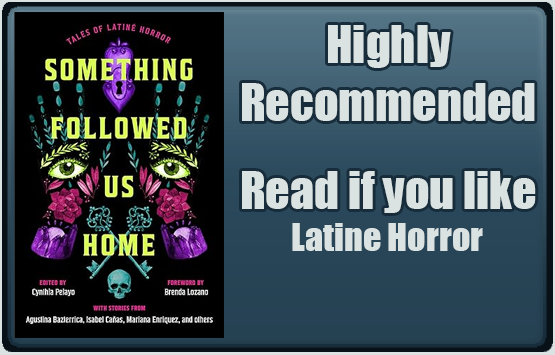
Formats: Print, audio, digital
Publisher: Atria/Primero Sueno Press
Genre: Comedy Horror, Dark Fantasy, Historic Horror, Monster, Myth and Folklore, Vampire, Zombie
Audience: Adult
Diversity: Latiné, Puerto Rican, Mexican, Ecuadorian, Columbian, Argentinian
Content Warnings (Highlight to view): Alcohol Abuse, Amputation, Animal Abuse, Body Shaming, Bullying, Child Abuse, Child Death, Classism, Death, Drug Use/Abuse, Illness, Incest, Physical Abuse, Racism, Rape/Sexual Assault, Slut-Shaming, Suicide, Victim Blaming, Violence
Blurb
Dive into the chilling depths of Latiné horror with this groundbreaking anthology, edited by Bram Stoker Award winner Cynthia Pelayo, where each story reimagines immigration, colonization, faith, and folklore as the fears we inherit and carry across borders and generations.
Something followed us home. It crawled in with our prayers, slipped into our beds, watched from mirrors, waited in water, and learned our names.
Gathering chilling work from some of today’s most acclaimed Latiné voices, this horror anthology moves through haunted households, brutal landscapes, sacred spaces turned dangerous, and bodies claimed by forces both ancient and intimate. The dead murmur behind locked doors. Bones rebuild themselves under merciless suns. Love becomes a doorway for demonic hunger. Blood, devotion, and memory intertwine as the past presses back with teeth.
Something Followed Us Home is an unnerving, visceral, and impossible-to-shake collection that proves that what is carried forward does not remain quiet, and what follows us rarely leaves without taking something in return.
I received this product for free in return for providing an honest and unbiased review. I received no other compensation. I am disclosing this in accordance with the Federal Trade Commission’s 16 CFR, Part 255: Guides Concerning the Use of Endorsements and Testimonials in Advertising.
I liked that both the English and Spanish language versions of the book are being released on the same day. Readers of Lo que nos siguió a casa will be able to read some of the stories in their original Spanish, while English readers will have some stories that were translated. Because the authors come from across the Latiné diaspora, there may be something new for everyone, while also including more universal themes like feminism, colonization, and family.
While I was familiar with authors such as Cynthia Pelayo (who also edited the collection), Ann Dávila Cardina, Agustina Bazterrica, Zoraida Cordova and Isabel Cañas I was delighted to also be introduced to new authors such as Carolina Flórez-Cerchiaro and Ananda Lima. I couldn’t believe how good all the stories were! There were really only one or two that I didn’t vibe with. I liked the stories that included figures from folklore like la Huesera (The Hand that Feeds by Isabel Cañas) and El Silbón (Fidelity by Alex Segura). El Jíbaro de Puerto Rico by Cynthia Pelayo was definitely one of my favorites, a bittersweet ghost story that teaches readers about the dark history in Puerto Rico, from its colonization by the Spanish, to slavery, to the American invasion. Her First Cruise Ship by Ann Dávila Cardinal was another, a humorous zombie story about undead tourists in Puerto Rico that critiques the tourism industry. It also has themes of classism and privilege. It will definitely make you think twice about how you behave when visiting another country!
While all the countries in Latin America each have their own unique cultures and histories one thing they share is a history of colonization by the Spanish and the Portuguese. These European invaders forced their languages and religion on the Indigenous people living there and brought disease, violence, slavery, destruction and later political and financial instability and war. That’s not even counting the damage done by the United States during the 19th and 20th centuries. Colonialism in Latin American countries is a reoccurring theme throughout the anthology explored in stories like the previously mentioned El Jíbaro de Puerto Rico and The Return of La Muelona by Carolina Flórez-Cerchiaro. This story is about how banana plantation owners continue the history of exploitation that began with the Spanish conquerors and how one woman gets her revenge. Other tales of revenge include Whispers from the Root by Lilliam Rivera and We are Gathered Here Together by Diana Rodriguez Wallace which address the corruption and cruelty of the wealthy and bullying, respectively. All were intensely satisfying to read as I’m a sucker for a good revenge story.
Many of the stories aren’t what I’d typically think of as “horror.” Some are more magical realism or speculative fiction like Pomelo and The World from Above and the World from Down Below. The Hand that Feeds is closer to a dark fairy tale. There are also some horror comedies like We are Gathered Here Together, My Boyfriend, and Her First Cruise Ship. However, stories like Luz Y Fer, Blue Flowers, and Specter are what I would think of as more “traditional” horror stories. I liked that every author has their own idea of what makes a story horror. There were traditional horror staples like vampires, killers, ghosts and zombies, but also religious mania, greed, sexism, and loneliness which can be equally, if not more, horrifying. The stories ranged from straight forward to more experimental. Some of the stories address the immigrant experience, while others take place in the main character’s home country, whether that be the United States or somewhere in Latin America. Settings include NYC, Puerto Rico, and Mexico City. I have to say, I really liked how much variety there was, emphasizing the many experiences across the diaspora. This creepy collection will have something for everyone, whether it be secret cults of children’s authors, plagues of spontaneous pregnancies, or a desperate father trying to bring back his dead daughter.




0 Comments