Funerals Are for the Living by Sami Ellis

Funerals Are for the Living by Sami Ellis

Formats: Print, digital

Publisher: Amulet Books

Genre: Occult, Thriller

Audience: Young Adult

Diversity: Black, queer main character and author, main character with anxiety and depression

Takes Place in: North Carolina

Content Warnings (Highlight to view):  Alcohol Abuse, Body Shaming, Cannibalism, Child Abuse, Child Death, Child Endangerment, Death, Forced Captivity, Kidnapping, Mental Illness, Physical Abuse, Police Harassment, Racism, Slut-Shaming, Stalking, Suicide, Torture, Violence, Vomit

Blurb

New from the author of Dead Girls Walking comes a YA horror about a girl kidnapped by a racist cult after investigating the supernatural happenings at her sister’s gravesite

A month ago, Junie Daniels was in a car crash that left her with a dead sister, fragmented memories of the accident, and a mother too checked-out to plan a funeral. The cheapest grave plot Junie can find is in the next town over. Sure, Williamsville is still proudly named after a slave master who was rumored to dabble in dark magic—but this North Carolina, after all.

When unexplained occurrences start happening at the graveyard, though, Junie and her best friend, Omari, investigate. And it’s not long before Junie and Omari are taken…

Williamsville wants both Daniels girls. But Junie will do anything to protect her sister—even if it’s only her corpse.

Sisters Junie and Jay were as different as can be. Jay was outgoing, popular, and an activist who lived her life out loud. In comparison Junie is introverted, quiet, and only has one friend, Omari. Jay has to drag Junie to parties just to keep her from sitting alone in their shared room. So, when Jay is killed in a car accident that Junie survives, Junie can’t help but think the wrong sister died. While her mom is depressed to the point of catatonia, Junie is forced to use her college savings to plan her sister’s funeral herself. Instead of buying a plot in Daniels, where they live, Junie has Jay buried in the neighboring town of Williamsville after finding a flyer advertising a cheap plot on the windshield of her mom’s car.

Like the two sisters, Daniels and Williamsville are polar opposites. Williamsville was founded by slave owner William Graham, who terrorized the town and killed his slaves for fun. Basically, Graham is Simon Legree and Madame LaLaurie combined. The creepy, desolate town is still mostly white to this day. Meanwhile Daniels was founded by Black sharecroppers who refused to live on the land where their ancestors were enslaved. It’s small but lively and has a strong sense of community. But it’s a community Junie does not feel a part of due to her introversion and low self-esteem. And honestly, I get it. It’s hard to think other people like you when you don’t even like yourself, and it can be scary trying to connect with others when you’re not naturally outgoing.

Junie knows everyone loved Jay, who was very active in the community, and Omari, who is friends with everyone. But she thinks of herself as a third wheel, a cheap imitation of her more popular little sister. Junie seems to struggle with depression and anxiety, which definitely play a role in her self-isolation. But Junie is also kind of mean. Time and again we see people in the community try to reach out to her as she pushes them away. When her neighbors call after her, asking how she and her mom are doing, Junie ignores them. When her sparring partner and crush, Neveña, tries to be friends with her, Junie coldly rejects her. And when Jay dragged her to a party before her death, Junie sat in the corner and sulked the entire time. But community is important. Especially when you’re marginalized.

It’s her disconnect from the community that stops Junie from reaching out for help when she and her mom are clearly struggling. Unfortunately, Junie decides she can handle everything by herself without any support. Junie is so completely turned off by the entire town showing up to mourn Jay (she refers to them as “sloppy sad”) that she decides to have a second, more reserved funeral at Jay’s grave, just her and Omari. It’s there that Junie notices something is wrong with the soil. The white graves are covered in lush, green grass, but Jay’s is just off colored soil that immediately kills the roses Omari places on the grave. Pissed off by the “racist dirt” the Williamsville church clearly gave her, Junie vows to return and fix it. Omari suggests contacting a lawyer and suing the church or at least getting help from his Uncle York who owns a local flower shop. But Junie doesn’t want to draw attention to the fact that her mom hasn’t left her room for a month and can’t take care of her daughter, because CPS might get involved. After hearing a strange noise in the graveyard, Omari decides that’s their cue to leave the creepy-ass town and go home.

Things continue to go poorly for Junie. Her mixed martial arts coach tells Junie she can’t go to the state MMA championship because of how much she’s been slacking off, despite the fact she’s gone every year. She finds an eviction notice on her door due to non-payment. And when Junie’s mother finally musters the energy to get out of bed and returns to work, they let her go, which she deals with by getting drunk. Junie is already feeling down when her mom drops a bombshell.

Junie already knows that the town of Daniels was named after her great-grandpa, but what she didn’t know is that she’s also a descendent of William Graham. While it’s not uncommon for Black people to be descended from white slave owners, since enslaved women were routinely raped by white men (my own last name comes from the white man who owned my great-great grandparents, his own children), it’s still horrifying to discover she’s related to such a monster. Apparently, Graham had multiple families, and sired many offspring, the descendants of whom are actually proud of their heritage. Junie’s mom warns her never to return to Williamsville, even though her sister is buried there.

There’s a reason Junie’s mom doesn’t want her going to Williamsville. It’s what’s known as a Sundown Town, a community that keeps non-whites (usually Black people) from living there through a combination of racist laws, racial covenants,  violence, and intimidation. Black folks could work there during the day but were expected to leave before sundown. While the Civil Rights and Fair Housing Acts of 1968 made Sundown Towns technically illegal, housing discrimination, gentrification, policing, and the lasting effects of redlining,  continued the tradition. Keep in mind Sundown Towns can be found all over the US, even in supposedly  “liberal” states. But Junie ignores her mom and drags Omari back to Jay’s grave to deal with the racist soil problem. It turns out she should have listened to her mom because the two teens end up kidnapped by a cult of William Graham’s white descendants, led by the sinister Sister Erica.

It’s no accident that one of the main villains is a white woman. Sister Erica reminds me of the white women who sell out BIPOC women to uphold the white supremacist patriarchy, like the 53–55% of white women who voted for Trump (compared to 7-10% of Black women). I find it particularly satisfying to see women like Pam Bondi or Kristi Noem betrayed by the white patriarchy they supported because they though it made them special and safe. So, of course I was excitedly waiting for Sister Erica to get hers. Maybe it’s petty and cruel of me to enjoy the suffering of others like that, but honestly, I don’t fucking care. People who happily intentionally hurt already marginalized people deserve to be laughed at when the leopards inevitably eat their face.

The first thing I noticed while reading Funerals are for the Living is how much I enjoyed the writing style. Ellis uses AAVE (African-American Vernacular English) liberally throughout the book, and I fucking love it. The editor didn’t remove the double negatives or the “done beens” in the name of “proper” grammar, so the characters sound like real people at ease in their environment instead of Black folks forced to code-switch. AAVE and other English dialects have their own grammar rules and are not “broken English” any more than American English is a broken form of British English. But racist grammar snobs still act like it is. For me, reading characters use AAVE felt familiar and comforting, after all it’s how my Black family speaks when they’re around each other and don’t have to code-switch for work. If they’re speaking in AAVE that means it’s a safe space.

I love how Ellis described Junie’s Black skin as “summer colored,” a welcome departure from white authors comparing Black skin to food. In fact, the only time Black skin is compared to food in the book is when Sister Erica does it while fetishizing a Black man, and you can practically feel Junie and Omari cringe. It’s also a nice change of pace that the white characters are the ones who are dirty, have bad hair, and act “primal”. And it’s just nice to have a book that’s clearly made for Black readers and isn’t forced to make things more digestible to try and appeal to a white audience.

I thought Junie was a great protagonist. She doesn’t really excel at anything, she’s not as smart Omari or as outgoing and strong as her sister Jay, nor is she much of a martial artist like Neveña. She’s also not particularly nice and only has one real friend because of it. She felt like an everyday, average teenager who was going through some shit. But despite all her faults she is very loyal to the few lucky people she cares about. While the cult represents unquestioning obedience of the white patriarchy, Junie represents rebellion against oppression. She starts out as someone who just lets things happen to her but becomes more of a fighter (like Jay) over the course of the book. I also liked Ellis’ unflinching portrayal of grief in Funerals are for the Living, in addition to Black mental health. One of the major morals of the story is that it’s okay to ask for help, which brings us back to the importance of community. It’s something Junie and Jay used to fight about, Jay wanted their mom to see a therapist while Junie just wanted to leave her be and hope it got better on its own (which of course it doesn’t). Medical racism and stigma keep Black people from receiving therapy that acknowledges their unique needs, like the trauma caused by everyday racism.

Funerals are for the Living gave me Get Out vibes, but set in the backwoods of rural North Carolina rather than the wealthy suburbs of upstate New York. You know you can’t trust these seemingly friendly white people, and something is very off, you just don’t know what it is yet. There are some really creepy scenes, like when characters are tortured or you realize just how brainwashed the members of the cult (mostly young people and children) are. Then there are more subtle chills like finding the slave mural in the church or knowing the racist police won’t save you if you call them for help.

Despite the overall dark and sometimes depressing tone of the book, there’s still some great moments of dark humor. I laughed out loud when Junie yelled that the church scammed her with a “Temu Grave,” or when she worried that the white cult would turn her and Omari into chili with no seasoning. I personally felt the book had a few pacing issues and could drag in some parts, but when it hit its stride, it really hit its stride and I found I couldn’t put it down. The mystery element of the book is really gripping, and I never knew what was going to happen next. I did feel like the supernatural parts of the story were kind of shoehorned in, and I’m not sure if they were strictly necessary since the book was chilling enough with just the racist cult. They didn’t necessarily detract from the story, I just don’t think they really added anything either. Overall, Funerals are for the Living is a well-crafted and moving piece of young adult fiction that doesn’t speak down to its young audience and trusts them with heavy topics.

Dead First by Johnny Compton

Dead First by Johnny Compton

Formats: Print, audio, digital

Publisher: G.P. Putnam’s Son

Genre:  Ghosts & Hauntings, Mystery, Occult

Audience: Adult

Diversity: Black author and main character, bisexual main character, Korean-American side character

Takes Place in: Texas

Content Warnings (Highlight to view): Alcohol Abuse, Amputation, Child Death, Death, Drug Use/Abuse, Forced Captivity, Gore, Kidnapping, Mental Illness, Police Harassment, Racism, Self-Harm, Suicide, Torture, Violence

Blurb

When private investigator Shyla Sinclair is invited to the looming mansion of mysterious Texan tycoon Saxton Braith, she’s more than a little suspicious. The last thing she expects to see that night is Braith’s assistant driving an iron rod straight through the back of his skull. Scratch that—the last thing she expects to see is Braith’s resurrection afterward.

Braith can’t die, it turns out, but he has no explanation for his immortality, and very few intact memories of his past. Which is why he wants to pay Shyla millions to investigate him, and bring his long-buried history to light.

Shyla can’t help but be intrigued, but she’s also trapped by the offer. Braith has made it clear that he knows she’s the only person he can trust with his secret, because he knows all about hers.

Bold, atmospheric, and utterly frightening, Johnny Compton’s Dead First is spine-chilling supernatural horror about the pursuit of power and the undying need for reckoning.

Private investigator Shyla has just finished a case for a man named Massimo Dante, who thought he was the antichrist. He paid her well enough that she was able to buy herself a house and help her cousins out financially. She doesn’t need to accept billionaire Sexton Braith’s case, but curiosity gets the better of her. Braith wants Shyla to determine why he’s immortal, which his trusted chauffer, Remy, demonstrates by shoving a fire poker through his skull. Thoroughly freaked out, Shyla is ready to turn him down. Yet, Braith implies he knows her biggest secret–that she killed a man when she was young–and will bring it to light if she doesn’t help him. Little does Shyla know that Braith is hiding his own, much darker, secrets.

I was instantly hooked by the premise for Dead First. I’m a sucker for horror mysteries. While the first half of the book felt a bit slow for my taste, the pace really picks by the midpoint, and each reveal feels more horrific than the last. What starts out as a supernatural mystery eventually morphs into full blown horror. Interesting to note, Dead First seems to take place in the same world as Compton’s Bram Stoker Award nominated novel The Spite House, as there’s a passing reference to The Spite House at the very end of the book.

I liked how Shyla was more morally ambiguous than most protagonists. She’s willing to do some pretty messed up stuff for the ones she loves and to protect her secret. She’s driven by revenge and you can tell her anger is poisoning her, but she’s unwilling to let go of it. Shyla has trouble opening up to others and past experiences have hardened her. This is part of why she broke up with her girlfriend, Jinh. Shyla’s relationship with Jinh is complicated, to say the least. The two clearly still care for each other, but Shyla seems scared to get too close. Shyla first met her ex when she went on Jinh’s podcast, a blend of true crime and supernatural lore that has fans all over the world. Jinh has the ability to speak to the dead, though Shyla doesn’t really believe in Jinh’s power. While I liked Jinh, I felt like her character could have used more development.

I appreciated how the racism in the book is very subtle. You’re not hit over the head with it, but it’s there, hinted at and never outright stated.  For example, Shyla is always concerned about being harassed by the police. If you are a non-Black person who was somehow in a coma all through 2020, or just completely unaware of how cops treat Black people, you might not pick up on it. But it’s obvious Shyla must worry about cops and the busybodies who call them because she’s Black, even if it’s never spelled out for the audience. I liked that Dead First doesn’t feel like it’s written for non-Black people to learn about the horrors of racism. Instead, it assumes the reader is already aware of the systemic racism Black people deal with every day and Compton doesn’t have to delve in to it because it’s not part of the story. As much as I appreciate racism as horror stories, it’s also nice to read Black stories that aren’t focused on racism and Black trauma. Shyla does have trauma, but it has nothing to do with her race (other than the police not working as hard to find a missing Black child).

While the book initially feels more like a supernatural mystery thriller than straight horror, there’s still plenty of gore and some genuinely frightening moments in the second half of the book.  I personally enjoyed it, but I can see the mystery crowd being turned off by the violence and torture, while horror fans may not want to wait through the detective procedural parts of the story to get to the scary stuff. But I believe readers will enjoy the tense, haunted atmosphere, one of the story’s strongest points.


Greedy by Callie Kazumi

Greedy by Callie Kazumi

Formats: Print, audio, digital

Publisher: Bantam

Genre: Psychological Horror

Audience: Adult

Diversity: Multiracial (hafu) Japanese-British author and major character, Japanese minor characters

Takes Place in: Japan

Content Warnings (Highlight to view): Alcohol Abuse, Animal Death, Body Shaming, Bullying, Cannibalism, Child Death, Death, Drug Use/Abuse, Eating Disorder, Suicide, Violence, Vomit

Blurb

They will kill me soon, Edward Cook thinks. And when the Yakuza are unable to collect what he owes, Ed realizes, theyʼll go after his wife and child next. Broke, desperate, and unemployed, he stumbles upon an unusual ad: Chef wanted! Private chef for a high-profile businesswoman. One million yen per day.

Ed accepts the job. He hasnʼt earned any Michelin stars, but he knows his way around a kitchen. Leaving his life in Tokyo behind, he departs for an opulent estate in the mountains owned by the enigmatic and reclusive Hazeline Yamamoto, a disgraced socialite with a predatorʼs smile and an exacting palate. Hazelineʼs world is one of taste, connoisseurship, and experimentation—she is a certified gourmand. But when you can afford filet mignon for every meal, you begin to seek out the strange and forbidden.

The closer Ed gets to Hazeline and the brighter future that she promises—if he remains loyal—the nearer he is to realizing the chilling truth about her altruism. In this shadow world of unimaginable wealth, there are worse monsters than two-bit gangsters. The wind blowing through Hazeline’s home carries the sound of screaming, and Ed finds himself feeding all kinds of beasts.

Perfect for fans of Parasite and The Menu—enticing as a starter, meaty as a main dish, and full of satisfying just-desserts—Greedy is a suspenseful poison-pen note to classism and an ode to Japanese cuisine, a horror-tinged thriller unsuitable for vegetarians but full of shocking delights for every reader.

I received this product for free in return for providing an honest and unbiased review. I received no other compensation. I am disclosing this in accordance with the Federal Trade Commission’s 16 CFR, Part 255: Guides Concerning the Use of Endorsements and Testimonials in Advertising.

Food-centric horror always makes me hungry, and this one had me craving meat. There’s a reason the cover warns it’s not safe for vegetarians.

Ed is a British ex-pat living in Japan with his Japanese wife, Sayuri, and their young daughter, Kaori. After traveling to Japan and falling head over heels for Sayuri, he lands a sales job at an English-speaking company. Unfortunately, COVID hits the company hard, and Ed gets laid off. Instead of job hunting, he starts spending the day at pachinko parlors and soon becomes addicted to the rush of gambling. Now Ed has wasted their savings, developed a significant gambling debt, and gotten involved with the yakuza, all of which he hides from his wife. He knows Sayuri will never forgive him if she finds out, but his lack of a job and the financial strain on their family is already causing marital tension. Desperate for money, Ed finally spots a job ad in the newspaper which may be the answer to his prayers. A high-profile businesswoman needs a discreet personal chef and is willing to pay one million yen a day (around $6,345 USD) to the right person. While not officially trained in the culinary arts, Ed spent time working as a sous chef at a few terrible restaurant chains in England and his wife has taught him to cook Japanese dishes, so he figures he can bullshit his way through an interview.

I liked how Ed is a flawed yet sympathetic character. His addiction was presented not as a moral failing (that would be Ed’s decision to lie to his wife), but as an illness. Most forms of gambling are illegal in Japan, but gambling addiction is still a huge problem, especially after COVID-19 when more people turned to overseas online gambling. Currently, it’s estimated that there are about 1.97 million people in Japan who actively use online casinos. Some even take yami baito or “dark part-time jobs” to pay for their gambling debt. These jobs, often advertised online, promise lots of quick cash for seemingly easy tasks, but don’t mention they require illegal activities. You would think that Ed would be concerned that this too good to be true job as a personal chef might actually be a yami baito, but as we quickly learn, Ed tends to ignore clear warning signs.

*trigger warning for discussions of body size and eating disorders*

It turns out the high-profile business woman is none other than Hazeline Yamamoto, a wealthy recluse and the widow of billionaire Botan Yamamoto. Ed is surprised by how Western Hazeline is, rejecting both restraint and conformity, things typically valued in Japanese society. She tells Ed about being growing up hāfu in Japan, a term used to describe people who have one Japanese parent and one non-Japanese parent. Like the author, who is the daughter of a Japanese mother born and raised in Brazil and a Scottish and Columbian father, both Hazeline Yamamoto and Ed’s daughter have one Japanese parent and one non-Japanese parent. In Hazeline’s case her mother was a British model and her father a Japanese businessman. On top of the struggles of being mixed race in a homogenous society, Hazeline was also bigger than her Japanese classmates. She was bullied for being “chubby” and not fitting into Japanese clothing, despite not being overweight by western standards.

In Japan, less than 40% of adults are considered overweight, and Japan has one of the lowest obesity rates in the world, most likely due to walkable cities and the traditional Japanese diet being so healthy.  The average size for a Japanese woman is 1.58 m (5’2”) and 55.3 kg (122 lbs) according to World Data, while women in the UK are on average 1.64 m (5’4”) and 73.6 kg (162 lbs).

On the flip side, over 10% of Japanese women are underweight, and for women in their twenties, one in five are underweight. Hazeline felt so pressured to be thin that, in order to fit in, she became anorexic. There’s unfortunately a lot of stigma surrounding eating disorders in Japan and a lack of support for those who have them.

But after her husband died, Hazeline realized she was sick and tired of being hungry all the time and living as a hermit meant there was no one to care about Hazeline’s body. She tells Ed that the only joy she had left is from the food she consumes. “What use is dying skinny and hungry? When I join Lucifer, I shall be plump and happy, and I can’t bring myself to give a damn what anyone thinks about it.” And that’s where Ed comes in.

*end trigger warning*

Hazeline wants Ed to prepare her exquisite, inventive meals. As Hazeline puts it “I don’t eat to survive, I eat to savor. It should always be worth it, every mouthful a justification for my body.” She especially loves meat and tells Ed “…a meal without meat is merely a side dish.” When Ed serves her duck with plum jam as part of his interview, Hazeline very proudly tells him how she killed and gutted it herself. Kazumi touches on the Burakumin during her story, a historically “outcaste” or “untouchable” social class, occupying the lowest level of the feudal Japanese social hierarchy.

The Burakumin are those descended from people employed in occupations considered taboo by orthodox Shintō and Buddhism beliefs about not killing living things or touching the dead. So, undertakers, executioners, leatherworkers, and, of course, butchers. Discrimination against those who work as butchers continues in Japan to this day. So, it’s weird that Hazeline has a philosophy that it’s good practice to kill your meals yourself. As the final step of his interview Ed must slaughter a chicken for food.

I didn’t like that the Japanese words were italicized. When non-English words are italicized, I feel it labels them as “exotic” and other. Editor Natalia Iwanek goes into detail about why italicizing non-English words is problematic here. I suspect, however, that this was the editor’s decision rather than the author’s. There is a glossary in the back of the book of Japanese words used in the book, which is helpful as Kazumi doesn’t have to interrupt the flow of the story to explain the words to an English-speaking audience who may not be familiar with what an izakaya is or what majide means.

It’s pretty evident what the “big reveal” of the book is early on, and most readers will quickly figure out what Ed is trying so hard to deny. Somehow, that makes it even more suspenseful because you KNOW what’s going to happen, but that doesn’t stop you from praying it won’t. It’s horrible, like watching a car crash in slow motion. You’re screaming at Ed to figure it out and get out of there, but he keeps dismissing the very apparent red flags. Even though there wasn’t any obvious horror until the end of the book, and not much on-page violence, my anxiety levels were through the roof, dreading what was coming. Greedy is a book that I absolutely devoured (pun intended).

The Valley of Vengeful Ghosts by Kim Fu

The Valley of Vengeful Ghosts by Kim Fu

Formats: Print, audio, digital

Publisher:  Tin House

Genre:  Gothic, Psychological Horror

Audience: Adult

Diversity: Chinese American author and main character

Content Warnings (Highlight to view): Animal Death, Child Abuse, Death, Drug Use/Abuse, Illness, Incest, Kidnapping, Medical Torture/Abuse, Medical Procedures, Miscarriage, Necrophilia, Oppression, Mental Illness,  Physical Abuse, Rape/Sexual Assault, Suicide

Blurb

In the aftermath of her mother’s death, Eleanor is unmoored. For years, her mother orchestrated every detail of her life—from meals, to laundry, to finances—as Eleanor focused on her career as an online therapist. Left to navigate the world on her own, Eleanor clings to her mother’s final directive: use her inheritance to buy a house.

Desperate to obey her mother one last time, Eleanor impulsively buys a model home in a valley-turned-construction site, a picturesque development steeped in a shadowy history. It feels like a fresh start, until the rain comes—an endless, torrential downpour. As water seeps in through the house’s cracks, the line between what is real and what is not begins to blur. Haunted by the stories of her clients, a stream of workmen and bureaucrats she can’t trust, and visions of ghosts from her past and present, Eleanor’s reality unravels, and she is forced to reckon with the secrets she’s buried and the choices she’s made.

I received this product for free in return for providing an honest and unbiased review. I received no other compensation. I am disclosing this in accordance with the Federal Trade Commission’s 16 CFR, Part 255: Guides Concerning the Use of Endorsements and Testimonials in Advertising.

The Valley of Vengeful Ghosts is a horror story about every millennial’s worst nightmare: being expected to navigate the world of adulthood without any guidance or support, and buying a home.

Eleanor Fan is a therapist whose mother, Lele, has recently passed away from cancer. Her dying wish was for her daughter to buy a house. Like many millennials, owning her own home seemed like an impossibility for Eleanor until her frugal mother passed and left her enough for a modest house. But even with her inheritance, Eleanor is struggling to find somewhere livable. Her first realtor, Mary, only shows her crappy, one bedroom condos, and Eleanor is outbid each time she applies. Her new realtor, Matt, drives her through a dying town, into the forest and shows her a model home in a newly developed area. The developer went bankrupt after building the model homes, and the new developer is waiting for the summer to continue building. Eleanor loves the house, though is unsure about buying.Matt encourages her to jump on the opportunity as soon as possible, which means waiving the inspection (huge red flag). What seems like a dream come true turns into a nightmare when the house quickly becomes unlivable.

I’m lucky enough to be married to a super competent gen Xer who knows how to repair most anything, otherwise I probably wouldn’t have bothered with home ownership, even if I lived in an alternate universe where I could have afforded one on my own. I don’t know how to fix a cracked pipe, install a dishwasher, or build a bookshelf that wasn’t purchased from Ikea (all things my wife has done easily). I’ve never even mowed a lawn or cleaned gutters! And forget taking care of it, just trying to purchase a home can be a confusing nightmare. There’s the whole process of applying for a mortgage, finding the right real estate agent, putting in a bid on the house, hiring a home inspector, figuring out internet service and all that crap. It’s overwhelming! No wonder Eleanor has no idea what she’s doing.

The house she buys was cheaply and quickly made to look good, not actually serve as a home. And even if it was? Some of the design choices were made with form over function in mind, like the giant floor to ceiling windows with no blinds or curtains. Not only do the windows lack insulation, there’s zero privacy (thank God Eleanor lives in the middle of nowhere), and there will be a ton of light during the day, whether she wants it or not. Unfortunately, Eleanor didn’t consider any of these things before buying the house, and when she does finally notice the above issues and tries to solve them with curtains, she learns that curtains are really freaking expensive. And that’s just the start of the problems. With a seemingly endless rain pouring down on her new home comes numerous leaks that start as a trickle under the windows but quickly start damaging the home. The rain gets in the front door lock and jams it, forcing Eleanor to call a sketchy locksmith who charges her $600 and then makes vague threats about what will happen if she doesn’t pay.

There are a lot of creepy men in The Valley of Vengeful Ghosts. Eleanor’s grad school mentor raped her. her work colleague, Teddy, lusts after her even though Eleanor sees him as a father figure (his wife even assumes they slept together). Her real estate agent, Matt, clearly conned her. One of Elanor’s new patients, Jared, is a raging misogynist who refers to women as “females” and wants to use Eleanor to practice talking to women yet constantly speaks down to her and ignores her. Eleanor just doesn’t seem to have good luck with men. There is her ex, who by all accounts seems like a decent guy, but he wants nothing to do with her because of her weird attachment to her mother.

Millennials like Eleanor have had it rough. We reached adulthood during the Great Recession of 2008, and many of us were forced to move back in with our Boomer parents (assuming that was even an option). Even those of us with college degrees, something we were told by adults we had to get if we wanted to a good paying job, weren’t having any luck. The jobs we’d been prepared for weren’t hiring people without experience, and retail and food service jobs didn’t want someone they considered “overqualified.” Meanwhile, we had a ton of student debt we couldn’t pay off, wages were stagnant, and the cost of living was soaring. That means we were forced to put off typical adult milestones like marriage, having kids, and yes, buying a house. With schools getting rid of shop and home economics courses many of us also weren’t taught how to fix a car, sew a button, or a cook a meal (thanks Ronald Regan).

Eleanor’s mom completely failed in preparing her daughter for the real world. After Eleanor is raped by her grad school mentor she drops out of her PhD program and regresses emotionally (something Teddy points out is common after trauma) and her mother comes to take care of her. She handles Eleanor’s money and keeps the books for her practice as dealing with money bores and frightens Eleanor (all her bank accounts are joint accounts with her mother). Lele cleans Eleanor’s apartment, takes out her trash, buys her groceries, cooks her meals, and does her laundry for her.  Eleanor is so coddled that her mother even feeds her apple slices like a baby bird while she’s working and clips her toenails. The irony is not lost on me that Eleanor works as a therapist, helping other people with their lives, when she can’t even get her own shit together and would definitely benefit from some therapy herself.

Isolation is a recurring theme throughout the story. Eleanor is physically isolated in the valley where she lives and where the rain never seems to end, but also emotionally isolated from others after the passing of her mother. She has no romantic partner, no real friends, and only a distant aunt for family. She doesn’t even see her patients in person anymore, instead opting to focus solely on telehealth. The story is strongly implied to take place right after COVID, when everyone was feeling the despair that comes from isolation. But it seems Eleanor never really connected to people after the pandemic.

I should point out that, despite the title, this is not a haunted house story. The “ghosts” are people that Eleanor knows (or knew) that appear in her mind and talk to her, more hallucination than specter. But while there are no literal ghosts, Fu still instills tension with modern fears like home ownership, isolation, climate change, and losing one’s parents.  It feels like a gothic novel, except the house isn’t old and decaying but new and decaying, while the never-ending rain, which is slowly eroding the surrounding landscape, creates an oppressive atmosphere. There isn’t really a plot so much as a series of events that unfolds in Eleanor’s life as we watch her mental state fall apart along with her home, but it still grabbed my attention and never felt like the story dragged.

These Bodies Ain’t Broken Edited by Madeline Dyer

These Bodies Ain’t Broken Edited by Madeline Dyer

Formats: Print, digital

Publisher: Page Street Publishing

Genre: Body Horror, Demon, Historic Horror, Monster, Myths and Folklore, Romance, Vampire

Audience: Young Adult

Diversity: Authors and characters with disabilities including ADHD, anxiety, agoraphobia, Autism, celiac disease, chronic pain, Crohn’s disease, diabetes, Down syndrome, Ehlers-Danlos syndrome, Fibromyalgia, mast cell activation syndrome (MCAS), neurofibromatosis, postural orthostatic tachycardia syndrome (POTS), PTSD, and substance use disorder. Non-binary main character and author, agender main character, biracial Haitian side character, bisexual main character.

Content Warnings (Highlight to view): Ableism, Amputation,  Animal Death, Body Shaming, Bullying, Cannibalism, Child Abuse, Child Death, Classism, Death, Drug Use/Abuse, Forced Captivity, Gore, Homophobia, Illness, Kidnapping, Medical Procedures, Oppression, Mental Illness, Physical Abuse, Self-Harm, Sexism, Slurs,  Suicide, Verbal/Emotional Abuse, Victim Blaming, Violence

Blurb

A monstrous transformation within your own body.
A sacrificial imprisonment.
A fight to the death against an ancient evil.

These stories showcase disabled characters winning against all odds.

Outsmarting deadly video games, hunting the predatory monster in the woods, rooting out evil within their community, finding love and revenge with their newly turned vampire friend—this anthology upends expectations of the roles disabled people can play in horror. With visibly and invisibly disabled characters whose illnesses include Ehlers-Danlos syndrome, Crohn’s disease, diabetes, PTSD, and more, each entry also includes a short essay from the author about the conditions portrayed in their stories to further contextualize their characters’ perspectives. From breaking ancient curses to defying death itself, these 13 horror stories cast disabled characters as heroes we can all root for.

Contributors include bestselling and award-winning as well as emerging authors: Dana Mele, Lillie Lainoff, Soumi Roy, Anandi, Fin Leary, S.E. Anderson, K. Ancrum, Pintip Dunn, Lily Meade, Mo Netz, P.H. Low, and Carly Nugent.

I received this product for free in return for providing an honest and unbiased review. I received no other compensation. I am disclosing this in accordance with the Federal Trade Commission’s 16 CFR, Part 255: Guides Concerning the Use of Endorsements and Testimonials in Advertising.

Horror isn’t exactly known for having good disability rep, so it was great having an anthology written by authors with disabilities because there was so much variety in representation. There was everything from Crohn’s disease to Ehlers-Danlos syndrome to PTSD. In some stories, a character’s disability played a huge role (Baby Teeth, Within the Walls, The Worst of It), and it’s only mentioned in passing in others (When the Night Calls, Kissed by Death). At the end of each story, the author would write about how they chose to represent disability in their work, and some even shared their experiences with their own disabilities and how they related to their stories.

I loved that both invisible and visible disabilities were featured. I have invisible disabilities myself (ADHD and mental illness), but for a long time I didn’t consider myself disabled because, like many people, I thought the only disabilities that existed were visible. This caused me a great deal of stress because I was always trying to compare myself to neurotypical people. It never occurred to me to ask for accommodations because I thought I should be able to “power through” any challenges on willpower alone. Engaging with the disability community online helped me be more accepting of my own disability. I learned that I wasn’t “broken,” the difficulties I had were not moral failings, and having a disability is not a “bad” thing. I discovered that the things I struggled with due to ADHD and mental illness were not my fault, it was just a difference in brain chemistry that I was born with. Accepting my disability meant I also accepted help and learned to function with my disability instead of always fighting against it. It was empowering. So, reading stories about ADHD and mental health in a disability anthology felt incredibly validating. Not only that, but these characters with disabilities got to be the heroes. It was awesome reading about a woman with ADHD get revenge on the men who wronged her and a non-binary person whose mental illness was not the source of horror in the story. Another great thing about These Bodies Ain’t Broken is the amount of intersectionality. There were queer characters, non-binary characters, Asian characters, etc.

This review would be unreasonably long if I examined every story in the collection I will focus on a few that stood out to me. When the Night Calls by Soumi Roy takes place in 19th century Bengal. Charu is a newly married 16-year-old girl whose best friend Malati, an educated city girl who is fiercely independent, has disappeared without a trace. Malati’s cold husband claims that his wife was lured into the forest and taken by the Nishi Daak for being so willful. He says it was Malati’s own fault she was taken, but Charu isn’t sure what to believe. Malati always told her the Nishi Daak was just a story told to keep women in line. Although Charu does her best to be an obedient wife and daughter-in-law her curiosity gets the better of her and she stumbles across the terrible secret kept by the village men; the reason women and girls of the village keep disappearing. This bloody story of feminine vengeance and Bengali monsters was an extremely satisfying read. I also enjoyed it as Charu and I share a disability, ADHD (although it’s not named it the story the author reveals that Charu is neurodiverse). I related to the frustration of making mistakes, even when you’re trying your hardest, and how painful it is when people around you attribute this to laziness or “just not paying attention.”

The first line of Thy Creature by Lillie Lainoff draws you in immediately. “The hardest thing about coming back to life is remembering how to breathe.” Told in the second person, this Frankenstein inspired tale tells the story of a girl brought back to life by her college boyfriend, Cal, after she dies in a hiking accident. Despite being a mediocre boyfriend at best, the protagonist seems perfectly happy to settle and set her expectations low when it comes to Cal, especially since she now owes him for bringing her back to life. The story reminded me so much of all the straight women who settle for awful men because they don’t think they deserve better. Hey, there’s a reason single women are happier.

Dating while disabled comes with its own set of challenges especially when dating someone without a disability. The non-disabled person may only date someone with a disability out of pity or because they fetishize their disability. This also applies to anyone who isn’t skinny, white, cisgender, etc. (aka has their own category on Pornhub), so heaven help you if you belong to more than one of those marginalized groups (intersectionality). Then there’s all the misconceptions, like the assumption that people with disabilities aren’t sexual (obviously Ace people with disabilities exist, but that’s a sexual orientation, and has nothing to do with their disabilities). As Lainoff’s protagonist slowly builds confidence, she also learns she doesn’t have to settle just because she has a disability and that maybe her boyfriend isn’t all that great.

In Ravenous by Carly Nugent, the protagonist, Linden, is struggling with depression and passive suicidal ideation. She refuses to monitor her blood sugar or manage her diabetes which has already landed her in the ER once. Linden has decided she’s just going not to accept her diabetes, forcing her mother to help her manage most of it, and she’d rather die from it than live with it. I like that Nugent wrote about the difficulty someone with a chronic illness goes through when they’re first diagnosed. Linden is still in the denial and depression stages of her grief after learning her life will never be the same. But over the course of the story, she learns to accept that she has diabetes, and it doesn’t mean her life is over. I love that the author didn’t portray disability in a negative light while also acknowledging that yes, finding out that you’re going to have to manage a chronic illness for the rest of your life can really suck.

Another story I really liked was House of Hades by Dana Mele. House of Hades is a virtual world filled with gamers and virtual replicas of the dead. The tech was originally funded by some billionaire who wanted to live forever. But when he learned that you can’t really become an immortal machine, he sold the program, which was used it to create House of Hades. They call the digital clones “ghosts,” which include historical figures like Shakespeare and Marie Antoinette. The game is so realistic that if you die in the game you can die in real life (so Matrix rules) unless you “wake up,” which is why the game requires a buddy system. The voice command “wake up” triggers the exit protocol. Unfortunately, you need someone else to trigger it for you, you can’t exit yourself, which seems like a serious design flaw.

Ode and Era are two gamers who like to hang out in House of Hades. Ode is currently grounded, and isn’t supposed to be playing the game because they’ve been abusing pills and recently had an overdose on a drug called V (aka Viper, the story’s fictional drug). Their parents recently got divorced and they’re struggling with it. When they go back to Hades with Era, Ode is shocked to discover they’ve been separated. Now Ode is all alone in a dark little town, seemingly empty, but something is watching them. They are forced to solve puzzles and play the town’s strange game to try and find Era and a way out.

I thought the setting was very creative, and I like that the protagonist was non-binary like me. In the story notes Mele explains how she didn’t like the way horror villains were always portrayed as mentally ill. As someone with my own mental illness and who has spent time inpatient at mental health hospitals (or as I like to call it “a grippy sock vacation”) it hurts when I hear people talk about the “dangerous crazies” in the psych ward or explain away a person’s terrible behavior (racism, violence, abuse, etc.) by saying “they’re crazy.” They’re not mentally ill, they’re just awful people! And mentally ill people are more likely to be the victims of violent crime than commit it. Only a very small percent of violent crimes (around 5%) are committed by people with mental illness. Yet the myth of the “crazed killer” prevails in horror. So, I appreciate that Mele made her protagonist mentally ill.

One of my favorite stories in the collection was The Weepers and Washer-Women of Lake Lomond by Madeline Dyer (the editor of the anthology), though I think the story would have worked better if it was a full-length novel. It was like I was being served this amazing meal, but I had to shove it in my mouth in five minutes when I really wanted to savor it. It didn’t necessarily feel rushed, I just think I would have enjoyed it more if I had had more time with the characters, the setting, and the lore because it was all so great! In the story the protagonist, Bianca, who has multiple disabilities including Ehlers-Danlos, POTS, and MCAS, is pretending to be her twin sister, Remi, so she can take part in the World Kickboxing Championship on the island of Loch Lomond. Bianca is convinced the island had something to do with the death or their cousin, Mari, who competed on Loch Lomond a ten years prior. Remi’s boyfriend, Blake, does not think this is a good idea, but Bianca, who hates being treated like she’s “broken,” is determined. She’s thought of everything; Remi faked an injury months ago to explain away Bianca’s crutches. The competition takes place in pitch dark, the organizers claiming that it’s to make it more fair for blind and low-vision competitors (a blind girl won the championship last time), so no one will see Bianca using a mobility aid. And she only needs to stay in the competition long enough to find out what happened to Mari, so Bianca doesn’t necessarily have to win her first match.

I can understand Blake’s hesitation to help Bianca go through with her plan, because at first, I thought Bianca was foolish to try and pretend to be her sister. While both sister’s have Ehlers-Danlos, Remi only got stretchy joints, while Bianca got the whole shebang that can come with the condition. How would Bianca be able to compete in such a physically demanding competition? And immediately after arriving on the island,things start to go wrong. There’s no food that Bianca can safely eat, and the training masters confiscate her medication and medical drinks claiming it will give her an “unfair advantage.” Dizzy with fatigue and illness she tries to bow out of the championship, but is forced to compete. And when she enters the dark arena, the training master takes Bianca’s crutches. Worst of all, her opponent doesn’t seem quite human. I thought she was guaranteed to be monster chow. But then her disability ends up being the reason she survives. *spoiler* Because Bianca’s crutches (presumably made of durable steel, which contains iron) can hurt her adversaries. As Bianca says at the end of the story “I’m Bianca. And that’s how I’m alive. Because I’m disabled. Because I need mobility aids. Because I fought with my crutch.” *spoiler ends* I absolutely love this twist. Disabilities are often to assumed to be a “weakness” but it ends up being Bianca’s strength.

Three of the stories used the second person point of view, which is when the story addresses the reader directly using the pronoun “you” when describing the protagonists’ actions (i.e. you shook in fear when faced with the monster from your dreams). This is a tricky to do, and doesn’t always work well, as you’re basically telling the reader what they’re doing and feeling. But it’s also more intimate and the reader gets a greater feel for what the protagonist is going through. I liked that some of the authors used this for their storytelling. It gives  you more of a feel for what it’s was like living with a specific disability.

While not all the stories in the collection were as strong as others, I think this is a solid anthology. It was great to both see myself in characters and learn about different types of disabilities, as there’s so much variation. I also love that the stories defied stereotypes like disabled people not being worthy of love, or mentally ill people being dangerous. The only thing that surprised me was that there were no stories by authors who were blind, low vision, or Deaf/deaf, and there was only one story with a character who used a wheelchair. Perhaps Madeline Dyer wanted to focus on disabilities which don’t get as much media attention or she simply wasn’t able to get authors to represent those disabilities. This isn’t really a criticism, just something that surprised me. Perhaps I just need to reexamine my own biases when it comes to disabilities.

Pour One for the Devil by Theodore C. Van Alst Jr.

Pour One for the Devil by Theodore C. Van Alst Jr.

Formats: Print, digital

Publisher: Lanternfish Press

Genre: Gothic

Audience: Adult

Diversity: Author is Mackinac Bands of Chippewa and Ottawa Indian, main character is American Indian (unknown tribe), Gullah side characters

Takes Place in: South Carolina Sea Islands

Content Warnings (Highlight to view): Alcohol Abuse, Animal Death, Death, Drug Use/Abuse, Forced Captivity,  Incest, Racism

Blurb

When Dr. Van Vierlans receives an invitation from Mrs. Elizabeth Van der Horst to give a lecture at her island mansion off the coast of South Carolina, he doesn’t think twice. There’s a generous honorarium, and he relishes the chance to revisit the Sea Islands, where he once studied the Gullah language.

The lavish house he arrives at is strangely out of time. No other historians appear, nor does an audience, as he passes the time chatting in Gullah with the household servants. Just when his suspicions become difficult to ignore, Mrs. Van der Horst plies him with a sumptuous feast that distracts him from her true motives–which may prove more sinister than anything he’s prepared to imagine.

I first read Van Alst’s work in the Indigenous dark fiction anthology, Never Whistle at Night. His story, The Longest Street in the World stood out to me because it was the first time I’d read an Indigenous story about an “Urban Indian.”  The story took place in Chicago, home to the first Urban Indian center in the country, and author Theodore C. Van Alst Jr.

Van Alst’s main character in Pour One for the Devil, Dr. Van Vierlans, is also an urban Indian and an Ivy League trained junior professor of anthropology. Already I love this because we not only get to see an American Indian man with a PhD, but he’s also an anthropologist to boot. So often anthropologists are portrayed in media as white people studying “primitive” Indigenous people in remote areas, and the field itself is the product of colonialism, so it was refreshing to see an Indigenous anthropologist.

This Southern Gothic story begins with Dr. Van Vierlans being lured to the estate of the wealthy, white Elizabeth Morgenstern, with the promise of a generous honorarium for a lecture about the Coosaw shell rings. I was already getting vibes before the professor arrived, but then Auntie Delilah, a Gullah domestic worker at Morgenstern’s home, attempts to warn the doctor that both Elizabeth and the house are dangerous. Either due to ignorance (has he never seen a horror movie?!) or greed, Dr. Van Vierlans decides to ignore the warnings and stays anyway.

While taking a nap in one of the guest rooms Dr. Van Vierlans has a dream that the Devil is sitting on his chest. The Devil asks for a story about himself, and the doctor agrees to give him one, but in exchange Lucifer must leave him alone until Van Vierlans dies. The devil warns him that his death will be sooner than he expects, but even this isn’t enough to scare him away from Elizabeth’s House. It’s interesting that the devil appears to him at all,since Van Vierlans supports the traditional ways, unlike his father who insists on practicing Christianity.

At dinner the professor and his host engage in verbal combat. Dr. Van Vierlans finds Elizabeth Morgenstern, or Miss Lizzy, as she prefers to be called, fascinating. As a man from Chicago, he finds her rural Southern ways to be quaint. And because he’s an anthropologist, and familiar with the etiquette of different cultures, he’s able to impress Miss Lizzie with his impeccable manners. Elizabeth tells him about the automatons built by her late husband, Peter, which Delilah believes are powered by spirits.  

I like how the American Indian man is portrayed as the cosmopolitan city mouse, while the country mouse is the wealthy white woman. He has studied her culture enough that he can easily blend in and impress the old white lady. Dr. Van Vierlans also becomes friendly with Auntie Delilah as he studied the Gullah as part of his work as an anthropologist and speaks Gullah creole (though Delilah points out he speaks it “like a little boy”).  

I also really appreciated how Gullah is translated into a more formal style of English; a sociolect associated with the wealth and intelligence. Mitford popularized the idea of U (upper class) and non-U (non-upper class) English in the 1950s, which she claimed could determine what social class one belonged to. A person’s accent is also strongly associated with class. Because class is often erroneously tied to intelligence people will infer how smart someone is by what kind of English they speak. For example, standardized grammar often aligns with high IQ scores, and IQ tests have been show to favor people who are white and privileged. And no, it’s not because they’re smarter, IQ tests just aren’t accurate measures of intelligence. Gullah used to be (and sometimes still is) erroneously considered a mark of ignorance. By translating Gullah into “upper class English” (which Delilah and her sisters also speak fluently) Van Alst demonstrates that not only does the creole language have its own grammar and syntax rules, but that Gullah speakers are just as intelligent as those who speak a more formal English. The Gullah people are also described as “West Africa’s best and brightest farmers” who were enslaved and “forced to use their agricultural genius to grow rice crops on stolen land.” Again, Van Alst directly contradicts the racist stereotype that enslaved Black people were ignorant.

Auntie Delilah (whose true name is Nenge) was my favorite character. She is ethnically Mende (one of the largest ethnic groups in Sierra Leone), and her father and grandfather were Kamajor, respected hunters/warriors. She describes her childhood teachers as foolish white folks from up North who saw her and her people as souls to be saved. She learned about the bible and took her name from there as a middle finger to white Christians and the patriarchy. Delilah is happily unmarried and childfree, but is far from being a mammy stereotype. Instead, she’s chosen to remain single and without children because she enjoys her independence and doesn’t have the patience for a husband and child. I also always enjoy seeing happily childfree women in fiction.

I think some of the strongest aspect of Van Alst’s writing are his descriptions of nature and Elizabeth’s house. You could practically feel the humidity and smell the lush vegetation. I also enjoyed the humor, which balanced out the horror well. The ending was weird, not in a bad way, but it did leave me yearning for more of an explanation. It felt to me like the book ended abruptly before the story had finished, but I’m also not someone who enjoys vague endings.

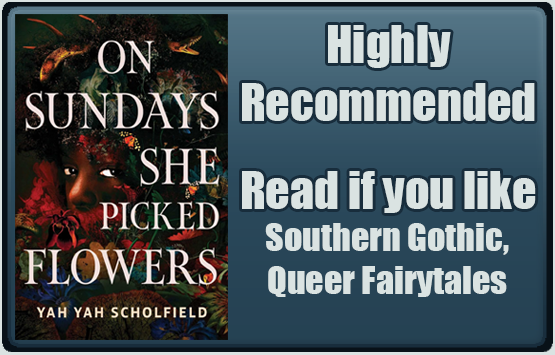
On Sunday She Picked Flowers by Yah Yah Scholfield

On Sunday She Picked Flowers by Yah Yah Scholfield

Formats: Print, audio, digital

Publisher: Saga Press

Genre: Gothic, Historic Horror, Werebeast

Audience: Adult

Diversity: Black characters and author, Queer main character and author

Takes Place in: Georgia, USA

Content Warnings (Highlight to view): Alcohol Abuse, Animal Death, Body Shaming, Cannibalism, Child Death, Childbirth, Death, Gore, Homophobia, Incest, Miscarriage, Physical Abuse, Racism, Rape/Sexual Assault, Self-Harm, Sexual Abuse, Slurs, Slut-Shaming, Verbal/Emotional Abuse, Violence, Vomit

Blurb

When Judith Rice fled her childhood home, she thought she’d severed her abusive mother’s hold on her. She didn’t have a plan or destination, just a desperate need to escape. Drawn to the forests of southern Georgia, Jude finds shelter in a house as haunted by its violent history as she is by her own.

Jude embraces the eccentricities of the dilapidated house, soothing its ghosts and haints, honoring its blood-soaked land. And over the next thirteen years, Jude blossoms from her bitter beginnings into a wisewoman, a healer.

But her hard-won peace is threatened when an enigmatic woman shows up on her doorstep. The woman is beautiful but unsettling, captivating but uncanny. Ensnared by her desire for this stranger, Jude is caught off guard by brutal urges suddenly simmering beneath her skin. As the woman stirs up memories of her escape years ago, Jude must confront the calls of violence rooted in her bloodline.

Haunting and thought-provoking, On Sunday She Picked Flowers explores retribution, family trauma, and the power of building oneself back up after breaking down.

I received this product for free in return for providing an honest and unbiased review. I received no other compensation. I am disclosing this in accordance with the Federal Trade Commission’s 16 CFR, Part 255: Guides Concerning the Use of Endorsements and Testimonials in Advertising.

Jude (short for Judith) does what I’m sure many women have dreamed of doing. After killing her abuser she runs away from her terrible life to live alone in a haunted house in the forest where she becomes a wisewoman/healer and takes a mysterious lover who may or not be a beast. On Sunday She Picked Flowers reads like a Southern Gothic fairytale, if “Once Upon a Time” were 1965 and “a land far away” was Georgia. This is not a pretty story with a pure, fair maiden who is rescued from her miserable life. Instead, our heroine, 41-year-old Jude, is described as “too fat, too Black, too tall, and too damn ugly” (at least by her teachers and classmates) and is forced to save herself from her wicked mother and the curse of transgenerational trauma.

Jude has lived with her abusive, religious mother for her entire life. She doesn’t understand why her mother, whom she calls Ma’am, hates her so much, only that she does. Ma’am will beat her daughter for the smallest offense then turn around and act like nothing happened (this is known as the cycle of abuse). Her two aunts, Phyillis and Vivian, tell Jude it’s her own fault she’s abused for being “difficult” and she should be grateful for all her mother has sacrificed for her.

Jude keeps a packed bag and a tin of money hidden under her bed so she can leave one day. She’s tried to run away before but people in the town always bring her back. Eventually Jude realizes the only way she’ll ever be free is to kill her mother. One night Jude is making dinner when Ma’am announces she found the packed bag under Jude’s bed. Ma’am tried to guilt trip Jude before telling her daughter that she’ll never let her leave. Something snaps in Jude and she starts hitting her mother and the two end up on the floor. Ma’am tries to strangle her but Jude grabs a meat cleaver on the floor and buries it in her mother’s face. She attempts to call her aunt Phyllis for help and to confess what she’s done, the only one of Ma’am’s two sisters who might show her compassion, but is rebuffed. Realizing she can’t stay in that house Jude runs away and ends up in an abandoned haunted house in the middle of the woods that she names Candle.

In many ways transgenerational trauma can feel like a family curse that passes from parent to child. The controversial field of epigenetics claims that trauma can change your DNA to the point that it’s passed down genetically to your offspring, with descendants of Holocaust survivors, Residential School Survivors, and enslaved Africans continuing to experience the symptoms of trauma (depression, anxiety, substance misuse, etc.). Dr. Joy DeGruy, who holds advanced degrees in both clinical psychology and social work research, came up with the term “post traumatic slave syndrome” to describe the transgenerational trauma experienced by African Americans as a result of the Atlantic slave trade, in addition continued discrimination in the present day. While the American Psychological Association (APA) awarded Dr. DeGruy a Presidential Citation in 2023 her theory is not without its critics. Dr. Ibram X. Kendi, a historian and anti-racism scholar, argues that the idea of post traumatic slave syndrome is itself racist as it implies that Black people are inherently dysfunctional as a group.

Some studies have shown that when someone experiences abuse as a child and is unable to learn healthy coping methods, they are more likely to abuse their own children, with one study stating that abuse and neglect victims are three times more likely to be abusive themselves. Rates of domestic violence are higher in the Black community, with Black women at the greatest risk, most likely due to a combination of racism and poverty. Black parents also have a complex relationship with the corporal punishment of children, especially in the South. When my siblings and I were little my Black grandmother thought it was very amusing that my white mother didn’t believe in spanking, and joked about how the beatings she gave my aunt and father would get her sent to prison now.

But she did what she did to protect them from something worse. She knew white people would use any excuse to hurt, arrest, or even kill a Black person, even if they were a child so Black children had to always be obedient if they wanted to survive. They did not have the same opportunities as white children to make youthful mistakes. Child advocate Dr. Stacey Patton, who is herself a child abuse survivor, explained in an interview with Ebony that “People think that hitting a child is a form of teaching. We think it will protect them.” In another interview with the Touré Show podcast  Dr. Patton stated “There was this idea that ‘Well if I beat you, you’re gonna be alive at the end of the day, whereas if the Klan gets their hands on you, you’re dead’… And so we fast forward to this century, and you have Black people saying, ‘If I don’t beat my child, then the police will kill them.’” Of course, the belief that all Black parents are inherently abusive or “bad” parents is rooted in racism.

Ma’am was horribly abused by her own father, and ended up taking her pain out on her daughter. Jude’s beatings were treated as acceptable “punishments” by her aunts who had been beaten similarly as children. But this does NOT mean that an abused child is guaranteed to be abusive themselves. Jude is able to break free and learns to love herself and that she’s more than what was done to her, just as many Black parents today are moving away from “tough love” and embracing gentle parenting. In fact, corporal punishment is quickly falling out of favor in the Black community.

Scholfield’s prose is gorgeous, one my favorite lines in the book is, “Jude entered the verdant maw of the woods, past its bark teeth and down its mossy throat, down into its humid green bowels.” What a great description, both foreboding and beautiful. It’s also a perfect example of the book’s reoccurring theme of transformation as Jude leaves civilization behind and enters the enchanted world of the forest (appropriate, as the forest has long been a metaphor for transformation in both fairytales and folklore). Ma’am prefers nature small and tamable because she had too much of it as a child working on a plantation (one of the reasons my grandmother left Tennessee and moved to Chicago) and four generations of Ma’am’s family slaved away on a plantation, even after emancipation. But Jude loves the beauty of nature and its wildness, and is willing to work the land if she’s working it for herself and not another. For in the forest, she is truly free.

Judediscovers safety and strength in her solitude, that is until she meets Nemoira, a strange and beautiful woman who enters Candle and immediately makes herself at home. Jude falls hard and fast for the mysterious Nemoira, who may or may not be the beast that’s been leaving meat on her doorstep. Their relationship reminds me of classic stories like Bluebeard, Tsuru no Ongaeshi (Crane’s Return of a Favor), and Beauty and the Beast. I loved that this book was about an older woman rather than a 20-something. Of course there’s nothing wrong with younger heroines, but it can get repetitive always reading about women half my age in books supposedly aimed at adults. It’s easy to find older men in media, but creators seem afraid to make their women older than 30 or so. Jude, on the other hand, starts the story out at 41 and is in her sixties by the end of it. She’s also able to change and develop as a character despite being older. It’s wonderful to watch Jude go from terrified and helpless to fearless and self-sufficient over the course of the story. Best of all, she gets to have a romance and hot sex! Media makes it seem like women stop having sex the minute they hit 40, but while age can change how you have sex, older adults are still sexually active. So it’s nice to see that represented here and not treated as a punchline or something gross.

This was an achingly beautiful and haunting story. Despite its supernatural and fairy tale-like elements, the book’s depictions of abuse are still realistic. I appreciated how Scholfield humanizes Ma’am without excusing her abuse of Judith. Ma’am’s treatment of her daughter is inexcusable, even though Judith is not a “perfect victim” (a harmful myth that often prevents abuse survivors from getting help). Judith’s relationship with Nemoira is similarly complex, with Judith trying to love a monster without herself becoming monstrous and learning to stand up for herself. Scholfield’s descriptions are lush: you can practically see, smell, and hear the forest. On Sunday She Picked Flowers feels like in takes place in a liminal space between fantasy and cold reality, the “real” world, and the world of the forest. While reading it, I always felt like I was just on the edge of a dream.

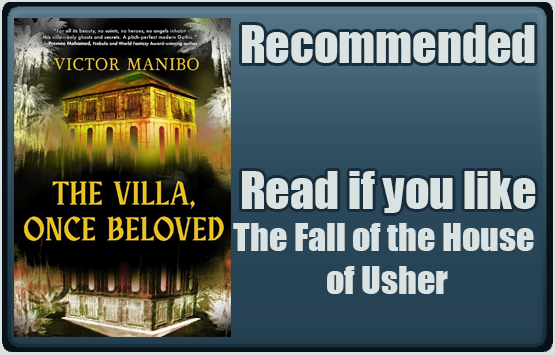
The Villa, Once Beloved by Victor Manibo

The Villa, Once Beloved by Victor Manibo

Formats: Print, audio, digital

Publisher: Erewhon Books

Genre: Gothic, Myth and Folklore

Audience: Adult

Diversity: Filipino author and characters, Gay author and character, non-binary side character

Takes Place in: The Philippines

Content Warnings (Highlight to view): Child Abuse, Classism, Death, Drug Use/Abuse, Forced Captivity, Gaslighting, Gore, Homophobia, Illness, Incest, Miscarriage, Mental Illness, Racism, Rape/Sexual Assault, Sexism, Slurs, Transphobia, Verbal/Emotional Abuse, Victim Blaming, Violence, Vomit

Blurb

Some legacies are best left buried…

Villa Sepulveda is a storied relic of the Philippines’ past: a Spanish colonial manor, its moldering stonework filled with centuries-old heirlooms, nestled in a remote coconut plantation. When their patriarch dies mysteriously, his far-flung family returns to their ancestral home. Filipino-American student Adrian Sepulveda invites his college girlfriend, Sophie, a transracial adoptee who knows little about her own Filipino heritage, to the funeral of a man who was entwined with the history of the country itself.

Sophie soon learns that there is more to the Sepulvedas than a grand tradition of political and entrepreneurial success. Adrian’s relatives clash viciously amid grief, confusion, and questions about the family curse that their matriarch refuses to answer. When a landslide traps them all in the villa, secrets begin to emerge, revealing sins both intimately personal and unthinkably public.

Sifting through fact, folklore, and fiction, Sophie finds herself at the center of a reckoning. Did a mythical demon really kill Adrian’s grandfather? How complicit are the Sepulvedas in the country’s oppressive history? As a series of ill omens befall the villa, Sophie must decide whom to trust—and whom to flee—before the family’s true legacy comes to take its revenge . . .

I received this product for free in return for providing an honest and unbiased review. I received no other compensation. I am disclosing this in accordance with the Federal Trade Commission’s 16 CFR, Part 255: Guides Concerning the Use of Endorsements and Testimonials in Advertising.

The Villa, Once Beloved is a modern gothic horror story set in the Philippines about the terrible crimes people will commit to obtain and maintain wealth and power. The story is tied to its setting, with the history of colonialism and political corruption in the Philippines playing an integral role in the plot. 

Don Raul Sepulveda, the wealthy patriarch of the Sepulveda family, has decided his deceased family members need to be moved to a grand mausoleum. He attempts to build the mausoleum himself, despite his advanced age, after firing all the builders because they kept telling him his vision was impossible. Raul believes his family’s grand tomb must be finished quickly because death is coming for him, and is proven correct when he dies that night after seeing a terrifying specter in the jungle: a pale, faceless woman. His wife, Doña Olympia finds Raul’s crushed body in his bed the next day, his hands covered in dirt. 

A few days later, a college student named Sophie is flying to the Philippines in a luxurious private jet with her boyfriend, Adrian, to visit his family. It’s her first time on an airplane and her first time out of the country. They’re flying to the Philippines for the funeral of Don Raul, Adrian’s grandfather. Sophie may be Filipino but she was raised by a white, working-class couple on a farm in Nebraska, making her feel like an outsider. While Sophie is worried that she may be intruding on the Sepulveda’s family’s private grief, she’s happy she can support Adrian in his time of need.  

Sophie loves her boyfriend because of his “boundless and innocent optimism” and his ability to talk about his feelings and have tough conversations.  He lavishes her with praise, unlike her adoptive parents, who don’t give her a lot of positive affirmation. Adrian cares deeply about his family and country, and has been educating Sophie about the Philippines: its history, culture, and what it means to be Filipino. Maybe I just distrust straight cis men, but Adrian seemed too good to be true. There weren’t exactly any red flags, but something about him felt off. Yellow flags, if you will. He never brings Sophie to his family’s home, despite it being only an hour from campus, and I got the sense a lot of his activism was performative. And the way he educates Sophie about the Philippines felt  condescending. Sophie loves it;she describes it as “very My Fair Lady. Sophie was clay ready to be molded, a Filipina Eliza Doolittle who somehow needed to be more Filipina, and Adrian was happy to be Henry Higgins.” But if  you remember the film  (or the George Bernard Shaw play it was based on) Henry Higgins was a misogynistic jerk to Eliza Doolittle.

Adrian is planning to make a documentary about his family and their ties to the Marcos, a major political family in the Philippines. The Sepulvedas are related to the Marcos through Imelda Romualdez Marcos, the former First Lady of the Philippines. She was the wife of former president Ferdinand Emmanuel Edralin Marcos, Sr., and mother of the current president of the Philippines, Ferdinand “Bongbong” Romualdez Marcos, Jr. Ferdinand was a kleptocrat who ruled as a dictator from 1965-1986, committed numerous human rights violations, and kept the Philippines under martial law in the ‘70s. Adrian hates the Marcos with a passion, even going so far as to organize a protest at Standford University when Bongbong visited the Bay Area. When his grandmother Olympia announces that the current president and his mother will likely be guests at Raul’s funeral, Adrian is horrified.

Adrian’s family has been in the Philippines since before the diocese, and own a large coconut plantation. Their villa was built nearly 200 years ago by Señor Bartolome Sepúlveda as a summer retreat for his reclusive wife Dorotea to hide her from the attention of other men (or to hide her from society after she went mad from homesickness). They were Spanish aristocrats who had fallen on hard times and moved to the Spanish East Indies attracting by Manila’s growing wealth after the Spanish crown took control and turned it into a major trading port. Their son Oscar saved the Sepulveda fortune, by starting the coconut plantation. He married Mercedes, an indio (which his father didn’t approve of). They had seven sons and one daughter, Soledad, who was married off to a member of the Marcos family.

Claudio, the oldest son of Oscar and Mercedes, is Divina and Raul’s father. He was born in 1929, after the Philippines had been sold to America. Claudio, as a US national, served in the US army and fought in WWII during the Japanese occupation of the Philippines under General Douglas MacArthur. Claudio became a general himself, and a war hero, and chose to marry Elisea Jimenez because she was an heiress. He cheated on her multiple times, and may or may not have fathered children with other women. Elisea was the power behind the throne. She prevented Claudio’s siblings from ousting him from the company and it was her idea to expand into the international coconut trade in the sixties, selling lumber, coconut wine, and coconut oil. The coconut oil was especially popular with their US partners, and is still used in major cosmetics brands. 

But then the Sepulveda family’s fortunes turned. In 1985 there was a worker’s strike at the Sepulveda’s plantation due to Marcos’ Coco Levy Fund Scam. A few days after that typhoon Saling (aka Typhoon Dot) struck, resulting in landslides that destroyed the countryside. Then malaria struck the town. There were crocodile attacks after that, then swarms of beetles that destroyed crops. Finally, a warehouse collapsed, killing several workers including Raul’s brother-in-law. When Raul’s father died suddenly of an aneurysm, Raul decided to flee to the states with his wife and young sons (Kai was not yet born), hoping to escape the curse. He left behind his newly widowed sister Divina to care for the villa and the coconut plantation.

Joining Adrian and Sophie at the villa are his parents Eric and Margot, his uncle Javier, his grandmother Olympia, his great aunt Divina, and some servants including the caretaker Remidios. Adrian’s auncle (a gender-neutral term for a parent’s sibling) Kai joins them later, barely making it to the villa because of the typhoon that strikes the Philippines. If you’re as bad at remembering names as I am, I would definitely recommend keeping a list of the characters because there are A LOT. Keeping track of the living family was one thing, but throw in all the ancestors on top of that and I started having trouble keeping track of who was who.

The book is told in third person limited tense, with Sophie acting as the main protagonist and audience surrogate who, while Filipino, is also an outsider and new to the culture and history. We also learn more about the family’s history through Adrian’s interviews with Divina for his documentary. Javier and Remidios serve as the deuteragonist and tritagonist of the story, giving the reader more of an insider’s view of the Sepulveda family. Javier and Remidios are both more cynical than the naïve Sophie who is just happy to be included. Javier is disappointed to discover his old home is not as grand as he remembered, instead finding it cramped and ill preserved whereas Sophie is in awe of the villa, highlighting their very different upbringings. Remidios has a less than charitable opinion of Sophie in the beginning (though she does warm up to her) and it’s interesting to see the protagonist, who is so often praised by Adrian, looked down upon by another character. Sophie is also the character who is most disturbed by what’s happening and becomes increasingly distraught as the story continues, growing paranoid and isolating herself from the rest of the family.

This is a slow burn horror book, which admittedly, I’m not usually a fan of. Things don’t start to getexciting until halfway through, when one of the family’s biggest secrets is finally revealed. The first half of the story is mostly getting to know the characters and their history, and I feel like it could have used more horror and foreboding. But of course, that’s just my personal preference.People with more patience than me will have a completely different reading experience. I did really enjoy learning about Filippino history and I liked how Manibo used real events and tied them into the story, like Typhoon Dot and the Coco Levy Fund Scam. I also liked how it isn’t revealed whether supernatural factors are at play until the very end. The reader is left to wonder if Raul was really killed by a batibat (a sort of Filipino sleep paralysis demon that can cause sudden, unexplained deaths) during a bangungot as Remidios claims, or whether the monster he saw was merely an apparition brought on by his madness. And is the string of disasters surrounding the family the work of a curse or merely bad luck?

Despite the villa’s size there’s a feeling of claustrophobia due to its isolation. The typhoon knocks out the internet, phone services, and roads making it impossible to reach anyone outside the villa. Because the villa is in a secluded area, it’s unlikely anyone will come to the aid of those trapped there by the landslides, despite Olympia’s insistence that everyone will come for her late husband’s funeral. Manibo is excellent at creating a gothic atmosphere, and, despite so many characters, each has their own unique perspective and personality, making them stand out. A must read if you’re a fan of the gothic.


Fever Dreams of a Parasite by Pedro Íñiguez

Fever Dreams of a Parasite by Pedro Íñiguez

Formats: Print, digital

Publisher: Raw Dog Screaming Press

Genre: Body Horror, Eco Horror, Eldritch Horror, Folk Horror, Ghosts/Haunting, Historic Horror, Killer/Slasher, Monster, Sci-Fi Horror, Zombie

Audience: Adult

Diversity: Mexican American author and characters, Mexican characters

Takes Place in: Mainly Mexico and California

Content Warnings (Highlight to view): Ableism, Alcohol Abuse, Amputation, Animal Abuse, Animal Death, Body Shaming, Cannibalism, Child Death, Child Endangerment, Childbirth, Death, Drug Use/Abuse, Gore, Kidnapping, Miscarriage, Mental Illness, Physical Abuse, Racism, Rape/Sexual Assault, Sexism, Stalking, Suicide, Torture, Verbal/Emotional Abuse, Violence, Xenophobia

Blurb

Íñiguez weaves haunting tales that traverse worlds both familiar and alien in Fever Dreams of a Parasite. Paying homage to Lovecraft, Ligotti, and Langan, these cosmic horror, weird fiction, and folk-inspired stories explore tales of outsiders, killers, and tormented souls as they struggle to survive the lurking terrors of a cold and cruel universe. With symbolism and metaphor pulled from his Latino roots, Iniguez cuts deep into the political undercurrent to expose an America rarely presented in fiction. Whether it’s the desperation of poverty, the fear of deportation or the countless daily slights endured by immigrants, every story is precisely rendered, often with a twist that allows us to see the mundane with fresh eyes.

I received this product for free in return for providing an honest and unbiased review. I received no other compensation. I am disclosing this in accordance with the Federal Trade Commission’s 16 CFR, Part 255: Guides Concerning the Use of Endorsements and Testimonials in Advertising.

Most of the stories in this anthology fall in the cosmic horror genre, but each story is entirely unique. There are, however, a few repeated themes; families, poverty and classism, people down on their luck, and those who take advantage of them. Monsters are a staple throughout the book, though most of the stories don’t really explain what the monster is. Are the dog-creatures werewolves? Is the blood sucking child a vampire? What in the world are those maggot monsters in Midnight Frequencies? What the hell is the old man with the fangs? Who knows! I can guess, but sometimes it’s scarier not to know. Even with all the different strange creatures, there’s often a human enabling it, once again proving that humans are the worst monsters of all. The anthology explores various themes and contemporary issues like the California wildfires, environmental destruction, addiction, the damage done by both the cartel and the US in the poverty-stricken areas of Mexico, how desperate immigrants are exploited, predatory landlords, and even increasingly adversarial political TV commentators.

The first story, titled Nightmare of a Million Faces, is about Anastasia Mendez, an unemployed porn star who just left an abusive relationship with her ex-boyfriend/manager/fellow porn star, Robert. Even without the monster appearing at the end the story is already disturbing as it focuses on how women’s bodies are often controlled. In Anastasia’s case, Robert decides(as her manager) who she has sex with and what roles she takes, and as her boyfriend, he coerces her into having an abortion she doesn’t want when he gets her pregnant. Even though the story is short, much of it focuses on fleshing out Anastasia’s character so you feel invested in her survival by the end of it.

I liked that Nightmare of a Million Faces focused on the flaws in the mainstream porn industry without condemning sex work itself. And while Robert was controlling, Anastasia chose to work in porn before she met him, and even after they broke up, sex work wasn’t something she was forced to do. It’s also very pro-choice, despite focusing on an abortion Anastasia didn’t want. People with uteruses shouldn’t be forced to abort any more than they should be forced to give birth. Women of color like Anastasia are at especially high risk of reproductive coercion.

Birthday Boy is one of my favorite stories in the collection. It’s about a child whose fantasies shield him from the horrors around him and the atrocities committed about his father. The story is quite short, but effective, and the ending feels like a gut punch. Many of the characters are either parents or about to become parents, and there’s a certain horror in knowing they must protect their children from the monsters. Some are men whose wives have left them and taken their children, like in Midnight Shoeshine. Others, like the father in Postcards from Saguaroland, have left on their own to try and secure a better life for their families. Then, there’s Frank from Roots in Kon Tum, who abandoned the woman he impregnated in Vietnam and started a new family in the US. Effigies of Monstrous Things is about a single father trying to raise his daughters after his wife’s disappearance. Shantytown and Caravan are both stories about single mothers living in poverty struggling to take care of their only child, and The Body Booth is about an expectant mother who has chosen to raise her child alone. The House of Laments is one of the few stories with a happily married couple in which Rodrigo and Julia are expecting a baby after suffering multiple miscarriages. Some of the stories are focused on other types of familial relationships, like the grieving siblings in The Cellar and the seal hunting uncle and nephew in Skins.

The story from which the anthology gets its title is written like a magazine profile on an elderly fashion designer named Alberto Madrigal, whose designs are based on traditional Mexican fashion. When he first immigrated to the United States, before he became famous, other designers called him a “parasite” and accused him of stealing jobs. But now he’s hired by famous celebrities, like heavy metal star Kane Krieger, who has just had his directorial debut. His horror film, called Fever Dreams of a Parasite, is about a man tormented by dreams that may come from another world and slowly drive him to madness. The critics have panned Krieger’s film at advanced screenings, and he wants to wear something to the premiere that will be a big “fuck you” to the critics. Madrigal struggles to create a suit until he’s inspired by a nightmare and the fleas on his dog’s back. I liked the unique epistolary style of this story.  Postcards from Saguaroland is another notable example of Íñiguez deviating from his typical story structure, with a non-linear story that starts with the reveal of the monster.

There was one story I had a few issues with, The Savage Night. When I first started reading it I thought it was about an unnamed Indigenous tribe, because the main character was referred to as the tribe’s medicine man, in which case many of the tropes used in the story and the title would have been problematic. Fortunately, it turned out to be about Paleolithic humans in which case a writer has a lot more creative freedom. Still, I would have used a different term for the tribes’ spiritual healer as “medicine man” seems to be specific to American Indians.

The Last Train out of Calico is much better in terms of representation. Although Lakota train robber Warren Blackhawk has hints of “the stoic Indian” it’s nice to see a morally gray American Indian character. American Indians are usually painted as either the “noble savage” or someone on horseback whooping and killing cowboys. So, it’s nice to see a sympathetic character who’s just a guy who robs trains with his friends.

Other things I liked: Black was capitalized when referring to race and the Spanish wasn’t italicized. A woman with substance use disorder was portrayed sympathetically as a struggling mom who loves her child but is also battling a disease, rather than a weak and immoral person.

The anthology felt like Lovecraft meets the Twilight Zone, which I loved. It’s full of fun, bite-size horror stories full of tragic characters struggling against an uncaring world, whose desperation and hopelessness you can really feel. Íñiguez’s collection is bleak with a strange, dream-like quality to it, full of the weird and grotesque.

The Unfinished by Cheryl Isaacs

The Unfinished by Cheryl Isaacs. Recommended. Read if you like atmospheric, slow burn horror

Formats: Print, audio, digital

Publisher: HarperCollins

Genre: Demon, Eco Horror, Folk Horror

Audience: Young Adult

Diversity: Kanien’kehá:ka (Mohawk) main character and author, Jamacian-American side character

Content Warnings (Highlight to view):  Child Endangerment, Forced Captivity, Gaslighting, Kidnapping

Blurb

In this debut YA horror novel by Cheryl Isaacs (Mohawk), small-town athlete Avery is haunted by the black water and Unfinished beings of Kanyen’kehá:ka stories and must turn to the culture she hasn’t felt connected to in order to save her town.

The black water has been waiting. Watching. Hungry for the souls it needs to survive.

When small-town athlete Avery’s morning run leads her to a strange pond in the middle of the forest, she awakens a horror the townspeople of Crook’s Falls have long forgotten.

Avery can smell the water, see it flooding everywhere; she thinks she’s losing her mind. And as the black water haunts Avery—taking a new form each time—people in town begin to go missing.

Though Avery had heard whispers of monsters from her Kanyen’kehá:ka (Mohawk) relatives, she’s never really connected to her Indigenous culture or understood the stories. But the Elders she has distanced herself from now may have the answers she needs.

When Key, her best friend and longtime crush, is the next to disappear, Avery is faced with a choice: listen to the Kanyen’kehá:ka and save the town but lose her friend forever…or listen to her heart and risk everything to get Key back.

In her stunning debut, Cheryl Isaacs pulls the reader down into an unsettling tale of monsters, mystery, and secrets that refuse to stay submerged.

The story begins with Avery, a Kanien’kehá:ka (Mohawk) teenager living in Crook’s Falls, going on her morning run through the forest. She’s trying to get a cross-country scholarship to afford university as she and her mother struggle financially, especially after her parents’ divorce. Avery did her first run for cancer research at age 7 and immediately fell in love. She explains “[Running] had been and still was the closest thing I could imagine to flying.” It also helps still her mind of racing thoughts. Her mother, along with everyone else, has told Avery to never leave the forest path for her own safety (though they don’t elaborate as to why). But apparently, Avery’s never heard the story of Red Riding Hood and decides to do just that. While she doesn’t encounter any wolves, Avery does come across a hidden meadow with a strange, black pond that gives her a sense of unease. When she peers into it, her reflection smiles at her. Thoroughly freaked out Avery manages to stumble her way back to the path and runs home.

Her overprotective mother, Violet, was worried about her daughter going on an early morning excursion without leaving a note, but Avery blows off her concern (something she does frequently with her friends as well). At first, Avery doesn’t treat her–or her friends, Key and Stella– that well, mostly because she’s so reserved and pushes them away when things get too emotionally heavy for her. But her friends accept these aspects of her and are supportive (Avery is essentially an introvert who was adopted by two extroverts, which is usually how introverts like me make friends). She even admits “And here it was—the maddening part of my personality that just couldn’t deal with Serious Feelings Talk. Sharing. Vulnerability. I couldn’t do any of it, even when I wanted to… But just like my mom, I found sharing scary. Unlike her, I was basically a coward.” Avery does get better as the story progresses though.

Avery finds that the black water seems to have followed her home, showing up in her dreams, her shower, her coffee, and even flooding a bus she’s riding. She has strange visions no one else can see that get progressively worse as time passes. Sleep deprived with frayed nerves Avery tries to open up about what’s happening to others, but people either don’t believe her or tell her to just ignore it. Avery is beginning to question her sanity when folks start to disappear, and she realizes it’s all connected to the Black water and a strange pale figure called “The Ragged Man.”

I found the most interesting part of the story to be Avery’s character development. She starts the book feeling disconnected from her culture and holding the world at arm’s length. Avery just can’t deal with her emotions or opening up to others. Part of this is because Avery thinks that if she speaks something, that makes it real, but if she just suppresses it then it will go away. This is based on her belief that she caused her parents divorce by asking them if they were getting divorced: her question made it happen. Although she understands intellectually that can’t be true, it doesn’t stop her from believing it. As Avery explains, “…saying things can make them real, and when they’re real, they can be taken away.” But as the story progresses Avery finds her strength by connecting to others.

Part of Avery’s disconnect from her Kanien’kehá:ka heritage is because her mother refused to teach her about it growing up. Avery explains “I think Mom was afraid it might do me more harm than good, marking me as different in a world that only claimed to value diversity.” This also may be a remanent of the lasting damage done by residential schools. As Noetta, an Osage, Mvskoke Creek, and Seminole woman explained in an interview with PBS “There are some Natives that were so affected by their boarding school experiences that they chose not to raise their children in the traditional ways” resulting in a loss of culture between the generations. As is perfectly summarized by the website Native Hope “All of these current challenges—lack of educational opportunity, physical and mental health disparities, the intense impact of historical trauma, lack of economic independence—are part of the great tragedy facing Native Americans: the loss of Native American culture and identity.”

For example, Avery’s can’t understand when her Ihstá (aunt), Lily, tries to speak Kanyen’kéha (the Kanien’kehá:ka language) to her, only knowing a few words because her mother never taught Avery their language. This loss of culture and community may be part of the reason Avery struggles so much with her mental health and feels like she must be independent, never relying on others for help. Unlike the traditional western approach to Wellness which focuses primarily on the body, Native communities often have a more holistic approach. According to the Canadian Health Justice website “There is immense diversity in approaches to wellness among different Indigenous communities however, a core concept of health and wellness common to First Nations, Métis, and Inuit people is that people, earth, and everything around us are deeply interconnected and that wellness comes from holistic internal and external balance that goes beyond the absence of illness.” Without these important connections Avery’s mental health suffers.

Obviously, I can never understand the struggles American Indians go through, nor what it feels like to have your culture erased by residential schools (amongst other forms of cultural genocide), and I won’t pretend to. But I still found myself relating to Avery’s longing for a culture erased by colonialism. As some of you are aware, I’m half Black (though white passing), and while Black Americans do have their own rich culture, it doesn’t hurt any less knowing that generations worth of culture and knowledge have been erased by the enslavement of Africans by Euro-Westerners. While some remnants of African cultures still remain (like in music, food, religion, and even speech) it’s not the same thing as knowing how to speak the language of my ancestors or follow their spiritual beliefs because I don’t know what those were, and there’s really no way of finding out what specific region of Africa my family came from (genetic testing can narrow it down to a general area, but not a culture).

I know it’s not the same, but Avery’s despair over feeling like she was losing her roots stirred up grief and frustration in me. It was the same feeling I get when my white mother talks about the genealogy research she does for her side of the family (who are horrible people I don’t like) that she can trace back hundred of years. I would love to do that with the Black side of my family (who I’m much closer to), because that information was erased when they were enslaved. Again, I can’t really know how Avery feels, but I know how she made me feel. I guess what I’m saying is this book stirred up a lot of deep-rooted feelings for me. Avery feeling like she wasn’t part of her culture, or had a right to tell their stories really resonated with me as a biracial person who sometimes feel like an intruder in both my parent’s cultures. For Avery, reconnecting to her family and culture, and learning to rely on her friends, is the best way for her to heal and holds the key to defeating the black water.

The black water reminded me of MMIW and Native children taken from their families by the government. It’s supernatural metaphor for very real problems destroying Native communities today. When the black water steals someone the community finds reasons to excuse their absence, like “they ran away from home” and the police show little to no interest in their disappearance. I found the black water to be especially creepy, and at first, I believed it had to be based on some real-world legend. But no, it was entirely Isaac’s own invention, which I found impressive. The black water felt like a story passed down as a warning from generation to generation, and not something the author just invented for the book. However, Isaac does use some traditional stories in her narrative. Avery reflects on Haudenosaunee (the six Iroquois Nations) creation story of Sky Woman, at first believing  Sky Woman’s fall from the Sky World is something terrifying, a punishment for being too curious. But a Kanien’kehá:ka elder makes her realize that if Sky Woman hadn’t fallen, we wouldn’t have Turtle Island (the name used by some American Indians for what Euro-Westerners call North and Central America) or the Haudenosaunee people. So, although change can be scary, good things can come from it.

This made it the antagonist of the story even creepier, and this was definitely a creepy book, filled with a general sense of unease. But it wasn’t scary per se, so perfect for people who want to dip their toes in the shallow end of the horror pool. Your personal experience may vary, but I think this will appeal to fans who don’t usually read horror. You’ll also notice there aren’t a lot of trigger warnings for this book. The Unfinished feels very approachable, but if you’re a hardened horror fan, you may be disappointed at the lack of scares. I liked how the story centers around a teenage girl trying to save the boy she’s crushing on, a nice inversion of the “damsel in distress” trope, and the message about building community and relationships.

I personally feel that The Unfinished would have worked better as a novella, as the story really dragged for me. The pacing is much slower than I usually prefer, focusing more on atmosphere, emotion, and building suspense than action. Which is fine, it just didn’t grab my attention as much as other books. Keep in mind however, I do struggle with ADHD so I tend to prefer a fast pace with a lot going on over atmospheric reads. Those who do like a slow buildup of suspense and in-depth character studies will probably have no issue with the lack of action. I also found that the story was very repetitive; Avery sees something creepy, gets scared, goes to someone for help but then has trouble actually asking for help then runs away, lather, rinse, repeat. I understand this was probably to give Avery more time to develop her character, but to me it came off as unnecessary padding, which just reinforced my opinion that this would have worked better as a shorter story. The only other fault I found is something that’s admittedly, very nitpicky. I just really wished that Avery and Key could have just been friends instead of having an awkward crush get in the way, but that’s just my queer aversion to hetero romance tropes and I feel like most readers won’t care about that. Even though I had some issues with the length of the book I still enjoyed the story and its message, and I think it will be relatable to many BIPOC people who feel disconnected from their culture.

*If you want to learn more about the Haudenosaunee confederacy, I highly recommend the Iroquois Museum in Howes Cave, NY. I visited it years ago and found the museum highly informative and had great conversations with the staff and an elder who had painted the mural in the museum. If you’re not near New York the museum’s website has virtual tours and an online gift shop that sells educational books.

Navigation

Social Media

Search by Tags

To learn more about the Age Group, Diversity, and Genre tags, click here.

Age Groups

Diversity

Genre

Support the Blog

Search

Links

Funerals Are for the Living by Sami Ellis

Funerals Are for the Living by Sami Ellis

Formats: Print, digital

Publisher: Amulet Books

Genre: Occult, Thriller

Audience: Young Adult

Diversity: Black, queer main character and author, main character with anxiety and depression

Takes Place in: North Carolina

Content Warnings (Highlight to view):  Alcohol Abuse, Body Shaming, Cannibalism, Child Abuse, Child Death, Child Endangerment, Death, Forced Captivity, Kidnapping, Mental Illness, Physical Abuse, Police Harassment, Racism, Slut-Shaming, Stalking, Suicide, Torture, Violence, Vomit

Blurb

New from the author of Dead Girls Walking comes a YA horror about a girl kidnapped by a racist cult after investigating the supernatural happenings at her sister’s gravesite

A month ago, Junie Daniels was in a car crash that left her with a dead sister, fragmented memories of the accident, and a mother too checked-out to plan a funeral. The cheapest grave plot Junie can find is in the next town over. Sure, Williamsville is still proudly named after a slave master who was rumored to dabble in dark magic—but this North Carolina, after all.

When unexplained occurrences start happening at the graveyard, though, Junie and her best friend, Omari, investigate. And it’s not long before Junie and Omari are taken…

Williamsville wants both Daniels girls. But Junie will do anything to protect her sister—even if it’s only her corpse.

Sisters Junie and Jay were as different as can be. Jay was outgoing, popular, and an activist who lived her life out loud. In comparison Junie is introverted, quiet, and only has one friend, Omari. Jay has to drag Junie to parties just to keep her from sitting alone in their shared room. So, when Jay is killed in a car accident that Junie survives, Junie can’t help but think the wrong sister died. While her mom is depressed to the point of catatonia, Junie is forced to use her college savings to plan her sister’s funeral herself. Instead of buying a plot in Daniels, where they live, Junie has Jay buried in the neighboring town of Williamsville after finding a flyer advertising a cheap plot on the windshield of her mom’s car.

Like the two sisters, Daniels and Williamsville are polar opposites. Williamsville was founded by slave owner William Graham, who terrorized the town and killed his slaves for fun. Basically, Graham is Simon Legree and Madame LaLaurie combined. The creepy, desolate town is still mostly white to this day. Meanwhile Daniels was founded by Black sharecroppers who refused to live on the land where their ancestors were enslaved. It’s small but lively and has a strong sense of community. But it’s a community Junie does not feel a part of due to her introversion and low self-esteem. And honestly, I get it. It’s hard to think other people like you when you don’t even like yourself, and it can be scary trying to connect with others when you’re not naturally outgoing.

Junie knows everyone loved Jay, who was very active in the community, and Omari, who is friends with everyone. But she thinks of herself as a third wheel, a cheap imitation of her more popular little sister. Junie seems to struggle with depression and anxiety, which definitely play a role in her self-isolation. But Junie is also kind of mean. Time and again we see people in the community try to reach out to her as she pushes them away. When her neighbors call after her, asking how she and her mom are doing, Junie ignores them. When her sparring partner and crush, Neveña, tries to be friends with her, Junie coldly rejects her. And when Jay dragged her to a party before her death, Junie sat in the corner and sulked the entire time. But community is important. Especially when you’re marginalized.

It’s her disconnect from the community that stops Junie from reaching out for help when she and her mom are clearly struggling. Unfortunately, Junie decides she can handle everything by herself without any support. Junie is so completely turned off by the entire town showing up to mourn Jay (she refers to them as “sloppy sad”) that she decides to have a second, more reserved funeral at Jay’s grave, just her and Omari. It’s there that Junie notices something is wrong with the soil. The white graves are covered in lush, green grass, but Jay’s is just off colored soil that immediately kills the roses Omari places on the grave. Pissed off by the “racist dirt” the Williamsville church clearly gave her, Junie vows to return and fix it. Omari suggests contacting a lawyer and suing the church or at least getting help from his Uncle York who owns a local flower shop. But Junie doesn’t want to draw attention to the fact that her mom hasn’t left her room for a month and can’t take care of her daughter, because CPS might get involved. After hearing a strange noise in the graveyard, Omari decides that’s their cue to leave the creepy-ass town and go home.

Things continue to go poorly for Junie. Her mixed martial arts coach tells Junie she can’t go to the state MMA championship because of how much she’s been slacking off, despite the fact she’s gone every year. She finds an eviction notice on her door due to non-payment. And when Junie’s mother finally musters the energy to get out of bed and returns to work, they let her go, which she deals with by getting drunk. Junie is already feeling down when her mom drops a bombshell.

Junie already knows that the town of Daniels was named after her great-grandpa, but what she didn’t know is that she’s also a descendent of William Graham. While it’s not uncommon for Black people to be descended from white slave owners, since enslaved women were routinely raped by white men (my own last name comes from the white man who owned my great-great grandparents, his own children), it’s still horrifying to discover she’s related to such a monster. Apparently, Graham had multiple families, and sired many offspring, the descendants of whom are actually proud of their heritage. Junie’s mom warns her never to return to Williamsville, even though her sister is buried there.

There’s a reason Junie’s mom doesn’t want her going to Williamsville. It’s what’s known as a Sundown Town, a community that keeps non-whites (usually Black people) from living there through a combination of racist laws, racial covenants,  violence, and intimidation. Black folks could work there during the day but were expected to leave before sundown. While the Civil Rights and Fair Housing Acts of 1968 made Sundown Towns technically illegal, housing discrimination, gentrification, policing, and the lasting effects of redlining,  continued the tradition. Keep in mind Sundown Towns can be found all over the US, even in supposedly  “liberal” states. But Junie ignores her mom and drags Omari back to Jay’s grave to deal with the racist soil problem. It turns out she should have listened to her mom because the two teens end up kidnapped by a cult of William Graham’s white descendants, led by the sinister Sister Erica.

It’s no accident that one of the main villains is a white woman. Sister Erica reminds me of the white women who sell out BIPOC women to uphold the white supremacist patriarchy, like the 53–55% of white women who voted for Trump (compared to 7-10% of Black women). I find it particularly satisfying to see women like Pam Bondi or Kristi Noem betrayed by the white patriarchy they supported because they though it made them special and safe. So, of course I was excitedly waiting for Sister Erica to get hers. Maybe it’s petty and cruel of me to enjoy the suffering of others like that, but honestly, I don’t fucking care. People who happily intentionally hurt already marginalized people deserve to be laughed at when the leopards inevitably eat their face.

The first thing I noticed while reading Funerals are for the Living is how much I enjoyed the writing style. Ellis uses AAVE (African-American Vernacular English) liberally throughout the book, and I fucking love it. The editor didn’t remove the double negatives or the “done beens” in the name of “proper” grammar, so the characters sound like real people at ease in their environment instead of Black folks forced to code-switch. AAVE and other English dialects have their own grammar rules and are not “broken English” any more than American English is a broken form of British English. But racist grammar snobs still act like it is. For me, reading characters use AAVE felt familiar and comforting, after all it’s how my Black family speaks when they’re around each other and don’t have to code-switch for work. If they’re speaking in AAVE that means it’s a safe space.

I love how Ellis described Junie’s Black skin as “summer colored,” a welcome departure from white authors comparing Black skin to food. In fact, the only time Black skin is compared to food in the book is when Sister Erica does it while fetishizing a Black man, and you can practically feel Junie and Omari cringe. It’s also a nice change of pace that the white characters are the ones who are dirty, have bad hair, and act “primal”. And it’s just nice to have a book that’s clearly made for Black readers and isn’t forced to make things more digestible to try and appeal to a white audience.

I thought Junie was a great protagonist. She doesn’t really excel at anything, she’s not as smart Omari or as outgoing and strong as her sister Jay, nor is she much of a martial artist like Neveña. She’s also not particularly nice and only has one real friend because of it. She felt like an everyday, average teenager who was going through some shit. But despite all her faults she is very loyal to the few lucky people she cares about. While the cult represents unquestioning obedience of the white patriarchy, Junie represents rebellion against oppression. She starts out as someone who just lets things happen to her but becomes more of a fighter (like Jay) over the course of the book. I also liked Ellis’ unflinching portrayal of grief in Funerals are for the Living, in addition to Black mental health. One of the major morals of the story is that it’s okay to ask for help, which brings us back to the importance of community. It’s something Junie and Jay used to fight about, Jay wanted their mom to see a therapist while Junie just wanted to leave her be and hope it got better on its own (which of course it doesn’t). Medical racism and stigma keep Black people from receiving therapy that acknowledges their unique needs, like the trauma caused by everyday racism.

Funerals are for the Living gave me Get Out vibes, but set in the backwoods of rural North Carolina rather than the wealthy suburbs of upstate New York. You know you can’t trust these seemingly friendly white people, and something is very off, you just don’t know what it is yet. There are some really creepy scenes, like when characters are tortured or you realize just how brainwashed the members of the cult (mostly young people and children) are. Then there are more subtle chills like finding the slave mural in the church or knowing the racist police won’t save you if you call them for help.

Despite the overall dark and sometimes depressing tone of the book, there’s still some great moments of dark humor. I laughed out loud when Junie yelled that the church scammed her with a “Temu Grave,” or when she worried that the white cult would turn her and Omari into chili with no seasoning. I personally felt the book had a few pacing issues and could drag in some parts, but when it hit its stride, it really hit its stride and I found I couldn’t put it down. The mystery element of the book is really gripping, and I never knew what was going to happen next. I did feel like the supernatural parts of the story were kind of shoehorned in, and I’m not sure if they were strictly necessary since the book was chilling enough with just the racist cult. They didn’t necessarily detract from the story, I just don’t think they really added anything either. Overall, Funerals are for the Living is a well-crafted and moving piece of young adult fiction that doesn’t speak down to its young audience and trusts them with heavy topics.

Dead First by Johnny Compton

Dead First by Johnny Compton

Formats: Print, audio, digital

Publisher: G.P. Putnam’s Son

Genre:  Ghosts & Hauntings, Mystery, Occult

Audience: Adult

Diversity: Black author and main character, bisexual main character, Korean-American side character

Takes Place in: Texas

Content Warnings (Highlight to view): Alcohol Abuse, Amputation, Child Death, Death, Drug Use/Abuse, Forced Captivity, Gore, Kidnapping, Mental Illness, Police Harassment, Racism, Self-Harm, Suicide, Torture, Violence

Blurb

When private investigator Shyla Sinclair is invited to the looming mansion of mysterious Texan tycoon Saxton Braith, she’s more than a little suspicious. The last thing she expects to see that night is Braith’s assistant driving an iron rod straight through the back of his skull. Scratch that—the last thing she expects to see is Braith’s resurrection afterward.

Braith can’t die, it turns out, but he has no explanation for his immortality, and very few intact memories of his past. Which is why he wants to pay Shyla millions to investigate him, and bring his long-buried history to light.

Shyla can’t help but be intrigued, but she’s also trapped by the offer. Braith has made it clear that he knows she’s the only person he can trust with his secret, because he knows all about hers.

Bold, atmospheric, and utterly frightening, Johnny Compton’s Dead First is spine-chilling supernatural horror about the pursuit of power and the undying need for reckoning.

Private investigator Shyla has just finished a case for a man named Massimo Dante, who thought he was the antichrist. He paid her well enough that she was able to buy herself a house and help her cousins out financially. She doesn’t need to accept billionaire Sexton Braith’s case, but curiosity gets the better of her. Braith wants Shyla to determine why he’s immortal, which his trusted chauffer, Remy, demonstrates by shoving a fire poker through his skull. Thoroughly freaked out, Shyla is ready to turn him down. Yet, Braith implies he knows her biggest secret–that she killed a man when she was young–and will bring it to light if she doesn’t help him. Little does Shyla know that Braith is hiding his own, much darker, secrets.

I was instantly hooked by the premise for Dead First. I’m a sucker for horror mysteries. While the first half of the book felt a bit slow for my taste, the pace really picks by the midpoint, and each reveal feels more horrific than the last. What starts out as a supernatural mystery eventually morphs into full blown horror. Interesting to note, Dead First seems to take place in the same world as Compton’s Bram Stoker Award nominated novel The Spite House, as there’s a passing reference to The Spite House at the very end of the book.

I liked how Shyla was more morally ambiguous than most protagonists. She’s willing to do some pretty messed up stuff for the ones she loves and to protect her secret. She’s driven by revenge and you can tell her anger is poisoning her, but she’s unwilling to let go of it. Shyla has trouble opening up to others and past experiences have hardened her. This is part of why she broke up with her girlfriend, Jinh. Shyla’s relationship with Jinh is complicated, to say the least. The two clearly still care for each other, but Shyla seems scared to get too close. Shyla first met her ex when she went on Jinh’s podcast, a blend of true crime and supernatural lore that has fans all over the world. Jinh has the ability to speak to the dead, though Shyla doesn’t really believe in Jinh’s power. While I liked Jinh, I felt like her character could have used more development.

I appreciated how the racism in the book is very subtle. You’re not hit over the head with it, but it’s there, hinted at and never outright stated.  For example, Shyla is always concerned about being harassed by the police. If you are a non-Black person who was somehow in a coma all through 2020, or just completely unaware of how cops treat Black people, you might not pick up on it. But it’s obvious Shyla must worry about cops and the busybodies who call them because she’s Black, even if it’s never spelled out for the audience. I liked that Dead First doesn’t feel like it’s written for non-Black people to learn about the horrors of racism. Instead, it assumes the reader is already aware of the systemic racism Black people deal with every day and Compton doesn’t have to delve in to it because it’s not part of the story. As much as I appreciate racism as horror stories, it’s also nice to read Black stories that aren’t focused on racism and Black trauma. Shyla does have trauma, but it has nothing to do with her race (other than the police not working as hard to find a missing Black child).

While the book initially feels more like a supernatural mystery thriller than straight horror, there’s still plenty of gore and some genuinely frightening moments in the second half of the book.  I personally enjoyed it, but I can see the mystery crowd being turned off by the violence and torture, while horror fans may not want to wait through the detective procedural parts of the story to get to the scary stuff. But I believe readers will enjoy the tense, haunted atmosphere, one of the story’s strongest points.


Greedy by Callie Kazumi

Greedy by Callie Kazumi

Formats: Print, audio, digital

Publisher: Bantam

Genre: Psychological Horror

Audience: Adult

Diversity: Multiracial (hafu) Japanese-British author and major character, Japanese minor characters

Takes Place in: Japan

Content Warnings (Highlight to view): Alcohol Abuse, Animal Death, Body Shaming, Bullying, Cannibalism, Child Death, Death, Drug Use/Abuse, Eating Disorder, Suicide, Violence, Vomit

Blurb

They will kill me soon, Edward Cook thinks. And when the Yakuza are unable to collect what he owes, Ed realizes, theyʼll go after his wife and child next. Broke, desperate, and unemployed, he stumbles upon an unusual ad: Chef wanted! Private chef for a high-profile businesswoman. One million yen per day.

Ed accepts the job. He hasnʼt earned any Michelin stars, but he knows his way around a kitchen. Leaving his life in Tokyo behind, he departs for an opulent estate in the mountains owned by the enigmatic and reclusive Hazeline Yamamoto, a disgraced socialite with a predatorʼs smile and an exacting palate. Hazelineʼs world is one of taste, connoisseurship, and experimentation—she is a certified gourmand. But when you can afford filet mignon for every meal, you begin to seek out the strange and forbidden.

The closer Ed gets to Hazeline and the brighter future that she promises—if he remains loyal—the nearer he is to realizing the chilling truth about her altruism. In this shadow world of unimaginable wealth, there are worse monsters than two-bit gangsters. The wind blowing through Hazeline’s home carries the sound of screaming, and Ed finds himself feeding all kinds of beasts.

Perfect for fans of Parasite and The Menu—enticing as a starter, meaty as a main dish, and full of satisfying just-desserts—Greedy is a suspenseful poison-pen note to classism and an ode to Japanese cuisine, a horror-tinged thriller unsuitable for vegetarians but full of shocking delights for every reader.

I received this product for free in return for providing an honest and unbiased review. I received no other compensation. I am disclosing this in accordance with the Federal Trade Commission’s 16 CFR, Part 255: Guides Concerning the Use of Endorsements and Testimonials in Advertising.

Food-centric horror always makes me hungry, and this one had me craving meat. There’s a reason the cover warns it’s not safe for vegetarians.

Ed is a British ex-pat living in Japan with his Japanese wife, Sayuri, and their young daughter, Kaori. After traveling to Japan and falling head over heels for Sayuri, he lands a sales job at an English-speaking company. Unfortunately, COVID hits the company hard, and Ed gets laid off. Instead of job hunting, he starts spending the day at pachinko parlors and soon becomes addicted to the rush of gambling. Now Ed has wasted their savings, developed a significant gambling debt, and gotten involved with the yakuza, all of which he hides from his wife. He knows Sayuri will never forgive him if she finds out, but his lack of a job and the financial strain on their family is already causing marital tension. Desperate for money, Ed finally spots a job ad in the newspaper which may be the answer to his prayers. A high-profile businesswoman needs a discreet personal chef and is willing to pay one million yen a day (around $6,345 USD) to the right person. While not officially trained in the culinary arts, Ed spent time working as a sous chef at a few terrible restaurant chains in England and his wife has taught him to cook Japanese dishes, so he figures he can bullshit his way through an interview.

I liked how Ed is a flawed yet sympathetic character. His addiction was presented not as a moral failing (that would be Ed’s decision to lie to his wife), but as an illness. Most forms of gambling are illegal in Japan, but gambling addiction is still a huge problem, especially after COVID-19 when more people turned to overseas online gambling. Currently, it’s estimated that there are about 1.97 million people in Japan who actively use online casinos. Some even take yami baito or “dark part-time jobs” to pay for their gambling debt. These jobs, often advertised online, promise lots of quick cash for seemingly easy tasks, but don’t mention they require illegal activities. You would think that Ed would be concerned that this too good to be true job as a personal chef might actually be a yami baito, but as we quickly learn, Ed tends to ignore clear warning signs.

*trigger warning for discussions of body size and eating disorders*

It turns out the high-profile business woman is none other than Hazeline Yamamoto, a wealthy recluse and the widow of billionaire Botan Yamamoto. Ed is surprised by how Western Hazeline is, rejecting both restraint and conformity, things typically valued in Japanese society. She tells Ed about being growing up hāfu in Japan, a term used to describe people who have one Japanese parent and one non-Japanese parent. Like the author, who is the daughter of a Japanese mother born and raised in Brazil and a Scottish and Columbian father, both Hazeline Yamamoto and Ed’s daughter have one Japanese parent and one non-Japanese parent. In Hazeline’s case her mother was a British model and her father a Japanese businessman. On top of the struggles of being mixed race in a homogenous society, Hazeline was also bigger than her Japanese classmates. She was bullied for being “chubby” and not fitting into Japanese clothing, despite not being overweight by western standards.

In Japan, less than 40% of adults are considered overweight, and Japan has one of the lowest obesity rates in the world, most likely due to walkable cities and the traditional Japanese diet being so healthy.  The average size for a Japanese woman is 1.58 m (5’2”) and 55.3 kg (122 lbs) according to World Data, while women in the UK are on average 1.64 m (5’4”) and 73.6 kg (162 lbs).

On the flip side, over 10% of Japanese women are underweight, and for women in their twenties, one in five are underweight. Hazeline felt so pressured to be thin that, in order to fit in, she became anorexic. There’s unfortunately a lot of stigma surrounding eating disorders in Japan and a lack of support for those who have them.

But after her husband died, Hazeline realized she was sick and tired of being hungry all the time and living as a hermit meant there was no one to care about Hazeline’s body. She tells Ed that the only joy she had left is from the food she consumes. “What use is dying skinny and hungry? When I join Lucifer, I shall be plump and happy, and I can’t bring myself to give a damn what anyone thinks about it.” And that’s where Ed comes in.

*end trigger warning*

Hazeline wants Ed to prepare her exquisite, inventive meals. As Hazeline puts it “I don’t eat to survive, I eat to savor. It should always be worth it, every mouthful a justification for my body.” She especially loves meat and tells Ed “…a meal without meat is merely a side dish.” When Ed serves her duck with plum jam as part of his interview, Hazeline very proudly tells him how she killed and gutted it herself. Kazumi touches on the Burakumin during her story, a historically “outcaste” or “untouchable” social class, occupying the lowest level of the feudal Japanese social hierarchy.

The Burakumin are those descended from people employed in occupations considered taboo by orthodox Shintō and Buddhism beliefs about not killing living things or touching the dead. So, undertakers, executioners, leatherworkers, and, of course, butchers. Discrimination against those who work as butchers continues in Japan to this day. So, it’s weird that Hazeline has a philosophy that it’s good practice to kill your meals yourself. As the final step of his interview Ed must slaughter a chicken for food.

I didn’t like that the Japanese words were italicized. When non-English words are italicized, I feel it labels them as “exotic” and other. Editor Natalia Iwanek goes into detail about why italicizing non-English words is problematic here. I suspect, however, that this was the editor’s decision rather than the author’s. There is a glossary in the back of the book of Japanese words used in the book, which is helpful as Kazumi doesn’t have to interrupt the flow of the story to explain the words to an English-speaking audience who may not be familiar with what an izakaya is or what majide means.

It’s pretty evident what the “big reveal” of the book is early on, and most readers will quickly figure out what Ed is trying so hard to deny. Somehow, that makes it even more suspenseful because you KNOW what’s going to happen, but that doesn’t stop you from praying it won’t. It’s horrible, like watching a car crash in slow motion. You’re screaming at Ed to figure it out and get out of there, but he keeps dismissing the very apparent red flags. Even though there wasn’t any obvious horror until the end of the book, and not much on-page violence, my anxiety levels were through the roof, dreading what was coming. Greedy is a book that I absolutely devoured (pun intended).

The Valley of Vengeful Ghosts by Kim Fu

The Valley of Vengeful Ghosts by Kim Fu

Formats: Print, audio, digital

Publisher:  Tin House

Genre:  Gothic, Psychological Horror

Audience: Adult

Diversity: Chinese American author and main character

Content Warnings (Highlight to view): Animal Death, Child Abuse, Death, Drug Use/Abuse, Illness, Incest, Kidnapping, Medical Torture/Abuse, Medical Procedures, Miscarriage, Necrophilia, Oppression, Mental Illness,  Physical Abuse, Rape/Sexual Assault, Suicide

Blurb

In the aftermath of her mother’s death, Eleanor is unmoored. For years, her mother orchestrated every detail of her life—from meals, to laundry, to finances—as Eleanor focused on her career as an online therapist. Left to navigate the world on her own, Eleanor clings to her mother’s final directive: use her inheritance to buy a house.

Desperate to obey her mother one last time, Eleanor impulsively buys a model home in a valley-turned-construction site, a picturesque development steeped in a shadowy history. It feels like a fresh start, until the rain comes—an endless, torrential downpour. As water seeps in through the house’s cracks, the line between what is real and what is not begins to blur. Haunted by the stories of her clients, a stream of workmen and bureaucrats she can’t trust, and visions of ghosts from her past and present, Eleanor’s reality unravels, and she is forced to reckon with the secrets she’s buried and the choices she’s made.

I received this product for free in return for providing an honest and unbiased review. I received no other compensation. I am disclosing this in accordance with the Federal Trade Commission’s 16 CFR, Part 255: Guides Concerning the Use of Endorsements and Testimonials in Advertising.

The Valley of Vengeful Ghosts is a horror story about every millennial’s worst nightmare: being expected to navigate the world of adulthood without any guidance or support, and buying a home.

Eleanor Fan is a therapist whose mother, Lele, has recently passed away from cancer. Her dying wish was for her daughter to buy a house. Like many millennials, owning her own home seemed like an impossibility for Eleanor until her frugal mother passed and left her enough for a modest house. But even with her inheritance, Eleanor is struggling to find somewhere livable. Her first realtor, Mary, only shows her crappy, one bedroom condos, and Eleanor is outbid each time she applies. Her new realtor, Matt, drives her through a dying town, into the forest and shows her a model home in a newly developed area. The developer went bankrupt after building the model homes, and the new developer is waiting for the summer to continue building. Eleanor loves the house, though is unsure about buying.Matt encourages her to jump on the opportunity as soon as possible, which means waiving the inspection (huge red flag). What seems like a dream come true turns into a nightmare when the house quickly becomes unlivable.

I’m lucky enough to be married to a super competent gen Xer who knows how to repair most anything, otherwise I probably wouldn’t have bothered with home ownership, even if I lived in an alternate universe where I could have afforded one on my own. I don’t know how to fix a cracked pipe, install a dishwasher, or build a bookshelf that wasn’t purchased from Ikea (all things my wife has done easily). I’ve never even mowed a lawn or cleaned gutters! And forget taking care of it, just trying to purchase a home can be a confusing nightmare. There’s the whole process of applying for a mortgage, finding the right real estate agent, putting in a bid on the house, hiring a home inspector, figuring out internet service and all that crap. It’s overwhelming! No wonder Eleanor has no idea what she’s doing.

The house she buys was cheaply and quickly made to look good, not actually serve as a home. And even if it was? Some of the design choices were made with form over function in mind, like the giant floor to ceiling windows with no blinds or curtains. Not only do the windows lack insulation, there’s zero privacy (thank God Eleanor lives in the middle of nowhere), and there will be a ton of light during the day, whether she wants it or not. Unfortunately, Eleanor didn’t consider any of these things before buying the house, and when she does finally notice the above issues and tries to solve them with curtains, she learns that curtains are really freaking expensive. And that’s just the start of the problems. With a seemingly endless rain pouring down on her new home comes numerous leaks that start as a trickle under the windows but quickly start damaging the home. The rain gets in the front door lock and jams it, forcing Eleanor to call a sketchy locksmith who charges her $600 and then makes vague threats about what will happen if she doesn’t pay.

There are a lot of creepy men in The Valley of Vengeful Ghosts. Eleanor’s grad school mentor raped her. her work colleague, Teddy, lusts after her even though Eleanor sees him as a father figure (his wife even assumes they slept together). Her real estate agent, Matt, clearly conned her. One of Elanor’s new patients, Jared, is a raging misogynist who refers to women as “females” and wants to use Eleanor to practice talking to women yet constantly speaks down to her and ignores her. Eleanor just doesn’t seem to have good luck with men. There is her ex, who by all accounts seems like a decent guy, but he wants nothing to do with her because of her weird attachment to her mother.

Millennials like Eleanor have had it rough. We reached adulthood during the Great Recession of 2008, and many of us were forced to move back in with our Boomer parents (assuming that was even an option). Even those of us with college degrees, something we were told by adults we had to get if we wanted to a good paying job, weren’t having any luck. The jobs we’d been prepared for weren’t hiring people without experience, and retail and food service jobs didn’t want someone they considered “overqualified.” Meanwhile, we had a ton of student debt we couldn’t pay off, wages were stagnant, and the cost of living was soaring. That means we were forced to put off typical adult milestones like marriage, having kids, and yes, buying a house. With schools getting rid of shop and home economics courses many of us also weren’t taught how to fix a car, sew a button, or a cook a meal (thanks Ronald Regan).

Eleanor’s mom completely failed in preparing her daughter for the real world. After Eleanor is raped by her grad school mentor she drops out of her PhD program and regresses emotionally (something Teddy points out is common after trauma) and her mother comes to take care of her. She handles Eleanor’s money and keeps the books for her practice as dealing with money bores and frightens Eleanor (all her bank accounts are joint accounts with her mother). Lele cleans Eleanor’s apartment, takes out her trash, buys her groceries, cooks her meals, and does her laundry for her.  Eleanor is so coddled that her mother even feeds her apple slices like a baby bird while she’s working and clips her toenails. The irony is not lost on me that Eleanor works as a therapist, helping other people with their lives, when she can’t even get her own shit together and would definitely benefit from some therapy herself.

Isolation is a recurring theme throughout the story. Eleanor is physically isolated in the valley where she lives and where the rain never seems to end, but also emotionally isolated from others after the passing of her mother. She has no romantic partner, no real friends, and only a distant aunt for family. She doesn’t even see her patients in person anymore, instead opting to focus solely on telehealth. The story is strongly implied to take place right after COVID, when everyone was feeling the despair that comes from isolation. But it seems Eleanor never really connected to people after the pandemic.

I should point out that, despite the title, this is not a haunted house story. The “ghosts” are people that Eleanor knows (or knew) that appear in her mind and talk to her, more hallucination than specter. But while there are no literal ghosts, Fu still instills tension with modern fears like home ownership, isolation, climate change, and losing one’s parents.  It feels like a gothic novel, except the house isn’t old and decaying but new and decaying, while the never-ending rain, which is slowly eroding the surrounding landscape, creates an oppressive atmosphere. There isn’t really a plot so much as a series of events that unfolds in Eleanor’s life as we watch her mental state fall apart along with her home, but it still grabbed my attention and never felt like the story dragged.

These Bodies Ain’t Broken Edited by Madeline Dyer

These Bodies Ain’t Broken Edited by Madeline Dyer

Formats: Print, digital

Publisher: Page Street Publishing

Genre: Body Horror, Demon, Historic Horror, Monster, Myths and Folklore, Romance, Vampire

Audience: Young Adult

Diversity: Authors and characters with disabilities including ADHD, anxiety, agoraphobia, Autism, celiac disease, chronic pain, Crohn’s disease, diabetes, Down syndrome, Ehlers-Danlos syndrome, Fibromyalgia, mast cell activation syndrome (MCAS), neurofibromatosis, postural orthostatic tachycardia syndrome (POTS), PTSD, and substance use disorder. Non-binary main character and author, agender main character, biracial Haitian side character, bisexual main character.

Content Warnings (Highlight to view): Ableism, Amputation,  Animal Death, Body Shaming, Bullying, Cannibalism, Child Abuse, Child Death, Classism, Death, Drug Use/Abuse, Forced Captivity, Gore, Homophobia, Illness, Kidnapping, Medical Procedures, Oppression, Mental Illness, Physical Abuse, Self-Harm, Sexism, Slurs,  Suicide, Verbal/Emotional Abuse, Victim Blaming, Violence

Blurb

A monstrous transformation within your own body.
A sacrificial imprisonment.
A fight to the death against an ancient evil.

These stories showcase disabled characters winning against all odds.

Outsmarting deadly video games, hunting the predatory monster in the woods, rooting out evil within their community, finding love and revenge with their newly turned vampire friend—this anthology upends expectations of the roles disabled people can play in horror. With visibly and invisibly disabled characters whose illnesses include Ehlers-Danlos syndrome, Crohn’s disease, diabetes, PTSD, and more, each entry also includes a short essay from the author about the conditions portrayed in their stories to further contextualize their characters’ perspectives. From breaking ancient curses to defying death itself, these 13 horror stories cast disabled characters as heroes we can all root for.

Contributors include bestselling and award-winning as well as emerging authors: Dana Mele, Lillie Lainoff, Soumi Roy, Anandi, Fin Leary, S.E. Anderson, K. Ancrum, Pintip Dunn, Lily Meade, Mo Netz, P.H. Low, and Carly Nugent.

I received this product for free in return for providing an honest and unbiased review. I received no other compensation. I am disclosing this in accordance with the Federal Trade Commission’s 16 CFR, Part 255: Guides Concerning the Use of Endorsements and Testimonials in Advertising.

Horror isn’t exactly known for having good disability rep, so it was great having an anthology written by authors with disabilities because there was so much variety in representation. There was everything from Crohn’s disease to Ehlers-Danlos syndrome to PTSD. In some stories, a character’s disability played a huge role (Baby Teeth, Within the Walls, The Worst of It), and it’s only mentioned in passing in others (When the Night Calls, Kissed by Death). At the end of each story, the author would write about how they chose to represent disability in their work, and some even shared their experiences with their own disabilities and how they related to their stories.

I loved that both invisible and visible disabilities were featured. I have invisible disabilities myself (ADHD and mental illness), but for a long time I didn’t consider myself disabled because, like many people, I thought the only disabilities that existed were visible. This caused me a great deal of stress because I was always trying to compare myself to neurotypical people. It never occurred to me to ask for accommodations because I thought I should be able to “power through” any challenges on willpower alone. Engaging with the disability community online helped me be more accepting of my own disability. I learned that I wasn’t “broken,” the difficulties I had were not moral failings, and having a disability is not a “bad” thing. I discovered that the things I struggled with due to ADHD and mental illness were not my fault, it was just a difference in brain chemistry that I was born with. Accepting my disability meant I also accepted help and learned to function with my disability instead of always fighting against it. It was empowering. So, reading stories about ADHD and mental health in a disability anthology felt incredibly validating. Not only that, but these characters with disabilities got to be the heroes. It was awesome reading about a woman with ADHD get revenge on the men who wronged her and a non-binary person whose mental illness was not the source of horror in the story. Another great thing about These Bodies Ain’t Broken is the amount of intersectionality. There were queer characters, non-binary characters, Asian characters, etc.

This review would be unreasonably long if I examined every story in the collection I will focus on a few that stood out to me. When the Night Calls by Soumi Roy takes place in 19th century Bengal. Charu is a newly married 16-year-old girl whose best friend Malati, an educated city girl who is fiercely independent, has disappeared without a trace. Malati’s cold husband claims that his wife was lured into the forest and taken by the Nishi Daak for being so willful. He says it was Malati’s own fault she was taken, but Charu isn’t sure what to believe. Malati always told her the Nishi Daak was just a story told to keep women in line. Although Charu does her best to be an obedient wife and daughter-in-law her curiosity gets the better of her and she stumbles across the terrible secret kept by the village men; the reason women and girls of the village keep disappearing. This bloody story of feminine vengeance and Bengali monsters was an extremely satisfying read. I also enjoyed it as Charu and I share a disability, ADHD (although it’s not named it the story the author reveals that Charu is neurodiverse). I related to the frustration of making mistakes, even when you’re trying your hardest, and how painful it is when people around you attribute this to laziness or “just not paying attention.”

The first line of Thy Creature by Lillie Lainoff draws you in immediately. “The hardest thing about coming back to life is remembering how to breathe.” Told in the second person, this Frankenstein inspired tale tells the story of a girl brought back to life by her college boyfriend, Cal, after she dies in a hiking accident. Despite being a mediocre boyfriend at best, the protagonist seems perfectly happy to settle and set her expectations low when it comes to Cal, especially since she now owes him for bringing her back to life. The story reminded me so much of all the straight women who settle for awful men because they don’t think they deserve better. Hey, there’s a reason single women are happier.

Dating while disabled comes with its own set of challenges especially when dating someone without a disability. The non-disabled person may only date someone with a disability out of pity or because they fetishize their disability. This also applies to anyone who isn’t skinny, white, cisgender, etc. (aka has their own category on Pornhub), so heaven help you if you belong to more than one of those marginalized groups (intersectionality). Then there’s all the misconceptions, like the assumption that people with disabilities aren’t sexual (obviously Ace people with disabilities exist, but that’s a sexual orientation, and has nothing to do with their disabilities). As Lainoff’s protagonist slowly builds confidence, she also learns she doesn’t have to settle just because she has a disability and that maybe her boyfriend isn’t all that great.

In Ravenous by Carly Nugent, the protagonist, Linden, is struggling with depression and passive suicidal ideation. She refuses to monitor her blood sugar or manage her diabetes which has already landed her in the ER once. Linden has decided she’s just going not to accept her diabetes, forcing her mother to help her manage most of it, and she’d rather die from it than live with it. I like that Nugent wrote about the difficulty someone with a chronic illness goes through when they’re first diagnosed. Linden is still in the denial and depression stages of her grief after learning her life will never be the same. But over the course of the story, she learns to accept that she has diabetes, and it doesn’t mean her life is over. I love that the author didn’t portray disability in a negative light while also acknowledging that yes, finding out that you’re going to have to manage a chronic illness for the rest of your life can really suck.

Another story I really liked was House of Hades by Dana Mele. House of Hades is a virtual world filled with gamers and virtual replicas of the dead. The tech was originally funded by some billionaire who wanted to live forever. But when he learned that you can’t really become an immortal machine, he sold the program, which was used it to create House of Hades. They call the digital clones “ghosts,” which include historical figures like Shakespeare and Marie Antoinette. The game is so realistic that if you die in the game you can die in real life (so Matrix rules) unless you “wake up,” which is why the game requires a buddy system. The voice command “wake up” triggers the exit protocol. Unfortunately, you need someone else to trigger it for you, you can’t exit yourself, which seems like a serious design flaw.

Ode and Era are two gamers who like to hang out in House of Hades. Ode is currently grounded, and isn’t supposed to be playing the game because they’ve been abusing pills and recently had an overdose on a drug called V (aka Viper, the story’s fictional drug). Their parents recently got divorced and they’re struggling with it. When they go back to Hades with Era, Ode is shocked to discover they’ve been separated. Now Ode is all alone in a dark little town, seemingly empty, but something is watching them. They are forced to solve puzzles and play the town’s strange game to try and find Era and a way out.

I thought the setting was very creative, and I like that the protagonist was non-binary like me. In the story notes Mele explains how she didn’t like the way horror villains were always portrayed as mentally ill. As someone with my own mental illness and who has spent time inpatient at mental health hospitals (or as I like to call it “a grippy sock vacation”) it hurts when I hear people talk about the “dangerous crazies” in the psych ward or explain away a person’s terrible behavior (racism, violence, abuse, etc.) by saying “they’re crazy.” They’re not mentally ill, they’re just awful people! And mentally ill people are more likely to be the victims of violent crime than commit it. Only a very small percent of violent crimes (around 5%) are committed by people with mental illness. Yet the myth of the “crazed killer” prevails in horror. So, I appreciate that Mele made her protagonist mentally ill.

One of my favorite stories in the collection was The Weepers and Washer-Women of Lake Lomond by Madeline Dyer (the editor of the anthology), though I think the story would have worked better if it was a full-length novel. It was like I was being served this amazing meal, but I had to shove it in my mouth in five minutes when I really wanted to savor it. It didn’t necessarily feel rushed, I just think I would have enjoyed it more if I had had more time with the characters, the setting, and the lore because it was all so great! In the story the protagonist, Bianca, who has multiple disabilities including Ehlers-Danlos, POTS, and MCAS, is pretending to be her twin sister, Remi, so she can take part in the World Kickboxing Championship on the island of Loch Lomond. Bianca is convinced the island had something to do with the death or their cousin, Mari, who competed on Loch Lomond a ten years prior. Remi’s boyfriend, Blake, does not think this is a good idea, but Bianca, who hates being treated like she’s “broken,” is determined. She’s thought of everything; Remi faked an injury months ago to explain away Bianca’s crutches. The competition takes place in pitch dark, the organizers claiming that it’s to make it more fair for blind and low-vision competitors (a blind girl won the championship last time), so no one will see Bianca using a mobility aid. And she only needs to stay in the competition long enough to find out what happened to Mari, so Bianca doesn’t necessarily have to win her first match.

I can understand Blake’s hesitation to help Bianca go through with her plan, because at first, I thought Bianca was foolish to try and pretend to be her sister. While both sister’s have Ehlers-Danlos, Remi only got stretchy joints, while Bianca got the whole shebang that can come with the condition. How would Bianca be able to compete in such a physically demanding competition? And immediately after arriving on the island,things start to go wrong. There’s no food that Bianca can safely eat, and the training masters confiscate her medication and medical drinks claiming it will give her an “unfair advantage.” Dizzy with fatigue and illness she tries to bow out of the championship, but is forced to compete. And when she enters the dark arena, the training master takes Bianca’s crutches. Worst of all, her opponent doesn’t seem quite human. I thought she was guaranteed to be monster chow. But then her disability ends up being the reason she survives. *spoiler* Because Bianca’s crutches (presumably made of durable steel, which contains iron) can hurt her adversaries. As Bianca says at the end of the story “I’m Bianca. And that’s how I’m alive. Because I’m disabled. Because I need mobility aids. Because I fought with my crutch.” *spoiler ends* I absolutely love this twist. Disabilities are often to assumed to be a “weakness” but it ends up being Bianca’s strength.

Three of the stories used the second person point of view, which is when the story addresses the reader directly using the pronoun “you” when describing the protagonists’ actions (i.e. you shook in fear when faced with the monster from your dreams). This is a tricky to do, and doesn’t always work well, as you’re basically telling the reader what they’re doing and feeling. But it’s also more intimate and the reader gets a greater feel for what the protagonist is going through. I liked that some of the authors used this for their storytelling. It gives  you more of a feel for what it’s was like living with a specific disability.

While not all the stories in the collection were as strong as others, I think this is a solid anthology. It was great to both see myself in characters and learn about different types of disabilities, as there’s so much variation. I also love that the stories defied stereotypes like disabled people not being worthy of love, or mentally ill people being dangerous. The only thing that surprised me was that there were no stories by authors who were blind, low vision, or Deaf/deaf, and there was only one story with a character who used a wheelchair. Perhaps Madeline Dyer wanted to focus on disabilities which don’t get as much media attention or she simply wasn’t able to get authors to represent those disabilities. This isn’t really a criticism, just something that surprised me. Perhaps I just need to reexamine my own biases when it comes to disabilities.

Pour One for the Devil by Theodore C. Van Alst Jr.

Pour One for the Devil by Theodore C. Van Alst Jr.

Formats: Print, digital

Publisher: Lanternfish Press

Genre: Gothic

Audience: Adult

Diversity: Author is Mackinac Bands of Chippewa and Ottawa Indian, main character is American Indian (unknown tribe), Gullah side characters

Takes Place in: South Carolina Sea Islands

Content Warnings (Highlight to view): Alcohol Abuse, Animal Death, Death, Drug Use/Abuse, Forced Captivity,  Incest, Racism

Blurb

When Dr. Van Vierlans receives an invitation from Mrs. Elizabeth Van der Horst to give a lecture at her island mansion off the coast of South Carolina, he doesn’t think twice. There’s a generous honorarium, and he relishes the chance to revisit the Sea Islands, where he once studied the Gullah language.

The lavish house he arrives at is strangely out of time. No other historians appear, nor does an audience, as he passes the time chatting in Gullah with the household servants. Just when his suspicions become difficult to ignore, Mrs. Van der Horst plies him with a sumptuous feast that distracts him from her true motives–which may prove more sinister than anything he’s prepared to imagine.

I first read Van Alst’s work in the Indigenous dark fiction anthology, Never Whistle at Night. His story, The Longest Street in the World stood out to me because it was the first time I’d read an Indigenous story about an “Urban Indian.”  The story took place in Chicago, home to the first Urban Indian center in the country, and author Theodore C. Van Alst Jr.

Van Alst’s main character in Pour One for the Devil, Dr. Van Vierlans, is also an urban Indian and an Ivy League trained junior professor of anthropology. Already I love this because we not only get to see an American Indian man with a PhD, but he’s also an anthropologist to boot. So often anthropologists are portrayed in media as white people studying “primitive” Indigenous people in remote areas, and the field itself is the product of colonialism, so it was refreshing to see an Indigenous anthropologist.

This Southern Gothic story begins with Dr. Van Vierlans being lured to the estate of the wealthy, white Elizabeth Morgenstern, with the promise of a generous honorarium for a lecture about the Coosaw shell rings. I was already getting vibes before the professor arrived, but then Auntie Delilah, a Gullah domestic worker at Morgenstern’s home, attempts to warn the doctor that both Elizabeth and the house are dangerous. Either due to ignorance (has he never seen a horror movie?!) or greed, Dr. Van Vierlans decides to ignore the warnings and stays anyway.

While taking a nap in one of the guest rooms Dr. Van Vierlans has a dream that the Devil is sitting on his chest. The Devil asks for a story about himself, and the doctor agrees to give him one, but in exchange Lucifer must leave him alone until Van Vierlans dies. The devil warns him that his death will be sooner than he expects, but even this isn’t enough to scare him away from Elizabeth’s House. It’s interesting that the devil appears to him at all,since Van Vierlans supports the traditional ways, unlike his father who insists on practicing Christianity.

At dinner the professor and his host engage in verbal combat. Dr. Van Vierlans finds Elizabeth Morgenstern, or Miss Lizzy, as she prefers to be called, fascinating. As a man from Chicago, he finds her rural Southern ways to be quaint. And because he’s an anthropologist, and familiar with the etiquette of different cultures, he’s able to impress Miss Lizzie with his impeccable manners. Elizabeth tells him about the automatons built by her late husband, Peter, which Delilah believes are powered by spirits.  

I like how the American Indian man is portrayed as the cosmopolitan city mouse, while the country mouse is the wealthy white woman. He has studied her culture enough that he can easily blend in and impress the old white lady. Dr. Van Vierlans also becomes friendly with Auntie Delilah as he studied the Gullah as part of his work as an anthropologist and speaks Gullah creole (though Delilah points out he speaks it “like a little boy”).  

I also really appreciated how Gullah is translated into a more formal style of English; a sociolect associated with the wealth and intelligence. Mitford popularized the idea of U (upper class) and non-U (non-upper class) English in the 1950s, which she claimed could determine what social class one belonged to. A person’s accent is also strongly associated with class. Because class is often erroneously tied to intelligence people will infer how smart someone is by what kind of English they speak. For example, standardized grammar often aligns with high IQ scores, and IQ tests have been show to favor people who are white and privileged. And no, it’s not because they’re smarter, IQ tests just aren’t accurate measures of intelligence. Gullah used to be (and sometimes still is) erroneously considered a mark of ignorance. By translating Gullah into “upper class English” (which Delilah and her sisters also speak fluently) Van Alst demonstrates that not only does the creole language have its own grammar and syntax rules, but that Gullah speakers are just as intelligent as those who speak a more formal English. The Gullah people are also described as “West Africa’s best and brightest farmers” who were enslaved and “forced to use their agricultural genius to grow rice crops on stolen land.” Again, Van Alst directly contradicts the racist stereotype that enslaved Black people were ignorant.

Auntie Delilah (whose true name is Nenge) was my favorite character. She is ethnically Mende (one of the largest ethnic groups in Sierra Leone), and her father and grandfather were Kamajor, respected hunters/warriors. She describes her childhood teachers as foolish white folks from up North who saw her and her people as souls to be saved. She learned about the bible and took her name from there as a middle finger to white Christians and the patriarchy. Delilah is happily unmarried and childfree, but is far from being a mammy stereotype. Instead, she’s chosen to remain single and without children because she enjoys her independence and doesn’t have the patience for a husband and child. I also always enjoy seeing happily childfree women in fiction.

I think some of the strongest aspect of Van Alst’s writing are his descriptions of nature and Elizabeth’s house. You could practically feel the humidity and smell the lush vegetation. I also enjoyed the humor, which balanced out the horror well. The ending was weird, not in a bad way, but it did leave me yearning for more of an explanation. It felt to me like the book ended abruptly before the story had finished, but I’m also not someone who enjoys vague endings.

On Sunday She Picked Flowers by Yah Yah Scholfield

On Sunday She Picked Flowers by Yah Yah Scholfield

Formats: Print, audio, digital

Publisher: Saga Press

Genre: Gothic, Historic Horror, Werebeast

Audience: Adult

Diversity: Black characters and author, Queer main character and author

Takes Place in: Georgia, USA

Content Warnings (Highlight to view): Alcohol Abuse, Animal Death, Body Shaming, Cannibalism, Child Death, Childbirth, Death, Gore, Homophobia, Incest, Miscarriage, Physical Abuse, Racism, Rape/Sexual Assault, Self-Harm, Sexual Abuse, Slurs, Slut-Shaming, Verbal/Emotional Abuse, Violence, Vomit

Blurb

When Judith Rice fled her childhood home, she thought she’d severed her abusive mother’s hold on her. She didn’t have a plan or destination, just a desperate need to escape. Drawn to the forests of southern Georgia, Jude finds shelter in a house as haunted by its violent history as she is by her own.

Jude embraces the eccentricities of the dilapidated house, soothing its ghosts and haints, honoring its blood-soaked land. And over the next thirteen years, Jude blossoms from her bitter beginnings into a wisewoman, a healer.

But her hard-won peace is threatened when an enigmatic woman shows up on her doorstep. The woman is beautiful but unsettling, captivating but uncanny. Ensnared by her desire for this stranger, Jude is caught off guard by brutal urges suddenly simmering beneath her skin. As the woman stirs up memories of her escape years ago, Jude must confront the calls of violence rooted in her bloodline.

Haunting and thought-provoking, On Sunday She Picked Flowers explores retribution, family trauma, and the power of building oneself back up after breaking down.

I received this product for free in return for providing an honest and unbiased review. I received no other compensation. I am disclosing this in accordance with the Federal Trade Commission’s 16 CFR, Part 255: Guides Concerning the Use of Endorsements and Testimonials in Advertising.

Jude (short for Judith) does what I’m sure many women have dreamed of doing. After killing her abuser she runs away from her terrible life to live alone in a haunted house in the forest where she becomes a wisewoman/healer and takes a mysterious lover who may or not be a beast. On Sunday She Picked Flowers reads like a Southern Gothic fairytale, if “Once Upon a Time” were 1965 and “a land far away” was Georgia. This is not a pretty story with a pure, fair maiden who is rescued from her miserable life. Instead, our heroine, 41-year-old Jude, is described as “too fat, too Black, too tall, and too damn ugly” (at least by her teachers and classmates) and is forced to save herself from her wicked mother and the curse of transgenerational trauma.

Jude has lived with her abusive, religious mother for her entire life. She doesn’t understand why her mother, whom she calls Ma’am, hates her so much, only that she does. Ma’am will beat her daughter for the smallest offense then turn around and act like nothing happened (this is known as the cycle of abuse). Her two aunts, Phyillis and Vivian, tell Jude it’s her own fault she’s abused for being “difficult” and she should be grateful for all her mother has sacrificed for her.

Jude keeps a packed bag and a tin of money hidden under her bed so she can leave one day. She’s tried to run away before but people in the town always bring her back. Eventually Jude realizes the only way she’ll ever be free is to kill her mother. One night Jude is making dinner when Ma’am announces she found the packed bag under Jude’s bed. Ma’am tried to guilt trip Jude before telling her daughter that she’ll never let her leave. Something snaps in Jude and she starts hitting her mother and the two end up on the floor. Ma’am tries to strangle her but Jude grabs a meat cleaver on the floor and buries it in her mother’s face. She attempts to call her aunt Phyllis for help and to confess what she’s done, the only one of Ma’am’s two sisters who might show her compassion, but is rebuffed. Realizing she can’t stay in that house Jude runs away and ends up in an abandoned haunted house in the middle of the woods that she names Candle.

In many ways transgenerational trauma can feel like a family curse that passes from parent to child. The controversial field of epigenetics claims that trauma can change your DNA to the point that it’s passed down genetically to your offspring, with descendants of Holocaust survivors, Residential School Survivors, and enslaved Africans continuing to experience the symptoms of trauma (depression, anxiety, substance misuse, etc.). Dr. Joy DeGruy, who holds advanced degrees in both clinical psychology and social work research, came up with the term “post traumatic slave syndrome” to describe the transgenerational trauma experienced by African Americans as a result of the Atlantic slave trade, in addition continued discrimination in the present day. While the American Psychological Association (APA) awarded Dr. DeGruy a Presidential Citation in 2023 her theory is not without its critics. Dr. Ibram X. Kendi, a historian and anti-racism scholar, argues that the idea of post traumatic slave syndrome is itself racist as it implies that Black people are inherently dysfunctional as a group.

Some studies have shown that when someone experiences abuse as a child and is unable to learn healthy coping methods, they are more likely to abuse their own children, with one study stating that abuse and neglect victims are three times more likely to be abusive themselves. Rates of domestic violence are higher in the Black community, with Black women at the greatest risk, most likely due to a combination of racism and poverty. Black parents also have a complex relationship with the corporal punishment of children, especially in the South. When my siblings and I were little my Black grandmother thought it was very amusing that my white mother didn’t believe in spanking, and joked about how the beatings she gave my aunt and father would get her sent to prison now.

But she did what she did to protect them from something worse. She knew white people would use any excuse to hurt, arrest, or even kill a Black person, even if they were a child so Black children had to always be obedient if they wanted to survive. They did not have the same opportunities as white children to make youthful mistakes. Child advocate Dr. Stacey Patton, who is herself a child abuse survivor, explained in an interview with Ebony that “People think that hitting a child is a form of teaching. We think it will protect them.” In another interview with the Touré Show podcast  Dr. Patton stated “There was this idea that ‘Well if I beat you, you’re gonna be alive at the end of the day, whereas if the Klan gets their hands on you, you’re dead’… And so we fast forward to this century, and you have Black people saying, ‘If I don’t beat my child, then the police will kill them.’” Of course, the belief that all Black parents are inherently abusive or “bad” parents is rooted in racism.

Ma’am was horribly abused by her own father, and ended up taking her pain out on her daughter. Jude’s beatings were treated as acceptable “punishments” by her aunts who had been beaten similarly as children. But this does NOT mean that an abused child is guaranteed to be abusive themselves. Jude is able to break free and learns to love herself and that she’s more than what was done to her, just as many Black parents today are moving away from “tough love” and embracing gentle parenting. In fact, corporal punishment is quickly falling out of favor in the Black community.

Scholfield’s prose is gorgeous, one my favorite lines in the book is, “Jude entered the verdant maw of the woods, past its bark teeth and down its mossy throat, down into its humid green bowels.” What a great description, both foreboding and beautiful. It’s also a perfect example of the book’s reoccurring theme of transformation as Jude leaves civilization behind and enters the enchanted world of the forest (appropriate, as the forest has long been a metaphor for transformation in both fairytales and folklore). Ma’am prefers nature small and tamable because she had too much of it as a child working on a plantation (one of the reasons my grandmother left Tennessee and moved to Chicago) and four generations of Ma’am’s family slaved away on a plantation, even after emancipation. But Jude loves the beauty of nature and its wildness, and is willing to work the land if she’s working it for herself and not another. For in the forest, she is truly free.

Judediscovers safety and strength in her solitude, that is until she meets Nemoira, a strange and beautiful woman who enters Candle and immediately makes herself at home. Jude falls hard and fast for the mysterious Nemoira, who may or may not be the beast that’s been leaving meat on her doorstep. Their relationship reminds me of classic stories like Bluebeard, Tsuru no Ongaeshi (Crane’s Return of a Favor), and Beauty and the Beast. I loved that this book was about an older woman rather than a 20-something. Of course there’s nothing wrong with younger heroines, but it can get repetitive always reading about women half my age in books supposedly aimed at adults. It’s easy to find older men in media, but creators seem afraid to make their women older than 30 or so. Jude, on the other hand, starts the story out at 41 and is in her sixties by the end of it. She’s also able to change and develop as a character despite being older. It’s wonderful to watch Jude go from terrified and helpless to fearless and self-sufficient over the course of the story. Best of all, she gets to have a romance and hot sex! Media makes it seem like women stop having sex the minute they hit 40, but while age can change how you have sex, older adults are still sexually active. So it’s nice to see that represented here and not treated as a punchline or something gross.

This was an achingly beautiful and haunting story. Despite its supernatural and fairy tale-like elements, the book’s depictions of abuse are still realistic. I appreciated how Scholfield humanizes Ma’am without excusing her abuse of Judith. Ma’am’s treatment of her daughter is inexcusable, even though Judith is not a “perfect victim” (a harmful myth that often prevents abuse survivors from getting help). Judith’s relationship with Nemoira is similarly complex, with Judith trying to love a monster without herself becoming monstrous and learning to stand up for herself. Scholfield’s descriptions are lush: you can practically see, smell, and hear the forest. On Sunday She Picked Flowers feels like in takes place in a liminal space between fantasy and cold reality, the “real” world, and the world of the forest. While reading it, I always felt like I was just on the edge of a dream.

The Villa, Once Beloved by Victor Manibo

The Villa, Once Beloved by Victor Manibo

Formats: Print, audio, digital

Publisher: Erewhon Books

Genre: Gothic, Myth and Folklore

Audience: Adult

Diversity: Filipino author and characters, Gay author and character, non-binary side character

Takes Place in: The Philippines

Content Warnings (Highlight to view): Child Abuse, Classism, Death, Drug Use/Abuse, Forced Captivity, Gaslighting, Gore, Homophobia, Illness, Incest, Miscarriage, Mental Illness, Racism, Rape/Sexual Assault, Sexism, Slurs, Transphobia, Verbal/Emotional Abuse, Victim Blaming, Violence, Vomit

Blurb

Some legacies are best left buried…

Villa Sepulveda is a storied relic of the Philippines’ past: a Spanish colonial manor, its moldering stonework filled with centuries-old heirlooms, nestled in a remote coconut plantation. When their patriarch dies mysteriously, his far-flung family returns to their ancestral home. Filipino-American student Adrian Sepulveda invites his college girlfriend, Sophie, a transracial adoptee who knows little about her own Filipino heritage, to the funeral of a man who was entwined with the history of the country itself.

Sophie soon learns that there is more to the Sepulvedas than a grand tradition of political and entrepreneurial success. Adrian’s relatives clash viciously amid grief, confusion, and questions about the family curse that their matriarch refuses to answer. When a landslide traps them all in the villa, secrets begin to emerge, revealing sins both intimately personal and unthinkably public.

Sifting through fact, folklore, and fiction, Sophie finds herself at the center of a reckoning. Did a mythical demon really kill Adrian’s grandfather? How complicit are the Sepulvedas in the country’s oppressive history? As a series of ill omens befall the villa, Sophie must decide whom to trust—and whom to flee—before the family’s true legacy comes to take its revenge . . .

I received this product for free in return for providing an honest and unbiased review. I received no other compensation. I am disclosing this in accordance with the Federal Trade Commission’s 16 CFR, Part 255: Guides Concerning the Use of Endorsements and Testimonials in Advertising.

The Villa, Once Beloved is a modern gothic horror story set in the Philippines about the terrible crimes people will commit to obtain and maintain wealth and power. The story is tied to its setting, with the history of colonialism and political corruption in the Philippines playing an integral role in the plot. 

Don Raul Sepulveda, the wealthy patriarch of the Sepulveda family, has decided his deceased family members need to be moved to a grand mausoleum. He attempts to build the mausoleum himself, despite his advanced age, after firing all the builders because they kept telling him his vision was impossible. Raul believes his family’s grand tomb must be finished quickly because death is coming for him, and is proven correct when he dies that night after seeing a terrifying specter in the jungle: a pale, faceless woman. His wife, Doña Olympia finds Raul’s crushed body in his bed the next day, his hands covered in dirt. 

A few days later, a college student named Sophie is flying to the Philippines in a luxurious private jet with her boyfriend, Adrian, to visit his family. It’s her first time on an airplane and her first time out of the country. They’re flying to the Philippines for the funeral of Don Raul, Adrian’s grandfather. Sophie may be Filipino but she was raised by a white, working-class couple on a farm in Nebraska, making her feel like an outsider. While Sophie is worried that she may be intruding on the Sepulveda’s family’s private grief, she’s happy she can support Adrian in his time of need.  

Sophie loves her boyfriend because of his “boundless and innocent optimism” and his ability to talk about his feelings and have tough conversations.  He lavishes her with praise, unlike her adoptive parents, who don’t give her a lot of positive affirmation. Adrian cares deeply about his family and country, and has been educating Sophie about the Philippines: its history, culture, and what it means to be Filipino. Maybe I just distrust straight cis men, but Adrian seemed too good to be true. There weren’t exactly any red flags, but something about him felt off. Yellow flags, if you will. He never brings Sophie to his family’s home, despite it being only an hour from campus, and I got the sense a lot of his activism was performative. And the way he educates Sophie about the Philippines felt  condescending. Sophie loves it;she describes it as “very My Fair Lady. Sophie was clay ready to be molded, a Filipina Eliza Doolittle who somehow needed to be more Filipina, and Adrian was happy to be Henry Higgins.” But if  you remember the film  (or the George Bernard Shaw play it was based on) Henry Higgins was a misogynistic jerk to Eliza Doolittle.

Adrian is planning to make a documentary about his family and their ties to the Marcos, a major political family in the Philippines. The Sepulvedas are related to the Marcos through Imelda Romualdez Marcos, the former First Lady of the Philippines. She was the wife of former president Ferdinand Emmanuel Edralin Marcos, Sr., and mother of the current president of the Philippines, Ferdinand “Bongbong” Romualdez Marcos, Jr. Ferdinand was a kleptocrat who ruled as a dictator from 1965-1986, committed numerous human rights violations, and kept the Philippines under martial law in the ‘70s. Adrian hates the Marcos with a passion, even going so far as to organize a protest at Standford University when Bongbong visited the Bay Area. When his grandmother Olympia announces that the current president and his mother will likely be guests at Raul’s funeral, Adrian is horrified.

Adrian’s family has been in the Philippines since before the diocese, and own a large coconut plantation. Their villa was built nearly 200 years ago by Señor Bartolome Sepúlveda as a summer retreat for his reclusive wife Dorotea to hide her from the attention of other men (or to hide her from society after she went mad from homesickness). They were Spanish aristocrats who had fallen on hard times and moved to the Spanish East Indies attracting by Manila’s growing wealth after the Spanish crown took control and turned it into a major trading port. Their son Oscar saved the Sepulveda fortune, by starting the coconut plantation. He married Mercedes, an indio (which his father didn’t approve of). They had seven sons and one daughter, Soledad, who was married off to a member of the Marcos family.

Claudio, the oldest son of Oscar and Mercedes, is Divina and Raul’s father. He was born in 1929, after the Philippines had been sold to America. Claudio, as a US national, served in the US army and fought in WWII during the Japanese occupation of the Philippines under General Douglas MacArthur. Claudio became a general himself, and a war hero, and chose to marry Elisea Jimenez because she was an heiress. He cheated on her multiple times, and may or may not have fathered children with other women. Elisea was the power behind the throne. She prevented Claudio’s siblings from ousting him from the company and it was her idea to expand into the international coconut trade in the sixties, selling lumber, coconut wine, and coconut oil. The coconut oil was especially popular with their US partners, and is still used in major cosmetics brands. 

But then the Sepulveda family’s fortunes turned. In 1985 there was a worker’s strike at the Sepulveda’s plantation due to Marcos’ Coco Levy Fund Scam. A few days after that typhoon Saling (aka Typhoon Dot) struck, resulting in landslides that destroyed the countryside. Then malaria struck the town. There were crocodile attacks after that, then swarms of beetles that destroyed crops. Finally, a warehouse collapsed, killing several workers including Raul’s brother-in-law. When Raul’s father died suddenly of an aneurysm, Raul decided to flee to the states with his wife and young sons (Kai was not yet born), hoping to escape the curse. He left behind his newly widowed sister Divina to care for the villa and the coconut plantation.

Joining Adrian and Sophie at the villa are his parents Eric and Margot, his uncle Javier, his grandmother Olympia, his great aunt Divina, and some servants including the caretaker Remidios. Adrian’s auncle (a gender-neutral term for a parent’s sibling) Kai joins them later, barely making it to the villa because of the typhoon that strikes the Philippines. If you’re as bad at remembering names as I am, I would definitely recommend keeping a list of the characters because there are A LOT. Keeping track of the living family was one thing, but throw in all the ancestors on top of that and I started having trouble keeping track of who was who.

The book is told in third person limited tense, with Sophie acting as the main protagonist and audience surrogate who, while Filipino, is also an outsider and new to the culture and history. We also learn more about the family’s history through Adrian’s interviews with Divina for his documentary. Javier and Remidios serve as the deuteragonist and tritagonist of the story, giving the reader more of an insider’s view of the Sepulveda family. Javier and Remidios are both more cynical than the naïve Sophie who is just happy to be included. Javier is disappointed to discover his old home is not as grand as he remembered, instead finding it cramped and ill preserved whereas Sophie is in awe of the villa, highlighting their very different upbringings. Remidios has a less than charitable opinion of Sophie in the beginning (though she does warm up to her) and it’s interesting to see the protagonist, who is so often praised by Adrian, looked down upon by another character. Sophie is also the character who is most disturbed by what’s happening and becomes increasingly distraught as the story continues, growing paranoid and isolating herself from the rest of the family.

This is a slow burn horror book, which admittedly, I’m not usually a fan of. Things don’t start to getexciting until halfway through, when one of the family’s biggest secrets is finally revealed. The first half of the story is mostly getting to know the characters and their history, and I feel like it could have used more horror and foreboding. But of course, that’s just my personal preference.People with more patience than me will have a completely different reading experience. I did really enjoy learning about Filippino history and I liked how Manibo used real events and tied them into the story, like Typhoon Dot and the Coco Levy Fund Scam. I also liked how it isn’t revealed whether supernatural factors are at play until the very end. The reader is left to wonder if Raul was really killed by a batibat (a sort of Filipino sleep paralysis demon that can cause sudden, unexplained deaths) during a bangungot as Remidios claims, or whether the monster he saw was merely an apparition brought on by his madness. And is the string of disasters surrounding the family the work of a curse or merely bad luck?

Despite the villa’s size there’s a feeling of claustrophobia due to its isolation. The typhoon knocks out the internet, phone services, and roads making it impossible to reach anyone outside the villa. Because the villa is in a secluded area, it’s unlikely anyone will come to the aid of those trapped there by the landslides, despite Olympia’s insistence that everyone will come for her late husband’s funeral. Manibo is excellent at creating a gothic atmosphere, and, despite so many characters, each has their own unique perspective and personality, making them stand out. A must read if you’re a fan of the gothic.


Fever Dreams of a Parasite by Pedro Íñiguez

Fever Dreams of a Parasite by Pedro Íñiguez

Formats: Print, digital

Publisher: Raw Dog Screaming Press

Genre: Body Horror, Eco Horror, Eldritch Horror, Folk Horror, Ghosts/Haunting, Historic Horror, Killer/Slasher, Monster, Sci-Fi Horror, Zombie

Audience: Adult

Diversity: Mexican American author and characters, Mexican characters

Takes Place in: Mainly Mexico and California

Content Warnings (Highlight to view): Ableism, Alcohol Abuse, Amputation, Animal Abuse, Animal Death, Body Shaming, Cannibalism, Child Death, Child Endangerment, Childbirth, Death, Drug Use/Abuse, Gore, Kidnapping, Miscarriage, Mental Illness, Physical Abuse, Racism, Rape/Sexual Assault, Sexism, Stalking, Suicide, Torture, Verbal/Emotional Abuse, Violence, Xenophobia

Blurb

Íñiguez weaves haunting tales that traverse worlds both familiar and alien in Fever Dreams of a Parasite. Paying homage to Lovecraft, Ligotti, and Langan, these cosmic horror, weird fiction, and folk-inspired stories explore tales of outsiders, killers, and tormented souls as they struggle to survive the lurking terrors of a cold and cruel universe. With symbolism and metaphor pulled from his Latino roots, Iniguez cuts deep into the political undercurrent to expose an America rarely presented in fiction. Whether it’s the desperation of poverty, the fear of deportation or the countless daily slights endured by immigrants, every story is precisely rendered, often with a twist that allows us to see the mundane with fresh eyes.

I received this product for free in return for providing an honest and unbiased review. I received no other compensation. I am disclosing this in accordance with the Federal Trade Commission’s 16 CFR, Part 255: Guides Concerning the Use of Endorsements and Testimonials in Advertising.

Most of the stories in this anthology fall in the cosmic horror genre, but each story is entirely unique. There are, however, a few repeated themes; families, poverty and classism, people down on their luck, and those who take advantage of them. Monsters are a staple throughout the book, though most of the stories don’t really explain what the monster is. Are the dog-creatures werewolves? Is the blood sucking child a vampire? What in the world are those maggot monsters in Midnight Frequencies? What the hell is the old man with the fangs? Who knows! I can guess, but sometimes it’s scarier not to know. Even with all the different strange creatures, there’s often a human enabling it, once again proving that humans are the worst monsters of all. The anthology explores various themes and contemporary issues like the California wildfires, environmental destruction, addiction, the damage done by both the cartel and the US in the poverty-stricken areas of Mexico, how desperate immigrants are exploited, predatory landlords, and even increasingly adversarial political TV commentators.

The first story, titled Nightmare of a Million Faces, is about Anastasia Mendez, an unemployed porn star who just left an abusive relationship with her ex-boyfriend/manager/fellow porn star, Robert. Even without the monster appearing at the end the story is already disturbing as it focuses on how women’s bodies are often controlled. In Anastasia’s case, Robert decides(as her manager) who she has sex with and what roles she takes, and as her boyfriend, he coerces her into having an abortion she doesn’t want when he gets her pregnant. Even though the story is short, much of it focuses on fleshing out Anastasia’s character so you feel invested in her survival by the end of it.

I liked that Nightmare of a Million Faces focused on the flaws in the mainstream porn industry without condemning sex work itself. And while Robert was controlling, Anastasia chose to work in porn before she met him, and even after they broke up, sex work wasn’t something she was forced to do. It’s also very pro-choice, despite focusing on an abortion Anastasia didn’t want. People with uteruses shouldn’t be forced to abort any more than they should be forced to give birth. Women of color like Anastasia are at especially high risk of reproductive coercion.

Birthday Boy is one of my favorite stories in the collection. It’s about a child whose fantasies shield him from the horrors around him and the atrocities committed about his father. The story is quite short, but effective, and the ending feels like a gut punch. Many of the characters are either parents or about to become parents, and there’s a certain horror in knowing they must protect their children from the monsters. Some are men whose wives have left them and taken their children, like in Midnight Shoeshine. Others, like the father in Postcards from Saguaroland, have left on their own to try and secure a better life for their families. Then, there’s Frank from Roots in Kon Tum, who abandoned the woman he impregnated in Vietnam and started a new family in the US. Effigies of Monstrous Things is about a single father trying to raise his daughters after his wife’s disappearance. Shantytown and Caravan are both stories about single mothers living in poverty struggling to take care of their only child, and The Body Booth is about an expectant mother who has chosen to raise her child alone. The House of Laments is one of the few stories with a happily married couple in which Rodrigo and Julia are expecting a baby after suffering multiple miscarriages. Some of the stories are focused on other types of familial relationships, like the grieving siblings in The Cellar and the seal hunting uncle and nephew in Skins.

The story from which the anthology gets its title is written like a magazine profile on an elderly fashion designer named Alberto Madrigal, whose designs are based on traditional Mexican fashion. When he first immigrated to the United States, before he became famous, other designers called him a “parasite” and accused him of stealing jobs. But now he’s hired by famous celebrities, like heavy metal star Kane Krieger, who has just had his directorial debut. His horror film, called Fever Dreams of a Parasite, is about a man tormented by dreams that may come from another world and slowly drive him to madness. The critics have panned Krieger’s film at advanced screenings, and he wants to wear something to the premiere that will be a big “fuck you” to the critics. Madrigal struggles to create a suit until he’s inspired by a nightmare and the fleas on his dog’s back. I liked the unique epistolary style of this story.  Postcards from Saguaroland is another notable example of Íñiguez deviating from his typical story structure, with a non-linear story that starts with the reveal of the monster.

There was one story I had a few issues with, The Savage Night. When I first started reading it I thought it was about an unnamed Indigenous tribe, because the main character was referred to as the tribe’s medicine man, in which case many of the tropes used in the story and the title would have been problematic. Fortunately, it turned out to be about Paleolithic humans in which case a writer has a lot more creative freedom. Still, I would have used a different term for the tribes’ spiritual healer as “medicine man” seems to be specific to American Indians.

The Last Train out of Calico is much better in terms of representation. Although Lakota train robber Warren Blackhawk has hints of “the stoic Indian” it’s nice to see a morally gray American Indian character. American Indians are usually painted as either the “noble savage” or someone on horseback whooping and killing cowboys. So, it’s nice to see a sympathetic character who’s just a guy who robs trains with his friends.

Other things I liked: Black was capitalized when referring to race and the Spanish wasn’t italicized. A woman with substance use disorder was portrayed sympathetically as a struggling mom who loves her child but is also battling a disease, rather than a weak and immoral person.

The anthology felt like Lovecraft meets the Twilight Zone, which I loved. It’s full of fun, bite-size horror stories full of tragic characters struggling against an uncaring world, whose desperation and hopelessness you can really feel. Íñiguez’s collection is bleak with a strange, dream-like quality to it, full of the weird and grotesque.

The Unfinished by Cheryl Isaacs

The Unfinished by Cheryl Isaacs. Recommended. Read if you like atmospheric, slow burn horror

Formats: Print, audio, digital

Publisher: HarperCollins

Genre: Demon, Eco Horror, Folk Horror

Audience: Young Adult

Diversity: Kanien’kehá:ka (Mohawk) main character and author, Jamacian-American side character

Content Warnings (Highlight to view):  Child Endangerment, Forced Captivity, Gaslighting, Kidnapping

Blurb

In this debut YA horror novel by Cheryl Isaacs (Mohawk), small-town athlete Avery is haunted by the black water and Unfinished beings of Kanyen’kehá:ka stories and must turn to the culture she hasn’t felt connected to in order to save her town.

The black water has been waiting. Watching. Hungry for the souls it needs to survive.

When small-town athlete Avery’s morning run leads her to a strange pond in the middle of the forest, she awakens a horror the townspeople of Crook’s Falls have long forgotten.

Avery can smell the water, see it flooding everywhere; she thinks she’s losing her mind. And as the black water haunts Avery—taking a new form each time—people in town begin to go missing.

Though Avery had heard whispers of monsters from her Kanyen’kehá:ka (Mohawk) relatives, she’s never really connected to her Indigenous culture or understood the stories. But the Elders she has distanced herself from now may have the answers she needs.

When Key, her best friend and longtime crush, is the next to disappear, Avery is faced with a choice: listen to the Kanyen’kehá:ka and save the town but lose her friend forever…or listen to her heart and risk everything to get Key back.

In her stunning debut, Cheryl Isaacs pulls the reader down into an unsettling tale of monsters, mystery, and secrets that refuse to stay submerged.

The story begins with Avery, a Kanien’kehá:ka (Mohawk) teenager living in Crook’s Falls, going on her morning run through the forest. She’s trying to get a cross-country scholarship to afford university as she and her mother struggle financially, especially after her parents’ divorce. Avery did her first run for cancer research at age 7 and immediately fell in love. She explains “[Running] had been and still was the closest thing I could imagine to flying.” It also helps still her mind of racing thoughts. Her mother, along with everyone else, has told Avery to never leave the forest path for her own safety (though they don’t elaborate as to why). But apparently, Avery’s never heard the story of Red Riding Hood and decides to do just that. While she doesn’t encounter any wolves, Avery does come across a hidden meadow with a strange, black pond that gives her a sense of unease. When she peers into it, her reflection smiles at her. Thoroughly freaked out Avery manages to stumble her way back to the path and runs home.

Her overprotective mother, Violet, was worried about her daughter going on an early morning excursion without leaving a note, but Avery blows off her concern (something she does frequently with her friends as well). At first, Avery doesn’t treat her–or her friends, Key and Stella– that well, mostly because she’s so reserved and pushes them away when things get too emotionally heavy for her. But her friends accept these aspects of her and are supportive (Avery is essentially an introvert who was adopted by two extroverts, which is usually how introverts like me make friends). She even admits “And here it was—the maddening part of my personality that just couldn’t deal with Serious Feelings Talk. Sharing. Vulnerability. I couldn’t do any of it, even when I wanted to… But just like my mom, I found sharing scary. Unlike her, I was basically a coward.” Avery does get better as the story progresses though.

Avery finds that the black water seems to have followed her home, showing up in her dreams, her shower, her coffee, and even flooding a bus she’s riding. She has strange visions no one else can see that get progressively worse as time passes. Sleep deprived with frayed nerves Avery tries to open up about what’s happening to others, but people either don’t believe her or tell her to just ignore it. Avery is beginning to question her sanity when folks start to disappear, and she realizes it’s all connected to the Black water and a strange pale figure called “The Ragged Man.”

I found the most interesting part of the story to be Avery’s character development. She starts the book feeling disconnected from her culture and holding the world at arm’s length. Avery just can’t deal with her emotions or opening up to others. Part of this is because Avery thinks that if she speaks something, that makes it real, but if she just suppresses it then it will go away. This is based on her belief that she caused her parents divorce by asking them if they were getting divorced: her question made it happen. Although she understands intellectually that can’t be true, it doesn’t stop her from believing it. As Avery explains, “…saying things can make them real, and when they’re real, they can be taken away.” But as the story progresses Avery finds her strength by connecting to others.

Part of Avery’s disconnect from her Kanien’kehá:ka heritage is because her mother refused to teach her about it growing up. Avery explains “I think Mom was afraid it might do me more harm than good, marking me as different in a world that only claimed to value diversity.” This also may be a remanent of the lasting damage done by residential schools. As Noetta, an Osage, Mvskoke Creek, and Seminole woman explained in an interview with PBS “There are some Natives that were so affected by their boarding school experiences that they chose not to raise their children in the traditional ways” resulting in a loss of culture between the generations. As is perfectly summarized by the website Native Hope “All of these current challenges—lack of educational opportunity, physical and mental health disparities, the intense impact of historical trauma, lack of economic independence—are part of the great tragedy facing Native Americans: the loss of Native American culture and identity.”

For example, Avery’s can’t understand when her Ihstá (aunt), Lily, tries to speak Kanyen’kéha (the Kanien’kehá:ka language) to her, only knowing a few words because her mother never taught Avery their language. This loss of culture and community may be part of the reason Avery struggles so much with her mental health and feels like she must be independent, never relying on others for help. Unlike the traditional western approach to Wellness which focuses primarily on the body, Native communities often have a more holistic approach. According to the Canadian Health Justice website “There is immense diversity in approaches to wellness among different Indigenous communities however, a core concept of health and wellness common to First Nations, Métis, and Inuit people is that people, earth, and everything around us are deeply interconnected and that wellness comes from holistic internal and external balance that goes beyond the absence of illness.” Without these important connections Avery’s mental health suffers.

Obviously, I can never understand the struggles American Indians go through, nor what it feels like to have your culture erased by residential schools (amongst other forms of cultural genocide), and I won’t pretend to. But I still found myself relating to Avery’s longing for a culture erased by colonialism. As some of you are aware, I’m half Black (though white passing), and while Black Americans do have their own rich culture, it doesn’t hurt any less knowing that generations worth of culture and knowledge have been erased by the enslavement of Africans by Euro-Westerners. While some remnants of African cultures still remain (like in music, food, religion, and even speech) it’s not the same thing as knowing how to speak the language of my ancestors or follow their spiritual beliefs because I don’t know what those were, and there’s really no way of finding out what specific region of Africa my family came from (genetic testing can narrow it down to a general area, but not a culture).

I know it’s not the same, but Avery’s despair over feeling like she was losing her roots stirred up grief and frustration in me. It was the same feeling I get when my white mother talks about the genealogy research she does for her side of the family (who are horrible people I don’t like) that she can trace back hundred of years. I would love to do that with the Black side of my family (who I’m much closer to), because that information was erased when they were enslaved. Again, I can’t really know how Avery feels, but I know how she made me feel. I guess what I’m saying is this book stirred up a lot of deep-rooted feelings for me. Avery feeling like she wasn’t part of her culture, or had a right to tell their stories really resonated with me as a biracial person who sometimes feel like an intruder in both my parent’s cultures. For Avery, reconnecting to her family and culture, and learning to rely on her friends, is the best way for her to heal and holds the key to defeating the black water.

The black water reminded me of MMIW and Native children taken from their families by the government. It’s supernatural metaphor for very real problems destroying Native communities today. When the black water steals someone the community finds reasons to excuse their absence, like “they ran away from home” and the police show little to no interest in their disappearance. I found the black water to be especially creepy, and at first, I believed it had to be based on some real-world legend. But no, it was entirely Isaac’s own invention, which I found impressive. The black water felt like a story passed down as a warning from generation to generation, and not something the author just invented for the book. However, Isaac does use some traditional stories in her narrative. Avery reflects on Haudenosaunee (the six Iroquois Nations) creation story of Sky Woman, at first believing  Sky Woman’s fall from the Sky World is something terrifying, a punishment for being too curious. But a Kanien’kehá:ka elder makes her realize that if Sky Woman hadn’t fallen, we wouldn’t have Turtle Island (the name used by some American Indians for what Euro-Westerners call North and Central America) or the Haudenosaunee people. So, although change can be scary, good things can come from it.

This made it the antagonist of the story even creepier, and this was definitely a creepy book, filled with a general sense of unease. But it wasn’t scary per se, so perfect for people who want to dip their toes in the shallow end of the horror pool. Your personal experience may vary, but I think this will appeal to fans who don’t usually read horror. You’ll also notice there aren’t a lot of trigger warnings for this book. The Unfinished feels very approachable, but if you’re a hardened horror fan, you may be disappointed at the lack of scares. I liked how the story centers around a teenage girl trying to save the boy she’s crushing on, a nice inversion of the “damsel in distress” trope, and the message about building community and relationships.

I personally feel that The Unfinished would have worked better as a novella, as the story really dragged for me. The pacing is much slower than I usually prefer, focusing more on atmosphere, emotion, and building suspense than action. Which is fine, it just didn’t grab my attention as much as other books. Keep in mind however, I do struggle with ADHD so I tend to prefer a fast pace with a lot going on over atmospheric reads. Those who do like a slow buildup of suspense and in-depth character studies will probably have no issue with the lack of action. I also found that the story was very repetitive; Avery sees something creepy, gets scared, goes to someone for help but then has trouble actually asking for help then runs away, lather, rinse, repeat. I understand this was probably to give Avery more time to develop her character, but to me it came off as unnecessary padding, which just reinforced my opinion that this would have worked better as a shorter story. The only other fault I found is something that’s admittedly, very nitpicky. I just really wished that Avery and Key could have just been friends instead of having an awkward crush get in the way, but that’s just my queer aversion to hetero romance tropes and I feel like most readers won’t care about that. Even though I had some issues with the length of the book I still enjoyed the story and its message, and I think it will be relatable to many BIPOC people who feel disconnected from their culture.

*If you want to learn more about the Haudenosaunee confederacy, I highly recommend the Iroquois Museum in Howes Cave, NY. I visited it years ago and found the museum highly informative and had great conversations with the staff and an elder who had painted the mural in the museum. If you’re not near New York the museum’s website has virtual tours and an online gift shop that sells educational books.

Navigation

Social Media

Search by Tags

To learn more about the Age Group, Diversity, and Genre tags, click here.

Age Groups

Diversity

Genre

Support the Blog

Search

Links