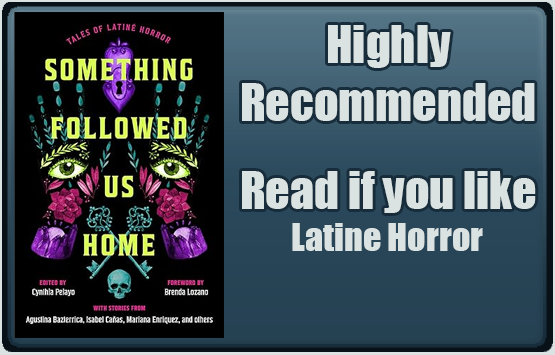
Something Followed Us Home edited by Cynthia Pelayo

Something Followed Us Home edited by Cynthia Pelayo

Formats: Print, audio, digital

Publisher: Atria/Primero Sueno Press

Genre: Comedy Horror, Dark Fantasy, Historic Horror, Monster, Myth and Folklore, Vampire, Zombie

Audience: Adult

Diversity: Latiné, Puerto Rican, Mexican, Ecuadorian, Columbian, Argentinian

Content Warnings (Highlight to view): Alcohol Abuse, Amputation, Animal Abuse, Body Shaming, Bullying, Child Abuse, Child Death, Classism, Death, Drug Use/Abuse, Illness, Incest, Physical Abuse, Racism, Rape/Sexual Assault, Slut-Shaming, Suicide, Victim Blaming, Violence

Blurb

Dive into the chilling depths of Latiné horror with this groundbreaking anthology, edited by Bram Stoker Award winner Cynthia Pelayo, where each story reimagines immigration, colonization, faith, and folklore as the fears we inherit and carry across borders and generations.

Something followed us home. It crawled in with our prayers, slipped into our beds, watched from mirrors, waited in water, and learned our names.

Gathering chilling work from some of today’s most acclaimed Latiné voices, this horror anthology moves through haunted households, brutal landscapes, sacred spaces turned dangerous, and bodies claimed by forces both ancient and intimate. The dead murmur behind locked doors. Bones rebuild themselves under merciless suns. Love becomes a doorway for demonic hunger. Blood, devotion, and memory intertwine as the past presses back with teeth.

Something Followed Us Home is an unnerving, visceral, and impossible-to-shake collection that proves that what is carried forward does not remain quiet, and what follows us rarely leaves without taking something in return.

I received this product for free in return for providing an honest and unbiased review. I received no other compensation. I am disclosing this in accordance with the Federal Trade Commission’s 16 CFR, Part 255: Guides Concerning the Use of Endorsements and Testimonials in Advertising.

I liked that both the English and Spanish language versions of the book are being released on the same day. Readers of Lo que nos siguió a casa will be able to read some of the stories in their original Spanish, while English readers will have some stories that were translated. Because the authors come from across the Latiné diaspora, there may be something new for everyone, while also including more universal themes like feminism, colonization, and family.

While I was familiar with authors such as Cynthia Pelayo (who also edited the collection), Ann Dávila Cardina, Agustina Bazterrica, Zoraida Cordova and Isabel Cañas I was delighted to also be introduced to new authors such as Carolina Flórez-Cerchiaro and Ananda Lima. I couldn’t believe how good all the stories were! There were really only one or two that I didn’t vibe with. I liked the stories that included figures from folklore like la Huesera (The Hand that Feeds by Isabel Cañas) and El Silbón (Fidelity by Alex Segura). El Jíbaro de Puerto Rico by Cynthia Pelayo was definitely one of my favorites, a bittersweet ghost story that teaches readers about the dark history in Puerto Rico, from its colonization by the Spanish, to slavery, to the American invasion. Her First Cruise Ship by Ann Dávila Cardinal was another, a humorous zombie story about undead tourists in Puerto Rico that critiques the tourism industry. It also has themes of classism and privilege. It will definitely make you think twice about how you behave when visiting another country!

While all the countries in Latin America each have their own unique cultures and histories one thing they share is a history of colonization by the Spanish and the Portuguese. These European invaders forced their languages and religion on the Indigenous people living there and brought disease, violence, slavery, destruction and later political and financial instability and war. That’s not even counting the damage done by the United States during the 19th and 20th centuries. Colonialism in Latin American countries is a reoccurring theme throughout the anthology explored in stories like the previously mentioned El Jíbaro de Puerto Rico and The Return of La Muelona by Carolina Flórez-Cerchiaro. This story is about how banana plantation owners continue the history of exploitation that began with the Spanish conquerors and how one woman gets her revenge. Other tales of revenge include Whispers from the Root by Lilliam Rivera and We are Gathered Here Together by Diana Rodriguez Wallace which address the corruption and cruelty of the wealthy and bullying, respectively. All were intensely satisfying to read as I’m a sucker for a good revenge story.

Many of the stories aren’t what I’d typically think of as “horror.” Some are more magical realism or speculative fiction like Pomelo and The World from Above and the World from Down Below. The Hand that Feeds is closer to a dark fairy tale. There are also some horror comedies like We are Gathered Here Together, My Boyfriend, and Her First Cruise Ship. However, stories like Luz Y Fer, Blue Flowers, and Specter are what I would think of as more “traditional” horror stories. I liked that every author has their own idea of what makes a story horror. There were traditional horror staples like vampires, killers, ghosts and zombies, but also religious mania, greed, sexism, and loneliness which can be equally, if not more, horrifying. The stories ranged from straight forward to more experimental. Some of the stories address the immigrant experience, while others take place in the main character’s home country, whether that be the United States or somewhere in Latin America. Settings include NYC, Puerto Rico, and Mexico City.  I have to say, I really liked how much variety there was, emphasizing the many experiences across the diaspora.  This creepy collection will have something for everyone, whether it be secret cults of children’s authors, plagues of spontaneous pregnancies, or a desperate father trying to bring back his dead daughter.
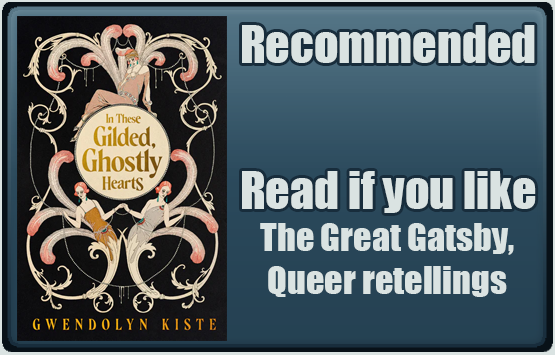
In These Gilded, Ghostly Hearts by Gwendolyn Kiste

In These Gilded, Ghostly Hearts by Gwendolyn Kiste

Formats: Print, audio, digital

Publisher: Creature Publishing

Genre: Ghosts/Haunting, Gothic, Historic Horror, Romance

Audience: Adult

Diversity: Lesbian main character and bisexual side character

Takes Place in: New York

Content Warnings (Highlight to view): Alcohol Abuse, Child Abuse, Death,  Forced Captivity, Homophobia, Suicide

Blurb

In 1955, Daisy Buchanan is found dead in an abandoned West Egg mansion, but her daughter Mel knows she’s really been gone for years. No one knows whether Daisy was murdered, or if it was a simpler, slower death: her yearslong spiral of alcohol, abuse, and helplessness. But when Mel enters the estate, she finds Daisy’s ghost, somehow frozen at twenty-three, and a charming, bleeding phantom that used to be Jay Gatsby.

To free her mother, Mel must carve a path through family secrets and decaying revelers: deep into Gatsby’s starving house as it gorges itself on unfulfilled love and grows stronger every night.

I received this product for free in return for providing an honest and unbiased review. I received no other compensation. I am disclosing this in accordance with the Federal Trade Commission’s 16 CFR, Part 255: Guides Concerning the Use of Endorsements and Testimonials in Advertising.

The year is 1955. Daisy Buchanan is dead, her body discovered in Jay Gatsby’s abandoned estate in West Egg. Daisy’s now adult daughter, Pamela “Mel” Buchanan, and one of Daisy’s few remaining friends, Jordan Baker, travel from New York City to investigate the mysterious death. They learn that Daisy was working with a predatory spiritualist named Harrison to summon the ghost of her lost lover, Jay Gatsby. Harrison convinces the two women to return to Gatsby’s old home, now dripping with ectoplasm, and complete the séance with him. Soon the mansion is filled with ghosts, partygoers from bygone days, Gatsby himself, and Daisy. The partygoers are Stone Tape hauntings, a mere echo of the past. Gatsby’s ghost, on the other hand, is an intelligent haunting who is able to interact with Mel, who soon learns his obsession with Daisy has continued after his death.

Mel and Daisy have a complicated mother/daughter relationship. No matter how badly their mother treats them, children still crave their mother’s love. Mel is parentified by Daisy who is helpless and broken after losing her lover Gatsby, her husband Tom, and her lifestyle. Mel explains “Once the cash dried up and she wasn’t a rich girl anymore, she practically dissolved into sea foam before my eyes.” Daisy is not a resilient woman–understandable since she was raised to be a pretty bauble on a rich man’s arm. Daisy was a fairly passive character in Fitzgerald’s novel, a beautiful woman for Gatsby to idolize and Tom to possess. It was satisfying, however, to read that toxic alpha-male Tom threw himself off the Brooklyn Bridge after losing everything in the stock market crash of ’29. A fitting end to an awful man. Unfortunately, it means he leaves his wife and daughter penniless and alone. Kiste often writes books for “lost” women and girls who are trapped in the past and mistreated by an uncaring society who doesn’t understand them. The Marys in Pretty Marys All in a Row, the Rust Maidens in the novel of the same name, Talitha Velkwood and her friends in The Haunting of Velkwood, and now Mel and Daisy Buchanan.

You don’t necessarily have to have any knowledge of The Great Gatsby prior to reading In These Gilded, Ghostly Hearts but it does certainly help to be able to familiarize yourself with the characters and themes. There are also lots of fun little callbacks to the original book, like Gatsby’s automatic orange juicer machine. Just don’t make the same mistake I did and try and compare the writing in the two. I re-read F. Scott Fitzgerald’s famous work right before Kiste’s so I’d have a refresher and I do think it made me more judgmental of the writing in the latter. Don’t get me wrong, I generally love Kiste’s writing, two of my favorites being Pretty Marys All in a Row and The Haunting of Velkwood. I’m not at all implying that this is not a well-written story. But very few books are going to be able to stand up to one of the “Great American Novels” and trying to compare the two is a disservice to Kiste’s novella.

While Gatsby is written as a sympathetic character in the original book, I like how Kiste points out how incredibly creepy his obsession with Daisy is. Some might view his grand gestures as romantic but honestly, they always felt like borderline incel behavior to me. Gatsby views Daisy as a prize to be won rather than a person, and if he has enough money of course she’ll leave Tom for him. The main reason we’re sympathetic to Gatsby is because Tom is portrayed as the bigger asshole with no redeeming qualities, and because Nick sees Gatsby as sympathetic. Daisy is “supposed” to choose the heroic Gatsby over the brutish Tom, and when she doesn’t, she’s cast as the villain. Yet, does she really have a choice?  Herstory and Daisy Buchanan by Leland S. Person, Jr. quotes the numerous men who have described Daisy as “vulgar and inhuman,” a “Dark Destroyer,” and the “anti-virgin…the prototype of the blasphemous portraits of the Fair Goddess as bitch” who “preyed on” Gatsby. Yikes! But Person viewed Daisy as more victim than conniving, selfish woman. She’s a woman in the 1920s, from an old money family who’s expected to marry an old money man, not some nouveau riche who may or may not have a criminal history. Daisy has no way of earning a living herself, she’s completely dependent on men for her financial security, and always had been. She’s also under immense societal expectations; she can’t simply leave her husband to have the life she wants with Gatsby. We also known Tom is abusive, as shown when he breaks his mistress’ nose.Leaving him was unlikely to be easy. I don’t think any of that necessarily makes her a good person; she’s just an imperfect victim. And this seems to be the characterization that Kiste goes with. Daisy wasn’t a good mother, but that doesn’t mean she doesn’t deserve sympathy or Gatsby’s obsessive idolization. Similarly, as a lesbian, Mel is also unable to be with the ones she loves, first Jordan and then her coworker, Vera.

I loved how queer Kiste’s book was. Mel is gay, Jordan bisexual, and Tom’s implied crush on Gatsby is no longer subtext. In These Gilded, Ghostly Hearts takes place during the Lavender Scare of the 1950s, an anti-LGBTQ+ witch hunt, so Mel lives in constant fear of having her sexuality discovered. At one point she and Jordan go to the Bagatelle on University Place. The Bag, as it was more commonly known, was a real lesbian bar that was popular in the 1950s. I love that little bit of realism that Kiste added to the story. Audre Lorde and Ann Bannon both wrote about the bar and how it shaped their pre-Stonewall experience. The Bag was owned by the mafia and frequently raided by police. A red light would go off to warn patrons when they vice squad showed up, which happens to Mel at the bag one night.

Kiste is not the first to write about the Great Gatsby through a queer lens. In 1963 Lionel Trilling characterized Jordan Baker as “vaguely guilty, vaguely homosexual.” Nearly thirty years later The International Fiction Review published The Sexual Drama of Nick and Gatsby by Edward Wasiolek who argued that Nick has “homosexual  leanings” and intense feelings for Gatsby. The Chosen and the Beautiful by Nghi Vo (author of The Empress of Salt and Fortune) also imagines Jordan and Gatsby as bisexual, and Nick and Gatsby have a fling. Self-Made Boys: A Great Gatsby Remix by Anna-Marie McLemore and The Pursued and the Pursuing by AJ Odasso explore a queer relationship between Gatsby and Nick.

Kiste’s writing can best be described as “haunting;” beautiful, unsettling, nostalgic, and melancholy, lending itself well to a ghost story. Her stories are less “in your face” horror with gore and blood and instead rely on atmosphere to create a general sense of unease commonly found in gothic horror. For some readers, it may feel like the pacing is dragging, as there’s no sense of urgency and not a lot of action because this isn’t that kind of book. This is a novella meant to be savored rather than rushed through. So, while it won’t be everyone’s cup of tea, I think fans of slow burn horror and character driven story will enjoy In These Gilded Ghostly Hearts.

I did feel like the book needed a little more show and a little less tell. It seemed like Mel was constantly explaining things to the audience that didn’t necessarily need to be spelled out. At the same time, I thought it was awesome that Mel was middle aged and Jordan in her fifties. It’s so rare to find older women protagonists in fiction. Male protagonists have a wide range of ages, but women seem to always skew young. What’s more, neither character is a wife or mother. While I don’t think In These Gilded, Ghostly Hearts is as strong as some of Kiste’s other novels and novellas, it’s still a solid, spooky read perfect for autumn.


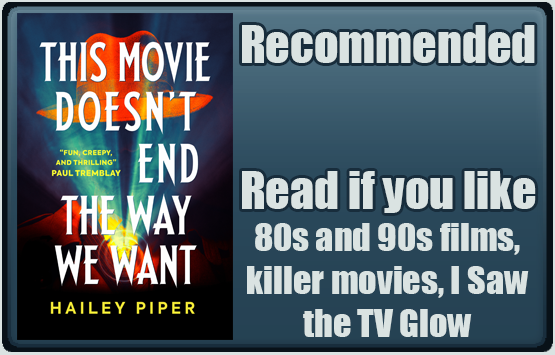
This Movie Doesn’t End the Way We Want by Hailey Piper

This Movie Doesn’t End the Way We Want by Hailey Piper

Formats: Print, audio, digital

Publisher: Titan Books

Genre: Eldritch Horror, Monster, Mystery,

Audience: Adult

Diversity: Lesbian author and main characters, trans woman author

Takes Place in: Maryland

Content Warnings (Highlight to view): Body Shaming, Child Death, Child Endangerment, Death, Kidnapping, Verbal/Emotional Abuse, Violence

Blurb

In November 1994, three girls visit their local movie theater to see an obscure film. Only one of them is ever seen again.

Thirty years later, Val McQueen has never forgotten the day she lost her little sister and best friend, but she’s closed the curtain on it, certain she’s moved on despite her parents’ resentment and hounding by true crime enthusiasts.

That is until a stranger’s murder brings it all screaming back—a terror she’s tried to tell herself is only a movie. Enlisting the help of cinephile and former classmate Roxie de la Fontaine to find the film, Val soon realizes that hers is not the only pursuit. Someone, or something involved with the movie is on the hunt, too…

… For the girl who got away all those years ago.

I received this product for free in return for providing an honest and unbiased review. I received no other compensation. I am disclosing this in accordance with the Federal Trade Commission’s 16 CFR, Part 255: Guides Concerning the Use of Endorsements and Testimonials in Advertising.

It’s 1994, and Valerie McQueen loves going to the movies. It’s her favorite way to escape her chaotic home life and her parents’ constant fighting. On this particular evening, she’s accompanied by her little sister, Ashley, and best friend, Colette. Colette wants to see Interview with the Vampire, but Valerie convinces the girls to go see a schlocky B-move she’s never heard of before: Blood-Curse of the Toad Man. At first, they’re the only ones in the theater watching the cheesy monster flick, but soon Valerie notices a stranger seated behind them wearing a trench coat and a fedora that obscures their face. The stranger seems to be moving closer, which freaks Valerie out, and she runs out of the theater. When she finally plucks up the courage to return, Colette and Ashley are gone. The police investigate but the girls are never found.

Thirty years later, Valerie (who now goes by Val) is still struggling with her survivor’s guilt, working as a tattoo artist, and getting into bar fights. Ever since that tragic night, Val hasn’t been able to bring herself to watch another movie. She chooses to self-isolate with no social media presence, only one real friend, and little contact with her parents, who blame her for Ashley’s disappearance. To cope with her unresolved trauma and guilt, Val tries to live in the moment to avoid thinking about the past. Unfortunately, the past has a way of catching up with you, and it appears Blood-Curse isn’t ready to let her go yet. Kate, a true crime podcaster, shows up at Val’s workplace posing as a tattoo client and tries to talk to Val about the worst night of her life.

When Val understandably gets pissed and walks away, Kate reacts poorly, demanding Val speak to her, as she paid for a tattoo. Kate is more interested in the entertainment value of the unsolved crime than she is in protecting Val and her parents from further pain. Kate pops up periodically throughout the book to prove what a shitty person she is, and it feels like her character is Piper’s way of criticizing the true crime genre. A common criticism of the true crime genre is that it’s exploitative, voyeuristic, and can re-traumatize victims and/or their families who are trying to move on, and Kate represents all of these things.

Later, when Val goes to meet a woman from the bar, she discovers the woman’s hotel room destroyed, the woman missing, and two lines from the creepy song from Blood-Curse of the Toad Man written on a scrap of paper. Realizing the only way to make the disappearances stop is to learn more about Blood-Curse of the Toad Man, Val ends up reaching out to Roxie, a girl who was kind to her after Ashley and Colette went missing who now does freelance work hunting down lost media. Despite Val’s warnings to be careful, Roxie is intrigued when she tells her about the cursed film and immediately dives right in to researching it. It’s at this point the book starts alternating between Val and Roxie’s points of view.

I love the idea of a movie that kills you, which is what immediately drew me to Piper’s latest work. Although the film Ringu (1998) and the book by Koji Suzuki it was based upon popularized the idea of a killer film, you could argue that the idea goes all the way back to 1895 when The King in Yellow was published. This short story collection by Robert W. Chambers centers around a cursed play that can drive anyone who reads it mad and would later inspire writer H.P. Lovecraft to write The Whisperer in Darkness. Interestingly, Piper has also published a book entitled A Game in Yellow based on the mythos created by Chambers. Like Lovecraft, Piper also excels in cosmic horror as seen in her books Queen of Teeth (which won a Bram Stoker Awards in 2021), The Worm and His Kings, and the aforementioned A Game in Yellow. In This Movie Doesn’t End the Way We Want, the story starts out as a simple horror story but later morphs into cosmic horror, creating one of the most unique explanations for a “cursed” film I’ve ever seen.

There are lots of 80s and 90s movie references, like Never Ending Story (1984), Ghost Busters (1984), Labyrinth (1986), Moonwalker (1988), Who Framed Roger Rabbit (1988), and Devil in a Blue Dress (1995). Even the isekai anime Escaflowne (1996) gets a shout out. There are also references to more modern movies like Sinister (2012), older ones like Chinatown (1974), and even relatively obscure films like Manos: The Hands of Fate (1966), popularized in the nineties by MST3K. This is definitely a book for millennial movies fans. Speaking of which, I loved that both Roxie and Val are in their forties. You don’t see a lot of forty-something women as horror protagonists. While the book plays tribute to these nostalgic films,  it simultaneously warns us against dwelling too much on the past.

Val can’t move on properly because she tries to ignore what happened instead of facing it and finding a way to move on. She thinks she’s “letting go” by not thinking about the past, when in realty Val is trapped in it. Similarly, Val’s parents haven’t moved on from that horrible day in 1994 and focus all their attention on mourning the daughter they lost rather than loving the one they have. Roxie is also critical of nostalgia, as much of her job involves hunting down old commercials and TV shows for clients who are willing to spend big bucks on a small reminder of their childhood. Remembering the past does not mean getting stuck in it, unable to move on. It gave me I Saw the TV Glow (2024) vibes, reminding me of the protagonist’s obsession with fictional TV show The Pink Opaque then later discovering that nostalgia had warped his perspective of the show.

I’m a fan of horror mysteries, especially those that involve researching the past, so this book drew me right in. It’s filled with plenty of twists and turns to keep the reader guessing, which I really enjoyed. It also made me happy that both Val and Roxie were lesbians. Val would have brief flings with women thanks to her “only focus on the present” mindset while Roxie is happily married. I liked that the film hides its true nature behind a silly premise, I mean, who is going to take a movie called Blood-Curse of the Toad Man seriously? But the campy film becomes increasingly sinister the more Val and Roxie learn about it. But most of all I liked how the book continued to sit with me long after I finished it. Another great horror story from Piper!

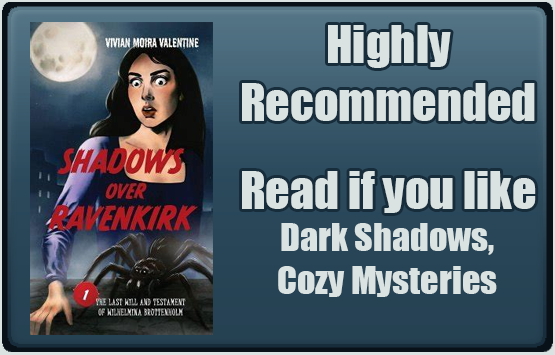
Shadows Over Ravenkirk by Vivian Moira Valentine

Shadows Over Ravenkirk by Vivian Moira Valentine

Formats: Print, digital

Publisher: Blue Fortune Enterprises

Genre: Dark Fantasy, Gothic, Mystery, Occult

Audience: Adult

Diversity: Trans, lesbian main character and author

Takes Place in: Maine

Content Warnings (Highlight to view): Classicism, Death, Drug Use/Abuse, Forced Captivity, Medical Procedures, Physical Abuse, Torture, Transphobia, Verbal/Emotional Abuse

Blurb

Victoria Williams, a struggling photographer from Boston, receives a letter informing her of a surprise inheritance. Wilhelmina Bruttenholm of Ravenkirk, Maine, has recently passed away and left her a bequest. Victoria doesn’t know who Wilhelmina is-to her knowledge, she doesn’t know anyone in Ravenkirk-but she travels to Maine anyway to attend the will reading.

But who is this family and what do they really want of her? Struggling to understand the events happening in this unique little town, Victoria is confronted with secrets, magic, and Samantha, one very sweet tarantula. And while she must face the truth about her own mysterious family history, she will have to do so carefully. Because murder abounds in Ravenkirk and nobody is who they appear to be.

I received this product for free in return for providing an honest and unbiased review. I received no other compensation. I am disclosing this in accordance with the Federal Trade Commission’s 16 CFR, Part 255: Guides Concerning the Use of Endorsements and Testimonials in Advertising.

I’m doing something a little different for this review and reviewing the first two books in the Shadows Over Ravenkirk series by Vivian Moira Valentine instead of just one book, as I feel the two novellas work better when read together. The overall story is just so big, with so many elements and characters, that I think the series would have worked better as a couple full length novels rather than a bunch of novellas. Of course, that might also be because I’m not a patient person and I want to read the rest of the story now and I’m already impatient for the third book to come out because the second ended on a cliffhanger.

The first Shadows Over Ravenkirk book gives cozy mystery vibes. I hesitate to use the term “cozy horror” as it’s so controversial, with valid points made on both the pro and con sides. Personally, I feel if someone’s comfort film can be Nightmare on Elm Street or they listen to Tales to Terrify to help them fall asleep, then I don’t see why people can’t also find a horror story about a small gothic town “cozy” without sacrificing the elements that make it horror. But I know plenty of folks hate the term so I’ll refrain from labeling the book as such. What I will say is that Valentine’s books quickly became a comfort read for me at a time I really needed it.

In it, we’re introduced to Victoria Williams, a trans, lesbian, goth girl from Boston (yay Boston!). She’s been summoned to the will reading of the mysterious Wilhelmina Bruttenholm, despite not having known the woman in life. With nothing to lose, Victoria sets off to the small seaside town of Ravenkirk, Maine for the reading. While trying to enjoy her book–Ghost Flower by Jessica Conwell–on the train, Victoria is interrupted by a vulpine young man, the deuteragonist of the story, Nicodemus Ruthven. He’s friendly, and thankfully not transphobic as Victoria initially fears, but he also seems to be unpredictable with a dangerous edge to him that makes her nervous.

He may be a rich asshole but I kind of like Nicodemus. Maybe “like” is too strong a word. I’m more fascinated by him. I enjoy a complex, morally gray character, and I love how snarky Nicodemus is, especially toward his awful family. Speaking of his family, the Ruthvens are Ravenkirk’s old money family who are used to being in control. They’re pretty evil (because rich people are inherently evil) and are not at all happy to see Nicodemus return to Ravenkirk, as he was banished from the town for a yet undisclosed reason. But he has returned for Wilhelmina Bruttenholm’s funeral as an invited guest, much to everyone’s shock and dismay.

Victoria meets some other colorful characters in the town, three of whom she immediately starts crushing on. There’s Tabitha Swann, who used to work for Wilhelmina and gives Victoria a ride to her hotel;Bianca Burke, who was hired by Wilhelmina to act as Victoria’s bodyguard while she’s in town;and finally, Thorn Hale, a non-binary femme who works as the hotel’s cook. Victoria also adopts a tarantula named Samantha. The town seems to be divided into factions, none of whom trust the other, so trying to make friends with the townsfolk is tricky. The book felt a little like a queer dating sim where the reader is left to wonder which hot femme Victoria will pick.

Valentine spends a lot of time introducing characters and developing the town. The world building in this story is AMAZING and very in-depth, and I’m a sucker for good world building. Ravenkirk feels like a town trapped in the past, despite the story being set in the modern day, and it reminded me of the strange New England locations Lovecraft invented, like Miskatonic University and the town of Arkham. Valentine clearly put a lot of thought into the setting and the characters. And there are A LOT of characters in Shadows Over Ravenkirk, especially in the second book. So many, in fact, that it can be confusing trying to keep everyone straight. Fortunately, there’s a list at the beginning of the book with short character descriptions to help keep everyone straight.

There are the Talbots, one of the three major families and the local farmers of Ravenkirk. The Gilmans (fishermen and dockworkers) who give The Shadow over Innsmouth vibes, and from the short preview in the end of the second novella, it seems they’ll be the focus of the third book. And of course, the Ruthvens. Then there are the people who work at the hotel Victoria is staying at, the members of a strange cult called “The Yonders,” and Wilhelmina Bruttenholm’s confidants, none of whom seem to trust each other. The downside to having so many characters in such a short book means that there’s not as much time to develop them. Again, this is why I think the two books work better when read together, as the first novella just feels like we’re getting a bunch of quick character introductions and we don’t really get any action until the last third of the book. It feels more like the first few chapters of a much longer story with the setup but not offering much in the way of a resolution. The book is over before the plot has a chance to get going.

The second book leans more into the story’s horror elements with much more violence (including a torture scene that’s cut short) and some hot sex scenes. Instead of Victoria and her friends, the main focus has switched over to the messed-up Ruthven family, fleshing out already existing characters and introducing new ones. Nicodemus takes up residence in the abandoned Mooncroft Manor, the ancestral home of the Ruthvens, who left because their dwindling fortunes made the upkeep too expensive. Nicodemus invites the various cousins to stay with him to help him with his yet unknown plan to restore the Ruthvens to their former glory. The cousins are all varying degrees of evil; one of them makes snuff films, another creates mind altering drugs, and yet another re-animates corpses to be his “servants.”

The second book was also more focused on setting up overarching plot, giving the reader more questions than answers. But rather than leave me frustrated (okay, maybe just a little frustrated), it just left me desperate to read more! That’s right, this series has me completely hooked and I cannot wait for the third book to come out. I need to know what happens next. I absolutely adored Valentine’s voice. She excels at creating atmosphere and intriguing characters. I feel like this is a series, while not necessarily aimed at teens (especially with the graphic sex scenes in the second book), I would’ve loved as a young adult. In terms of representation, the cast is very diverse, especially when it comes to trans and non-binary characters. I can’t wait to read more!

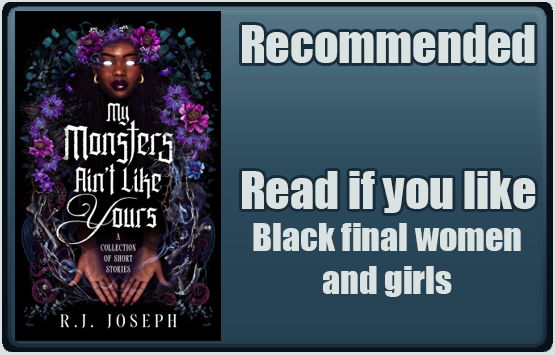
My Monsters Ain’t Like Yours by R.J. Joseph

My Monsters Ain’t Like Yours by R.J. Joseph

Formats: Print, audio, digital

Publisher: Quill & Crow Publishing House

Genre: Eldritch Horror, Folk Horror, Ghosts/Haunting, Historic Horror, Monster, Zombie

Audience: Adult

Diversity: Black, African/American characters and author, queer and bisexual characters

Takes Place in: Texas

Content Warnings (Highlight to view): Animal Abuse, Animal Death, Body Shaming, Cannibalism, Child Abuse, Child Death, Child Endangerment, Childbirth, Death, Drug Use/Abuse, Forced Captivity, Incest, Miscarriage, Oppression, Pedophilia, Physical Abuse, Racism, Rape/Sexual Assault, Sexism, Sexual Abuse, Slut-Shaming, Suicide, Torture, Verbal/Emotional Abuse, Violence, Vomit 

Blurb

At its core, the horror genre is an effective vehicle for exploring human behavior. From within its terrifying boundaries, and lack thereof, we can examine monstrosity. We can determine how monsters are labeled, analyze the actions of those deemed monstrous, and prophesy the impacts this labeling and actions have on the world around us.

Monsters are personal. Monsters are universal. These facts create an intriguing juxtaposition where the things deemed monstrous or frightening can be shaped by personal experiences, while also representing many aspects of the human condition; our fears are much more similar than dissimilar. This means my monsters are absolutely like yours: they are our collective nightmares.

My Monsters Ain’t Like Yours reflects this irony through Black feminist intersectional horror at its rawest.

I received this product for free in return for providing an honest and unbiased review. I received no other compensation. I am disclosing this in accordance with the Federal Trade Commission’s 16 CFR, Part 255: Guides Concerning the Use of Endorsements and Testimonials in Advertising.

While many of the monsters in the collection are supernatural (Suffer the Little Children, The Crazy   with Daisy, Higher Education, Something Wicked Came for Me, Welcome, Skinny Minnie, Sweet Sunday Supper Smile, etc.) the most terrifying ones are the human monsters (Regrets Never Die, The Collector, Sweet Sunday Supper Smile, Her Heart’s Desire, No Tricks Only Treats, The Preying Family, Sad, Spooky Sally, etc.). Interestingly, some of the supernatural monsters are friendly and helpful creatures/spirits who protect the protagonists from other monsters, both literal and figurative. Humans, after all, are much worse than some imagined creature. Then there are the metaphorical “monsters” of grief, loneliness, and trauma that haunt the protagonists.

There are a lot of bad heterosexual relationships in the anthology.  These range from Where the Horizon Kisses the Sky in which the husband is neglectful, Endless Possibilities where he’s a selfish loser, to Her Heart’s Desire where he’s outright abusive towards his wife. In all these stories the wife yearns for something better and uses supernatural means to get it, with varying degrees of success. In The Badly Terrible, Absolute Worst she doesn’t even get that chance. But queer relationships, like in The Crazy with Daisy and Witness Bearer, are shown in a more positive light.  A report by the Institute for Women’s Policy Research and the National Domestic Worker’s Alliance states that “More than 40 percent of Black women experience physical violence by an intimate partner during their lifetimes (41.2 percent), compared with 31.5 percent of all women.” And a study published in the Lancet reported that Black women are also nearly six times as likely to be murdered than white women. Thankfully there are resources like Ujima that support Black women who are in domestic violence situations, even as the justice system continues to fail them.

In Endless Possibilities and Her Heart’s Desire the wife herself becomes a monster to escape her bad marriage, and in the latter, get revenge on her horrible husband. Then there’s Tanita in The Collector, a serial killer who murders for the fun of it. There’s something incredibly satisfying about women embracing their monstrosity and rage, especially Black women. Those with marginalized identities are often cast as monsters in other people’s stories so why not reclaim the title? I especially like that feminine monstrosity in Endless Possibilities and Her Heart’s Desire is not tied to sexuality. While I appreciate women like Tanita reclaiming their sexuality and using it to seduce and murder men à la Jennifer’s Body (2009) and The Hunger (1983) sometimes it feels like the majority of female monsters are temptresses ( leading men to their death. And it can start to get a little old.

Can’t they just be horrible and violent without wanting to have sex with their victim? Plus, there’s the unfortunate implication that women who have sex on their own terms are evil and they go against the natural order of things by overpowering men. So, I appreciated that Joseph gave us some nice variety. The book even has monstrous children (#GIRLMOM and Suffer the Little Children) though in both cases the children are embraced by the main character rather than shunned for the monstrosity.

Sweet Sunday Supper Smile and No Tricks Only Treats are stories containing child abuse, though the abusers get their comeuppance in both. Then there’s Sad, Spooky Sally which is especially disturbing, so much so that it comes with its own set of content warnings before the chapter, rather than in the index. It’s an absolutely heart-breaking story with a bittersweet ending and one of my favorites in the collection. But it’s also very triggering, so make sure you check out those content warnings before reading it. The same goes for Regrets Never Die and Witness Bearer. They’re both very dark, with the latter being about a girl who can see the worst things a person has ever done. She witnesses some truly awful memories, so I appreciate that Joseph included content warnings for all the stories in the book’s index.

Those who Teach Pay Knowledge Forward stood out in the collection, as it was sweet rather than scary, A ghost story where the ghosts aren’t the source of fear. It also had a nice message about helping to educate the next generation so they can succeed. I love how so many of the Black women in the collection are intelligent and well educated, ranging from college students (The Collector) and graduate students (Whole New World), to teachers (Those Who Teach Pay Knowledge Forward) and college professors (Grand Opening, Higher Education, Something Wicked Came for Me). The young woman in Important Things is sent on an all expenses paid trip to Palm Springs for a symposium because she excels in her high school classes. In 1995 14% of Black women between 25 to 34 held a bachelor’s degree compared to 38% in 2024 according to the Pew Research Center.

There are so many great stories in the collection, I’d be pressed to pick a favorite, though I did especially enjoy Regrets Never Die, #GIRLMOM, Endless Possibilities, Those Who Teach Pay Knowledge Forward, and Something Wicked Came for Me. While Black women and children’s trauma is a reoccurring theme of My Monsters Ain’t Like Yours, it’s not the only focus of the anthology. If every story were about Black trauma and abuse, it honestly may have been too much for me. Instead, Joseph includes a bunch of fun, spooky stories to offset the heavier stuff so the collection never feels too dark and depressing. Instead, we get a nice balance.

I really liked this because while horror is a great way to process trauma, Black horror shouldn’t be pigeonholed into stories of Black pain. I love Get Out (2017), it’s one of my favorite films, but if that was the only kind of Black horror story told by Hollywood, it would start to feel like the suffering of Black people was being fetishized for entertainment. There’s a reason why Peele’s next two films, Us (2019) and Nope (2022) aren’t rooted in Black trauma. So, while there are plenty of stories about abuse, bad relationships, and the general mistreatment of Black women and children, there are also enough tales about living mannequins, small fanged creatures, and ghosts to offer the reader a breather.

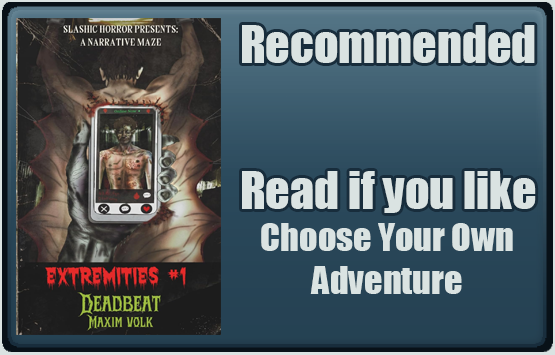
Deadbeat by Maxim Volk

Deadbeat by Maxim Volk

Formats: Print, digital

Publisher: Slashic Horror Press

Genre: Comedy Horror, Zombie

Audience: Adult

Diversity: Gay man author and main character

Content Warnings (Highlight to view): Alcohol Abuse, Body Shaming, Cannibalism, Child Death, Death, Drug Use/Abuse, Gore, Homophobia, Mental Illness, Necrophilia, Pedophilia, Physical Abuse, Police Harassment, Slurs, Vomit 

Blurb

Ji-won’s life tumbles into disarray in the wake of her Appa’s extramarital affair and subsequent departure. Her mother, distraught. Her younger sister, hurt and confused. Her college freshman grades, failing. Her dreams, horrifying… yet enticing.

In them, Ji-won walks through bloody rooms full of eyes. Succulent blue eyes. Salivatingly blue eyes. Eyes the same shape and shade as George’s, who is Umma’s obnoxious new boyfriend. George has already overstayed his welcome in her family’s claustrophobic apartment. He brags about his puffed-up consulting job, ogles Asian waitresses while dining out, and acts condescending toward Ji-won and her sister as if he deserves all of Umma’s fawning adoration. No, George doesn’t deserve anything from her family. Ji-won will make sure of that.

For no matter how many victims accumulate around her campus or how many people she must deceive and manipulate, Ji-won’s hunger and her rage deserve to be sated.

A brilliantly inventive, subversive novel about a young woman unraveling, Monika Kim’s The Eyes Are the Best Part is a story of a family falling apart and trying to find their way back to each other, marking a bold new voice in horror that will leave readers mesmerized and craving more.

I received this product for free in return for providing an honest and unbiased review. I received no other compensation. I am disclosing this in accordance with the Federal Trade Commission’s 16 CFR, Part 255: Guides Concerning the Use of Endorsements and Testimonials in Advertising.

Your husband Matt expects you to remain monogamous despite constantly going on business trips. Worse, he doesn’t even like video sex because he’s worried someone will hack your phone, though you tell him that it’s a ridiculous paranoia. He won’t even let allow you a quickie before his trip because he’s worried about “smelling like sex” on the plane. You’re feeling pissed off, neglected, and sexually frustrated. You’ve cheated on him before while he’s away on trips, but you assume he’s also cheating on you while he’s away. So now you have a decision to make. Blow off some steam with a casual hook up or be a faithful husband and stay home. You end up dead either way,though how you meet your untimely end varies depending on your choice, ranging from carbon monoxide poisoning to getting murdered in a snuff film. You think it’s all over until you wake up in a basement surrounded by robed figures saying they’ve resurrected you. And you’re hungry. So very hungry. Now all you have to worry about is your insatiable appetite for human flesh, your decaying body, and avoiding Zombie Hunter Rome Samuel.

Deadbeat is a “choose your own adventure” style erotic horror novella. You can run into bigfoot, try to be the Dexter Morgan of zombies/a zombie superhero, eat some cops (because ACAB), or get revenge on a councilman who didn’t approve your backyard pool even after trading sexual favors. My favorite storyline was, in a twist right out of Thirty Rock’s Reunion episode, when the reader discovers that your high school “bully” (whose name you can’t even remember) was actually a good guy who just didn’t put up with your asshole behavior. And you character is an asshole. This may be a turn off for some readers, but personally, I love problematic queer characters. I also loved how we get a reference to “that social media app that has become overrun with Nazis” (Twitter) and digs at AI being used in porn (AI sucks and people who use it are losers). That doesn’t mean this story can’t get dark, though. One of the storylines involves a trafficking ring that kidnaps children, and they aren’t rescued if you don’t make the right decisions.

Deadbeat also addresses something I’ve always wondered about in zombie stories. Stomach acid and bile are no longer produced after death, so how do the undead digest things? Apparently, they can’t because you throw up everything after devouring someone, leaving you hungry again. I thought it was clever how Volk considered some of the science behind the living dead. For example, when you awaken, you find all your blood has been replaced with embalming fluid.

For erotic horror, the sex scenes are super short. I guess that makes sense for a novella, but it means it’s hard to get in the mood, so all the sex and dicks just feel kind of distracting rather than sexy. Of course, I’m also not a gay man, so not really the target audience. Over all it’s a very silly little book, which may take some people out of the story, but I personally thought Deadbeat was tons of fun.

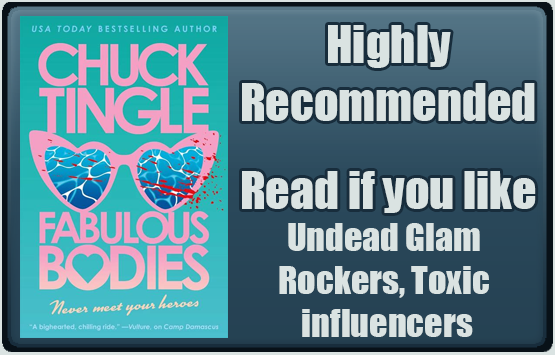
Fabulous Bodies by Chuck Tingle

Fabulous Bodies by Chuck Tingle

Formats: Print, audio, digital

Publisher: Tor Nighfire

Genre: Blood & Guts, Sci-Fi Horror

Audience: Adult

Diversity: Lesbian main character, Bisexual side character, Gay, Autistic author,

Takes Place in: Palm Springs, California

Content Warnings (Highlight to view): Amputation, Animal Abuse, Child Endangerment, Death, Drug Use/Abuse, Gore, Illness, Kidnapping, Self-Harm, Suicide, Torture, Violence

Blurb

Poppy Stringer was born to be a star.

An aspiring fashion influencer by day, Poppy moonlights as a grave robber to make ends meet, wheeling and dealing dead bodies across Palm Springs.

When her hero, the flamboyant, piano-slamming rockstar Eddie Michaels, unexpectedly dies, Poppy gets a call to retrieve his body from the medical examiner’s office for a lucrative sum. It could be the last job she’ll ever need—if everything goes to plan. But the night’s delivery quickly veers off course when Eddie wakes up.

Now Poppy must fight for her life if she hopes to survive this blood-soaked joyride of carnage and extravagant entertainment.

I received this product for free in return for providing an honest and unbiased review. I received no other compensation. I am disclosing this in accordance with the Federal Trade Commission’s 16 CFR, Part 255: Guides Concerning the Use of Endorsements and Testimonials in Advertising.

I was SO excited when I got approved for this ARC, you have no idea. There’s a lot of death in Fabulous Bodies, like, A LOT. The violence and gore are over the top, which I found fun, but may be too much for some readers. It’s also super campy, which again, I personally love but other readers might find ridiculous. That doesn’t mean the deaths aren’t disturbing, as people die in all number of creative ways and some of them are truly horrific. It’s basically splatterpunk without the sexual violence and misogyny that seems to plague so much of the genre. A fun read with great dark humor that I finished in only a few sittings. I just couldn’t bear to put it down.

Poppy Stringer is a confident (or full of herself, depending on your point of view), queer woman who knows she’s fucking hot and will do almost anything to become a famous influencer. Her Instafeed (the book’s fictional version of Instagram) makes her lifestyle look glamorous, but the single mom is struggling to fund it. To support her lavish lifestyle, Poppy turns to body snatching. After all, her giant house in Palm Springs won’t pay for itself. She sees what she does as a victimless crime because no one is actually getting hurt and the loved ones of the deceased are merely inconvenienced. After all, the bodes she steals are just hunks of meat who don’t care what happens to them. And it’s worth it to give her five-year-old daughter, Marlo, the childhood she never had, even if it means spending less time together. Being raised by adoptive parents who didn’t really want her has hardened Poppy into someone cold and calculating who will do almost anything to get ahead, including grave robbing. She’s sees herself as a shark, surrounded by fish who’re satisfied nibbling on scraps.

Poppy isn’t an entirely selfish person; she does care deeply about her daughter and her best friend Noah. But when other people, like Poppy’s neighbor Ashley, try to get close to her, Poppy is quick to push them away. Noah honestly puts up with a lot from her, frequently babysits Marlo while her mom is out working her “other job,” which she tells him nothing about. While dining out with Noah, Poppy gets a call from a mysterious woman who somehow found her number. The woman offers her five million to retrieve a body. But not just any body, it’s the body of Poppy’s favorite musician and queer icon, Eddie Micheals, recently killed by a drunk driver (a tragedy which Poppy used for content). Despite her reservations, Poppy agrees to take the job. After all, five million is life-changing money. Enough that she can quit the grave robbing business.

Everything goes smoothly when she steals the corpse. A little too smoothly, in fact, and Poppy ignores her gut feeling that something isn’t right. She’s driving down a desert road with the body in her van when Eddie wakes up. The now undead rockstar reveals that he’s made a deal with the devil which gave him fame, fortune, and the ability to control people with his voice (think Jesse Custer from Preacher or Killgrave/The Purple Man from Marvel Comics). He just needs Poppy to help him run a few “errands” before sunrise and then she’s free to go. But of course, nothing is ever that simple. Poppy is forced to bear witness as Eddie tells people to murder, mutilate, and maim themselves and others, leaving a trail of bodies through Palm Springs.

While the story starts with Poppy as an almost-villain protagonist, there are some things even she won’t stoop to, which Eddie is all too happy to indulge in–mostly hurting and killing others. She may be a shark, but she’s a nurse shark while Eddie is a great white. The two are similar in that they’re both artists willing to do “anything” to get ahead (although Poppy learns that night that she actually has limits) and neither sees themselves as a “bad” person. Eddie tells Poppy “I’m not a bad guy, I’m just a survivor.”

Despite the horrible things he does, he never sees himself as a villain, which forces Poppy to question her own amoral actions and gives her the chance to have a nice character arc. Yes, Poppy is an awful person, and all I can say is “Yay for unlikable, problematic gay characters!” I love how terrible and morally gray she is. And Eddie is a delightfully campy villain. Queer readers deserve to have complex queer characters. Unfortunately, some folks have adopted right-wing puritanical viewpoints around moral purity. These are the people who argue kink doesn’t belong at Pride and want to censor anything that makes them uncomfortable which includes problematic queer characters. To these morality police I say:f you can’t handle queer characters who aren’t cutesy, pure, beacons of morality then maybe you should stick to cozy fic and stay away from horror. Liking a problematic character does not mean you would approve of their actions in real life, and trying to sanitize queer content is a particularly nefarious form of censorship.

At one point Eddie tells Poppy that art is what makes life worth living, and he’s not wrong. Yet, Poppy realizes love is what really matters. Poppy may be a morally grey narcissist, but she’s nowhere near as bad as Eddie, because unlike Eddie, there’s one thing she cares about more than fame, and that’s her daughter. It’s her love for her daughter that keeps her from completely crossing the line into villainy and which ultimately gives her the strength to fight Eddie. Fabulous Bodies is another Tingle book that proves love is real. Fabulous Bodies may be an action-packed roller coaster ride of gore, but at its core it’s still about the power of love.


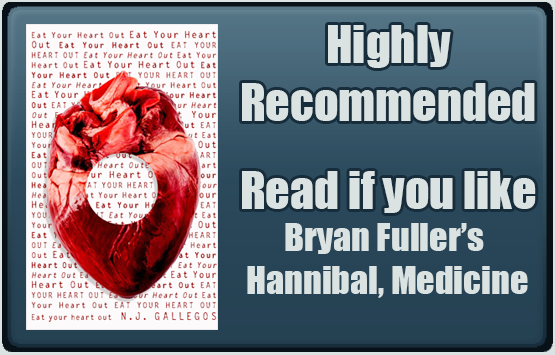
Eat Your Heart Out N.J. Gallegos

Eat Your Heart Out N.J. Gallegos

Formats: Print, digital

Publisher: Black Hare Press

Genre: Comedy Horror, Romance,

Audience: Adult

Diversity: Lesbian main character and author

Content Warnings (Highlight to view): Alcohol Abuse, Cannibalism, Death, Drug Use/Abuse, Gore, Homophobia, Medical Procedures, Violence

Blurb

Jules is a first-year medical student with an exceptional mind for anatomy, a devotion to precision, and a carefully controlled emotional life. That control shatters when she meets Maureen.

Maureen is magnetic—confident, beautiful, effortlessly desired. What begins as attraction quickly deepens into something sharper, darker, and far more consuming. Jules mistakes intensity for intimacy, chemistry for destiny, and fixation for love.

As their relationship lurches between passion and distance, Jules begins to unravel. The boundaries between study and obsession blur. Anatomy labs bleed into fantasy. Hunger—emotional, erotic, psychological—becomes impossible to ignore. Every slight feels catastrophic. Every touch feels like a promise. Every rejection fuels something dangerous.

Set within the sterile world of medical training, Eat Your Heart Out explores the seductive logic of obsession and the quiet horror of a mind convincing itself that devotion justifies anything. Desire becomes possession. Love becomes entitlement.  Control slips, slowly and then all at once.

Dark, intimate, and deeply unsettling, this psychological horror novella traces the path from longing to fixation—and the terrifying places desire can lead when nothing is ever enough.

I received this product for free in return for providing an honest and unbiased review. I received no other compensation. I am disclosing this in accordance with the Federal Trade Commission’s 16 CFR, Part 255: Guides Concerning the Use of Endorsements and Testimonials in Advertising.

Oh man, N.J. Gallegos had me at “toxic lesbians” and “cannibalism.”  Add in a medical setting and a kickass playlist, and I was sold. Cannibalism is hinted at throughout the story: Our protagonist, a queer medical student named Jules, constantly compares parts of her cadavers to food (to the point it makes her hungry), uses kuru as a random example of a neurodegenerative disease, and named her cat Jeff after serial killer Jeffrey Dahmer (aka the Milwaukee Cannibal). So you know that at some point someone is getting eaten, you just don’t know how or when.

Jules is an introverted horror nerd who is studying to be a surgeon. She loves medicine, her cat, and her classmate Maureen (who Jules calls Mo). Sadly, Mo doesn’t seem to even realize Jules exists. But after Jules’ best friend, a neurology nerd named Chris, gives her molly at a Halloween party (which Jules attends dressed as Patrick Bateman), she finally has the courage to approach her crush. The two women end up having a drunken hookup and spend a cozy weekend in Jules’ apartment having mind blowing sex. Jules falls hard and fast. Her obsession with Mo (which Jules mistakes for being in love) only gets worse, to the point she’s already planning the rest of their lives together. Now she just has to convince Mo, who doesn’t even want to be exclusive, that she feels the same way about Jules.

Jules’ obsession and possessiveness is disturbing, but also kind of sad, especially since Mo is not that great. For one thing, she pours ketchup on an expensive steak that Jules spent a lot of time making for her. If I did that, no jury in the world would convict my wife after she inevitably chopped me up and fed me to the cats. Mo strings Jules along, fully aware that she has fallen hard and wants to be exclusive. And while Mo is honest about just wanting to be casual and seeing other people, she also gives Jules just enough hope to keep her from breaking it off. You can’t help but feel bad for Jules, even as you cringe at her creepy, obsessive behavior.

I really loved Gallegos’s prose. The story is narrated by Jules, and the writing can range from flowery (“Professor Adams’ weaselly face twitched with frank pleasure, luxuriating in his droll pontifications”) to blunt (“she made love to me then completely shit on my feelings”) underlining Jules’ flair for the dramatic and her wildly changing moods. One moment she’s a poetic romantic, the next angry and immature.  Jules only gets more unhinged as the story progresses, stalking Mo, sending her cryptic texts with song lyrics (how very 2000s emo teen of her) at all hours of the day, and harassing Mo’s other lover, Tyler, the dumb jock ortho. The humor sprinkled throughout Eat Your Heart Out blends well with the horror without feeling out of place, and the pace of the story kept me invested (despite my ADHD) without feeling rushed.


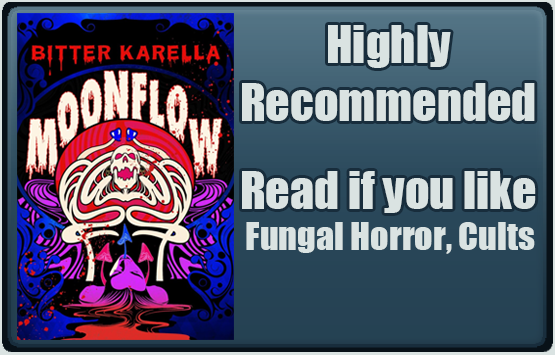
Moonflow by Bitter Karella

Moonflow by Bitter Karella

Formats: Print, audio, digital

Publisher: Run for It

Genre: Blood & Guts (Gorn), Eco Horror, Eldritch Horror, Myth and Folklore

Audience: Adult

Diversity: Trans main character and author, queer/lesbian major characters

Takes Place in: California

Content Warnings (Highlight to view): Animal Abuse, Child Abuse, Child Death, Child Endangerment, Childbirth, Death, Drug Use/Abuse, Gore, Incest, Medical Torture/Abuse, Mental Illness, Physical Abuse, Police Harassment, Racism, Rape/Sexual Assault, Sexism, Sexual Abuse, Slurs, Slut-Shaming, Transphobia, Violence, Vomit

Blurb

I see something out there, in the woods. It does not have a face. They call it the King’s Breakfast. One bite and you can understand the full scope of the universe; one bite and you can commune with forgotten gods beyond human comprehension. And it only grows deep in the Pamogo forest, where the trees crowd so tight that the forest floor is pitch black day and night, where rumors of strange cults and disappearing hikers abound. Sarah makes her living growing mushrooms. When a bad harvest leaves her in a desperate fix, the lure of the King’s Breakfast has her journeying into those vast uncharted woods. Her only guide is the most annoying man in the world, and he’s convinced there’s no danger. But as they descend deeper, they realize they’re not alone. Something is luring them into the heart of the forest, and they must answer its call.
Wow, this book… just wow.

How do I even begin to describe this fucked up, queer, psychedelic, gross, erotic, satirical, disturbing, fungal horror story that I sped through because I couldn’t put it down? Every free minute I had was dedicated to reading Moonflow. And I have ADHD; I can never focus on one thing for long unless I’m super interested. But I hyper-fixated on Karella’s weird ass masterpiece of a novel. As a splatterpunk story, the writing is intentionally over the top and there’s a ton of weird, gross stuff going on. There’s lots  of violence and fucking and it’s crude and funny as hell, but also deeply tragic. I personally loved it, but I know splatterpunk is not everyone’s cup of tea and some readers are going to be off put by the sex and violence. I love how trans the book is; eggs, muffing, dead names, TERFs, and chasers are all mentioned. The main character, Sarah, reminded me a lot of myself. She’s fat, trans, and a science nerd who could use a boost of self-confidence and went on three dates with her girlfriend before realizing they were dates. She also really loves her cat, Herman, and most of her desire to earn more money is so she can afford nice things for him, like the wet food he likes.

Sarah was forced to drop out of college due to depression and dysphoria, but at least she can still put the mycology skills she learned there to good use. Sarah grows psychedelic mushrooms for Madeline, a hot trans woman who delas drugs at house parties and is always surrounded by admirers. Madeline invites Sarah to another one of her sordid house parties where Sarah offers her a batch of freshly grown Fire Imps (all the mushrooms in the book are fictional). Unfortunately, Madeline isn’t interested, claiming they’re “last season” and “gauche.” She tells Sarah about a mushroom called The King’s Breakfast that she wants instead. Despite lacking the blue coloration that indicates a high concentration of psilocybin, the King’s Breakfast is strong and (even better) it’s impossible to have a bad trip on it. Even Sarah, who hates getting high around other people, enjoys her experience with the King’s Breakfast, hallucinating a beautiful nature goddess. Madeline asks Sarah to go into the Pamogo forest to collect some spores to grow. Desperate for money, Sarah agrees. Madeline has “a very old and dear and trusted friend” who will act as her guide in theforest.

It turns out the “trusted friend” is Andy, and Sarah immediately pegs him as a doofus. He’s the kind of guy who describes himself as “an ally,” despite it being a term others bestow upon you and not something you can claim. He complains about her selling mushrooms–a free natural resource– because of Capitalism, while ignoring the fact that Sarah is in desperate need of money and how, as a trans college dropout, she can’t just “get a job.” Despite his objections, Andy still guides Sarah through the Pamago forest, using the dead bodies of hikers lost in the forest as morbid trail markers (as everything else in the forest seems to move). Andy always has some sort of logical explanation for the weird things that happen in the Pamogo. Compasses don’t work because of electromagnetic storms. Raccoon bones end up in piles because the trees create a wind tunnel. The mushrooms move as if alive due to acidity in the soil.

Meanwhile, in a town near the Pamogo forest, two women named Skillet and the Hell Slut are watching an innocent looking girl enter the only bar in town. The Hell Slut correctly guesses that she’s a runaway escaping her pimp and saves her from a frat boy harasser outside the bar. After the Hell Slut kicks the guy’s ass, Skillet convinces the girl to go with them to meet their leader “Mother Moonflow.” If you think that sounds like the name of a cult leader, you’d be 100% correct.

Skillet and the Hell Slut belong to a lesbian separatist cult nested in the heart of the Pamogo forest, living off the land. They worship the Green Lady, a nature goddess who resides in Pamogo forest. She was formerly the consort of the Lord of the Forest, a male fertility and nature God with antlers, who she now protects her followers from (or so Mother Moonflow says). Both deities are reminiscent of the Wiccan Mother Goddess and the Horned God. The followers of the Green Lady seem to have similar (though less extreme) beliefs as women who practice Dianic Wicca. The founder of Dianic Wicca, Zsuzsanna Budapest, is also a huge TERF who, despite claiming to be a radical feminist, reduces women to their reproductive organs. Mother Moonflow is similarly obsessed with genitals, she and her group call anyone with a penis a phallic Alec. There are also vaginas painted on everything.

I liked the book’s criticism of a certain type of radical feminism, the kind practiced by TERFs like Z. Budapest. By claiming men (and anyone else with a penis because they reduce gender to genitals) are inherently violent, it means they don’t think men can change this part of their nature. This is an issue because it lets men off the hook for their actions.They can’t help raping/abusing/murdering because they’re men. It’s the same sexist attitude as “boys will be boys,” a sort of twisted, reverse victim blaming. These are also the kind of people who will brush aside sexual assault and violence committed by women. Even though Andy is an idiot, he is right about one thing. Trying to get rid of either the masculine or feminine throws off the balance of nature. Mushrooms are a perfect example of this, as most are hermaphroditic. In other words they contain both “male” and “female” sexual traits, capable of both fertilizing and being fertilized (some mushrooms also have thousands of different sexes).

There’s a lot of focus on Sarah and the Hell Slut being fat and their large bodies are frequently described, more so than the non-fat bodies of other characters, with the exception of Mother Moonflow’s comically large tits. Skillet is clearly a chubby chaser, she loves fondling the Hell Slut’s tummy folds and asks Sarah how much she weighs. She does get called out on it, thank God, but it still felt like Skillet gets away with being very gross. I’m guessing all the focus on Sarah and the Hell Slut’s bodies is because fat people are so often uncomfortable with their bodies (and make other people uncomfortable) from living in a fatphobic society. I loved that two of the main characters were fat women, but as a fatty myself, I felt like all the focus on their bodies was too much, and it admittedly made me uncomfortable.

Each chapter begins with either a quote from Lazarus Sloane’s diary (a man who tried and failed to build a sawmill in the Pamago forest) or Sarah’s mushroom guidebook for the Pamago by a man named T. F. Greengarb. Each gets increasingly unhinged as the story progresses. Sloane is clearly losing his grip on reality as more and more of his workmen start to disappear. Greengarb’s mushroom descriptions also start getting really weird. Early on, he writes about mushrooms like the Candy Cap, said to taste like maple syrup, but later in the book he describes the oily black Fox Candle that tastes like “children’s fear.” I thought this was a nice, creepy touch.

This was a weird read, which usually I’m not a fan of. In this case, I felt it worked well.

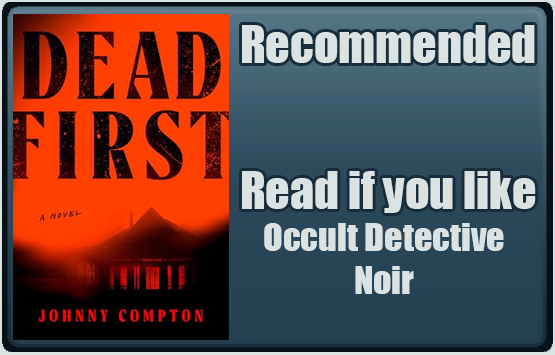
Dead First by Johnny Compton

Dead First by Johnny Compton

Formats: Print, audio, digital

Publisher: G.P. Putnam’s Son

Genre:  Ghosts & Hauntings, Mystery, Occult

Audience: Adult

Diversity: Black author and main character, bisexual main character, Korean-American side character

Takes Place in: Texas

Content Warnings (Highlight to view): Alcohol Abuse, Amputation, Child Death, Death, Drug Use/Abuse, Forced Captivity, Gore, Kidnapping, Mental Illness, Police Harassment, Racism, Self-Harm, Suicide, Torture, Violence

Blurb

When private investigator Shyla Sinclair is invited to the looming mansion of mysterious Texan tycoon Saxton Braith, she’s more than a little suspicious. The last thing she expects to see that night is Braith’s assistant driving an iron rod straight through the back of his skull. Scratch that—the last thing she expects to see is Braith’s resurrection afterward.

Braith can’t die, it turns out, but he has no explanation for his immortality, and very few intact memories of his past. Which is why he wants to pay Shyla millions to investigate him, and bring his long-buried history to light.

Shyla can’t help but be intrigued, but she’s also trapped by the offer. Braith has made it clear that he knows she’s the only person he can trust with his secret, because he knows all about hers.

Bold, atmospheric, and utterly frightening, Johnny Compton’s Dead First is spine-chilling supernatural horror about the pursuit of power and the undying need for reckoning.

Private investigator Shyla has just finished a case for a man named Massimo Dante, who thought he was the antichrist. He paid her well enough that she was able to buy herself a house and help her cousins out financially. She doesn’t need to accept billionaire Sexton Braith’s case, but curiosity gets the better of her. Braith wants Shyla to determine why he’s immortal, which his trusted chauffer, Remy, demonstrates by shoving a fire poker through his skull. Thoroughly freaked out, Shyla is ready to turn him down. Yet, Braith implies he knows her biggest secret–that she killed a man when she was young–and will bring it to light if she doesn’t help him. Little does Shyla know that Braith is hiding his own, much darker, secrets.

I was instantly hooked by the premise for Dead First. I’m a sucker for horror mysteries. While the first half of the book felt a bit slow for my taste, the pace really picks by the midpoint, and each reveal feels more horrific than the last. What starts out as a supernatural mystery eventually morphs into full blown horror. Interesting to note, Dead First seems to take place in the same world as Compton’s Bram Stoker Award nominated novel The Spite House, as there’s a passing reference to The Spite House at the very end of the book.

I liked how Shyla was more morally ambiguous than most protagonists. She’s willing to do some pretty messed up stuff for the ones she loves and to protect her secret. She’s driven by revenge and you can tell her anger is poisoning her, but she’s unwilling to let go of it. Shyla has trouble opening up to others and past experiences have hardened her. This is part of why she broke up with her girlfriend, Jinh. Shyla’s relationship with Jinh is complicated, to say the least. The two clearly still care for each other, but Shyla seems scared to get too close. Shyla first met her ex when she went on Jinh’s podcast, a blend of true crime and supernatural lore that has fans all over the world. Jinh has the ability to speak to the dead, though Shyla doesn’t really believe in Jinh’s power. While I liked Jinh, I felt like her character could have used more development.

I appreciated how the racism in the book is very subtle. You’re not hit over the head with it, but it’s there, hinted at and never outright stated.  For example, Shyla is always concerned about being harassed by the police. If you are a non-Black person who was somehow in a coma all through 2020, or just completely unaware of how cops treat Black people, you might not pick up on it. But it’s obvious Shyla must worry about cops and the busybodies who call them because she’s Black, even if it’s never spelled out for the audience. I liked that Dead First doesn’t feel like it’s written for non-Black people to learn about the horrors of racism. Instead, it assumes the reader is already aware of the systemic racism Black people deal with every day and Compton doesn’t have to delve in to it because it’s not part of the story. As much as I appreciate racism as horror stories, it’s also nice to read Black stories that aren’t focused on racism and Black trauma. Shyla does have trauma, but it has nothing to do with her race (other than the police not working as hard to find a missing Black child).

While the book initially feels more like a supernatural mystery thriller than straight horror, there’s still plenty of gore and some genuinely frightening moments in the second half of the book.  I personally enjoyed it, but I can see the mystery crowd being turned off by the violence and torture, while horror fans may not want to wait through the detective procedural parts of the story to get to the scary stuff. But I believe readers will enjoy the tense, haunted atmosphere, one of the story’s strongest points.


Navigation

Social Media

Search by Tags

To learn more about the Age Group, Diversity, and Genre tags, click here.

Age Groups

Diversity

Genre

Support the Blog

Search

Links

Something Followed Us Home edited by Cynthia Pelayo

Something Followed Us Home edited by Cynthia Pelayo

Formats: Print, audio, digital

Publisher: Atria/Primero Sueno Press

Genre: Comedy Horror, Dark Fantasy, Historic Horror, Monster, Myth and Folklore, Vampire, Zombie

Audience: Adult

Diversity: Latiné, Puerto Rican, Mexican, Ecuadorian, Columbian, Argentinian

Content Warnings (Highlight to view): Alcohol Abuse, Amputation, Animal Abuse, Body Shaming, Bullying, Child Abuse, Child Death, Classism, Death, Drug Use/Abuse, Illness, Incest, Physical Abuse, Racism, Rape/Sexual Assault, Slut-Shaming, Suicide, Victim Blaming, Violence

Blurb

Dive into the chilling depths of Latiné horror with this groundbreaking anthology, edited by Bram Stoker Award winner Cynthia Pelayo, where each story reimagines immigration, colonization, faith, and folklore as the fears we inherit and carry across borders and generations.

Something followed us home. It crawled in with our prayers, slipped into our beds, watched from mirrors, waited in water, and learned our names.

Gathering chilling work from some of today’s most acclaimed Latiné voices, this horror anthology moves through haunted households, brutal landscapes, sacred spaces turned dangerous, and bodies claimed by forces both ancient and intimate. The dead murmur behind locked doors. Bones rebuild themselves under merciless suns. Love becomes a doorway for demonic hunger. Blood, devotion, and memory intertwine as the past presses back with teeth.

Something Followed Us Home is an unnerving, visceral, and impossible-to-shake collection that proves that what is carried forward does not remain quiet, and what follows us rarely leaves without taking something in return.

I received this product for free in return for providing an honest and unbiased review. I received no other compensation. I am disclosing this in accordance with the Federal Trade Commission’s 16 CFR, Part 255: Guides Concerning the Use of Endorsements and Testimonials in Advertising.

I liked that both the English and Spanish language versions of the book are being released on the same day. Readers of Lo que nos siguió a casa will be able to read some of the stories in their original Spanish, while English readers will have some stories that were translated. Because the authors come from across the Latiné diaspora, there may be something new for everyone, while also including more universal themes like feminism, colonization, and family.

While I was familiar with authors such as Cynthia Pelayo (who also edited the collection), Ann Dávila Cardina, Agustina Bazterrica, Zoraida Cordova and Isabel Cañas I was delighted to also be introduced to new authors such as Carolina Flórez-Cerchiaro and Ananda Lima. I couldn’t believe how good all the stories were! There were really only one or two that I didn’t vibe with. I liked the stories that included figures from folklore like la Huesera (The Hand that Feeds by Isabel Cañas) and El Silbón (Fidelity by Alex Segura). El Jíbaro de Puerto Rico by Cynthia Pelayo was definitely one of my favorites, a bittersweet ghost story that teaches readers about the dark history in Puerto Rico, from its colonization by the Spanish, to slavery, to the American invasion. Her First Cruise Ship by Ann Dávila Cardinal was another, a humorous zombie story about undead tourists in Puerto Rico that critiques the tourism industry. It also has themes of classism and privilege. It will definitely make you think twice about how you behave when visiting another country!

While all the countries in Latin America each have their own unique cultures and histories one thing they share is a history of colonization by the Spanish and the Portuguese. These European invaders forced their languages and religion on the Indigenous people living there and brought disease, violence, slavery, destruction and later political and financial instability and war. That’s not even counting the damage done by the United States during the 19th and 20th centuries. Colonialism in Latin American countries is a reoccurring theme throughout the anthology explored in stories like the previously mentioned El Jíbaro de Puerto Rico and The Return of La Muelona by Carolina Flórez-Cerchiaro. This story is about how banana plantation owners continue the history of exploitation that began with the Spanish conquerors and how one woman gets her revenge. Other tales of revenge include Whispers from the Root by Lilliam Rivera and We are Gathered Here Together by Diana Rodriguez Wallace which address the corruption and cruelty of the wealthy and bullying, respectively. All were intensely satisfying to read as I’m a sucker for a good revenge story.

Many of the stories aren’t what I’d typically think of as “horror.” Some are more magical realism or speculative fiction like Pomelo and The World from Above and the World from Down Below. The Hand that Feeds is closer to a dark fairy tale. There are also some horror comedies like We are Gathered Here Together, My Boyfriend, and Her First Cruise Ship. However, stories like Luz Y Fer, Blue Flowers, and Specter are what I would think of as more “traditional” horror stories. I liked that every author has their own idea of what makes a story horror. There were traditional horror staples like vampires, killers, ghosts and zombies, but also religious mania, greed, sexism, and loneliness which can be equally, if not more, horrifying. The stories ranged from straight forward to more experimental. Some of the stories address the immigrant experience, while others take place in the main character’s home country, whether that be the United States or somewhere in Latin America. Settings include NYC, Puerto Rico, and Mexico City.  I have to say, I really liked how much variety there was, emphasizing the many experiences across the diaspora.  This creepy collection will have something for everyone, whether it be secret cults of children’s authors, plagues of spontaneous pregnancies, or a desperate father trying to bring back his dead daughter.
In These Gilded, Ghostly Hearts by Gwendolyn Kiste

In These Gilded, Ghostly Hearts by Gwendolyn Kiste

Formats: Print, audio, digital

Publisher: Creature Publishing

Genre: Ghosts/Haunting, Gothic, Historic Horror, Romance

Audience: Adult

Diversity: Lesbian main character and bisexual side character

Takes Place in: New York

Content Warnings (Highlight to view): Alcohol Abuse, Child Abuse, Death,  Forced Captivity, Homophobia, Suicide

Blurb

In 1955, Daisy Buchanan is found dead in an abandoned West Egg mansion, but her daughter Mel knows she’s really been gone for years. No one knows whether Daisy was murdered, or if it was a simpler, slower death: her yearslong spiral of alcohol, abuse, and helplessness. But when Mel enters the estate, she finds Daisy’s ghost, somehow frozen at twenty-three, and a charming, bleeding phantom that used to be Jay Gatsby.

To free her mother, Mel must carve a path through family secrets and decaying revelers: deep into Gatsby’s starving house as it gorges itself on unfulfilled love and grows stronger every night.

I received this product for free in return for providing an honest and unbiased review. I received no other compensation. I am disclosing this in accordance with the Federal Trade Commission’s 16 CFR, Part 255: Guides Concerning the Use of Endorsements and Testimonials in Advertising.

The year is 1955. Daisy Buchanan is dead, her body discovered in Jay Gatsby’s abandoned estate in West Egg. Daisy’s now adult daughter, Pamela “Mel” Buchanan, and one of Daisy’s few remaining friends, Jordan Baker, travel from New York City to investigate the mysterious death. They learn that Daisy was working with a predatory spiritualist named Harrison to summon the ghost of her lost lover, Jay Gatsby. Harrison convinces the two women to return to Gatsby’s old home, now dripping with ectoplasm, and complete the séance with him. Soon the mansion is filled with ghosts, partygoers from bygone days, Gatsby himself, and Daisy. The partygoers are Stone Tape hauntings, a mere echo of the past. Gatsby’s ghost, on the other hand, is an intelligent haunting who is able to interact with Mel, who soon learns his obsession with Daisy has continued after his death.

Mel and Daisy have a complicated mother/daughter relationship. No matter how badly their mother treats them, children still crave their mother’s love. Mel is parentified by Daisy who is helpless and broken after losing her lover Gatsby, her husband Tom, and her lifestyle. Mel explains “Once the cash dried up and she wasn’t a rich girl anymore, she practically dissolved into sea foam before my eyes.” Daisy is not a resilient woman–understandable since she was raised to be a pretty bauble on a rich man’s arm. Daisy was a fairly passive character in Fitzgerald’s novel, a beautiful woman for Gatsby to idolize and Tom to possess. It was satisfying, however, to read that toxic alpha-male Tom threw himself off the Brooklyn Bridge after losing everything in the stock market crash of ’29. A fitting end to an awful man. Unfortunately, it means he leaves his wife and daughter penniless and alone. Kiste often writes books for “lost” women and girls who are trapped in the past and mistreated by an uncaring society who doesn’t understand them. The Marys in Pretty Marys All in a Row, the Rust Maidens in the novel of the same name, Talitha Velkwood and her friends in The Haunting of Velkwood, and now Mel and Daisy Buchanan.

You don’t necessarily have to have any knowledge of The Great Gatsby prior to reading In These Gilded, Ghostly Hearts but it does certainly help to be able to familiarize yourself with the characters and themes. There are also lots of fun little callbacks to the original book, like Gatsby’s automatic orange juicer machine. Just don’t make the same mistake I did and try and compare the writing in the two. I re-read F. Scott Fitzgerald’s famous work right before Kiste’s so I’d have a refresher and I do think it made me more judgmental of the writing in the latter. Don’t get me wrong, I generally love Kiste’s writing, two of my favorites being Pretty Marys All in a Row and The Haunting of Velkwood. I’m not at all implying that this is not a well-written story. But very few books are going to be able to stand up to one of the “Great American Novels” and trying to compare the two is a disservice to Kiste’s novella.

While Gatsby is written as a sympathetic character in the original book, I like how Kiste points out how incredibly creepy his obsession with Daisy is. Some might view his grand gestures as romantic but honestly, they always felt like borderline incel behavior to me. Gatsby views Daisy as a prize to be won rather than a person, and if he has enough money of course she’ll leave Tom for him. The main reason we’re sympathetic to Gatsby is because Tom is portrayed as the bigger asshole with no redeeming qualities, and because Nick sees Gatsby as sympathetic. Daisy is “supposed” to choose the heroic Gatsby over the brutish Tom, and when she doesn’t, she’s cast as the villain. Yet, does she really have a choice?  Herstory and Daisy Buchanan by Leland S. Person, Jr. quotes the numerous men who have described Daisy as “vulgar and inhuman,” a “Dark Destroyer,” and the “anti-virgin…the prototype of the blasphemous portraits of the Fair Goddess as bitch” who “preyed on” Gatsby. Yikes! But Person viewed Daisy as more victim than conniving, selfish woman. She’s a woman in the 1920s, from an old money family who’s expected to marry an old money man, not some nouveau riche who may or may not have a criminal history. Daisy has no way of earning a living herself, she’s completely dependent on men for her financial security, and always had been. She’s also under immense societal expectations; she can’t simply leave her husband to have the life she wants with Gatsby. We also known Tom is abusive, as shown when he breaks his mistress’ nose.Leaving him was unlikely to be easy. I don’t think any of that necessarily makes her a good person; she’s just an imperfect victim. And this seems to be the characterization that Kiste goes with. Daisy wasn’t a good mother, but that doesn’t mean she doesn’t deserve sympathy or Gatsby’s obsessive idolization. Similarly, as a lesbian, Mel is also unable to be with the ones she loves, first Jordan and then her coworker, Vera.

I loved how queer Kiste’s book was. Mel is gay, Jordan bisexual, and Tom’s implied crush on Gatsby is no longer subtext. In These Gilded, Ghostly Hearts takes place during the Lavender Scare of the 1950s, an anti-LGBTQ+ witch hunt, so Mel lives in constant fear of having her sexuality discovered. At one point she and Jordan go to the Bagatelle on University Place. The Bag, as it was more commonly known, was a real lesbian bar that was popular in the 1950s. I love that little bit of realism that Kiste added to the story. Audre Lorde and Ann Bannon both wrote about the bar and how it shaped their pre-Stonewall experience. The Bag was owned by the mafia and frequently raided by police. A red light would go off to warn patrons when they vice squad showed up, which happens to Mel at the bag one night.

Kiste is not the first to write about the Great Gatsby through a queer lens. In 1963 Lionel Trilling characterized Jordan Baker as “vaguely guilty, vaguely homosexual.” Nearly thirty years later The International Fiction Review published The Sexual Drama of Nick and Gatsby by Edward Wasiolek who argued that Nick has “homosexual  leanings” and intense feelings for Gatsby. The Chosen and the Beautiful by Nghi Vo (author of The Empress of Salt and Fortune) also imagines Jordan and Gatsby as bisexual, and Nick and Gatsby have a fling. Self-Made Boys: A Great Gatsby Remix by Anna-Marie McLemore and The Pursued and the Pursuing by AJ Odasso explore a queer relationship between Gatsby and Nick.

Kiste’s writing can best be described as “haunting;” beautiful, unsettling, nostalgic, and melancholy, lending itself well to a ghost story. Her stories are less “in your face” horror with gore and blood and instead rely on atmosphere to create a general sense of unease commonly found in gothic horror. For some readers, it may feel like the pacing is dragging, as there’s no sense of urgency and not a lot of action because this isn’t that kind of book. This is a novella meant to be savored rather than rushed through. So, while it won’t be everyone’s cup of tea, I think fans of slow burn horror and character driven story will enjoy In These Gilded Ghostly Hearts.

I did feel like the book needed a little more show and a little less tell. It seemed like Mel was constantly explaining things to the audience that didn’t necessarily need to be spelled out. At the same time, I thought it was awesome that Mel was middle aged and Jordan in her fifties. It’s so rare to find older women protagonists in fiction. Male protagonists have a wide range of ages, but women seem to always skew young. What’s more, neither character is a wife or mother. While I don’t think In These Gilded, Ghostly Hearts is as strong as some of Kiste’s other novels and novellas, it’s still a solid, spooky read perfect for autumn.


This Movie Doesn’t End the Way We Want by Hailey Piper

This Movie Doesn’t End the Way We Want by Hailey Piper

Formats: Print, audio, digital

Publisher: Titan Books

Genre: Eldritch Horror, Monster, Mystery,

Audience: Adult

Diversity: Lesbian author and main characters, trans woman author

Takes Place in: Maryland

Content Warnings (Highlight to view): Body Shaming, Child Death, Child Endangerment, Death, Kidnapping, Verbal/Emotional Abuse, Violence

Blurb

In November 1994, three girls visit their local movie theater to see an obscure film. Only one of them is ever seen again.

Thirty years later, Val McQueen has never forgotten the day she lost her little sister and best friend, but she’s closed the curtain on it, certain she’s moved on despite her parents’ resentment and hounding by true crime enthusiasts.

That is until a stranger’s murder brings it all screaming back—a terror she’s tried to tell herself is only a movie. Enlisting the help of cinephile and former classmate Roxie de la Fontaine to find the film, Val soon realizes that hers is not the only pursuit. Someone, or something involved with the movie is on the hunt, too…

… For the girl who got away all those years ago.

I received this product for free in return for providing an honest and unbiased review. I received no other compensation. I am disclosing this in accordance with the Federal Trade Commission’s 16 CFR, Part 255: Guides Concerning the Use of Endorsements and Testimonials in Advertising.

It’s 1994, and Valerie McQueen loves going to the movies. It’s her favorite way to escape her chaotic home life and her parents’ constant fighting. On this particular evening, she’s accompanied by her little sister, Ashley, and best friend, Colette. Colette wants to see Interview with the Vampire, but Valerie convinces the girls to go see a schlocky B-move she’s never heard of before: Blood-Curse of the Toad Man. At first, they’re the only ones in the theater watching the cheesy monster flick, but soon Valerie notices a stranger seated behind them wearing a trench coat and a fedora that obscures their face. The stranger seems to be moving closer, which freaks Valerie out, and she runs out of the theater. When she finally plucks up the courage to return, Colette and Ashley are gone. The police investigate but the girls are never found.

Thirty years later, Valerie (who now goes by Val) is still struggling with her survivor’s guilt, working as a tattoo artist, and getting into bar fights. Ever since that tragic night, Val hasn’t been able to bring herself to watch another movie. She chooses to self-isolate with no social media presence, only one real friend, and little contact with her parents, who blame her for Ashley’s disappearance. To cope with her unresolved trauma and guilt, Val tries to live in the moment to avoid thinking about the past. Unfortunately, the past has a way of catching up with you, and it appears Blood-Curse isn’t ready to let her go yet. Kate, a true crime podcaster, shows up at Val’s workplace posing as a tattoo client and tries to talk to Val about the worst night of her life.

When Val understandably gets pissed and walks away, Kate reacts poorly, demanding Val speak to her, as she paid for a tattoo. Kate is more interested in the entertainment value of the unsolved crime than she is in protecting Val and her parents from further pain. Kate pops up periodically throughout the book to prove what a shitty person she is, and it feels like her character is Piper’s way of criticizing the true crime genre. A common criticism of the true crime genre is that it’s exploitative, voyeuristic, and can re-traumatize victims and/or their families who are trying to move on, and Kate represents all of these things.

Later, when Val goes to meet a woman from the bar, she discovers the woman’s hotel room destroyed, the woman missing, and two lines from the creepy song from Blood-Curse of the Toad Man written on a scrap of paper. Realizing the only way to make the disappearances stop is to learn more about Blood-Curse of the Toad Man, Val ends up reaching out to Roxie, a girl who was kind to her after Ashley and Colette went missing who now does freelance work hunting down lost media. Despite Val’s warnings to be careful, Roxie is intrigued when she tells her about the cursed film and immediately dives right in to researching it. It’s at this point the book starts alternating between Val and Roxie’s points of view.

I love the idea of a movie that kills you, which is what immediately drew me to Piper’s latest work. Although the film Ringu (1998) and the book by Koji Suzuki it was based upon popularized the idea of a killer film, you could argue that the idea goes all the way back to 1895 when The King in Yellow was published. This short story collection by Robert W. Chambers centers around a cursed play that can drive anyone who reads it mad and would later inspire writer H.P. Lovecraft to write The Whisperer in Darkness. Interestingly, Piper has also published a book entitled A Game in Yellow based on the mythos created by Chambers. Like Lovecraft, Piper also excels in cosmic horror as seen in her books Queen of Teeth (which won a Bram Stoker Awards in 2021), The Worm and His Kings, and the aforementioned A Game in Yellow. In This Movie Doesn’t End the Way We Want, the story starts out as a simple horror story but later morphs into cosmic horror, creating one of the most unique explanations for a “cursed” film I’ve ever seen.

There are lots of 80s and 90s movie references, like Never Ending Story (1984), Ghost Busters (1984), Labyrinth (1986), Moonwalker (1988), Who Framed Roger Rabbit (1988), and Devil in a Blue Dress (1995). Even the isekai anime Escaflowne (1996) gets a shout out. There are also references to more modern movies like Sinister (2012), older ones like Chinatown (1974), and even relatively obscure films like Manos: The Hands of Fate (1966), popularized in the nineties by MST3K. This is definitely a book for millennial movies fans. Speaking of which, I loved that both Roxie and Val are in their forties. You don’t see a lot of forty-something women as horror protagonists. While the book plays tribute to these nostalgic films,  it simultaneously warns us against dwelling too much on the past.

Val can’t move on properly because she tries to ignore what happened instead of facing it and finding a way to move on. She thinks she’s “letting go” by not thinking about the past, when in realty Val is trapped in it. Similarly, Val’s parents haven’t moved on from that horrible day in 1994 and focus all their attention on mourning the daughter they lost rather than loving the one they have. Roxie is also critical of nostalgia, as much of her job involves hunting down old commercials and TV shows for clients who are willing to spend big bucks on a small reminder of their childhood. Remembering the past does not mean getting stuck in it, unable to move on. It gave me I Saw the TV Glow (2024) vibes, reminding me of the protagonist’s obsession with fictional TV show The Pink Opaque then later discovering that nostalgia had warped his perspective of the show.

I’m a fan of horror mysteries, especially those that involve researching the past, so this book drew me right in. It’s filled with plenty of twists and turns to keep the reader guessing, which I really enjoyed. It also made me happy that both Val and Roxie were lesbians. Val would have brief flings with women thanks to her “only focus on the present” mindset while Roxie is happily married. I liked that the film hides its true nature behind a silly premise, I mean, who is going to take a movie called Blood-Curse of the Toad Man seriously? But the campy film becomes increasingly sinister the more Val and Roxie learn about it. But most of all I liked how the book continued to sit with me long after I finished it. Another great horror story from Piper!

Shadows Over Ravenkirk by Vivian Moira Valentine

Shadows Over Ravenkirk by Vivian Moira Valentine

Formats: Print, digital

Publisher: Blue Fortune Enterprises

Genre: Dark Fantasy, Gothic, Mystery, Occult

Audience: Adult

Diversity: Trans, lesbian main character and author

Takes Place in: Maine

Content Warnings (Highlight to view): Classicism, Death, Drug Use/Abuse, Forced Captivity, Medical Procedures, Physical Abuse, Torture, Transphobia, Verbal/Emotional Abuse

Blurb

Victoria Williams, a struggling photographer from Boston, receives a letter informing her of a surprise inheritance. Wilhelmina Bruttenholm of Ravenkirk, Maine, has recently passed away and left her a bequest. Victoria doesn’t know who Wilhelmina is-to her knowledge, she doesn’t know anyone in Ravenkirk-but she travels to Maine anyway to attend the will reading.

But who is this family and what do they really want of her? Struggling to understand the events happening in this unique little town, Victoria is confronted with secrets, magic, and Samantha, one very sweet tarantula. And while she must face the truth about her own mysterious family history, she will have to do so carefully. Because murder abounds in Ravenkirk and nobody is who they appear to be.

I received this product for free in return for providing an honest and unbiased review. I received no other compensation. I am disclosing this in accordance with the Federal Trade Commission’s 16 CFR, Part 255: Guides Concerning the Use of Endorsements and Testimonials in Advertising.

I’m doing something a little different for this review and reviewing the first two books in the Shadows Over Ravenkirk series by Vivian Moira Valentine instead of just one book, as I feel the two novellas work better when read together. The overall story is just so big, with so many elements and characters, that I think the series would have worked better as a couple full length novels rather than a bunch of novellas. Of course, that might also be because I’m not a patient person and I want to read the rest of the story now and I’m already impatient for the third book to come out because the second ended on a cliffhanger.

The first Shadows Over Ravenkirk book gives cozy mystery vibes. I hesitate to use the term “cozy horror” as it’s so controversial, with valid points made on both the pro and con sides. Personally, I feel if someone’s comfort film can be Nightmare on Elm Street or they listen to Tales to Terrify to help them fall asleep, then I don’t see why people can’t also find a horror story about a small gothic town “cozy” without sacrificing the elements that make it horror. But I know plenty of folks hate the term so I’ll refrain from labeling the book as such. What I will say is that Valentine’s books quickly became a comfort read for me at a time I really needed it.

In it, we’re introduced to Victoria Williams, a trans, lesbian, goth girl from Boston (yay Boston!). She’s been summoned to the will reading of the mysterious Wilhelmina Bruttenholm, despite not having known the woman in life. With nothing to lose, Victoria sets off to the small seaside town of Ravenkirk, Maine for the reading. While trying to enjoy her book–Ghost Flower by Jessica Conwell–on the train, Victoria is interrupted by a vulpine young man, the deuteragonist of the story, Nicodemus Ruthven. He’s friendly, and thankfully not transphobic as Victoria initially fears, but he also seems to be unpredictable with a dangerous edge to him that makes her nervous.

He may be a rich asshole but I kind of like Nicodemus. Maybe “like” is too strong a word. I’m more fascinated by him. I enjoy a complex, morally gray character, and I love how snarky Nicodemus is, especially toward his awful family. Speaking of his family, the Ruthvens are Ravenkirk’s old money family who are used to being in control. They’re pretty evil (because rich people are inherently evil) and are not at all happy to see Nicodemus return to Ravenkirk, as he was banished from the town for a yet undisclosed reason. But he has returned for Wilhelmina Bruttenholm’s funeral as an invited guest, much to everyone’s shock and dismay.

Victoria meets some other colorful characters in the town, three of whom she immediately starts crushing on. There’s Tabitha Swann, who used to work for Wilhelmina and gives Victoria a ride to her hotel;Bianca Burke, who was hired by Wilhelmina to act as Victoria’s bodyguard while she’s in town;and finally, Thorn Hale, a non-binary femme who works as the hotel’s cook. Victoria also adopts a tarantula named Samantha. The town seems to be divided into factions, none of whom trust the other, so trying to make friends with the townsfolk is tricky. The book felt a little like a queer dating sim where the reader is left to wonder which hot femme Victoria will pick.

Valentine spends a lot of time introducing characters and developing the town. The world building in this story is AMAZING and very in-depth, and I’m a sucker for good world building. Ravenkirk feels like a town trapped in the past, despite the story being set in the modern day, and it reminded me of the strange New England locations Lovecraft invented, like Miskatonic University and the town of Arkham. Valentine clearly put a lot of thought into the setting and the characters. And there are A LOT of characters in Shadows Over Ravenkirk, especially in the second book. So many, in fact, that it can be confusing trying to keep everyone straight. Fortunately, there’s a list at the beginning of the book with short character descriptions to help keep everyone straight.

There are the Talbots, one of the three major families and the local farmers of Ravenkirk. The Gilmans (fishermen and dockworkers) who give The Shadow over Innsmouth vibes, and from the short preview in the end of the second novella, it seems they’ll be the focus of the third book. And of course, the Ruthvens. Then there are the people who work at the hotel Victoria is staying at, the members of a strange cult called “The Yonders,” and Wilhelmina Bruttenholm’s confidants, none of whom seem to trust each other. The downside to having so many characters in such a short book means that there’s not as much time to develop them. Again, this is why I think the two books work better when read together, as the first novella just feels like we’re getting a bunch of quick character introductions and we don’t really get any action until the last third of the book. It feels more like the first few chapters of a much longer story with the setup but not offering much in the way of a resolution. The book is over before the plot has a chance to get going.

The second book leans more into the story’s horror elements with much more violence (including a torture scene that’s cut short) and some hot sex scenes. Instead of Victoria and her friends, the main focus has switched over to the messed-up Ruthven family, fleshing out already existing characters and introducing new ones. Nicodemus takes up residence in the abandoned Mooncroft Manor, the ancestral home of the Ruthvens, who left because their dwindling fortunes made the upkeep too expensive. Nicodemus invites the various cousins to stay with him to help him with his yet unknown plan to restore the Ruthvens to their former glory. The cousins are all varying degrees of evil; one of them makes snuff films, another creates mind altering drugs, and yet another re-animates corpses to be his “servants.”

The second book was also more focused on setting up overarching plot, giving the reader more questions than answers. But rather than leave me frustrated (okay, maybe just a little frustrated), it just left me desperate to read more! That’s right, this series has me completely hooked and I cannot wait for the third book to come out. I need to know what happens next. I absolutely adored Valentine’s voice. She excels at creating atmosphere and intriguing characters. I feel like this is a series, while not necessarily aimed at teens (especially with the graphic sex scenes in the second book), I would’ve loved as a young adult. In terms of representation, the cast is very diverse, especially when it comes to trans and non-binary characters. I can’t wait to read more!

My Monsters Ain’t Like Yours by R.J. Joseph

My Monsters Ain’t Like Yours by R.J. Joseph

Formats: Print, audio, digital

Publisher: Quill & Crow Publishing House

Genre: Eldritch Horror, Folk Horror, Ghosts/Haunting, Historic Horror, Monster, Zombie

Audience: Adult

Diversity: Black, African/American characters and author, queer and bisexual characters

Takes Place in: Texas

Content Warnings (Highlight to view): Animal Abuse, Animal Death, Body Shaming, Cannibalism, Child Abuse, Child Death, Child Endangerment, Childbirth, Death, Drug Use/Abuse, Forced Captivity, Incest, Miscarriage, Oppression, Pedophilia, Physical Abuse, Racism, Rape/Sexual Assault, Sexism, Sexual Abuse, Slut-Shaming, Suicide, Torture, Verbal/Emotional Abuse, Violence, Vomit 

Blurb

At its core, the horror genre is an effective vehicle for exploring human behavior. From within its terrifying boundaries, and lack thereof, we can examine monstrosity. We can determine how monsters are labeled, analyze the actions of those deemed monstrous, and prophesy the impacts this labeling and actions have on the world around us.

Monsters are personal. Monsters are universal. These facts create an intriguing juxtaposition where the things deemed monstrous or frightening can be shaped by personal experiences, while also representing many aspects of the human condition; our fears are much more similar than dissimilar. This means my monsters are absolutely like yours: they are our collective nightmares.

My Monsters Ain’t Like Yours reflects this irony through Black feminist intersectional horror at its rawest.

I received this product for free in return for providing an honest and unbiased review. I received no other compensation. I am disclosing this in accordance with the Federal Trade Commission’s 16 CFR, Part 255: Guides Concerning the Use of Endorsements and Testimonials in Advertising.

While many of the monsters in the collection are supernatural (Suffer the Little Children, The Crazy   with Daisy, Higher Education, Something Wicked Came for Me, Welcome, Skinny Minnie, Sweet Sunday Supper Smile, etc.) the most terrifying ones are the human monsters (Regrets Never Die, The Collector, Sweet Sunday Supper Smile, Her Heart’s Desire, No Tricks Only Treats, The Preying Family, Sad, Spooky Sally, etc.). Interestingly, some of the supernatural monsters are friendly and helpful creatures/spirits who protect the protagonists from other monsters, both literal and figurative. Humans, after all, are much worse than some imagined creature. Then there are the metaphorical “monsters” of grief, loneliness, and trauma that haunt the protagonists.

There are a lot of bad heterosexual relationships in the anthology.  These range from Where the Horizon Kisses the Sky in which the husband is neglectful, Endless Possibilities where he’s a selfish loser, to Her Heart’s Desire where he’s outright abusive towards his wife. In all these stories the wife yearns for something better and uses supernatural means to get it, with varying degrees of success. In The Badly Terrible, Absolute Worst she doesn’t even get that chance. But queer relationships, like in The Crazy with Daisy and Witness Bearer, are shown in a more positive light.  A report by the Institute for Women’s Policy Research and the National Domestic Worker’s Alliance states that “More than 40 percent of Black women experience physical violence by an intimate partner during their lifetimes (41.2 percent), compared with 31.5 percent of all women.” And a study published in the Lancet reported that Black women are also nearly six times as likely to be murdered than white women. Thankfully there are resources like Ujima that support Black women who are in domestic violence situations, even as the justice system continues to fail them.

In Endless Possibilities and Her Heart’s Desire the wife herself becomes a monster to escape her bad marriage, and in the latter, get revenge on her horrible husband. Then there’s Tanita in The Collector, a serial killer who murders for the fun of it. There’s something incredibly satisfying about women embracing their monstrosity and rage, especially Black women. Those with marginalized identities are often cast as monsters in other people’s stories so why not reclaim the title? I especially like that feminine monstrosity in Endless Possibilities and Her Heart’s Desire is not tied to sexuality. While I appreciate women like Tanita reclaiming their sexuality and using it to seduce and murder men à la Jennifer’s Body (2009) and The Hunger (1983) sometimes it feels like the majority of female monsters are temptresses ( leading men to their death. And it can start to get a little old.

Can’t they just be horrible and violent without wanting to have sex with their victim? Plus, there’s the unfortunate implication that women who have sex on their own terms are evil and they go against the natural order of things by overpowering men. So, I appreciated that Joseph gave us some nice variety. The book even has monstrous children (#GIRLMOM and Suffer the Little Children) though in both cases the children are embraced by the main character rather than shunned for the monstrosity.

Sweet Sunday Supper Smile and No Tricks Only Treats are stories containing child abuse, though the abusers get their comeuppance in both. Then there’s Sad, Spooky Sally which is especially disturbing, so much so that it comes with its own set of content warnings before the chapter, rather than in the index. It’s an absolutely heart-breaking story with a bittersweet ending and one of my favorites in the collection. But it’s also very triggering, so make sure you check out those content warnings before reading it. The same goes for Regrets Never Die and Witness Bearer. They’re both very dark, with the latter being about a girl who can see the worst things a person has ever done. She witnesses some truly awful memories, so I appreciate that Joseph included content warnings for all the stories in the book’s index.

Those who Teach Pay Knowledge Forward stood out in the collection, as it was sweet rather than scary, A ghost story where the ghosts aren’t the source of fear. It also had a nice message about helping to educate the next generation so they can succeed. I love how so many of the Black women in the collection are intelligent and well educated, ranging from college students (The Collector) and graduate students (Whole New World), to teachers (Those Who Teach Pay Knowledge Forward) and college professors (Grand Opening, Higher Education, Something Wicked Came for Me). The young woman in Important Things is sent on an all expenses paid trip to Palm Springs for a symposium because she excels in her high school classes. In 1995 14% of Black women between 25 to 34 held a bachelor’s degree compared to 38% in 2024 according to the Pew Research Center.

There are so many great stories in the collection, I’d be pressed to pick a favorite, though I did especially enjoy Regrets Never Die, #GIRLMOM, Endless Possibilities, Those Who Teach Pay Knowledge Forward, and Something Wicked Came for Me. While Black women and children’s trauma is a reoccurring theme of My Monsters Ain’t Like Yours, it’s not the only focus of the anthology. If every story were about Black trauma and abuse, it honestly may have been too much for me. Instead, Joseph includes a bunch of fun, spooky stories to offset the heavier stuff so the collection never feels too dark and depressing. Instead, we get a nice balance.

I really liked this because while horror is a great way to process trauma, Black horror shouldn’t be pigeonholed into stories of Black pain. I love Get Out (2017), it’s one of my favorite films, but if that was the only kind of Black horror story told by Hollywood, it would start to feel like the suffering of Black people was being fetishized for entertainment. There’s a reason why Peele’s next two films, Us (2019) and Nope (2022) aren’t rooted in Black trauma. So, while there are plenty of stories about abuse, bad relationships, and the general mistreatment of Black women and children, there are also enough tales about living mannequins, small fanged creatures, and ghosts to offer the reader a breather.

Deadbeat by Maxim Volk

Deadbeat by Maxim Volk

Formats: Print, digital

Publisher: Slashic Horror Press

Genre: Comedy Horror, Zombie

Audience: Adult

Diversity: Gay man author and main character

Content Warnings (Highlight to view): Alcohol Abuse, Body Shaming, Cannibalism, Child Death, Death, Drug Use/Abuse, Gore, Homophobia, Mental Illness, Necrophilia, Pedophilia, Physical Abuse, Police Harassment, Slurs, Vomit 

Blurb

Ji-won’s life tumbles into disarray in the wake of her Appa’s extramarital affair and subsequent departure. Her mother, distraught. Her younger sister, hurt and confused. Her college freshman grades, failing. Her dreams, horrifying… yet enticing.

In them, Ji-won walks through bloody rooms full of eyes. Succulent blue eyes. Salivatingly blue eyes. Eyes the same shape and shade as George’s, who is Umma’s obnoxious new boyfriend. George has already overstayed his welcome in her family’s claustrophobic apartment. He brags about his puffed-up consulting job, ogles Asian waitresses while dining out, and acts condescending toward Ji-won and her sister as if he deserves all of Umma’s fawning adoration. No, George doesn’t deserve anything from her family. Ji-won will make sure of that.

For no matter how many victims accumulate around her campus or how many people she must deceive and manipulate, Ji-won’s hunger and her rage deserve to be sated.

A brilliantly inventive, subversive novel about a young woman unraveling, Monika Kim’s The Eyes Are the Best Part is a story of a family falling apart and trying to find their way back to each other, marking a bold new voice in horror that will leave readers mesmerized and craving more.

I received this product for free in return for providing an honest and unbiased review. I received no other compensation. I am disclosing this in accordance with the Federal Trade Commission’s 16 CFR, Part 255: Guides Concerning the Use of Endorsements and Testimonials in Advertising.

Your husband Matt expects you to remain monogamous despite constantly going on business trips. Worse, he doesn’t even like video sex because he’s worried someone will hack your phone, though you tell him that it’s a ridiculous paranoia. He won’t even let allow you a quickie before his trip because he’s worried about “smelling like sex” on the plane. You’re feeling pissed off, neglected, and sexually frustrated. You’ve cheated on him before while he’s away on trips, but you assume he’s also cheating on you while he’s away. So now you have a decision to make. Blow off some steam with a casual hook up or be a faithful husband and stay home. You end up dead either way,though how you meet your untimely end varies depending on your choice, ranging from carbon monoxide poisoning to getting murdered in a snuff film. You think it’s all over until you wake up in a basement surrounded by robed figures saying they’ve resurrected you. And you’re hungry. So very hungry. Now all you have to worry about is your insatiable appetite for human flesh, your decaying body, and avoiding Zombie Hunter Rome Samuel.

Deadbeat is a “choose your own adventure” style erotic horror novella. You can run into bigfoot, try to be the Dexter Morgan of zombies/a zombie superhero, eat some cops (because ACAB), or get revenge on a councilman who didn’t approve your backyard pool even after trading sexual favors. My favorite storyline was, in a twist right out of Thirty Rock’s Reunion episode, when the reader discovers that your high school “bully” (whose name you can’t even remember) was actually a good guy who just didn’t put up with your asshole behavior. And you character is an asshole. This may be a turn off for some readers, but personally, I love problematic queer characters. I also loved how we get a reference to “that social media app that has become overrun with Nazis” (Twitter) and digs at AI being used in porn (AI sucks and people who use it are losers). That doesn’t mean this story can’t get dark, though. One of the storylines involves a trafficking ring that kidnaps children, and they aren’t rescued if you don’t make the right decisions.

Deadbeat also addresses something I’ve always wondered about in zombie stories. Stomach acid and bile are no longer produced after death, so how do the undead digest things? Apparently, they can’t because you throw up everything after devouring someone, leaving you hungry again. I thought it was clever how Volk considered some of the science behind the living dead. For example, when you awaken, you find all your blood has been replaced with embalming fluid.

For erotic horror, the sex scenes are super short. I guess that makes sense for a novella, but it means it’s hard to get in the mood, so all the sex and dicks just feel kind of distracting rather than sexy. Of course, I’m also not a gay man, so not really the target audience. Over all it’s a very silly little book, which may take some people out of the story, but I personally thought Deadbeat was tons of fun.

Fabulous Bodies by Chuck Tingle

Fabulous Bodies by Chuck Tingle

Formats: Print, audio, digital

Publisher: Tor Nighfire

Genre: Blood & Guts, Sci-Fi Horror

Audience: Adult

Diversity: Lesbian main character, Bisexual side character, Gay, Autistic author,

Takes Place in: Palm Springs, California

Content Warnings (Highlight to view): Amputation, Animal Abuse, Child Endangerment, Death, Drug Use/Abuse, Gore, Illness, Kidnapping, Self-Harm, Suicide, Torture, Violence

Blurb

Poppy Stringer was born to be a star.

An aspiring fashion influencer by day, Poppy moonlights as a grave robber to make ends meet, wheeling and dealing dead bodies across Palm Springs.

When her hero, the flamboyant, piano-slamming rockstar Eddie Michaels, unexpectedly dies, Poppy gets a call to retrieve his body from the medical examiner’s office for a lucrative sum. It could be the last job she’ll ever need—if everything goes to plan. But the night’s delivery quickly veers off course when Eddie wakes up.

Now Poppy must fight for her life if she hopes to survive this blood-soaked joyride of carnage and extravagant entertainment.

I received this product for free in return for providing an honest and unbiased review. I received no other compensation. I am disclosing this in accordance with the Federal Trade Commission’s 16 CFR, Part 255: Guides Concerning the Use of Endorsements and Testimonials in Advertising.

I was SO excited when I got approved for this ARC, you have no idea. There’s a lot of death in Fabulous Bodies, like, A LOT. The violence and gore are over the top, which I found fun, but may be too much for some readers. It’s also super campy, which again, I personally love but other readers might find ridiculous. That doesn’t mean the deaths aren’t disturbing, as people die in all number of creative ways and some of them are truly horrific. It’s basically splatterpunk without the sexual violence and misogyny that seems to plague so much of the genre. A fun read with great dark humor that I finished in only a few sittings. I just couldn’t bear to put it down.

Poppy Stringer is a confident (or full of herself, depending on your point of view), queer woman who knows she’s fucking hot and will do almost anything to become a famous influencer. Her Instafeed (the book’s fictional version of Instagram) makes her lifestyle look glamorous, but the single mom is struggling to fund it. To support her lavish lifestyle, Poppy turns to body snatching. After all, her giant house in Palm Springs won’t pay for itself. She sees what she does as a victimless crime because no one is actually getting hurt and the loved ones of the deceased are merely inconvenienced. After all, the bodes she steals are just hunks of meat who don’t care what happens to them. And it’s worth it to give her five-year-old daughter, Marlo, the childhood she never had, even if it means spending less time together. Being raised by adoptive parents who didn’t really want her has hardened Poppy into someone cold and calculating who will do almost anything to get ahead, including grave robbing. She’s sees herself as a shark, surrounded by fish who’re satisfied nibbling on scraps.

Poppy isn’t an entirely selfish person; she does care deeply about her daughter and her best friend Noah. But when other people, like Poppy’s neighbor Ashley, try to get close to her, Poppy is quick to push them away. Noah honestly puts up with a lot from her, frequently babysits Marlo while her mom is out working her “other job,” which she tells him nothing about. While dining out with Noah, Poppy gets a call from a mysterious woman who somehow found her number. The woman offers her five million to retrieve a body. But not just any body, it’s the body of Poppy’s favorite musician and queer icon, Eddie Micheals, recently killed by a drunk driver (a tragedy which Poppy used for content). Despite her reservations, Poppy agrees to take the job. After all, five million is life-changing money. Enough that she can quit the grave robbing business.

Everything goes smoothly when she steals the corpse. A little too smoothly, in fact, and Poppy ignores her gut feeling that something isn’t right. She’s driving down a desert road with the body in her van when Eddie wakes up. The now undead rockstar reveals that he’s made a deal with the devil which gave him fame, fortune, and the ability to control people with his voice (think Jesse Custer from Preacher or Killgrave/The Purple Man from Marvel Comics). He just needs Poppy to help him run a few “errands” before sunrise and then she’s free to go. But of course, nothing is ever that simple. Poppy is forced to bear witness as Eddie tells people to murder, mutilate, and maim themselves and others, leaving a trail of bodies through Palm Springs.

While the story starts with Poppy as an almost-villain protagonist, there are some things even she won’t stoop to, which Eddie is all too happy to indulge in–mostly hurting and killing others. She may be a shark, but she’s a nurse shark while Eddie is a great white. The two are similar in that they’re both artists willing to do “anything” to get ahead (although Poppy learns that night that she actually has limits) and neither sees themselves as a “bad” person. Eddie tells Poppy “I’m not a bad guy, I’m just a survivor.”

Despite the horrible things he does, he never sees himself as a villain, which forces Poppy to question her own amoral actions and gives her the chance to have a nice character arc. Yes, Poppy is an awful person, and all I can say is “Yay for unlikable, problematic gay characters!” I love how terrible and morally gray she is. And Eddie is a delightfully campy villain. Queer readers deserve to have complex queer characters. Unfortunately, some folks have adopted right-wing puritanical viewpoints around moral purity. These are the people who argue kink doesn’t belong at Pride and want to censor anything that makes them uncomfortable which includes problematic queer characters. To these morality police I say:f you can’t handle queer characters who aren’t cutesy, pure, beacons of morality then maybe you should stick to cozy fic and stay away from horror. Liking a problematic character does not mean you would approve of their actions in real life, and trying to sanitize queer content is a particularly nefarious form of censorship.

At one point Eddie tells Poppy that art is what makes life worth living, and he’s not wrong. Yet, Poppy realizes love is what really matters. Poppy may be a morally grey narcissist, but she’s nowhere near as bad as Eddie, because unlike Eddie, there’s one thing she cares about more than fame, and that’s her daughter. It’s her love for her daughter that keeps her from completely crossing the line into villainy and which ultimately gives her the strength to fight Eddie. Fabulous Bodies is another Tingle book that proves love is real. Fabulous Bodies may be an action-packed roller coaster ride of gore, but at its core it’s still about the power of love.


Eat Your Heart Out N.J. Gallegos

Eat Your Heart Out N.J. Gallegos

Formats: Print, digital

Publisher: Black Hare Press

Genre: Comedy Horror, Romance,

Audience: Adult

Diversity: Lesbian main character and author

Content Warnings (Highlight to view): Alcohol Abuse, Cannibalism, Death, Drug Use/Abuse, Gore, Homophobia, Medical Procedures, Violence

Blurb

Jules is a first-year medical student with an exceptional mind for anatomy, a devotion to precision, and a carefully controlled emotional life. That control shatters when she meets Maureen.

Maureen is magnetic—confident, beautiful, effortlessly desired. What begins as attraction quickly deepens into something sharper, darker, and far more consuming. Jules mistakes intensity for intimacy, chemistry for destiny, and fixation for love.

As their relationship lurches between passion and distance, Jules begins to unravel. The boundaries between study and obsession blur. Anatomy labs bleed into fantasy. Hunger—emotional, erotic, psychological—becomes impossible to ignore. Every slight feels catastrophic. Every touch feels like a promise. Every rejection fuels something dangerous.

Set within the sterile world of medical training, Eat Your Heart Out explores the seductive logic of obsession and the quiet horror of a mind convincing itself that devotion justifies anything. Desire becomes possession. Love becomes entitlement.  Control slips, slowly and then all at once.

Dark, intimate, and deeply unsettling, this psychological horror novella traces the path from longing to fixation—and the terrifying places desire can lead when nothing is ever enough.

I received this product for free in return for providing an honest and unbiased review. I received no other compensation. I am disclosing this in accordance with the Federal Trade Commission’s 16 CFR, Part 255: Guides Concerning the Use of Endorsements and Testimonials in Advertising.

Oh man, N.J. Gallegos had me at “toxic lesbians” and “cannibalism.”  Add in a medical setting and a kickass playlist, and I was sold. Cannibalism is hinted at throughout the story: Our protagonist, a queer medical student named Jules, constantly compares parts of her cadavers to food (to the point it makes her hungry), uses kuru as a random example of a neurodegenerative disease, and named her cat Jeff after serial killer Jeffrey Dahmer (aka the Milwaukee Cannibal). So you know that at some point someone is getting eaten, you just don’t know how or when.

Jules is an introverted horror nerd who is studying to be a surgeon. She loves medicine, her cat, and her classmate Maureen (who Jules calls Mo). Sadly, Mo doesn’t seem to even realize Jules exists. But after Jules’ best friend, a neurology nerd named Chris, gives her molly at a Halloween party (which Jules attends dressed as Patrick Bateman), she finally has the courage to approach her crush. The two women end up having a drunken hookup and spend a cozy weekend in Jules’ apartment having mind blowing sex. Jules falls hard and fast. Her obsession with Mo (which Jules mistakes for being in love) only gets worse, to the point she’s already planning the rest of their lives together. Now she just has to convince Mo, who doesn’t even want to be exclusive, that she feels the same way about Jules.

Jules’ obsession and possessiveness is disturbing, but also kind of sad, especially since Mo is not that great. For one thing, she pours ketchup on an expensive steak that Jules spent a lot of time making for her. If I did that, no jury in the world would convict my wife after she inevitably chopped me up and fed me to the cats. Mo strings Jules along, fully aware that she has fallen hard and wants to be exclusive. And while Mo is honest about just wanting to be casual and seeing other people, she also gives Jules just enough hope to keep her from breaking it off. You can’t help but feel bad for Jules, even as you cringe at her creepy, obsessive behavior.

I really loved Gallegos’s prose. The story is narrated by Jules, and the writing can range from flowery (“Professor Adams’ weaselly face twitched with frank pleasure, luxuriating in his droll pontifications”) to blunt (“she made love to me then completely shit on my feelings”) underlining Jules’ flair for the dramatic and her wildly changing moods. One moment she’s a poetic romantic, the next angry and immature.  Jules only gets more unhinged as the story progresses, stalking Mo, sending her cryptic texts with song lyrics (how very 2000s emo teen of her) at all hours of the day, and harassing Mo’s other lover, Tyler, the dumb jock ortho. The humor sprinkled throughout Eat Your Heart Out blends well with the horror without feeling out of place, and the pace of the story kept me invested (despite my ADHD) without feeling rushed.


Moonflow by Bitter Karella

Moonflow by Bitter Karella

Formats: Print, audio, digital

Publisher: Run for It

Genre: Blood & Guts (Gorn), Eco Horror, Eldritch Horror, Myth and Folklore

Audience: Adult

Diversity: Trans main character and author, queer/lesbian major characters

Takes Place in: California

Content Warnings (Highlight to view): Animal Abuse, Child Abuse, Child Death, Child Endangerment, Childbirth, Death, Drug Use/Abuse, Gore, Incest, Medical Torture/Abuse, Mental Illness, Physical Abuse, Police Harassment, Racism, Rape/Sexual Assault, Sexism, Sexual Abuse, Slurs, Slut-Shaming, Transphobia, Violence, Vomit

Blurb

I see something out there, in the woods. It does not have a face. They call it the King’s Breakfast. One bite and you can understand the full scope of the universe; one bite and you can commune with forgotten gods beyond human comprehension. And it only grows deep in the Pamogo forest, where the trees crowd so tight that the forest floor is pitch black day and night, where rumors of strange cults and disappearing hikers abound. Sarah makes her living growing mushrooms. When a bad harvest leaves her in a desperate fix, the lure of the King’s Breakfast has her journeying into those vast uncharted woods. Her only guide is the most annoying man in the world, and he’s convinced there’s no danger. But as they descend deeper, they realize they’re not alone. Something is luring them into the heart of the forest, and they must answer its call.
Wow, this book… just wow.

How do I even begin to describe this fucked up, queer, psychedelic, gross, erotic, satirical, disturbing, fungal horror story that I sped through because I couldn’t put it down? Every free minute I had was dedicated to reading Moonflow. And I have ADHD; I can never focus on one thing for long unless I’m super interested. But I hyper-fixated on Karella’s weird ass masterpiece of a novel. As a splatterpunk story, the writing is intentionally over the top and there’s a ton of weird, gross stuff going on. There’s lots  of violence and fucking and it’s crude and funny as hell, but also deeply tragic. I personally loved it, but I know splatterpunk is not everyone’s cup of tea and some readers are going to be off put by the sex and violence. I love how trans the book is; eggs, muffing, dead names, TERFs, and chasers are all mentioned. The main character, Sarah, reminded me a lot of myself. She’s fat, trans, and a science nerd who could use a boost of self-confidence and went on three dates with her girlfriend before realizing they were dates. She also really loves her cat, Herman, and most of her desire to earn more money is so she can afford nice things for him, like the wet food he likes.

Sarah was forced to drop out of college due to depression and dysphoria, but at least she can still put the mycology skills she learned there to good use. Sarah grows psychedelic mushrooms for Madeline, a hot trans woman who delas drugs at house parties and is always surrounded by admirers. Madeline invites Sarah to another one of her sordid house parties where Sarah offers her a batch of freshly grown Fire Imps (all the mushrooms in the book are fictional). Unfortunately, Madeline isn’t interested, claiming they’re “last season” and “gauche.” She tells Sarah about a mushroom called The King’s Breakfast that she wants instead. Despite lacking the blue coloration that indicates a high concentration of psilocybin, the King’s Breakfast is strong and (even better) it’s impossible to have a bad trip on it. Even Sarah, who hates getting high around other people, enjoys her experience with the King’s Breakfast, hallucinating a beautiful nature goddess. Madeline asks Sarah to go into the Pamogo forest to collect some spores to grow. Desperate for money, Sarah agrees. Madeline has “a very old and dear and trusted friend” who will act as her guide in theforest.

It turns out the “trusted friend” is Andy, and Sarah immediately pegs him as a doofus. He’s the kind of guy who describes himself as “an ally,” despite it being a term others bestow upon you and not something you can claim. He complains about her selling mushrooms–a free natural resource– because of Capitalism, while ignoring the fact that Sarah is in desperate need of money and how, as a trans college dropout, she can’t just “get a job.” Despite his objections, Andy still guides Sarah through the Pamago forest, using the dead bodies of hikers lost in the forest as morbid trail markers (as everything else in the forest seems to move). Andy always has some sort of logical explanation for the weird things that happen in the Pamogo. Compasses don’t work because of electromagnetic storms. Raccoon bones end up in piles because the trees create a wind tunnel. The mushrooms move as if alive due to acidity in the soil.

Meanwhile, in a town near the Pamogo forest, two women named Skillet and the Hell Slut are watching an innocent looking girl enter the only bar in town. The Hell Slut correctly guesses that she’s a runaway escaping her pimp and saves her from a frat boy harasser outside the bar. After the Hell Slut kicks the guy’s ass, Skillet convinces the girl to go with them to meet their leader “Mother Moonflow.” If you think that sounds like the name of a cult leader, you’d be 100% correct.

Skillet and the Hell Slut belong to a lesbian separatist cult nested in the heart of the Pamogo forest, living off the land. They worship the Green Lady, a nature goddess who resides in Pamogo forest. She was formerly the consort of the Lord of the Forest, a male fertility and nature God with antlers, who she now protects her followers from (or so Mother Moonflow says). Both deities are reminiscent of the Wiccan Mother Goddess and the Horned God. The followers of the Green Lady seem to have similar (though less extreme) beliefs as women who practice Dianic Wicca. The founder of Dianic Wicca, Zsuzsanna Budapest, is also a huge TERF who, despite claiming to be a radical feminist, reduces women to their reproductive organs. Mother Moonflow is similarly obsessed with genitals, she and her group call anyone with a penis a phallic Alec. There are also vaginas painted on everything.

I liked the book’s criticism of a certain type of radical feminism, the kind practiced by TERFs like Z. Budapest. By claiming men (and anyone else with a penis because they reduce gender to genitals) are inherently violent, it means they don’t think men can change this part of their nature. This is an issue because it lets men off the hook for their actions.They can’t help raping/abusing/murdering because they’re men. It’s the same sexist attitude as “boys will be boys,” a sort of twisted, reverse victim blaming. These are also the kind of people who will brush aside sexual assault and violence committed by women. Even though Andy is an idiot, he is right about one thing. Trying to get rid of either the masculine or feminine throws off the balance of nature. Mushrooms are a perfect example of this, as most are hermaphroditic. In other words they contain both “male” and “female” sexual traits, capable of both fertilizing and being fertilized (some mushrooms also have thousands of different sexes).

There’s a lot of focus on Sarah and the Hell Slut being fat and their large bodies are frequently described, more so than the non-fat bodies of other characters, with the exception of Mother Moonflow’s comically large tits. Skillet is clearly a chubby chaser, she loves fondling the Hell Slut’s tummy folds and asks Sarah how much she weighs. She does get called out on it, thank God, but it still felt like Skillet gets away with being very gross. I’m guessing all the focus on Sarah and the Hell Slut’s bodies is because fat people are so often uncomfortable with their bodies (and make other people uncomfortable) from living in a fatphobic society. I loved that two of the main characters were fat women, but as a fatty myself, I felt like all the focus on their bodies was too much, and it admittedly made me uncomfortable.

Each chapter begins with either a quote from Lazarus Sloane’s diary (a man who tried and failed to build a sawmill in the Pamago forest) or Sarah’s mushroom guidebook for the Pamago by a man named T. F. Greengarb. Each gets increasingly unhinged as the story progresses. Sloane is clearly losing his grip on reality as more and more of his workmen start to disappear. Greengarb’s mushroom descriptions also start getting really weird. Early on, he writes about mushrooms like the Candy Cap, said to taste like maple syrup, but later in the book he describes the oily black Fox Candle that tastes like “children’s fear.” I thought this was a nice, creepy touch.

This was a weird read, which usually I’m not a fan of. In this case, I felt it worked well.

Dead First by Johnny Compton

Dead First by Johnny Compton

Formats: Print, audio, digital

Publisher: G.P. Putnam’s Son

Genre:  Ghosts & Hauntings, Mystery, Occult

Audience: Adult

Diversity: Black author and main character, bisexual main character, Korean-American side character

Takes Place in: Texas

Content Warnings (Highlight to view): Alcohol Abuse, Amputation, Child Death, Death, Drug Use/Abuse, Forced Captivity, Gore, Kidnapping, Mental Illness, Police Harassment, Racism, Self-Harm, Suicide, Torture, Violence

Blurb

When private investigator Shyla Sinclair is invited to the looming mansion of mysterious Texan tycoon Saxton Braith, she’s more than a little suspicious. The last thing she expects to see that night is Braith’s assistant driving an iron rod straight through the back of his skull. Scratch that—the last thing she expects to see is Braith’s resurrection afterward.

Braith can’t die, it turns out, but he has no explanation for his immortality, and very few intact memories of his past. Which is why he wants to pay Shyla millions to investigate him, and bring his long-buried history to light.

Shyla can’t help but be intrigued, but she’s also trapped by the offer. Braith has made it clear that he knows she’s the only person he can trust with his secret, because he knows all about hers.

Bold, atmospheric, and utterly frightening, Johnny Compton’s Dead First is spine-chilling supernatural horror about the pursuit of power and the undying need for reckoning.

Private investigator Shyla has just finished a case for a man named Massimo Dante, who thought he was the antichrist. He paid her well enough that she was able to buy herself a house and help her cousins out financially. She doesn’t need to accept billionaire Sexton Braith’s case, but curiosity gets the better of her. Braith wants Shyla to determine why he’s immortal, which his trusted chauffer, Remy, demonstrates by shoving a fire poker through his skull. Thoroughly freaked out, Shyla is ready to turn him down. Yet, Braith implies he knows her biggest secret–that she killed a man when she was young–and will bring it to light if she doesn’t help him. Little does Shyla know that Braith is hiding his own, much darker, secrets.

I was instantly hooked by the premise for Dead First. I’m a sucker for horror mysteries. While the first half of the book felt a bit slow for my taste, the pace really picks by the midpoint, and each reveal feels more horrific than the last. What starts out as a supernatural mystery eventually morphs into full blown horror. Interesting to note, Dead First seems to take place in the same world as Compton’s Bram Stoker Award nominated novel The Spite House, as there’s a passing reference to The Spite House at the very end of the book.

I liked how Shyla was more morally ambiguous than most protagonists. She’s willing to do some pretty messed up stuff for the ones she loves and to protect her secret. She’s driven by revenge and you can tell her anger is poisoning her, but she’s unwilling to let go of it. Shyla has trouble opening up to others and past experiences have hardened her. This is part of why she broke up with her girlfriend, Jinh. Shyla’s relationship with Jinh is complicated, to say the least. The two clearly still care for each other, but Shyla seems scared to get too close. Shyla first met her ex when she went on Jinh’s podcast, a blend of true crime and supernatural lore that has fans all over the world. Jinh has the ability to speak to the dead, though Shyla doesn’t really believe in Jinh’s power. While I liked Jinh, I felt like her character could have used more development.

I appreciated how the racism in the book is very subtle. You’re not hit over the head with it, but it’s there, hinted at and never outright stated.  For example, Shyla is always concerned about being harassed by the police. If you are a non-Black person who was somehow in a coma all through 2020, or just completely unaware of how cops treat Black people, you might not pick up on it. But it’s obvious Shyla must worry about cops and the busybodies who call them because she’s Black, even if it’s never spelled out for the audience. I liked that Dead First doesn’t feel like it’s written for non-Black people to learn about the horrors of racism. Instead, it assumes the reader is already aware of the systemic racism Black people deal with every day and Compton doesn’t have to delve in to it because it’s not part of the story. As much as I appreciate racism as horror stories, it’s also nice to read Black stories that aren’t focused on racism and Black trauma. Shyla does have trauma, but it has nothing to do with her race (other than the police not working as hard to find a missing Black child).

While the book initially feels more like a supernatural mystery thriller than straight horror, there’s still plenty of gore and some genuinely frightening moments in the second half of the book.  I personally enjoyed it, but I can see the mystery crowd being turned off by the violence and torture, while horror fans may not want to wait through the detective procedural parts of the story to get to the scary stuff. But I believe readers will enjoy the tense, haunted atmosphere, one of the story’s strongest points.


Navigation

Social Media

Search by Tags

To learn more about the Age Group, Diversity, and Genre tags, click here.

Age Groups

Diversity

Genre

Support the Blog

Search

Links