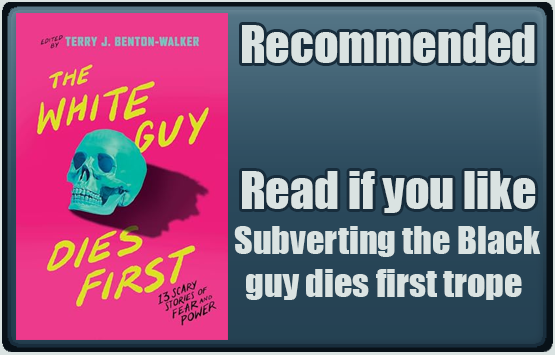
The White Guy Dies First: 13 Scary Stories of Fear and Power edited by Terry J. Benton-Walker

The White Guy Dies First: 13 Scary Stories of Fear and Power edited by Terry J. Benton-Walker

Formats: Print, audio, digital

Publisher: Tor Teen

Genre: Apocalypse/Disaster, Dark Fantasy, Eco Horror, Killer/Slasher, Monster, Mystery, Myth and Folklore, Romance

Audience: Young Adult

Diversity: Black characters and authors, characters of Chinese descent and Chinese New Zealander author, Indigenous characters and author (Seminole), Korean American characters and author, Bisexual characters, Queer women characters, Non-binary character and authors, Ace Spectrum author, MENA character, Bangladeshi-Irish author, Iranian-American author, Latinx characters and author

Content Warnings (Highlight to view): Alcohol Abuse, Amputation, Bullying, Cannibalism, Child Abuse, Child Death, Child Endangerment, Death, Drug Use/Abuse, Forced Captivity, Gaslighting, Gore, Mental Illness, Racism, Rape/Sexual Assault, Suicide, Verbal/Emotional Abuse, Violence, Vomit

Blurb

13 SCARY STORIES. 13 AUTHORS OF COLOR.
13 TIMES WE SURVIVED THE FIRST KILL.

The White Guy Dies First includes thirteen scary stories by all-star contributors and this time, the white guy dies first.

Killer clowns, a hungry hedge maze, and rich kids who got bored. Friendly cannibals, impossible slashers, and the dead who don’t stay dead….

A museum curator who despises “diasporic inaccuracies.” A sweet girl and her diary of happy thoughts. An old house that just wants friends forever….

These stories are filled with ancient terrors and modern villains, but go ahead, go into the basement, step onto the old plantation, and open the magician’s mystery box because this time, the white guy dies first.

I received this product for free in return for providing an honest and unbiased review. I received no other compensation. I am disclosing this in accordance with the Federal Trade Commission’s 16 CFR, Part 255: Guides Concerning the Use of Endorsements and Testimonials in Advertising.

This is a book that is going to make racists people mad, and I’m here for it. Consider yourself forewarned: if you’re white, this book is not written for you and you’re going to need a thick skin to read it. White people are so used to having positive representation in media that a book where white people make everything worse and always end up dead is going to rub the more sensitive white folks the wrong way, even those who might consider themselves allies. But for the rest of us? It’s awesome and a much-needed subversion of the “Black Guy Dies First” trope. Now, just because the white guy dies first in these stories does not make the BIPOC immune from horrific deaths. Hedge and The Protégé both have Black teens who meet violent ends. A Native person in Best Served Cold is tortured. They’re just not the first to die and get to be main characters.

Many (but not all) of the stories focus on the racism characters face and how often bad things happen to BIPOC people because of the actions of white people. Farz-joon from Break Through Our Skin by Naseem Jamnia is a non-binary, Iranian high school student who desperately wants a Smithosian internship. In order to secure one, they agree to volunteer at the University of Chicago’s Oriental Institute (thankfully, the problematic name was changed to the Institute for the Study of Ancient Culture in 2023) working under a condescending, racist, and transphobic old white professor named Dr. Hudson who thinks he knows more about Iran than Farz does because he’s studied it, speaks Farsi, and actually visited Iran, which Farz has not. He also objects to the Institute’s name change because the original name has “history” and “meaning.” Farz tolerates his boorish behavior so they can fulfill their dream of becoming an archeologist and challenge the idea that gender can be determined from a skeleton alone, but of course Dr. Hudson criticizes their “modern” ideas about gender stating “political correctness has no place in ancient history”, despite historical evidence of gender non-conforming people existing in ancient Iran and bioarchaeologist’s more recent views on sex and gender. Unsurprisingly, it turns out he only hired Farz to give the exhibits a “layer of authenticity” and he’s willing to jeopardize Farz’s future by withholding his recommendation.

Wasps by Mark Oshiro focuses on how gentrification hurts immigrant communities, while Hedge by Kalynn Brown has a topiary garden created by wealthy whites in the 1970s where anyone who enters winds up dead, including the main character’s father. In Grave Grove by Alexis Henderson, a Black teen named Rumi befriends a white Northerner named Kaitlin and who she helps adjust to life in the Southern US. The two even start a podcast together entitled Girls and Ghosts. Their newest episode is about Kyle Adams, a racist who went missing in the eighties after chasing a Black teen, William Jones, into an abandoned plantation. Unfortunately, we quickly learn that Kaitlin is not a good friend to Rumi. She ignores her at school in favor of hanging out with white girls, makes Rumi do all the grunt work for their podcast, and is actually pretty racist for someone who probably considers themselves liberal. She excuses Kyle’s racism because it happened in the past (the 1980s) and “everyone was racist back then.” She thinks William is a “drug dealer” who belongs in prison because he was caught with marijuana, despite smoking weed herself. She views Kyle as the victim, not William. She doesn’t want to talk about the racist history of the plantation or consider the slaves who died there, just the missing white boy. She even mentions her sister’s best friend got married at the plantation, a favorite location for Southern brides (gross). Side note, but I loved that Kaitlin believed in the supernatural while Rumi was the skeptic, since BIPOC are so often cast as superstitious and foolish compared to logical white people. I’m a skeptic myself so it was nice to see a character like me in both Grave Grove and Hell is Other Demons, where the Black main character is an atheist.

Best Served Cold by H. E. Edgmon and The Protégé by Lamar Giles both have the BIPOC main characters get into trouble specifically because they choose to trust a white person. In the former, our protagonist, EJ, makes the mistake of accepting a white man who befriended their brother. EJ struggled with internalized racism throughout their childhood, doing things like using cheap, unsafe contacts from the mall to change their eye color from brown to green. Kai, their brother, tells EJ that those are their ancestor’s eyes, and that their appearance connects them to their ancestry and they should be proud of them. Kai works to reclaim a past that was stolen by colonization (like learning traditional farming and hunting), and teaches EJ about ancestral trauma. EJ realizes the reason they feel angry and frustrated is because they are “playing a game whose rules have never been designed for me to win.” Their mother claims to be white because she passes, even though her grandfather was sent to a residential school in Oklahoma. She denies her heritage. EJ and Kai’s parents grew up together on a reservation in Florida, but moved to Chicago as adults. They told their children they’d left the Rez to give them a better life. Kai brings his white friend (possibly boyfriend) Isaac, who has intense green eyes, to a Pow Wow where the other Natives give him side eye. Clearly, they see something Kai doesn’t (there are other white people there but they don’t face the same level of scrutiny). One of the community leaders talks about MMIWC (Missing and Murdered Indigenous Women and Children) which serves as foreshadowing. It’s implied that the antagonist in the story is a certain evil spirit from Algonquian mythology (one who’s associated with winter and cannibalism). Edgmon is Seminole, not one of the Algonquian tribes, but he writes with respect, never breaking the taboo of using the spirits name which is said to summon it. This particular creature is also a perfect representation of colonialism with its insatiable hunger and destructive nature.  Kai and EJ do everything they can to fight colonialism but still fall victim to the evil spirit.

The Protégé by Lamar Giles, like Best Served Cold, is a particularly tragic story with the main character, Troy’s, life ruined by his best friend, in this case an older, white gentleman named Jack Meridian. Jack is a retired magician who’s been mentoring Troy in the art of card tricks and illusions, and one of the young teen’s only friends. Troy so admires the older man that he immediately agrees to do him a favor, accepting a package while Jack runs errands downtown. Simple enough, right? While Troy’s older brother Darius is having a party with his friends, Troy sees that the news is reporting a mass killing at the mall where Jack was heading. He tries to contact his magician mentor but the person who killed him answers the phone and threatens Troy if he doesn’t give them the package he received. The killer is revealed to be Danford Dread, a magician who “perverts” the art and performs dark and gory magic that “plays to the worst in people.” And now he’s after Troy and his brother. Even though the white guy in this story is a “good guy” he still ruins a Black boy’s life by bringing him into his world and putting him directly into danger.

In Hell is Other Demons by Karen Strong, the main character is killed (she spends most of the story as a ghost) because her crush’s white boyfriend starts meddling with the supernatural and summons a demon. The other stories of dating a white boy don’t end with dead young women, but they do highlight the perils of interracial dating, namely that white men often fetishize non-white women. I mean, just look how BIPOC women have their own categories on porn sites (gross). Obviously not all mixed-race relationships are problematic; my parents are a mixed-race couple, my sister has an amazing Chilean fiancé (who is himself biracial), and I’m friends with happily married couples in mixed relationships. Unfortunately, there are always bad apples.

In both the Golden Dragon by Kendare Blake and Docile Girls by Chloe Gong, Korean-American Sophie and Chinese-I-think-American-but-possibly-New-Zealander Adelaid are dumped by their white boyfriends (and subsequently lose all the white people they thought were their friends) who fetishized them but don’t view them as committed relationship material. As Sophie’s sister puts it, they’re an exotic bang to mark off their “international bang bingo card.” Even after she gets dumped, Adelaid’s ex sees her as too weak and docile to be the killer who’s been stalking the teens, an assumption that proves fatal for him. This is unfortunately common, as all the East Asian-American women I know I can attest to. When they’re sexually harassed, it almost always has racist undertones. They’ve been propositioned by white men looking for “submissive waifus,” had “me so horny” shouted at them, asked if they have sideways vaginas, or “complimented” on their “exotic” beauty. White men have long fetishized East Asian women, with examples dating as far back as 1898 with the book Madame Butterfly. A Columbia University study from 2007 showed that in online dating, White men seemed to have a strong preference for Asian women when it came to hookups, but when they wanted a committed relationship, they preferred white women. Meanwhile, Black women, especially those with dark skin, are considered less desirable than women of other races.

In All Eyes on Me by Faridah Àbíké-Íyímídé main character Helen deals with a white boyfriend, Asher, who is constantly committing microaggressions. He mocks her kinky hair, and implies she can’t be an actress because she’s Black and not a “bombshell.”  Yet Helen still feels guilty about wanting to break up with Asher because everyone else considers him the perfect, all-American boy. And as a Black girl she’s supposed to be grateful that a white boy wants her, even though being tied down to him and trapped in their small town forever sounds like a nightmare. Fortunately for all three girls, they end their stories without being tied down by their racist exes.

Not all the stories in the collection are focused on race and racism, however. The Road to Hell by Terry Benton-Walker has a very original set up, exploring an abusive relationship between a haunted house and a family living it with the house as the abuser. Everything’s Coming Up Roses by Tiffany D. Jackson is about a mentally unwell girl named Leesa who is obsessed with gardening and documents her daily life in her journal. Leesa is an unreliable narrator and the true horror is slowly revealed over the course of the story. Like most anthologies, the quality of the stories varies, but none that I would have rated below three out of five stars. Some were good, others, like Everything’s Coming Up RosesGray Grove, and Best Served Cold, were great. It’s also worth noting that many of the stories are VERY gory, which may be too much for younger teens who aren’t big horror fans. Of course, since most horror fans were reading Stephen King when they were eight, I don’t foresee this being an issue for anyone who decides to read this book.
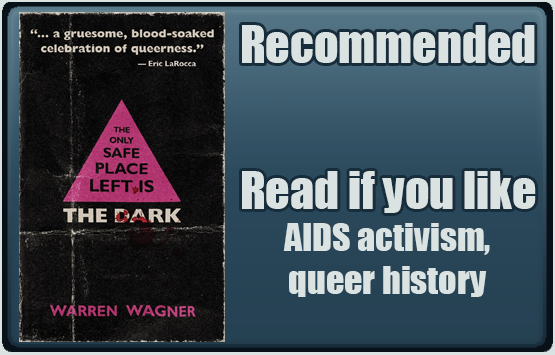
The Only Safe Place Left is the Dark by Warren Wagner

The Only Safe Place Left is the Dark by Warren Wagner

Formats: Print, digital

Publisher: Ghoulish Books

Genre: Apocalypse/Disaster, Zombie

Audience: Adult/Mature

Diversity: Gay man author and main characters, main characters with AIDS

Content Warnings (Highlight to view): Animal Death, Child Death, Death, Drug Use/Abuse, Homophobia, Illness, Medical Procedure, Slurs, Suicide

Blurb

In The Only Safe Place Left is the Dark, an HIV positive gay man must leave the relative safety of his cabin in the woods to brave the zombie apocalypse and find the medication he needs to stay alive.

I received this product for free in return for providing an honest and unbiased review. I received no other compensation. I am disclosing this in accordance with the Federal Trade Commission’s 16 CFR, Part 255: Guides Concerning the Use of Endorsements and Testimonials in Advertising.

I was born during the beginning of the AIDS outbreak, during which my mom lost many of her gay friends. I remember the deep-rooted fear of AIDS that existed during my childhood. In grade school, we attended assemblies about the dangers of AIDS and how it was spread. There were public service ads about AIDS on every TV station. Parents wore red ribbons. As a queer teen I mourned the loss of an entire generation of gay and bisexual men.

One of the doctors I work with through my hospital, a gay man in his eighties who was one of the first physicians to treat AIDS patients, told me about the weekly funerals he attended. No one cared that gay men were dying of a mysterious illness during the conservative Regan administration. Little research was done on the epidemic. This doctor was one of the few who treated AIDS patients back then, using his knowledge of pharmacology to create a treatment regimen through off-label uses of already existing drugs. Of course, he couldn’t openly advertise his services due to the stigma in the medical community, so his patients found him through a whisper network and would visit him under the guise of getting a routine physical.

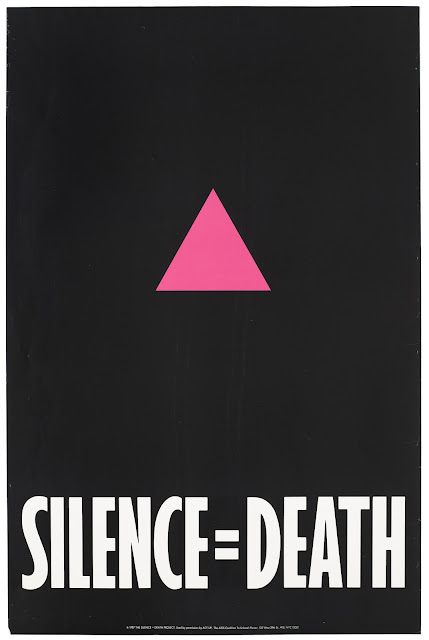
The Only Safe Place Left is the Dark is a unique zombie apocalypse novella about the AIDS epidemic. The cover of book is meant to invoke the iconic Silence=Death AIDS design from the late 1980s (a poster Quinton keeps in his Cabin). The title of the story comes from a quote in the play The Destiny of Me by writer and activist Larry Kramer, who is best known for co-founding the grassroots political group the AIDS Coalition to Unleash Power (ACT UP).  In the first chapter of the book, Wagner references a New York Times article from July 3, 1981 entitled Rare Cancer Seen in 41 Homosexuals. The article discusses an outbreak of Kaposi’s Sarcoma in New York and San Francisco, a form of cancer that can form lesions on the skin and in the mouth. It wasn’t yet known, but this sub-type of KS was caused by the immune suppression from some of the first HIV cases in the country.

A black poster with a pink triangle on it. Underneath is white font that says "Silence = Death"

Wagner’s zombie virus (if it even is a virus) is particularly terrifying because its victims, referred to as “The Afflicted,” are still awake and aware of what’s happening to them and powerless to stop it. They can feel themselves rotting and falling apart, even being eaten by flies. The zombies don’t want to hurt anyone but are completely unable to control their hunger, so they’ll scream warnings to their victims and plead for forgiveness as they tear them apart. Most disturbingly, they’ll beg uninfected humans to kill them. I suspect the Wagner’s zombies are loosely based on AIDS victims, as zombies are often an allegory for infectious disease. In her journal article Attack of the Living Dead Virus: The Metaphor of Contagious Disease in Zombie Movies English professor Cecilia Petretto explains that, “Much of our fear lies within the nature of disease itself… Disease, ugly as death, has its association with evil stemming back to the Black Plague.” What was known about AIDS was largely based on misconception, and AIDS victims were shunned and regarded as dangerous, much like the Hollywood zombies. In 1986, an article published in the Journal of the American Medical Association about AIDS was entitled Night of the Living Dead II: Slow Virus Encephalopathies and AIDS. Dr. Arthur Fournier, who encountered his first AIDS patient in 1979 while working with Miami’s Haitian community, compared the virus to “the zombie curse.” Before the advent of active antiretroviral therapy (ART), an AIDS diagnosis was often a death sentence. In that way AIDS patients were like the living dead, dying but not truly dead as their bodies were slowly destroyed and they wasted away. Wagner even describes them as “Waiting for a cure. Waiting for the end. They weren’t dead yet, but they weren’t alive either. They were zombies.”

A group advocating AIDS research marches down Fifth Avenue during the 14th annual Lesbian and Gay Pride parade in New York, June 27, 1983. This year’s parade is dedicated to victims of the incurable disease AIDS which primarily afflicts homosexual men. (AP Photo/Mario Suriani)

A group advocating AIDS research marches down Fifth Avenue during the 14th annual Lesbian and Gay Pride parade in New York, June 27, 1983. This year’s parade is dedicated to victims of the incurable disease AIDS which primarily afflicts homosexual men. (AP Photo/Mario Suriani)

Kept alive for 26 years by his antiretroviral medication, Quinton is one of the few humans who survived the zombie apocalypse–survived being the operative word, as he’s not really living, just surviving. He’s all but given up on love and compassion or anything ever getting better. His love for his deceased boyfriend, Frankie, brought him so much pain he’s now become a gruff loner. It’s safe to say Quinton may also be suffering from survivor’s guilt, as both he and his boyfriend were HIV positive but he survived while Frankie died. Worse, Frankie died when Quinton wasn’t there. The story switches between Quinton’s memories of Frankie’s last days and the present.

While out scavenging for more antiretroviral, Quinton meets Billy, a fellow gay man who’s managed to survive the apocalypse and is also HIV positive. But while Quinton has become cold, Billy still openly cares for others, which Quinton sees as a liability. Billy also believes in working together and the importance of community, while Quinton prefers to avoid other people. We learn that one of the reasons Billy has stayed alive so long is because those who are HIV positive are immune to the zombie virus. I thought this was an interesting twist, as outside of The Last of UsCooties, and Blood Quantum I’ve never seen a human with a natural immunity to Zombies in media. AIDS ravages the immune system, yet for some reason protects Quinton and Billy from turning into Afflicted. Being the kind of person who reads science articles about theoretical zombie biology, I did want to know how it all worked, but honestly an explanation isn’t important to the narrative.  

I had a few nitpicks when it came to Billy, a Black character. While he was written well, “Black” was not capitalized when describing him. When referring to race, Black should always be capitalized. Billy was also described as having dreadlocks. As far as I know Billy was not a Rastafarian, therefore his hairstyle should be referred to as locs, not dreadlocks. While these examples are relatively minor issues, it does highlight the importance of doing your research and using sensitivity readers when writing about groups different than your own.

Wagner’s writing is very spartan; there are no grandiloquent descriptions or deep introspections. Instead, he gets his point across without the need for flowery adjectives or metaphors. The only part where this proved an issue for me was when it came to Quinton and Billy’s relationship, which felt very rushed. Otherwise, I appreciated Wagner’s straight-to-the-point style. It’s not often we get a new take on Zombies, but Wagner’s Afflicted managed to add a whole new level of horror to the undead. The history of AIDS is seamlessly interwoven, never forced, throughout the narrative. Wagner uses horror fiction to not only educate readers in a way that feels natural and respectful, but to capture the feelings of despair no doubt felt by many during the AIDS epidemic. The message is clear. Having AIDS may feel bleak, and every day is a fight for survival, but even amongst all the horror there is always love and hope.

Unshod, Cackling, and Naked by Tamika Thompson

Unshod, Cackling, and Naked by Tamika Thompson

Formats: Print, digital

Publisher: Unnerving 

Genre: Apocalypse/Disaster, Killer/Slasher, Sci-Fi Horror, Werebeasts

Audience: Adult/Mature

Diversity: Black main characters and author, lesbian character, Biracial Black/Creek character

Takes Place in: LA, California

Content Warnings (Highlight to view): Alcohol Abuse, Animal Death, Body Shaming, Child Abuse, Child Death, Pedophilia, Police Harassment, Racism, Rape/Sexual Assault, Slurs, Verbal/Emotional Abuse, Violence

Blurb

A beauty pageant veteran appeases her mother by competing for one final crown, only to find herself trapped in a hand-sewn gown that cuts into her flesh. A journalist falls deeply in love with a mysterious woman but discovers his beloved can vanish and reappear hours later in the same spot, as if no time has passed at all. A cash-strapped college student agrees to work in a shop window as a mannequin but quickly learns she’s not free to break her pose. And what happens when the family pet decides it no longer wants to have ‘owners’?

In the grim and often horrific thirteen tales collected here, beauty is violent, and love and hate are the same feeling, laid bare by unbridled obsession. Entering worlds both strange and quotidian, and spanning horror landscapes both speculative and real, asks who among us is worthy of love and who deserves to die?

I received this product for free in return for providing an honest and unbiased review. I received no other compensation. I am disclosing this in accordance with the Federal Trade Commission’s 16 CFR, Part 255: Guides Concerning the Use of Endorsements and Testimonials in Advertising.

I absolutely love horror anthologies, so I was excited to receive Unshod, Cackling, and Naked by Tamika Thompson. Many of the stories in the anthology focus on the balance between humans and nature and the morality of killing, owning, and eating animals. Bridget has Disappeared takes place in a dystopian near-future with disappearing resources which lead to poverty and crime. I Will be Glorious is about coping with loss and a killer tree. The Bats and The Turn are both about diseases that seemingly spread overnight (much like COVID) that cause dogs and bats, respectively, to turn against humans and attack them. The Turn especially focuses on the humanity’s relationship with domesticated animals and describes what would happen if dogs no longer wished to be kept as pets. Similarly, And We Screamed examines humanity’s relationship with livestock, and why we choose to eat some animals and feel entitled to try and control them. It also examines the sanctity of death and dead bodies. I found this story especially interesting because I was probably the exact opposite of the target audience. I eat meat and have several pets. I used to work on a farm with livestock (some of which were being raised for food) as a child, and I volunteered at an animal hospital where I sometimes had to help euthanize sick animals in my teens. In college I majored in biology and had no qualms about dissecting dead animals, including rats and cats (despite being a huge rat and cat lover).

In And We Screamed there’s a scene where the main character refuses to dissect a cat and her classmate points out that it’s messed up because it still has a face. My first thought was “Well, how are you supposed to dissect the eyes if it doesn’t have a face?” (Which turns out to be the teacher’s argument as well.) It was intriguing to be reminded that something I consider routine and mundane was actually horrific for many people, and to see why exactly it was so frightening from their point of view.  I was able to understand and empathize with where the author, and her characters, were coming from, even if I didn’t fully agree with her conclusions. I also recognized the mental disconnect that makes me willing to dissect a rat for science while also dropping over a grand on veterinary bills for a rat I keep as a pet.  Truly a testament to Thompson’s skill as a writer.

My favorite stories in Unshod, Cackling, and Naked were the ones with feminist themes. In I Did it for You a young rape survivor tracks down creepy men and cuts off their small toe, turning them into victims who will have to carry a scar for the rest of their lives, just as she does. She points out to one cop–the one who raped her because he thought she was a prostitute–that losing a toe is nothing like losing your will to live after being sexually assaulted. I always enjoy a good rape revenge story and I appreciated that Thompson makes the sex workers in I Did it for You heroes rather than victims (like they are in most horror), and they feel like real characters rather than stereotypes.  

Mannequin Model is the story from which Unshod, Cackling, and Naked draws its name. In it, a woman acts as a “living doll,” modeling clothing in a store window where she’s objectified and sexually harassed. She’s treated as a literal sex object, with no voice or will, so it’s extremely satisfying when she finally rebels. But my absolute favorite story in the collection is I am Goddess. In it, a woman named Lira wants to convince her husband to pay for face treatments so she can be beautiful. Her marriage to her husband is basically every bad heterosexual relationship you’ve read about on Reddit. Lira works full time and does everything around the house. She pays the mortgage and all the bills out of her paycheck, despite earning the same amount as her husband. Her husband uses his own money to buy himself big-screen TVs and flashy new cars while telling Lira they can’t afford a washer and dryer or a car for her, so she’s stuck doing laundry by hand and taking the bus. He flirts with other women, dismisses her feelings, and ignores her unless he wants sex. But Lira puts up with it with a smile because she has been conditioned her whole like to believe she needs a man to be “complete” and that she’s lucky to have anyone at all considering her appearance. All of Lira’s accomplishments growing up are downplayed until she finds a husband. Her cousin constantly mocks her appearance and makes Lira feel inferior. No wonder she’s trapped in such a toxic relationship. But her husband’s refusal to let her get the one thing she wants, her face treatment, finally pushes Lira over the edge. She finally sees her husband for who he really is, a loser, and all her pent up anger and frustration comes pouring out. She gets even, and it’s glorious. Definitely one of the strongest stories in the collection, in my humble opinion. 

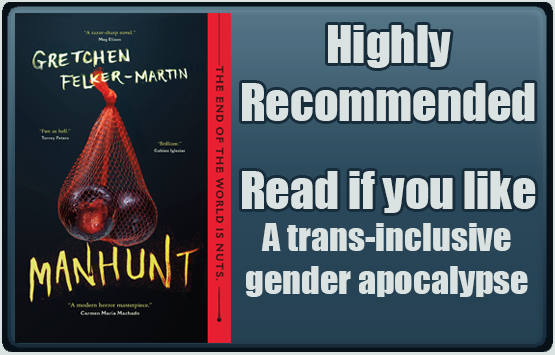
Manhunt by Gretchen Felker-Martin

Manhunt by Gretchen Felker-Martin

Formats: Print, audio, digital

Publisher: Tor Nightfire

Genre: Apocalypse/Disaster, Monster

Audience: Adult/Mature

Diversity: Trans author and characters, queer characters, Native character

Takes Place in: northeastern USA

Content Warnings (Highlight to view): Animal Death, Body Shaming, Cannibalism,  Child Death, Childbirth, Death, Drug Use/Abuse, Eating Disorder, Forced Captivity, Gore, Illness, Kidnapping, Medical Procedures, Oppression, Rape/Sexual Assault, Self-Harm, Slurs, Torture, Transphobia, Verbal/Emotional Abuse, Violence

Blurb

Y: The Last Man meets The Girl With All the Gifts in Gretchen Felker-Martin’s Manhunt, an explosive post-apocalyptic novel that follows trans women and men on a grotesque journey of survival.

Beth and Fran spend their days traveling the ravaged New England coast, hunting feral men and harvesting their organs in a gruesome effort to ensure they’ll never face the same fate.

Robbie lives by his gun and one hard-learned motto: other people aren’t safe.

After a brutal accident entwines the three of them, this found family of survivors must navigate murderous TERFs, a sociopathic billionaire bunker brat, and awkward relationship dynamics―all while outrunning packs of feral men, and their own demons.

Manhunt is a timely, powerful response to every gender-based apocalypse story that failed to consider the existence of transgender and non-binary people, from a powerful new voice in horror.

 received this product for free in return for providing an honest and unbiased review. I received no other compensation. I am disclosing this in accordance with the Federal Trade Commission’s 16 CFR, Part 255: Guides Concerning the Use of Endorsements and Testimonials in Advertising.

Have you ever wondered what happens to trans people in sex-based apocalypses like those in Y: The Last Man or Ōoku: The Inner Chambers? Gretchen Felker-Martin sets out to answer exactly that in her post-apocalypse splatterpunk novel Manhunt.

The T-rex virus transforms anyone with high levels of testosterone—mostly cis-men—into cannibalistic, sex-crazed monsters. Emboldened by the end of the world, a group of TERFs (trans-exclusionary radical “feminists”) have formed their own militia where they hunt and kill any trans women they find. It may seem like a group of militant TERFs is an exaggeration, but it feels like less of a stretch when you consider there’s already a high rate of violence against trans people. In 2021 alone, at least 56 trans and gender non-conforming people were murdered in the US. Transphobic hate crimes have quadrupled over the last five years in the UK. These fake feminists are also more fascist adjacent than they’d like to admit. As Judith Butler accurately pointed out, TERFs “have allied with rightwing attacks on gender” and “The anti-gender ideology is one of the dominant strains of fascism in our times. So, the TERFs will not be part of the contemporary struggle against fascism.” TERFs Lily Cade and Bev Jo Von Dohre have even called for the death of trans women. The fact that trans women in Manhunt can transform into monsters if they don’t have access to anti-androgen medication gives the TERFs exactly the excuse they’ve been waiting for to go from hateful rhetoric to actually destroying that which they hate most (never mind that cis-women with PCOS or congenital adrenal hyperplasia can also transform into feral beasts).

Not only do trans women have to avoid getting killed by the monstrous men, but also running into the militant TERFs who have seized control of most of the northeast. Fran and Beth are two such transwomen trying to survive in the new world, catching feral men and harvesting their testicles for their friend Indy to extract estradiol from. After running afoul of a militant group of TERFs and almost being killed by men, Fran and Beth meet a sharp-shooting trans man named Robbie, who they take on their journey with them. The trio return to Indy’s house with their testicle trophies where they learn she’s been offered a job by a spoiled rich girl who controls a luxurious bunker. But the promises of comfort the bunker offers may hide a deadly truth.

While I personally enjoyed this book, it won’t be for everyone. It is splatterpunk, after all. That means there’s lots of brutal violence (including a cis woman having her uterus cut out of her), gross content (testicle eating), and graphic sex. Everyone in Manhunt is super horny, sometimes at wildly inappropriate times, so Beth, Fran, Indy, and Robbie do a lot of fucking. The sex is hot, sometimes gross, and other times both hot and gross, much like real sex. It was nice to have sex scenes centered around trans pleasure rather than the cis-male gaze. Of course, the graphic description of genitalia might be triggering for some people who experience gender dysphoria, so be aware of that. Speaking of hot sex, a captain in the TERF army named Ramona is sleeping with a non-binary prostitute named Feather. One reviewer claimed this is unrealistic but I have to disagree. A lot of chasers are happy to sleep with trans people but won’t do anything to defend their rights or even stand up for them. Too many people with trans partners see their relationship as a shameful secret to be kept, and Ramona is no different. She’s too much of a coward to do the right thing and just goes along with the TERF army because it’s what’s easy.

Splatterpunk is very hit or miss for me, as many extreme horror books can cross over into misogynistic violence. Manhunt manages to avoid this trap, even though most of the book’s violence is against women (as all the characters, aside from Robbie, are women). Perhaps because it’s other women committing the violence, but I didn’t get that gross feeling I usually do when reading splatterpunk authored by cis men. Even the sexual assault scene didn’t feel gratuitous and was handled well. I also loved how flawed the protagonists are. Some people mistakenly assume LGBTQIA+ characters need to be perfect for it to be considered a “good” portrayal. I believe realistic is preferable to perfect, and I like my queer characters to have character flaws who sometimes do and say problematic things. Both Beth and Fran feel very human. Beth is reckless and insecure; Fran has both passing and class privilege and can sometimes be selfish. Neither of them are bad people, just realistically flawed.

My only complaint about the book (and granted, it’s minor) is that there are so many descriptions of Indi’s fat body. The way she’s described isn’t quite fatphobic, but it did make me feel uncomfortable that there was so much focus on it. I can understand that Indy is dealing with a lot of internalized fatphobia and insecurity, so it makes sense that her character would spend a lot of time focusing on her size and the limitations that come with it. When the story is told from a third-person point of view, there’s no reason for Indy’s weight to be described in such detail, especially since no one else’s body gets that much description or scrutiny. At least she’s never described as gross or unattractive, and Indi even gets to be sexually desirable, which is rare for fat characters outside of fetish porn. It was refreshing to see fat people having passionate sex scenes just like their skinny counterparts. Like I said, it’s a minor complaint and could absolutely be my own hypersensitivity.

Reading this book is like having your brain put in a blender. It’s wild, gross, horny, disgusting, tragic, and hilarious all whipped together into an extreme horror smoothie. In other words, I LOVED it. You have to be at least somewhat familiar with trans culture to fully appreciate the story, which I thought was awesome. There’s also just something extremely satisfying about trans women killing fascist TERFs: not something I’d advocate in real life, but it’s fun and cathartic in fiction. Unsurprisingly, this made a bunch of real-life TERFs very angry. They didn’t like being portrayed as bigoted assholes just because of their bigoted asshole-ish behavior and tried to review bomb Manhunt…which should just make you want to read it more.

Grievers by Adrienne Maree Brown

Grievers by Adrienne Maree Brown

Formats: Print, digital

Publisher: AK Press

Genre: Apocalypse/Disaster

Audience: Adult/Mature

Diversity: Black/African-American, Lesbian

Takes Place in: Detroit, MI, USA

Content Warnings (Highlight to view): Death, Drug Use/Abuse, Illness, Medical Procedures

Blurb

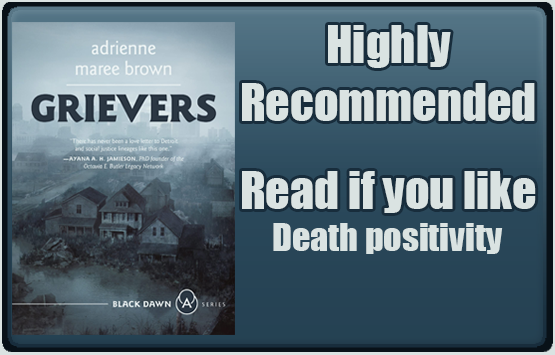
Dune’s mother is patient zero of a mysterious illness that stops people in their tracks—in mid-sentence, mid-action, mid-life—casting them into a nonresponsive state from which no one recovers. Dune must navigate poverty and the loss of her mother as Detroit’s hospitals, morgues, and graveyards begin to overflow. As the quarantined city slowly empties of life, she investigates what caused the plague, and what might end it, following in the footsteps of her late researcher father, who has a physical model of Detroit’s history and losses set up in their basement. She dusts it off and begins tracking the sick and dying, discovering patterns, finding comrades in curiosity, conspiracies for the fertile ground of the city, and the unexpected magic that emerges when the debt of grief is cleared.

I received this product for free in return for providing an honest and unbiased review. I received no other compensation. I am disclosing this in accordance with the Federal Trade Commission’s 16 CFR, Part 255: Guides Concerning the Use of Endorsements and Testimonials in Advertising.

“Grief was an amalgamation of absence narratives layered over each other”

Death positivity is the philosophy that death and grief should be spoken of openly and that treating the subject as taboo does more harm than good. It encourages people to learn about end-of-life care, make plans for their own deaths, be involved in the care of their dead loved ones, and explore their curiosity and feelings surrounding death. In a way, Grievers is a death-positive book. The story explores what it’s like to lose the people you love, care for the dying, prepare for death, and the mourning process. Most horror skims over the death of its characters, their lives nothing more than cheap fodder for the reader’s entertainment. But in Grievers, you feel the weight of every death.

A mysterious illness is sweeping Detroit and killing its Black population. Dubbed “H8”, it leaves its victims frozen in place with grief-stricken faces. A social justice activist named Kama is the first to contract the disease. Unable to afford a hospital, Dune, Kama’s only child, cares for her mother at home by feeding her, changing her, and keeping her as comfortable as she can. Dune, distrustful of the system that failed them, decides to cremate her mother herself when Kama finally passes. Dune’s act of cremating her own mother (although not something I would recommend as it’s neither safe nor legal) is described as “sacred work,” a ritual that allows her to be close to her mother one last time.

Death rituals, whether religious or secular, perform a necessary function in the grieving process. In his research on grieving rituals Michael I. Norton, a professor at Harvard Business School, discovered the following:

“Despite the variance in the form that rituals take… a common psychological mechanism underlies their effectiveness: a restoration of feelings of control that losses impair. Indeed, people who suffer losses often report feeling out of control and actively try to regain control when they feel it slipping away; feeling in control, in turn, is associated with increased well-being, physical health, and coping ability.” [1]

In the story, a group of traditional Chinese medicine practitioners perform grieving rituals believing that this will protect them from H8, a disease, they theorize, that targets the lungs where grief is held. Dune performs grief rituals to help overcome the immense sense of loss she’s experiencing. The first is cremating her mother in her backyard. The second is “telling” her dead father that her mother has passed. The third, and most important, is creating a record of everyone who has fallen ill and marking their locations with pins on her father’s model of Detroit. The last project gives her something to do, a way of combatting her sense of helplessness as the world falls apart around her. After slipping into a deep depression and shutting herself away, collecting data on the infected gives Dune a new sense of purpose and feeling of control. She organizes her data onto index cards and files them away, creating order out of chaos.

The way Brown represents grief is both beautiful and heartbreaking. Dune isolates herself from the world, too depressed to even plan a memorial service for her mother. She physically carries the weight of her grief as she gains weight during her depression. Eventually, Dune finds ways to cope with her grief. In addition to the rituals providing her with a sense of control, Dune also focuses on survival and caring for her elderly grandmother, Mama Vivian. She harvests produce from community gardens and cans them for the winter. She changes, feeds, and sings to her grandmother. She eventually reaches out to one of her mother’s activist friends for emotional support. It’s not always easy. Dune blows up at a volunteer food distributor without really knowing why, other than just needing someone to lash out at. She dips back into a depression when other people she cares about die. But she keeps surviving, and slowly things start to improve. Brown describes the feeling of slowly emerging from a deep depression perfectly: “Dune was beginning to feel aware of her own aliveness again – not quite a desire to live, just a growing, surprising awareness that she was not dead.” While this may not sound like much, it’s still a step forward in Dune’s path to healing and an improvement from the beginning of the story when “the detritus of grief became Dune’s comfort.” As someone who suffers from clinical depression themselves, I can say that just feeling alive again is such a huge step forward. At the same time, her father’s model, now thick with markers, is starting to sprout little green shoots: new life that has started to grow in the basement against all odds.

A year defined by a pandemic and protests, 2020 was especially difficult for Black Americans. Black communities were hit especially hard by Covid-19, and our anger and frustration with a racist system reached a boiling point with the murder of George Floyd by a White police officer. Grievers may be fiction, but it captures the very real feelings of pain and loss the Black community has been feeling recently. The H8 virus is a metaphor for both Covid and the pain caused by racism. “Hate” is literally killing Black people by destroying them emotionally and no one seems to be able to quell the spread of the disease. Like Covid, everyone knows someone who died from the virus. The city seems to shut down overnight as the wealthy flee and hospitals are overwhelmed.

Grievers does not follow a standard three arch story structure. There’s no antagonist to overcome, no climax, or satisfying resolution. If you’re looking for traditional storytelling, then this book isn’t for you. If you want a beautiful, heartbreaking, death-positive horror story that focuses on one woman’s battle with grief and just trying to survive a pandemic that feels all too familiar, I highly recommend Grievers.

[1] From the Journal of Experimental Psychology

The Marrow Thieves by Cherie Dimaline

The Marrow Thieves by Cherie Dimaline

Formats: Print, audio, digital

Publisher: Dancing Cat Books

Genre: Apocalypse/Disaster, Body Horror, Sci-Fi Horror

Audience: Y/A

Diversity: American/Indian and Indigenous characters (Mostly Métis, Anishinaabe, and Cree), Black/Indo-Caribbean/Biracial character, gay male characters

Takes Place in: Toronto, Canada

Content Warnings (Highlight to view): Alcohol Abuse, Amputation, Child Abuse, Child Death, Child Endangerment, Death, Drug Use/Abuse, Forced Captivity, Kidnapping, Medical Torture/Abuse, Pedophilia, Police Harassment, Racism, Rape/Sexual Assault, Sexual Abuse, Slurs, Suicide, Violence

Blurb

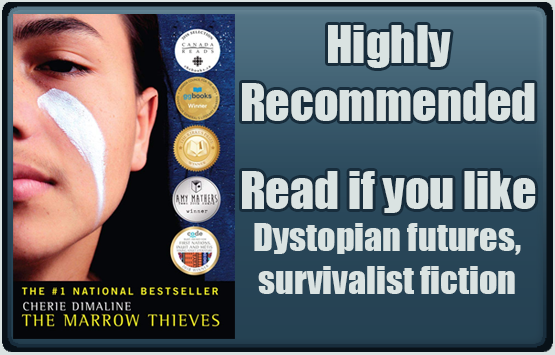
In a futuristic world ravaged by global warming, people have lost the ability to dream, and the dreamlessness has led to widespread madness. The only people still able to dream are North America’s Indigenous people, and it is their marrow that holds the cure for the rest of the world. But getting the marrow, and dreams, means death for the unwilling donors. Driven to flight, a fifteen-year-old and his companions struggle for survival, attempt to reunite with loved ones and take refuge from the “recruiters” who seek them out to bring them to the marrow-stealing “factories.”

***CONTENT WARNING: In this review I will be discussing Indigenous American (Canadian, Mexican, and the US) history and residential schools/Indian boarding schools, with a primary focus on Canada where the Marrow Thieves takes place. I will be touching on genocide, forced assimilation, abuse, sexual assault, trauma, and addiction. There will also be images of verbal abuse and the effects of trauma. Please proceed with caution and take breaks if you need to. For my Indigenous readers: if you feel at all distressed or disturbed while reading this, or just need support in general, there are resources for the US and Canada here and here respectively. If you need extra help you can also find Indigenous-friendly therapists here and here to talk to. If you are a abuse survivor, are being abused, or know someone who is, please go here. There are further links at the end of the review. Please reach out if you need to!***

I have tried to use mainly Indigenous created articles, websites, books, films, and interviews for reference when writing this review. I have also included multiple quotes from residential school survivors, as I felt I could not do justice to their vastly different experiences without using their own words. However, I can only cover a fraction of a long and complex history. I strongly encourage everyone to check out the books, videos, and podcasts I have listed at the end of the review. Kú’daa Dr. Debbie Reese for providing such an excellent list of suggestions for residential school resources! They were a huge help in this review. And speaking or Dr. Reese, check out her review of The Marrow Thieves as well as Johnnie Jae’s Native book list. And another big thank you to Tiff Morris for being my sensitivity reader for this review. Your help and advice was invaluable! Wela’lin!

When I first read The Marrow Thieves years ago it didn’t impact me the way it does now. Back in 2017 a worldwide pandemic still existed solely in the realm of science fiction. Much like a giant asteroid destroying the earth, it was technically possible but so unlikely that such a scenario wasn’t worth worrying about. Re-reading the dystopian horror novel in 2020 was a completely different and utterly terrifying experience. Even knowing how the story would end was not enough to quell my anxiety and I felt on edge the entire time. The fact that Cherie Dimaline’s used real world atrocities committed against Indigenous people just makes the story feel even more plausible and horrifying. Water rightsviolence against Indigenous womencultural appropriationclimate change, cultural erasure, and the trauma caused by residential schools are all referenced.

The book opens with the protagonist Frenchie, a young Métis boy, watching helplessly as his Brother Mitch is beaten and kidnapped by Recruiters, a group of government thugs tasked with capturing Indigenous people for the purpose of extracting their bone marrow. Now alone, and with no idea how to survive on his own Frenchie has to be rescued from starvation by a small band of Indigenous (mostly Anishinaabe and Métis) travelers. The group welcomes the young boy as one of their own, and he soon comes to see them as an adoptive family as the ragtag bunch works together to survive and protect each other.

Miig is the patriarch of the group, an older gay gentleman who likes to speak in metaphor and teaches the older kids Indigenous history through storytelling. He also trains Frenchie and the others to hunt, travel undetected, and generally survive in their harsh new reality. Miig might seem cold at first but he genuinely loves the kids, he just prefers to show it through actions rather than words. Dimaline did an excellent job writing Miig and he felt like a real person rather that a lazy gay stereotype. I absolutely adore his character. He’s got the whole “gruff but kind dad” thing going. Minerva is another one of my favorites, a cool and cheerful Elder who acts as the heart of the group and teaches the girls Anishinaabemowin, as most of the kids have lost their original languages. She keeps all of them to the past. Minerva also raised the youngest member of the group, Riri, a curious and spunky 7-year-old who ends up bonding with Frenchie. Riri was only a baby when she was rescued and has no memory of a time before they were forced into a nomadic lifestyle in order to avoid the Recruiters so, unlike the others, she has nothing to miss. Cheerful and lively Riri never fails to raise everyone’s spirits or give them hope for a better future.

The rest of the kids range from nine to young adulthood. Wab is the eldest girl, beautiful and fierce and “as the woman of the group she was in charge of the important things.” Then there’s Chi-boy, a Cree teenager who rarely speaks. The youngest are the twins Tree and Zheegwan, followed by Slopper, a greedy 9-year-old from the east coast who likes to complain and brings his adoptive family the levity they all need. Later on they’re joined by Rose, a biracial Black/White River First Nation teen who Frenchie immediately develops a crush on. And I can’t really blame him because Rose is a total bad ass. All of them have lost people to the residential schools and some, like the twins, were even victims of “marrow thieves” themselves. But they all support each other and survive despite the difficulties they’ve faced.

No one knows what caused the dreamless disease rapidly infecting the country, an illness that causes the victim to stop dreaming and slowly descend into madness, only that Indigenous people are immune. And yes, I do appreciate the irony of a plague that only affects Colonizers. Perhaps it’s divine retribution for Jeffery Amherst’s (yes that Amherstgerm warfare. When their immunity is discovered people begin to flock to Native nations begging for help. But Indigenous people are understandably reluctant, having been burned too many times before. They don’t want to share their sacred ceremonies and traditions with outsiders, and for very good reason. Non-Natives quickly get tired of asking and do what they do best: take what they want, in this case Indigenous practices and later Indigenous bodies. The few survivors who do manage to escape the new residential schools often return with parts of themselves missing, an apt metaphor for real residential schools. Although set in a fictional future The Marrow Thieves dives into a past that Colonialism has actively tried to suppress.

Indigenous history is rarely taught in either US or Canadian schools (outside of elective courses) and what is taught is often grossly inaccurate. To quote Dr. Debbie Reese’s post about representation in the best-selling paperbacks of all time: “23,999,617 readers (children, presumably) have read about savage, primitive, heroic, stealthy, lazy, tragic, chiefs, braves, squaws, and papooses.” In America we’re taught that the Wampanoag (who are never mentioned by name) showed up to save their pilgrims friends from starvation and celebrate the first Thanksgiving, with no mention of the English massacre of the Pequot, Natives being sold into slavery, or the Colonists’ grave robbing. After 1621, mentions of American Indians are scarce to non-existent. There might be a brief paragraph here and there in a high school textbook about the Iroquois Nation siding with the British in the Revolutionary War, or the Trail of Tears.

2015 study of US history classes, grades K-12, showed that over 86% of schools didn’t teach modern (post-1900) Indigenous history and American Indians were largely portrayed “as barriers to America progress. As a result, students might think that Indigenous People are gone for one reason—they were against the creation of the United States.” Few students are ever told about the mass genocide of American Indians, smallpox blankets, the government’s unlawful seizure of Native land, the many broken treaties, destruction of culture, and forced experimentation. American Indian writer and activist Suzan Shown Harjo points out in an interview “When you move a people from one place to another, when you displace people, when you wrench people from their homelands, wasn’t that genocide? We don’t make the case that there was genocide. We know there was, yet here we are.” You would think that American history would dedicate more than a paragraph to THE PEOPLE WHO FUCKING LIVED IN AMERICA. I’m not that familiar with the Canadian education system, but according to Métis writer and legal scholar Chelsea Vowel they’re not much better at teaching the history of First Nation, Inuit, and Métis people. The omission of Indigenous Americans and Canadians from history lessons is just another form of erasure that contributes to the continued systemic oppression of First Peoples by a racist and colonialist system.

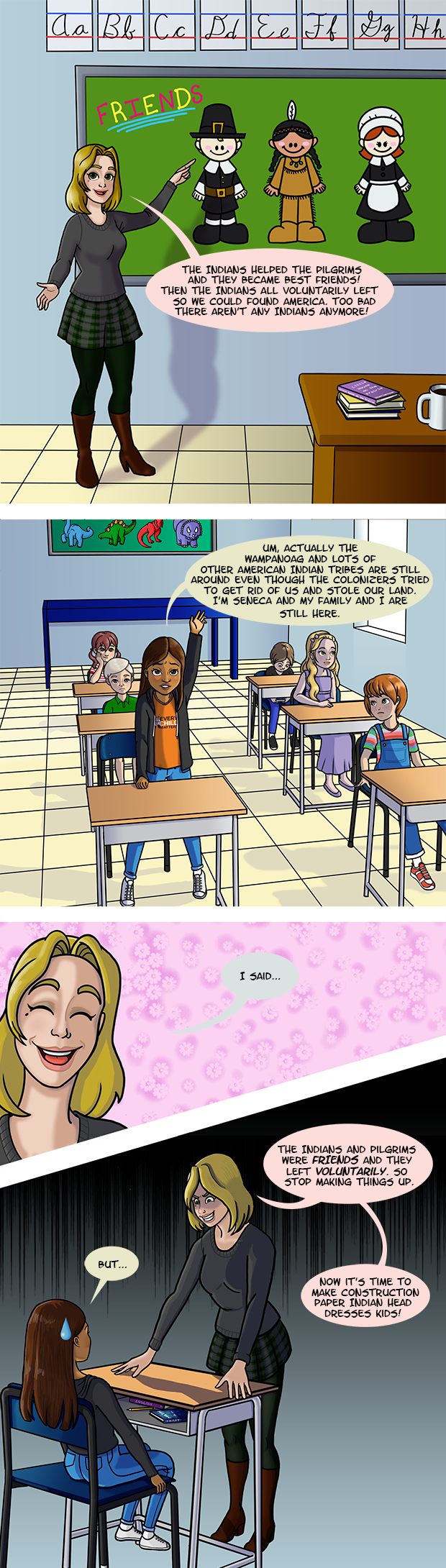
A White teacher stands in front of her class and is pointing to racist, stereotypical cartoon images of Pilgrims and Indians. The teacher says “The Indians helped the pilgrims and they became best friends! Then the Indians all voluntarily left so we could found America. Too bad there aren’t any Indians anymore!” The only non-White child in the class, a Native girl raises her hand and say “Um, actually the Wampanoag and lots of other American Indian tribes are still around even though the colonizers tried to get rid of us and stole our land. I’m Seneca and my family and I are still here.” The cheerful teacher says “I said…” then she turns menacing “…The Indians and Pilgrims were FRIENDS and they left voluntarily. So stop making things up. Now it’s time to make construction paper Indian head dresses kids!”

The sad thing is, the “Pilgrim and Indian” drawings are based on actual, present day “lessons” from teaching websites. This comic is loosely based on my experience as the only Black kid in class when we learned about the Civil War. The Seneca girl is wearing a “Every Child Matters” orange shirt for Residential Schools survivors.

White supremacist Andrew Jackson believed American Indians had “neither the intelligence, the industry, the moral habits, not the desire of improvement” and used this to justify the numerous acts of Cultural Genocide he committed. One of the worst was the Indian Removal Act, which forced the Cherokee, Choctaw, Chickasaw, Creek and Seminole to choose between assimilation or leaving their homelands. Justin Giles, assistant director of the Muscogee (Creek) Nation Museum, describes it as, “You can have one of two things: you can keep your sovereignty, but you can’t keep your land. If you keep your land you have to assimilate and no longer be Indian… you can’t have both.” While reading The Marrow Thieves, I was struck by how much the world Dimaline created felt like a futuristic Nazi Germany. It makes sense considering “American Indian law played a role in the Nazi formulation of Jewish policies and laws” according to professor of law Robert J. Miller. Good job America, you helped create the Holocaust. I’m sure Andrew Jackson would be proud.

But people tend to object to mass murder and breaking treaties, even in the 1830’s. Jackson’s Indian Removal Act was controversial and drew a great deal of criticism, most notably from Davy Crockett and Ralph Waldo Emerson. Christian missionary and activist Jeremiah Evarts wrote a series of famous essays against the Removal Act that accused Jackson of lacking in morality. So even back then folks hated the 7th president for being a lying, racist piece of shit. Of course that didn’t necessarily mean they were accepting of the people they saw as “savages.” A line from They Called it Prairie Light sums it up best: “Europeans were at first skeptical of the humanity of the inhabitants of the American continents, but most were soon persuaded that these so-called Indians had souls worthy of redemption.”  So how could they “kill” Indians without actually killing them and looking like the bad guys? Richard Henry Pratt came up with the solution. Changing everything about Indigenous people to make them as close to Whiteness as possible.

“A great general has said that the only good Indian is a dead one. In a sense, I agree with the sentiment but only in this: that all the Indian there is in the race should be dead. Kill the Indian in him, and save the man.” – Richard Henry Pratt

Pratt was a former Brigadier General who had fought in the Union during the Civil War. He spoke out against racial segregation, lead an all Black regiment known as the “Buffalo Soldiers” in 1867 (yes, the ones from the Bob Marley song), and unlike Jackson, actually viewed the American Indians as people. Unfortunately, like most “White Saviors,” Pratt was ignorant, misguided and believed Euro-Americans were superior. “Federal commitment to boarding schools and their ‘appropriate’ education for Native Americans sprouted from the enduring rootstock of European misperceptions of America’s natives.” (Tsianina Lomawaima). And so Pratt decided the best way to help American Indians was to remove children from their homes to teach them “the value of hard work” and the superiority of Euro-American culture. Pratt had already practiced turning Cheyenne prisoners of war at Fort Marion into “good Indians” and he was convinced an Indian school would be equally successful. So in 1879 he founded the Carlisle Indian Industrial School, the first Indian boarding school in the US.

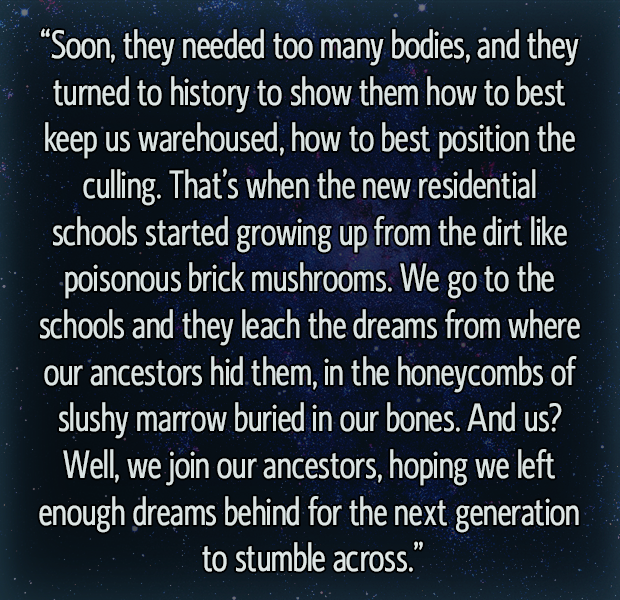
“Soon, they needed too many bodies, and they turned to history to show them how to best keep us warehoused, how to best position the culling. That’s when the new residential schools started growing up from the dirt like poisonous brick mushrooms. We go to the schools and they leach the dreams from where our ancestors hid them, in the honeycombs of slushy marrow buried in our bones. And us? Well, we join our ancestors, hoping we left enough dreams behind for the next generation to stumble across.”

Miig telling the kids how the bone marrow harvesting started.

“Civilizing” American Indian children by separating them from their cultural roots and teaching them Eurocentric values was not a new idea: The Catholic church had already been doing it for years. But it was Pratt who made it widespread. At the school, students were forced to cut their long hair, adopt White names and clothing, speak only in English, and convert to Christianity. Failure to comply would be met with corporal punishment from Pratt, who ran the school like an army barrack. Understandably, Indigenous people —   who had no reason to trust a nation of treaty breakers —    were initially reluctant to send their children away from their families to go to school. But Pratt convinced Lakota chief Siŋté Glešká aka Spotted Tail (one of three chiefs who had travelled to Washington to try and convince President Grant to honor the treaties the US had made) that an English education was essential to survival in an increasingly Euro-centric America. He argued that if Spotted Tail and his people were able to read the treaties they signed, they never would’ve been forced from their land. He would teach the students so they could return home and in turn help their people. Reluctantly the chief agreed to send the children Dakota Rosebud reservation, including his own sons, to Carlise. Ten years later Pratt’s “save the Indian” goal became a National policy and Natives no longer had a choice in the matter.

“As girls, Martha and young Frances found the atmosphere of the school alien, unfriendly, and oppressive. Both had been raised by nurturing parents of the leadership class, and neither had been abused as a child. They had learned the traditions and laws of their tribes, but the church had not had a strong presence on the San Manuel Reservation. When the girls entered the St. Boniface school, their parents had agreed to their enrollment so that they could cope better with an ever-changing society dominated by non-Indians. Furthermore, their parents expected them to be future leaders of the tribe and felt that training at an off-reservation boarding school would better prepare them for tribal responsibilities.” (Trafzer)

Canada was also pushing for assimilation and, using Pratt’s Residential School model, began to develop their own “off-reserve” schools. In 1920 Duncan Campbell Scott, the Deputy Superintendent of Indian Affairs for Canada from 1913 to 1932, passed the Indian Act. The bill made school attendance mandatory for all Indigenous children under the age of 15. Anyone who refused could be arrested and their children taken away by truant officers, the basis for Dimaline’s Recruiters. Residential school survivor Howard Stacy Jones describes how she was snatched by Mounted Police from her public school in Port Renfrew British Columbia and brought to a residential school: “I was kidnapped when I was around six years old, and this happened right in the schoolyard. My auntie and another witnessed this… saw me fighting, trying to get away from the two RCMP officers that threw me in the back seat of the car and drove away with me. My mom didn’t know where I was for three days.”

Scott famously said “I want to get rid of the Indian problem. . . Our objective is to continue until there is not a single Indian in Canada that has not been absorbed into the body politic and there is no Indian question, and no Indian Department, that is the whole object of this Bill.” Schools in the US and Canada did have some dissimilarities. While the U.S. moved away from mission schools in favor of government run ones, most Canadian residential schools continue to be run by Christian missionaries and supported by several churches. As a result, federal control was weaker in Canada and the goal of converting Indigenous people to Catholicism and Protestantism remained at the forefront. Interestingly, during my research I found that Indigenous people reported a wide variety of experiences in US residential schools ranging from positive to negative, whereas the stories about Canadian ones were overwhelmingly negative.  It’s possible that the Canadian residential schools were somehow worse than US ones, possibly due to the strong influence of the state and little government regulation, but I don’t want to draw conclusions on a topic I simply don’t know enough about. Besides it’s not my place to compare the experiences of survivors like that.

Still, I was genuinely surprised to find so many positive memories reported by former US residential school students who felt they benefited from their time there. While conducting interviews for They Called it Prairie Light Tsianina Lomawaima revealed that former Chilocco students had nothing but good things to say about L. E. Correll, the school’s superintendent from 1926 to 1952. “The participants in this research concurred unanimously in their positive assessment of Correll’s leadership, a testimonial to his commitment to students and the school. Alumni references to Mr. Correll… all share a positive tone. He is described as Chilocco’s ‘driving force,’ ‘wonderful,’ [and] ‘a fine man, we called him ‘Dad Correll.'” I bring this up not to minimize the damage the schools did nor excuse the atrocities they committed, but to illustrate the complexity of this topic. It would also be disingenuous not include the wide range of experiences at these schools. Another student at Chilocco wrote a letter to a North Dakota Agency complaining of a broken collarbone and not enough to eat only to be told to stop “whining about little matters.” Another student refused to Chilocco explaining, “I could stay there [at Chilocco) if they furnished clothing and good food. I don’t like to have bread and water three times a day, and beside work real hard, then get old clothes that been wear for three years at Chilocco [sic]. I rather go back to Cheyenne School.”

Regardless, all the schools caused lasting damage to Indigenous culture and communities. What Canada and the US claimed called assimilation “more accurately should be called ethnic cleansing…” explains Dr. Jennifer Nez Denetdale a Najavo Professor of American Studies at the University of New Mexico. Pratt may have had good intentions, but remember what they say the road to hell is paved with. Much like voluntourism today attempts to “help” American Indians through assimilation were rooted in colonialism and hurt more than they helped. Forrest S. Cuch, former director of the Utah Division of Indian Affairs describes the damage done to his tribe, the Utes. “Assimilation affected the Utes in a very tragic way. It was so ineffective that it did not train us to become competent in the White World and it took us away from our own culture, so much so that we weren’t even competent as Indians anymore.” “Children do not understand their language and they’re Navajos. This was done to us.” explained Navajo/Dine elder Katherine Smith. Assimilation was nothing short of Cultural genocide as defined by the 2015 the Truth and Reconciliation Commission of Canada:

“…the destruction of those structures and practices that allow the group to continue as a group. States that engage in cultural genocide set out to destroy the political and social institutions of the targeted group… Languages are banned. Spiritual leaders are persecuted, spiritual practices are forbidden, and objects of spiritual value are confiscated and destroyed. And, most significantly to the issue at hand, families are disrupted to prevent the transmission of cultural values and identity from one generation to the next.”

Residential boarding schools are yet another atrocity that remains suspiciously absent from American and Canadian history books, but they are popular in Indigenous horror (Rhymes for Young GhoulsThe Candy MeisterThese Walls), and for good reason. Survivors describe deplorable living conditions, rampant abuse, rape, starvation, and being torn away from their families and culture. Homesickness was a common problem for young children who had spent their entire lives surrounded by family. Ernest White Thunder, the son of chief White Thunder, became so homesick and depressed he refused to eat or take medicine until he finally died.

“Students arriving at Chilocco [Residential School] met the discrepancies between institutional life and family life at every turn. Military discipline entailed a high level of surveillance of students but constant adult supervision and control was impossible. The high ratio of students to adults and the comprehensive power wielded by those few adults compromised any flowering of surrogate parenting. In the dormitories, four adults might be responsible for over two hundred children. The loss of the parent/child relationship and the attenuated contact with school personnel reinforced bonds among the students, who forged new kinds of family ties within dorm rooms, work details, and gang territories. Dormitory home life-siblings and peers, living quarters and conditions, food and clothing, response to discipline-dominates narratives.”  (Tsianina Lomawaima)

Running away was common and could end tragically. Kathleen Wood shared one of her memories of students who ran away: “There were three boys that ran away from [Chuska Boarding School]. They wanted to go home… They were three brothers, they were from Naschitti. They ran away from here as winter… They did find the boys after a while, but the sad part is all three boys lost their legs.” Not everyone survived their attempts to return home, as was the tragic case for Chanie “Charlie” Wenjack (trigger warning for description of child death). At the Fort William Indian Residential School 6 children died and 16 more disappeared.

Indigenous children first entering residential school would often have their long hair cut short, an undoubtedly traumatic experience for many children. For the Cheyenne the cutting of hair is done as a sign of mourning and deathRoy Smith, a member of the Navajo Nation (Diné) where long hair is an essential part of one’s identity, describes his experience: “They all looked at me when they were giving me my haircut… My long hair falling off. And I was really hurt. The teaching from my grandfather was… your long hair is your strength, and your long hair is your wisdom, your knowledge.” Hair is also holds spiritual importance to the Nishnawbe Aski. An anonymous Nishnawbe Aski School survivor was left deeply hurt be her hair cut:

“When I was a girl. I had nice long black hair. My mother used to brush my hair for me and make braids. I would let the braids hang behind me or I would move them over my shoulders so they hung down front. I liked it when they were in front because I could see those little colored ribbons and they reminded me of my mother. Before I left home for residential school at Kenora my mother did my hair up in braids so I would look nice when I went to school. The first thing they did when I arrived at the school was to cut my braids off and throw them away. I was so hurt by their actions and I cried. It was as if they threw a part of me away – discarded in the garbage.” – Anonymous

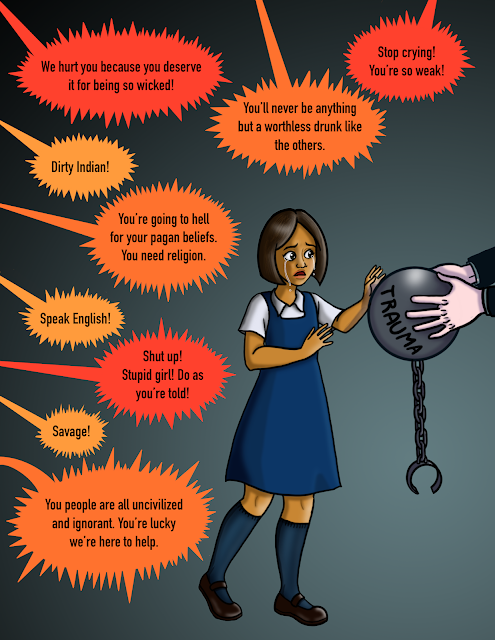
***Content warning, descriptions of child abuse and sexual assault and an image of verbal abuse of a child below***

Students were severely beaten for not displaying unquestioning obedience and sometimes for no reason at all. Those in charge would constantly reinforce the message that Indigenous people were stupid, worthless, and inferior to Whites, destroying the children’s sense of self-worth. Some students were forced to kneel for long stretches of time, hold up heavy books in their outstretched arms, or locked in the basement for hours. Children would be force-fed spoiled meat and fish until they vomited, then forced to eat their own vomit. Some were even electrocuted. Chief Edmund Metatawabin recalls his experience at St. Anne’s Indian Residential School:

There was [an electric chair with] a metal handle on both sides you have to hold on to and there were brothers and sisters sitting around in the boys’ room. And of course the boys were all lined up. And somebody turned the power on and you can’t let go once the power goes on. You can’t let go… my feet were flying in front of me and I heard laughter. The nuns and the brothers were all laughing.” – Edmund Metatawabin

From 1992 until 1998 Ontario Provincial Police launched an investigation into the abuse at St. Anne’s Residential School after Chief Edmund Metatawabin presented them with evidence of the crimes. The police took statements from 700 St. Anne’s survivors, many of whom described incidents of sexual assault and abuse involving priests, nuns, and other staff. During her interview one survivor said “This shouldn’t have happened to us. They’re God’s workers, they were to look after us.” (link contains graphic descriptions of abuse). One figure estimates that one in five  students were sexually abused when attending residential school. But schools would cover up the abuse, and anyone who complained was intimidated into silence.

A priest is forcing a ball and chain, representing trauma, to a little girl in a residential school uniform. She is surrounded by red and orange speech bubbles saying cruel things like "Dirty Indian!," "Shut up! Stupid Girl! Do as you're told!," "Savage!," and "You're going to hell for your pagan beliefs. You need religion."

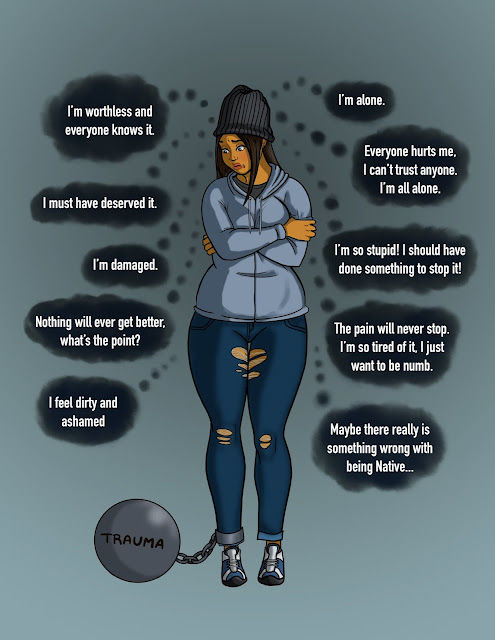
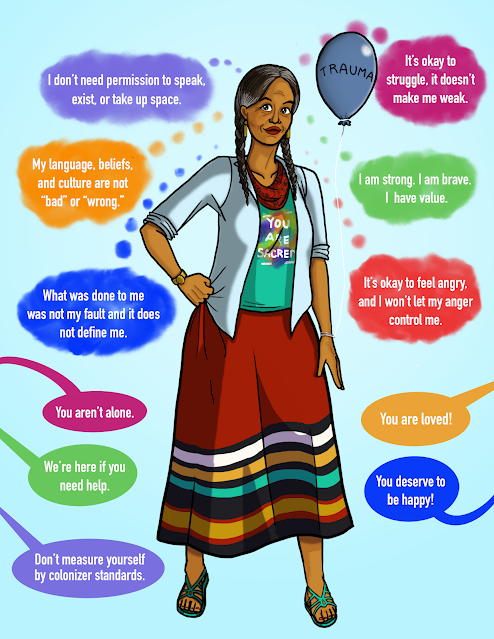
The verbal abuse shown here is paraphrased from actual things said to Residential school survivals. They are taken from interviews and autobiographies. If you or someone you know is being abused, go here. Learn more about forms of abuse here.

All this pain and suffering was committed under the pretense of “civilizing” Native people, when in reality it was Cultural Genocide driven by White supremacy. “The whole move was to make Indian children white… Of course, at the end of the school experience, the children still weren’t white. They were not accepted by White mainstream America. When they went back to their tribal homelands, they didn’t fit in at home anymore either.” says Kay McGowan, who teaches cultural anthropology at Eastern Michigan University. Inuvialuit author Margaret Pokiak-Fenton describes how her mother did not even recognize her when she returned home in her children’s book Not my Girl. As if the rejection wasn’t heart breaking enough, Margaret had forgotten much of her own language and struggled to communicate with her family. Another residential school survivor, Elaine Durocher, says “They were there to discipline you, teach you, beat you, rape you, molest you, but I never got an education…. [instead] it taught me how to lie, how to manipulate, how to exchange sexual favors for cash, meals, whatever the case may be.” In a video for Women’s Centre she volunteers at she discusses how “The teachers were always hitting us because we were just ‘stupid Indians'”.

***End of content warning***

“[People] need to know that it was an event that happened to a lot of kids, that it wasn’t just a few; it was literally thousands of kids that suffered. I’ve come to realize that there were also others where the experience for them was actually very good, and I don’t question that. I can only relate to mine. Mine wasn’t a good one, and I know a lot of really good friends who also did not have a good experience.” – Joseph Williams

In The Marrow Thieves the government and the church join forces to perform experiments on prisoners, and later Indigenous people, in order to find a cure for the dreamless plague. And if you were hoping that was just a metaphor for destroying cultural identities and real residential schools never sunk so low as to experiment on helpless children, well, you’d be wrong. Science has a dark history of exploiting the most vulnerable populations for unethical experiments. In the U.S. alone enslaved women were tortured and mutilated by the father of gynecology  without any form of anesthesia (1845-1849), the government backed Tuskegee syphilis experiment (1932-1972) infected hundreds of Black men without their knowledge or consent, a stuttering experiment (1939) performed on orphans is now known as “The Monster Study,” elderly Jewish patients were injected with liver cancer cells (1963) to “discover the secret of how healthy bodies fight the invasion of malignant cells,” and inmates in the Holmesburg Prison were used to test the effects of various toxic chemicals on skin (1951-1974).

In the 1920s experimental eyes surgeries to treat trachoma were conducted on Southwestern US Natives. The contagious eye disease became an epidemic on Southwestern reservations, affecting up to 40% of some tribal groups. “Some tribes, such as the Navajo, experienced no “sore eyes” prior to their defeat by the United States, yet once confined to the reservation, they witnessed a significant increase in unexplained eye problems.” (Trennert) GEE I WONDER WHY. Maybe it had something to do with being forced to live in poverty on shitty reservations where their access to healthcare and sanitation was limited? The government decided to “help” by once again making it worse. The Indian office opened an eye clinic and hired the Otolaryngologist Dr. Ancil Martin to run it. Dr. Martin began the student treatment program before he had any idea how to cure trachoma. He decided to test out a surgical procedure called “grattage” which involved cutting the granules off the eyelids (without anesthesia of coure). One little girl described the experience: “During the operation they cut off little rough things from under the eyelid. It was a grisly scene, with blood running all over. The children had to be held down tight.” (Trennert) Unfortunately the experimental treatment only provided temporary relief and those children who recovered where left with permanent damage to their eyelids. Later, as part of the “Southwestern Trachoma Campaign,” ophthalmologist Dr. Webster Fox convinced the Indian Office to take even more drastic measures and surgically remove the tarsus (the plate of connective tissue inside each eyelid that contributes to the eyelids form and support). His reasoning for this was because he did not believe Indians would submit to prolonged treatment and it was better to “remove the disease more quickly and with less deformity than the way Nature goes about it.” Yikes.

In case you were hoping this was a tragic but isolated incident, I’m afraid I have some bad news for you. When giving testimony to the Truth and Reconciliation Commission of Canada survivors consistently described an environment where “hunger was never absent.” Residential school meals were typical low in calories (they ranged from 1000 to 1450 calories per day, undernourishment is considered less than 1,800 calories per day), vegetables, fruit, protein, and fat, all essential parts of a growing child’s diet. “We cried to have something good to eat before we sleep. A lot of the times the food we had was rancid, full of maggots, stink. Sometimes we would sneak away from school to go visit our aunts or uncles, just to have a piece of bannock.” explained school survivor Andrew Paul. Food-borne illnesses were another common occurrence. Although at least partly due to negligence or a lack of funds some schools intentionally withheld food to see how the children’s bodies would react to malnutrition, especially as they fought off viruses and infections. “When investigators came to the schools in the mid-1940s they discovered widespread malnutrition at both of the schools” explained food historian Dr. Ian Mosby. ” “In the 1940s, there were a lot of questions about what are human requirements for vitamins… Malnourished aboriginal people became viewed as possible means of testing these theories.” Mosby said an interview with the Toronto Star. And so Indigenous Canadian children became unwitting guinea pigs in an unethical study. Between 1942 and 1952 Dr. Percy Moore, head of the superintendent for medical services for the Department of Indian Affairs, and Dr. Frederick Tisdall, former president of the Canadian Pediatric Society performed illicit nutrition experiments on students at St. Mary’s School. Milk and dairy rations were withheld. Instead children were given a fortified flour mixture containing B vitamins and bone meal. The experimental supplement impacted their development and caused children to become dangerously anemic, and continued to have negative effects on them as adults. Incidentally, this experimental flour mix was illegal in the rest of Canada.

A decade later the U.S. Air Force’s Arctic Aeromedical Laboratory in Fairbanks wanted to study the role the thyroid gland played in acclimating humans to cold in hopes of improving their operational capability in cold environments. The hypothesis was that Alaskan Natives were somehow physically better adapted to cold environments than White people This is another example of scientific racism as the study didn’t bother looking at the White inhabitants of the Arctic Circle:  Greenlanders, who hypothetically should have a similar resistance to the cold. Instead, they chose to focus on Alaskan Natives almost as if they were a different species. The othering didn’t end there. Participants (84 Inuit, 17 Athabascan Indians, and 19 White service members) were given a medical tracer, the radioisotope iodine 131 to measure thyroid function. Guess who wasn’t told they were part of the experiment? Instead of informing the Indigenous test subjects they were participating in a research study as would’ve been required by the recently created Nuremberg Code (the first point in the code literally says “The voluntary consent of the human subject is absolutely essential”), the scientists just said “Fuck it, we do what we want!” I mean, it’s not like someone might want to know they were being given RADIOACTIVE MATERIAL or anything right? Not only did the experiment offer no potential benefit to the Alaskan Natives who participated but the original hypothesis was disproven. The Airforce provided no follow up tests or treatment for the test subjects to insure they hadn’t suffered any long-term effects.

Students at Kenora residential school were used as test subjects for ear infection drugs, again without their knowledge or consent. School nurse Kathleen Stewart wrote in her report “The most conspicuous evidence of ear trouble at Cecilia Jeffrey School has been the offensive odor of the children’s breath, discharging ears, lack of sustained attention, poor enunciation when speaking and loud talking,” In a follow-up report she noted three children “were almost deaf with no ear drums, six had [hearing in] one ear gone.”

Human research violations aren’t just a problem of the distant past before the IRB was established. In 1979 Native leaders asked researchers to help them assess the drinking problem in their community in Barrow, Alaska. They were hoping to cooperate with them to find a solution. Instead the researchers went ahead and publicly shared the results of the Barrow Alcohol Study with news outlets. Because the study implied the majority of adults in Barrow were alcoholics (which was inaccurate), left out the socioeconomic context which led to drinking problems, and then announced the results without representatives from the tribal community, it caused both a great deal of shame and direct financial harm. Starting in the 1990s, Arizona State University obtained blood from the Havasupai tribe under false pretenses. Instead of using the samples for diabetes research like they had promised the tribal members, researchers used the Havasupai’s DNA for a wide range of genetic studies. This continued until 2003 when a Havasupai college student discovered how the blood was being used without permission. Carletta Tilousi explained in an NPR Interview “Part of it is it was a part of my body that was taken from me, a part of my blood and a part of our bodies as Native-Americans are very sacred and special to us and we should respect it.”

Keeping all this in mind the dystopian future that Dimaline created suddenly doesn’t seem so far-fetched. Indigenous people have already had their land stolen, their graves robbed, their children kidnapped, and their culture appropriated. They’ve even had their blood taken under false pretenses. Indigenous children held prisoner in residential schools were deliberately starved and denied access to basic healthcare all in the name of science. The Marrow Thieves feels especially poignant right now, with the Americas experiencing (at the time of writing this) some of the highest Covid-19 rates in the world. Who would we sacrifice to find a cure? Pfizer, the company responsible for making one of the two currently available Covid vaccines did illegal human research as recently as the 90’s. “What does it mean when the disproportionate disease burden currently faced by Indigenous communities is, in large part, the product of a residential system that the TRC has found was nothing short of a cultural genocide?” asks Mosby. “In part, it means that we need to rethink the current behavioral and pharmacologic approaches… in Indigenous communities. In their place, we need more community-driven, trauma-informed and culturally appropriate interventions… [and] also acknowledge the role of residential schools in determining the current health problems faced by residential school survivors and their families…[M]ost importantly, we need to demand that the next generation of Indigenous children have access to the kinds of plentiful, healthy, seasonal and traditional foods that were denied to their parents and grandparents, as a matter of government policy” he argues.

The worst part about the residential school is that even after they closed, their legacy remained and the damage they did would affect future generations. A report entitled Indigenous Communities and Family Violence: Changing the Conversation states “The [Royal Commission on Aboriginals Peoples] named residential schools as a significant cause of family violence in Indigenous communities… and the intergenerational impacts of residential schools on the prevalence continues to be recognized…”. Many of the abused students became abusers themselves, taking out their pain, fear, and frustration on the younger children. After leaving the school, survivors continued to suffer from low self esteem, hopelessness, painful memories and severe mental, social, and emotional damage. Boarding school trauma was then passed down from parent to child and the cycle of abuse would continue.  Because the children were deprived of affection and family during their formative years, many of them left residential school emotionally stunted and unable to openly express love, even towards their own children.

“Few [students] came out of residential schools having learned good boundaries, and good boundaries included some sense of self-determination, sovereignty over your own body. They didn’t have any control over that, and they didn’t see people around with appropriate behavior and being respectful of them as human beings, that they were sacred. And they were abused. Children learn what they live and that was their life.” – Sylvia Maracle, executive director of the Ontario Federation of Indigenous Friendship Centres.

Add in loss of land, racism, poverty, and a lack of healthcare and support and you’re left with a complex system of trauma that’s stacked against Indigenous people and their recovery. A report prepared for the Aboriginal Healing Foundation entitled Aboriginal Domestic Violence in Canada states:

 “Social and political violence inflicted upon Aborigional children, families and communities by the state and the churches through the residential school system not only created the patterns of violence communities are now experiencing but also introduced the family and community to behaviors that are impeding collective recovery.”

In her award-winning autobiography They Called Me Number One writer and former Xat’sull chief Bev Sellars discusses the long-lasting damage to her done by St. Joseph’s Mission.  Sellars watched helplessly as her brother’s personality completely changed as a result of sexual abuse and he began to take out his rage and pain on her. Sellar’s own trauma affected the way she interacted with her three children. She practiced an authoritarian style of parenting she had learned from the school and expected her children to hide their pain instead of expressing it as she was forced to do. Because the only touch Sellars experienced at the residential school was painful and abusive she feared any form of physical contact and was unable to hug anyone until her own children were grown. She continued to fear disobeying any White person or authority figure and made her want her children to behave perfectly in front of Whites.

She describes how she suffered from panic attacks, migraines, nightmares, memory problems, emotional numbness, angry outbursts, shame and phobias after attending the residential school. Because her complaints of mistreatment were dismissed and summarily punished by those in charge, Sellars developed a learned helplessness and “why bother?” attitude. Years of brainwashing by the nuns and priests caused Sellars to see “the world through the tunnel vision of the mission” and led her to believe she was inferior because she was Indigenous. Those familiar with trauma will recognize these as PTSD symptoms commonly seen in survivors. Unfortunately, emotional and mental health were still poorly understood in the 1960s and medical services are limited on reservations forcing survivors like Sellars to find other ways to numb their pain.

***Content warning for image of depressive thoughts below***

The girl from earlier is now a grown woman. She looks depressed, is wearing dark clothing, and hugging herself. The ball and chain that represents trauma are chained around her ankle. Dark thoughts fill her head like: “I must have deserved it,” “Nothing will ever get better, what’s the point?,” “Maybe there really is something wrong with being Native…,””The pain will never stop. I’m so tired of it, I just want to be numb,” and “Everyone hurts me, I can’t trust anyone. I’m all alone.”

The ball and chain represent the trauma the residential school survivor has to carry around with her. Her thoughts are based on those common to people with trauma. Please contact a mental health provider (listed at the beginning and end of the review) if you have similar thoughts.

***End of content warning***

In The Marrow Thieves Wab eventually shares how her mother became addicted to alcohol and later crack cocaine. The stress of living in a dirty, overcrowded military state while trying not to starve or get taken away by the school staff became too much for her. Wab wonders if her mother could feel herself dying and just gave up. Alcohol and drugs are frequently abused by those who’ve experienced trauma or have untreated mental illness. In fact, childhood abuse is prevalent among alcoholics, and children who experience trauma are four to twelve times more likely to engage in substance abuse. Sellars’ brother never recovered from the sexual abuse he experienced at the hands of the priests and developed an addiction to alcohol. Others survivors die by suicide. According to the CDC the suicide rate among adolescent American Indians is more than twice the U.S. average and the highest of any ethnic groups. Amanda Blackhorse explains “…we’re still feeling the effects of boarding schools today… and it has completely demolished the Indigenous familial system. And many of our people are suffering and they don’t… realize that they are suffering from the boarding school system. Many of us don’t even understand it…”

However, while alcoholism is definitely a problem in Native populations the stereotype of the “drunken Indian” is no more than a harmful myth. Indigenous people aren’t “genetically more susceptible to alcoholism” and American Indians are actually more likely to abstain from alcohol that Whites.

 “The participants in this study talked about historical trauma as an ongoing problem that is at the root of substance abuse issues in their families and communities. Further, the participants believed their experiences to be shared or common among other AI families and communities. Feelings about historical trauma among the participants, their families, and/or their communities included disbelief that these events could have happened, sadness, and fear that such events could recur; however, there also were messages about strength and survival.” – Laurelle L. Myhra

This huge, horrible thing that scarred thousands of survivors and had long lasting effects for Indigenous populations is almost entirely unknown outside of Native, Inuit and Métis communities, and the Canadian Government continues to underfund education and health services for Indigenous children. But there are many Indigenous people, like Bev Sellars, who are not just surviving, but flourishing, and in turn helping others to recover. Indigenous founded and run groups such as The National Indigenous Women’s Resource CenterFreedom LodgeIndigenous Circle of Wellness, and Biidaaban Healing Lodge, are all working to heal generational trauma by combining traditional Indigenous healing practices and modern trauma-informed therapy to create a holistic approach to wellness and mental health. Horror and Apocalyptic Fiction has also given Indigenous creators a way to process this generational trauma and make a wider audience aware of these historical atrocities. But even with everything Indigenous people have suffered through, they’re still here. The Marrow Thieves similarly ends on a hopeful note with Frenchie and his friends holding their heads high as they march into the future.

The woman is now older, wearing bright clothing, and looks happy. She has a Native-made T-shirt that says “you are sacred.” The speech and though bubbles all have bright colors. People are giving the woman positive affirmations like “You aren’t alone,” “You deserve to be happy,” and “Don’t measure yourself by colonizer standards.” Her thoughts are happy now instead of dark. The woman thinks “I don’t need permission to speak, exist, or take up space,” “My language, beliefs, and culture are not ‘bad’ or ‘wrong’,” “What was done to me was not my fault and it does not define me,” and “I am strong. I am brave. I have value.”

The girl from the residential school is all grown up, and with the support from her community has started to heal. Her trauma, now represented by a balloon to show the “weight” of it is now gone, is still there but is no longer impeding her ability to enjoy life. She finally feels free to celebrate her Chippewa culture and heritage, as reflected by her bright clothing and long braids. Her T-shirt is from Choctaw journalist and artist Johnnie Jae’s collection. Her skirt is based on the work of Chippewa fashion designer Delina White. Her scarf has a floral Chippewa design.

Sources:

Unspoken: America’s Native American Boarding Schools, PBS, 2016

The Indian Problem, The Smithsonian, 2016

In the White Man’s Image, PBS, 1992

Bopp, J., Bopp, M., and Lane, P.  Aboriginal Domestic Violence in Canada. The Aboriginal Healing Foundation. 2003. https://epub.sub.uni-hamburg.de/epub/volltexte/2009/2900/pdf/aboriginal_domestic_violence.pdf

Dunbar-Ortiz, Roxanne. An Indigenous People’s History of the United States. Boston: Beacon Press, 2014.

Fortunate Eagle, Adam. Pipestone: My Life in an Indian Boarding School. University of Oklahoma Press, 2010.

Health Justice, Daniel. Why Indigenous Literature Matters. Wilfrid Laurier University Press, 2018.

Holmes, C. and Hunt, S. Indigenous Communities and Family Violence: Changing the ConversationNational Collaborating Center for Aboriginal Health, 2017.  https://www.nccih.ca/docs/emerging/RPT-FamilyViolence-Holmes-Hunt-EN.pdf

Jordan-Fenton, C. and Pokiak-Fenton, M. Not My Girl. Annick Press, 2014.

Jordan-Fenton, C. and Pokiak-Fenton, M. Fatty Legs. Annick Press, 2010.

Mihesuah, Devon A. American Indians Stereotypes & Realities. 1996. Reprint. Atlanta: Clarity Press, 2009.

Mihesuah, Devon A. So you Want to Write About American Indians?: A Guide for Writers, Students, and Scholars. Lincoln: University of Nebraska Press, 2005.

Pember, Mary Annette. “Death by Civilization.” Atlantic, 8 March. 2019.

https://www.theatlantic.com/education/archive/2019/03/traumatic-legacy-indian-boarding-schools/584293/

Robertson, David Alexander. Sugar Falls: A Residential School Story. Highwater Press, 2012.

Sellars, Bev. They Called Me Number One: Secrets and Survival at an Indian Residential School. Talonbooks, 2013.

Sterling, Sherling. My Name is Seepeetza. Groundwood Books, 1992.

Trafzer, C. E., Keller, J.A., eds. Boarding School Blues: Revisiting American Indian Educational Experiences. Bison Books, 2006.

Treuer, Anton. Everything You Wanted to Know about Indians But Were Afraid to Ask. St Paul: Minnesota Historical Society Press, 2012.

Tsianina Lomawaima, K. They Called It Prairie Light: The Story of Chilocco Indian School. University of Nebraska Press, 1995.

Robinson-Desjarlais, Shaneen (host). Residential Schools Podcast Series. Audio podcast, February 21, 2020. https://www.thecanadianencyclopedia.ca/en/article/residential-schools-podcast-series

Dawson, Alexander S. “Histories and Memories of the Indian Boarding Schools in Mexico, Canada, and the United States.” Latin American Perspectives 39, no. 5 (2012): 80-99. http://www.jstor.org/stable/41702285.

Everything I Know About Zombies I Learned in Kindergarten by Kevin Wayne Williams

Everything I Know About Zombies I Learned in Kindergarten by Kevin Wayne Williams

Formats: Print, digital

Publisher: Mott Haven Books

Genre: Apocalypse/Disaster, Blood & Guts, Zombie

Audience: Adult/Mature

Diversity: Black/African American/Caribbean American characters, Trinidad, Jamacian, Hispanic/Latinx characters

Takes Place in: New York City, USA

Content Warnings (Highlight to view): Abelism, Animal Abuse, Animal Death, Body Shaming, Bullying, Cannibalism, Child Death, Child Endangerment, Death, Drug Use/Abuse, Forced Captivity, Gore,  Medical Procedures, Miscarriage, Racism, Rape/Sexual Assault, Slurs, Suicide, Violence

Blurb

Finalist for Foreword Reviews’ IndieFab Novel of the Year for Multicultural fiction and Horror. Even before the apocalypse, nine-year-old Letitia Johnson’s life had never been simple. Shuttled from foster home to foster home in the impoverished neighborhood of Mott Haven, it was all she could do to keep track of her little sister. When the apocalypse came, she tried to keep her sister’s kindergarten safe by locking them all in a tiny school bathroom, hiding while they waited for a rescue that never came. For five days, they hid. They hid while their teachers were being eaten, while their classmates were being killed. They hid while the Bronx was being evacuated. Now, there’s no one left to help them. There’s no place left to hide. It’s just her, one ax, twelve kindergarteners, twelve garden stakes, and a will to live.

While the cast of this novel is primarily children, the book is intended for adults and contains material unsuitable for younger readers.

When it comes to horror, kids come in two types. Either they’re sweet, innocent, completely helpless victims the protagonist needs to protect at all costs, or they’re evil little bastards that will send you into the cornfield, control you with their telepathic powers, or just straight up murder you because they’re the spawn ofSatan. The children in Everything I Know About Zombies I Learned in Kindergarten somehow land right dab in the middle of the victim/villain scale. They’re neither helpless nor innocent after being forced to go through things no child should go through, nor are they actively malicious, only killing for survival. They also don’t seem to possess the immunity to handle situations that most children do in horror stories. Kids get eaten by Zombies, shot, torn apart, and baby zombies get spiked in the head. So if you can’t stomach minors getting killed in fiction, I recommend staying far, far away from this book.

 Letitia, the nine-year-old protagonist, is easily the most competent, clever, and practical character in the book, organizing her little sister’s kindergartners into a unit of efficient zombie killers and quickly picking up survival skills. Growing up with a drug addicted mom, Letitia is used to taking charge and picking up adults’ slack, in addition to becoming wary of the world at a young age. In the early chapters, they try to look for the childrens’ parents, eager to be rid of such a heavy responsibility, only to discover their dickbag guardians all evacuated without them. (Who the hell just leaves their kid behind during a disaster? You’d think they’d at least make some effort to save them, damn.) The adult survivors actually pose more of a threat than the zombies (or cucos, as the children call them), their greed and despair claiming far more lives than the undead do. It’s weird, even though the children are far from innocent, having become skilled killers, the adults are the ones who’ve become morally bankrupt. The few who do manage to hold on to their optimism and naivety don’t last long, foolishly trusting the wrong people or refusing to admit the world, and the rules, have changed. The kids might be depressingly cynical and violent now, but they’re merely adapting to their new reality, and are much more practical than their grown counterparts. It’s no wonder the adults are so unnerved by them.

In the top panel, a little girl holding a spike is telling a grown woman “Don’t worry Señorita, I will protect you from the cuco!” The woman, bemused, responds “Awwww, you’re so adorable!” In the next panel the little girl brandishes her spike with a crazed grin and responds “I have become an expert killer and now I yearn for blood! Human or cuco, I can slay them with ease!” The woman, confused and concerned, asks “Wait, what?”

Some of the kids enjoy killing a little too much.

I was expecting the children being eaten by the undead to be the most disturbing part, until the book turned out to be about the death of innocence, and children being forced to adapt to a situation no child should ever go through. It’s one thing to read about fantastical monsters like Zombies attacking a bunch of helpless kids, but quite another when they’re dying from gun violence, or growing up in crushing poverty. In the first, the situation is pure fiction, no real child is ever going to be attacked by the undead, and you can feel safe in that knowledge. But it hits close to home when it comes to real world problems. Even if the children in the story are fictional, you know millions of real kids out there right now who are surrounded by abuse, violence, and probably living without basic necessities, and that’s super depressing. So basically, it’s a story about how kids with rough lives can’t rely on adults (because they’re either malicious, incompetent, or ignorant) and have to take charge of their own safety and survival, which probably would’ve ended up happening with or without undead hordes overtaking the city. I know zombie apocalypse stories are generally bleak, but damn.

 The zombies in the story are pretty much your typical Romero zombies, slow-moving and stupid, and not too difficult to kill as long as there aren’t a lot of them and their brains are destroyed, a feat which the children usually accomplish by stabbing them in the eye with garden stakes. Unfortunately, everyone becomes zombified upon death, regardless of how they die, so the undead multiply even if they can’t bite anyone. Letitia quickly figures out that the zombies are attracted to movement and sound, and is smart enough to stick to quiet, secluded areas, while the adults continue to attract the undead with the buzz of their emergency generators and gun fire (because the adults are somehow less competent than grade schoolers, another reason Letitia avoids them).

 Unfortunately for me, most of the book is dedicated to the practically of surviving in an abandoned New York City, wandering around and looting mini-marts for supplies…which made for less than stimulating reading. I’m going to admit right now, I don’t like camping or fishing, or any form of “roughing it,” and I don’t like reading about it, either. I’m pretty sure I’d die if I went for more than 40 minutes without WiFi.  So I’ve long ago accepted the fact that I would probably be the first person to die in a zombie apocalypse type situation due to my dependence on modern conveniences and comfort, and I’m okay with that. I’m sure some people will find all the survivor type stuff super interesting, as is evident from Discovery Channel’s programming, but I was hoping for way more suspense and undead violence, and less foraging and guinea pig farming. Speaking of which, there’s a decent amount of animal death too, apparently Zombies like to eat puppies as much as they like to eat little kids.

I’m on my knees, fists raised above my head, screaming at the sky in despair “There’s no Wi-Fi! Noooooooooooooooooooo!” A tablet lies in front of me displaying a large “no Wi-Fi” symbol on the screen.

I would not last long in an Apocalypse, or even a dead zone. How did I even function back in the 80’s?

Stepping away from the story for a moment, I feel it’s worth mentioning that while this book was a finalist for a multicultural fiction award, and has a very diverse cast, it was written by a white guy. Obviously, I prefer Own Voices books, but I’ve reviewed non-minority authors writing about minority characters on here before, and I probably wouldn’t even be mentioning the author’s race except for one thing that was bothering me. For the most part Williams does do a pretty decent job at representing a very racially diverse cast, and has clearly put a lot of effort into making the children’s voices seem authentic. But the way the protagonist, Letitia, spoke came off as iffy to me, and I found myself side-eyeing like I always do when white people try to replicate the slang and speech patterns used by people of color within their communities. Now, it’s totally possible Letitia is completely accurate to how Caribbean children speak, and I’m just super ignorant. It’s just as possible Williams was trying to portray the way an average nine-year-old speaks, and Letitia’s ethnicity had nothing to do with it. I mean, I have no idea what children are supposed to sound like, and my mom was a grammar obsessed English major so I probably sounded like an overly-formal weirdo at that age. (No one says “to whom are you referring” or “may I please”, when they’re in Kindergarten mom, GOD.) I honestly don’t know, so I’m afraid I’m going to have to leave that distinction to someone more qualified. And if I am jumping to conclusions, well, blame it on all the racist pidgin I’ve heard spouted by characters like Long Duk Dong and the Crows from Dumbo (did you know the main crow’s name is Jim? Damn, Disney…) over the years making me super wary.

In the top panel, a TV screen displays an image of the five crows from Disney’s Dumbo. The leader shouts “I’d be done see’n about everything, when I see an elephant fly!” In the second panel I’m squinting suspiciously at the Dumbo DVD case thinking “This movie is a lot more racist than I remember.”

Seriously, Jim Crow! WTF were you thinking Disney!?! At least they’re not as bad as Sunflower from Fantasia.

Everything I Know About Zombies I Learned in Kindergarten definitely has flaws, most of the adults (and a few of the kids) get so little characterization it’s hard to figure out who’s who, the action scenes are confusing, and Williams spends way too much time on boring minutiae, but it’s still an enjoyable read. The horror is less the gory, run away from the monster kind like I was expecting, and more a slow building horror at the nature of humanity and how adults kind of suck.

Bleeding Earth by Kaitlin Ward

Bleeding Earth by Kaitlin Ward

Formats: Print, digital

Publisher: Adaptive Studios

Genre: Blood & Guts, Apocalypse/Disaster, Psychological Horror, Romance

Audience: Y/A

Diversity: Lesbian characters, Hispanic/Latine character

Takes Place in: New Hampshire, USA

Content Warnings (Highlight to view): Alcohol Abuse, Bullying, Child Abuse, Child Death, Child Endangerment, Death, Forced Captivity, Gore, Homophobia, Mental Illness, Racism, Suicide, Verbal/Emotional Abuse, Violence

Blurb

Between Mother Nature and human nature, disasters are inevitable. 

Lea was in a cemetery when the earth started bleeding. Within twenty-four hours, the blood made international news. All over the world, blood oozed out of the ground, even through the concrete, even in the water. Then the earth started growing hair and bones.
Lea wishes she could ignore the blood. She wishes she could spend time with her new girlfriend, Aracely, in public, if only Aracely wasn’t so afraid of her father. Lea wants to be a regular teen again, but the blood has made her a prisoner in her own home. Fear for her social life turns into fear for her sanity, and Lea must save herself and her girlfriend however she can.

Happy Pride month! Here’s something fun for queer horror fans, after Netflix accidently featured the Australian indie horror film, The Babadook, on their LGBT movie page, the titular creature has quickly become a Pride meme and it’s wonderful. If you haven’t seen the film, it’s awesome, go watch it.

A tall, dark, creepy creature with long fingers and a white face is wearing a top hat with a rainbow button, rainbow suspenders, a purple feather boa, sparkly pink flamingo glasses, and a belly shirt that says “Get Ready to be Babashook.”

Artwork by Muffin Pines at http://muffinpines.tumblr.com/

For June I’ll be reviewing two horror stories with queer characters, the first of which is Bleeding Earth. And oh man, did this book mess me up good. I was expecting a gory, end of the world sort of book, and instead I got a heartbreaking survival story about love, family, and humanity (yes I know how cheesy that sounds, shut up). It gave me so much anxiety, and so many emotions, and I’m still trying to process what the hell I just read. But I know it was good. It was really freaking good. And there was so much blood. Blood, and bones, and hair. I love blood. And bones. Not wads of hair though, I have my limits.

In the first caption I’m wearing a light pink dress and covered in blood. I’m clearly enjoying the blood dripping through my hair and down my shoulders because I’m smearing it on my ecstatic face while sighing “Mmmmmm, So much blood.” In the next panel I’m screaming “OH GROSS, HAIR!”  in disgust and pulling away from a wad of bloody hair I’ve just noticed.

I was going for a “Carrie at the Prom” kind of look.

Lea, the novel’s protagonist and narrator, is enjoying the blossoming relationship she shares with her girlfriend, Aracely, when the blood first appears. Now, normally teen romances in dystopias and apocalyptic fiction seems tacked on and out of place. I mean, who worries about crushes when their life is on the line? But in Bleeding Earth, it works beautifully. Surrounded by chaos and despair, Lea wants to hold onto one of the few good things she has left to keep her going, because no one knows how long they have left. The girls are still in their honeymoon phase, so everything still feels wonderful and new, a sharp contrast to the reality around them. When Lea starts experiencing night terrors and hallucinations from stress and isolation, talking to her girlfriend on the phone is the only thing that helps her. And when she wants to give up, it’s Aracely that keeps her going. And I just can’t bring myself to begrudge her that one little bit of happiness. Who wouldn’t want to spend time with someone who makes you feel safe and lets you forget your problems for a while? It gave my cold, little heart all the feels.The scariest thing about Bleeding Earth isn’t the blood, hair, and bones seeping up from the ground. It’s the feeling of isolation, uncertainty, and powerlessness. At least with zombies, aliens, and diseases there’s always something you can do, a safe zone to flee to, a cure, an end in sight. But with the blood there’s nowhere to escape, no way to fight back, and no stopping the blood. No one knows what’s causing it, or if it will ever end. There are no answers or explanations to soothe the scared populace. And while I normally hate it when a story doesn’t give me an explanation, here it actually works. It’s so much more frightening when you don’t know what’s happening, and there’s literally nothing you can do about it. Will things get better? Is this the end of the world? Did humanity piss off the earth so much it’s finally rejecting them? Even at the start of the bleeding, when everyone is still doing their best to “keep calm and carry on,” fear is already causing people to take desperate actions. Lea’s mom obsessively measures their water and screams at her friends when they drink some, her father nails boards over all the windows so they’re in complete darkness, a man attacks Aracely with a bone over a breathing mask, and some jerks at an Apocalypse party try to get an inebriated girl to drink the blood. It starts with fights over tampons in the grocery store, then looting Home Depot, to violence and riots, and it only gets worse from there. Much, MUCH worse.Now, I know poor decision making seems to be a staple of Y/A fiction (one that annoys me to no end), but here, it makes sense. Everyone is absolutely terrified, struggling with isolation and the horror of what’s happening around them, while still trying their damnedest to pretend like everything is going to be fine. And scared, stressed people do not behave in a rational manner. At various points the teenagers in the story become so desperate for normalcy and human contact they’re willing to brave the blood and all its dangers just to be together. Is this a good idea? No, absolutely not. But is it understandable? Completely. Humans are social creatures, so much so that isolation can actually be deadly. And here’s the original research to back it up. I’m an introvert who prefers a quiet night at home, and even I felt stressed and nauseous when poor Lea described being trapped in her boarded up home for weeks on end, with little to no outside communication. Honestly, if I had to go through a bloodpocalypse, I probably would’ve snapped after a few hours indoors and gone blood hydroplaning (hemiaplaning?) in a stolen car while throwing human skulls at pedestrians. And that’s speaking as someone who willingly goes for days without human contact, I can’t imagine what a non-homebody extrovert would go through. So kudos to Lea for keeping it together as long as she did! If you’re probably going to die anyway, it’s better to die among friends and go out with a bang.

A close up of me driving a car through blood while leaning out the window. I’m holding a human skull out the window while waves of blood are being splashed up by the car. I’m dressed like one of the War Boys from Mad Max: Fury Road, with corpse pain covering my face. I gleefully shout “Oh what a day… What a lovely day!”

I showed this drawing to my wife, and now I’m not allowed to drive her car.

While I really enjoyed Bleeding Earth, it did have some problems that got to me, and kept me from giving it the full five stars. Like Lea’s dad. He learns that the mom has become unhinged, and Lea fears for their safety, but instead of going to help his wife and child, he tells his frightened daughter to get her unstable mom, slip through the looters and people willing to kill for water, and come to him. So of course a ton of horrible things happen because Lea can’t get her sick mother to leave the house, and her dad is apparently too lazy to drive the 40 minutes to help her. Like, I get they need everyone they can get to keep the power going, but for fuck’s sake man, you can take an hour to go rescue your wife and daughter. He’s just so frustratingly blasé about the whole thing. And then there were a bunch of weird little plot points that didn’t go anywhere. Like Lea’s hallucinations. Ingesting the blood is discovered to cause hallucinations, night terrors, lost time, and mental breaks. Lea starts to have horrible nightmares, imagining blood in the house, but it’s unclear if it’s an effect from the blood or the isolation. While she does spend part of the book questioning her sanity, and it’s definitely stressful and unsettling, it doesn’t really go anywhere. Was she infected by the blood? Yeah, we never get an answer for that one either.

A frightened teen is on the phone with her dad. “Hey, dad? Looters keep trying to get in the house, I haven’t seen the sun in over a week, and I think mom’s gone off the deep end and she’s possibly planning to kill someone. Could you come get us?” Her dad is seen doing Sudoku in his office and tells her “That’s nice honey, but I’m just swamped at work right now, can I call you back later? Tell your mom I said “Hi”. “Dad are you even listening!? Screw your work and get your ass back here!”

Hey, Sudoku IS work!

The lack of explanations will be a major turn off for a lot of readers, and I can understand that. But honestly, I didn’t feel like it was needed, because that really isn’t the point of the story. This isn’t a sci-fi novel with an omniscient narrator about a world-wide disaster. This is Lea’s story. It’s about her fears, her loneliness, her confusion, and her crush on Aracely. She’s terrified and frustrated because she doesn’t know what will happen, her parents can’t reassure her, and she just wants to be able to take comfort in something. It’s a sweet, sad story of survival, isolation, and just trying to enjoy a simple teen crush in a world that’s gone to hell.

Navigation

Social Media

Search by Tags

To learn more about the Age Group, Diversity, and Genre tags, click here.

Age Groups

Diversity

Genre

Support the Blog

Search

Links

The White Guy Dies First: 13 Scary Stories of Fear and Power edited by Terry J. Benton-Walker

The White Guy Dies First: 13 Scary Stories of Fear and Power edited by Terry J. Benton-Walker

Formats: Print, audio, digital

Publisher: Tor Teen

Genre: Apocalypse/Disaster, Dark Fantasy, Eco Horror, Killer/Slasher, Monster, Mystery, Myth and Folklore, Romance

Audience: Young Adult

Diversity: Black characters and authors, characters of Chinese descent and Chinese New Zealander author, Indigenous characters and author (Seminole), Korean American characters and author, Bisexual characters, Queer women characters, Non-binary character and authors, Ace Spectrum author, MENA character, Bangladeshi-Irish author, Iranian-American author, Latinx characters and author

Content Warnings (Highlight to view): Alcohol Abuse, Amputation, Bullying, Cannibalism, Child Abuse, Child Death, Child Endangerment, Death, Drug Use/Abuse, Forced Captivity, Gaslighting, Gore, Mental Illness, Racism, Rape/Sexual Assault, Suicide, Verbal/Emotional Abuse, Violence, Vomit

Blurb

13 SCARY STORIES. 13 AUTHORS OF COLOR.
13 TIMES WE SURVIVED THE FIRST KILL.

The White Guy Dies First includes thirteen scary stories by all-star contributors and this time, the white guy dies first.

Killer clowns, a hungry hedge maze, and rich kids who got bored. Friendly cannibals, impossible slashers, and the dead who don’t stay dead….

A museum curator who despises “diasporic inaccuracies.” A sweet girl and her diary of happy thoughts. An old house that just wants friends forever….

These stories are filled with ancient terrors and modern villains, but go ahead, go into the basement, step onto the old plantation, and open the magician’s mystery box because this time, the white guy dies first.

I received this product for free in return for providing an honest and unbiased review. I received no other compensation. I am disclosing this in accordance with the Federal Trade Commission’s 16 CFR, Part 255: Guides Concerning the Use of Endorsements and Testimonials in Advertising.

This is a book that is going to make racists people mad, and I’m here for it. Consider yourself forewarned: if you’re white, this book is not written for you and you’re going to need a thick skin to read it. White people are so used to having positive representation in media that a book where white people make everything worse and always end up dead is going to rub the more sensitive white folks the wrong way, even those who might consider themselves allies. But for the rest of us? It’s awesome and a much-needed subversion of the “Black Guy Dies First” trope. Now, just because the white guy dies first in these stories does not make the BIPOC immune from horrific deaths. Hedge and The Protégé both have Black teens who meet violent ends. A Native person in Best Served Cold is tortured. They’re just not the first to die and get to be main characters.

Many (but not all) of the stories focus on the racism characters face and how often bad things happen to BIPOC people because of the actions of white people. Farz-joon from Break Through Our Skin by Naseem Jamnia is a non-binary, Iranian high school student who desperately wants a Smithosian internship. In order to secure one, they agree to volunteer at the University of Chicago’s Oriental Institute (thankfully, the problematic name was changed to the Institute for the Study of Ancient Culture in 2023) working under a condescending, racist, and transphobic old white professor named Dr. Hudson who thinks he knows more about Iran than Farz does because he’s studied it, speaks Farsi, and actually visited Iran, which Farz has not. He also objects to the Institute’s name change because the original name has “history” and “meaning.” Farz tolerates his boorish behavior so they can fulfill their dream of becoming an archeologist and challenge the idea that gender can be determined from a skeleton alone, but of course Dr. Hudson criticizes their “modern” ideas about gender stating “political correctness has no place in ancient history”, despite historical evidence of gender non-conforming people existing in ancient Iran and bioarchaeologist’s more recent views on sex and gender. Unsurprisingly, it turns out he only hired Farz to give the exhibits a “layer of authenticity” and he’s willing to jeopardize Farz’s future by withholding his recommendation.

Wasps by Mark Oshiro focuses on how gentrification hurts immigrant communities, while Hedge by Kalynn Brown has a topiary garden created by wealthy whites in the 1970s where anyone who enters winds up dead, including the main character’s father. In Grave Grove by Alexis Henderson, a Black teen named Rumi befriends a white Northerner named Kaitlin and who she helps adjust to life in the Southern US. The two even start a podcast together entitled Girls and Ghosts. Their newest episode is about Kyle Adams, a racist who went missing in the eighties after chasing a Black teen, William Jones, into an abandoned plantation. Unfortunately, we quickly learn that Kaitlin is not a good friend to Rumi. She ignores her at school in favor of hanging out with white girls, makes Rumi do all the grunt work for their podcast, and is actually pretty racist for someone who probably considers themselves liberal. She excuses Kyle’s racism because it happened in the past (the 1980s) and “everyone was racist back then.” She thinks William is a “drug dealer” who belongs in prison because he was caught with marijuana, despite smoking weed herself. She views Kyle as the victim, not William. She doesn’t want to talk about the racist history of the plantation or consider the slaves who died there, just the missing white boy. She even mentions her sister’s best friend got married at the plantation, a favorite location for Southern brides (gross). Side note, but I loved that Kaitlin believed in the supernatural while Rumi was the skeptic, since BIPOC are so often cast as superstitious and foolish compared to logical white people. I’m a skeptic myself so it was nice to see a character like me in both Grave Grove and Hell is Other Demons, where the Black main character is an atheist.

Best Served Cold by H. E. Edgmon and The Protégé by Lamar Giles both have the BIPOC main characters get into trouble specifically because they choose to trust a white person. In the former, our protagonist, EJ, makes the mistake of accepting a white man who befriended their brother. EJ struggled with internalized racism throughout their childhood, doing things like using cheap, unsafe contacts from the mall to change their eye color from brown to green. Kai, their brother, tells EJ that those are their ancestor’s eyes, and that their appearance connects them to their ancestry and they should be proud of them. Kai works to reclaim a past that was stolen by colonization (like learning traditional farming and hunting), and teaches EJ about ancestral trauma. EJ realizes the reason they feel angry and frustrated is because they are “playing a game whose rules have never been designed for me to win.” Their mother claims to be white because she passes, even though her grandfather was sent to a residential school in Oklahoma. She denies her heritage. EJ and Kai’s parents grew up together on a reservation in Florida, but moved to Chicago as adults. They told their children they’d left the Rez to give them a better life. Kai brings his white friend (possibly boyfriend) Isaac, who has intense green eyes, to a Pow Wow where the other Natives give him side eye. Clearly, they see something Kai doesn’t (there are other white people there but they don’t face the same level of scrutiny). One of the community leaders talks about MMIWC (Missing and Murdered Indigenous Women and Children) which serves as foreshadowing. It’s implied that the antagonist in the story is a certain evil spirit from Algonquian mythology (one who’s associated with winter and cannibalism). Edgmon is Seminole, not one of the Algonquian tribes, but he writes with respect, never breaking the taboo of using the spirits name which is said to summon it. This particular creature is also a perfect representation of colonialism with its insatiable hunger and destructive nature.  Kai and EJ do everything they can to fight colonialism but still fall victim to the evil spirit.

The Protégé by Lamar Giles, like Best Served Cold, is a particularly tragic story with the main character, Troy’s, life ruined by his best friend, in this case an older, white gentleman named Jack Meridian. Jack is a retired magician who’s been mentoring Troy in the art of card tricks and illusions, and one of the young teen’s only friends. Troy so admires the older man that he immediately agrees to do him a favor, accepting a package while Jack runs errands downtown. Simple enough, right? While Troy’s older brother Darius is having a party with his friends, Troy sees that the news is reporting a mass killing at the mall where Jack was heading. He tries to contact his magician mentor but the person who killed him answers the phone and threatens Troy if he doesn’t give them the package he received. The killer is revealed to be Danford Dread, a magician who “perverts” the art and performs dark and gory magic that “plays to the worst in people.” And now he’s after Troy and his brother. Even though the white guy in this story is a “good guy” he still ruins a Black boy’s life by bringing him into his world and putting him directly into danger.

In Hell is Other Demons by Karen Strong, the main character is killed (she spends most of the story as a ghost) because her crush’s white boyfriend starts meddling with the supernatural and summons a demon. The other stories of dating a white boy don’t end with dead young women, but they do highlight the perils of interracial dating, namely that white men often fetishize non-white women. I mean, just look how BIPOC women have their own categories on porn sites (gross). Obviously not all mixed-race relationships are problematic; my parents are a mixed-race couple, my sister has an amazing Chilean fiancé (who is himself biracial), and I’m friends with happily married couples in mixed relationships. Unfortunately, there are always bad apples.

In both the Golden Dragon by Kendare Blake and Docile Girls by Chloe Gong, Korean-American Sophie and Chinese-I-think-American-but-possibly-New-Zealander Adelaid are dumped by their white boyfriends (and subsequently lose all the white people they thought were their friends) who fetishized them but don’t view them as committed relationship material. As Sophie’s sister puts it, they’re an exotic bang to mark off their “international bang bingo card.” Even after she gets dumped, Adelaid’s ex sees her as too weak and docile to be the killer who’s been stalking the teens, an assumption that proves fatal for him. This is unfortunately common, as all the East Asian-American women I know I can attest to. When they’re sexually harassed, it almost always has racist undertones. They’ve been propositioned by white men looking for “submissive waifus,” had “me so horny” shouted at them, asked if they have sideways vaginas, or “complimented” on their “exotic” beauty. White men have long fetishized East Asian women, with examples dating as far back as 1898 with the book Madame Butterfly. A Columbia University study from 2007 showed that in online dating, White men seemed to have a strong preference for Asian women when it came to hookups, but when they wanted a committed relationship, they preferred white women. Meanwhile, Black women, especially those with dark skin, are considered less desirable than women of other races.

In All Eyes on Me by Faridah Àbíké-Íyímídé main character Helen deals with a white boyfriend, Asher, who is constantly committing microaggressions. He mocks her kinky hair, and implies she can’t be an actress because she’s Black and not a “bombshell.”  Yet Helen still feels guilty about wanting to break up with Asher because everyone else considers him the perfect, all-American boy. And as a Black girl she’s supposed to be grateful that a white boy wants her, even though being tied down to him and trapped in their small town forever sounds like a nightmare. Fortunately for all three girls, they end their stories without being tied down by their racist exes.

Not all the stories in the collection are focused on race and racism, however. The Road to Hell by Terry Benton-Walker has a very original set up, exploring an abusive relationship between a haunted house and a family living it with the house as the abuser. Everything’s Coming Up Roses by Tiffany D. Jackson is about a mentally unwell girl named Leesa who is obsessed with gardening and documents her daily life in her journal. Leesa is an unreliable narrator and the true horror is slowly revealed over the course of the story. Like most anthologies, the quality of the stories varies, but none that I would have rated below three out of five stars. Some were good, others, like Everything’s Coming Up RosesGray Grove, and Best Served Cold, were great. It’s also worth noting that many of the stories are VERY gory, which may be too much for younger teens who aren’t big horror fans. Of course, since most horror fans were reading Stephen King when they were eight, I don’t foresee this being an issue for anyone who decides to read this book.
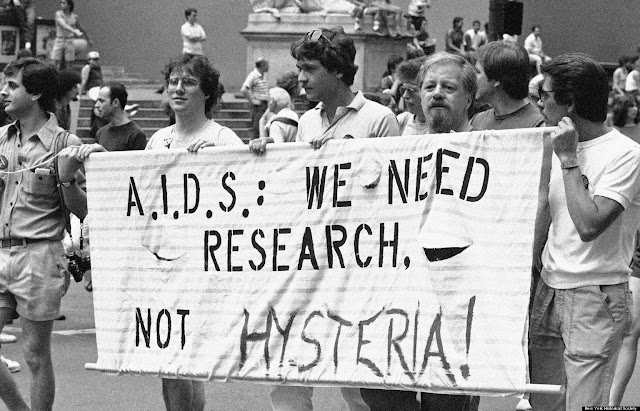
The Only Safe Place Left is the Dark by Warren Wagner

The Only Safe Place Left is the Dark by Warren Wagner

Formats: Print, digital

Publisher: Ghoulish Books

Genre: Apocalypse/Disaster, Zombie

Audience: Adult/Mature

Diversity: Gay man author and main characters, main characters with AIDS

Content Warnings (Highlight to view): Animal Death, Child Death, Death, Drug Use/Abuse, Homophobia, Illness, Medical Procedure, Slurs, Suicide

Blurb

In The Only Safe Place Left is the Dark, an HIV positive gay man must leave the relative safety of his cabin in the woods to brave the zombie apocalypse and find the medication he needs to stay alive.

I received this product for free in return for providing an honest and unbiased review. I received no other compensation. I am disclosing this in accordance with the Federal Trade Commission’s 16 CFR, Part 255: Guides Concerning the Use of Endorsements and Testimonials in Advertising.

I was born during the beginning of the AIDS outbreak, during which my mom lost many of her gay friends. I remember the deep-rooted fear of AIDS that existed during my childhood. In grade school, we attended assemblies about the dangers of AIDS and how it was spread. There were public service ads about AIDS on every TV station. Parents wore red ribbons. As a queer teen I mourned the loss of an entire generation of gay and bisexual men.

One of the doctors I work with through my hospital, a gay man in his eighties who was one of the first physicians to treat AIDS patients, told me about the weekly funerals he attended. No one cared that gay men were dying of a mysterious illness during the conservative Regan administration. Little research was done on the epidemic. This doctor was one of the few who treated AIDS patients back then, using his knowledge of pharmacology to create a treatment regimen through off-label uses of already existing drugs. Of course, he couldn’t openly advertise his services due to the stigma in the medical community, so his patients found him through a whisper network and would visit him under the guise of getting a routine physical.

The Only Safe Place Left is the Dark is a unique zombie apocalypse novella about the AIDS epidemic. The cover of book is meant to invoke the iconic Silence=Death AIDS design from the late 1980s (a poster Quinton keeps in his Cabin). The title of the story comes from a quote in the play The Destiny of Me by writer and activist Larry Kramer, who is best known for co-founding the grassroots political group the AIDS Coalition to Unleash Power (ACT UP).  In the first chapter of the book, Wagner references a New York Times article from July 3, 1981 entitled Rare Cancer Seen in 41 Homosexuals. The article discusses an outbreak of Kaposi’s Sarcoma in New York and San Francisco, a form of cancer that can form lesions on the skin and in the mouth. It wasn’t yet known, but this sub-type of KS was caused by the immune suppression from some of the first HIV cases in the country.

A black poster with a pink triangle on it. Underneath is white font that says "Silence = Death"

Wagner’s zombie virus (if it even is a virus) is particularly terrifying because its victims, referred to as “The Afflicted,” are still awake and aware of what’s happening to them and powerless to stop it. They can feel themselves rotting and falling apart, even being eaten by flies. The zombies don’t want to hurt anyone but are completely unable to control their hunger, so they’ll scream warnings to their victims and plead for forgiveness as they tear them apart. Most disturbingly, they’ll beg uninfected humans to kill them. I suspect the Wagner’s zombies are loosely based on AIDS victims, as zombies are often an allegory for infectious disease. In her journal article Attack of the Living Dead Virus: The Metaphor of Contagious Disease in Zombie Movies English professor Cecilia Petretto explains that, “Much of our fear lies within the nature of disease itself… Disease, ugly as death, has its association with evil stemming back to the Black Plague.” What was known about AIDS was largely based on misconception, and AIDS victims were shunned and regarded as dangerous, much like the Hollywood zombies. In 1986, an article published in the Journal of the American Medical Association about AIDS was entitled Night of the Living Dead II: Slow Virus Encephalopathies and AIDS. Dr. Arthur Fournier, who encountered his first AIDS patient in 1979 while working with Miami’s Haitian community, compared the virus to “the zombie curse.” Before the advent of active antiretroviral therapy (ART), an AIDS diagnosis was often a death sentence. In that way AIDS patients were like the living dead, dying but not truly dead as their bodies were slowly destroyed and they wasted away. Wagner even describes them as “Waiting for a cure. Waiting for the end. They weren’t dead yet, but they weren’t alive either. They were zombies.”

A group advocating AIDS research marches down Fifth Avenue during the 14th annual Lesbian and Gay Pride parade in New York, June 27, 1983. This year’s parade is dedicated to victims of the incurable disease AIDS which primarily afflicts homosexual men. (AP Photo/Mario Suriani)

A group advocating AIDS research marches down Fifth Avenue during the 14th annual Lesbian and Gay Pride parade in New York, June 27, 1983. This year’s parade is dedicated to victims of the incurable disease AIDS which primarily afflicts homosexual men. (AP Photo/Mario Suriani)

Kept alive for 26 years by his antiretroviral medication, Quinton is one of the few humans who survived the zombie apocalypse–survived being the operative word, as he’s not really living, just surviving. He’s all but given up on love and compassion or anything ever getting better. His love for his deceased boyfriend, Frankie, brought him so much pain he’s now become a gruff loner. It’s safe to say Quinton may also be suffering from survivor’s guilt, as both he and his boyfriend were HIV positive but he survived while Frankie died. Worse, Frankie died when Quinton wasn’t there. The story switches between Quinton’s memories of Frankie’s last days and the present.

While out scavenging for more antiretroviral, Quinton meets Billy, a fellow gay man who’s managed to survive the apocalypse and is also HIV positive. But while Quinton has become cold, Billy still openly cares for others, which Quinton sees as a liability. Billy also believes in working together and the importance of community, while Quinton prefers to avoid other people. We learn that one of the reasons Billy has stayed alive so long is because those who are HIV positive are immune to the zombie virus. I thought this was an interesting twist, as outside of The Last of UsCooties, and Blood Quantum I’ve never seen a human with a natural immunity to Zombies in media. AIDS ravages the immune system, yet for some reason protects Quinton and Billy from turning into Afflicted. Being the kind of person who reads science articles about theoretical zombie biology, I did want to know how it all worked, but honestly an explanation isn’t important to the narrative.  

I had a few nitpicks when it came to Billy, a Black character. While he was written well, “Black” was not capitalized when describing him. When referring to race, Black should always be capitalized. Billy was also described as having dreadlocks. As far as I know Billy was not a Rastafarian, therefore his hairstyle should be referred to as locs, not dreadlocks. While these examples are relatively minor issues, it does highlight the importance of doing your research and using sensitivity readers when writing about groups different than your own.

Wagner’s writing is very spartan; there are no grandiloquent descriptions or deep introspections. Instead, he gets his point across without the need for flowery adjectives or metaphors. The only part where this proved an issue for me was when it came to Quinton and Billy’s relationship, which felt very rushed. Otherwise, I appreciated Wagner’s straight-to-the-point style. It’s not often we get a new take on Zombies, but Wagner’s Afflicted managed to add a whole new level of horror to the undead. The history of AIDS is seamlessly interwoven, never forced, throughout the narrative. Wagner uses horror fiction to not only educate readers in a way that feels natural and respectful, but to capture the feelings of despair no doubt felt by many during the AIDS epidemic. The message is clear. Having AIDS may feel bleak, and every day is a fight for survival, but even amongst all the horror there is always love and hope.

Unshod, Cackling, and Naked by Tamika Thompson

Unshod, Cackling, and Naked by Tamika Thompson

Formats: Print, digital

Publisher: Unnerving 

Genre: Apocalypse/Disaster, Killer/Slasher, Sci-Fi Horror, Werebeasts

Audience: Adult/Mature

Diversity: Black main characters and author, lesbian character, Biracial Black/Creek character

Takes Place in: LA, California

Content Warnings (Highlight to view): Alcohol Abuse, Animal Death, Body Shaming, Child Abuse, Child Death, Pedophilia, Police Harassment, Racism, Rape/Sexual Assault, Slurs, Verbal/Emotional Abuse, Violence

Blurb

A beauty pageant veteran appeases her mother by competing for one final crown, only to find herself trapped in a hand-sewn gown that cuts into her flesh. A journalist falls deeply in love with a mysterious woman but discovers his beloved can vanish and reappear hours later in the same spot, as if no time has passed at all. A cash-strapped college student agrees to work in a shop window as a mannequin but quickly learns she’s not free to break her pose. And what happens when the family pet decides it no longer wants to have ‘owners’?

In the grim and often horrific thirteen tales collected here, beauty is violent, and love and hate are the same feeling, laid bare by unbridled obsession. Entering worlds both strange and quotidian, and spanning horror landscapes both speculative and real, asks who among us is worthy of love and who deserves to die?

I received this product for free in return for providing an honest and unbiased review. I received no other compensation. I am disclosing this in accordance with the Federal Trade Commission’s 16 CFR, Part 255: Guides Concerning the Use of Endorsements and Testimonials in Advertising.

I absolutely love horror anthologies, so I was excited to receive Unshod, Cackling, and Naked by Tamika Thompson. Many of the stories in the anthology focus on the balance between humans and nature and the morality of killing, owning, and eating animals. Bridget has Disappeared takes place in a dystopian near-future with disappearing resources which lead to poverty and crime. I Will be Glorious is about coping with loss and a killer tree. The Bats and The Turn are both about diseases that seemingly spread overnight (much like COVID) that cause dogs and bats, respectively, to turn against humans and attack them. The Turn especially focuses on the humanity’s relationship with domesticated animals and describes what would happen if dogs no longer wished to be kept as pets. Similarly, And We Screamed examines humanity’s relationship with livestock, and why we choose to eat some animals and feel entitled to try and control them. It also examines the sanctity of death and dead bodies. I found this story especially interesting because I was probably the exact opposite of the target audience. I eat meat and have several pets. I used to work on a farm with livestock (some of which were being raised for food) as a child, and I volunteered at an animal hospital where I sometimes had to help euthanize sick animals in my teens. In college I majored in biology and had no qualms about dissecting dead animals, including rats and cats (despite being a huge rat and cat lover).

In And We Screamed there’s a scene where the main character refuses to dissect a cat and her classmate points out that it’s messed up because it still has a face. My first thought was “Well, how are you supposed to dissect the eyes if it doesn’t have a face?” (Which turns out to be the teacher’s argument as well.) It was intriguing to be reminded that something I consider routine and mundane was actually horrific for many people, and to see why exactly it was so frightening from their point of view.  I was able to understand and empathize with where the author, and her characters, were coming from, even if I didn’t fully agree with her conclusions. I also recognized the mental disconnect that makes me willing to dissect a rat for science while also dropping over a grand on veterinary bills for a rat I keep as a pet.  Truly a testament to Thompson’s skill as a writer.

My favorite stories in Unshod, Cackling, and Naked were the ones with feminist themes. In I Did it for You a young rape survivor tracks down creepy men and cuts off their small toe, turning them into victims who will have to carry a scar for the rest of their lives, just as she does. She points out to one cop–the one who raped her because he thought she was a prostitute–that losing a toe is nothing like losing your will to live after being sexually assaulted. I always enjoy a good rape revenge story and I appreciated that Thompson makes the sex workers in I Did it for You heroes rather than victims (like they are in most horror), and they feel like real characters rather than stereotypes.  

Mannequin Model is the story from which Unshod, Cackling, and Naked draws its name. In it, a woman acts as a “living doll,” modeling clothing in a store window where she’s objectified and sexually harassed. She’s treated as a literal sex object, with no voice or will, so it’s extremely satisfying when she finally rebels. But my absolute favorite story in the collection is I am Goddess. In it, a woman named Lira wants to convince her husband to pay for face treatments so she can be beautiful. Her marriage to her husband is basically every bad heterosexual relationship you’ve read about on Reddit. Lira works full time and does everything around the house. She pays the mortgage and all the bills out of her paycheck, despite earning the same amount as her husband. Her husband uses his own money to buy himself big-screen TVs and flashy new cars while telling Lira they can’t afford a washer and dryer or a car for her, so she’s stuck doing laundry by hand and taking the bus. He flirts with other women, dismisses her feelings, and ignores her unless he wants sex. But Lira puts up with it with a smile because she has been conditioned her whole like to believe she needs a man to be “complete” and that she’s lucky to have anyone at all considering her appearance. All of Lira’s accomplishments growing up are downplayed until she finds a husband. Her cousin constantly mocks her appearance and makes Lira feel inferior. No wonder she’s trapped in such a toxic relationship. But her husband’s refusal to let her get the one thing she wants, her face treatment, finally pushes Lira over the edge. She finally sees her husband for who he really is, a loser, and all her pent up anger and frustration comes pouring out. She gets even, and it’s glorious. Definitely one of the strongest stories in the collection, in my humble opinion. 

Manhunt by Gretchen Felker-Martin

Manhunt by Gretchen Felker-Martin

Formats: Print, audio, digital

Publisher: Tor Nightfire

Genre: Apocalypse/Disaster, Monster

Audience: Adult/Mature

Diversity: Trans author and characters, queer characters, Native character

Takes Place in: northeastern USA

Content Warnings (Highlight to view): Animal Death, Body Shaming, Cannibalism,  Child Death, Childbirth, Death, Drug Use/Abuse, Eating Disorder, Forced Captivity, Gore, Illness, Kidnapping, Medical Procedures, Oppression, Rape/Sexual Assault, Self-Harm, Slurs, Torture, Transphobia, Verbal/Emotional Abuse, Violence

Blurb

Y: The Last Man meets The Girl With All the Gifts in Gretchen Felker-Martin’s Manhunt, an explosive post-apocalyptic novel that follows trans women and men on a grotesque journey of survival.

Beth and Fran spend their days traveling the ravaged New England coast, hunting feral men and harvesting their organs in a gruesome effort to ensure they’ll never face the same fate.

Robbie lives by his gun and one hard-learned motto: other people aren’t safe.

After a brutal accident entwines the three of them, this found family of survivors must navigate murderous TERFs, a sociopathic billionaire bunker brat, and awkward relationship dynamics―all while outrunning packs of feral men, and their own demons.

Manhunt is a timely, powerful response to every gender-based apocalypse story that failed to consider the existence of transgender and non-binary people, from a powerful new voice in horror.

 received this product for free in return for providing an honest and unbiased review. I received no other compensation. I am disclosing this in accordance with the Federal Trade Commission’s 16 CFR, Part 255: Guides Concerning the Use of Endorsements and Testimonials in Advertising.

Have you ever wondered what happens to trans people in sex-based apocalypses like those in Y: The Last Man or Ōoku: The Inner Chambers? Gretchen Felker-Martin sets out to answer exactly that in her post-apocalypse splatterpunk novel Manhunt.

The T-rex virus transforms anyone with high levels of testosterone—mostly cis-men—into cannibalistic, sex-crazed monsters. Emboldened by the end of the world, a group of TERFs (trans-exclusionary radical “feminists”) have formed their own militia where they hunt and kill any trans women they find. It may seem like a group of militant TERFs is an exaggeration, but it feels like less of a stretch when you consider there’s already a high rate of violence against trans people. In 2021 alone, at least 56 trans and gender non-conforming people were murdered in the US. Transphobic hate crimes have quadrupled over the last five years in the UK. These fake feminists are also more fascist adjacent than they’d like to admit. As Judith Butler accurately pointed out, TERFs “have allied with rightwing attacks on gender” and “The anti-gender ideology is one of the dominant strains of fascism in our times. So, the TERFs will not be part of the contemporary struggle against fascism.” TERFs Lily Cade and Bev Jo Von Dohre have even called for the death of trans women. The fact that trans women in Manhunt can transform into monsters if they don’t have access to anti-androgen medication gives the TERFs exactly the excuse they’ve been waiting for to go from hateful rhetoric to actually destroying that which they hate most (never mind that cis-women with PCOS or congenital adrenal hyperplasia can also transform into feral beasts).

Not only do trans women have to avoid getting killed by the monstrous men, but also running into the militant TERFs who have seized control of most of the northeast. Fran and Beth are two such transwomen trying to survive in the new world, catching feral men and harvesting their testicles for their friend Indy to extract estradiol from. After running afoul of a militant group of TERFs and almost being killed by men, Fran and Beth meet a sharp-shooting trans man named Robbie, who they take on their journey with them. The trio return to Indy’s house with their testicle trophies where they learn she’s been offered a job by a spoiled rich girl who controls a luxurious bunker. But the promises of comfort the bunker offers may hide a deadly truth.

While I personally enjoyed this book, it won’t be for everyone. It is splatterpunk, after all. That means there’s lots of brutal violence (including a cis woman having her uterus cut out of her), gross content (testicle eating), and graphic sex. Everyone in Manhunt is super horny, sometimes at wildly inappropriate times, so Beth, Fran, Indy, and Robbie do a lot of fucking. The sex is hot, sometimes gross, and other times both hot and gross, much like real sex. It was nice to have sex scenes centered around trans pleasure rather than the cis-male gaze. Of course, the graphic description of genitalia might be triggering for some people who experience gender dysphoria, so be aware of that. Speaking of hot sex, a captain in the TERF army named Ramona is sleeping with a non-binary prostitute named Feather. One reviewer claimed this is unrealistic but I have to disagree. A lot of chasers are happy to sleep with trans people but won’t do anything to defend their rights or even stand up for them. Too many people with trans partners see their relationship as a shameful secret to be kept, and Ramona is no different. She’s too much of a coward to do the right thing and just goes along with the TERF army because it’s what’s easy.

Splatterpunk is very hit or miss for me, as many extreme horror books can cross over into misogynistic violence. Manhunt manages to avoid this trap, even though most of the book’s violence is against women (as all the characters, aside from Robbie, are women). Perhaps because it’s other women committing the violence, but I didn’t get that gross feeling I usually do when reading splatterpunk authored by cis men. Even the sexual assault scene didn’t feel gratuitous and was handled well. I also loved how flawed the protagonists are. Some people mistakenly assume LGBTQIA+ characters need to be perfect for it to be considered a “good” portrayal. I believe realistic is preferable to perfect, and I like my queer characters to have character flaws who sometimes do and say problematic things. Both Beth and Fran feel very human. Beth is reckless and insecure; Fran has both passing and class privilege and can sometimes be selfish. Neither of them are bad people, just realistically flawed.

My only complaint about the book (and granted, it’s minor) is that there are so many descriptions of Indi’s fat body. The way she’s described isn’t quite fatphobic, but it did make me feel uncomfortable that there was so much focus on it. I can understand that Indy is dealing with a lot of internalized fatphobia and insecurity, so it makes sense that her character would spend a lot of time focusing on her size and the limitations that come with it. When the story is told from a third-person point of view, there’s no reason for Indy’s weight to be described in such detail, especially since no one else’s body gets that much description or scrutiny. At least she’s never described as gross or unattractive, and Indi even gets to be sexually desirable, which is rare for fat characters outside of fetish porn. It was refreshing to see fat people having passionate sex scenes just like their skinny counterparts. Like I said, it’s a minor complaint and could absolutely be my own hypersensitivity.

Reading this book is like having your brain put in a blender. It’s wild, gross, horny, disgusting, tragic, and hilarious all whipped together into an extreme horror smoothie. In other words, I LOVED it. You have to be at least somewhat familiar with trans culture to fully appreciate the story, which I thought was awesome. There’s also just something extremely satisfying about trans women killing fascist TERFs: not something I’d advocate in real life, but it’s fun and cathartic in fiction. Unsurprisingly, this made a bunch of real-life TERFs very angry. They didn’t like being portrayed as bigoted assholes just because of their bigoted asshole-ish behavior and tried to review bomb Manhunt…which should just make you want to read it more.

Grievers by Adrienne Maree Brown

Grievers by Adrienne Maree Brown

Formats: Print, digital

Publisher: AK Press

Genre: Apocalypse/Disaster

Audience: Adult/Mature

Diversity: Black/African-American, Lesbian

Takes Place in: Detroit, MI, USA

Content Warnings (Highlight to view): Death, Drug Use/Abuse, Illness, Medical Procedures

Blurb

Dune’s mother is patient zero of a mysterious illness that stops people in their tracks—in mid-sentence, mid-action, mid-life—casting them into a nonresponsive state from which no one recovers. Dune must navigate poverty and the loss of her mother as Detroit’s hospitals, morgues, and graveyards begin to overflow. As the quarantined city slowly empties of life, she investigates what caused the plague, and what might end it, following in the footsteps of her late researcher father, who has a physical model of Detroit’s history and losses set up in their basement. She dusts it off and begins tracking the sick and dying, discovering patterns, finding comrades in curiosity, conspiracies for the fertile ground of the city, and the unexpected magic that emerges when the debt of grief is cleared.

I received this product for free in return for providing an honest and unbiased review. I received no other compensation. I am disclosing this in accordance with the Federal Trade Commission’s 16 CFR, Part 255: Guides Concerning the Use of Endorsements and Testimonials in Advertising.

“Grief was an amalgamation of absence narratives layered over each other”

Death positivity is the philosophy that death and grief should be spoken of openly and that treating the subject as taboo does more harm than good. It encourages people to learn about end-of-life care, make plans for their own deaths, be involved in the care of their dead loved ones, and explore their curiosity and feelings surrounding death. In a way, Grievers is a death-positive book. The story explores what it’s like to lose the people you love, care for the dying, prepare for death, and the mourning process. Most horror skims over the death of its characters, their lives nothing more than cheap fodder for the reader’s entertainment. But in Grievers, you feel the weight of every death.

A mysterious illness is sweeping Detroit and killing its Black population. Dubbed “H8”, it leaves its victims frozen in place with grief-stricken faces. A social justice activist named Kama is the first to contract the disease. Unable to afford a hospital, Dune, Kama’s only child, cares for her mother at home by feeding her, changing her, and keeping her as comfortable as she can. Dune, distrustful of the system that failed them, decides to cremate her mother herself when Kama finally passes. Dune’s act of cremating her own mother (although not something I would recommend as it’s neither safe nor legal) is described as “sacred work,” a ritual that allows her to be close to her mother one last time.

Death rituals, whether religious or secular, perform a necessary function in the grieving process. In his research on grieving rituals Michael I. Norton, a professor at Harvard Business School, discovered the following:

“Despite the variance in the form that rituals take… a common psychological mechanism underlies their effectiveness: a restoration of feelings of control that losses impair. Indeed, people who suffer losses often report feeling out of control and actively try to regain control when they feel it slipping away; feeling in control, in turn, is associated with increased well-being, physical health, and coping ability.” [1]

In the story, a group of traditional Chinese medicine practitioners perform grieving rituals believing that this will protect them from H8, a disease, they theorize, that targets the lungs where grief is held. Dune performs grief rituals to help overcome the immense sense of loss she’s experiencing. The first is cremating her mother in her backyard. The second is “telling” her dead father that her mother has passed. The third, and most important, is creating a record of everyone who has fallen ill and marking their locations with pins on her father’s model of Detroit. The last project gives her something to do, a way of combatting her sense of helplessness as the world falls apart around her. After slipping into a deep depression and shutting herself away, collecting data on the infected gives Dune a new sense of purpose and feeling of control. She organizes her data onto index cards and files them away, creating order out of chaos.

The way Brown represents grief is both beautiful and heartbreaking. Dune isolates herself from the world, too depressed to even plan a memorial service for her mother. She physically carries the weight of her grief as she gains weight during her depression. Eventually, Dune finds ways to cope with her grief. In addition to the rituals providing her with a sense of control, Dune also focuses on survival and caring for her elderly grandmother, Mama Vivian. She harvests produce from community gardens and cans them for the winter. She changes, feeds, and sings to her grandmother. She eventually reaches out to one of her mother’s activist friends for emotional support. It’s not always easy. Dune blows up at a volunteer food distributor without really knowing why, other than just needing someone to lash out at. She dips back into a depression when other people she cares about die. But she keeps surviving, and slowly things start to improve. Brown describes the feeling of slowly emerging from a deep depression perfectly: “Dune was beginning to feel aware of her own aliveness again – not quite a desire to live, just a growing, surprising awareness that she was not dead.” While this may not sound like much, it’s still a step forward in Dune’s path to healing and an improvement from the beginning of the story when “the detritus of grief became Dune’s comfort.” As someone who suffers from clinical depression themselves, I can say that just feeling alive again is such a huge step forward. At the same time, her father’s model, now thick with markers, is starting to sprout little green shoots: new life that has started to grow in the basement against all odds.

A year defined by a pandemic and protests, 2020 was especially difficult for Black Americans. Black communities were hit especially hard by Covid-19, and our anger and frustration with a racist system reached a boiling point with the murder of George Floyd by a White police officer. Grievers may be fiction, but it captures the very real feelings of pain and loss the Black community has been feeling recently. The H8 virus is a metaphor for both Covid and the pain caused by racism. “Hate” is literally killing Black people by destroying them emotionally and no one seems to be able to quell the spread of the disease. Like Covid, everyone knows someone who died from the virus. The city seems to shut down overnight as the wealthy flee and hospitals are overwhelmed.

Grievers does not follow a standard three arch story structure. There’s no antagonist to overcome, no climax, or satisfying resolution. If you’re looking for traditional storytelling, then this book isn’t for you. If you want a beautiful, heartbreaking, death-positive horror story that focuses on one woman’s battle with grief and just trying to survive a pandemic that feels all too familiar, I highly recommend Grievers.

[1] From the Journal of Experimental Psychology

The Marrow Thieves by Cherie Dimaline

The Marrow Thieves by Cherie Dimaline

Formats: Print, audio, digital

Publisher: Dancing Cat Books

Genre: Apocalypse/Disaster, Body Horror, Sci-Fi Horror

Audience: Y/A

Diversity: American/Indian and Indigenous characters (Mostly Métis, Anishinaabe, and Cree), Black/Indo-Caribbean/Biracial character, gay male characters

Takes Place in: Toronto, Canada

Content Warnings (Highlight to view): Alcohol Abuse, Amputation, Child Abuse, Child Death, Child Endangerment, Death, Drug Use/Abuse, Forced Captivity, Kidnapping, Medical Torture/Abuse, Pedophilia, Police Harassment, Racism, Rape/Sexual Assault, Sexual Abuse, Slurs, Suicide, Violence

Blurb

In a futuristic world ravaged by global warming, people have lost the ability to dream, and the dreamlessness has led to widespread madness. The only people still able to dream are North America’s Indigenous people, and it is their marrow that holds the cure for the rest of the world. But getting the marrow, and dreams, means death for the unwilling donors. Driven to flight, a fifteen-year-old and his companions struggle for survival, attempt to reunite with loved ones and take refuge from the “recruiters” who seek them out to bring them to the marrow-stealing “factories.”

***CONTENT WARNING: In this review I will be discussing Indigenous American (Canadian, Mexican, and the US) history and residential schools/Indian boarding schools, with a primary focus on Canada where the Marrow Thieves takes place. I will be touching on genocide, forced assimilation, abuse, sexual assault, trauma, and addiction. There will also be images of verbal abuse and the effects of trauma. Please proceed with caution and take breaks if you need to. For my Indigenous readers: if you feel at all distressed or disturbed while reading this, or just need support in general, there are resources for the US and Canada here and here respectively. If you need extra help you can also find Indigenous-friendly therapists here and here to talk to. If you are a abuse survivor, are being abused, or know someone who is, please go here. There are further links at the end of the review. Please reach out if you need to!***

I have tried to use mainly Indigenous created articles, websites, books, films, and interviews for reference when writing this review. I have also included multiple quotes from residential school survivors, as I felt I could not do justice to their vastly different experiences without using their own words. However, I can only cover a fraction of a long and complex history. I strongly encourage everyone to check out the books, videos, and podcasts I have listed at the end of the review. Kú’daa Dr. Debbie Reese for providing such an excellent list of suggestions for residential school resources! They were a huge help in this review. And speaking or Dr. Reese, check out her review of The Marrow Thieves as well as Johnnie Jae’s Native book list. And another big thank you to Tiff Morris for being my sensitivity reader for this review. Your help and advice was invaluable! Wela’lin!

When I first read The Marrow Thieves years ago it didn’t impact me the way it does now. Back in 2017 a worldwide pandemic still existed solely in the realm of science fiction. Much like a giant asteroid destroying the earth, it was technically possible but so unlikely that such a scenario wasn’t worth worrying about. Re-reading the dystopian horror novel in 2020 was a completely different and utterly terrifying experience. Even knowing how the story would end was not enough to quell my anxiety and I felt on edge the entire time. The fact that Cherie Dimaline’s used real world atrocities committed against Indigenous people just makes the story feel even more plausible and horrifying. Water rightsviolence against Indigenous womencultural appropriationclimate change, cultural erasure, and the trauma caused by residential schools are all referenced.

The book opens with the protagonist Frenchie, a young Métis boy, watching helplessly as his Brother Mitch is beaten and kidnapped by Recruiters, a group of government thugs tasked with capturing Indigenous people for the purpose of extracting their bone marrow. Now alone, and with no idea how to survive on his own Frenchie has to be rescued from starvation by a small band of Indigenous (mostly Anishinaabe and Métis) travelers. The group welcomes the young boy as one of their own, and he soon comes to see them as an adoptive family as the ragtag bunch works together to survive and protect each other.

Miig is the patriarch of the group, an older gay gentleman who likes to speak in metaphor and teaches the older kids Indigenous history through storytelling. He also trains Frenchie and the others to hunt, travel undetected, and generally survive in their harsh new reality. Miig might seem cold at first but he genuinely loves the kids, he just prefers to show it through actions rather than words. Dimaline did an excellent job writing Miig and he felt like a real person rather that a lazy gay stereotype. I absolutely adore his character. He’s got the whole “gruff but kind dad” thing going. Minerva is another one of my favorites, a cool and cheerful Elder who acts as the heart of the group and teaches the girls Anishinaabemowin, as most of the kids have lost their original languages. She keeps all of them to the past. Minerva also raised the youngest member of the group, Riri, a curious and spunky 7-year-old who ends up bonding with Frenchie. Riri was only a baby when she was rescued and has no memory of a time before they were forced into a nomadic lifestyle in order to avoid the Recruiters so, unlike the others, she has nothing to miss. Cheerful and lively Riri never fails to raise everyone’s spirits or give them hope for a better future.

The rest of the kids range from nine to young adulthood. Wab is the eldest girl, beautiful and fierce and “as the woman of the group she was in charge of the important things.” Then there’s Chi-boy, a Cree teenager who rarely speaks. The youngest are the twins Tree and Zheegwan, followed by Slopper, a greedy 9-year-old from the east coast who likes to complain and brings his adoptive family the levity they all need. Later on they’re joined by Rose, a biracial Black/White River First Nation teen who Frenchie immediately develops a crush on. And I can’t really blame him because Rose is a total bad ass. All of them have lost people to the residential schools and some, like the twins, were even victims of “marrow thieves” themselves. But they all support each other and survive despite the difficulties they’ve faced.

No one knows what caused the dreamless disease rapidly infecting the country, an illness that causes the victim to stop dreaming and slowly descend into madness, only that Indigenous people are immune. And yes, I do appreciate the irony of a plague that only affects Colonizers. Perhaps it’s divine retribution for Jeffery Amherst’s (yes that Amherstgerm warfare. When their immunity is discovered people begin to flock to Native nations begging for help. But Indigenous people are understandably reluctant, having been burned too many times before. They don’t want to share their sacred ceremonies and traditions with outsiders, and for very good reason. Non-Natives quickly get tired of asking and do what they do best: take what they want, in this case Indigenous practices and later Indigenous bodies. The few survivors who do manage to escape the new residential schools often return with parts of themselves missing, an apt metaphor for real residential schools. Although set in a fictional future The Marrow Thieves dives into a past that Colonialism has actively tried to suppress.

Indigenous history is rarely taught in either US or Canadian schools (outside of elective courses) and what is taught is often grossly inaccurate. To quote Dr. Debbie Reese’s post about representation in the best-selling paperbacks of all time: “23,999,617 readers (children, presumably) have read about savage, primitive, heroic, stealthy, lazy, tragic, chiefs, braves, squaws, and papooses.” In America we’re taught that the Wampanoag (who are never mentioned by name) showed up to save their pilgrims friends from starvation and celebrate the first Thanksgiving, with no mention of the English massacre of the Pequot, Natives being sold into slavery, or the Colonists’ grave robbing. After 1621, mentions of American Indians are scarce to non-existent. There might be a brief paragraph here and there in a high school textbook about the Iroquois Nation siding with the British in the Revolutionary War, or the Trail of Tears.

2015 study of US history classes, grades K-12, showed that over 86% of schools didn’t teach modern (post-1900) Indigenous history and American Indians were largely portrayed “as barriers to America progress. As a result, students might think that Indigenous People are gone for one reason—they were against the creation of the United States.” Few students are ever told about the mass genocide of American Indians, smallpox blankets, the government’s unlawful seizure of Native land, the many broken treaties, destruction of culture, and forced experimentation. American Indian writer and activist Suzan Shown Harjo points out in an interview “When you move a people from one place to another, when you displace people, when you wrench people from their homelands, wasn’t that genocide? We don’t make the case that there was genocide. We know there was, yet here we are.” You would think that American history would dedicate more than a paragraph to THE PEOPLE WHO FUCKING LIVED IN AMERICA. I’m not that familiar with the Canadian education system, but according to Métis writer and legal scholar Chelsea Vowel they’re not much better at teaching the history of First Nation, Inuit, and Métis people. The omission of Indigenous Americans and Canadians from history lessons is just another form of erasure that contributes to the continued systemic oppression of First Peoples by a racist and colonialist system.

A White teacher stands in front of her class and is pointing to racist, stereotypical cartoon images of Pilgrims and Indians. The teacher says “The Indians helped the pilgrims and they became best friends! Then the Indians all voluntarily left so we could found America. Too bad there aren’t any Indians anymore!” The only non-White child in the class, a Native girl raises her hand and say “Um, actually the Wampanoag and lots of other American Indian tribes are still around even though the colonizers tried to get rid of us and stole our land. I’m Seneca and my family and I are still here.” The cheerful teacher says “I said…” then she turns menacing “…The Indians and Pilgrims were FRIENDS and they left voluntarily. So stop making things up. Now it’s time to make construction paper Indian head dresses kids!”

The sad thing is, the “Pilgrim and Indian” drawings are based on actual, present day “lessons” from teaching websites. This comic is loosely based on my experience as the only Black kid in class when we learned about the Civil War. The Seneca girl is wearing a “Every Child Matters” orange shirt for Residential Schools survivors.

White supremacist Andrew Jackson believed American Indians had “neither the intelligence, the industry, the moral habits, not the desire of improvement” and used this to justify the numerous acts of Cultural Genocide he committed. One of the worst was the Indian Removal Act, which forced the Cherokee, Choctaw, Chickasaw, Creek and Seminole to choose between assimilation or leaving their homelands. Justin Giles, assistant director of the Muscogee (Creek) Nation Museum, describes it as, “You can have one of two things: you can keep your sovereignty, but you can’t keep your land. If you keep your land you have to assimilate and no longer be Indian… you can’t have both.” While reading The Marrow Thieves, I was struck by how much the world Dimaline created felt like a futuristic Nazi Germany. It makes sense considering “American Indian law played a role in the Nazi formulation of Jewish policies and laws” according to professor of law Robert J. Miller. Good job America, you helped create the Holocaust. I’m sure Andrew Jackson would be proud.

But people tend to object to mass murder and breaking treaties, even in the 1830’s. Jackson’s Indian Removal Act was controversial and drew a great deal of criticism, most notably from Davy Crockett and Ralph Waldo Emerson. Christian missionary and activist Jeremiah Evarts wrote a series of famous essays against the Removal Act that accused Jackson of lacking in morality. So even back then folks hated the 7th president for being a lying, racist piece of shit. Of course that didn’t necessarily mean they were accepting of the people they saw as “savages.” A line from They Called it Prairie Light sums it up best: “Europeans were at first skeptical of the humanity of the inhabitants of the American continents, but most were soon persuaded that these so-called Indians had souls worthy of redemption.”  So how could they “kill” Indians without actually killing them and looking like the bad guys? Richard Henry Pratt came up with the solution. Changing everything about Indigenous people to make them as close to Whiteness as possible.

“A great general has said that the only good Indian is a dead one. In a sense, I agree with the sentiment but only in this: that all the Indian there is in the race should be dead. Kill the Indian in him, and save the man.” – Richard Henry Pratt

Pratt was a former Brigadier General who had fought in the Union during the Civil War. He spoke out against racial segregation, lead an all Black regiment known as the “Buffalo Soldiers” in 1867 (yes, the ones from the Bob Marley song), and unlike Jackson, actually viewed the American Indians as people. Unfortunately, like most “White Saviors,” Pratt was ignorant, misguided and believed Euro-Americans were superior. “Federal commitment to boarding schools and their ‘appropriate’ education for Native Americans sprouted from the enduring rootstock of European misperceptions of America’s natives.” (Tsianina Lomawaima). And so Pratt decided the best way to help American Indians was to remove children from their homes to teach them “the value of hard work” and the superiority of Euro-American culture. Pratt had already practiced turning Cheyenne prisoners of war at Fort Marion into “good Indians” and he was convinced an Indian school would be equally successful. So in 1879 he founded the Carlisle Indian Industrial School, the first Indian boarding school in the US.

“Soon, they needed too many bodies, and they turned to history to show them how to best keep us warehoused, how to best position the culling. That’s when the new residential schools started growing up from the dirt like poisonous brick mushrooms. We go to the schools and they leach the dreams from where our ancestors hid them, in the honeycombs of slushy marrow buried in our bones. And us? Well, we join our ancestors, hoping we left enough dreams behind for the next generation to stumble across.”

Miig telling the kids how the bone marrow harvesting started.

“Civilizing” American Indian children by separating them from their cultural roots and teaching them Eurocentric values was not a new idea: The Catholic church had already been doing it for years. But it was Pratt who made it widespread. At the school, students were forced to cut their long hair, adopt White names and clothing, speak only in English, and convert to Christianity. Failure to comply would be met with corporal punishment from Pratt, who ran the school like an army barrack. Understandably, Indigenous people —   who had no reason to trust a nation of treaty breakers —    were initially reluctant to send their children away from their families to go to school. But Pratt convinced Lakota chief Siŋté Glešká aka Spotted Tail (one of three chiefs who had travelled to Washington to try and convince President Grant to honor the treaties the US had made) that an English education was essential to survival in an increasingly Euro-centric America. He argued that if Spotted Tail and his people were able to read the treaties they signed, they never would’ve been forced from their land. He would teach the students so they could return home and in turn help their people. Reluctantly the chief agreed to send the children Dakota Rosebud reservation, including his own sons, to Carlise. Ten years later Pratt’s “save the Indian” goal became a National policy and Natives no longer had a choice in the matter.

“As girls, Martha and young Frances found the atmosphere of the school alien, unfriendly, and oppressive. Both had been raised by nurturing parents of the leadership class, and neither had been abused as a child. They had learned the traditions and laws of their tribes, but the church had not had a strong presence on the San Manuel Reservation. When the girls entered the St. Boniface school, their parents had agreed to their enrollment so that they could cope better with an ever-changing society dominated by non-Indians. Furthermore, their parents expected them to be future leaders of the tribe and felt that training at an off-reservation boarding school would better prepare them for tribal responsibilities.” (Trafzer)

Canada was also pushing for assimilation and, using Pratt’s Residential School model, began to develop their own “off-reserve” schools. In 1920 Duncan Campbell Scott, the Deputy Superintendent of Indian Affairs for Canada from 1913 to 1932, passed the Indian Act. The bill made school attendance mandatory for all Indigenous children under the age of 15. Anyone who refused could be arrested and their children taken away by truant officers, the basis for Dimaline’s Recruiters. Residential school survivor Howard Stacy Jones describes how she was snatched by Mounted Police from her public school in Port Renfrew British Columbia and brought to a residential school: “I was kidnapped when I was around six years old, and this happened right in the schoolyard. My auntie and another witnessed this… saw me fighting, trying to get away from the two RCMP officers that threw me in the back seat of the car and drove away with me. My mom didn’t know where I was for three days.”

Scott famously said “I want to get rid of the Indian problem. . . Our objective is to continue until there is not a single Indian in Canada that has not been absorbed into the body politic and there is no Indian question, and no Indian Department, that is the whole object of this Bill.” Schools in the US and Canada did have some dissimilarities. While the U.S. moved away from mission schools in favor of government run ones, most Canadian residential schools continue to be run by Christian missionaries and supported by several churches. As a result, federal control was weaker in Canada and the goal of converting Indigenous people to Catholicism and Protestantism remained at the forefront. Interestingly, during my research I found that Indigenous people reported a wide variety of experiences in US residential schools ranging from positive to negative, whereas the stories about Canadian ones were overwhelmingly negative.  It’s possible that the Canadian residential schools were somehow worse than US ones, possibly due to the strong influence of the state and little government regulation, but I don’t want to draw conclusions on a topic I simply don’t know enough about. Besides it’s not my place to compare the experiences of survivors like that.

Still, I was genuinely surprised to find so many positive memories reported by former US residential school students who felt they benefited from their time there. While conducting interviews for They Called it Prairie Light Tsianina Lomawaima revealed that former Chilocco students had nothing but good things to say about L. E. Correll, the school’s superintendent from 1926 to 1952. “The participants in this research concurred unanimously in their positive assessment of Correll’s leadership, a testimonial to his commitment to students and the school. Alumni references to Mr. Correll… all share a positive tone. He is described as Chilocco’s ‘driving force,’ ‘wonderful,’ [and] ‘a fine man, we called him ‘Dad Correll.'” I bring this up not to minimize the damage the schools did nor excuse the atrocities they committed, but to illustrate the complexity of this topic. It would also be disingenuous not include the wide range of experiences at these schools. Another student at Chilocco wrote a letter to a North Dakota Agency complaining of a broken collarbone and not enough to eat only to be told to stop “whining about little matters.” Another student refused to Chilocco explaining, “I could stay there [at Chilocco) if they furnished clothing and good food. I don’t like to have bread and water three times a day, and beside work real hard, then get old clothes that been wear for three years at Chilocco [sic]. I rather go back to Cheyenne School.”

Regardless, all the schools caused lasting damage to Indigenous culture and communities. What Canada and the US claimed called assimilation “more accurately should be called ethnic cleansing…” explains Dr. Jennifer Nez Denetdale a Najavo Professor of American Studies at the University of New Mexico. Pratt may have had good intentions, but remember what they say the road to hell is paved with. Much like voluntourism today attempts to “help” American Indians through assimilation were rooted in colonialism and hurt more than they helped. Forrest S. Cuch, former director of the Utah Division of Indian Affairs describes the damage done to his tribe, the Utes. “Assimilation affected the Utes in a very tragic way. It was so ineffective that it did not train us to become competent in the White World and it took us away from our own culture, so much so that we weren’t even competent as Indians anymore.” “Children do not understand their language and they’re Navajos. This was done to us.” explained Navajo/Dine elder Katherine Smith. Assimilation was nothing short of Cultural genocide as defined by the 2015 the Truth and Reconciliation Commission of Canada:

“…the destruction of those structures and practices that allow the group to continue as a group. States that engage in cultural genocide set out to destroy the political and social institutions of the targeted group… Languages are banned. Spiritual leaders are persecuted, spiritual practices are forbidden, and objects of spiritual value are confiscated and destroyed. And, most significantly to the issue at hand, families are disrupted to prevent the transmission of cultural values and identity from one generation to the next.”

Residential boarding schools are yet another atrocity that remains suspiciously absent from American and Canadian history books, but they are popular in Indigenous horror (Rhymes for Young GhoulsThe Candy MeisterThese Walls), and for good reason. Survivors describe deplorable living conditions, rampant abuse, rape, starvation, and being torn away from their families and culture. Homesickness was a common problem for young children who had spent their entire lives surrounded by family. Ernest White Thunder, the son of chief White Thunder, became so homesick and depressed he refused to eat or take medicine until he finally died.

“Students arriving at Chilocco [Residential School] met the discrepancies between institutional life and family life at every turn. Military discipline entailed a high level of surveillance of students but constant adult supervision and control was impossible. The high ratio of students to adults and the comprehensive power wielded by those few adults compromised any flowering of surrogate parenting. In the dormitories, four adults might be responsible for over two hundred children. The loss of the parent/child relationship and the attenuated contact with school personnel reinforced bonds among the students, who forged new kinds of family ties within dorm rooms, work details, and gang territories. Dormitory home life-siblings and peers, living quarters and conditions, food and clothing, response to discipline-dominates narratives.”  (Tsianina Lomawaima)

Running away was common and could end tragically. Kathleen Wood shared one of her memories of students who ran away: “There were three boys that ran away from [Chuska Boarding School]. They wanted to go home… They were three brothers, they were from Naschitti. They ran away from here as winter… They did find the boys after a while, but the sad part is all three boys lost their legs.” Not everyone survived their attempts to return home, as was the tragic case for Chanie “Charlie” Wenjack (trigger warning for description of child death). At the Fort William Indian Residential School 6 children died and 16 more disappeared.

Indigenous children first entering residential school would often have their long hair cut short, an undoubtedly traumatic experience for many children. For the Cheyenne the cutting of hair is done as a sign of mourning and deathRoy Smith, a member of the Navajo Nation (Diné) where long hair is an essential part of one’s identity, describes his experience: “They all looked at me when they were giving me my haircut… My long hair falling off. And I was really hurt. The teaching from my grandfather was… your long hair is your strength, and your long hair is your wisdom, your knowledge.” Hair is also holds spiritual importance to the Nishnawbe Aski. An anonymous Nishnawbe Aski School survivor was left deeply hurt be her hair cut:

“When I was a girl. I had nice long black hair. My mother used to brush my hair for me and make braids. I would let the braids hang behind me or I would move them over my shoulders so they hung down front. I liked it when they were in front because I could see those little colored ribbons and they reminded me of my mother. Before I left home for residential school at Kenora my mother did my hair up in braids so I would look nice when I went to school. The first thing they did when I arrived at the school was to cut my braids off and throw them away. I was so hurt by their actions and I cried. It was as if they threw a part of me away – discarded in the garbage.” – Anonymous

***Content warning, descriptions of child abuse and sexual assault and an image of verbal abuse of a child below***

Students were severely beaten for not displaying unquestioning obedience and sometimes for no reason at all. Those in charge would constantly reinforce the message that Indigenous people were stupid, worthless, and inferior to Whites, destroying the children’s sense of self-worth. Some students were forced to kneel for long stretches of time, hold up heavy books in their outstretched arms, or locked in the basement for hours. Children would be force-fed spoiled meat and fish until they vomited, then forced to eat their own vomit. Some were even electrocuted. Chief Edmund Metatawabin recalls his experience at St. Anne’s Indian Residential School:

There was [an electric chair with] a metal handle on both sides you have to hold on to and there were brothers and sisters sitting around in the boys’ room. And of course the boys were all lined up. And somebody turned the power on and you can’t let go once the power goes on. You can’t let go… my feet were flying in front of me and I heard laughter. The nuns and the brothers were all laughing.” – Edmund Metatawabin

From 1992 until 1998 Ontario Provincial Police launched an investigation into the abuse at St. Anne’s Residential School after Chief Edmund Metatawabin presented them with evidence of the crimes. The police took statements from 700 St. Anne’s survivors, many of whom described incidents of sexual assault and abuse involving priests, nuns, and other staff. During her interview one survivor said “This shouldn’t have happened to us. They’re God’s workers, they were to look after us.” (link contains graphic descriptions of abuse). One figure estimates that one in five  students were sexually abused when attending residential school. But schools would cover up the abuse, and anyone who complained was intimidated into silence.

A priest is forcing a ball and chain, representing trauma, to a little girl in a residential school uniform. She is surrounded by red and orange speech bubbles saying cruel things like "Dirty Indian!," "Shut up! Stupid Girl! Do as you're told!," "Savage!," and "You're going to hell for your pagan beliefs. You need religion."

The verbal abuse shown here is paraphrased from actual things said to Residential school survivals. They are taken from interviews and autobiographies. If you or someone you know is being abused, go here. Learn more about forms of abuse here.

All this pain and suffering was committed under the pretense of “civilizing” Native people, when in reality it was Cultural Genocide driven by White supremacy. “The whole move was to make Indian children white… Of course, at the end of the school experience, the children still weren’t white. They were not accepted by White mainstream America. When they went back to their tribal homelands, they didn’t fit in at home anymore either.” says Kay McGowan, who teaches cultural anthropology at Eastern Michigan University. Inuvialuit author Margaret Pokiak-Fenton describes how her mother did not even recognize her when she returned home in her children’s book Not my Girl. As if the rejection wasn’t heart breaking enough, Margaret had forgotten much of her own language and struggled to communicate with her family. Another residential school survivor, Elaine Durocher, says “They were there to discipline you, teach you, beat you, rape you, molest you, but I never got an education…. [instead] it taught me how to lie, how to manipulate, how to exchange sexual favors for cash, meals, whatever the case may be.” In a video for Women’s Centre she volunteers at she discusses how “The teachers were always hitting us because we were just ‘stupid Indians'”.

***End of content warning***

“[People] need to know that it was an event that happened to a lot of kids, that it wasn’t just a few; it was literally thousands of kids that suffered. I’ve come to realize that there were also others where the experience for them was actually very good, and I don’t question that. I can only relate to mine. Mine wasn’t a good one, and I know a lot of really good friends who also did not have a good experience.” – Joseph Williams

In The Marrow Thieves the government and the church join forces to perform experiments on prisoners, and later Indigenous people, in order to find a cure for the dreamless plague. And if you were hoping that was just a metaphor for destroying cultural identities and real residential schools never sunk so low as to experiment on helpless children, well, you’d be wrong. Science has a dark history of exploiting the most vulnerable populations for unethical experiments. In the U.S. alone enslaved women were tortured and mutilated by the father of gynecology  without any form of anesthesia (1845-1849), the government backed Tuskegee syphilis experiment (1932-1972) infected hundreds of Black men without their knowledge or consent, a stuttering experiment (1939) performed on orphans is now known as “The Monster Study,” elderly Jewish patients were injected with liver cancer cells (1963) to “discover the secret of how healthy bodies fight the invasion of malignant cells,” and inmates in the Holmesburg Prison were used to test the effects of various toxic chemicals on skin (1951-1974).

In the 1920s experimental eyes surgeries to treat trachoma were conducted on Southwestern US Natives. The contagious eye disease became an epidemic on Southwestern reservations, affecting up to 40% of some tribal groups. “Some tribes, such as the Navajo, experienced no “sore eyes” prior to their defeat by the United States, yet once confined to the reservation, they witnessed a significant increase in unexplained eye problems.” (Trennert) GEE I WONDER WHY. Maybe it had something to do with being forced to live in poverty on shitty reservations where their access to healthcare and sanitation was limited? The government decided to “help” by once again making it worse. The Indian office opened an eye clinic and hired the Otolaryngologist Dr. Ancil Martin to run it. Dr. Martin began the student treatment program before he had any idea how to cure trachoma. He decided to test out a surgical procedure called “grattage” which involved cutting the granules off the eyelids (without anesthesia of coure). One little girl described the experience: “During the operation they cut off little rough things from under the eyelid. It was a grisly scene, with blood running all over. The children had to be held down tight.” (Trennert) Unfortunately the experimental treatment only provided temporary relief and those children who recovered where left with permanent damage to their eyelids. Later, as part of the “Southwestern Trachoma Campaign,” ophthalmologist Dr. Webster Fox convinced the Indian Office to take even more drastic measures and surgically remove the tarsus (the plate of connective tissue inside each eyelid that contributes to the eyelids form and support). His reasoning for this was because he did not believe Indians would submit to prolonged treatment and it was better to “remove the disease more quickly and with less deformity than the way Nature goes about it.” Yikes.

In case you were hoping this was a tragic but isolated incident, I’m afraid I have some bad news for you. When giving testimony to the Truth and Reconciliation Commission of Canada survivors consistently described an environment where “hunger was never absent.” Residential school meals were typical low in calories (they ranged from 1000 to 1450 calories per day, undernourishment is considered less than 1,800 calories per day), vegetables, fruit, protein, and fat, all essential parts of a growing child’s diet. “We cried to have something good to eat before we sleep. A lot of the times the food we had was rancid, full of maggots, stink. Sometimes we would sneak away from school to go visit our aunts or uncles, just to have a piece of bannock.” explained school survivor Andrew Paul. Food-borne illnesses were another common occurrence. Although at least partly due to negligence or a lack of funds some schools intentionally withheld food to see how the children’s bodies would react to malnutrition, especially as they fought off viruses and infections. “When investigators came to the schools in the mid-1940s they discovered widespread malnutrition at both of the schools” explained food historian Dr. Ian Mosby. ” “In the 1940s, there were a lot of questions about what are human requirements for vitamins… Malnourished aboriginal people became viewed as possible means of testing these theories.” Mosby said an interview with the Toronto Star. And so Indigenous Canadian children became unwitting guinea pigs in an unethical study. Between 1942 and 1952 Dr. Percy Moore, head of the superintendent for medical services for the Department of Indian Affairs, and Dr. Frederick Tisdall, former president of the Canadian Pediatric Society performed illicit nutrition experiments on students at St. Mary’s School. Milk and dairy rations were withheld. Instead children were given a fortified flour mixture containing B vitamins and bone meal. The experimental supplement impacted their development and caused children to become dangerously anemic, and continued to have negative effects on them as adults. Incidentally, this experimental flour mix was illegal in the rest of Canada.

A decade later the U.S. Air Force’s Arctic Aeromedical Laboratory in Fairbanks wanted to study the role the thyroid gland played in acclimating humans to cold in hopes of improving their operational capability in cold environments. The hypothesis was that Alaskan Natives were somehow physically better adapted to cold environments than White people This is another example of scientific racism as the study didn’t bother looking at the White inhabitants of the Arctic Circle:  Greenlanders, who hypothetically should have a similar resistance to the cold. Instead, they chose to focus on Alaskan Natives almost as if they were a different species. The othering didn’t end there. Participants (84 Inuit, 17 Athabascan Indians, and 19 White service members) were given a medical tracer, the radioisotope iodine 131 to measure thyroid function. Guess who wasn’t told they were part of the experiment? Instead of informing the Indigenous test subjects they were participating in a research study as would’ve been required by the recently created Nuremberg Code (the first point in the code literally says “The voluntary consent of the human subject is absolutely essential”), the scientists just said “Fuck it, we do what we want!” I mean, it’s not like someone might want to know they were being given RADIOACTIVE MATERIAL or anything right? Not only did the experiment offer no potential benefit to the Alaskan Natives who participated but the original hypothesis was disproven. The Airforce provided no follow up tests or treatment for the test subjects to insure they hadn’t suffered any long-term effects.

Students at Kenora residential school were used as test subjects for ear infection drugs, again without their knowledge or consent. School nurse Kathleen Stewart wrote in her report “The most conspicuous evidence of ear trouble at Cecilia Jeffrey School has been the offensive odor of the children’s breath, discharging ears, lack of sustained attention, poor enunciation when speaking and loud talking,” In a follow-up report she noted three children “were almost deaf with no ear drums, six had [hearing in] one ear gone.”

Human research violations aren’t just a problem of the distant past before the IRB was established. In 1979 Native leaders asked researchers to help them assess the drinking problem in their community in Barrow, Alaska. They were hoping to cooperate with them to find a solution. Instead the researchers went ahead and publicly shared the results of the Barrow Alcohol Study with news outlets. Because the study implied the majority of adults in Barrow were alcoholics (which was inaccurate), left out the socioeconomic context which led to drinking problems, and then announced the results without representatives from the tribal community, it caused both a great deal of shame and direct financial harm. Starting in the 1990s, Arizona State University obtained blood from the Havasupai tribe under false pretenses. Instead of using the samples for diabetes research like they had promised the tribal members, researchers used the Havasupai’s DNA for a wide range of genetic studies. This continued until 2003 when a Havasupai college student discovered how the blood was being used without permission. Carletta Tilousi explained in an NPR Interview “Part of it is it was a part of my body that was taken from me, a part of my blood and a part of our bodies as Native-Americans are very sacred and special to us and we should respect it.”

Keeping all this in mind the dystopian future that Dimaline created suddenly doesn’t seem so far-fetched. Indigenous people have already had their land stolen, their graves robbed, their children kidnapped, and their culture appropriated. They’ve even had their blood taken under false pretenses. Indigenous children held prisoner in residential schools were deliberately starved and denied access to basic healthcare all in the name of science. The Marrow Thieves feels especially poignant right now, with the Americas experiencing (at the time of writing this) some of the highest Covid-19 rates in the world. Who would we sacrifice to find a cure? Pfizer, the company responsible for making one of the two currently available Covid vaccines did illegal human research as recently as the 90’s. “What does it mean when the disproportionate disease burden currently faced by Indigenous communities is, in large part, the product of a residential system that the TRC has found was nothing short of a cultural genocide?” asks Mosby. “In part, it means that we need to rethink the current behavioral and pharmacologic approaches… in Indigenous communities. In their place, we need more community-driven, trauma-informed and culturally appropriate interventions… [and] also acknowledge the role of residential schools in determining the current health problems faced by residential school survivors and their families…[M]ost importantly, we need to demand that the next generation of Indigenous children have access to the kinds of plentiful, healthy, seasonal and traditional foods that were denied to their parents and grandparents, as a matter of government policy” he argues.

The worst part about the residential school is that even after they closed, their legacy remained and the damage they did would affect future generations. A report entitled Indigenous Communities and Family Violence: Changing the Conversation states “The [Royal Commission on Aboriginals Peoples] named residential schools as a significant cause of family violence in Indigenous communities… and the intergenerational impacts of residential schools on the prevalence continues to be recognized…”. Many of the abused students became abusers themselves, taking out their pain, fear, and frustration on the younger children. After leaving the school, survivors continued to suffer from low self esteem, hopelessness, painful memories and severe mental, social, and emotional damage. Boarding school trauma was then passed down from parent to child and the cycle of abuse would continue.  Because the children were deprived of affection and family during their formative years, many of them left residential school emotionally stunted and unable to openly express love, even towards their own children.

“Few [students] came out of residential schools having learned good boundaries, and good boundaries included some sense of self-determination, sovereignty over your own body. They didn’t have any control over that, and they didn’t see people around with appropriate behavior and being respectful of them as human beings, that they were sacred. And they were abused. Children learn what they live and that was their life.” – Sylvia Maracle, executive director of the Ontario Federation of Indigenous Friendship Centres.

Add in loss of land, racism, poverty, and a lack of healthcare and support and you’re left with a complex system of trauma that’s stacked against Indigenous people and their recovery. A report prepared for the Aboriginal Healing Foundation entitled Aboriginal Domestic Violence in Canada states:

 “Social and political violence inflicted upon Aborigional children, families and communities by the state and the churches through the residential school system not only created the patterns of violence communities are now experiencing but also introduced the family and community to behaviors that are impeding collective recovery.”

In her award-winning autobiography They Called Me Number One writer and former Xat’sull chief Bev Sellars discusses the long-lasting damage to her done by St. Joseph’s Mission.  Sellars watched helplessly as her brother’s personality completely changed as a result of sexual abuse and he began to take out his rage and pain on her. Sellar’s own trauma affected the way she interacted with her three children. She practiced an authoritarian style of parenting she had learned from the school and expected her children to hide their pain instead of expressing it as she was forced to do. Because the only touch Sellars experienced at the residential school was painful and abusive she feared any form of physical contact and was unable to hug anyone until her own children were grown. She continued to fear disobeying any White person or authority figure and made her want her children to behave perfectly in front of Whites.

She describes how she suffered from panic attacks, migraines, nightmares, memory problems, emotional numbness, angry outbursts, shame and phobias after attending the residential school. Because her complaints of mistreatment were dismissed and summarily punished by those in charge, Sellars developed a learned helplessness and “why bother?” attitude. Years of brainwashing by the nuns and priests caused Sellars to see “the world through the tunnel vision of the mission” and led her to believe she was inferior because she was Indigenous. Those familiar with trauma will recognize these as PTSD symptoms commonly seen in survivors. Unfortunately, emotional and mental health were still poorly understood in the 1960s and medical services are limited on reservations forcing survivors like Sellars to find other ways to numb their pain.

***Content warning for image of depressive thoughts below***

The girl from earlier is now a grown woman. She looks depressed, is wearing dark clothing, and hugging herself. The ball and chain that represents trauma are chained around her ankle. Dark thoughts fill her head like: “I must have deserved it,” “Nothing will ever get better, what’s the point?,” “Maybe there really is something wrong with being Native…,””The pain will never stop. I’m so tired of it, I just want to be numb,” and “Everyone hurts me, I can’t trust anyone. I’m all alone.”

The ball and chain represent the trauma the residential school survivor has to carry around with her. Her thoughts are based on those common to people with trauma. Please contact a mental health provider (listed at the beginning and end of the review) if you have similar thoughts.

***End of content warning***

In The Marrow Thieves Wab eventually shares how her mother became addicted to alcohol and later crack cocaine. The stress of living in a dirty, overcrowded military state while trying not to starve or get taken away by the school staff became too much for her. Wab wonders if her mother could feel herself dying and just gave up. Alcohol and drugs are frequently abused by those who’ve experienced trauma or have untreated mental illness. In fact, childhood abuse is prevalent among alcoholics, and children who experience trauma are four to twelve times more likely to engage in substance abuse. Sellars’ brother never recovered from the sexual abuse he experienced at the hands of the priests and developed an addiction to alcohol. Others survivors die by suicide. According to the CDC the suicide rate among adolescent American Indians is more than twice the U.S. average and the highest of any ethnic groups. Amanda Blackhorse explains “…we’re still feeling the effects of boarding schools today… and it has completely demolished the Indigenous familial system. And many of our people are suffering and they don’t… realize that they are suffering from the boarding school system. Many of us don’t even understand it…”

However, while alcoholism is definitely a problem in Native populations the stereotype of the “drunken Indian” is no more than a harmful myth. Indigenous people aren’t “genetically more susceptible to alcoholism” and American Indians are actually more likely to abstain from alcohol that Whites.

 “The participants in this study talked about historical trauma as an ongoing problem that is at the root of substance abuse issues in their families and communities. Further, the participants believed their experiences to be shared or common among other AI families and communities. Feelings about historical trauma among the participants, their families, and/or their communities included disbelief that these events could have happened, sadness, and fear that such events could recur; however, there also were messages about strength and survival.” – Laurelle L. Myhra

This huge, horrible thing that scarred thousands of survivors and had long lasting effects for Indigenous populations is almost entirely unknown outside of Native, Inuit and Métis communities, and the Canadian Government continues to underfund education and health services for Indigenous children. But there are many Indigenous people, like Bev Sellars, who are not just surviving, but flourishing, and in turn helping others to recover. Indigenous founded and run groups such as The National Indigenous Women’s Resource CenterFreedom LodgeIndigenous Circle of Wellness, and Biidaaban Healing Lodge, are all working to heal generational trauma by combining traditional Indigenous healing practices and modern trauma-informed therapy to create a holistic approach to wellness and mental health. Horror and Apocalyptic Fiction has also given Indigenous creators a way to process this generational trauma and make a wider audience aware of these historical atrocities. But even with everything Indigenous people have suffered through, they’re still here. The Marrow Thieves similarly ends on a hopeful note with Frenchie and his friends holding their heads high as they march into the future.

The woman is now older, wearing bright clothing, and looks happy. She has a Native-made T-shirt that says “you are sacred.” The speech and though bubbles all have bright colors. People are giving the woman positive affirmations like “You aren’t alone,” “You deserve to be happy,” and “Don’t measure yourself by colonizer standards.” Her thoughts are happy now instead of dark. The woman thinks “I don’t need permission to speak, exist, or take up space,” “My language, beliefs, and culture are not ‘bad’ or ‘wrong’,” “What was done to me was not my fault and it does not define me,” and “I am strong. I am brave. I have value.”

The girl from the residential school is all grown up, and with the support from her community has started to heal. Her trauma, now represented by a balloon to show the “weight” of it is now gone, is still there but is no longer impeding her ability to enjoy life. She finally feels free to celebrate her Chippewa culture and heritage, as reflected by her bright clothing and long braids. Her T-shirt is from Choctaw journalist and artist Johnnie Jae’s collection. Her skirt is based on the work of Chippewa fashion designer Delina White. Her scarf has a floral Chippewa design.

Sources:

Unspoken: America’s Native American Boarding Schools, PBS, 2016

The Indian Problem, The Smithsonian, 2016

In the White Man’s Image, PBS, 1992

Bopp, J., Bopp, M., and Lane, P.  Aboriginal Domestic Violence in Canada. The Aboriginal Healing Foundation. 2003. https://epub.sub.uni-hamburg.de/epub/volltexte/2009/2900/pdf/aboriginal_domestic_violence.pdf

Dunbar-Ortiz, Roxanne. An Indigenous People’s History of the United States. Boston: Beacon Press, 2014.

Fortunate Eagle, Adam. Pipestone: My Life in an Indian Boarding School. University of Oklahoma Press, 2010.

Health Justice, Daniel. Why Indigenous Literature Matters. Wilfrid Laurier University Press, 2018.

Holmes, C. and Hunt, S. Indigenous Communities and Family Violence: Changing the ConversationNational Collaborating Center for Aboriginal Health, 2017.  https://www.nccih.ca/docs/emerging/RPT-FamilyViolence-Holmes-Hunt-EN.pdf

Jordan-Fenton, C. and Pokiak-Fenton, M. Not My Girl. Annick Press, 2014.

Jordan-Fenton, C. and Pokiak-Fenton, M. Fatty Legs. Annick Press, 2010.

Mihesuah, Devon A. American Indians Stereotypes & Realities. 1996. Reprint. Atlanta: Clarity Press, 2009.

Mihesuah, Devon A. So you Want to Write About American Indians?: A Guide for Writers, Students, and Scholars. Lincoln: University of Nebraska Press, 2005.

Pember, Mary Annette. “Death by Civilization.” Atlantic, 8 March. 2019.

https://www.theatlantic.com/education/archive/2019/03/traumatic-legacy-indian-boarding-schools/584293/

Robertson, David Alexander. Sugar Falls: A Residential School Story. Highwater Press, 2012.

Sellars, Bev. They Called Me Number One: Secrets and Survival at an Indian Residential School. Talonbooks, 2013.

Sterling, Sherling. My Name is Seepeetza. Groundwood Books, 1992.

Trafzer, C. E., Keller, J.A., eds. Boarding School Blues: Revisiting American Indian Educational Experiences. Bison Books, 2006.

Treuer, Anton. Everything You Wanted to Know about Indians But Were Afraid to Ask. St Paul: Minnesota Historical Society Press, 2012.

Tsianina Lomawaima, K. They Called It Prairie Light: The Story of Chilocco Indian School. University of Nebraska Press, 1995.

Robinson-Desjarlais, Shaneen (host). Residential Schools Podcast Series. Audio podcast, February 21, 2020. https://www.thecanadianencyclopedia.ca/en/article/residential-schools-podcast-series

Dawson, Alexander S. “Histories and Memories of the Indian Boarding Schools in Mexico, Canada, and the United States.” Latin American Perspectives 39, no. 5 (2012): 80-99. http://www.jstor.org/stable/41702285.

Everything I Know About Zombies I Learned in Kindergarten by Kevin Wayne Williams

Everything I Know About Zombies I Learned in Kindergarten by Kevin Wayne Williams

Formats: Print, digital

Publisher: Mott Haven Books

Genre: Apocalypse/Disaster, Blood & Guts, Zombie

Audience: Adult/Mature

Diversity: Black/African American/Caribbean American characters, Trinidad, Jamacian, Hispanic/Latinx characters

Takes Place in: New York City, USA

Content Warnings (Highlight to view): Abelism, Animal Abuse, Animal Death, Body Shaming, Bullying, Cannibalism, Child Death, Child Endangerment, Death, Drug Use/Abuse, Forced Captivity, Gore,  Medical Procedures, Miscarriage, Racism, Rape/Sexual Assault, Slurs, Suicide, Violence

Blurb

Finalist for Foreword Reviews’ IndieFab Novel of the Year for Multicultural fiction and Horror. Even before the apocalypse, nine-year-old Letitia Johnson’s life had never been simple. Shuttled from foster home to foster home in the impoverished neighborhood of Mott Haven, it was all she could do to keep track of her little sister. When the apocalypse came, she tried to keep her sister’s kindergarten safe by locking them all in a tiny school bathroom, hiding while they waited for a rescue that never came. For five days, they hid. They hid while their teachers were being eaten, while their classmates were being killed. They hid while the Bronx was being evacuated. Now, there’s no one left to help them. There’s no place left to hide. It’s just her, one ax, twelve kindergarteners, twelve garden stakes, and a will to live.

While the cast of this novel is primarily children, the book is intended for adults and contains material unsuitable for younger readers.

When it comes to horror, kids come in two types. Either they’re sweet, innocent, completely helpless victims the protagonist needs to protect at all costs, or they’re evil little bastards that will send you into the cornfield, control you with their telepathic powers, or just straight up murder you because they’re the spawn ofSatan. The children in Everything I Know About Zombies I Learned in Kindergarten somehow land right dab in the middle of the victim/villain scale. They’re neither helpless nor innocent after being forced to go through things no child should go through, nor are they actively malicious, only killing for survival. They also don’t seem to possess the immunity to handle situations that most children do in horror stories. Kids get eaten by Zombies, shot, torn apart, and baby zombies get spiked in the head. So if you can’t stomach minors getting killed in fiction, I recommend staying far, far away from this book.

 Letitia, the nine-year-old protagonist, is easily the most competent, clever, and practical character in the book, organizing her little sister’s kindergartners into a unit of efficient zombie killers and quickly picking up survival skills. Growing up with a drug addicted mom, Letitia is used to taking charge and picking up adults’ slack, in addition to becoming wary of the world at a young age. In the early chapters, they try to look for the childrens’ parents, eager to be rid of such a heavy responsibility, only to discover their dickbag guardians all evacuated without them. (Who the hell just leaves their kid behind during a disaster? You’d think they’d at least make some effort to save them, damn.) The adult survivors actually pose more of a threat than the zombies (or cucos, as the children call them), their greed and despair claiming far more lives than the undead do. It’s weird, even though the children are far from innocent, having become skilled killers, the adults are the ones who’ve become morally bankrupt. The few who do manage to hold on to their optimism and naivety don’t last long, foolishly trusting the wrong people or refusing to admit the world, and the rules, have changed. The kids might be depressingly cynical and violent now, but they’re merely adapting to their new reality, and are much more practical than their grown counterparts. It’s no wonder the adults are so unnerved by them.

In the top panel, a little girl holding a spike is telling a grown woman “Don’t worry Señorita, I will protect you from the cuco!” The woman, bemused, responds “Awwww, you’re so adorable!” In the next panel the little girl brandishes her spike with a crazed grin and responds “I have become an expert killer and now I yearn for blood! Human or cuco, I can slay them with ease!” The woman, confused and concerned, asks “Wait, what?”

Some of the kids enjoy killing a little too much.

I was expecting the children being eaten by the undead to be the most disturbing part, until the book turned out to be about the death of innocence, and children being forced to adapt to a situation no child should ever go through. It’s one thing to read about fantastical monsters like Zombies attacking a bunch of helpless kids, but quite another when they’re dying from gun violence, or growing up in crushing poverty. In the first, the situation is pure fiction, no real child is ever going to be attacked by the undead, and you can feel safe in that knowledge. But it hits close to home when it comes to real world problems. Even if the children in the story are fictional, you know millions of real kids out there right now who are surrounded by abuse, violence, and probably living without basic necessities, and that’s super depressing. So basically, it’s a story about how kids with rough lives can’t rely on adults (because they’re either malicious, incompetent, or ignorant) and have to take charge of their own safety and survival, which probably would’ve ended up happening with or without undead hordes overtaking the city. I know zombie apocalypse stories are generally bleak, but damn.

 The zombies in the story are pretty much your typical Romero zombies, slow-moving and stupid, and not too difficult to kill as long as there aren’t a lot of them and their brains are destroyed, a feat which the children usually accomplish by stabbing them in the eye with garden stakes. Unfortunately, everyone becomes zombified upon death, regardless of how they die, so the undead multiply even if they can’t bite anyone. Letitia quickly figures out that the zombies are attracted to movement and sound, and is smart enough to stick to quiet, secluded areas, while the adults continue to attract the undead with the buzz of their emergency generators and gun fire (because the adults are somehow less competent than grade schoolers, another reason Letitia avoids them).

 Unfortunately for me, most of the book is dedicated to the practically of surviving in an abandoned New York City, wandering around and looting mini-marts for supplies…which made for less than stimulating reading. I’m going to admit right now, I don’t like camping or fishing, or any form of “roughing it,” and I don’t like reading about it, either. I’m pretty sure I’d die if I went for more than 40 minutes without WiFi.  So I’ve long ago accepted the fact that I would probably be the first person to die in a zombie apocalypse type situation due to my dependence on modern conveniences and comfort, and I’m okay with that. I’m sure some people will find all the survivor type stuff super interesting, as is evident from Discovery Channel’s programming, but I was hoping for way more suspense and undead violence, and less foraging and guinea pig farming. Speaking of which, there’s a decent amount of animal death too, apparently Zombies like to eat puppies as much as they like to eat little kids.

I’m on my knees, fists raised above my head, screaming at the sky in despair “There’s no Wi-Fi! Noooooooooooooooooooo!” A tablet lies in front of me displaying a large “no Wi-Fi” symbol on the screen.

I would not last long in an Apocalypse, or even a dead zone. How did I even function back in the 80’s?

Stepping away from the story for a moment, I feel it’s worth mentioning that while this book was a finalist for a multicultural fiction award, and has a very diverse cast, it was written by a white guy. Obviously, I prefer Own Voices books, but I’ve reviewed non-minority authors writing about minority characters on here before, and I probably wouldn’t even be mentioning the author’s race except for one thing that was bothering me. For the most part Williams does do a pretty decent job at representing a very racially diverse cast, and has clearly put a lot of effort into making the children’s voices seem authentic. But the way the protagonist, Letitia, spoke came off as iffy to me, and I found myself side-eyeing like I always do when white people try to replicate the slang and speech patterns used by people of color within their communities. Now, it’s totally possible Letitia is completely accurate to how Caribbean children speak, and I’m just super ignorant. It’s just as possible Williams was trying to portray the way an average nine-year-old speaks, and Letitia’s ethnicity had nothing to do with it. I mean, I have no idea what children are supposed to sound like, and my mom was a grammar obsessed English major so I probably sounded like an overly-formal weirdo at that age. (No one says “to whom are you referring” or “may I please”, when they’re in Kindergarten mom, GOD.) I honestly don’t know, so I’m afraid I’m going to have to leave that distinction to someone more qualified. And if I am jumping to conclusions, well, blame it on all the racist pidgin I’ve heard spouted by characters like Long Duk Dong and the Crows from Dumbo (did you know the main crow’s name is Jim? Damn, Disney…) over the years making me super wary.

In the top panel, a TV screen displays an image of the five crows from Disney’s Dumbo. The leader shouts “I’d be done see’n about everything, when I see an elephant fly!” In the second panel I’m squinting suspiciously at the Dumbo DVD case thinking “This movie is a lot more racist than I remember.”

Seriously, Jim Crow! WTF were you thinking Disney!?! At least they’re not as bad as Sunflower from Fantasia.

Everything I Know About Zombies I Learned in Kindergarten definitely has flaws, most of the adults (and a few of the kids) get so little characterization it’s hard to figure out who’s who, the action scenes are confusing, and Williams spends way too much time on boring minutiae, but it’s still an enjoyable read. The horror is less the gory, run away from the monster kind like I was expecting, and more a slow building horror at the nature of humanity and how adults kind of suck.

Bleeding Earth by Kaitlin Ward

Bleeding Earth by Kaitlin Ward

Formats: Print, digital

Publisher: Adaptive Studios

Genre: Blood & Guts, Apocalypse/Disaster, Psychological Horror, Romance

Audience: Y/A

Diversity: Lesbian characters, Hispanic/Latine character

Takes Place in: New Hampshire, USA

Content Warnings (Highlight to view): Alcohol Abuse, Bullying, Child Abuse, Child Death, Child Endangerment, Death, Forced Captivity, Gore, Homophobia, Mental Illness, Racism, Suicide, Verbal/Emotional Abuse, Violence

Blurb

Between Mother Nature and human nature, disasters are inevitable. 

Lea was in a cemetery when the earth started bleeding. Within twenty-four hours, the blood made international news. All over the world, blood oozed out of the ground, even through the concrete, even in the water. Then the earth started growing hair and bones.
Lea wishes she could ignore the blood. She wishes she could spend time with her new girlfriend, Aracely, in public, if only Aracely wasn’t so afraid of her father. Lea wants to be a regular teen again, but the blood has made her a prisoner in her own home. Fear for her social life turns into fear for her sanity, and Lea must save herself and her girlfriend however she can.

Happy Pride month! Here’s something fun for queer horror fans, after Netflix accidently featured the Australian indie horror film, The Babadook, on their LGBT movie page, the titular creature has quickly become a Pride meme and it’s wonderful. If you haven’t seen the film, it’s awesome, go watch it.

A tall, dark, creepy creature with long fingers and a white face is wearing a top hat with a rainbow button, rainbow suspenders, a purple feather boa, sparkly pink flamingo glasses, and a belly shirt that says “Get Ready to be Babashook.”

Artwork by Muffin Pines at http://muffinpines.tumblr.com/

For June I’ll be reviewing two horror stories with queer characters, the first of which is Bleeding Earth. And oh man, did this book mess me up good. I was expecting a gory, end of the world sort of book, and instead I got a heartbreaking survival story about love, family, and humanity (yes I know how cheesy that sounds, shut up). It gave me so much anxiety, and so many emotions, and I’m still trying to process what the hell I just read. But I know it was good. It was really freaking good. And there was so much blood. Blood, and bones, and hair. I love blood. And bones. Not wads of hair though, I have my limits.

In the first caption I’m wearing a light pink dress and covered in blood. I’m clearly enjoying the blood dripping through my hair and down my shoulders because I’m smearing it on my ecstatic face while sighing “Mmmmmm, So much blood.” In the next panel I’m screaming “OH GROSS, HAIR!”  in disgust and pulling away from a wad of bloody hair I’ve just noticed.

I was going for a “Carrie at the Prom” kind of look.

Lea, the novel’s protagonist and narrator, is enjoying the blossoming relationship she shares with her girlfriend, Aracely, when the blood first appears. Now, normally teen romances in dystopias and apocalyptic fiction seems tacked on and out of place. I mean, who worries about crushes when their life is on the line? But in Bleeding Earth, it works beautifully. Surrounded by chaos and despair, Lea wants to hold onto one of the few good things she has left to keep her going, because no one knows how long they have left. The girls are still in their honeymoon phase, so everything still feels wonderful and new, a sharp contrast to the reality around them. When Lea starts experiencing night terrors and hallucinations from stress and isolation, talking to her girlfriend on the phone is the only thing that helps her. And when she wants to give up, it’s Aracely that keeps her going. And I just can’t bring myself to begrudge her that one little bit of happiness. Who wouldn’t want to spend time with someone who makes you feel safe and lets you forget your problems for a while? It gave my cold, little heart all the feels.The scariest thing about Bleeding Earth isn’t the blood, hair, and bones seeping up from the ground. It’s the feeling of isolation, uncertainty, and powerlessness. At least with zombies, aliens, and diseases there’s always something you can do, a safe zone to flee to, a cure, an end in sight. But with the blood there’s nowhere to escape, no way to fight back, and no stopping the blood. No one knows what’s causing it, or if it will ever end. There are no answers or explanations to soothe the scared populace. And while I normally hate it when a story doesn’t give me an explanation, here it actually works. It’s so much more frightening when you don’t know what’s happening, and there’s literally nothing you can do about it. Will things get better? Is this the end of the world? Did humanity piss off the earth so much it’s finally rejecting them? Even at the start of the bleeding, when everyone is still doing their best to “keep calm and carry on,” fear is already causing people to take desperate actions. Lea’s mom obsessively measures their water and screams at her friends when they drink some, her father nails boards over all the windows so they’re in complete darkness, a man attacks Aracely with a bone over a breathing mask, and some jerks at an Apocalypse party try to get an inebriated girl to drink the blood. It starts with fights over tampons in the grocery store, then looting Home Depot, to violence and riots, and it only gets worse from there. Much, MUCH worse.Now, I know poor decision making seems to be a staple of Y/A fiction (one that annoys me to no end), but here, it makes sense. Everyone is absolutely terrified, struggling with isolation and the horror of what’s happening around them, while still trying their damnedest to pretend like everything is going to be fine. And scared, stressed people do not behave in a rational manner. At various points the teenagers in the story become so desperate for normalcy and human contact they’re willing to brave the blood and all its dangers just to be together. Is this a good idea? No, absolutely not. But is it understandable? Completely. Humans are social creatures, so much so that isolation can actually be deadly. And here’s the original research to back it up. I’m an introvert who prefers a quiet night at home, and even I felt stressed and nauseous when poor Lea described being trapped in her boarded up home for weeks on end, with little to no outside communication. Honestly, if I had to go through a bloodpocalypse, I probably would’ve snapped after a few hours indoors and gone blood hydroplaning (hemiaplaning?) in a stolen car while throwing human skulls at pedestrians. And that’s speaking as someone who willingly goes for days without human contact, I can’t imagine what a non-homebody extrovert would go through. So kudos to Lea for keeping it together as long as she did! If you’re probably going to die anyway, it’s better to die among friends and go out with a bang.

A close up of me driving a car through blood while leaning out the window. I’m holding a human skull out the window while waves of blood are being splashed up by the car. I’m dressed like one of the War Boys from Mad Max: Fury Road, with corpse pain covering my face. I gleefully shout “Oh what a day… What a lovely day!”

I showed this drawing to my wife, and now I’m not allowed to drive her car.

While I really enjoyed Bleeding Earth, it did have some problems that got to me, and kept me from giving it the full five stars. Like Lea’s dad. He learns that the mom has become unhinged, and Lea fears for their safety, but instead of going to help his wife and child, he tells his frightened daughter to get her unstable mom, slip through the looters and people willing to kill for water, and come to him. So of course a ton of horrible things happen because Lea can’t get her sick mother to leave the house, and her dad is apparently too lazy to drive the 40 minutes to help her. Like, I get they need everyone they can get to keep the power going, but for fuck’s sake man, you can take an hour to go rescue your wife and daughter. He’s just so frustratingly blasé about the whole thing. And then there were a bunch of weird little plot points that didn’t go anywhere. Like Lea’s hallucinations. Ingesting the blood is discovered to cause hallucinations, night terrors, lost time, and mental breaks. Lea starts to have horrible nightmares, imagining blood in the house, but it’s unclear if it’s an effect from the blood or the isolation. While she does spend part of the book questioning her sanity, and it’s definitely stressful and unsettling, it doesn’t really go anywhere. Was she infected by the blood? Yeah, we never get an answer for that one either.

A frightened teen is on the phone with her dad. “Hey, dad? Looters keep trying to get in the house, I haven’t seen the sun in over a week, and I think mom’s gone off the deep end and she’s possibly planning to kill someone. Could you come get us?” Her dad is seen doing Sudoku in his office and tells her “That’s nice honey, but I’m just swamped at work right now, can I call you back later? Tell your mom I said “Hi”. “Dad are you even listening!? Screw your work and get your ass back here!”

Hey, Sudoku IS work!

The lack of explanations will be a major turn off for a lot of readers, and I can understand that. But honestly, I didn’t feel like it was needed, because that really isn’t the point of the story. This isn’t a sci-fi novel with an omniscient narrator about a world-wide disaster. This is Lea’s story. It’s about her fears, her loneliness, her confusion, and her crush on Aracely. She’s terrified and frustrated because she doesn’t know what will happen, her parents can’t reassure her, and she just wants to be able to take comfort in something. It’s a sweet, sad story of survival, isolation, and just trying to enjoy a simple teen crush in a world that’s gone to hell.

Navigation

Social Media

Search by Tags

To learn more about the Age Group, Diversity, and Genre tags, click here.

Age Groups

Diversity

Genre

Support the Blog

Search

Links