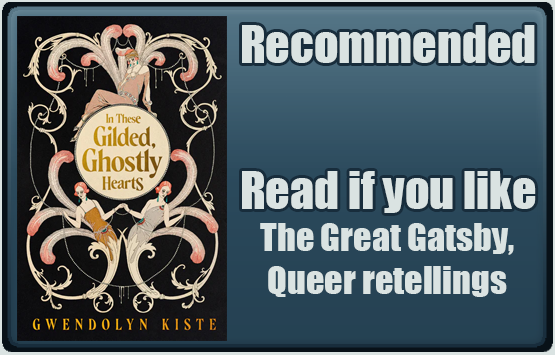
Formats: Print, audio, digital
Publisher: Creature Publishing
Genre: Ghosts/Haunting, Gothic, Historic Horror, Romance
Audience: Adult
Diversity: Lesbian main character and bisexual side character
Takes Place in: New York
Content Warnings (Highlight to view): Alcohol Abuse, Child Abuse, Death, Forced Captivity, Homophobia, Suicide
Blurb
In 1955, Daisy Buchanan is found dead in an abandoned West Egg mansion, but her daughter Mel knows she’s really been gone for years. No one knows whether Daisy was murdered, or if it was a simpler, slower death: her yearslong spiral of alcohol, abuse, and helplessness. But when Mel enters the estate, she finds Daisy’s ghost, somehow frozen at twenty-three, and a charming, bleeding phantom that used to be Jay Gatsby.
To free her mother, Mel must carve a path through family secrets and decaying revelers: deep into Gatsby’s starving house as it gorges itself on unfulfilled love and grows stronger every night.
I received this product for free in return for providing an honest and unbiased review. I received no other compensation. I am disclosing this in accordance with the Federal Trade Commission’s 16 CFR, Part 255: Guides Concerning the Use of Endorsements and Testimonials in Advertising.
The year is 1955. Daisy Buchanan is dead, her body discovered in Jay Gatsby’s abandoned estate in West Egg. Daisy’s now adult daughter, Pamela “Mel” Buchanan, and one of Daisy’s few remaining friends, Jordan Baker, travel from New York City to investigate the mysterious death. They learn that Daisy was working with a predatory spiritualist named Harrison to summon the ghost of her lost lover, Jay Gatsby. Harrison convinces the two women to return to Gatsby’s old home, now dripping with ectoplasm, and complete the séance with him. Soon the mansion is filled with ghosts, partygoers from bygone days, Gatsby himself, and Daisy. The partygoers are Stone Tape hauntings, a mere echo of the past. Gatsby’s ghost, on the other hand, is an intelligent haunting who is able to interact with Mel, who soon learns his obsession with Daisy has continued after his death.
Mel and Daisy have a complicated mother/daughter relationship. No matter how badly their mother treats them, children still crave their mother’s love. Mel is parentified by Daisy who is helpless and broken after losing her lover Gatsby, her husband Tom, and her lifestyle. Mel explains “Once the cash dried up and she wasn’t a rich girl anymore, she practically dissolved into sea foam before my eyes.” Daisy is not a resilient woman–understandable since she was raised to be a pretty bauble on a rich man’s arm. Daisy was a fairly passive character in Fitzgerald’s novel, a beautiful woman for Gatsby to idolize and Tom to possess. It was satisfying, however, to read that toxic alpha-male Tom threw himself off the Brooklyn Bridge after losing everything in the stock market crash of ’29. A fitting end to an awful man. Unfortunately, it means he leaves his wife and daughter penniless and alone. Kiste often writes books for “lost” women and girls who are trapped in the past and mistreated by an uncaring society who doesn’t understand them. The Marys in Pretty Marys All in a Row, the Rust Maidens in the novel of the same name, Talitha Velkwood and her friends in The Haunting of Velkwood, and now Mel and Daisy Buchanan.
You don’t necessarily have to have any knowledge of The Great Gatsby prior to reading In These Gilded, Ghostly Hearts but it does certainly help to be able to familiarize yourself with the characters and themes. There are also lots of fun little callbacks to the original book, like Gatsby’s automatic orange juicer machine. Just don’t make the same mistake I did and try and compare the writing in the two. I re-read F. Scott Fitzgerald’s famous work right before Kiste’s so I’d have a refresher and I do think it made me more judgmental of the writing in the latter. Don’t get me wrong, I generally love Kiste’s writing, two of my favorites being Pretty Marys All in a Row and The Haunting of Velkwood. I’m not at all implying that this is not a well-written story. But very few books are going to be able to stand up to one of the “Great American Novels” and trying to compare the two is a disservice to Kiste’s novella.
While Gatsby is written as a sympathetic character in the original book, I like how Kiste points out how incredibly creepy his obsession with Daisy is. Some might view his grand gestures as romantic but honestly, they always felt like borderline incel behavior to me. Gatsby views Daisy as a prize to be won rather than a person, and if he has enough money of course she’ll leave Tom for him. The main reason we’re sympathetic to Gatsby is because Tom is portrayed as the bigger asshole with no redeeming qualities, and because Nick sees Gatsby as sympathetic. Daisy is “supposed” to choose the heroic Gatsby over the brutish Tom, and when she doesn’t, she’s cast as the villain. Yet, does she really have a choice? Herstory and Daisy Buchanan by Leland S. Person, Jr. quotes the numerous men who have described Daisy as “vulgar and inhuman,” a “Dark Destroyer,” and the “anti-virgin…the prototype of the blasphemous portraits of the Fair Goddess as bitch” who “preyed on” Gatsby. Yikes! But Person viewed Daisy as more victim than conniving, selfish woman. She’s a woman in the 1920s, from an old money family who’s expected to marry an old money man, not some nouveau riche who may or may not have a criminal history. Daisy has no way of earning a living herself, she’s completely dependent on men for her financial security, and always had been. She’s also under immense societal expectations; she can’t simply leave her husband to have the life she wants with Gatsby. We also known Tom is abusive, as shown when he breaks his mistress’ nose.Leaving him was unlikely to be easy. I don’t think any of that necessarily makes her a good person; she’s just an imperfect victim. And this seems to be the characterization that Kiste goes with. Daisy wasn’t a good mother, but that doesn’t mean she doesn’t deserve sympathy or Gatsby’s obsessive idolization. Similarly, as a lesbian, Mel is also unable to be with the ones she loves, first Jordan and then her coworker, Vera.
I loved how queer Kiste’s book was. Mel is gay, Jordan bisexual, and Tom’s implied crush on Gatsby is no longer subtext. In These Gilded, Ghostly Hearts takes place during the Lavender Scare of the 1950s, an anti-LGBTQ+ witch hunt, so Mel lives in constant fear of having her sexuality discovered. At one point she and Jordan go to the Bagatelle on University Place. The Bag, as it was more commonly known, was a real lesbian bar that was popular in the 1950s. I love that little bit of realism that Kiste added to the story. Audre Lorde and Ann Bannon both wrote about the bar and how it shaped their pre-Stonewall experience. The Bag was owned by the mafia and frequently raided by police. A red light would go off to warn patrons when they vice squad showed up, which happens to Mel at the bag one night.
Kiste is not the first to write about the Great Gatsby through a queer lens. In 1963 Lionel Trilling characterized Jordan Baker as “vaguely guilty, vaguely homosexual.” Nearly thirty years later The International Fiction Review published The Sexual Drama of Nick and Gatsby by Edward Wasiolek who argued that Nick has “homosexual leanings” and intense feelings for Gatsby. The Chosen and the Beautiful by Nghi Vo (author of The Empress of Salt and Fortune) also imagines Jordan and Gatsby as bisexual, and Nick and Gatsby have a fling. Self-Made Boys: A Great Gatsby Remix by Anna-Marie McLemore and The Pursued and the Pursuing by AJ Odasso explore a queer relationship between Gatsby and Nick.
Kiste’s writing can best be described as “haunting;” beautiful, unsettling, nostalgic, and melancholy, lending itself well to a ghost story. Her stories are less “in your face” horror with gore and blood and instead rely on atmosphere to create a general sense of unease commonly found in gothic horror. For some readers, it may feel like the pacing is dragging, as there’s no sense of urgency and not a lot of action because this isn’t that kind of book. This is a novella meant to be savored rather than rushed through. So, while it won’t be everyone’s cup of tea, I think fans of slow burn horror and character driven story will enjoy In These Gilded Ghostly Hearts.
I did feel like the book needed a little more show and a little less tell. It seemed like Mel was constantly explaining things to the audience that didn’t necessarily need to be spelled out. At the same time, I thought it was awesome that Mel was middle aged and Jordan in her fifties. It’s so rare to find older women protagonists in fiction. Male protagonists have a wide range of ages, but women seem to always skew young. What’s more, neither character is a wife or mother. While I don’t think In These Gilded, Ghostly Hearts is as strong as some of Kiste’s other novels and novellas, it’s still a solid, spooky read perfect for autumn.




0 Comments