Hemlock by Melissa Faliveno

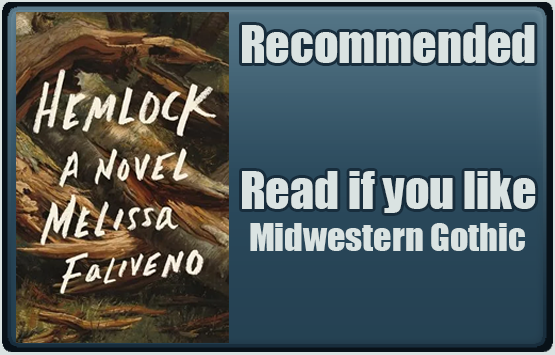
Hemlock by Melissa Faliveno

Formats: Print, audio, digital

Publisher: Little, Brown and Company

Genre: Gothic

Audience: Adult

Diversity: Bisexual main character, main character with alcohol use disorder (AUD)

Takes Place in: Wisconsin

Content Warnings (Highlight to view): Alcohol Abuse, Animal Death, Classism, Death, Drug Use/Abuse, Homophobia, Illness, Mental Illness, Rape/Sexual Assault, Self-Harm, Sexism, Sexual Abuse, Slut-Shaming, Stalking, Suicide, Transphobia, Victim Blaming, Vomit

Blurb

Sam, finally sober and stable with a cat and a long-term boyfriend in Brooklyn, returns alone to Hemlock, her family’s deteriorating cabin deep in the Wisconsin Northwoods, where her mother disappeared years before and never returned. But a quick, practical trip takes a turn for the worse when the rot and creak of the forest starts to creep in around the edges of Sam’s mind. It starts, as it always does, with a beer.

As Sam dips back into the murky waters of dependency, the inexplicable begins to arrive at her door in the forms of a neighbor who leaves no trace, a talking doe who sounds just like Sam’s missing mother, and a series of mysterious gifts that might be a welcome or a warning. And as Sam’s stay extends—as the town’s grip on her tightens and her body takes on a strange new shape—the borders of reality begin to blur, and she senses she is battling something sinister—whether nested in the woods or within herself.

Hemlock is a carnal coming-of-addiction, a dark sparkler about rapture, desire, transformation, and transcendence in many forms. What lives at the heart of fear—animal, monster, or man? How do we contain a threat that may come from within? And how can we reject our own inheritance, the psychic storm that’s been coming for generations, and rebuild a new home for ourselves? In the tradition of Han Kang’s The VegetarianHemlock is a novel of singular style, with all the edginess of a survival story and a simmering menace that glints from the very periphery of the page.

I received this product for free in return for providing an honest and unbiased review. I received no other compensation. I am disclosing this in accordance with the Federal Trade Commission’s 16 CFR, Part 255: Guides Concerning the Use of Endorsements and Testimonials in Advertising.

Hemlock is not a traditional horror narrative, so be warned if you go in expecting monsters, violent killers, or haunted houses. Instead, it’s a much more subtle approach to gothic fiction about a woman being haunted by her alcoholism. It has all the classic hallmarks of gothic fiction such as beautiful but isolated locales hiding dark secrets, decay, obsession, supernatural elements, and an antihero protagonist tormented by the family curse of alcoholism. Sam has managed to remain sober for ten months, but when she leaves her life in New York City to return to rural Wisconsin and fix up her parent’s cabin in the Northwoods, she quickly falls off the wagon. Sam’s father built the cabin in the Northwoods himself out of pine, and named it Hemlock (after one of his favorite varieties of pine) explaining “if you love something, you’ve got to give it a name.” Sam thinks it’s interesting that the cabin also shares the name of a deadly plant. Later in the book, we learn Hemlock means “you will be my death” in the language of flowers.

Sam had a hard childhood. She was bullied for her dark skin and body hair inherited from her Italian father. People said they “didn’t like the look of her” even though she did everything to try and be good. She was bullied by boys who spit on her. The ladies at church described her as “feral.” Because Sam wasn’t white enough or feminine enough, she was othered by her rural community and labeled as “bad.” Eventually, Sam embraces the labels forced upon her and goes down a self-destructive path that includes abusive relationships, letting men do whatever they want with her, self-sabotage, and alcoholism. Sam does finally get into a healthy relationship with a man named Stephen and manages to stay sober for ten months. But returning to Hemlock triggers her return to alcohol. It starts simply enough. Sam discovers a pack of beer in the basement of the cabin, as if it’s been left there just for her, and tells herself she deserves one after all the hard work she’s done. But one beer is never enough. Getting drunk is the first time Sam has felt truly happy and at peace in a while.

Hemlock’s isolation is both a blessing and a curse for Sam. On the one hand it gives her the peace she’s been craving from living in NYC. Surrounded by nature, she finds a contentment she didn’t have in the city.  On the other, too much time alone causes Sam to relapse and her mind starts to play tricks on her. Or perhaps there really is something in the woods, a cryptid or a ghost, the novel leaves it open to interpretation. In a review published of 280 hundred studies it was found “that rural, relative to urban, residence is associated with an increased likelihood of hazardous alcohol use and alcohol-related harm.”  Being low income also increases the risk of alcohol related harm. There’s also a lack of treatment options for alcohol and substance use disorder in rural areas compared to urban areas. For Sam, alcoholism is a family trait, passed down from mother to daughter. Her grandmother was an alcoholic but did everything to hide it. Sam’s mother was an alcoholic who drank Listerine after Sam and her father poured out all the booze in the house. Sam lives with the shame of having a mother with alcohol use disorder and resents her mother for it, but still ends up growing up to be an alcoholic herself. It has been found that children of alcoholics are at an increased risk of having alcohol use disorder.

I don’t find Sam particularly likable, but she doesn’t need to be. She feels real. She feels like someone struggling. There’s a reason it’s hard to be in a relationship with or related to alcoholics. As Sam puts it “anyone who’s ever loved a drunk knows that having hope is the most hopeless thing.” Sam doesn’t really like herself when she’s drinking either. She starts fights with strangers and gets arrested. She drives under the influence. She cheats on her boyfriend. In her family, they don’t talk about their feelings, they ignore them and cope by drinking. Sam will feel guilty about what she did while intoxicated, then drink more to deal with the shame, repeating the cycle. She believes the best feeling in the world is the oblivion that comes with being drunk, and nothing, including her boyfriend, can compete with it because alcohol is her one true love.

I liked how it was mainly women who influence Sam’s life (her father and boyfriend were less important) and fit the maiden, mother, crone archetype. There’s her mother, who loved Sam but whose struggles with alcohol forced Sam to grow up too fast. The maiden is a woman Sam meets in a hardware store who Sam cheats on her boyfriend with. She encourages Sam to get drunk and party with her. Then, there’s the good influence among the three, Lou-Ann, an older, butch Ojibwe lesbian and recovering alcoholic who gives Sam good advice and encourages her to go to an AA meeting with her. She reminded me a lot of a recovery coach I work with; a down-to-earth older woman who’s been sober for nearly 40 years and uses her personal experience with alcoholism to help guide others to sobriety and support them on their journey of recovery. Like my coworker, Lou-Ann never shames Sam for her alcoholism, but she doesn’t bullshit her either. She just lets her know she’ll be there when Sam is ready. While I was initially concerned that Lou-Ann would skirt the line of the unfortunate “drunken Indian” stereotype I personally felt like Faliveno did a good job making her feel like a real, complex person. But while no red flags went off for me, I’m also not Native, so her character may hit different for someone who is.

Sam physically transforms over the course of the story. Her muscles become more defined and her body hair thicker and darker. Her eyes change color and her senses sharpen to the point she no longer needs contacts and she can hear sounds in the woods. Some days Sam feels like a woman, some days, she doesn’t. Lately, she’s felt like something that doesn’t have a name. I liked the references to gender dysphoria, but I wish Sam’s transformation had more of a payoff. At first, I thought she was becoming something monstrous, but that particular plotline doesn’t really go anywhere.

Sam also encounters a talking doe, whom I suspect will be divisive. The doe is snarky and offers advice, but the humor and fancifulness of her character in an otherwise dark story can feel out of place. Personally, I liked the doe as a character, but wasn’t entirely sure she fit the gothic aesthetic. Faliveno never reveals whether the doe, Sam’s transformation, or the dark figure in the forest are supernatural or just a figment of Sam’s imagination brought on by alcohol. Normally I’m a big fan of leaving the reader wondering if something is supernatural or not à la the Turn of the Screw, but this didn’t feel well executed. Don’t get me wrong, some of it worked (like the possible ghost), but some of it, like Sam’s changing body, didn’t. You can only get away with so many unanswered questions before the reader starts to get frustrated. The other thing I struggled with was the overall lack of horror. Sure, there are some tense moments, but there’s no big payoff, just a sense of something dangerous in the woods.

Faliveno is an essayist, and the book does sometimes feel more like a series of essays on alcoholism and smalltown life in the rural Northwest than one cohesive narrative. This is not a criticism by any means, though I do feel it will work for some people and not for others. For me, it sort of worked. I was pulled in by the first half of the book, but by the second half, my interest began to wane. While there were a lot of things that didn’t work for me, I truly enjoyed Faliveno’s honest look at what alcoholism does to a person. In an interview, the author explains she had experienced her own struggles with alcohol, which helped inform her writing. Overall, I think I would have enjoyed the book more if I had gone in with different expectations.

The Valley of Vengeful Ghosts by Kim Fu

The Valley of Vengeful Ghosts by Kim Fu

Formats: Print, audio, digital

Publisher:  Tin House

Genre:  Gothic, Psychological Horror

Audience: Adult

Diversity: Chinese American author and main character

Content Warnings (Highlight to view): Animal Death, Child Abuse, Death, Drug Use/Abuse, Illness, Incest, Kidnapping, Medical Torture/Abuse, Medical Procedures, Miscarriage, Necrophilia, Oppression, Mental Illness,  Physical Abuse, Rape/Sexual Assault, Suicide

Blurb

In the aftermath of her mother’s death, Eleanor is unmoored. For years, her mother orchestrated every detail of her life—from meals, to laundry, to finances—as Eleanor focused on her career as an online therapist. Left to navigate the world on her own, Eleanor clings to her mother’s final directive: use her inheritance to buy a house.

Desperate to obey her mother one last time, Eleanor impulsively buys a model home in a valley-turned-construction site, a picturesque development steeped in a shadowy history. It feels like a fresh start, until the rain comes—an endless, torrential downpour. As water seeps in through the house’s cracks, the line between what is real and what is not begins to blur. Haunted by the stories of her clients, a stream of workmen and bureaucrats she can’t trust, and visions of ghosts from her past and present, Eleanor’s reality unravels, and she is forced to reckon with the secrets she’s buried and the choices she’s made.

I received this product for free in return for providing an honest and unbiased review. I received no other compensation. I am disclosing this in accordance with the Federal Trade Commission’s 16 CFR, Part 255: Guides Concerning the Use of Endorsements and Testimonials in Advertising.

The Valley of Vengeful Ghosts is a horror story about every millennial’s worst nightmare: being expected to navigate the world of adulthood without any guidance or support, and buying a home.

Eleanor Fan is a therapist whose mother, Lele, has recently passed away from cancer. Her dying wish was for her daughter to buy a house. Like many millennials, owning her own home seemed like an impossibility for Eleanor until her frugal mother passed and left her enough for a modest house. But even with her inheritance, Eleanor is struggling to find somewhere livable. Her first realtor, Mary, only shows her crappy, one bedroom condos, and Eleanor is outbid each time she applies. Her new realtor, Matt, drives her through a dying town, into the forest and shows her a model home in a newly developed area. The developer went bankrupt after building the model homes, and the new developer is waiting for the summer to continue building. Eleanor loves the house, though is unsure about buying.Matt encourages her to jump on the opportunity as soon as possible, which means waiving the inspection (huge red flag). What seems like a dream come true turns into a nightmare when the house quickly becomes unlivable.

I’m lucky enough to be married to a super competent gen Xer who knows how to repair most anything, otherwise I probably wouldn’t have bothered with home ownership, even if I lived in an alternate universe where I could have afforded one on my own. I don’t know how to fix a cracked pipe, install a dishwasher, or build a bookshelf that wasn’t purchased from Ikea (all things my wife has done easily). I’ve never even mowed a lawn or cleaned gutters! And forget taking care of it, just trying to purchase a home can be a confusing nightmare. There’s the whole process of applying for a mortgage, finding the right real estate agent, putting in a bid on the house, hiring a home inspector, figuring out internet service and all that crap. It’s overwhelming! No wonder Eleanor has no idea what she’s doing.

The house she buys was cheaply and quickly made to look good, not actually serve as a home. And even if it was? Some of the design choices were made with form over function in mind, like the giant floor to ceiling windows with no blinds or curtains. Not only do the windows lack insulation, there’s zero privacy (thank God Eleanor lives in the middle of nowhere), and there will be a ton of light during the day, whether she wants it or not. Unfortunately, Eleanor didn’t consider any of these things before buying the house, and when she does finally notice the above issues and tries to solve them with curtains, she learns that curtains are really freaking expensive. And that’s just the start of the problems. With a seemingly endless rain pouring down on her new home comes numerous leaks that start as a trickle under the windows but quickly start damaging the home. The rain gets in the front door lock and jams it, forcing Eleanor to call a sketchy locksmith who charges her $600 and then makes vague threats about what will happen if she doesn’t pay.

There are a lot of creepy men in The Valley of Vengeful Ghosts. Eleanor’s grad school mentor raped her. her work colleague, Teddy, lusts after her even though Eleanor sees him as a father figure (his wife even assumes they slept together). Her real estate agent, Matt, clearly conned her. One of Elanor’s new patients, Jared, is a raging misogynist who refers to women as “females” and wants to use Eleanor to practice talking to women yet constantly speaks down to her and ignores her. Eleanor just doesn’t seem to have good luck with men. There is her ex, who by all accounts seems like a decent guy, but he wants nothing to do with her because of her weird attachment to her mother.

Millennials like Eleanor have had it rough. We reached adulthood during the Great Recession of 2008, and many of us were forced to move back in with our Boomer parents (assuming that was even an option). Even those of us with college degrees, something we were told by adults we had to get if we wanted to a good paying job, weren’t having any luck. The jobs we’d been prepared for weren’t hiring people without experience, and retail and food service jobs didn’t want someone they considered “overqualified.” Meanwhile, we had a ton of student debt we couldn’t pay off, wages were stagnant, and the cost of living was soaring. That means we were forced to put off typical adult milestones like marriage, having kids, and yes, buying a house. With schools getting rid of shop and home economics courses many of us also weren’t taught how to fix a car, sew a button, or a cook a meal (thanks Ronald Regan).

Eleanor’s mom completely failed in preparing her daughter for the real world. After Eleanor is raped by her grad school mentor she drops out of her PhD program and regresses emotionally (something Teddy points out is common after trauma) and her mother comes to take care of her. She handles Eleanor’s money and keeps the books for her practice as dealing with money bores and frightens Eleanor (all her bank accounts are joint accounts with her mother). Lele cleans Eleanor’s apartment, takes out her trash, buys her groceries, cooks her meals, and does her laundry for her.  Eleanor is so coddled that her mother even feeds her apple slices like a baby bird while she’s working and clips her toenails. The irony is not lost on me that Eleanor works as a therapist, helping other people with their lives, when she can’t even get her own shit together and would definitely benefit from some therapy herself.

Isolation is a recurring theme throughout the story. Eleanor is physically isolated in the valley where she lives and where the rain never seems to end, but also emotionally isolated from others after the passing of her mother. She has no romantic partner, no real friends, and only a distant aunt for family. She doesn’t even see her patients in person anymore, instead opting to focus solely on telehealth. The story is strongly implied to take place right after COVID, when everyone was feeling the despair that comes from isolation. But it seems Eleanor never really connected to people after the pandemic.

I should point out that, despite the title, this is not a haunted house story. The “ghosts” are people that Eleanor knows (or knew) that appear in her mind and talk to her, more hallucination than specter. But while there are no literal ghosts, Fu still instills tension with modern fears like home ownership, isolation, climate change, and losing one’s parents.  It feels like a gothic novel, except the house isn’t old and decaying but new and decaying, while the never-ending rain, which is slowly eroding the surrounding landscape, creates an oppressive atmosphere. There isn’t really a plot so much as a series of events that unfolds in Eleanor’s life as we watch her mental state fall apart along with her home, but it still grabbed my attention and never felt like the story dragged.

Pour One for the Devil by Theodore C. Van Alst Jr.

Pour One for the Devil by Theodore C. Van Alst Jr.

Formats: Print, digital

Publisher: Lanternfish Press

Genre: Gothic

Audience: Adult

Diversity: Author is Mackinac Bands of Chippewa and Ottawa Indian, main character is American Indian (unknown tribe), Gullah side characters

Takes Place in: South Carolina Sea Islands

Content Warnings (Highlight to view): Alcohol Abuse, Animal Death, Death, Drug Use/Abuse, Forced Captivity,  Incest, Racism

Blurb

When Dr. Van Vierlans receives an invitation from Mrs. Elizabeth Van der Horst to give a lecture at her island mansion off the coast of South Carolina, he doesn’t think twice. There’s a generous honorarium, and he relishes the chance to revisit the Sea Islands, where he once studied the Gullah language.

The lavish house he arrives at is strangely out of time. No other historians appear, nor does an audience, as he passes the time chatting in Gullah with the household servants. Just when his suspicions become difficult to ignore, Mrs. Van der Horst plies him with a sumptuous feast that distracts him from her true motives–which may prove more sinister than anything he’s prepared to imagine.

I first read Van Alst’s work in the Indigenous dark fiction anthology, Never Whistle at Night. His story, The Longest Street in the World stood out to me because it was the first time I’d read an Indigenous story about an “Urban Indian.”  The story took place in Chicago, home to the first Urban Indian center in the country, and author Theodore C. Van Alst Jr.

Van Alst’s main character in Pour One for the Devil, Dr. Van Vierlans, is also an urban Indian and an Ivy League trained junior professor of anthropology. Already I love this because we not only get to see an American Indian man with a PhD, but he’s also an anthropologist to boot. So often anthropologists are portrayed in media as white people studying “primitive” Indigenous people in remote areas, and the field itself is the product of colonialism, so it was refreshing to see an Indigenous anthropologist.

This Southern Gothic story begins with Dr. Van Vierlans being lured to the estate of the wealthy, white Elizabeth Morgenstern, with the promise of a generous honorarium for a lecture about the Coosaw shell rings. I was already getting vibes before the professor arrived, but then Auntie Delilah, a Gullah domestic worker at Morgenstern’s home, attempts to warn the doctor that both Elizabeth and the house are dangerous. Either due to ignorance (has he never seen a horror movie?!) or greed, Dr. Van Vierlans decides to ignore the warnings and stays anyway.

While taking a nap in one of the guest rooms Dr. Van Vierlans has a dream that the Devil is sitting on his chest. The Devil asks for a story about himself, and the doctor agrees to give him one, but in exchange Lucifer must leave him alone until Van Vierlans dies. The devil warns him that his death will be sooner than he expects, but even this isn’t enough to scare him away from Elizabeth’s House. It’s interesting that the devil appears to him at all,since Van Vierlans supports the traditional ways, unlike his father who insists on practicing Christianity.

At dinner the professor and his host engage in verbal combat. Dr. Van Vierlans finds Elizabeth Morgenstern, or Miss Lizzy, as she prefers to be called, fascinating. As a man from Chicago, he finds her rural Southern ways to be quaint. And because he’s an anthropologist, and familiar with the etiquette of different cultures, he’s able to impress Miss Lizzie with his impeccable manners. Elizabeth tells him about the automatons built by her late husband, Peter, which Delilah believes are powered by spirits.  

I like how the American Indian man is portrayed as the cosmopolitan city mouse, while the country mouse is the wealthy white woman. He has studied her culture enough that he can easily blend in and impress the old white lady. Dr. Van Vierlans also becomes friendly with Auntie Delilah as he studied the Gullah as part of his work as an anthropologist and speaks Gullah creole (though Delilah points out he speaks it “like a little boy”).  

I also really appreciated how Gullah is translated into a more formal style of English; a sociolect associated with the wealth and intelligence. Mitford popularized the idea of U (upper class) and non-U (non-upper class) English in the 1950s, which she claimed could determine what social class one belonged to. A person’s accent is also strongly associated with class. Because class is often erroneously tied to intelligence people will infer how smart someone is by what kind of English they speak. For example, standardized grammar often aligns with high IQ scores, and IQ tests have been show to favor people who are white and privileged. And no, it’s not because they’re smarter, IQ tests just aren’t accurate measures of intelligence. Gullah used to be (and sometimes still is) erroneously considered a mark of ignorance. By translating Gullah into “upper class English” (which Delilah and her sisters also speak fluently) Van Alst demonstrates that not only does the creole language have its own grammar and syntax rules, but that Gullah speakers are just as intelligent as those who speak a more formal English. The Gullah people are also described as “West Africa’s best and brightest farmers” who were enslaved and “forced to use their agricultural genius to grow rice crops on stolen land.” Again, Van Alst directly contradicts the racist stereotype that enslaved Black people were ignorant.

Auntie Delilah (whose true name is Nenge) was my favorite character. She is ethnically Mende (one of the largest ethnic groups in Sierra Leone), and her father and grandfather were Kamajor, respected hunters/warriors. She describes her childhood teachers as foolish white folks from up North who saw her and her people as souls to be saved. She learned about the bible and took her name from there as a middle finger to white Christians and the patriarchy. Delilah is happily unmarried and childfree, but is far from being a mammy stereotype. Instead, she’s chosen to remain single and without children because she enjoys her independence and doesn’t have the patience for a husband and child. I also always enjoy seeing happily childfree women in fiction.

I think some of the strongest aspect of Van Alst’s writing are his descriptions of nature and Elizabeth’s house. You could practically feel the humidity and smell the lush vegetation. I also enjoyed the humor, which balanced out the horror well. The ending was weird, not in a bad way, but it did leave me yearning for more of an explanation. It felt to me like the book ended abruptly before the story had finished, but I’m also not someone who enjoys vague endings.

On Sunday She Picked Flowers by Yah Yah Scholfield

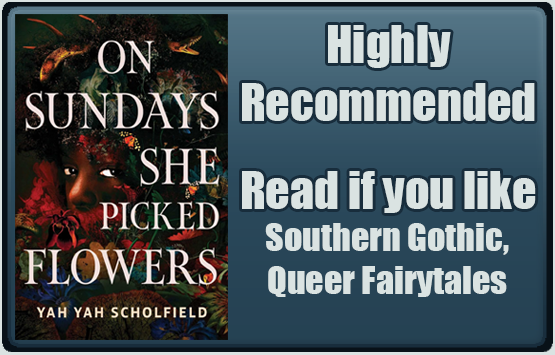
On Sunday She Picked Flowers by Yah Yah Scholfield

Formats: Print, audio, digital

Publisher: Saga Press

Genre: Gothic, Historic Horror, Werebeast

Audience: Adult

Diversity: Black characters and author, Queer main character and author

Takes Place in: Georgia, USA

Content Warnings (Highlight to view): Alcohol Abuse, Animal Death, Body Shaming, Cannibalism, Child Death, Childbirth, Death, Gore, Homophobia, Incest, Miscarriage, Physical Abuse, Racism, Rape/Sexual Assault, Self-Harm, Sexual Abuse, Slurs, Slut-Shaming, Verbal/Emotional Abuse, Violence, Vomit

Blurb

When Judith Rice fled her childhood home, she thought she’d severed her abusive mother’s hold on her. She didn’t have a plan or destination, just a desperate need to escape. Drawn to the forests of southern Georgia, Jude finds shelter in a house as haunted by its violent history as she is by her own.

Jude embraces the eccentricities of the dilapidated house, soothing its ghosts and haints, honoring its blood-soaked land. And over the next thirteen years, Jude blossoms from her bitter beginnings into a wisewoman, a healer.

But her hard-won peace is threatened when an enigmatic woman shows up on her doorstep. The woman is beautiful but unsettling, captivating but uncanny. Ensnared by her desire for this stranger, Jude is caught off guard by brutal urges suddenly simmering beneath her skin. As the woman stirs up memories of her escape years ago, Jude must confront the calls of violence rooted in her bloodline.

Haunting and thought-provoking, On Sunday She Picked Flowers explores retribution, family trauma, and the power of building oneself back up after breaking down.

I received this product for free in return for providing an honest and unbiased review. I received no other compensation. I am disclosing this in accordance with the Federal Trade Commission’s 16 CFR, Part 255: Guides Concerning the Use of Endorsements and Testimonials in Advertising.

Jude (short for Judith) does what I’m sure many women have dreamed of doing. After killing her abuser she runs away from her terrible life to live alone in a haunted house in the forest where she becomes a wisewoman/healer and takes a mysterious lover who may or not be a beast. On Sunday She Picked Flowers reads like a Southern Gothic fairytale, if “Once Upon a Time” were 1965 and “a land far away” was Georgia. This is not a pretty story with a pure, fair maiden who is rescued from her miserable life. Instead, our heroine, 41-year-old Jude, is described as “too fat, too Black, too tall, and too damn ugly” (at least by her teachers and classmates) and is forced to save herself from her wicked mother and the curse of transgenerational trauma.

Jude has lived with her abusive, religious mother for her entire life. She doesn’t understand why her mother, whom she calls Ma’am, hates her so much, only that she does. Ma’am will beat her daughter for the smallest offense then turn around and act like nothing happened (this is known as the cycle of abuse). Her two aunts, Phyillis and Vivian, tell Jude it’s her own fault she’s abused for being “difficult” and she should be grateful for all her mother has sacrificed for her.

Jude keeps a packed bag and a tin of money hidden under her bed so she can leave one day. She’s tried to run away before but people in the town always bring her back. Eventually Jude realizes the only way she’ll ever be free is to kill her mother. One night Jude is making dinner when Ma’am announces she found the packed bag under Jude’s bed. Ma’am tried to guilt trip Jude before telling her daughter that she’ll never let her leave. Something snaps in Jude and she starts hitting her mother and the two end up on the floor. Ma’am tries to strangle her but Jude grabs a meat cleaver on the floor and buries it in her mother’s face. She attempts to call her aunt Phyllis for help and to confess what she’s done, the only one of Ma’am’s two sisters who might show her compassion, but is rebuffed. Realizing she can’t stay in that house Jude runs away and ends up in an abandoned haunted house in the middle of the woods that she names Candle.

In many ways transgenerational trauma can feel like a family curse that passes from parent to child. The controversial field of epigenetics claims that trauma can change your DNA to the point that it’s passed down genetically to your offspring, with descendants of Holocaust survivors, Residential School Survivors, and enslaved Africans continuing to experience the symptoms of trauma (depression, anxiety, substance misuse, etc.). Dr. Joy DeGruy, who holds advanced degrees in both clinical psychology and social work research, came up with the term “post traumatic slave syndrome” to describe the transgenerational trauma experienced by African Americans as a result of the Atlantic slave trade, in addition continued discrimination in the present day. While the American Psychological Association (APA) awarded Dr. DeGruy a Presidential Citation in 2023 her theory is not without its critics. Dr. Ibram X. Kendi, a historian and anti-racism scholar, argues that the idea of post traumatic slave syndrome is itself racist as it implies that Black people are inherently dysfunctional as a group.

Some studies have shown that when someone experiences abuse as a child and is unable to learn healthy coping methods, they are more likely to abuse their own children, with one study stating that abuse and neglect victims are three times more likely to be abusive themselves. Rates of domestic violence are higher in the Black community, with Black women at the greatest risk, most likely due to a combination of racism and poverty. Black parents also have a complex relationship with the corporal punishment of children, especially in the South. When my siblings and I were little my Black grandmother thought it was very amusing that my white mother didn’t believe in spanking, and joked about how the beatings she gave my aunt and father would get her sent to prison now.

But she did what she did to protect them from something worse. She knew white people would use any excuse to hurt, arrest, or even kill a Black person, even if they were a child so Black children had to always be obedient if they wanted to survive. They did not have the same opportunities as white children to make youthful mistakes. Child advocate Dr. Stacey Patton, who is herself a child abuse survivor, explained in an interview with Ebony that “People think that hitting a child is a form of teaching. We think it will protect them.” In another interview with the Touré Show podcast  Dr. Patton stated “There was this idea that ‘Well if I beat you, you’re gonna be alive at the end of the day, whereas if the Klan gets their hands on you, you’re dead’… And so we fast forward to this century, and you have Black people saying, ‘If I don’t beat my child, then the police will kill them.’” Of course, the belief that all Black parents are inherently abusive or “bad” parents is rooted in racism.

Ma’am was horribly abused by her own father, and ended up taking her pain out on her daughter. Jude’s beatings were treated as acceptable “punishments” by her aunts who had been beaten similarly as children. But this does NOT mean that an abused child is guaranteed to be abusive themselves. Jude is able to break free and learns to love herself and that she’s more than what was done to her, just as many Black parents today are moving away from “tough love” and embracing gentle parenting. In fact, corporal punishment is quickly falling out of favor in the Black community.

Scholfield’s prose is gorgeous, one my favorite lines in the book is, “Jude entered the verdant maw of the woods, past its bark teeth and down its mossy throat, down into its humid green bowels.” What a great description, both foreboding and beautiful. It’s also a perfect example of the book’s reoccurring theme of transformation as Jude leaves civilization behind and enters the enchanted world of the forest (appropriate, as the forest has long been a metaphor for transformation in both fairytales and folklore). Ma’am prefers nature small and tamable because she had too much of it as a child working on a plantation (one of the reasons my grandmother left Tennessee and moved to Chicago) and four generations of Ma’am’s family slaved away on a plantation, even after emancipation. But Jude loves the beauty of nature and its wildness, and is willing to work the land if she’s working it for herself and not another. For in the forest, she is truly free.

Judediscovers safety and strength in her solitude, that is until she meets Nemoira, a strange and beautiful woman who enters Candle and immediately makes herself at home. Jude falls hard and fast for the mysterious Nemoira, who may or may not be the beast that’s been leaving meat on her doorstep. Their relationship reminds me of classic stories like Bluebeard, Tsuru no Ongaeshi (Crane’s Return of a Favor), and Beauty and the Beast. I loved that this book was about an older woman rather than a 20-something. Of course there’s nothing wrong with younger heroines, but it can get repetitive always reading about women half my age in books supposedly aimed at adults. It’s easy to find older men in media, but creators seem afraid to make their women older than 30 or so. Jude, on the other hand, starts the story out at 41 and is in her sixties by the end of it. She’s also able to change and develop as a character despite being older. It’s wonderful to watch Jude go from terrified and helpless to fearless and self-sufficient over the course of the story. Best of all, she gets to have a romance and hot sex! Media makes it seem like women stop having sex the minute they hit 40, but while age can change how you have sex, older adults are still sexually active. So it’s nice to see that represented here and not treated as a punchline or something gross.

This was an achingly beautiful and haunting story. Despite its supernatural and fairy tale-like elements, the book’s depictions of abuse are still realistic. I appreciated how Scholfield humanizes Ma’am without excusing her abuse of Judith. Ma’am’s treatment of her daughter is inexcusable, even though Judith is not a “perfect victim” (a harmful myth that often prevents abuse survivors from getting help). Judith’s relationship with Nemoira is similarly complex, with Judith trying to love a monster without herself becoming monstrous and learning to stand up for herself. Scholfield’s descriptions are lush: you can practically see, smell, and hear the forest. On Sunday She Picked Flowers feels like in takes place in a liminal space between fantasy and cold reality, the “real” world, and the world of the forest. While reading it, I always felt like I was just on the edge of a dream.

The Villa, Once Beloved by Victor Manibo

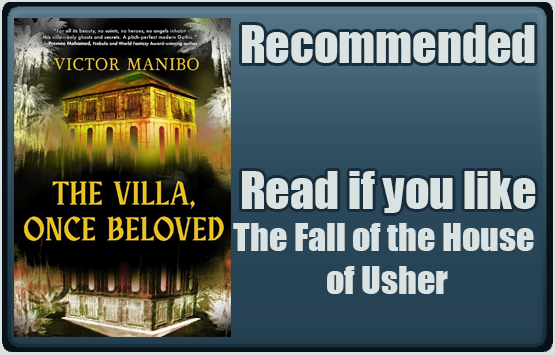
The Villa, Once Beloved by Victor Manibo

Formats: Print, audio, digital

Publisher: Erewhon Books

Genre: Gothic, Myth and Folklore

Audience: Adult

Diversity: Filipino author and characters, Gay author and character, non-binary side character

Takes Place in: The Philippines

Content Warnings (Highlight to view): Child Abuse, Classism, Death, Drug Use/Abuse, Forced Captivity, Gaslighting, Gore, Homophobia, Illness, Incest, Miscarriage, Mental Illness, Racism, Rape/Sexual Assault, Sexism, Slurs, Transphobia, Verbal/Emotional Abuse, Victim Blaming, Violence, Vomit

Blurb

Some legacies are best left buried…

Villa Sepulveda is a storied relic of the Philippines’ past: a Spanish colonial manor, its moldering stonework filled with centuries-old heirlooms, nestled in a remote coconut plantation. When their patriarch dies mysteriously, his far-flung family returns to their ancestral home. Filipino-American student Adrian Sepulveda invites his college girlfriend, Sophie, a transracial adoptee who knows little about her own Filipino heritage, to the funeral of a man who was entwined with the history of the country itself.

Sophie soon learns that there is more to the Sepulvedas than a grand tradition of political and entrepreneurial success. Adrian’s relatives clash viciously amid grief, confusion, and questions about the family curse that their matriarch refuses to answer. When a landslide traps them all in the villa, secrets begin to emerge, revealing sins both intimately personal and unthinkably public.

Sifting through fact, folklore, and fiction, Sophie finds herself at the center of a reckoning. Did a mythical demon really kill Adrian’s grandfather? How complicit are the Sepulvedas in the country’s oppressive history? As a series of ill omens befall the villa, Sophie must decide whom to trust—and whom to flee—before the family’s true legacy comes to take its revenge . . .

I received this product for free in return for providing an honest and unbiased review. I received no other compensation. I am disclosing this in accordance with the Federal Trade Commission’s 16 CFR, Part 255: Guides Concerning the Use of Endorsements and Testimonials in Advertising.

The Villa, Once Beloved is a modern gothic horror story set in the Philippines about the terrible crimes people will commit to obtain and maintain wealth and power. The story is tied to its setting, with the history of colonialism and political corruption in the Philippines playing an integral role in the plot. 

Don Raul Sepulveda, the wealthy patriarch of the Sepulveda family, has decided his deceased family members need to be moved to a grand mausoleum. He attempts to build the mausoleum himself, despite his advanced age, after firing all the builders because they kept telling him his vision was impossible. Raul believes his family’s grand tomb must be finished quickly because death is coming for him, and is proven correct when he dies that night after seeing a terrifying specter in the jungle: a pale, faceless woman. His wife, Doña Olympia finds Raul’s crushed body in his bed the next day, his hands covered in dirt. 

A few days later, a college student named Sophie is flying to the Philippines in a luxurious private jet with her boyfriend, Adrian, to visit his family. It’s her first time on an airplane and her first time out of the country. They’re flying to the Philippines for the funeral of Don Raul, Adrian’s grandfather. Sophie may be Filipino but she was raised by a white, working-class couple on a farm in Nebraska, making her feel like an outsider. While Sophie is worried that she may be intruding on the Sepulveda’s family’s private grief, she’s happy she can support Adrian in his time of need.  

Sophie loves her boyfriend because of his “boundless and innocent optimism” and his ability to talk about his feelings and have tough conversations.  He lavishes her with praise, unlike her adoptive parents, who don’t give her a lot of positive affirmation. Adrian cares deeply about his family and country, and has been educating Sophie about the Philippines: its history, culture, and what it means to be Filipino. Maybe I just distrust straight cis men, but Adrian seemed too good to be true. There weren’t exactly any red flags, but something about him felt off. Yellow flags, if you will. He never brings Sophie to his family’s home, despite it being only an hour from campus, and I got the sense a lot of his activism was performative. And the way he educates Sophie about the Philippines felt  condescending. Sophie loves it;she describes it as “very My Fair Lady. Sophie was clay ready to be molded, a Filipina Eliza Doolittle who somehow needed to be more Filipina, and Adrian was happy to be Henry Higgins.” But if  you remember the film  (or the George Bernard Shaw play it was based on) Henry Higgins was a misogynistic jerk to Eliza Doolittle.

Adrian is planning to make a documentary about his family and their ties to the Marcos, a major political family in the Philippines. The Sepulvedas are related to the Marcos through Imelda Romualdez Marcos, the former First Lady of the Philippines. She was the wife of former president Ferdinand Emmanuel Edralin Marcos, Sr., and mother of the current president of the Philippines, Ferdinand “Bongbong” Romualdez Marcos, Jr. Ferdinand was a kleptocrat who ruled as a dictator from 1965-1986, committed numerous human rights violations, and kept the Philippines under martial law in the ‘70s. Adrian hates the Marcos with a passion, even going so far as to organize a protest at Standford University when Bongbong visited the Bay Area. When his grandmother Olympia announces that the current president and his mother will likely be guests at Raul’s funeral, Adrian is horrified.

Adrian’s family has been in the Philippines since before the diocese, and own a large coconut plantation. Their villa was built nearly 200 years ago by Señor Bartolome Sepúlveda as a summer retreat for his reclusive wife Dorotea to hide her from the attention of other men (or to hide her from society after she went mad from homesickness). They were Spanish aristocrats who had fallen on hard times and moved to the Spanish East Indies attracting by Manila’s growing wealth after the Spanish crown took control and turned it into a major trading port. Their son Oscar saved the Sepulveda fortune, by starting the coconut plantation. He married Mercedes, an indio (which his father didn’t approve of). They had seven sons and one daughter, Soledad, who was married off to a member of the Marcos family.

Claudio, the oldest son of Oscar and Mercedes, is Divina and Raul’s father. He was born in 1929, after the Philippines had been sold to America. Claudio, as a US national, served in the US army and fought in WWII during the Japanese occupation of the Philippines under General Douglas MacArthur. Claudio became a general himself, and a war hero, and chose to marry Elisea Jimenez because she was an heiress. He cheated on her multiple times, and may or may not have fathered children with other women. Elisea was the power behind the throne. She prevented Claudio’s siblings from ousting him from the company and it was her idea to expand into the international coconut trade in the sixties, selling lumber, coconut wine, and coconut oil. The coconut oil was especially popular with their US partners, and is still used in major cosmetics brands. 

But then the Sepulveda family’s fortunes turned. In 1985 there was a worker’s strike at the Sepulveda’s plantation due to Marcos’ Coco Levy Fund Scam. A few days after that typhoon Saling (aka Typhoon Dot) struck, resulting in landslides that destroyed the countryside. Then malaria struck the town. There were crocodile attacks after that, then swarms of beetles that destroyed crops. Finally, a warehouse collapsed, killing several workers including Raul’s brother-in-law. When Raul’s father died suddenly of an aneurysm, Raul decided to flee to the states with his wife and young sons (Kai was not yet born), hoping to escape the curse. He left behind his newly widowed sister Divina to care for the villa and the coconut plantation.

Joining Adrian and Sophie at the villa are his parents Eric and Margot, his uncle Javier, his grandmother Olympia, his great aunt Divina, and some servants including the caretaker Remidios. Adrian’s auncle (a gender-neutral term for a parent’s sibling) Kai joins them later, barely making it to the villa because of the typhoon that strikes the Philippines. If you’re as bad at remembering names as I am, I would definitely recommend keeping a list of the characters because there are A LOT. Keeping track of the living family was one thing, but throw in all the ancestors on top of that and I started having trouble keeping track of who was who.

The book is told in third person limited tense, with Sophie acting as the main protagonist and audience surrogate who, while Filipino, is also an outsider and new to the culture and history. We also learn more about the family’s history through Adrian’s interviews with Divina for his documentary. Javier and Remidios serve as the deuteragonist and tritagonist of the story, giving the reader more of an insider’s view of the Sepulveda family. Javier and Remidios are both more cynical than the naïve Sophie who is just happy to be included. Javier is disappointed to discover his old home is not as grand as he remembered, instead finding it cramped and ill preserved whereas Sophie is in awe of the villa, highlighting their very different upbringings. Remidios has a less than charitable opinion of Sophie in the beginning (though she does warm up to her) and it’s interesting to see the protagonist, who is so often praised by Adrian, looked down upon by another character. Sophie is also the character who is most disturbed by what’s happening and becomes increasingly distraught as the story continues, growing paranoid and isolating herself from the rest of the family.

This is a slow burn horror book, which admittedly, I’m not usually a fan of. Things don’t start to getexciting until halfway through, when one of the family’s biggest secrets is finally revealed. The first half of the story is mostly getting to know the characters and their history, and I feel like it could have used more horror and foreboding. But of course, that’s just my personal preference.People with more patience than me will have a completely different reading experience. I did really enjoy learning about Filippino history and I liked how Manibo used real events and tied them into the story, like Typhoon Dot and the Coco Levy Fund Scam. I also liked how it isn’t revealed whether supernatural factors are at play until the very end. The reader is left to wonder if Raul was really killed by a batibat (a sort of Filipino sleep paralysis demon that can cause sudden, unexplained deaths) during a bangungot as Remidios claims, or whether the monster he saw was merely an apparition brought on by his madness. And is the string of disasters surrounding the family the work of a curse or merely bad luck?

Despite the villa’s size there’s a feeling of claustrophobia due to its isolation. The typhoon knocks out the internet, phone services, and roads making it impossible to reach anyone outside the villa. Because the villa is in a secluded area, it’s unlikely anyone will come to the aid of those trapped there by the landslides, despite Olympia’s insistence that everyone will come for her late husband’s funeral. Manibo is excellent at creating a gothic atmosphere, and, despite so many characters, each has their own unique perspective and personality, making them stand out. A must read if you’re a fan of the gothic.


Portrait of Lysbeth : A Gothic Novella by Rama Santa Mansa

Portrait of Lysbeth : A Gothic Novella by Rama Santa Mansa

Formats: digital

Publisher: Lingeer Press

Genre: Demon, Gothic, Historic Horror

Audience: Adult/Mature

Diversity: Black (African American) main character and author, minor gay character

Takes Place in: Sleepy Hollow, NY

Content Warnings (Highlight to view): Antisemitism, Child Abuse, Child Sexual Abuse, Childbirth, Death, Forced Captivity, Homophobia, Kidnapping, Medical Procedures, Oppression, Pedophilia, Physical Abuse, Racism, Rape/Sexual Assault, Sexism, Sexual Abuse, Slurs, Slut-Shaming, Verbal/Emotional Abuse, Xenophobia

Blurb

The year is 1676. We meet Lysbeth Luanda, a second-generation African freedwoman in New York, the former Dutch colony seized by the English, who, in a mere decade, have passed more cruel and oppressive restrictions on the free African community already living in the colony.After being orphaned at age 13, Lysbeth is forced to restart life all on her own––while working as a tavern waitress in Dutch and German-owned taverns along the banks of the Delaware and Hudson rivers. In this multinational milieu, she learns cosmopolitan skills and street philosophy from lovable lowlifes, brash buccaneers, African dreamers, indigenous heroines, and globetrotting Scandinavians. Lysbeth eventually finds a mentor in a Sephardi Jewish medical doctor from Curaçao, under whom she studies surgery and anatomy.

As the gloomy autumn season begins in 1676, the gruesome murders of three European women, by an unknown assailant in the isolated village of Sleepy Hollow, shocks the whole of New York.

Lysbeth’s mentor convinces the New York High Sheriff to appoint Lysbeth to go investigate the victims’ inexplicable cause of death and bring back a written coroner’s report. After an initial frosty reception by the villagers of Sleepy Hollow, Lysbeth gains new allies who assist her in her investigation

I received this product for free in return for providing an honest and unbiased review. I received no other compensation. I am disclosing this in accordance with the Federal Trade Commission’s 16 CFR, Part 255: Guides Concerning the Use of Endorsements and Testimonials in Advertising.

The Portrait of Lysbeth is set in Sleepy Hollow, but don’t expect mentions of the Headless Horseman or Ichabod Crane in this book. This story takes place about 100 years before the Revolutionary War and centers around Lysbeth, a free born Black woman, sent to investigate a serial killer (although that term wasn’t coined until the 20th century) in Sleepy Hollow, New York.

Lisbeth Anthonijsen, was a real person born around 1650 into the free Black community of New Amsterdam (what is now New York City). She started working as a servant for white colonists at a young age. In June 1661 she was accused of stealing wampum from the house where she was employed and the court ordered her to be beaten with a rod as punishment. In the winter of 1663, Lisbeth was spotted running away from a housefire at the Cregier household where she was employed. She was blamed for starting the fire and the court sentenced her to be enslaved by the Cregier family. Young Lisbeth was never given a chance. Mansa’s mission, as she puts it, was to get justice for Lisbeth by writing The Portrait of Lysbeth. She did a ton of research for this book, and it really adds to the story. I appreciate the time and effort Mansa put in to creating the setting and her main character, Lysbeth.

The fictional Lysbeth Luanda is an educated freed woman who becomes an indentured servant at the age of 13, after the death or her parents. She’s forced to work as a tavern waitress for the next 22 years, where she learns about the world from her diverse clientele.  Eventually, Lysbeth makes her way back to New Amsterdam where she apprentices for a Sephardic Jewish doctor, who sends her to Sleepy Hollow to act as coroner.

Some parts of the book are written in third person present perfect tense, which I felt was an interesting, if uncommon, choice. It’s fine, it just took a little while to get used to. It also jumps around quite a bit, from Lysbeth’s childhood to her time studying under the physician then back to the murder investigation. It can get a little confusing. But once I got used to it, the story flowed much more smoothly. I found the more fanciful elements genuinely creepy, like when a maid becomes possessed and chases Lysbeth through the house. The entire murder investigation has an eerie feeling, and not just because of the way the townsfolk stare at her. There seem to be things lurking in the woods, things Lysbeth, as a woman of science, refuses to believe in.

 I appreciated how Mansa not only avoids common racist literary tropes but makes a point to subvert them. In the beginning of the book, Mansa describes an unpleasant white man’s complexion as “milk cream.” I was amused to see, for the first time, a white person’s skin compared to food, something that routinely happens to Black characters written by white authors. It was also a nice change of pace to not have the color black associated with evil, but with spiritual strength and protection from evil. This is seen both is Lysbeth’s horse and the spirit wolf that protects her. Instead, Lysbeth believes that it is white animals that are to feared as they lack the spiritual protection of blackness. I also liked that the enslaved Africans were referred to as “enslaved,” rather than “slaves.” A seemingly small change, but to me a powerful one. By calling someone a slave, their identity is reduced to their circumstance. It dehumanizes them. An enslaved person is a person first, who has had slavery forced upon them.

In the book, both Native and African characters were referred to by their nations and not all lumped into the same group. For example, Lisbeth’s father is Kongolese, a people originally found in what is modern day northern Angola. The man who gave Lysbeth her witch gun is Mbundu. It was also refreshing to see Native history, which is often erased, acknowledged in the story, such as the Wampanoag leader Metacom (also known by the English name King Philip) defending his lands from the Puritans and the Moravian massacre. However, the Native representation did leave me questioning some of the author’s choices. There’s a rather brutal description of the 1643 Pavonia massacre, where the Dutch invaded what is now called Manhattan and massacred scores of Lenape people. I appreciate that it’s made clear that the settlers are living on stolen land (Lenapehoking) and that attention is brought to Native history, however, I felt weird about having a non-Native author write about Native trauma. If this were a white author doing it, it would be a more clear-cut example of exploitation of a marginalized group’s suffering. White people have been stealing from and exploiting Natives for hundreds of years, even though it’s not always done maliciously. As Debbie Reese, a Nambé Owingeh Pueblo scholar and educator, explains on her blog American Indians in Children’s Literature:

“…the history of White people taking from Native people is also filled with White people who befriend us because they have found themselves living in or near our communities.

Of that latter group, I wish they could form those friendships without saying “look at me and my Native friend.” Or, “look at the good I do for my Native friends!” Or, “I worked with them and they asked me to write this story about them.” Or, “I taught their kids and I learned from them and so, I am able to write books about them that you should buy because I know what I’m talking about.” Or, “Look! My book has a note inside from my Native friend or colleague. You can trust what you read in my book.”

They mean well. But I wish they could see past their good intentions. What they’re doing is exploitation.”

But Rama Santa Mansa isn’t white. She is a Black woman who wants to use her book to honor the untold stories of marginalized groups in what is now called the United States, but is that enough to give her a pass? Does her race make the story less problematic? It’s clear that Mansa did her best to portray the Lenape’s plight with respect, and wanted to include them as the first inhabitants of what is now called New York. There’s no colonialism being enforced, as Mansa is a Black author. She also did a significant amount of research for her book, but it left me wondering if she had reached out to Lenape or other Native scholars when writing it. There are certainly no Native books listed in her bibliography, no Native professors that she thanks in the acknowledgement, not even a reference to Indian 101 for writers.

I feel like at the very least a Native sensitivity reader would have been warranted. As Debbie Reese writes in her criticism of Justina Ireland’s book Dread Nation (another historic novel by a Black author), “It became clear to me that the reason her book fails in its representations of Native peoples is because she relied heavily on archival research. The “primary sources” she used are items in government archives–that are heavily biased.” This underlines the importance of using Native sources when discussing Native issues in addition to actually speaking to Native people. It’s also serves as a good reminder that just because a writer belongs to one marginalized group, it doesn’t mean they are qualified to write about another.

Despite the issues mentioned above I found the book overall enjoyable, with a highly detailed and well-researched setting and a strong Black woman protagonist. 

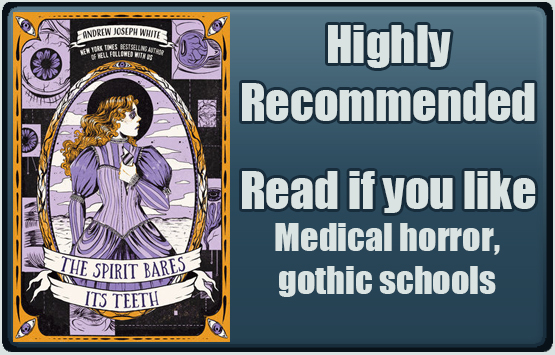
The Spirit Bares Its Teeth by Andrew Joseph White

The Spirit Bares Its Teeth by Andrew Joseph White

Formats: Print, audio, digital

Publisher:Peachtree Teen

Genre: Blood & Guts, Body Horror, Ghosts/Haunting, Mystery, Gothic

Audience: Young Adult

Diversity: Neurodiversity (Autism), transgender characters, queer character

Takes Place in: LA, California

Content Warnings (Highlight to view): Abelism, Animal Death, Bullying, Child Abuse, Child Death, Child Endangerment, Death, Forced Captivity, Gaslighting, Gore, Homophobia, Kidnapping, Medical Torture/Abuse, Medical Procedures, Miscarriage, Oppression, Pedophilia, Physical Abuse, Rape/Sexual Assault, Self-Harm, Sexism, Slurs, Slut-Shaming, Torture, Transphobia, Verbal/Emotional Abuse, Victim Blaming, Violence

Blurb

Mors vincit omnia. Death conquers all.

London, 1883. The Veil between the living and dead has thinned. Violet-eyed mediums commune with spirits under the watchful eye of the Royal Speaker Society, and sixteen-year-old Silas Bell would rather rip out his violet eyes than become an obedient Speaker wife. According to Mother, he’ll be married by the end of the year. It doesn’t matter that he’s needed a decade of tutors to hide his autism; that he practices surgery on slaughtered pigs; that he is a boy, not the girl the world insists on seeing.

After a failed attempt to escape an arranged marriage, Silas is diagnosed with Veil sickness—a mysterious disease sending violet-eyed women into madness—and shipped away to Braxton’s Finishing School and Sanitorium. The facility is cold, the instructors merciless, and the students either bloom into eligible wives or disappear. When the ghosts of missing students start begging Silas for help, he decides to reach into Braxton’s innards and expose its guts to the world—if the school doesn’t break him first.

Featuring an autistic trans protagonist in a historical setting, Andrew Joseph White’s much-anticipated sophomore novel does not back down from exposing the violence of the patriarchy and the harm inflicted on trans youth who are forced into conformity.

I received this product for free in return for providing an honest and unbiased review. I received no other compensation. I am disclosing this in accordance with the Federal Trade Commission’s 16 CFR, Part 255: Guides Concerning the Use of Endorsements and Testimonials in Advertising.

Silas is an autistic trans boy living in Victorian London who wants nothing more than to be a surgeon like his brother, George, and his idol James Barry. Unfortunately for Silas, the world still sees him as a young girl with violet eyes.

In White’s alternative history people born with violet eyes are Speakers, those who can open the Veil that separates the living and dead to communicate with ghosts. But only violet-eyed men are permitted to be mediums. It is believed that women who tamper with the Veil will become unstable and a threat to themselves and others. Veil sickness is said to be the result of violet-eyed women coming into contact with the Veil and is blamed for a wide range of symptoms from promiscuity to anger, but is really just the result of women who don’t obediently follow social norms. Thus, England has made it strictly illegal for women to engage in spirit work. After Silas’ failed attempt to run away and live as a man, he is diagnosed with Veil sickness and carted off to Braxton’s Finishing School and Sanitorium to be transformed into an obedient wife. Braxton’s is your typical gothic school filled with sad waifs and dangerous secrets, namely that girls keep disappearing. The headmaster is a creep and his methods for curing young girls are abusive. Despite the danger, Silas is determined to get to the bottom of the mysterious disappearances and find justice for the missing girls.

Violet-eyed women are highly valued as wives who can produce violet-eyed sons and are in high demand among the elite. Silas is no different, and his parents are eager to marry him off to any man with money. If being made to live as a girl weren’t bad enough, the idea of being forced to bear children is even more horrific to Silas. As someone who struggles with Tokophobia myself, I found White’s descriptions of forced pregnancy to be a terrifying and especially disturbing form of body horror. Because of Silas’ obsession with medicine, the entire book is filled with medical body horror. There are detailed descriptions of injuries and surgeries, medical torture, and an at-home c-section/abortion. Personally, I loved all the grossness and the detailed descriptions of anatomy and medical procedures. But The Spirit Bares its Teeth is most definitely not for the squeamish or easily grossed-out. I appreciated that in the afterword White made a point of mentioning that in the real world, it was usually racial minorities who were the subject of medical experimentation (rather than wealthy White women), and then recommended the books Medical Apartheid by Harriet A. Washington and Medical Bondage by Deirdre Cooper Owens for readers to learn more.

I was also happy to see an autistic character written by an autistic author. Stories about Autistic individuals often are told by neurotypical people who characterize autism as “tragic” or as an illness that needs to be cured. In The Spirit Bares its Teeth, neurodiversity is humanized and we see how harmful a lack of acceptance and understanding of autism is. Silas is forced to mask by society, and we see how difficult and harmful masking is to him. He is taught by his tutors to ignore his own needs in favor of acting the way others want. They reinforce the idea that acting “normal” (i.e. neurotypical) is the only way anyone will tolerate him. Silas’ tutors use methods similar to the highly controversial Applied Behavior Analysis (ABA) to force him to behave in a manner they deem appropriate. He is not allowed to flap his hands, pace or cover his ears at loud noises, and is forced into uncomfortable clothing that hurts his skin and to eat food that makes him sick. He is mocked for taking things literally and punished if he can’t sit still and keep quiet. It’s horrible and heartbreaking.

Although I’m not autistic, I do have Attention Deficit Disorder (ADD), a condition which has many overlapping symptoms with autism, including being easily overstimulated by sensory input. I have texture issues and White’s description of the uncomfortable clothing Silas is forced into made my skin itch in sympathy. It sounded like pure hell, and poor Silas can’t even distract himself with stimming so he just has to sit there and endure it. After meeting a non-verbal indentured servant whose autistic traits are much more noticeable, he also acknowledges that his ability to mask gains him certain privileges as he can “pass” as neurotypical (even though he should never have to pass in the first place and doing so is extremely harmful to his wellbeing).

In addition to its positive autism representation, White also does an excellent job portraying the struggles of being a trans person forced to live as their assigned gender. Interestingly, this is the first book with a transgender main character I’ve read where said character isn’t fully out or living as their true gender. Part of the horror of the story is that Silas can’t transition as he’s in an unsupportive and abusive environment. I also found it interesting that Silas is both trans and autistic as there’s an overlap between autism and gender identity/diversity.

The Spirit Bares its Teeth is a suspenseful and deeply disturbing gothic horror story about misogyny, ableism, and how society tries and controls women. I was absolutely glued to this story and could not put it down, no easy feat when my ADD demands constant distraction. Each revelation was more horrifying than the last and by the end I was terrified of what secrets Silas would uncover next. 

All The Dead Lie Down by Kyrie McCauley

All The Dead Lie Down by Kyrie McCauley

Formats: Print, digital

Publisher: Harper Collins

Genre: Gothic

Audience: Young Adult

Diversity: Lesbian characters, mentally ill character (anxiety disorder)

Takes Place in: Maine, USA

Content Warnings (Highlight to view): Animal Death, Child Death, Child Endangerment, Death, Mental Illness

Blurb

The Haunting of Bly Manor meets House of Salt and Sorrows in award-winning author Kyrie McCauley’s contemporary YA gothic romance about a dark family lineage, the ghosts of grief, and the lines we’ll cross for love.

The Sleeping House was very much awake . . .

Days after a tragedy leaves Marin Blythe alone in the world, she receives a surprising invitation from Alice Lovelace—an acclaimed horror writer and childhood friend of Marin’s mother. Alice offers her a nanny position at Lovelace House, the family’s coastal Maine estate.

Marin accepts and soon finds herself minding Alice’s peculiar girls. Thea buries her dolls one by one, hosting a series of funerals, while Wren does everything in her power to drive Marin away. Then Alice’s eldest daughter returns home unexpectedly. Evie Hallowell is every bit as strange as her younger sisters, and yet Marin is quickly drawn in by Evie’s compelling behavior and ethereal grace.

But as Marin settles in, she can’t escape the anxiety that follows her like a shadow. Dead birds appear in Marin’s room. The children’s pranks escalate. Something dangerous lurks in the woods, leaving mutilated animals in its wake. All is not well at Lovelace House, and Marin must unravel its secrets before they consume her.

 received this product for free in return for providing an honest and unbiased review. I received no other compensation. I am disclosing this in accordance with the Federal Trade Commission’s 16 CFR, Part 255: Guides Concerning the Use of Endorsements and Testimonials in Advertising.

Oh, Kyrie McCauley, you had me at gothic lesbian romance.

As with most gothic novels, the story starts with an impoverished orphan girl named Marin Blythe. Having recently lost her mother in a train crash, Marin is feeling lost and overcome by her anxiety. That’s when a distant friend of her mother’s, Alice Lovelace, reaches out and offers to give her a home in exchange for Marin nannying her two younger daughters, Wren and Thea.

Alice Lovelace is a reclusive horror author who lives in the middle of nowhere with her daughters in a stately manor home that’s slowly sinking into the sea. The house holds many secrets, and even has its own cemetery where generations of Lovelaces have been buried and the youngest daughter, Thea, hold funerals for her dolls. All that’s missing from the desolate home is a forbidden wing (which Marin even cracks a joke about). Despite being set in the presentday, Lovelace house feels trapped in the past due to the lack of electronics and cell signal, making Marin feel all the more isolated. Worst still, Wren and Thea have a penchant for cruel pranks, like leaving the braided hair of their dead ancestors in Marin’s bed.

All the Dead Lie Down is a very pretty book and a love letter to classic Gothic romances. It’s as dark and delicate as the bird skeletons Alice Lovelace keeps around the house. But in some ways the book feels very paint-by-numbers, like McCauley was working off a gothic checklist. It definitely makes the novel atmospheric, but not particularly unique. However, since the book is aimed at young adults who may not yet be familiar with Jane EyreWuthering HeightsThe Turn of the Screw, etc. All the Dead Lie Down is an entertaining and accessible introduction to gothic fiction.

The romance between Marin and Alice’s eldest daughter, Evie, is lovely and sweet. Both girls are approach each other hesitantly, stealing secret kisses in the garden and passing secret notes tied up with ribbon. The plot takes a while to get to the exciting bits, but I didn’t mind the wait, as it gives the reader time to enjoy the suspense and become familiar with the characters and house (arguably a character itself), and to enjoy the gloomy atmosphere. Overall, a cozy and creepy read perfect for a rainy day with a hot cup of tea.

Linghun by Ai Jiang

Linghun by Ai Jiang

Formats: Print, digital

Publisher: Dark Matter Ink

Genre: Ghosts/Haunting, Gothic

Audience: Y/A

Diversity: Chinese-Canadian main characters, non-binary side character

Takes Place in: Canada

Content Warnings (Highlight to view): Child Abuse, Child Death, Death, Illness, Racism, Sexism,Verbal/Emotional Abuse 

Blurb

WELCOME HOME.

Follow Wenqi, Liam, and Mrs. in this modern gothic ghost story by Chinese-Canadian writer and immigrant, Ai Jiang. LINGHUN is set in the mysterious town of HOME, a place where the dead live again as spirits, conjured by the grief-sick population that refuses to let go.

I received this product for free in return for providing an honest and unbiased review. I received no other compensation. I am disclosing this in accordance with the Federal Trade Commission’s 16 CFR, Part 255: Guides Concerning the Use of Endorsements and Testimonials in Advertising.

In most horror, haunted houses are something to be avoided at all costs. Characters who find themselves in a haunted home will do anything to escape. But in HOME, an exclusive community in Canada that’s trapped in the past, people will do anything, even kill, to purchase a haunted house. Instead of being feared or encouraged to move on, the ghosts of dead loved ones that haunt the houses in HOME are welcomed into the family. Living in HOME (which stands for Homecoming of Missing Entities) means never having to say goodbye to someone who dies, and never moving on. The novella is divided up between the perspectives of three characters, Wenqi, whose story is told in the first person, Liam in the third person, and Linghun in the second.

Wenqi has always lived under her older brother’s shadow, even more so since he died. She is neglected by her parents, especially her mother, who can’t move past the tragic death of their golden child. Unfortunately, like many countries, sexism and a preference for sons is still an issue in China. PhD student Xueqing Zhang, who studies gender inequality, wrote in an article for the South China Morning Post:

 “In China, a son is seen as insurance for continuing the family line, and the preference has persisted through the years, even as urbanization and economic development has brought many social changes to the nation. For the girls who are born, gender bias continues to overshadow their lives as they grow up.” 

As a daughter, Wenqi is valued less by her parents than her brother was and she has to live every day knowing they wish she had died instead of him. Her life is uprooted when her parents are able to purchase a house in HOME in the hopes of summoning the spirit of their dead son.

Linghun is an elderly woman who lives across the street from Wenqi’s family in HOME, and is the only resident whose house isn’t haunted. A mail order bride from a poor farming family in China, she is sold to a Canadian man who wants an exotic “china doll” instead of a wife. And because Linghun’s family is unable to support her, she has no choice but to become her late husband’s ideal woman, someone, quiet, beautiful, and obedient. In their paper titled The Ancient Origins of Chinese Traditional Female Gender Role : A Historical Review from Pre-Qin Dynasty to Han Dynasty authors Cheng Chen and Qin Bo state “for most women, even their names were not necessary. They were called someone’s daughter when unmarried, and called someone’s wife when married.” This clearly demonstrated by Linghun who is known only as “Mrs.” to her neighbors, and named Linghun by her husband who dislikes her real name. Throughout the story, she is known only by her aliases and her true name is never revealed until the very end when she finally becomes her own person, rather than a wife or daughter. Linghun is Mandarin for soul, or spirit, appropriate as the old woman becomes little more than a ghost herself, haunting her house instead of her dead husband.

Just as Linghun and Wenqi are both examples of how women and girls can be undervalued in Chinese culture, Liam and Wenqi demonstrate what it’s like to be a victim of neglect. Liam is what’s known as a lingerer, a person who has chosen (or in this case his parents have chosen) to live on the streets of HOME waiting desperately for a house to become available. Desperate to see the baby girl that was never born, Liam’s parents gave up everything to live as lingerers. They sit on the lawns of other people’s homes all day simply waiting. They eat gray slop from a truck and sleep on the ground. His parents push Liam to befriend Wenqi so they can get her house and otherwise ignore him.

In HOME, everyone is so trapped in the past that even the school seems to be 40 years out of date. Distractions, like computers, cellphones, and TVs are limited so residents can focus on the dead. Their lives have completely halted over someone who’s no longer there. Life cannot be sacred in a place where death is meaningless. The residents have more in common with the shades that wander aimlessly in their homes than the living. And most disturbingly of all, this is considered a highly coveted position to be in. People will willingly become homeless just waiting for the chance at a house. It’s like the worst parts of grief are being encouraged instead of processed in a healthy way. Like everyone, I’ve lost loved ones whom I desperately wish I could see again. But not enough to give up my entire life, nor would I want anyone I care about to do that for me. The hardest part to process for me was seeing the parents in the story neglect their living children for their dead ones. It was both infuriating and heartbreaking. Wenqi and Liam are treated as a means to get their dead siblings back and nothing more.

Linghun is a brilliant exploration of neglect, sexism, and the complexities of grief. Heartbreaking and disturbing, this novella is not your typical horror story, but HOME, to me, is more terrifying that any ghost. It’s not their reverence for the dead or their desire to see their loved ones again that disturbs me, in fact both those things are normal and highly relatable, but residents of HOME’s inability to move on.

House of Pungsu by K.P. Kulski

House of Pungsu by K.P. Kulski

Formats: Print, digital

Publisher: Bizarro Pulp Press

Genre: Dark Fantasy, Ghosts/Haunting, Gothic

Audience: Adult/Mature

Diversity: Korean-American author, Korean characters

Takes Place in: Korea

Content Warnings (Highlight to view): Child Death, Death, Sexism, Verbal/Emotional Abuse

Blurb

“As sharp as broken pottery and as delicate as a peony petal, House of Pungsu is the story my spirit hungered for. K.P. Kulski shifts rice paper doors to reveal the darkest truth.”—Lee Murray, USA Today bestselling author and four-time Bram Stoker Award® winner.

No one knows what’s beyond the walls of the Joseon-era palace that never seems to decay, a sprawling complex where daughter, mother, and grandmother are the only inhabitants. Why is her bed-bound grandmother locked in her room each night, and what exactly is behind the locked doors of the palace pavilions and halls? When daughter unexpectedly begins to menstruate, she is tormented with dreams that drive her to find answers.

Following the Korean folk story of “A Tiger’s Whisker,” HOUSE OF PUNGSU is a feminist meditation on women’s inner identity and the struggle to rediscover it.

I received this product for free in return for providing an honest and unbiased review. I received no other compensation. I am disclosing this in accordance with the Federal Trade Commission’s 16 CFR, Part 255: Guides Concerning the Use of Endorsements and Testimonials in Advertising.

 
House of Pungsu is a dark, feminist fairy tale about a young woman finding her own identity and power. It is the story of three women–daughter, mother, and grandmother–living in an uninhabited palace in Joseon where time stands still and nothing changes. None of the women have names and are only defined by their roles in relation to each other. Grandmother, mother, and daughter reflect the triple goddess archetype (the maiden, the mother, and the crone) or the three stages of growth. Ironic since they are trapped in a world where time doesn’t move, and the maiden is unable to become the mother. That is, until Daughter experiences her first period and time slowly begins to affect the palace again. Rain falls once more and the fruit on the trees begins to rot.

Daughter does not remember her real name or her past, only that she is someone’s daughter. She is full of barely contained rebellious spirit and hope for the future, but she is bound by duty to be obedient and quiet, a “tame tiger.”  “Their lives an animal within me that growls… a wild thing that wants to bite its tether yet I do nothing to free it. Instead, I stand very still, say little, and wait for the fury to subside.” Mother is bitter and pessimistic, though still hopes her daughter can one day leave the palace while still believing it impossible. It’s implied she was once the wife of an emperor and not allowed her own hopes, dreams, and aspirations beyond pleasing her husband and bearing his children. Daughter believes that grandmother is confined to her bed, just as she and mother are confined to the palace, but mother has to lock grandmother in at night, and someone locks the other side of the door. At night, growling and commotion can be heard from the bedroom. It seems grandmother is not as helpless or trapped as she seems, a wild tiger locked up for the safety of mother and daughter. 

A drawing of a woman in a hanbok serving a bowl of meat and rice to a tiger

The tiger motif is repeated throughout the book, as tigers are strongly associated with Korea and found repeatedly throughout Korean folklore. Kulski draws inspiration from one such folktale, The Tiger’s Whisker, a folktale about living with someone who suffers from PTSD. It emphasizes the diligence and patience you must have when working with someone with complex trauma. While on its surface the story seems to be a heartwarming tale of helping a loved one, Kulski notes that the burden is put on the wife to help her husband and have patience when he’s angry and abusive. The wife exists only to help her husband and is expected to suffer with him. In many versions of the tale, she is not even given her own name. And so Kulski creates her own ending, instead focusing on the wife overcoming the fear of the tiger and the husband that once held her back. She asks the question, “What would happen if you released the full ferocity of the tiger rather than tame it?”

Navigation

Social Media

Search by Tags

To learn more about the Age Group, Diversity, and Genre tags, click here.

Age Groups

Diversity

Genre

Support the Blog

Search

Links

Hemlock by Melissa Faliveno

Hemlock by Melissa Faliveno

Formats: Print, audio, digital

Publisher: Little, Brown and Company

Genre: Gothic

Audience: Adult

Diversity: Bisexual main character, main character with alcohol use disorder (AUD)

Takes Place in: Wisconsin

Content Warnings (Highlight to view): Alcohol Abuse, Animal Death, Classism, Death, Drug Use/Abuse, Homophobia, Illness, Mental Illness, Rape/Sexual Assault, Self-Harm, Sexism, Sexual Abuse, Slut-Shaming, Stalking, Suicide, Transphobia, Victim Blaming, Vomit

Blurb

Sam, finally sober and stable with a cat and a long-term boyfriend in Brooklyn, returns alone to Hemlock, her family’s deteriorating cabin deep in the Wisconsin Northwoods, where her mother disappeared years before and never returned. But a quick, practical trip takes a turn for the worse when the rot and creak of the forest starts to creep in around the edges of Sam’s mind. It starts, as it always does, with a beer.

As Sam dips back into the murky waters of dependency, the inexplicable begins to arrive at her door in the forms of a neighbor who leaves no trace, a talking doe who sounds just like Sam’s missing mother, and a series of mysterious gifts that might be a welcome or a warning. And as Sam’s stay extends—as the town’s grip on her tightens and her body takes on a strange new shape—the borders of reality begin to blur, and she senses she is battling something sinister—whether nested in the woods or within herself.

Hemlock is a carnal coming-of-addiction, a dark sparkler about rapture, desire, transformation, and transcendence in many forms. What lives at the heart of fear—animal, monster, or man? How do we contain a threat that may come from within? And how can we reject our own inheritance, the psychic storm that’s been coming for generations, and rebuild a new home for ourselves? In the tradition of Han Kang’s The VegetarianHemlock is a novel of singular style, with all the edginess of a survival story and a simmering menace that glints from the very periphery of the page.

I received this product for free in return for providing an honest and unbiased review. I received no other compensation. I am disclosing this in accordance with the Federal Trade Commission’s 16 CFR, Part 255: Guides Concerning the Use of Endorsements and Testimonials in Advertising.

Hemlock is not a traditional horror narrative, so be warned if you go in expecting monsters, violent killers, or haunted houses. Instead, it’s a much more subtle approach to gothic fiction about a woman being haunted by her alcoholism. It has all the classic hallmarks of gothic fiction such as beautiful but isolated locales hiding dark secrets, decay, obsession, supernatural elements, and an antihero protagonist tormented by the family curse of alcoholism. Sam has managed to remain sober for ten months, but when she leaves her life in New York City to return to rural Wisconsin and fix up her parent’s cabin in the Northwoods, she quickly falls off the wagon. Sam’s father built the cabin in the Northwoods himself out of pine, and named it Hemlock (after one of his favorite varieties of pine) explaining “if you love something, you’ve got to give it a name.” Sam thinks it’s interesting that the cabin also shares the name of a deadly plant. Later in the book, we learn Hemlock means “you will be my death” in the language of flowers.

Sam had a hard childhood. She was bullied for her dark skin and body hair inherited from her Italian father. People said they “didn’t like the look of her” even though she did everything to try and be good. She was bullied by boys who spit on her. The ladies at church described her as “feral.” Because Sam wasn’t white enough or feminine enough, she was othered by her rural community and labeled as “bad.” Eventually, Sam embraces the labels forced upon her and goes down a self-destructive path that includes abusive relationships, letting men do whatever they want with her, self-sabotage, and alcoholism. Sam does finally get into a healthy relationship with a man named Stephen and manages to stay sober for ten months. But returning to Hemlock triggers her return to alcohol. It starts simply enough. Sam discovers a pack of beer in the basement of the cabin, as if it’s been left there just for her, and tells herself she deserves one after all the hard work she’s done. But one beer is never enough. Getting drunk is the first time Sam has felt truly happy and at peace in a while.

Hemlock’s isolation is both a blessing and a curse for Sam. On the one hand it gives her the peace she’s been craving from living in NYC. Surrounded by nature, she finds a contentment she didn’t have in the city.  On the other, too much time alone causes Sam to relapse and her mind starts to play tricks on her. Or perhaps there really is something in the woods, a cryptid or a ghost, the novel leaves it open to interpretation. In a review published of 280 hundred studies it was found “that rural, relative to urban, residence is associated with an increased likelihood of hazardous alcohol use and alcohol-related harm.”  Being low income also increases the risk of alcohol related harm. There’s also a lack of treatment options for alcohol and substance use disorder in rural areas compared to urban areas. For Sam, alcoholism is a family trait, passed down from mother to daughter. Her grandmother was an alcoholic but did everything to hide it. Sam’s mother was an alcoholic who drank Listerine after Sam and her father poured out all the booze in the house. Sam lives with the shame of having a mother with alcohol use disorder and resents her mother for it, but still ends up growing up to be an alcoholic herself. It has been found that children of alcoholics are at an increased risk of having alcohol use disorder.

I don’t find Sam particularly likable, but she doesn’t need to be. She feels real. She feels like someone struggling. There’s a reason it’s hard to be in a relationship with or related to alcoholics. As Sam puts it “anyone who’s ever loved a drunk knows that having hope is the most hopeless thing.” Sam doesn’t really like herself when she’s drinking either. She starts fights with strangers and gets arrested. She drives under the influence. She cheats on her boyfriend. In her family, they don’t talk about their feelings, they ignore them and cope by drinking. Sam will feel guilty about what she did while intoxicated, then drink more to deal with the shame, repeating the cycle. She believes the best feeling in the world is the oblivion that comes with being drunk, and nothing, including her boyfriend, can compete with it because alcohol is her one true love.

I liked how it was mainly women who influence Sam’s life (her father and boyfriend were less important) and fit the maiden, mother, crone archetype. There’s her mother, who loved Sam but whose struggles with alcohol forced Sam to grow up too fast. The maiden is a woman Sam meets in a hardware store who Sam cheats on her boyfriend with. She encourages Sam to get drunk and party with her. Then, there’s the good influence among the three, Lou-Ann, an older, butch Ojibwe lesbian and recovering alcoholic who gives Sam good advice and encourages her to go to an AA meeting with her. She reminded me a lot of a recovery coach I work with; a down-to-earth older woman who’s been sober for nearly 40 years and uses her personal experience with alcoholism to help guide others to sobriety and support them on their journey of recovery. Like my coworker, Lou-Ann never shames Sam for her alcoholism, but she doesn’t bullshit her either. She just lets her know she’ll be there when Sam is ready. While I was initially concerned that Lou-Ann would skirt the line of the unfortunate “drunken Indian” stereotype I personally felt like Faliveno did a good job making her feel like a real, complex person. But while no red flags went off for me, I’m also not Native, so her character may hit different for someone who is.

Sam physically transforms over the course of the story. Her muscles become more defined and her body hair thicker and darker. Her eyes change color and her senses sharpen to the point she no longer needs contacts and she can hear sounds in the woods. Some days Sam feels like a woman, some days, she doesn’t. Lately, she’s felt like something that doesn’t have a name. I liked the references to gender dysphoria, but I wish Sam’s transformation had more of a payoff. At first, I thought she was becoming something monstrous, but that particular plotline doesn’t really go anywhere.

Sam also encounters a talking doe, whom I suspect will be divisive. The doe is snarky and offers advice, but the humor and fancifulness of her character in an otherwise dark story can feel out of place. Personally, I liked the doe as a character, but wasn’t entirely sure she fit the gothic aesthetic. Faliveno never reveals whether the doe, Sam’s transformation, or the dark figure in the forest are supernatural or just a figment of Sam’s imagination brought on by alcohol. Normally I’m a big fan of leaving the reader wondering if something is supernatural or not à la the Turn of the Screw, but this didn’t feel well executed. Don’t get me wrong, some of it worked (like the possible ghost), but some of it, like Sam’s changing body, didn’t. You can only get away with so many unanswered questions before the reader starts to get frustrated. The other thing I struggled with was the overall lack of horror. Sure, there are some tense moments, but there’s no big payoff, just a sense of something dangerous in the woods.

Faliveno is an essayist, and the book does sometimes feel more like a series of essays on alcoholism and smalltown life in the rural Northwest than one cohesive narrative. This is not a criticism by any means, though I do feel it will work for some people and not for others. For me, it sort of worked. I was pulled in by the first half of the book, but by the second half, my interest began to wane. While there were a lot of things that didn’t work for me, I truly enjoyed Faliveno’s honest look at what alcoholism does to a person. In an interview, the author explains she had experienced her own struggles with alcohol, which helped inform her writing. Overall, I think I would have enjoyed the book more if I had gone in with different expectations.

The Valley of Vengeful Ghosts by Kim Fu

The Valley of Vengeful Ghosts by Kim Fu

Formats: Print, audio, digital

Publisher:  Tin House

Genre:  Gothic, Psychological Horror

Audience: Adult

Diversity: Chinese American author and main character

Content Warnings (Highlight to view): Animal Death, Child Abuse, Death, Drug Use/Abuse, Illness, Incest, Kidnapping, Medical Torture/Abuse, Medical Procedures, Miscarriage, Necrophilia, Oppression, Mental Illness,  Physical Abuse, Rape/Sexual Assault, Suicide

Blurb

In the aftermath of her mother’s death, Eleanor is unmoored. For years, her mother orchestrated every detail of her life—from meals, to laundry, to finances—as Eleanor focused on her career as an online therapist. Left to navigate the world on her own, Eleanor clings to her mother’s final directive: use her inheritance to buy a house.

Desperate to obey her mother one last time, Eleanor impulsively buys a model home in a valley-turned-construction site, a picturesque development steeped in a shadowy history. It feels like a fresh start, until the rain comes—an endless, torrential downpour. As water seeps in through the house’s cracks, the line between what is real and what is not begins to blur. Haunted by the stories of her clients, a stream of workmen and bureaucrats she can’t trust, and visions of ghosts from her past and present, Eleanor’s reality unravels, and she is forced to reckon with the secrets she’s buried and the choices she’s made.

I received this product for free in return for providing an honest and unbiased review. I received no other compensation. I am disclosing this in accordance with the Federal Trade Commission’s 16 CFR, Part 255: Guides Concerning the Use of Endorsements and Testimonials in Advertising.

The Valley of Vengeful Ghosts is a horror story about every millennial’s worst nightmare: being expected to navigate the world of adulthood without any guidance or support, and buying a home.

Eleanor Fan is a therapist whose mother, Lele, has recently passed away from cancer. Her dying wish was for her daughter to buy a house. Like many millennials, owning her own home seemed like an impossibility for Eleanor until her frugal mother passed and left her enough for a modest house. But even with her inheritance, Eleanor is struggling to find somewhere livable. Her first realtor, Mary, only shows her crappy, one bedroom condos, and Eleanor is outbid each time she applies. Her new realtor, Matt, drives her through a dying town, into the forest and shows her a model home in a newly developed area. The developer went bankrupt after building the model homes, and the new developer is waiting for the summer to continue building. Eleanor loves the house, though is unsure about buying.Matt encourages her to jump on the opportunity as soon as possible, which means waiving the inspection (huge red flag). What seems like a dream come true turns into a nightmare when the house quickly becomes unlivable.

I’m lucky enough to be married to a super competent gen Xer who knows how to repair most anything, otherwise I probably wouldn’t have bothered with home ownership, even if I lived in an alternate universe where I could have afforded one on my own. I don’t know how to fix a cracked pipe, install a dishwasher, or build a bookshelf that wasn’t purchased from Ikea (all things my wife has done easily). I’ve never even mowed a lawn or cleaned gutters! And forget taking care of it, just trying to purchase a home can be a confusing nightmare. There’s the whole process of applying for a mortgage, finding the right real estate agent, putting in a bid on the house, hiring a home inspector, figuring out internet service and all that crap. It’s overwhelming! No wonder Eleanor has no idea what she’s doing.

The house she buys was cheaply and quickly made to look good, not actually serve as a home. And even if it was? Some of the design choices were made with form over function in mind, like the giant floor to ceiling windows with no blinds or curtains. Not only do the windows lack insulation, there’s zero privacy (thank God Eleanor lives in the middle of nowhere), and there will be a ton of light during the day, whether she wants it or not. Unfortunately, Eleanor didn’t consider any of these things before buying the house, and when she does finally notice the above issues and tries to solve them with curtains, she learns that curtains are really freaking expensive. And that’s just the start of the problems. With a seemingly endless rain pouring down on her new home comes numerous leaks that start as a trickle under the windows but quickly start damaging the home. The rain gets in the front door lock and jams it, forcing Eleanor to call a sketchy locksmith who charges her $600 and then makes vague threats about what will happen if she doesn’t pay.

There are a lot of creepy men in The Valley of Vengeful Ghosts. Eleanor’s grad school mentor raped her. her work colleague, Teddy, lusts after her even though Eleanor sees him as a father figure (his wife even assumes they slept together). Her real estate agent, Matt, clearly conned her. One of Elanor’s new patients, Jared, is a raging misogynist who refers to women as “females” and wants to use Eleanor to practice talking to women yet constantly speaks down to her and ignores her. Eleanor just doesn’t seem to have good luck with men. There is her ex, who by all accounts seems like a decent guy, but he wants nothing to do with her because of her weird attachment to her mother.

Millennials like Eleanor have had it rough. We reached adulthood during the Great Recession of 2008, and many of us were forced to move back in with our Boomer parents (assuming that was even an option). Even those of us with college degrees, something we were told by adults we had to get if we wanted to a good paying job, weren’t having any luck. The jobs we’d been prepared for weren’t hiring people without experience, and retail and food service jobs didn’t want someone they considered “overqualified.” Meanwhile, we had a ton of student debt we couldn’t pay off, wages were stagnant, and the cost of living was soaring. That means we were forced to put off typical adult milestones like marriage, having kids, and yes, buying a house. With schools getting rid of shop and home economics courses many of us also weren’t taught how to fix a car, sew a button, or a cook a meal (thanks Ronald Regan).

Eleanor’s mom completely failed in preparing her daughter for the real world. After Eleanor is raped by her grad school mentor she drops out of her PhD program and regresses emotionally (something Teddy points out is common after trauma) and her mother comes to take care of her. She handles Eleanor’s money and keeps the books for her practice as dealing with money bores and frightens Eleanor (all her bank accounts are joint accounts with her mother). Lele cleans Eleanor’s apartment, takes out her trash, buys her groceries, cooks her meals, and does her laundry for her.  Eleanor is so coddled that her mother even feeds her apple slices like a baby bird while she’s working and clips her toenails. The irony is not lost on me that Eleanor works as a therapist, helping other people with their lives, when she can’t even get her own shit together and would definitely benefit from some therapy herself.

Isolation is a recurring theme throughout the story. Eleanor is physically isolated in the valley where she lives and where the rain never seems to end, but also emotionally isolated from others after the passing of her mother. She has no romantic partner, no real friends, and only a distant aunt for family. She doesn’t even see her patients in person anymore, instead opting to focus solely on telehealth. The story is strongly implied to take place right after COVID, when everyone was feeling the despair that comes from isolation. But it seems Eleanor never really connected to people after the pandemic.

I should point out that, despite the title, this is not a haunted house story. The “ghosts” are people that Eleanor knows (or knew) that appear in her mind and talk to her, more hallucination than specter. But while there are no literal ghosts, Fu still instills tension with modern fears like home ownership, isolation, climate change, and losing one’s parents.  It feels like a gothic novel, except the house isn’t old and decaying but new and decaying, while the never-ending rain, which is slowly eroding the surrounding landscape, creates an oppressive atmosphere. There isn’t really a plot so much as a series of events that unfolds in Eleanor’s life as we watch her mental state fall apart along with her home, but it still grabbed my attention and never felt like the story dragged.

Pour One for the Devil by Theodore C. Van Alst Jr.

Pour One for the Devil by Theodore C. Van Alst Jr.

Formats: Print, digital

Publisher: Lanternfish Press

Genre: Gothic

Audience: Adult

Diversity: Author is Mackinac Bands of Chippewa and Ottawa Indian, main character is American Indian (unknown tribe), Gullah side characters

Takes Place in: South Carolina Sea Islands

Content Warnings (Highlight to view): Alcohol Abuse, Animal Death, Death, Drug Use/Abuse, Forced Captivity,  Incest, Racism

Blurb

When Dr. Van Vierlans receives an invitation from Mrs. Elizabeth Van der Horst to give a lecture at her island mansion off the coast of South Carolina, he doesn’t think twice. There’s a generous honorarium, and he relishes the chance to revisit the Sea Islands, where he once studied the Gullah language.

The lavish house he arrives at is strangely out of time. No other historians appear, nor does an audience, as he passes the time chatting in Gullah with the household servants. Just when his suspicions become difficult to ignore, Mrs. Van der Horst plies him with a sumptuous feast that distracts him from her true motives–which may prove more sinister than anything he’s prepared to imagine.

I first read Van Alst’s work in the Indigenous dark fiction anthology, Never Whistle at Night. His story, The Longest Street in the World stood out to me because it was the first time I’d read an Indigenous story about an “Urban Indian.”  The story took place in Chicago, home to the first Urban Indian center in the country, and author Theodore C. Van Alst Jr.

Van Alst’s main character in Pour One for the Devil, Dr. Van Vierlans, is also an urban Indian and an Ivy League trained junior professor of anthropology. Already I love this because we not only get to see an American Indian man with a PhD, but he’s also an anthropologist to boot. So often anthropologists are portrayed in media as white people studying “primitive” Indigenous people in remote areas, and the field itself is the product of colonialism, so it was refreshing to see an Indigenous anthropologist.

This Southern Gothic story begins with Dr. Van Vierlans being lured to the estate of the wealthy, white Elizabeth Morgenstern, with the promise of a generous honorarium for a lecture about the Coosaw shell rings. I was already getting vibes before the professor arrived, but then Auntie Delilah, a Gullah domestic worker at Morgenstern’s home, attempts to warn the doctor that both Elizabeth and the house are dangerous. Either due to ignorance (has he never seen a horror movie?!) or greed, Dr. Van Vierlans decides to ignore the warnings and stays anyway.

While taking a nap in one of the guest rooms Dr. Van Vierlans has a dream that the Devil is sitting on his chest. The Devil asks for a story about himself, and the doctor agrees to give him one, but in exchange Lucifer must leave him alone until Van Vierlans dies. The devil warns him that his death will be sooner than he expects, but even this isn’t enough to scare him away from Elizabeth’s House. It’s interesting that the devil appears to him at all,since Van Vierlans supports the traditional ways, unlike his father who insists on practicing Christianity.

At dinner the professor and his host engage in verbal combat. Dr. Van Vierlans finds Elizabeth Morgenstern, or Miss Lizzy, as she prefers to be called, fascinating. As a man from Chicago, he finds her rural Southern ways to be quaint. And because he’s an anthropologist, and familiar with the etiquette of different cultures, he’s able to impress Miss Lizzie with his impeccable manners. Elizabeth tells him about the automatons built by her late husband, Peter, which Delilah believes are powered by spirits.  

I like how the American Indian man is portrayed as the cosmopolitan city mouse, while the country mouse is the wealthy white woman. He has studied her culture enough that he can easily blend in and impress the old white lady. Dr. Van Vierlans also becomes friendly with Auntie Delilah as he studied the Gullah as part of his work as an anthropologist and speaks Gullah creole (though Delilah points out he speaks it “like a little boy”).  

I also really appreciated how Gullah is translated into a more formal style of English; a sociolect associated with the wealth and intelligence. Mitford popularized the idea of U (upper class) and non-U (non-upper class) English in the 1950s, which she claimed could determine what social class one belonged to. A person’s accent is also strongly associated with class. Because class is often erroneously tied to intelligence people will infer how smart someone is by what kind of English they speak. For example, standardized grammar often aligns with high IQ scores, and IQ tests have been show to favor people who are white and privileged. And no, it’s not because they’re smarter, IQ tests just aren’t accurate measures of intelligence. Gullah used to be (and sometimes still is) erroneously considered a mark of ignorance. By translating Gullah into “upper class English” (which Delilah and her sisters also speak fluently) Van Alst demonstrates that not only does the creole language have its own grammar and syntax rules, but that Gullah speakers are just as intelligent as those who speak a more formal English. The Gullah people are also described as “West Africa’s best and brightest farmers” who were enslaved and “forced to use their agricultural genius to grow rice crops on stolen land.” Again, Van Alst directly contradicts the racist stereotype that enslaved Black people were ignorant.

Auntie Delilah (whose true name is Nenge) was my favorite character. She is ethnically Mende (one of the largest ethnic groups in Sierra Leone), and her father and grandfather were Kamajor, respected hunters/warriors. She describes her childhood teachers as foolish white folks from up North who saw her and her people as souls to be saved. She learned about the bible and took her name from there as a middle finger to white Christians and the patriarchy. Delilah is happily unmarried and childfree, but is far from being a mammy stereotype. Instead, she’s chosen to remain single and without children because she enjoys her independence and doesn’t have the patience for a husband and child. I also always enjoy seeing happily childfree women in fiction.

I think some of the strongest aspect of Van Alst’s writing are his descriptions of nature and Elizabeth’s house. You could practically feel the humidity and smell the lush vegetation. I also enjoyed the humor, which balanced out the horror well. The ending was weird, not in a bad way, but it did leave me yearning for more of an explanation. It felt to me like the book ended abruptly before the story had finished, but I’m also not someone who enjoys vague endings.

On Sunday She Picked Flowers by Yah Yah Scholfield

On Sunday She Picked Flowers by Yah Yah Scholfield

Formats: Print, audio, digital

Publisher: Saga Press

Genre: Gothic, Historic Horror, Werebeast

Audience: Adult

Diversity: Black characters and author, Queer main character and author

Takes Place in: Georgia, USA

Content Warnings (Highlight to view): Alcohol Abuse, Animal Death, Body Shaming, Cannibalism, Child Death, Childbirth, Death, Gore, Homophobia, Incest, Miscarriage, Physical Abuse, Racism, Rape/Sexual Assault, Self-Harm, Sexual Abuse, Slurs, Slut-Shaming, Verbal/Emotional Abuse, Violence, Vomit

Blurb

When Judith Rice fled her childhood home, she thought she’d severed her abusive mother’s hold on her. She didn’t have a plan or destination, just a desperate need to escape. Drawn to the forests of southern Georgia, Jude finds shelter in a house as haunted by its violent history as she is by her own.

Jude embraces the eccentricities of the dilapidated house, soothing its ghosts and haints, honoring its blood-soaked land. And over the next thirteen years, Jude blossoms from her bitter beginnings into a wisewoman, a healer.

But her hard-won peace is threatened when an enigmatic woman shows up on her doorstep. The woman is beautiful but unsettling, captivating but uncanny. Ensnared by her desire for this stranger, Jude is caught off guard by brutal urges suddenly simmering beneath her skin. As the woman stirs up memories of her escape years ago, Jude must confront the calls of violence rooted in her bloodline.

Haunting and thought-provoking, On Sunday She Picked Flowers explores retribution, family trauma, and the power of building oneself back up after breaking down.

I received this product for free in return for providing an honest and unbiased review. I received no other compensation. I am disclosing this in accordance with the Federal Trade Commission’s 16 CFR, Part 255: Guides Concerning the Use of Endorsements and Testimonials in Advertising.

Jude (short for Judith) does what I’m sure many women have dreamed of doing. After killing her abuser she runs away from her terrible life to live alone in a haunted house in the forest where she becomes a wisewoman/healer and takes a mysterious lover who may or not be a beast. On Sunday She Picked Flowers reads like a Southern Gothic fairytale, if “Once Upon a Time” were 1965 and “a land far away” was Georgia. This is not a pretty story with a pure, fair maiden who is rescued from her miserable life. Instead, our heroine, 41-year-old Jude, is described as “too fat, too Black, too tall, and too damn ugly” (at least by her teachers and classmates) and is forced to save herself from her wicked mother and the curse of transgenerational trauma.

Jude has lived with her abusive, religious mother for her entire life. She doesn’t understand why her mother, whom she calls Ma’am, hates her so much, only that she does. Ma’am will beat her daughter for the smallest offense then turn around and act like nothing happened (this is known as the cycle of abuse). Her two aunts, Phyillis and Vivian, tell Jude it’s her own fault she’s abused for being “difficult” and she should be grateful for all her mother has sacrificed for her.

Jude keeps a packed bag and a tin of money hidden under her bed so she can leave one day. She’s tried to run away before but people in the town always bring her back. Eventually Jude realizes the only way she’ll ever be free is to kill her mother. One night Jude is making dinner when Ma’am announces she found the packed bag under Jude’s bed. Ma’am tried to guilt trip Jude before telling her daughter that she’ll never let her leave. Something snaps in Jude and she starts hitting her mother and the two end up on the floor. Ma’am tries to strangle her but Jude grabs a meat cleaver on the floor and buries it in her mother’s face. She attempts to call her aunt Phyllis for help and to confess what she’s done, the only one of Ma’am’s two sisters who might show her compassion, but is rebuffed. Realizing she can’t stay in that house Jude runs away and ends up in an abandoned haunted house in the middle of the woods that she names Candle.

In many ways transgenerational trauma can feel like a family curse that passes from parent to child. The controversial field of epigenetics claims that trauma can change your DNA to the point that it’s passed down genetically to your offspring, with descendants of Holocaust survivors, Residential School Survivors, and enslaved Africans continuing to experience the symptoms of trauma (depression, anxiety, substance misuse, etc.). Dr. Joy DeGruy, who holds advanced degrees in both clinical psychology and social work research, came up with the term “post traumatic slave syndrome” to describe the transgenerational trauma experienced by African Americans as a result of the Atlantic slave trade, in addition continued discrimination in the present day. While the American Psychological Association (APA) awarded Dr. DeGruy a Presidential Citation in 2023 her theory is not without its critics. Dr. Ibram X. Kendi, a historian and anti-racism scholar, argues that the idea of post traumatic slave syndrome is itself racist as it implies that Black people are inherently dysfunctional as a group.

Some studies have shown that when someone experiences abuse as a child and is unable to learn healthy coping methods, they are more likely to abuse their own children, with one study stating that abuse and neglect victims are three times more likely to be abusive themselves. Rates of domestic violence are higher in the Black community, with Black women at the greatest risk, most likely due to a combination of racism and poverty. Black parents also have a complex relationship with the corporal punishment of children, especially in the South. When my siblings and I were little my Black grandmother thought it was very amusing that my white mother didn’t believe in spanking, and joked about how the beatings she gave my aunt and father would get her sent to prison now.

But she did what she did to protect them from something worse. She knew white people would use any excuse to hurt, arrest, or even kill a Black person, even if they were a child so Black children had to always be obedient if they wanted to survive. They did not have the same opportunities as white children to make youthful mistakes. Child advocate Dr. Stacey Patton, who is herself a child abuse survivor, explained in an interview with Ebony that “People think that hitting a child is a form of teaching. We think it will protect them.” In another interview with the Touré Show podcast  Dr. Patton stated “There was this idea that ‘Well if I beat you, you’re gonna be alive at the end of the day, whereas if the Klan gets their hands on you, you’re dead’… And so we fast forward to this century, and you have Black people saying, ‘If I don’t beat my child, then the police will kill them.’” Of course, the belief that all Black parents are inherently abusive or “bad” parents is rooted in racism.

Ma’am was horribly abused by her own father, and ended up taking her pain out on her daughter. Jude’s beatings were treated as acceptable “punishments” by her aunts who had been beaten similarly as children. But this does NOT mean that an abused child is guaranteed to be abusive themselves. Jude is able to break free and learns to love herself and that she’s more than what was done to her, just as many Black parents today are moving away from “tough love” and embracing gentle parenting. In fact, corporal punishment is quickly falling out of favor in the Black community.

Scholfield’s prose is gorgeous, one my favorite lines in the book is, “Jude entered the verdant maw of the woods, past its bark teeth and down its mossy throat, down into its humid green bowels.” What a great description, both foreboding and beautiful. It’s also a perfect example of the book’s reoccurring theme of transformation as Jude leaves civilization behind and enters the enchanted world of the forest (appropriate, as the forest has long been a metaphor for transformation in both fairytales and folklore). Ma’am prefers nature small and tamable because she had too much of it as a child working on a plantation (one of the reasons my grandmother left Tennessee and moved to Chicago) and four generations of Ma’am’s family slaved away on a plantation, even after emancipation. But Jude loves the beauty of nature and its wildness, and is willing to work the land if she’s working it for herself and not another. For in the forest, she is truly free.

Judediscovers safety and strength in her solitude, that is until she meets Nemoira, a strange and beautiful woman who enters Candle and immediately makes herself at home. Jude falls hard and fast for the mysterious Nemoira, who may or may not be the beast that’s been leaving meat on her doorstep. Their relationship reminds me of classic stories like Bluebeard, Tsuru no Ongaeshi (Crane’s Return of a Favor), and Beauty and the Beast. I loved that this book was about an older woman rather than a 20-something. Of course there’s nothing wrong with younger heroines, but it can get repetitive always reading about women half my age in books supposedly aimed at adults. It’s easy to find older men in media, but creators seem afraid to make their women older than 30 or so. Jude, on the other hand, starts the story out at 41 and is in her sixties by the end of it. She’s also able to change and develop as a character despite being older. It’s wonderful to watch Jude go from terrified and helpless to fearless and self-sufficient over the course of the story. Best of all, she gets to have a romance and hot sex! Media makes it seem like women stop having sex the minute they hit 40, but while age can change how you have sex, older adults are still sexually active. So it’s nice to see that represented here and not treated as a punchline or something gross.

This was an achingly beautiful and haunting story. Despite its supernatural and fairy tale-like elements, the book’s depictions of abuse are still realistic. I appreciated how Scholfield humanizes Ma’am without excusing her abuse of Judith. Ma’am’s treatment of her daughter is inexcusable, even though Judith is not a “perfect victim” (a harmful myth that often prevents abuse survivors from getting help). Judith’s relationship with Nemoira is similarly complex, with Judith trying to love a monster without herself becoming monstrous and learning to stand up for herself. Scholfield’s descriptions are lush: you can practically see, smell, and hear the forest. On Sunday She Picked Flowers feels like in takes place in a liminal space between fantasy and cold reality, the “real” world, and the world of the forest. While reading it, I always felt like I was just on the edge of a dream.

The Villa, Once Beloved by Victor Manibo

The Villa, Once Beloved by Victor Manibo

Formats: Print, audio, digital

Publisher: Erewhon Books

Genre: Gothic, Myth and Folklore

Audience: Adult

Diversity: Filipino author and characters, Gay author and character, non-binary side character

Takes Place in: The Philippines

Content Warnings (Highlight to view): Child Abuse, Classism, Death, Drug Use/Abuse, Forced Captivity, Gaslighting, Gore, Homophobia, Illness, Incest, Miscarriage, Mental Illness, Racism, Rape/Sexual Assault, Sexism, Slurs, Transphobia, Verbal/Emotional Abuse, Victim Blaming, Violence, Vomit

Blurb

Some legacies are best left buried…

Villa Sepulveda is a storied relic of the Philippines’ past: a Spanish colonial manor, its moldering stonework filled with centuries-old heirlooms, nestled in a remote coconut plantation. When their patriarch dies mysteriously, his far-flung family returns to their ancestral home. Filipino-American student Adrian Sepulveda invites his college girlfriend, Sophie, a transracial adoptee who knows little about her own Filipino heritage, to the funeral of a man who was entwined with the history of the country itself.

Sophie soon learns that there is more to the Sepulvedas than a grand tradition of political and entrepreneurial success. Adrian’s relatives clash viciously amid grief, confusion, and questions about the family curse that their matriarch refuses to answer. When a landslide traps them all in the villa, secrets begin to emerge, revealing sins both intimately personal and unthinkably public.

Sifting through fact, folklore, and fiction, Sophie finds herself at the center of a reckoning. Did a mythical demon really kill Adrian’s grandfather? How complicit are the Sepulvedas in the country’s oppressive history? As a series of ill omens befall the villa, Sophie must decide whom to trust—and whom to flee—before the family’s true legacy comes to take its revenge . . .

I received this product for free in return for providing an honest and unbiased review. I received no other compensation. I am disclosing this in accordance with the Federal Trade Commission’s 16 CFR, Part 255: Guides Concerning the Use of Endorsements and Testimonials in Advertising.

The Villa, Once Beloved is a modern gothic horror story set in the Philippines about the terrible crimes people will commit to obtain and maintain wealth and power. The story is tied to its setting, with the history of colonialism and political corruption in the Philippines playing an integral role in the plot. 

Don Raul Sepulveda, the wealthy patriarch of the Sepulveda family, has decided his deceased family members need to be moved to a grand mausoleum. He attempts to build the mausoleum himself, despite his advanced age, after firing all the builders because they kept telling him his vision was impossible. Raul believes his family’s grand tomb must be finished quickly because death is coming for him, and is proven correct when he dies that night after seeing a terrifying specter in the jungle: a pale, faceless woman. His wife, Doña Olympia finds Raul’s crushed body in his bed the next day, his hands covered in dirt. 

A few days later, a college student named Sophie is flying to the Philippines in a luxurious private jet with her boyfriend, Adrian, to visit his family. It’s her first time on an airplane and her first time out of the country. They’re flying to the Philippines for the funeral of Don Raul, Adrian’s grandfather. Sophie may be Filipino but she was raised by a white, working-class couple on a farm in Nebraska, making her feel like an outsider. While Sophie is worried that she may be intruding on the Sepulveda’s family’s private grief, she’s happy she can support Adrian in his time of need.  

Sophie loves her boyfriend because of his “boundless and innocent optimism” and his ability to talk about his feelings and have tough conversations.  He lavishes her with praise, unlike her adoptive parents, who don’t give her a lot of positive affirmation. Adrian cares deeply about his family and country, and has been educating Sophie about the Philippines: its history, culture, and what it means to be Filipino. Maybe I just distrust straight cis men, but Adrian seemed too good to be true. There weren’t exactly any red flags, but something about him felt off. Yellow flags, if you will. He never brings Sophie to his family’s home, despite it being only an hour from campus, and I got the sense a lot of his activism was performative. And the way he educates Sophie about the Philippines felt  condescending. Sophie loves it;she describes it as “very My Fair Lady. Sophie was clay ready to be molded, a Filipina Eliza Doolittle who somehow needed to be more Filipina, and Adrian was happy to be Henry Higgins.” But if  you remember the film  (or the George Bernard Shaw play it was based on) Henry Higgins was a misogynistic jerk to Eliza Doolittle.

Adrian is planning to make a documentary about his family and their ties to the Marcos, a major political family in the Philippines. The Sepulvedas are related to the Marcos through Imelda Romualdez Marcos, the former First Lady of the Philippines. She was the wife of former president Ferdinand Emmanuel Edralin Marcos, Sr., and mother of the current president of the Philippines, Ferdinand “Bongbong” Romualdez Marcos, Jr. Ferdinand was a kleptocrat who ruled as a dictator from 1965-1986, committed numerous human rights violations, and kept the Philippines under martial law in the ‘70s. Adrian hates the Marcos with a passion, even going so far as to organize a protest at Standford University when Bongbong visited the Bay Area. When his grandmother Olympia announces that the current president and his mother will likely be guests at Raul’s funeral, Adrian is horrified.

Adrian’s family has been in the Philippines since before the diocese, and own a large coconut plantation. Their villa was built nearly 200 years ago by Señor Bartolome Sepúlveda as a summer retreat for his reclusive wife Dorotea to hide her from the attention of other men (or to hide her from society after she went mad from homesickness). They were Spanish aristocrats who had fallen on hard times and moved to the Spanish East Indies attracting by Manila’s growing wealth after the Spanish crown took control and turned it into a major trading port. Their son Oscar saved the Sepulveda fortune, by starting the coconut plantation. He married Mercedes, an indio (which his father didn’t approve of). They had seven sons and one daughter, Soledad, who was married off to a member of the Marcos family.

Claudio, the oldest son of Oscar and Mercedes, is Divina and Raul’s father. He was born in 1929, after the Philippines had been sold to America. Claudio, as a US national, served in the US army and fought in WWII during the Japanese occupation of the Philippines under General Douglas MacArthur. Claudio became a general himself, and a war hero, and chose to marry Elisea Jimenez because she was an heiress. He cheated on her multiple times, and may or may not have fathered children with other women. Elisea was the power behind the throne. She prevented Claudio’s siblings from ousting him from the company and it was her idea to expand into the international coconut trade in the sixties, selling lumber, coconut wine, and coconut oil. The coconut oil was especially popular with their US partners, and is still used in major cosmetics brands. 

But then the Sepulveda family’s fortunes turned. In 1985 there was a worker’s strike at the Sepulveda’s plantation due to Marcos’ Coco Levy Fund Scam. A few days after that typhoon Saling (aka Typhoon Dot) struck, resulting in landslides that destroyed the countryside. Then malaria struck the town. There were crocodile attacks after that, then swarms of beetles that destroyed crops. Finally, a warehouse collapsed, killing several workers including Raul’s brother-in-law. When Raul’s father died suddenly of an aneurysm, Raul decided to flee to the states with his wife and young sons (Kai was not yet born), hoping to escape the curse. He left behind his newly widowed sister Divina to care for the villa and the coconut plantation.

Joining Adrian and Sophie at the villa are his parents Eric and Margot, his uncle Javier, his grandmother Olympia, his great aunt Divina, and some servants including the caretaker Remidios. Adrian’s auncle (a gender-neutral term for a parent’s sibling) Kai joins them later, barely making it to the villa because of the typhoon that strikes the Philippines. If you’re as bad at remembering names as I am, I would definitely recommend keeping a list of the characters because there are A LOT. Keeping track of the living family was one thing, but throw in all the ancestors on top of that and I started having trouble keeping track of who was who.

The book is told in third person limited tense, with Sophie acting as the main protagonist and audience surrogate who, while Filipino, is also an outsider and new to the culture and history. We also learn more about the family’s history through Adrian’s interviews with Divina for his documentary. Javier and Remidios serve as the deuteragonist and tritagonist of the story, giving the reader more of an insider’s view of the Sepulveda family. Javier and Remidios are both more cynical than the naïve Sophie who is just happy to be included. Javier is disappointed to discover his old home is not as grand as he remembered, instead finding it cramped and ill preserved whereas Sophie is in awe of the villa, highlighting their very different upbringings. Remidios has a less than charitable opinion of Sophie in the beginning (though she does warm up to her) and it’s interesting to see the protagonist, who is so often praised by Adrian, looked down upon by another character. Sophie is also the character who is most disturbed by what’s happening and becomes increasingly distraught as the story continues, growing paranoid and isolating herself from the rest of the family.

This is a slow burn horror book, which admittedly, I’m not usually a fan of. Things don’t start to getexciting until halfway through, when one of the family’s biggest secrets is finally revealed. The first half of the story is mostly getting to know the characters and their history, and I feel like it could have used more horror and foreboding. But of course, that’s just my personal preference.People with more patience than me will have a completely different reading experience. I did really enjoy learning about Filippino history and I liked how Manibo used real events and tied them into the story, like Typhoon Dot and the Coco Levy Fund Scam. I also liked how it isn’t revealed whether supernatural factors are at play until the very end. The reader is left to wonder if Raul was really killed by a batibat (a sort of Filipino sleep paralysis demon that can cause sudden, unexplained deaths) during a bangungot as Remidios claims, or whether the monster he saw was merely an apparition brought on by his madness. And is the string of disasters surrounding the family the work of a curse or merely bad luck?

Despite the villa’s size there’s a feeling of claustrophobia due to its isolation. The typhoon knocks out the internet, phone services, and roads making it impossible to reach anyone outside the villa. Because the villa is in a secluded area, it’s unlikely anyone will come to the aid of those trapped there by the landslides, despite Olympia’s insistence that everyone will come for her late husband’s funeral. Manibo is excellent at creating a gothic atmosphere, and, despite so many characters, each has their own unique perspective and personality, making them stand out. A must read if you’re a fan of the gothic.


Portrait of Lysbeth : A Gothic Novella by Rama Santa Mansa

Portrait of Lysbeth : A Gothic Novella by Rama Santa Mansa

Formats: digital

Publisher: Lingeer Press

Genre: Demon, Gothic, Historic Horror

Audience: Adult/Mature

Diversity: Black (African American) main character and author, minor gay character

Takes Place in: Sleepy Hollow, NY

Content Warnings (Highlight to view): Antisemitism, Child Abuse, Child Sexual Abuse, Childbirth, Death, Forced Captivity, Homophobia, Kidnapping, Medical Procedures, Oppression, Pedophilia, Physical Abuse, Racism, Rape/Sexual Assault, Sexism, Sexual Abuse, Slurs, Slut-Shaming, Verbal/Emotional Abuse, Xenophobia

Blurb

The year is 1676. We meet Lysbeth Luanda, a second-generation African freedwoman in New York, the former Dutch colony seized by the English, who, in a mere decade, have passed more cruel and oppressive restrictions on the free African community already living in the colony.After being orphaned at age 13, Lysbeth is forced to restart life all on her own––while working as a tavern waitress in Dutch and German-owned taverns along the banks of the Delaware and Hudson rivers. In this multinational milieu, she learns cosmopolitan skills and street philosophy from lovable lowlifes, brash buccaneers, African dreamers, indigenous heroines, and globetrotting Scandinavians. Lysbeth eventually finds a mentor in a Sephardi Jewish medical doctor from Curaçao, under whom she studies surgery and anatomy.

As the gloomy autumn season begins in 1676, the gruesome murders of three European women, by an unknown assailant in the isolated village of Sleepy Hollow, shocks the whole of New York.

Lysbeth’s mentor convinces the New York High Sheriff to appoint Lysbeth to go investigate the victims’ inexplicable cause of death and bring back a written coroner’s report. After an initial frosty reception by the villagers of Sleepy Hollow, Lysbeth gains new allies who assist her in her investigation

I received this product for free in return for providing an honest and unbiased review. I received no other compensation. I am disclosing this in accordance with the Federal Trade Commission’s 16 CFR, Part 255: Guides Concerning the Use of Endorsements and Testimonials in Advertising.

The Portrait of Lysbeth is set in Sleepy Hollow, but don’t expect mentions of the Headless Horseman or Ichabod Crane in this book. This story takes place about 100 years before the Revolutionary War and centers around Lysbeth, a free born Black woman, sent to investigate a serial killer (although that term wasn’t coined until the 20th century) in Sleepy Hollow, New York.

Lisbeth Anthonijsen, was a real person born around 1650 into the free Black community of New Amsterdam (what is now New York City). She started working as a servant for white colonists at a young age. In June 1661 she was accused of stealing wampum from the house where she was employed and the court ordered her to be beaten with a rod as punishment. In the winter of 1663, Lisbeth was spotted running away from a housefire at the Cregier household where she was employed. She was blamed for starting the fire and the court sentenced her to be enslaved by the Cregier family. Young Lisbeth was never given a chance. Mansa’s mission, as she puts it, was to get justice for Lisbeth by writing The Portrait of Lysbeth. She did a ton of research for this book, and it really adds to the story. I appreciate the time and effort Mansa put in to creating the setting and her main character, Lysbeth.

The fictional Lysbeth Luanda is an educated freed woman who becomes an indentured servant at the age of 13, after the death or her parents. She’s forced to work as a tavern waitress for the next 22 years, where she learns about the world from her diverse clientele.  Eventually, Lysbeth makes her way back to New Amsterdam where she apprentices for a Sephardic Jewish doctor, who sends her to Sleepy Hollow to act as coroner.

Some parts of the book are written in third person present perfect tense, which I felt was an interesting, if uncommon, choice. It’s fine, it just took a little while to get used to. It also jumps around quite a bit, from Lysbeth’s childhood to her time studying under the physician then back to the murder investigation. It can get a little confusing. But once I got used to it, the story flowed much more smoothly. I found the more fanciful elements genuinely creepy, like when a maid becomes possessed and chases Lysbeth through the house. The entire murder investigation has an eerie feeling, and not just because of the way the townsfolk stare at her. There seem to be things lurking in the woods, things Lysbeth, as a woman of science, refuses to believe in.

 I appreciated how Mansa not only avoids common racist literary tropes but makes a point to subvert them. In the beginning of the book, Mansa describes an unpleasant white man’s complexion as “milk cream.” I was amused to see, for the first time, a white person’s skin compared to food, something that routinely happens to Black characters written by white authors. It was also a nice change of pace to not have the color black associated with evil, but with spiritual strength and protection from evil. This is seen both is Lysbeth’s horse and the spirit wolf that protects her. Instead, Lysbeth believes that it is white animals that are to feared as they lack the spiritual protection of blackness. I also liked that the enslaved Africans were referred to as “enslaved,” rather than “slaves.” A seemingly small change, but to me a powerful one. By calling someone a slave, their identity is reduced to their circumstance. It dehumanizes them. An enslaved person is a person first, who has had slavery forced upon them.

In the book, both Native and African characters were referred to by their nations and not all lumped into the same group. For example, Lisbeth’s father is Kongolese, a people originally found in what is modern day northern Angola. The man who gave Lysbeth her witch gun is Mbundu. It was also refreshing to see Native history, which is often erased, acknowledged in the story, such as the Wampanoag leader Metacom (also known by the English name King Philip) defending his lands from the Puritans and the Moravian massacre. However, the Native representation did leave me questioning some of the author’s choices. There’s a rather brutal description of the 1643 Pavonia massacre, where the Dutch invaded what is now called Manhattan and massacred scores of Lenape people. I appreciate that it’s made clear that the settlers are living on stolen land (Lenapehoking) and that attention is brought to Native history, however, I felt weird about having a non-Native author write about Native trauma. If this were a white author doing it, it would be a more clear-cut example of exploitation of a marginalized group’s suffering. White people have been stealing from and exploiting Natives for hundreds of years, even though it’s not always done maliciously. As Debbie Reese, a Nambé Owingeh Pueblo scholar and educator, explains on her blog American Indians in Children’s Literature:

“…the history of White people taking from Native people is also filled with White people who befriend us because they have found themselves living in or near our communities.

Of that latter group, I wish they could form those friendships without saying “look at me and my Native friend.” Or, “look at the good I do for my Native friends!” Or, “I worked with them and they asked me to write this story about them.” Or, “I taught their kids and I learned from them and so, I am able to write books about them that you should buy because I know what I’m talking about.” Or, “Look! My book has a note inside from my Native friend or colleague. You can trust what you read in my book.”

They mean well. But I wish they could see past their good intentions. What they’re doing is exploitation.”

But Rama Santa Mansa isn’t white. She is a Black woman who wants to use her book to honor the untold stories of marginalized groups in what is now called the United States, but is that enough to give her a pass? Does her race make the story less problematic? It’s clear that Mansa did her best to portray the Lenape’s plight with respect, and wanted to include them as the first inhabitants of what is now called New York. There’s no colonialism being enforced, as Mansa is a Black author. She also did a significant amount of research for her book, but it left me wondering if she had reached out to Lenape or other Native scholars when writing it. There are certainly no Native books listed in her bibliography, no Native professors that she thanks in the acknowledgement, not even a reference to Indian 101 for writers.

I feel like at the very least a Native sensitivity reader would have been warranted. As Debbie Reese writes in her criticism of Justina Ireland’s book Dread Nation (another historic novel by a Black author), “It became clear to me that the reason her book fails in its representations of Native peoples is because she relied heavily on archival research. The “primary sources” she used are items in government archives–that are heavily biased.” This underlines the importance of using Native sources when discussing Native issues in addition to actually speaking to Native people. It’s also serves as a good reminder that just because a writer belongs to one marginalized group, it doesn’t mean they are qualified to write about another.

Despite the issues mentioned above I found the book overall enjoyable, with a highly detailed and well-researched setting and a strong Black woman protagonist. 

The Spirit Bares Its Teeth by Andrew Joseph White

The Spirit Bares Its Teeth by Andrew Joseph White

Formats: Print, audio, digital

Publisher:Peachtree Teen

Genre: Blood & Guts, Body Horror, Ghosts/Haunting, Mystery, Gothic

Audience: Young Adult

Diversity: Neurodiversity (Autism), transgender characters, queer character

Takes Place in: LA, California

Content Warnings (Highlight to view): Abelism, Animal Death, Bullying, Child Abuse, Child Death, Child Endangerment, Death, Forced Captivity, Gaslighting, Gore, Homophobia, Kidnapping, Medical Torture/Abuse, Medical Procedures, Miscarriage, Oppression, Pedophilia, Physical Abuse, Rape/Sexual Assault, Self-Harm, Sexism, Slurs, Slut-Shaming, Torture, Transphobia, Verbal/Emotional Abuse, Victim Blaming, Violence

Blurb

Mors vincit omnia. Death conquers all.

London, 1883. The Veil between the living and dead has thinned. Violet-eyed mediums commune with spirits under the watchful eye of the Royal Speaker Society, and sixteen-year-old Silas Bell would rather rip out his violet eyes than become an obedient Speaker wife. According to Mother, he’ll be married by the end of the year. It doesn’t matter that he’s needed a decade of tutors to hide his autism; that he practices surgery on slaughtered pigs; that he is a boy, not the girl the world insists on seeing.

After a failed attempt to escape an arranged marriage, Silas is diagnosed with Veil sickness—a mysterious disease sending violet-eyed women into madness—and shipped away to Braxton’s Finishing School and Sanitorium. The facility is cold, the instructors merciless, and the students either bloom into eligible wives or disappear. When the ghosts of missing students start begging Silas for help, he decides to reach into Braxton’s innards and expose its guts to the world—if the school doesn’t break him first.

Featuring an autistic trans protagonist in a historical setting, Andrew Joseph White’s much-anticipated sophomore novel does not back down from exposing the violence of the patriarchy and the harm inflicted on trans youth who are forced into conformity.

I received this product for free in return for providing an honest and unbiased review. I received no other compensation. I am disclosing this in accordance with the Federal Trade Commission’s 16 CFR, Part 255: Guides Concerning the Use of Endorsements and Testimonials in Advertising.

Silas is an autistic trans boy living in Victorian London who wants nothing more than to be a surgeon like his brother, George, and his idol James Barry. Unfortunately for Silas, the world still sees him as a young girl with violet eyes.

In White’s alternative history people born with violet eyes are Speakers, those who can open the Veil that separates the living and dead to communicate with ghosts. But only violet-eyed men are permitted to be mediums. It is believed that women who tamper with the Veil will become unstable and a threat to themselves and others. Veil sickness is said to be the result of violet-eyed women coming into contact with the Veil and is blamed for a wide range of symptoms from promiscuity to anger, but is really just the result of women who don’t obediently follow social norms. Thus, England has made it strictly illegal for women to engage in spirit work. After Silas’ failed attempt to run away and live as a man, he is diagnosed with Veil sickness and carted off to Braxton’s Finishing School and Sanitorium to be transformed into an obedient wife. Braxton’s is your typical gothic school filled with sad waifs and dangerous secrets, namely that girls keep disappearing. The headmaster is a creep and his methods for curing young girls are abusive. Despite the danger, Silas is determined to get to the bottom of the mysterious disappearances and find justice for the missing girls.

Violet-eyed women are highly valued as wives who can produce violet-eyed sons and are in high demand among the elite. Silas is no different, and his parents are eager to marry him off to any man with money. If being made to live as a girl weren’t bad enough, the idea of being forced to bear children is even more horrific to Silas. As someone who struggles with Tokophobia myself, I found White’s descriptions of forced pregnancy to be a terrifying and especially disturbing form of body horror. Because of Silas’ obsession with medicine, the entire book is filled with medical body horror. There are detailed descriptions of injuries and surgeries, medical torture, and an at-home c-section/abortion. Personally, I loved all the grossness and the detailed descriptions of anatomy and medical procedures. But The Spirit Bares its Teeth is most definitely not for the squeamish or easily grossed-out. I appreciated that in the afterword White made a point of mentioning that in the real world, it was usually racial minorities who were the subject of medical experimentation (rather than wealthy White women), and then recommended the books Medical Apartheid by Harriet A. Washington and Medical Bondage by Deirdre Cooper Owens for readers to learn more.

I was also happy to see an autistic character written by an autistic author. Stories about Autistic individuals often are told by neurotypical people who characterize autism as “tragic” or as an illness that needs to be cured. In The Spirit Bares its Teeth, neurodiversity is humanized and we see how harmful a lack of acceptance and understanding of autism is. Silas is forced to mask by society, and we see how difficult and harmful masking is to him. He is taught by his tutors to ignore his own needs in favor of acting the way others want. They reinforce the idea that acting “normal” (i.e. neurotypical) is the only way anyone will tolerate him. Silas’ tutors use methods similar to the highly controversial Applied Behavior Analysis (ABA) to force him to behave in a manner they deem appropriate. He is not allowed to flap his hands, pace or cover his ears at loud noises, and is forced into uncomfortable clothing that hurts his skin and to eat food that makes him sick. He is mocked for taking things literally and punished if he can’t sit still and keep quiet. It’s horrible and heartbreaking.

Although I’m not autistic, I do have Attention Deficit Disorder (ADD), a condition which has many overlapping symptoms with autism, including being easily overstimulated by sensory input. I have texture issues and White’s description of the uncomfortable clothing Silas is forced into made my skin itch in sympathy. It sounded like pure hell, and poor Silas can’t even distract himself with stimming so he just has to sit there and endure it. After meeting a non-verbal indentured servant whose autistic traits are much more noticeable, he also acknowledges that his ability to mask gains him certain privileges as he can “pass” as neurotypical (even though he should never have to pass in the first place and doing so is extremely harmful to his wellbeing).

In addition to its positive autism representation, White also does an excellent job portraying the struggles of being a trans person forced to live as their assigned gender. Interestingly, this is the first book with a transgender main character I’ve read where said character isn’t fully out or living as their true gender. Part of the horror of the story is that Silas can’t transition as he’s in an unsupportive and abusive environment. I also found it interesting that Silas is both trans and autistic as there’s an overlap between autism and gender identity/diversity.

The Spirit Bares its Teeth is a suspenseful and deeply disturbing gothic horror story about misogyny, ableism, and how society tries and controls women. I was absolutely glued to this story and could not put it down, no easy feat when my ADD demands constant distraction. Each revelation was more horrifying than the last and by the end I was terrified of what secrets Silas would uncover next. 

All The Dead Lie Down by Kyrie McCauley

All The Dead Lie Down by Kyrie McCauley

Formats: Print, digital

Publisher: Harper Collins

Genre: Gothic

Audience: Young Adult

Diversity: Lesbian characters, mentally ill character (anxiety disorder)

Takes Place in: Maine, USA

Content Warnings (Highlight to view): Animal Death, Child Death, Child Endangerment, Death, Mental Illness

Blurb

The Haunting of Bly Manor meets House of Salt and Sorrows in award-winning author Kyrie McCauley’s contemporary YA gothic romance about a dark family lineage, the ghosts of grief, and the lines we’ll cross for love.

The Sleeping House was very much awake . . .

Days after a tragedy leaves Marin Blythe alone in the world, she receives a surprising invitation from Alice Lovelace—an acclaimed horror writer and childhood friend of Marin’s mother. Alice offers her a nanny position at Lovelace House, the family’s coastal Maine estate.

Marin accepts and soon finds herself minding Alice’s peculiar girls. Thea buries her dolls one by one, hosting a series of funerals, while Wren does everything in her power to drive Marin away. Then Alice’s eldest daughter returns home unexpectedly. Evie Hallowell is every bit as strange as her younger sisters, and yet Marin is quickly drawn in by Evie’s compelling behavior and ethereal grace.

But as Marin settles in, she can’t escape the anxiety that follows her like a shadow. Dead birds appear in Marin’s room. The children’s pranks escalate. Something dangerous lurks in the woods, leaving mutilated animals in its wake. All is not well at Lovelace House, and Marin must unravel its secrets before they consume her.

 received this product for free in return for providing an honest and unbiased review. I received no other compensation. I am disclosing this in accordance with the Federal Trade Commission’s 16 CFR, Part 255: Guides Concerning the Use of Endorsements and Testimonials in Advertising.

Oh, Kyrie McCauley, you had me at gothic lesbian romance.

As with most gothic novels, the story starts with an impoverished orphan girl named Marin Blythe. Having recently lost her mother in a train crash, Marin is feeling lost and overcome by her anxiety. That’s when a distant friend of her mother’s, Alice Lovelace, reaches out and offers to give her a home in exchange for Marin nannying her two younger daughters, Wren and Thea.

Alice Lovelace is a reclusive horror author who lives in the middle of nowhere with her daughters in a stately manor home that’s slowly sinking into the sea. The house holds many secrets, and even has its own cemetery where generations of Lovelaces have been buried and the youngest daughter, Thea, hold funerals for her dolls. All that’s missing from the desolate home is a forbidden wing (which Marin even cracks a joke about). Despite being set in the presentday, Lovelace house feels trapped in the past due to the lack of electronics and cell signal, making Marin feel all the more isolated. Worst still, Wren and Thea have a penchant for cruel pranks, like leaving the braided hair of their dead ancestors in Marin’s bed.

All the Dead Lie Down is a very pretty book and a love letter to classic Gothic romances. It’s as dark and delicate as the bird skeletons Alice Lovelace keeps around the house. But in some ways the book feels very paint-by-numbers, like McCauley was working off a gothic checklist. It definitely makes the novel atmospheric, but not particularly unique. However, since the book is aimed at young adults who may not yet be familiar with Jane EyreWuthering HeightsThe Turn of the Screw, etc. All the Dead Lie Down is an entertaining and accessible introduction to gothic fiction.

The romance between Marin and Alice’s eldest daughter, Evie, is lovely and sweet. Both girls are approach each other hesitantly, stealing secret kisses in the garden and passing secret notes tied up with ribbon. The plot takes a while to get to the exciting bits, but I didn’t mind the wait, as it gives the reader time to enjoy the suspense and become familiar with the characters and house (arguably a character itself), and to enjoy the gloomy atmosphere. Overall, a cozy and creepy read perfect for a rainy day with a hot cup of tea.

Linghun by Ai Jiang

Linghun by Ai Jiang

Formats: Print, digital

Publisher: Dark Matter Ink

Genre: Ghosts/Haunting, Gothic

Audience: Y/A

Diversity: Chinese-Canadian main characters, non-binary side character

Takes Place in: Canada

Content Warnings (Highlight to view): Child Abuse, Child Death, Death, Illness, Racism, Sexism,Verbal/Emotional Abuse 

Blurb

WELCOME HOME.

Follow Wenqi, Liam, and Mrs. in this modern gothic ghost story by Chinese-Canadian writer and immigrant, Ai Jiang. LINGHUN is set in the mysterious town of HOME, a place where the dead live again as spirits, conjured by the grief-sick population that refuses to let go.

I received this product for free in return for providing an honest and unbiased review. I received no other compensation. I am disclosing this in accordance with the Federal Trade Commission’s 16 CFR, Part 255: Guides Concerning the Use of Endorsements and Testimonials in Advertising.

In most horror, haunted houses are something to be avoided at all costs. Characters who find themselves in a haunted home will do anything to escape. But in HOME, an exclusive community in Canada that’s trapped in the past, people will do anything, even kill, to purchase a haunted house. Instead of being feared or encouraged to move on, the ghosts of dead loved ones that haunt the houses in HOME are welcomed into the family. Living in HOME (which stands for Homecoming of Missing Entities) means never having to say goodbye to someone who dies, and never moving on. The novella is divided up between the perspectives of three characters, Wenqi, whose story is told in the first person, Liam in the third person, and Linghun in the second.

Wenqi has always lived under her older brother’s shadow, even more so since he died. She is neglected by her parents, especially her mother, who can’t move past the tragic death of their golden child. Unfortunately, like many countries, sexism and a preference for sons is still an issue in China. PhD student Xueqing Zhang, who studies gender inequality, wrote in an article for the South China Morning Post:

 “In China, a son is seen as insurance for continuing the family line, and the preference has persisted through the years, even as urbanization and economic development has brought many social changes to the nation. For the girls who are born, gender bias continues to overshadow their lives as they grow up.” 

As a daughter, Wenqi is valued less by her parents than her brother was and she has to live every day knowing they wish she had died instead of him. Her life is uprooted when her parents are able to purchase a house in HOME in the hopes of summoning the spirit of their dead son.

Linghun is an elderly woman who lives across the street from Wenqi’s family in HOME, and is the only resident whose house isn’t haunted. A mail order bride from a poor farming family in China, she is sold to a Canadian man who wants an exotic “china doll” instead of a wife. And because Linghun’s family is unable to support her, she has no choice but to become her late husband’s ideal woman, someone, quiet, beautiful, and obedient. In their paper titled The Ancient Origins of Chinese Traditional Female Gender Role : A Historical Review from Pre-Qin Dynasty to Han Dynasty authors Cheng Chen and Qin Bo state “for most women, even their names were not necessary. They were called someone’s daughter when unmarried, and called someone’s wife when married.” This clearly demonstrated by Linghun who is known only as “Mrs.” to her neighbors, and named Linghun by her husband who dislikes her real name. Throughout the story, she is known only by her aliases and her true name is never revealed until the very end when she finally becomes her own person, rather than a wife or daughter. Linghun is Mandarin for soul, or spirit, appropriate as the old woman becomes little more than a ghost herself, haunting her house instead of her dead husband.

Just as Linghun and Wenqi are both examples of how women and girls can be undervalued in Chinese culture, Liam and Wenqi demonstrate what it’s like to be a victim of neglect. Liam is what’s known as a lingerer, a person who has chosen (or in this case his parents have chosen) to live on the streets of HOME waiting desperately for a house to become available. Desperate to see the baby girl that was never born, Liam’s parents gave up everything to live as lingerers. They sit on the lawns of other people’s homes all day simply waiting. They eat gray slop from a truck and sleep on the ground. His parents push Liam to befriend Wenqi so they can get her house and otherwise ignore him.

In HOME, everyone is so trapped in the past that even the school seems to be 40 years out of date. Distractions, like computers, cellphones, and TVs are limited so residents can focus on the dead. Their lives have completely halted over someone who’s no longer there. Life cannot be sacred in a place where death is meaningless. The residents have more in common with the shades that wander aimlessly in their homes than the living. And most disturbingly of all, this is considered a highly coveted position to be in. People will willingly become homeless just waiting for the chance at a house. It’s like the worst parts of grief are being encouraged instead of processed in a healthy way. Like everyone, I’ve lost loved ones whom I desperately wish I could see again. But not enough to give up my entire life, nor would I want anyone I care about to do that for me. The hardest part to process for me was seeing the parents in the story neglect their living children for their dead ones. It was both infuriating and heartbreaking. Wenqi and Liam are treated as a means to get their dead siblings back and nothing more.

Linghun is a brilliant exploration of neglect, sexism, and the complexities of grief. Heartbreaking and disturbing, this novella is not your typical horror story, but HOME, to me, is more terrifying that any ghost. It’s not their reverence for the dead or their desire to see their loved ones again that disturbs me, in fact both those things are normal and highly relatable, but residents of HOME’s inability to move on.

House of Pungsu by K.P. Kulski

House of Pungsu by K.P. Kulski

Formats: Print, digital

Publisher: Bizarro Pulp Press

Genre: Dark Fantasy, Ghosts/Haunting, Gothic

Audience: Adult/Mature

Diversity: Korean-American author, Korean characters

Takes Place in: Korea

Content Warnings (Highlight to view): Child Death, Death, Sexism, Verbal/Emotional Abuse

Blurb

“As sharp as broken pottery and as delicate as a peony petal, House of Pungsu is the story my spirit hungered for. K.P. Kulski shifts rice paper doors to reveal the darkest truth.”—Lee Murray, USA Today bestselling author and four-time Bram Stoker Award® winner.

No one knows what’s beyond the walls of the Joseon-era palace that never seems to decay, a sprawling complex where daughter, mother, and grandmother are the only inhabitants. Why is her bed-bound grandmother locked in her room each night, and what exactly is behind the locked doors of the palace pavilions and halls? When daughter unexpectedly begins to menstruate, she is tormented with dreams that drive her to find answers.

Following the Korean folk story of “A Tiger’s Whisker,” HOUSE OF PUNGSU is a feminist meditation on women’s inner identity and the struggle to rediscover it.

I received this product for free in return for providing an honest and unbiased review. I received no other compensation. I am disclosing this in accordance with the Federal Trade Commission’s 16 CFR, Part 255: Guides Concerning the Use of Endorsements and Testimonials in Advertising.

 
House of Pungsu is a dark, feminist fairy tale about a young woman finding her own identity and power. It is the story of three women–daughter, mother, and grandmother–living in an uninhabited palace in Joseon where time stands still and nothing changes. None of the women have names and are only defined by their roles in relation to each other. Grandmother, mother, and daughter reflect the triple goddess archetype (the maiden, the mother, and the crone) or the three stages of growth. Ironic since they are trapped in a world where time doesn’t move, and the maiden is unable to become the mother. That is, until Daughter experiences her first period and time slowly begins to affect the palace again. Rain falls once more and the fruit on the trees begins to rot.

Daughter does not remember her real name or her past, only that she is someone’s daughter. She is full of barely contained rebellious spirit and hope for the future, but she is bound by duty to be obedient and quiet, a “tame tiger.”  “Their lives an animal within me that growls… a wild thing that wants to bite its tether yet I do nothing to free it. Instead, I stand very still, say little, and wait for the fury to subside.” Mother is bitter and pessimistic, though still hopes her daughter can one day leave the palace while still believing it impossible. It’s implied she was once the wife of an emperor and not allowed her own hopes, dreams, and aspirations beyond pleasing her husband and bearing his children. Daughter believes that grandmother is confined to her bed, just as she and mother are confined to the palace, but mother has to lock grandmother in at night, and someone locks the other side of the door. At night, growling and commotion can be heard from the bedroom. It seems grandmother is not as helpless or trapped as she seems, a wild tiger locked up for the safety of mother and daughter. 

A drawing of a woman in a hanbok serving a bowl of meat and rice to a tiger

The tiger motif is repeated throughout the book, as tigers are strongly associated with Korea and found repeatedly throughout Korean folklore. Kulski draws inspiration from one such folktale, The Tiger’s Whisker, a folktale about living with someone who suffers from PTSD. It emphasizes the diligence and patience you must have when working with someone with complex trauma. While on its surface the story seems to be a heartwarming tale of helping a loved one, Kulski notes that the burden is put on the wife to help her husband and have patience when he’s angry and abusive. The wife exists only to help her husband and is expected to suffer with him. In many versions of the tale, she is not even given her own name. And so Kulski creates her own ending, instead focusing on the wife overcoming the fear of the tiger and the husband that once held her back. She asks the question, “What would happen if you released the full ferocity of the tiger rather than tame it?”

Navigation

Social Media

Search by Tags

To learn more about the Age Group, Diversity, and Genre tags, click here.

Age Groups

Diversity

Genre

Support the Blog

Search

Links