Formats: Print, audio, digital
Publisher: Erewhon Books
Genre: Gothic, Myth and Folklore
Audience: Adult
Diversity: Filipino author and characters, Gay author and character, non-binary side character
Takes Place in: The Philippines
Content Warnings (Highlight to view): Child Abuse, Classism, Death, Drug Use/Abuse, Forced Captivity, Gaslighting, Gore, Homophobia, Illness, Incest, Miscarriage, Mental Illness, Racism, Rape/Sexual Assault, Sexism, Slurs, Transphobia, Verbal/Emotional Abuse, Victim Blaming, Violence, Vomit
Blurb
Some legacies are best left buried…
Villa Sepulveda is a storied relic of the Philippines’ past: a Spanish colonial manor, its moldering stonework filled with centuries-old heirlooms, nestled in a remote coconut plantation. When their patriarch dies mysteriously, his far-flung family returns to their ancestral home. Filipino-American student Adrian Sepulveda invites his college girlfriend, Sophie, a transracial adoptee who knows little about her own Filipino heritage, to the funeral of a man who was entwined with the history of the country itself.
Sophie soon learns that there is more to the Sepulvedas than a grand tradition of political and entrepreneurial success. Adrian’s relatives clash viciously amid grief, confusion, and questions about the family curse that their matriarch refuses to answer. When a landslide traps them all in the villa, secrets begin to emerge, revealing sins both intimately personal and unthinkably public.
Sifting through fact, folklore, and fiction, Sophie finds herself at the center of a reckoning. Did a mythical demon really kill Adrian’s grandfather? How complicit are the Sepulvedas in the country’s oppressive history? As a series of ill omens befall the villa, Sophie must decide whom to trust—and whom to flee—before the family’s true legacy comes to take its revenge . . .
I received this product for free in return for providing an honest and unbiased review. I received no other compensation. I am disclosing this in accordance with the Federal Trade Commission’s 16 CFR, Part 255: Guides Concerning the Use of Endorsements and Testimonials in Advertising.
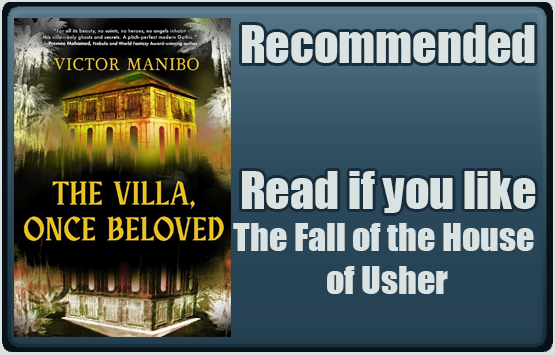
The Villa, Once Beloved is a modern gothic horror story set in the Philippines about the terrible crimes people will commit to obtain and maintain wealth and power. The story is tied to its setting, with the history of colonialism and political corruption in the Philippines playing an integral role in the plot.
Don Raul Sepulveda, the wealthy patriarch of the Sepulveda family, has decided his deceased family members need to be moved to a grand mausoleum. He attempts to build the mausoleum himself, despite his advanced age, after firing all the builders because they kept telling him his vision was impossible. Raul believes his family’s grand tomb must be finished quickly because death is coming for him, and is proven correct when he dies that night after seeing a terrifying specter in the jungle: a pale, faceless woman. His wife, Doña Olympia finds Raul’s crushed body in his bed the next day, his hands covered in dirt.
A few days later, a college student named Sophie is flying to the Philippines in a luxurious private jet with her boyfriend, Adrian, to visit his family. It’s her first time on an airplane and her first time out of the country. They’re flying to the Philippines for the funeral of Don Raul, Adrian’s grandfather. Sophie may be Filipino but she was raised by a white, working-class couple on a farm in Nebraska, making her feel like an outsider. While Sophie is worried that she may be intruding on the Sepulveda’s family’s private grief, she’s happy she can support Adrian in his time of need.
Sophie loves her boyfriend because of his “boundless and innocent optimism” and his ability to talk about his feelings and have tough conversations. He lavishes her with praise, unlike her adoptive parents, who don’t give her a lot of positive affirmation. Adrian cares deeply about his family and country, and has been educating Sophie about the Philippines: its history, culture, and what it means to be Filipino. Maybe I just distrust straight cis men, but Adrian seemed too good to be true. There weren’t exactly any red flags, but something about him felt off. Yellow flags, if you will. He never brings Sophie to his family’s home, despite it being only an hour from campus, and I got the sense a lot of his activism was performative. And the way he educates Sophie about the Philippines felt condescending. Sophie loves it;she describes it as “very My Fair Lady. Sophie was clay ready to be molded, a Filipina Eliza Doolittle who somehow needed to be more Filipina, and Adrian was happy to be Henry Higgins.” But if you remember the film (or the George Bernard Shaw play it was based on) Henry Higgins was a misogynistic jerk to Eliza Doolittle.
Adrian is planning to make a documentary about his family and their ties to the Marcos, a major political family in the Philippines. The Sepulvedas are related to the Marcos through Imelda Romualdez Marcos, the former First Lady of the Philippines. She was the wife of former president Ferdinand Emmanuel Edralin Marcos, Sr., and mother of the current president of the Philippines, Ferdinand “Bongbong” Romualdez Marcos, Jr. Ferdinand was a kleptocrat who ruled as a dictator from 1965-1986, committed numerous human rights violations, and kept the Philippines under martial law in the ‘70s. Adrian hates the Marcos with a passion, even going so far as to organize a protest at Standford University when Bongbong visited the Bay Area. When his grandmother Olympia announces that the current president and his mother will likely be guests at Raul’s funeral, Adrian is horrified.
Adrian’s family has been in the Philippines since before the diocese, and own a large coconut plantation. Their villa was built nearly 200 years ago by Señor Bartolome Sepúlveda as a summer retreat for his reclusive wife Dorotea to hide her from the attention of other men (or to hide her from society after she went mad from homesickness). They were Spanish aristocrats who had fallen on hard times and moved to the Spanish East Indies attracting by Manila’s growing wealth after the Spanish crown took control and turned it into a major trading port. Their son Oscar saved the Sepulveda fortune, by starting the coconut plantation. He married Mercedes, an indio (which his father didn’t approve of). They had seven sons and one daughter, Soledad, who was married off to a member of the Marcos family.
Claudio, the oldest son of Oscar and Mercedes, is Divina and Raul’s father. He was born in 1929, after the Philippines had been sold to America. Claudio, as a US national, served in the US army and fought in WWII during the Japanese occupation of the Philippines under General Douglas MacArthur. Claudio became a general himself, and a war hero, and chose to marry Elisea Jimenez because she was an heiress. He cheated on her multiple times, and may or may not have fathered children with other women. Elisea was the power behind the throne. She prevented Claudio’s siblings from ousting him from the company and it was her idea to expand into the international coconut trade in the sixties, selling lumber, coconut wine, and coconut oil. The coconut oil was especially popular with their US partners, and is still used in major cosmetics brands.
But then the Sepulveda family’s fortunes turned. In 1985 there was a worker’s strike at the Sepulveda’s plantation due to Marcos’ Coco Levy Fund Scam. A few days after that typhoon Saling (aka Typhoon Dot) struck, resulting in landslides that destroyed the countryside. Then malaria struck the town. There were crocodile attacks after that, then swarms of beetles that destroyed crops. Finally, a warehouse collapsed, killing several workers including Raul’s brother-in-law. When Raul’s father died suddenly of an aneurysm, Raul decided to flee to the states with his wife and young sons (Kai was not yet born), hoping to escape the curse. He left behind his newly widowed sister Divina to care for the villa and the coconut plantation.
Joining Adrian and Sophie at the villa are his parents Eric and Margot, his uncle Javier, his grandmother Olympia, his great aunt Divina, and some servants including the caretaker Remidios. Adrian’s auncle (a gender-neutral term for a parent’s sibling) Kai joins them later, barely making it to the villa because of the typhoon that strikes the Philippines. If you’re as bad at remembering names as I am, I would definitely recommend keeping a list of the characters because there are A LOT. Keeping track of the living family was one thing, but throw in all the ancestors on top of that and I started having trouble keeping track of who was who.
The book is told in third person limited tense, with Sophie acting as the main protagonist and audience surrogate who, while Filipino, is also an outsider and new to the culture and history. We also learn more about the family’s history through Adrian’s interviews with Divina for his documentary. Javier and Remidios serve as the deuteragonist and tritagonist of the story, giving the reader more of an insider’s view of the Sepulveda family. Javier and Remidios are both more cynical than the naïve Sophie who is just happy to be included. Javier is disappointed to discover his old home is not as grand as he remembered, instead finding it cramped and ill preserved whereas Sophie is in awe of the villa, highlighting their very different upbringings. Remidios has a less than charitable opinion of Sophie in the beginning (though she does warm up to her) and it’s interesting to see the protagonist, who is so often praised by Adrian, looked down upon by another character. Sophie is also the character who is most disturbed by what’s happening and becomes increasingly distraught as the story continues, growing paranoid and isolating herself from the rest of the family.
This is a slow burn horror book, which admittedly, I’m not usually a fan of. Things don’t start to getexciting until halfway through, when one of the family’s biggest secrets is finally revealed. The first half of the story is mostly getting to know the characters and their history, and I feel like it could have used more horror and foreboding. But of course, that’s just my personal preference.People with more patience than me will have a completely different reading experience. I did really enjoy learning about Filippino history and I liked how Manibo used real events and tied them into the story, like Typhoon Dot and the Coco Levy Fund Scam. I also liked how it isn’t revealed whether supernatural factors are at play until the very end. The reader is left to wonder if Raul was really killed by a batibat (a sort of Filipino sleep paralysis demon that can cause sudden, unexplained deaths) during a bangungot as Remidios claims, or whether the monster he saw was merely an apparition brought on by his madness. And is the string of disasters surrounding the family the work of a curse or merely bad luck?
Despite the villa’s size there’s a feeling of claustrophobia due to its isolation. The typhoon knocks out the internet, phone services, and roads making it impossible to reach anyone outside the villa. Because the villa is in a secluded area, it’s unlikely anyone will come to the aid of those trapped there by the landslides, despite Olympia’s insistence that everyone will come for her late husband’s funeral. Manibo is excellent at creating a gothic atmosphere, and, despite so many characters, each has their own unique perspective and personality, making them stand out. A must read if you’re a fan of the gothic.




0 Comments