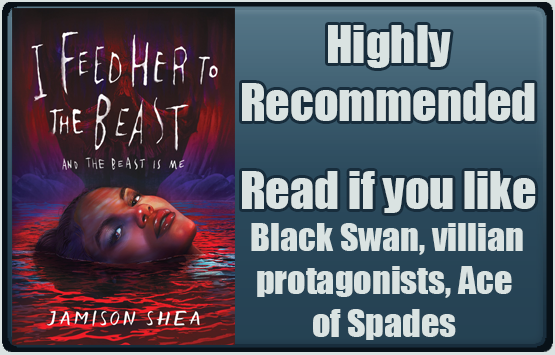
I Feed Her to the Beast and the Beast Is Me by Jamison Shea

I Feed Her to the Beast and the Beast Is Me by Jamison Shea

Formats: Print, audio, digital

Publisher: Henry Holt and Co.

Genre: Dark Fantasy, Mystery, Occult, Thriller

Audience: Young Adult

Diversity: Black main character and author, bisexual main character

Takes Place in: Paris, France

Content Warnings (Highlight to view): Body Shaming, Bullying, Death, Racism, Self Harm, Verbal/Emotional Abuse

Blurb

There will be blood.

Ace of Spades meets House of Hollow in this villain origin story.

Laure Mesny is a perfectionist with an axe to grind. Despite being constantly overlooked in the elite and cutthroat world of the Parisian ballet, she will do anything to prove that a Black girl can take center stage. To level the playing field, Laure ventures deep into the depths of the Catacombs and strikes a deal with a pulsating river of blood.

The primordial power Laure gains promises influence and adoration, everything she’s dreamed of and worked toward. With retribution on her mind, she surpasses her bitter and privileged peers, leaving broken bodies behind her on her climb to stardom.

But even as undeniable as she is, Laure is not the only monster around. And her vicious desires make her a perfect target for slaughter. As she descends into madness and the mystifying underworld beneath her, she is faced with the ultimate choice: continue to break herself for scraps of validation or succumb to the darkness that wants her exactly as she is—monstrous heart and all. That is, if the god-killer doesn’t catch her first.

From debut author Jamison Shea comes I Feed Her to the Beast and the Beast Is Me, a slow-burn horror that lifts a veil on the institutions that profit on exclusion and the toll of giving everything to a world that will never love you back.

I received this product for free in return for providing an honest and unbiased review. I received no other compensation. I am disclosing this in accordance with the Federal Trade Commission’s 16 CFR, Part 255: Guides Concerning the Use of Endorsements and Testimonials in Advertising.

I went into I Feed Her to the Beast and the Beast is Me expecting Laure to be an unlikeable female protagonist (something I actually enjoy in a story), but I was not prepared for just how relatable she was. If I ever become a supervillain, my origin story will be me finally getting fed up with all the bigotry and microaggressions I have to deal with every day and deciding to get even, rather than continuing to either educate or ignore the people hurting me. And that’s exactly what Laure does. Can you blame her? Every other ballerina in her company is rich and white, with powerful parents just dripping with privilege. The ballet is cutthroat, with ballerinas actively trying to sabotage each other (dancers often finds glass and tacks in their ballet shoes) and praying for one another’s downfall, and Laure is at a distinct disadvantage. Even though she works the hardest and performs the best of all of them, she’ll always be the Black girl who has to steal to pay for her tights. So, she cheats to level the playing field. Once she does, her talent and hard work is immediately rewarded. And honestly? It’s cathartic to watch Laure stoop to the level of the other ballerinas and their awful parents. It is SO exhausting to always have to be the bigger person in the face of abuse. I may agree with Michelle Obama’s “When they go low, we go high,” but I still don’t like having to “go high” when I would rather be a petty asshole. So, in a purely fictional world? It’s wonderfully satisfying to watch a Black woman choose the role of the villain and get even with all those rich white girls.

Ballet is still one of the least diverse performing arts, fraught with racism that ranges from subtle to overt. This is especially true in Europe. In her book Turning Pointe, Chloe Angyal discusses ballet’s racism problem. She describes an encounter with a racist dance mom and her implied message to her daughter: “[Black dancers are] not really good, but they are allowed to be here. In this space that is rightfully yours, in this art form that is rightfully yours. They’re never as good as the white girls, a sweeping generalization that grants no individuality, no humanity, to any nonwhite dancer. They’re all the same, and they never deserve to be here. But don’t worry. Your excellence is a given. You belong here, while their presence is conditional or even ill-gotten.” I think this quote sums up Laure’s struggles beautifully. The only difference is that these are struggles faced by real dancers.

Even something as simple as buying pointe shoes is no easy task for Black dancers. Most dance garments are traditionally “European pink,” and don’t match darker skin tones. Black ballerinas often have to pancake their shoes in dark foundation to match their skin tone and dye their tutus and tights. It’s only recently that brands like Capezio, Freed of London, and Bloch have offered shoes in darker skin tones. In the book Laure must purchase her own ballet shoes and tights because the ballet will only pay for pink ones. Black bodies are also discriminated against in ballet. In an interview with Sheila Rohan the Black ballet dancer described racism in ballet. “Racism in the ballet arts… meant people would make remarks about the Black ballerinas’ bodies — such as their chests being ‘too busty’ or their thighs being ‘too thick.’” A Black dancer in Berlin was told to lighten her skin with white makeup in order to play a song in Swan Lake. Laure straightens and gels her curly hair into place so she won’t stand out from the other dancers, but is still told she’s too “exotic” for a French ballet by a drunk patron. The controversial ballet La Bayadère was performed in Blackface by Russian dancers (white dancers have also worn stereotypical clothing and makeup to portray Roma and Chinese characters). The same ballet put on by Laure’s company in which she plays a shade.

After being abandoned by both parents, Laure’s only source of support is her best (and only) friend, Coralie, who is… not great. She’s kind and supportive of Laure, yes, but she’s also a subpar ballerina who just assumes she’ll get a spot in Paris’ prestigious ballet due to her famous mother. She’s essentially an entitled slacker and just as oblivious to her privilege as the other rich white girls. Coralie is also a snob, turning her nose up at anything that doesn’t come with a high price tag, which grates on permanently broke Laure’s nerves. Coralie really does seem to love her best friend, but their relationship comes with a power imbalance. So, she does not take it well when that balance of power shifts and Laure starts beating her out for roles. Because she has no one else, Laure is terrified of losing her only friend (as difficult as she can be), that is until she meets the étoile of the ballet, Josephine. Josephine gives her friendship freely without expecting anything in return, and treats Laure as an equal. She introduces Laure to her friends and shows her how she too can become an étoile. Slowly, Laure starts to see what a true friendship is like and begins to pull away from Coralie, although she still refuses to drop her completely and makes excuses for the wealthy girl’s bad behavior. I liked that while Laure does pursue a romance with a man later in the book, the story is mostly focused on her female friendships. It’s also a nice change of pace to see a toxic platonic, non-familial relationship explored. I don’t think enough people talk about how friendships can be abusive and how hard “breaking up” with a friend can be.

Another interesting theme in I Feed Her to the Beast and the Beast is Me is the idea of “perfection.” As a burned-out former “gifted kid” I know what it’s like to be expected to be perfect, then destroy yourself trying to do the impossible and ultimately have a mental breakdown when you realize perfection can never be achieved, and therefore that makes you a “failure.” The ballet expects Laure and her peers to be no less than perfect, and anyone who doesn’t make the cut is thrown aside and forgotten. While Coralie can get by half-assing it because of her mother, Laure must be the best there is to even think of if she wants to compete with the others. And it means giving up everything. This kind of perfectionism is extremely damaging to your mental health. Laure also believes that acceptance and respect from the others is entirely dependent on being perfect, not realizing she deserves respect regardless of her performance.

I Feed Her to the Beast and the Beast is Me is one of those books that I absolutely devoured. It held my attention throughout the story (no small feat when you have ADHD), save for a short part in the middle that felt like it was dragging. But other than that small criticism I can’t think of anything negative to say about this book. It’s a unique setting for a horror story, and a fresh spin on a Faustian bargain narrative. 
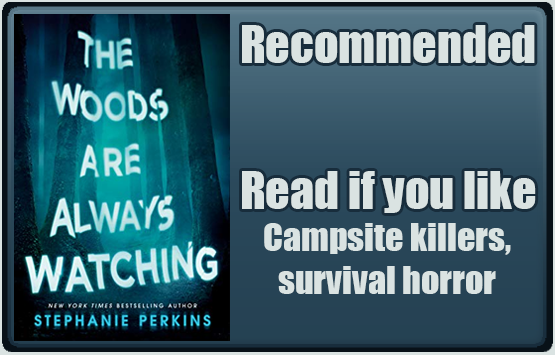
The Woods are Always Watching by Stephanie Perkins

The Woods are Always Watching by Stephanie Perkins

Formats: Print, audio, digital

Publisher: Dutton Books for Young Readers

Genre: Killer/Slasher, Thriller

Audience: Y/A

Diversity: Indian-American Main character

Takes Place in: North Carolina, USA

Content Warnings (Highlight to view):  Amputation, Child Endangerment, Death, Forced Captivity, Gore, Kidnapping, Rape/Sexual Assault, Torture, Violence 

Blurb

Bears aren’t the only predators in these woods.

Best friends Neena and Josie spent high school as outsiders, but at least they had each other. Now, with college and a two-thousand-mile separation looming on the horizon, they have one last chance to be together—a three-day hike deep into the woods of the Pisgah National Forest.

Simmering tensions lead to a detour off the trail and straight into a waking nightmare; and then into something far worse. Something that will test them in horrifying ways.

Camping and horror go together like chocolate and toasted marshmallows. There’s just something about being out in the middle of nowhere with only the light of a bonfire to really prey on those primal fears. In Western tradition, the woods have been a symbol of the dark and unknown for as long as folklore and fairytales have been told: a place where witches, wild beasts, monsters and faeries dwell.

The threat of becoming lost in the forest and falling victim to these creatures is central to many dark tales. In the beginning of the Divine Comedy Dante finds himself wandering in a dark wood, the “selva oscura,” unable to find his way and set upon by a lion, a leopard, and a she-wolf. Little Red Riding Hood encounters a wolf when she wanders off the path (though some interpretations of the fairy tale say the wolf is meant to represent a sexual predator) and Hansel and Gretel stumble upon a witch after losing their way in the woods. In Tam Lin, anyone who wanders into the forest runs the risk of becoming the fae’s blood tithing to hell. The films the Ritual and the Blair Witch both have a group of friends become lost in the woods through supernatural means and then assailed by a Jötunn and the titular witch respectively. But beasts and supernatural beings aren’t the only monsters in the forest. Ordinary humans can be just as —if not more — deadly than wolves and witches. The woods are popular killing grounds for murderers like William Mitchell Hudson (the Texas Campsite Killer) and Herbert MullinIvan Milat was a serial killer who specifically targeted backpackers while Alexander Pichushkin lured dozens of victims to Bitsevski park before murdering them. It’s safe to say the woods can be a dark and dangerous place in both fiction and reality, as best friends Neena and Josie are about to discover in Perkins’ outdoor horror novel The Woods are Always Watching.

Neena Chandrasekhar is a carefree and fun-loving teenage girl, especially compared to her worrywart best friend, Josie Gordon. After the death of her father in a car accident, Josie is scared of the world and often needs Nina to push her to try new things, like camping.  Neither girl is much of an outdoors woman, but going on a solo camping trip is practically a rite of passage in Asheville North Carolina, and with Neena soon leaving for college, the duo decides it’s the perfect way to celebrate their last few days together. They have GPS, printouts of the trails, and Josie’s brother’s camping gear, so what could possibly go wrong? Well, it’s a horror novel, so a lot.

The trip gets off to a rough start with both girls quickly realizing that they may not be physically prepared for such an arduous journey. Their exhaustion soon leads to short tempers and building tension as Josie quickly becomes fed up with Neena’s cavalier attitude towards camping and Neena gets annoyed with her best –friend’s condescending bossiness. Their friendship is further put to the test as the duo discover how ill-prepared they actually are for their hike through the woods and each takes out their frustration on the other. Caught up in their own petty squabbling the pair are dangerously unaware of something watching and waiting for them in the woods until it’s too late.

The Woods are Always Watching is slow to start, focusing on teenage drama and interpersonal conflict for the first chunk of the story, which can feel tedious even if it does offer glimpses into the main characters’ psyches. We don’t meet the actual villains of the story until almost halfway in (although there are hints to their presence early on). But once the action actually does get started, I found I couldn’t put the book down. Perkins is a master of creating atmosphere and suspense and making the forest feel dark and foreboding, especially to two inexperienced girls. The whole book feels like a modern-day fairytale with two naïve young women journeying through the dark woods

So, will you enjoy this particular dark woods story? Well, it’s essentially a young adult version of Deliverance, and the film is a good metric of how much you’ll like this book. Does the idea of being isolated in the woods, and slasher/folk horror terrify you? Then you’ll enjoy Stephanie Perkins’ camping-gone-wrong novel. Evil hillbillies and threats of rape not your thing? Then you’re probably better off skipping this one.

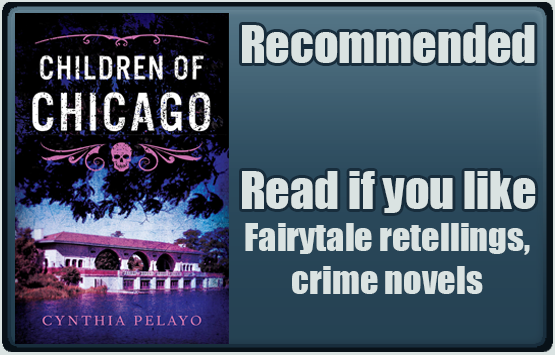
Children of Chicago by Cynthia Pelayo

Children of Chicago by Cynthia Pelayo

Formats: Print, audio, digital

Publisher: Agora

Genre: Dark Fantasy, Demon, Killer/Slasher, Myth and Folklore, Thriller

Audience: Adult/Mature

Diversity: Bisexual main character, Puerto Rican main character and author, Latine characters

Takes Place in: Chicago, IL, USA

Content Warnings (Highlight to view): Alcohol Abuse, Child Death, Death, Forced Captivity, Gaslighting, Illness, Kidnapping, Mental Illness, Physical Abuse, Police Harassment, Suicide, Violence

Blurb

This horrifying retelling of the Pied Piper fairytale set in present-day Chicago is an edge of your seat, chills up the spine, thrill ride. ‪ When Detective Lauren Medina sees the calling card at a murder scene in Chicago’s Humboldt Park neighborhood, she knows the Pied Piper has returned. When another teenager is brutally murdered at the same lagoon where her sister’s body was found floating years before, she is certain that the Pied Piper is not just back, he’s looking for payment he’s owed from her. Lauren’s torn between protecting the city she has sworn to keep safe, and keeping a promise she made long ago with her sister’s murderer. She may have to ruin her life by exposing her secrets and lies to stop the Pied Piper before he collects.

And I chiefly use my charm
On creatures that do people harm,
The mole and toad and newt and viper;
And people call me the Pied Piper.
The Pied Piper of Hamelin by Robert Browning (1812-1889)

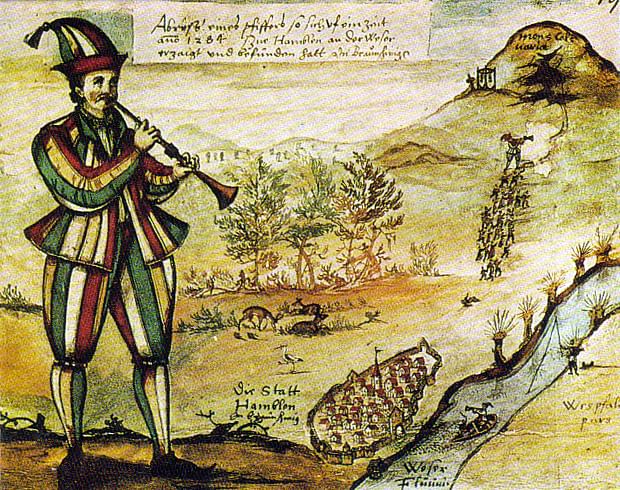
“The Pied Piper of Hamelin”by Augustin von Mörsperg, 1592

My dad was born and raised on the Southside Chicago and will tell anyone who will listen that his birthplace is the best city in the world. My wife, on the other hand, firmly believes Chicago is akin to LA in the ‘90s. When I did finally manage to lure her there with the promise of deep-dish pizza and the Museum of Science and Industry she did admit the Windy City was a pretty cool place and not at scary as she was expecting (even after we stumbled onto an illegal street race). Although the crime rate there is higher than the national average, Chicago is hardly the crime and drug filled dystopia my wife and other outsiders seem to believe it is. In fact, its violent crime rates are far lower than those of Anchorage, Wichita, and Milwaukee. The dangerous reputation may have come from Chicago’s fascinating history of crime, gangsters, and serial killers or even the many tragedies that have befallen the White City in the past. Modern-day boogiemen like the Lipstick Killer, John Wayne Gacy, the Ripper Crew, and Richard Speck all called Chicago their home. The Blue Beard-esque H. H. Holmes built his murder castle in Englewood. The city’s most notorious gangster, Al Capone, has morphed into something of a folk hero and tragedies like the Great Chicago Fire and the Haymarket affair have taken on almost a legendary status. Dark rumors surround the abandoned Edgewater Medical Center. Stories like these have shaped Chicago’s history and how it’s perceived by the rest of the country: a gothic city haunted by the past. But darkness and death aren’t all the city has to offer.

Fairy tales, at least the original versions and not the Disney-fied ones, are often a child’s first introduction to the world of horror. Beautiful and sinister stories full of threats of death and assault, mutilation, hungry wolves, and dark forests have been used to frighten children for generations. Fairy tales are beautiful roses and sharp thorns, poisonous treats, beauty and blood. They also share many of the same elements as gothic fiction. Sometime in the distant past, a helpless woman is placed in a dark and dangerous setting (now a castle instead of a forest), where she is threatened by supernatural forces until rescued by the hero. Orphans and peasant girls are made to suffer before finally coming into riches. Animals no longer speak, but still bring portents of doom. Nature is wild, dangerous, and unpredictable. Both have themes of revenge, isolation, rags to riches, abuse, and women who are under constant threat as the men in her life fight over her body. Bluebeard, and other versions of the Aarne–Thompson type 312 tale, are the perfect example of a gothic fairy tale. In the story a woman leaves her family to marry a mysterious stranger and goes to live in his isolated and lonely castle. But locked away in a castle is a dark and dangerous secret. The wife can go in any room, but one, which contains the bodies of the stranger’s previous, murdered wives.

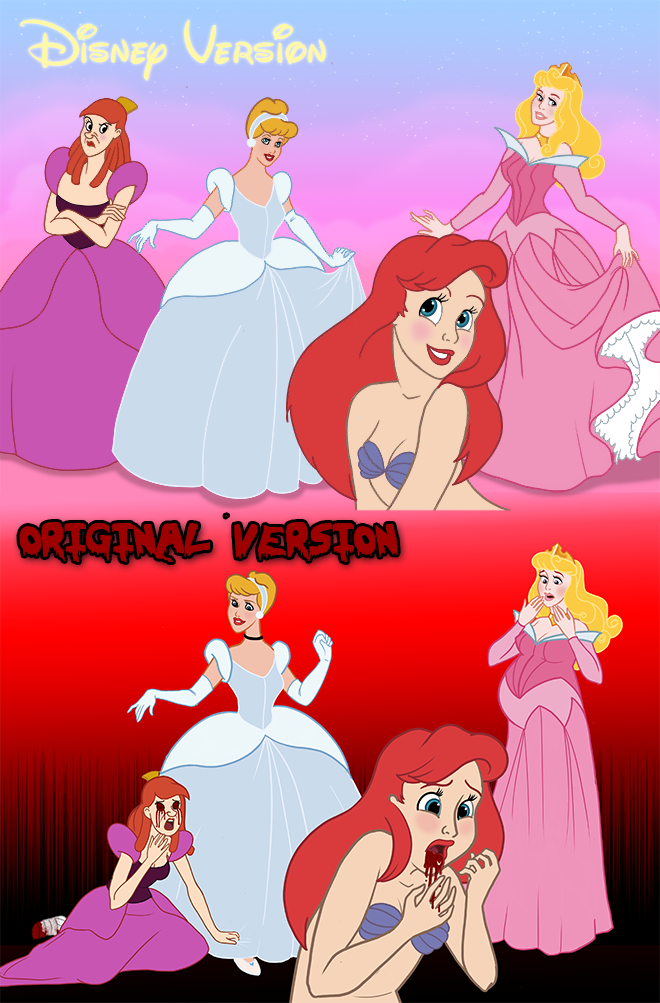
In the original version of Cinderella, the Little Mermaid, and Sleeping Beauty, the step sisters cut off parts of their feet and birds pecked out their eyes, the mermaid’s tongue was cut out and every step she took on land was agony, and Sleeping Beauty was raped and impregnated with twins by a married king while she slept.

Cynthia Pelayo draws on the city’s history to create her gothic urban fairy tale, Children of Chicago. The city stands in for the dark forest, a vaguely supernatural setting where unwary children disappear and gang members prowl the street like big bad wolves. The book follows recently orphaned Lauren Medina, a deeply troubled police detective hunting a serial killer known only as The Pied Piper– a shadowy boogeyman who preys on children then vanishes into the night. It’s rumored he can be summoned by burning a black candle and speaking a spell in front of a mirror. Throughout the story, Lauren is unstable and brimming over with barely-contained emotion, a staple of any good Gothic tale, as she wrestles with her missing memories of her sister’s death. Lauren breaks the typical female fairy tale mold where women were relegated to witches, wise women, virginal damsels, and evil stepmothers. She’s not exactly evil, but she isn’t pure and heroic either, instead she’s but a rare example of a female Byronic hero intentionally written to be tragic, unlikeable, morally gray, and hiding a dark past, much like the heroes found in gothic horror. In fact, few of the women in the story fall into any of the aforementioned roles. Stepmothers aren’t necessarily evil, even if their angry stepdaughters perceive them as such. Damsels in distress may possess more agency than they seem to, and villainous women can also be victims. I genuinely enjoyed seeing a female character (who wasn’t intended to be liked) embrace her darkness and struggle with her morality. Just as much horror came from Lauren’s psychological trauma and instability as it did from the threat of the supernatural.

While Lauren initially came across as “the young female cop with a dark past and something to prove” trope (aka Jodie Foster in Silence of the Lambs), it soon became clear that unlike Clarice Starling, we’re not necessarily supposed to root for her. And unlike every maverick detective in an ‘80s buddy-cop comedy, Lauren’s flagrant disregard for the rules in order to get her guy aren’t justified, but instead dangerous and unjust. Though, much like police in the real world, she’s able to get away with it. I appreciate that Pelayo avoided turning her crime drama into “copaganda” by making Lauren a protagonist, but not a hero. I admit I used to enjoy shows like Brooklyn 99Lucifer, and Law & Order SVU (yes, I’m old) even though I recognized how incredibly problematic they were. But ever since 2020 I’ve more or less lost my taste for any media that portrays a corrupt system as a heroic force for good, justified in flouting the law. It no longer feels like harmless fantasy when you realize how many people actually believe that cop shows reflect real life and officers only target “bad guys” as oppose to anyone they don’t like (mostly BIPOC, the poor, and the mentally ill). So, reading a crime story where the police weren’t heroes was a relief. In fact, Lauren’s only redeeming quality is that she has a soft spot for troubled teens, ever since the mysterious death of her own sister.

Brimming with references to Chicago’s history, it’s clear that Pelayo loves her home while still recognizing its flaws. In fact, the novel feels just as much a crime story as it does a guide to the dark and fantastical parts of the Windy City. She holds a Master of Fine Arts in Writing from The School of the Art Institute of Chicago and it shows in her writing. Throughout Children of Chicago Pelayo references the original, dark versions of famous and not-so famous fairytales, from Cinderella to the Singing Bone, adding to her own story’s dark atmosphere balancing on the edge of reality and fantasy. Pelayo’s novel is full of missing mothers, an unjust society where the most vulnerable suffer, magic mirrors, plenty of gore, spells, and a moral message. But overall, it’s a subversion of the classic fairy tale formula where the good are rewarded, the evil are punished, and morality is clearly defined. In Children of Chicago the “heroes” are neither pure-hearted nor moral, evil escapes justice while the innocent suffer, and no one is getting a happy ending.

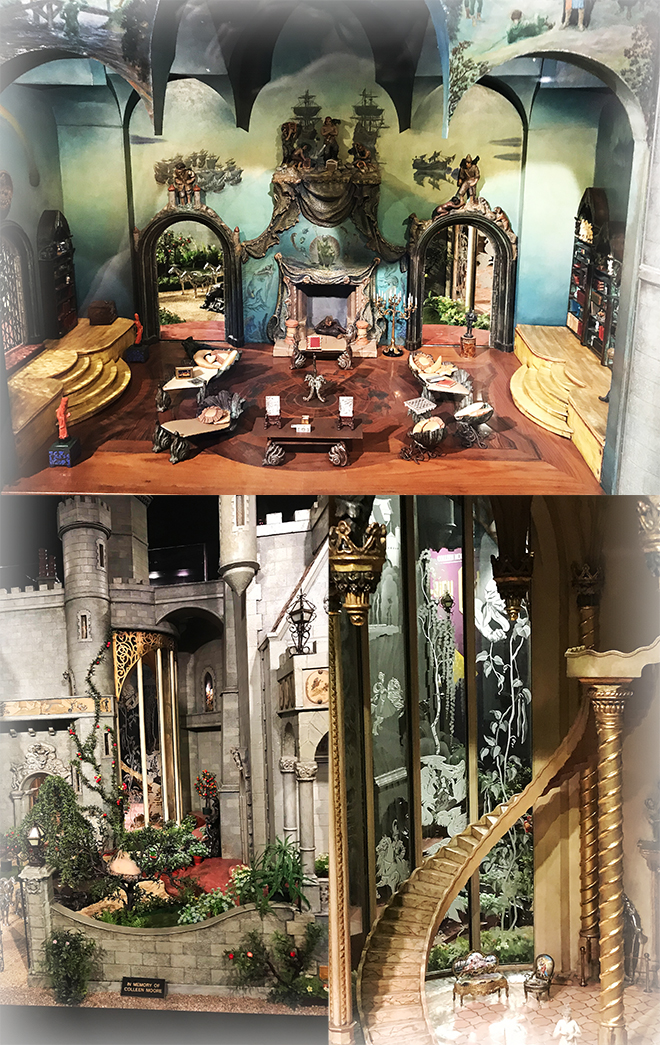
It’s unfortunate that the darkest parts of Chicago’s history have shaped so much of its reputation when the Windy City has so much to offer. As my wife soon discovered on her first visit, the city is full or art, beauty, and wonder. Pelayo doesn’t just show the city’s dark side, she shows its magic as well. “Fairy tales are in our blood as Chicagoans” one of the books characters explains. Walt DisneyL. Frank BaumRay Bradbury, and Gwnedolyn Brooks were all inspired by the city to create their own fairy tales. Colleen Moore created her famous Fairy Castle and donated it to The Chicago Museum of Science and Industry. Children gathered pennies to create the Rock-a-Bye Lady from Eugene Field’s poem. The haunting beauty of the SheddAquarium feels like you’ve stepped into another world. The city even has a secret Little Mermaid inspired bar! It’s this beauty, contrasted with the allure of danger, that makes Chicago as wonderous as any fairytale.

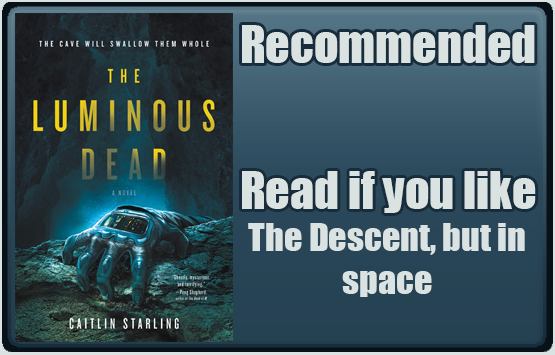
The Luminous Dead by Caitlin Starling

The Luminous Dead by Caitlin Starling

Formats: Print, audio, digital

Publisher: Harper Voyager

Genre: Psychological Horror, Sci-Fi Horror, Thriller

Audience: Adult/Mature

Diversity: Lesbian/queer characters and author, Biracial Black character 

Takes Place in: another planet

Content Warnings (Highlight to view): Death, Drug Use/Abuse, Forced Captivity, Gaslighting, Medical Torture/Abuse, Medical Procedures, Mental Illness,  Self-Harm, Attempted Suicide, Verbal/Emotional Abuse

Blurb

“This claustrophobic, horror-leaning tour de force is highly recommended for fans of Jeff VanderMeer’s Annihilation and Andy Weir’s The Martian.” — Publishers Weekly (starred review)
***

A thrilling, atmospheric debut with the intensive drive of The Martian and Gravity and the creeping dread of Annihilation, in which a caver on a foreign planet finds herself on a terrifying psychological and emotional journey for survival.

When Gyre Price lied her way into this expedition, she thought she’d be mapping mineral deposits, and that her biggest problems would be cave collapses and gear malfunctions. She also thought that the fat paycheck—enough to get her off-planet and on the trail of her mother—meant she’d get a skilled surface team, monitoring her suit and environment, keeping her safe. Keeping her sane.

Instead, she got Em.
Em sees nothing wrong with controlling Gyre’s body with drugs or withholding critical information to “ensure the smooth operation” of her expedition. Em knows all about Gyre’s falsified credentials, and has no qualms using them as a leash—and a lash. And Em has secrets, too . . .
As Gyre descends, little inconsistencies—missing supplies, unexpected changes in the route, and, worst of all, shifts in Em’s motivations—drive her out of her depths. Lost and disoriented, Gyre finds her sense of control giving way to paranoia and anger. On her own in this mysterious, deadly place, surrounded by darkness and the unknown, Gyre must overcome more than just the dangerous terrain and the Tunneler which calls underground its home if she wants to make it out alive—she must confront the ghosts in her own head.

But how come she can’t shake the feeling she’s being followed?

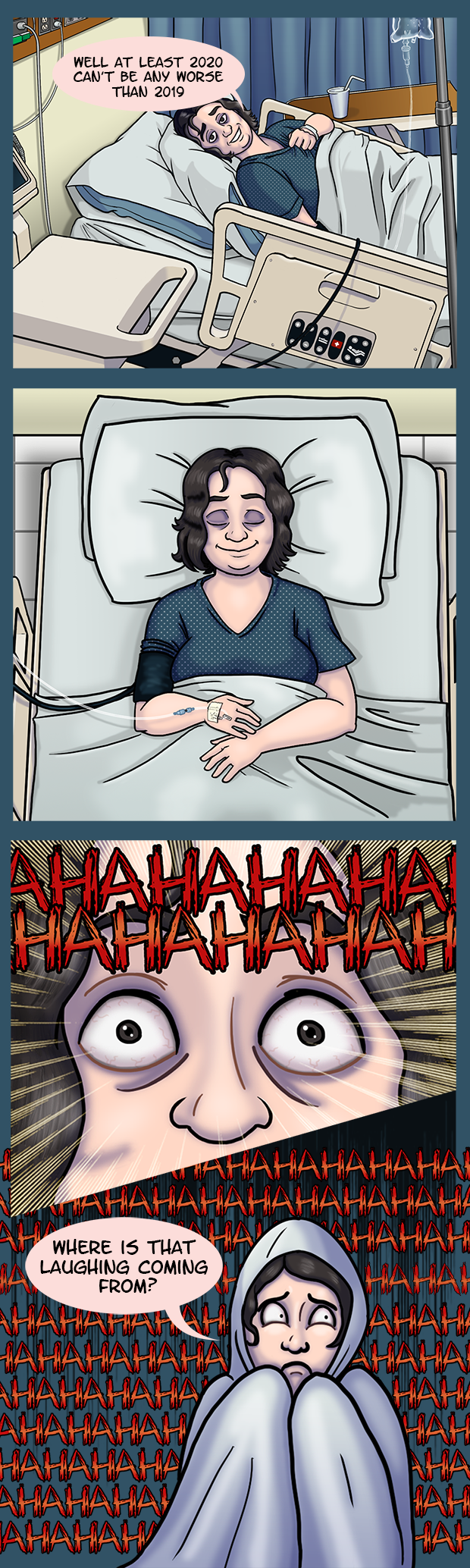
The Luminous Dead is a survival horror story with only two characters, one location, and no antagonist. It’s also one of the most stressful horror stories I’ve ever read. Starling is a master of playing with the reader’s paranoia, building up the suspense and atmosphere until you’re jumping at every sound and shadow. Ironically, The Luminous Dead also managed to calm me down considerably when I was dealing with my own stressful situation (horror is great for anxiety): spending the night in the ER awaiting an emergency cholecystectomy (after my wife told me it was nothing and we weren’t spending $4,000 at the ER just because I had stomach cramps that were probably just from drinking milk, and why hadn’t I just taken the Lactaid tablets she bought me). After managing to survive a severely infected gallbladder, I assumed that 2020 could only be uphill from there. Poor, naïve past me.  

In the first panel I'm lying in a hospital bed looking worn out. "Well at least 2020 can't be any worse than 2019." I say. In the second panel I'm sleeping peacfully, when suddenly I'm woken up in the third panel by evil laughter. In the 4th panel the demonic laughing continues while I hide under the blankets and ask "Where is that laughing coming from?"

Well at least none of my organs exploded in 2020, so there’s that…

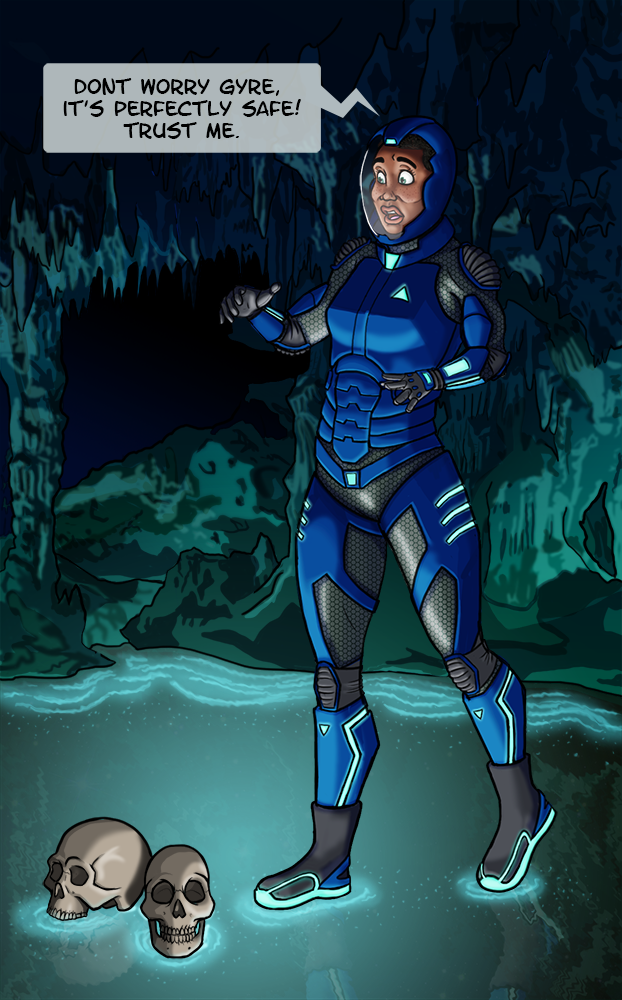
In the future, humanity has spread out across the stars, but sadly it’s not the socialist utopia dreamed of in Star Trek. Gyre lives on a barren, back-water mining planet where poverty is rampant and the only escape is to take a job as a caver for wealthy mining companies. It’s not a pleasant job. On top of spending days or even weeks in a self-contained suit with little human interaction, breathing recycled air, and being fed through a stomach stoma, these subterranean explorers have to contend with falls, cave-ins, and underground flooding. Worst of all are the Tunnelers – giant alien worms that burrow through solid stone. Not many cavers survive, but those who do can expect a huge payout. In Gyre’s case, it’s enough to get her off-world to find the mother who abandoned her as a child. Desperate, uncertified, and inexperienced, she accepts an especially sketchy caving job that doesn’t ask too many questions. It’s not until Gyre has already begun her descent into the subterranean labyrinth she’s been hired to explore that she discovers she may have made a grave mistake. Instead of having an entire team topside to monitor her vitals, feed her info, and watch her while she sleeps, which is the standard, she has only one woman, Em. Cold, efficient, controlling, and stingy with details, Em is not above obfuscating data and manipulating her cavers to get the job done. Not exactly someone you want to trust with your life. Em seems to genuinely want to protect Gyre even if her methods are questionable, but that hardly excuses the lying and manipulation which only serve to exacerbate the young caver’s trust issues. Not that Gyre is much better. Her desperation means she’s willing to make some morally questionable decisions, and her stubbornness leads to her making bad ones.

A drawing of Gyre in her suit. She's in the cave and is looking at two skulls on the ground, horrified. Em is on the intercom saying "Don't worry Gyre, it's perfectly safe. Trust me!"

The background is from a cave in the Dominican Republic I visited back in February 2020. There weren’t any skulls in it though. *sigh* I miss travel.

As if paranoia, isolation, and giant monsters aren’t scary enough, Starling adds another twist: there may or may not be something sinister going on in the cave as Gyre’s senses start to play tricks on her. Maybe it’s another one of Em’s deceptions. For most of the book, you’re genuinely unsure of where the biggest threat is coming from: the cave, Em, or Gyre’s own mindknowing she’s all alone in the dark unknown (or is she?) with only one less-than-trustworthy guide. Although Gyre never fully trusts Em, the two begin to form a distrustful, dysfunctional relationship over time as they reveal and struggle with past traumas. And yes, their trauma bond is just as maladjusted as it sounds. It’s both fascinating and horrifying to watch these two deeply flawed, fucked up people grow closer. Part of me was rooting for Gyre and Em because, when everything is awful, people deserve every bit of happiness they can get. But the more rational part of me was horrified. Shared suffering does not mean two people will be compatible and without trust issues, and on top of Em’s willingness to put Gyre in danger, there are the hallmarks of a toxic relationship. To Starling’s credit, she doesn’t try to create an idealized romance, or even imply that their bond is healthy like certain romance books that will remain nameless tend to do *cough*Twilight*cough*. Instead she aims to create two realistic, flawed characters who are doing their best in a bad situation. I’m a huge fan of antiheroes and morally gray characters in fiction (in real life they’re just assholes) because they’re rarely bland or boring, and Gyre and Em are anything but dull. Watching a caver with trust issues put her life in the hands of a woman who lies just makes the story all the more suspenseful.

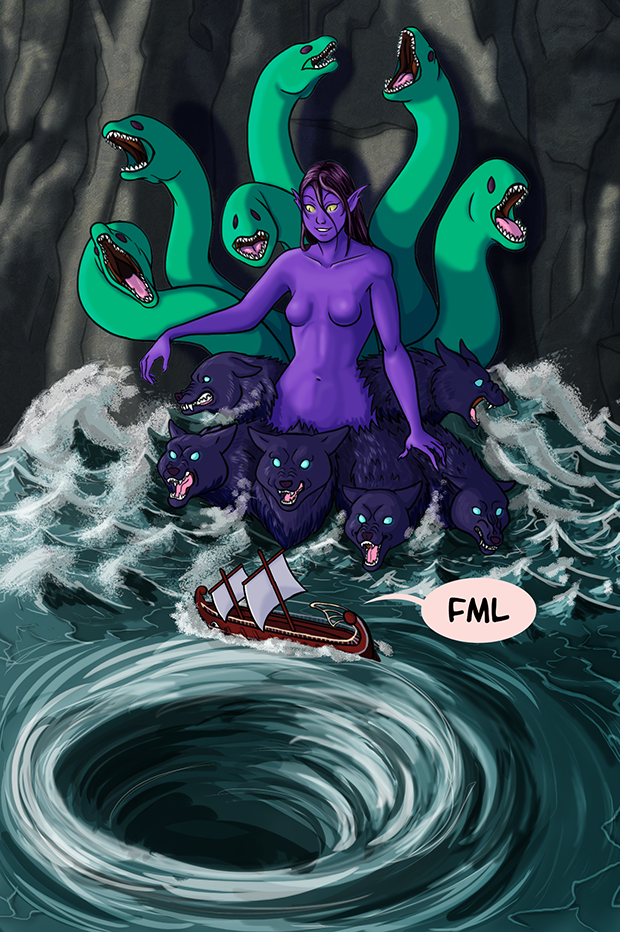
Part of the reason Gyre acts the way she does is because she grew up in survival mode. Living in a barren, capitalist hellhole will do that to a person. Like any good work of science fiction, The Luminous Dead uses fictional characters in a fictional setting to draw attention to some very real-world ethical dilemmas. In this case, it’s the exploitation of the poor and vulnerable in a Capitalist society. Dubbed 3K jobs in Japan (kitanai, kiken, kitsui or dirty, dangerous, and difficult in English) this sort of work has traditionally been given to immigrants, migrant workers, and other vulnerable populations who have few options available to earn a living and are less likely to complain about unsafe working environments. Dangerous jobs that require specialized skills and training, such as construction and steel working jobs, pay better salaries and are more likely to be OSHA compliant, but rarely pay enough to offset the risk. Sex work can be a 3K job that pays well, but leaves sex workers open to arrest, abuse, and disease without legal protections in place. While workers aren’t being forced into these jobs per se (as opposed to victims of trafficking, domestic servitude, debt bondage, and other forms of slavery) they’re not usually done by people who have other options available. In The Luminous Dead, caver jobs are only ever taken by those in poverty (the wealthy would never risk their lives doing such dangerous work) and no one continues caving after they’ve made enough to escape. So is it really a choice when you’re between Scylla and Charybdis?

A drawing of Odysseus' ship passing between Scylla (a monstrous woman with six dog's heads around her waist and six serpents head's with shark's teeth coming out of her back) and Charybdis (a giant whirlpool). Someone on the ship is saying "FML".

Scylla wasn’t that big but she’s also not real so I can draw her however I want lol

I can’t describe much more of the plot, as spoilers would ruin the suspense Starling worked so hard to create, but suffice it to say that The Luminous Dead is, at its core, about the trauma of losing a mother, whether from abandonment or death, and how anger and grief can destroy you. If you love isolation horror, definitely pick up a copy of your own.

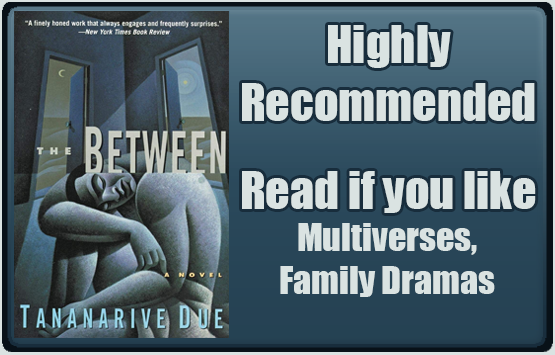
The Between by Tananarive Due

The Between by Tananarive Due

Formats: Print, digital

Publisher: Harper Collins

Genre: Psychological, Thriller

Audience: Adult/Mature

Diversity: Black Characters (African American and Ghanaian) and author, Hispanic/Latino character (Puerto Rican), Character with possible Mental Illness

Takes Place in: Miami, Florida, USA

Content Warnings (Highlight to view): Animal Abuse, Animal Death, Child Abuse, Child Death, Death, Drug Use/Abuse, Gaslighting, Homophobia, Mental Illness, Racism, Rape/Sexual Assault mentioned, Stalking, Slurs, Suicidal thoughts, Verbal/Emotional Abuse 

Blurb

When Hilton was just a boy, his grandmother sacrificed her life to save him from drowning. Thirty years later, he begins to suspect that he was never meant to survive that accident, and that dark forces are working to rectify that mistake.

When Hilton’s wife, the only elected African-American judge in Dade County, FL, begins to receive racist hate mail, he becomes obsessed with protecting his family. Soon, however, he begins to have horrible nightmares, more intense and disturbing than any he has ever experienced. Are the strange dreams trying to tell him something? His sense of reality begins to slip away as he battles both the psychotic threatening to destroy his family and the even more terrifying enemy stalking his sleep.

Chilling and utterly convincing, The Between follows the struggles of a man desperately trying to hold on to the people and life he loves, but may have already lost. The compelling plot holds readers in suspense until the final, profound moment of resolution.

I admit, I’m a huge Tananarive Due fan. I love her books, I love her academic work, I love reading her tweets, and I especially love how she’s always willing to share her wisdom and encourage other writers. When I was watching Black horror films for my Horror Noire timeline and Morbidly Beautiful review Due was kind enough to engage with me on Twitter and offer movie recommendations, insights, and feedback for my articles. Here was this amazing author who I admired so much not only chatting with me about our shared love of horror, but taking the time to help me out! If I ever get the chance to meet her in person, I’d probably faint. Needless to say, trying to pick a book to review by one of the most influential Black horror authors out there was a daunting task. Should I write about one of her best-known novels, My Soul to Keep from the popular African Immortals series? Or should I review my personal favorite, The Good House (which I’ve been known to throw at random friends and family members, insisting they read it)? After much back and forth, I finally decided I should start at the beginning and shine the spotlight on her very first novel which doesn’t get nearly as much recognition as it deserves: The Between. This award-winning psychological thriller stars family man Hilton as he loses his grasp on reality while watching his perfect life fall apart after his wife, Dede, receives a racist death threat at her job. In addition to being a truly creepy piece of speculative fiction, it’s also nice to see such a strong, loving, successful Black family dealing with issues like code-switching in a mostly white neighborhood, the Black community’s views on homosexuality and mental illness, and the differences in culture between Africans and Black Americans.

Before diving into the plot of Due’s very first novel, let’s have a quick physics lesson because I can’t review a sci-fi story without at least a little bit of science. Many of you may already be familiar with the many-worlds theory: an interpretation of quantum physics which essentially states that everything that could have possibly happened, but did not, has occurred in a different, alternate timeline, creating a vast multiverse where universes branch into more universes with each possible outcome. For example, flipping a coin would create two separate universes, one where it lands on heads and another where it lands on tails. Some of these universes would be nearly identical to our own, like the two timelines seen in the movie Sliding Doors, while others would hardly be recognizable, like the alternate history in The Man in the High Castle by Philip K Dick where the allies lose WWII, or the two-dimensional world from Edwin Abbott Abbott’s satirical novella, Flatland. However, we are only capable of perceiving the universe that we’re currently in. That’s the main, overly simplified, gist of it anyway. Here’s a great video that further explains this complex concept in an easy to understand way. Now you can impress your friends with your physics knowledge!

The many-worlds theory is especially popular with science and speculative fiction writers and shows up in everything from novels (Mid-World from Stephen King’s Dark Tower series) and comics (the Bizarro World in Superman) to films (Spider-Man into the Spider-Verse) and TV shows (Star Trek‘s Mirror Universe). The Between differs from most of these examples because, in true Schrödinger’s cat fashion, a multiverse may or may not play an important role in the book, and it all starts when Hilton’s grandmother dies the first time. Seven-year old Hilton James discovers his Nana’s cold, dead body on the kitchen floor and runs to get help, only to return and discover she’s alive and well. Her second, and final, death occurs when she drowns trying to save him. Struggling with survivor’s guilt, Hilton becomes obsessed with saving everyone and grows up to run a rehab clinic for low-income people suffering from drug addiction. While a noble calling, spending his every waking moment helping the less fortunate at the expense of him family puts a serious strain on Hilton’s relationship with his wife, Dede, whose jealousy causes her to suspect the worst. Worse still, Hilton is plagued by morbid nightmares in which a voice asks him “How many times do you think you can die?” Believing “we’re always closest to death when we sleep” the nightmares result in somniphobia and severe insomnia. Marriage counseling improves his relationship with his wife, and hypnotherapy helps Hilton sleep, but his nightmares soon resurface with a vengeance after Dede receives a racist, threatening letter shortly after being elected as a judge. Seemingly prophetic dreams full of his Nana’s decaying corpse, his children dying, and his own, mutilated body telling him he’s running out of time plague Hilton until he starts staying up all night, wandering the house, rather than returning to his cadaver-filled dream land. Unsurprisingly, Hilton’s mental health takes a turn for the worse.

Seemingly unsatisfied with simply haunting Hilton’s nightmares, portents of death start appearing to him during the day. After waking up with a sense of dread, Hilton insists the family go to church, only to be met with a new preacher ranting about the water of life from Revelations and meeting Jesus when you face eternity. Cheerful! The day gets worse when his young son, Jamil, is traumatized after witnessing some older boys kill a duckling. Then, Hilton accidentally rear-ends a hearse because the universe is not fucking around with the foreboding omens. A few days later, his adolescent daughter, Kaya, has her first period which Hilton’s commemorates by taking her to the hospital to meet one of his clients, Antoinette, a teenage girl dying of AIDS. I know I’m not a parent, but I feel like reminding your child of their own impending mortality is probably not the best way to celebrate their menarche. And just to make sure Hilton really gets it, because Death doesn’t do subtle, they’re stopped by a funeral procession on their way back from seeing Antoinette. Did I mention it’s raining? Of course it’s raining. I’m surprised a murder of crows didn’t fly overhead and blot out the sun while chanting “doooooooom”. No wonder Hilton becomes convinced Death is stalking him. The symbolism may seem heavy handed, and in the hands of a less talented writer would’ve come off as cheesy, but in Due’s case it works incredibly well to emphasize the depths of Hilton’s paranoia and his loosening grip on reality and set up two equally creepy explanations for what’s happening.

 
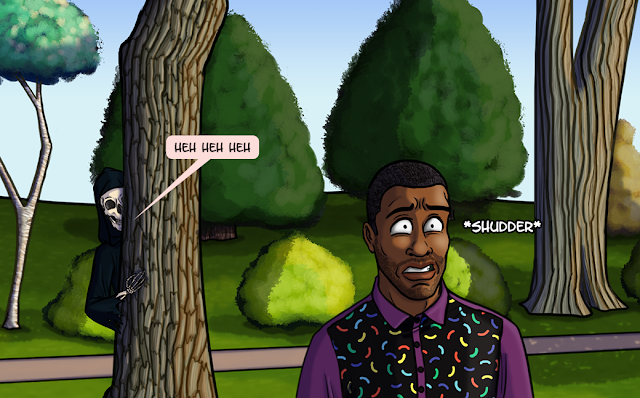
Death, represented by a skeleton wearing a dark robe, is hiding behind a tree in a park so they can spy on Hilton. Death is snickering. Hilton, a middle-aged Black man wearing a brightly colored 90’s shirt, is in the foreground looking nervous and shuddering. He doesn’t see Death, but he senses them.

What I imagined Death doing throughout the book

It’s implied that Hilton is a “traveler”, someone with the ability to escape death and bad decisions by traveling through “doorways” from his current reality to one with a more favorable outcome. It’s how he brought Nana back to life and survived drowning as a child. He does it again when he rear-ends the hearse to save his family. Of course, not every timeline he jumps into is exactly identical. Hilton begins to notice more and more inconsistencies in his everyday life, from events that repeat themselves to encounters that seemingly never occurred no matter how clearly he remembers them and even visions of deaths that never happened. On top of this, you can only cheat the system for so long before you get caught. Some unknown force, sensing that Hilton isn’t supposed to be alive, is making subtle alterations to the timeline to “correct” this. Between his menacing nightmares and threatening letters that continue to arrive at Dede’s office, and eventually their home, Hilton’s concern for his family’s safety warps into full blown paranoia. Even after putting his children under lockdown, buying a rifle, security lighting, and a guard dog, Hilton continues to see danger around every corner, thanks in no small part to his lack of sleep. He goes from his normal calm and sensitive self to a scared, angry man who lashes out at his family and friends.

Hilton may see signs that Death is lurking around every corner, but the rest of his family isn’t making the same connection between a dead duckling and their patriarch’s distracted driving. Maybe something supernatural is going on and the universe is trying to send the poor man a warning about abusing the natural order of things, but there’s also a strong argument to be made that Hilton is merely suffering from Apophenia, assigning meaning to unrelated coincidences. Apophenia is also a major symptom of paranoid schizophrenia, along with a fear that someone or something is out to get you, an inability to tell what is and isn’t real, a voice (or voices) in your head, and major changes to mood and sleeping habits, all of which Hilton has started to display. Those prone to schizophrenia can have a psychotic episode triggered by a stressful life event, like, say, having a racist stalker sending threatening letters to your wife.

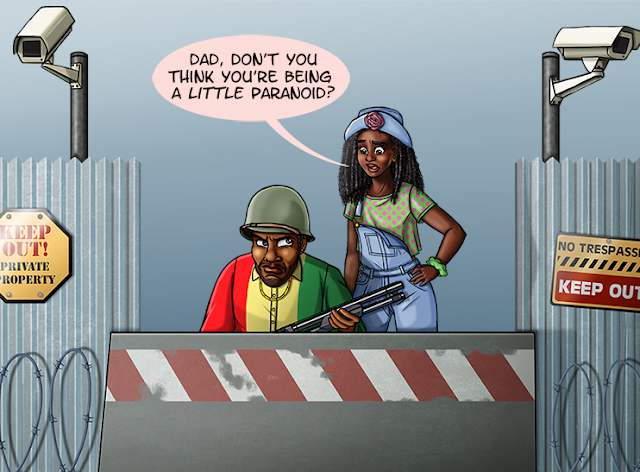
Hilton is crouched behind a cement and barbed wire barrier, surrounded by security cameras and “Keep Out” signs. He’s wearing an army helmet and holding a rifle, ready to shoot any intruders. His teenage daughter stands behind him looking concerned, and asks “Dad, don’t you think you’re being a little paranoid?”

The Between is set in the 90’s, but all my memories of that particular decade seem to be either Pokémon or Harry Potter related and I don’t really remember what we were wearing back then. So I just put Hilton and his daughter in 90’s sitcom clothes and called it a day.

As we watch Hilton’s mind unravel as he desperately tries to prevent some horrible, unknown disaster he’s convinced will happen, there’s a strong sense of urgency and dread. However, it’s unclear if supernatural forces are at work and Hilton is the only person who can see the truth, or if he really is just paranoid and his visions are a result of his fears made manifest by mental illness. Are his lapses in memory and reoccurring nightmares a result of a mental illness combined with guilt, or some sort of supernatural force?  Is the racist stalker leaving poison pen letters for his wife the only thing threatening Hilton’s family, or is Death playing a drawn out game of Final Destination? Will he lose everything due to a curse, or his own actions? With the line between dreams and the real world becoming more and more blurred, it’s difficult for the reader to determine how much of what happens is in Hilton’s head, and whose version of reality is the truth until the very end. Hilton is not the most reliable of narrators, making it difficult to determine whether or not something supernatural is going on, but like The Turn of the Screw, not knowing if it’s the narrator’s sanity slippage or the work of spirits is part of the appeal and both possibilities are equally terrifying. Due hit the ground running with her very first novel and her fiction has only gotten better from there.

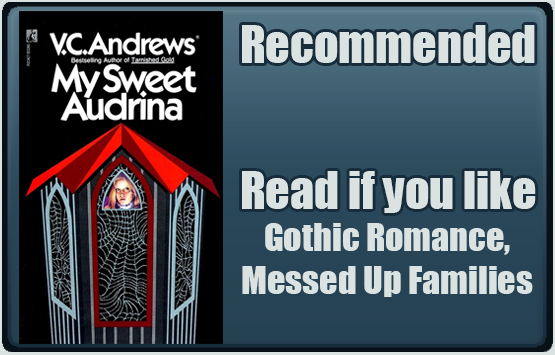
My Sweet Audrina by V.C. Andrews

My Sweet Audrina by V.C. Andrews

Formats: Print, audio, digital

Genre: Gothic Horror, Romance, Thriller

Audience: Adult/Mature

Diversity: Intellectual Disability, Possible Autism, Physical Disability (bilateral above the knee amputee), Chronic Illness (Osteogenesis imperfecta/brittle bone disease), PTSD

Takes Place in: Southern USA

Content Warnings (Highlight to view): Abelism, Alcohol Abuse, Body Shaming, Bullying, Implied Cannibalism, Child Abuse, Child Death, Childbirth, Death, Forced Captivity, Gaslighting,  Illness, Emotional Incest, Medical Torture/Abuse, Miscarriage, Mental Illness, Pedophilia, Physical Abuse, Racism, Rape/Sexual Assault, Implied Self-Harm, Sexism, Sexual Abuse, Slut Shaming, Suicide Attempt, Transphobia, Verbal/Emotional Abuse

Blurb

V.C. Andrews, author of the phenomenally successful Dollanganger series, has created a fascinating new cast of characters in this haunting story of love and deceit, innocence and betrayal, and the suffocating power of parental love.
Audrina Adare wanted so to be as good as her sister. She knew her father could not love her as he loved her sister. Her sister was so special, so perfect — and dead.
Now she will come face to face with the dangerous, terrifying secret that everyone knows. Everyone except…
My Sweet Audrina

Holy fuck, this book.

I’m curled up, holding my knees to my chest, and looking shell shocked. My right eye is twitching. “WTF” I ask as I stare into the void.

This book is definitely the winner of the OMGWTFBBQ award

If you’re unfamiliar with V. C. Andrews, she wrote gothic horror novels during the eighties about really messed up, toxic, abusive, families that Lifetime loves to turn into terrible made-for-TV movies.  A standard Andrews book usually contains gas lighting, emotional and physical abuse, dark family secrets, and some of the most fucked up relationships ever put to paper that run the gambit from pedophilia to incest. Imagine if all guests on the Jerry Springer show were rich, beautiful, gothic heroines with enough skeletons in their closets to start their own ossuary, and you’ll have an idea of what you’re in for. They’re trash novels, but in the best possible way, written by a talented author who knows her audience is looking to be shocked and horrified, like splatterpunk without the gore. Her stories may be ridiculous and over-the-top at times, but never, ever dull, and of all her fucked up books, My Sweet Audrina is probably her most fucked up. It manages to contain nearly every content warning I have that doesn’t involve blood and gore (although there is a rather grisly scene where a woman miscarries and throws one of the blood clots at her mother in a fit of rage). There’s a brutal child rape, a lot of abuse by a manipulative bastard, everyone messing with Audrina’s mind, and a dead aunt who may or may not have been eaten by cannibals, so be forewarned, My Sweet Audrina is not for the squeamish.

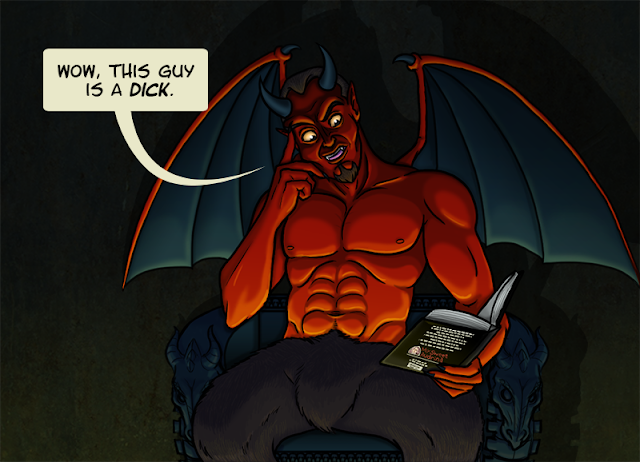
Damian Adere, the family patriarch, is aptly named because the guy is just fucking evil. He’s greedy, immature, vain, sexist, lazy, abusive, controlling, narcissistic, and manages to destroy the lives of every woman he knows while still seeing himself  as the victim because he’s just that fucking self-centered. Yet, he continues to get away with his awful behavior because he’s handsome, charming, and extremely manipulative, which honestly makes him even more frightening. In the first few chapters he comes off as kind of a dick but still likable. His daughter, Audrina, who acts as the book’s narrator, still loves and respects him. But over the course of the story as we witness his true nature, Damian quickly goes from seemingly well-intentioned but misguided, to a full-blown asshole, then finally becomes Satan incarnate. In fact, I’m still not entirely convinced this isn’t some sort of sequel to The Omen where the Anti-Christ kid grows up to become a lazy, whiny, codependent, narcissistic asshat who gets married and lives in a dilapidated mansion that he never lets his daughter leave. Actually, comparing Damian to Satan seems unfair because even the Dark Lord isn’t that big of a flaming dick. I can just imagine the devil reading My Sweet Audrina and being utterly horrified. The other characters, save for our virtuous heroine, Audrina, aren’t a whole lot better, although a lot of their behavior can be more or less attributed to Damian’s abuse.

Satan is leaning back in his creepy dragon chair reading “My Sweet Audrina”. He has red skin, black horns, bat wings, furry goat legs, a goatee, and well-defined abs. The image is dark, and lit from below. Satan has a finger to his temple and comments “Wow, this guy is a DICK” (referring to Damian).

I just assume Satan is ripped

Audrina’s mother, Lucietta, had to give up her dream of becoming a concert pianist to marry Damian (because he didn’t want his wife to make more money than him), and now hides her misery by living in denial and drinking to numb the pain. She frequently lashes out at her sister, Ellsbeth, who has become bitter (again, thanks to Damian) and abusive, neglecting her own daughter, Vera. In turn, Vera has turned into a complete monster before the start of the book because nobody loves her and Damian (whom she sees as her father) constantly treats her like shit and compares her to his “perfect” daughter, Audrina. As horrible as Vera is (and she’s pretty fucking horrible), you can’t help but feel sorry for her. She’s forced to be the whore to Audrina’s virgin, which makes her hate and resents her cousin. She’s so desperate for love and attention that 14-year-old Vera has “sex” with an adult man (everyone acts like it’s consensual sex when it’s very clearly statutory rape), and acts seductively from a young age. Of course none of the adults think “Hey, this isn’t normal behavior for a child, maybe we should get her some help” they just decided “She’s just a slut, oh well, who cares.” Meanwhile Audrina is haunted by memories of a childhood rape, which her father keeps forcing her to remember in a sick attempt to make her “perfect” (I’m not even going to try and explain Damian’s troll logic on this one). He reinforces her role as the virgin by frequently telling his daughter that all men are evil and forcing her to cover up in old fashioned dresses lest she be attacked. Is it any wonder Audrina becomes terrified of sex and disgusted by nudity to the point that she can’t even be intimate with someone she loves without trauma? Of course Damian is totally fine with this because it means she’s less likely to have a relationship with any man that isn’t him. If that makes your skin crawl, well, it should, because even Audrina describes their relationship as being like husband and wife without the sex. Ew. At least there isn’t any actual incest like I was fearing, which is a first for a V C Andrews novel.

Even Lucietta isn’t safe from her husband’s slut shaming, as Damian flies into a rage if her outfits are too revealing and accuses her of flirting with the men at the parties he forces her to host. He wants to show off his pretty wife, but then gets ridiculously jealous when other men think she’s pretty and ends up throwing a tantrum. He loves to be surrounded by women who adore him, but doesn’t want to share, so everyone is essentially trapped in this giant, run down house where Damian can keep an eye on them, isolated from the rest of the world. Like I said, the dude is fucking evil, and doesn’t even realize it. Or maybe he does, but simply doesn’t give a shit. Basically, if there was a drinking game where you had to take a shot every time Damien pulls a dick move, no one would ever finish the book because they’d die from alcohol poisoning after a few chapters.

Now, you’re probably wondering where the diversity comes in. I chose this book because of its representation of disability which, while not ideal (especially in Sylvia’s case), was at least written by an author who herself had a physical disability for most of her life. As a teenager, Andrews developed severe arthritis and underwent multiple spinal surgeries to treat it. Andrews says this was the result of a back injury she sustained from falling on a staircase in high school, while her family claims it was something she was born with. Regardless, the resulting chronic pain required the use of a wheelchair or crutches for most of her life. Andrews lived at home, under the care of her mother, where she completed a four-year correspondence course in art, before starting her career as a writer. Her very first book, Flowers in the Attic, is about four children who are kept in the attic for years by their religious grandmother, and the toll it takes on their mental and physical well-being. Andrews said in a 1985 interview for Faces of Fear that Flowers in the Attic was based on her own feelings of frustration at being trapped at home. While accessibility for people with mobility issues still isn’t great, I can imagine it was even worse when Andrews was growing up, and she died four years prior to the passing of the Americans with Disabilities Act. This theme of feeling “trapped” continues in My Sweet Audrina, where five of the six women in the story have some kind of disability that limits their freedom, which Damien of course takes full advantage of. Even the stairs that may or may not have been the start of Andrews’ chronic pain and limited mobility feature prominently in the book. The Adere house’s staircase essentially goes on a killing spree, offing multiple family members to the point where I have to wonder if the stairs were constructed from the bones of murdered children and cursed relics. Or maybe it’s just haunted by all the ghosts of the people Damien pissed off (which I can only imagine is every person he’s ever met). Andrews’ representation of disability is definitely problematic, but also complex and extremely personal, which is what makes this story worth exploring. It’s one of the few horror novels I’ve been able to find about disability that was actually written by a disabled person.

Vera has brittle bone disease, frequently breaking an arm or leg at the slightest bump. Audrina’s younger sister, Sylvia has autism and/or an intellectual disability (it’s not handled or explained well by Andrews) that requires full time care. Lucietta seems to have a heart disease that limits her activity. Billie, the Adere’s neighbor and one of the few likable characters in the book, is a bilateral amputee following complications from diabetes. Then there’s Audrina, whose untreated PTSD leaves her too terrified to leave her yard, even though she desperately wants to go to school and have friends. Audrina is sort of a Mary Sue for Andrews, what with her violet eyes, magically color changing hair, and extraordinary beauty (seriously, WTF?). They’re both artistic, unable to leave the house, and need to rely heavily on their families to function which causes them great frustration. The depictions of women with disabilities in My Sweet Audrina aren’t particularly progressive, and can even be downright ablest at time (especially when it comes to Sylvia), but the characters are all unique with very different personalities, outlooks, and ways of dealing with their disabilities.

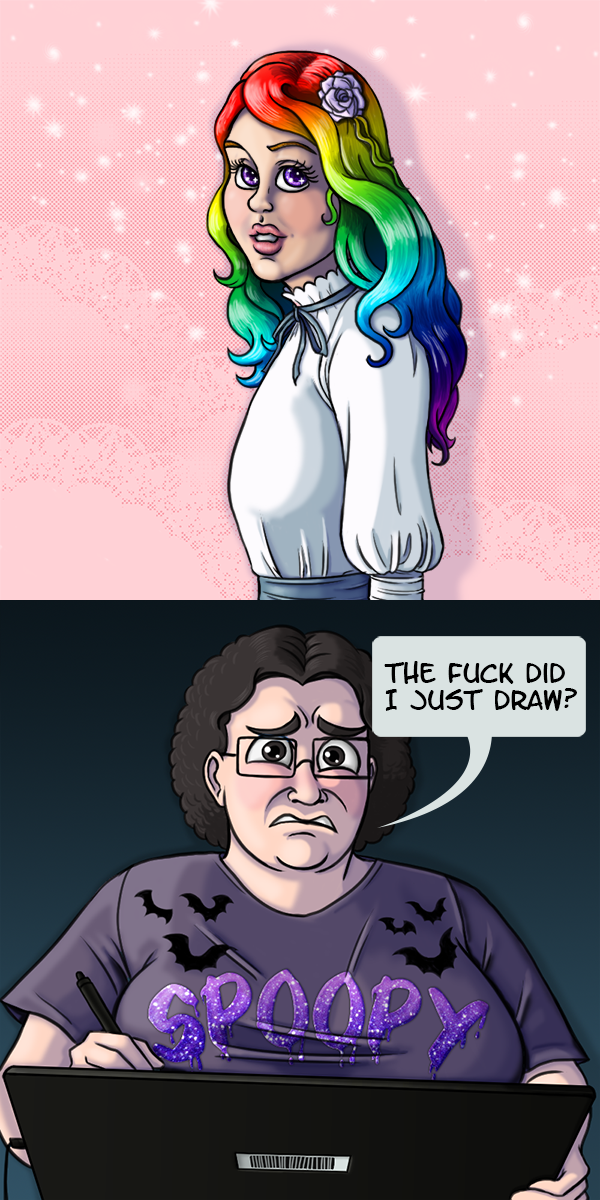
I’m drawing a picture of Audrina. The first panel shows a stereotypically attractive woman in a white, conservative, Victorian dress. She has large, sparkly, violet eyes, and long rainbow hair that starts as red at her scalp, and moves down the spectrum to indigo and violet at the ends of her hair. In the second panel I’m looking at my creation with horror and ask, “The fuck did I just draw?” I’m wearing a purple shirt with bats that says “spoopy” in violet glitter.

What Audrina looks like, presumable. Unrelated, but I wish I had that Spoopy shirt in real life.

Audrina desperately wishes for freedom and is frustrated by her PTSD, but without proper help and treatment she struggles to deal with her trauma (thanks a fucking lot, Damien). She does try to force herself to “get over it” a few times, and it doesn’t go well. Vera, on the other hand, seems proud of her disability, bragging about her delicate bones and teasing Audrina for having “peasant bones”, though it’s most likely an act to make herself feel better. Vera will frequently play up her disability to get out of doing chores, and even purposely hurt herself for attention, even though her mother and Damien seem fairy unconcerned by her injuries. Billie, on the other hand, is ashamed of her residual limbs, and goes to great effort to hide them. Her husband left her after her legs were amputated, and she now sees herself as “damaged” and “unlovable” despite being drop-dead gorgeous and able to function just fine with the use of a wheeled board. Although Billie continues to live her life and seems pretty happy for the most part, she’s still incredibly insecure, making her an easy target for Damien. Finally there’s Sylvia, the youngest Adare daughter, who gets ignored and insulted by pretty much everyone except Audrina, her appointed caretaker. Because why would Damien get actual help when he can just make Audrina play Occupational Therapist for free? And then everyone seems ~shocked~ that Sylvia’s not making much progress when she has a child (who only just started going to school herself) as her teacher. At least Sylvia gets some revenge on her awful family. It’s never outright confirmed, but is strongly implied that she knows more than she lets on and allows people to underestimate her abilities so she can better manipulate them (and occasionally possibly murder them). Part of me really hopes Sylvia is knowingly screwing with everyone as a sort of “fuck you” to her neurotypical family who constantly calls her really ableist slurs and compare her to an animal, because they really fucking deserve it. Now if only she’d arrange for Damien to have a little accident….

My Sweet Audrina is a combination of exploitation horror and chick lit, meant to grab your attention from the first paragraph and brand its shocking subject manner deep into your brain so that years from now you’ll still be thinking “God, that was a fucked up book.” And if you’re wondering why I would inflict this on myself, well, A) Because I’m a horror fan, that’s kind of what I do, and B) It’s just so damn enjoyable. It’s a wonderful guilty pleasure I couldn’t put down until the end, and Andrews is a talented writer who is fully aware of what she’s creating. So what if the story can sometimes read like Soap Opera fan fiction written by a fourteen-year-old?  My Sweet Audrina is especially interesting when viewed as a personal exploration of the author’s feelings of being “trapped’ by her chronic pain and mobility issues.  For fans of tragic heroines, gothic horror, and guilty pleasures, I’d definitely recommend My Sweet Audrina.

Shutter by Courtney Alameda

Shutter by Courtney Alameda

Formats: Print, digital

Publisher: Square Fish Books

Genre: Monster, Ghosts/Haunting, Zombie, Vampires, Blood & Guts, Thriller, Horror, Romance

Audience: Y/A

Diversity: POC (Love interest is part Aboriginal Islander, author is Latina), Disability (PTSD)

Takes Place in: type here

Content Warnings (Highlight to view): Violence, Gore, Child Death, Physical Abuse, Emotional Abuse, Child Abuse, Sexism, Sexual Harassment/Assault, Torture 

Blurb

Lock, stock, and lens, she’s in for one hell of a week.

Micheline Helsing is a tetrachromat-a girl who sees the auras of the undead in a prismatic spectrum. As one of the last descendants of the Van Helsing lineage, she has trained since childhood to destroy monsters both corporeal and spiritual: the corporeal undead go down by the bullet, the spiritual undead by the lens. With an analog SLR camera as her best weapon, Micheline exorcises ghosts by capturing their spiritual energy on film. She’s aided by her crew: Oliver, a techno-whiz and the boy who developed her camera’s technology; Jude, who can predict death; and Ryder, the boy Micheline has known and loved forever.


When a routine ghost hunt goes awry, Micheline and the boys are infected with a curse known as a soulchain. As the ghostly chains spread through their bodies, Micheline learns that if she doesn’t exorcise her entity in seven days or less, she and her friends will die. Now pursued as a renegade agent by her monster-hunting father, Leonard Helsing, she must track and destroy an entity more powerful than anything she’s faced before . . . or die trying.


Shutter by Courtney Alameda is a thrilling horror story laced with an irresistible romance.

As a 90’s kid, I grew up with some truly terrible action films. And I loved them. Mortal KombatWild Wild West, and Total Recall are all proudly displayed on my DVD shelf. So I like to think I’m pretty forgiving when it comes to plots full of holes and cookie-cutter characters, as long as the story itself is fun and entertaining. Keeping that in mind, let’s dive into Shutter, the literary equivalent of a bad action film.

We’ll start with our four, action-cliché, main characters. We’ve got the leader of the good guys, complete with her obligatory tragic backstory, the tough guy who always has her back, the smart guy who’s good with computers but not so great at fighting, and the wise cracking jackass who we’re supposed to like but just comes off as sexist and irritating. They exist to spout “clever” quips at each other, provide exposition at awkward times, and act like bad asses.

Following a standard action movie formula, the hero decides to rush off on her own without backup, and gets suspended by the boss (who’s also her abusive dad). But they go after the bad guy anyway because screw the rules, they’re action heroes! Then there’s lots of cool action scenes, explosions, some TRULY creepy shit, and a love story that gets shoehorned in there.

Okay, so the writing is “meh”, the characters are kind of flat, and the story formulaic as hell, but was it at least exciting and entertaining?  Was their nail biting suspense and horror? I’ll get to that in a minute. First, I need to address some major issues I had with story, the first being its heroine, Micheline.Micheline is a tetrachromat, able to see the invisible “ghost light” given off by the undead. As a direct descendant of Abraham Van Helsing, (because of course she is) she is sworn to protect the world from monsters, and captures and exorcises ghosts on her camera, à la Fatal Frame. Now, I’m going to give the author major props for making the lead a woman, something that doesn’t happen often in the action genre (but is slowly becoming more common). So that’s great. What’s not so great is that Micheline has this really annoying habit of having to prove what a “Strong Female Character TM” she is by running head first into danger, then needing to be rescued by the guys. Apparently nothing says “bad ass” like poor decision making and being a damsel in distress.

Micheline, is wearing her tactical, Hellsing gear and has her hair pulled back in a ponytail. She’s leaping in the air, brandishing a gun in one hand, and a camera in the other while gleefully shouting “Leerrooooy Jenkins!!!!”

Great teamwork there.

I can understand why she might want to prove herself; Micheline is struggling with PTSD and an abusive father, so it would make sense if the story was about her difficulty returning to active duty while suffering from flashbacks. Overcoming something like that is no easy task. But her trauma and strained relationship with her father seem to be their own separate thing, with little to nothing to do with her foolhardy, reckless, and selfish behavior. At least Micheline doesn’t take her grief out on everyone else, like her jerk-ass dad, she just puts their lives in danger by keeping important information from them, making everything about her, and refusing to deal with her issues. So, basically a pretty awful leader. I also got this whole “I’m not like other girls, I’m a cool girl” vibe from Micheline. Throughout the book she kept putting down other women and/or viewing them as competition for her “boys”, which was just sexist and gross. Basically, what could have been a cool, strong, female action hero was ruined by internalized sexism, bad decisions, and needing men to save her all the freaking time.

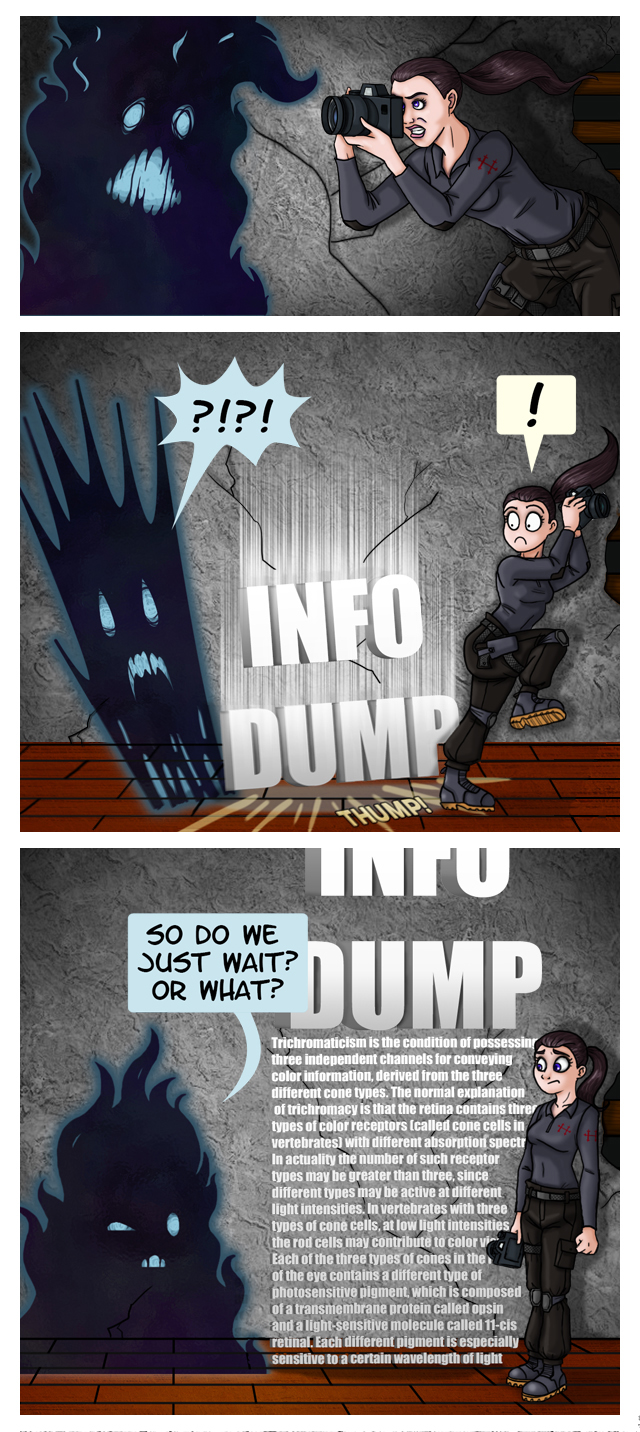
Another huge problem with Shutter was the flow of the action scenes. There is SO MUCH exposition and info dumping, and it keeps interrupting the suspenseful parts of the story. I mean, it’s wonderful how much thought Alameda put into this world, and I was certainly interested in the science behind monster hunting, but I don’t want to read a full page about how a camera works right when Micheline is about to be killed by a ghost. It’d be like pausing the duel scene between Luke and Vader to give a five minute lecture on the technology behind lightsabers. It’s cool and all, but really not the right time, and completely destroys the tension.

Micheline is fighting a shadowy creature with a glowing blue mouth and eyes. In the first panel she’s attempting to take its photo. In the second, both she and the monster jump out of the way in surprise as the words “INFO DUMP” fall from the sky. They both stand there awkwardly as an extensive, verbose paragraph about trichromsticism scrolls by. The shadow monsters asks “So do we just wait, or what?”

Forget the incredibly dramatic fight scene, let’s learn about trichromsticism!

Okay, so now for the moment you’ve been waiting for, was it at least entertaining? Heck yeah it was! The overall story was great, suspenseful, and fun, with some truly terrifying scenes. By the time I got to the second half of the book, I couldn’t put it down! The monsters were incredibly creative and creepy, like something out of Silent Hill, and the horror scenes were spot on. Alameda does an excellent job of building suspense and creating a creepy atmosphere (minus the random info dumps that kill the mood). It’s worth pointing out that this is the author’s debut novel, so it’s understandable that the book has flaws. Even the great Terry Pratchett’s early work was, admittedly, not that great, and he’s one of my favorite authors! So Alameda definitely has time to hone her skills and improve on her characterization and exposition. She’s already great at world building, horror, and action scenes. And honestly, it’s nice to see a horror novel written by a Latina author. The genre is severely lacking in Latine/Latina writers, and the few I know of are mostly men.

Overall, Shutter is a fun, suspenseful read, even with its flaws. If I could just take out the annoying characters, and focus on the plot, the monsters, and the fight scenes, the book would be perfect, like a horror survival game. That’s actually not a bad idea, it could be a cross between Fatal Frame and Resident Evil, where you can just explore abandoned buildings and fight monsters instead of listening to pointless dialogue. At least in a video game I can skip random info dumps.

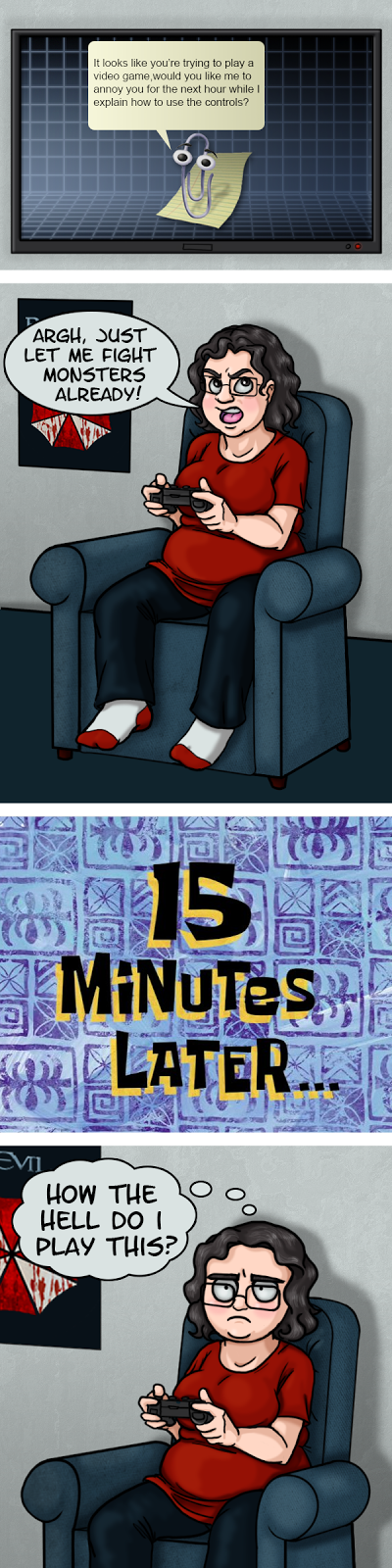
The Microsoft paperclip asks “It looks like you’re trying to play a video game, would you like me to annoy you the next hour while I explain how to use the controls?” Annoyed, I complain “Argh, just let me fight monsters already!” and skip the tutorial. 15 minutes later, I wonder to myself how the hell I’m supposed to play this game.

I just imagine all annoying video game tutorials as being done by either Navi or the Microsoft Paperclip.

I just imagine all annoying video game tutorials as being done by either Navi or the Microsoft Paperclip.

Panic by Sharon Draper

Panic by Sharon Draper

Formats: Print, digital

Publisher: Atheneum Books for Young Readers

Genre: thriller

Audience: Y/A

Diversity: POC (Black, Asian American)

Takes Place in: Western USA

Content Warnings (Highlight to view): Rape/Sexual Assault, Sexual Abuse, Physical Abuse, Verbal/Emotional Abuse, Child Endangerment, Self-Harm, Kidnapping, Forced Captivity, Homophobia, Ableism, Sexism, Misogyny, Body Shaming, Slurs, Gaslighting, Violence, Death

Blurb

This gripping, chillingly realistic novel from New York Times bestselling author Sharon Draper, “by turns pulse-pounding and inspiring” (Kirkus Reviews), shows that all it takes is one bad decision for a dream to become a nightmare.

Diamond knows not to get into a car with a stranger.

But what if the stranger is well-dressed and handsome? On his way to meet his wife and daughter? And casting a movie that very night—a movie in need of a star dancer? What then?

Then Diamond might make the wrong decision.

It’s a nightmare come true: Diamond Landers has been kidnapped. She was at the mall with a friend, alone for only a few brief minutes—and now she’s being held captive, forced to endure horrors beyond what she ever could have dreamed, while her family and friends experience their own torments and wait desperately for any bit of news.

From New York Times bestselling author Sharon Draper, this is a riveting exploration of power: how quickly we can lose it—and how we can take it back.

Here’s the thing about Panic. The first time read it, I hated it. I thought it was preachy, poorly-written, and out of touch. The book advertises itself as a crime-thriller about the abduction of the teenage dancer, Diamond, and the ordeals she goes through while in captivity. And I’ll tell you right now, those parts of the story are deeply disturbing. Stop here if you don’t want to read about the abduction and sexual assault of a fictional minor. But that’s only a very small part of the story. In fact, most of the book focuses on what Diamond’s fellow dancers go through, especially a young woman named Layla who’s entwined in an abusive relationship. And that’s not what I signed up for when I started reading Panic. We have this abducted girl who’s being drugged and brutalized, and you feel so scared for her, but instead the story chooses to focus on her whiny fellow dancers. WTF?! And that bugged me, because it felt like Diamond’s rape and exploitation wasn’t important enough to focus on, so instead Draper squeezed in some insipid love triangle, and some extra drama about a dad in jail and an abusive relationship. BUT, I’ll admit, after a second reading, I initially rushed to judgment and missed the point of the book.

Despite what the book jacket said, this isn’t a story about a girl who gets kidnapped by a pedophile. I mean, that does happen, but it’s not the story’s main focus. This is a book about a bunch of kids trying to cope with the tragedy of their friend’s abduction, and expressing their fear and frustration through dance. It’s also about abuse victims, and how anyone can become one. And honestly, Panic was a lot better the second time around. I still didn’t like it, but at least I’ve now figured out why I had so many issues with the story the first time around.

Draper has definitely done her research when it comes to sexual assault and abuse. Although abductions by strangers are uncommon (most are committed by a family member or acquaintance), Diamond’s kidnapper, Thane, is just the sort of person who would lure a girl into sex trafficking. He’s not some sketchy guy driving a refrigerator van, like the ones we’re taught to fear. Instead, Thane is well dressed, friendly, and charming. He approaches Diamond in a well-lit, public food court in the mall. He’s able to back up his claims with photographs, offers to let her call her mom, and convinces her to get into his car of her own free will. This is more accurate to real life, where the people who “recruit” teens into prostitution and porn usually work out in the open. They make promises of a glamorous (or at least marginally better) lifestyle, and come off as legitimate businessmen and women. They spend time gaining their victim’s trust and learn how to manipulate them. It’s similar to other abusive relationships, like Layla’s, where the abuser presents themselves as charming and kind, and only reveals their true nature bit by bit, after they’ve developed control over their victim. Likewise, Layla’s awful boyfriend, Donovan, keeps her by his side by giving her the love she desperately craves (since her father is in jail and her mother’s never around), picking away at her self-esteem so she thinks she’s “lucky” to have him, and always tearfully apologizing whenever he hurts her. Obviously Draper knows her stuff, and is able to approach sensitive topics in an honest way. She never blames the victims (even if some of the characters do), both Thane and Donovan are clearly at fault for everything that happened to Diamond and Layla. Although, I find it ironic that Draper includes one of Chris Brown’s songs in her book about women being abused, especially since Panic was written around 2011-2012, then published in 2013, so Draper should have been aware of Brown’s domestic abuse allegations, which happened back in ’09. So yeah…

While Draper seems to be a pretty talented author, as is obvious from her descriptions of her character’s dancing, the quality of the writing in Panic varies wildly, almost as if Draper was struggling to find the right voice for a teenage audience. Sometimes the lines are elegant and poignant, while others made me feel like I was reading a “My First Chapter Book”. Except the subject matter probably isn’t appropriate for anyone in the easy reader audience (I think, I dunno what the kids are reading these days).

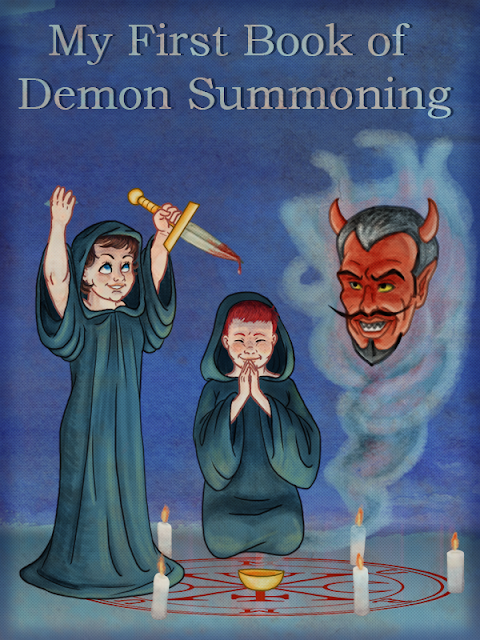
A fake vintage children’s book cover entitled “My First Book of Demon Summoning”. Two cheerful, Dick and Jane-esque children are wearing dark robes, the boy is on the ground praying and the girl is holding a blood dagger over her head. They’re standing in a demonic circle, surrounded by candles, with a gold bowl in the middle. Smoke rises out of the bowl revealing a very stereotypical red devil face, complete with pointed ears, horns, a moustache and goatee.

I mean, I’d let a kid read this, so I’m probably not the best judge…

Just when I’m starting to actually enjoy the story, along comes a cringe-worthy line like “This is the only place where I feel like I can really kick it.” And “OMG, the show is gonna be off the chain!” or “Nice ‘fit today… I gotta get out my shades to combat the shine you’re bouncing.” Who talks like that? NO ONE. NO ONE TALKS LIKE THAT. It’s like how old people who believe that sex bracelets are a real thing think teenagers speak. It reeks of embarrassing adult trying to be hip. Worse, it makes scenes that were intended to be moving come off as cheesy or forced. Draper also feels the need to fill her book with “current” slang, pop culture references, and mentions of popular songs from 2011, which I’m sure in no way is going to make this book seem incredibly dated in a few years. And this is what ruined the book for me. Because even though Panic isn’t actually preachy or condescending with its subject matter, the dialogue and attempts to come off as “cool” and “relevant” conjure up images of every patronizing, poorly researched, and vaguely racist PSA I was forced to sit through as a schoolchild in the 90’s. So of course that’s all I could think about the entire time I was reading Panic, those crappy drug-free programs that told naïve school children their faces would melt like the guy from Raiders if they so much as thought about smoking a joint, which led to me judging the book unfairly.

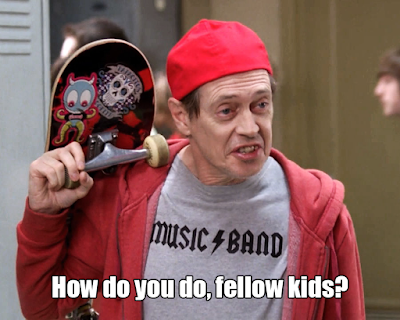
A photo of a fifty-something Steve Buschemi wearing a backwards baseball hat, a T-shirt that says “Music Band” with lightning bolt in the middle (similar to the AC/DC logo), and a red hoodie. He has a skateboard slung over his shoulder and you can see high school lockers in the background. The photo says “How do you do, fellow kids?” at the bottom.

Now I’m going to sit in my chair backwards to show you how “rad” I am.

Well, not entirely unfairly. Like I said, even if the final result is decent, the quality of the writing is pretty bad in some spots, and the dialogue is god awful. And here’s another issue: Panic is fairly short, like, less than 300 pages in large print, but the book is divided between four points of view, meaning it’s hard to get a feel for any of the characters. And truthfully, they’re all kind of generic and bland. We get to know Layla better than the others, and the ballet teacher stands out as the wise adult, but everyone else just seems to be interchangeable, generic kids who respond to everything with “true dat” and “you trippin” (I’m not kidding, that’s like 20% of their dialogue. There’s clearly a lot of tripping going on). The worst of the bunch is ZiZi, who I guess is supposed to be the comic relief, but is incredibly annoying and awkwardly written, like the ballet version of Jar Jar Binks (and now you have that mental image, you’re welcome). Actually all the “humor” included in the novel falls pretty flat. Like when Mercedes (one of the four main characters) tells Layla her yellow butterfly shirt looks like a butterfly about to land in some butter. Ha ha? I guess? Panic needs an audience laugh track so I can know where the jokes are. At least the scary parts are actually scary. Then there are just random annoyances, like all the fat shaming and how a supposedly non-religious dance troupe says a Christian prayer before each performance. It’s not that I have a problem with religious characters or prayer, it just seems weird that they’re ALL the same religion in a supposedly diverse group. Is this like a dance tradition I don’t know about?

Jar Jar Binks, from Star Wars Episode 1, is wearing a silky white ballet outfit and standing en pointe, with his arms raised gracefully above his head. His tutu is covered in sparkles and he’s wearing stain blue shoes on his oddly human looking feet (I basically just put Jar Jar’s torso on top of some human legs).

Enjoy this image in your head.

I know it has won awards, I know it has fans, and I know it’s not that bad, and yes, I even know a lot of my complaints are really nitpicky, but I just can’t get myself to like Panic. Instead, I’d recommend curious readers pick up Pointe by Brandy Colbert, which deals with similar themes, but actually gives us time to get to know the characters and their feelings. It’s about a black ballet dancer trying to cope with childhood sexual abuse after the reappearance of her best friend, who was kidnapped years ago. While it’s not a thriller like Panic, it does have a compelling mystery. Pointe focuses more on the aftermath of the main character’s abuse, rather than abuse itself, and how she learns to deal with what happened. Her path to recovery is a difficult one, but the story ends on a hopeful note.

Girl, Stolen by April Henry

Girl, Stolen by April Henry

Formats: Print, audio, digital

Genre: Thriller

Audience: Y/A

Diversity: Disability (Vision Impairment, Cognitive, Learning Disability)

Takes Place in: Oregon, USA

Content Warnings (Highlight to view):  Abelism, Alcohol Abuse, Animal Abuse, Animal Death, Bullying, Child Abuse, Death, Drug Use/Abuse, Forced Captivity, Gaslighting, Illness, Medical Procedures, Physical Abuse, Mentions of Rape/Sexual, Slurs, Verbal/Emotional Abuse, Violence

Blurb

Sixteen-year-old Cheyenne Wilder is sleeping in the back of the car while her step mom fills a prescription for antibiotics. Before Cheyenne realizes what’s happening, the car is being stolen.

Griffin hadn’t meant to kidnap Cheyenne and once he finds out that not only does she have pneumonia, but that she’s blind, he really doesn’t know what to do. When his dad finds out that Cheyenne’s father is the president of a powerful corporation, everything changes–now there’s a reason to keep her.

How will Cheyenne survive this nightmare?

As you can probably guess, Cheyenne is not having a good day. Though her kidnapper’s, Griffin, isn’t going much better. The story alternates between the points of view of these two main characters, as they anxiously stumble their way through a bad situation. Cheyenne, who has been blind for about three years following a car accident, describes her world in sounds, smells, and sensations. Sick, feverish, and stranded without her guide dog and cane, she does her best to outwit her captors and survive her terrifying ordeal. Meanwhile, Griffin, who’s almost as panicked as Cheyenne, struggles between listening to his conscience and obeying his abusive, criminal father. You can sense his denial, born from years of abuse, his desperation for love and acceptance, and the fear that’s holding him back. The two characters, both trapped in terrible situations, form an unlikely bond as they nervously wait for Griffin’s father to make a decision.

Not having any sort of severe visual impairment myself (other than my corrective lenses), I can’t say how accurate April Henry’s depiction of a blind/low vision person is. But Cheyenne’s disability does seem to be well pretty researched, as far as I can tell anyway. For example, Cheyenne still has some of her peripheral vision in one eye, a nice touch since about 85% of legally blind people have at least some light and/or form perception, and complete blindness is relatively rare. And the description of how a guide dog and its owner work together sounded pretty accurate, at least from what I’ve read. She doesn’t fall victim to any of the common blindness tropes either. Then there’s this reviewer, who is herself blind, and says the portrayal of Cheyenne’s visual impairment is pretty spot on, and relatable. So there you go.

A blind/low vision man examining a hideous jacket and tells his friend “this is the ugliest effin’ jacket I have ever seen, it looks like you stole it off a patriotic clown. Please burn this immediately for the good of humanity.” Annoyed, his friend responds “You’re blind, how can you even tell what it looks like?” “Dude, I’m not that blind, though I might lose all of my vision if I have to look at this thing any longer.” “Why are you so salty?”

He’s salty because people keep accusing him of “faking” his blindness just because he can sort of see things six inches from his face with one of his eyes.

Henry could have easily made her heroine a broken bird that readers pitied, or turned the story into inspiration porn, but she doesn’t. Instead, Cheyenne is characterized as a young woman who went through a traumatic event, which understandably caused her to grieve, and then has to adapt to a completely different way of interacting with the world which is challenging, but certainly not anything extraordinary. Cheyenne works with her therapist and teachers to pull herself out of her depression and learn a new skill set, all without becoming a “feel good” story for sighted readers. She isn’t sweet and chipper about it either, our heroine gets frustrated, feels sorry for herself, lashes out, and gets grumpy. She’s allowed to be a flawed person, instead of some sort of blind saint who forgives the ableists. Although she now relies much more on sound, smell, and touch to function, her senses are the same as before, Cheyenne just learns to pay more attention to them, as oppose to getting magically heightened senses that turn her into a ninja. And yes, Cheyenne is feeling weak and helpless after being kidnapped, but this is due to being severely ill with pneumonia, not her low vision. And even sick and terrified, she’s still a tough, resourceful character.

Speaking of blind ninjas, did you know Daredevil and the Teenage Mutant Ninja Turtles share an origin story? It has nothing to do with Girl, Stolen, it’s just cool.

Griffin, meanwhile, is complex and interesting. You can’t help but feel bad for the guy, even if Cheyenne isn’t in a position to be sympathetic, and Henry doesn’t try to excuse his actions by invoking pity in the reader (Henry never tries to get you to feel sorry for the characters, she just presents the facts of their lives). Poor Griffin’s mom left when he was young, his dad is an abusive alcoholic who forces him into a life of crime, and he has basically zero support system. We find out later that he’s Dyslexic, though unaware of it, and was forced to drop out of school because he struggles with reading. It’s an interesting contrast to Cheyenne, who comes from a wealthy background and goes to a private school that’s able to accommodate her. After her accident she had private nurses who cared for her in her home. Her father sent her to a special program where she learned how to function independently without her vision. They’re able to afford a guide dog so Cheyenne can get around. Ideally, all people with disabilities would have the same access to accommodations that Cheyenne does, but unfortunately that’s simply not the case, especially for people with low incomes or living in poverty. Griffin is one of those kids who slips through the cracks. He was never tested for Dyslexia, and his teachers and father apparently wrote him off, he gets zero help with his reading skills and is forced to drop out of school, believing his only option in life is to be a criminal like his father. Although Henry isn’t heavy handed about it, she makes clear what a world of difference it makes when people have access to proper accommodations, a constant source of frustration for anyone with a disability. Seriously, go on any disability website, and you will see a legion of posts about the daily frustration and obstacles that able-bodied and neurotypical people don’t even notice, not to mention the constant struggles with health insurance and trying to get accommodations approved at school and work.

In the first panel, a doctor is looking at her laptop when she hears a nurse yell off screen “Why didn’t anyone tell me the sink was broken!?!?!” Irritated, she responds, “*sigh* didn’t you read the sign?” In the second panel we see the nurse, who is blind and holding a cane, soaking wet from the malfunctioning sink. He snaps “If by sign, you mean the piece of paper you taped up that could say literally anything, then NO, OBVIOUSLY I DIDN’T.” Sheepish, the doctor says “Oh.... right. Sorry.”

Other pet peeves of the visually impaired include the little stickers on fruit and people who ask them to guess who they are by their voice. Seriously, don’t do that.

As for the story itself, it’s definitely a thriller, and a well written one. I couldn’t put Girl, Stolen down and ended up finishing it in only a few sittings (and that’s only because I was interrupted by annoying grown up responsibilities). Yeah, I know I haven’t gone over the writing that much, but honestly, I can’t really get into the plot without also going into spoiler territory, and part of what makes this story so great is the suspense. Of course, there are still a few flaws. Usually Henry is able to blend the backstory of the characters smoothly into the story, but it does get bogged down by random info dumps in a few places. I like when I learn new things from books, but not when they’re awkwardly shoehorned in. You don’t need to stop the story to explain what vehicle identification numbers are, I could have just Googled “VIN” if I didn’t know.  Nor do we need a completely unnecessary explanation of what the Nike company is. In fact, why even bother using a real company in your book if you then have to explain what they do? Thankfully these instances are few and far between. The two main characters were interesting and well written, but everyone else was pretty bland, especially Griffin’s one-dimensional, evil father. 


Oh, and for any readers who are visually impaired, the audiobook narrator, Kate Rudd does a pretty good job, though she does seem to struggle with male voices (some of them sound pretty silly), which can be distracting during a suspenseful scene. But for the most part it’s well acted; Cheyenne sounds great, and Rudd really makes the listener feel the tension. A sequel, Count all her Bones, came out this past May.

The Graveyard Apartment by Mariko Koike, translated by Deborah Boliver Boehm

The Graveyard Apartment by Mariko Koike, translated by Deborah Boliver Boehm

Formats: Print

Publisher: St. Martin’s Press

Genre: Ghosts/Haunting, Thriller

Audience: Adult/Mature

Diversity: Japanese characters

Takes Place in: Japan

Content Warnings (Highlight to view): Animal Death, Child Death, Child Endangerment, Suicide, Verbal/Emotional Abuse, Forced Captivity

Blurb

A terrifying tale of a young family who move into an apartment building next to a graveyard and the horrors that are unleashed upon them.

One of the most popular writers working in Japan today, Mariko Koike is a recognized master of detective fiction and horror writing. Known in particular for her hybrid works that blend these styles with elements of romance, The Graveyard Apartment is arguably Koike’s masterpiece. Originally published in Japan in 1986, Koike’s novel is the suspenseful tale of a young family that believes it has found the perfect home to grow in to, only to realize that the apartment’s idyllic setting harbors the specter of evil and that longer they stay, the more trapped they become.

This tale of a young married couple who are harboring a dark secret is packed with dread and terror, as they and their daughter move into a brand new apartment building built next to a graveyard. As strange and terrifying occurrences begin to pile up, people in the building begin to move out one by one, until the young family is left alone with someone… or something… lurking in the basement. The psychological horror builds moment after moment, scene after scene, culminating with a conclusion that will make you think twice before ever going into a basement again.

Next up for Asian and Pacific American heritage month, is a new translation of Mariko Koike’s popular 1986 horror novel, The Graveyard Apartment.The Graveyard Apartment had a great premise; a married couple and their young daughter move into a haunted apartment near a cemetery and creepy shit keeps happening, but they’re unwilling to move due to their financial situation, societal pressure to appear normal, and the husband’s deep denial that anything is wrong. The book explores their feelings of emptiness and isolation and their struggle with their fears, both mundane and supernatural. But what should have been amazing ended up being very, well, “meh”. So how exactly does one manage to fuck up what should have been a fool proof haunted house formula? 

To be completely fair, much of the awkward writing present in the English version could very well be due to translation problems. But unless the translator of The Graveyard Apartment pulled a 4KIDs Entertainment and just started making up random shit and cutting out half the story, there’s only so much you can blame on her. The problems with the book go far beyond a language barrier issue. The biggest setback is that half the story seems pointless (maybe the translator should have cut some of it out after all). Koike spends more time on random details, like what her main character, Misao, is wearing, than she does on the evil entity haunting the building. There’s even an entire chapter, later on in the book, dedicated to visiting a realtor’s office and looking at new apartments. Can you handle the terror as her husband, Teppei, walks their daughter to school? Shiver as the doomed couple look at rental listings within their budget!

A picture draw in the style of a vintage horror movie posters shows a Japanese woman with poofy, 80’s hair screaming in horror at a random assortment of leftovers (daikon radish, red bean paste, pickled umeboshi plums, lettuce, soy sauce, and mushrooms) in front of her. In creepy looking, dripping, front across the top it says “Witness the horror as Misao tries to make dinner with ‘The Random Leftovers!’

The story takes place in the 80’s so I tried to give her poofy 80’s hair. I was not successful.

And even when Koike does finally get to the creepy stuff, it’s a crapshoot whether or not it actually has anything do with the plot or just more random detailing. For example; early on in the book we discover Teppei’s first wife, Reiko, committed suicide because he was cheating on her with Misao. So you’d think that Reiko’s vengeful spirit would somehow be involved in the plot. Well, you’d be wrong. The suicide backstory serves no purpose other than highlighting what a remorseless dick Teppei is. We also learn that at one point there were plans to build an underground shopping center, but they were abandoned after the initial tunnel was built. So maybe the project disturbed the graves above and angered the spirits? Nope. The project was abandoned because people didn’t want the cemetery relocated, so the graves were pretty much left alone. Actually we never learn why the ghosts (or demons, or monsters, or whatever) are such huge assholes. Usually ghosts haunt the living because they’re pissed off about being murdered or moved, or having a Taco Bell built over their remains, but these entities just like to lock doors, mess with the elevators, and put handprints on the glass, because…. reasons. I dunno, maybe they just really hate whoever does the building maintenance, or they’re a bunch of drunk frat boys.

The comic shows the annoying ghost of a frat boy, sticking out his tongue and waking up another man by screaming “Woooo! Bro, let’s play some beer pong!” The ghost is muscular, holding a Solo cup, and is wearing a Polo shirt with a popped collar, a backwards baseball hat, and a Puka shell necklace. The man he has just woken up is shirtless, with two subcutaneous mastectomy scars on his chest. Irritated, he responds “Can’t you just rattle chains and make the lights flicker like a normal ghost?”

Not so much evil as incredibly irritating.

The story and characters are well written enough, it just isn’t scary. Well, except for the ending, where all the horror gets crammed into the last few chapters of the book. It’s like Koike suddenly went “Shit! I’ve got four chapters left, and the scariest things in the book so far are a creepy basement and being forced to into awkward social situations!” (Granted, awkward social situations are much scarier than any demonic entity). So then the ghosts (or demons, or whatever) go from mildly irritating to eldritch abominations with god damn superpowers and a lust for blood.Oh, and just as the story is starting to get scary and suspenseful? It finishes with a vague, open ending and we STILL don’t know what the fuck is wrong with the building! To top it off, the ending isn’t even part of the actual story, it’s a freaking epilogue! WHAT? There was all this slow buildup up for the most underwhelming payoff ever. Way to get my hopes up, Koike! Look, The Graveyard Apartment isn’t a bad book overall, which is why I didn’t knock it down to “not recommended”, it just doesn’t work as a haunted house story.

Navigation

Social Media

Search by Tags

To learn more about the Age Group, Diversity, and Genre tags, click here.

Age Groups

Diversity

Genre

Support the Blog

Search

Links

I Feed Her to the Beast and the Beast Is Me by Jamison Shea

I Feed Her to the Beast and the Beast Is Me by Jamison Shea

Formats: Print, audio, digital

Publisher: Henry Holt and Co.

Genre: Dark Fantasy, Mystery, Occult, Thriller

Audience: Young Adult

Diversity: Black main character and author, bisexual main character

Takes Place in: Paris, France

Content Warnings (Highlight to view): Body Shaming, Bullying, Death, Racism, Self Harm, Verbal/Emotional Abuse

Blurb

There will be blood.

Ace of Spades meets House of Hollow in this villain origin story.

Laure Mesny is a perfectionist with an axe to grind. Despite being constantly overlooked in the elite and cutthroat world of the Parisian ballet, she will do anything to prove that a Black girl can take center stage. To level the playing field, Laure ventures deep into the depths of the Catacombs and strikes a deal with a pulsating river of blood.

The primordial power Laure gains promises influence and adoration, everything she’s dreamed of and worked toward. With retribution on her mind, she surpasses her bitter and privileged peers, leaving broken bodies behind her on her climb to stardom.

But even as undeniable as she is, Laure is not the only monster around. And her vicious desires make her a perfect target for slaughter. As she descends into madness and the mystifying underworld beneath her, she is faced with the ultimate choice: continue to break herself for scraps of validation or succumb to the darkness that wants her exactly as she is—monstrous heart and all. That is, if the god-killer doesn’t catch her first.

From debut author Jamison Shea comes I Feed Her to the Beast and the Beast Is Me, a slow-burn horror that lifts a veil on the institutions that profit on exclusion and the toll of giving everything to a world that will never love you back.

I received this product for free in return for providing an honest and unbiased review. I received no other compensation. I am disclosing this in accordance with the Federal Trade Commission’s 16 CFR, Part 255: Guides Concerning the Use of Endorsements and Testimonials in Advertising.

I went into I Feed Her to the Beast and the Beast is Me expecting Laure to be an unlikeable female protagonist (something I actually enjoy in a story), but I was not prepared for just how relatable she was. If I ever become a supervillain, my origin story will be me finally getting fed up with all the bigotry and microaggressions I have to deal with every day and deciding to get even, rather than continuing to either educate or ignore the people hurting me. And that’s exactly what Laure does. Can you blame her? Every other ballerina in her company is rich and white, with powerful parents just dripping with privilege. The ballet is cutthroat, with ballerinas actively trying to sabotage each other (dancers often finds glass and tacks in their ballet shoes) and praying for one another’s downfall, and Laure is at a distinct disadvantage. Even though she works the hardest and performs the best of all of them, she’ll always be the Black girl who has to steal to pay for her tights. So, she cheats to level the playing field. Once she does, her talent and hard work is immediately rewarded. And honestly? It’s cathartic to watch Laure stoop to the level of the other ballerinas and their awful parents. It is SO exhausting to always have to be the bigger person in the face of abuse. I may agree with Michelle Obama’s “When they go low, we go high,” but I still don’t like having to “go high” when I would rather be a petty asshole. So, in a purely fictional world? It’s wonderfully satisfying to watch a Black woman choose the role of the villain and get even with all those rich white girls.

Ballet is still one of the least diverse performing arts, fraught with racism that ranges from subtle to overt. This is especially true in Europe. In her book Turning Pointe, Chloe Angyal discusses ballet’s racism problem. She describes an encounter with a racist dance mom and her implied message to her daughter: “[Black dancers are] not really good, but they are allowed to be here. In this space that is rightfully yours, in this art form that is rightfully yours. They’re never as good as the white girls, a sweeping generalization that grants no individuality, no humanity, to any nonwhite dancer. They’re all the same, and they never deserve to be here. But don’t worry. Your excellence is a given. You belong here, while their presence is conditional or even ill-gotten.” I think this quote sums up Laure’s struggles beautifully. The only difference is that these are struggles faced by real dancers.

Even something as simple as buying pointe shoes is no easy task for Black dancers. Most dance garments are traditionally “European pink,” and don’t match darker skin tones. Black ballerinas often have to pancake their shoes in dark foundation to match their skin tone and dye their tutus and tights. It’s only recently that brands like Capezio, Freed of London, and Bloch have offered shoes in darker skin tones. In the book Laure must purchase her own ballet shoes and tights because the ballet will only pay for pink ones. Black bodies are also discriminated against in ballet. In an interview with Sheila Rohan the Black ballet dancer described racism in ballet. “Racism in the ballet arts… meant people would make remarks about the Black ballerinas’ bodies — such as their chests being ‘too busty’ or their thighs being ‘too thick.’” A Black dancer in Berlin was told to lighten her skin with white makeup in order to play a song in Swan Lake. Laure straightens and gels her curly hair into place so she won’t stand out from the other dancers, but is still told she’s too “exotic” for a French ballet by a drunk patron. The controversial ballet La Bayadère was performed in Blackface by Russian dancers (white dancers have also worn stereotypical clothing and makeup to portray Roma and Chinese characters). The same ballet put on by Laure’s company in which she plays a shade.

After being abandoned by both parents, Laure’s only source of support is her best (and only) friend, Coralie, who is… not great. She’s kind and supportive of Laure, yes, but she’s also a subpar ballerina who just assumes she’ll get a spot in Paris’ prestigious ballet due to her famous mother. She’s essentially an entitled slacker and just as oblivious to her privilege as the other rich white girls. Coralie is also a snob, turning her nose up at anything that doesn’t come with a high price tag, which grates on permanently broke Laure’s nerves. Coralie really does seem to love her best friend, but their relationship comes with a power imbalance. So, she does not take it well when that balance of power shifts and Laure starts beating her out for roles. Because she has no one else, Laure is terrified of losing her only friend (as difficult as she can be), that is until she meets the étoile of the ballet, Josephine. Josephine gives her friendship freely without expecting anything in return, and treats Laure as an equal. She introduces Laure to her friends and shows her how she too can become an étoile. Slowly, Laure starts to see what a true friendship is like and begins to pull away from Coralie, although she still refuses to drop her completely and makes excuses for the wealthy girl’s bad behavior. I liked that while Laure does pursue a romance with a man later in the book, the story is mostly focused on her female friendships. It’s also a nice change of pace to see a toxic platonic, non-familial relationship explored. I don’t think enough people talk about how friendships can be abusive and how hard “breaking up” with a friend can be.

Another interesting theme in I Feed Her to the Beast and the Beast is Me is the idea of “perfection.” As a burned-out former “gifted kid” I know what it’s like to be expected to be perfect, then destroy yourself trying to do the impossible and ultimately have a mental breakdown when you realize perfection can never be achieved, and therefore that makes you a “failure.” The ballet expects Laure and her peers to be no less than perfect, and anyone who doesn’t make the cut is thrown aside and forgotten. While Coralie can get by half-assing it because of her mother, Laure must be the best there is to even think of if she wants to compete with the others. And it means giving up everything. This kind of perfectionism is extremely damaging to your mental health. Laure also believes that acceptance and respect from the others is entirely dependent on being perfect, not realizing she deserves respect regardless of her performance.

I Feed Her to the Beast and the Beast is Me is one of those books that I absolutely devoured. It held my attention throughout the story (no small feat when you have ADHD), save for a short part in the middle that felt like it was dragging. But other than that small criticism I can’t think of anything negative to say about this book. It’s a unique setting for a horror story, and a fresh spin on a Faustian bargain narrative. 
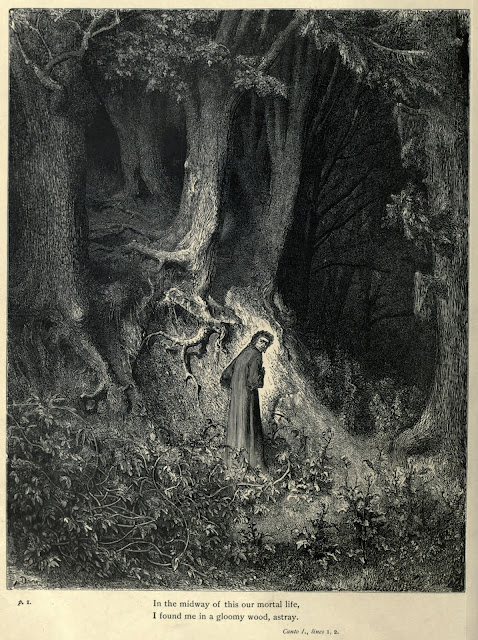
The Woods are Always Watching by Stephanie Perkins

The Woods are Always Watching by Stephanie Perkins

Formats: Print, audio, digital

Publisher: Dutton Books for Young Readers

Genre: Killer/Slasher, Thriller

Audience: Y/A

Diversity: Indian-American Main character

Takes Place in: North Carolina, USA

Content Warnings (Highlight to view):  Amputation, Child Endangerment, Death, Forced Captivity, Gore, Kidnapping, Rape/Sexual Assault, Torture, Violence 

Blurb

Bears aren’t the only predators in these woods.

Best friends Neena and Josie spent high school as outsiders, but at least they had each other. Now, with college and a two-thousand-mile separation looming on the horizon, they have one last chance to be together—a three-day hike deep into the woods of the Pisgah National Forest.

Simmering tensions lead to a detour off the trail and straight into a waking nightmare; and then into something far worse. Something that will test them in horrifying ways.

Camping and horror go together like chocolate and toasted marshmallows. There’s just something about being out in the middle of nowhere with only the light of a bonfire to really prey on those primal fears. In Western tradition, the woods have been a symbol of the dark and unknown for as long as folklore and fairytales have been told: a place where witches, wild beasts, monsters and faeries dwell.

The threat of becoming lost in the forest and falling victim to these creatures is central to many dark tales. In the beginning of the Divine Comedy Dante finds himself wandering in a dark wood, the “selva oscura,” unable to find his way and set upon by a lion, a leopard, and a she-wolf. Little Red Riding Hood encounters a wolf when she wanders off the path (though some interpretations of the fairy tale say the wolf is meant to represent a sexual predator) and Hansel and Gretel stumble upon a witch after losing their way in the woods. In Tam Lin, anyone who wanders into the forest runs the risk of becoming the fae’s blood tithing to hell. The films the Ritual and the Blair Witch both have a group of friends become lost in the woods through supernatural means and then assailed by a Jötunn and the titular witch respectively. But beasts and supernatural beings aren’t the only monsters in the forest. Ordinary humans can be just as —if not more — deadly than wolves and witches. The woods are popular killing grounds for murderers like William Mitchell Hudson (the Texas Campsite Killer) and Herbert MullinIvan Milat was a serial killer who specifically targeted backpackers while Alexander Pichushkin lured dozens of victims to Bitsevski park before murdering them. It’s safe to say the woods can be a dark and dangerous place in both fiction and reality, as best friends Neena and Josie are about to discover in Perkins’ outdoor horror novel The Woods are Always Watching.

Neena Chandrasekhar is a carefree and fun-loving teenage girl, especially compared to her worrywart best friend, Josie Gordon. After the death of her father in a car accident, Josie is scared of the world and often needs Nina to push her to try new things, like camping.  Neither girl is much of an outdoors woman, but going on a solo camping trip is practically a rite of passage in Asheville North Carolina, and with Neena soon leaving for college, the duo decides it’s the perfect way to celebrate their last few days together. They have GPS, printouts of the trails, and Josie’s brother’s camping gear, so what could possibly go wrong? Well, it’s a horror novel, so a lot.

The trip gets off to a rough start with both girls quickly realizing that they may not be physically prepared for such an arduous journey. Their exhaustion soon leads to short tempers and building tension as Josie quickly becomes fed up with Neena’s cavalier attitude towards camping and Neena gets annoyed with her best –friend’s condescending bossiness. Their friendship is further put to the test as the duo discover how ill-prepared they actually are for their hike through the woods and each takes out their frustration on the other. Caught up in their own petty squabbling the pair are dangerously unaware of something watching and waiting for them in the woods until it’s too late.

The Woods are Always Watching is slow to start, focusing on teenage drama and interpersonal conflict for the first chunk of the story, which can feel tedious even if it does offer glimpses into the main characters’ psyches. We don’t meet the actual villains of the story until almost halfway in (although there are hints to their presence early on). But once the action actually does get started, I found I couldn’t put the book down. Perkins is a master of creating atmosphere and suspense and making the forest feel dark and foreboding, especially to two inexperienced girls. The whole book feels like a modern-day fairytale with two naïve young women journeying through the dark woods

So, will you enjoy this particular dark woods story? Well, it’s essentially a young adult version of Deliverance, and the film is a good metric of how much you’ll like this book. Does the idea of being isolated in the woods, and slasher/folk horror terrify you? Then you’ll enjoy Stephanie Perkins’ camping-gone-wrong novel. Evil hillbillies and threats of rape not your thing? Then you’re probably better off skipping this one.

Children of Chicago by Cynthia Pelayo

Children of Chicago by Cynthia Pelayo

Formats: Print, audio, digital

Publisher: Agora

Genre: Dark Fantasy, Demon, Killer/Slasher, Myth and Folklore, Thriller

Audience: Adult/Mature

Diversity: Bisexual main character, Puerto Rican main character and author, Latine characters

Takes Place in: Chicago, IL, USA

Content Warnings (Highlight to view): Alcohol Abuse, Child Death, Death, Forced Captivity, Gaslighting, Illness, Kidnapping, Mental Illness, Physical Abuse, Police Harassment, Suicide, Violence

Blurb

This horrifying retelling of the Pied Piper fairytale set in present-day Chicago is an edge of your seat, chills up the spine, thrill ride. ‪ When Detective Lauren Medina sees the calling card at a murder scene in Chicago’s Humboldt Park neighborhood, she knows the Pied Piper has returned. When another teenager is brutally murdered at the same lagoon where her sister’s body was found floating years before, she is certain that the Pied Piper is not just back, he’s looking for payment he’s owed from her. Lauren’s torn between protecting the city she has sworn to keep safe, and keeping a promise she made long ago with her sister’s murderer. She may have to ruin her life by exposing her secrets and lies to stop the Pied Piper before he collects.

And I chiefly use my charm
On creatures that do people harm,
The mole and toad and newt and viper;
And people call me the Pied Piper.
The Pied Piper of Hamelin by Robert Browning (1812-1889)

“The Pied Piper of Hamelin”by Augustin von Mörsperg, 1592

My dad was born and raised on the Southside Chicago and will tell anyone who will listen that his birthplace is the best city in the world. My wife, on the other hand, firmly believes Chicago is akin to LA in the ‘90s. When I did finally manage to lure her there with the promise of deep-dish pizza and the Museum of Science and Industry she did admit the Windy City was a pretty cool place and not at scary as she was expecting (even after we stumbled onto an illegal street race). Although the crime rate there is higher than the national average, Chicago is hardly the crime and drug filled dystopia my wife and other outsiders seem to believe it is. In fact, its violent crime rates are far lower than those of Anchorage, Wichita, and Milwaukee. The dangerous reputation may have come from Chicago’s fascinating history of crime, gangsters, and serial killers or even the many tragedies that have befallen the White City in the past. Modern-day boogiemen like the Lipstick Killer, John Wayne Gacy, the Ripper Crew, and Richard Speck all called Chicago their home. The Blue Beard-esque H. H. Holmes built his murder castle in Englewood. The city’s most notorious gangster, Al Capone, has morphed into something of a folk hero and tragedies like the Great Chicago Fire and the Haymarket affair have taken on almost a legendary status. Dark rumors surround the abandoned Edgewater Medical Center. Stories like these have shaped Chicago’s history and how it’s perceived by the rest of the country: a gothic city haunted by the past. But darkness and death aren’t all the city has to offer.

Fairy tales, at least the original versions and not the Disney-fied ones, are often a child’s first introduction to the world of horror. Beautiful and sinister stories full of threats of death and assault, mutilation, hungry wolves, and dark forests have been used to frighten children for generations. Fairy tales are beautiful roses and sharp thorns, poisonous treats, beauty and blood. They also share many of the same elements as gothic fiction. Sometime in the distant past, a helpless woman is placed in a dark and dangerous setting (now a castle instead of a forest), where she is threatened by supernatural forces until rescued by the hero. Orphans and peasant girls are made to suffer before finally coming into riches. Animals no longer speak, but still bring portents of doom. Nature is wild, dangerous, and unpredictable. Both have themes of revenge, isolation, rags to riches, abuse, and women who are under constant threat as the men in her life fight over her body. Bluebeard, and other versions of the Aarne–Thompson type 312 tale, are the perfect example of a gothic fairy tale. In the story a woman leaves her family to marry a mysterious stranger and goes to live in his isolated and lonely castle. But locked away in a castle is a dark and dangerous secret. The wife can go in any room, but one, which contains the bodies of the stranger’s previous, murdered wives.

In the original version of Cinderella, the Little Mermaid, and Sleeping Beauty, the step sisters cut off parts of their feet and birds pecked out their eyes, the mermaid’s tongue was cut out and every step she took on land was agony, and Sleeping Beauty was raped and impregnated with twins by a married king while she slept.

Cynthia Pelayo draws on the city’s history to create her gothic urban fairy tale, Children of Chicago. The city stands in for the dark forest, a vaguely supernatural setting where unwary children disappear and gang members prowl the street like big bad wolves. The book follows recently orphaned Lauren Medina, a deeply troubled police detective hunting a serial killer known only as The Pied Piper– a shadowy boogeyman who preys on children then vanishes into the night. It’s rumored he can be summoned by burning a black candle and speaking a spell in front of a mirror. Throughout the story, Lauren is unstable and brimming over with barely-contained emotion, a staple of any good Gothic tale, as she wrestles with her missing memories of her sister’s death. Lauren breaks the typical female fairy tale mold where women were relegated to witches, wise women, virginal damsels, and evil stepmothers. She’s not exactly evil, but she isn’t pure and heroic either, instead she’s but a rare example of a female Byronic hero intentionally written to be tragic, unlikeable, morally gray, and hiding a dark past, much like the heroes found in gothic horror. In fact, few of the women in the story fall into any of the aforementioned roles. Stepmothers aren’t necessarily evil, even if their angry stepdaughters perceive them as such. Damsels in distress may possess more agency than they seem to, and villainous women can also be victims. I genuinely enjoyed seeing a female character (who wasn’t intended to be liked) embrace her darkness and struggle with her morality. Just as much horror came from Lauren’s psychological trauma and instability as it did from the threat of the supernatural.

While Lauren initially came across as “the young female cop with a dark past and something to prove” trope (aka Jodie Foster in Silence of the Lambs), it soon became clear that unlike Clarice Starling, we’re not necessarily supposed to root for her. And unlike every maverick detective in an ‘80s buddy-cop comedy, Lauren’s flagrant disregard for the rules in order to get her guy aren’t justified, but instead dangerous and unjust. Though, much like police in the real world, she’s able to get away with it. I appreciate that Pelayo avoided turning her crime drama into “copaganda” by making Lauren a protagonist, but not a hero. I admit I used to enjoy shows like Brooklyn 99Lucifer, and Law & Order SVU (yes, I’m old) even though I recognized how incredibly problematic they were. But ever since 2020 I’ve more or less lost my taste for any media that portrays a corrupt system as a heroic force for good, justified in flouting the law. It no longer feels like harmless fantasy when you realize how many people actually believe that cop shows reflect real life and officers only target “bad guys” as oppose to anyone they don’t like (mostly BIPOC, the poor, and the mentally ill). So, reading a crime story where the police weren’t heroes was a relief. In fact, Lauren’s only redeeming quality is that she has a soft spot for troubled teens, ever since the mysterious death of her own sister.

Brimming with references to Chicago’s history, it’s clear that Pelayo loves her home while still recognizing its flaws. In fact, the novel feels just as much a crime story as it does a guide to the dark and fantastical parts of the Windy City. She holds a Master of Fine Arts in Writing from The School of the Art Institute of Chicago and it shows in her writing. Throughout Children of Chicago Pelayo references the original, dark versions of famous and not-so famous fairytales, from Cinderella to the Singing Bone, adding to her own story’s dark atmosphere balancing on the edge of reality and fantasy. Pelayo’s novel is full of missing mothers, an unjust society where the most vulnerable suffer, magic mirrors, plenty of gore, spells, and a moral message. But overall, it’s a subversion of the classic fairy tale formula where the good are rewarded, the evil are punished, and morality is clearly defined. In Children of Chicago the “heroes” are neither pure-hearted nor moral, evil escapes justice while the innocent suffer, and no one is getting a happy ending.

It’s unfortunate that the darkest parts of Chicago’s history have shaped so much of its reputation when the Windy City has so much to offer. As my wife soon discovered on her first visit, the city is full or art, beauty, and wonder. Pelayo doesn’t just show the city’s dark side, she shows its magic as well. “Fairy tales are in our blood as Chicagoans” one of the books characters explains. Walt DisneyL. Frank BaumRay Bradbury, and Gwnedolyn Brooks were all inspired by the city to create their own fairy tales. Colleen Moore created her famous Fairy Castle and donated it to The Chicago Museum of Science and Industry. Children gathered pennies to create the Rock-a-Bye Lady from Eugene Field’s poem. The haunting beauty of the SheddAquarium feels like you’ve stepped into another world. The city even has a secret Little Mermaid inspired bar! It’s this beauty, contrasted with the allure of danger, that makes Chicago as wonderous as any fairytale.

The Luminous Dead by Caitlin Starling

The Luminous Dead by Caitlin Starling

Formats: Print, audio, digital

Publisher: Harper Voyager

Genre: Psychological Horror, Sci-Fi Horror, Thriller

Audience: Adult/Mature

Diversity: Lesbian/queer characters and author, Biracial Black character 

Takes Place in: another planet

Content Warnings (Highlight to view): Death, Drug Use/Abuse, Forced Captivity, Gaslighting, Medical Torture/Abuse, Medical Procedures, Mental Illness,  Self-Harm, Attempted Suicide, Verbal/Emotional Abuse

Blurb

“This claustrophobic, horror-leaning tour de force is highly recommended for fans of Jeff VanderMeer’s Annihilation and Andy Weir’s The Martian.” — Publishers Weekly (starred review)
***

A thrilling, atmospheric debut with the intensive drive of The Martian and Gravity and the creeping dread of Annihilation, in which a caver on a foreign planet finds herself on a terrifying psychological and emotional journey for survival.

When Gyre Price lied her way into this expedition, she thought she’d be mapping mineral deposits, and that her biggest problems would be cave collapses and gear malfunctions. She also thought that the fat paycheck—enough to get her off-planet and on the trail of her mother—meant she’d get a skilled surface team, monitoring her suit and environment, keeping her safe. Keeping her sane.

Instead, she got Em.
Em sees nothing wrong with controlling Gyre’s body with drugs or withholding critical information to “ensure the smooth operation” of her expedition. Em knows all about Gyre’s falsified credentials, and has no qualms using them as a leash—and a lash. And Em has secrets, too . . .
As Gyre descends, little inconsistencies—missing supplies, unexpected changes in the route, and, worst of all, shifts in Em’s motivations—drive her out of her depths. Lost and disoriented, Gyre finds her sense of control giving way to paranoia and anger. On her own in this mysterious, deadly place, surrounded by darkness and the unknown, Gyre must overcome more than just the dangerous terrain and the Tunneler which calls underground its home if she wants to make it out alive—she must confront the ghosts in her own head.

But how come she can’t shake the feeling she’s being followed?

The Luminous Dead is a survival horror story with only two characters, one location, and no antagonist. It’s also one of the most stressful horror stories I’ve ever read. Starling is a master of playing with the reader’s paranoia, building up the suspense and atmosphere until you’re jumping at every sound and shadow. Ironically, The Luminous Dead also managed to calm me down considerably when I was dealing with my own stressful situation (horror is great for anxiety): spending the night in the ER awaiting an emergency cholecystectomy (after my wife told me it was nothing and we weren’t spending $4,000 at the ER just because I had stomach cramps that were probably just from drinking milk, and why hadn’t I just taken the Lactaid tablets she bought me). After managing to survive a severely infected gallbladder, I assumed that 2020 could only be uphill from there. Poor, naïve past me.  

In the first panel I'm lying in a hospital bed looking worn out. "Well at least 2020 can't be any worse than 2019." I say. In the second panel I'm sleeping peacfully, when suddenly I'm woken up in the third panel by evil laughter. In the 4th panel the demonic laughing continues while I hide under the blankets and ask "Where is that laughing coming from?"

Well at least none of my organs exploded in 2020, so there’s that…

In the future, humanity has spread out across the stars, but sadly it’s not the socialist utopia dreamed of in Star Trek. Gyre lives on a barren, back-water mining planet where poverty is rampant and the only escape is to take a job as a caver for wealthy mining companies. It’s not a pleasant job. On top of spending days or even weeks in a self-contained suit with little human interaction, breathing recycled air, and being fed through a stomach stoma, these subterranean explorers have to contend with falls, cave-ins, and underground flooding. Worst of all are the Tunnelers – giant alien worms that burrow through solid stone. Not many cavers survive, but those who do can expect a huge payout. In Gyre’s case, it’s enough to get her off-world to find the mother who abandoned her as a child. Desperate, uncertified, and inexperienced, she accepts an especially sketchy caving job that doesn’t ask too many questions. It’s not until Gyre has already begun her descent into the subterranean labyrinth she’s been hired to explore that she discovers she may have made a grave mistake. Instead of having an entire team topside to monitor her vitals, feed her info, and watch her while she sleeps, which is the standard, she has only one woman, Em. Cold, efficient, controlling, and stingy with details, Em is not above obfuscating data and manipulating her cavers to get the job done. Not exactly someone you want to trust with your life. Em seems to genuinely want to protect Gyre even if her methods are questionable, but that hardly excuses the lying and manipulation which only serve to exacerbate the young caver’s trust issues. Not that Gyre is much better. Her desperation means she’s willing to make some morally questionable decisions, and her stubbornness leads to her making bad ones.

A drawing of Gyre in her suit. She's in the cave and is looking at two skulls on the ground, horrified. Em is on the intercom saying "Don't worry Gyre, it's perfectly safe. Trust me!"

The background is from a cave in the Dominican Republic I visited back in February 2020. There weren’t any skulls in it though. *sigh* I miss travel.

As if paranoia, isolation, and giant monsters aren’t scary enough, Starling adds another twist: there may or may not be something sinister going on in the cave as Gyre’s senses start to play tricks on her. Maybe it’s another one of Em’s deceptions. For most of the book, you’re genuinely unsure of where the biggest threat is coming from: the cave, Em, or Gyre’s own mindknowing she’s all alone in the dark unknown (or is she?) with only one less-than-trustworthy guide. Although Gyre never fully trusts Em, the two begin to form a distrustful, dysfunctional relationship over time as they reveal and struggle with past traumas. And yes, their trauma bond is just as maladjusted as it sounds. It’s both fascinating and horrifying to watch these two deeply flawed, fucked up people grow closer. Part of me was rooting for Gyre and Em because, when everything is awful, people deserve every bit of happiness they can get. But the more rational part of me was horrified. Shared suffering does not mean two people will be compatible and without trust issues, and on top of Em’s willingness to put Gyre in danger, there are the hallmarks of a toxic relationship. To Starling’s credit, she doesn’t try to create an idealized romance, or even imply that their bond is healthy like certain romance books that will remain nameless tend to do *cough*Twilight*cough*. Instead she aims to create two realistic, flawed characters who are doing their best in a bad situation. I’m a huge fan of antiheroes and morally gray characters in fiction (in real life they’re just assholes) because they’re rarely bland or boring, and Gyre and Em are anything but dull. Watching a caver with trust issues put her life in the hands of a woman who lies just makes the story all the more suspenseful.

Part of the reason Gyre acts the way she does is because she grew up in survival mode. Living in a barren, capitalist hellhole will do that to a person. Like any good work of science fiction, The Luminous Dead uses fictional characters in a fictional setting to draw attention to some very real-world ethical dilemmas. In this case, it’s the exploitation of the poor and vulnerable in a Capitalist society. Dubbed 3K jobs in Japan (kitanai, kiken, kitsui or dirty, dangerous, and difficult in English) this sort of work has traditionally been given to immigrants, migrant workers, and other vulnerable populations who have few options available to earn a living and are less likely to complain about unsafe working environments. Dangerous jobs that require specialized skills and training, such as construction and steel working jobs, pay better salaries and are more likely to be OSHA compliant, but rarely pay enough to offset the risk. Sex work can be a 3K job that pays well, but leaves sex workers open to arrest, abuse, and disease without legal protections in place. While workers aren’t being forced into these jobs per se (as opposed to victims of trafficking, domestic servitude, debt bondage, and other forms of slavery) they’re not usually done by people who have other options available. In The Luminous Dead, caver jobs are only ever taken by those in poverty (the wealthy would never risk their lives doing such dangerous work) and no one continues caving after they’ve made enough to escape. So is it really a choice when you’re between Scylla and Charybdis?

A drawing of Odysseus' ship passing between Scylla (a monstrous woman with six dog's heads around her waist and six serpents head's with shark's teeth coming out of her back) and Charybdis (a giant whirlpool). Someone on the ship is saying "FML".

Scylla wasn’t that big but she’s also not real so I can draw her however I want lol

I can’t describe much more of the plot, as spoilers would ruin the suspense Starling worked so hard to create, but suffice it to say that The Luminous Dead is, at its core, about the trauma of losing a mother, whether from abandonment or death, and how anger and grief can destroy you. If you love isolation horror, definitely pick up a copy of your own.

The Between by Tananarive Due

The Between by Tananarive Due

Formats: Print, digital

Publisher: Harper Collins

Genre: Psychological, Thriller

Audience: Adult/Mature

Diversity: Black Characters (African American and Ghanaian) and author, Hispanic/Latino character (Puerto Rican), Character with possible Mental Illness

Takes Place in: Miami, Florida, USA

Content Warnings (Highlight to view): Animal Abuse, Animal Death, Child Abuse, Child Death, Death, Drug Use/Abuse, Gaslighting, Homophobia, Mental Illness, Racism, Rape/Sexual Assault mentioned, Stalking, Slurs, Suicidal thoughts, Verbal/Emotional Abuse 

Blurb

When Hilton was just a boy, his grandmother sacrificed her life to save him from drowning. Thirty years later, he begins to suspect that he was never meant to survive that accident, and that dark forces are working to rectify that mistake.

When Hilton’s wife, the only elected African-American judge in Dade County, FL, begins to receive racist hate mail, he becomes obsessed with protecting his family. Soon, however, he begins to have horrible nightmares, more intense and disturbing than any he has ever experienced. Are the strange dreams trying to tell him something? His sense of reality begins to slip away as he battles both the psychotic threatening to destroy his family and the even more terrifying enemy stalking his sleep.

Chilling and utterly convincing, The Between follows the struggles of a man desperately trying to hold on to the people and life he loves, but may have already lost. The compelling plot holds readers in suspense until the final, profound moment of resolution.

I admit, I’m a huge Tananarive Due fan. I love her books, I love her academic work, I love reading her tweets, and I especially love how she’s always willing to share her wisdom and encourage other writers. When I was watching Black horror films for my Horror Noire timeline and Morbidly Beautiful review Due was kind enough to engage with me on Twitter and offer movie recommendations, insights, and feedback for my articles. Here was this amazing author who I admired so much not only chatting with me about our shared love of horror, but taking the time to help me out! If I ever get the chance to meet her in person, I’d probably faint. Needless to say, trying to pick a book to review by one of the most influential Black horror authors out there was a daunting task. Should I write about one of her best-known novels, My Soul to Keep from the popular African Immortals series? Or should I review my personal favorite, The Good House (which I’ve been known to throw at random friends and family members, insisting they read it)? After much back and forth, I finally decided I should start at the beginning and shine the spotlight on her very first novel which doesn’t get nearly as much recognition as it deserves: The Between. This award-winning psychological thriller stars family man Hilton as he loses his grasp on reality while watching his perfect life fall apart after his wife, Dede, receives a racist death threat at her job. In addition to being a truly creepy piece of speculative fiction, it’s also nice to see such a strong, loving, successful Black family dealing with issues like code-switching in a mostly white neighborhood, the Black community’s views on homosexuality and mental illness, and the differences in culture between Africans and Black Americans.

Before diving into the plot of Due’s very first novel, let’s have a quick physics lesson because I can’t review a sci-fi story without at least a little bit of science. Many of you may already be familiar with the many-worlds theory: an interpretation of quantum physics which essentially states that everything that could have possibly happened, but did not, has occurred in a different, alternate timeline, creating a vast multiverse where universes branch into more universes with each possible outcome. For example, flipping a coin would create two separate universes, one where it lands on heads and another where it lands on tails. Some of these universes would be nearly identical to our own, like the two timelines seen in the movie Sliding Doors, while others would hardly be recognizable, like the alternate history in The Man in the High Castle by Philip K Dick where the allies lose WWII, or the two-dimensional world from Edwin Abbott Abbott’s satirical novella, Flatland. However, we are only capable of perceiving the universe that we’re currently in. That’s the main, overly simplified, gist of it anyway. Here’s a great video that further explains this complex concept in an easy to understand way. Now you can impress your friends with your physics knowledge!

The many-worlds theory is especially popular with science and speculative fiction writers and shows up in everything from novels (Mid-World from Stephen King’s Dark Tower series) and comics (the Bizarro World in Superman) to films (Spider-Man into the Spider-Verse) and TV shows (Star Trek‘s Mirror Universe). The Between differs from most of these examples because, in true Schrödinger’s cat fashion, a multiverse may or may not play an important role in the book, and it all starts when Hilton’s grandmother dies the first time. Seven-year old Hilton James discovers his Nana’s cold, dead body on the kitchen floor and runs to get help, only to return and discover she’s alive and well. Her second, and final, death occurs when she drowns trying to save him. Struggling with survivor’s guilt, Hilton becomes obsessed with saving everyone and grows up to run a rehab clinic for low-income people suffering from drug addiction. While a noble calling, spending his every waking moment helping the less fortunate at the expense of him family puts a serious strain on Hilton’s relationship with his wife, Dede, whose jealousy causes her to suspect the worst. Worse still, Hilton is plagued by morbid nightmares in which a voice asks him “How many times do you think you can die?” Believing “we’re always closest to death when we sleep” the nightmares result in somniphobia and severe insomnia. Marriage counseling improves his relationship with his wife, and hypnotherapy helps Hilton sleep, but his nightmares soon resurface with a vengeance after Dede receives a racist, threatening letter shortly after being elected as a judge. Seemingly prophetic dreams full of his Nana’s decaying corpse, his children dying, and his own, mutilated body telling him he’s running out of time plague Hilton until he starts staying up all night, wandering the house, rather than returning to his cadaver-filled dream land. Unsurprisingly, Hilton’s mental health takes a turn for the worse.

Seemingly unsatisfied with simply haunting Hilton’s nightmares, portents of death start appearing to him during the day. After waking up with a sense of dread, Hilton insists the family go to church, only to be met with a new preacher ranting about the water of life from Revelations and meeting Jesus when you face eternity. Cheerful! The day gets worse when his young son, Jamil, is traumatized after witnessing some older boys kill a duckling. Then, Hilton accidentally rear-ends a hearse because the universe is not fucking around with the foreboding omens. A few days later, his adolescent daughter, Kaya, has her first period which Hilton’s commemorates by taking her to the hospital to meet one of his clients, Antoinette, a teenage girl dying of AIDS. I know I’m not a parent, but I feel like reminding your child of their own impending mortality is probably not the best way to celebrate their menarche. And just to make sure Hilton really gets it, because Death doesn’t do subtle, they’re stopped by a funeral procession on their way back from seeing Antoinette. Did I mention it’s raining? Of course it’s raining. I’m surprised a murder of crows didn’t fly overhead and blot out the sun while chanting “doooooooom”. No wonder Hilton becomes convinced Death is stalking him. The symbolism may seem heavy handed, and in the hands of a less talented writer would’ve come off as cheesy, but in Due’s case it works incredibly well to emphasize the depths of Hilton’s paranoia and his loosening grip on reality and set up two equally creepy explanations for what’s happening.

 
Death, represented by a skeleton wearing a dark robe, is hiding behind a tree in a park so they can spy on Hilton. Death is snickering. Hilton, a middle-aged Black man wearing a brightly colored 90’s shirt, is in the foreground looking nervous and shuddering. He doesn’t see Death, but he senses them.

What I imagined Death doing throughout the book

It’s implied that Hilton is a “traveler”, someone with the ability to escape death and bad decisions by traveling through “doorways” from his current reality to one with a more favorable outcome. It’s how he brought Nana back to life and survived drowning as a child. He does it again when he rear-ends the hearse to save his family. Of course, not every timeline he jumps into is exactly identical. Hilton begins to notice more and more inconsistencies in his everyday life, from events that repeat themselves to encounters that seemingly never occurred no matter how clearly he remembers them and even visions of deaths that never happened. On top of this, you can only cheat the system for so long before you get caught. Some unknown force, sensing that Hilton isn’t supposed to be alive, is making subtle alterations to the timeline to “correct” this. Between his menacing nightmares and threatening letters that continue to arrive at Dede’s office, and eventually their home, Hilton’s concern for his family’s safety warps into full blown paranoia. Even after putting his children under lockdown, buying a rifle, security lighting, and a guard dog, Hilton continues to see danger around every corner, thanks in no small part to his lack of sleep. He goes from his normal calm and sensitive self to a scared, angry man who lashes out at his family and friends.

Hilton may see signs that Death is lurking around every corner, but the rest of his family isn’t making the same connection between a dead duckling and their patriarch’s distracted driving. Maybe something supernatural is going on and the universe is trying to send the poor man a warning about abusing the natural order of things, but there’s also a strong argument to be made that Hilton is merely suffering from Apophenia, assigning meaning to unrelated coincidences. Apophenia is also a major symptom of paranoid schizophrenia, along with a fear that someone or something is out to get you, an inability to tell what is and isn’t real, a voice (or voices) in your head, and major changes to mood and sleeping habits, all of which Hilton has started to display. Those prone to schizophrenia can have a psychotic episode triggered by a stressful life event, like, say, having a racist stalker sending threatening letters to your wife.

Hilton is crouched behind a cement and barbed wire barrier, surrounded by security cameras and “Keep Out” signs. He’s wearing an army helmet and holding a rifle, ready to shoot any intruders. His teenage daughter stands behind him looking concerned, and asks “Dad, don’t you think you’re being a little paranoid?”

The Between is set in the 90’s, but all my memories of that particular decade seem to be either Pokémon or Harry Potter related and I don’t really remember what we were wearing back then. So I just put Hilton and his daughter in 90’s sitcom clothes and called it a day.

As we watch Hilton’s mind unravel as he desperately tries to prevent some horrible, unknown disaster he’s convinced will happen, there’s a strong sense of urgency and dread. However, it’s unclear if supernatural forces are at work and Hilton is the only person who can see the truth, or if he really is just paranoid and his visions are a result of his fears made manifest by mental illness. Are his lapses in memory and reoccurring nightmares a result of a mental illness combined with guilt, or some sort of supernatural force?  Is the racist stalker leaving poison pen letters for his wife the only thing threatening Hilton’s family, or is Death playing a drawn out game of Final Destination? Will he lose everything due to a curse, or his own actions? With the line between dreams and the real world becoming more and more blurred, it’s difficult for the reader to determine how much of what happens is in Hilton’s head, and whose version of reality is the truth until the very end. Hilton is not the most reliable of narrators, making it difficult to determine whether or not something supernatural is going on, but like The Turn of the Screw, not knowing if it’s the narrator’s sanity slippage or the work of spirits is part of the appeal and both possibilities are equally terrifying. Due hit the ground running with her very first novel and her fiction has only gotten better from there.

My Sweet Audrina by V.C. Andrews

My Sweet Audrina by V.C. Andrews

Formats: Print, audio, digital

Genre: Gothic Horror, Romance, Thriller

Audience: Adult/Mature

Diversity: Intellectual Disability, Possible Autism, Physical Disability (bilateral above the knee amputee), Chronic Illness (Osteogenesis imperfecta/brittle bone disease), PTSD

Takes Place in: Southern USA

Content Warnings (Highlight to view): Abelism, Alcohol Abuse, Body Shaming, Bullying, Implied Cannibalism, Child Abuse, Child Death, Childbirth, Death, Forced Captivity, Gaslighting,  Illness, Emotional Incest, Medical Torture/Abuse, Miscarriage, Mental Illness, Pedophilia, Physical Abuse, Racism, Rape/Sexual Assault, Implied Self-Harm, Sexism, Sexual Abuse, Slut Shaming, Suicide Attempt, Transphobia, Verbal/Emotional Abuse

Blurb

V.C. Andrews, author of the phenomenally successful Dollanganger series, has created a fascinating new cast of characters in this haunting story of love and deceit, innocence and betrayal, and the suffocating power of parental love.
Audrina Adare wanted so to be as good as her sister. She knew her father could not love her as he loved her sister. Her sister was so special, so perfect — and dead.
Now she will come face to face with the dangerous, terrifying secret that everyone knows. Everyone except…
My Sweet Audrina

Holy fuck, this book.

I’m curled up, holding my knees to my chest, and looking shell shocked. My right eye is twitching. “WTF” I ask as I stare into the void.

This book is definitely the winner of the OMGWTFBBQ award

If you’re unfamiliar with V. C. Andrews, she wrote gothic horror novels during the eighties about really messed up, toxic, abusive, families that Lifetime loves to turn into terrible made-for-TV movies.  A standard Andrews book usually contains gas lighting, emotional and physical abuse, dark family secrets, and some of the most fucked up relationships ever put to paper that run the gambit from pedophilia to incest. Imagine if all guests on the Jerry Springer show were rich, beautiful, gothic heroines with enough skeletons in their closets to start their own ossuary, and you’ll have an idea of what you’re in for. They’re trash novels, but in the best possible way, written by a talented author who knows her audience is looking to be shocked and horrified, like splatterpunk without the gore. Her stories may be ridiculous and over-the-top at times, but never, ever dull, and of all her fucked up books, My Sweet Audrina is probably her most fucked up. It manages to contain nearly every content warning I have that doesn’t involve blood and gore (although there is a rather grisly scene where a woman miscarries and throws one of the blood clots at her mother in a fit of rage). There’s a brutal child rape, a lot of abuse by a manipulative bastard, everyone messing with Audrina’s mind, and a dead aunt who may or may not have been eaten by cannibals, so be forewarned, My Sweet Audrina is not for the squeamish.

Damian Adere, the family patriarch, is aptly named because the guy is just fucking evil. He’s greedy, immature, vain, sexist, lazy, abusive, controlling, narcissistic, and manages to destroy the lives of every woman he knows while still seeing himself  as the victim because he’s just that fucking self-centered. Yet, he continues to get away with his awful behavior because he’s handsome, charming, and extremely manipulative, which honestly makes him even more frightening. In the first few chapters he comes off as kind of a dick but still likable. His daughter, Audrina, who acts as the book’s narrator, still loves and respects him. But over the course of the story as we witness his true nature, Damian quickly goes from seemingly well-intentioned but misguided, to a full-blown asshole, then finally becomes Satan incarnate. In fact, I’m still not entirely convinced this isn’t some sort of sequel to The Omen where the Anti-Christ kid grows up to become a lazy, whiny, codependent, narcissistic asshat who gets married and lives in a dilapidated mansion that he never lets his daughter leave. Actually, comparing Damian to Satan seems unfair because even the Dark Lord isn’t that big of a flaming dick. I can just imagine the devil reading My Sweet Audrina and being utterly horrified. The other characters, save for our virtuous heroine, Audrina, aren’t a whole lot better, although a lot of their behavior can be more or less attributed to Damian’s abuse.

Satan is leaning back in his creepy dragon chair reading “My Sweet Audrina”. He has red skin, black horns, bat wings, furry goat legs, a goatee, and well-defined abs. The image is dark, and lit from below. Satan has a finger to his temple and comments “Wow, this guy is a DICK” (referring to Damian).

I just assume Satan is ripped

Audrina’s mother, Lucietta, had to give up her dream of becoming a concert pianist to marry Damian (because he didn’t want his wife to make more money than him), and now hides her misery by living in denial and drinking to numb the pain. She frequently lashes out at her sister, Ellsbeth, who has become bitter (again, thanks to Damian) and abusive, neglecting her own daughter, Vera. In turn, Vera has turned into a complete monster before the start of the book because nobody loves her and Damian (whom she sees as her father) constantly treats her like shit and compares her to his “perfect” daughter, Audrina. As horrible as Vera is (and she’s pretty fucking horrible), you can’t help but feel sorry for her. She’s forced to be the whore to Audrina’s virgin, which makes her hate and resents her cousin. She’s so desperate for love and attention that 14-year-old Vera has “sex” with an adult man (everyone acts like it’s consensual sex when it’s very clearly statutory rape), and acts seductively from a young age. Of course none of the adults think “Hey, this isn’t normal behavior for a child, maybe we should get her some help” they just decided “She’s just a slut, oh well, who cares.” Meanwhile Audrina is haunted by memories of a childhood rape, which her father keeps forcing her to remember in a sick attempt to make her “perfect” (I’m not even going to try and explain Damian’s troll logic on this one). He reinforces her role as the virgin by frequently telling his daughter that all men are evil and forcing her to cover up in old fashioned dresses lest she be attacked. Is it any wonder Audrina becomes terrified of sex and disgusted by nudity to the point that she can’t even be intimate with someone she loves without trauma? Of course Damian is totally fine with this because it means she’s less likely to have a relationship with any man that isn’t him. If that makes your skin crawl, well, it should, because even Audrina describes their relationship as being like husband and wife without the sex. Ew. At least there isn’t any actual incest like I was fearing, which is a first for a V C Andrews novel.

Even Lucietta isn’t safe from her husband’s slut shaming, as Damian flies into a rage if her outfits are too revealing and accuses her of flirting with the men at the parties he forces her to host. He wants to show off his pretty wife, but then gets ridiculously jealous when other men think she’s pretty and ends up throwing a tantrum. He loves to be surrounded by women who adore him, but doesn’t want to share, so everyone is essentially trapped in this giant, run down house where Damian can keep an eye on them, isolated from the rest of the world. Like I said, the dude is fucking evil, and doesn’t even realize it. Or maybe he does, but simply doesn’t give a shit. Basically, if there was a drinking game where you had to take a shot every time Damien pulls a dick move, no one would ever finish the book because they’d die from alcohol poisoning after a few chapters.

Now, you’re probably wondering where the diversity comes in. I chose this book because of its representation of disability which, while not ideal (especially in Sylvia’s case), was at least written by an author who herself had a physical disability for most of her life. As a teenager, Andrews developed severe arthritis and underwent multiple spinal surgeries to treat it. Andrews says this was the result of a back injury she sustained from falling on a staircase in high school, while her family claims it was something she was born with. Regardless, the resulting chronic pain required the use of a wheelchair or crutches for most of her life. Andrews lived at home, under the care of her mother, where she completed a four-year correspondence course in art, before starting her career as a writer. Her very first book, Flowers in the Attic, is about four children who are kept in the attic for years by their religious grandmother, and the toll it takes on their mental and physical well-being. Andrews said in a 1985 interview for Faces of Fear that Flowers in the Attic was based on her own feelings of frustration at being trapped at home. While accessibility for people with mobility issues still isn’t great, I can imagine it was even worse when Andrews was growing up, and she died four years prior to the passing of the Americans with Disabilities Act. This theme of feeling “trapped” continues in My Sweet Audrina, where five of the six women in the story have some kind of disability that limits their freedom, which Damien of course takes full advantage of. Even the stairs that may or may not have been the start of Andrews’ chronic pain and limited mobility feature prominently in the book. The Adere house’s staircase essentially goes on a killing spree, offing multiple family members to the point where I have to wonder if the stairs were constructed from the bones of murdered children and cursed relics. Or maybe it’s just haunted by all the ghosts of the people Damien pissed off (which I can only imagine is every person he’s ever met). Andrews’ representation of disability is definitely problematic, but also complex and extremely personal, which is what makes this story worth exploring. It’s one of the few horror novels I’ve been able to find about disability that was actually written by a disabled person.

Vera has brittle bone disease, frequently breaking an arm or leg at the slightest bump. Audrina’s younger sister, Sylvia has autism and/or an intellectual disability (it’s not handled or explained well by Andrews) that requires full time care. Lucietta seems to have a heart disease that limits her activity. Billie, the Adere’s neighbor and one of the few likable characters in the book, is a bilateral amputee following complications from diabetes. Then there’s Audrina, whose untreated PTSD leaves her too terrified to leave her yard, even though she desperately wants to go to school and have friends. Audrina is sort of a Mary Sue for Andrews, what with her violet eyes, magically color changing hair, and extraordinary beauty (seriously, WTF?). They’re both artistic, unable to leave the house, and need to rely heavily on their families to function which causes them great frustration. The depictions of women with disabilities in My Sweet Audrina aren’t particularly progressive, and can even be downright ablest at time (especially when it comes to Sylvia), but the characters are all unique with very different personalities, outlooks, and ways of dealing with their disabilities.

I’m drawing a picture of Audrina. The first panel shows a stereotypically attractive woman in a white, conservative, Victorian dress. She has large, sparkly, violet eyes, and long rainbow hair that starts as red at her scalp, and moves down the spectrum to indigo and violet at the ends of her hair. In the second panel I’m looking at my creation with horror and ask, “The fuck did I just draw?” I’m wearing a purple shirt with bats that says “spoopy” in violet glitter.

What Audrina looks like, presumable. Unrelated, but I wish I had that Spoopy shirt in real life.

Audrina desperately wishes for freedom and is frustrated by her PTSD, but without proper help and treatment she struggles to deal with her trauma (thanks a fucking lot, Damien). She does try to force herself to “get over it” a few times, and it doesn’t go well. Vera, on the other hand, seems proud of her disability, bragging about her delicate bones and teasing Audrina for having “peasant bones”, though it’s most likely an act to make herself feel better. Vera will frequently play up her disability to get out of doing chores, and even purposely hurt herself for attention, even though her mother and Damien seem fairy unconcerned by her injuries. Billie, on the other hand, is ashamed of her residual limbs, and goes to great effort to hide them. Her husband left her after her legs were amputated, and she now sees herself as “damaged” and “unlovable” despite being drop-dead gorgeous and able to function just fine with the use of a wheeled board. Although Billie continues to live her life and seems pretty happy for the most part, she’s still incredibly insecure, making her an easy target for Damien. Finally there’s Sylvia, the youngest Adare daughter, who gets ignored and insulted by pretty much everyone except Audrina, her appointed caretaker. Because why would Damien get actual help when he can just make Audrina play Occupational Therapist for free? And then everyone seems ~shocked~ that Sylvia’s not making much progress when she has a child (who only just started going to school herself) as her teacher. At least Sylvia gets some revenge on her awful family. It’s never outright confirmed, but is strongly implied that she knows more than she lets on and allows people to underestimate her abilities so she can better manipulate them (and occasionally possibly murder them). Part of me really hopes Sylvia is knowingly screwing with everyone as a sort of “fuck you” to her neurotypical family who constantly calls her really ableist slurs and compare her to an animal, because they really fucking deserve it. Now if only she’d arrange for Damien to have a little accident….

My Sweet Audrina is a combination of exploitation horror and chick lit, meant to grab your attention from the first paragraph and brand its shocking subject manner deep into your brain so that years from now you’ll still be thinking “God, that was a fucked up book.” And if you’re wondering why I would inflict this on myself, well, A) Because I’m a horror fan, that’s kind of what I do, and B) It’s just so damn enjoyable. It’s a wonderful guilty pleasure I couldn’t put down until the end, and Andrews is a talented writer who is fully aware of what she’s creating. So what if the story can sometimes read like Soap Opera fan fiction written by a fourteen-year-old?  My Sweet Audrina is especially interesting when viewed as a personal exploration of the author’s feelings of being “trapped’ by her chronic pain and mobility issues.  For fans of tragic heroines, gothic horror, and guilty pleasures, I’d definitely recommend My Sweet Audrina.

Shutter by Courtney Alameda

Shutter by Courtney Alameda

Formats: Print, digital

Publisher: Square Fish Books

Genre: Monster, Ghosts/Haunting, Zombie, Vampires, Blood & Guts, Thriller, Horror, Romance

Audience: Y/A

Diversity: POC (Love interest is part Aboriginal Islander, author is Latina), Disability (PTSD)

Takes Place in: type here

Content Warnings (Highlight to view): Violence, Gore, Child Death, Physical Abuse, Emotional Abuse, Child Abuse, Sexism, Sexual Harassment/Assault, Torture 

Blurb

Lock, stock, and lens, she’s in for one hell of a week.

Micheline Helsing is a tetrachromat-a girl who sees the auras of the undead in a prismatic spectrum. As one of the last descendants of the Van Helsing lineage, she has trained since childhood to destroy monsters both corporeal and spiritual: the corporeal undead go down by the bullet, the spiritual undead by the lens. With an analog SLR camera as her best weapon, Micheline exorcises ghosts by capturing their spiritual energy on film. She’s aided by her crew: Oliver, a techno-whiz and the boy who developed her camera’s technology; Jude, who can predict death; and Ryder, the boy Micheline has known and loved forever.


When a routine ghost hunt goes awry, Micheline and the boys are infected with a curse known as a soulchain. As the ghostly chains spread through their bodies, Micheline learns that if she doesn’t exorcise her entity in seven days or less, she and her friends will die. Now pursued as a renegade agent by her monster-hunting father, Leonard Helsing, she must track and destroy an entity more powerful than anything she’s faced before . . . or die trying.


Shutter by Courtney Alameda is a thrilling horror story laced with an irresistible romance.

As a 90’s kid, I grew up with some truly terrible action films. And I loved them. Mortal KombatWild Wild West, and Total Recall are all proudly displayed on my DVD shelf. So I like to think I’m pretty forgiving when it comes to plots full of holes and cookie-cutter characters, as long as the story itself is fun and entertaining. Keeping that in mind, let’s dive into Shutter, the literary equivalent of a bad action film.

We’ll start with our four, action-cliché, main characters. We’ve got the leader of the good guys, complete with her obligatory tragic backstory, the tough guy who always has her back, the smart guy who’s good with computers but not so great at fighting, and the wise cracking jackass who we’re supposed to like but just comes off as sexist and irritating. They exist to spout “clever” quips at each other, provide exposition at awkward times, and act like bad asses.

Following a standard action movie formula, the hero decides to rush off on her own without backup, and gets suspended by the boss (who’s also her abusive dad). But they go after the bad guy anyway because screw the rules, they’re action heroes! Then there’s lots of cool action scenes, explosions, some TRULY creepy shit, and a love story that gets shoehorned in there.

Okay, so the writing is “meh”, the characters are kind of flat, and the story formulaic as hell, but was it at least exciting and entertaining?  Was their nail biting suspense and horror? I’ll get to that in a minute. First, I need to address some major issues I had with story, the first being its heroine, Micheline.Micheline is a tetrachromat, able to see the invisible “ghost light” given off by the undead. As a direct descendant of Abraham Van Helsing, (because of course she is) she is sworn to protect the world from monsters, and captures and exorcises ghosts on her camera, à la Fatal Frame. Now, I’m going to give the author major props for making the lead a woman, something that doesn’t happen often in the action genre (but is slowly becoming more common). So that’s great. What’s not so great is that Micheline has this really annoying habit of having to prove what a “Strong Female Character TM” she is by running head first into danger, then needing to be rescued by the guys. Apparently nothing says “bad ass” like poor decision making and being a damsel in distress.

Micheline, is wearing her tactical, Hellsing gear and has her hair pulled back in a ponytail. She’s leaping in the air, brandishing a gun in one hand, and a camera in the other while gleefully shouting “Leerrooooy Jenkins!!!!”

Great teamwork there.

I can understand why she might want to prove herself; Micheline is struggling with PTSD and an abusive father, so it would make sense if the story was about her difficulty returning to active duty while suffering from flashbacks. Overcoming something like that is no easy task. But her trauma and strained relationship with her father seem to be their own separate thing, with little to nothing to do with her foolhardy, reckless, and selfish behavior. At least Micheline doesn’t take her grief out on everyone else, like her jerk-ass dad, she just puts their lives in danger by keeping important information from them, making everything about her, and refusing to deal with her issues. So, basically a pretty awful leader. I also got this whole “I’m not like other girls, I’m a cool girl” vibe from Micheline. Throughout the book she kept putting down other women and/or viewing them as competition for her “boys”, which was just sexist and gross. Basically, what could have been a cool, strong, female action hero was ruined by internalized sexism, bad decisions, and needing men to save her all the freaking time.

Another huge problem with Shutter was the flow of the action scenes. There is SO MUCH exposition and info dumping, and it keeps interrupting the suspenseful parts of the story. I mean, it’s wonderful how much thought Alameda put into this world, and I was certainly interested in the science behind monster hunting, but I don’t want to read a full page about how a camera works right when Micheline is about to be killed by a ghost. It’d be like pausing the duel scene between Luke and Vader to give a five minute lecture on the technology behind lightsabers. It’s cool and all, but really not the right time, and completely destroys the tension.

Micheline is fighting a shadowy creature with a glowing blue mouth and eyes. In the first panel she’s attempting to take its photo. In the second, both she and the monster jump out of the way in surprise as the words “INFO DUMP” fall from the sky. They both stand there awkwardly as an extensive, verbose paragraph about trichromsticism scrolls by. The shadow monsters asks “So do we just wait, or what?”

Forget the incredibly dramatic fight scene, let’s learn about trichromsticism!

Okay, so now for the moment you’ve been waiting for, was it at least entertaining? Heck yeah it was! The overall story was great, suspenseful, and fun, with some truly terrifying scenes. By the time I got to the second half of the book, I couldn’t put it down! The monsters were incredibly creative and creepy, like something out of Silent Hill, and the horror scenes were spot on. Alameda does an excellent job of building suspense and creating a creepy atmosphere (minus the random info dumps that kill the mood). It’s worth pointing out that this is the author’s debut novel, so it’s understandable that the book has flaws. Even the great Terry Pratchett’s early work was, admittedly, not that great, and he’s one of my favorite authors! So Alameda definitely has time to hone her skills and improve on her characterization and exposition. She’s already great at world building, horror, and action scenes. And honestly, it’s nice to see a horror novel written by a Latina author. The genre is severely lacking in Latine/Latina writers, and the few I know of are mostly men.

Overall, Shutter is a fun, suspenseful read, even with its flaws. If I could just take out the annoying characters, and focus on the plot, the monsters, and the fight scenes, the book would be perfect, like a horror survival game. That’s actually not a bad idea, it could be a cross between Fatal Frame and Resident Evil, where you can just explore abandoned buildings and fight monsters instead of listening to pointless dialogue. At least in a video game I can skip random info dumps.

The Microsoft paperclip asks “It looks like you’re trying to play a video game, would you like me to annoy you the next hour while I explain how to use the controls?” Annoyed, I complain “Argh, just let me fight monsters already!” and skip the tutorial. 15 minutes later, I wonder to myself how the hell I’m supposed to play this game.

I just imagine all annoying video game tutorials as being done by either Navi or the Microsoft Paperclip.

I just imagine all annoying video game tutorials as being done by either Navi or the Microsoft Paperclip.

Panic by Sharon Draper

Panic by Sharon Draper

Formats: Print, digital

Publisher: Atheneum Books for Young Readers

Genre: thriller

Audience: Y/A

Diversity: POC (Black, Asian American)

Takes Place in: Western USA

Content Warnings (Highlight to view): Rape/Sexual Assault, Sexual Abuse, Physical Abuse, Verbal/Emotional Abuse, Child Endangerment, Self-Harm, Kidnapping, Forced Captivity, Homophobia, Ableism, Sexism, Misogyny, Body Shaming, Slurs, Gaslighting, Violence, Death

Blurb

This gripping, chillingly realistic novel from New York Times bestselling author Sharon Draper, “by turns pulse-pounding and inspiring” (Kirkus Reviews), shows that all it takes is one bad decision for a dream to become a nightmare.

Diamond knows not to get into a car with a stranger.

But what if the stranger is well-dressed and handsome? On his way to meet his wife and daughter? And casting a movie that very night—a movie in need of a star dancer? What then?

Then Diamond might make the wrong decision.

It’s a nightmare come true: Diamond Landers has been kidnapped. She was at the mall with a friend, alone for only a few brief minutes—and now she’s being held captive, forced to endure horrors beyond what she ever could have dreamed, while her family and friends experience their own torments and wait desperately for any bit of news.

From New York Times bestselling author Sharon Draper, this is a riveting exploration of power: how quickly we can lose it—and how we can take it back.

Here’s the thing about Panic. The first time read it, I hated it. I thought it was preachy, poorly-written, and out of touch. The book advertises itself as a crime-thriller about the abduction of the teenage dancer, Diamond, and the ordeals she goes through while in captivity. And I’ll tell you right now, those parts of the story are deeply disturbing. Stop here if you don’t want to read about the abduction and sexual assault of a fictional minor. But that’s only a very small part of the story. In fact, most of the book focuses on what Diamond’s fellow dancers go through, especially a young woman named Layla who’s entwined in an abusive relationship. And that’s not what I signed up for when I started reading Panic. We have this abducted girl who’s being drugged and brutalized, and you feel so scared for her, but instead the story chooses to focus on her whiny fellow dancers. WTF?! And that bugged me, because it felt like Diamond’s rape and exploitation wasn’t important enough to focus on, so instead Draper squeezed in some insipid love triangle, and some extra drama about a dad in jail and an abusive relationship. BUT, I’ll admit, after a second reading, I initially rushed to judgment and missed the point of the book.

Despite what the book jacket said, this isn’t a story about a girl who gets kidnapped by a pedophile. I mean, that does happen, but it’s not the story’s main focus. This is a book about a bunch of kids trying to cope with the tragedy of their friend’s abduction, and expressing their fear and frustration through dance. It’s also about abuse victims, and how anyone can become one. And honestly, Panic was a lot better the second time around. I still didn’t like it, but at least I’ve now figured out why I had so many issues with the story the first time around.

Draper has definitely done her research when it comes to sexual assault and abuse. Although abductions by strangers are uncommon (most are committed by a family member or acquaintance), Diamond’s kidnapper, Thane, is just the sort of person who would lure a girl into sex trafficking. He’s not some sketchy guy driving a refrigerator van, like the ones we’re taught to fear. Instead, Thane is well dressed, friendly, and charming. He approaches Diamond in a well-lit, public food court in the mall. He’s able to back up his claims with photographs, offers to let her call her mom, and convinces her to get into his car of her own free will. This is more accurate to real life, where the people who “recruit” teens into prostitution and porn usually work out in the open. They make promises of a glamorous (or at least marginally better) lifestyle, and come off as legitimate businessmen and women. They spend time gaining their victim’s trust and learn how to manipulate them. It’s similar to other abusive relationships, like Layla’s, where the abuser presents themselves as charming and kind, and only reveals their true nature bit by bit, after they’ve developed control over their victim. Likewise, Layla’s awful boyfriend, Donovan, keeps her by his side by giving her the love she desperately craves (since her father is in jail and her mother’s never around), picking away at her self-esteem so she thinks she’s “lucky” to have him, and always tearfully apologizing whenever he hurts her. Obviously Draper knows her stuff, and is able to approach sensitive topics in an honest way. She never blames the victims (even if some of the characters do), both Thane and Donovan are clearly at fault for everything that happened to Diamond and Layla. Although, I find it ironic that Draper includes one of Chris Brown’s songs in her book about women being abused, especially since Panic was written around 2011-2012, then published in 2013, so Draper should have been aware of Brown’s domestic abuse allegations, which happened back in ’09. So yeah…

While Draper seems to be a pretty talented author, as is obvious from her descriptions of her character’s dancing, the quality of the writing in Panic varies wildly, almost as if Draper was struggling to find the right voice for a teenage audience. Sometimes the lines are elegant and poignant, while others made me feel like I was reading a “My First Chapter Book”. Except the subject matter probably isn’t appropriate for anyone in the easy reader audience (I think, I dunno what the kids are reading these days).

A fake vintage children’s book cover entitled “My First Book of Demon Summoning”. Two cheerful, Dick and Jane-esque children are wearing dark robes, the boy is on the ground praying and the girl is holding a blood dagger over her head. They’re standing in a demonic circle, surrounded by candles, with a gold bowl in the middle. Smoke rises out of the bowl revealing a very stereotypical red devil face, complete with pointed ears, horns, a moustache and goatee.

I mean, I’d let a kid read this, so I’m probably not the best judge…

Just when I’m starting to actually enjoy the story, along comes a cringe-worthy line like “This is the only place where I feel like I can really kick it.” And “OMG, the show is gonna be off the chain!” or “Nice ‘fit today… I gotta get out my shades to combat the shine you’re bouncing.” Who talks like that? NO ONE. NO ONE TALKS LIKE THAT. It’s like how old people who believe that sex bracelets are a real thing think teenagers speak. It reeks of embarrassing adult trying to be hip. Worse, it makes scenes that were intended to be moving come off as cheesy or forced. Draper also feels the need to fill her book with “current” slang, pop culture references, and mentions of popular songs from 2011, which I’m sure in no way is going to make this book seem incredibly dated in a few years. And this is what ruined the book for me. Because even though Panic isn’t actually preachy or condescending with its subject matter, the dialogue and attempts to come off as “cool” and “relevant” conjure up images of every patronizing, poorly researched, and vaguely racist PSA I was forced to sit through as a schoolchild in the 90’s. So of course that’s all I could think about the entire time I was reading Panic, those crappy drug-free programs that told naïve school children their faces would melt like the guy from Raiders if they so much as thought about smoking a joint, which led to me judging the book unfairly.

A photo of a fifty-something Steve Buschemi wearing a backwards baseball hat, a T-shirt that says “Music Band” with lightning bolt in the middle (similar to the AC/DC logo), and a red hoodie. He has a skateboard slung over his shoulder and you can see high school lockers in the background. The photo says “How do you do, fellow kids?” at the bottom.

Now I’m going to sit in my chair backwards to show you how “rad” I am.

Well, not entirely unfairly. Like I said, even if the final result is decent, the quality of the writing is pretty bad in some spots, and the dialogue is god awful. And here’s another issue: Panic is fairly short, like, less than 300 pages in large print, but the book is divided between four points of view, meaning it’s hard to get a feel for any of the characters. And truthfully, they’re all kind of generic and bland. We get to know Layla better than the others, and the ballet teacher stands out as the wise adult, but everyone else just seems to be interchangeable, generic kids who respond to everything with “true dat” and “you trippin” (I’m not kidding, that’s like 20% of their dialogue. There’s clearly a lot of tripping going on). The worst of the bunch is ZiZi, who I guess is supposed to be the comic relief, but is incredibly annoying and awkwardly written, like the ballet version of Jar Jar Binks (and now you have that mental image, you’re welcome). Actually all the “humor” included in the novel falls pretty flat. Like when Mercedes (one of the four main characters) tells Layla her yellow butterfly shirt looks like a butterfly about to land in some butter. Ha ha? I guess? Panic needs an audience laugh track so I can know where the jokes are. At least the scary parts are actually scary. Then there are just random annoyances, like all the fat shaming and how a supposedly non-religious dance troupe says a Christian prayer before each performance. It’s not that I have a problem with religious characters or prayer, it just seems weird that they’re ALL the same religion in a supposedly diverse group. Is this like a dance tradition I don’t know about?

Jar Jar Binks, from Star Wars Episode 1, is wearing a silky white ballet outfit and standing en pointe, with his arms raised gracefully above his head. His tutu is covered in sparkles and he’s wearing stain blue shoes on his oddly human looking feet (I basically just put Jar Jar’s torso on top of some human legs).

Enjoy this image in your head.

I know it has won awards, I know it has fans, and I know it’s not that bad, and yes, I even know a lot of my complaints are really nitpicky, but I just can’t get myself to like Panic. Instead, I’d recommend curious readers pick up Pointe by Brandy Colbert, which deals with similar themes, but actually gives us time to get to know the characters and their feelings. It’s about a black ballet dancer trying to cope with childhood sexual abuse after the reappearance of her best friend, who was kidnapped years ago. While it’s not a thriller like Panic, it does have a compelling mystery. Pointe focuses more on the aftermath of the main character’s abuse, rather than abuse itself, and how she learns to deal with what happened. Her path to recovery is a difficult one, but the story ends on a hopeful note.

Girl, Stolen by April Henry

Girl, Stolen by April Henry

Formats: Print, audio, digital

Genre: Thriller

Audience: Y/A

Diversity: Disability (Vision Impairment, Cognitive, Learning Disability)

Takes Place in: Oregon, USA

Content Warnings (Highlight to view):  Abelism, Alcohol Abuse, Animal Abuse, Animal Death, Bullying, Child Abuse, Death, Drug Use/Abuse, Forced Captivity, Gaslighting, Illness, Medical Procedures, Physical Abuse, Mentions of Rape/Sexual, Slurs, Verbal/Emotional Abuse, Violence

Blurb

Sixteen-year-old Cheyenne Wilder is sleeping in the back of the car while her step mom fills a prescription for antibiotics. Before Cheyenne realizes what’s happening, the car is being stolen.

Griffin hadn’t meant to kidnap Cheyenne and once he finds out that not only does she have pneumonia, but that she’s blind, he really doesn’t know what to do. When his dad finds out that Cheyenne’s father is the president of a powerful corporation, everything changes–now there’s a reason to keep her.

How will Cheyenne survive this nightmare?

As you can probably guess, Cheyenne is not having a good day. Though her kidnapper’s, Griffin, isn’t going much better. The story alternates between the points of view of these two main characters, as they anxiously stumble their way through a bad situation. Cheyenne, who has been blind for about three years following a car accident, describes her world in sounds, smells, and sensations. Sick, feverish, and stranded without her guide dog and cane, she does her best to outwit her captors and survive her terrifying ordeal. Meanwhile, Griffin, who’s almost as panicked as Cheyenne, struggles between listening to his conscience and obeying his abusive, criminal father. You can sense his denial, born from years of abuse, his desperation for love and acceptance, and the fear that’s holding him back. The two characters, both trapped in terrible situations, form an unlikely bond as they nervously wait for Griffin’s father to make a decision.

Not having any sort of severe visual impairment myself (other than my corrective lenses), I can’t say how accurate April Henry’s depiction of a blind/low vision person is. But Cheyenne’s disability does seem to be well pretty researched, as far as I can tell anyway. For example, Cheyenne still has some of her peripheral vision in one eye, a nice touch since about 85% of legally blind people have at least some light and/or form perception, and complete blindness is relatively rare. And the description of how a guide dog and its owner work together sounded pretty accurate, at least from what I’ve read. She doesn’t fall victim to any of the common blindness tropes either. Then there’s this reviewer, who is herself blind, and says the portrayal of Cheyenne’s visual impairment is pretty spot on, and relatable. So there you go.

A blind/low vision man examining a hideous jacket and tells his friend “this is the ugliest effin’ jacket I have ever seen, it looks like you stole it off a patriotic clown. Please burn this immediately for the good of humanity.” Annoyed, his friend responds “You’re blind, how can you even tell what it looks like?” “Dude, I’m not that blind, though I might lose all of my vision if I have to look at this thing any longer.” “Why are you so salty?”

He’s salty because people keep accusing him of “faking” his blindness just because he can sort of see things six inches from his face with one of his eyes.

Henry could have easily made her heroine a broken bird that readers pitied, or turned the story into inspiration porn, but she doesn’t. Instead, Cheyenne is characterized as a young woman who went through a traumatic event, which understandably caused her to grieve, and then has to adapt to a completely different way of interacting with the world which is challenging, but certainly not anything extraordinary. Cheyenne works with her therapist and teachers to pull herself out of her depression and learn a new skill set, all without becoming a “feel good” story for sighted readers. She isn’t sweet and chipper about it either, our heroine gets frustrated, feels sorry for herself, lashes out, and gets grumpy. She’s allowed to be a flawed person, instead of some sort of blind saint who forgives the ableists. Although she now relies much more on sound, smell, and touch to function, her senses are the same as before, Cheyenne just learns to pay more attention to them, as oppose to getting magically heightened senses that turn her into a ninja. And yes, Cheyenne is feeling weak and helpless after being kidnapped, but this is due to being severely ill with pneumonia, not her low vision. And even sick and terrified, she’s still a tough, resourceful character.

Speaking of blind ninjas, did you know Daredevil and the Teenage Mutant Ninja Turtles share an origin story? It has nothing to do with Girl, Stolen, it’s just cool.

Griffin, meanwhile, is complex and interesting. You can’t help but feel bad for the guy, even if Cheyenne isn’t in a position to be sympathetic, and Henry doesn’t try to excuse his actions by invoking pity in the reader (Henry never tries to get you to feel sorry for the characters, she just presents the facts of their lives). Poor Griffin’s mom left when he was young, his dad is an abusive alcoholic who forces him into a life of crime, and he has basically zero support system. We find out later that he’s Dyslexic, though unaware of it, and was forced to drop out of school because he struggles with reading. It’s an interesting contrast to Cheyenne, who comes from a wealthy background and goes to a private school that’s able to accommodate her. After her accident she had private nurses who cared for her in her home. Her father sent her to a special program where she learned how to function independently without her vision. They’re able to afford a guide dog so Cheyenne can get around. Ideally, all people with disabilities would have the same access to accommodations that Cheyenne does, but unfortunately that’s simply not the case, especially for people with low incomes or living in poverty. Griffin is one of those kids who slips through the cracks. He was never tested for Dyslexia, and his teachers and father apparently wrote him off, he gets zero help with his reading skills and is forced to drop out of school, believing his only option in life is to be a criminal like his father. Although Henry isn’t heavy handed about it, she makes clear what a world of difference it makes when people have access to proper accommodations, a constant source of frustration for anyone with a disability. Seriously, go on any disability website, and you will see a legion of posts about the daily frustration and obstacles that able-bodied and neurotypical people don’t even notice, not to mention the constant struggles with health insurance and trying to get accommodations approved at school and work.

In the first panel, a doctor is looking at her laptop when she hears a nurse yell off screen “Why didn’t anyone tell me the sink was broken!?!?!” Irritated, she responds, “*sigh* didn’t you read the sign?” In the second panel we see the nurse, who is blind and holding a cane, soaking wet from the malfunctioning sink. He snaps “If by sign, you mean the piece of paper you taped up that could say literally anything, then NO, OBVIOUSLY I DIDN’T.” Sheepish, the doctor says “Oh.... right. Sorry.”

Other pet peeves of the visually impaired include the little stickers on fruit and people who ask them to guess who they are by their voice. Seriously, don’t do that.

As for the story itself, it’s definitely a thriller, and a well written one. I couldn’t put Girl, Stolen down and ended up finishing it in only a few sittings (and that’s only because I was interrupted by annoying grown up responsibilities). Yeah, I know I haven’t gone over the writing that much, but honestly, I can’t really get into the plot without also going into spoiler territory, and part of what makes this story so great is the suspense. Of course, there are still a few flaws. Usually Henry is able to blend the backstory of the characters smoothly into the story, but it does get bogged down by random info dumps in a few places. I like when I learn new things from books, but not when they’re awkwardly shoehorned in. You don’t need to stop the story to explain what vehicle identification numbers are, I could have just Googled “VIN” if I didn’t know.  Nor do we need a completely unnecessary explanation of what the Nike company is. In fact, why even bother using a real company in your book if you then have to explain what they do? Thankfully these instances are few and far between. The two main characters were interesting and well written, but everyone else was pretty bland, especially Griffin’s one-dimensional, evil father. 


Oh, and for any readers who are visually impaired, the audiobook narrator, Kate Rudd does a pretty good job, though she does seem to struggle with male voices (some of them sound pretty silly), which can be distracting during a suspenseful scene. But for the most part it’s well acted; Cheyenne sounds great, and Rudd really makes the listener feel the tension. A sequel, Count all her Bones, came out this past May.

The Graveyard Apartment by Mariko Koike, translated by Deborah Boliver Boehm

The Graveyard Apartment by Mariko Koike, translated by Deborah Boliver Boehm

Formats: Print

Publisher: St. Martin’s Press

Genre: Ghosts/Haunting, Thriller

Audience: Adult/Mature

Diversity: Japanese characters

Takes Place in: Japan

Content Warnings (Highlight to view): Animal Death, Child Death, Child Endangerment, Suicide, Verbal/Emotional Abuse, Forced Captivity

Blurb

A terrifying tale of a young family who move into an apartment building next to a graveyard and the horrors that are unleashed upon them.

One of the most popular writers working in Japan today, Mariko Koike is a recognized master of detective fiction and horror writing. Known in particular for her hybrid works that blend these styles with elements of romance, The Graveyard Apartment is arguably Koike’s masterpiece. Originally published in Japan in 1986, Koike’s novel is the suspenseful tale of a young family that believes it has found the perfect home to grow in to, only to realize that the apartment’s idyllic setting harbors the specter of evil and that longer they stay, the more trapped they become.

This tale of a young married couple who are harboring a dark secret is packed with dread and terror, as they and their daughter move into a brand new apartment building built next to a graveyard. As strange and terrifying occurrences begin to pile up, people in the building begin to move out one by one, until the young family is left alone with someone… or something… lurking in the basement. The psychological horror builds moment after moment, scene after scene, culminating with a conclusion that will make you think twice before ever going into a basement again.

Next up for Asian and Pacific American heritage month, is a new translation of Mariko Koike’s popular 1986 horror novel, The Graveyard Apartment.The Graveyard Apartment had a great premise; a married couple and their young daughter move into a haunted apartment near a cemetery and creepy shit keeps happening, but they’re unwilling to move due to their financial situation, societal pressure to appear normal, and the husband’s deep denial that anything is wrong. The book explores their feelings of emptiness and isolation and their struggle with their fears, both mundane and supernatural. But what should have been amazing ended up being very, well, “meh”. So how exactly does one manage to fuck up what should have been a fool proof haunted house formula? 

To be completely fair, much of the awkward writing present in the English version could very well be due to translation problems. But unless the translator of The Graveyard Apartment pulled a 4KIDs Entertainment and just started making up random shit and cutting out half the story, there’s only so much you can blame on her. The problems with the book go far beyond a language barrier issue. The biggest setback is that half the story seems pointless (maybe the translator should have cut some of it out after all). Koike spends more time on random details, like what her main character, Misao, is wearing, than she does on the evil entity haunting the building. There’s even an entire chapter, later on in the book, dedicated to visiting a realtor’s office and looking at new apartments. Can you handle the terror as her husband, Teppei, walks their daughter to school? Shiver as the doomed couple look at rental listings within their budget!

A picture draw in the style of a vintage horror movie posters shows a Japanese woman with poofy, 80’s hair screaming in horror at a random assortment of leftovers (daikon radish, red bean paste, pickled umeboshi plums, lettuce, soy sauce, and mushrooms) in front of her. In creepy looking, dripping, front across the top it says “Witness the horror as Misao tries to make dinner with ‘The Random Leftovers!’

The story takes place in the 80’s so I tried to give her poofy 80’s hair. I was not successful.

And even when Koike does finally get to the creepy stuff, it’s a crapshoot whether or not it actually has anything do with the plot or just more random detailing. For example; early on in the book we discover Teppei’s first wife, Reiko, committed suicide because he was cheating on her with Misao. So you’d think that Reiko’s vengeful spirit would somehow be involved in the plot. Well, you’d be wrong. The suicide backstory serves no purpose other than highlighting what a remorseless dick Teppei is. We also learn that at one point there were plans to build an underground shopping center, but they were abandoned after the initial tunnel was built. So maybe the project disturbed the graves above and angered the spirits? Nope. The project was abandoned because people didn’t want the cemetery relocated, so the graves were pretty much left alone. Actually we never learn why the ghosts (or demons, or monsters, or whatever) are such huge assholes. Usually ghosts haunt the living because they’re pissed off about being murdered or moved, or having a Taco Bell built over their remains, but these entities just like to lock doors, mess with the elevators, and put handprints on the glass, because…. reasons. I dunno, maybe they just really hate whoever does the building maintenance, or they’re a bunch of drunk frat boys.

The comic shows the annoying ghost of a frat boy, sticking out his tongue and waking up another man by screaming “Woooo! Bro, let’s play some beer pong!” The ghost is muscular, holding a Solo cup, and is wearing a Polo shirt with a popped collar, a backwards baseball hat, and a Puka shell necklace. The man he has just woken up is shirtless, with two subcutaneous mastectomy scars on his chest. Irritated, he responds “Can’t you just rattle chains and make the lights flicker like a normal ghost?”

Not so much evil as incredibly irritating.

The story and characters are well written enough, it just isn’t scary. Well, except for the ending, where all the horror gets crammed into the last few chapters of the book. It’s like Koike suddenly went “Shit! I’ve got four chapters left, and the scariest things in the book so far are a creepy basement and being forced to into awkward social situations!” (Granted, awkward social situations are much scarier than any demonic entity). So then the ghosts (or demons, or whatever) go from mildly irritating to eldritch abominations with god damn superpowers and a lust for blood.Oh, and just as the story is starting to get scary and suspenseful? It finishes with a vague, open ending and we STILL don’t know what the fuck is wrong with the building! To top it off, the ending isn’t even part of the actual story, it’s a freaking epilogue! WHAT? There was all this slow buildup up for the most underwhelming payoff ever. Way to get my hopes up, Koike! Look, The Graveyard Apartment isn’t a bad book overall, which is why I didn’t knock it down to “not recommended”, it just doesn’t work as a haunted house story.

Navigation

Social Media

Search by Tags

To learn more about the Age Group, Diversity, and Genre tags, click here.

Age Groups

Diversity

Genre

Support the Blog

Search

Links