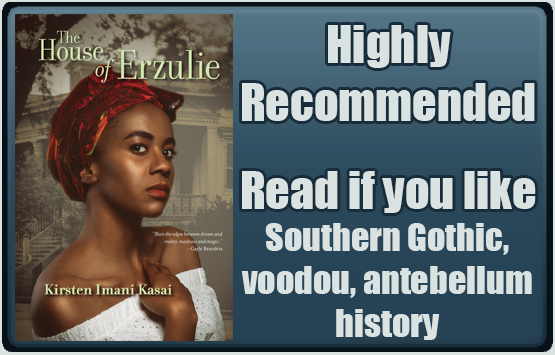
The House of Erzulie by Kirsten Imani Kasai

The House of Erzulie by Kirsten Imani Kasai

Formats: Print, audio, digital

Publisher: Shade Mountain Press

Genre: Gothic, Historic Horror, Myth and Folklore

Audience: Adult/Mature

Diversity: Black/biracial main characters and author, mentally ill main characters

Takes Place in: Philadelphia and New Orleans, USA

Content Warnings (Highlight to view): Alcohol Abuse, Animal Death, Body Shaming, Child Abuse, Child Death, Death, Drug Use/Abuse, Forced Captivity, Gaslighting, Illness, Kidnapping, Medical Torture/Abuse, Medical Procedures, Miscarriage, Mental Illness, Oppression, Pedophilia, Physical Abuse, Racism, Rape/Sexual Assault, Self-Harm, Sexism, Sexual Abuse, Slurs, Slut-Shaming, Torture, Verbal/Emotional Abuse, Violence, Xenophobia 

Blurb

The House of Erzulie tells the eerily intertwined stories of an ill-fated young couple in the 1850s and the troubled historian who discovers their writings in the present day. Emilie St. Ange, the daughter of a Creole slaveowning family in Louisiana, rebels against her parents’ values by embracing spiritualism, women’s rights, and the abolition of slavery. Isidore, her biracial, French-born husband, is an educated man who is horrified by the brutalities of plantation life and becomes unhinged by an obsessive affair with a notorious New Orleans voodou practitioner. Emilie’s and Isidore’s letters and journals are interspersed with sections narrated by Lydia Mueller, an architectural historian whose fragile mental health further deteriorates as she reads. Imbued with a sense of the uncanny and the surreal, The House of Erzulie also alludes to the very real horrors of slavery, and makes a significant contribution to the literature of the U.S. South, particularly the tradition of the African-American Gothic novel.

I received this product for free in return for providing an honest and unbiased review. I received no other compensation. I am disclosing this in accordance with the Federal Trade Commission’s 16 CFR, Part 255: Guides Concerning the Use of Endorsements and Testimonials in Advertising.

The House of Erzulie is an exquisitely written, thought-provoking work of Southern Gothic fiction that explores themes of identity, love, obsession, and oppression while blurring the line between reality and the supernatural. Kasai’s book also forced me to acknowledge and confront my own complicated feelings and insecurities about my identity as a light-skinned, biracial Black person and reflect on the colorism within the Black community.

Lydia is a professor of history trapped in a bad marriage with her former advisor Lance, a selfish, serial philanderer who prefers his women young, docile, and naive. Their teenage son is emotionally distant and rarely home. Struggling with depression and a desire to self-harm, Lydia tries to cope with her emotional pain and feelings of isolation by throwing herself into her job, the one area of her life that isn’t falling apart. Ironically, it’s her work, the last vestige of stability in Lydia’s life, that finally destroys her fragile mental health.

At first Lydia thinks nothing of the journals she receives in a packet of historical documents belonging to the once grand Bilodeau plantation in New Orleans. After all, she’s been hired to aid in the restoration of the dilapidated building, even if she finds the monument to slavery distasteful. It’s only on a whim that she chooses to peruse the diaries of Emilie Bilodeau, the progressive daughter of a slave-owning family, and her husband Isidore Saint-Ange, a free-born biracial Frenchman. But as she learns more about the tragic couple’s lives Lydia finds herself strongly empathizing with Emilie’s loneliness and crumbling marriage. But it is Isidore’s journal that finally pushes her over the edge. Once logical and purely scientific in his approach to the world, Isidore becomes increasingly paranoid as a series of poor decisions and bad luck destroy his life. Eventually succumbing to madness, Isidore is imprisoned in an insane asylum convinced he is the victim of supernatural forces. As her own life turns to chaos, Lydia finds herself mirroring Isidore’s destructive actions.

The House of Erzulie has all the elements of a first-rate Gothic story; a distressed heroine kept trapped and powerless. A passionate but ultimately doomed romance. Hints of the supernatural in the form of spirits, curses, and prophetic nightmares that may or may not be products of the antihero’s imagination. A once great home falling into ruin as disease, death, and madness ravage its inhabitants, all set against the backdrop of one of America’s greatest atrocities. Kasai is careful to emphasize how appalling and inhumane the practice of chattel slavery is without using a historical tragedy for cheap scares or trauma porn. Instead Isidore’s rapidly declining mental state reflected in the plantation’s decay and the multiple misfortunes befalling the Bilodeaus is what makes the novel so frightening. I must admit I found it incredibly satisfying to watch such unsympathetic characters suffer karmic retribution (Emilie being the exception) the more gruesome and agonizing the better though I’m sure not all readers will share my taste for schadenfreude. Kasai’s writing is superb, her carefully crafted prose flows like poetry and evoked strong emotions in me. I’ll share one of my favorite passages here:

They say “love is not a cup of sugar that gets used up” but it is. Spoonful by spoonful, grain by grain, the greedy, the needy, and the hungry consume it and demand more until the bowl is empty. Then they run away, jonesing for a fix from another source. Each betrayal, every insult or injury depletes the loving cup and leaves the holder bitter. It’s a bitterness I can taste, and it sits on my tongue like the foulest medicine.

Kasai also did extensive research for her novel, as is obvious from the story’s numerous references to historical events and the accuracy with which mid-19th century healthcare is depicted. The Spiritualist movement (which Kasai notes provided one of the few public platforms for women at the time), the yellow fever epidemic of 1853, and the anti-Spanish riots of 1851 all make appearances in The House of Erzulie. But it’s the lives of her gens de couleur libres, or “free people of color” characters that deserve special attention. While I was initially disappointed by how little attention the narrative paid to the stories and voices of the slaves, it was a nice change of pace to read a novel that focused on the lives of free Black characters. Despite the significant role they played in US history, wealthy, free Blacks in the antebellum South rarely make an appearance in historical fiction.

The majority of the novel is set in Louisiana, once home to the largest population of gens de couleur libres in the US. Forming an intermediate class below White colonizers but above slaves, free Blacks achieved more rights, wealth, and education in the French settlement than in any of the British colonies. Professor Amy R. Sumpter notes in her article Segregation of the Free People of Color and the Construction of Race in Antebellum New Orleans that before the state currently called Louisiana was stolen “acquired” by the US in 1803 “the cultural blending of French, Spanish, and African traditions… created an atmosphere of racial openness in Louisiana and particularly New Orleans that stood apart from much of the rest of the South. Aspects of the unique racial atmosphere included a tripartite racial structure and racial fluidity.” Much of this was due to the Code Noir, an edict originally issued by King Louis XIV in 1724 that defined the legal status of both slaves and free blacks and imposed regulations on slave ownership. While no less cruel and inhumane than any of the other laws governing the enslavement of human beings, the code did make allowances not found in the rest of country.

The US followed a strict “one drop” rule that classified anyone with Black ancestry as Black. Mixed raced individuals were given offensive labels depending on their percentage of “Black blood”. “Mulattos” were biracial with one Black parent and one White. “Quadroons” were a quarter Black, “octoroons”(also called “mustees”) one-eighth, and “quintroons” (or “mustefinos”) one-sixteenth. In her acclaimed essay Whiteness as Property civil rights professor Cheryl Harris explains that this complicated system was “designed to accomplish what mere observation could not: That even Blacks who did not look Black were kept in their place.” English colonies also practiced partus sequitur ventrem (Latin for “the offspring follows the womb”) a law that gave a child the same legal status as their mother. So a mixed-race child born to an enslaved mother would be born into slavery, while the child of a free woman would also be free.

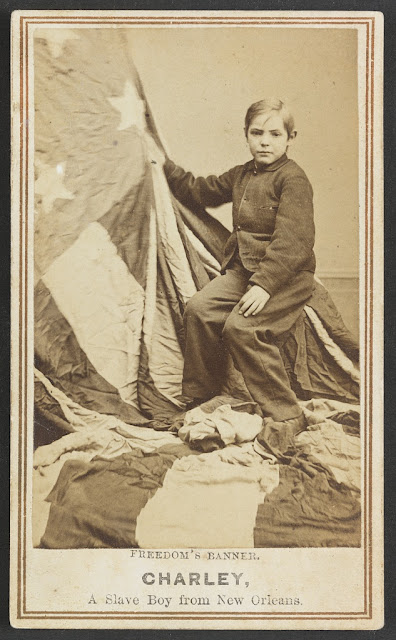
An old daguerreotype photo depicting a light-skinned boy with European features. A large American flag is draped off to the left of the image, covering the floor and the stool the boy is sitting on. Under the photo the following has been typed: Freedom's Banner, CHARLEY, A Slave Boy from New Orleans.

Charley Taylor was the “quadroon” son of White slave-owner Alexander Scott Withers and a biracial slave named Lucy Taylor. Because his mother was a slave Charley was also born into slavery and sold by his father to a New Orleans plantation. Abolitionists often used images of White-passing slaves to elicit sympathy as White audiences were more likely to be identify with the suffering of people who looked like them.

Most of the main characters in The House of Eruzile are upper class gens de couleur libres all of whom approach their Blackness and privilege differently. Emilie’s father, Monsieur Bilodeau, is a willing and enthusiastic participant in the slave economy and chooses to idolize Whiteness, despite having a Black grandmother. It’s a sad fact that some free Blacks became slave owners themselves, and many of them lived in Louisiana. While I can’t pretend to know the motivations of long-dead men, Kasai makes it clear that M. Bilodeau does it because he’s greedy, racist scum, a twisted amalgamation of Uncle Tom and Simon Legree. Isidore is shocked and disgusted by the treatment of the slaves on his in-laws plantation (slavery would’ve just been abolished in France), but is unwilling to risk his own privilege and wealth by objecting or leaving. Well-educated and used to a comfortable existence Isidore married into the Bilodeau family so he could continue enjoying a life of leisure rather than be forced to get a job. He does his best to ignore the suffering of the plantation’s slaves, as if this will somehow absolve him of his participation in a racist and inhumane system. Emilie, on the other hand, uses what little power she has to advocate for her family’s slaves, including her great-great-aunt Clothilde (yup, her dad wouldn’t even free his own family-members) and becomes involved in the abolitionist movement. She does her best to try to convince her husband to move North and free the Bilodeau slaves once they inherit the plantation but is always shot down. Finally, there’s P’tite Marie, the light-skinned daughter of Marie Laveau, a free-woman with significant influence.

While Kasai is undoubtedly a talented writer, I was troubled by the way she portrayed P’tite Marie as a one-dimensional Jezebel who uses voodoo to literally enchant her lovers. Her characterization is in sharp contrast to Emilie’s role as the virtuous mother, bringing to mind the deeply problematic Madonna/whore dichotomy. P’tite Marie would certainly have been exploited by men who fetishized free Black women, as is evident from the stories of Quadroon Ballsplaçages and “fancy maids,” so implying that she is sort of succubus who takes advantage of men didn’t sit right with me. Admittedly, we only get to view P’tite Marie through the lens of an unreliable, misogynist narrator who is seemingly incapable of accepting responsibility for his own actions and who is quick to blame her for his philandering. Still, it would’ve been nice to learn more about P’tite Marie as a person rather than a sexual fantasy. Personally, I would have much preferred if P’tite Marie and Emilie had realized that all the men in their lives were awful and decide to run away together.

The house in the background is based on the Oak Alley Plantation in New Orleans. Now a museum, Oak Alley boasts tours of the facility, a beautiful venue for weddings and reunions, a well-reviewed restaurant, and overnight cottages. What could be more relaxing than sipping mint juleps at the site of significant human right’s abuses and suffering? Maybe Auschwitz should start doing weddings.

Emilie was another character I took issue with. I found her naivety grating rather than endearing, and it concerned me that the Whitest character in the book was written to be the most sympathetic. To Kasai’s credit she does a wonderful job creating a mixed-race Gothic heroine without making her a tragic mulatta. Emilie is still a tragic character, but none of that is related to her identity. She is not ashamed of being mixed and is astutely aware of her good fortune. She uses her privilege to help others and would gladly give up her wealth if it meant freedom for the Bilodeau’s slaves. Instead of lamenting the “single drop of midnight in her veins” Emilie’s greatest source of ignominy is her family’s arrogance and lack of empathy. As she matures, she begins pushing back more aggressively against the injustices she perceives. And yet, I still deeply disliked her. But more on that in a moment.

Emilie was not the only character that inspired a strong reaction from me. Lydia, like many mixed race folks, has a complicated relationship with the White grandparents who raised her, and her family problems resonated deeply with me. I don’t even know most of my White family, nor do I want to, as they’re racists who disowned my mother for marrying my Black father. My mother is amazing and dedicated to anti-racism work, but I feel nothing but contempt for the biological family that labeled me a “jigaboo baby.” Meanwhile Isidore and M. Bilodeau reminded me of the worse aspects of the mixed community; those who choose inaction, thereby becoming complicit in the system of White supremacy, and the self-hating Blacks who reject their race and actively promote racism and colorism to get ahead. I could easily imagine the reprehensible M. Bilodeau in a blue vein society wearing a “Make America Great Again” hat while defending voter suppression and laughing at racist jokes. Emilie’s father is clearly an irredeemable villain who has no qualms about abusing his slaves, while Isidore is given more complexity and a conscience. Unfortunately, his guilt has no effect on his actions, and I was hard-pressed to dredge up even a shred of sympathy for Isidore and his hypocrisy. This is a perfect example of why intent doesn’t matter. While Isidore may not be an unrepentant racist like his father-in-law both men selfishly used their privilege for their own benefit at the expense of other Black people. It’s hard to say if his inaction makes him more or less morally reprehensible that his monstrous father-in-law.

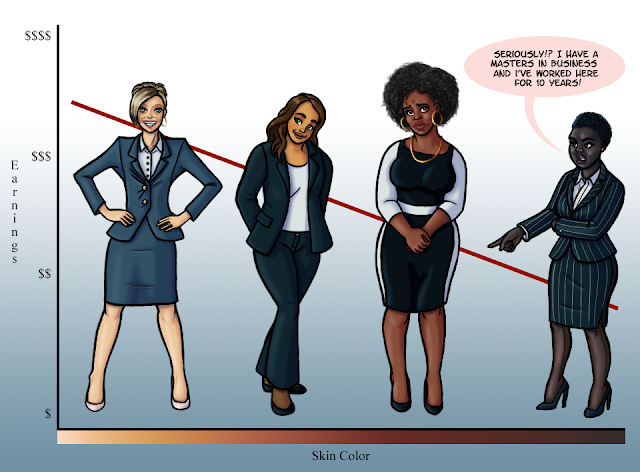
I suspect that the reason I felt so much animosity towards Emilie, even though Isidore and M. Bilodeau are much more reprehensible, may stem from my own experience and insecurities as a White-passing Black person. I struggle daily with the guilt and resentment I feel knowing that while I’m undoubtedly oppressed by a White supremacist system, it also gives me an unearned advantage over others. I, and others like me, enjoy higher wages and are perceived as more intelligent while those with darker skin are given longer prison sentences, are three times more likely to be suspended from school and struggle to find partners. My grandfather could join Black fraternities that implemented paper bag tests, and probably used his light complexion to secure jobs as a physician. His grandparents were house slaves (and the children of their owner) like the ones described by James Stirling in The Life of Plantation Field Hands and Malcom X in his Message to Grassroots speech. Not only am I treated better by Whites (who were responsible for this racist caste system in the first place) but even the black community puts a high-value on my pale skin. Colorism is so deeply ingrained in society that skin-whitening creams are a $20 billion industry. My Black grandmother used to keep my father and his sister out of the sun so they wouldn’t be “too dark.” There’s a #Teamlightskin hashtag on Twitter. A color-struck, light-skinned manager at Applebee’s called his darker skinned employee racist slurs and suggested he bleach his skin. My passing privilege (most people assume I’m Jewish, Italian or Latinx until I correct them) and proximity to Whiteness means I can easily avoid the racist aggression the rest of my family experiences on a daily basis.

This a fake graph, but it’s based on actual data.

Because Emilie is so White, I instinctively questioned whether she could even be considered Black, just as my own melanin-deficient skin often makes others question my identity. While I can easily dismiss comments of “you’re not really Black” from Whites who are pissed I told them not to say the n-word (I could be Whiter than Conan O’Brien and you still can’t fucking say it Karen), it’s a lot harder when the remarks come from other Black people who make it clear they don’t want me in their spaces. But as much as I’m tempted to self-indulgently sulk, I can’t ignore the very valid concerns of darker skinned Black folk who are frequently pushed aside in favor of people like me. Yes, I, and other light-skinned BIPOC may deal with frequent microaggressions and sometimes even outright hostility, but we’re still much more welcomed by a racist society then we would be if our skin were darker. Given all this it’s no wonder my intrusion on BIPOC spaces is often called into question. Yes, I have racial trauma, but is it right for me to complain to those who are clearly dealing with so much more? It would be like crying about having my purse stolen to someone whose had their home burnt down and lost everything. Denying that I have privilege is incredibly harmful to the Black community as are comments like “we’re all Black, why are we dividing ourselves even more?”  Tonya Pennington does an excellent job encapsulating my feelings on the matter in their article for The Black Youth Project:

…despite my empathy for [Ayesha Curry], I disagree with her conclusion for why she isn’t accepted by the Black community. Both of us are light-skinned, and we know light-skinned Black people are often considered more desirable than dark skin Black women because of colorism. As much as she may have been picked on for being “different,” like me, it’s inevitable that she also experienced a host of privileges both within and outside the Black community for the same thing.

To be clear, in my personal experience most other Black people have been extremely welcoming to me and are sympathetic to the unique challenges of being mixed race. I am eternally grateful to everyone who has shown me such support and compassion, even when dealing with their own problems. They didn’t need to, and it was incredibly kind. I try my best to avoid demanding pity, taking over conversations, or otherwise making things about me when I’m in Black spaces. To do otherwise would be reprehensible. I know I have it a lot easier that others, and it’s my responsibility to use my light-skinned privilege to combat systemic racism when I can.

As Afropunk writer Erin White explains “Light skin people have a responsibility to call out colorism and be honest about the privileges they benefit from.” Blogger Amanda Bonam, founder of The Black & Project even gives examples on how she confronts her own light-skinned privilege. Unfortunately, the best ways to oppose colorism isn’t always obvious, and even good intentions can be harmful if one isn’t cautious. Like all allies we walk a fine line, confronting colorism without speaking over those without light-skinned privilege. For instance, as a person with light-skinned privilege, I constantly worry that I’m either not doing enough, or else I’m so vocal that I’m silencing other Black voices. Like my “white-passing” guilt, I push these worries down because, again, it’s not about me and those emotions are unhelpful. But they still exist no matter how much I try to deny them, because that’s how feelings work. Which brings me back to Emilie, because in her I saw my own insecurities.

Mentally I condemned Emilie for what I saw as meager attempts to help the Bilodeau’s slaves, despite benefiting so much from colorism. When Emilie bemoaned the fact she couldn’t do more, I bristled at how she seemed to be selfishly focused on her own suffering. I cast her in the role of White savior whose negligible struggles and accomplishments were lauded above those of the Black characters. Except Emile isn’t White, at least she wouldn’t have been in 1850. Hypodescent rules would have meant she’d be labelled Black by society, and there was certainly no benefit to having a Black great-grandparent in antebellum Louisiana. And how much could she have possibly done to help the slaves? Emilie was a woman, with no power and her resources were completely controlled by the men in her life. When she spoke out she was ignored. She couldn’t purchase anyone’s freedom as Isidore had complete control of her finances. The laws were not on her side. Much of the novel’s focus is on Emilie’s feelings, but it’s also written as a diary, where she would have recorded her personal thoughts, struggles, and misgivings. There’s no indication she was putting her feelings over those of the slaves; to the contrary Emilie seems to hide her guilt and frustration from everyone save her White abolitionist friend.

So did I judge Emilie, Kasai’s heroine, unfairly because I projected so much of myself onto her? Or was I right to be critical of a light-skinned character who once again is given the spotlight over dark-skinned Black folk? As of now, that’s not an answer I can provide. Instead I encourage the reader to draw their own conclusions about Emilie. All I know is that any book that can provoke so much both emotionally and intellectually is well worth a read.

My Sweet Audrina by V.C. Andrews

My Sweet Audrina by V.C. Andrews

Formats: Print, audio, digital

Genre: Gothic Horror, Romance, Thriller

Audience: Adult/Mature

Diversity: Intellectual Disability, Possible Autism, Physical Disability (bilateral above the knee amputee), Chronic Illness (Osteogenesis imperfecta/brittle bone disease), PTSD

Takes Place in: Southern USA

Content Warnings (Highlight to view): Abelism, Alcohol Abuse, Body Shaming, Bullying, Implied Cannibalism, Child Abuse, Child Death, Childbirth, Death, Forced Captivity, Gaslighting,  Illness, Emotional Incest, Medical Torture/Abuse, Miscarriage, Mental Illness, Pedophilia, Physical Abuse, Racism, Rape/Sexual Assault, Implied Self-Harm, Sexism, Sexual Abuse, Slut Shaming, Suicide Attempt, Transphobia, Verbal/Emotional Abuse

Blurb

V.C. Andrews, author of the phenomenally successful Dollanganger series, has created a fascinating new cast of characters in this haunting story of love and deceit, innocence and betrayal, and the suffocating power of parental love.
Audrina Adare wanted so to be as good as her sister. She knew her father could not love her as he loved her sister. Her sister was so special, so perfect — and dead.
Now she will come face to face with the dangerous, terrifying secret that everyone knows. Everyone except…
My Sweet Audrina

Holy fuck, this book.

I’m curled up, holding my knees to my chest, and looking shell shocked. My right eye is twitching. “WTF” I ask as I stare into the void.

This book is definitely the winner of the OMGWTFBBQ award

If you’re unfamiliar with V. C. Andrews, she wrote gothic horror novels during the eighties about really messed up, toxic, abusive, families that Lifetime loves to turn into terrible made-for-TV movies.  A standard Andrews book usually contains gas lighting, emotional and physical abuse, dark family secrets, and some of the most fucked up relationships ever put to paper that run the gambit from pedophilia to incest. Imagine if all guests on the Jerry Springer show were rich, beautiful, gothic heroines with enough skeletons in their closets to start their own ossuary, and you’ll have an idea of what you’re in for. They’re trash novels, but in the best possible way, written by a talented author who knows her audience is looking to be shocked and horrified, like splatterpunk without the gore. Her stories may be ridiculous and over-the-top at times, but never, ever dull, and of all her fucked up books, My Sweet Audrina is probably her most fucked up. It manages to contain nearly every content warning I have that doesn’t involve blood and gore (although there is a rather grisly scene where a woman miscarries and throws one of the blood clots at her mother in a fit of rage). There’s a brutal child rape, a lot of abuse by a manipulative bastard, everyone messing with Audrina’s mind, and a dead aunt who may or may not have been eaten by cannibals, so be forewarned, My Sweet Audrina is not for the squeamish.

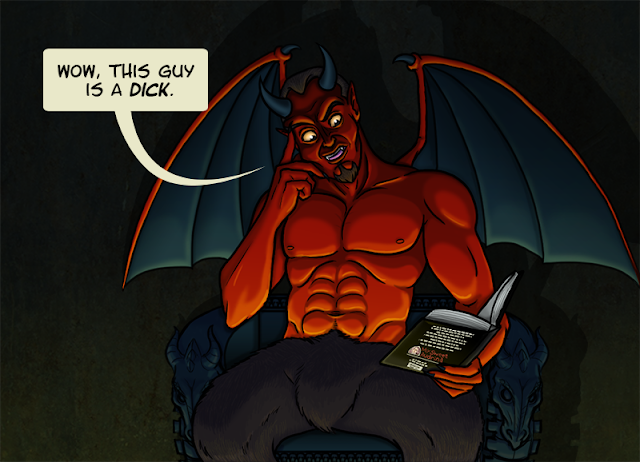
Damian Adere, the family patriarch, is aptly named because the guy is just fucking evil. He’s greedy, immature, vain, sexist, lazy, abusive, controlling, narcissistic, and manages to destroy the lives of every woman he knows while still seeing himself  as the victim because he’s just that fucking self-centered. Yet, he continues to get away with his awful behavior because he’s handsome, charming, and extremely manipulative, which honestly makes him even more frightening. In the first few chapters he comes off as kind of a dick but still likable. His daughter, Audrina, who acts as the book’s narrator, still loves and respects him. But over the course of the story as we witness his true nature, Damian quickly goes from seemingly well-intentioned but misguided, to a full-blown asshole, then finally becomes Satan incarnate. In fact, I’m still not entirely convinced this isn’t some sort of sequel to The Omen where the Anti-Christ kid grows up to become a lazy, whiny, codependent, narcissistic asshat who gets married and lives in a dilapidated mansion that he never lets his daughter leave. Actually, comparing Damian to Satan seems unfair because even the Dark Lord isn’t that big of a flaming dick. I can just imagine the devil reading My Sweet Audrina and being utterly horrified. The other characters, save for our virtuous heroine, Audrina, aren’t a whole lot better, although a lot of their behavior can be more or less attributed to Damian’s abuse.

Satan is leaning back in his creepy dragon chair reading “My Sweet Audrina”. He has red skin, black horns, bat wings, furry goat legs, a goatee, and well-defined abs. The image is dark, and lit from below. Satan has a finger to his temple and comments “Wow, this guy is a DICK” (referring to Damian).

I just assume Satan is ripped

Audrina’s mother, Lucietta, had to give up her dream of becoming a concert pianist to marry Damian (because he didn’t want his wife to make more money than him), and now hides her misery by living in denial and drinking to numb the pain. She frequently lashes out at her sister, Ellsbeth, who has become bitter (again, thanks to Damian) and abusive, neglecting her own daughter, Vera. In turn, Vera has turned into a complete monster before the start of the book because nobody loves her and Damian (whom she sees as her father) constantly treats her like shit and compares her to his “perfect” daughter, Audrina. As horrible as Vera is (and she’s pretty fucking horrible), you can’t help but feel sorry for her. She’s forced to be the whore to Audrina’s virgin, which makes her hate and resents her cousin. She’s so desperate for love and attention that 14-year-old Vera has “sex” with an adult man (everyone acts like it’s consensual sex when it’s very clearly statutory rape), and acts seductively from a young age. Of course none of the adults think “Hey, this isn’t normal behavior for a child, maybe we should get her some help” they just decided “She’s just a slut, oh well, who cares.” Meanwhile Audrina is haunted by memories of a childhood rape, which her father keeps forcing her to remember in a sick attempt to make her “perfect” (I’m not even going to try and explain Damian’s troll logic on this one). He reinforces her role as the virgin by frequently telling his daughter that all men are evil and forcing her to cover up in old fashioned dresses lest she be attacked. Is it any wonder Audrina becomes terrified of sex and disgusted by nudity to the point that she can’t even be intimate with someone she loves without trauma? Of course Damian is totally fine with this because it means she’s less likely to have a relationship with any man that isn’t him. If that makes your skin crawl, well, it should, because even Audrina describes their relationship as being like husband and wife without the sex. Ew. At least there isn’t any actual incest like I was fearing, which is a first for a V C Andrews novel.

Even Lucietta isn’t safe from her husband’s slut shaming, as Damian flies into a rage if her outfits are too revealing and accuses her of flirting with the men at the parties he forces her to host. He wants to show off his pretty wife, but then gets ridiculously jealous when other men think she’s pretty and ends up throwing a tantrum. He loves to be surrounded by women who adore him, but doesn’t want to share, so everyone is essentially trapped in this giant, run down house where Damian can keep an eye on them, isolated from the rest of the world. Like I said, the dude is fucking evil, and doesn’t even realize it. Or maybe he does, but simply doesn’t give a shit. Basically, if there was a drinking game where you had to take a shot every time Damien pulls a dick move, no one would ever finish the book because they’d die from alcohol poisoning after a few chapters.

Now, you’re probably wondering where the diversity comes in. I chose this book because of its representation of disability which, while not ideal (especially in Sylvia’s case), was at least written by an author who herself had a physical disability for most of her life. As a teenager, Andrews developed severe arthritis and underwent multiple spinal surgeries to treat it. Andrews says this was the result of a back injury she sustained from falling on a staircase in high school, while her family claims it was something she was born with. Regardless, the resulting chronic pain required the use of a wheelchair or crutches for most of her life. Andrews lived at home, under the care of her mother, where she completed a four-year correspondence course in art, before starting her career as a writer. Her very first book, Flowers in the Attic, is about four children who are kept in the attic for years by their religious grandmother, and the toll it takes on their mental and physical well-being. Andrews said in a 1985 interview for Faces of Fear that Flowers in the Attic was based on her own feelings of frustration at being trapped at home. While accessibility for people with mobility issues still isn’t great, I can imagine it was even worse when Andrews was growing up, and she died four years prior to the passing of the Americans with Disabilities Act. This theme of feeling “trapped” continues in My Sweet Audrina, where five of the six women in the story have some kind of disability that limits their freedom, which Damien of course takes full advantage of. Even the stairs that may or may not have been the start of Andrews’ chronic pain and limited mobility feature prominently in the book. The Adere house’s staircase essentially goes on a killing spree, offing multiple family members to the point where I have to wonder if the stairs were constructed from the bones of murdered children and cursed relics. Or maybe it’s just haunted by all the ghosts of the people Damien pissed off (which I can only imagine is every person he’s ever met). Andrews’ representation of disability is definitely problematic, but also complex and extremely personal, which is what makes this story worth exploring. It’s one of the few horror novels I’ve been able to find about disability that was actually written by a disabled person.

Vera has brittle bone disease, frequently breaking an arm or leg at the slightest bump. Audrina’s younger sister, Sylvia has autism and/or an intellectual disability (it’s not handled or explained well by Andrews) that requires full time care. Lucietta seems to have a heart disease that limits her activity. Billie, the Adere’s neighbor and one of the few likable characters in the book, is a bilateral amputee following complications from diabetes. Then there’s Audrina, whose untreated PTSD leaves her too terrified to leave her yard, even though she desperately wants to go to school and have friends. Audrina is sort of a Mary Sue for Andrews, what with her violet eyes, magically color changing hair, and extraordinary beauty (seriously, WTF?). They’re both artistic, unable to leave the house, and need to rely heavily on their families to function which causes them great frustration. The depictions of women with disabilities in My Sweet Audrina aren’t particularly progressive, and can even be downright ablest at time (especially when it comes to Sylvia), but the characters are all unique with very different personalities, outlooks, and ways of dealing with their disabilities.

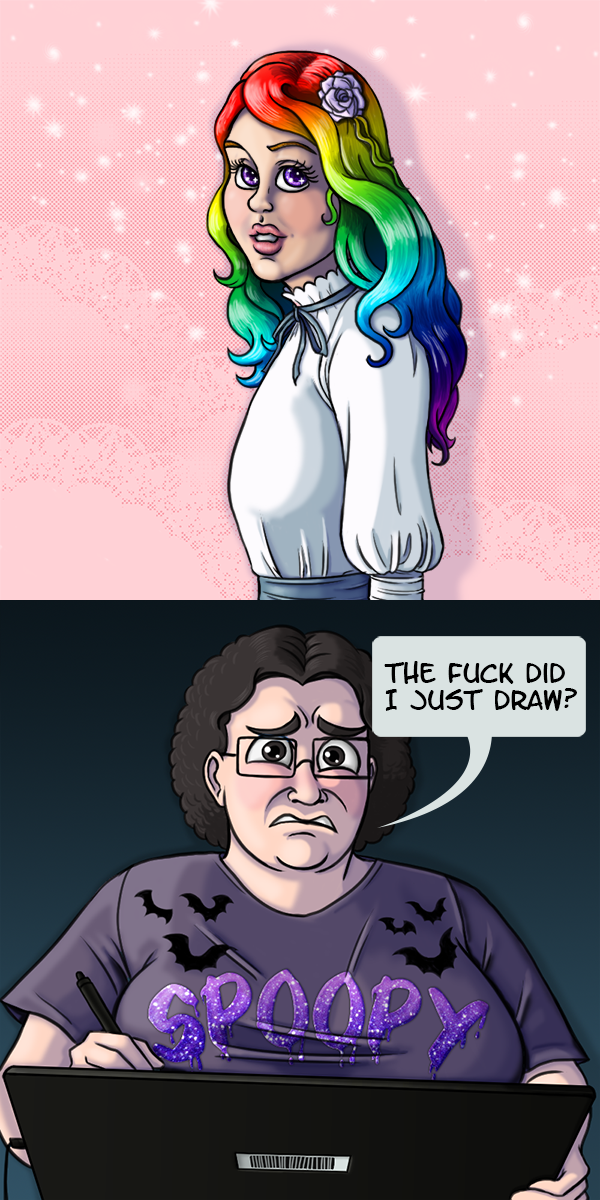
I’m drawing a picture of Audrina. The first panel shows a stereotypically attractive woman in a white, conservative, Victorian dress. She has large, sparkly, violet eyes, and long rainbow hair that starts as red at her scalp, and moves down the spectrum to indigo and violet at the ends of her hair. In the second panel I’m looking at my creation with horror and ask, “The fuck did I just draw?” I’m wearing a purple shirt with bats that says “spoopy” in violet glitter.

What Audrina looks like, presumable. Unrelated, but I wish I had that Spoopy shirt in real life.

Audrina desperately wishes for freedom and is frustrated by her PTSD, but without proper help and treatment she struggles to deal with her trauma (thanks a fucking lot, Damien). She does try to force herself to “get over it” a few times, and it doesn’t go well. Vera, on the other hand, seems proud of her disability, bragging about her delicate bones and teasing Audrina for having “peasant bones”, though it’s most likely an act to make herself feel better. Vera will frequently play up her disability to get out of doing chores, and even purposely hurt herself for attention, even though her mother and Damien seem fairy unconcerned by her injuries. Billie, on the other hand, is ashamed of her residual limbs, and goes to great effort to hide them. Her husband left her after her legs were amputated, and she now sees herself as “damaged” and “unlovable” despite being drop-dead gorgeous and able to function just fine with the use of a wheeled board. Although Billie continues to live her life and seems pretty happy for the most part, she’s still incredibly insecure, making her an easy target for Damien. Finally there’s Sylvia, the youngest Adare daughter, who gets ignored and insulted by pretty much everyone except Audrina, her appointed caretaker. Because why would Damien get actual help when he can just make Audrina play Occupational Therapist for free? And then everyone seems ~shocked~ that Sylvia’s not making much progress when she has a child (who only just started going to school herself) as her teacher. At least Sylvia gets some revenge on her awful family. It’s never outright confirmed, but is strongly implied that she knows more than she lets on and allows people to underestimate her abilities so she can better manipulate them (and occasionally possibly murder them). Part of me really hopes Sylvia is knowingly screwing with everyone as a sort of “fuck you” to her neurotypical family who constantly calls her really ableist slurs and compare her to an animal, because they really fucking deserve it. Now if only she’d arrange for Damien to have a little accident….

My Sweet Audrina is a combination of exploitation horror and chick lit, meant to grab your attention from the first paragraph and brand its shocking subject manner deep into your brain so that years from now you’ll still be thinking “God, that was a fucked up book.” And if you’re wondering why I would inflict this on myself, well, A) Because I’m a horror fan, that’s kind of what I do, and B) It’s just so damn enjoyable. It’s a wonderful guilty pleasure I couldn’t put down until the end, and Andrews is a talented writer who is fully aware of what she’s creating. So what if the story can sometimes read like Soap Opera fan fiction written by a fourteen-year-old?  My Sweet Audrina is especially interesting when viewed as a personal exploration of the author’s feelings of being “trapped’ by her chronic pain and mobility issues.  For fans of tragic heroines, gothic horror, and guilty pleasures, I’d definitely recommend My Sweet Audrina.

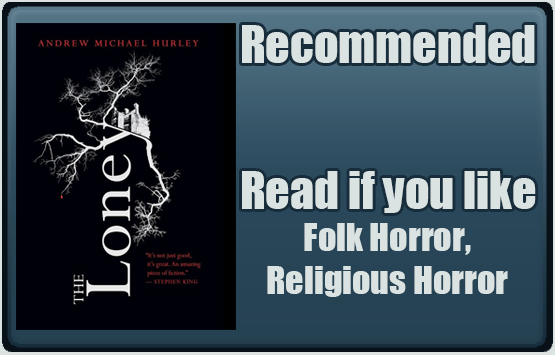
The Loney by Andrew Michael Hurley

The Loney by Andrew Michael Hurley

Formats: Print, audio, digital

Publisher: Houghton Mifflin Harcourt

Genre: Gothic, Folk Horror, Psychological Horror, Mystery

Audience: Adult/Mature

Diversity: Disability (Speech Disorder – muteness, Cognitive/Learning Disability, PTSD)

Takes Place in: Lancashire, UK

Content Warnings (Highlight to view): Abelism, Alcohol Abuse, Animal Death, Bullying, Child Abuse, Child Death, Child Endangerment, Death, Racism, Forced Captivity, Gaslighting, Gore, Homophobia, Illness, Medical Torture/Abuse, Medical Procedures, Mental Illness, Physical Abuse, Racism, Slurs, Suicide, Verbal/Emotional Abuse, Violence

Blurb

When the remains of a young child are discovered during a winter storm on a stretch of the bleak Lancashire coastline known as the Loney, a man named Smith is forced to confront the terrifying and mysterious events that occurred forty years earlier when he visited the place as a boy. At that time, his devoutly Catholic mother was determined to find healing for Hanny, his disabled older brother. And so the family, along with members of their parish, embarked on an Easter pilgrimage to an ancient shrine.

But not all of the locals were pleased to see visitors in the area. And when the two brothers found their lives entangling with a glamorous couple staying at a nearby house, they became involved in more troubling rites. Smith feels he is the only one to know the truth, and he must bear the burden of his knowledge, no matter what the cost. Proclaimed a “modern classic” by the Sunday Telegraph (UK), The Loney marks the arrival of an important new voice in fiction.

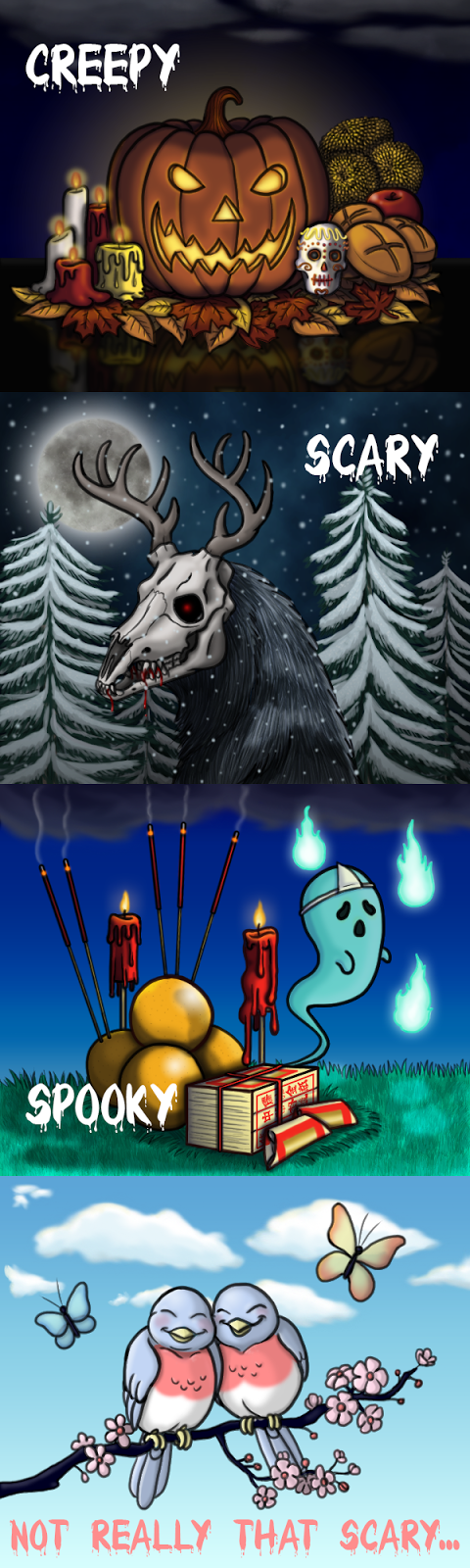
Autumn is normally considered the season for all things horror, due to holidays like Samhain, All Hallows’ Eve/Halloween, and the Day of the Dead in Europe and the Americas, but the other seasons have their own share of scary stories and traditions. Summer is perfect for slasher flicks, spooky stories by the campfire, and the Ghost Festival is celebrated in East and Southeast Asia. The long, dark nights of winter inspired the Victorians to tell ghost stories and Algonquin-speaking people associated the season with the cannibalistic monsters. But spring, generally associated with new life, rebirth, flowers, and cute baby animals in the Northern Hemisphere, is the odd one out. Other than Bram Stoker’s famous short story, Dracula’s Guest, which takes place on Walpurgis NightThe Loney is the probably the only scary story I’ve ever read set during the Spring.

The first image is of a Jack-o-Lantern on a bed of autumn leaves, surrounded by candles, marigolds, soul cakes, and a sugar skull. It says “creepy”. Next is a snowy night in a pine forest, with a full moon and a wendigo that says “scary”. The third says “spooky” and depicts an offering of oranges, joss paper, incense and red candles, with little ghost is surrounded by Hitodama. The final image is of two birds snuggling on a spring day with butterflies and cherry blossoms. It says, “Not really that scary.”

I mean, I guess if you’re scared of flowers and baby animals Spring might be scary….

The Loney was written by an English Teacher, and boy does it show. It’s overflowing with symbolism, deeply complicated characters, religious imagery, and all the other stuff that gets pretentious professors all hot and bothered. This is the kind of book that lends itself well to long, dry, dissertations about death and rebirth, or some other equally clichéd thesis, like how everything is a metaphor for sex. Not that any of this is bad, mind you, just don’t expect a classic horror story so much as a coming-of-age character exploration set in a gloomy, shit hole town that leaves you feeling creeped out and disturbed. There’s a lot more focus on the environment and characters than there is on the actual story (or lack thereof). It reminds me of one of those artsy games with no plot or clear goals where you just wander around and explore the gorgeous environment, like The Path (the game,  not the TV series). Which, again, isn’t a bad thing if you’re into walking simulators, but I miss having a three act story structure, and a build up of suspense. So my reaction to The Loney was along the lines of “bored, bored, bored, do something already, wow that’s creepy, damn these people are messed up, bored, bored, is something going to happen now or what, so borrrreeed, stop talking for fuck’s sake, bored, HOLY SHIT WTF OMG, oh, well I guess that’s the end.” And then I was left wondering what the fuck I had just read.

While the pointless milling about can get tedious (really, REALLY tedious), it’s still an entertaining and creepy book. I wouldn’t exactly call it horror, since The Loney isn’t scary per se, but it is definitely disturbing. There are still a few of the standard horror “shock value” scenes you’d expect, y’know, the kind where any person with common sense would take it as an obvious sign to turn the fuck around because it’s clear they just stumbled into some Blair Witch, demonic serial killer, Eldritch abomination crap? But most of the creepiness comes from the irrational religious fervor of the adults (except, ironically, the priest), and their disturbing obsession with “curing” the unnamed protagonist’s disabled brother, Hanny. Not for his own benefit, since he seems perfectly happy as is, and could probably function on his own just fine if given a chance, but as part of some selfish desire to see a miracle and be closer to God.

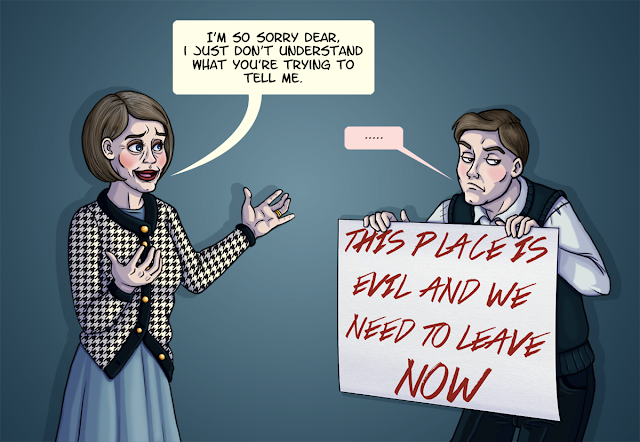
Now here’s the thing about being a disabled person in horror fiction, you can come in one of three flavors. You can either be a victim (Audrey Hepburn in Wait Until Dark, the mute woman in The Tingler, Mark from Friday the 13th Part 2), the “psycho” (pretty much every movie killer ever, because mental illness apparently makes you evil), or some sort of disabled version of the “magical negro” trope (the little girl from the Langoliers, “Duddits” from Dreamcatcher, Tom Cullen from The Stand, and every other disabled person in a Steven King novel). But Hanny doesn’t seem to fall into any of these groups. He’s certainly not helpless, a monster, or “magical”, despite what those around him may think. For example, late in the book Hanny manages to uncover and successfully load a rifle (despite having little to no experience doing so), sneak out of the house by muffling his foot steps on a blanket and bribing the dog with treats, then find his way across dangerous terrain in the middle of the night. And when the narrator tries to follow him? He ends up almost drowning, and Hanny has to save his pathetic butt. Hell, I can barely find the bathroom in my own house without turning the light on, much less load a gun in the dark and go for a night hike in the English equivalent of Lovecraft country. But despite being able to do things military personnel take months to learn, Hanny is still considered “helpless” by those around him because he has a learning disability and doesn’t communicate in a way anyone else has bothered to learn. And he CAN communicate. Hanny is clearly shown using hand gestures and objects to try and communicate his emotions and desires, but is mostly ignored by everyone, save his brother, who apparently can’t wrap their brains around the concept of non-verbal communication. The priest, probably the only moral, well adjusted adult in the whole story, is also the only person to question if Hanny even wants to be cured. Like, he would literally have been fine if someone had just thought to equip him with an Alternative and Augmentative Commination system. But no, they want a miracle, they want Hanny to give it to them, screw what he wants or needs. And that’s pretty much how everything goes to shit. Because most of the characters in the story can’t seem to comprehend that anyone outside their narrow view of normal could possible be happy. The narrator describes how determined his mother and her church buddies are to reject anyone different, like a fundamentalist Catholic version of Mean Girls.

An older, WASP-y woman in a houndstooth jacket is talking to her son (Hanny), who is wearing a sweater-vest and holding up a sign that says, “This place is evil and we need to leave NOW”. His mother is smiling indulgently and says, “I’m so sorry dear, I just don’t understand what you’re trying to tell me.” Hanny looks annoyed and is rolling his eyes.

Hanny has to put up with so much crap from his neurotypical family

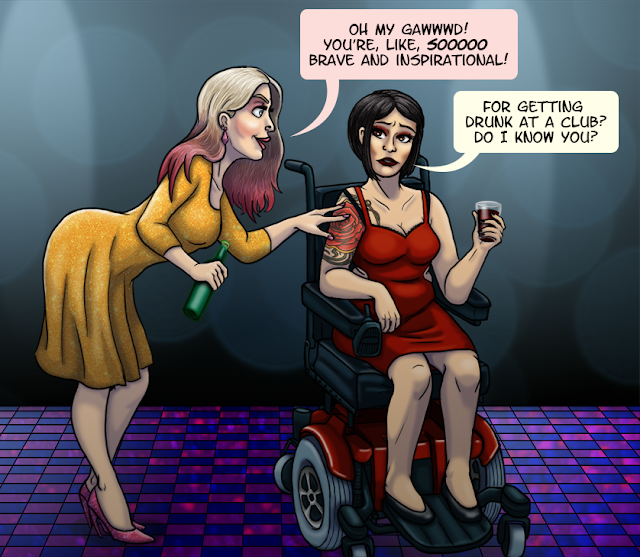
So often in fiction “curing” a disability is automatically seen as a good thing, because it’s just assumed that being able-bodied and neurotypical is the only way to have a happy, fulfilling life. And if a disabled person does seem happy? Then they’re considered some sort of inspirational martyr for the able-bodied to admire. Obviously this attitude is really freaking ableist and arrogant, as numerous disability advocates have pointed out. If a person with a disability would prefer to be rid of it, that’s an extremely personal decision, and not one intended to serve as a happy ending for the able-bodied and neurotypical. Basically, assuming everyone with a disability feels the same way about it is pretty shitty, as is acting like they can’t make their own decisions. And that’s what makes The Loney different, it’s not a typical “oh, the poor disabled person was cured by a miracle, now they can be happy!” fairy tail. Instead it’s a gothic horror story about how fucked up that attitude is, and how trying to “fix” someone without their knowledge or consent so they can serve as an inspirational story is seriously messed up. Of course, in this case it’s taken to an extreme where the parent’s misguided stubbornness results in the death, misery, and despair of a lot of people. Hanny makes it out more or less okay (albeit now suffering from some serious guilt he doesn’t understand), with his oblivious parents none the wiser, but the narrator becomes an unstable wreck with PTSD who stalks his brother until Hanny forces him in therapy. Essentially, The Loney is the antithesis of inspiration porn (yes, the link is safe for work, chill).

Two women are in a night club. A white woman in a glittery gold dress and blonde hair dyed pink at the bottom, is bending over to speak to an Asian woman in a motorized wheel chair. The woman in the wheel chair has goth makeup, a large tattoo of a red rose on her right arm, and is wearing a sexy red dress. The woman in gold tells the woman in red “Oh my gawwwwd? You’re, like, soooo brave and inspirtational!” The woman in red looks confused and asks “For getting drunk at a club? Do I know you?”

It’s actually because she ate two jumbo orders of nachos by herself, now that is truly inspirational. I should point out I have no idea what people wear at clubs, so one of them is a semi-goth chick, and the other looks like Jem.

The plot still drags though. Like, a lot. And Hurley uses the word “said” too much. Replied, snapped, exclaimed, responded, mused, just pick a different freaking word! Seriously, you’re an English teacher, use your thesaurus.  But while it wasn’t quite my cup of tea, I can still recommend it to people looking for a rich, gloomy story full of atmosphere and some truly messed up characters.

Navigation

Social Media

Search by Tags

To learn more about the Age Group, Diversity, and Genre tags, click here.

Age Groups

Diversity

Genre

Support the Blog

Search

Links

The House of Erzulie by Kirsten Imani Kasai

The House of Erzulie by Kirsten Imani Kasai

Formats: Print, audio, digital

Publisher: Shade Mountain Press

Genre: Gothic, Historic Horror, Myth and Folklore

Audience: Adult/Mature

Diversity: Black/biracial main characters and author, mentally ill main characters

Takes Place in: Philadelphia and New Orleans, USA

Content Warnings (Highlight to view): Alcohol Abuse, Animal Death, Body Shaming, Child Abuse, Child Death, Death, Drug Use/Abuse, Forced Captivity, Gaslighting, Illness, Kidnapping, Medical Torture/Abuse, Medical Procedures, Miscarriage, Mental Illness, Oppression, Pedophilia, Physical Abuse, Racism, Rape/Sexual Assault, Self-Harm, Sexism, Sexual Abuse, Slurs, Slut-Shaming, Torture, Verbal/Emotional Abuse, Violence, Xenophobia 

Blurb

The House of Erzulie tells the eerily intertwined stories of an ill-fated young couple in the 1850s and the troubled historian who discovers their writings in the present day. Emilie St. Ange, the daughter of a Creole slaveowning family in Louisiana, rebels against her parents’ values by embracing spiritualism, women’s rights, and the abolition of slavery. Isidore, her biracial, French-born husband, is an educated man who is horrified by the brutalities of plantation life and becomes unhinged by an obsessive affair with a notorious New Orleans voodou practitioner. Emilie’s and Isidore’s letters and journals are interspersed with sections narrated by Lydia Mueller, an architectural historian whose fragile mental health further deteriorates as she reads. Imbued with a sense of the uncanny and the surreal, The House of Erzulie also alludes to the very real horrors of slavery, and makes a significant contribution to the literature of the U.S. South, particularly the tradition of the African-American Gothic novel.

I received this product for free in return for providing an honest and unbiased review. I received no other compensation. I am disclosing this in accordance with the Federal Trade Commission’s 16 CFR, Part 255: Guides Concerning the Use of Endorsements and Testimonials in Advertising.

The House of Erzulie is an exquisitely written, thought-provoking work of Southern Gothic fiction that explores themes of identity, love, obsession, and oppression while blurring the line between reality and the supernatural. Kasai’s book also forced me to acknowledge and confront my own complicated feelings and insecurities about my identity as a light-skinned, biracial Black person and reflect on the colorism within the Black community.

Lydia is a professor of history trapped in a bad marriage with her former advisor Lance, a selfish, serial philanderer who prefers his women young, docile, and naive. Their teenage son is emotionally distant and rarely home. Struggling with depression and a desire to self-harm, Lydia tries to cope with her emotional pain and feelings of isolation by throwing herself into her job, the one area of her life that isn’t falling apart. Ironically, it’s her work, the last vestige of stability in Lydia’s life, that finally destroys her fragile mental health.

At first Lydia thinks nothing of the journals she receives in a packet of historical documents belonging to the once grand Bilodeau plantation in New Orleans. After all, she’s been hired to aid in the restoration of the dilapidated building, even if she finds the monument to slavery distasteful. It’s only on a whim that she chooses to peruse the diaries of Emilie Bilodeau, the progressive daughter of a slave-owning family, and her husband Isidore Saint-Ange, a free-born biracial Frenchman. But as she learns more about the tragic couple’s lives Lydia finds herself strongly empathizing with Emilie’s loneliness and crumbling marriage. But it is Isidore’s journal that finally pushes her over the edge. Once logical and purely scientific in his approach to the world, Isidore becomes increasingly paranoid as a series of poor decisions and bad luck destroy his life. Eventually succumbing to madness, Isidore is imprisoned in an insane asylum convinced he is the victim of supernatural forces. As her own life turns to chaos, Lydia finds herself mirroring Isidore’s destructive actions.

The House of Erzulie has all the elements of a first-rate Gothic story; a distressed heroine kept trapped and powerless. A passionate but ultimately doomed romance. Hints of the supernatural in the form of spirits, curses, and prophetic nightmares that may or may not be products of the antihero’s imagination. A once great home falling into ruin as disease, death, and madness ravage its inhabitants, all set against the backdrop of one of America’s greatest atrocities. Kasai is careful to emphasize how appalling and inhumane the practice of chattel slavery is without using a historical tragedy for cheap scares or trauma porn. Instead Isidore’s rapidly declining mental state reflected in the plantation’s decay and the multiple misfortunes befalling the Bilodeaus is what makes the novel so frightening. I must admit I found it incredibly satisfying to watch such unsympathetic characters suffer karmic retribution (Emilie being the exception) the more gruesome and agonizing the better though I’m sure not all readers will share my taste for schadenfreude. Kasai’s writing is superb, her carefully crafted prose flows like poetry and evoked strong emotions in me. I’ll share one of my favorite passages here:

They say “love is not a cup of sugar that gets used up” but it is. Spoonful by spoonful, grain by grain, the greedy, the needy, and the hungry consume it and demand more until the bowl is empty. Then they run away, jonesing for a fix from another source. Each betrayal, every insult or injury depletes the loving cup and leaves the holder bitter. It’s a bitterness I can taste, and it sits on my tongue like the foulest medicine.

Kasai also did extensive research for her novel, as is obvious from the story’s numerous references to historical events and the accuracy with which mid-19th century healthcare is depicted. The Spiritualist movement (which Kasai notes provided one of the few public platforms for women at the time), the yellow fever epidemic of 1853, and the anti-Spanish riots of 1851 all make appearances in The House of Erzulie. But it’s the lives of her gens de couleur libres, or “free people of color” characters that deserve special attention. While I was initially disappointed by how little attention the narrative paid to the stories and voices of the slaves, it was a nice change of pace to read a novel that focused on the lives of free Black characters. Despite the significant role they played in US history, wealthy, free Blacks in the antebellum South rarely make an appearance in historical fiction.

The majority of the novel is set in Louisiana, once home to the largest population of gens de couleur libres in the US. Forming an intermediate class below White colonizers but above slaves, free Blacks achieved more rights, wealth, and education in the French settlement than in any of the British colonies. Professor Amy R. Sumpter notes in her article Segregation of the Free People of Color and the Construction of Race in Antebellum New Orleans that before the state currently called Louisiana was stolen “acquired” by the US in 1803 “the cultural blending of French, Spanish, and African traditions… created an atmosphere of racial openness in Louisiana and particularly New Orleans that stood apart from much of the rest of the South. Aspects of the unique racial atmosphere included a tripartite racial structure and racial fluidity.” Much of this was due to the Code Noir, an edict originally issued by King Louis XIV in 1724 that defined the legal status of both slaves and free blacks and imposed regulations on slave ownership. While no less cruel and inhumane than any of the other laws governing the enslavement of human beings, the code did make allowances not found in the rest of country.

The US followed a strict “one drop” rule that classified anyone with Black ancestry as Black. Mixed raced individuals were given offensive labels depending on their percentage of “Black blood”. “Mulattos” were biracial with one Black parent and one White. “Quadroons” were a quarter Black, “octoroons”(also called “mustees”) one-eighth, and “quintroons” (or “mustefinos”) one-sixteenth. In her acclaimed essay Whiteness as Property civil rights professor Cheryl Harris explains that this complicated system was “designed to accomplish what mere observation could not: That even Blacks who did not look Black were kept in their place.” English colonies also practiced partus sequitur ventrem (Latin for “the offspring follows the womb”) a law that gave a child the same legal status as their mother. So a mixed-race child born to an enslaved mother would be born into slavery, while the child of a free woman would also be free.

An old daguerreotype photo depicting a light-skinned boy with European features. A large American flag is draped off to the left of the image, covering the floor and the stool the boy is sitting on. Under the photo the following has been typed: Freedom's Banner, CHARLEY, A Slave Boy from New Orleans.

Charley Taylor was the “quadroon” son of White slave-owner Alexander Scott Withers and a biracial slave named Lucy Taylor. Because his mother was a slave Charley was also born into slavery and sold by his father to a New Orleans plantation. Abolitionists often used images of White-passing slaves to elicit sympathy as White audiences were more likely to be identify with the suffering of people who looked like them.

Most of the main characters in The House of Eruzile are upper class gens de couleur libres all of whom approach their Blackness and privilege differently. Emilie’s father, Monsieur Bilodeau, is a willing and enthusiastic participant in the slave economy and chooses to idolize Whiteness, despite having a Black grandmother. It’s a sad fact that some free Blacks became slave owners themselves, and many of them lived in Louisiana. While I can’t pretend to know the motivations of long-dead men, Kasai makes it clear that M. Bilodeau does it because he’s greedy, racist scum, a twisted amalgamation of Uncle Tom and Simon Legree. Isidore is shocked and disgusted by the treatment of the slaves on his in-laws plantation (slavery would’ve just been abolished in France), but is unwilling to risk his own privilege and wealth by objecting or leaving. Well-educated and used to a comfortable existence Isidore married into the Bilodeau family so he could continue enjoying a life of leisure rather than be forced to get a job. He does his best to ignore the suffering of the plantation’s slaves, as if this will somehow absolve him of his participation in a racist and inhumane system. Emilie, on the other hand, uses what little power she has to advocate for her family’s slaves, including her great-great-aunt Clothilde (yup, her dad wouldn’t even free his own family-members) and becomes involved in the abolitionist movement. She does her best to try to convince her husband to move North and free the Bilodeau slaves once they inherit the plantation but is always shot down. Finally, there’s P’tite Marie, the light-skinned daughter of Marie Laveau, a free-woman with significant influence.

While Kasai is undoubtedly a talented writer, I was troubled by the way she portrayed P’tite Marie as a one-dimensional Jezebel who uses voodoo to literally enchant her lovers. Her characterization is in sharp contrast to Emilie’s role as the virtuous mother, bringing to mind the deeply problematic Madonna/whore dichotomy. P’tite Marie would certainly have been exploited by men who fetishized free Black women, as is evident from the stories of Quadroon Ballsplaçages and “fancy maids,” so implying that she is sort of succubus who takes advantage of men didn’t sit right with me. Admittedly, we only get to view P’tite Marie through the lens of an unreliable, misogynist narrator who is seemingly incapable of accepting responsibility for his own actions and who is quick to blame her for his philandering. Still, it would’ve been nice to learn more about P’tite Marie as a person rather than a sexual fantasy. Personally, I would have much preferred if P’tite Marie and Emilie had realized that all the men in their lives were awful and decide to run away together.

The house in the background is based on the Oak Alley Plantation in New Orleans. Now a museum, Oak Alley boasts tours of the facility, a beautiful venue for weddings and reunions, a well-reviewed restaurant, and overnight cottages. What could be more relaxing than sipping mint juleps at the site of significant human right’s abuses and suffering? Maybe Auschwitz should start doing weddings.

Emilie was another character I took issue with. I found her naivety grating rather than endearing, and it concerned me that the Whitest character in the book was written to be the most sympathetic. To Kasai’s credit she does a wonderful job creating a mixed-race Gothic heroine without making her a tragic mulatta. Emilie is still a tragic character, but none of that is related to her identity. She is not ashamed of being mixed and is astutely aware of her good fortune. She uses her privilege to help others and would gladly give up her wealth if it meant freedom for the Bilodeau’s slaves. Instead of lamenting the “single drop of midnight in her veins” Emilie’s greatest source of ignominy is her family’s arrogance and lack of empathy. As she matures, she begins pushing back more aggressively against the injustices she perceives. And yet, I still deeply disliked her. But more on that in a moment.

Emilie was not the only character that inspired a strong reaction from me. Lydia, like many mixed race folks, has a complicated relationship with the White grandparents who raised her, and her family problems resonated deeply with me. I don’t even know most of my White family, nor do I want to, as they’re racists who disowned my mother for marrying my Black father. My mother is amazing and dedicated to anti-racism work, but I feel nothing but contempt for the biological family that labeled me a “jigaboo baby.” Meanwhile Isidore and M. Bilodeau reminded me of the worse aspects of the mixed community; those who choose inaction, thereby becoming complicit in the system of White supremacy, and the self-hating Blacks who reject their race and actively promote racism and colorism to get ahead. I could easily imagine the reprehensible M. Bilodeau in a blue vein society wearing a “Make America Great Again” hat while defending voter suppression and laughing at racist jokes. Emilie’s father is clearly an irredeemable villain who has no qualms about abusing his slaves, while Isidore is given more complexity and a conscience. Unfortunately, his guilt has no effect on his actions, and I was hard-pressed to dredge up even a shred of sympathy for Isidore and his hypocrisy. This is a perfect example of why intent doesn’t matter. While Isidore may not be an unrepentant racist like his father-in-law both men selfishly used their privilege for their own benefit at the expense of other Black people. It’s hard to say if his inaction makes him more or less morally reprehensible that his monstrous father-in-law.

I suspect that the reason I felt so much animosity towards Emilie, even though Isidore and M. Bilodeau are much more reprehensible, may stem from my own experience and insecurities as a White-passing Black person. I struggle daily with the guilt and resentment I feel knowing that while I’m undoubtedly oppressed by a White supremacist system, it also gives me an unearned advantage over others. I, and others like me, enjoy higher wages and are perceived as more intelligent while those with darker skin are given longer prison sentences, are three times more likely to be suspended from school and struggle to find partners. My grandfather could join Black fraternities that implemented paper bag tests, and probably used his light complexion to secure jobs as a physician. His grandparents were house slaves (and the children of their owner) like the ones described by James Stirling in The Life of Plantation Field Hands and Malcom X in his Message to Grassroots speech. Not only am I treated better by Whites (who were responsible for this racist caste system in the first place) but even the black community puts a high-value on my pale skin. Colorism is so deeply ingrained in society that skin-whitening creams are a $20 billion industry. My Black grandmother used to keep my father and his sister out of the sun so they wouldn’t be “too dark.” There’s a #Teamlightskin hashtag on Twitter. A color-struck, light-skinned manager at Applebee’s called his darker skinned employee racist slurs and suggested he bleach his skin. My passing privilege (most people assume I’m Jewish, Italian or Latinx until I correct them) and proximity to Whiteness means I can easily avoid the racist aggression the rest of my family experiences on a daily basis.

This a fake graph, but it’s based on actual data.

Because Emilie is so White, I instinctively questioned whether she could even be considered Black, just as my own melanin-deficient skin often makes others question my identity. While I can easily dismiss comments of “you’re not really Black” from Whites who are pissed I told them not to say the n-word (I could be Whiter than Conan O’Brien and you still can’t fucking say it Karen), it’s a lot harder when the remarks come from other Black people who make it clear they don’t want me in their spaces. But as much as I’m tempted to self-indulgently sulk, I can’t ignore the very valid concerns of darker skinned Black folk who are frequently pushed aside in favor of people like me. Yes, I, and other light-skinned BIPOC may deal with frequent microaggressions and sometimes even outright hostility, but we’re still much more welcomed by a racist society then we would be if our skin were darker. Given all this it’s no wonder my intrusion on BIPOC spaces is often called into question. Yes, I have racial trauma, but is it right for me to complain to those who are clearly dealing with so much more? It would be like crying about having my purse stolen to someone whose had their home burnt down and lost everything. Denying that I have privilege is incredibly harmful to the Black community as are comments like “we’re all Black, why are we dividing ourselves even more?”  Tonya Pennington does an excellent job encapsulating my feelings on the matter in their article for The Black Youth Project:

…despite my empathy for [Ayesha Curry], I disagree with her conclusion for why she isn’t accepted by the Black community. Both of us are light-skinned, and we know light-skinned Black people are often considered more desirable than dark skin Black women because of colorism. As much as she may have been picked on for being “different,” like me, it’s inevitable that she also experienced a host of privileges both within and outside the Black community for the same thing.

To be clear, in my personal experience most other Black people have been extremely welcoming to me and are sympathetic to the unique challenges of being mixed race. I am eternally grateful to everyone who has shown me such support and compassion, even when dealing with their own problems. They didn’t need to, and it was incredibly kind. I try my best to avoid demanding pity, taking over conversations, or otherwise making things about me when I’m in Black spaces. To do otherwise would be reprehensible. I know I have it a lot easier that others, and it’s my responsibility to use my light-skinned privilege to combat systemic racism when I can.

As Afropunk writer Erin White explains “Light skin people have a responsibility to call out colorism and be honest about the privileges they benefit from.” Blogger Amanda Bonam, founder of The Black & Project even gives examples on how she confronts her own light-skinned privilege. Unfortunately, the best ways to oppose colorism isn’t always obvious, and even good intentions can be harmful if one isn’t cautious. Like all allies we walk a fine line, confronting colorism without speaking over those without light-skinned privilege. For instance, as a person with light-skinned privilege, I constantly worry that I’m either not doing enough, or else I’m so vocal that I’m silencing other Black voices. Like my “white-passing” guilt, I push these worries down because, again, it’s not about me and those emotions are unhelpful. But they still exist no matter how much I try to deny them, because that’s how feelings work. Which brings me back to Emilie, because in her I saw my own insecurities.

Mentally I condemned Emilie for what I saw as meager attempts to help the Bilodeau’s slaves, despite benefiting so much from colorism. When Emilie bemoaned the fact she couldn’t do more, I bristled at how she seemed to be selfishly focused on her own suffering. I cast her in the role of White savior whose negligible struggles and accomplishments were lauded above those of the Black characters. Except Emile isn’t White, at least she wouldn’t have been in 1850. Hypodescent rules would have meant she’d be labelled Black by society, and there was certainly no benefit to having a Black great-grandparent in antebellum Louisiana. And how much could she have possibly done to help the slaves? Emilie was a woman, with no power and her resources were completely controlled by the men in her life. When she spoke out she was ignored. She couldn’t purchase anyone’s freedom as Isidore had complete control of her finances. The laws were not on her side. Much of the novel’s focus is on Emilie’s feelings, but it’s also written as a diary, where she would have recorded her personal thoughts, struggles, and misgivings. There’s no indication she was putting her feelings over those of the slaves; to the contrary Emilie seems to hide her guilt and frustration from everyone save her White abolitionist friend.

So did I judge Emilie, Kasai’s heroine, unfairly because I projected so much of myself onto her? Or was I right to be critical of a light-skinned character who once again is given the spotlight over dark-skinned Black folk? As of now, that’s not an answer I can provide. Instead I encourage the reader to draw their own conclusions about Emilie. All I know is that any book that can provoke so much both emotionally and intellectually is well worth a read.

My Sweet Audrina by V.C. Andrews

My Sweet Audrina by V.C. Andrews

Formats: Print, audio, digital

Genre: Gothic Horror, Romance, Thriller

Audience: Adult/Mature

Diversity: Intellectual Disability, Possible Autism, Physical Disability (bilateral above the knee amputee), Chronic Illness (Osteogenesis imperfecta/brittle bone disease), PTSD

Takes Place in: Southern USA

Content Warnings (Highlight to view): Abelism, Alcohol Abuse, Body Shaming, Bullying, Implied Cannibalism, Child Abuse, Child Death, Childbirth, Death, Forced Captivity, Gaslighting,  Illness, Emotional Incest, Medical Torture/Abuse, Miscarriage, Mental Illness, Pedophilia, Physical Abuse, Racism, Rape/Sexual Assault, Implied Self-Harm, Sexism, Sexual Abuse, Slut Shaming, Suicide Attempt, Transphobia, Verbal/Emotional Abuse

Blurb

V.C. Andrews, author of the phenomenally successful Dollanganger series, has created a fascinating new cast of characters in this haunting story of love and deceit, innocence and betrayal, and the suffocating power of parental love.
Audrina Adare wanted so to be as good as her sister. She knew her father could not love her as he loved her sister. Her sister was so special, so perfect — and dead.
Now she will come face to face with the dangerous, terrifying secret that everyone knows. Everyone except…
My Sweet Audrina

Holy fuck, this book.

I’m curled up, holding my knees to my chest, and looking shell shocked. My right eye is twitching. “WTF” I ask as I stare into the void.

This book is definitely the winner of the OMGWTFBBQ award

If you’re unfamiliar with V. C. Andrews, she wrote gothic horror novels during the eighties about really messed up, toxic, abusive, families that Lifetime loves to turn into terrible made-for-TV movies.  A standard Andrews book usually contains gas lighting, emotional and physical abuse, dark family secrets, and some of the most fucked up relationships ever put to paper that run the gambit from pedophilia to incest. Imagine if all guests on the Jerry Springer show were rich, beautiful, gothic heroines with enough skeletons in their closets to start their own ossuary, and you’ll have an idea of what you’re in for. They’re trash novels, but in the best possible way, written by a talented author who knows her audience is looking to be shocked and horrified, like splatterpunk without the gore. Her stories may be ridiculous and over-the-top at times, but never, ever dull, and of all her fucked up books, My Sweet Audrina is probably her most fucked up. It manages to contain nearly every content warning I have that doesn’t involve blood and gore (although there is a rather grisly scene where a woman miscarries and throws one of the blood clots at her mother in a fit of rage). There’s a brutal child rape, a lot of abuse by a manipulative bastard, everyone messing with Audrina’s mind, and a dead aunt who may or may not have been eaten by cannibals, so be forewarned, My Sweet Audrina is not for the squeamish.

Damian Adere, the family patriarch, is aptly named because the guy is just fucking evil. He’s greedy, immature, vain, sexist, lazy, abusive, controlling, narcissistic, and manages to destroy the lives of every woman he knows while still seeing himself  as the victim because he’s just that fucking self-centered. Yet, he continues to get away with his awful behavior because he’s handsome, charming, and extremely manipulative, which honestly makes him even more frightening. In the first few chapters he comes off as kind of a dick but still likable. His daughter, Audrina, who acts as the book’s narrator, still loves and respects him. But over the course of the story as we witness his true nature, Damian quickly goes from seemingly well-intentioned but misguided, to a full-blown asshole, then finally becomes Satan incarnate. In fact, I’m still not entirely convinced this isn’t some sort of sequel to The Omen where the Anti-Christ kid grows up to become a lazy, whiny, codependent, narcissistic asshat who gets married and lives in a dilapidated mansion that he never lets his daughter leave. Actually, comparing Damian to Satan seems unfair because even the Dark Lord isn’t that big of a flaming dick. I can just imagine the devil reading My Sweet Audrina and being utterly horrified. The other characters, save for our virtuous heroine, Audrina, aren’t a whole lot better, although a lot of their behavior can be more or less attributed to Damian’s abuse.

Satan is leaning back in his creepy dragon chair reading “My Sweet Audrina”. He has red skin, black horns, bat wings, furry goat legs, a goatee, and well-defined abs. The image is dark, and lit from below. Satan has a finger to his temple and comments “Wow, this guy is a DICK” (referring to Damian).

I just assume Satan is ripped

Audrina’s mother, Lucietta, had to give up her dream of becoming a concert pianist to marry Damian (because he didn’t want his wife to make more money than him), and now hides her misery by living in denial and drinking to numb the pain. She frequently lashes out at her sister, Ellsbeth, who has become bitter (again, thanks to Damian) and abusive, neglecting her own daughter, Vera. In turn, Vera has turned into a complete monster before the start of the book because nobody loves her and Damian (whom she sees as her father) constantly treats her like shit and compares her to his “perfect” daughter, Audrina. As horrible as Vera is (and she’s pretty fucking horrible), you can’t help but feel sorry for her. She’s forced to be the whore to Audrina’s virgin, which makes her hate and resents her cousin. She’s so desperate for love and attention that 14-year-old Vera has “sex” with an adult man (everyone acts like it’s consensual sex when it’s very clearly statutory rape), and acts seductively from a young age. Of course none of the adults think “Hey, this isn’t normal behavior for a child, maybe we should get her some help” they just decided “She’s just a slut, oh well, who cares.” Meanwhile Audrina is haunted by memories of a childhood rape, which her father keeps forcing her to remember in a sick attempt to make her “perfect” (I’m not even going to try and explain Damian’s troll logic on this one). He reinforces her role as the virgin by frequently telling his daughter that all men are evil and forcing her to cover up in old fashioned dresses lest she be attacked. Is it any wonder Audrina becomes terrified of sex and disgusted by nudity to the point that she can’t even be intimate with someone she loves without trauma? Of course Damian is totally fine with this because it means she’s less likely to have a relationship with any man that isn’t him. If that makes your skin crawl, well, it should, because even Audrina describes their relationship as being like husband and wife without the sex. Ew. At least there isn’t any actual incest like I was fearing, which is a first for a V C Andrews novel.

Even Lucietta isn’t safe from her husband’s slut shaming, as Damian flies into a rage if her outfits are too revealing and accuses her of flirting with the men at the parties he forces her to host. He wants to show off his pretty wife, but then gets ridiculously jealous when other men think she’s pretty and ends up throwing a tantrum. He loves to be surrounded by women who adore him, but doesn’t want to share, so everyone is essentially trapped in this giant, run down house where Damian can keep an eye on them, isolated from the rest of the world. Like I said, the dude is fucking evil, and doesn’t even realize it. Or maybe he does, but simply doesn’t give a shit. Basically, if there was a drinking game where you had to take a shot every time Damien pulls a dick move, no one would ever finish the book because they’d die from alcohol poisoning after a few chapters.

Now, you’re probably wondering where the diversity comes in. I chose this book because of its representation of disability which, while not ideal (especially in Sylvia’s case), was at least written by an author who herself had a physical disability for most of her life. As a teenager, Andrews developed severe arthritis and underwent multiple spinal surgeries to treat it. Andrews says this was the result of a back injury she sustained from falling on a staircase in high school, while her family claims it was something she was born with. Regardless, the resulting chronic pain required the use of a wheelchair or crutches for most of her life. Andrews lived at home, under the care of her mother, where she completed a four-year correspondence course in art, before starting her career as a writer. Her very first book, Flowers in the Attic, is about four children who are kept in the attic for years by their religious grandmother, and the toll it takes on their mental and physical well-being. Andrews said in a 1985 interview for Faces of Fear that Flowers in the Attic was based on her own feelings of frustration at being trapped at home. While accessibility for people with mobility issues still isn’t great, I can imagine it was even worse when Andrews was growing up, and she died four years prior to the passing of the Americans with Disabilities Act. This theme of feeling “trapped” continues in My Sweet Audrina, where five of the six women in the story have some kind of disability that limits their freedom, which Damien of course takes full advantage of. Even the stairs that may or may not have been the start of Andrews’ chronic pain and limited mobility feature prominently in the book. The Adere house’s staircase essentially goes on a killing spree, offing multiple family members to the point where I have to wonder if the stairs were constructed from the bones of murdered children and cursed relics. Or maybe it’s just haunted by all the ghosts of the people Damien pissed off (which I can only imagine is every person he’s ever met). Andrews’ representation of disability is definitely problematic, but also complex and extremely personal, which is what makes this story worth exploring. It’s one of the few horror novels I’ve been able to find about disability that was actually written by a disabled person.

Vera has brittle bone disease, frequently breaking an arm or leg at the slightest bump. Audrina’s younger sister, Sylvia has autism and/or an intellectual disability (it’s not handled or explained well by Andrews) that requires full time care. Lucietta seems to have a heart disease that limits her activity. Billie, the Adere’s neighbor and one of the few likable characters in the book, is a bilateral amputee following complications from diabetes. Then there’s Audrina, whose untreated PTSD leaves her too terrified to leave her yard, even though she desperately wants to go to school and have friends. Audrina is sort of a Mary Sue for Andrews, what with her violet eyes, magically color changing hair, and extraordinary beauty (seriously, WTF?). They’re both artistic, unable to leave the house, and need to rely heavily on their families to function which causes them great frustration. The depictions of women with disabilities in My Sweet Audrina aren’t particularly progressive, and can even be downright ablest at time (especially when it comes to Sylvia), but the characters are all unique with very different personalities, outlooks, and ways of dealing with their disabilities.

I’m drawing a picture of Audrina. The first panel shows a stereotypically attractive woman in a white, conservative, Victorian dress. She has large, sparkly, violet eyes, and long rainbow hair that starts as red at her scalp, and moves down the spectrum to indigo and violet at the ends of her hair. In the second panel I’m looking at my creation with horror and ask, “The fuck did I just draw?” I’m wearing a purple shirt with bats that says “spoopy” in violet glitter.

What Audrina looks like, presumable. Unrelated, but I wish I had that Spoopy shirt in real life.

Audrina desperately wishes for freedom and is frustrated by her PTSD, but without proper help and treatment she struggles to deal with her trauma (thanks a fucking lot, Damien). She does try to force herself to “get over it” a few times, and it doesn’t go well. Vera, on the other hand, seems proud of her disability, bragging about her delicate bones and teasing Audrina for having “peasant bones”, though it’s most likely an act to make herself feel better. Vera will frequently play up her disability to get out of doing chores, and even purposely hurt herself for attention, even though her mother and Damien seem fairy unconcerned by her injuries. Billie, on the other hand, is ashamed of her residual limbs, and goes to great effort to hide them. Her husband left her after her legs were amputated, and she now sees herself as “damaged” and “unlovable” despite being drop-dead gorgeous and able to function just fine with the use of a wheeled board. Although Billie continues to live her life and seems pretty happy for the most part, she’s still incredibly insecure, making her an easy target for Damien. Finally there’s Sylvia, the youngest Adare daughter, who gets ignored and insulted by pretty much everyone except Audrina, her appointed caretaker. Because why would Damien get actual help when he can just make Audrina play Occupational Therapist for free? And then everyone seems ~shocked~ that Sylvia’s not making much progress when she has a child (who only just started going to school herself) as her teacher. At least Sylvia gets some revenge on her awful family. It’s never outright confirmed, but is strongly implied that she knows more than she lets on and allows people to underestimate her abilities so she can better manipulate them (and occasionally possibly murder them). Part of me really hopes Sylvia is knowingly screwing with everyone as a sort of “fuck you” to her neurotypical family who constantly calls her really ableist slurs and compare her to an animal, because they really fucking deserve it. Now if only she’d arrange for Damien to have a little accident….

My Sweet Audrina is a combination of exploitation horror and chick lit, meant to grab your attention from the first paragraph and brand its shocking subject manner deep into your brain so that years from now you’ll still be thinking “God, that was a fucked up book.” And if you’re wondering why I would inflict this on myself, well, A) Because I’m a horror fan, that’s kind of what I do, and B) It’s just so damn enjoyable. It’s a wonderful guilty pleasure I couldn’t put down until the end, and Andrews is a talented writer who is fully aware of what she’s creating. So what if the story can sometimes read like Soap Opera fan fiction written by a fourteen-year-old?  My Sweet Audrina is especially interesting when viewed as a personal exploration of the author’s feelings of being “trapped’ by her chronic pain and mobility issues.  For fans of tragic heroines, gothic horror, and guilty pleasures, I’d definitely recommend My Sweet Audrina.

The Loney by Andrew Michael Hurley

The Loney by Andrew Michael Hurley

Formats: Print, audio, digital

Publisher: Houghton Mifflin Harcourt

Genre: Gothic, Folk Horror, Psychological Horror, Mystery

Audience: Adult/Mature

Diversity: Disability (Speech Disorder – muteness, Cognitive/Learning Disability, PTSD)

Takes Place in: Lancashire, UK

Content Warnings (Highlight to view): Abelism, Alcohol Abuse, Animal Death, Bullying, Child Abuse, Child Death, Child Endangerment, Death, Racism, Forced Captivity, Gaslighting, Gore, Homophobia, Illness, Medical Torture/Abuse, Medical Procedures, Mental Illness, Physical Abuse, Racism, Slurs, Suicide, Verbal/Emotional Abuse, Violence

Blurb

When the remains of a young child are discovered during a winter storm on a stretch of the bleak Lancashire coastline known as the Loney, a man named Smith is forced to confront the terrifying and mysterious events that occurred forty years earlier when he visited the place as a boy. At that time, his devoutly Catholic mother was determined to find healing for Hanny, his disabled older brother. And so the family, along with members of their parish, embarked on an Easter pilgrimage to an ancient shrine.

But not all of the locals were pleased to see visitors in the area. And when the two brothers found their lives entangling with a glamorous couple staying at a nearby house, they became involved in more troubling rites. Smith feels he is the only one to know the truth, and he must bear the burden of his knowledge, no matter what the cost. Proclaimed a “modern classic” by the Sunday Telegraph (UK), The Loney marks the arrival of an important new voice in fiction.

Autumn is normally considered the season for all things horror, due to holidays like Samhain, All Hallows’ Eve/Halloween, and the Day of the Dead in Europe and the Americas, but the other seasons have their own share of scary stories and traditions. Summer is perfect for slasher flicks, spooky stories by the campfire, and the Ghost Festival is celebrated in East and Southeast Asia. The long, dark nights of winter inspired the Victorians to tell ghost stories and Algonquin-speaking people associated the season with the cannibalistic monsters. But spring, generally associated with new life, rebirth, flowers, and cute baby animals in the Northern Hemisphere, is the odd one out. Other than Bram Stoker’s famous short story, Dracula’s Guest, which takes place on Walpurgis NightThe Loney is the probably the only scary story I’ve ever read set during the Spring.

The first image is of a Jack-o-Lantern on a bed of autumn leaves, surrounded by candles, marigolds, soul cakes, and a sugar skull. It says “creepy”. Next is a snowy night in a pine forest, with a full moon and a wendigo that says “scary”. The third says “spooky” and depicts an offering of oranges, joss paper, incense and red candles, with little ghost is surrounded by Hitodama. The final image is of two birds snuggling on a spring day with butterflies and cherry blossoms. It says, “Not really that scary.”

I mean, I guess if you’re scared of flowers and baby animals Spring might be scary….

The Loney was written by an English Teacher, and boy does it show. It’s overflowing with symbolism, deeply complicated characters, religious imagery, and all the other stuff that gets pretentious professors all hot and bothered. This is the kind of book that lends itself well to long, dry, dissertations about death and rebirth, or some other equally clichéd thesis, like how everything is a metaphor for sex. Not that any of this is bad, mind you, just don’t expect a classic horror story so much as a coming-of-age character exploration set in a gloomy, shit hole town that leaves you feeling creeped out and disturbed. There’s a lot more focus on the environment and characters than there is on the actual story (or lack thereof). It reminds me of one of those artsy games with no plot or clear goals where you just wander around and explore the gorgeous environment, like The Path (the game,  not the TV series). Which, again, isn’t a bad thing if you’re into walking simulators, but I miss having a three act story structure, and a build up of suspense. So my reaction to The Loney was along the lines of “bored, bored, bored, do something already, wow that’s creepy, damn these people are messed up, bored, bored, is something going to happen now or what, so borrrreeed, stop talking for fuck’s sake, bored, HOLY SHIT WTF OMG, oh, well I guess that’s the end.” And then I was left wondering what the fuck I had just read.

While the pointless milling about can get tedious (really, REALLY tedious), it’s still an entertaining and creepy book. I wouldn’t exactly call it horror, since The Loney isn’t scary per se, but it is definitely disturbing. There are still a few of the standard horror “shock value” scenes you’d expect, y’know, the kind where any person with common sense would take it as an obvious sign to turn the fuck around because it’s clear they just stumbled into some Blair Witch, demonic serial killer, Eldritch abomination crap? But most of the creepiness comes from the irrational religious fervor of the adults (except, ironically, the priest), and their disturbing obsession with “curing” the unnamed protagonist’s disabled brother, Hanny. Not for his own benefit, since he seems perfectly happy as is, and could probably function on his own just fine if given a chance, but as part of some selfish desire to see a miracle and be closer to God.

Now here’s the thing about being a disabled person in horror fiction, you can come in one of three flavors. You can either be a victim (Audrey Hepburn in Wait Until Dark, the mute woman in The Tingler, Mark from Friday the 13th Part 2), the “psycho” (pretty much every movie killer ever, because mental illness apparently makes you evil), or some sort of disabled version of the “magical negro” trope (the little girl from the Langoliers, “Duddits” from Dreamcatcher, Tom Cullen from The Stand, and every other disabled person in a Steven King novel). But Hanny doesn’t seem to fall into any of these groups. He’s certainly not helpless, a monster, or “magical”, despite what those around him may think. For example, late in the book Hanny manages to uncover and successfully load a rifle (despite having little to no experience doing so), sneak out of the house by muffling his foot steps on a blanket and bribing the dog with treats, then find his way across dangerous terrain in the middle of the night. And when the narrator tries to follow him? He ends up almost drowning, and Hanny has to save his pathetic butt. Hell, I can barely find the bathroom in my own house without turning the light on, much less load a gun in the dark and go for a night hike in the English equivalent of Lovecraft country. But despite being able to do things military personnel take months to learn, Hanny is still considered “helpless” by those around him because he has a learning disability and doesn’t communicate in a way anyone else has bothered to learn. And he CAN communicate. Hanny is clearly shown using hand gestures and objects to try and communicate his emotions and desires, but is mostly ignored by everyone, save his brother, who apparently can’t wrap their brains around the concept of non-verbal communication. The priest, probably the only moral, well adjusted adult in the whole story, is also the only person to question if Hanny even wants to be cured. Like, he would literally have been fine if someone had just thought to equip him with an Alternative and Augmentative Commination system. But no, they want a miracle, they want Hanny to give it to them, screw what he wants or needs. And that’s pretty much how everything goes to shit. Because most of the characters in the story can’t seem to comprehend that anyone outside their narrow view of normal could possible be happy. The narrator describes how determined his mother and her church buddies are to reject anyone different, like a fundamentalist Catholic version of Mean Girls.

An older, WASP-y woman in a houndstooth jacket is talking to her son (Hanny), who is wearing a sweater-vest and holding up a sign that says, “This place is evil and we need to leave NOW”. His mother is smiling indulgently and says, “I’m so sorry dear, I just don’t understand what you’re trying to tell me.” Hanny looks annoyed and is rolling his eyes.

Hanny has to put up with so much crap from his neurotypical family

So often in fiction “curing” a disability is automatically seen as a good thing, because it’s just assumed that being able-bodied and neurotypical is the only way to have a happy, fulfilling life. And if a disabled person does seem happy? Then they’re considered some sort of inspirational martyr for the able-bodied to admire. Obviously this attitude is really freaking ableist and arrogant, as numerous disability advocates have pointed out. If a person with a disability would prefer to be rid of it, that’s an extremely personal decision, and not one intended to serve as a happy ending for the able-bodied and neurotypical. Basically, assuming everyone with a disability feels the same way about it is pretty shitty, as is acting like they can’t make their own decisions. And that’s what makes The Loney different, it’s not a typical “oh, the poor disabled person was cured by a miracle, now they can be happy!” fairy tail. Instead it’s a gothic horror story about how fucked up that attitude is, and how trying to “fix” someone without their knowledge or consent so they can serve as an inspirational story is seriously messed up. Of course, in this case it’s taken to an extreme where the parent’s misguided stubbornness results in the death, misery, and despair of a lot of people. Hanny makes it out more or less okay (albeit now suffering from some serious guilt he doesn’t understand), with his oblivious parents none the wiser, but the narrator becomes an unstable wreck with PTSD who stalks his brother until Hanny forces him in therapy. Essentially, The Loney is the antithesis of inspiration porn (yes, the link is safe for work, chill).

Two women are in a night club. A white woman in a glittery gold dress and blonde hair dyed pink at the bottom, is bending over to speak to an Asian woman in a motorized wheel chair. The woman in the wheel chair has goth makeup, a large tattoo of a red rose on her right arm, and is wearing a sexy red dress. The woman in gold tells the woman in red “Oh my gawwwwd? You’re, like, soooo brave and inspirtational!” The woman in red looks confused and asks “For getting drunk at a club? Do I know you?”

It’s actually because she ate two jumbo orders of nachos by herself, now that is truly inspirational. I should point out I have no idea what people wear at clubs, so one of them is a semi-goth chick, and the other looks like Jem.

The plot still drags though. Like, a lot. And Hurley uses the word “said” too much. Replied, snapped, exclaimed, responded, mused, just pick a different freaking word! Seriously, you’re an English teacher, use your thesaurus.  But while it wasn’t quite my cup of tea, I can still recommend it to people looking for a rich, gloomy story full of atmosphere and some truly messed up characters.

Navigation

Social Media

Search by Tags

To learn more about the Age Group, Diversity, and Genre tags, click here.

Age Groups

Diversity

Genre

Support the Blog

Search

Links