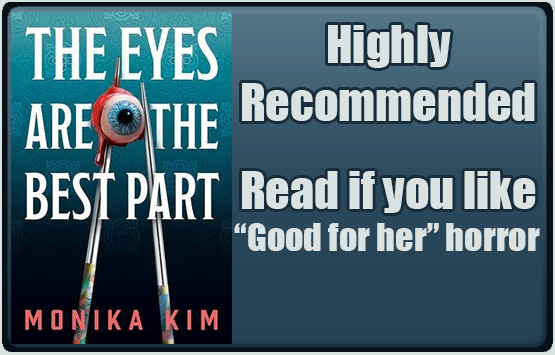
The Eyes Are the Best Part by Monika Kim

The Eyes Are the Best Part by Monika Kim

Formats: Print, audio, digital

Publisher: Erewhon Books

Genre: Psychological Horror

Audience: Adult/Mature

Diversity: Korean-American author, main character, and side characters, Black side character

Takes Place in: LA, California

Content Warnings (Highlight to view): Alcohol Abuse, Cannibalism, Death, Forced Captivity, Gaslighting, Gore, Medical Procedures, Mental Illness, Racism, Sexism, Slurs, Slut-Shaming, Violence, Vomit, Xenophobia

Blurb

Ji-won’s life tumbles into disarray in the wake of her Appa’s extramarital affair and subsequent departure. Her mother, distraught. Her younger sister, hurt and confused. Her college freshman grades, failing. Her dreams, horrifying… yet enticing.

In them, Ji-won walks through bloody rooms full of eyes. Succulent blue eyes. Salivatingly blue eyes. Eyes the same shape and shade as George’s, who is Umma’s obnoxious new boyfriend. George has already overstayed his welcome in her family’s claustrophobic apartment. He brags about his puffed-up consulting job, ogles Asian waitresses while dining out, and acts condescending toward Ji-won and her sister as if he deserves all of Umma’s fawning adoration. No, George doesn’t deserve anything from her family. Ji-won will make sure of that.

For no matter how many victims accumulate around her campus or how many people she must deceive and manipulate, Ji-won’s hunger and her rage deserve to be sated.

A brilliantly inventive, subversive novel about a young woman unraveling, Monika Kim’s The Eyes Are the Best Part is a story of a family falling apart and trying to find their way back to each other, marking a bold new voice in horror that will leave readers mesmerized and craving more.

Out of all the types of trauma and injuries the human body can suffer, eye trauma makes me the most squeamish. They’re so soft and vulnerable; whenever I know an eye injury is about to happen in a horror movie, I watch the scene through my fingers. The infamous eye scene in Zombi 2 still makes me squirm. So, I knew a story that centered around ripping out eyes and consuming them would be especially horrific. Interestingly, the book isn’t especially violent. There are only two scenes with any significant amount of blood, though ironically the stabbing and bludgeoning is less disturbing than the scenes of eye trauma and cannibalism (which have comparatively little gore).

After Ji-won Lim’s Appa (Korean for dad) abandons his wife and two daughters their Umma (the Korean word for mom) is completely inconsolable. Despite being a faithful and devoted wife, he still leaves her for another woman. She haunts the entrance to their apartment, hoping he will come back and saying she wants to die without him. It’s at that moment Ji-won realizes their roles are reversed. She has become the mother and Umma the daughter; it’s now Ji-won’s responsibility to take care of her little family.

When Umma was little, her parents left their children to search for work. Her other siblings decided to follow, afraid they would starve to death before their parents returned. But Umma refused to leave their home and instead waited for her parents to return, living off bark and snow throughout the harsh winter. When her family finally returned the following summer, they found her skeletal and delirious. Her older brother mistook her for a ghost.

To Ji-won, her mother’s decision to remain behind seems foolish and naive. She feels frustrated by what she sees as Umma’s stupidity and thinks she’s pathetic for spending her life making herself small and inconspicuous to men. But she also pities how every part of Umma’s life is characterized by suffering and relates to the fact that her mother is always alone. Ji-won is feeling abandoned, not just by her Appa but also her high school friends who all got into Berkeley when she didn’t.  Their loneliness makes both women particularly vulnerable to predatory men. Umma begins dating George, a white man with striking blue eyes. He says he speaks Korean, but is terrible at it and his pronunciation is awful. He clearly fetishizes Asian women as is clear when he leers at a Chinese waitress and later at Ji-won’s chest, makes gross sexual comments to Ji-won and her younger, underage sister Ji-hyun, and goes on trips to Thailand to sleep with the women there.

He also gets mad when they have a white waitress at a Chinese restaurant because he wants to experience “culture,” even though the restaurant is anything but authentic (it’s called Wok and Roll for crying out loud). George has a truck with a bumper sticker that says “I’m a Republican because we can’t all be on welfare,” complains loudly about how kids these days are “too soft” and “easily offended,” and reminiscences about “the good old days.” Essentially, he’s a loud, mediocre, abrasive white man who is thoroughly convinced of his own superiority. Understandably, the sisters can’t stand George, and they both resent Umma for bringing him into their lives, but the conflict averse Ji-won refuses to say anything about it.

Meanwhile, Ji-won befriends a boy in her class who seems like George’s polar opposite. Geoffrey presents himself as an ally. He takes women’s studies, wears “Nevertheless she Persisted” and Ruth Bader Ginsburg t-shirts, reads Ngozi Adichie’s We Should All be Feminists, and is horrified when a group of frat bros at their school say disgusting things about Asian women in front of Ji-won. Ji-won immediately likes Geoffrey and really wants to be his friend. She’s impressed by his intellect and his knowledge of the world. She believes they “get” each other and she doesn’t need her old friends anymore because she has Geoffrey now. But slowly red flags start to pop up. Geoffrey gets extremely jealous when Ji-won spends any time with her new friend (and possible crush) Alexis. At first Ji-won excuses this, thinking he’s just insecure and possessive of his friends like she is. Even when he snatches her phone out of her pocket to get her phone number, acts clingy, or pushes her to do things even after she’s said no, Ji-won continues to ignore his toxic behavior. She doesn’t realize Geoffrey is arrogant, loud, self-absorbed, and rude, just like George. His quips about feminism are just showing off, trying to make himself seem better than other men. He claims he’s an ally because he’s read about oppression, yet still gives Ji-won a thoughtless, racist gift for Christmas. George and Geoffrey are merely two sides of the same coin.

After Appa’s abandonment, the frat boys at her school saying disgusting about Asian women, George invading their life and being horrible, and Geoffrey’s face heel turn, Ji-won is boiling over with barely suppressed rage. Things come to a head when George wakes her from a nightmare and she quickly turns her anger on him and starts cussing him out. She apologizes for Umma’s sake, but the outburst has awoken something in Ji-won. Up until this point Ji-hyun has been begging her Unni (Korean for older sister, an honorific used by younger women to refer to older women) to do something about George and is frustrated by her inaction. Now Ji-hyun notices something is off about Ji-won and starts to worry about her, despite her sister’s insistence that she’s fine. Ji-won is a well-crafted, sympathetic anti-villain who focuses her anger on the toxic men who have wronged her. She cares deeply for her little sister, Ji-hyun, and her Umma, while still finding them frustrating (something I’m sure many daughters will relate to).

She’s also incredibly manipulative, cowardly, jealous, and unable to deal with her emotions in a healthy and mature way. Feeling betrayed that her friends are all going to Berkley, Ji-won hides an heirloom ring then blames one of her friends for stealing it. She continues to try and sabotage their relationships by sending texts pretending to be her other friends or their crushes because she’s upset that they’re “abandoning” her. When her friends finally figure out what she’s doing and try to have a calm conversation about how she hurt them, Ji-won shuts them down and leaves abruptly because she feels like she can’t face what she did. She doesn’t interact with them again for the rest of the story.

Later, Ji-won fucks with George the same way she did with her friends. Because he’s so convinced of his own self-importance and superiority, he’s easily manipulated by a “Oriental girl” he sees as beneath him. She starts by stealing money from his wallet, hiding his keys, and putting his driver’s license down the garbage disposal. Her “pranks” escalate and she destroys his most prized possession, the expensive Rolex his father gave him, and even gets him fired from his job, all why playing innocent. I love that she’s imperfect and gets to do bad things. I’ve mentioned it before, but imperfect, morally gray, sometimes villainous characters are my favorite! There’s too much of a push for protagonists to be perfect and heroic, but too often it leads to dull characters, in my humble opinion, at least. As horrified as I am at some of Ji-won’s behavior, I still love her as a character, and it thrills me that she gets to live out her (and I imagine many other Asian women’s) revenge fantasy.

I’ve touched before on how white men tend to fetishize Asian women and how harmful it is. As Nancy Wang Yuen, a sociologist and author of “Reel Inequality” told USA Today “The idea that Asian women are desirable and exotic and passive isn’t just an innocent stereotype or a desirable trait to envy. The shadowed side of that is they then become targets of hate, sexual violence and physical violence when they aren’t perceived as fully human and deserving of rights to be safe.” Media representation unfortunately only reenforces harmful hypersexualization of Asian women.

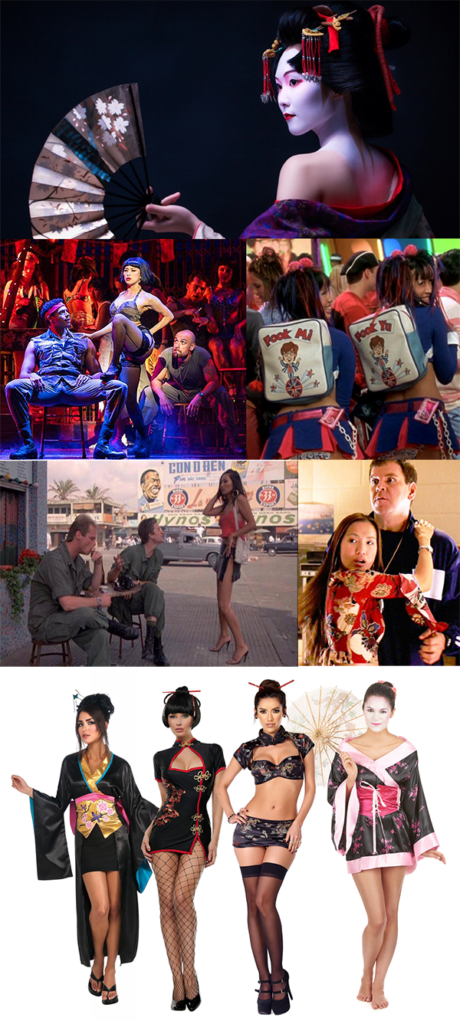
Top: Cio-Cio-San from a 2019 production of Madama Butterfly at the San Carlo Theater in Naples. Second row: (left) Gigi from the musical Miss Saigon (right), Fook Mi and Fook Yu from Austin Powers. Third row: (left) a Vietnamese sex worker propositioning Joker and Rafterman from the film Full Metal Jacket (right), Trang Pak hooking up with Coach Carr from film Mean Girls. Fourth Row: a series of sexy costumes loosely inspired by Chinese and Japanese clothing modeled by white women in “yellow face.”


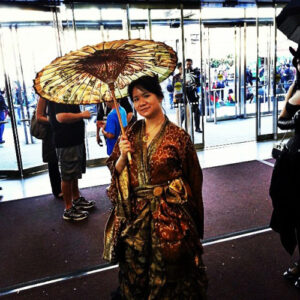
One of the editors for this book, and my personal friend, Diana Pho, wrote this piece about being fetishized and harassed as a Vietnamese-American woman during an interview at New York Comic Con back in 2013. Diana was there to host a panel on representation in comics and had donned one of her Asian inspired steampunk outfits and was carrying a parasol. She was approached by a group of white men asking her to do an interview for a “TV show”. Though hesitant, Diana agreed. The interviewer (who she would later learn was Mike Babchik from the now defunct Man Banter) immediately started making sexist and racist comments (you can read a full account of the incident here).

Mike Babchik: So, if I were walking in the rain, could I pay you to walk next to me with your umbrella?

Diana Pho: Pay me?

Mike: If I paid you?

Diana: Then, buy your own umbrella.

Mike: No, I want to buy an umbrella with an Asian girl.

Diana: Then no.

It got even grosser from there.

Mike: Well in my experience, girls who stand next to me longer than 20 seconds get a cream pie.

Diana: I would give you a slap in the face.

Mike: (backing away) Really? Would you?

He then scurried off. As white men tend to do, Man Banter had completely underestimated Diana. They were expecting a weak, submissive, Asian girl who would giggle at their crude remarks, but what they got was a fight from a woman who wasn’t about to put up with their racism and sexual harassment. She told her story, and it wasn’t long before outlets like The Daily Dot18 Million Rising, and The Mary Sue all picked up the story. A petition was started to have Mike Babchik’s employer hold him responsible for the harassment. One of the employees from Man Banter sent Diana an apology on Tumblr, and promised to delete the so-called interview and agreed not to return to NYCC (though it sounds like the con was planning to ban them after Diana reported the incident to them). Diana mentioned that while she was angry that this happened to her, she was even more upset that this could be potentially happening to young women and underage girls who didn’t have the same resources, support, or confidence to call them out (I know I certainly wouldn’t have felt comfortable standing up to an adult when I was a teenager). For every Diana there are thousands of other Asian women who don’t get to tell their story. Women whose valid concerns are dismissed as “overreacting,” are shamed into believing it’s their fault, and that they should keep quiet about their experiences.

Diana Pho at New York Comic Con in 2013

The Eyes Are the Best Part is a slow-burn psychological horror story. I was half way through the book and wondering if perhaps I had picked up a thriller by mistake, when things started to get bloody and wild. It’s a suspenseful read, made even more tense by Ji-won’s deteriorating mental state and fraught relationships. The atmosphere is oppressive and claustrophobic, with the tiny, cramped apartment the family shares emphasizing Ji-won’s feeling of being trapped. Kim’s writing is as precise as a surgeon’s blade, gradually becoming more chaotic as Ji-won’s mind begins to unravel. There isn’t a page or paragraph wasted on filler or pointless details. Every line of the book carries meaning and weight.

American Ghoul by Michelle McGill-Vargas

American Ghoul by Michelle McGill-Vargas

Formats: Print, audio, digital

Publisher: Blackstone Publishing, Inc

Genre: Historic Horror, Vampire

Audience: Adult/Mature

Diversity: Black main character, Black side characters, Black/Native side character, Black author

Takes Place in: Georgia and Indiana

Content Warnings (Highlight to view): Alcohol Abuse, Child Abuse, Child Death, Death, Drug Use/Abuse, Forced Captivity, Oppression, Pedophilia, Police Harassment, Physical Abuse, Racism, Self-Harm, Slurs, Suicide, Verbal/Emotional Abuse, Violence, Vomit, Xenophobia

Blurb

You can’t kill someone already dead.

That’s what Lavinia keeps telling her jailer after—allegedly—killing her mistress, Simone Arceaneau. But how could Simone be dead when she was taking callers just a few minutes before? And why was her house always so dark?

Lavinia, a recently freed slave, met Simone, a recently undead vampire, on a plantation in post-Civil War Georgia. With nothing remaining for either woman in the South, the two form a fast friendship and head north. However, Lavinia quickly learns that teaming up with this white woman may be more than she bargained for.

Simone is reckless and impulsive—which would’ve been bad enough on its own, but when combined with her particular diet Lavinia finds herself in way over her head. As she is forced to repeatedly compromise her morals and struggle to make lasting human connections, Lavinia begins to wonder if is she truly free or if has she merely exchanged one form of enslavement for another. As bodies pile up in the small Indiana town they’ve settled in, people start to take a second look at the two newcomers, and Simone and Lavinia’s relationship is stretched to its breaking point…

I received this product for free in return for providing an honest and unbiased review. I received no other compensation. I am disclosing this in accordance with the Federal Trade Commission’s 16 CFR, Part 255: Guides Concerning the Use of Endorsements and Testimonials in Advertising.

American Ghoul is a unique historical novel with dark humor sprinkled throughout about a free Black woman, her white vampire companion, and all the trouble they get into. Lavinia, the forementioned free woman, hardly feels free after being released from her enslavement after the Civil War. With limited options and too afraid to leave the only home she’s ever known, Lavinia stays at the plantation where she was enslaved, helping her former mistress, Miss Tillie, run it as a brothel. It’s unpleasant work, but Lavina doesn’t dare hope for something better. That is, until she meets a strange white girl named Simone whom she rescues from burning up in the sun. Later she finds Simone drinking the blood of one of the brothel regulars.

Lavinia is an interesting character, as she’s an unlikeable victim who defies the mistaken belief that a victim must also be a good person. What happened to her both during and after her enslavement is horrific, and she’s certainly sympathetic, but Lavinia also does terrible things without feeling particularly guilty about it. She justifies what she does by saying she never killed anyone herself: she just helped Simone do it (which is hardly better). Personally, I love that she’s such a complicated character and gets to be an anti-villain. It’s clear she doesn’t think what she’s doing is that bad, as Lavinia does try to choose immoral people for her vampire friend to bleed dry. But other times, she just picks victims who have things she needs, like a new pair of boots. Lavinia is brave, no-nonsense, and blunt, and doesn’t have a lot of patience for Simone’s nonsense. While Simone is well-educated, Lavinia is clearly the smarter and more practical of the two, and it’s a miracle Simone even managed to survive a year on her own.

With the exception of Lavinia’s love interest, King, and a little girl that Simone murders, very few of the characters are fully good or bad. Take Miss Tillie, Lavinia’s former mistress, for example. She never beat Lavinia, gave her a new dress for Christmas, and speaks to her rather than at her, which causes Lavinia a small pang of guilt when Simone kills her. But while Miss Tillie is a far cry from Simon Legree, she was still complicit in the enslavement other human beings, an unforgiveable sin definitely worthy of making her a vampire’s dinner.

Simone is similar in that she’s not a good person and thinks that helping Lavinia makes up for the fact that she’s also controlling and doesn’t seem to care about anyone but herself (although she claims to love Lavinia). While you can’t help but feel bad for Simone for being turned into a monster against her will, it doesn’t justify the way she treats Lavinia. She wants her friend all to herself, gets extremely jealous if Lavinia spends time with anyone else, and will read her mind without consent to figure out what she’s been doing and where she’s been. Their relationship is toxic at best, and abusive at worst. With Simone’s possessiveness and their shared mental link, Lavinia eventually realizes their connection is almost as bad as the one that tethered her to Miss Tillie.

And of course, there’s the fact a vampire will kill anyone, even children, for food, especially if she’s hungry. Simone’s recklessness when it comes to food often leaves a mess for Lavinia to clean up and gets them both in trouble on numerous occasions. Simone is a spoiled white girl who claims she’s less racist than other white people, but as we learn more about her past it’s revealed that she’s not the white savior she claims to be. This is hinted at early on when Simone refers to Lavinia as her “chocolate savior” (ew), is completely unaware of how dangerous it is to be a Black woman walking around a white town on her own, and laughs when Lavinia doesn’t know how to read a globe. Because Simone also had a troubled past, she thinks she and Lavinia are similar, not realizing her white girl problems are nothing compared to being enslaved. Sometimes it feels like Lavinia is sacrificing everything for a white woman because of some misplaced sense of loyalty.

While the two women make their way to Chicago (a popular destination for formerly enslaved people) Lavinia meets a Romanian couple named Valerica and Victor Radut who own a store where she sells the belongings of Simone’s victims.  The couple recognize Simone as a vampire immediately, and believe Lavinia can protect them from her, since Simone (sort of) does what she says. They believe that in order to kill a vampire you must cut off the head, burn the heart, then drink the ashes for protection (like they did to the body of poor Mercy Brown in 1892). Despite claiming Valerica as a friend, Lavinia is ultimately unmoved by the unfortunate fate that befalls the Raduts because, as she puts it, “Simone was my priority. Maybe the only friend I needed.” Other people who make the mistake of getting close to Lavinia suffer similar fates. It’s hard to decide whether you want the them to face justice or not, or if you want them to get away with all the horrible things they’ve done.

It’s Only a Game by Kelsea Yu

It’s Only a Game by Kelsea Yu

Formats: Print, audio, digital

Publisher: Bloomsbury YA

Genre: Mystery

Audience: Young Adult

Diversity: Chinese American main character and Taiwanese Chinese author, Black major character, Indian American major character, transgender major character

Takes Place in: Seattle, Washington

Content Warnings (Highlight to view): Bullying, Child Abuse, Child Death, Child Endangerment, Death, Forced Captivity, Gaslighting, Mental Illness, Physical Abuse, Self-Harm, Stalking, Suicide, Transphobia, Verbal/Emotional Abuse, Victim Blaming

Blurb

In this twisty, fast-paced YA thriller, a dangerous game becomes all too real when Marina and her friends are framed for murder.

When Marina Chan ran from her old life, she brought nothing with her-not even her real name. Now she lives in fear of her past being discovered. But when her online gaming team is offered a tour of their favorite game company, Marina can’t resist accepting, even though she knows it might put her fake identity at risk.

Then the creator of the game is murdered during their tour. Whoever killed him plans to frame Marina and her friends for the murder unless they win four rounds of a dangerous game. A game that requires them to lie, trespass, and steal. A game that could destroy everything Marina’s worked so hard to build…. A game that she might not survive.

It’s Only a Game is a story about parental abuse, found family, and video games, all wrapped up in a murder mystery.

The beginning of the book really grabs the reader and makes it clear this is going to be a gripping narrative. At the start, all we know about main character Marina Chan is that she’s a runaway teen living illegally in a Chinese restaurant/game café, and that she must hide her identity from everyone. That means no school, no ID or paper trail, and no letting anyone get too close. The only relationships Marina has are with the owners of Bette’s Battles and Bao, who kindly allow her to live there, and her three online friends: RockSplice (Rock), Dreadnaughty (Dread), and Syldara (Syl). Marina has a MASSIVE crush on Syl. The four of them met through a PC game called Darkitect, a combination MMORPG (short for massively multiplayer online role-playing game) and level designer where Marina plays under the alias Nightmar3 (Night for short).  Their favorite level designer is a mysterious programmer named Cíxĭ (pronounced like tsuh-SHEE), who took her name from an Empress Dowager who ruled China during the late Qing dynasty. I like that Cíxĭ’s name has the accents when Marina says it, indicating that she uses the correct Mandarin inflections, as compared to her non-Chinese friends who pronounce it as Cixi (without the accents).

After beating an especially challenging level she designed, the four gamers score exclusive invites to one of Cíxĭ’s new levels. As thrilled as Marina is at the prospect of playing a new level designed by the elusive programmer, she’s even more excited knowing that tomorrow she’ll be meeting her online friends in real life for the first time on top of getting a tour of getting a tour of Apocalypta Games (the creators of Darkitect). Things couldn’t be better.  Meeting her friends for the first time goes exceptionally well, and Rock, Dread, and Syl immediately accept Marina as one of their own.

Rock is a slender Indian American guy whose parents run security for Apocalypta Games. Dread is a tall, white guy, and the oldest, who interns at Apocalypta. Finally there’s Dread’s cousin, Syl, a gorgeous and glamorous Black girl who’s the girly-girl to Marina’s tomboy. I love that Syl’s character enjoys girly things, like makeup, dresses, heels, and stylish nails, while still being very into video games. While the rise in popularity of Twitch has shown that women who play video games are a diverse group, I remember when feminine gamers were accused of only doing it for male attention, and “real gamer girls” were tomboys. While this stereotype has somewhat changed over the years, women gamers are still subject to a great deal of harassment. But the guys in Marina’s gaming group are completely supportive of the two girls and the friends manage to avoid most of the toxicity in the gaming world.

Two chibi style drawings of Marina (wearing her trademark black hoodie and leggins) and Syl (a girl with her hair in twists wearing a green dress). They are on a blue background that has drawings of different gaming controllers. Underneath it says

Marina and her crush, Syl

The tour is great, with the owner of the company, Ethan Wainwright himself, showing the group around. He even invites Marina to contribute her art to Apocalypta’s quarterly magazine, and offers her and her friends exhibitor badges for PAX West. Originally known as Penny Arcade Expo, PAX West, along with the other PAX conventions, is one of the largest gaming conventions in the US, so this is a HUGE deal. Marina can barely contain her excitement and is having the best day of her life, that is, until she and her friends find the body. What follows is a page-turning murder mystery that tests the limits of Marina’s newfound friendships.

Marina’s mysterious past is slowly revealed over the course of the book. She lived with her overprotective mother, but never knew her father (her mother says he was a “bad man”). We know she must hide who she is, but we’re not sure why. We also discover that Marina suffered from emotional abuse. Trauma from her past has made her private and slow to trust, as her mother made sure Marina was completely dependent on her. The Confucian concept of filial piety (Xiao) an important aspect of Chinese culture, seems to play a role in Marina’s abuse. Chinese American reddit user CauliflowerOk7056 argues in his college essay entitled “Beat Him till the Blood Flows”: How Confucianism and Traditional East Asian Culture Can Enable Child Abuse that, in addition to poverty, a major contributor to  Chinse and Chinse American child abuse is filial piety. In it he states “Sadly, as well-intentioned as Confucius’ ideal may have been, filial piety has its issues that can be exploited to justify child abuse. For one thing, its undue emphasis on strict obedience from children sets a precedent that can provide some leeway for abusive parents.”

However, he is quick to explain that Confucianism in and of itself does not encourage abuse, and even suggest that children hold their parents responsible. Psychotherapist Sam Louie explains “As [Asian American] clients talk about the emotional and/or physical abuse, they will often defend their parents saying something to the effect of, ‘They did the best they could,’ or ‘I knew they still loved me.’ It isn’t until more trust is developed that I can confront their inability to see how abuse can and often does happen within ‘loving’ households and relationships in general.” One of the reasons it takes so long for Marina to recognize her mother’s abuse is because her mother constantly tells her how much she loves her. When Marina asks to go over to a friends’ house, her mother refuses explaining she “loves [Marina] too much”to let her go. Additionally she guilts Marina for wanting friends and successfully isolates her (another hallmark of abuse), asking “Am I not enough for you? Am I so bad that you have to get away from me?”

Asian Americans, especially Asian American immigrants like Marina’s mother, also underutilize mental health services creating a “major mental health disparity” according to entitled Use of Specialty Mental Health Services by Asian Americans With Psychiatric Disorders. While it’s certainly not an excuse, and plenty of mentally ill individuals still make great parents, her mother’s mental health may have also played a role in the way she treated Marina. It’s important to note that, while Marina’s abuse may have cultural elements to it, child abuse is not unique to any one race or culture, and in fact a research study entitled Child Maltreatment Among Asian Americans: Characteristics and Explanatory Framework points out that “The reported rate of child maltreatment among Asian Americans is disproportionately low” compared to other racial and ethnic groups (though this may be partially due to under reporting). When calculating the risks of child abuse, poverty and inequality are leading factors, along with intergenerational trauma, stress, isolation, and a lack of a support system.

Yu puts a lot of emphasis on the importance of building supportive relationships, especially when you don’t have family to rely on. I appreciate that Yu believes that online friendships can be just as important as face-to-face ones. As a millennial, I grew up in the early days of the internet when adults firmly believed everyone online was a predator and forming online friendships was new territory. Yet, despite the warnings from overprotective adults, I still formed meaningful relationships with people I met online.

I met one of my best friends on LiveJournal. I would have never known my wife if she hadn’t joined our friend’s group through Meetup. For a kid who grew up in a small town who had trouble finding others my age with the same niche interests as me, the internet gave me a way to feel less alone, just like it did for Marina. These days 57% of teenagers meet a new friend online, and those relationships can be just as meaningful as face-to-face ones.

While you don’t have to be a gamer to enjoy It’s Only a Game it definitely helps since non-gamers are unlikely to recognize some of the references and terminology, which Yu doesn’t bother to explain or elaborate on (I had to look up what AoE stands for). Most of the action takes place within the world of Darkitect so readers who have never felt the excitement and suspense of playing a video game with fighting elements may not get as much out of those scenes. On the plus side, all the gaming elements are likely to appeal to reluctant readers who prefer World of Warcraft over books.

Splinter by Jasper Hyde

Splinter by Jasper Hyde

Formats: Print, digital

Publisher: The Magnificent Engine

Genre: Folk Horror, Killer/Slasher, Occult, Myth and Folklore, Romance

Audience: Adult/Mature

Diversity: Black main character and author, Filipino British main character, asexual (demisexual) main character and author, bisexual main character, main character with ADHD, Trans masc/Non-binary author

Takes Place in: Sleepy Hollow, NY

Content Warnings (Highlight to view): Ableism, Bullying, Death, Drug Use/Abuse, Medical Procedures, Mental Illness, Police Harassment, Racism, Torture 

Blurb

In a small town hidden behind the hills of New York, things are far from ordinary. As Sleepy Hollow’s youngest Medical Examiner, the pressure intensifies for Dr. Drusilla Van Tassel when the headless bodies of her sister Katrina’s friends start surfacing. Meanwhile, Drusilla’s ex-lover Ichabod Crane returns to town, dredging up feelings better left buried.

Things take a turn for the worst when Drusilla comes face-to-face with the Headless Horseman, who is back to settle old scores – and she and her sister are the perfect targets. Drusilla can repel the horseman with an unknown power, but her sister isn’t so lucky, and she goes missing.

However, when Drusilla discovers Ichabod is a monster hunter, she has no other choice but to turn to him for help. Even if that means working with a man she feels an inexplicable attraction to. Will they find Katrina and banish the headless horseman once and for all?

I received this product for free in return for providing an honest and unbiased review. I received no other compensation. I am disclosing this in accordance with the Federal Trade Commission’s 16 CFR, Part 255: Guides Concerning the Use of Endorsements and Testimonials in Advertising.

If you decide to read Splinter, keep in mind that this story comes from a small, indie publisher and didn’t benefit from a professional editor. There are quite a few grammar errors sprinkled throughout. I didn’t find them particularly distracting, and the quality of the writing was still good, but I know this will bother some readers. I would encourage them to give Splinter a chance anyway, as it really is an enjoyable story and I hope my review will encourage you to check it out.

Dr. Drusilla Van Tassel is our main character, and I kind of love her. She’s an introverted, bisexual, horror fan who just wants to do her job as a medical examiner, and I can relate to that. Her sister Katrina, on the other hand, is outgoing, popular, and prefers her rich, white friends over her own sister. But Drusilla is just as hostile to Katrina, so it’s not your stereotypical mean girl situation. I found it interesting how Drusilla can relax and use AAVE in front of her Black assistant (and former lover) Kyndall, but codeswitches with Katrina like she does around white people. It underlines how “other” Katrina is from her and how uncomfortable Drusilla feels in her own sister’s presence. Although, she does feel guilty for not doing more to support Katrina when her husband Brom died under mysterious circumstances.

One night Drusilla is called in to deal with a murder, and the victim is no other than Denis Carter, Katrina’s close friend. Poor Drusilla just can’t catch a break! At the crime scene, we see firsthand the racism and sexism Drusilla faces on a regular basis from the law enforcement officials she has to work alongside when one rookie cop tries to stop her from entering the crime scene. Despite having graduated Magna Cum Laude from Cornell she still gets treated as a “Black girl playing dress up.”

Then Katrina’s former friend and lover, Ichabod Crane (who I like to imagine looks like Piolo Pascual), shows up out of the blue and starts pestering her for details of the strange murder. Because they ended things badly, she isn’t exactly thrilled to see him. But when another murder takes place, the two are forced to set aside their differences and work together. What follows is a fun, supernatural mystery with a great sex scene. This was the first time in a story I’ve seen someone on the asexual spectrum have sex. Not only are asexual character underrepresented in fiction, but they’re often stereotyped as always being completely sex adverse, which just isn’t true, especially in the case of people who are demisexual like this particular character.

I really appreciate that Hyde not only put the effort into getting Filipino sensitivity readers, but also included their email in the beginning of the story for anyone to reach out to them if they made any mistakes in representation. I wish more authors would do that!

If you were a fan of the Fox tv series Sleepy Hollow that aired from 2013-2017, but hated the way they treated Nicole Beharie and her character, this book is for you. It feels like a remedy to the show without being a fix-it fanfiction. Instead, Splinter gets to be its own thing. It’s a quick, compelling read that sucks you in, helped in no small part by its compelling and complex characters.

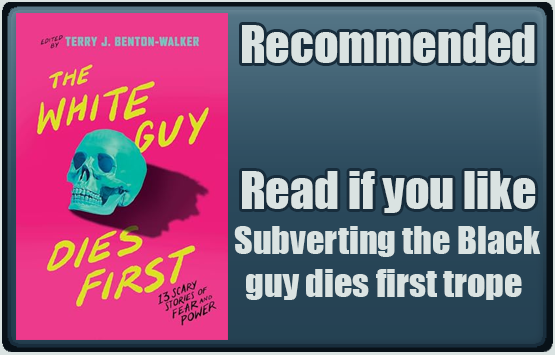
The White Guy Dies First: 13 Scary Stories of Fear and Power edited by Terry J. Benton-Walker

The White Guy Dies First: 13 Scary Stories of Fear and Power edited by Terry J. Benton-Walker

Formats: Print, audio, digital

Publisher: Tor Teen

Genre: Apocalypse/Disaster, Dark Fantasy, Eco Horror, Killer/Slasher, Monster, Mystery, Myth and Folklore, Romance

Audience: Young Adult

Diversity: Black characters and authors, characters of Chinese descent and Chinese New Zealander author, Indigenous characters and author (Seminole), Korean American characters and author, Bisexual characters, Queer women characters, Non-binary character and authors, Ace Spectrum author, MENA character, Bangladeshi-Irish author, Iranian-American author, Latinx characters and author

Content Warnings (Highlight to view): Alcohol Abuse, Amputation, Bullying, Cannibalism, Child Abuse, Child Death, Child Endangerment, Death, Drug Use/Abuse, Forced Captivity, Gaslighting, Gore, Mental Illness, Racism, Rape/Sexual Assault, Suicide, Verbal/Emotional Abuse, Violence, Vomit

Blurb

13 SCARY STORIES. 13 AUTHORS OF COLOR.
13 TIMES WE SURVIVED THE FIRST KILL.

The White Guy Dies First includes thirteen scary stories by all-star contributors and this time, the white guy dies first.

Killer clowns, a hungry hedge maze, and rich kids who got bored. Friendly cannibals, impossible slashers, and the dead who don’t stay dead….

A museum curator who despises “diasporic inaccuracies.” A sweet girl and her diary of happy thoughts. An old house that just wants friends forever….

These stories are filled with ancient terrors and modern villains, but go ahead, go into the basement, step onto the old plantation, and open the magician’s mystery box because this time, the white guy dies first.

I received this product for free in return for providing an honest and unbiased review. I received no other compensation. I am disclosing this in accordance with the Federal Trade Commission’s 16 CFR, Part 255: Guides Concerning the Use of Endorsements and Testimonials in Advertising.

This is a book that is going to make racists people mad, and I’m here for it. Consider yourself forewarned: if you’re white, this book is not written for you and you’re going to need a thick skin to read it. White people are so used to having positive representation in media that a book where white people make everything worse and always end up dead is going to rub the more sensitive white folks the wrong way, even those who might consider themselves allies. But for the rest of us? It’s awesome and a much-needed subversion of the “Black Guy Dies First” trope. Now, just because the white guy dies first in these stories does not make the BIPOC immune from horrific deaths. Hedge and The Protégé both have Black teens who meet violent ends. A Native person in Best Served Cold is tortured. They’re just not the first to die and get to be main characters.

Many (but not all) of the stories focus on the racism characters face and how often bad things happen to BIPOC people because of the actions of white people. Farz-joon from Break Through Our Skin by Naseem Jamnia is a non-binary, Iranian high school student who desperately wants a Smithosian internship. In order to secure one, they agree to volunteer at the University of Chicago’s Oriental Institute (thankfully, the problematic name was changed to the Institute for the Study of Ancient Culture in 2023) working under a condescending, racist, and transphobic old white professor named Dr. Hudson who thinks he knows more about Iran than Farz does because he’s studied it, speaks Farsi, and actually visited Iran, which Farz has not. He also objects to the Institute’s name change because the original name has “history” and “meaning.” Farz tolerates his boorish behavior so they can fulfill their dream of becoming an archeologist and challenge the idea that gender can be determined from a skeleton alone, but of course Dr. Hudson criticizes their “modern” ideas about gender stating “political correctness has no place in ancient history”, despite historical evidence of gender non-conforming people existing in ancient Iran and bioarchaeologist’s more recent views on sex and gender. Unsurprisingly, it turns out he only hired Farz to give the exhibits a “layer of authenticity” and he’s willing to jeopardize Farz’s future by withholding his recommendation.

Wasps by Mark Oshiro focuses on how gentrification hurts immigrant communities, while Hedge by Kalynn Brown has a topiary garden created by wealthy whites in the 1970s where anyone who enters winds up dead, including the main character’s father. In Grave Grove by Alexis Henderson, a Black teen named Rumi befriends a white Northerner named Kaitlin and who she helps adjust to life in the Southern US. The two even start a podcast together entitled Girls and Ghosts. Their newest episode is about Kyle Adams, a racist who went missing in the eighties after chasing a Black teen, William Jones, into an abandoned plantation. Unfortunately, we quickly learn that Kaitlin is not a good friend to Rumi. She ignores her at school in favor of hanging out with white girls, makes Rumi do all the grunt work for their podcast, and is actually pretty racist for someone who probably considers themselves liberal. She excuses Kyle’s racism because it happened in the past (the 1980s) and “everyone was racist back then.” She thinks William is a “drug dealer” who belongs in prison because he was caught with marijuana, despite smoking weed herself. She views Kyle as the victim, not William. She doesn’t want to talk about the racist history of the plantation or consider the slaves who died there, just the missing white boy. She even mentions her sister’s best friend got married at the plantation, a favorite location for Southern brides (gross). Side note, but I loved that Kaitlin believed in the supernatural while Rumi was the skeptic, since BIPOC are so often cast as superstitious and foolish compared to logical white people. I’m a skeptic myself so it was nice to see a character like me in both Grave Grove and Hell is Other Demons, where the Black main character is an atheist.

Best Served Cold by H. E. Edgmon and The Protégé by Lamar Giles both have the BIPOC main characters get into trouble specifically because they choose to trust a white person. In the former, our protagonist, EJ, makes the mistake of accepting a white man who befriended their brother. EJ struggled with internalized racism throughout their childhood, doing things like using cheap, unsafe contacts from the mall to change their eye color from brown to green. Kai, their brother, tells EJ that those are their ancestor’s eyes, and that their appearance connects them to their ancestry and they should be proud of them. Kai works to reclaim a past that was stolen by colonization (like learning traditional farming and hunting), and teaches EJ about ancestral trauma. EJ realizes the reason they feel angry and frustrated is because they are “playing a game whose rules have never been designed for me to win.” Their mother claims to be white because she passes, even though her grandfather was sent to a residential school in Oklahoma. She denies her heritage. EJ and Kai’s parents grew up together on a reservation in Florida, but moved to Chicago as adults. They told their children they’d left the Rez to give them a better life. Kai brings his white friend (possibly boyfriend) Isaac, who has intense green eyes, to a Pow Wow where the other Natives give him side eye. Clearly, they see something Kai doesn’t (there are other white people there but they don’t face the same level of scrutiny). One of the community leaders talks about MMIWC (Missing and Murdered Indigenous Women and Children) which serves as foreshadowing. It’s implied that the antagonist in the story is a certain evil spirit from Algonquian mythology (one who’s associated with winter and cannibalism). Edgmon is Seminole, not one of the Algonquian tribes, but he writes with respect, never breaking the taboo of using the spirits name which is said to summon it. This particular creature is also a perfect representation of colonialism with its insatiable hunger and destructive nature.  Kai and EJ do everything they can to fight colonialism but still fall victim to the evil spirit.

The Protégé by Lamar Giles, like Best Served Cold, is a particularly tragic story with the main character, Troy’s, life ruined by his best friend, in this case an older, white gentleman named Jack Meridian. Jack is a retired magician who’s been mentoring Troy in the art of card tricks and illusions, and one of the young teen’s only friends. Troy so admires the older man that he immediately agrees to do him a favor, accepting a package while Jack runs errands downtown. Simple enough, right? While Troy’s older brother Darius is having a party with his friends, Troy sees that the news is reporting a mass killing at the mall where Jack was heading. He tries to contact his magician mentor but the person who killed him answers the phone and threatens Troy if he doesn’t give them the package he received. The killer is revealed to be Danford Dread, a magician who “perverts” the art and performs dark and gory magic that “plays to the worst in people.” And now he’s after Troy and his brother. Even though the white guy in this story is a “good guy” he still ruins a Black boy’s life by bringing him into his world and putting him directly into danger.

In Hell is Other Demons by Karen Strong, the main character is killed (she spends most of the story as a ghost) because her crush’s white boyfriend starts meddling with the supernatural and summons a demon. The other stories of dating a white boy don’t end with dead young women, but they do highlight the perils of interracial dating, namely that white men often fetishize non-white women. I mean, just look how BIPOC women have their own categories on porn sites (gross). Obviously not all mixed-race relationships are problematic; my parents are a mixed-race couple, my sister has an amazing Chilean fiancé (who is himself biracial), and I’m friends with happily married couples in mixed relationships. Unfortunately, there are always bad apples.

In both the Golden Dragon by Kendare Blake and Docile Girls by Chloe Gong, Korean-American Sophie and Chinese-I-think-American-but-possibly-New-Zealander Adelaid are dumped by their white boyfriends (and subsequently lose all the white people they thought were their friends) who fetishized them but don’t view them as committed relationship material. As Sophie’s sister puts it, they’re an exotic bang to mark off their “international bang bingo card.” Even after she gets dumped, Adelaid’s ex sees her as too weak and docile to be the killer who’s been stalking the teens, an assumption that proves fatal for him. This is unfortunately common, as all the East Asian-American women I know I can attest to. When they’re sexually harassed, it almost always has racist undertones. They’ve been propositioned by white men looking for “submissive waifus,” had “me so horny” shouted at them, asked if they have sideways vaginas, or “complimented” on their “exotic” beauty. White men have long fetishized East Asian women, with examples dating as far back as 1898 with the book Madame Butterfly. A Columbia University study from 2007 showed that in online dating, White men seemed to have a strong preference for Asian women when it came to hookups, but when they wanted a committed relationship, they preferred white women. Meanwhile, Black women, especially those with dark skin, are considered less desirable than women of other races.

In All Eyes on Me by Faridah Àbíké-Íyímídé main character Helen deals with a white boyfriend, Asher, who is constantly committing microaggressions. He mocks her kinky hair, and implies she can’t be an actress because she’s Black and not a “bombshell.”  Yet Helen still feels guilty about wanting to break up with Asher because everyone else considers him the perfect, all-American boy. And as a Black girl she’s supposed to be grateful that a white boy wants her, even though being tied down to him and trapped in their small town forever sounds like a nightmare. Fortunately for all three girls, they end their stories without being tied down by their racist exes.

Not all the stories in the collection are focused on race and racism, however. The Road to Hell by Terry Benton-Walker has a very original set up, exploring an abusive relationship between a haunted house and a family living it with the house as the abuser. Everything’s Coming Up Roses by Tiffany D. Jackson is about a mentally unwell girl named Leesa who is obsessed with gardening and documents her daily life in her journal. Leesa is an unreliable narrator and the true horror is slowly revealed over the course of the story. Like most anthologies, the quality of the stories varies, but none that I would have rated below three out of five stars. Some were good, others, like Everything’s Coming Up RosesGray Grove, and Best Served Cold, were great. It’s also worth noting that many of the stories are VERY gory, which may be too much for younger teens who aren’t big horror fans. Of course, since most horror fans were reading Stephen King when they were eight, I don’t foresee this being an issue for anyone who decides to read this book.

Portrait of Lysbeth : A Gothic Novella by Rama Santa Mansa

Portrait of Lysbeth : A Gothic Novella by Rama Santa Mansa

Formats: digital

Publisher: Lingeer Press

Genre: Demon, Gothic, Historic Horror

Audience: Adult/Mature

Diversity: Black (African American) main character and author, minor gay character

Takes Place in: Sleepy Hollow, NY

Content Warnings (Highlight to view): Antisemitism, Child Abuse, Child Sexual Abuse, Childbirth, Death, Forced Captivity, Homophobia, Kidnapping, Medical Procedures, Oppression, Pedophilia, Physical Abuse, Racism, Rape/Sexual Assault, Sexism, Sexual Abuse, Slurs, Slut-Shaming, Verbal/Emotional Abuse, Xenophobia

Blurb

The year is 1676. We meet Lysbeth Luanda, a second-generation African freedwoman in New York, the former Dutch colony seized by the English, who, in a mere decade, have passed more cruel and oppressive restrictions on the free African community already living in the colony.After being orphaned at age 13, Lysbeth is forced to restart life all on her own––while working as a tavern waitress in Dutch and German-owned taverns along the banks of the Delaware and Hudson rivers. In this multinational milieu, she learns cosmopolitan skills and street philosophy from lovable lowlifes, brash buccaneers, African dreamers, indigenous heroines, and globetrotting Scandinavians. Lysbeth eventually finds a mentor in a Sephardi Jewish medical doctor from Curaçao, under whom she studies surgery and anatomy.

As the gloomy autumn season begins in 1676, the gruesome murders of three European women, by an unknown assailant in the isolated village of Sleepy Hollow, shocks the whole of New York.

Lysbeth’s mentor convinces the New York High Sheriff to appoint Lysbeth to go investigate the victims’ inexplicable cause of death and bring back a written coroner’s report. After an initial frosty reception by the villagers of Sleepy Hollow, Lysbeth gains new allies who assist her in her investigation

I received this product for free in return for providing an honest and unbiased review. I received no other compensation. I am disclosing this in accordance with the Federal Trade Commission’s 16 CFR, Part 255: Guides Concerning the Use of Endorsements and Testimonials in Advertising.

The Portrait of Lysbeth is set in Sleepy Hollow, but don’t expect mentions of the Headless Horseman or Ichabod Crane in this book. This story takes place about 100 years before the Revolutionary War and centers around Lysbeth, a free born Black woman, sent to investigate a serial killer (although that term wasn’t coined until the 20th century) in Sleepy Hollow, New York.

Lisbeth Anthonijsen, was a real person born around 1650 into the free Black community of New Amsterdam (what is now New York City). She started working as a servant for white colonists at a young age. In June 1661 she was accused of stealing wampum from the house where she was employed and the court ordered her to be beaten with a rod as punishment. In the winter of 1663, Lisbeth was spotted running away from a housefire at the Cregier household where she was employed. She was blamed for starting the fire and the court sentenced her to be enslaved by the Cregier family. Young Lisbeth was never given a chance. Mansa’s mission, as she puts it, was to get justice for Lisbeth by writing The Portrait of Lysbeth. She did a ton of research for this book, and it really adds to the story. I appreciate the time and effort Mansa put in to creating the setting and her main character, Lysbeth.

The fictional Lysbeth Luanda is an educated freed woman who becomes an indentured servant at the age of 13, after the death or her parents. She’s forced to work as a tavern waitress for the next 22 years, where she learns about the world from her diverse clientele.  Eventually, Lysbeth makes her way back to New Amsterdam where she apprentices for a Sephardic Jewish doctor, who sends her to Sleepy Hollow to act as coroner.

Some parts of the book are written in third person present perfect tense, which I felt was an interesting, if uncommon, choice. It’s fine, it just took a little while to get used to. It also jumps around quite a bit, from Lysbeth’s childhood to her time studying under the physician then back to the murder investigation. It can get a little confusing. But once I got used to it, the story flowed much more smoothly. I found the more fanciful elements genuinely creepy, like when a maid becomes possessed and chases Lysbeth through the house. The entire murder investigation has an eerie feeling, and not just because of the way the townsfolk stare at her. There seem to be things lurking in the woods, things Lysbeth, as a woman of science, refuses to believe in.

 I appreciated how Mansa not only avoids common racist literary tropes but makes a point to subvert them. In the beginning of the book, Mansa describes an unpleasant white man’s complexion as “milk cream.” I was amused to see, for the first time, a white person’s skin compared to food, something that routinely happens to Black characters written by white authors. It was also a nice change of pace to not have the color black associated with evil, but with spiritual strength and protection from evil. This is seen both is Lysbeth’s horse and the spirit wolf that protects her. Instead, Lysbeth believes that it is white animals that are to feared as they lack the spiritual protection of blackness. I also liked that the enslaved Africans were referred to as “enslaved,” rather than “slaves.” A seemingly small change, but to me a powerful one. By calling someone a slave, their identity is reduced to their circumstance. It dehumanizes them. An enslaved person is a person first, who has had slavery forced upon them.

In the book, both Native and African characters were referred to by their nations and not all lumped into the same group. For example, Lisbeth’s father is Kongolese, a people originally found in what is modern day northern Angola. The man who gave Lysbeth her witch gun is Mbundu. It was also refreshing to see Native history, which is often erased, acknowledged in the story, such as the Wampanoag leader Metacom (also known by the English name King Philip) defending his lands from the Puritans and the Moravian massacre. However, the Native representation did leave me questioning some of the author’s choices. There’s a rather brutal description of the 1643 Pavonia massacre, where the Dutch invaded what is now called Manhattan and massacred scores of Lenape people. I appreciate that it’s made clear that the settlers are living on stolen land (Lenapehoking) and that attention is brought to Native history, however, I felt weird about having a non-Native author write about Native trauma. If this were a white author doing it, it would be a more clear-cut example of exploitation of a marginalized group’s suffering. White people have been stealing from and exploiting Natives for hundreds of years, even though it’s not always done maliciously. As Debbie Reese, a Nambé Owingeh Pueblo scholar and educator, explains on her blog American Indians in Children’s Literature:

“…the history of White people taking from Native people is also filled with White people who befriend us because they have found themselves living in or near our communities.

Of that latter group, I wish they could form those friendships without saying “look at me and my Native friend.” Or, “look at the good I do for my Native friends!” Or, “I worked with them and they asked me to write this story about them.” Or, “I taught their kids and I learned from them and so, I am able to write books about them that you should buy because I know what I’m talking about.” Or, “Look! My book has a note inside from my Native friend or colleague. You can trust what you read in my book.”

They mean well. But I wish they could see past their good intentions. What they’re doing is exploitation.”

But Rama Santa Mansa isn’t white. She is a Black woman who wants to use her book to honor the untold stories of marginalized groups in what is now called the United States, but is that enough to give her a pass? Does her race make the story less problematic? It’s clear that Mansa did her best to portray the Lenape’s plight with respect, and wanted to include them as the first inhabitants of what is now called New York. There’s no colonialism being enforced, as Mansa is a Black author. She also did a significant amount of research for her book, but it left me wondering if she had reached out to Lenape or other Native scholars when writing it. There are certainly no Native books listed in her bibliography, no Native professors that she thanks in the acknowledgement, not even a reference to Indian 101 for writers.

I feel like at the very least a Native sensitivity reader would have been warranted. As Debbie Reese writes in her criticism of Justina Ireland’s book Dread Nation (another historic novel by a Black author), “It became clear to me that the reason her book fails in its representations of Native peoples is because she relied heavily on archival research. The “primary sources” she used are items in government archives–that are heavily biased.” This underlines the importance of using Native sources when discussing Native issues in addition to actually speaking to Native people. It’s also serves as a good reminder that just because a writer belongs to one marginalized group, it doesn’t mean they are qualified to write about another.

Despite the issues mentioned above I found the book overall enjoyable, with a highly detailed and well-researched setting and a strong Black woman protagonist. 

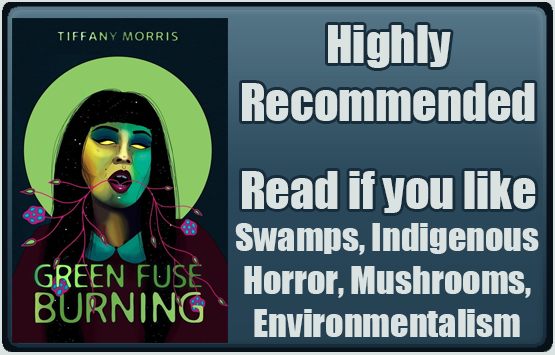
Green Fuse Burning by Tiffany Morris

Green Fuse Burning by Tiffany Morris

Formats: Print, digital

Publisher: Stelliform Press

Genre: Body Horror, Eco-Horror

Audience: Adult/Mature

Diversity: Mi’kmaw author and main character, queer main character, bisexual author

Content Warnings (Highlight to view): Animal Death, Death, Gore, Medical Procedures, Suicide, Verbal/Emotional Abuse

Blurb

The debut novella from the Elgin Award winning author of Elegies of Rotting Stars. After the death of her estranged father, artist Rita struggles with grief and regret. There was so much she wanted to ask him-about his childhood, their family, and the Mi’kmaq language and culture from which Rita feels disconnected. But when Rita’s girlfriend Molly forges an artist’s residency application on her behalf, winning Rita a week to paint at an isolated cabin, Rita is both furious and intrigued. The residency is located where her father grew up. On the first night at the cabin, Rita wakes to strange sounds. Was that a body being dragged through the woods? When she questions the locals about the cabin’s history, they are suspicious and unhelpful. Ignoring her unease, Rita gives in to dark visions that emanate from the forest’s lake and the surrounding swamp. She feels its pull, channeling that energy into art like she’s never painted before. But the uncanny visions become more insistent, more intrusive, and Rita discovers that in the swamp’s decay the end of one life is sometimes the beginning of another.

This is a book about grief, nature, and how death transforms. And when you’re finished, you’ll love wetlands and never look at fungi the same way again.

Despite being a landscape artist who relies on nature to make a living, Rita is very separated from it. She’s a germaphobe (due to her mother) who lives in the city with her white girlfriend Maddie. Rita also incorporates inspiration from her cultural heritage, despite being disconnected from that too. She’s barely in contact with the Mi’kmaw family. She only remembers bits of the Mi’kmaw her father taught her, and while she can recognize Gomgwejui’gasit (Suckerfish script), she can’t read it. This makes it difficult for her to talk to other family members when her father dies or receive the same level of community support as her half-brother, who lives on the reservation with the rest of their family. Rita feels alone in her grief because she’s so isolated from her family, with Maddie offering little support. Rita is not able to say goodbye to her father in his home, like she traditionally would, but in a hospital hooked up to machines, which traumatizes her. Rita’s grief over losing her father is so severe that she has PTSD. Morris describes her grief as a devouring green, a chlorophyll feeding and transforming Rita. She feels guilt (not uncommon for someone who’s grieving), afraid she’s not mourning “correctly” and that it’s selfish and impersonal.

Part of Rita’s alienation from nature also means she is not connected to the natural process of death and rebirth, despite feeling like she and the land are both dying, “flailing fish on a drying shore”. Mi’kmaw artist Alan Syliboy, who created an art exhibit that will focus on Mi’kmaw traditions around death, told CBC “…in Mi’kmaw society, death is not covered or hidden. When you’re a child, you’re aware [of it].” Rita, however, is surrounded by Euro-American culture, which rarely interacts with death outside the funeral industrial complex. One of the tenets of the death positivity movement is that hiding death behind closed doors and surrounding it with a  culture of silence  does more harm than good. Another tenet is that death should be handled in a way that “does not do great harm to the environment” and encourages green burials. Historically, both things would have been practiced in most cultures, but the invention of the toxic embalming process took death customs out of the home and created a for-profit industry. If you’re interested in learning more about the history of embalming and the birth of the funeral industry, my sister has made a great video about it here. Today, standard funeral practices such as embalming and cremation are devastating the environment, poisoning the land and air.

The theme of environmental devastation is present throughout the book. It’s the Frog Croaking Moon, Squoljikus (around May), but the heat from climate change makes the loons think it’s summer and Rita can hear their mating calls. The Mi’kmaw names for the months, like the Trees Fully Leafed Moon, no longer match seasonal changes. She describes the heat as “unbearable” and feels like she’s being smothered by it. A history of colonial violence is inexorably linked to the current environmental crisis. Colonizers brought with them industrialization and capitalism, treating nature and its resources as something to be exploited. Indigenous environmental justice addresses both the injustices suffered by Indigenous people and the current climate crisis. Kānaka Maoli (Native Hawaiian) organizer Kaniela Ing wrote “Indigenous communities are disproportionately impacted by the climate crisis because we maintain the closest ties to our natural environment.” He also wrote “Any climate solution would be incomplete without justice at its core. Kānaka Maoli, Native Hawaiians, should be central to the rebuilding and recovery efforts. We should have the authority to manage our lands and resources.”

The water protectors of the Standing Rock Sioux Reservation are probably the best known example of Indigenous environmental justice. There’s also Shiela Watt-Cloutier, an Inuit Indigenous rights activist, and author of the book “Right to be Cold.” In it she writes about how global warming is destroying her home by melting the permafrost and ice caps, and causing unpredictable weather patterns. Dario Kopenawa, a Yanomami leader, combats illegal gold mining and deforestation in the Brazilian Amazon. And Rick O’Rourke, fire and fuels manager of the Yurok Cultural Fire Management Council, uses traditional Yurok knowledge of controlled burns to prevent forest fires in the Klamath mountains of northern California.

Throughout the book nature is described in a way that makes it seem violent and alien, and Rita is shown to be fearful of it (she’s even terrified of harmless moths), with a good dose of body horror mixed in to represent her fear. But as time passes, and Rita feels her body being reclaimed by nature her fear slowly morphs into acceptance. She even considers walking into the forest and disappearing. Morris’ descriptions of Rita’s strong emotions and fears feels like a frenzied fever dream, with the environment becoming a character itself. Her descriptions of grief are powerful and moved me to tears as I remembered my own experiences with grieving. With Green Fuse Burning Morris has created a beautiful, deeply personal story that flows like poetry. 

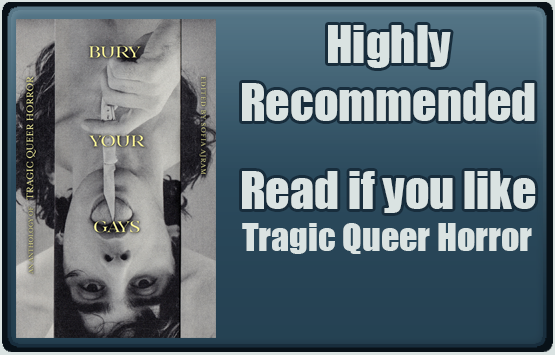
Bury Your Gays: An Anthology of Tragic Queer Horror edited by Sofia Ajram

Bury Your Gays: An Anthology of Tragic Queer Horror edited by Sofia Ajram

Formats: Print, digital

Publisher: Ghoulish Books

Genre: Anthology, Body Horror, Ghosts/Haunting, Killer/Slasher, Monster, Romance

Audience: Adult/Mature

Diversity: Queer and trans authors and characters

Content Warnings (Highlight to view): Alcohol Abuse, Body Shaming, Bullying, Death, Drug Use/Abuse, Eating Disorder, Homophobia, Medical Torture/Abuse, Medical Procedures, Necrophilia, Police Harassment, Rape/Sexual Assault, Slurs, Suicide, Torture, Transphobia, Violence

Blurb

A manifestation of ecstasy, heartache, horror and suffering rendered in feverish lyrical prose. Inside are sixteen new stories by some of the genre’s most visionary queer writers. Young lovers find themselves deliriously lost in an expanding garden labyrinth. The porter of a sentient hotel is haunted within a liminal time loop. A soldier and his abusive commanding officer escape a war in the trenches but discover themselves in an even greater nightmare. Parasites chase each other across time-space in hungry desperation to never be apart. A graduate student with violent tendencies falls into step with a seemingly walking corpse. Featuring stories from Cassandra Khaw, Joe Koch, Gretchen Felker-Martin, Robbie Banfitch, August Clarke, Son M., Jonathan Louis Duckworth, M.V. Pine, Ed Kurtz, LC Von Hessen, Matteo L. Cerilli, November Rush, Meredith Rose, Charlene Adhiambo, Violet, and Thomas Kearnes.

I received this product for free in return for providing an honest and unbiased review. I received no other compensation. I am disclosing this in accordance with the Federal Trade Commission’s 16 CFR, Part 255: Guides Concerning the Use of Endorsements and Testimonials in Advertising.

An exquisite anthology of queer horror that boasts such talented authors as Cassandra Khaw, August Clarke, and Gretchen Felker-Martin, this collection contains something for everyone. In its pages, you’ll find alien fungi, body horror, dark fairytales, undead lovers, and lonely ghosts. Named for the common trope where gay characters often meet with untimely ends in mainstream media, this anthology subverts the trope by putting it in the hands of queer writers.

In Your Honor, I’d Like to Put You in the Shoes of One of Dr. Morehouse’s Thirty Proven Clients by M. V. Pine, a trans woman (although she’s never referred to as such) struggles to find gender-affirming care. It’s the 1970s and she’s been dishonorably discharged from the army for “mental health” reasons. Her family doesn’t support her. She refers to her genitals as “a tumor.” A tumor that’s benign (hence, no doctor will remove it for her) but still mortifying. Because she’d do anything to be rid of it, she becomes an easy mark for Dr. Morehouse, who performs dangerous back-alley vaginoplasties on trans women. His surgical room is dirty and he runs out of anesthesia halfway through the procedure. He doesn’t provide antibiotics or pain medication. But the woman would rather die than go another day living with her “tumor.”

This is a story is about what happens when people don’t have access to safe, gender-affirming care. In 2017 a trans woman known only as “Jane Doe” underwent a back-alley orchiectomy which caused her to lose large amounts of blood. Police arrested James Lowell Pennington, who had performed the procedure without a medical license. Doe defended Pennington stating “Arranging a back-alley surgery was out of pure desperation due to a system that failed me.” Why would someone risk their life for what seems like an elective procedure? A study published in JAMA that followed trans and non-binary youths ages 13 to 20 showed 60% reduction of depression and 73% reduction of suicidality in participants who had initiated puberty blockers and gender-affirming hormones compared to those who had not. Another study published in JAMA on gender-affirming surgeries among 27,715 trans and gender diverse adults showed a 42% reduction in psychological distress and a 44% reduction in suicidal ideation among those who were able to receive gender-affirming surgery compared to those who wanted to but could not. There are many such studies that show similar results. Access to safe, gender-affirming care is quite literally lifesaving and immensely improves quality of life for trans and gender diverse people.

Another story that touches on the desperation many trans people feel just to have access to gender-affirming care is Worth the Dying Shame by Matteo L. Cerilli. In it, trans men are being infected by tainted, counterfiet testosterone with a disease that causes their bodies to decay as if dead (a clear parallel to AIDS). They hide their Body Rot under heavy clothing, dark glasses, and face masks. This causes an already unaccepting public to further turn on trans men. With jobs drying up, friends abandoning them, and doctors no longer willing to prescribe testosterone, the men who are able togo back in the closet. Others are forced to buy their T on the black market since doctors are no longer willing to prescribe the real stuff, which carries an even greater risk of infection. The story follows two trans men who have become infected, Dimeshine and Rictus. Rictus chose to detransition because he can still pass for a girl, but Dimeshine continues to inject T despite the risk of decaying faster. Both turn to the dark web to try and slow their Body Rot, trusting the community more than they do hospitals (understandable considering how often healthcare fails trans people). The two argue over whether Dimeshine’s little brother, Ratty, who is still early in his transition, should use testosterone or not. Dimeshine is firmly against it, worried Ratty might become infected like he was, but Rictus argues that he can’t blame Ratty for wanting to die for something they both would have killed for. These stories are a solemn reminder of what happens when the healthcare system fails LGBTQIA+ patients. As someone who works in healthcare, I held both stories especially heartbreaking.

Surprisingly for a horror anthology, many of the stories were love stories. Editor Sofia Ajram states the collection “was created out of a desire to read stories about tragic queer love. Love that is broken, love that is toxic, and obsessive, and ill-fated. Love that is thwarted, as viewed through the lens of authors who are queer-identifying themselves.” Abusive relationships are too often played off as romantic (think Twilight and Hush Hush), so it’s nice to see those sorts of relationships being shown for what they are, even when the characters themselves can’t recognize it. While horrific in real life, villain protagonists and toxic relationships can be fascinating studies in fiction. I also enjoyed having imperfect, even villainous queer characters whose character faults aren’t tied to their sexuality.

In American Gothic by LC von Hessen, villain protagonist John Smith is a serial killer (although he’d never refer to himself as such since “those guys are losers”) who has an unfortunate habit of murdering his dates. It’s not premeditated, it just seems to happen. But one day, one of his victims, who he dubs “L,” comes back to life. Or rather, he reanimates, as he’s still technically dead. L has no memory of his time alive, so John weaves an ever changing, fictional history of their romance. As L slowly rots away, John falls deeper in love with him. As shown with his past crushes, John is more in love with the fantasy he conjures then the men themselves. L allows him to project his ideal partner on to a blank slate he can fall in love with, like some sort of twisted Pygmalion, whereas living men would frequently reject him for being unemotional or creepy. John is a selfish lover, viewing his partners only by what they can do for him rather than their needs. He stalks and harasses one of his exes to the point they delete all their social media, but John still views himself as the victim and wonders why he didn’t kill his ex. John wants L to live, not for L’s sake, but for his own. He even tells him, “I won’t let you die. You’re not allowed to die unless I want you to die.” His selfishness and obsessiveness reminded me of male stalkers who feel they’re owed something by the object of their affection and can’t understand the word “no.”

This Body is Not Your Home by Son M., Love Like Ours by C M Violet, and Fortune Favors Grief by Cassandra Khaw are also stories of men who kill their lovers. Domestic violence against men is rarely examined. Even though 1 in 10 men will experience intimate partner violence or stalking in their lifetime, DV is usually thought of as a women’s issue only. Research on domestic violence among LGBTQIA+ people is even more sparse, even though gay men experience higher rates of physical violence then straight men. So, it’s refreshing to see stories that focus on intimate partner violence in gay relationships. Some of the stories focus more on mental and emotional abuse rather than physical. Both Sardines by Gretchen Felker-Martin and Zero Tolerance by M. F. Rose deal with queer teenage girls who are bullied. The former is a body horror story about a fat girl struggling with her sexuality and the latter is about cyber bullying. In this case, it’s their non-romantic relationships that are toxic.

Cleodora by August Clarke is a more lighthearted tale that follows the romance between a beautiful sea monster and a sea captain. The Captain discovers the monster and claims her as her bride, naming her Cleodora after a prophetic river nymph (The Captain seems to conflate the nymph Cleodroa with Andromeda, a princess who was offered as a sacrifice to a sea monster and rescued by the Greek hero Perseus). She sees Cleodora as helpless, which may explain why the Captain has no qualms about marrying a monster, happily feeding her new bride live eels and listening to her stories of drowning men. Cleodora feels equally unthreatened, stating “It’s fortunate my true love is a woman, because women do not hurt each other.” Ironic, considering how the story ends. The story feels like the original, darker version of a German fairytale, with hints of selkie wife folklore and siren myths.

Not all the romances involve toxic relationships or unrequited love. Bad Axe by Ed Kurtz is a tragic love story wherein John loses his lover, Eric, to the lake at Bad Axe in Minnesota. They’re never able to recover the body, so John goes back to Bad Axe to drown himself so he can be with Eric again. A touching yet morbid story it shares similarities with the myth of Hero and Leander. Hero, a priestess of Aphrodite, throws herself out of her tower after her lover, Leander, drowns trying to swim to her. The tragedy in Bad Axe is that John and Eric have a beautiful relationship that was tragically taken from them and now John must try and navigate the world through his immense grief. Black Hole, a sci-fi story by November Rush, also centers around a beautiful relationship that’s torn apart, but this time it’s between two parasitic, sentient fungi. Despite not being human, their love is no less pure and real. Lost and Found by Charlene Adhiambo also deals with lovers being united in death, but in this case they didn’t know each other before they died. 

It’s an intense read– many of the stories handle dark themes like transphobic healthcare systems, bullying, drug abuse, suicide and AIDS analogies–but a beautiful one, full of romance and tragedy. Remarkably, each one of the stories in Bury Your Gays is as strong as the last, and I’d be hard pressed to pick a favorite. Some broke my heart, others chilled me to the bone, and yet others were touching in a bittersweet way. But all left a lasting impression.

The Grimmer by Naben Ruthnum

The Grimmer by Naben Ruthnum

Formats: Print, digital

Publisher: ECW Press

Genre: Dark Fantasy, Sci-Fi

Audience: Young Adult

Diversity: Indian Canadian author and characters

Takes Place in: BC, Canada

Content Warnings (Highlight to view): Alcohol Abuse, Death, Drug Use/Abuse, Racism

Blurb

The small-town mysteries of John Bellairs are made modern with a dash of Stranger Things in this spine-tingling supernatural horror-thriller After his father returns from treatment for addiction, highschooler Vish ― lover of metal music and literature ― is uncertain what the future holds. It doesn’t help that everyone seems to know about the family’s troubles, and they stand out doubly as one of the only brown families in town. When Vish is mistaken for a relative of the weird local bookseller and attacked by an unsettling pale man who seems to be decaying, he is pulled into the world of the occult, where witches live in television sets, undead creatures can burn with a touch, and magic is mathematical. Vish must work with the bookstore owner and his mysterious teenage employee, Gisela, to stop an interdimensional invasion that would destroy their peaceful town. Bringing together scares, suspense, and body horror, The Grimmer is award-winning author Naben Ruthnum’s first foray into the young adult genre. This gripping ride through the supernatural is loaded with vivid characters, frightening imagery, and astonishing twists, while tackling complex issues such as grief, racism, and addiction.

I received this product for free in return for providing an honest and unbiased review. I received no other compensation. I am disclosing this in accordance with the Federal Trade Commission’s 16 CFR, Part 255: Guides Concerning the Use of Endorsements and Testimonials in Advertising.

It’s 1996, and Vish Maurya is finally returning from his Vancouver Island boarding school to his home of Kelowna, BC (where Ruthnum grew up). Normally, he’d spend the summer playing music with his best friends, Danny and Matt Pearson, but they’re no longer on speaking terms after the brothers told their music teacher about Vish’s father’s opioid addiction. Somehow, the entire school found out and Vish was sent away to boarding school while his father went to detox and worked on his recovery. Now he spends his days in his room brooding and pretending everything at is normal at home.

Kelwona is very white, and it’s hard for Vish being one of the only Indian kids. Other children do imitations of his parents’ Indian accents (never mind that neither of them has a strong accent). They joke that his beautiful mother is a mail-order bride or make snide remarks about arranged marriages because “there was no way someone that beautiful would willingly end up with someone who looked like his dad.” Parents tell him how much they love butter chicken and samosas. So, it’s a relief when Vish meets another Indian person, a cool but sick-looking young man named Agastya who runs a bookstore called Greycat books. A shop I would totally visit for the name alone if it existed in the real world. There’s even a shop cat named Moby. Little does he know that Agastya, a punk teen named Gisela, and a strange man named Mr. Farris are about to change his life forever.

And this is where the book veers into a mix of dark fantasy and science-fiction à la a Wrinkle in Time. Mr. Farris is a nachzehrer, an undead creature from German folklore that is said to be able to drain its victim’s lifeforce. Gisela is also a 700-year-old German witch, but somehow still 16 so it’s totally not creepy for Vish to harbor a crush on her because they’re technically the same age due to magic and time travel. She gave me the impression of a punk version of a Manic Pixie Dream Girl, that is, a woman who exists only to help and fulfil the male protagonists. She rescues her love interest from his own boring life and guides him to become a better version of himself. Gisela at least has her own motivations and desires, using Vish to stop the antagonist, but her “not like other girls” vibes still grated on me. I also didn’t like how Agastya and Gisela keep promising to tell Vish everything, then would end up dropping new, horrible surprises on him. You can hardly blame him for getting frustrated with them. They would act like they cared, but then seemed to be only interested in using poor Vish.

I found the Grimmer’s magic system confusing, somehow both extremely detailed and vague. Despite multiple explanations of both magic and magical beings I still had no idea how everything worked (something to do with very complex math and physics?). All this seemed to do was make the book feel unnecessarily drawn out. Kudos to Ruthnum for putting so much thought into his world, but I would’ve liked to have seen less world building and more character development, especially for Gisela. I could have also used more horror, given that the book is advertised as horror, though what little there was felt genuinely creepy.

Although The Grimmer takes place in the 90s, it avoids relying too much on nostalgia or making a plethora of pop culture references that might alienate its young adult audience. I liked how the book dealt so deftly with heavy topics like racism and addiction and showed the adults as imperfect. I like that Vish’s father, a well-educated psychiatrist, struggles with drug addiction while we see Agastya, a successful book store owner, abuse alcohol to help cope with the death of his wife.

Anyone can suffer from a substance use disorder, including a successful doctor and family man like Vish’s father, but you wouldn’t know it from looking at most media. At my day job, I work with patients struggling with substance use disorder (SUD), and half the battle is confronting the stigma surrounding addiction. Stereotypes about those with SUD include being “bad” people who can’t hold down jobs, live in squalor, have no meaningful relationships, are uneducated (often drop outs) and choose to be this way. Often, I will hear patients tearfully tell me that they’re not bad people, not like those other “addicts.” They’re afraid we’ll judge them, even though they suffer from a disease that can affect anyone, because the stereotypes surrounding addiction are so pervasive. Unfortunately, their fears aren’t unfounded because even in healthcare addiction carries a lot of stigma and providers will treat these patients as “lesser.” Some patients can’t even admit they have a problem because they don’t fit the mold of what they think someone with SUD looks like. They have a successful job, a family, they own their own house, they go to church, etc. so they can’t possibly be someone with an addiction. Their inability to accept reality (of course) makes recovery even harder. The fanciful aspects of The Grimmer were hit and miss for me, and I felt like Giselle could have been a stronger character, but the book was solid and the more serious issues (grief, addiction, racism) were all handled well and were, for me at least, the strongest parts of the story. 

Hammers on Bone by Cassandra Khaw

Hammers on Bone by Cassandra Khaw

Formats: Print, digital

Publisher: Tor

Genre: Body Horror, Eldritch, Monster, Occult, Psychological Horror, Sci-Fi Horror

Audience: Young Adult

Diversity: Queer character (Gay woman), POC characters (Black, Creole woman, unknown POC character), Bisexual author, Malaysian author

Takes Place in: London

Content Warnings (Highlight to view): Alcohol Abuse, Body-Shaming, Bullying, Child Abuse, Child Endangerment, Death, Gore, Pedophilia, Physical Abuse, Racism, Rape/Sexual Assault, Sexism, Sexual Abuse, Slurs, Slut-Shaming, Verbal/Emotional Abuse, Violence

Blurb

John Persons is a private investigator with a distasteful job from an unlikely client. He’s been hired by a ten-year-old to kill the kid’s stepdad, McKinsey. The man in question is abusive, abrasive, and abominable.

He’s also a monster, which makes Persons the perfect thing to hunt him. Over the course of his ancient, arcane existence, he’s hunted gods and demons, and broken them in his teeth.


As Persons investigates the horrible McKinsey, he realizes that he carries something far darker. He’s infected with an alien presence, and he’s spreading that monstrosity far and wide. Luckily Persons is no stranger to the occult, being an ancient and magical intelligence himself. The question is whether the private dick can take down the abusive stepdad without releasing the holds on his own horrifying potential.

During one of my late-night explorations of the internet (when I should have been sleeping but was instead googling all the random thoughts that pop into my head at 2 AM) I stumbled upon the work of Malaysian author Cassandra Khaw, a nerdy, queer woman who writes video games and short horror stories. Instantly intrigued, I purchased one of her novellas, Hammers on Bone, and I have to say, I fell absolutely, head-over-heels in love with Khaw’s writing. Her beautifully crafted stories are full of wonderful words like “penumbra” and “ululation” (one of my favorite Latin derived words), deliciously grotesque descriptions, and unique characters. English is Khaw’s third language, yet she uses it with a mastery that puts even native English speakers to shame. Her writing has a lot of range, too. These Deathless Bones is a feminist fairy tale about a witch getting sweet revenge on her wicked stepson. Rupert Wong, Cannibal Chef is a comedic splatterpunk series, as hilarious as it is gory, about the misadventures of the titular chef who prepares decadent meals of human flesh for gods and ghouls and gets wrapped up in international deity politics. Khaw has even dabbled in chick-lit (while also managing to poke fun at the more problematic elements of the genre) with her book, Bearly a Lady, about a bisexual, plus size wear-bear that works at a faerie-run fashion magazine. Then there’s her Persona Non Grata series. Much like Victor LaValle’s The Ballad of Black Tom, Khaw’s novellas take place in a Lovecraft inspired universe, but she flips the famously racist HP the bird by putting people of color at the forefront and using his creations to address social issues like racism, poverty, and abuse. Both stories feature the private investigator, John Persons, one of the most interesting characters I’ve come across in horror fiction. It’s the first of Person’s two novellas, Hammers on Bone, that I’ll be reviewing here.

Persons speaks and acts like the “hardboiled detective” characters from 1930s pulp magazines, complete with dated American vernacular and machismo, despite living in modern day London. This makes John seem incredibly out of place and occasionally downright ridiculous, like when he describes a little boy running into his arms for a hug as “crashing into me like a Russian gangster’s scarred-over fist.” When he’s not working as a PI, John spends his time saving the world from destruction by Star Spawn and Elder-Things. He’s adept at using magic, smokes cigarettes to dull his inhumanly strong sense of smell, enjoys the cold, and can pick up memories from objects and people through physical contact. He also happens to be a Dead One (though not one of the Great Old Ones, Persons is quick to explain), an otherworldly creature whose true, terrifying form comfortably possesses resides in a human body which he shares with the ghost of its previous inhabitant. I bet that’s why he has the most unimaginative, made-up sounding name ever; it was probably the first thing that popped into his head when he started inhabiting his meat suit.


Persons and his human body have an interesting relationship, more commensal than parasitic. While other Star-Spawn and Elder Things simply take what they want, invading human flesh like a disease and eventually destroying their hosts, Persons tries to minimize damage to his meat suit (he may be immortal and resilient, but his human form still suffers from wear and tear, and he feels pain when it’s damaged), and gives his phantasmal passenger a say in certain decisions. Even though he’s in the driver’s seat, John’s body will still react to its original owner’s thoughts and feelings, independent of him. In one scene, the meat suit becomes aroused by the proximity of a beautiful woman. Persons is aware of “his” body’s quickening pulse and rising temperature (among “other” rising things, heh), and states that the sensation is “not unpleasant”, but he describes the physical reaction with the detached interest of scientist observing a cell under a microscope. He is, after all, still an alien being.

Not much is known about the man whose skin he now wears, except that he’s an older person of color who lived during the interwar period, and gave John his body willingly after being asked. The whole Philip Marlowe / Sam Spade persona Persons adopts to appear more human is as an homage to his meat suit’s original owner. I guess it’s kind of sweet that he does that, in a very weird way, but unfortunately his stubborn refusal to update his dated vocabulary and attitudes, or venture into any genre that isn’t detective noir makes John come off as pretty sexist. He refers to women as “skirts,” “broads,” “dames,” and “birds”, and divides them into victims and femme fatales. This attitude backfires on him spectacularly since, of course, the real world isn’t like his detective novels, and John keeps misjudging the women he interacts with.

What sets the monstrous PI apart from his fellow cosmic entities, besides seeking consent from his body’s original owner, is his fondness for humanity, his dedication to following the law and maintaining order, and his desire for earth to remain more or less the way it is, i.e. not a barren hell-scape inhabited by Eldritch abominations.  Most of the monsters he fights are chaotic evil, infecting and destroying whenever they go, but John Persons is closer to lawful neutral, occasionally leaning towards good. He’s not exactly heroic since, in his words, “Good karma don’t pay the bills,” but Persons does have a strong set of morals. As previously mentioned he’s big on consent and describes the act of possessing a willing host’s body as “better than anything else I’d ever experienced” and feels incredibly guilty when he accidentally reads a woman’s mind after touching her arm. When she becomes understandably angry at the violation, screaming “You don’t take what you’re not given!” John doesn’t try to minimize, excuse, or defend his behavior (even though the intrusion was an accident), he simply apologizes, mortified by what he’s done. He can even show compassion at times, but how much of his altruistic behavior is due to the remaining sentience of his body’s former inhabitant acting as his ghostly conscience is unclear.

It’s his spectral companion who convinces John to take the case of a young boy named Abel, who wants Persons to kill his abusive stepfather. While initially hesitant about committing murder, John is convinced once the boy reveals that his stepfather is a monster, both literally and figuratively, and both Abel and his little brother’s lives are in danger. He might not be a hero, but Persons does seem to genuinely want to help the two boys, even if he claims it’s just because they’re clients. It may be simply because he wants the ghost with whom he cohabitates to stop nagging him, as John is usually pretty indifferent to human suffering on his own, or perhaps it’s because an Old One is involved, and he’d really prefer it not destroy the world. Regardless of the reason, he agrees to help.

In his eagerness to play white knight (or his meat suit’s eagerness) Persons often fails to realize that the “helpless victims” he seeks to rescue are often perfectly able to take care of themselves, like the waitress whose mind he reads. He’s also quick to victim blame the boys’ mother for not leaving, clearly unable to understand the psychological element of abuse or how dangerous it is for a person to try and leave an abusive partner, just making her feel worse than she already does. John struggles when it comes to comforting victims or dealing with their emotions. He claims his lack of skill when it comes to words and feelings is due to being a “man” (or at least inhabiting the body of one), though it’s just as likely it’s because he’s an eldritch abomination, and he’s just been using sexism to avoid learning the nuances of human emotion. While Persons is better at managing his desire to destroy and devour than the other monsters and is able to maintain a detached control over his meat suit’s emotions and baser instincts, he’s not immune to the effects of his human body’s testosterone or his own toxic misogyny. When the PI is feeling especially aggressive his true form starts to writhe beneath his human skin, straining to break free from his epidermis and rip apart the object of his ire. Even his thoughts start to degrade into a sort of violent, inhuman, babble when he gets too riled up. John actually has to fight to keep control of his monstrous body when he first encounters the abusive stepfather, he’s so desperate to disembowel and devour him. His true nature is a stark contrast to the cool and logical detective persona Persons has adopted. I won’t lie, I did enjoy seeing him act all protective of Abel and his little brother. There’s something amusing about what is essentially an immortal abomination that can effortlessly rip a grown man in two, doing something as mundane and sweet as escorting his young client home while carrying the child’s kid brother on his hip. It’s also heartbreaking when you realize the two boys are safer with a literal monster than their step dad, McKinsey (even before he was possessed).

The step-father is a real piece or work, and throughout the story I desperately wanted John to give in to his monstrous instincts and tear the bastard apart, limb by limb. But being a man/monster of the law, Persons won’t do much more than saber-rattle until he has solid proof of McKinsey’s wrong doing, much to Abel’s frustration. The kid would much rather the PI solve things with his fists (teeth, tentacles, claws, and other miscellaneous alien appendages) than waste time talking to witnesses, and I’d certainly be annoyed too if the monster I hired to kill someone wasted time playing detective instead of just eating his target. But Persons did warn Abel that he’s not a killer for hire and wants to do things “by the book”. Unfortunately, like most real monsters, McKinsey excels at hiding his wrong doing and camouflaging his true nature which makes it difficult for John to find a solid lead. People like McKinsey and describe him as a “loving family-man”.  Those who haven’t been completely conned by his act either don’t care he’s a monster (like his boss) or are too terrified to do anything (like his fiancée). None of the adults in the boys’ lives are fulfilling their duty of protecting two vulnerable children. This is where the real horror lies in Khaw’s story– not the eldritch abominations like Shub-Niggurath, or the threats of world destruction, but the all too painful reminder that we so often fail abuse victims. Khaw is tasteful when describing what the two boys go through, and it isn’t played for titillation or described in explicit detail. She only reveals enough to lets us know the two boys in the story are going through something no child should ever have to suffer. I also liked her choice to make the victims male. Far too often male survivors are overlooked, erased, or mocked because society tells us males can’t be victims, even though the CDC states that “More than 1 in 4 men in the United States have experienced rape, physical violence, and/or stalking by an intimate partner in their lifetime” and a study published in the American Journal of Preventive Medicine found that 1 in 6 boys will be sexually abused before the age of 18. As depressing as these statistics are, the situation isn’t completely hopeless, because monsters aren’t invulnerable, even the kind that have been infected by Elder Things. As Person muses towards the end of the book “I don’t remember who said it, but there’s an author out there who once wrote that we don’t need to kill our children’s monsters. Instead, what we need to do is show them that they can be killed.” For those of us who can’t go out an hire a eldritch abomination PI, at least we have RAINN (Rape, Abuse & Incest National Network) and their recommended resources for cases of abuse and sexual assault.

Navigation

Social Media

Search by Tags

To learn more about the Age Group, Diversity, and Genre tags, click here.

Age Groups

Diversity

Genre

Support the Blog

Search

Links

The Eyes Are the Best Part by Monika Kim

The Eyes Are the Best Part by Monika Kim

Formats: Print, audio, digital

Publisher: Erewhon Books

Genre: Psychological Horror

Audience: Adult/Mature

Diversity: Korean-American author, main character, and side characters, Black side character

Takes Place in: LA, California

Content Warnings (Highlight to view): Alcohol Abuse, Cannibalism, Death, Forced Captivity, Gaslighting, Gore, Medical Procedures, Mental Illness, Racism, Sexism, Slurs, Slut-Shaming, Violence, Vomit, Xenophobia

Blurb

Ji-won’s life tumbles into disarray in the wake of her Appa’s extramarital affair and subsequent departure. Her mother, distraught. Her younger sister, hurt and confused. Her college freshman grades, failing. Her dreams, horrifying… yet enticing.

In them, Ji-won walks through bloody rooms full of eyes. Succulent blue eyes. Salivatingly blue eyes. Eyes the same shape and shade as George’s, who is Umma’s obnoxious new boyfriend. George has already overstayed his welcome in her family’s claustrophobic apartment. He brags about his puffed-up consulting job, ogles Asian waitresses while dining out, and acts condescending toward Ji-won and her sister as if he deserves all of Umma’s fawning adoration. No, George doesn’t deserve anything from her family. Ji-won will make sure of that.

For no matter how many victims accumulate around her campus or how many people she must deceive and manipulate, Ji-won’s hunger and her rage deserve to be sated.

A brilliantly inventive, subversive novel about a young woman unraveling, Monika Kim’s The Eyes Are the Best Part is a story of a family falling apart and trying to find their way back to each other, marking a bold new voice in horror that will leave readers mesmerized and craving more.

Out of all the types of trauma and injuries the human body can suffer, eye trauma makes me the most squeamish. They’re so soft and vulnerable; whenever I know an eye injury is about to happen in a horror movie, I watch the scene through my fingers. The infamous eye scene in Zombi 2 still makes me squirm. So, I knew a story that centered around ripping out eyes and consuming them would be especially horrific. Interestingly, the book isn’t especially violent. There are only two scenes with any significant amount of blood, though ironically the stabbing and bludgeoning is less disturbing than the scenes of eye trauma and cannibalism (which have comparatively little gore).

After Ji-won Lim’s Appa (Korean for dad) abandons his wife and two daughters their Umma (the Korean word for mom) is completely inconsolable. Despite being a faithful and devoted wife, he still leaves her for another woman. She haunts the entrance to their apartment, hoping he will come back and saying she wants to die without him. It’s at that moment Ji-won realizes their roles are reversed. She has become the mother and Umma the daughter; it’s now Ji-won’s responsibility to take care of her little family.

When Umma was little, her parents left their children to search for work. Her other siblings decided to follow, afraid they would starve to death before their parents returned. But Umma refused to leave their home and instead waited for her parents to return, living off bark and snow throughout the harsh winter. When her family finally returned the following summer, they found her skeletal and delirious. Her older brother mistook her for a ghost.

To Ji-won, her mother’s decision to remain behind seems foolish and naive. She feels frustrated by what she sees as Umma’s stupidity and thinks she’s pathetic for spending her life making herself small and inconspicuous to men. But she also pities how every part of Umma’s life is characterized by suffering and relates to the fact that her mother is always alone. Ji-won is feeling abandoned, not just by her Appa but also her high school friends who all got into Berkeley when she didn’t.  Their loneliness makes both women particularly vulnerable to predatory men. Umma begins dating George, a white man with striking blue eyes. He says he speaks Korean, but is terrible at it and his pronunciation is awful. He clearly fetishizes Asian women as is clear when he leers at a Chinese waitress and later at Ji-won’s chest, makes gross sexual comments to Ji-won and her younger, underage sister Ji-hyun, and goes on trips to Thailand to sleep with the women there.

He also gets mad when they have a white waitress at a Chinese restaurant because he wants to experience “culture,” even though the restaurant is anything but authentic (it’s called Wok and Roll for crying out loud). George has a truck with a bumper sticker that says “I’m a Republican because we can’t all be on welfare,” complains loudly about how kids these days are “too soft” and “easily offended,” and reminiscences about “the good old days.” Essentially, he’s a loud, mediocre, abrasive white man who is thoroughly convinced of his own superiority. Understandably, the sisters can’t stand George, and they both resent Umma for bringing him into their lives, but the conflict averse Ji-won refuses to say anything about it.

Meanwhile, Ji-won befriends a boy in her class who seems like George’s polar opposite. Geoffrey presents himself as an ally. He takes women’s studies, wears “Nevertheless she Persisted” and Ruth Bader Ginsburg t-shirts, reads Ngozi Adichie’s We Should All be Feminists, and is horrified when a group of frat bros at their school say disgusting things about Asian women in front of Ji-won. Ji-won immediately likes Geoffrey and really wants to be his friend. She’s impressed by his intellect and his knowledge of the world. She believes they “get” each other and she doesn’t need her old friends anymore because she has Geoffrey now. But slowly red flags start to pop up. Geoffrey gets extremely jealous when Ji-won spends any time with her new friend (and possible crush) Alexis. At first Ji-won excuses this, thinking he’s just insecure and possessive of his friends like she is. Even when he snatches her phone out of her pocket to get her phone number, acts clingy, or pushes her to do things even after she’s said no, Ji-won continues to ignore his toxic behavior. She doesn’t realize Geoffrey is arrogant, loud, self-absorbed, and rude, just like George. His quips about feminism are just showing off, trying to make himself seem better than other men. He claims he’s an ally because he’s read about oppression, yet still gives Ji-won a thoughtless, racist gift for Christmas. George and Geoffrey are merely two sides of the same coin.

After Appa’s abandonment, the frat boys at her school saying disgusting about Asian women, George invading their life and being horrible, and Geoffrey’s face heel turn, Ji-won is boiling over with barely suppressed rage. Things come to a head when George wakes her from a nightmare and she quickly turns her anger on him and starts cussing him out. She apologizes for Umma’s sake, but the outburst has awoken something in Ji-won. Up until this point Ji-hyun has been begging her Unni (Korean for older sister, an honorific used by younger women to refer to older women) to do something about George and is frustrated by her inaction. Now Ji-hyun notices something is off about Ji-won and starts to worry about her, despite her sister’s insistence that she’s fine. Ji-won is a well-crafted, sympathetic anti-villain who focuses her anger on the toxic men who have wronged her. She cares deeply for her little sister, Ji-hyun, and her Umma, while still finding them frustrating (something I’m sure many daughters will relate to).

She’s also incredibly manipulative, cowardly, jealous, and unable to deal with her emotions in a healthy and mature way. Feeling betrayed that her friends are all going to Berkley, Ji-won hides an heirloom ring then blames one of her friends for stealing it. She continues to try and sabotage their relationships by sending texts pretending to be her other friends or their crushes because she’s upset that they’re “abandoning” her. When her friends finally figure out what she’s doing and try to have a calm conversation about how she hurt them, Ji-won shuts them down and leaves abruptly because she feels like she can’t face what she did. She doesn’t interact with them again for the rest of the story.

Later, Ji-won fucks with George the same way she did with her friends. Because he’s so convinced of his own self-importance and superiority, he’s easily manipulated by a “Oriental girl” he sees as beneath him. She starts by stealing money from his wallet, hiding his keys, and putting his driver’s license down the garbage disposal. Her “pranks” escalate and she destroys his most prized possession, the expensive Rolex his father gave him, and even gets him fired from his job, all why playing innocent. I love that she’s imperfect and gets to do bad things. I’ve mentioned it before, but imperfect, morally gray, sometimes villainous characters are my favorite! There’s too much of a push for protagonists to be perfect and heroic, but too often it leads to dull characters, in my humble opinion, at least. As horrified as I am at some of Ji-won’s behavior, I still love her as a character, and it thrills me that she gets to live out her (and I imagine many other Asian women’s) revenge fantasy.

I’ve touched before on how white men tend to fetishize Asian women and how harmful it is. As Nancy Wang Yuen, a sociologist and author of “Reel Inequality” told USA Today “The idea that Asian women are desirable and exotic and passive isn’t just an innocent stereotype or a desirable trait to envy. The shadowed side of that is they then become targets of hate, sexual violence and physical violence when they aren’t perceived as fully human and deserving of rights to be safe.” Media representation unfortunately only reenforces harmful hypersexualization of Asian women.

Top: Cio-Cio-San from a 2019 production of Madama Butterfly at the San Carlo Theater in Naples. Second row: (left) Gigi from the musical Miss Saigon (right), Fook Mi and Fook Yu from Austin Powers. Third row: (left) a Vietnamese sex worker propositioning Joker and Rafterman from the film Full Metal Jacket (right), Trang Pak hooking up with Coach Carr from film Mean Girls. Fourth Row: a series of sexy costumes loosely inspired by Chinese and Japanese clothing modeled by white women in “yellow face.”


One of the editors for this book, and my personal friend, Diana Pho, wrote this piece about being fetishized and harassed as a Vietnamese-American woman during an interview at New York Comic Con back in 2013. Diana was there to host a panel on representation in comics and had donned one of her Asian inspired steampunk outfits and was carrying a parasol. She was approached by a group of white men asking her to do an interview for a “TV show”. Though hesitant, Diana agreed. The interviewer (who she would later learn was Mike Babchik from the now defunct Man Banter) immediately started making sexist and racist comments (you can read a full account of the incident here).

Mike Babchik: So, if I were walking in the rain, could I pay you to walk next to me with your umbrella?

Diana Pho: Pay me?

Mike: If I paid you?

Diana: Then, buy your own umbrella.

Mike: No, I want to buy an umbrella with an Asian girl.

Diana: Then no.

It got even grosser from there.

Mike: Well in my experience, girls who stand next to me longer than 20 seconds get a cream pie.

Diana: I would give you a slap in the face.

Mike: (backing away) Really? Would you?

He then scurried off. As white men tend to do, Man Banter had completely underestimated Diana. They were expecting a weak, submissive, Asian girl who would giggle at their crude remarks, but what they got was a fight from a woman who wasn’t about to put up with their racism and sexual harassment. She told her story, and it wasn’t long before outlets like The Daily Dot18 Million Rising, and The Mary Sue all picked up the story. A petition was started to have Mike Babchik’s employer hold him responsible for the harassment. One of the employees from Man Banter sent Diana an apology on Tumblr, and promised to delete the so-called interview and agreed not to return to NYCC (though it sounds like the con was planning to ban them after Diana reported the incident to them). Diana mentioned that while she was angry that this happened to her, she was even more upset that this could be potentially happening to young women and underage girls who didn’t have the same resources, support, or confidence to call them out (I know I certainly wouldn’t have felt comfortable standing up to an adult when I was a teenager). For every Diana there are thousands of other Asian women who don’t get to tell their story. Women whose valid concerns are dismissed as “overreacting,” are shamed into believing it’s their fault, and that they should keep quiet about their experiences.

Diana Pho at New York Comic Con in 2013

The Eyes Are the Best Part is a slow-burn psychological horror story. I was half way through the book and wondering if perhaps I had picked up a thriller by mistake, when things started to get bloody and wild. It’s a suspenseful read, made even more tense by Ji-won’s deteriorating mental state and fraught relationships. The atmosphere is oppressive and claustrophobic, with the tiny, cramped apartment the family shares emphasizing Ji-won’s feeling of being trapped. Kim’s writing is as precise as a surgeon’s blade, gradually becoming more chaotic as Ji-won’s mind begins to unravel. There isn’t a page or paragraph wasted on filler or pointless details. Every line of the book carries meaning and weight.

American Ghoul by Michelle McGill-Vargas

American Ghoul by Michelle McGill-Vargas

Formats: Print, audio, digital

Publisher: Blackstone Publishing, Inc

Genre: Historic Horror, Vampire

Audience: Adult/Mature

Diversity: Black main character, Black side characters, Black/Native side character, Black author

Takes Place in: Georgia and Indiana

Content Warnings (Highlight to view): Alcohol Abuse, Child Abuse, Child Death, Death, Drug Use/Abuse, Forced Captivity, Oppression, Pedophilia, Police Harassment, Physical Abuse, Racism, Self-Harm, Slurs, Suicide, Verbal/Emotional Abuse, Violence, Vomit, Xenophobia

Blurb

You can’t kill someone already dead.

That’s what Lavinia keeps telling her jailer after—allegedly—killing her mistress, Simone Arceaneau. But how could Simone be dead when she was taking callers just a few minutes before? And why was her house always so dark?

Lavinia, a recently freed slave, met Simone, a recently undead vampire, on a plantation in post-Civil War Georgia. With nothing remaining for either woman in the South, the two form a fast friendship and head north. However, Lavinia quickly learns that teaming up with this white woman may be more than she bargained for.

Simone is reckless and impulsive—which would’ve been bad enough on its own, but when combined with her particular diet Lavinia finds herself in way over her head. As she is forced to repeatedly compromise her morals and struggle to make lasting human connections, Lavinia begins to wonder if is she truly free or if has she merely exchanged one form of enslavement for another. As bodies pile up in the small Indiana town they’ve settled in, people start to take a second look at the two newcomers, and Simone and Lavinia’s relationship is stretched to its breaking point…

I received this product for free in return for providing an honest and unbiased review. I received no other compensation. I am disclosing this in accordance with the Federal Trade Commission’s 16 CFR, Part 255: Guides Concerning the Use of Endorsements and Testimonials in Advertising.

American Ghoul is a unique historical novel with dark humor sprinkled throughout about a free Black woman, her white vampire companion, and all the trouble they get into. Lavinia, the forementioned free woman, hardly feels free after being released from her enslavement after the Civil War. With limited options and too afraid to leave the only home she’s ever known, Lavinia stays at the plantation where she was enslaved, helping her former mistress, Miss Tillie, run it as a brothel. It’s unpleasant work, but Lavina doesn’t dare hope for something better. That is, until she meets a strange white girl named Simone whom she rescues from burning up in the sun. Later she finds Simone drinking the blood of one of the brothel regulars.

Lavinia is an interesting character, as she’s an unlikeable victim who defies the mistaken belief that a victim must also be a good person. What happened to her both during and after her enslavement is horrific, and she’s certainly sympathetic, but Lavinia also does terrible things without feeling particularly guilty about it. She justifies what she does by saying she never killed anyone herself: she just helped Simone do it (which is hardly better). Personally, I love that she’s such a complicated character and gets to be an anti-villain. It’s clear she doesn’t think what she’s doing is that bad, as Lavinia does try to choose immoral people for her vampire friend to bleed dry. But other times, she just picks victims who have things she needs, like a new pair of boots. Lavinia is brave, no-nonsense, and blunt, and doesn’t have a lot of patience for Simone’s nonsense. While Simone is well-educated, Lavinia is clearly the smarter and more practical of the two, and it’s a miracle Simone even managed to survive a year on her own.

With the exception of Lavinia’s love interest, King, and a little girl that Simone murders, very few of the characters are fully good or bad. Take Miss Tillie, Lavinia’s former mistress, for example. She never beat Lavinia, gave her a new dress for Christmas, and speaks to her rather than at her, which causes Lavinia a small pang of guilt when Simone kills her. But while Miss Tillie is a far cry from Simon Legree, she was still complicit in the enslavement other human beings, an unforgiveable sin definitely worthy of making her a vampire’s dinner.

Simone is similar in that she’s not a good person and thinks that helping Lavinia makes up for the fact that she’s also controlling and doesn’t seem to care about anyone but herself (although she claims to love Lavinia). While you can’t help but feel bad for Simone for being turned into a monster against her will, it doesn’t justify the way she treats Lavinia. She wants her friend all to herself, gets extremely jealous if Lavinia spends time with anyone else, and will read her mind without consent to figure out what she’s been doing and where she’s been. Their relationship is toxic at best, and abusive at worst. With Simone’s possessiveness and their shared mental link, Lavinia eventually realizes their connection is almost as bad as the one that tethered her to Miss Tillie.

And of course, there’s the fact a vampire will kill anyone, even children, for food, especially if she’s hungry. Simone’s recklessness when it comes to food often leaves a mess for Lavinia to clean up and gets them both in trouble on numerous occasions. Simone is a spoiled white girl who claims she’s less racist than other white people, but as we learn more about her past it’s revealed that she’s not the white savior she claims to be. This is hinted at early on when Simone refers to Lavinia as her “chocolate savior” (ew), is completely unaware of how dangerous it is to be a Black woman walking around a white town on her own, and laughs when Lavinia doesn’t know how to read a globe. Because Simone also had a troubled past, she thinks she and Lavinia are similar, not realizing her white girl problems are nothing compared to being enslaved. Sometimes it feels like Lavinia is sacrificing everything for a white woman because of some misplaced sense of loyalty.

While the two women make their way to Chicago (a popular destination for formerly enslaved people) Lavinia meets a Romanian couple named Valerica and Victor Radut who own a store where she sells the belongings of Simone’s victims.  The couple recognize Simone as a vampire immediately, and believe Lavinia can protect them from her, since Simone (sort of) does what she says. They believe that in order to kill a vampire you must cut off the head, burn the heart, then drink the ashes for protection (like they did to the body of poor Mercy Brown in 1892). Despite claiming Valerica as a friend, Lavinia is ultimately unmoved by the unfortunate fate that befalls the Raduts because, as she puts it, “Simone was my priority. Maybe the only friend I needed.” Other people who make the mistake of getting close to Lavinia suffer similar fates. It’s hard to decide whether you want the them to face justice or not, or if you want them to get away with all the horrible things they’ve done.

It’s Only a Game by Kelsea Yu

It’s Only a Game by Kelsea Yu

Formats: Print, audio, digital

Publisher: Bloomsbury YA

Genre: Mystery

Audience: Young Adult

Diversity: Chinese American main character and Taiwanese Chinese author, Black major character, Indian American major character, transgender major character

Takes Place in: Seattle, Washington

Content Warnings (Highlight to view): Bullying, Child Abuse, Child Death, Child Endangerment, Death, Forced Captivity, Gaslighting, Mental Illness, Physical Abuse, Self-Harm, Stalking, Suicide, Transphobia, Verbal/Emotional Abuse, Victim Blaming

Blurb

In this twisty, fast-paced YA thriller, a dangerous game becomes all too real when Marina and her friends are framed for murder.

When Marina Chan ran from her old life, she brought nothing with her-not even her real name. Now she lives in fear of her past being discovered. But when her online gaming team is offered a tour of their favorite game company, Marina can’t resist accepting, even though she knows it might put her fake identity at risk.

Then the creator of the game is murdered during their tour. Whoever killed him plans to frame Marina and her friends for the murder unless they win four rounds of a dangerous game. A game that requires them to lie, trespass, and steal. A game that could destroy everything Marina’s worked so hard to build…. A game that she might not survive.

It’s Only a Game is a story about parental abuse, found family, and video games, all wrapped up in a murder mystery.

The beginning of the book really grabs the reader and makes it clear this is going to be a gripping narrative. At the start, all we know about main character Marina Chan is that she’s a runaway teen living illegally in a Chinese restaurant/game café, and that she must hide her identity from everyone. That means no school, no ID or paper trail, and no letting anyone get too close. The only relationships Marina has are with the owners of Bette’s Battles and Bao, who kindly allow her to live there, and her three online friends: RockSplice (Rock), Dreadnaughty (Dread), and Syldara (Syl). Marina has a MASSIVE crush on Syl. The four of them met through a PC game called Darkitect, a combination MMORPG (short for massively multiplayer online role-playing game) and level designer where Marina plays under the alias Nightmar3 (Night for short).  Their favorite level designer is a mysterious programmer named Cíxĭ (pronounced like tsuh-SHEE), who took her name from an Empress Dowager who ruled China during the late Qing dynasty. I like that Cíxĭ’s name has the accents when Marina says it, indicating that she uses the correct Mandarin inflections, as compared to her non-Chinese friends who pronounce it as Cixi (without the accents).

After beating an especially challenging level she designed, the four gamers score exclusive invites to one of Cíxĭ’s new levels. As thrilled as Marina is at the prospect of playing a new level designed by the elusive programmer, she’s even more excited knowing that tomorrow she’ll be meeting her online friends in real life for the first time on top of getting a tour of getting a tour of Apocalypta Games (the creators of Darkitect). Things couldn’t be better.  Meeting her friends for the first time goes exceptionally well, and Rock, Dread, and Syl immediately accept Marina as one of their own.

Rock is a slender Indian American guy whose parents run security for Apocalypta Games. Dread is a tall, white guy, and the oldest, who interns at Apocalypta. Finally there’s Dread’s cousin, Syl, a gorgeous and glamorous Black girl who’s the girly-girl to Marina’s tomboy. I love that Syl’s character enjoys girly things, like makeup, dresses, heels, and stylish nails, while still being very into video games. While the rise in popularity of Twitch has shown that women who play video games are a diverse group, I remember when feminine gamers were accused of only doing it for male attention, and “real gamer girls” were tomboys. While this stereotype has somewhat changed over the years, women gamers are still subject to a great deal of harassment. But the guys in Marina’s gaming group are completely supportive of the two girls and the friends manage to avoid most of the toxicity in the gaming world.

Two chibi style drawings of Marina (wearing her trademark black hoodie and leggins) and Syl (a girl with her hair in twists wearing a green dress). They are on a blue background that has drawings of different gaming controllers. Underneath it says

Marina and her crush, Syl

The tour is great, with the owner of the company, Ethan Wainwright himself, showing the group around. He even invites Marina to contribute her art to Apocalypta’s quarterly magazine, and offers her and her friends exhibitor badges for PAX West. Originally known as Penny Arcade Expo, PAX West, along with the other PAX conventions, is one of the largest gaming conventions in the US, so this is a HUGE deal. Marina can barely contain her excitement and is having the best day of her life, that is, until she and her friends find the body. What follows is a page-turning murder mystery that tests the limits of Marina’s newfound friendships.

Marina’s mysterious past is slowly revealed over the course of the book. She lived with her overprotective mother, but never knew her father (her mother says he was a “bad man”). We know she must hide who she is, but we’re not sure why. We also discover that Marina suffered from emotional abuse. Trauma from her past has made her private and slow to trust, as her mother made sure Marina was completely dependent on her. The Confucian concept of filial piety (Xiao) an important aspect of Chinese culture, seems to play a role in Marina’s abuse. Chinese American reddit user CauliflowerOk7056 argues in his college essay entitled “Beat Him till the Blood Flows”: How Confucianism and Traditional East Asian Culture Can Enable Child Abuse that, in addition to poverty, a major contributor to  Chinse and Chinse American child abuse is filial piety. In it he states “Sadly, as well-intentioned as Confucius’ ideal may have been, filial piety has its issues that can be exploited to justify child abuse. For one thing, its undue emphasis on strict obedience from children sets a precedent that can provide some leeway for abusive parents.”

However, he is quick to explain that Confucianism in and of itself does not encourage abuse, and even suggest that children hold their parents responsible. Psychotherapist Sam Louie explains “As [Asian American] clients talk about the emotional and/or physical abuse, they will often defend their parents saying something to the effect of, ‘They did the best they could,’ or ‘I knew they still loved me.’ It isn’t until more trust is developed that I can confront their inability to see how abuse can and often does happen within ‘loving’ households and relationships in general.” One of the reasons it takes so long for Marina to recognize her mother’s abuse is because her mother constantly tells her how much she loves her. When Marina asks to go over to a friends’ house, her mother refuses explaining she “loves [Marina] too much”to let her go. Additionally she guilts Marina for wanting friends and successfully isolates her (another hallmark of abuse), asking “Am I not enough for you? Am I so bad that you have to get away from me?”

Asian Americans, especially Asian American immigrants like Marina’s mother, also underutilize mental health services creating a “major mental health disparity” according to entitled Use of Specialty Mental Health Services by Asian Americans With Psychiatric Disorders. While it’s certainly not an excuse, and plenty of mentally ill individuals still make great parents, her mother’s mental health may have also played a role in the way she treated Marina. It’s important to note that, while Marina’s abuse may have cultural elements to it, child abuse is not unique to any one race or culture, and in fact a research study entitled Child Maltreatment Among Asian Americans: Characteristics and Explanatory Framework points out that “The reported rate of child maltreatment among Asian Americans is disproportionately low” compared to other racial and ethnic groups (though this may be partially due to under reporting). When calculating the risks of child abuse, poverty and inequality are leading factors, along with intergenerational trauma, stress, isolation, and a lack of a support system.

Yu puts a lot of emphasis on the importance of building supportive relationships, especially when you don’t have family to rely on. I appreciate that Yu believes that online friendships can be just as important as face-to-face ones. As a millennial, I grew up in the early days of the internet when adults firmly believed everyone online was a predator and forming online friendships was new territory. Yet, despite the warnings from overprotective adults, I still formed meaningful relationships with people I met online.

I met one of my best friends on LiveJournal. I would have never known my wife if she hadn’t joined our friend’s group through Meetup. For a kid who grew up in a small town who had trouble finding others my age with the same niche interests as me, the internet gave me a way to feel less alone, just like it did for Marina. These days 57% of teenagers meet a new friend online, and those relationships can be just as meaningful as face-to-face ones.

While you don’t have to be a gamer to enjoy It’s Only a Game it definitely helps since non-gamers are unlikely to recognize some of the references and terminology, which Yu doesn’t bother to explain or elaborate on (I had to look up what AoE stands for). Most of the action takes place within the world of Darkitect so readers who have never felt the excitement and suspense of playing a video game with fighting elements may not get as much out of those scenes. On the plus side, all the gaming elements are likely to appeal to reluctant readers who prefer World of Warcraft over books.

Splinter by Jasper Hyde

Splinter by Jasper Hyde

Formats: Print, digital

Publisher: The Magnificent Engine

Genre: Folk Horror, Killer/Slasher, Occult, Myth and Folklore, Romance

Audience: Adult/Mature

Diversity: Black main character and author, Filipino British main character, asexual (demisexual) main character and author, bisexual main character, main character with ADHD, Trans masc/Non-binary author

Takes Place in: Sleepy Hollow, NY

Content Warnings (Highlight to view): Ableism, Bullying, Death, Drug Use/Abuse, Medical Procedures, Mental Illness, Police Harassment, Racism, Torture 

Blurb

In a small town hidden behind the hills of New York, things are far from ordinary. As Sleepy Hollow’s youngest Medical Examiner, the pressure intensifies for Dr. Drusilla Van Tassel when the headless bodies of her sister Katrina’s friends start surfacing. Meanwhile, Drusilla’s ex-lover Ichabod Crane returns to town, dredging up feelings better left buried.

Things take a turn for the worst when Drusilla comes face-to-face with the Headless Horseman, who is back to settle old scores – and she and her sister are the perfect targets. Drusilla can repel the horseman with an unknown power, but her sister isn’t so lucky, and she goes missing.

However, when Drusilla discovers Ichabod is a monster hunter, she has no other choice but to turn to him for help. Even if that means working with a man she feels an inexplicable attraction to. Will they find Katrina and banish the headless horseman once and for all?

I received this product for free in return for providing an honest and unbiased review. I received no other compensation. I am disclosing this in accordance with the Federal Trade Commission’s 16 CFR, Part 255: Guides Concerning the Use of Endorsements and Testimonials in Advertising.

If you decide to read Splinter, keep in mind that this story comes from a small, indie publisher and didn’t benefit from a professional editor. There are quite a few grammar errors sprinkled throughout. I didn’t find them particularly distracting, and the quality of the writing was still good, but I know this will bother some readers. I would encourage them to give Splinter a chance anyway, as it really is an enjoyable story and I hope my review will encourage you to check it out.

Dr. Drusilla Van Tassel is our main character, and I kind of love her. She’s an introverted, bisexual, horror fan who just wants to do her job as a medical examiner, and I can relate to that. Her sister Katrina, on the other hand, is outgoing, popular, and prefers her rich, white friends over her own sister. But Drusilla is just as hostile to Katrina, so it’s not your stereotypical mean girl situation. I found it interesting how Drusilla can relax and use AAVE in front of her Black assistant (and former lover) Kyndall, but codeswitches with Katrina like she does around white people. It underlines how “other” Katrina is from her and how uncomfortable Drusilla feels in her own sister’s presence. Although, she does feel guilty for not doing more to support Katrina when her husband Brom died under mysterious circumstances.

One night Drusilla is called in to deal with a murder, and the victim is no other than Denis Carter, Katrina’s close friend. Poor Drusilla just can’t catch a break! At the crime scene, we see firsthand the racism and sexism Drusilla faces on a regular basis from the law enforcement officials she has to work alongside when one rookie cop tries to stop her from entering the crime scene. Despite having graduated Magna Cum Laude from Cornell she still gets treated as a “Black girl playing dress up.”

Then Katrina’s former friend and lover, Ichabod Crane (who I like to imagine looks like Piolo Pascual), shows up out of the blue and starts pestering her for details of the strange murder. Because they ended things badly, she isn’t exactly thrilled to see him. But when another murder takes place, the two are forced to set aside their differences and work together. What follows is a fun, supernatural mystery with a great sex scene. This was the first time in a story I’ve seen someone on the asexual spectrum have sex. Not only are asexual character underrepresented in fiction, but they’re often stereotyped as always being completely sex adverse, which just isn’t true, especially in the case of people who are demisexual like this particular character.

I really appreciate that Hyde not only put the effort into getting Filipino sensitivity readers, but also included their email in the beginning of the story for anyone to reach out to them if they made any mistakes in representation. I wish more authors would do that!

If you were a fan of the Fox tv series Sleepy Hollow that aired from 2013-2017, but hated the way they treated Nicole Beharie and her character, this book is for you. It feels like a remedy to the show without being a fix-it fanfiction. Instead, Splinter gets to be its own thing. It’s a quick, compelling read that sucks you in, helped in no small part by its compelling and complex characters.

The White Guy Dies First: 13 Scary Stories of Fear and Power edited by Terry J. Benton-Walker

The White Guy Dies First: 13 Scary Stories of Fear and Power edited by Terry J. Benton-Walker

Formats: Print, audio, digital

Publisher: Tor Teen

Genre: Apocalypse/Disaster, Dark Fantasy, Eco Horror, Killer/Slasher, Monster, Mystery, Myth and Folklore, Romance

Audience: Young Adult

Diversity: Black characters and authors, characters of Chinese descent and Chinese New Zealander author, Indigenous characters and author (Seminole), Korean American characters and author, Bisexual characters, Queer women characters, Non-binary character and authors, Ace Spectrum author, MENA character, Bangladeshi-Irish author, Iranian-American author, Latinx characters and author

Content Warnings (Highlight to view): Alcohol Abuse, Amputation, Bullying, Cannibalism, Child Abuse, Child Death, Child Endangerment, Death, Drug Use/Abuse, Forced Captivity, Gaslighting, Gore, Mental Illness, Racism, Rape/Sexual Assault, Suicide, Verbal/Emotional Abuse, Violence, Vomit

Blurb

13 SCARY STORIES. 13 AUTHORS OF COLOR.
13 TIMES WE SURVIVED THE FIRST KILL.

The White Guy Dies First includes thirteen scary stories by all-star contributors and this time, the white guy dies first.

Killer clowns, a hungry hedge maze, and rich kids who got bored. Friendly cannibals, impossible slashers, and the dead who don’t stay dead….

A museum curator who despises “diasporic inaccuracies.” A sweet girl and her diary of happy thoughts. An old house that just wants friends forever….

These stories are filled with ancient terrors and modern villains, but go ahead, go into the basement, step onto the old plantation, and open the magician’s mystery box because this time, the white guy dies first.

I received this product for free in return for providing an honest and unbiased review. I received no other compensation. I am disclosing this in accordance with the Federal Trade Commission’s 16 CFR, Part 255: Guides Concerning the Use of Endorsements and Testimonials in Advertising.

This is a book that is going to make racists people mad, and I’m here for it. Consider yourself forewarned: if you’re white, this book is not written for you and you’re going to need a thick skin to read it. White people are so used to having positive representation in media that a book where white people make everything worse and always end up dead is going to rub the more sensitive white folks the wrong way, even those who might consider themselves allies. But for the rest of us? It’s awesome and a much-needed subversion of the “Black Guy Dies First” trope. Now, just because the white guy dies first in these stories does not make the BIPOC immune from horrific deaths. Hedge and The Protégé both have Black teens who meet violent ends. A Native person in Best Served Cold is tortured. They’re just not the first to die and get to be main characters.

Many (but not all) of the stories focus on the racism characters face and how often bad things happen to BIPOC people because of the actions of white people. Farz-joon from Break Through Our Skin by Naseem Jamnia is a non-binary, Iranian high school student who desperately wants a Smithosian internship. In order to secure one, they agree to volunteer at the University of Chicago’s Oriental Institute (thankfully, the problematic name was changed to the Institute for the Study of Ancient Culture in 2023) working under a condescending, racist, and transphobic old white professor named Dr. Hudson who thinks he knows more about Iran than Farz does because he’s studied it, speaks Farsi, and actually visited Iran, which Farz has not. He also objects to the Institute’s name change because the original name has “history” and “meaning.” Farz tolerates his boorish behavior so they can fulfill their dream of becoming an archeologist and challenge the idea that gender can be determined from a skeleton alone, but of course Dr. Hudson criticizes their “modern” ideas about gender stating “political correctness has no place in ancient history”, despite historical evidence of gender non-conforming people existing in ancient Iran and bioarchaeologist’s more recent views on sex and gender. Unsurprisingly, it turns out he only hired Farz to give the exhibits a “layer of authenticity” and he’s willing to jeopardize Farz’s future by withholding his recommendation.

Wasps by Mark Oshiro focuses on how gentrification hurts immigrant communities, while Hedge by Kalynn Brown has a topiary garden created by wealthy whites in the 1970s where anyone who enters winds up dead, including the main character’s father. In Grave Grove by Alexis Henderson, a Black teen named Rumi befriends a white Northerner named Kaitlin and who she helps adjust to life in the Southern US. The two even start a podcast together entitled Girls and Ghosts. Their newest episode is about Kyle Adams, a racist who went missing in the eighties after chasing a Black teen, William Jones, into an abandoned plantation. Unfortunately, we quickly learn that Kaitlin is not a good friend to Rumi. She ignores her at school in favor of hanging out with white girls, makes Rumi do all the grunt work for their podcast, and is actually pretty racist for someone who probably considers themselves liberal. She excuses Kyle’s racism because it happened in the past (the 1980s) and “everyone was racist back then.” She thinks William is a “drug dealer” who belongs in prison because he was caught with marijuana, despite smoking weed herself. She views Kyle as the victim, not William. She doesn’t want to talk about the racist history of the plantation or consider the slaves who died there, just the missing white boy. She even mentions her sister’s best friend got married at the plantation, a favorite location for Southern brides (gross). Side note, but I loved that Kaitlin believed in the supernatural while Rumi was the skeptic, since BIPOC are so often cast as superstitious and foolish compared to logical white people. I’m a skeptic myself so it was nice to see a character like me in both Grave Grove and Hell is Other Demons, where the Black main character is an atheist.

Best Served Cold by H. E. Edgmon and The Protégé by Lamar Giles both have the BIPOC main characters get into trouble specifically because they choose to trust a white person. In the former, our protagonist, EJ, makes the mistake of accepting a white man who befriended their brother. EJ struggled with internalized racism throughout their childhood, doing things like using cheap, unsafe contacts from the mall to change their eye color from brown to green. Kai, their brother, tells EJ that those are their ancestor’s eyes, and that their appearance connects them to their ancestry and they should be proud of them. Kai works to reclaim a past that was stolen by colonization (like learning traditional farming and hunting), and teaches EJ about ancestral trauma. EJ realizes the reason they feel angry and frustrated is because they are “playing a game whose rules have never been designed for me to win.” Their mother claims to be white because she passes, even though her grandfather was sent to a residential school in Oklahoma. She denies her heritage. EJ and Kai’s parents grew up together on a reservation in Florida, but moved to Chicago as adults. They told their children they’d left the Rez to give them a better life. Kai brings his white friend (possibly boyfriend) Isaac, who has intense green eyes, to a Pow Wow where the other Natives give him side eye. Clearly, they see something Kai doesn’t (there are other white people there but they don’t face the same level of scrutiny). One of the community leaders talks about MMIWC (Missing and Murdered Indigenous Women and Children) which serves as foreshadowing. It’s implied that the antagonist in the story is a certain evil spirit from Algonquian mythology (one who’s associated with winter and cannibalism). Edgmon is Seminole, not one of the Algonquian tribes, but he writes with respect, never breaking the taboo of using the spirits name which is said to summon it. This particular creature is also a perfect representation of colonialism with its insatiable hunger and destructive nature.  Kai and EJ do everything they can to fight colonialism but still fall victim to the evil spirit.

The Protégé by Lamar Giles, like Best Served Cold, is a particularly tragic story with the main character, Troy’s, life ruined by his best friend, in this case an older, white gentleman named Jack Meridian. Jack is a retired magician who’s been mentoring Troy in the art of card tricks and illusions, and one of the young teen’s only friends. Troy so admires the older man that he immediately agrees to do him a favor, accepting a package while Jack runs errands downtown. Simple enough, right? While Troy’s older brother Darius is having a party with his friends, Troy sees that the news is reporting a mass killing at the mall where Jack was heading. He tries to contact his magician mentor but the person who killed him answers the phone and threatens Troy if he doesn’t give them the package he received. The killer is revealed to be Danford Dread, a magician who “perverts” the art and performs dark and gory magic that “plays to the worst in people.” And now he’s after Troy and his brother. Even though the white guy in this story is a “good guy” he still ruins a Black boy’s life by bringing him into his world and putting him directly into danger.

In Hell is Other Demons by Karen Strong, the main character is killed (she spends most of the story as a ghost) because her crush’s white boyfriend starts meddling with the supernatural and summons a demon. The other stories of dating a white boy don’t end with dead young women, but they do highlight the perils of interracial dating, namely that white men often fetishize non-white women. I mean, just look how BIPOC women have their own categories on porn sites (gross). Obviously not all mixed-race relationships are problematic; my parents are a mixed-race couple, my sister has an amazing Chilean fiancé (who is himself biracial), and I’m friends with happily married couples in mixed relationships. Unfortunately, there are always bad apples.

In both the Golden Dragon by Kendare Blake and Docile Girls by Chloe Gong, Korean-American Sophie and Chinese-I-think-American-but-possibly-New-Zealander Adelaid are dumped by their white boyfriends (and subsequently lose all the white people they thought were their friends) who fetishized them but don’t view them as committed relationship material. As Sophie’s sister puts it, they’re an exotic bang to mark off their “international bang bingo card.” Even after she gets dumped, Adelaid’s ex sees her as too weak and docile to be the killer who’s been stalking the teens, an assumption that proves fatal for him. This is unfortunately common, as all the East Asian-American women I know I can attest to. When they’re sexually harassed, it almost always has racist undertones. They’ve been propositioned by white men looking for “submissive waifus,” had “me so horny” shouted at them, asked if they have sideways vaginas, or “complimented” on their “exotic” beauty. White men have long fetishized East Asian women, with examples dating as far back as 1898 with the book Madame Butterfly. A Columbia University study from 2007 showed that in online dating, White men seemed to have a strong preference for Asian women when it came to hookups, but when they wanted a committed relationship, they preferred white women. Meanwhile, Black women, especially those with dark skin, are considered less desirable than women of other races.

In All Eyes on Me by Faridah Àbíké-Íyímídé main character Helen deals with a white boyfriend, Asher, who is constantly committing microaggressions. He mocks her kinky hair, and implies she can’t be an actress because she’s Black and not a “bombshell.”  Yet Helen still feels guilty about wanting to break up with Asher because everyone else considers him the perfect, all-American boy. And as a Black girl she’s supposed to be grateful that a white boy wants her, even though being tied down to him and trapped in their small town forever sounds like a nightmare. Fortunately for all three girls, they end their stories without being tied down by their racist exes.

Not all the stories in the collection are focused on race and racism, however. The Road to Hell by Terry Benton-Walker has a very original set up, exploring an abusive relationship between a haunted house and a family living it with the house as the abuser. Everything’s Coming Up Roses by Tiffany D. Jackson is about a mentally unwell girl named Leesa who is obsessed with gardening and documents her daily life in her journal. Leesa is an unreliable narrator and the true horror is slowly revealed over the course of the story. Like most anthologies, the quality of the stories varies, but none that I would have rated below three out of five stars. Some were good, others, like Everything’s Coming Up RosesGray Grove, and Best Served Cold, were great. It’s also worth noting that many of the stories are VERY gory, which may be too much for younger teens who aren’t big horror fans. Of course, since most horror fans were reading Stephen King when they were eight, I don’t foresee this being an issue for anyone who decides to read this book.

Portrait of Lysbeth : A Gothic Novella by Rama Santa Mansa

Portrait of Lysbeth : A Gothic Novella by Rama Santa Mansa

Formats: digital

Publisher: Lingeer Press

Genre: Demon, Gothic, Historic Horror

Audience: Adult/Mature

Diversity: Black (African American) main character and author, minor gay character

Takes Place in: Sleepy Hollow, NY

Content Warnings (Highlight to view): Antisemitism, Child Abuse, Child Sexual Abuse, Childbirth, Death, Forced Captivity, Homophobia, Kidnapping, Medical Procedures, Oppression, Pedophilia, Physical Abuse, Racism, Rape/Sexual Assault, Sexism, Sexual Abuse, Slurs, Slut-Shaming, Verbal/Emotional Abuse, Xenophobia

Blurb

The year is 1676. We meet Lysbeth Luanda, a second-generation African freedwoman in New York, the former Dutch colony seized by the English, who, in a mere decade, have passed more cruel and oppressive restrictions on the free African community already living in the colony.After being orphaned at age 13, Lysbeth is forced to restart life all on her own––while working as a tavern waitress in Dutch and German-owned taverns along the banks of the Delaware and Hudson rivers. In this multinational milieu, she learns cosmopolitan skills and street philosophy from lovable lowlifes, brash buccaneers, African dreamers, indigenous heroines, and globetrotting Scandinavians. Lysbeth eventually finds a mentor in a Sephardi Jewish medical doctor from Curaçao, under whom she studies surgery and anatomy.

As the gloomy autumn season begins in 1676, the gruesome murders of three European women, by an unknown assailant in the isolated village of Sleepy Hollow, shocks the whole of New York.

Lysbeth’s mentor convinces the New York High Sheriff to appoint Lysbeth to go investigate the victims’ inexplicable cause of death and bring back a written coroner’s report. After an initial frosty reception by the villagers of Sleepy Hollow, Lysbeth gains new allies who assist her in her investigation

I received this product for free in return for providing an honest and unbiased review. I received no other compensation. I am disclosing this in accordance with the Federal Trade Commission’s 16 CFR, Part 255: Guides Concerning the Use of Endorsements and Testimonials in Advertising.

The Portrait of Lysbeth is set in Sleepy Hollow, but don’t expect mentions of the Headless Horseman or Ichabod Crane in this book. This story takes place about 100 years before the Revolutionary War and centers around Lysbeth, a free born Black woman, sent to investigate a serial killer (although that term wasn’t coined until the 20th century) in Sleepy Hollow, New York.

Lisbeth Anthonijsen, was a real person born around 1650 into the free Black community of New Amsterdam (what is now New York City). She started working as a servant for white colonists at a young age. In June 1661 she was accused of stealing wampum from the house where she was employed and the court ordered her to be beaten with a rod as punishment. In the winter of 1663, Lisbeth was spotted running away from a housefire at the Cregier household where she was employed. She was blamed for starting the fire and the court sentenced her to be enslaved by the Cregier family. Young Lisbeth was never given a chance. Mansa’s mission, as she puts it, was to get justice for Lisbeth by writing The Portrait of Lysbeth. She did a ton of research for this book, and it really adds to the story. I appreciate the time and effort Mansa put in to creating the setting and her main character, Lysbeth.

The fictional Lysbeth Luanda is an educated freed woman who becomes an indentured servant at the age of 13, after the death or her parents. She’s forced to work as a tavern waitress for the next 22 years, where she learns about the world from her diverse clientele.  Eventually, Lysbeth makes her way back to New Amsterdam where she apprentices for a Sephardic Jewish doctor, who sends her to Sleepy Hollow to act as coroner.

Some parts of the book are written in third person present perfect tense, which I felt was an interesting, if uncommon, choice. It’s fine, it just took a little while to get used to. It also jumps around quite a bit, from Lysbeth’s childhood to her time studying under the physician then back to the murder investigation. It can get a little confusing. But once I got used to it, the story flowed much more smoothly. I found the more fanciful elements genuinely creepy, like when a maid becomes possessed and chases Lysbeth through the house. The entire murder investigation has an eerie feeling, and not just because of the way the townsfolk stare at her. There seem to be things lurking in the woods, things Lysbeth, as a woman of science, refuses to believe in.

 I appreciated how Mansa not only avoids common racist literary tropes but makes a point to subvert them. In the beginning of the book, Mansa describes an unpleasant white man’s complexion as “milk cream.” I was amused to see, for the first time, a white person’s skin compared to food, something that routinely happens to Black characters written by white authors. It was also a nice change of pace to not have the color black associated with evil, but with spiritual strength and protection from evil. This is seen both is Lysbeth’s horse and the spirit wolf that protects her. Instead, Lysbeth believes that it is white animals that are to feared as they lack the spiritual protection of blackness. I also liked that the enslaved Africans were referred to as “enslaved,” rather than “slaves.” A seemingly small change, but to me a powerful one. By calling someone a slave, their identity is reduced to their circumstance. It dehumanizes them. An enslaved person is a person first, who has had slavery forced upon them.

In the book, both Native and African characters were referred to by their nations and not all lumped into the same group. For example, Lisbeth’s father is Kongolese, a people originally found in what is modern day northern Angola. The man who gave Lysbeth her witch gun is Mbundu. It was also refreshing to see Native history, which is often erased, acknowledged in the story, such as the Wampanoag leader Metacom (also known by the English name King Philip) defending his lands from the Puritans and the Moravian massacre. However, the Native representation did leave me questioning some of the author’s choices. There’s a rather brutal description of the 1643 Pavonia massacre, where the Dutch invaded what is now called Manhattan and massacred scores of Lenape people. I appreciate that it’s made clear that the settlers are living on stolen land (Lenapehoking) and that attention is brought to Native history, however, I felt weird about having a non-Native author write about Native trauma. If this were a white author doing it, it would be a more clear-cut example of exploitation of a marginalized group’s suffering. White people have been stealing from and exploiting Natives for hundreds of years, even though it’s not always done maliciously. As Debbie Reese, a Nambé Owingeh Pueblo scholar and educator, explains on her blog American Indians in Children’s Literature:

“…the history of White people taking from Native people is also filled with White people who befriend us because they have found themselves living in or near our communities.

Of that latter group, I wish they could form those friendships without saying “look at me and my Native friend.” Or, “look at the good I do for my Native friends!” Or, “I worked with them and they asked me to write this story about them.” Or, “I taught their kids and I learned from them and so, I am able to write books about them that you should buy because I know what I’m talking about.” Or, “Look! My book has a note inside from my Native friend or colleague. You can trust what you read in my book.”

They mean well. But I wish they could see past their good intentions. What they’re doing is exploitation.”

But Rama Santa Mansa isn’t white. She is a Black woman who wants to use her book to honor the untold stories of marginalized groups in what is now called the United States, but is that enough to give her a pass? Does her race make the story less problematic? It’s clear that Mansa did her best to portray the Lenape’s plight with respect, and wanted to include them as the first inhabitants of what is now called New York. There’s no colonialism being enforced, as Mansa is a Black author. She also did a significant amount of research for her book, but it left me wondering if she had reached out to Lenape or other Native scholars when writing it. There are certainly no Native books listed in her bibliography, no Native professors that she thanks in the acknowledgement, not even a reference to Indian 101 for writers.

I feel like at the very least a Native sensitivity reader would have been warranted. As Debbie Reese writes in her criticism of Justina Ireland’s book Dread Nation (another historic novel by a Black author), “It became clear to me that the reason her book fails in its representations of Native peoples is because she relied heavily on archival research. The “primary sources” she used are items in government archives–that are heavily biased.” This underlines the importance of using Native sources when discussing Native issues in addition to actually speaking to Native people. It’s also serves as a good reminder that just because a writer belongs to one marginalized group, it doesn’t mean they are qualified to write about another.

Despite the issues mentioned above I found the book overall enjoyable, with a highly detailed and well-researched setting and a strong Black woman protagonist. 

Green Fuse Burning by Tiffany Morris

Green Fuse Burning by Tiffany Morris

Formats: Print, digital

Publisher: Stelliform Press

Genre: Body Horror, Eco-Horror

Audience: Adult/Mature

Diversity: Mi’kmaw author and main character, queer main character, bisexual author

Content Warnings (Highlight to view): Animal Death, Death, Gore, Medical Procedures, Suicide, Verbal/Emotional Abuse

Blurb

The debut novella from the Elgin Award winning author of Elegies of Rotting Stars. After the death of her estranged father, artist Rita struggles with grief and regret. There was so much she wanted to ask him-about his childhood, their family, and the Mi’kmaq language and culture from which Rita feels disconnected. But when Rita’s girlfriend Molly forges an artist’s residency application on her behalf, winning Rita a week to paint at an isolated cabin, Rita is both furious and intrigued. The residency is located where her father grew up. On the first night at the cabin, Rita wakes to strange sounds. Was that a body being dragged through the woods? When she questions the locals about the cabin’s history, they are suspicious and unhelpful. Ignoring her unease, Rita gives in to dark visions that emanate from the forest’s lake and the surrounding swamp. She feels its pull, channeling that energy into art like she’s never painted before. But the uncanny visions become more insistent, more intrusive, and Rita discovers that in the swamp’s decay the end of one life is sometimes the beginning of another.

This is a book about grief, nature, and how death transforms. And when you’re finished, you’ll love wetlands and never look at fungi the same way again.

Despite being a landscape artist who relies on nature to make a living, Rita is very separated from it. She’s a germaphobe (due to her mother) who lives in the city with her white girlfriend Maddie. Rita also incorporates inspiration from her cultural heritage, despite being disconnected from that too. She’s barely in contact with the Mi’kmaw family. She only remembers bits of the Mi’kmaw her father taught her, and while she can recognize Gomgwejui’gasit (Suckerfish script), she can’t read it. This makes it difficult for her to talk to other family members when her father dies or receive the same level of community support as her half-brother, who lives on the reservation with the rest of their family. Rita feels alone in her grief because she’s so isolated from her family, with Maddie offering little support. Rita is not able to say goodbye to her father in his home, like she traditionally would, but in a hospital hooked up to machines, which traumatizes her. Rita’s grief over losing her father is so severe that she has PTSD. Morris describes her grief as a devouring green, a chlorophyll feeding and transforming Rita. She feels guilt (not uncommon for someone who’s grieving), afraid she’s not mourning “correctly” and that it’s selfish and impersonal.

Part of Rita’s alienation from nature also means she is not connected to the natural process of death and rebirth, despite feeling like she and the land are both dying, “flailing fish on a drying shore”. Mi’kmaw artist Alan Syliboy, who created an art exhibit that will focus on Mi’kmaw traditions around death, told CBC “…in Mi’kmaw society, death is not covered or hidden. When you’re a child, you’re aware [of it].” Rita, however, is surrounded by Euro-American culture, which rarely interacts with death outside the funeral industrial complex. One of the tenets of the death positivity movement is that hiding death behind closed doors and surrounding it with a  culture of silence  does more harm than good. Another tenet is that death should be handled in a way that “does not do great harm to the environment” and encourages green burials. Historically, both things would have been practiced in most cultures, but the invention of the toxic embalming process took death customs out of the home and created a for-profit industry. If you’re interested in learning more about the history of embalming and the birth of the funeral industry, my sister has made a great video about it here. Today, standard funeral practices such as embalming and cremation are devastating the environment, poisoning the land and air.

The theme of environmental devastation is present throughout the book. It’s the Frog Croaking Moon, Squoljikus (around May), but the heat from climate change makes the loons think it’s summer and Rita can hear their mating calls. The Mi’kmaw names for the months, like the Trees Fully Leafed Moon, no longer match seasonal changes. She describes the heat as “unbearable” and feels like she’s being smothered by it. A history of colonial violence is inexorably linked to the current environmental crisis. Colonizers brought with them industrialization and capitalism, treating nature and its resources as something to be exploited. Indigenous environmental justice addresses both the injustices suffered by Indigenous people and the current climate crisis. Kānaka Maoli (Native Hawaiian) organizer Kaniela Ing wrote “Indigenous communities are disproportionately impacted by the climate crisis because we maintain the closest ties to our natural environment.” He also wrote “Any climate solution would be incomplete without justice at its core. Kānaka Maoli, Native Hawaiians, should be central to the rebuilding and recovery efforts. We should have the authority to manage our lands and resources.”

The water protectors of the Standing Rock Sioux Reservation are probably the best known example of Indigenous environmental justice. There’s also Shiela Watt-Cloutier, an Inuit Indigenous rights activist, and author of the book “Right to be Cold.” In it she writes about how global warming is destroying her home by melting the permafrost and ice caps, and causing unpredictable weather patterns. Dario Kopenawa, a Yanomami leader, combats illegal gold mining and deforestation in the Brazilian Amazon. And Rick O’Rourke, fire and fuels manager of the Yurok Cultural Fire Management Council, uses traditional Yurok knowledge of controlled burns to prevent forest fires in the Klamath mountains of northern California.

Throughout the book nature is described in a way that makes it seem violent and alien, and Rita is shown to be fearful of it (she’s even terrified of harmless moths), with a good dose of body horror mixed in to represent her fear. But as time passes, and Rita feels her body being reclaimed by nature her fear slowly morphs into acceptance. She even considers walking into the forest and disappearing. Morris’ descriptions of Rita’s strong emotions and fears feels like a frenzied fever dream, with the environment becoming a character itself. Her descriptions of grief are powerful and moved me to tears as I remembered my own experiences with grieving. With Green Fuse Burning Morris has created a beautiful, deeply personal story that flows like poetry. 

Bury Your Gays: An Anthology of Tragic Queer Horror edited by Sofia Ajram

Bury Your Gays: An Anthology of Tragic Queer Horror edited by Sofia Ajram

Formats: Print, digital

Publisher: Ghoulish Books

Genre: Anthology, Body Horror, Ghosts/Haunting, Killer/Slasher, Monster, Romance

Audience: Adult/Mature

Diversity: Queer and trans authors and characters

Content Warnings (Highlight to view): Alcohol Abuse, Body Shaming, Bullying, Death, Drug Use/Abuse, Eating Disorder, Homophobia, Medical Torture/Abuse, Medical Procedures, Necrophilia, Police Harassment, Rape/Sexual Assault, Slurs, Suicide, Torture, Transphobia, Violence

Blurb

A manifestation of ecstasy, heartache, horror and suffering rendered in feverish lyrical prose. Inside are sixteen new stories by some of the genre’s most visionary queer writers. Young lovers find themselves deliriously lost in an expanding garden labyrinth. The porter of a sentient hotel is haunted within a liminal time loop. A soldier and his abusive commanding officer escape a war in the trenches but discover themselves in an even greater nightmare. Parasites chase each other across time-space in hungry desperation to never be apart. A graduate student with violent tendencies falls into step with a seemingly walking corpse. Featuring stories from Cassandra Khaw, Joe Koch, Gretchen Felker-Martin, Robbie Banfitch, August Clarke, Son M., Jonathan Louis Duckworth, M.V. Pine, Ed Kurtz, LC Von Hessen, Matteo L. Cerilli, November Rush, Meredith Rose, Charlene Adhiambo, Violet, and Thomas Kearnes.

I received this product for free in return for providing an honest and unbiased review. I received no other compensation. I am disclosing this in accordance with the Federal Trade Commission’s 16 CFR, Part 255: Guides Concerning the Use of Endorsements and Testimonials in Advertising.

An exquisite anthology of queer horror that boasts such talented authors as Cassandra Khaw, August Clarke, and Gretchen Felker-Martin, this collection contains something for everyone. In its pages, you’ll find alien fungi, body horror, dark fairytales, undead lovers, and lonely ghosts. Named for the common trope where gay characters often meet with untimely ends in mainstream media, this anthology subverts the trope by putting it in the hands of queer writers.

In Your Honor, I’d Like to Put You in the Shoes of One of Dr. Morehouse’s Thirty Proven Clients by M. V. Pine, a trans woman (although she’s never referred to as such) struggles to find gender-affirming care. It’s the 1970s and she’s been dishonorably discharged from the army for “mental health” reasons. Her family doesn’t support her. She refers to her genitals as “a tumor.” A tumor that’s benign (hence, no doctor will remove it for her) but still mortifying. Because she’d do anything to be rid of it, she becomes an easy mark for Dr. Morehouse, who performs dangerous back-alley vaginoplasties on trans women. His surgical room is dirty and he runs out of anesthesia halfway through the procedure. He doesn’t provide antibiotics or pain medication. But the woman would rather die than go another day living with her “tumor.”

This is a story is about what happens when people don’t have access to safe, gender-affirming care. In 2017 a trans woman known only as “Jane Doe” underwent a back-alley orchiectomy which caused her to lose large amounts of blood. Police arrested James Lowell Pennington, who had performed the procedure without a medical license. Doe defended Pennington stating “Arranging a back-alley surgery was out of pure desperation due to a system that failed me.” Why would someone risk their life for what seems like an elective procedure? A study published in JAMA that followed trans and non-binary youths ages 13 to 20 showed 60% reduction of depression and 73% reduction of suicidality in participants who had initiated puberty blockers and gender-affirming hormones compared to those who had not. Another study published in JAMA on gender-affirming surgeries among 27,715 trans and gender diverse adults showed a 42% reduction in psychological distress and a 44% reduction in suicidal ideation among those who were able to receive gender-affirming surgery compared to those who wanted to but could not. There are many such studies that show similar results. Access to safe, gender-affirming care is quite literally lifesaving and immensely improves quality of life for trans and gender diverse people.

Another story that touches on the desperation many trans people feel just to have access to gender-affirming care is Worth the Dying Shame by Matteo L. Cerilli. In it, trans men are being infected by tainted, counterfiet testosterone with a disease that causes their bodies to decay as if dead (a clear parallel to AIDS). They hide their Body Rot under heavy clothing, dark glasses, and face masks. This causes an already unaccepting public to further turn on trans men. With jobs drying up, friends abandoning them, and doctors no longer willing to prescribe testosterone, the men who are able togo back in the closet. Others are forced to buy their T on the black market since doctors are no longer willing to prescribe the real stuff, which carries an even greater risk of infection. The story follows two trans men who have become infected, Dimeshine and Rictus. Rictus chose to detransition because he can still pass for a girl, but Dimeshine continues to inject T despite the risk of decaying faster. Both turn to the dark web to try and slow their Body Rot, trusting the community more than they do hospitals (understandable considering how often healthcare fails trans people). The two argue over whether Dimeshine’s little brother, Ratty, who is still early in his transition, should use testosterone or not. Dimeshine is firmly against it, worried Ratty might become infected like he was, but Rictus argues that he can’t blame Ratty for wanting to die for something they both would have killed for. These stories are a solemn reminder of what happens when the healthcare system fails LGBTQIA+ patients. As someone who works in healthcare, I held both stories especially heartbreaking.

Surprisingly for a horror anthology, many of the stories were love stories. Editor Sofia Ajram states the collection “was created out of a desire to read stories about tragic queer love. Love that is broken, love that is toxic, and obsessive, and ill-fated. Love that is thwarted, as viewed through the lens of authors who are queer-identifying themselves.” Abusive relationships are too often played off as romantic (think Twilight and Hush Hush), so it’s nice to see those sorts of relationships being shown for what they are, even when the characters themselves can’t recognize it. While horrific in real life, villain protagonists and toxic relationships can be fascinating studies in fiction. I also enjoyed having imperfect, even villainous queer characters whose character faults aren’t tied to their sexuality.

In American Gothic by LC von Hessen, villain protagonist John Smith is a serial killer (although he’d never refer to himself as such since “those guys are losers”) who has an unfortunate habit of murdering his dates. It’s not premeditated, it just seems to happen. But one day, one of his victims, who he dubs “L,” comes back to life. Or rather, he reanimates, as he’s still technically dead. L has no memory of his time alive, so John weaves an ever changing, fictional history of their romance. As L slowly rots away, John falls deeper in love with him. As shown with his past crushes, John is more in love with the fantasy he conjures then the men themselves. L allows him to project his ideal partner on to a blank slate he can fall in love with, like some sort of twisted Pygmalion, whereas living men would frequently reject him for being unemotional or creepy. John is a selfish lover, viewing his partners only by what they can do for him rather than their needs. He stalks and harasses one of his exes to the point they delete all their social media, but John still views himself as the victim and wonders why he didn’t kill his ex. John wants L to live, not for L’s sake, but for his own. He even tells him, “I won’t let you die. You’re not allowed to die unless I want you to die.” His selfishness and obsessiveness reminded me of male stalkers who feel they’re owed something by the object of their affection and can’t understand the word “no.”

This Body is Not Your Home by Son M., Love Like Ours by C M Violet, and Fortune Favors Grief by Cassandra Khaw are also stories of men who kill their lovers. Domestic violence against men is rarely examined. Even though 1 in 10 men will experience intimate partner violence or stalking in their lifetime, DV is usually thought of as a women’s issue only. Research on domestic violence among LGBTQIA+ people is even more sparse, even though gay men experience higher rates of physical violence then straight men. So, it’s refreshing to see stories that focus on intimate partner violence in gay relationships. Some of the stories focus more on mental and emotional abuse rather than physical. Both Sardines by Gretchen Felker-Martin and Zero Tolerance by M. F. Rose deal with queer teenage girls who are bullied. The former is a body horror story about a fat girl struggling with her sexuality and the latter is about cyber bullying. In this case, it’s their non-romantic relationships that are toxic.

Cleodora by August Clarke is a more lighthearted tale that follows the romance between a beautiful sea monster and a sea captain. The Captain discovers the monster and claims her as her bride, naming her Cleodora after a prophetic river nymph (The Captain seems to conflate the nymph Cleodroa with Andromeda, a princess who was offered as a sacrifice to a sea monster and rescued by the Greek hero Perseus). She sees Cleodora as helpless, which may explain why the Captain has no qualms about marrying a monster, happily feeding her new bride live eels and listening to her stories of drowning men. Cleodora feels equally unthreatened, stating “It’s fortunate my true love is a woman, because women do not hurt each other.” Ironic, considering how the story ends. The story feels like the original, darker version of a German fairytale, with hints of selkie wife folklore and siren myths.

Not all the romances involve toxic relationships or unrequited love. Bad Axe by Ed Kurtz is a tragic love story wherein John loses his lover, Eric, to the lake at Bad Axe in Minnesota. They’re never able to recover the body, so John goes back to Bad Axe to drown himself so he can be with Eric again. A touching yet morbid story it shares similarities with the myth of Hero and Leander. Hero, a priestess of Aphrodite, throws herself out of her tower after her lover, Leander, drowns trying to swim to her. The tragedy in Bad Axe is that John and Eric have a beautiful relationship that was tragically taken from them and now John must try and navigate the world through his immense grief. Black Hole, a sci-fi story by November Rush, also centers around a beautiful relationship that’s torn apart, but this time it’s between two parasitic, sentient fungi. Despite not being human, their love is no less pure and real. Lost and Found by Charlene Adhiambo also deals with lovers being united in death, but in this case they didn’t know each other before they died. 

It’s an intense read– many of the stories handle dark themes like transphobic healthcare systems, bullying, drug abuse, suicide and AIDS analogies–but a beautiful one, full of romance and tragedy. Remarkably, each one of the stories in Bury Your Gays is as strong as the last, and I’d be hard pressed to pick a favorite. Some broke my heart, others chilled me to the bone, and yet others were touching in a bittersweet way. But all left a lasting impression.

The Grimmer by Naben Ruthnum

The Grimmer by Naben Ruthnum

Formats: Print, digital

Publisher: ECW Press

Genre: Dark Fantasy, Sci-Fi

Audience: Young Adult

Diversity: Indian Canadian author and characters

Takes Place in: BC, Canada

Content Warnings (Highlight to view): Alcohol Abuse, Death, Drug Use/Abuse, Racism

Blurb

The small-town mysteries of John Bellairs are made modern with a dash of Stranger Things in this spine-tingling supernatural horror-thriller After his father returns from treatment for addiction, highschooler Vish ― lover of metal music and literature ― is uncertain what the future holds. It doesn’t help that everyone seems to know about the family’s troubles, and they stand out doubly as one of the only brown families in town. When Vish is mistaken for a relative of the weird local bookseller and attacked by an unsettling pale man who seems to be decaying, he is pulled into the world of the occult, where witches live in television sets, undead creatures can burn with a touch, and magic is mathematical. Vish must work with the bookstore owner and his mysterious teenage employee, Gisela, to stop an interdimensional invasion that would destroy their peaceful town. Bringing together scares, suspense, and body horror, The Grimmer is award-winning author Naben Ruthnum’s first foray into the young adult genre. This gripping ride through the supernatural is loaded with vivid characters, frightening imagery, and astonishing twists, while tackling complex issues such as grief, racism, and addiction.

I received this product for free in return for providing an honest and unbiased review. I received no other compensation. I am disclosing this in accordance with the Federal Trade Commission’s 16 CFR, Part 255: Guides Concerning the Use of Endorsements and Testimonials in Advertising.

It’s 1996, and Vish Maurya is finally returning from his Vancouver Island boarding school to his home of Kelowna, BC (where Ruthnum grew up). Normally, he’d spend the summer playing music with his best friends, Danny and Matt Pearson, but they’re no longer on speaking terms after the brothers told their music teacher about Vish’s father’s opioid addiction. Somehow, the entire school found out and Vish was sent away to boarding school while his father went to detox and worked on his recovery. Now he spends his days in his room brooding and pretending everything at is normal at home.

Kelwona is very white, and it’s hard for Vish being one of the only Indian kids. Other children do imitations of his parents’ Indian accents (never mind that neither of them has a strong accent). They joke that his beautiful mother is a mail-order bride or make snide remarks about arranged marriages because “there was no way someone that beautiful would willingly end up with someone who looked like his dad.” Parents tell him how much they love butter chicken and samosas. So, it’s a relief when Vish meets another Indian person, a cool but sick-looking young man named Agastya who runs a bookstore called Greycat books. A shop I would totally visit for the name alone if it existed in the real world. There’s even a shop cat named Moby. Little does he know that Agastya, a punk teen named Gisela, and a strange man named Mr. Farris are about to change his life forever.

And this is where the book veers into a mix of dark fantasy and science-fiction à la a Wrinkle in Time. Mr. Farris is a nachzehrer, an undead creature from German folklore that is said to be able to drain its victim’s lifeforce. Gisela is also a 700-year-old German witch, but somehow still 16 so it’s totally not creepy for Vish to harbor a crush on her because they’re technically the same age due to magic and time travel. She gave me the impression of a punk version of a Manic Pixie Dream Girl, that is, a woman who exists only to help and fulfil the male protagonists. She rescues her love interest from his own boring life and guides him to become a better version of himself. Gisela at least has her own motivations and desires, using Vish to stop the antagonist, but her “not like other girls” vibes still grated on me. I also didn’t like how Agastya and Gisela keep promising to tell Vish everything, then would end up dropping new, horrible surprises on him. You can hardly blame him for getting frustrated with them. They would act like they cared, but then seemed to be only interested in using poor Vish.

I found the Grimmer’s magic system confusing, somehow both extremely detailed and vague. Despite multiple explanations of both magic and magical beings I still had no idea how everything worked (something to do with very complex math and physics?). All this seemed to do was make the book feel unnecessarily drawn out. Kudos to Ruthnum for putting so much thought into his world, but I would’ve liked to have seen less world building and more character development, especially for Gisela. I could have also used more horror, given that the book is advertised as horror, though what little there was felt genuinely creepy.

Although The Grimmer takes place in the 90s, it avoids relying too much on nostalgia or making a plethora of pop culture references that might alienate its young adult audience. I liked how the book dealt so deftly with heavy topics like racism and addiction and showed the adults as imperfect. I like that Vish’s father, a well-educated psychiatrist, struggles with drug addiction while we see Agastya, a successful book store owner, abuse alcohol to help cope with the death of his wife.

Anyone can suffer from a substance use disorder, including a successful doctor and family man like Vish’s father, but you wouldn’t know it from looking at most media. At my day job, I work with patients struggling with substance use disorder (SUD), and half the battle is confronting the stigma surrounding addiction. Stereotypes about those with SUD include being “bad” people who can’t hold down jobs, live in squalor, have no meaningful relationships, are uneducated (often drop outs) and choose to be this way. Often, I will hear patients tearfully tell me that they’re not bad people, not like those other “addicts.” They’re afraid we’ll judge them, even though they suffer from a disease that can affect anyone, because the stereotypes surrounding addiction are so pervasive. Unfortunately, their fears aren’t unfounded because even in healthcare addiction carries a lot of stigma and providers will treat these patients as “lesser.” Some patients can’t even admit they have a problem because they don’t fit the mold of what they think someone with SUD looks like. They have a successful job, a family, they own their own house, they go to church, etc. so they can’t possibly be someone with an addiction. Their inability to accept reality (of course) makes recovery even harder. The fanciful aspects of The Grimmer were hit and miss for me, and I felt like Giselle could have been a stronger character, but the book was solid and the more serious issues (grief, addiction, racism) were all handled well and were, for me at least, the strongest parts of the story. 

Hammers on Bone by Cassandra Khaw

Hammers on Bone by Cassandra Khaw

Formats: Print, digital

Publisher: Tor

Genre: Body Horror, Eldritch, Monster, Occult, Psychological Horror, Sci-Fi Horror

Audience: Young Adult

Diversity: Queer character (Gay woman), POC characters (Black, Creole woman, unknown POC character), Bisexual author, Malaysian author

Takes Place in: London

Content Warnings (Highlight to view): Alcohol Abuse, Body-Shaming, Bullying, Child Abuse, Child Endangerment, Death, Gore, Pedophilia, Physical Abuse, Racism, Rape/Sexual Assault, Sexism, Sexual Abuse, Slurs, Slut-Shaming, Verbal/Emotional Abuse, Violence

Blurb

John Persons is a private investigator with a distasteful job from an unlikely client. He’s been hired by a ten-year-old to kill the kid’s stepdad, McKinsey. The man in question is abusive, abrasive, and abominable.

He’s also a monster, which makes Persons the perfect thing to hunt him. Over the course of his ancient, arcane existence, he’s hunted gods and demons, and broken them in his teeth.


As Persons investigates the horrible McKinsey, he realizes that he carries something far darker. He’s infected with an alien presence, and he’s spreading that monstrosity far and wide. Luckily Persons is no stranger to the occult, being an ancient and magical intelligence himself. The question is whether the private dick can take down the abusive stepdad without releasing the holds on his own horrifying potential.

During one of my late-night explorations of the internet (when I should have been sleeping but was instead googling all the random thoughts that pop into my head at 2 AM) I stumbled upon the work of Malaysian author Cassandra Khaw, a nerdy, queer woman who writes video games and short horror stories. Instantly intrigued, I purchased one of her novellas, Hammers on Bone, and I have to say, I fell absolutely, head-over-heels in love with Khaw’s writing. Her beautifully crafted stories are full of wonderful words like “penumbra” and “ululation” (one of my favorite Latin derived words), deliciously grotesque descriptions, and unique characters. English is Khaw’s third language, yet she uses it with a mastery that puts even native English speakers to shame. Her writing has a lot of range, too. These Deathless Bones is a feminist fairy tale about a witch getting sweet revenge on her wicked stepson. Rupert Wong, Cannibal Chef is a comedic splatterpunk series, as hilarious as it is gory, about the misadventures of the titular chef who prepares decadent meals of human flesh for gods and ghouls and gets wrapped up in international deity politics. Khaw has even dabbled in chick-lit (while also managing to poke fun at the more problematic elements of the genre) with her book, Bearly a Lady, about a bisexual, plus size wear-bear that works at a faerie-run fashion magazine. Then there’s her Persona Non Grata series. Much like Victor LaValle’s The Ballad of Black Tom, Khaw’s novellas take place in a Lovecraft inspired universe, but she flips the famously racist HP the bird by putting people of color at the forefront and using his creations to address social issues like racism, poverty, and abuse. Both stories feature the private investigator, John Persons, one of the most interesting characters I’ve come across in horror fiction. It’s the first of Person’s two novellas, Hammers on Bone, that I’ll be reviewing here.

Persons speaks and acts like the “hardboiled detective” characters from 1930s pulp magazines, complete with dated American vernacular and machismo, despite living in modern day London. This makes John seem incredibly out of place and occasionally downright ridiculous, like when he describes a little boy running into his arms for a hug as “crashing into me like a Russian gangster’s scarred-over fist.” When he’s not working as a PI, John spends his time saving the world from destruction by Star Spawn and Elder-Things. He’s adept at using magic, smokes cigarettes to dull his inhumanly strong sense of smell, enjoys the cold, and can pick up memories from objects and people through physical contact. He also happens to be a Dead One (though not one of the Great Old Ones, Persons is quick to explain), an otherworldly creature whose true, terrifying form comfortably possesses resides in a human body which he shares with the ghost of its previous inhabitant. I bet that’s why he has the most unimaginative, made-up sounding name ever; it was probably the first thing that popped into his head when he started inhabiting his meat suit.


Persons and his human body have an interesting relationship, more commensal than parasitic. While other Star-Spawn and Elder Things simply take what they want, invading human flesh like a disease and eventually destroying their hosts, Persons tries to minimize damage to his meat suit (he may be immortal and resilient, but his human form still suffers from wear and tear, and he feels pain when it’s damaged), and gives his phantasmal passenger a say in certain decisions. Even though he’s in the driver’s seat, John’s body will still react to its original owner’s thoughts and feelings, independent of him. In one scene, the meat suit becomes aroused by the proximity of a beautiful woman. Persons is aware of “his” body’s quickening pulse and rising temperature (among “other” rising things, heh), and states that the sensation is “not unpleasant”, but he describes the physical reaction with the detached interest of scientist observing a cell under a microscope. He is, after all, still an alien being.

Not much is known about the man whose skin he now wears, except that he’s an older person of color who lived during the interwar period, and gave John his body willingly after being asked. The whole Philip Marlowe / Sam Spade persona Persons adopts to appear more human is as an homage to his meat suit’s original owner. I guess it’s kind of sweet that he does that, in a very weird way, but unfortunately his stubborn refusal to update his dated vocabulary and attitudes, or venture into any genre that isn’t detective noir makes John come off as pretty sexist. He refers to women as “skirts,” “broads,” “dames,” and “birds”, and divides them into victims and femme fatales. This attitude backfires on him spectacularly since, of course, the real world isn’t like his detective novels, and John keeps misjudging the women he interacts with.

What sets the monstrous PI apart from his fellow cosmic entities, besides seeking consent from his body’s original owner, is his fondness for humanity, his dedication to following the law and maintaining order, and his desire for earth to remain more or less the way it is, i.e. not a barren hell-scape inhabited by Eldritch abominations.  Most of the monsters he fights are chaotic evil, infecting and destroying whenever they go, but John Persons is closer to lawful neutral, occasionally leaning towards good. He’s not exactly heroic since, in his words, “Good karma don’t pay the bills,” but Persons does have a strong set of morals. As previously mentioned he’s big on consent and describes the act of possessing a willing host’s body as “better than anything else I’d ever experienced” and feels incredibly guilty when he accidentally reads a woman’s mind after touching her arm. When she becomes understandably angry at the violation, screaming “You don’t take what you’re not given!” John doesn’t try to minimize, excuse, or defend his behavior (even though the intrusion was an accident), he simply apologizes, mortified by what he’s done. He can even show compassion at times, but how much of his altruistic behavior is due to the remaining sentience of his body’s former inhabitant acting as his ghostly conscience is unclear.

It’s his spectral companion who convinces John to take the case of a young boy named Abel, who wants Persons to kill his abusive stepfather. While initially hesitant about committing murder, John is convinced once the boy reveals that his stepfather is a monster, both literally and figuratively, and both Abel and his little brother’s lives are in danger. He might not be a hero, but Persons does seem to genuinely want to help the two boys, even if he claims it’s just because they’re clients. It may be simply because he wants the ghost with whom he cohabitates to stop nagging him, as John is usually pretty indifferent to human suffering on his own, or perhaps it’s because an Old One is involved, and he’d really prefer it not destroy the world. Regardless of the reason, he agrees to help.

In his eagerness to play white knight (or his meat suit’s eagerness) Persons often fails to realize that the “helpless victims” he seeks to rescue are often perfectly able to take care of themselves, like the waitress whose mind he reads. He’s also quick to victim blame the boys’ mother for not leaving, clearly unable to understand the psychological element of abuse or how dangerous it is for a person to try and leave an abusive partner, just making her feel worse than she already does. John struggles when it comes to comforting victims or dealing with their emotions. He claims his lack of skill when it comes to words and feelings is due to being a “man” (or at least inhabiting the body of one), though it’s just as likely it’s because he’s an eldritch abomination, and he’s just been using sexism to avoid learning the nuances of human emotion. While Persons is better at managing his desire to destroy and devour than the other monsters and is able to maintain a detached control over his meat suit’s emotions and baser instincts, he’s not immune to the effects of his human body’s testosterone or his own toxic misogyny. When the PI is feeling especially aggressive his true form starts to writhe beneath his human skin, straining to break free from his epidermis and rip apart the object of his ire. Even his thoughts start to degrade into a sort of violent, inhuman, babble when he gets too riled up. John actually has to fight to keep control of his monstrous body when he first encounters the abusive stepfather, he’s so desperate to disembowel and devour him. His true nature is a stark contrast to the cool and logical detective persona Persons has adopted. I won’t lie, I did enjoy seeing him act all protective of Abel and his little brother. There’s something amusing about what is essentially an immortal abomination that can effortlessly rip a grown man in two, doing something as mundane and sweet as escorting his young client home while carrying the child’s kid brother on his hip. It’s also heartbreaking when you realize the two boys are safer with a literal monster than their step dad, McKinsey (even before he was possessed).

The step-father is a real piece or work, and throughout the story I desperately wanted John to give in to his monstrous instincts and tear the bastard apart, limb by limb. But being a man/monster of the law, Persons won’t do much more than saber-rattle until he has solid proof of McKinsey’s wrong doing, much to Abel’s frustration. The kid would much rather the PI solve things with his fists (teeth, tentacles, claws, and other miscellaneous alien appendages) than waste time talking to witnesses, and I’d certainly be annoyed too if the monster I hired to kill someone wasted time playing detective instead of just eating his target. But Persons did warn Abel that he’s not a killer for hire and wants to do things “by the book”. Unfortunately, like most real monsters, McKinsey excels at hiding his wrong doing and camouflaging his true nature which makes it difficult for John to find a solid lead. People like McKinsey and describe him as a “loving family-man”.  Those who haven’t been completely conned by his act either don’t care he’s a monster (like his boss) or are too terrified to do anything (like his fiancée). None of the adults in the boys’ lives are fulfilling their duty of protecting two vulnerable children. This is where the real horror lies in Khaw’s story– not the eldritch abominations like Shub-Niggurath, or the threats of world destruction, but the all too painful reminder that we so often fail abuse victims. Khaw is tasteful when describing what the two boys go through, and it isn’t played for titillation or described in explicit detail. She only reveals enough to lets us know the two boys in the story are going through something no child should ever have to suffer. I also liked her choice to make the victims male. Far too often male survivors are overlooked, erased, or mocked because society tells us males can’t be victims, even though the CDC states that “More than 1 in 4 men in the United States have experienced rape, physical violence, and/or stalking by an intimate partner in their lifetime” and a study published in the American Journal of Preventive Medicine found that 1 in 6 boys will be sexually abused before the age of 18. As depressing as these statistics are, the situation isn’t completely hopeless, because monsters aren’t invulnerable, even the kind that have been infected by Elder Things. As Person muses towards the end of the book “I don’t remember who said it, but there’s an author out there who once wrote that we don’t need to kill our children’s monsters. Instead, what we need to do is show them that they can be killed.” For those of us who can’t go out an hire a eldritch abomination PI, at least we have RAINN (Rape, Abuse & Incest National Network) and their recommended resources for cases of abuse and sexual assault.

Navigation

Social Media

Search by Tags

To learn more about the Age Group, Diversity, and Genre tags, click here.

Age Groups

Diversity

Genre

Support the Blog

Search

Links