The Marrow Thieves by Cherie Dimaline

The Marrow Thieves by Cherie Dimaline

Formats: Print, audio, digital

Publisher: Dancing Cat Books

Genre: Apocalypse/Disaster, Body Horror, Sci-Fi Horror

Audience: Y/A

Diversity: American/Indian and Indigenous characters (Mostly Métis, Anishinaabe, and Cree), Black/Indo-Caribbean/Biracial character, gay male characters

Takes Place in: Toronto, Canada

Content Warnings (Highlight to view): Alcohol Abuse, Amputation, Child Abuse, Child Death, Child Endangerment, Death, Drug Use/Abuse, Forced Captivity, Kidnapping, Medical Torture/Abuse, Pedophilia, Police Harassment, Racism, Rape/Sexual Assault, Sexual Abuse, Slurs, Suicide, Violence

Blurb

In a futuristic world ravaged by global warming, people have lost the ability to dream, and the dreamlessness has led to widespread madness. The only people still able to dream are North America’s Indigenous people, and it is their marrow that holds the cure for the rest of the world. But getting the marrow, and dreams, means death for the unwilling donors. Driven to flight, a fifteen-year-old and his companions struggle for survival, attempt to reunite with loved ones and take refuge from the “recruiters” who seek them out to bring them to the marrow-stealing “factories.”

***CONTENT WARNING: In this review I will be discussing Indigenous American (Canadian, Mexican, and the US) history and residential schools/Indian boarding schools, with a primary focus on Canada where the Marrow Thieves takes place. I will be touching on genocide, forced assimilation, abuse, sexual assault, trauma, and addiction. There will also be images of verbal abuse and the effects of trauma. Please proceed with caution and take breaks if you need to. For my Indigenous readers: if you feel at all distressed or disturbed while reading this, or just need support in general, there are resources for the US and Canada here and here respectively. If you need extra help you can also find Indigenous-friendly therapists here and here to talk to. If you are a abuse survivor, are being abused, or know someone who is, please go here. There are further links at the end of the review. Please reach out if you need to!***

I have tried to use mainly Indigenous created articles, websites, books, films, and interviews for reference when writing this review. I have also included multiple quotes from residential school survivors, as I felt I could not do justice to their vastly different experiences without using their own words. However, I can only cover a fraction of a long and complex history. I strongly encourage everyone to check out the books, videos, and podcasts I have listed at the end of the review. Kú’daa Dr. Debbie Reese for providing such an excellent list of suggestions for residential school resources! They were a huge help in this review. And speaking or Dr. Reese, check out her review of The Marrow Thieves as well as Johnnie Jae’s Native book list. And another big thank you to Tiff Morris for being my sensitivity reader for this review. Your help and advice was invaluable! Wela’lin!

When I first read The Marrow Thieves years ago it didn’t impact me the way it does now. Back in 2017 a worldwide pandemic still existed solely in the realm of science fiction. Much like a giant asteroid destroying the earth, it was technically possible but so unlikely that such a scenario wasn’t worth worrying about. Re-reading the dystopian horror novel in 2020 was a completely different and utterly terrifying experience. Even knowing how the story would end was not enough to quell my anxiety and I felt on edge the entire time. The fact that Cherie Dimaline’s used real world atrocities committed against Indigenous people just makes the story feel even more plausible and horrifying. Water rightsviolence against Indigenous womencultural appropriationclimate change, cultural erasure, and the trauma caused by residential schools are all referenced.

The book opens with the protagonist Frenchie, a young Métis boy, watching helplessly as his Brother Mitch is beaten and kidnapped by Recruiters, a group of government thugs tasked with capturing Indigenous people for the purpose of extracting their bone marrow. Now alone, and with no idea how to survive on his own Frenchie has to be rescued from starvation by a small band of Indigenous (mostly Anishinaabe and Métis) travelers. The group welcomes the young boy as one of their own, and he soon comes to see them as an adoptive family as the ragtag bunch works together to survive and protect each other.

Miig is the patriarch of the group, an older gay gentleman who likes to speak in metaphor and teaches the older kids Indigenous history through storytelling. He also trains Frenchie and the others to hunt, travel undetected, and generally survive in their harsh new reality. Miig might seem cold at first but he genuinely loves the kids, he just prefers to show it through actions rather than words. Dimaline did an excellent job writing Miig and he felt like a real person rather that a lazy gay stereotype. I absolutely adore his character. He’s got the whole “gruff but kind dad” thing going. Minerva is another one of my favorites, a cool and cheerful Elder who acts as the heart of the group and teaches the girls Anishinaabemowin, as most of the kids have lost their original languages. She keeps all of them to the past. Minerva also raised the youngest member of the group, Riri, a curious and spunky 7-year-old who ends up bonding with Frenchie. Riri was only a baby when she was rescued and has no memory of a time before they were forced into a nomadic lifestyle in order to avoid the Recruiters so, unlike the others, she has nothing to miss. Cheerful and lively Riri never fails to raise everyone’s spirits or give them hope for a better future.

The rest of the kids range from nine to young adulthood. Wab is the eldest girl, beautiful and fierce and “as the woman of the group she was in charge of the important things.” Then there’s Chi-boy, a Cree teenager who rarely speaks. The youngest are the twins Tree and Zheegwan, followed by Slopper, a greedy 9-year-old from the east coast who likes to complain and brings his adoptive family the levity they all need. Later on they’re joined by Rose, a biracial Black/White River First Nation teen who Frenchie immediately develops a crush on. And I can’t really blame him because Rose is a total bad ass. All of them have lost people to the residential schools and some, like the twins, were even victims of “marrow thieves” themselves. But they all support each other and survive despite the difficulties they’ve faced.

No one knows what caused the dreamless disease rapidly infecting the country, an illness that causes the victim to stop dreaming and slowly descend into madness, only that Indigenous people are immune. And yes, I do appreciate the irony of a plague that only affects Colonizers. Perhaps it’s divine retribution for Jeffery Amherst’s (yes that Amherstgerm warfare. When their immunity is discovered people begin to flock to Native nations begging for help. But Indigenous people are understandably reluctant, having been burned too many times before. They don’t want to share their sacred ceremonies and traditions with outsiders, and for very good reason. Non-Natives quickly get tired of asking and do what they do best: take what they want, in this case Indigenous practices and later Indigenous bodies. The few survivors who do manage to escape the new residential schools often return with parts of themselves missing, an apt metaphor for real residential schools. Although set in a fictional future The Marrow Thieves dives into a past that Colonialism has actively tried to suppress.

Indigenous history is rarely taught in either US or Canadian schools (outside of elective courses) and what is taught is often grossly inaccurate. To quote Dr. Debbie Reese’s post about representation in the best-selling paperbacks of all time: “23,999,617 readers (children, presumably) have read about savage, primitive, heroic, stealthy, lazy, tragic, chiefs, braves, squaws, and papooses.” In America we’re taught that the Wampanoag (who are never mentioned by name) showed up to save their pilgrims friends from starvation and celebrate the first Thanksgiving, with no mention of the English massacre of the Pequot, Natives being sold into slavery, or the Colonists’ grave robbing. After 1621, mentions of American Indians are scarce to non-existent. There might be a brief paragraph here and there in a high school textbook about the Iroquois Nation siding with the British in the Revolutionary War, or the Trail of Tears.

2015 study of US history classes, grades K-12, showed that over 86% of schools didn’t teach modern (post-1900) Indigenous history and American Indians were largely portrayed “as barriers to America progress. As a result, students might think that Indigenous People are gone for one reason—they were against the creation of the United States.” Few students are ever told about the mass genocide of American Indians, smallpox blankets, the government’s unlawful seizure of Native land, the many broken treaties, destruction of culture, and forced experimentation. American Indian writer and activist Suzan Shown Harjo points out in an interview “When you move a people from one place to another, when you displace people, when you wrench people from their homelands, wasn’t that genocide? We don’t make the case that there was genocide. We know there was, yet here we are.” You would think that American history would dedicate more than a paragraph to THE PEOPLE WHO FUCKING LIVED IN AMERICA. I’m not that familiar with the Canadian education system, but according to Métis writer and legal scholar Chelsea Vowel they’re not much better at teaching the history of First Nation, Inuit, and Métis people. The omission of Indigenous Americans and Canadians from history lessons is just another form of erasure that contributes to the continued systemic oppression of First Peoples by a racist and colonialist system.
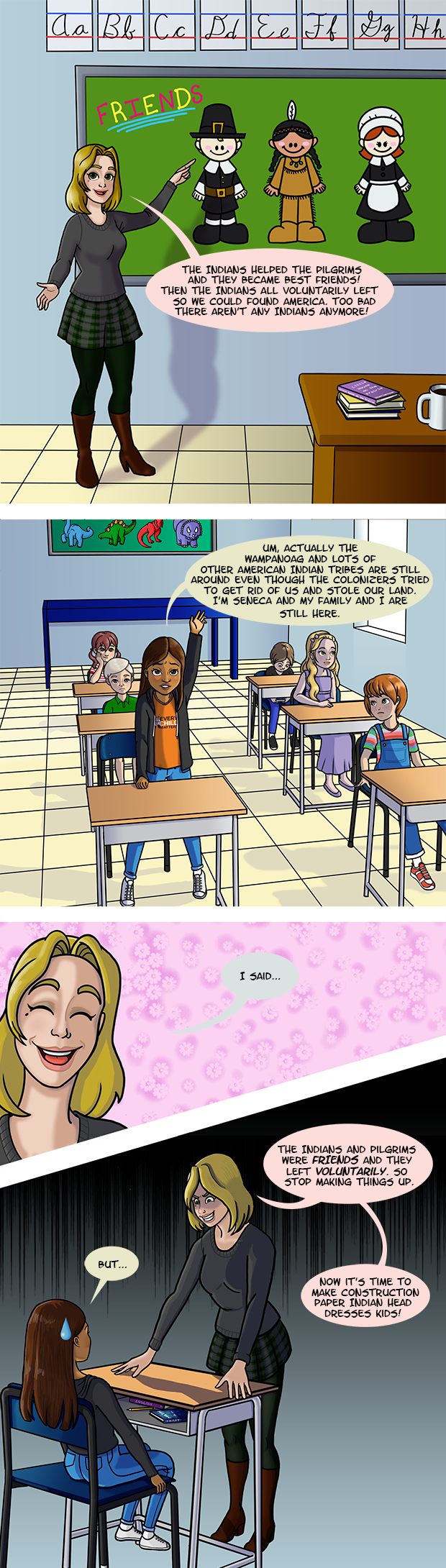
A White teacher stands in front of her class and is pointing to racist, stereotypical cartoon images of Pilgrims and Indians. The teacher says “The Indians helped the pilgrims and they became best friends! Then the Indians all voluntarily left so we could found America. Too bad there aren’t any Indians anymore!” The only non-White child in the class, a Native girl raises her hand and say “Um, actually the Wampanoag and lots of other American Indian tribes are still around even though the colonizers tried to get rid of us and stole our land. I’m Seneca and my family and I are still here.” The cheerful teacher says “I said…” then she turns menacing “…The Indians and Pilgrims were FRIENDS and they left voluntarily. So stop making things up. Now it’s time to make construction paper Indian head dresses kids!”

The sad thing is, the “Pilgrim and Indian” drawings are based on actual, present day “lessons” from teaching websites. This comic is loosely based on my experience as the only Black kid in class when we learned about the Civil War. The Seneca girl is wearing a “Every Child Matters” orange shirt for Residential Schools survivors.

White supremacist Andrew Jackson believed American Indians had “neither the intelligence, the industry, the moral habits, not the desire of improvement” and used this to justify the numerous acts of Cultural Genocide he committed. One of the worst was the Indian Removal Act, which forced the Cherokee, Choctaw, Chickasaw, Creek and Seminole to choose between assimilation or leaving their homelands. Justin Giles, assistant director of the Muscogee (Creek) Nation Museum, describes it as, “You can have one of two things: you can keep your sovereignty, but you can’t keep your land. If you keep your land you have to assimilate and no longer be Indian… you can’t have both.” While reading The Marrow Thieves, I was struck by how much the world Dimaline created felt like a futuristic Nazi Germany. It makes sense considering “American Indian law played a role in the Nazi formulation of Jewish policies and laws” according to professor of law Robert J. Miller. Good job America, you helped create the Holocaust. I’m sure Andrew Jackson would be proud.

But people tend to object to mass murder and breaking treaties, even in the 1830’s. Jackson’s Indian Removal Act was controversial and drew a great deal of criticism, most notably from Davy Crockett and Ralph Waldo Emerson. Christian missionary and activist Jeremiah Evarts wrote a series of famous essays against the Removal Act that accused Jackson of lacking in morality. So even back then folks hated the 7th president for being a lying, racist piece of shit. Of course that didn’t necessarily mean they were accepting of the people they saw as “savages.” A line from They Called it Prairie Light sums it up best: “Europeans were at first skeptical of the humanity of the inhabitants of the American continents, but most were soon persuaded that these so-called Indians had souls worthy of redemption.”  So how could they “kill” Indians without actually killing them and looking like the bad guys? Richard Henry Pratt came up with the solution. Changing everything about Indigenous people to make them as close to Whiteness as possible.

“A great general has said that the only good Indian is a dead one. In a sense, I agree with the sentiment but only in this: that all the Indian there is in the race should be dead. Kill the Indian in him, and save the man.” – Richard Henry Pratt

Pratt was a former Brigadier General who had fought in the Union during the Civil War. He spoke out against racial segregation, lead an all Black regiment known as the “Buffalo Soldiers” in 1867 (yes, the ones from the Bob Marley song), and unlike Jackson, actually viewed the American Indians as people. Unfortunately, like most “White Saviors,” Pratt was ignorant, misguided and believed Euro-Americans were superior. “Federal commitment to boarding schools and their ‘appropriate’ education for Native Americans sprouted from the enduring rootstock of European misperceptions of America’s natives.” (Tsianina Lomawaima). And so Pratt decided the best way to help American Indians was to remove children from their homes to teach them “the value of hard work” and the superiority of Euro-American culture. Pratt had already practiced turning Cheyenne prisoners of war at Fort Marion into “good Indians” and he was convinced an Indian school would be equally successful. So in 1879 he founded the Carlisle Indian Industrial School, the first Indian boarding school in the US.
“Soon, they needed too many bodies, and they turned to history to show them how to best keep us warehoused, how to best position the culling. That’s when the new residential schools started growing up from the dirt like poisonous brick mushrooms. We go to the schools and they leach the dreams from where our ancestors hid them, in the honeycombs of slushy marrow buried in our bones. And us? Well, we join our ancestors, hoping we left enough dreams behind for the next generation to stumble across.”

Miig telling the kids how the bone marrow harvesting started.

“Civilizing” American Indian children by separating them from their cultural roots and teaching them Eurocentric values was not a new idea: The Catholic church had already been doing it for years. But it was Pratt who made it widespread. At the school, students were forced to cut their long hair, adopt White names and clothing, speak only in English, and convert to Christianity. Failure to comply would be met with corporal punishment from Pratt, who ran the school like an army barrack. Understandably, Indigenous people —   who had no reason to trust a nation of treaty breakers —    were initially reluctant to send their children away from their families to go to school. But Pratt convinced Lakota chief Siŋté Glešká aka Spotted Tail (one of three chiefs who had travelled to Washington to try and convince President Grant to honor the treaties the US had made) that an English education was essential to survival in an increasingly Euro-centric America. He argued that if Spotted Tail and his people were able to read the treaties they signed, they never would’ve been forced from their land. He would teach the students so they could return home and in turn help their people. Reluctantly the chief agreed to send the children Dakota Rosebud reservation, including his own sons, to Carlise. Ten years later Pratt’s “save the Indian” goal became a National policy and Natives no longer had a choice in the matter.

“As girls, Martha and young Frances found the atmosphere of the school alien, unfriendly, and oppressive. Both had been raised by nurturing parents of the leadership class, and neither had been abused as a child. They had learned the traditions and laws of their tribes, but the church had not had a strong presence on the San Manuel Reservation. When the girls entered the St. Boniface school, their parents had agreed to their enrollment so that they could cope better with an ever-changing society dominated by non-Indians. Furthermore, their parents expected them to be future leaders of the tribe and felt that training at an off-reservation boarding school would better prepare them for tribal responsibilities.” (Trafzer)

Canada was also pushing for assimilation and, using Pratt’s Residential School model, began to develop their own “off-reserve” schools. In 1920 Duncan Campbell Scott, the Deputy Superintendent of Indian Affairs for Canada from 1913 to 1932, passed the Indian Act. The bill made school attendance mandatory for all Indigenous children under the age of 15. Anyone who refused could be arrested and their children taken away by truant officers, the basis for Dimaline’s Recruiters. Residential school survivor Howard Stacy Jones describes how she was snatched by Mounted Police from her public school in Port Renfrew British Columbia and brought to a residential school: “I was kidnapped when I was around six years old, and this happened right in the schoolyard. My auntie and another witnessed this… saw me fighting, trying to get away from the two RCMP officers that threw me in the back seat of the car and drove away with me. My mom didn’t know where I was for three days.”

Scott famously said “I want to get rid of the Indian problem. . . Our objective is to continue until there is not a single Indian in Canada that has not been absorbed into the body politic and there is no Indian question, and no Indian Department, that is the whole object of this Bill.” Schools in the US and Canada did have some dissimilarities. While the U.S. moved away from mission schools in favor of government run ones, most Canadian residential schools continue to be run by Christian missionaries and supported by several churches. As a result, federal control was weaker in Canada and the goal of converting Indigenous people to Catholicism and Protestantism remained at the forefront. Interestingly, during my research I found that Indigenous people reported a wide variety of experiences in US residential schools ranging from positive to negative, whereas the stories about Canadian ones were overwhelmingly negative.  It’s possible that the Canadian residential schools were somehow worse than US ones, possibly due to the strong influence of the state and little government regulation, but I don’t want to draw conclusions on a topic I simply don’t know enough about. Besides it’s not my place to compare the experiences of survivors like that.

Still, I was genuinely surprised to find so many positive memories reported by former US residential school students who felt they benefited from their time there. While conducting interviews for They Called it Prairie Light Tsianina Lomawaima revealed that former Chilocco students had nothing but good things to say about L. E. Correll, the school’s superintendent from 1926 to 1952. “The participants in this research concurred unanimously in their positive assessment of Correll’s leadership, a testimonial to his commitment to students and the school. Alumni references to Mr. Correll… all share a positive tone. He is described as Chilocco’s ‘driving force,’ ‘wonderful,’ [and] ‘a fine man, we called him ‘Dad Correll.'” I bring this up not to minimize the damage the schools did nor excuse the atrocities they committed, but to illustrate the complexity of this topic. It would also be disingenuous not include the wide range of experiences at these schools. Another student at Chilocco wrote a letter to a North Dakota Agency complaining of a broken collarbone and not enough to eat only to be told to stop “whining about little matters.” Another student refused to Chilocco explaining, “I could stay there [at Chilocco) if they furnished clothing and good food. I don’t like to have bread and water three times a day, and beside work real hard, then get old clothes that been wear for three years at Chilocco [sic]. I rather go back to Cheyenne School.”

Regardless, all the schools caused lasting damage to Indigenous culture and communities. What Canada and the US claimed called assimilation “more accurately should be called ethnic cleansing…” explains Dr. Jennifer Nez Denetdale a Najavo Professor of American Studies at the University of New Mexico. Pratt may have had good intentions, but remember what they say the road to hell is paved with. Much like voluntourism today attempts to “help” American Indians through assimilation were rooted in colonialism and hurt more than they helped. Forrest S. Cuch, former director of the Utah Division of Indian Affairs describes the damage done to his tribe, the Utes. “Assimilation affected the Utes in a very tragic way. It was so ineffective that it did not train us to become competent in the White World and it took us away from our own culture, so much so that we weren’t even competent as Indians anymore.” “Children do not understand their language and they’re Navajos. This was done to us.” explained Navajo/Dine elder Katherine Smith. Assimilation was nothing short of Cultural genocide as defined by the 2015 the Truth and Reconciliation Commission of Canada:

“…the destruction of those structures and practices that allow the group to continue as a group. States that engage in cultural genocide set out to destroy the political and social institutions of the targeted group… Languages are banned. Spiritual leaders are persecuted, spiritual practices are forbidden, and objects of spiritual value are confiscated and destroyed. And, most significantly to the issue at hand, families are disrupted to prevent the transmission of cultural values and identity from one generation to the next.”

Residential boarding schools are yet another atrocity that remains suspiciously absent from American and Canadian history books, but they are popular in Indigenous horror (Rhymes for Young GhoulsThe Candy MeisterThese Walls), and for good reason. Survivors describe deplorable living conditions, rampant abuse, rape, starvation, and being torn away from their families and culture. Homesickness was a common problem for young children who had spent their entire lives surrounded by family. Ernest White Thunder, the son of chief White Thunder, became so homesick and depressed he refused to eat or take medicine until he finally died.

“Students arriving at Chilocco [Residential School] met the discrepancies between institutional life and family life at every turn. Military discipline entailed a high level of surveillance of students but constant adult supervision and control was impossible. The high ratio of students to adults and the comprehensive power wielded by those few adults compromised any flowering of surrogate parenting. In the dormitories, four adults might be responsible for over two hundred children. The loss of the parent/child relationship and the attenuated contact with school personnel reinforced bonds among the students, who forged new kinds of family ties within dorm rooms, work details, and gang territories. Dormitory home life-siblings and peers, living quarters and conditions, food and clothing, response to discipline-dominates narratives.”  (Tsianina Lomawaima)

Running away was common and could end tragically. Kathleen Wood shared one of her memories of students who ran away: “There were three boys that ran away from [Chuska Boarding School]. They wanted to go home… They were three brothers, they were from Naschitti. They ran away from here as winter… They did find the boys after a while, but the sad part is all three boys lost their legs.” Not everyone survived their attempts to return home, as was the tragic case for Chanie “Charlie” Wenjack (trigger warning for description of child death). At the Fort William Indian Residential School 6 children died and 16 more disappeared.

Indigenous children first entering residential school would often have their long hair cut short, an undoubtedly traumatic experience for many children. For the Cheyenne the cutting of hair is done as a sign of mourning and deathRoy Smith, a member of the Navajo Nation (Diné) where long hair is an essential part of one’s identity, describes his experience: “They all looked at me when they were giving me my haircut… My long hair falling off. And I was really hurt. The teaching from my grandfather was… your long hair is your strength, and your long hair is your wisdom, your knowledge.” Hair is also holds spiritual importance to the Nishnawbe Aski. An anonymous Nishnawbe Aski School survivor was left deeply hurt be her hair cut:

“When I was a girl. I had nice long black hair. My mother used to brush my hair for me and make braids. I would let the braids hang behind me or I would move them over my shoulders so they hung down front. I liked it when they were in front because I could see those little colored ribbons and they reminded me of my mother. Before I left home for residential school at Kenora my mother did my hair up in braids so I would look nice when I went to school. The first thing they did when I arrived at the school was to cut my braids off and throw them away. I was so hurt by their actions and I cried. It was as if they threw a part of me away – discarded in the garbage.” – Anonymous

***Content warning, descriptions of child abuse and sexual assault and an image of verbal abuse of a child below***

Students were severely beaten for not displaying unquestioning obedience and sometimes for no reason at all. Those in charge would constantly reinforce the message that Indigenous people were stupid, worthless, and inferior to Whites, destroying the children’s sense of self-worth. Some students were forced to kneel for long stretches of time, hold up heavy books in their outstretched arms, or locked in the basement for hours. Children would be force-fed spoiled meat and fish until they vomited, then forced to eat their own vomit. Some were even electrocuted. Chief Edmund Metatawabin recalls his experience at St. Anne’s Indian Residential School:

There was [an electric chair with] a metal handle on both sides you have to hold on to and there were brothers and sisters sitting around in the boys’ room. And of course the boys were all lined up. And somebody turned the power on and you can’t let go once the power goes on. You can’t let go… my feet were flying in front of me and I heard laughter. The nuns and the brothers were all laughing.” – Edmund Metatawabin

From 1992 until 1998 Ontario Provincial Police launched an investigation into the abuse at St. Anne’s Residential School after Chief Edmund Metatawabin presented them with evidence of the crimes. The police took statements from 700 St. Anne’s survivors, many of whom described incidents of sexual assault and abuse involving priests, nuns, and other staff. During her interview one survivor said “This shouldn’t have happened to us. They’re God’s workers, they were to look after us.” (link contains graphic descriptions of abuse). One figure estimates that one in five  students were sexually abused when attending residential school. But schools would cover up the abuse, and anyone who complained was intimidated into silence.
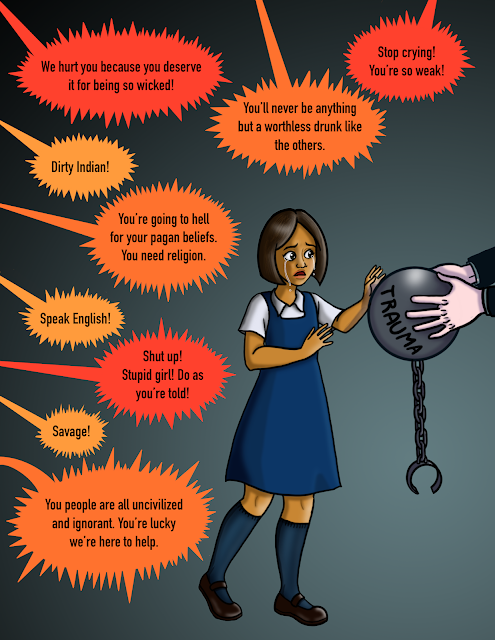
A priest is forcing a ball and chain, representing trauma, to a little girl in a residential school uniform. She is surrounded by red and orange speech bubbles saying cruel things like "Dirty Indian!," "Shut up! Stupid Girl! Do as you're told!," "Savage!," and "You're going to hell for your pagan beliefs. You need religion."

The verbal abuse shown here is paraphrased from actual things said to Residential school survivals. They are taken from interviews and autobiographies. If you or someone you know is being abused, go here. Learn more about forms of abuse here.

All this pain and suffering was committed under the pretense of “civilizing” Native people, when in reality it was Cultural Genocide driven by White supremacy. “The whole move was to make Indian children white… Of course, at the end of the school experience, the children still weren’t white. They were not accepted by White mainstream America. When they went back to their tribal homelands, they didn’t fit in at home anymore either.” says Kay McGowan, who teaches cultural anthropology at Eastern Michigan University. Inuvialuit author Margaret Pokiak-Fenton describes how her mother did not even recognize her when she returned home in her children’s book Not my Girl. As if the rejection wasn’t heart breaking enough, Margaret had forgotten much of her own language and struggled to communicate with her family. Another residential school survivor, Elaine Durocher, says “They were there to discipline you, teach you, beat you, rape you, molest you, but I never got an education…. [instead] it taught me how to lie, how to manipulate, how to exchange sexual favors for cash, meals, whatever the case may be.” In a video for Women’s Centre she volunteers at she discusses how “The teachers were always hitting us because we were just ‘stupid Indians'”.

***End of content warning***

“[People] need to know that it was an event that happened to a lot of kids, that it wasn’t just a few; it was literally thousands of kids that suffered. I’ve come to realize that there were also others where the experience for them was actually very good, and I don’t question that. I can only relate to mine. Mine wasn’t a good one, and I know a lot of really good friends who also did not have a good experience.” – Joseph Williams

In The Marrow Thieves the government and the church join forces to perform experiments on prisoners, and later Indigenous people, in order to find a cure for the dreamless plague. And if you were hoping that was just a metaphor for destroying cultural identities and real residential schools never sunk so low as to experiment on helpless children, well, you’d be wrong. Science has a dark history of exploiting the most vulnerable populations for unethical experiments. In the U.S. alone enslaved women were tortured and mutilated by the father of gynecology  without any form of anesthesia (1845-1849), the government backed Tuskegee syphilis experiment (1932-1972) infected hundreds of Black men without their knowledge or consent, a stuttering experiment (1939) performed on orphans is now known as “The Monster Study,” elderly Jewish patients were injected with liver cancer cells (1963) to “discover the secret of how healthy bodies fight the invasion of malignant cells,” and inmates in the Holmesburg Prison were used to test the effects of various toxic chemicals on skin (1951-1974).

In the 1920s experimental eyes surgeries to treat trachoma were conducted on Southwestern US Natives. The contagious eye disease became an epidemic on Southwestern reservations, affecting up to 40% of some tribal groups. “Some tribes, such as the Navajo, experienced no “sore eyes” prior to their defeat by the United States, yet once confined to the reservation, they witnessed a significant increase in unexplained eye problems.” (Trennert) GEE I WONDER WHY. Maybe it had something to do with being forced to live in poverty on shitty reservations where their access to healthcare and sanitation was limited? The government decided to “help” by once again making it worse. The Indian office opened an eye clinic and hired the Otolaryngologist Dr. Ancil Martin to run it. Dr. Martin began the student treatment program before he had any idea how to cure trachoma. He decided to test out a surgical procedure called “grattage” which involved cutting the granules off the eyelids (without anesthesia of coure). One little girl described the experience: “During the operation they cut off little rough things from under the eyelid. It was a grisly scene, with blood running all over. The children had to be held down tight.” (Trennert) Unfortunately the experimental treatment only provided temporary relief and those children who recovered where left with permanent damage to their eyelids. Later, as part of the “Southwestern Trachoma Campaign,” ophthalmologist Dr. Webster Fox convinced the Indian Office to take even more drastic measures and surgically remove the tarsus (the plate of connective tissue inside each eyelid that contributes to the eyelids form and support). His reasoning for this was because he did not believe Indians would submit to prolonged treatment and it was better to “remove the disease more quickly and with less deformity than the way Nature goes about it.” Yikes.

In case you were hoping this was a tragic but isolated incident, I’m afraid I have some bad news for you. When giving testimony to the Truth and Reconciliation Commission of Canada survivors consistently described an environment where “hunger was never absent.” Residential school meals were typical low in calories (they ranged from 1000 to 1450 calories per day, undernourishment is considered less than 1,800 calories per day), vegetables, fruit, protein, and fat, all essential parts of a growing child’s diet. “We cried to have something good to eat before we sleep. A lot of the times the food we had was rancid, full of maggots, stink. Sometimes we would sneak away from school to go visit our aunts or uncles, just to have a piece of bannock.” explained school survivor Andrew Paul. Food-borne illnesses were another common occurrence. Although at least partly due to negligence or a lack of funds some schools intentionally withheld food to see how the children’s bodies would react to malnutrition, especially as they fought off viruses and infections. “When investigators came to the schools in the mid-1940s they discovered widespread malnutrition at both of the schools” explained food historian Dr. Ian Mosby. ” “In the 1940s, there were a lot of questions about what are human requirements for vitamins… Malnourished aboriginal people became viewed as possible means of testing these theories.” Mosby said an interview with the Toronto Star. And so Indigenous Canadian children became unwitting guinea pigs in an unethical study. Between 1942 and 1952 Dr. Percy Moore, head of the superintendent for medical services for the Department of Indian Affairs, and Dr. Frederick Tisdall, former president of the Canadian Pediatric Society performed illicit nutrition experiments on students at St. Mary’s School. Milk and dairy rations were withheld. Instead children were given a fortified flour mixture containing B vitamins and bone meal. The experimental supplement impacted their development and caused children to become dangerously anemic, and continued to have negative effects on them as adults. Incidentally, this experimental flour mix was illegal in the rest of Canada.

A decade later the U.S. Air Force’s Arctic Aeromedical Laboratory in Fairbanks wanted to study the role the thyroid gland played in acclimating humans to cold in hopes of improving their operational capability in cold environments. The hypothesis was that Alaskan Natives were somehow physically better adapted to cold environments than White people This is another example of scientific racism as the study didn’t bother looking at the White inhabitants of the Arctic Circle:  Greenlanders, who hypothetically should have a similar resistance to the cold. Instead, they chose to focus on Alaskan Natives almost as if they were a different species. The othering didn’t end there. Participants (84 Inuit, 17 Athabascan Indians, and 19 White service members) were given a medical tracer, the radioisotope iodine 131 to measure thyroid function. Guess who wasn’t told they were part of the experiment? Instead of informing the Indigenous test subjects they were participating in a research study as would’ve been required by the recently created Nuremberg Code (the first point in the code literally says “The voluntary consent of the human subject is absolutely essential”), the scientists just said “Fuck it, we do what we want!” I mean, it’s not like someone might want to know they were being given RADIOACTIVE MATERIAL or anything right? Not only did the experiment offer no potential benefit to the Alaskan Natives who participated but the original hypothesis was disproven. The Airforce provided no follow up tests or treatment for the test subjects to insure they hadn’t suffered any long-term effects.

Students at Kenora residential school were used as test subjects for ear infection drugs, again without their knowledge or consent. School nurse Kathleen Stewart wrote in her report “The most conspicuous evidence of ear trouble at Cecilia Jeffrey School has been the offensive odor of the children’s breath, discharging ears, lack of sustained attention, poor enunciation when speaking and loud talking,” In a follow-up report she noted three children “were almost deaf with no ear drums, six had [hearing in] one ear gone.”

Human research violations aren’t just a problem of the distant past before the IRB was established. In 1979 Native leaders asked researchers to help them assess the drinking problem in their community in Barrow, Alaska. They were hoping to cooperate with them to find a solution. Instead the researchers went ahead and publicly shared the results of the Barrow Alcohol Study with news outlets. Because the study implied the majority of adults in Barrow were alcoholics (which was inaccurate), left out the socioeconomic context which led to drinking problems, and then announced the results without representatives from the tribal community, it caused both a great deal of shame and direct financial harm. Starting in the 1990s, Arizona State University obtained blood from the Havasupai tribe under false pretenses. Instead of using the samples for diabetes research like they had promised the tribal members, researchers used the Havasupai’s DNA for a wide range of genetic studies. This continued until 2003 when a Havasupai college student discovered how the blood was being used without permission. Carletta Tilousi explained in an NPR Interview “Part of it is it was a part of my body that was taken from me, a part of my blood and a part of our bodies as Native-Americans are very sacred and special to us and we should respect it.”

Keeping all this in mind the dystopian future that Dimaline created suddenly doesn’t seem so far-fetched. Indigenous people have already had their land stolen, their graves robbed, their children kidnapped, and their culture appropriated. They’ve even had their blood taken under false pretenses. Indigenous children held prisoner in residential schools were deliberately starved and denied access to basic healthcare all in the name of science. The Marrow Thieves feels especially poignant right now, with the Americas experiencing (at the time of writing this) some of the highest Covid-19 rates in the world. Who would we sacrifice to find a cure? Pfizer, the company responsible for making one of the two currently available Covid vaccines did illegal human research as recently as the 90’s. “What does it mean when the disproportionate disease burden currently faced by Indigenous communities is, in large part, the product of a residential system that the TRC has found was nothing short of a cultural genocide?” asks Mosby. “In part, it means that we need to rethink the current behavioral and pharmacologic approaches… in Indigenous communities. In their place, we need more community-driven, trauma-informed and culturally appropriate interventions… [and] also acknowledge the role of residential schools in determining the current health problems faced by residential school survivors and their families…[M]ost importantly, we need to demand that the next generation of Indigenous children have access to the kinds of plentiful, healthy, seasonal and traditional foods that were denied to their parents and grandparents, as a matter of government policy” he argues.

The worst part about the residential school is that even after they closed, their legacy remained and the damage they did would affect future generations. A report entitled Indigenous Communities and Family Violence: Changing the Conversation states “The [Royal Commission on Aboriginals Peoples] named residential schools as a significant cause of family violence in Indigenous communities… and the intergenerational impacts of residential schools on the prevalence continues to be recognized…”. Many of the abused students became abusers themselves, taking out their pain, fear, and frustration on the younger children. After leaving the school, survivors continued to suffer from low self esteem, hopelessness, painful memories and severe mental, social, and emotional damage. Boarding school trauma was then passed down from parent to child and the cycle of abuse would continue.  Because the children were deprived of affection and family during their formative years, many of them left residential school emotionally stunted and unable to openly express love, even towards their own children.

“Few [students] came out of residential schools having learned good boundaries, and good boundaries included some sense of self-determination, sovereignty over your own body. They didn’t have any control over that, and they didn’t see people around with appropriate behavior and being respectful of them as human beings, that they were sacred. And they were abused. Children learn what they live and that was their life.” – Sylvia Maracle, executive director of the Ontario Federation of Indigenous Friendship Centres.

Add in loss of land, racism, poverty, and a lack of healthcare and support and you’re left with a complex system of trauma that’s stacked against Indigenous people and their recovery. A report prepared for the Aboriginal Healing Foundation entitled Aboriginal Domestic Violence in Canada states:

 “Social and political violence inflicted upon Aborigional children, families and communities by the state and the churches through the residential school system not only created the patterns of violence communities are now experiencing but also introduced the family and community to behaviors that are impeding collective recovery.”

In her award-winning autobiography They Called Me Number One writer and former Xat’sull chief Bev Sellars discusses the long-lasting damage to her done by St. Joseph’s Mission.  Sellars watched helplessly as her brother’s personality completely changed as a result of sexual abuse and he began to take out his rage and pain on her. Sellar’s own trauma affected the way she interacted with her three children. She practiced an authoritarian style of parenting she had learned from the school and expected her children to hide their pain instead of expressing it as she was forced to do. Because the only touch Sellars experienced at the residential school was painful and abusive she feared any form of physical contact and was unable to hug anyone until her own children were grown. She continued to fear disobeying any White person or authority figure and made her want her children to behave perfectly in front of Whites.

She describes how she suffered from panic attacks, migraines, nightmares, memory problems, emotional numbness, angry outbursts, shame and phobias after attending the residential school. Because her complaints of mistreatment were dismissed and summarily punished by those in charge, Sellars developed a learned helplessness and “why bother?” attitude. Years of brainwashing by the nuns and priests caused Sellars to see “the world through the tunnel vision of the mission” and led her to believe she was inferior because she was Indigenous. Those familiar with trauma will recognize these as PTSD symptoms commonly seen in survivors. Unfortunately, emotional and mental health were still poorly understood in the 1960s and medical services are limited on reservations forcing survivors like Sellars to find other ways to numb their pain.

***Content warning for image of depressive thoughts below***
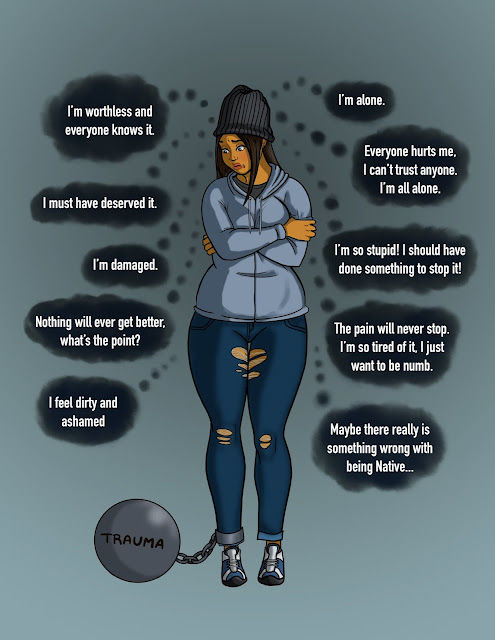
The girl from earlier is now a grown woman. She looks depressed, is wearing dark clothing, and hugging herself. The ball and chain that represents trauma are chained around her ankle. Dark thoughts fill her head like: “I must have deserved it,” “Nothing will ever get better, what’s the point?,” “Maybe there really is something wrong with being Native…,””The pain will never stop. I’m so tired of it, I just want to be numb,” and “Everyone hurts me, I can’t trust anyone. I’m all alone.”

The ball and chain represent the trauma the residential school survivor has to carry around with her. Her thoughts are based on those common to people with trauma. Please contact a mental health provider (listed at the beginning and end of the review) if you have similar thoughts.

***End of content warning***

In The Marrow Thieves Wab eventually shares how her mother became addicted to alcohol and later crack cocaine. The stress of living in a dirty, overcrowded military state while trying not to starve or get taken away by the school staff became too much for her. Wab wonders if her mother could feel herself dying and just gave up. Alcohol and drugs are frequently abused by those who’ve experienced trauma or have untreated mental illness. In fact, childhood abuse is prevalent among alcoholics, and children who experience trauma are four to twelve times more likely to engage in substance abuse. Sellars’ brother never recovered from the sexual abuse he experienced at the hands of the priests and developed an addiction to alcohol. Others survivors die by suicide. According to the CDC the suicide rate among adolescent American Indians is more than twice the U.S. average and the highest of any ethnic groups. Amanda Blackhorse explains “…we’re still feeling the effects of boarding schools today… and it has completely demolished the Indigenous familial system. And many of our people are suffering and they don’t… realize that they are suffering from the boarding school system. Many of us don’t even understand it…”

However, while alcoholism is definitely a problem in Native populations the stereotype of the “drunken Indian” is no more than a harmful myth. Indigenous people aren’t “genetically more susceptible to alcoholism” and American Indians are actually more likely to abstain from alcohol that Whites.

 “The participants in this study talked about historical trauma as an ongoing problem that is at the root of substance abuse issues in their families and communities. Further, the participants believed their experiences to be shared or common among other AI families and communities. Feelings about historical trauma among the participants, their families, and/or their communities included disbelief that these events could have happened, sadness, and fear that such events could recur; however, there also were messages about strength and survival.” – Laurelle L. Myhra

This huge, horrible thing that scarred thousands of survivors and had long lasting effects for Indigenous populations is almost entirely unknown outside of Native, Inuit and Métis communities, and the Canadian Government continues to underfund education and health services for Indigenous children. But there are many Indigenous people, like Bev Sellars, who are not just surviving, but flourishing, and in turn helping others to recover. Indigenous founded and run groups such as The National Indigenous Women’s Resource CenterFreedom LodgeIndigenous Circle of Wellness, and Biidaaban Healing Lodge, are all working to heal generational trauma by combining traditional Indigenous healing practices and modern trauma-informed therapy to create a holistic approach to wellness and mental health. Horror and Apocalyptic Fiction has also given Indigenous creators a way to process this generational trauma and make a wider audience aware of these historical atrocities. But even with everything Indigenous people have suffered through, they’re still here. The Marrow Thieves similarly ends on a hopeful note with Frenchie and his friends holding their heads high as they march into the future.
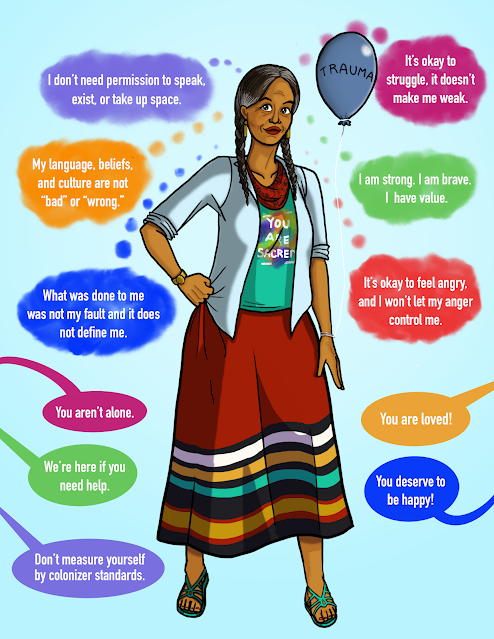
The woman is now older, wearing bright clothing, and looks happy. She has a Native-made T-shirt that says “you are sacred.” The speech and though bubbles all have bright colors. People are giving the woman positive affirmations like “You aren’t alone,” “You deserve to be happy,” and “Don’t measure yourself by colonizer standards.” Her thoughts are happy now instead of dark. The woman thinks “I don’t need permission to speak, exist, or take up space,” “My language, beliefs, and culture are not ‘bad’ or ‘wrong’,” “What was done to me was not my fault and it does not define me,” and “I am strong. I am brave. I have value.”

The girl from the residential school is all grown up, and with the support from her community has started to heal. Her trauma, now represented by a balloon to show the “weight” of it is now gone, is still there but is no longer impeding her ability to enjoy life. She finally feels free to celebrate her Chippewa culture and heritage, as reflected by her bright clothing and long braids. Her T-shirt is from Choctaw journalist and artist Johnnie Jae’s collection. Her skirt is based on the work of Chippewa fashion designer Delina White. Her scarf has a floral Chippewa design.

Sources:

Unspoken: America’s Native American Boarding Schools, PBS, 2016

The Indian Problem, The Smithsonian, 2016

In the White Man’s Image, PBS, 1992

Bopp, J., Bopp, M., and Lane, P.  Aboriginal Domestic Violence in Canada. The Aboriginal Healing Foundation. 2003. https://epub.sub.uni-hamburg.de/epub/volltexte/2009/2900/pdf/aboriginal_domestic_violence.pdf

Dunbar-Ortiz, Roxanne. An Indigenous People’s History of the United States. Boston: Beacon Press, 2014.

Fortunate Eagle, Adam. Pipestone: My Life in an Indian Boarding School. University of Oklahoma Press, 2010.

Health Justice, Daniel. Why Indigenous Literature Matters. Wilfrid Laurier University Press, 2018.

Holmes, C. and Hunt, S. Indigenous Communities and Family Violence: Changing the ConversationNational Collaborating Center for Aboriginal Health, 2017.  https://www.nccih.ca/docs/emerging/RPT-FamilyViolence-Holmes-Hunt-EN.pdf

Jordan-Fenton, C. and Pokiak-Fenton, M. Not My Girl. Annick Press, 2014.

Jordan-Fenton, C. and Pokiak-Fenton, M. Fatty Legs. Annick Press, 2010.

Mihesuah, Devon A. American Indians Stereotypes & Realities. 1996. Reprint. Atlanta: Clarity Press, 2009.

Mihesuah, Devon A. So you Want to Write About American Indians?: A Guide for Writers, Students, and Scholars. Lincoln: University of Nebraska Press, 2005.

Pember, Mary Annette. “Death by Civilization.” Atlantic, 8 March. 2019.

https://www.theatlantic.com/education/archive/2019/03/traumatic-legacy-indian-boarding-schools/584293/

Robertson, David Alexander. Sugar Falls: A Residential School Story. Highwater Press, 2012.

Sellars, Bev. They Called Me Number One: Secrets and Survival at an Indian Residential School. Talonbooks, 2013.

Sterling, Sherling. My Name is Seepeetza. Groundwood Books, 1992.

Trafzer, C. E., Keller, J.A., eds. Boarding School Blues: Revisiting American Indian Educational Experiences. Bison Books, 2006.

Treuer, Anton. Everything You Wanted to Know about Indians But Were Afraid to Ask. St Paul: Minnesota Historical Society Press, 2012.

Tsianina Lomawaima, K. They Called It Prairie Light: The Story of Chilocco Indian School. University of Nebraska Press, 1995.

Robinson-Desjarlais, Shaneen (host). Residential Schools Podcast Series. Audio podcast, February 21, 2020. https://www.thecanadianencyclopedia.ca/en/article/residential-schools-podcast-series

Dawson, Alexander S. “Histories and Memories of the Indian Boarding Schools in Mexico, Canada, and the United States.” Latin American Perspectives 39, no. 5 (2012): 80-99. http://www.jstor.org/stable/41702285.

Cirque Berserk by Jessica Guess

Cirque Berserk by Jessica Guess

Formats: Print, digital

Publisher: Unnerving Magazine

Genre: Killer/Slasher, Myth and Folklore, Occult, Demons

Audience: Y/A

Diversity: Black main character and author, Native Oglala Lakota main character, character with syndactyly

Takes Place in: Florida, USA

Content Warnings (Highlight to view): Abelism, Alcohol Abuse, Animal Death, Child Abuse, Death, Forced Captivity, Gore, Kidnapping, Physical Abuse, Racism, Sexual Abuse (Voyeurism), Slurs, Slut-Shaming, Torture, Verbal/Emotional Abuse, Violence 

Blurb

The summer of 1989 brought terror to the town of Shadows Creek, Florida in the form of a massacre at the local carnival, Cirque Berserk. One fateful night, a group of teens killed a dozen people then disappeared into thin air. No one knows why they did it, where they went, or even how many of them there were, but legend has it they still roam the abandoned carnival, looking for blood to spill.

Thirty years later, best friends, Sam and Rochelle, are in the midst of a boring senior trip when they learn about the infamous Cirque Berserk. Seeking one last adventure, they and their friends journey to the nearby Shadows Creek to see if the urban legends about Cirque Berserk are true. But waiting for them beyond the carnival gates is a night of brutality, bloodshed, and betrayal.

Will they make they it out alive, or will the carnival’s past demons extinguish their futures?

I received this product for free in return for providing an honest and unbiased review. I received no other compensation. I am disclosing this in accordance with the Federal Trade Commission’s 16 CFR, Part 255: Guides Concerning the Use of Endorsements and Testimonials in Advertising.

Put on your sequins and neon spandex, grab a New Coke, and turn up that Whitney Houston cassette because it’s time to take a look at Jessica Guess‘s tribute to eighties’ slashers, Cirque Berserk! Guess’s new horror novella is the perfect ode to trashy, B-horror movies of the yuppie decade à la The Funhouse, Evilspeak, and Prom Night. Praised by one of my favorite horror authors, Stephen Graham Jones, Cirque Berserk hits most of the squares on the “teen scream” Bingo card, but still feels fresh and original. Guess has fun playing with the classic slasher clichés while subverting more problematic tropes like the “black best friend” and the “nice guy” being rewarded with a hot girl. She fills her story with plenty of self-aware humor and the kind of affectionate mocking that can only come from a true horror fan, which balances well with the more serious scenes of racism, sexism, and abuse. The result is a fun, nostalgic, carnival ride with a deeply emotional narrative hidden just beneath all the glitter, gore, and a bad-ass Black protagonist.

A black and red bingo card that says "Teen Scream Bingo." The squares include various slasher cliche's like "corny puns," "abandoned location," "Black best friend," and "masked murderer."

The eighties have made a come back in horror recently with popular TV shows (Stranger Things, American Horror Story: 1984), movies (the It reboot, The Final Girls), and novels (Grady Hendrix’s My Best Friend’s Exorcism) all drawing inspiration from the decade that gave rise to the slasher film, and it’s no wonder why. Not only do they have the nostalgia factor going for them as Gen Xers have their midlife crises, but they’ve got a ton of amazing source material to work from. Eighties audiences were blessed with a plethora of classic horror movies: grotesque monsters (The Thing, Aliens, Scanners, American Werewolf in London), final girls who fought back, (Halloween, Nightmare on Elm Street, Hell Raiser, Aliens), self-aware humor (Elvira, Monster Squad, Fright Night) cool, sexy vampires (Lost Boys, Near Dark, The Hunger) and horror franchises (Texas Chainsaw Massacre, Friday the 13th, The Evil Dead) graced the silver screen. Hell, even the remakes were good. Both The Fly and The Thing arguably surpassed their originals.

But what was it about the decade of greed that inspired so many amazing films? To understand eighties horror, you need to understand that the 1980’s were an age of excess, greed, rapid technological advancement, and reactionary conservatism. As late writer/director Stuart Gordan explained in the Shudder documentary In Search of Darkness: A Journey Into Iconic 80’s Horror, “horror thrives when there’s a repressive government” and the Reagan years certainly qualified. Additionally, public uncertainty and fear lead to the genre’s rise in popularity, just as it did during the Great Depression resulting in Universal’s famous Golden Age monsters. Meanwhile, advancements in technology and the increased affordability of personal computers led to some groundbreaking special effects and makeup (The Thing, Scanners, The Fly, American Werewolf in London). This decade was the perfect balance of repression and paranoia for horror films to flourish.

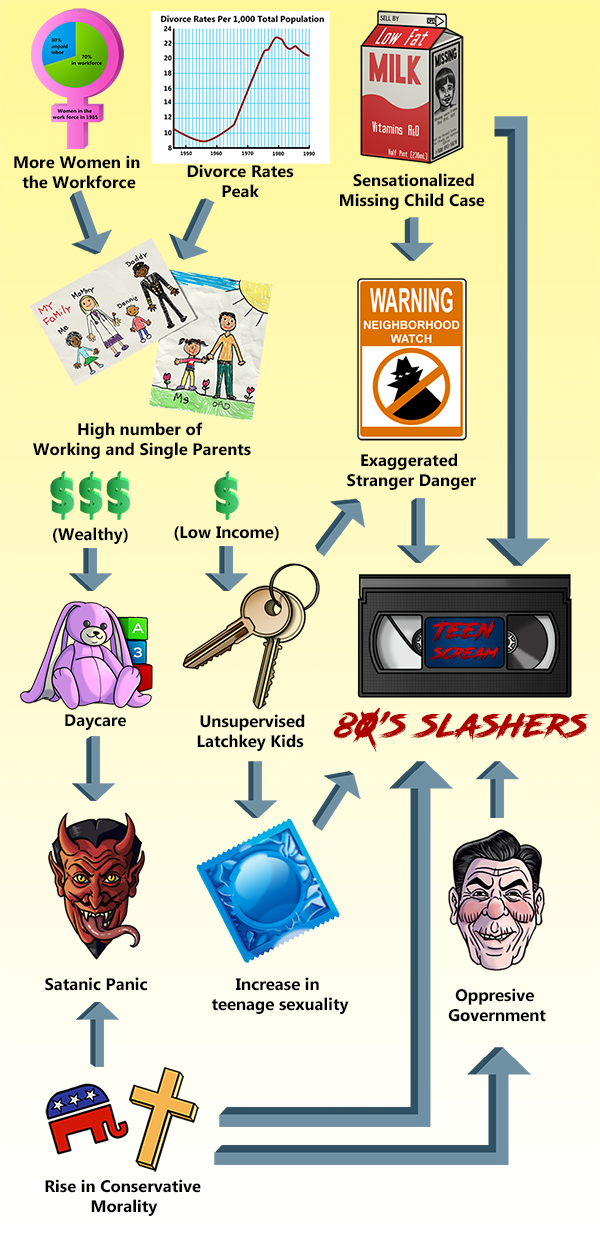
The rise of the “New Right” in the late seventies and eighties brought with it a push to return to “traditional American values” (i.e. being sexist, racist, homophobic, and slut-shaming with impunity). Everywhere you looked, the crack cocaine epidemic was sweeping the nation, AIDS was desolating the population, hardcore porn was easily accessible on video, the rich were getting greedier and richer, and divorce rates had peaked. With more women entering the workforce and an increasing number of newly-single kids were suddenly being left at home unsupervised. The public might have been content with leaving their kids at home, but a generation of ‘suddenly being left unsupervised for long periods of time’ were exposed to a plethora of violence and sex in media. Concern for the latchkey generation was only made worse by the abduction and murder of six-year-old Adam Walsh. The tragic case “created a nation of petrified kids and paranoid parents” who saw danger in every stranger they encountered. The media-fueled mass hysteria eventually led to a rash of Satanic panic.

It was enough to make any God-fearing White conservative clutch their pearls! Rather than blame Reagan for taking away childcare funding and completely botching the response to drugs and AIDS, or recognize that the risk strangers pose to children is minimal at best a vocal group of conservatives decided it was the loss of a nuclear family, declining morals, and demonic media that had left everything such a mess. Even if you didn’t buy into the whole “little Timmy will get murdered by Satanists because his mommy had to rejoin the workforce” school of thought, it was hard to deny the world was pretty scary, what with global warming, Jeffrey Dahmer, the cold war, and deadly invisible illnesses. Why couldn’t we go back to the way they were in the fifties when bad things only happened to minorities and women weren’t constantly going on about equal rights? Back before all teens were watching heavy metal videos on MTV, popping third generation birth control pills, and playing Super Mario Bros on their NES (or whatever they were into back then. Doing whippets maybe? I dunno, I was like 4 at the time). Cue a wave of 1950’s nostalgia and horror films that capitalized on the public’s fear for the safety of unsupervised kids.

A flow chart with images that shows the various events in the 80's that led to the rise in slasher horror as described in the review.

Most slashers followed a basic formula. A group of unsupervised teenagers with poor decision making skills all did “Bad Things TM” until an evil man would show up and kill everyone but the clever, resourceful, virginal hero because they were too pure to be defeated by evil. The story was simple, yet effective — at least in its ability to terrify audiences. I doubt anyone waited for their wedding night because they were afraid Jason would show up for a murderous version of coïtus interruptus. Ironically the conservative adults whose fear and values inspired the horror Renaissance were also its main detractors. Probably because filmmakers were interested in making money, not PSAs about morality, and tits and blood sell. The so-called golden age of slashers began in 1978 with Halloween and ended in 1984 with A Nightmare on Elm Street. Unfortunately sequelitis and low budget direct-to-video horror flicks marked the end of the era, but thankfully schlock could be just as entertaining in all it’s goofy, cheesy glory. When 80’s horror is good, it’s really good, but when it’s bad it’s amazing. And it’s these B-movie slashers that make Cirque Berserk such a fun read. Guess understands that while The Shining may be the Michelin star-winning gourmet meal of eighties horror and the franchise slasher films are the family restaurants with mass appeal, movies like Basket Case and Slumber Party Massacre 2 are greasy fast-food burgers you cram in your maw at 3 A.M. in the CVS parking lot. Yes, they’re terrible for you, and yes you regret it the next day when you wake up with a hangover and smell like dumpster fries, but god damn if those weren’t some delicious fucking burgers. Cirque Berserk is what happens when you have a talented chef prepare those greasy, salty, fast-food burgers. It’s fast, fun, and you won’t be able to put it down until you’ve devoured the whole thing.
Guess cleverly subverts the standard slasher story line while still paying homage to many of its elements. There’s a cast of stereotypical teens whose bad judgement lands them in an abandoned amusement park with a masked killer despite the warnings from the wise old woman at the gas station. There’s stupid teen drama, bad puns, and buckets of blood. Guess even adds a Satanic subplot where a group of disenfranchised teens summon the demon Lilith to grant them wishes, poking fun at Yuppie parents’ unfounded fear that their kids were listening to Stairway to Heaven backwards and using D&D to summon demons. The story is full of self-aware humor, my favorite example of which involves one of the characters pointing out how weird it is that no one is carrying a gun in Florida. Curses and murderous Satan worshipers are well within the realm of possibility, but no one packing heat in a Southern “stand your ground” state is way too weird. Guess manages to give us all this and still make her story genuinely scary. And for what felt like a pretty standard slasher set-up, I was actually caught off guard by a plot twist.

When it comes to her villains, however, Guess dispenses with the usual “irredeemably evil for the heck of it” masked murderers typical in slashers. Instead, she gives us a group of tragic figures who sell their humanity for a chance at freedom. It’s appropriate that the teen killers summoned Lilith to grant them freedom, a figure who chose to become a demon rather than submit to the will of a man. As another famous Abrahamic rebel declares in Paradise Lost “Better to reign in Hell than serve in Heaven.” The Alphabet of Ben Sira describes Lilith as Adam’s first wife, created as his equal. After getting fed up with her husband’s misogyny and bad sex, Liltith decides dick really isn’t worth all this bullshit and flies off into the night, choosing to become a demon rather than submit to male authority. Modern Jewish feminists, such as Judith Plaskow, interpret her as “a female symbol for autonomy, sexual choice, and control of one’s own destiny.” In her midrash, The Coming of Lilith, Plaskow writes “Lilith not only embodies people’s fears of how attraction to others can ruin their marriages, or of how risky childbearing and raising children are, but also represents a woman whom society cannot control—a woman who determines her own sexual partners, who is wild and unkempt, and who does not have the natural consequences of sexual activity, children.” Demon or no, Lilith sounds like my kind of woman.

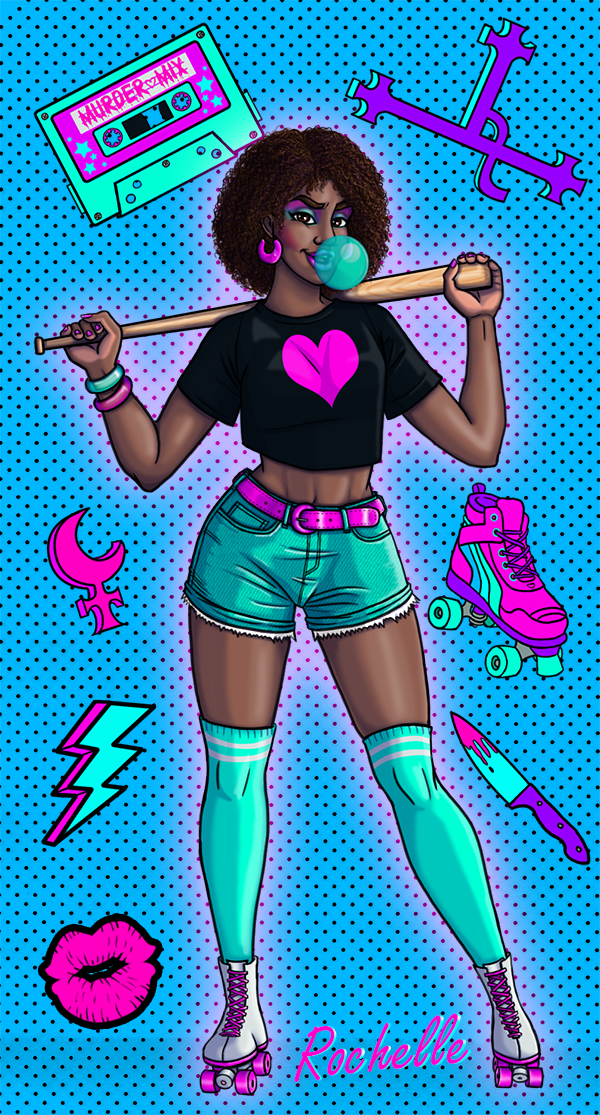
But my absolute favorite part of Cirque Berserk is Guess’ tough-as-nails and whip-smart protagonist, Rochelle, who is anything but your typical final girl. Guess got the name from Rachel True’s character in The Craft, whose frequent erasure from horror conventions and panel discussions Guess even wrote about here. She explains that this was her way of honoring True. “I love The Craft and I got the idea for Cirque Berserk a little after watching Horror Noir and hearing what Rachel said about being typecast as the best friend and always having to say “are you okay” a million different ways. My Rochelle is a response to that.” And I say she’s the perfect response! But what else would you expect from Guess, creator of the Black Girl’s Guide to Horror blog? Cirque Berserk is a novella for Black and Indigenous horror fans who are sick of getting cast as victims, and hero helpers. As Guess states on her website:

“Horror is for everyone, but it doesn’t always feel that way with the lack of representation in the genre. Final Girls? White. Heroes? White. Villains? White. Masters of Horror? Mostly all white. Even those who talk about horror are all for the most part White. [My site] is the answer to the too white, too male, too cis, too straight genre that so many of us love but don’t see much of ourselves in.”

A teenage Black girl with natural hair. She's wearing roller skates, blowing green bubble gum, and has a bat slung over her shoulders. She surrounded by images of roller skates, a bloody knife, symbols for the demon Lilith, and a murder mix tape. The art is colored in pinks, teals, greens, blues, and purples. All colors that were popular in the eighties.

The novella has very few problems. I felt like some of the descriptions were a bit lacking  and Guess has a tendency to “tell” rather than “show.” The word choices could also get repetitive (for example using “said” repeatedly), but these are both fairly minor nitpicks for what’s otherwise a very strong story. I also wish we’d been given a little more time with the victims before they started getting picked off one by one, but I otherwise can’t complain about the novella’s pacing. Building suspense is a great way to make your story scary, but sometimes you want a horror book that gets straight to the killing spree instead of dicking you around for ten gore-free chapters. And Guess knows how to give the reader that instant blood-soaked satisfaction we crave. Her book was the perfect length: long enough to get its point across without letting the story drag. It may not be as fancy or polished as some award-winning, gourmet novel, but who gives a fuck? You know which one you’re going to be craving at 3 AM.

The Lamb Will Slaughter the Lion by Margaret Killjoy

The Lamb Will Slaughter the Lion by Margaret Killjoy

Formats: Print, digital

Publisher: Tor

Genre: Demon, Occult

Audience: Y/A

Diversity: Gay, lesbian, and bisexual characters,Trans character and author, Black character, Latine/Hispanic character, Character with anxiety disorder

Takes Place in: Iowa, USA

Content Warnings (Highlight to view): Animal Death, Forced Captivity, Gore, Oppression, Police Harassment, Mentions of Rape/Sexual Assault and Abuse, Suicide, Violence 

Blurb

Searching for clues about her best friend’s mysterious suicide, Danielle ventures to the squatter, utopian town of Freedom, Iowa, and witnesses a protector spirit — in the form of a blood-red, three-antlered deer — begin to turn on its summoners. She and her new friends have to act fast if they’re going to save the town — or get out alive.

I’ll admit, I really didn’t know much about Anarchism or the squatter/crusty punk/traveler lifestyle (which are all different, but overlap) before picking up The Lamb Will Slaughter the Lion. I had a vague notion that Anarchists didn’t like the government, but I always pictured them as some sort of cishet white boys, oblivious to their own privilege, who would disrupt otherwise peaceful protests by smashing windows and setting things on fire. Heck, if you google Anarchist, one of the synonyms that pops up at the top of the page is “terrorist”. Of course, I started to question my long-held prejudices when I noticed some of my Facebook friends, many of whom are minorities, identified as anarchists. These were people who frequently posted about human rights, non-violence, and green-living – a far cry from the violent images of Anarchists I’d seen in TV shows and movies. It was Margaret Killjoy’s novella that finally familiarized me with the movement and the people in it and encouraged me to do my research.

Killjoy, drawing from her own experience as a travelling Anarchist, created a diverse cast of anti-capitalists punks. The main character, Danielle, suffers from one of the most realistically portrayed anxiety attacks I’ve ever seen in fiction. Her mental illness isn’t glamorized or downplayed, nor is she depicted as a “crazy, weird girl”. She develops a crush on Brynn, a bisexual woman, who offers to snuggle with her in bed, without any sort of pressure or expectation. Vulture, a queer, black, femme trans-man, introduces himself  to Danielle by asking what pronouns she uses. Most of the anarchists depicted in the book are peaceful, only resorting to violence in cases of self-defense, and limiting their minimal criminal activity to squatting in abandoned buildings and shoplifting necessities from big box stores. They’re idealists, but they’re also flawed and human. Some of the younger characters can be heavy handed about declaring how punk/counter culture they are, still too insecure to realize they don’t need to prove anything to anyone. One of the story’s antagonists actually calls someone a poser like it’s the sickest burn in the world. Vulture is obsessed with posting everything to Instagram, while his partner behaves like he’s in some sort of dramatic art film. The characters bicker, disagree, and even get into scuffles, and it all feels incredibly genuine and authentic.

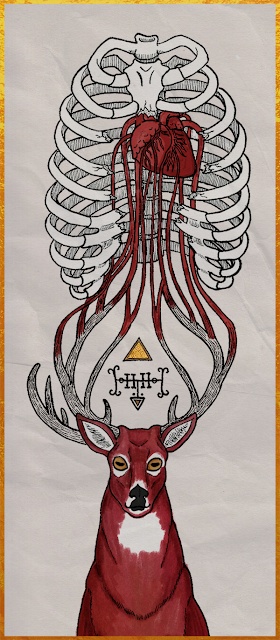
When Danielle first stumbles across the Anarchist commune where her deceased friend, Clay, was living, it seems like an Anarchists Utopia. There’s no capitalism, money, oppressive laws, or ruling bodies. Everyone helps each other out by sharing their food and resources, the town functions on trust alone, and all issues are solved through group consensus with the aid of mediators. There’s also a blood-red demon deer named Uliksi who reanimates dead animals and has a penchant for ripping out hearts. Clay co-founded Freedom with the best of intentions, but the wide-eyed idealist failed to consider the fact that any political system can be corrupted, no matter how perfect it seems. There’s a reason Utopia is based on the Greek “ou topos” which means “no place”. It’s because human nature is inherently flawed, making perfection impossible. Since the Golden Age and the Garden of Eden, somebody is always ruining paradise for everyone else, and the town of Freedom is no exception. In this case, it’s entitled fuckboys who use violence and threats to impose their will on everyone, turning the town from an Anarchist haven to a totalitarian dictatorship. Almost a year before Danielle’s arrival in Freedom, a man named Desmond took over the town, murdered those who disagreed with him, and prevented anyone from leaving. Terrified and desperate, Clay and his friends Rebecca, Anchor, and Doomsday resorted to summoning a demon named Uliski, a three-antlered deer with blood red fur, to stop the want-to-be despot. Most of you are realizing immediately that this plan will inevitably backfire because, much like trying to form a Utopian society, demon summoning never ends well.  Personally, I wouldn’t know because my wife won’t even let me summon a single adorable, little owl even though I’m pretty sure (like 80% sure) it would turn out fine, not that I’m bitter about it or anything. Anyway…. Clay and his crew figure “fuck it, we’ll deal with the consequences later” and let Uliski rip out Desmond’s heart.

First panel: I’m standing in a summoning circle with a long-legged owl demon wearing a crown and boots. My wife is reacting in horror and asking “What are you… did you just summon a demon!?!” 2nd panel: I hug the demon and ask “Can I keep him? He’ll be good! I’ll train him, and him, and feed him souls every day!” 3rd panel: My annoyed wife snaps “No! Put. It. Back.” While I plead “But we love each other! Stolas will be sad if I send him back! Pleaaaase? He’s so polite and smart! He knows all about plants, precious stones, and astronomy.” Stolas turns his head upside down.  4th panel: “Watch!” I shout enthusiastically “Prince Stolas, what star is that outside?” “That is the Sun” Stolas responds. “Good Boy! Such a smart little demon fluffy face!” My wife is not impressed. 5th panel: Stolas explains “Take mistletoe to treat an inflammation of black bile and enhance fertility” while I hug him tightly.  My wife points out “That’s not even remotely correct.”

According to the Ars Goetia, Prince Stolas is Great Prince of Hell who commands twenty-six legions of demons and imparts knowledge on those who summon him. He’s also super cute. Please do not take Mistletoe. It is very toxic.

Instead of fucking off back to the Underworld, or wherever it is endless spirits live, Uliski decides to stick around to continue his mission of hunting the vengeful and hateful who wield power over others, and reanimating animal corpses because he wasn’t already creepy enough already. At first, everyone is so glad that Desmond has been stopped and peace restored, they don’t really question the demon living in their town and even come to revere him. But Clay warns that Uliski will eventually turn on his summoners after one year, which leads us to Danielle’s arrival. She has a rather traumatic welcome after witnessing the bloodthirsty buck rip out Anchor’s heart, encountering a bunch of zombie wildlife, and dealing with town’s crazy drama, but instead of hauling ass out of the Animal Farm version of Dawn of the Dead, she resolves to stay and search for answers behind Clay’s suicide. Meanwhile, Freedom is in an uproar over whether or not their demonic protector should be dismissed, with half the town believing he’s keeping them safe and only kills when it’s justified, and the other half pointing out that murder may not be the best way to keep the peace. Once again, the town seems headed towards a Dystopian nightmare, with Uliski’s remaining summoners afraid for their lives, and a new charming and arrogant young man looking to “save” Freedom by enforcing his will on others.


A gold-trimmed pen and ink drawing of a red deer with three antlers, two on the right and one on the left. The prongs of the antlers turn into veins which are connected to a human heart, surrounded by a fractured rib cage. Between the deer's antlers is the sigil for the goetic demon Furfur and the alchemical symbol for fire, painted gold.

Uliski the demon deer

This is a story about how power causes corruption, especially when it’s wielded by violent young men dripping with privilege. While the novella is very pro-Anarchist, Killjoy keeps it from feeling too much like heavy handed propaganda by presenting a balanced view of her socio-political beliefs and chooses realism (well, other than the supernatural elements of course) over romanticism. The town of Freedom is presented as both an ideal and a warning; a community based on equality and cooperation is something to strive for, but, like any system, it can easily be corrupted by selfishness and fear even when everyone has the best of intentions. Hierarchies started to form without anyone realizing, and once those hierarchies were enforced through violence Freedom went from Anarchism to Authoritarianism, much like what happened after the Russian revolution.

As much as I loved The Lamb Will Slaughter the Lion, I felt it would have worked much better as a full-length novel, rather than a novella. The world building, story set up, character development, and ending all seemed too rushed and I was left feeling underwhelmed and longing for more. The concept is so cool, a demon deer turning on its summoners as a revolution slowly brews from with the town, that I wanted to spend more time there and learn about all the characters and what brought them to Freedom. I especially wanted to see more of Danielle and Brynn’s relationship develop. These reasons are why I much prefer the sequel, The Barrow Will Send What It May. By the second book, Killjoy has already established the world and the main players in it and is able to spend more time on developing her characters, building suspense, and giving Danielle and Brynn time to explore their feelings for each other. It’s for these reasons that I strongly suggest reading the two novellas together. The Lamb Will Slaughter the Lion feels incomplete on its own, but works well as the first chapter to an overarching story, and this is why I truly hope we will see many more chapters in the Danielle Cain series. I want to read a full-length novel about a band of Anarchists travelling from town to town solving mysteries and fighting demons, Scooby-Doo and Supernatural style, even if it is separated into several short stories. Killjoy clearly has many more stories to tell, and I look forward to reading them.

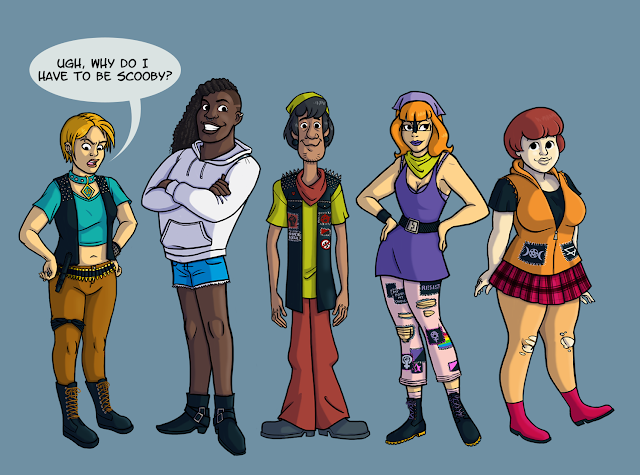
Five people in punk clothing colored to resemble the characters from Scooby-Doo. Furthest to the left is Danielle, a White woman with short, blonde hair. Next is Vulture, a tall, Black trans man with long hair and one half of his head shaved. Thursday, a Latino man in a leather vest is the middle, then Brynn, a White woman with red hair, a tattooed line on her forehead, and glasses. Her pants are covered in lgbtq, anarchist, and feminist patches. On the left is a chubby White woman, Doomsday with bobbed, brown hair.

Left to right are Danielle (as Scooby), Vulture (as Fred), Thursday (as Shaggy), Brynn (as Daphne), and Doomsday (as Velma). Anarchist Mystery Gang!

 
Ten by Gretchen McNeil

Ten by Gretchen McNeil

Formats: Print, audio, digital

Publisher: Harper Collins

Genre: Mystery, Psychological Horror, Killer/Slasher

Audience: Y/A

Diversity: African American character, Japanese American character, Asian American character, Samoan character, Bipolar character

Takes Place in: Seattle, USA

Content Warnings (Highlight to view):  Sexist Language, Abelist Language, Racist Language, Sexism, Mental Illness, Drug Use, Violence, Death

Blurb

SHHHH!
Don’t spread the word!
Three-day weekend. Party at White Rock House on Henry Island.
You do NOT want to miss it.

It was supposed to be the weekend of their lives—an exclusive house party on Henry Island. Best friends Meg and Minnie each have their reasons for being there (which involve T.J., the school’s most eligible bachelor) and look forward to three glorious days of boys, booze and fun-filled luxury.

But what they expect is definitely not what they get, and what starts out as fun turns dark and twisted after the discovery of a DVD with a sinister message: Vengeance is mine.

Suddenly people are dying, and with a storm raging, the teens are cut off from the outside world. No electricity, no phones, no internet, and a ferry that isn’t scheduled to return for two days. As the deaths become more violent and the teens turn on each other, can Meg find the killer before more people die? Or is the killer closer to her than she could ever imagine?

Ten is inspired by Agatha Christie’s bestselling mystery thriller, And Then There Were None, a tale of ten strangers with dark secrets trapped on an island with a killer who terminates them in ironic ways and publicly marks the deaths one by one. McNeil takes Christie’s original concept, sets it in modern times, changes the terrible, unlikeable adults into a bunch of terrible, unlikeable teens, does away with racism, xenophobia, and anti-Semitism, and replaces it with a diverse cast.

Like the original Christie novel, Ten starts off with ten (get it!?!) people gathering on a remote island under false pretenses only to discover that it was all a trick by the killer, who has kindly left them a Ringu-esque DVD (a gramophone record in the original) to inform the victims of their inevitable demises and remind them how shitty they all are (in case you started feeling bad for any of them). At first, no one believes the sketchy murder announcement is legit, at least until they start dropping like flies, and then all hell breaks loose. Both books involve distrust, everyone accusing each other, the fear of knowing there’s a wolf (or possibly wolves) hiding among the sheep, and of course, a party with a body count. Why do so many parties in these kind of stories end up with a bunch of dead guests? Does the Red Death just go around gate crashing every party in the horror genre? Why does every gathering of three or more people that involves alcohol inevitably end in someone’s demise? Being an introverted nerd who would rather gnaw off my own hand than attend most social gatherings, I honestly have no idea what happens at parties, so I’m just going to assume that it’s pretty standard for them to end in either mass murder or demon summoning (and now I wish I went to more parties).

 I’m walking with a red-headed friend who cheerfully asks “So, you’re coming to my party tonight, right? Everyone is going to be there!” Apprehensive, I respond “Oh uh…” then plunge a knife into my stomach. Holding my wound and trying to smile through the pain, I respond to my shocked friend “I can’t make it because I have to go to the ER and get stiches, heh.” Irritated, she asks “Wait, were you just carrying that knife around the whole time?” Bleeding profusely, I mutter “Oh God, I think I nicked my liver.”

A liver laceration is a small price to pay to avoid social interaction.

Last, but not least, is the diversity, which pretty much only applies to Ten since Agatha Christie was a racist asshole, so it’s pretty obvious who the winner is here, but let’s go over it anyway. Ten features a fairly diverse cast, with about half the characters being POC, in addition to a character with a fairly realistic depiction of bipolar disorder. Of course, most of the characters don’t get enough of a chance to develop anything close to a personality before they get offed, so they’re all pretty one-dimensional characters. There’s also a “rebellious” East-Asian girl with a rebellious blue streak in her hair, so Ten isn’t completely free of stereotypes either. But at least the diversity is there, even if it sometimes leans more towards “early 90’s kid show” diversity.

A drawing of the members of the “Burger King Kid’s Club”, a multi-ethnic group of fictional children from the 90’s. Their names are written next to them. In the front row are the dog, J.D., and a white boy in a wheel chair named “Wheels.” The second row (from left to right) shows a butch red-headed girl in sports-wear named Boomer, a femme blonde girl named “Snaps”, and a short, white boy named I/Q. The back row depicts JaWs, a black kid, a Hispanic boy named Lingo, and another white boy named “Kid Vid”.

I can just imagine Wheels being like “My name is Jordan, you insensitive, ableist jerks.” Well, at least it’s better than JaWs, his names looks like a typo. Why do none of these children have normal names?! Is their mom Gwyneth Paltrow? And how come the white kids get to be in the front?

So how does the re-imagining stand up to the original classic? In terms of writing, McNeil is a decent-ish author, but there’s just no competing with Agatha “The Queen of Crime” Christie. I mean, Agatha is the world’s best-selling mystery writer (that’s not an exaggeration, she’s actually in the Guinness Book of World Records), while Ten contains the line “The whole thing had been a perfect storm of not awesome.” So yeah…any comparison between the two would be downright unfair. However, it seems like McNeil realizes this, and isn’t trying to outdo her inspiration. Plot-wise, both books have a good mystery, although the original is unbelievably difficult to solve, and requires an extensive epilogue to explain what the hell just happened because the clues are so vague. Even knowing who the killer was on subsequent readings of And Then There Were None, I couldn’t pick up on any hints as to their identity. In fact, I’m not entirely convinced Christie didn’t just randomly pull the ending out of her ass at the last minute, but whatever, at least I couldn’t guess the culprit after a few chapters. Meanwhile Ten gives the reader enough clues to figure out the ending without being super obvious. That is, unless you’ve already read And Then There Were None in which case you’re probably going figure out the killer (or killers) almost instantly. So yeaaaaaaah, sorry about that. The scary parts of Ten are done well, but the rest of the story (especially the beginning) feel forced. All the dialogue is generic teen bickering and cookie cutter conversations about crushes, school, and beer and it only exists as a quick set up before the murder spree starts.

While Christie’s novel is a psychological thriller that focuses heavily on the characters, McNeil’s work leans more towards the classic horror genre, specifically the teenage slasher/cabin in the woods kind. The characters in both stories are awful human beings, which works fine for And Then There Were None, where they’re at least complex and interesting, and we’re more interested in solving the mystery than anyone surviving. The closest thing we have to a primary cast in Christie’s book are Vera the governess, Philip Lombard the solider, Armstrong the doctor, and Blore the private investigator. And it’s still really ambiguous if any of them are the killer until the end. Christie switches the point of view frequently, so her reader becomes just familiar enough with each character to get a basic understanding of their personality, but not so much as to clue them in to the killer’s identity. In Ten we’re given a clear and likeable protagonist to root for, the shy Meg, along with her best friend, Minnie, and their shared love interest, T.J. (ugh, love triangles). This lends itself better to a slasher story where we need at least one character whose safety we fear for, and then a bunch of cannon fodder characters to satisfy the reader’s bloodlust. (Let’s face it, if you’re reading a book like this you’re looking for a body count.) The rest of the cast is one dimensional and just needs to hurry up and die. However, this does add a wrinkle to the whole revenge thing, you can’t very well root for a main character that did something terrible, so we know the killer/killers are either overreacting or there’s been a terrible misunderstanding. It also means we can rule out Meg as the killer (and assume it’s probably not Minnie either), but there are still enough potential killers left over to fuel plenty of paranoia.

Having most of the characters know each other in Ten adds an extra layer of creepiness because no one wants to believe their friend is a murderer, and the killer is quite literally backstabbing people who trusted them. In Christie’s setup, you don’t really care who gets the ax (literally and figuratively) because everyone is awful. Lombard’s an arrogant chauvinist who left a bunch of natives to die because he barely saw them as people, Blore is an overconfident idiot who falsifies evidence, and Dr. Armstrong is a spineless alcoholic who cares more about recognition and his reputation than the patient he killed while he was drunk. The only character who is sort of sympathetic is General MacArthur, and that’s only because his victim was a world class jerk who slept with the guy’s wife, and MacArthur feels genuinely remorseful about sending him on a death mission. And that’s not even including the minor characters and all the reasons they suck. The mystery and the identity of the killer are really the only things that matter in And Then There Were None (okay, and maybe whether or not Vera survives, she’s slightly more likable than her companions), which makes it a captivating read, but not particularly scary.

Because Ten is aimed at teens, McNeil threw in a completely unnecessary love triangle (as is apparently required for any book in Y/A section) because apparently a murder spree wasn’t dramatic enough. To her credit, McNeil makes the clichéd romance slightly less terrible by actually giving Meg a legitimate reason for not wanting to upset Minnie by going after their mutual crush. Minnie suffers from bipolar disorder, and even though she’s finally getting treatment, she’s still prone to making bad decisions while manic, including turning into someone Meg didn’t recognize and lashing out when she found out her best friend was also interested in T.J. Because she’s been friends with Minnie for so long, and the mental illness is a more recent development, Meg still hasn’t quite figured out a balance between an overprotective enabler and a supportive friend when Minnie is having a depressive or manic episode. Because Minnie is still in serious denial about her Bipolar Disorder and tends to minimize the severity of her symptoms Meg also feels responsible for her best friend’s wellbeing and acts like a mother hen. It also doesn’t help that Minnie’s dad has asked Meg to “take care of his daughter” and placed an unfair burden on her unqualified shoulders. As a result, the two girls have developed a toxic, codependent relationship with Meg treating Minnie like she’s some sort of fragile doll who will shatter at the slightest hardship. Honestly their dysfunctional relationship was about 100 times more interesting than their stupid crush on T.J.

It’s still about five hundred times better than the Christie’s original novel (not that that’s saying much), which, by the way, wasn’t originally called And Then There Were None. The actual title of the novel was considered too racist for American publication, 25 years prior to the Civil Rights Act. That’s right, a country where racial segregation was totally legal was like “Whoa, Agatha, that title’s pretty offensive, don’t you think?” So she can’t even use the “oh well, attitudes were different back then” excuse, (which is a bad excuse anyway) because it was still considered fucking offensive at the time it was published. Mark Twain’s used racial slurs in The Adventures of Huckleberry Finn to make a point about the evils and ugliness of slavery, but the racism, anti-Semitism, and xenophobia in And Then There Were None have literally no reason to be there. Christie, like Lovecraft (who I complain about in detail here), is one of those writers whose obvious talent is often marred by her bigotry, which sucks because her work is otherwise really enjoyable. Of course, that’s like saying “This ice cream sundae is pretty enjoyable, except there’s a dead rat in it.” I mean, you could probably eat around it, but the experience is still going to be severely tainted by a rodent carcass.

A beautiful ice-cream sundae with strawberry, chocolate, and vanilla scoops of ice-cream, fresh sliced strawberries, three different sauce toppings, and bits of nuts and sprinkles sits in a glass dish. Lying on the ice-cream, drizzled with fudge sauce, and topped with whipped cream and a cherry, is a dead rat. The rat is lying on its back, with its little pink feet in the air, its tongue hanging out, and little red “X’s” over its eyes.

I mean, I’d probably still eat it… but I have problems.

These days, there are editions of Christie’s book that have been edited to varying degrees to make the work less jarringly racist (and before anyone starts screaming about censorship, the original, unedited version is still in print too, so you’re free to read whichever version you want), but it’s still super uncomfortable. Even in the edited versions that aren’t dropping the N-word every few pages, the ugly attitude still hangs heavy in the air throughout the story, and it’s difficult to immerse yourself in the mystery with that hanging over you. Plus, none of the anti-Semitism was edited out in the audiobook version I listened to, so I still got to “enjoy” hearing that in the first chapter. Fun! Of course, how many problematic elements you’re willing to put up with before the book becomes irredeemable depends on the individual. I liked… aspects of Christie’s book well enough, but I can understand if someone has zero desire subject themselves to 272 pages (or in my case 6 hours) of bigotry.

So, which book is better? Ten preserves some of the spirit of the original story, but does away with the blatant racism, although it leans more towards slasher horror than suspense. But And Then There Were None is considered a classic for a reason. The quality of the writing is obvious, Christie does an excellent job building the suspense, and the characters are unique and interesting (you could probably write an entire English paper on each of them). Ten isn’t a bad book, but it’s never going to be a literary classic. So, which would I recommend? Well, it really depends what you’re looking for: a fun horror story, or a classic murder mystery (and whether or not you want to deal with Christie’s racism). From a literary perspective, yes, And Then There Were None is the better work (no surprise there). But in terms of straight horror? You’ll probably get a lot more scares from reading Ten. You could always read both, like I did, just make sure to read McNeil’s book first to avoid spoilers.

The Ballad of Black Tom by Victor LaValle

The Ballad of Black Tom by Victor LaValle

Formats: Print, audio, digital

Publisher: Tor

Genre: Eldritch, Monster, Historic Horror, Occult, Sci-Fi Horror

Audience: Adult/Mature, Y/A

Diversity: Black characters (African American and Caribbean)

Takes Place in: Harlem, New York City, USA

Content Warnings (Highlight to view): Bullying, Death, Gore, Mental Illness, Medical Procedures, Oppression, Physical Abuse, Police Harassment, Racism, Torture, Verbal/Emotional Abuse, Violence, Xenophobia

Blurb

People move to New York looking for magic and nothing will convince them it isn’t there.
Charles Thomas Tester hustles to put food on the table, keep the roof over his father’s head, from Harlem to Flushing Meadows to Red Hook. He knows what magic a suit can cast, the invisibility a guitar case can provide, and the curse written on his skin that attracts the eye of wealthy white folks and their cops. But when he delivers an occult tome to a reclusive sorceress in the heart of Queens, Tom opens a door to a deeper realm of magic, and earns the attention of things best left sleeping.
A storm that might swallow the world is building in Brooklyn. Will Black Tom live to see it break?

Oh Lovecraft, you were such a great horror writer, but an absolutely terrible human being.

When it comes to Lovecraft, I have some very complicated opinions. I adore the Cthulhu mythos, cosmic horror, and the concept of forbidden knowledge that utterly destroys your sanity, but it’s hard to enjoy his writing when he liberally peppers it with his hatred for anyone who isn’t a WASP. One minute  I’m reading an enjoyable little story about a cosmic abomination and the dark secrets humanity was never meant to know, and the next it’s morphed into some sort of eugenics bullshit. Here’s a small sampling of just some of the bullshit he pulls in his stories: In the Case Of Charles Dexter Ward Lovecraft describes a woman as having “a very repulsive cast of countenance, probably due to a mixture of negro blood,” in Herbert West: Reaminator the black boxer, Buck Robinson, is compared to an ape, in The Rats in the Walls there’s a black cat named N****r Man, The Horror at Red Hook is basically just Lovecraft rambling about how much he hates immigrants and black people who he refers to as a “contagion” with “primitive half-ape savagery”, and in Medusa’s Coil he describes slavery as “a civilization and social order now sadly extinct”. Oh, and let’s not forget that poem. There’s a good reason why Lovecraft’s bust is no longer used for the World Fantasy Award trophy, the guy was a dick.

A drawing of Nnedi Okorafor wearing a dark blue dress, large red and gold earrings, and holding her World Fantasy Award, a bust of H.P. Lovecraft. Okorafor looks uncomfortable while she says “Um, Thanks, I guess? Yeah, I don’t really want this racist’s head on my mantle.”

I tried to draw Nnedi Okorafor, “tried” being the operative word. She says I got it right from the shoulders up though!

Now, before anyone uses the “Lovecraft was just a product of his time” excuse, please consider this: Yes, his active years as a writer were during the incredibly racist segregation era, but not everyone shared his shitty beliefs about people of color and Jews. Mary White OvingtonMoorfield Storey, and William English Walling were all white, but they were also supporters of  civil rights and racial equality during the same period, and even helped found the NAACP with W. E. B. Du Bois. So it’s not like every white person in the 1920s and 1930s was racist. Lovecraft would’ve at least been aware of civil rights due to Guinn v. United States, a landmark case that found racist literacy tests unconstitutional, the National Negro Business League which helped to double the number of black owned businesses, and prominent black lawyer Charles Hamilton Houston, who was fighting for civil rights in court. Hell, even his friends and family criticized the horror writer’s ignorant attitude. Lovecraft’s wife, Sonia Greene, and friend Samuel Loveman were both horrified by Lovecraft’s anti-Semitism and resented him for it. Sonia even wrote, “Whenever we found ourselves in the racially mixed crowds which characterize New York, Howard would become livid with rage… He seemed almost to lose his mind.” When Lovecraft attacked Charles D. Isaacson‘s, article on racial tolerance, In a Minor Key, in his own article titled In a Major Key (where he praised the KKK as “that noble but much maligned of Southerners who saved half our country from destruction”) he managed to piss off not just Isaacson, but his own friend James Ferdinand Morton, both of whom wrote responses attacking Lovecraft’s racism. He knew people thought he was racist, as he’d been called out multiple times and even his wife had pleaded with him to reconsider his beliefs- Lovecraft just chose to be an intolerant jerk.

There are two books. On the left is a book with a red cover written by H.P. Lovecraft. It’s titled “The Horror at Red Hook, or Why Immigrants and Minorities Ruin Everything.” On the right is a green, leather bound book with an image of a brass octopus on the cover. The title, written in gold lettering, is “Lovecraft’s Letters: About How Anyone Who Isn’t Anglo-Saxon Sucks, and Why Eugenics are Super Awesome”.

Probably real Lovecraft titles.

Luckily for us, many talented creators have taken concepts in Lovecraft’s writing and used it to create their own works, so fans can still enjoy Yog-Sothoth, the Deep Ones, and the horrors of forbidden knowledge driving men to madness- without all the bigotry. The Ballad of Black Tom is one of these works, a retelling of  Lovecraft’s incredibly racist The Horror at Red Hook from the point of view of a black man living in Harlem.

For those not familiar with Lovecraft’s original short story, The Horror at Red Hook follows police detective Thomas Malone and his pursuit of forbidden knowledge in the immigrant neighborhood of Red Hook, Brooklyn, or as Lovecraft describes it “a maze of hybrid squalor”. Because the only religions in Lovecraft’s world are either good, Anglo-Saxon Christianity or evil, bad, demon worship, all the brown people are apparently involved with the occult.  Malone is put on a case involving the wealthy and eccentric recluse, Robert Suydam because his relatives want the old man declared mentally unfit so they can have his money. During the course of the investigation Malone discovers that Suydam has been spending time with illegal immigrants and foreigners, which obviously means he’s doing something super evil, like sacrificing white babies to tentacle-faced monsters, because Lovecraft is racist and Malone is an awful detective. Suydam continues to do suspicious things, in Malone’s opinion anyway, like lose weight, work on his personal grooming, and get married. Eventually the whole thing cumulates in a police raid in Redhook, where Malone finds a bunch of creepy shit in Suydam’s basement flat which causes the police detective to lose his sanity points and pass out from sheer terror. Afterwards we discover that the buildings collapsed, killing almost everyone except Malone, who is left with PTSD and batophobia. The rest of the story is just Lovecraft whining about immigrants “ruining” New York and reads like the antiquated 8,000 word equivalent of a Trump tweet. It’s not one of his better stories. So it’s kind of a miracle that LaValle not only manages to write a version of The Horror at Red Hook that’s not just a commentary on racism, but is actually good, while still keeping all the creepiness, mind-fuckery, characters, and plot of the original. Suydam and Thomas Malone both appear as major characters in The Ballad of Black Tom, Malone serving as a deuteragonist for the second half of the story, while Suydam introduces Tommy Tester, the book’s protagonist, to the occult. There are other hidden references to Lovecraft lore throughout the book. The title, Black Tom, is an allusion to the cat from The Rats in the Walls whose name was changed from N***** Man to Black Tom when the story was reprinted in Zest magazine in the 1950s. Toward the end Robert LaValle mentions a man from Rhode Island, living in New York, who may be Lovecraft himself.

LaValle defends the minority population living in Harlem and Redhook that Lovecraft so despised by showing them as the every day folks they are, trying to get by with what little they have. Tommy even expresses disappointment after visiting the Victoria Club, when he learns that it’s not the den of debauchery and sin he had hoped for, but instead old men playing cards and women selling meals they’ve made at home. There are criminals, yes, but that’s to be expected in any impoverished area, and they’re far from a majority of the population. When Tommy discovers Suydam is associating with so many criminals, he’s terrified, and it speaks more to the rich, white man’s character than the immigrants on New York. What Malone discovers in the basement is also been changed from the original, but to reveal more would ruin the amazing ending of Black Tom. Let’s just say LaValle provides his readers with more detail on the horrors the detective discovers, and a much more satisfying ending.

The thing I found the scariest about The Ballad of Black Tom weren’t the fictional monstrosities sleeping at the bottom of the see ready to destroy humanity, it was how much LaValle’s fictionalized world reminded me of our own. The cops’ blatant racism, their harassment of black men who were simply walking down the street, and their willingness to kill at the slightest provocation felt all too familiar, as did the rampant xenophobia and anti-immigration attitudes. The story may be set in the 1920s, but it’s clear that some things still haven’t changed. Tommy’s encounters with the police were enough to give me panic attacks, as I remembered my own family’s terrifying encounters with cops. While I’m pale enough to pass as white, most of my extended family isn’t, and I grew up with horror stories about what happened to black people stalked, shot, raped, and lynched for merely existing. Tommy has learned what every young black person is still being taught: if the police stop you, appear as non-aggressive as possible, be polite, and put up with whatever harassment the cops dish out or you’ll wind up dead. We see this in all his encounters with Malone. Tommy plays dumb, looks downs, and lets them steal his money and insult him to his face without making a comment. At least for the first half of the book.

Tommy Tester starts the story as a good man. He may trick others and take on some not-so-legal work, but he’s trying to take care of his disabled father in a world that’s against him, so it’s not surprising he has to do some questionable things to survive. At least he never actively hurts others and tries to do the right thing when he can, like preventing a witch from getting her hands on forbidden knowledge, which is more than I can say for most of the people Tommy encounters. Racist cops constantly threaten and abuse him, he’s harassed by a bunch of white kids just for walking while black, and white society treats him as less than human. Even Robert Suydam, who claims to admire Tommy and gives him a large sum of money to play guitar in his home, is merely using for his own ends. As it turns out, Suydam is a white man who fetishizes POC cultures, while still viewing himself as superior to the same people he claims he wants to help. There’s a saying “you can only kick a dog so many times before it bites back” and after being attacked, abused, taunted, stolen from, threatened, and finally losing everything to cold and corrupt law enforcement, Tommy Tester realizes he has nothing left to lose and says “fuck it”. And that’s how we start the second half of the story, told from Malone’s point of view, with Tommy, now calling himself “Black Tom,” transforming himself into the most badass, brutal, and terrifying antagonist in order to exact his bloody revenge on Robert Suydam, Thomas Malone, and the xenophobic NYPD. And let me just say, it’s immensely satisfying. Gory, but satisfying.

I abhor violence in real life, and obviously don’t agree with mass slaughter and abuse, no matter how evil the victims are. The real world is more complicated than just good vs. evil, and violence and revenge just beget more of the same. That said, there’s still a violent, pissed off part of me, hurt and furious at the injustice of the world, that wants to see wicked people suffer. Not just get their richly deserved comeuppance, but really, truly suffer in the worst ways imaginable. It’s the bitter part of me that relates to all those Saturday morning cartoon villains of my past who just want to destroy everything, because the world is such a terrible, hateful place that it probably deserves it. This vengeful part of me that becomes more and more hateful every time I read the news was immensely satisfied and soothed to watch Black Tom punish a group of racists who resemble 21st century hate groups a little too closely. It’s the same anger that motivates Killmonger in the Black Panther film.


But, like I said, these are ugly thoughts I would never actually act on or hope to see happen in real life because I know how wrong they are, and I still hold on to the hope that logic and compassion will win out (so FBI, if you’re reading this, I just want to clarify, I’m not actually planning on going on any kind of bloody killing spree). When Tommy, pushed to choose between an eldritch abomination and the hateful people who hurt him again and again, he gives in to revenge and loses part of his humanity, and that’s what makes the story so bitter-sweet. Black Tom may have gotten his revenge, but at the cost of being a good man, something he will have to live with for the rest of his life. He’s compromised his most important value, being the kind of man his father would be proud of, and can no longer look his best friend in the eye. As satisfying as it is to see horrible people suffer a horrible fate, you can’t help but feel bad for Tommy who’s left to wonder if it was really worth it. 

My wife, who is wearing a blue space dress and white, over-the-knee socks has just opened the door to reveal two FBI agents, a light-skinned man, and a dark-skinned woman. My wife has her hands on her and looks irritated. She shouts, “What did you do this time!?!!” I’m in the foreground, carrying a human foot that’s been cut off below the knee. The limb is starting to decay and is wrapped in bandages. I look surprised and guilty at being caught by my wife.

The severed human leg actually has nothing to do with why the Feds are here. Though I’m sure my wife is going to ask about that too. Watch what you say on the internet kids!

Labyrinth Lost by Zoraida Córdova

Labyrinth Lost by Zoraida Córdova

Formats: Print, digital

Publisher: Sourcebooks Fire

Genre: Dark Fantasy, Occult

Audience: Y/A

Diversity: Ecuadorian author, Hispanic/Latinx characters, Puerto Rican characters, South Asian character, Bisexual characters

Takes Place in: New York City, USA

Content Warnings (Highlight to view): Abelism, Animal Death, Body Shaming, Bullying, Child Abuse, Child Endangerment, Death, Forced Captivity, Gaslighting, Gore, Kidnapping, Torture, Violence

Blurb

Nothing says Happy Birthday like summoning the spirits of your dead relatives.

Alex is a bruja, the most powerful witch in a generation…and she hates magic. At her Deathday celebration, Alex performs a spell to rid herself of her power. But it backfires. Her whole family vanishes into thin air, leaving her alone with Nova, a brujo boy she can’t trust. A boy whose intentions are as dark as the strange marks on his skin.

The only way to get her family back is to travel with Nova to Los Lagos, a land in-between, as dark as Limbo and as strange as Wonderland…

Alex is about to celebrate her Deathday, a huge party that’s thrown when a young bruja or brujo first gets their powers. Her entire extended family will be there to help her bind and control her newfound abilities. Everyone seems thrilled, especially her mother and older sister Lula; everyone that is, except for Alex. She views magic as a curse rather than a blessing, so she’s pretty upset when she discovers that, no surprise (it’s Y/A fiction after all), she’s essentially the most powerful bruja they’ve seen in generations, an encantrix whose magic is vast and broad. Most brujas are limited to one or two abilities, like healing or seeing the future, but Alex can pretty much do anything. In a misguided attempt to get rid of her power, she accidentally banishes not only all her living relatives but her dead ancestors as well to the Limbo-like land of Las Lagos. Oops.

Okay, so admittedly the whole powerful chosen one thing does sound kind of Mary Sue-ish, especially the part about not wanting her super special powers. “Oh, poor little main character, you get all these awesome powers, how awful for you!” said no reader ever. Well, Alex has a pretty good reason for hating her magic, and it’s not the typical “Oh, being perfect is so hard~” B.S. You see, magic isn’t some consequence free wish-fulfilling super power, it’s born from sacrifice. Magic drains the user and causes them physical pain. The more powerful the spell, the more you’ll suffer. Healing someone’s else’s headache means you’ll end up with a black eye. A protection spell could cause you to pass out. Some magic can even drain the life force of the user, slowly killing them. Magic is also the reason Alex’s father disappeared, destroying her family. She has to watch her mother grieve and suffer every day, trying to raise three girls on her own.  It traumatized her when she was seven and saw the re-animated corpse of her Aunt Rosaria. Magic killed her pet cat, plagues her with nightmares, and forces her to keep her best friend at arm’s length. So Alex’s aversion to her powers is understandable, I wouldn’t want to use magic either after all that.

A dark skinned girl looks traumatized in front of a destroyed kitchen. Blue, magical flame surrounds her hand and the broken dishes on the counter.

Thanks, magic!

Love triangles are another tired trope in young adult fiction that I’m sick of seeing. It’s just pointless and needless drama that derails the story. Can’t everyone just be polyamorous and get along? A threesome would clearly solve this problem. It’s especially irritating when one (or both) of the love interests is a mysterious bad boy who appears out of nowhere and seduces the main character, despite them having nothing in common. Just have a one-night stand and get it out of your system, he clearly isn’t relationship material, damn. So many problems in YA fiction could be solved by just sleeping with everyone… and I just realized why I probably shouldn’t be giving advice to teenagers. Okay, forget everything I just said. Love triangles are still stupid though, and when I first learned Labyrinth Lost had one (with a mysterious bad boy no less) I let out one of those long, exasperated groans that makes me sound like a slow-moving zombie that just discovered it’s going to have run after its prey. So, basically me as a zombie. Running is the worst. So are pointless romantic sub-plots.

I’m rolling my eyes letting out a very long, very loud groan. My wife is sitting at a table looking at her tablet and trying to ignore me. She asks “So is it a love triangle again, or are you craving brains?”

THE WORST

Nova, the smug, douchey, “bad boy” brujo who kept flirting with Alex was about as obnoxious as you’d expect, no surprise there. He was all dark and tortured and rude, bleh. But this is where Córdova surprised me. Because Nova’s romantic rival is a South Asian girl named Rishi, Alex’s longtime friend. Okay, so a multiracial, bisexual love triangle, that’s not something you see every day. And it’s not just queer baiting either! The two girls are genuinely romantically interested in each other. Plus, Rishi is so awesome; she’s brave, weird, loyal, funny–exactly the kind of person I’d want to be friends with. When Alex is in trouble she doesn’t even hesitate to dive in and rescue her, because that’s what friends do. My interest was cautiously piqued, but I was still wary. Was this going to turn into a huge drama-filled plot point that derails the story? But again Córdova exceeded my expectations, because the love triangle is barely even there. Yes, Alex ends up with one of them, and yeah, the bickering of the two suitors could be annoying, but Alex’s entire focus is on saving her family, as it should be. Yes, she has crazy teenage hormones and starts lusting after her best friend and the mysterious Nova, but her focus never wavers from the task at hand, and she pushes her romantic impulses to the side. Alex even gets irritated that Nova is wasting so much time flirting and Rishi keeps getting jealous, when there are clearly much bigger fish to fry. I don’t usually get invested in romantic subplots, and I’m almost embarrassed to admit this, but I went full on fan girl and found myself shipping Rishi and Alex the entire time (much to the chagrin of my poor wife who had to deal with my high pitched squees every few minutes). I feel like I need to write Córdova an apology letter for ever doubting her, because she has somehow managed to pull off the least annoying love triangle I’ve ever read in YA fiction. Hell, even Nova got called out for his arrogant dick act, which I was also not expecting. So, Kudos to you Córdova.

I’m reading Labyrinth Lost, looking annoyed, and comment “Ugh, I hate pointless love triangles.” In the next panel I suddenly look interested and saying “Oooooh, it’s a bisexual love triangle? That doesn’t waste time with needless drama!? And she doesn’t up with the bad boy’s douchey behavior!?!” The third panel shows me squeeing, surrounded by sparkles, with big, shiny eyes. In the final panel, someone yells off screen “Y’know, you don’t have to say every thought that pops into your head out loud”.

A love of triangle actually made me squee for the first time in history.

The whole romantic subplot, if you can even call it that, is thankfully a pretty minor story element, and the story’s main focus is on family and identity. Alex’s relationship with her sisters, mother, aunts and the other women in her family is incredibly well written and touching, and one of my favorite aspects of the book. It’s just so wonderfully refreshing to see a YA novel that focus on the bonds between women and familial love rather than girls fighting over stupid boys. Lula, her beautiful and bossy older sister is great, a force unto herself, overflowing with love and magic, and always ready to take charge. I love Lula. Her younger sister, Rose, is a psychic with the whole creepy child vibe going on, an incredibly clever and intelligent young girl with a sweet tooth and a mischievous streak. She doesn’t get as much page time, as she’s more reserved than her two sisters. And of course Alex’s mother, Carmen, a strong woman and loving parent, holds their little family together. They’re not perfect, and they might bicker, but they’re all fiercely loyal and protective of each other, and Alex’s strong connection with her family is what gives her the strength to journey through Los Lagos, and protects her from the perils of the dark, magical Limbo.

Córdova’s world building is another strong point of the story. Los Lagos is probably tied with Paheli from The Gauntlet for the coolest fantasy world I’ve read about this year. It’s enchantingly creepy, beautiful, and weird.  Interestingly, it reminds me of two other fantasies titled after the Minotaur’s legendary prison, Jim Henson’s Labyrinth and Guillermo del Toro’s Pan’s Labyrinth (with a little bit of the Wizard of Oz thrown in for good measure, even if it breaks the themed naming). The only downside to having a creative world that stands out so much is that the characters seem kind of bland in comparison. That’s not to say any of the characters are poorly written or dull, it’s just hard to hold a candle to the land of Los Lagos with its rivers of ghosts, burning forests, and creepy creatures.

Córdova’s world is inspired by Latin American religions and cultures to create the story’s mythology, magic, and gods. The bilingual bonuses and Latina influences will be fun for anyone familiar with the language and culture, but if you’re new to brujas and brujos keep in mind the ones in Labyrinth Lost resemble actual Brujeria, Santeria, and folk magic practitioners about as much as the wizards and witches in Harry Potter represent real Wiccans. For example, the Deos in the story are similar in many respects to the orixá of Santeria and the Loa form Vodou, but have no “real world” counterparts. Interestingly enough, other witches and magic users from other traditions also exist in the Labyrinth Lost universe, though we never get a chance to see them. Maybe in future Brooklyn Brujas titles.

Shutter by Courtney Alameda

Shutter by Courtney Alameda

Formats: Print, digital

Publisher: Square Fish Books

Genre: Monster, Ghosts/Haunting, Zombie, Vampires, Blood & Guts, Thriller, Horror, Romance

Audience: Y/A

Diversity: POC (Love interest is part Aboriginal Islander, author is Latina), Disability (PTSD)

Takes Place in: type here

Content Warnings (Highlight to view): Violence, Gore, Child Death, Physical Abuse, Emotional Abuse, Child Abuse, Sexism, Sexual Harassment/Assault, Torture 

Blurb

Lock, stock, and lens, she’s in for one hell of a week.

Micheline Helsing is a tetrachromat-a girl who sees the auras of the undead in a prismatic spectrum. As one of the last descendants of the Van Helsing lineage, she has trained since childhood to destroy monsters both corporeal and spiritual: the corporeal undead go down by the bullet, the spiritual undead by the lens. With an analog SLR camera as her best weapon, Micheline exorcises ghosts by capturing their spiritual energy on film. She’s aided by her crew: Oliver, a techno-whiz and the boy who developed her camera’s technology; Jude, who can predict death; and Ryder, the boy Micheline has known and loved forever.


When a routine ghost hunt goes awry, Micheline and the boys are infected with a curse known as a soulchain. As the ghostly chains spread through their bodies, Micheline learns that if she doesn’t exorcise her entity in seven days or less, she and her friends will die. Now pursued as a renegade agent by her monster-hunting father, Leonard Helsing, she must track and destroy an entity more powerful than anything she’s faced before . . . or die trying.


Shutter by Courtney Alameda is a thrilling horror story laced with an irresistible romance.

As a 90’s kid, I grew up with some truly terrible action films. And I loved them. Mortal KombatWild Wild West, and Total Recall are all proudly displayed on my DVD shelf. So I like to think I’m pretty forgiving when it comes to plots full of holes and cookie-cutter characters, as long as the story itself is fun and entertaining. Keeping that in mind, let’s dive into Shutter, the literary equivalent of a bad action film.

We’ll start with our four, action-cliché, main characters. We’ve got the leader of the good guys, complete with her obligatory tragic backstory, the tough guy who always has her back, the smart guy who’s good with computers but not so great at fighting, and the wise cracking jackass who we’re supposed to like but just comes off as sexist and irritating. They exist to spout “clever” quips at each other, provide exposition at awkward times, and act like bad asses.

Following a standard action movie formula, the hero decides to rush off on her own without backup, and gets suspended by the boss (who’s also her abusive dad). But they go after the bad guy anyway because screw the rules, they’re action heroes! Then there’s lots of cool action scenes, explosions, some TRULY creepy shit, and a love story that gets shoehorned in there.

Okay, so the writing is “meh”, the characters are kind of flat, and the story formulaic as hell, but was it at least exciting and entertaining?  Was their nail biting suspense and horror? I’ll get to that in a minute. First, I need to address some major issues I had with story, the first being its heroine, Micheline.Micheline is a tetrachromat, able to see the invisible “ghost light” given off by the undead. As a direct descendant of Abraham Van Helsing, (because of course she is) she is sworn to protect the world from monsters, and captures and exorcises ghosts on her camera, à la Fatal Frame. Now, I’m going to give the author major props for making the lead a woman, something that doesn’t happen often in the action genre (but is slowly becoming more common). So that’s great. What’s not so great is that Micheline has this really annoying habit of having to prove what a “Strong Female Character TM” she is by running head first into danger, then needing to be rescued by the guys. Apparently nothing says “bad ass” like poor decision making and being a damsel in distress.

Micheline, is wearing her tactical, Hellsing gear and has her hair pulled back in a ponytail. She’s leaping in the air, brandishing a gun in one hand, and a camera in the other while gleefully shouting “Leerrooooy Jenkins!!!!”

Great teamwork there.

I can understand why she might want to prove herself; Micheline is struggling with PTSD and an abusive father, so it would make sense if the story was about her difficulty returning to active duty while suffering from flashbacks. Overcoming something like that is no easy task. But her trauma and strained relationship with her father seem to be their own separate thing, with little to nothing to do with her foolhardy, reckless, and selfish behavior. At least Micheline doesn’t take her grief out on everyone else, like her jerk-ass dad, she just puts their lives in danger by keeping important information from them, making everything about her, and refusing to deal with her issues. So, basically a pretty awful leader. I also got this whole “I’m not like other girls, I’m a cool girl” vibe from Micheline. Throughout the book she kept putting down other women and/or viewing them as competition for her “boys”, which was just sexist and gross. Basically, what could have been a cool, strong, female action hero was ruined by internalized sexism, bad decisions, and needing men to save her all the freaking time.

Another huge problem with Shutter was the flow of the action scenes. There is SO MUCH exposition and info dumping, and it keeps interrupting the suspenseful parts of the story. I mean, it’s wonderful how much thought Alameda put into this world, and I was certainly interested in the science behind monster hunting, but I don’t want to read a full page about how a camera works right when Micheline is about to be killed by a ghost. It’d be like pausing the duel scene between Luke and Vader to give a five minute lecture on the technology behind lightsabers. It’s cool and all, but really not the right time, and completely destroys the tension.

Micheline is fighting a shadowy creature with a glowing blue mouth and eyes. In the first panel she’s attempting to take its photo. In the second, both she and the monster jump out of the way in surprise as the words “INFO DUMP” fall from the sky. They both stand there awkwardly as an extensive, verbose paragraph about trichromsticism scrolls by. The shadow monsters asks “So do we just wait, or what?”

Forget the incredibly dramatic fight scene, let’s learn about trichromsticism!

Okay, so now for the moment you’ve been waiting for, was it at least entertaining? Heck yeah it was! The overall story was great, suspenseful, and fun, with some truly terrifying scenes. By the time I got to the second half of the book, I couldn’t put it down! The monsters were incredibly creative and creepy, like something out of Silent Hill, and the horror scenes were spot on. Alameda does an excellent job of building suspense and creating a creepy atmosphere (minus the random info dumps that kill the mood). It’s worth pointing out that this is the author’s debut novel, so it’s understandable that the book has flaws. Even the great Terry Pratchett’s early work was, admittedly, not that great, and he’s one of my favorite authors! So Alameda definitely has time to hone her skills and improve on her characterization and exposition. She’s already great at world building, horror, and action scenes. And honestly, it’s nice to see a horror novel written by a Latina author. The genre is severely lacking in Latine/Latina writers, and the few I know of are mostly men.

Overall, Shutter is a fun, suspenseful read, even with its flaws. If I could just take out the annoying characters, and focus on the plot, the monsters, and the fight scenes, the book would be perfect, like a horror survival game. That’s actually not a bad idea, it could be a cross between Fatal Frame and Resident Evil, where you can just explore abandoned buildings and fight monsters instead of listening to pointless dialogue. At least in a video game I can skip random info dumps.

The Microsoft paperclip asks “It looks like you’re trying to play a video game, would you like me to annoy you the next hour while I explain how to use the controls?” Annoyed, I complain “Argh, just let me fight monsters already!” and skip the tutorial. 15 minutes later, I wonder to myself how the hell I’m supposed to play this game.

I just imagine all annoying video game tutorials as being done by either Navi or the Microsoft Paperclip.

I just imagine all annoying video game tutorials as being done by either Navi or the Microsoft Paperclip.

Panic by Sharon Draper

Panic by Sharon Draper

Formats: Print, digital

Publisher: Atheneum Books for Young Readers

Genre: thriller

Audience: Y/A

Diversity: POC (Black, Asian American)

Takes Place in: Western USA

Content Warnings (Highlight to view): Rape/Sexual Assault, Sexual Abuse, Physical Abuse, Verbal/Emotional Abuse, Child Endangerment, Self-Harm, Kidnapping, Forced Captivity, Homophobia, Ableism, Sexism, Misogyny, Body Shaming, Slurs, Gaslighting, Violence, Death

Blurb

This gripping, chillingly realistic novel from New York Times bestselling author Sharon Draper, “by turns pulse-pounding and inspiring” (Kirkus Reviews), shows that all it takes is one bad decision for a dream to become a nightmare.

Diamond knows not to get into a car with a stranger.

But what if the stranger is well-dressed and handsome? On his way to meet his wife and daughter? And casting a movie that very night—a movie in need of a star dancer? What then?

Then Diamond might make the wrong decision.

It’s a nightmare come true: Diamond Landers has been kidnapped. She was at the mall with a friend, alone for only a few brief minutes—and now she’s being held captive, forced to endure horrors beyond what she ever could have dreamed, while her family and friends experience their own torments and wait desperately for any bit of news.

From New York Times bestselling author Sharon Draper, this is a riveting exploration of power: how quickly we can lose it—and how we can take it back.

Here’s the thing about Panic. The first time read it, I hated it. I thought it was preachy, poorly-written, and out of touch. The book advertises itself as a crime-thriller about the abduction of the teenage dancer, Diamond, and the ordeals she goes through while in captivity. And I’ll tell you right now, those parts of the story are deeply disturbing. Stop here if you don’t want to read about the abduction and sexual assault of a fictional minor. But that’s only a very small part of the story. In fact, most of the book focuses on what Diamond’s fellow dancers go through, especially a young woman named Layla who’s entwined in an abusive relationship. And that’s not what I signed up for when I started reading Panic. We have this abducted girl who’s being drugged and brutalized, and you feel so scared for her, but instead the story chooses to focus on her whiny fellow dancers. WTF?! And that bugged me, because it felt like Diamond’s rape and exploitation wasn’t important enough to focus on, so instead Draper squeezed in some insipid love triangle, and some extra drama about a dad in jail and an abusive relationship. BUT, I’ll admit, after a second reading, I initially rushed to judgment and missed the point of the book.

Despite what the book jacket said, this isn’t a story about a girl who gets kidnapped by a pedophile. I mean, that does happen, but it’s not the story’s main focus. This is a book about a bunch of kids trying to cope with the tragedy of their friend’s abduction, and expressing their fear and frustration through dance. It’s also about abuse victims, and how anyone can become one. And honestly, Panic was a lot better the second time around. I still didn’t like it, but at least I’ve now figured out why I had so many issues with the story the first time around.

Draper has definitely done her research when it comes to sexual assault and abuse. Although abductions by strangers are uncommon (most are committed by a family member or acquaintance), Diamond’s kidnapper, Thane, is just the sort of person who would lure a girl into sex trafficking. He’s not some sketchy guy driving a refrigerator van, like the ones we’re taught to fear. Instead, Thane is well dressed, friendly, and charming. He approaches Diamond in a well-lit, public food court in the mall. He’s able to back up his claims with photographs, offers to let her call her mom, and convinces her to get into his car of her own free will. This is more accurate to real life, where the people who “recruit” teens into prostitution and porn usually work out in the open. They make promises of a glamorous (or at least marginally better) lifestyle, and come off as legitimate businessmen and women. They spend time gaining their victim’s trust and learn how to manipulate them. It’s similar to other abusive relationships, like Layla’s, where the abuser presents themselves as charming and kind, and only reveals their true nature bit by bit, after they’ve developed control over their victim. Likewise, Layla’s awful boyfriend, Donovan, keeps her by his side by giving her the love she desperately craves (since her father is in jail and her mother’s never around), picking away at her self-esteem so she thinks she’s “lucky” to have him, and always tearfully apologizing whenever he hurts her. Obviously Draper knows her stuff, and is able to approach sensitive topics in an honest way. She never blames the victims (even if some of the characters do), both Thane and Donovan are clearly at fault for everything that happened to Diamond and Layla. Although, I find it ironic that Draper includes one of Chris Brown’s songs in her book about women being abused, especially since Panic was written around 2011-2012, then published in 2013, so Draper should have been aware of Brown’s domestic abuse allegations, which happened back in ’09. So yeah…

While Draper seems to be a pretty talented author, as is obvious from her descriptions of her character’s dancing, the quality of the writing in Panic varies wildly, almost as if Draper was struggling to find the right voice for a teenage audience. Sometimes the lines are elegant and poignant, while others made me feel like I was reading a “My First Chapter Book”. Except the subject matter probably isn’t appropriate for anyone in the easy reader audience (I think, I dunno what the kids are reading these days).

A fake vintage children’s book cover entitled “My First Book of Demon Summoning”. Two cheerful, Dick and Jane-esque children are wearing dark robes, the boy is on the ground praying and the girl is holding a blood dagger over her head. They’re standing in a demonic circle, surrounded by candles, with a gold bowl in the middle. Smoke rises out of the bowl revealing a very stereotypical red devil face, complete with pointed ears, horns, a moustache and goatee.

I mean, I’d let a kid read this, so I’m probably not the best judge…

Just when I’m starting to actually enjoy the story, along comes a cringe-worthy line like “This is the only place where I feel like I can really kick it.” And “OMG, the show is gonna be off the chain!” or “Nice ‘fit today… I gotta get out my shades to combat the shine you’re bouncing.” Who talks like that? NO ONE. NO ONE TALKS LIKE THAT. It’s like how old people who believe that sex bracelets are a real thing think teenagers speak. It reeks of embarrassing adult trying to be hip. Worse, it makes scenes that were intended to be moving come off as cheesy or forced. Draper also feels the need to fill her book with “current” slang, pop culture references, and mentions of popular songs from 2011, which I’m sure in no way is going to make this book seem incredibly dated in a few years. And this is what ruined the book for me. Because even though Panic isn’t actually preachy or condescending with its subject matter, the dialogue and attempts to come off as “cool” and “relevant” conjure up images of every patronizing, poorly researched, and vaguely racist PSA I was forced to sit through as a schoolchild in the 90’s. So of course that’s all I could think about the entire time I was reading Panic, those crappy drug-free programs that told naïve school children their faces would melt like the guy from Raiders if they so much as thought about smoking a joint, which led to me judging the book unfairly.

A photo of a fifty-something Steve Buschemi wearing a backwards baseball hat, a T-shirt that says “Music Band” with lightning bolt in the middle (similar to the AC/DC logo), and a red hoodie. He has a skateboard slung over his shoulder and you can see high school lockers in the background. The photo says “How do you do, fellow kids?” at the bottom.

Now I’m going to sit in my chair backwards to show you how “rad” I am.

Well, not entirely unfairly. Like I said, even if the final result is decent, the quality of the writing is pretty bad in some spots, and the dialogue is god awful. And here’s another issue: Panic is fairly short, like, less than 300 pages in large print, but the book is divided between four points of view, meaning it’s hard to get a feel for any of the characters. And truthfully, they’re all kind of generic and bland. We get to know Layla better than the others, and the ballet teacher stands out as the wise adult, but everyone else just seems to be interchangeable, generic kids who respond to everything with “true dat” and “you trippin” (I’m not kidding, that’s like 20% of their dialogue. There’s clearly a lot of tripping going on). The worst of the bunch is ZiZi, who I guess is supposed to be the comic relief, but is incredibly annoying and awkwardly written, like the ballet version of Jar Jar Binks (and now you have that mental image, you’re welcome). Actually all the “humor” included in the novel falls pretty flat. Like when Mercedes (one of the four main characters) tells Layla her yellow butterfly shirt looks like a butterfly about to land in some butter. Ha ha? I guess? Panic needs an audience laugh track so I can know where the jokes are. At least the scary parts are actually scary. Then there are just random annoyances, like all the fat shaming and how a supposedly non-religious dance troupe says a Christian prayer before each performance. It’s not that I have a problem with religious characters or prayer, it just seems weird that they’re ALL the same religion in a supposedly diverse group. Is this like a dance tradition I don’t know about?

Jar Jar Binks, from Star Wars Episode 1, is wearing a silky white ballet outfit and standing en pointe, with his arms raised gracefully above his head. His tutu is covered in sparkles and he’s wearing stain blue shoes on his oddly human looking feet (I basically just put Jar Jar’s torso on top of some human legs).

Enjoy this image in your head.

I know it has won awards, I know it has fans, and I know it’s not that bad, and yes, I even know a lot of my complaints are really nitpicky, but I just can’t get myself to like Panic. Instead, I’d recommend curious readers pick up Pointe by Brandy Colbert, which deals with similar themes, but actually gives us time to get to know the characters and their feelings. It’s about a black ballet dancer trying to cope with childhood sexual abuse after the reappearance of her best friend, who was kidnapped years ago. While it’s not a thriller like Panic, it does have a compelling mystery. Pointe focuses more on the aftermath of the main character’s abuse, rather than abuse itself, and how she learns to deal with what happened. Her path to recovery is a difficult one, but the story ends on a hopeful note.

Girl, Stolen by April Henry

Girl, Stolen by April Henry

Formats: Print, audio, digital

Genre: Thriller

Audience: Y/A

Diversity: Disability (Vision Impairment, Cognitive, Learning Disability)

Takes Place in: Oregon, USA

Content Warnings (Highlight to view):  Abelism, Alcohol Abuse, Animal Abuse, Animal Death, Bullying, Child Abuse, Death, Drug Use/Abuse, Forced Captivity, Gaslighting, Illness, Medical Procedures, Physical Abuse, Mentions of Rape/Sexual, Slurs, Verbal/Emotional Abuse, Violence

Blurb

Sixteen-year-old Cheyenne Wilder is sleeping in the back of the car while her step mom fills a prescription for antibiotics. Before Cheyenne realizes what’s happening, the car is being stolen.

Griffin hadn’t meant to kidnap Cheyenne and once he finds out that not only does she have pneumonia, but that she’s blind, he really doesn’t know what to do. When his dad finds out that Cheyenne’s father is the president of a powerful corporation, everything changes–now there’s a reason to keep her.

How will Cheyenne survive this nightmare?

As you can probably guess, Cheyenne is not having a good day. Though her kidnapper’s, Griffin, isn’t going much better. The story alternates between the points of view of these two main characters, as they anxiously stumble their way through a bad situation. Cheyenne, who has been blind for about three years following a car accident, describes her world in sounds, smells, and sensations. Sick, feverish, and stranded without her guide dog and cane, she does her best to outwit her captors and survive her terrifying ordeal. Meanwhile, Griffin, who’s almost as panicked as Cheyenne, struggles between listening to his conscience and obeying his abusive, criminal father. You can sense his denial, born from years of abuse, his desperation for love and acceptance, and the fear that’s holding him back. The two characters, both trapped in terrible situations, form an unlikely bond as they nervously wait for Griffin’s father to make a decision.

Not having any sort of severe visual impairment myself (other than my corrective lenses), I can’t say how accurate April Henry’s depiction of a blind/low vision person is. But Cheyenne’s disability does seem to be well pretty researched, as far as I can tell anyway. For example, Cheyenne still has some of her peripheral vision in one eye, a nice touch since about 85% of legally blind people have at least some light and/or form perception, and complete blindness is relatively rare. And the description of how a guide dog and its owner work together sounded pretty accurate, at least from what I’ve read. She doesn’t fall victim to any of the common blindness tropes either. Then there’s this reviewer, who is herself blind, and says the portrayal of Cheyenne’s visual impairment is pretty spot on, and relatable. So there you go.

A blind/low vision man examining a hideous jacket and tells his friend “this is the ugliest effin’ jacket I have ever seen, it looks like you stole it off a patriotic clown. Please burn this immediately for the good of humanity.” Annoyed, his friend responds “You’re blind, how can you even tell what it looks like?” “Dude, I’m not that blind, though I might lose all of my vision if I have to look at this thing any longer.” “Why are you so salty?”

He’s salty because people keep accusing him of “faking” his blindness just because he can sort of see things six inches from his face with one of his eyes.

Henry could have easily made her heroine a broken bird that readers pitied, or turned the story into inspiration porn, but she doesn’t. Instead, Cheyenne is characterized as a young woman who went through a traumatic event, which understandably caused her to grieve, and then has to adapt to a completely different way of interacting with the world which is challenging, but certainly not anything extraordinary. Cheyenne works with her therapist and teachers to pull herself out of her depression and learn a new skill set, all without becoming a “feel good” story for sighted readers. She isn’t sweet and chipper about it either, our heroine gets frustrated, feels sorry for herself, lashes out, and gets grumpy. She’s allowed to be a flawed person, instead of some sort of blind saint who forgives the ableists. Although she now relies much more on sound, smell, and touch to function, her senses are the same as before, Cheyenne just learns to pay more attention to them, as oppose to getting magically heightened senses that turn her into a ninja. And yes, Cheyenne is feeling weak and helpless after being kidnapped, but this is due to being severely ill with pneumonia, not her low vision. And even sick and terrified, she’s still a tough, resourceful character.

Speaking of blind ninjas, did you know Daredevil and the Teenage Mutant Ninja Turtles share an origin story? It has nothing to do with Girl, Stolen, it’s just cool.

Griffin, meanwhile, is complex and interesting. You can’t help but feel bad for the guy, even if Cheyenne isn’t in a position to be sympathetic, and Henry doesn’t try to excuse his actions by invoking pity in the reader (Henry never tries to get you to feel sorry for the characters, she just presents the facts of their lives). Poor Griffin’s mom left when he was young, his dad is an abusive alcoholic who forces him into a life of crime, and he has basically zero support system. We find out later that he’s Dyslexic, though unaware of it, and was forced to drop out of school because he struggles with reading. It’s an interesting contrast to Cheyenne, who comes from a wealthy background and goes to a private school that’s able to accommodate her. After her accident she had private nurses who cared for her in her home. Her father sent her to a special program where she learned how to function independently without her vision. They’re able to afford a guide dog so Cheyenne can get around. Ideally, all people with disabilities would have the same access to accommodations that Cheyenne does, but unfortunately that’s simply not the case, especially for people with low incomes or living in poverty. Griffin is one of those kids who slips through the cracks. He was never tested for Dyslexia, and his teachers and father apparently wrote him off, he gets zero help with his reading skills and is forced to drop out of school, believing his only option in life is to be a criminal like his father. Although Henry isn’t heavy handed about it, she makes clear what a world of difference it makes when people have access to proper accommodations, a constant source of frustration for anyone with a disability. Seriously, go on any disability website, and you will see a legion of posts about the daily frustration and obstacles that able-bodied and neurotypical people don’t even notice, not to mention the constant struggles with health insurance and trying to get accommodations approved at school and work.

In the first panel, a doctor is looking at her laptop when she hears a nurse yell off screen “Why didn’t anyone tell me the sink was broken!?!?!” Irritated, she responds, “*sigh* didn’t you read the sign?” In the second panel we see the nurse, who is blind and holding a cane, soaking wet from the malfunctioning sink. He snaps “If by sign, you mean the piece of paper you taped up that could say literally anything, then NO, OBVIOUSLY I DIDN’T.” Sheepish, the doctor says “Oh.... right. Sorry.”

Other pet peeves of the visually impaired include the little stickers on fruit and people who ask them to guess who they are by their voice. Seriously, don’t do that.

As for the story itself, it’s definitely a thriller, and a well written one. I couldn’t put Girl, Stolen down and ended up finishing it in only a few sittings (and that’s only because I was interrupted by annoying grown up responsibilities). Yeah, I know I haven’t gone over the writing that much, but honestly, I can’t really get into the plot without also going into spoiler territory, and part of what makes this story so great is the suspense. Of course, there are still a few flaws. Usually Henry is able to blend the backstory of the characters smoothly into the story, but it does get bogged down by random info dumps in a few places. I like when I learn new things from books, but not when they’re awkwardly shoehorned in. You don’t need to stop the story to explain what vehicle identification numbers are, I could have just Googled “VIN” if I didn’t know.  Nor do we need a completely unnecessary explanation of what the Nike company is. In fact, why even bother using a real company in your book if you then have to explain what they do? Thankfully these instances are few and far between. The two main characters were interesting and well written, but everyone else was pretty bland, especially Griffin’s one-dimensional, evil father. 


Oh, and for any readers who are visually impaired, the audiobook narrator, Kate Rudd does a pretty good job, though she does seem to struggle with male voices (some of them sound pretty silly), which can be distracting during a suspenseful scene. But for the most part it’s well acted; Cheyenne sounds great, and Rudd really makes the listener feel the tension. A sequel, Count all her Bones, came out this past May.

Oddity by Ashley Lauren Rogers

Genre: Body Horror, Historic Horror, Sci-Fi Horror

Audience: Y/A

Diversity: Trans characters

Content Warnings (Highlight to view): Abelism, Forced Captivity, Gaslighting, Gore, Illness, Medical Procedures, Transphobia/Misgendering, Violence

Blurb

A “Gender Specialist” is brought into a secret Victorian–Era medical facility deep within the earth to unravel the mystery of a series of murders and body mutilations which have taken place. As he meets the sole survivor and begins to unravel the mystery as his claustrophobic paranoia begins to overtake him the specialist finds it hard to believe anything he’s told.

So, full disclosure, this isn’t so much a review as it is an unpaid promotion for my friend’s new play Oddity, and I’ve only read the script, not seen the play itself. But fear not, this isn’t one of those situations where I felt pressured to pay compliments for the sake of our friendship, both because Ashley is an incredibly talented writer and I love reading her stuff, and because I’m an asshole who will let my friends know exactly what I think in the least tactful way imaginable. Which is probably why no one ever asks for my opinion…

My wife watched me draw this and wanted to know why I put her in such an ugly skirt. “It’s for the review honey!”

Anyway, like I said, Ashley is a talented writer who has written for CosmopolitanThe Mary Sue, SFWA, and John Scalzi Blog. And for you other writers out there looking to diversify your work, she also developed a workshop for writing trans and nonbinary narratives available on WritingTheOther.com. She’s also the one who introduced me to Rick and Morty and has fantastic hair. Neither of those things has anything to do with her writing, she just has excellent taste.

 
Ashley’s new play, Oddity, is part of the Trans Theatre Fest at The Brick in Brooklyn. It’s a creepy, suspenseful, psychological body horror play about gender that includes: flashbacks to a carnival freak show, a subterranean steampunkesque facility à la Jules Verne, and monster crabs (the crustacean kind, not the pubic lice kind).
 
 The plays starts with terrified screams and the professor (who’s never given a name) violently awakens to a doctor trying to push mysterious pills on him, a soldier “guarding” his room who won’t use his correct pronouns or let him out for “classified” reasons, and the discovery that he’s been losing time. His concerns are dismissed, his questions ignored, and he’s consistently told to calm down. The professor is experiencing classic gaslighting, and here’s the brilliant bit: between the dreams, flashbacks, lies, discrepancies, seemingly out-of-place items, and all around weird occurrences, it’s difficult to determine what’s real and what isn’t, mirroring the professor’s paranoia. At parts, I found myself frustrated because I couldn’t figure out what was going on, and unnerved by the overall feeling of “wrongness”. The body horror was pretty scary in and of itself, but it was the gaslighting that was truly terrifying. But fear not, everything makes sense in the end.
 
In fact, the ending was probably my favorite part. When everything finally falls into place it hits you like a punch to the gut, and I couldn’t help yelling out a few expletives in surprise (much to the annoyance of my napping cat). This was literally my reaction while reading the play: “Hmmm, okay, that’s creepy. Wait, what the…WHAT? WTF!?!!? Oh god oh god oh god, no no no no no no. Wait… but then that means… OMG. HOLY SHIT. SHIT. SHIT. WTF.” So yeah, good job Ashley, I actually yelled out loud at my computer screen after finishing your play.
 
And that was just the script. I can’t even imagine how I’d react to the actual performance, with actors Kelsey Jefferson Barrett, Kitty Mortland, Sam Lopresti, Aliyah Hakim, and Samantha Elizabeth Turlington, and directed by Ariel Mahler. So if you’d enjoy a creepy mindfuck of a play about trans people, by trans people, check out Oddity at the Brick theater (579 Metropolitan Ave, Brooklyn NY) on the following dates:
 
Thursday, July 20 @ 9:20pm
Saturday, July 22 @ 2pm
Monday, July 24 @ 9pm
 
Tickets are only $20.00 and you can purchase them here:

Navigation

Social Media

Search by Tags

To learn more about the Age Group, Diversity, and Genre tags, click here.

Age Groups

Diversity

Genre

Support the Blog

Search

Links

The Marrow Thieves by Cherie Dimaline

The Marrow Thieves by Cherie Dimaline

Formats: Print, audio, digital

Publisher: Dancing Cat Books

Genre: Apocalypse/Disaster, Body Horror, Sci-Fi Horror

Audience: Y/A

Diversity: American/Indian and Indigenous characters (Mostly Métis, Anishinaabe, and Cree), Black/Indo-Caribbean/Biracial character, gay male characters

Takes Place in: Toronto, Canada

Content Warnings (Highlight to view): Alcohol Abuse, Amputation, Child Abuse, Child Death, Child Endangerment, Death, Drug Use/Abuse, Forced Captivity, Kidnapping, Medical Torture/Abuse, Pedophilia, Police Harassment, Racism, Rape/Sexual Assault, Sexual Abuse, Slurs, Suicide, Violence

Blurb

In a futuristic world ravaged by global warming, people have lost the ability to dream, and the dreamlessness has led to widespread madness. The only people still able to dream are North America’s Indigenous people, and it is their marrow that holds the cure for the rest of the world. But getting the marrow, and dreams, means death for the unwilling donors. Driven to flight, a fifteen-year-old and his companions struggle for survival, attempt to reunite with loved ones and take refuge from the “recruiters” who seek them out to bring them to the marrow-stealing “factories.”

***CONTENT WARNING: In this review I will be discussing Indigenous American (Canadian, Mexican, and the US) history and residential schools/Indian boarding schools, with a primary focus on Canada where the Marrow Thieves takes place. I will be touching on genocide, forced assimilation, abuse, sexual assault, trauma, and addiction. There will also be images of verbal abuse and the effects of trauma. Please proceed with caution and take breaks if you need to. For my Indigenous readers: if you feel at all distressed or disturbed while reading this, or just need support in general, there are resources for the US and Canada here and here respectively. If you need extra help you can also find Indigenous-friendly therapists here and here to talk to. If you are a abuse survivor, are being abused, or know someone who is, please go here. There are further links at the end of the review. Please reach out if you need to!***

I have tried to use mainly Indigenous created articles, websites, books, films, and interviews for reference when writing this review. I have also included multiple quotes from residential school survivors, as I felt I could not do justice to their vastly different experiences without using their own words. However, I can only cover a fraction of a long and complex history. I strongly encourage everyone to check out the books, videos, and podcasts I have listed at the end of the review. Kú’daa Dr. Debbie Reese for providing such an excellent list of suggestions for residential school resources! They were a huge help in this review. And speaking or Dr. Reese, check out her review of The Marrow Thieves as well as Johnnie Jae’s Native book list. And another big thank you to Tiff Morris for being my sensitivity reader for this review. Your help and advice was invaluable! Wela’lin!

When I first read The Marrow Thieves years ago it didn’t impact me the way it does now. Back in 2017 a worldwide pandemic still existed solely in the realm of science fiction. Much like a giant asteroid destroying the earth, it was technically possible but so unlikely that such a scenario wasn’t worth worrying about. Re-reading the dystopian horror novel in 2020 was a completely different and utterly terrifying experience. Even knowing how the story would end was not enough to quell my anxiety and I felt on edge the entire time. The fact that Cherie Dimaline’s used real world atrocities committed against Indigenous people just makes the story feel even more plausible and horrifying. Water rightsviolence against Indigenous womencultural appropriationclimate change, cultural erasure, and the trauma caused by residential schools are all referenced.

The book opens with the protagonist Frenchie, a young Métis boy, watching helplessly as his Brother Mitch is beaten and kidnapped by Recruiters, a group of government thugs tasked with capturing Indigenous people for the purpose of extracting their bone marrow. Now alone, and with no idea how to survive on his own Frenchie has to be rescued from starvation by a small band of Indigenous (mostly Anishinaabe and Métis) travelers. The group welcomes the young boy as one of their own, and he soon comes to see them as an adoptive family as the ragtag bunch works together to survive and protect each other.

Miig is the patriarch of the group, an older gay gentleman who likes to speak in metaphor and teaches the older kids Indigenous history through storytelling. He also trains Frenchie and the others to hunt, travel undetected, and generally survive in their harsh new reality. Miig might seem cold at first but he genuinely loves the kids, he just prefers to show it through actions rather than words. Dimaline did an excellent job writing Miig and he felt like a real person rather that a lazy gay stereotype. I absolutely adore his character. He’s got the whole “gruff but kind dad” thing going. Minerva is another one of my favorites, a cool and cheerful Elder who acts as the heart of the group and teaches the girls Anishinaabemowin, as most of the kids have lost their original languages. She keeps all of them to the past. Minerva also raised the youngest member of the group, Riri, a curious and spunky 7-year-old who ends up bonding with Frenchie. Riri was only a baby when she was rescued and has no memory of a time before they were forced into a nomadic lifestyle in order to avoid the Recruiters so, unlike the others, she has nothing to miss. Cheerful and lively Riri never fails to raise everyone’s spirits or give them hope for a better future.

The rest of the kids range from nine to young adulthood. Wab is the eldest girl, beautiful and fierce and “as the woman of the group she was in charge of the important things.” Then there’s Chi-boy, a Cree teenager who rarely speaks. The youngest are the twins Tree and Zheegwan, followed by Slopper, a greedy 9-year-old from the east coast who likes to complain and brings his adoptive family the levity they all need. Later on they’re joined by Rose, a biracial Black/White River First Nation teen who Frenchie immediately develops a crush on. And I can’t really blame him because Rose is a total bad ass. All of them have lost people to the residential schools and some, like the twins, were even victims of “marrow thieves” themselves. But they all support each other and survive despite the difficulties they’ve faced.

No one knows what caused the dreamless disease rapidly infecting the country, an illness that causes the victim to stop dreaming and slowly descend into madness, only that Indigenous people are immune. And yes, I do appreciate the irony of a plague that only affects Colonizers. Perhaps it’s divine retribution for Jeffery Amherst’s (yes that Amherstgerm warfare. When their immunity is discovered people begin to flock to Native nations begging for help. But Indigenous people are understandably reluctant, having been burned too many times before. They don’t want to share their sacred ceremonies and traditions with outsiders, and for very good reason. Non-Natives quickly get tired of asking and do what they do best: take what they want, in this case Indigenous practices and later Indigenous bodies. The few survivors who do manage to escape the new residential schools often return with parts of themselves missing, an apt metaphor for real residential schools. Although set in a fictional future The Marrow Thieves dives into a past that Colonialism has actively tried to suppress.

Indigenous history is rarely taught in either US or Canadian schools (outside of elective courses) and what is taught is often grossly inaccurate. To quote Dr. Debbie Reese’s post about representation in the best-selling paperbacks of all time: “23,999,617 readers (children, presumably) have read about savage, primitive, heroic, stealthy, lazy, tragic, chiefs, braves, squaws, and papooses.” In America we’re taught that the Wampanoag (who are never mentioned by name) showed up to save their pilgrims friends from starvation and celebrate the first Thanksgiving, with no mention of the English massacre of the Pequot, Natives being sold into slavery, or the Colonists’ grave robbing. After 1621, mentions of American Indians are scarce to non-existent. There might be a brief paragraph here and there in a high school textbook about the Iroquois Nation siding with the British in the Revolutionary War, or the Trail of Tears.

2015 study of US history classes, grades K-12, showed that over 86% of schools didn’t teach modern (post-1900) Indigenous history and American Indians were largely portrayed “as barriers to America progress. As a result, students might think that Indigenous People are gone for one reason—they were against the creation of the United States.” Few students are ever told about the mass genocide of American Indians, smallpox blankets, the government’s unlawful seizure of Native land, the many broken treaties, destruction of culture, and forced experimentation. American Indian writer and activist Suzan Shown Harjo points out in an interview “When you move a people from one place to another, when you displace people, when you wrench people from their homelands, wasn’t that genocide? We don’t make the case that there was genocide. We know there was, yet here we are.” You would think that American history would dedicate more than a paragraph to THE PEOPLE WHO FUCKING LIVED IN AMERICA. I’m not that familiar with the Canadian education system, but according to Métis writer and legal scholar Chelsea Vowel they’re not much better at teaching the history of First Nation, Inuit, and Métis people. The omission of Indigenous Americans and Canadians from history lessons is just another form of erasure that contributes to the continued systemic oppression of First Peoples by a racist and colonialist system.

A White teacher stands in front of her class and is pointing to racist, stereotypical cartoon images of Pilgrims and Indians. The teacher says “The Indians helped the pilgrims and they became best friends! Then the Indians all voluntarily left so we could found America. Too bad there aren’t any Indians anymore!” The only non-White child in the class, a Native girl raises her hand and say “Um, actually the Wampanoag and lots of other American Indian tribes are still around even though the colonizers tried to get rid of us and stole our land. I’m Seneca and my family and I are still here.” The cheerful teacher says “I said…” then she turns menacing “…The Indians and Pilgrims were FRIENDS and they left voluntarily. So stop making things up. Now it’s time to make construction paper Indian head dresses kids!”

The sad thing is, the “Pilgrim and Indian” drawings are based on actual, present day “lessons” from teaching websites. This comic is loosely based on my experience as the only Black kid in class when we learned about the Civil War. The Seneca girl is wearing a “Every Child Matters” orange shirt for Residential Schools survivors.

White supremacist Andrew Jackson believed American Indians had “neither the intelligence, the industry, the moral habits, not the desire of improvement” and used this to justify the numerous acts of Cultural Genocide he committed. One of the worst was the Indian Removal Act, which forced the Cherokee, Choctaw, Chickasaw, Creek and Seminole to choose between assimilation or leaving their homelands. Justin Giles, assistant director of the Muscogee (Creek) Nation Museum, describes it as, “You can have one of two things: you can keep your sovereignty, but you can’t keep your land. If you keep your land you have to assimilate and no longer be Indian… you can’t have both.” While reading The Marrow Thieves, I was struck by how much the world Dimaline created felt like a futuristic Nazi Germany. It makes sense considering “American Indian law played a role in the Nazi formulation of Jewish policies and laws” according to professor of law Robert J. Miller. Good job America, you helped create the Holocaust. I’m sure Andrew Jackson would be proud.

But people tend to object to mass murder and breaking treaties, even in the 1830’s. Jackson’s Indian Removal Act was controversial and drew a great deal of criticism, most notably from Davy Crockett and Ralph Waldo Emerson. Christian missionary and activist Jeremiah Evarts wrote a series of famous essays against the Removal Act that accused Jackson of lacking in morality. So even back then folks hated the 7th president for being a lying, racist piece of shit. Of course that didn’t necessarily mean they were accepting of the people they saw as “savages.” A line from They Called it Prairie Light sums it up best: “Europeans were at first skeptical of the humanity of the inhabitants of the American continents, but most were soon persuaded that these so-called Indians had souls worthy of redemption.”  So how could they “kill” Indians without actually killing them and looking like the bad guys? Richard Henry Pratt came up with the solution. Changing everything about Indigenous people to make them as close to Whiteness as possible.

“A great general has said that the only good Indian is a dead one. In a sense, I agree with the sentiment but only in this: that all the Indian there is in the race should be dead. Kill the Indian in him, and save the man.” – Richard Henry Pratt

Pratt was a former Brigadier General who had fought in the Union during the Civil War. He spoke out against racial segregation, lead an all Black regiment known as the “Buffalo Soldiers” in 1867 (yes, the ones from the Bob Marley song), and unlike Jackson, actually viewed the American Indians as people. Unfortunately, like most “White Saviors,” Pratt was ignorant, misguided and believed Euro-Americans were superior. “Federal commitment to boarding schools and their ‘appropriate’ education for Native Americans sprouted from the enduring rootstock of European misperceptions of America’s natives.” (Tsianina Lomawaima). And so Pratt decided the best way to help American Indians was to remove children from their homes to teach them “the value of hard work” and the superiority of Euro-American culture. Pratt had already practiced turning Cheyenne prisoners of war at Fort Marion into “good Indians” and he was convinced an Indian school would be equally successful. So in 1879 he founded the Carlisle Indian Industrial School, the first Indian boarding school in the US.

“Soon, they needed too many bodies, and they turned to history to show them how to best keep us warehoused, how to best position the culling. That’s when the new residential schools started growing up from the dirt like poisonous brick mushrooms. We go to the schools and they leach the dreams from where our ancestors hid them, in the honeycombs of slushy marrow buried in our bones. And us? Well, we join our ancestors, hoping we left enough dreams behind for the next generation to stumble across.”

Miig telling the kids how the bone marrow harvesting started.

“Civilizing” American Indian children by separating them from their cultural roots and teaching them Eurocentric values was not a new idea: The Catholic church had already been doing it for years. But it was Pratt who made it widespread. At the school, students were forced to cut their long hair, adopt White names and clothing, speak only in English, and convert to Christianity. Failure to comply would be met with corporal punishment from Pratt, who ran the school like an army barrack. Understandably, Indigenous people —   who had no reason to trust a nation of treaty breakers —    were initially reluctant to send their children away from their families to go to school. But Pratt convinced Lakota chief Siŋté Glešká aka Spotted Tail (one of three chiefs who had travelled to Washington to try and convince President Grant to honor the treaties the US had made) that an English education was essential to survival in an increasingly Euro-centric America. He argued that if Spotted Tail and his people were able to read the treaties they signed, they never would’ve been forced from their land. He would teach the students so they could return home and in turn help their people. Reluctantly the chief agreed to send the children Dakota Rosebud reservation, including his own sons, to Carlise. Ten years later Pratt’s “save the Indian” goal became a National policy and Natives no longer had a choice in the matter.

“As girls, Martha and young Frances found the atmosphere of the school alien, unfriendly, and oppressive. Both had been raised by nurturing parents of the leadership class, and neither had been abused as a child. They had learned the traditions and laws of their tribes, but the church had not had a strong presence on the San Manuel Reservation. When the girls entered the St. Boniface school, their parents had agreed to their enrollment so that they could cope better with an ever-changing society dominated by non-Indians. Furthermore, their parents expected them to be future leaders of the tribe and felt that training at an off-reservation boarding school would better prepare them for tribal responsibilities.” (Trafzer)

Canada was also pushing for assimilation and, using Pratt’s Residential School model, began to develop their own “off-reserve” schools. In 1920 Duncan Campbell Scott, the Deputy Superintendent of Indian Affairs for Canada from 1913 to 1932, passed the Indian Act. The bill made school attendance mandatory for all Indigenous children under the age of 15. Anyone who refused could be arrested and their children taken away by truant officers, the basis for Dimaline’s Recruiters. Residential school survivor Howard Stacy Jones describes how she was snatched by Mounted Police from her public school in Port Renfrew British Columbia and brought to a residential school: “I was kidnapped when I was around six years old, and this happened right in the schoolyard. My auntie and another witnessed this… saw me fighting, trying to get away from the two RCMP officers that threw me in the back seat of the car and drove away with me. My mom didn’t know where I was for three days.”

Scott famously said “I want to get rid of the Indian problem. . . Our objective is to continue until there is not a single Indian in Canada that has not been absorbed into the body politic and there is no Indian question, and no Indian Department, that is the whole object of this Bill.” Schools in the US and Canada did have some dissimilarities. While the U.S. moved away from mission schools in favor of government run ones, most Canadian residential schools continue to be run by Christian missionaries and supported by several churches. As a result, federal control was weaker in Canada and the goal of converting Indigenous people to Catholicism and Protestantism remained at the forefront. Interestingly, during my research I found that Indigenous people reported a wide variety of experiences in US residential schools ranging from positive to negative, whereas the stories about Canadian ones were overwhelmingly negative.  It’s possible that the Canadian residential schools were somehow worse than US ones, possibly due to the strong influence of the state and little government regulation, but I don’t want to draw conclusions on a topic I simply don’t know enough about. Besides it’s not my place to compare the experiences of survivors like that.

Still, I was genuinely surprised to find so many positive memories reported by former US residential school students who felt they benefited from their time there. While conducting interviews for They Called it Prairie Light Tsianina Lomawaima revealed that former Chilocco students had nothing but good things to say about L. E. Correll, the school’s superintendent from 1926 to 1952. “The participants in this research concurred unanimously in their positive assessment of Correll’s leadership, a testimonial to his commitment to students and the school. Alumni references to Mr. Correll… all share a positive tone. He is described as Chilocco’s ‘driving force,’ ‘wonderful,’ [and] ‘a fine man, we called him ‘Dad Correll.'” I bring this up not to minimize the damage the schools did nor excuse the atrocities they committed, but to illustrate the complexity of this topic. It would also be disingenuous not include the wide range of experiences at these schools. Another student at Chilocco wrote a letter to a North Dakota Agency complaining of a broken collarbone and not enough to eat only to be told to stop “whining about little matters.” Another student refused to Chilocco explaining, “I could stay there [at Chilocco) if they furnished clothing and good food. I don’t like to have bread and water three times a day, and beside work real hard, then get old clothes that been wear for three years at Chilocco [sic]. I rather go back to Cheyenne School.”

Regardless, all the schools caused lasting damage to Indigenous culture and communities. What Canada and the US claimed called assimilation “more accurately should be called ethnic cleansing…” explains Dr. Jennifer Nez Denetdale a Najavo Professor of American Studies at the University of New Mexico. Pratt may have had good intentions, but remember what they say the road to hell is paved with. Much like voluntourism today attempts to “help” American Indians through assimilation were rooted in colonialism and hurt more than they helped. Forrest S. Cuch, former director of the Utah Division of Indian Affairs describes the damage done to his tribe, the Utes. “Assimilation affected the Utes in a very tragic way. It was so ineffective that it did not train us to become competent in the White World and it took us away from our own culture, so much so that we weren’t even competent as Indians anymore.” “Children do not understand their language and they’re Navajos. This was done to us.” explained Navajo/Dine elder Katherine Smith. Assimilation was nothing short of Cultural genocide as defined by the 2015 the Truth and Reconciliation Commission of Canada:

“…the destruction of those structures and practices that allow the group to continue as a group. States that engage in cultural genocide set out to destroy the political and social institutions of the targeted group… Languages are banned. Spiritual leaders are persecuted, spiritual practices are forbidden, and objects of spiritual value are confiscated and destroyed. And, most significantly to the issue at hand, families are disrupted to prevent the transmission of cultural values and identity from one generation to the next.”

Residential boarding schools are yet another atrocity that remains suspiciously absent from American and Canadian history books, but they are popular in Indigenous horror (Rhymes for Young GhoulsThe Candy MeisterThese Walls), and for good reason. Survivors describe deplorable living conditions, rampant abuse, rape, starvation, and being torn away from their families and culture. Homesickness was a common problem for young children who had spent their entire lives surrounded by family. Ernest White Thunder, the son of chief White Thunder, became so homesick and depressed he refused to eat or take medicine until he finally died.

“Students arriving at Chilocco [Residential School] met the discrepancies between institutional life and family life at every turn. Military discipline entailed a high level of surveillance of students but constant adult supervision and control was impossible. The high ratio of students to adults and the comprehensive power wielded by those few adults compromised any flowering of surrogate parenting. In the dormitories, four adults might be responsible for over two hundred children. The loss of the parent/child relationship and the attenuated contact with school personnel reinforced bonds among the students, who forged new kinds of family ties within dorm rooms, work details, and gang territories. Dormitory home life-siblings and peers, living quarters and conditions, food and clothing, response to discipline-dominates narratives.”  (Tsianina Lomawaima)

Running away was common and could end tragically. Kathleen Wood shared one of her memories of students who ran away: “There were three boys that ran away from [Chuska Boarding School]. They wanted to go home… They were three brothers, they were from Naschitti. They ran away from here as winter… They did find the boys after a while, but the sad part is all three boys lost their legs.” Not everyone survived their attempts to return home, as was the tragic case for Chanie “Charlie” Wenjack (trigger warning for description of child death). At the Fort William Indian Residential School 6 children died and 16 more disappeared.

Indigenous children first entering residential school would often have their long hair cut short, an undoubtedly traumatic experience for many children. For the Cheyenne the cutting of hair is done as a sign of mourning and deathRoy Smith, a member of the Navajo Nation (Diné) where long hair is an essential part of one’s identity, describes his experience: “They all looked at me when they were giving me my haircut… My long hair falling off. And I was really hurt. The teaching from my grandfather was… your long hair is your strength, and your long hair is your wisdom, your knowledge.” Hair is also holds spiritual importance to the Nishnawbe Aski. An anonymous Nishnawbe Aski School survivor was left deeply hurt be her hair cut:

“When I was a girl. I had nice long black hair. My mother used to brush my hair for me and make braids. I would let the braids hang behind me or I would move them over my shoulders so they hung down front. I liked it when they were in front because I could see those little colored ribbons and they reminded me of my mother. Before I left home for residential school at Kenora my mother did my hair up in braids so I would look nice when I went to school. The first thing they did when I arrived at the school was to cut my braids off and throw them away. I was so hurt by their actions and I cried. It was as if they threw a part of me away – discarded in the garbage.” – Anonymous

***Content warning, descriptions of child abuse and sexual assault and an image of verbal abuse of a child below***

Students were severely beaten for not displaying unquestioning obedience and sometimes for no reason at all. Those in charge would constantly reinforce the message that Indigenous people were stupid, worthless, and inferior to Whites, destroying the children’s sense of self-worth. Some students were forced to kneel for long stretches of time, hold up heavy books in their outstretched arms, or locked in the basement for hours. Children would be force-fed spoiled meat and fish until they vomited, then forced to eat their own vomit. Some were even electrocuted. Chief Edmund Metatawabin recalls his experience at St. Anne’s Indian Residential School:

There was [an electric chair with] a metal handle on both sides you have to hold on to and there were brothers and sisters sitting around in the boys’ room. And of course the boys were all lined up. And somebody turned the power on and you can’t let go once the power goes on. You can’t let go… my feet were flying in front of me and I heard laughter. The nuns and the brothers were all laughing.” – Edmund Metatawabin

From 1992 until 1998 Ontario Provincial Police launched an investigation into the abuse at St. Anne’s Residential School after Chief Edmund Metatawabin presented them with evidence of the crimes. The police took statements from 700 St. Anne’s survivors, many of whom described incidents of sexual assault and abuse involving priests, nuns, and other staff. During her interview one survivor said “This shouldn’t have happened to us. They’re God’s workers, they were to look after us.” (link contains graphic descriptions of abuse). One figure estimates that one in five  students were sexually abused when attending residential school. But schools would cover up the abuse, and anyone who complained was intimidated into silence.

A priest is forcing a ball and chain, representing trauma, to a little girl in a residential school uniform. She is surrounded by red and orange speech bubbles saying cruel things like "Dirty Indian!," "Shut up! Stupid Girl! Do as you're told!," "Savage!," and "You're going to hell for your pagan beliefs. You need religion."

The verbal abuse shown here is paraphrased from actual things said to Residential school survivals. They are taken from interviews and autobiographies. If you or someone you know is being abused, go here. Learn more about forms of abuse here.

All this pain and suffering was committed under the pretense of “civilizing” Native people, when in reality it was Cultural Genocide driven by White supremacy. “The whole move was to make Indian children white… Of course, at the end of the school experience, the children still weren’t white. They were not accepted by White mainstream America. When they went back to their tribal homelands, they didn’t fit in at home anymore either.” says Kay McGowan, who teaches cultural anthropology at Eastern Michigan University. Inuvialuit author Margaret Pokiak-Fenton describes how her mother did not even recognize her when she returned home in her children’s book Not my Girl. As if the rejection wasn’t heart breaking enough, Margaret had forgotten much of her own language and struggled to communicate with her family. Another residential school survivor, Elaine Durocher, says “They were there to discipline you, teach you, beat you, rape you, molest you, but I never got an education…. [instead] it taught me how to lie, how to manipulate, how to exchange sexual favors for cash, meals, whatever the case may be.” In a video for Women’s Centre she volunteers at she discusses how “The teachers were always hitting us because we were just ‘stupid Indians'”.

***End of content warning***

“[People] need to know that it was an event that happened to a lot of kids, that it wasn’t just a few; it was literally thousands of kids that suffered. I’ve come to realize that there were also others where the experience for them was actually very good, and I don’t question that. I can only relate to mine. Mine wasn’t a good one, and I know a lot of really good friends who also did not have a good experience.” – Joseph Williams

In The Marrow Thieves the government and the church join forces to perform experiments on prisoners, and later Indigenous people, in order to find a cure for the dreamless plague. And if you were hoping that was just a metaphor for destroying cultural identities and real residential schools never sunk so low as to experiment on helpless children, well, you’d be wrong. Science has a dark history of exploiting the most vulnerable populations for unethical experiments. In the U.S. alone enslaved women were tortured and mutilated by the father of gynecology  without any form of anesthesia (1845-1849), the government backed Tuskegee syphilis experiment (1932-1972) infected hundreds of Black men without their knowledge or consent, a stuttering experiment (1939) performed on orphans is now known as “The Monster Study,” elderly Jewish patients were injected with liver cancer cells (1963) to “discover the secret of how healthy bodies fight the invasion of malignant cells,” and inmates in the Holmesburg Prison were used to test the effects of various toxic chemicals on skin (1951-1974).

In the 1920s experimental eyes surgeries to treat trachoma were conducted on Southwestern US Natives. The contagious eye disease became an epidemic on Southwestern reservations, affecting up to 40% of some tribal groups. “Some tribes, such as the Navajo, experienced no “sore eyes” prior to their defeat by the United States, yet once confined to the reservation, they witnessed a significant increase in unexplained eye problems.” (Trennert) GEE I WONDER WHY. Maybe it had something to do with being forced to live in poverty on shitty reservations where their access to healthcare and sanitation was limited? The government decided to “help” by once again making it worse. The Indian office opened an eye clinic and hired the Otolaryngologist Dr. Ancil Martin to run it. Dr. Martin began the student treatment program before he had any idea how to cure trachoma. He decided to test out a surgical procedure called “grattage” which involved cutting the granules off the eyelids (without anesthesia of coure). One little girl described the experience: “During the operation they cut off little rough things from under the eyelid. It was a grisly scene, with blood running all over. The children had to be held down tight.” (Trennert) Unfortunately the experimental treatment only provided temporary relief and those children who recovered where left with permanent damage to their eyelids. Later, as part of the “Southwestern Trachoma Campaign,” ophthalmologist Dr. Webster Fox convinced the Indian Office to take even more drastic measures and surgically remove the tarsus (the plate of connective tissue inside each eyelid that contributes to the eyelids form and support). His reasoning for this was because he did not believe Indians would submit to prolonged treatment and it was better to “remove the disease more quickly and with less deformity than the way Nature goes about it.” Yikes.

In case you were hoping this was a tragic but isolated incident, I’m afraid I have some bad news for you. When giving testimony to the Truth and Reconciliation Commission of Canada survivors consistently described an environment where “hunger was never absent.” Residential school meals were typical low in calories (they ranged from 1000 to 1450 calories per day, undernourishment is considered less than 1,800 calories per day), vegetables, fruit, protein, and fat, all essential parts of a growing child’s diet. “We cried to have something good to eat before we sleep. A lot of the times the food we had was rancid, full of maggots, stink. Sometimes we would sneak away from school to go visit our aunts or uncles, just to have a piece of bannock.” explained school survivor Andrew Paul. Food-borne illnesses were another common occurrence. Although at least partly due to negligence or a lack of funds some schools intentionally withheld food to see how the children’s bodies would react to malnutrition, especially as they fought off viruses and infections. “When investigators came to the schools in the mid-1940s they discovered widespread malnutrition at both of the schools” explained food historian Dr. Ian Mosby. ” “In the 1940s, there were a lot of questions about what are human requirements for vitamins… Malnourished aboriginal people became viewed as possible means of testing these theories.” Mosby said an interview with the Toronto Star. And so Indigenous Canadian children became unwitting guinea pigs in an unethical study. Between 1942 and 1952 Dr. Percy Moore, head of the superintendent for medical services for the Department of Indian Affairs, and Dr. Frederick Tisdall, former president of the Canadian Pediatric Society performed illicit nutrition experiments on students at St. Mary’s School. Milk and dairy rations were withheld. Instead children were given a fortified flour mixture containing B vitamins and bone meal. The experimental supplement impacted their development and caused children to become dangerously anemic, and continued to have negative effects on them as adults. Incidentally, this experimental flour mix was illegal in the rest of Canada.

A decade later the U.S. Air Force’s Arctic Aeromedical Laboratory in Fairbanks wanted to study the role the thyroid gland played in acclimating humans to cold in hopes of improving their operational capability in cold environments. The hypothesis was that Alaskan Natives were somehow physically better adapted to cold environments than White people This is another example of scientific racism as the study didn’t bother looking at the White inhabitants of the Arctic Circle:  Greenlanders, who hypothetically should have a similar resistance to the cold. Instead, they chose to focus on Alaskan Natives almost as if they were a different species. The othering didn’t end there. Participants (84 Inuit, 17 Athabascan Indians, and 19 White service members) were given a medical tracer, the radioisotope iodine 131 to measure thyroid function. Guess who wasn’t told they were part of the experiment? Instead of informing the Indigenous test subjects they were participating in a research study as would’ve been required by the recently created Nuremberg Code (the first point in the code literally says “The voluntary consent of the human subject is absolutely essential”), the scientists just said “Fuck it, we do what we want!” I mean, it’s not like someone might want to know they were being given RADIOACTIVE MATERIAL or anything right? Not only did the experiment offer no potential benefit to the Alaskan Natives who participated but the original hypothesis was disproven. The Airforce provided no follow up tests or treatment for the test subjects to insure they hadn’t suffered any long-term effects.

Students at Kenora residential school were used as test subjects for ear infection drugs, again without their knowledge or consent. School nurse Kathleen Stewart wrote in her report “The most conspicuous evidence of ear trouble at Cecilia Jeffrey School has been the offensive odor of the children’s breath, discharging ears, lack of sustained attention, poor enunciation when speaking and loud talking,” In a follow-up report she noted three children “were almost deaf with no ear drums, six had [hearing in] one ear gone.”

Human research violations aren’t just a problem of the distant past before the IRB was established. In 1979 Native leaders asked researchers to help them assess the drinking problem in their community in Barrow, Alaska. They were hoping to cooperate with them to find a solution. Instead the researchers went ahead and publicly shared the results of the Barrow Alcohol Study with news outlets. Because the study implied the majority of adults in Barrow were alcoholics (which was inaccurate), left out the socioeconomic context which led to drinking problems, and then announced the results without representatives from the tribal community, it caused both a great deal of shame and direct financial harm. Starting in the 1990s, Arizona State University obtained blood from the Havasupai tribe under false pretenses. Instead of using the samples for diabetes research like they had promised the tribal members, researchers used the Havasupai’s DNA for a wide range of genetic studies. This continued until 2003 when a Havasupai college student discovered how the blood was being used without permission. Carletta Tilousi explained in an NPR Interview “Part of it is it was a part of my body that was taken from me, a part of my blood and a part of our bodies as Native-Americans are very sacred and special to us and we should respect it.”

Keeping all this in mind the dystopian future that Dimaline created suddenly doesn’t seem so far-fetched. Indigenous people have already had their land stolen, their graves robbed, their children kidnapped, and their culture appropriated. They’ve even had their blood taken under false pretenses. Indigenous children held prisoner in residential schools were deliberately starved and denied access to basic healthcare all in the name of science. The Marrow Thieves feels especially poignant right now, with the Americas experiencing (at the time of writing this) some of the highest Covid-19 rates in the world. Who would we sacrifice to find a cure? Pfizer, the company responsible for making one of the two currently available Covid vaccines did illegal human research as recently as the 90’s. “What does it mean when the disproportionate disease burden currently faced by Indigenous communities is, in large part, the product of a residential system that the TRC has found was nothing short of a cultural genocide?” asks Mosby. “In part, it means that we need to rethink the current behavioral and pharmacologic approaches… in Indigenous communities. In their place, we need more community-driven, trauma-informed and culturally appropriate interventions… [and] also acknowledge the role of residential schools in determining the current health problems faced by residential school survivors and their families…[M]ost importantly, we need to demand that the next generation of Indigenous children have access to the kinds of plentiful, healthy, seasonal and traditional foods that were denied to their parents and grandparents, as a matter of government policy” he argues.

The worst part about the residential school is that even after they closed, their legacy remained and the damage they did would affect future generations. A report entitled Indigenous Communities and Family Violence: Changing the Conversation states “The [Royal Commission on Aboriginals Peoples] named residential schools as a significant cause of family violence in Indigenous communities… and the intergenerational impacts of residential schools on the prevalence continues to be recognized…”. Many of the abused students became abusers themselves, taking out their pain, fear, and frustration on the younger children. After leaving the school, survivors continued to suffer from low self esteem, hopelessness, painful memories and severe mental, social, and emotional damage. Boarding school trauma was then passed down from parent to child and the cycle of abuse would continue.  Because the children were deprived of affection and family during their formative years, many of them left residential school emotionally stunted and unable to openly express love, even towards their own children.

“Few [students] came out of residential schools having learned good boundaries, and good boundaries included some sense of self-determination, sovereignty over your own body. They didn’t have any control over that, and they didn’t see people around with appropriate behavior and being respectful of them as human beings, that they were sacred. And they were abused. Children learn what they live and that was their life.” – Sylvia Maracle, executive director of the Ontario Federation of Indigenous Friendship Centres.

Add in loss of land, racism, poverty, and a lack of healthcare and support and you’re left with a complex system of trauma that’s stacked against Indigenous people and their recovery. A report prepared for the Aboriginal Healing Foundation entitled Aboriginal Domestic Violence in Canada states:

 “Social and political violence inflicted upon Aborigional children, families and communities by the state and the churches through the residential school system not only created the patterns of violence communities are now experiencing but also introduced the family and community to behaviors that are impeding collective recovery.”

In her award-winning autobiography They Called Me Number One writer and former Xat’sull chief Bev Sellars discusses the long-lasting damage to her done by St. Joseph’s Mission.  Sellars watched helplessly as her brother’s personality completely changed as a result of sexual abuse and he began to take out his rage and pain on her. Sellar’s own trauma affected the way she interacted with her three children. She practiced an authoritarian style of parenting she had learned from the school and expected her children to hide their pain instead of expressing it as she was forced to do. Because the only touch Sellars experienced at the residential school was painful and abusive she feared any form of physical contact and was unable to hug anyone until her own children were grown. She continued to fear disobeying any White person or authority figure and made her want her children to behave perfectly in front of Whites.

She describes how she suffered from panic attacks, migraines, nightmares, memory problems, emotional numbness, angry outbursts, shame and phobias after attending the residential school. Because her complaints of mistreatment were dismissed and summarily punished by those in charge, Sellars developed a learned helplessness and “why bother?” attitude. Years of brainwashing by the nuns and priests caused Sellars to see “the world through the tunnel vision of the mission” and led her to believe she was inferior because she was Indigenous. Those familiar with trauma will recognize these as PTSD symptoms commonly seen in survivors. Unfortunately, emotional and mental health were still poorly understood in the 1960s and medical services are limited on reservations forcing survivors like Sellars to find other ways to numb their pain.

***Content warning for image of depressive thoughts below***

The girl from earlier is now a grown woman. She looks depressed, is wearing dark clothing, and hugging herself. The ball and chain that represents trauma are chained around her ankle. Dark thoughts fill her head like: “I must have deserved it,” “Nothing will ever get better, what’s the point?,” “Maybe there really is something wrong with being Native…,””The pain will never stop. I’m so tired of it, I just want to be numb,” and “Everyone hurts me, I can’t trust anyone. I’m all alone.”

The ball and chain represent the trauma the residential school survivor has to carry around with her. Her thoughts are based on those common to people with trauma. Please contact a mental health provider (listed at the beginning and end of the review) if you have similar thoughts.

***End of content warning***

In The Marrow Thieves Wab eventually shares how her mother became addicted to alcohol and later crack cocaine. The stress of living in a dirty, overcrowded military state while trying not to starve or get taken away by the school staff became too much for her. Wab wonders if her mother could feel herself dying and just gave up. Alcohol and drugs are frequently abused by those who’ve experienced trauma or have untreated mental illness. In fact, childhood abuse is prevalent among alcoholics, and children who experience trauma are four to twelve times more likely to engage in substance abuse. Sellars’ brother never recovered from the sexual abuse he experienced at the hands of the priests and developed an addiction to alcohol. Others survivors die by suicide. According to the CDC the suicide rate among adolescent American Indians is more than twice the U.S. average and the highest of any ethnic groups. Amanda Blackhorse explains “…we’re still feeling the effects of boarding schools today… and it has completely demolished the Indigenous familial system. And many of our people are suffering and they don’t… realize that they are suffering from the boarding school system. Many of us don’t even understand it…”

However, while alcoholism is definitely a problem in Native populations the stereotype of the “drunken Indian” is no more than a harmful myth. Indigenous people aren’t “genetically more susceptible to alcoholism” and American Indians are actually more likely to abstain from alcohol that Whites.

 “The participants in this study talked about historical trauma as an ongoing problem that is at the root of substance abuse issues in their families and communities. Further, the participants believed their experiences to be shared or common among other AI families and communities. Feelings about historical trauma among the participants, their families, and/or their communities included disbelief that these events could have happened, sadness, and fear that such events could recur; however, there also were messages about strength and survival.” – Laurelle L. Myhra

This huge, horrible thing that scarred thousands of survivors and had long lasting effects for Indigenous populations is almost entirely unknown outside of Native, Inuit and Métis communities, and the Canadian Government continues to underfund education and health services for Indigenous children. But there are many Indigenous people, like Bev Sellars, who are not just surviving, but flourishing, and in turn helping others to recover. Indigenous founded and run groups such as The National Indigenous Women’s Resource CenterFreedom LodgeIndigenous Circle of Wellness, and Biidaaban Healing Lodge, are all working to heal generational trauma by combining traditional Indigenous healing practices and modern trauma-informed therapy to create a holistic approach to wellness and mental health. Horror and Apocalyptic Fiction has also given Indigenous creators a way to process this generational trauma and make a wider audience aware of these historical atrocities. But even with everything Indigenous people have suffered through, they’re still here. The Marrow Thieves similarly ends on a hopeful note with Frenchie and his friends holding their heads high as they march into the future.

The woman is now older, wearing bright clothing, and looks happy. She has a Native-made T-shirt that says “you are sacred.” The speech and though bubbles all have bright colors. People are giving the woman positive affirmations like “You aren’t alone,” “You deserve to be happy,” and “Don’t measure yourself by colonizer standards.” Her thoughts are happy now instead of dark. The woman thinks “I don’t need permission to speak, exist, or take up space,” “My language, beliefs, and culture are not ‘bad’ or ‘wrong’,” “What was done to me was not my fault and it does not define me,” and “I am strong. I am brave. I have value.”

The girl from the residential school is all grown up, and with the support from her community has started to heal. Her trauma, now represented by a balloon to show the “weight” of it is now gone, is still there but is no longer impeding her ability to enjoy life. She finally feels free to celebrate her Chippewa culture and heritage, as reflected by her bright clothing and long braids. Her T-shirt is from Choctaw journalist and artist Johnnie Jae’s collection. Her skirt is based on the work of Chippewa fashion designer Delina White. Her scarf has a floral Chippewa design.

Sources:

Unspoken: America’s Native American Boarding Schools, PBS, 2016

The Indian Problem, The Smithsonian, 2016

In the White Man’s Image, PBS, 1992

Bopp, J., Bopp, M., and Lane, P.  Aboriginal Domestic Violence in Canada. The Aboriginal Healing Foundation. 2003. https://epub.sub.uni-hamburg.de/epub/volltexte/2009/2900/pdf/aboriginal_domestic_violence.pdf

Dunbar-Ortiz, Roxanne. An Indigenous People’s History of the United States. Boston: Beacon Press, 2014.

Fortunate Eagle, Adam. Pipestone: My Life in an Indian Boarding School. University of Oklahoma Press, 2010.

Health Justice, Daniel. Why Indigenous Literature Matters. Wilfrid Laurier University Press, 2018.

Holmes, C. and Hunt, S. Indigenous Communities and Family Violence: Changing the ConversationNational Collaborating Center for Aboriginal Health, 2017.  https://www.nccih.ca/docs/emerging/RPT-FamilyViolence-Holmes-Hunt-EN.pdf

Jordan-Fenton, C. and Pokiak-Fenton, M. Not My Girl. Annick Press, 2014.

Jordan-Fenton, C. and Pokiak-Fenton, M. Fatty Legs. Annick Press, 2010.

Mihesuah, Devon A. American Indians Stereotypes & Realities. 1996. Reprint. Atlanta: Clarity Press, 2009.

Mihesuah, Devon A. So you Want to Write About American Indians?: A Guide for Writers, Students, and Scholars. Lincoln: University of Nebraska Press, 2005.

Pember, Mary Annette. “Death by Civilization.” Atlantic, 8 March. 2019.

https://www.theatlantic.com/education/archive/2019/03/traumatic-legacy-indian-boarding-schools/584293/

Robertson, David Alexander. Sugar Falls: A Residential School Story. Highwater Press, 2012.

Sellars, Bev. They Called Me Number One: Secrets and Survival at an Indian Residential School. Talonbooks, 2013.

Sterling, Sherling. My Name is Seepeetza. Groundwood Books, 1992.

Trafzer, C. E., Keller, J.A., eds. Boarding School Blues: Revisiting American Indian Educational Experiences. Bison Books, 2006.

Treuer, Anton. Everything You Wanted to Know about Indians But Were Afraid to Ask. St Paul: Minnesota Historical Society Press, 2012.

Tsianina Lomawaima, K. They Called It Prairie Light: The Story of Chilocco Indian School. University of Nebraska Press, 1995.

Robinson-Desjarlais, Shaneen (host). Residential Schools Podcast Series. Audio podcast, February 21, 2020. https://www.thecanadianencyclopedia.ca/en/article/residential-schools-podcast-series

Dawson, Alexander S. “Histories and Memories of the Indian Boarding Schools in Mexico, Canada, and the United States.” Latin American Perspectives 39, no. 5 (2012): 80-99. http://www.jstor.org/stable/41702285.
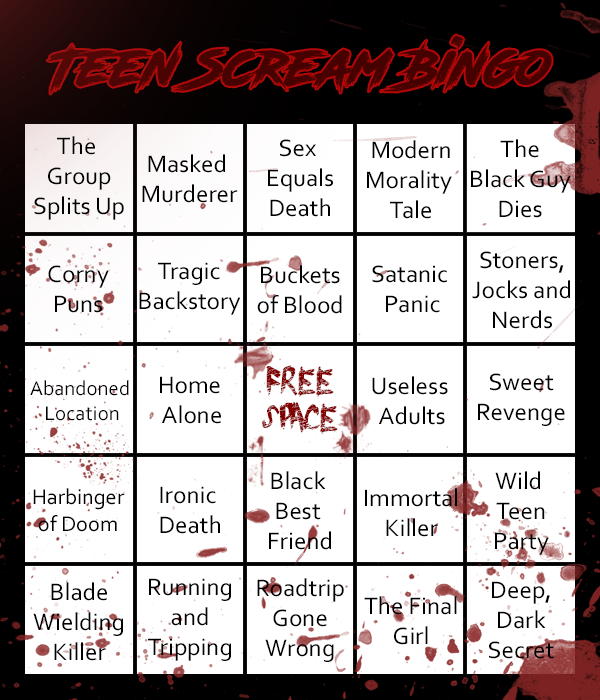
Cirque Berserk by Jessica Guess

Cirque Berserk by Jessica Guess

Formats: Print, digital

Publisher: Unnerving Magazine

Genre: Killer/Slasher, Myth and Folklore, Occult, Demons

Audience: Y/A

Diversity: Black main character and author, Native Oglala Lakota main character, character with syndactyly

Takes Place in: Florida, USA

Content Warnings (Highlight to view): Abelism, Alcohol Abuse, Animal Death, Child Abuse, Death, Forced Captivity, Gore, Kidnapping, Physical Abuse, Racism, Sexual Abuse (Voyeurism), Slurs, Slut-Shaming, Torture, Verbal/Emotional Abuse, Violence 

Blurb

The summer of 1989 brought terror to the town of Shadows Creek, Florida in the form of a massacre at the local carnival, Cirque Berserk. One fateful night, a group of teens killed a dozen people then disappeared into thin air. No one knows why they did it, where they went, or even how many of them there were, but legend has it they still roam the abandoned carnival, looking for blood to spill.

Thirty years later, best friends, Sam and Rochelle, are in the midst of a boring senior trip when they learn about the infamous Cirque Berserk. Seeking one last adventure, they and their friends journey to the nearby Shadows Creek to see if the urban legends about Cirque Berserk are true. But waiting for them beyond the carnival gates is a night of brutality, bloodshed, and betrayal.

Will they make they it out alive, or will the carnival’s past demons extinguish their futures?

I received this product for free in return for providing an honest and unbiased review. I received no other compensation. I am disclosing this in accordance with the Federal Trade Commission’s 16 CFR, Part 255: Guides Concerning the Use of Endorsements and Testimonials in Advertising.

Put on your sequins and neon spandex, grab a New Coke, and turn up that Whitney Houston cassette because it’s time to take a look at Jessica Guess‘s tribute to eighties’ slashers, Cirque Berserk! Guess’s new horror novella is the perfect ode to trashy, B-horror movies of the yuppie decade à la The Funhouse, Evilspeak, and Prom Night. Praised by one of my favorite horror authors, Stephen Graham Jones, Cirque Berserk hits most of the squares on the “teen scream” Bingo card, but still feels fresh and original. Guess has fun playing with the classic slasher clichés while subverting more problematic tropes like the “black best friend” and the “nice guy” being rewarded with a hot girl. She fills her story with plenty of self-aware humor and the kind of affectionate mocking that can only come from a true horror fan, which balances well with the more serious scenes of racism, sexism, and abuse. The result is a fun, nostalgic, carnival ride with a deeply emotional narrative hidden just beneath all the glitter, gore, and a bad-ass Black protagonist.

A black and red bingo card that says "Teen Scream Bingo." The squares include various slasher cliche's like "corny puns," "abandoned location," "Black best friend," and "masked murderer."

The eighties have made a come back in horror recently with popular TV shows (Stranger Things, American Horror Story: 1984), movies (the It reboot, The Final Girls), and novels (Grady Hendrix’s My Best Friend’s Exorcism) all drawing inspiration from the decade that gave rise to the slasher film, and it’s no wonder why. Not only do they have the nostalgia factor going for them as Gen Xers have their midlife crises, but they’ve got a ton of amazing source material to work from. Eighties audiences were blessed with a plethora of classic horror movies: grotesque monsters (The Thing, Aliens, Scanners, American Werewolf in London), final girls who fought back, (Halloween, Nightmare on Elm Street, Hell Raiser, Aliens), self-aware humor (Elvira, Monster Squad, Fright Night) cool, sexy vampires (Lost Boys, Near Dark, The Hunger) and horror franchises (Texas Chainsaw Massacre, Friday the 13th, The Evil Dead) graced the silver screen. Hell, even the remakes were good. Both The Fly and The Thing arguably surpassed their originals.

But what was it about the decade of greed that inspired so many amazing films? To understand eighties horror, you need to understand that the 1980’s were an age of excess, greed, rapid technological advancement, and reactionary conservatism. As late writer/director Stuart Gordan explained in the Shudder documentary In Search of Darkness: A Journey Into Iconic 80’s Horror, “horror thrives when there’s a repressive government” and the Reagan years certainly qualified. Additionally, public uncertainty and fear lead to the genre’s rise in popularity, just as it did during the Great Depression resulting in Universal’s famous Golden Age monsters. Meanwhile, advancements in technology and the increased affordability of personal computers led to some groundbreaking special effects and makeup (The Thing, Scanners, The Fly, American Werewolf in London). This decade was the perfect balance of repression and paranoia for horror films to flourish.

The rise of the “New Right” in the late seventies and eighties brought with it a push to return to “traditional American values” (i.e. being sexist, racist, homophobic, and slut-shaming with impunity). Everywhere you looked, the crack cocaine epidemic was sweeping the nation, AIDS was desolating the population, hardcore porn was easily accessible on video, the rich were getting greedier and richer, and divorce rates had peaked. With more women entering the workforce and an increasing number of newly-single kids were suddenly being left at home unsupervised. The public might have been content with leaving their kids at home, but a generation of ‘suddenly being left unsupervised for long periods of time’ were exposed to a plethora of violence and sex in media. Concern for the latchkey generation was only made worse by the abduction and murder of six-year-old Adam Walsh. The tragic case “created a nation of petrified kids and paranoid parents” who saw danger in every stranger they encountered. The media-fueled mass hysteria eventually led to a rash of Satanic panic.

It was enough to make any God-fearing White conservative clutch their pearls! Rather than blame Reagan for taking away childcare funding and completely botching the response to drugs and AIDS, or recognize that the risk strangers pose to children is minimal at best a vocal group of conservatives decided it was the loss of a nuclear family, declining morals, and demonic media that had left everything such a mess. Even if you didn’t buy into the whole “little Timmy will get murdered by Satanists because his mommy had to rejoin the workforce” school of thought, it was hard to deny the world was pretty scary, what with global warming, Jeffrey Dahmer, the cold war, and deadly invisible illnesses. Why couldn’t we go back to the way they were in the fifties when bad things only happened to minorities and women weren’t constantly going on about equal rights? Back before all teens were watching heavy metal videos on MTV, popping third generation birth control pills, and playing Super Mario Bros on their NES (or whatever they were into back then. Doing whippets maybe? I dunno, I was like 4 at the time). Cue a wave of 1950’s nostalgia and horror films that capitalized on the public’s fear for the safety of unsupervised kids.

A flow chart with images that shows the various events in the 80's that led to the rise in slasher horror as described in the review.

Most slashers followed a basic formula. A group of unsupervised teenagers with poor decision making skills all did “Bad Things TM” until an evil man would show up and kill everyone but the clever, resourceful, virginal hero because they were too pure to be defeated by evil. The story was simple, yet effective — at least in its ability to terrify audiences. I doubt anyone waited for their wedding night because they were afraid Jason would show up for a murderous version of coïtus interruptus. Ironically the conservative adults whose fear and values inspired the horror Renaissance were also its main detractors. Probably because filmmakers were interested in making money, not PSAs about morality, and tits and blood sell. The so-called golden age of slashers began in 1978 with Halloween and ended in 1984 with A Nightmare on Elm Street. Unfortunately sequelitis and low budget direct-to-video horror flicks marked the end of the era, but thankfully schlock could be just as entertaining in all it’s goofy, cheesy glory. When 80’s horror is good, it’s really good, but when it’s bad it’s amazing. And it’s these B-movie slashers that make Cirque Berserk such a fun read. Guess understands that while The Shining may be the Michelin star-winning gourmet meal of eighties horror and the franchise slasher films are the family restaurants with mass appeal, movies like Basket Case and Slumber Party Massacre 2 are greasy fast-food burgers you cram in your maw at 3 A.M. in the CVS parking lot. Yes, they’re terrible for you, and yes you regret it the next day when you wake up with a hangover and smell like dumpster fries, but god damn if those weren’t some delicious fucking burgers. Cirque Berserk is what happens when you have a talented chef prepare those greasy, salty, fast-food burgers. It’s fast, fun, and you won’t be able to put it down until you’ve devoured the whole thing.
Guess cleverly subverts the standard slasher story line while still paying homage to many of its elements. There’s a cast of stereotypical teens whose bad judgement lands them in an abandoned amusement park with a masked killer despite the warnings from the wise old woman at the gas station. There’s stupid teen drama, bad puns, and buckets of blood. Guess even adds a Satanic subplot where a group of disenfranchised teens summon the demon Lilith to grant them wishes, poking fun at Yuppie parents’ unfounded fear that their kids were listening to Stairway to Heaven backwards and using D&D to summon demons. The story is full of self-aware humor, my favorite example of which involves one of the characters pointing out how weird it is that no one is carrying a gun in Florida. Curses and murderous Satan worshipers are well within the realm of possibility, but no one packing heat in a Southern “stand your ground” state is way too weird. Guess manages to give us all this and still make her story genuinely scary. And for what felt like a pretty standard slasher set-up, I was actually caught off guard by a plot twist.

When it comes to her villains, however, Guess dispenses with the usual “irredeemably evil for the heck of it” masked murderers typical in slashers. Instead, she gives us a group of tragic figures who sell their humanity for a chance at freedom. It’s appropriate that the teen killers summoned Lilith to grant them freedom, a figure who chose to become a demon rather than submit to the will of a man. As another famous Abrahamic rebel declares in Paradise Lost “Better to reign in Hell than serve in Heaven.” The Alphabet of Ben Sira describes Lilith as Adam’s first wife, created as his equal. After getting fed up with her husband’s misogyny and bad sex, Liltith decides dick really isn’t worth all this bullshit and flies off into the night, choosing to become a demon rather than submit to male authority. Modern Jewish feminists, such as Judith Plaskow, interpret her as “a female symbol for autonomy, sexual choice, and control of one’s own destiny.” In her midrash, The Coming of Lilith, Plaskow writes “Lilith not only embodies people’s fears of how attraction to others can ruin their marriages, or of how risky childbearing and raising children are, but also represents a woman whom society cannot control—a woman who determines her own sexual partners, who is wild and unkempt, and who does not have the natural consequences of sexual activity, children.” Demon or no, Lilith sounds like my kind of woman.

But my absolute favorite part of Cirque Berserk is Guess’ tough-as-nails and whip-smart protagonist, Rochelle, who is anything but your typical final girl. Guess got the name from Rachel True’s character in The Craft, whose frequent erasure from horror conventions and panel discussions Guess even wrote about here. She explains that this was her way of honoring True. “I love The Craft and I got the idea for Cirque Berserk a little after watching Horror Noir and hearing what Rachel said about being typecast as the best friend and always having to say “are you okay” a million different ways. My Rochelle is a response to that.” And I say she’s the perfect response! But what else would you expect from Guess, creator of the Black Girl’s Guide to Horror blog? Cirque Berserk is a novella for Black and Indigenous horror fans who are sick of getting cast as victims, and hero helpers. As Guess states on her website:

“Horror is for everyone, but it doesn’t always feel that way with the lack of representation in the genre. Final Girls? White. Heroes? White. Villains? White. Masters of Horror? Mostly all white. Even those who talk about horror are all for the most part White. [My site] is the answer to the too white, too male, too cis, too straight genre that so many of us love but don’t see much of ourselves in.”

A teenage Black girl with natural hair. She's wearing roller skates, blowing green bubble gum, and has a bat slung over her shoulders. She surrounded by images of roller skates, a bloody knife, symbols for the demon Lilith, and a murder mix tape. The art is colored in pinks, teals, greens, blues, and purples. All colors that were popular in the eighties.

The novella has very few problems. I felt like some of the descriptions were a bit lacking  and Guess has a tendency to “tell” rather than “show.” The word choices could also get repetitive (for example using “said” repeatedly), but these are both fairly minor nitpicks for what’s otherwise a very strong story. I also wish we’d been given a little more time with the victims before they started getting picked off one by one, but I otherwise can’t complain about the novella’s pacing. Building suspense is a great way to make your story scary, but sometimes you want a horror book that gets straight to the killing spree instead of dicking you around for ten gore-free chapters. And Guess knows how to give the reader that instant blood-soaked satisfaction we crave. Her book was the perfect length: long enough to get its point across without letting the story drag. It may not be as fancy or polished as some award-winning, gourmet novel, but who gives a fuck? You know which one you’re going to be craving at 3 AM.

The Lamb Will Slaughter the Lion by Margaret Killjoy

The Lamb Will Slaughter the Lion by Margaret Killjoy

Formats: Print, digital

Publisher: Tor

Genre: Demon, Occult

Audience: Y/A

Diversity: Gay, lesbian, and bisexual characters,Trans character and author, Black character, Latine/Hispanic character, Character with anxiety disorder

Takes Place in: Iowa, USA

Content Warnings (Highlight to view): Animal Death, Forced Captivity, Gore, Oppression, Police Harassment, Mentions of Rape/Sexual Assault and Abuse, Suicide, Violence 

Blurb

Searching for clues about her best friend’s mysterious suicide, Danielle ventures to the squatter, utopian town of Freedom, Iowa, and witnesses a protector spirit — in the form of a blood-red, three-antlered deer — begin to turn on its summoners. She and her new friends have to act fast if they’re going to save the town — or get out alive.

I’ll admit, I really didn’t know much about Anarchism or the squatter/crusty punk/traveler lifestyle (which are all different, but overlap) before picking up The Lamb Will Slaughter the Lion. I had a vague notion that Anarchists didn’t like the government, but I always pictured them as some sort of cishet white boys, oblivious to their own privilege, who would disrupt otherwise peaceful protests by smashing windows and setting things on fire. Heck, if you google Anarchist, one of the synonyms that pops up at the top of the page is “terrorist”. Of course, I started to question my long-held prejudices when I noticed some of my Facebook friends, many of whom are minorities, identified as anarchists. These were people who frequently posted about human rights, non-violence, and green-living – a far cry from the violent images of Anarchists I’d seen in TV shows and movies. It was Margaret Killjoy’s novella that finally familiarized me with the movement and the people in it and encouraged me to do my research.

Killjoy, drawing from her own experience as a travelling Anarchist, created a diverse cast of anti-capitalists punks. The main character, Danielle, suffers from one of the most realistically portrayed anxiety attacks I’ve ever seen in fiction. Her mental illness isn’t glamorized or downplayed, nor is she depicted as a “crazy, weird girl”. She develops a crush on Brynn, a bisexual woman, who offers to snuggle with her in bed, without any sort of pressure or expectation. Vulture, a queer, black, femme trans-man, introduces himself  to Danielle by asking what pronouns she uses. Most of the anarchists depicted in the book are peaceful, only resorting to violence in cases of self-defense, and limiting their minimal criminal activity to squatting in abandoned buildings and shoplifting necessities from big box stores. They’re idealists, but they’re also flawed and human. Some of the younger characters can be heavy handed about declaring how punk/counter culture they are, still too insecure to realize they don’t need to prove anything to anyone. One of the story’s antagonists actually calls someone a poser like it’s the sickest burn in the world. Vulture is obsessed with posting everything to Instagram, while his partner behaves like he’s in some sort of dramatic art film. The characters bicker, disagree, and even get into scuffles, and it all feels incredibly genuine and authentic.

When Danielle first stumbles across the Anarchist commune where her deceased friend, Clay, was living, it seems like an Anarchists Utopia. There’s no capitalism, money, oppressive laws, or ruling bodies. Everyone helps each other out by sharing their food and resources, the town functions on trust alone, and all issues are solved through group consensus with the aid of mediators. There’s also a blood-red demon deer named Uliksi who reanimates dead animals and has a penchant for ripping out hearts. Clay co-founded Freedom with the best of intentions, but the wide-eyed idealist failed to consider the fact that any political system can be corrupted, no matter how perfect it seems. There’s a reason Utopia is based on the Greek “ou topos” which means “no place”. It’s because human nature is inherently flawed, making perfection impossible. Since the Golden Age and the Garden of Eden, somebody is always ruining paradise for everyone else, and the town of Freedom is no exception. In this case, it’s entitled fuckboys who use violence and threats to impose their will on everyone, turning the town from an Anarchist haven to a totalitarian dictatorship. Almost a year before Danielle’s arrival in Freedom, a man named Desmond took over the town, murdered those who disagreed with him, and prevented anyone from leaving. Terrified and desperate, Clay and his friends Rebecca, Anchor, and Doomsday resorted to summoning a demon named Uliski, a three-antlered deer with blood red fur, to stop the want-to-be despot. Most of you are realizing immediately that this plan will inevitably backfire because, much like trying to form a Utopian society, demon summoning never ends well.  Personally, I wouldn’t know because my wife won’t even let me summon a single adorable, little owl even though I’m pretty sure (like 80% sure) it would turn out fine, not that I’m bitter about it or anything. Anyway…. Clay and his crew figure “fuck it, we’ll deal with the consequences later” and let Uliski rip out Desmond’s heart.

First panel: I’m standing in a summoning circle with a long-legged owl demon wearing a crown and boots. My wife is reacting in horror and asking “What are you… did you just summon a demon!?!” 2nd panel: I hug the demon and ask “Can I keep him? He’ll be good! I’ll train him, and him, and feed him souls every day!” 3rd panel: My annoyed wife snaps “No! Put. It. Back.” While I plead “But we love each other! Stolas will be sad if I send him back! Pleaaaase? He’s so polite and smart! He knows all about plants, precious stones, and astronomy.” Stolas turns his head upside down.  4th panel: “Watch!” I shout enthusiastically “Prince Stolas, what star is that outside?” “That is the Sun” Stolas responds. “Good Boy! Such a smart little demon fluffy face!” My wife is not impressed. 5th panel: Stolas explains “Take mistletoe to treat an inflammation of black bile and enhance fertility” while I hug him tightly.  My wife points out “That’s not even remotely correct.”

According to the Ars Goetia, Prince Stolas is Great Prince of Hell who commands twenty-six legions of demons and imparts knowledge on those who summon him. He’s also super cute. Please do not take Mistletoe. It is very toxic.

Instead of fucking off back to the Underworld, or wherever it is endless spirits live, Uliski decides to stick around to continue his mission of hunting the vengeful and hateful who wield power over others, and reanimating animal corpses because he wasn’t already creepy enough already. At first, everyone is so glad that Desmond has been stopped and peace restored, they don’t really question the demon living in their town and even come to revere him. But Clay warns that Uliski will eventually turn on his summoners after one year, which leads us to Danielle’s arrival. She has a rather traumatic welcome after witnessing the bloodthirsty buck rip out Anchor’s heart, encountering a bunch of zombie wildlife, and dealing with town’s crazy drama, but instead of hauling ass out of the Animal Farm version of Dawn of the Dead, she resolves to stay and search for answers behind Clay’s suicide. Meanwhile, Freedom is in an uproar over whether or not their demonic protector should be dismissed, with half the town believing he’s keeping them safe and only kills when it’s justified, and the other half pointing out that murder may not be the best way to keep the peace. Once again, the town seems headed towards a Dystopian nightmare, with Uliski’s remaining summoners afraid for their lives, and a new charming and arrogant young man looking to “save” Freedom by enforcing his will on others.


A gold-trimmed pen and ink drawing of a red deer with three antlers, two on the right and one on the left. The prongs of the antlers turn into veins which are connected to a human heart, surrounded by a fractured rib cage. Between the deer's antlers is the sigil for the goetic demon Furfur and the alchemical symbol for fire, painted gold.

Uliski the demon deer

This is a story about how power causes corruption, especially when it’s wielded by violent young men dripping with privilege. While the novella is very pro-Anarchist, Killjoy keeps it from feeling too much like heavy handed propaganda by presenting a balanced view of her socio-political beliefs and chooses realism (well, other than the supernatural elements of course) over romanticism. The town of Freedom is presented as both an ideal and a warning; a community based on equality and cooperation is something to strive for, but, like any system, it can easily be corrupted by selfishness and fear even when everyone has the best of intentions. Hierarchies started to form without anyone realizing, and once those hierarchies were enforced through violence Freedom went from Anarchism to Authoritarianism, much like what happened after the Russian revolution.

As much as I loved The Lamb Will Slaughter the Lion, I felt it would have worked much better as a full-length novel, rather than a novella. The world building, story set up, character development, and ending all seemed too rushed and I was left feeling underwhelmed and longing for more. The concept is so cool, a demon deer turning on its summoners as a revolution slowly brews from with the town, that I wanted to spend more time there and learn about all the characters and what brought them to Freedom. I especially wanted to see more of Danielle and Brynn’s relationship develop. These reasons are why I much prefer the sequel, The Barrow Will Send What It May. By the second book, Killjoy has already established the world and the main players in it and is able to spend more time on developing her characters, building suspense, and giving Danielle and Brynn time to explore their feelings for each other. It’s for these reasons that I strongly suggest reading the two novellas together. The Lamb Will Slaughter the Lion feels incomplete on its own, but works well as the first chapter to an overarching story, and this is why I truly hope we will see many more chapters in the Danielle Cain series. I want to read a full-length novel about a band of Anarchists travelling from town to town solving mysteries and fighting demons, Scooby-Doo and Supernatural style, even if it is separated into several short stories. Killjoy clearly has many more stories to tell, and I look forward to reading them.

Five people in punk clothing colored to resemble the characters from Scooby-Doo. Furthest to the left is Danielle, a White woman with short, blonde hair. Next is Vulture, a tall, Black trans man with long hair and one half of his head shaved. Thursday, a Latino man in a leather vest is the middle, then Brynn, a White woman with red hair, a tattooed line on her forehead, and glasses. Her pants are covered in lgbtq, anarchist, and feminist patches. On the left is a chubby White woman, Doomsday with bobbed, brown hair.

Left to right are Danielle (as Scooby), Vulture (as Fred), Thursday (as Shaggy), Brynn (as Daphne), and Doomsday (as Velma). Anarchist Mystery Gang!

 
Ten by Gretchen McNeil

Ten by Gretchen McNeil

Formats: Print, audio, digital

Publisher: Harper Collins

Genre: Mystery, Psychological Horror, Killer/Slasher

Audience: Y/A

Diversity: African American character, Japanese American character, Asian American character, Samoan character, Bipolar character

Takes Place in: Seattle, USA

Content Warnings (Highlight to view):  Sexist Language, Abelist Language, Racist Language, Sexism, Mental Illness, Drug Use, Violence, Death

Blurb

SHHHH!
Don’t spread the word!
Three-day weekend. Party at White Rock House on Henry Island.
You do NOT want to miss it.

It was supposed to be the weekend of their lives—an exclusive house party on Henry Island. Best friends Meg and Minnie each have their reasons for being there (which involve T.J., the school’s most eligible bachelor) and look forward to three glorious days of boys, booze and fun-filled luxury.

But what they expect is definitely not what they get, and what starts out as fun turns dark and twisted after the discovery of a DVD with a sinister message: Vengeance is mine.

Suddenly people are dying, and with a storm raging, the teens are cut off from the outside world. No electricity, no phones, no internet, and a ferry that isn’t scheduled to return for two days. As the deaths become more violent and the teens turn on each other, can Meg find the killer before more people die? Or is the killer closer to her than she could ever imagine?

Ten is inspired by Agatha Christie’s bestselling mystery thriller, And Then There Were None, a tale of ten strangers with dark secrets trapped on an island with a killer who terminates them in ironic ways and publicly marks the deaths one by one. McNeil takes Christie’s original concept, sets it in modern times, changes the terrible, unlikeable adults into a bunch of terrible, unlikeable teens, does away with racism, xenophobia, and anti-Semitism, and replaces it with a diverse cast.

Like the original Christie novel, Ten starts off with ten (get it!?!) people gathering on a remote island under false pretenses only to discover that it was all a trick by the killer, who has kindly left them a Ringu-esque DVD (a gramophone record in the original) to inform the victims of their inevitable demises and remind them how shitty they all are (in case you started feeling bad for any of them). At first, no one believes the sketchy murder announcement is legit, at least until they start dropping like flies, and then all hell breaks loose. Both books involve distrust, everyone accusing each other, the fear of knowing there’s a wolf (or possibly wolves) hiding among the sheep, and of course, a party with a body count. Why do so many parties in these kind of stories end up with a bunch of dead guests? Does the Red Death just go around gate crashing every party in the horror genre? Why does every gathering of three or more people that involves alcohol inevitably end in someone’s demise? Being an introverted nerd who would rather gnaw off my own hand than attend most social gatherings, I honestly have no idea what happens at parties, so I’m just going to assume that it’s pretty standard for them to end in either mass murder or demon summoning (and now I wish I went to more parties).

 I’m walking with a red-headed friend who cheerfully asks “So, you’re coming to my party tonight, right? Everyone is going to be there!” Apprehensive, I respond “Oh uh…” then plunge a knife into my stomach. Holding my wound and trying to smile through the pain, I respond to my shocked friend “I can’t make it because I have to go to the ER and get stiches, heh.” Irritated, she asks “Wait, were you just carrying that knife around the whole time?” Bleeding profusely, I mutter “Oh God, I think I nicked my liver.”

A liver laceration is a small price to pay to avoid social interaction.

Last, but not least, is the diversity, which pretty much only applies to Ten since Agatha Christie was a racist asshole, so it’s pretty obvious who the winner is here, but let’s go over it anyway. Ten features a fairly diverse cast, with about half the characters being POC, in addition to a character with a fairly realistic depiction of bipolar disorder. Of course, most of the characters don’t get enough of a chance to develop anything close to a personality before they get offed, so they’re all pretty one-dimensional characters. There’s also a “rebellious” East-Asian girl with a rebellious blue streak in her hair, so Ten isn’t completely free of stereotypes either. But at least the diversity is there, even if it sometimes leans more towards “early 90’s kid show” diversity.

A drawing of the members of the “Burger King Kid’s Club”, a multi-ethnic group of fictional children from the 90’s. Their names are written next to them. In the front row are the dog, J.D., and a white boy in a wheel chair named “Wheels.” The second row (from left to right) shows a butch red-headed girl in sports-wear named Boomer, a femme blonde girl named “Snaps”, and a short, white boy named I/Q. The back row depicts JaWs, a black kid, a Hispanic boy named Lingo, and another white boy named “Kid Vid”.

I can just imagine Wheels being like “My name is Jordan, you insensitive, ableist jerks.” Well, at least it’s better than JaWs, his names looks like a typo. Why do none of these children have normal names?! Is their mom Gwyneth Paltrow? And how come the white kids get to be in the front?

So how does the re-imagining stand up to the original classic? In terms of writing, McNeil is a decent-ish author, but there’s just no competing with Agatha “The Queen of Crime” Christie. I mean, Agatha is the world’s best-selling mystery writer (that’s not an exaggeration, she’s actually in the Guinness Book of World Records), while Ten contains the line “The whole thing had been a perfect storm of not awesome.” So yeah…any comparison between the two would be downright unfair. However, it seems like McNeil realizes this, and isn’t trying to outdo her inspiration. Plot-wise, both books have a good mystery, although the original is unbelievably difficult to solve, and requires an extensive epilogue to explain what the hell just happened because the clues are so vague. Even knowing who the killer was on subsequent readings of And Then There Were None, I couldn’t pick up on any hints as to their identity. In fact, I’m not entirely convinced Christie didn’t just randomly pull the ending out of her ass at the last minute, but whatever, at least I couldn’t guess the culprit after a few chapters. Meanwhile Ten gives the reader enough clues to figure out the ending without being super obvious. That is, unless you’ve already read And Then There Were None in which case you’re probably going figure out the killer (or killers) almost instantly. So yeaaaaaaah, sorry about that. The scary parts of Ten are done well, but the rest of the story (especially the beginning) feel forced. All the dialogue is generic teen bickering and cookie cutter conversations about crushes, school, and beer and it only exists as a quick set up before the murder spree starts.

While Christie’s novel is a psychological thriller that focuses heavily on the characters, McNeil’s work leans more towards the classic horror genre, specifically the teenage slasher/cabin in the woods kind. The characters in both stories are awful human beings, which works fine for And Then There Were None, where they’re at least complex and interesting, and we’re more interested in solving the mystery than anyone surviving. The closest thing we have to a primary cast in Christie’s book are Vera the governess, Philip Lombard the solider, Armstrong the doctor, and Blore the private investigator. And it’s still really ambiguous if any of them are the killer until the end. Christie switches the point of view frequently, so her reader becomes just familiar enough with each character to get a basic understanding of their personality, but not so much as to clue them in to the killer’s identity. In Ten we’re given a clear and likeable protagonist to root for, the shy Meg, along with her best friend, Minnie, and their shared love interest, T.J. (ugh, love triangles). This lends itself better to a slasher story where we need at least one character whose safety we fear for, and then a bunch of cannon fodder characters to satisfy the reader’s bloodlust. (Let’s face it, if you’re reading a book like this you’re looking for a body count.) The rest of the cast is one dimensional and just needs to hurry up and die. However, this does add a wrinkle to the whole revenge thing, you can’t very well root for a main character that did something terrible, so we know the killer/killers are either overreacting or there’s been a terrible misunderstanding. It also means we can rule out Meg as the killer (and assume it’s probably not Minnie either), but there are still enough potential killers left over to fuel plenty of paranoia.

Having most of the characters know each other in Ten adds an extra layer of creepiness because no one wants to believe their friend is a murderer, and the killer is quite literally backstabbing people who trusted them. In Christie’s setup, you don’t really care who gets the ax (literally and figuratively) because everyone is awful. Lombard’s an arrogant chauvinist who left a bunch of natives to die because he barely saw them as people, Blore is an overconfident idiot who falsifies evidence, and Dr. Armstrong is a spineless alcoholic who cares more about recognition and his reputation than the patient he killed while he was drunk. The only character who is sort of sympathetic is General MacArthur, and that’s only because his victim was a world class jerk who slept with the guy’s wife, and MacArthur feels genuinely remorseful about sending him on a death mission. And that’s not even including the minor characters and all the reasons they suck. The mystery and the identity of the killer are really the only things that matter in And Then There Were None (okay, and maybe whether or not Vera survives, she’s slightly more likable than her companions), which makes it a captivating read, but not particularly scary.

Because Ten is aimed at teens, McNeil threw in a completely unnecessary love triangle (as is apparently required for any book in Y/A section) because apparently a murder spree wasn’t dramatic enough. To her credit, McNeil makes the clichéd romance slightly less terrible by actually giving Meg a legitimate reason for not wanting to upset Minnie by going after their mutual crush. Minnie suffers from bipolar disorder, and even though she’s finally getting treatment, she’s still prone to making bad decisions while manic, including turning into someone Meg didn’t recognize and lashing out when she found out her best friend was also interested in T.J. Because she’s been friends with Minnie for so long, and the mental illness is a more recent development, Meg still hasn’t quite figured out a balance between an overprotective enabler and a supportive friend when Minnie is having a depressive or manic episode. Because Minnie is still in serious denial about her Bipolar Disorder and tends to minimize the severity of her symptoms Meg also feels responsible for her best friend’s wellbeing and acts like a mother hen. It also doesn’t help that Minnie’s dad has asked Meg to “take care of his daughter” and placed an unfair burden on her unqualified shoulders. As a result, the two girls have developed a toxic, codependent relationship with Meg treating Minnie like she’s some sort of fragile doll who will shatter at the slightest hardship. Honestly their dysfunctional relationship was about 100 times more interesting than their stupid crush on T.J.

It’s still about five hundred times better than the Christie’s original novel (not that that’s saying much), which, by the way, wasn’t originally called And Then There Were None. The actual title of the novel was considered too racist for American publication, 25 years prior to the Civil Rights Act. That’s right, a country where racial segregation was totally legal was like “Whoa, Agatha, that title’s pretty offensive, don’t you think?” So she can’t even use the “oh well, attitudes were different back then” excuse, (which is a bad excuse anyway) because it was still considered fucking offensive at the time it was published. Mark Twain’s used racial slurs in The Adventures of Huckleberry Finn to make a point about the evils and ugliness of slavery, but the racism, anti-Semitism, and xenophobia in And Then There Were None have literally no reason to be there. Christie, like Lovecraft (who I complain about in detail here), is one of those writers whose obvious talent is often marred by her bigotry, which sucks because her work is otherwise really enjoyable. Of course, that’s like saying “This ice cream sundae is pretty enjoyable, except there’s a dead rat in it.” I mean, you could probably eat around it, but the experience is still going to be severely tainted by a rodent carcass.

A beautiful ice-cream sundae with strawberry, chocolate, and vanilla scoops of ice-cream, fresh sliced strawberries, three different sauce toppings, and bits of nuts and sprinkles sits in a glass dish. Lying on the ice-cream, drizzled with fudge sauce, and topped with whipped cream and a cherry, is a dead rat. The rat is lying on its back, with its little pink feet in the air, its tongue hanging out, and little red “X’s” over its eyes.

I mean, I’d probably still eat it… but I have problems.

These days, there are editions of Christie’s book that have been edited to varying degrees to make the work less jarringly racist (and before anyone starts screaming about censorship, the original, unedited version is still in print too, so you’re free to read whichever version you want), but it’s still super uncomfortable. Even in the edited versions that aren’t dropping the N-word every few pages, the ugly attitude still hangs heavy in the air throughout the story, and it’s difficult to immerse yourself in the mystery with that hanging over you. Plus, none of the anti-Semitism was edited out in the audiobook version I listened to, so I still got to “enjoy” hearing that in the first chapter. Fun! Of course, how many problematic elements you’re willing to put up with before the book becomes irredeemable depends on the individual. I liked… aspects of Christie’s book well enough, but I can understand if someone has zero desire subject themselves to 272 pages (or in my case 6 hours) of bigotry.

So, which book is better? Ten preserves some of the spirit of the original story, but does away with the blatant racism, although it leans more towards slasher horror than suspense. But And Then There Were None is considered a classic for a reason. The quality of the writing is obvious, Christie does an excellent job building the suspense, and the characters are unique and interesting (you could probably write an entire English paper on each of them). Ten isn’t a bad book, but it’s never going to be a literary classic. So, which would I recommend? Well, it really depends what you’re looking for: a fun horror story, or a classic murder mystery (and whether or not you want to deal with Christie’s racism). From a literary perspective, yes, And Then There Were None is the better work (no surprise there). But in terms of straight horror? You’ll probably get a lot more scares from reading Ten. You could always read both, like I did, just make sure to read McNeil’s book first to avoid spoilers.

The Ballad of Black Tom by Victor LaValle

The Ballad of Black Tom by Victor LaValle

Formats: Print, audio, digital

Publisher: Tor

Genre: Eldritch, Monster, Historic Horror, Occult, Sci-Fi Horror

Audience: Adult/Mature, Y/A

Diversity: Black characters (African American and Caribbean)

Takes Place in: Harlem, New York City, USA

Content Warnings (Highlight to view): Bullying, Death, Gore, Mental Illness, Medical Procedures, Oppression, Physical Abuse, Police Harassment, Racism, Torture, Verbal/Emotional Abuse, Violence, Xenophobia

Blurb

People move to New York looking for magic and nothing will convince them it isn’t there.
Charles Thomas Tester hustles to put food on the table, keep the roof over his father’s head, from Harlem to Flushing Meadows to Red Hook. He knows what magic a suit can cast, the invisibility a guitar case can provide, and the curse written on his skin that attracts the eye of wealthy white folks and their cops. But when he delivers an occult tome to a reclusive sorceress in the heart of Queens, Tom opens a door to a deeper realm of magic, and earns the attention of things best left sleeping.
A storm that might swallow the world is building in Brooklyn. Will Black Tom live to see it break?

Oh Lovecraft, you were such a great horror writer, but an absolutely terrible human being.

When it comes to Lovecraft, I have some very complicated opinions. I adore the Cthulhu mythos, cosmic horror, and the concept of forbidden knowledge that utterly destroys your sanity, but it’s hard to enjoy his writing when he liberally peppers it with his hatred for anyone who isn’t a WASP. One minute  I’m reading an enjoyable little story about a cosmic abomination and the dark secrets humanity was never meant to know, and the next it’s morphed into some sort of eugenics bullshit. Here’s a small sampling of just some of the bullshit he pulls in his stories: In the Case Of Charles Dexter Ward Lovecraft describes a woman as having “a very repulsive cast of countenance, probably due to a mixture of negro blood,” in Herbert West: Reaminator the black boxer, Buck Robinson, is compared to an ape, in The Rats in the Walls there’s a black cat named N****r Man, The Horror at Red Hook is basically just Lovecraft rambling about how much he hates immigrants and black people who he refers to as a “contagion” with “primitive half-ape savagery”, and in Medusa’s Coil he describes slavery as “a civilization and social order now sadly extinct”. Oh, and let’s not forget that poem. There’s a good reason why Lovecraft’s bust is no longer used for the World Fantasy Award trophy, the guy was a dick.

A drawing of Nnedi Okorafor wearing a dark blue dress, large red and gold earrings, and holding her World Fantasy Award, a bust of H.P. Lovecraft. Okorafor looks uncomfortable while she says “Um, Thanks, I guess? Yeah, I don’t really want this racist’s head on my mantle.”

I tried to draw Nnedi Okorafor, “tried” being the operative word. She says I got it right from the shoulders up though!

Now, before anyone uses the “Lovecraft was just a product of his time” excuse, please consider this: Yes, his active years as a writer were during the incredibly racist segregation era, but not everyone shared his shitty beliefs about people of color and Jews. Mary White OvingtonMoorfield Storey, and William English Walling were all white, but they were also supporters of  civil rights and racial equality during the same period, and even helped found the NAACP with W. E. B. Du Bois. So it’s not like every white person in the 1920s and 1930s was racist. Lovecraft would’ve at least been aware of civil rights due to Guinn v. United States, a landmark case that found racist literacy tests unconstitutional, the National Negro Business League which helped to double the number of black owned businesses, and prominent black lawyer Charles Hamilton Houston, who was fighting for civil rights in court. Hell, even his friends and family criticized the horror writer’s ignorant attitude. Lovecraft’s wife, Sonia Greene, and friend Samuel Loveman were both horrified by Lovecraft’s anti-Semitism and resented him for it. Sonia even wrote, “Whenever we found ourselves in the racially mixed crowds which characterize New York, Howard would become livid with rage… He seemed almost to lose his mind.” When Lovecraft attacked Charles D. Isaacson‘s, article on racial tolerance, In a Minor Key, in his own article titled In a Major Key (where he praised the KKK as “that noble but much maligned of Southerners who saved half our country from destruction”) he managed to piss off not just Isaacson, but his own friend James Ferdinand Morton, both of whom wrote responses attacking Lovecraft’s racism. He knew people thought he was racist, as he’d been called out multiple times and even his wife had pleaded with him to reconsider his beliefs- Lovecraft just chose to be an intolerant jerk.

There are two books. On the left is a book with a red cover written by H.P. Lovecraft. It’s titled “The Horror at Red Hook, or Why Immigrants and Minorities Ruin Everything.” On the right is a green, leather bound book with an image of a brass octopus on the cover. The title, written in gold lettering, is “Lovecraft’s Letters: About How Anyone Who Isn’t Anglo-Saxon Sucks, and Why Eugenics are Super Awesome”.

Probably real Lovecraft titles.

Luckily for us, many talented creators have taken concepts in Lovecraft’s writing and used it to create their own works, so fans can still enjoy Yog-Sothoth, the Deep Ones, and the horrors of forbidden knowledge driving men to madness- without all the bigotry. The Ballad of Black Tom is one of these works, a retelling of  Lovecraft’s incredibly racist The Horror at Red Hook from the point of view of a black man living in Harlem.

For those not familiar with Lovecraft’s original short story, The Horror at Red Hook follows police detective Thomas Malone and his pursuit of forbidden knowledge in the immigrant neighborhood of Red Hook, Brooklyn, or as Lovecraft describes it “a maze of hybrid squalor”. Because the only religions in Lovecraft’s world are either good, Anglo-Saxon Christianity or evil, bad, demon worship, all the brown people are apparently involved with the occult.  Malone is put on a case involving the wealthy and eccentric recluse, Robert Suydam because his relatives want the old man declared mentally unfit so they can have his money. During the course of the investigation Malone discovers that Suydam has been spending time with illegal immigrants and foreigners, which obviously means he’s doing something super evil, like sacrificing white babies to tentacle-faced monsters, because Lovecraft is racist and Malone is an awful detective. Suydam continues to do suspicious things, in Malone’s opinion anyway, like lose weight, work on his personal grooming, and get married. Eventually the whole thing cumulates in a police raid in Redhook, where Malone finds a bunch of creepy shit in Suydam’s basement flat which causes the police detective to lose his sanity points and pass out from sheer terror. Afterwards we discover that the buildings collapsed, killing almost everyone except Malone, who is left with PTSD and batophobia. The rest of the story is just Lovecraft whining about immigrants “ruining” New York and reads like the antiquated 8,000 word equivalent of a Trump tweet. It’s not one of his better stories. So it’s kind of a miracle that LaValle not only manages to write a version of The Horror at Red Hook that’s not just a commentary on racism, but is actually good, while still keeping all the creepiness, mind-fuckery, characters, and plot of the original. Suydam and Thomas Malone both appear as major characters in The Ballad of Black Tom, Malone serving as a deuteragonist for the second half of the story, while Suydam introduces Tommy Tester, the book’s protagonist, to the occult. There are other hidden references to Lovecraft lore throughout the book. The title, Black Tom, is an allusion to the cat from The Rats in the Walls whose name was changed from N***** Man to Black Tom when the story was reprinted in Zest magazine in the 1950s. Toward the end Robert LaValle mentions a man from Rhode Island, living in New York, who may be Lovecraft himself.

LaValle defends the minority population living in Harlem and Redhook that Lovecraft so despised by showing them as the every day folks they are, trying to get by with what little they have. Tommy even expresses disappointment after visiting the Victoria Club, when he learns that it’s not the den of debauchery and sin he had hoped for, but instead old men playing cards and women selling meals they’ve made at home. There are criminals, yes, but that’s to be expected in any impoverished area, and they’re far from a majority of the population. When Tommy discovers Suydam is associating with so many criminals, he’s terrified, and it speaks more to the rich, white man’s character than the immigrants on New York. What Malone discovers in the basement is also been changed from the original, but to reveal more would ruin the amazing ending of Black Tom. Let’s just say LaValle provides his readers with more detail on the horrors the detective discovers, and a much more satisfying ending.

The thing I found the scariest about The Ballad of Black Tom weren’t the fictional monstrosities sleeping at the bottom of the see ready to destroy humanity, it was how much LaValle’s fictionalized world reminded me of our own. The cops’ blatant racism, their harassment of black men who were simply walking down the street, and their willingness to kill at the slightest provocation felt all too familiar, as did the rampant xenophobia and anti-immigration attitudes. The story may be set in the 1920s, but it’s clear that some things still haven’t changed. Tommy’s encounters with the police were enough to give me panic attacks, as I remembered my own family’s terrifying encounters with cops. While I’m pale enough to pass as white, most of my extended family isn’t, and I grew up with horror stories about what happened to black people stalked, shot, raped, and lynched for merely existing. Tommy has learned what every young black person is still being taught: if the police stop you, appear as non-aggressive as possible, be polite, and put up with whatever harassment the cops dish out or you’ll wind up dead. We see this in all his encounters with Malone. Tommy plays dumb, looks downs, and lets them steal his money and insult him to his face without making a comment. At least for the first half of the book.

Tommy Tester starts the story as a good man. He may trick others and take on some not-so-legal work, but he’s trying to take care of his disabled father in a world that’s against him, so it’s not surprising he has to do some questionable things to survive. At least he never actively hurts others and tries to do the right thing when he can, like preventing a witch from getting her hands on forbidden knowledge, which is more than I can say for most of the people Tommy encounters. Racist cops constantly threaten and abuse him, he’s harassed by a bunch of white kids just for walking while black, and white society treats him as less than human. Even Robert Suydam, who claims to admire Tommy and gives him a large sum of money to play guitar in his home, is merely using for his own ends. As it turns out, Suydam is a white man who fetishizes POC cultures, while still viewing himself as superior to the same people he claims he wants to help. There’s a saying “you can only kick a dog so many times before it bites back” and after being attacked, abused, taunted, stolen from, threatened, and finally losing everything to cold and corrupt law enforcement, Tommy Tester realizes he has nothing left to lose and says “fuck it”. And that’s how we start the second half of the story, told from Malone’s point of view, with Tommy, now calling himself “Black Tom,” transforming himself into the most badass, brutal, and terrifying antagonist in order to exact his bloody revenge on Robert Suydam, Thomas Malone, and the xenophobic NYPD. And let me just say, it’s immensely satisfying. Gory, but satisfying.

I abhor violence in real life, and obviously don’t agree with mass slaughter and abuse, no matter how evil the victims are. The real world is more complicated than just good vs. evil, and violence and revenge just beget more of the same. That said, there’s still a violent, pissed off part of me, hurt and furious at the injustice of the world, that wants to see wicked people suffer. Not just get their richly deserved comeuppance, but really, truly suffer in the worst ways imaginable. It’s the bitter part of me that relates to all those Saturday morning cartoon villains of my past who just want to destroy everything, because the world is such a terrible, hateful place that it probably deserves it. This vengeful part of me that becomes more and more hateful every time I read the news was immensely satisfied and soothed to watch Black Tom punish a group of racists who resemble 21st century hate groups a little too closely. It’s the same anger that motivates Killmonger in the Black Panther film.


But, like I said, these are ugly thoughts I would never actually act on or hope to see happen in real life because I know how wrong they are, and I still hold on to the hope that logic and compassion will win out (so FBI, if you’re reading this, I just want to clarify, I’m not actually planning on going on any kind of bloody killing spree). When Tommy, pushed to choose between an eldritch abomination and the hateful people who hurt him again and again, he gives in to revenge and loses part of his humanity, and that’s what makes the story so bitter-sweet. Black Tom may have gotten his revenge, but at the cost of being a good man, something he will have to live with for the rest of his life. He’s compromised his most important value, being the kind of man his father would be proud of, and can no longer look his best friend in the eye. As satisfying as it is to see horrible people suffer a horrible fate, you can’t help but feel bad for Tommy who’s left to wonder if it was really worth it. 

My wife, who is wearing a blue space dress and white, over-the-knee socks has just opened the door to reveal two FBI agents, a light-skinned man, and a dark-skinned woman. My wife has her hands on her and looks irritated. She shouts, “What did you do this time!?!!” I’m in the foreground, carrying a human foot that’s been cut off below the knee. The limb is starting to decay and is wrapped in bandages. I look surprised and guilty at being caught by my wife.

The severed human leg actually has nothing to do with why the Feds are here. Though I’m sure my wife is going to ask about that too. Watch what you say on the internet kids!

Labyrinth Lost by Zoraida Córdova

Labyrinth Lost by Zoraida Córdova

Formats: Print, digital

Publisher: Sourcebooks Fire

Genre: Dark Fantasy, Occult

Audience: Y/A

Diversity: Ecuadorian author, Hispanic/Latinx characters, Puerto Rican characters, South Asian character, Bisexual characters

Takes Place in: New York City, USA

Content Warnings (Highlight to view): Abelism, Animal Death, Body Shaming, Bullying, Child Abuse, Child Endangerment, Death, Forced Captivity, Gaslighting, Gore, Kidnapping, Torture, Violence

Blurb

Nothing says Happy Birthday like summoning the spirits of your dead relatives.

Alex is a bruja, the most powerful witch in a generation…and she hates magic. At her Deathday celebration, Alex performs a spell to rid herself of her power. But it backfires. Her whole family vanishes into thin air, leaving her alone with Nova, a brujo boy she can’t trust. A boy whose intentions are as dark as the strange marks on his skin.

The only way to get her family back is to travel with Nova to Los Lagos, a land in-between, as dark as Limbo and as strange as Wonderland…

Alex is about to celebrate her Deathday, a huge party that’s thrown when a young bruja or brujo first gets their powers. Her entire extended family will be there to help her bind and control her newfound abilities. Everyone seems thrilled, especially her mother and older sister Lula; everyone that is, except for Alex. She views magic as a curse rather than a blessing, so she’s pretty upset when she discovers that, no surprise (it’s Y/A fiction after all), she’s essentially the most powerful bruja they’ve seen in generations, an encantrix whose magic is vast and broad. Most brujas are limited to one or two abilities, like healing or seeing the future, but Alex can pretty much do anything. In a misguided attempt to get rid of her power, she accidentally banishes not only all her living relatives but her dead ancestors as well to the Limbo-like land of Las Lagos. Oops.

Okay, so admittedly the whole powerful chosen one thing does sound kind of Mary Sue-ish, especially the part about not wanting her super special powers. “Oh, poor little main character, you get all these awesome powers, how awful for you!” said no reader ever. Well, Alex has a pretty good reason for hating her magic, and it’s not the typical “Oh, being perfect is so hard~” B.S. You see, magic isn’t some consequence free wish-fulfilling super power, it’s born from sacrifice. Magic drains the user and causes them physical pain. The more powerful the spell, the more you’ll suffer. Healing someone’s else’s headache means you’ll end up with a black eye. A protection spell could cause you to pass out. Some magic can even drain the life force of the user, slowly killing them. Magic is also the reason Alex’s father disappeared, destroying her family. She has to watch her mother grieve and suffer every day, trying to raise three girls on her own.  It traumatized her when she was seven and saw the re-animated corpse of her Aunt Rosaria. Magic killed her pet cat, plagues her with nightmares, and forces her to keep her best friend at arm’s length. So Alex’s aversion to her powers is understandable, I wouldn’t want to use magic either after all that.

A dark skinned girl looks traumatized in front of a destroyed kitchen. Blue, magical flame surrounds her hand and the broken dishes on the counter.

Thanks, magic!

Love triangles are another tired trope in young adult fiction that I’m sick of seeing. It’s just pointless and needless drama that derails the story. Can’t everyone just be polyamorous and get along? A threesome would clearly solve this problem. It’s especially irritating when one (or both) of the love interests is a mysterious bad boy who appears out of nowhere and seduces the main character, despite them having nothing in common. Just have a one-night stand and get it out of your system, he clearly isn’t relationship material, damn. So many problems in YA fiction could be solved by just sleeping with everyone… and I just realized why I probably shouldn’t be giving advice to teenagers. Okay, forget everything I just said. Love triangles are still stupid though, and when I first learned Labyrinth Lost had one (with a mysterious bad boy no less) I let out one of those long, exasperated groans that makes me sound like a slow-moving zombie that just discovered it’s going to have run after its prey. So, basically me as a zombie. Running is the worst. So are pointless romantic sub-plots.

I’m rolling my eyes letting out a very long, very loud groan. My wife is sitting at a table looking at her tablet and trying to ignore me. She asks “So is it a love triangle again, or are you craving brains?”

THE WORST

Nova, the smug, douchey, “bad boy” brujo who kept flirting with Alex was about as obnoxious as you’d expect, no surprise there. He was all dark and tortured and rude, bleh. But this is where Córdova surprised me. Because Nova’s romantic rival is a South Asian girl named Rishi, Alex’s longtime friend. Okay, so a multiracial, bisexual love triangle, that’s not something you see every day. And it’s not just queer baiting either! The two girls are genuinely romantically interested in each other. Plus, Rishi is so awesome; she’s brave, weird, loyal, funny–exactly the kind of person I’d want to be friends with. When Alex is in trouble she doesn’t even hesitate to dive in and rescue her, because that’s what friends do. My interest was cautiously piqued, but I was still wary. Was this going to turn into a huge drama-filled plot point that derails the story? But again Córdova exceeded my expectations, because the love triangle is barely even there. Yes, Alex ends up with one of them, and yeah, the bickering of the two suitors could be annoying, but Alex’s entire focus is on saving her family, as it should be. Yes, she has crazy teenage hormones and starts lusting after her best friend and the mysterious Nova, but her focus never wavers from the task at hand, and she pushes her romantic impulses to the side. Alex even gets irritated that Nova is wasting so much time flirting and Rishi keeps getting jealous, when there are clearly much bigger fish to fry. I don’t usually get invested in romantic subplots, and I’m almost embarrassed to admit this, but I went full on fan girl and found myself shipping Rishi and Alex the entire time (much to the chagrin of my poor wife who had to deal with my high pitched squees every few minutes). I feel like I need to write Córdova an apology letter for ever doubting her, because she has somehow managed to pull off the least annoying love triangle I’ve ever read in YA fiction. Hell, even Nova got called out for his arrogant dick act, which I was also not expecting. So, Kudos to you Córdova.

I’m reading Labyrinth Lost, looking annoyed, and comment “Ugh, I hate pointless love triangles.” In the next panel I suddenly look interested and saying “Oooooh, it’s a bisexual love triangle? That doesn’t waste time with needless drama!? And she doesn’t up with the bad boy’s douchey behavior!?!” The third panel shows me squeeing, surrounded by sparkles, with big, shiny eyes. In the final panel, someone yells off screen “Y’know, you don’t have to say every thought that pops into your head out loud”.

A love of triangle actually made me squee for the first time in history.

The whole romantic subplot, if you can even call it that, is thankfully a pretty minor story element, and the story’s main focus is on family and identity. Alex’s relationship with her sisters, mother, aunts and the other women in her family is incredibly well written and touching, and one of my favorite aspects of the book. It’s just so wonderfully refreshing to see a YA novel that focus on the bonds between women and familial love rather than girls fighting over stupid boys. Lula, her beautiful and bossy older sister is great, a force unto herself, overflowing with love and magic, and always ready to take charge. I love Lula. Her younger sister, Rose, is a psychic with the whole creepy child vibe going on, an incredibly clever and intelligent young girl with a sweet tooth and a mischievous streak. She doesn’t get as much page time, as she’s more reserved than her two sisters. And of course Alex’s mother, Carmen, a strong woman and loving parent, holds their little family together. They’re not perfect, and they might bicker, but they’re all fiercely loyal and protective of each other, and Alex’s strong connection with her family is what gives her the strength to journey through Los Lagos, and protects her from the perils of the dark, magical Limbo.

Córdova’s world building is another strong point of the story. Los Lagos is probably tied with Paheli from The Gauntlet for the coolest fantasy world I’ve read about this year. It’s enchantingly creepy, beautiful, and weird.  Interestingly, it reminds me of two other fantasies titled after the Minotaur’s legendary prison, Jim Henson’s Labyrinth and Guillermo del Toro’s Pan’s Labyrinth (with a little bit of the Wizard of Oz thrown in for good measure, even if it breaks the themed naming). The only downside to having a creative world that stands out so much is that the characters seem kind of bland in comparison. That’s not to say any of the characters are poorly written or dull, it’s just hard to hold a candle to the land of Los Lagos with its rivers of ghosts, burning forests, and creepy creatures.

Córdova’s world is inspired by Latin American religions and cultures to create the story’s mythology, magic, and gods. The bilingual bonuses and Latina influences will be fun for anyone familiar with the language and culture, but if you’re new to brujas and brujos keep in mind the ones in Labyrinth Lost resemble actual Brujeria, Santeria, and folk magic practitioners about as much as the wizards and witches in Harry Potter represent real Wiccans. For example, the Deos in the story are similar in many respects to the orixá of Santeria and the Loa form Vodou, but have no “real world” counterparts. Interestingly enough, other witches and magic users from other traditions also exist in the Labyrinth Lost universe, though we never get a chance to see them. Maybe in future Brooklyn Brujas titles.

Shutter by Courtney Alameda

Shutter by Courtney Alameda

Formats: Print, digital

Publisher: Square Fish Books

Genre: Monster, Ghosts/Haunting, Zombie, Vampires, Blood & Guts, Thriller, Horror, Romance

Audience: Y/A

Diversity: POC (Love interest is part Aboriginal Islander, author is Latina), Disability (PTSD)

Takes Place in: type here

Content Warnings (Highlight to view): Violence, Gore, Child Death, Physical Abuse, Emotional Abuse, Child Abuse, Sexism, Sexual Harassment/Assault, Torture 

Blurb

Lock, stock, and lens, she’s in for one hell of a week.

Micheline Helsing is a tetrachromat-a girl who sees the auras of the undead in a prismatic spectrum. As one of the last descendants of the Van Helsing lineage, she has trained since childhood to destroy monsters both corporeal and spiritual: the corporeal undead go down by the bullet, the spiritual undead by the lens. With an analog SLR camera as her best weapon, Micheline exorcises ghosts by capturing their spiritual energy on film. She’s aided by her crew: Oliver, a techno-whiz and the boy who developed her camera’s technology; Jude, who can predict death; and Ryder, the boy Micheline has known and loved forever.


When a routine ghost hunt goes awry, Micheline and the boys are infected with a curse known as a soulchain. As the ghostly chains spread through their bodies, Micheline learns that if she doesn’t exorcise her entity in seven days or less, she and her friends will die. Now pursued as a renegade agent by her monster-hunting father, Leonard Helsing, she must track and destroy an entity more powerful than anything she’s faced before . . . or die trying.


Shutter by Courtney Alameda is a thrilling horror story laced with an irresistible romance.

As a 90’s kid, I grew up with some truly terrible action films. And I loved them. Mortal KombatWild Wild West, and Total Recall are all proudly displayed on my DVD shelf. So I like to think I’m pretty forgiving when it comes to plots full of holes and cookie-cutter characters, as long as the story itself is fun and entertaining. Keeping that in mind, let’s dive into Shutter, the literary equivalent of a bad action film.

We’ll start with our four, action-cliché, main characters. We’ve got the leader of the good guys, complete with her obligatory tragic backstory, the tough guy who always has her back, the smart guy who’s good with computers but not so great at fighting, and the wise cracking jackass who we’re supposed to like but just comes off as sexist and irritating. They exist to spout “clever” quips at each other, provide exposition at awkward times, and act like bad asses.

Following a standard action movie formula, the hero decides to rush off on her own without backup, and gets suspended by the boss (who’s also her abusive dad). But they go after the bad guy anyway because screw the rules, they’re action heroes! Then there’s lots of cool action scenes, explosions, some TRULY creepy shit, and a love story that gets shoehorned in there.

Okay, so the writing is “meh”, the characters are kind of flat, and the story formulaic as hell, but was it at least exciting and entertaining?  Was their nail biting suspense and horror? I’ll get to that in a minute. First, I need to address some major issues I had with story, the first being its heroine, Micheline.Micheline is a tetrachromat, able to see the invisible “ghost light” given off by the undead. As a direct descendant of Abraham Van Helsing, (because of course she is) she is sworn to protect the world from monsters, and captures and exorcises ghosts on her camera, à la Fatal Frame. Now, I’m going to give the author major props for making the lead a woman, something that doesn’t happen often in the action genre (but is slowly becoming more common). So that’s great. What’s not so great is that Micheline has this really annoying habit of having to prove what a “Strong Female Character TM” she is by running head first into danger, then needing to be rescued by the guys. Apparently nothing says “bad ass” like poor decision making and being a damsel in distress.

Micheline, is wearing her tactical, Hellsing gear and has her hair pulled back in a ponytail. She’s leaping in the air, brandishing a gun in one hand, and a camera in the other while gleefully shouting “Leerrooooy Jenkins!!!!”

Great teamwork there.

I can understand why she might want to prove herself; Micheline is struggling with PTSD and an abusive father, so it would make sense if the story was about her difficulty returning to active duty while suffering from flashbacks. Overcoming something like that is no easy task. But her trauma and strained relationship with her father seem to be their own separate thing, with little to nothing to do with her foolhardy, reckless, and selfish behavior. At least Micheline doesn’t take her grief out on everyone else, like her jerk-ass dad, she just puts their lives in danger by keeping important information from them, making everything about her, and refusing to deal with her issues. So, basically a pretty awful leader. I also got this whole “I’m not like other girls, I’m a cool girl” vibe from Micheline. Throughout the book she kept putting down other women and/or viewing them as competition for her “boys”, which was just sexist and gross. Basically, what could have been a cool, strong, female action hero was ruined by internalized sexism, bad decisions, and needing men to save her all the freaking time.

Another huge problem with Shutter was the flow of the action scenes. There is SO MUCH exposition and info dumping, and it keeps interrupting the suspenseful parts of the story. I mean, it’s wonderful how much thought Alameda put into this world, and I was certainly interested in the science behind monster hunting, but I don’t want to read a full page about how a camera works right when Micheline is about to be killed by a ghost. It’d be like pausing the duel scene between Luke and Vader to give a five minute lecture on the technology behind lightsabers. It’s cool and all, but really not the right time, and completely destroys the tension.

Micheline is fighting a shadowy creature with a glowing blue mouth and eyes. In the first panel she’s attempting to take its photo. In the second, both she and the monster jump out of the way in surprise as the words “INFO DUMP” fall from the sky. They both stand there awkwardly as an extensive, verbose paragraph about trichromsticism scrolls by. The shadow monsters asks “So do we just wait, or what?”

Forget the incredibly dramatic fight scene, let’s learn about trichromsticism!

Okay, so now for the moment you’ve been waiting for, was it at least entertaining? Heck yeah it was! The overall story was great, suspenseful, and fun, with some truly terrifying scenes. By the time I got to the second half of the book, I couldn’t put it down! The monsters were incredibly creative and creepy, like something out of Silent Hill, and the horror scenes were spot on. Alameda does an excellent job of building suspense and creating a creepy atmosphere (minus the random info dumps that kill the mood). It’s worth pointing out that this is the author’s debut novel, so it’s understandable that the book has flaws. Even the great Terry Pratchett’s early work was, admittedly, not that great, and he’s one of my favorite authors! So Alameda definitely has time to hone her skills and improve on her characterization and exposition. She’s already great at world building, horror, and action scenes. And honestly, it’s nice to see a horror novel written by a Latina author. The genre is severely lacking in Latine/Latina writers, and the few I know of are mostly men.

Overall, Shutter is a fun, suspenseful read, even with its flaws. If I could just take out the annoying characters, and focus on the plot, the monsters, and the fight scenes, the book would be perfect, like a horror survival game. That’s actually not a bad idea, it could be a cross between Fatal Frame and Resident Evil, where you can just explore abandoned buildings and fight monsters instead of listening to pointless dialogue. At least in a video game I can skip random info dumps.

The Microsoft paperclip asks “It looks like you’re trying to play a video game, would you like me to annoy you the next hour while I explain how to use the controls?” Annoyed, I complain “Argh, just let me fight monsters already!” and skip the tutorial. 15 minutes later, I wonder to myself how the hell I’m supposed to play this game.

I just imagine all annoying video game tutorials as being done by either Navi or the Microsoft Paperclip.

I just imagine all annoying video game tutorials as being done by either Navi or the Microsoft Paperclip.

Panic by Sharon Draper

Panic by Sharon Draper

Formats: Print, digital

Publisher: Atheneum Books for Young Readers

Genre: thriller

Audience: Y/A

Diversity: POC (Black, Asian American)

Takes Place in: Western USA

Content Warnings (Highlight to view): Rape/Sexual Assault, Sexual Abuse, Physical Abuse, Verbal/Emotional Abuse, Child Endangerment, Self-Harm, Kidnapping, Forced Captivity, Homophobia, Ableism, Sexism, Misogyny, Body Shaming, Slurs, Gaslighting, Violence, Death

Blurb

This gripping, chillingly realistic novel from New York Times bestselling author Sharon Draper, “by turns pulse-pounding and inspiring” (Kirkus Reviews), shows that all it takes is one bad decision for a dream to become a nightmare.

Diamond knows not to get into a car with a stranger.

But what if the stranger is well-dressed and handsome? On his way to meet his wife and daughter? And casting a movie that very night—a movie in need of a star dancer? What then?

Then Diamond might make the wrong decision.

It’s a nightmare come true: Diamond Landers has been kidnapped. She was at the mall with a friend, alone for only a few brief minutes—and now she’s being held captive, forced to endure horrors beyond what she ever could have dreamed, while her family and friends experience their own torments and wait desperately for any bit of news.

From New York Times bestselling author Sharon Draper, this is a riveting exploration of power: how quickly we can lose it—and how we can take it back.

Here’s the thing about Panic. The first time read it, I hated it. I thought it was preachy, poorly-written, and out of touch. The book advertises itself as a crime-thriller about the abduction of the teenage dancer, Diamond, and the ordeals she goes through while in captivity. And I’ll tell you right now, those parts of the story are deeply disturbing. Stop here if you don’t want to read about the abduction and sexual assault of a fictional minor. But that’s only a very small part of the story. In fact, most of the book focuses on what Diamond’s fellow dancers go through, especially a young woman named Layla who’s entwined in an abusive relationship. And that’s not what I signed up for when I started reading Panic. We have this abducted girl who’s being drugged and brutalized, and you feel so scared for her, but instead the story chooses to focus on her whiny fellow dancers. WTF?! And that bugged me, because it felt like Diamond’s rape and exploitation wasn’t important enough to focus on, so instead Draper squeezed in some insipid love triangle, and some extra drama about a dad in jail and an abusive relationship. BUT, I’ll admit, after a second reading, I initially rushed to judgment and missed the point of the book.

Despite what the book jacket said, this isn’t a story about a girl who gets kidnapped by a pedophile. I mean, that does happen, but it’s not the story’s main focus. This is a book about a bunch of kids trying to cope with the tragedy of their friend’s abduction, and expressing their fear and frustration through dance. It’s also about abuse victims, and how anyone can become one. And honestly, Panic was a lot better the second time around. I still didn’t like it, but at least I’ve now figured out why I had so many issues with the story the first time around.

Draper has definitely done her research when it comes to sexual assault and abuse. Although abductions by strangers are uncommon (most are committed by a family member or acquaintance), Diamond’s kidnapper, Thane, is just the sort of person who would lure a girl into sex trafficking. He’s not some sketchy guy driving a refrigerator van, like the ones we’re taught to fear. Instead, Thane is well dressed, friendly, and charming. He approaches Diamond in a well-lit, public food court in the mall. He’s able to back up his claims with photographs, offers to let her call her mom, and convinces her to get into his car of her own free will. This is more accurate to real life, where the people who “recruit” teens into prostitution and porn usually work out in the open. They make promises of a glamorous (or at least marginally better) lifestyle, and come off as legitimate businessmen and women. They spend time gaining their victim’s trust and learn how to manipulate them. It’s similar to other abusive relationships, like Layla’s, where the abuser presents themselves as charming and kind, and only reveals their true nature bit by bit, after they’ve developed control over their victim. Likewise, Layla’s awful boyfriend, Donovan, keeps her by his side by giving her the love she desperately craves (since her father is in jail and her mother’s never around), picking away at her self-esteem so she thinks she’s “lucky” to have him, and always tearfully apologizing whenever he hurts her. Obviously Draper knows her stuff, and is able to approach sensitive topics in an honest way. She never blames the victims (even if some of the characters do), both Thane and Donovan are clearly at fault for everything that happened to Diamond and Layla. Although, I find it ironic that Draper includes one of Chris Brown’s songs in her book about women being abused, especially since Panic was written around 2011-2012, then published in 2013, so Draper should have been aware of Brown’s domestic abuse allegations, which happened back in ’09. So yeah…

While Draper seems to be a pretty talented author, as is obvious from her descriptions of her character’s dancing, the quality of the writing in Panic varies wildly, almost as if Draper was struggling to find the right voice for a teenage audience. Sometimes the lines are elegant and poignant, while others made me feel like I was reading a “My First Chapter Book”. Except the subject matter probably isn’t appropriate for anyone in the easy reader audience (I think, I dunno what the kids are reading these days).

A fake vintage children’s book cover entitled “My First Book of Demon Summoning”. Two cheerful, Dick and Jane-esque children are wearing dark robes, the boy is on the ground praying and the girl is holding a blood dagger over her head. They’re standing in a demonic circle, surrounded by candles, with a gold bowl in the middle. Smoke rises out of the bowl revealing a very stereotypical red devil face, complete with pointed ears, horns, a moustache and goatee.

I mean, I’d let a kid read this, so I’m probably not the best judge…

Just when I’m starting to actually enjoy the story, along comes a cringe-worthy line like “This is the only place where I feel like I can really kick it.” And “OMG, the show is gonna be off the chain!” or “Nice ‘fit today… I gotta get out my shades to combat the shine you’re bouncing.” Who talks like that? NO ONE. NO ONE TALKS LIKE THAT. It’s like how old people who believe that sex bracelets are a real thing think teenagers speak. It reeks of embarrassing adult trying to be hip. Worse, it makes scenes that were intended to be moving come off as cheesy or forced. Draper also feels the need to fill her book with “current” slang, pop culture references, and mentions of popular songs from 2011, which I’m sure in no way is going to make this book seem incredibly dated in a few years. And this is what ruined the book for me. Because even though Panic isn’t actually preachy or condescending with its subject matter, the dialogue and attempts to come off as “cool” and “relevant” conjure up images of every patronizing, poorly researched, and vaguely racist PSA I was forced to sit through as a schoolchild in the 90’s. So of course that’s all I could think about the entire time I was reading Panic, those crappy drug-free programs that told naïve school children their faces would melt like the guy from Raiders if they so much as thought about smoking a joint, which led to me judging the book unfairly.

A photo of a fifty-something Steve Buschemi wearing a backwards baseball hat, a T-shirt that says “Music Band” with lightning bolt in the middle (similar to the AC/DC logo), and a red hoodie. He has a skateboard slung over his shoulder and you can see high school lockers in the background. The photo says “How do you do, fellow kids?” at the bottom.

Now I’m going to sit in my chair backwards to show you how “rad” I am.

Well, not entirely unfairly. Like I said, even if the final result is decent, the quality of the writing is pretty bad in some spots, and the dialogue is god awful. And here’s another issue: Panic is fairly short, like, less than 300 pages in large print, but the book is divided between four points of view, meaning it’s hard to get a feel for any of the characters. And truthfully, they’re all kind of generic and bland. We get to know Layla better than the others, and the ballet teacher stands out as the wise adult, but everyone else just seems to be interchangeable, generic kids who respond to everything with “true dat” and “you trippin” (I’m not kidding, that’s like 20% of their dialogue. There’s clearly a lot of tripping going on). The worst of the bunch is ZiZi, who I guess is supposed to be the comic relief, but is incredibly annoying and awkwardly written, like the ballet version of Jar Jar Binks (and now you have that mental image, you’re welcome). Actually all the “humor” included in the novel falls pretty flat. Like when Mercedes (one of the four main characters) tells Layla her yellow butterfly shirt looks like a butterfly about to land in some butter. Ha ha? I guess? Panic needs an audience laugh track so I can know where the jokes are. At least the scary parts are actually scary. Then there are just random annoyances, like all the fat shaming and how a supposedly non-religious dance troupe says a Christian prayer before each performance. It’s not that I have a problem with religious characters or prayer, it just seems weird that they’re ALL the same religion in a supposedly diverse group. Is this like a dance tradition I don’t know about?

Jar Jar Binks, from Star Wars Episode 1, is wearing a silky white ballet outfit and standing en pointe, with his arms raised gracefully above his head. His tutu is covered in sparkles and he’s wearing stain blue shoes on his oddly human looking feet (I basically just put Jar Jar’s torso on top of some human legs).

Enjoy this image in your head.

I know it has won awards, I know it has fans, and I know it’s not that bad, and yes, I even know a lot of my complaints are really nitpicky, but I just can’t get myself to like Panic. Instead, I’d recommend curious readers pick up Pointe by Brandy Colbert, which deals with similar themes, but actually gives us time to get to know the characters and their feelings. It’s about a black ballet dancer trying to cope with childhood sexual abuse after the reappearance of her best friend, who was kidnapped years ago. While it’s not a thriller like Panic, it does have a compelling mystery. Pointe focuses more on the aftermath of the main character’s abuse, rather than abuse itself, and how she learns to deal with what happened. Her path to recovery is a difficult one, but the story ends on a hopeful note.

Girl, Stolen by April Henry

Girl, Stolen by April Henry

Formats: Print, audio, digital

Genre: Thriller

Audience: Y/A

Diversity: Disability (Vision Impairment, Cognitive, Learning Disability)

Takes Place in: Oregon, USA

Content Warnings (Highlight to view):  Abelism, Alcohol Abuse, Animal Abuse, Animal Death, Bullying, Child Abuse, Death, Drug Use/Abuse, Forced Captivity, Gaslighting, Illness, Medical Procedures, Physical Abuse, Mentions of Rape/Sexual, Slurs, Verbal/Emotional Abuse, Violence

Blurb

Sixteen-year-old Cheyenne Wilder is sleeping in the back of the car while her step mom fills a prescription for antibiotics. Before Cheyenne realizes what’s happening, the car is being stolen.

Griffin hadn’t meant to kidnap Cheyenne and once he finds out that not only does she have pneumonia, but that she’s blind, he really doesn’t know what to do. When his dad finds out that Cheyenne’s father is the president of a powerful corporation, everything changes–now there’s a reason to keep her.

How will Cheyenne survive this nightmare?

As you can probably guess, Cheyenne is not having a good day. Though her kidnapper’s, Griffin, isn’t going much better. The story alternates between the points of view of these two main characters, as they anxiously stumble their way through a bad situation. Cheyenne, who has been blind for about three years following a car accident, describes her world in sounds, smells, and sensations. Sick, feverish, and stranded without her guide dog and cane, she does her best to outwit her captors and survive her terrifying ordeal. Meanwhile, Griffin, who’s almost as panicked as Cheyenne, struggles between listening to his conscience and obeying his abusive, criminal father. You can sense his denial, born from years of abuse, his desperation for love and acceptance, and the fear that’s holding him back. The two characters, both trapped in terrible situations, form an unlikely bond as they nervously wait for Griffin’s father to make a decision.

Not having any sort of severe visual impairment myself (other than my corrective lenses), I can’t say how accurate April Henry’s depiction of a blind/low vision person is. But Cheyenne’s disability does seem to be well pretty researched, as far as I can tell anyway. For example, Cheyenne still has some of her peripheral vision in one eye, a nice touch since about 85% of legally blind people have at least some light and/or form perception, and complete blindness is relatively rare. And the description of how a guide dog and its owner work together sounded pretty accurate, at least from what I’ve read. She doesn’t fall victim to any of the common blindness tropes either. Then there’s this reviewer, who is herself blind, and says the portrayal of Cheyenne’s visual impairment is pretty spot on, and relatable. So there you go.

A blind/low vision man examining a hideous jacket and tells his friend “this is the ugliest effin’ jacket I have ever seen, it looks like you stole it off a patriotic clown. Please burn this immediately for the good of humanity.” Annoyed, his friend responds “You’re blind, how can you even tell what it looks like?” “Dude, I’m not that blind, though I might lose all of my vision if I have to look at this thing any longer.” “Why are you so salty?”

He’s salty because people keep accusing him of “faking” his blindness just because he can sort of see things six inches from his face with one of his eyes.

Henry could have easily made her heroine a broken bird that readers pitied, or turned the story into inspiration porn, but she doesn’t. Instead, Cheyenne is characterized as a young woman who went through a traumatic event, which understandably caused her to grieve, and then has to adapt to a completely different way of interacting with the world which is challenging, but certainly not anything extraordinary. Cheyenne works with her therapist and teachers to pull herself out of her depression and learn a new skill set, all without becoming a “feel good” story for sighted readers. She isn’t sweet and chipper about it either, our heroine gets frustrated, feels sorry for herself, lashes out, and gets grumpy. She’s allowed to be a flawed person, instead of some sort of blind saint who forgives the ableists. Although she now relies much more on sound, smell, and touch to function, her senses are the same as before, Cheyenne just learns to pay more attention to them, as oppose to getting magically heightened senses that turn her into a ninja. And yes, Cheyenne is feeling weak and helpless after being kidnapped, but this is due to being severely ill with pneumonia, not her low vision. And even sick and terrified, she’s still a tough, resourceful character.

Speaking of blind ninjas, did you know Daredevil and the Teenage Mutant Ninja Turtles share an origin story? It has nothing to do with Girl, Stolen, it’s just cool.

Griffin, meanwhile, is complex and interesting. You can’t help but feel bad for the guy, even if Cheyenne isn’t in a position to be sympathetic, and Henry doesn’t try to excuse his actions by invoking pity in the reader (Henry never tries to get you to feel sorry for the characters, she just presents the facts of their lives). Poor Griffin’s mom left when he was young, his dad is an abusive alcoholic who forces him into a life of crime, and he has basically zero support system. We find out later that he’s Dyslexic, though unaware of it, and was forced to drop out of school because he struggles with reading. It’s an interesting contrast to Cheyenne, who comes from a wealthy background and goes to a private school that’s able to accommodate her. After her accident she had private nurses who cared for her in her home. Her father sent her to a special program where she learned how to function independently without her vision. They’re able to afford a guide dog so Cheyenne can get around. Ideally, all people with disabilities would have the same access to accommodations that Cheyenne does, but unfortunately that’s simply not the case, especially for people with low incomes or living in poverty. Griffin is one of those kids who slips through the cracks. He was never tested for Dyslexia, and his teachers and father apparently wrote him off, he gets zero help with his reading skills and is forced to drop out of school, believing his only option in life is to be a criminal like his father. Although Henry isn’t heavy handed about it, she makes clear what a world of difference it makes when people have access to proper accommodations, a constant source of frustration for anyone with a disability. Seriously, go on any disability website, and you will see a legion of posts about the daily frustration and obstacles that able-bodied and neurotypical people don’t even notice, not to mention the constant struggles with health insurance and trying to get accommodations approved at school and work.

In the first panel, a doctor is looking at her laptop when she hears a nurse yell off screen “Why didn’t anyone tell me the sink was broken!?!?!” Irritated, she responds, “*sigh* didn’t you read the sign?” In the second panel we see the nurse, who is blind and holding a cane, soaking wet from the malfunctioning sink. He snaps “If by sign, you mean the piece of paper you taped up that could say literally anything, then NO, OBVIOUSLY I DIDN’T.” Sheepish, the doctor says “Oh.... right. Sorry.”

Other pet peeves of the visually impaired include the little stickers on fruit and people who ask them to guess who they are by their voice. Seriously, don’t do that.

As for the story itself, it’s definitely a thriller, and a well written one. I couldn’t put Girl, Stolen down and ended up finishing it in only a few sittings (and that’s only because I was interrupted by annoying grown up responsibilities). Yeah, I know I haven’t gone over the writing that much, but honestly, I can’t really get into the plot without also going into spoiler territory, and part of what makes this story so great is the suspense. Of course, there are still a few flaws. Usually Henry is able to blend the backstory of the characters smoothly into the story, but it does get bogged down by random info dumps in a few places. I like when I learn new things from books, but not when they’re awkwardly shoehorned in. You don’t need to stop the story to explain what vehicle identification numbers are, I could have just Googled “VIN” if I didn’t know.  Nor do we need a completely unnecessary explanation of what the Nike company is. In fact, why even bother using a real company in your book if you then have to explain what they do? Thankfully these instances are few and far between. The two main characters were interesting and well written, but everyone else was pretty bland, especially Griffin’s one-dimensional, evil father. 


Oh, and for any readers who are visually impaired, the audiobook narrator, Kate Rudd does a pretty good job, though she does seem to struggle with male voices (some of them sound pretty silly), which can be distracting during a suspenseful scene. But for the most part it’s well acted; Cheyenne sounds great, and Rudd really makes the listener feel the tension. A sequel, Count all her Bones, came out this past May.

Oddity by Ashley Lauren Rogers

Genre: Body Horror, Historic Horror, Sci-Fi Horror

Audience: Y/A

Diversity: Trans characters

Content Warnings (Highlight to view): Abelism, Forced Captivity, Gaslighting, Gore, Illness, Medical Procedures, Transphobia/Misgendering, Violence

Blurb

A “Gender Specialist” is brought into a secret Victorian–Era medical facility deep within the earth to unravel the mystery of a series of murders and body mutilations which have taken place. As he meets the sole survivor and begins to unravel the mystery as his claustrophobic paranoia begins to overtake him the specialist finds it hard to believe anything he’s told.

So, full disclosure, this isn’t so much a review as it is an unpaid promotion for my friend’s new play Oddity, and I’ve only read the script, not seen the play itself. But fear not, this isn’t one of those situations where I felt pressured to pay compliments for the sake of our friendship, both because Ashley is an incredibly talented writer and I love reading her stuff, and because I’m an asshole who will let my friends know exactly what I think in the least tactful way imaginable. Which is probably why no one ever asks for my opinion…

My wife watched me draw this and wanted to know why I put her in such an ugly skirt. “It’s for the review honey!”

Anyway, like I said, Ashley is a talented writer who has written for CosmopolitanThe Mary Sue, SFWA, and John Scalzi Blog. And for you other writers out there looking to diversify your work, she also developed a workshop for writing trans and nonbinary narratives available on WritingTheOther.com. She’s also the one who introduced me to Rick and Morty and has fantastic hair. Neither of those things has anything to do with her writing, she just has excellent taste.

 
Ashley’s new play, Oddity, is part of the Trans Theatre Fest at The Brick in Brooklyn. It’s a creepy, suspenseful, psychological body horror play about gender that includes: flashbacks to a carnival freak show, a subterranean steampunkesque facility à la Jules Verne, and monster crabs (the crustacean kind, not the pubic lice kind).
 
 The plays starts with terrified screams and the professor (who’s never given a name) violently awakens to a doctor trying to push mysterious pills on him, a soldier “guarding” his room who won’t use his correct pronouns or let him out for “classified” reasons, and the discovery that he’s been losing time. His concerns are dismissed, his questions ignored, and he’s consistently told to calm down. The professor is experiencing classic gaslighting, and here’s the brilliant bit: between the dreams, flashbacks, lies, discrepancies, seemingly out-of-place items, and all around weird occurrences, it’s difficult to determine what’s real and what isn’t, mirroring the professor’s paranoia. At parts, I found myself frustrated because I couldn’t figure out what was going on, and unnerved by the overall feeling of “wrongness”. The body horror was pretty scary in and of itself, but it was the gaslighting that was truly terrifying. But fear not, everything makes sense in the end.
 
In fact, the ending was probably my favorite part. When everything finally falls into place it hits you like a punch to the gut, and I couldn’t help yelling out a few expletives in surprise (much to the annoyance of my napping cat). This was literally my reaction while reading the play: “Hmmm, okay, that’s creepy. Wait, what the…WHAT? WTF!?!!? Oh god oh god oh god, no no no no no no. Wait… but then that means… OMG. HOLY SHIT. SHIT. SHIT. WTF.” So yeah, good job Ashley, I actually yelled out loud at my computer screen after finishing your play.
 
And that was just the script. I can’t even imagine how I’d react to the actual performance, with actors Kelsey Jefferson Barrett, Kitty Mortland, Sam Lopresti, Aliyah Hakim, and Samantha Elizabeth Turlington, and directed by Ariel Mahler. So if you’d enjoy a creepy mindfuck of a play about trans people, by trans people, check out Oddity at the Brick theater (579 Metropolitan Ave, Brooklyn NY) on the following dates:
 
Thursday, July 20 @ 9:20pm
Saturday, July 22 @ 2pm
Monday, July 24 @ 9pm
 
Tickets are only $20.00 and you can purchase them here:

Navigation

Social Media

Search by Tags

To learn more about the Age Group, Diversity, and Genre tags, click here.

Age Groups

Diversity

Genre

Support the Blog

Search

Links