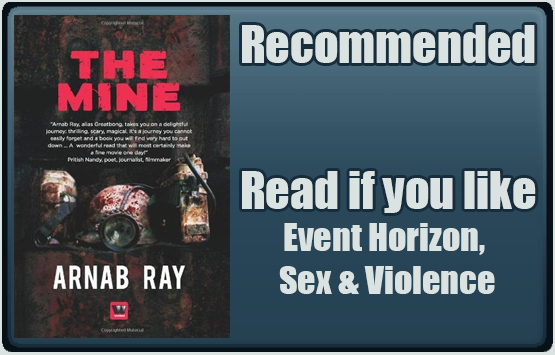
The Mine by Arnab Ray

The Mine by Arnab Ray

Formats: Print, digital

Publisher: Westland (Indian publisher now owned by Amazon)

Genre: Blood & Guts (Gorn), Psychological Horror, Occult

Audience: Adult/Mature

Diversity: South Asian/Desi/Indian, Disabled character (uses a wheelchair due to partial paralysis, mute/Aphonia)

Takes Place in: Thar Desert, Rajasthan, India

Content Warnings (Highlight to view): Abelism, Bullying, Cannibalism, Child Abuse, Child Death, Child Endangerment, Death, Drug Use/Abuse, Forced Captivity, Illness, Gaslighting, Gore, Kidnapping, Medical Torture/Abuse, Medical Procedures, Mental Illness, Self-Harm, Rape/Sexual Assault, Sexism, Slurs, Slut-Shaming, Stalking, Suicide, Torture, Violence, Xenophobia

Blurb

At a secret mining facility somewhere in the deserts of Rajasthan, an ancient place of worship, with disturbing carvings on its dome, is discovered buried deep inside the earth. Soon the miners find themselves in the grip of terrifying waking nightmares. One tries to mutilate himself. Worse follows.

Five experts are called in to investigate these strange occurrences. Sucked into a nightmare deep underground, they embark on a perilous journey; a journey that will change them forever, bringing them face-to-face with the most shattering truth of them all…

The greatest evil lies deep inside.

Imagine combining Event Horizon with Agatha Christie’s And Then There Were None then mixing in the criminally underrated film Below. Set it in a mine deep below the Great Indian Desert and you’ll get an idea of what you’re in for in Arnab Ray’s horrifying, claustrophobic, sex-filled gore-fest of a novel about five adults and one little girl trapped underground with their guilt.

The Mine starts out with Samar, a rich recluse specializing in industrial security, wallowing in his grief after the disappearance of his daughter and the death of his wife. Yeah, Samar has shit luck. A mysterious man named Arnold Paul (whose name I kept reading as Arnold Palmer) finally bribes convinces Samar to drag his depressed butt out of bed by offering him a large sum of money to go with him and do a sketchy job, the details of which Paul/Palmer won’t reveal. Samar is apparently used to this sort of thing due to his work as a security expert/spy for secret government ops, and figures he wasn’t doing anything important anyway (except moping and sleeping) so he begrudgingly accepts the offer and heads off for the titular mine. As it turns out, greed is a great motivator because Mr. Paul/Palmer has also convinced four other experts to go to the middle of nowhere with a complete stranger, no questions asked.

Joining Samar are Dr. Karan Singh Rathore, a diplomatic and laid back older gentleman who specializes in infectious diseases; Dr. Anjali Menon, a widowed archeologist who brought her disabled daughter, Anya, along; Dr. Akshay More, an arrogant and obnoxious assistant professor in forensic toxicology; and Dr. Preeti Singh, a short-tempered psychologist with a surprising lack of people skills. The group has been brought together to give their expert opinion on a series of deadly accidents that seem to have been caused by the discovery of an ancient, creepy temple the miners are too afraid to go near. A temple that also happens to be covered in explicit carvings of naked women being tortured and killed, because whomever created the damn thing is sexist and gross. If that wasn’t ominous enough, the director of the mine is named Lilith Adams. While it’s fully possible her parents were just uncreative goths from the early 00’s, it’s far more likely that Ms. Adams just picked the most obvious evil pseudonym since Alucard and Lou C. Pher.

At this point, most people would’ve noped the fuck out of there, but Samar and the scientists have clearly never seen a horror movie in their lives and are too wrapped up in their own issues to notice the whole situation has more red flags than a May Day parade in Moscow. The mine could not be more obviously evil if it had “Gateway to Hell” in big florescent lights over the entrance, ominous music playing in the background, and a bunch of demons chilling in the conference room. Then again, these are people who willingly followed a creepy stranger into the middle of nowhere to visit his sketchy underground dungeon (literally, the workers are all criminals and aren’t allowed to leave until their contracts are up) because Paul/Palmer promised them candy/money. Little kids have more street smarts than this group, so I shouldn’t be surprised they’re completely oblivious to danger.

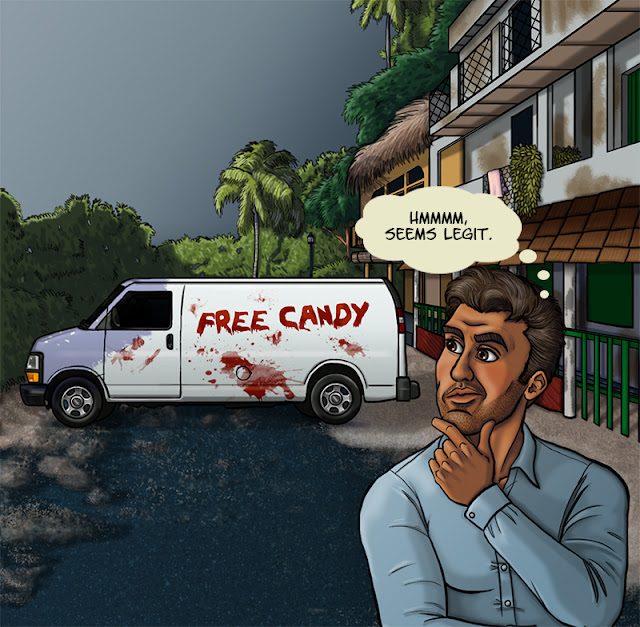
Illustration of a blood-spattered van bearing the name FREE CANDY and a South Asian man thinking

I mean, even I figured out the candy van was a trap after the first 9 or 10 times.

Akshay and Anjali explore the torture-porn temple and discover it depicts ironic punishments attributed to specific sins. Meanwhile, Karan and Preeti talk to the survivors, who share stories that would make Rob Zombie squeamish. Akshay makes light of the situation and acts like a jackass, Anjali does her best to ignore everyone and just do her job, Karan remains calm and reasonable, and Preeti is hostile and short-tempered. Samar checks the security and continues to have no fucks to give beyond a kind of creepy obsession with Anya, who reminds him of his dead daughter. The general consensus among the workers is that they’ve somehow opened a portal to hell and everyone in the mine is going to die horribly as a result of their dark pasts. Needless to say, company morale isn’t great. At this point, everyone finally agrees this place is super creepy and they want to collect their paychecks and GTFO. Alas, in a twist that should come as a surprise to exactly no one, Lilith turns out to be evil, and sets off an explosion that kills all the mine workers and traps the six survivors (Samar, the scientists, and Anjali’s daughter) inside while she laughs manically about the mine’s real resource being fear. Worst. Job. Ever.

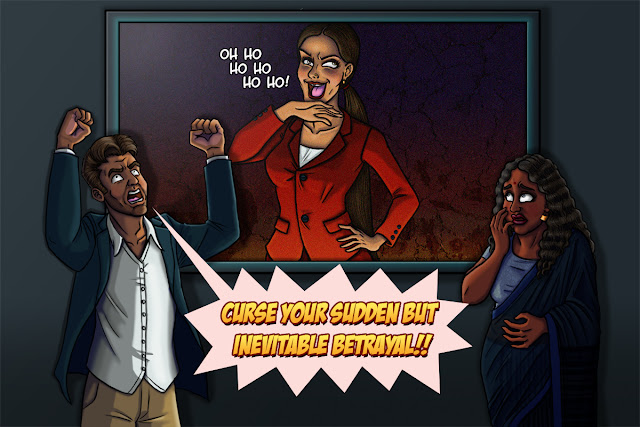
Illustration of laughing woman surrounded by a man and woman. The man says

Her name is Lilith, what did you guys expect?

The explosions cause the security systems to engage, sealing the group inside with a series of death traps. Because why wouldn’t you want death traps in an already dangerous mine? On top of everything, an experimental gas that causes super human strength and insanity is being pumped through the A/C, which frankly, feels like overkill to me, but hey, they can run their portal to hell however they want. After their initial panic, presumably followed by the realization that they really should have seen all of this coming, the survivors formulate a plan to navigate the traps and make it to the surface. They’re slightly hindered by the fact they have to trust each other and work together to make it out, and most of them are deceitful, suspicious, assholes, not to mention all the stupid puzzle traps that were apparently inspired by 80s video games. One such puzzle involves trying to obtain acid vials while avoiding motion activated laser and an electrified floor, and if you succeed you’ll be rewarded with a chainsaw, which may be useful later. Unfortunately in this “game” their are no save points or extra lives.

What follows is about what you’d expect for a book about trying to escape from a possibly haunted mine with a bunch of jerks, but the predictability doesn’t make the story any less suspenseful or gripping. But face it, if you’re reading this book, you’re looking for creative deaths, not creative storytellin, and boy, does Ray deliver there. Besides, the true mystery doesn’t lie in their Aeneas-like journey through the mine, but in each character’s backstory, all of which are slowly revealed as they try to escape the subterranean deathtrap. Each of the adults has done something criminal and escaped punishment, and have been struggling with their guilt ever since. The quality of the backstories varies, with some characters (like Akshay and Preeti) getting plenty of focus, while Anjali gets very little characterization beyond “the aloof mom”. So too do their sins seem to be of differing severity. Some of the survivors have committed crimes so awful as to make them irredeemable, while others are more sympathetic and their sins, while still terrible, are still at least partly understandable. This disparity seems a little unfair as it means at least some of the group will potentially suffer a gruesome death (at least according to the carvings in the temple) over something that would normally earn them less than 15 years in prison (at least in the US, not sure about the Indian judicial system). It’s not that their crimes aren’t bad, they just don’t seem to merit a sentence of being reduced to a puddle of bloody viscera.

We never really learn if the mine is truly being controlled by a demonic entity or if the group’s guilt and paranoia (fueled by the hallucinogenic gas) is causing them to attribute bad luck to malicious forces and see things that aren’t there. Samar even suggests that the whole thing is an unethical experiment by the government to test their new gas on subjects no one will miss, as there are far too many coincidences for mere random chance, and the temple may be a fake created to amp up their fear levels. Since none of the characters are able to trust their own senses, making them unreliable narrators, arguments could be made for either scenario, making the story even more spooky and disturbing. Monsters are scary, but they’re even scarier when you can’t even tell if they’re real or simply the imaginary scapegoats of guilt-ridden, paranoid people. Even more frightening, Ray argues, are the depths of human cruelty and depravity, which are explored in each character’s backstory. Though that may just be an excuse to squeeze more gore out of the story.

The Mine does an excellent job balancing itself between psychological horror and splatterpunk. The true scares lie in the book’s creepy atmosphere, suspense, and the characters slowly succumbing to madness; the over-the-top gore is simply dessert. Unfortunately, this otherwise perfect blend of horror comes with as huge helping of misogyny. Yuck. Look, I’m fully willing to admit I’m part of the lowest common denominator who just wants to see heads exploding like overripe cherries and attractive people boning, but that doesn’t mean I like sexism. Unfortunately, more often than not, the three seem to go hand in hand, much to the frustration of female horror fans, and other, more enlightened individuals who just happen to like hot sex and lots of blood. Ray isn’t as bad some other authors out there, the violence is pretty evenly split between the genders and there aren’t any scenes of knife-wielding killers chasing half naked women. He even manages to handle the subject of sexual assault fairly well, choosing to focus more on the problematic culture of victim-blaming and men who feel entitled to women’s bodies rather than the rape itself. But he struggles with creating believable female characters, defining them by their relationships with men, and them victimizing them. Both of the female scientists have backstories that involve abuse and mistreatment at the hands of men, and instead of being written as strong, survivors, they both come off as bitter, man-haters. Apparently Ray subscribes to the theory that in order to be “strong” a woman must act rude, aloof, aggressive, and despise an entire gender, with the exception of that one special man who tames her with his magical penis. Which is why both Anjali and Pretti act like complete jerks, with Pretti especially flying off the handle at every perceived slight (she must be a great psychologist), and basically being awful to everyone except, ironically, Akshay whom she latches onto almost immediately (despite the fact that he’s literally just the worst). Despite all her bluster, Pretti still falls quickly into the role of helpless victim in need of a man’s protection at the first sign of danger. It’s really embarrassing. I guess she can’t help it because she’s an emotional female with a hysterical uterus or some such nonsense. The women in the story are all described as being gorgeous, but only one male character is described as being very attractive, the wholly unlikable Akshay, and that’s only because his appearance is supposed to reinforce how vain and materialistic he is. Many of the women are also incredibly horny, even minor characters, like Tanya the gold-digging nurse, and Ray paradoxically has no problem slut-shaming them for it (apparently enjoying sex is sinful enough to get you murdered by the mine), even though he later demonizes other characters for doing the same thing. Maybe the mine is just super slut shame-y. The unearthed temple certainly implies that someone behind the scenes hates women.

The women in the story seem less like real people and more like a weird combination of straw-feminists and male masturbatory material, with Ray putting way too much emphasis on their appearance, sex drives, and relationships with men. Then of course we have Anya, who, while thankfully not a sex object, is still treated as an object nonetheless. She barely gets any characterization, and doesn’t communicate even through sign language or writing, she’s just a blank slate for Samar to project his weird daughter obsession onto. It’s doubly problematic since Samar seems to use Anya’s disability as an excuse to treat her like a life-sized doll he can love, protect, and turn into his replacement daughter. Because she’s mute he assumes she has nothing to say, and because she doesn’t walk he thinks she’s completely helpless. We don’t even get to learn what she’s thinking, or how she feels about Samar treating her as some sort of second chance, because, unlike the other characters who all get their turn in the spotlight of the limited, third-person narrative, Anya is completely ignored. At least she gets a little bit of a role later on (which I won’t spoil). Miraculously, Lilith Adams is the only female character who is neither a victim, nor a sex fantasy, and is described only as being terrifying, intense, and very much in charge, much like her namesake.

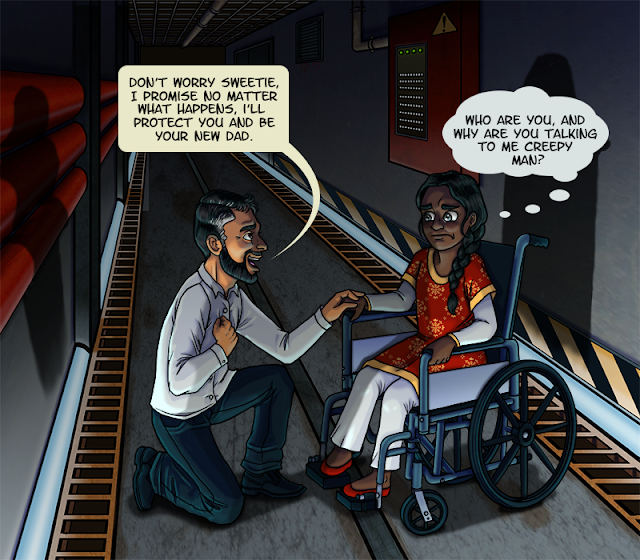
A man kneels in front of a woman in a wheelchair. The man says

This definitely feels like a stranger danger situation.

So the female characters are about as well written as you’d expect from a male author who doesn’t know how women work, and the whole “helpless, sick wheelchair girl” trope is super problematic. It’s not the worst treatment of women I’ve seen in splatterpunk, but I’d still prefer to enjoy my blood and guts without the side of sexism. I mean, I don’t think it’s an unreasonable request. The writing is still pretty good, and it’s definitely the scariest book I’ve read so far this year. The Mine is also one of only a few Indian horror novels I’ve been able to find in English. Whether that’s enough to overshadow the book’s problem areas, however, is up to the individual reader. 

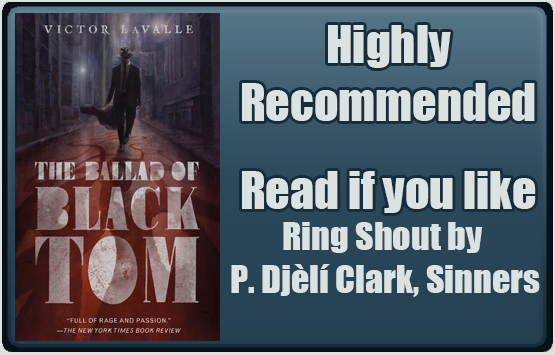
The Ballad of Black Tom by Victor LaValle

The Ballad of Black Tom by Victor LaValle

Formats: Print, audio, digital

Publisher: Tor

Genre: Eldritch, Monster, Historic Horror, Occult, Sci-Fi Horror

Audience: Adult/Mature, Y/A

Diversity: Black characters (African American and Caribbean)

Takes Place in: Harlem, New York City, USA

Content Warnings (Highlight to view): Bullying, Death, Gore, Mental Illness, Medical Procedures, Oppression, Physical Abuse, Police Harassment, Racism, Torture, Verbal/Emotional Abuse, Violence, Xenophobia

Blurb

People move to New York looking for magic and nothing will convince them it isn’t there.
Charles Thomas Tester hustles to put food on the table, keep the roof over his father’s head, from Harlem to Flushing Meadows to Red Hook. He knows what magic a suit can cast, the invisibility a guitar case can provide, and the curse written on his skin that attracts the eye of wealthy white folks and their cops. But when he delivers an occult tome to a reclusive sorceress in the heart of Queens, Tom opens a door to a deeper realm of magic, and earns the attention of things best left sleeping.
A storm that might swallow the world is building in Brooklyn. Will Black Tom live to see it break?

Oh Lovecraft, you were such a great horror writer, but an absolutely terrible human being.

When it comes to Lovecraft, I have some very complicated opinions. I adore the Cthulhu mythos, cosmic horror, and the concept of forbidden knowledge that utterly destroys your sanity, but it’s hard to enjoy his writing when he liberally peppers it with his hatred for anyone who isn’t a WASP. One minute  I’m reading an enjoyable little story about a cosmic abomination and the dark secrets humanity was never meant to know, and the next it’s morphed into some sort of eugenics bullshit. Here’s a small sampling of just some of the bullshit he pulls in his stories: In the Case Of Charles Dexter Ward Lovecraft describes a woman as having “a very repulsive cast of countenance, probably due to a mixture of negro blood,” in Herbert West: Reaminator the black boxer, Buck Robinson, is compared to an ape, in The Rats in the Walls there’s a black cat named N****r Man, The Horror at Red Hook is basically just Lovecraft rambling about how much he hates immigrants and black people who he refers to as a “contagion” with “primitive half-ape savagery”, and in Medusa’s Coil he describes slavery as “a civilization and social order now sadly extinct”. Oh, and let’s not forget that poem. There’s a good reason why Lovecraft’s bust is no longer used for the World Fantasy Award trophy, the guy was a dick.

A drawing of Nnedi Okorafor wearing a dark blue dress, large red and gold earrings, and holding her World Fantasy Award, a bust of H.P. Lovecraft. Okorafor looks uncomfortable while she says “Um, Thanks, I guess? Yeah, I don’t really want this racist’s head on my mantle.”

I tried to draw Nnedi Okorafor, “tried” being the operative word. She says I got it right from the shoulders up though!

Now, before anyone uses the “Lovecraft was just a product of his time” excuse, please consider this: Yes, his active years as a writer were during the incredibly racist segregation era, but not everyone shared his shitty beliefs about people of color and Jews. Mary White OvingtonMoorfield Storey, and William English Walling were all white, but they were also supporters of  civil rights and racial equality during the same period, and even helped found the NAACP with W. E. B. Du Bois. So it’s not like every white person in the 1920s and 1930s was racist. Lovecraft would’ve at least been aware of civil rights due to Guinn v. United States, a landmark case that found racist literacy tests unconstitutional, the National Negro Business League which helped to double the number of black owned businesses, and prominent black lawyer Charles Hamilton Houston, who was fighting for civil rights in court. Hell, even his friends and family criticized the horror writer’s ignorant attitude. Lovecraft’s wife, Sonia Greene, and friend Samuel Loveman were both horrified by Lovecraft’s anti-Semitism and resented him for it. Sonia even wrote, “Whenever we found ourselves in the racially mixed crowds which characterize New York, Howard would become livid with rage… He seemed almost to lose his mind.” When Lovecraft attacked Charles D. Isaacson‘s, article on racial tolerance, In a Minor Key, in his own article titled In a Major Key (where he praised the KKK as “that noble but much maligned of Southerners who saved half our country from destruction”) he managed to piss off not just Isaacson, but his own friend James Ferdinand Morton, both of whom wrote responses attacking Lovecraft’s racism. He knew people thought he was racist, as he’d been called out multiple times and even his wife had pleaded with him to reconsider his beliefs- Lovecraft just chose to be an intolerant jerk.

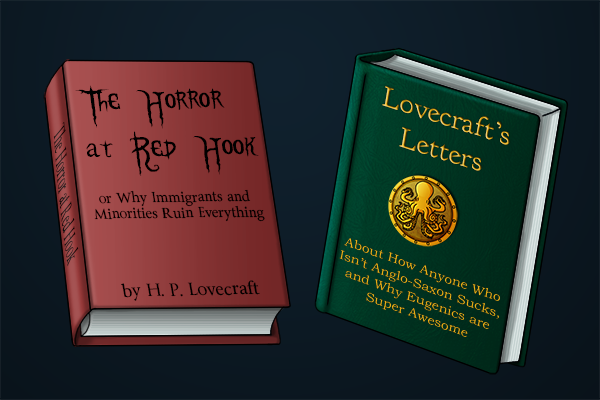
There are two books. On the left is a book with a red cover written by H.P. Lovecraft. It’s titled “The Horror at Red Hook, or Why Immigrants and Minorities Ruin Everything.” On the right is a green, leather bound book with an image of a brass octopus on the cover. The title, written in gold lettering, is “Lovecraft’s Letters: About How Anyone Who Isn’t Anglo-Saxon Sucks, and Why Eugenics are Super Awesome”.

Probably real Lovecraft titles.

Luckily for us, many talented creators have taken concepts in Lovecraft’s writing and used it to create their own works, so fans can still enjoy Yog-Sothoth, the Deep Ones, and the horrors of forbidden knowledge driving men to madness- without all the bigotry. The Ballad of Black Tom is one of these works, a retelling of  Lovecraft’s incredibly racist The Horror at Red Hook from the point of view of a black man living in Harlem.

For those not familiar with Lovecraft’s original short story, The Horror at Red Hook follows police detective Thomas Malone and his pursuit of forbidden knowledge in the immigrant neighborhood of Red Hook, Brooklyn, or as Lovecraft describes it “a maze of hybrid squalor”. Because the only religions in Lovecraft’s world are either good, Anglo-Saxon Christianity or evil, bad, demon worship, all the brown people are apparently involved with the occult.  Malone is put on a case involving the wealthy and eccentric recluse, Robert Suydam because his relatives want the old man declared mentally unfit so they can have his money. During the course of the investigation Malone discovers that Suydam has been spending time with illegal immigrants and foreigners, which obviously means he’s doing something super evil, like sacrificing white babies to tentacle-faced monsters, because Lovecraft is racist and Malone is an awful detective. Suydam continues to do suspicious things, in Malone’s opinion anyway, like lose weight, work on his personal grooming, and get married. Eventually the whole thing cumulates in a police raid in Redhook, where Malone finds a bunch of creepy shit in Suydam’s basement flat which causes the police detective to lose his sanity points and pass out from sheer terror. Afterwards we discover that the buildings collapsed, killing almost everyone except Malone, who is left with PTSD and batophobia. The rest of the story is just Lovecraft whining about immigrants “ruining” New York and reads like the antiquated 8,000 word equivalent of a Trump tweet. It’s not one of his better stories. So it’s kind of a miracle that LaValle not only manages to write a version of The Horror at Red Hook that’s not just a commentary on racism, but is actually good, while still keeping all the creepiness, mind-fuckery, characters, and plot of the original. Suydam and Thomas Malone both appear as major characters in The Ballad of Black Tom, Malone serving as a deuteragonist for the second half of the story, while Suydam introduces Tommy Tester, the book’s protagonist, to the occult. There are other hidden references to Lovecraft lore throughout the book. The title, Black Tom, is an allusion to the cat from The Rats in the Walls whose name was changed from N***** Man to Black Tom when the story was reprinted in Zest magazine in the 1950s. Toward the end Robert LaValle mentions a man from Rhode Island, living in New York, who may be Lovecraft himself.

LaValle defends the minority population living in Harlem and Redhook that Lovecraft so despised by showing them as the every day folks they are, trying to get by with what little they have. Tommy even expresses disappointment after visiting the Victoria Club, when he learns that it’s not the den of debauchery and sin he had hoped for, but instead old men playing cards and women selling meals they’ve made at home. There are criminals, yes, but that’s to be expected in any impoverished area, and they’re far from a majority of the population. When Tommy discovers Suydam is associating with so many criminals, he’s terrified, and it speaks more to the rich, white man’s character than the immigrants on New York. What Malone discovers in the basement is also been changed from the original, but to reveal more would ruin the amazing ending of Black Tom. Let’s just say LaValle provides his readers with more detail on the horrors the detective discovers, and a much more satisfying ending.

The thing I found the scariest about The Ballad of Black Tom weren’t the fictional monstrosities sleeping at the bottom of the see ready to destroy humanity, it was how much LaValle’s fictionalized world reminded me of our own. The cops’ blatant racism, their harassment of black men who were simply walking down the street, and their willingness to kill at the slightest provocation felt all too familiar, as did the rampant xenophobia and anti-immigration attitudes. The story may be set in the 1920s, but it’s clear that some things still haven’t changed. Tommy’s encounters with the police were enough to give me panic attacks, as I remembered my own family’s terrifying encounters with cops. While I’m pale enough to pass as white, most of my extended family isn’t, and I grew up with horror stories about what happened to black people stalked, shot, raped, and lynched for merely existing. Tommy has learned what every young black person is still being taught: if the police stop you, appear as non-aggressive as possible, be polite, and put up with whatever harassment the cops dish out or you’ll wind up dead. We see this in all his encounters with Malone. Tommy plays dumb, looks downs, and lets them steal his money and insult him to his face without making a comment. At least for the first half of the book.

Tommy Tester starts the story as a good man. He may trick others and take on some not-so-legal work, but he’s trying to take care of his disabled father in a world that’s against him, so it’s not surprising he has to do some questionable things to survive. At least he never actively hurts others and tries to do the right thing when he can, like preventing a witch from getting her hands on forbidden knowledge, which is more than I can say for most of the people Tommy encounters. Racist cops constantly threaten and abuse him, he’s harassed by a bunch of white kids just for walking while black, and white society treats him as less than human. Even Robert Suydam, who claims to admire Tommy and gives him a large sum of money to play guitar in his home, is merely using for his own ends. As it turns out, Suydam is a white man who fetishizes POC cultures, while still viewing himself as superior to the same people he claims he wants to help. There’s a saying “you can only kick a dog so many times before it bites back” and after being attacked, abused, taunted, stolen from, threatened, and finally losing everything to cold and corrupt law enforcement, Tommy Tester realizes he has nothing left to lose and says “fuck it”. And that’s how we start the second half of the story, told from Malone’s point of view, with Tommy, now calling himself “Black Tom,” transforming himself into the most badass, brutal, and terrifying antagonist in order to exact his bloody revenge on Robert Suydam, Thomas Malone, and the xenophobic NYPD. And let me just say, it’s immensely satisfying. Gory, but satisfying.

I abhor violence in real life, and obviously don’t agree with mass slaughter and abuse, no matter how evil the victims are. The real world is more complicated than just good vs. evil, and violence and revenge just beget more of the same. That said, there’s still a violent, pissed off part of me, hurt and furious at the injustice of the world, that wants to see wicked people suffer. Not just get their richly deserved comeuppance, but really, truly suffer in the worst ways imaginable. It’s the bitter part of me that relates to all those Saturday morning cartoon villains of my past who just want to destroy everything, because the world is such a terrible, hateful place that it probably deserves it. This vengeful part of me that becomes more and more hateful every time I read the news was immensely satisfied and soothed to watch Black Tom punish a group of racists who resemble 21st century hate groups a little too closely. It’s the same anger that motivates Killmonger in the Black Panther film.


But, like I said, these are ugly thoughts I would never actually act on or hope to see happen in real life because I know how wrong they are, and I still hold on to the hope that logic and compassion will win out (so FBI, if you’re reading this, I just want to clarify, I’m not actually planning on going on any kind of bloody killing spree). When Tommy, pushed to choose between an eldritch abomination and the hateful people who hurt him again and again, he gives in to revenge and loses part of his humanity, and that’s what makes the story so bitter-sweet. Black Tom may have gotten his revenge, but at the cost of being a good man, something he will have to live with for the rest of his life. He’s compromised his most important value, being the kind of man his father would be proud of, and can no longer look his best friend in the eye. As satisfying as it is to see horrible people suffer a horrible fate, you can’t help but feel bad for Tommy who’s left to wonder if it was really worth it. 

My wife, who is wearing a blue space dress and white, over-the-knee socks has just opened the door to reveal two FBI agents, a light-skinned man, and a dark-skinned woman. My wife has her hands on her and looks irritated. She shouts, “What did you do this time!?!!” I’m in the foreground, carrying a human foot that’s been cut off below the knee. The limb is starting to decay and is wrapped in bandages. I look surprised and guilty at being caught by my wife.

The severed human leg actually has nothing to do with why the Feds are here. Though I’m sure my wife is going to ask about that too. Watch what you say on the internet kids!

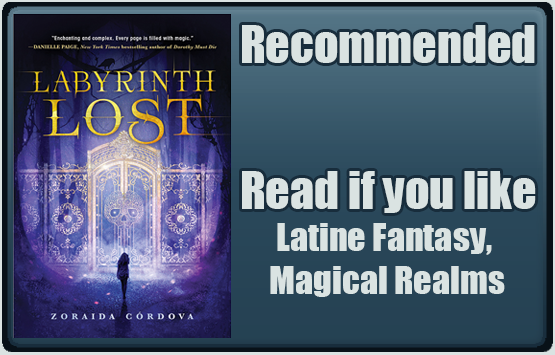
Labyrinth Lost by Zoraida Córdova

Labyrinth Lost by Zoraida Córdova

Formats: Print, digital

Publisher: Sourcebooks Fire

Genre: Dark Fantasy, Occult

Audience: Y/A

Diversity: Ecuadorian author, Hispanic/Latinx characters, Puerto Rican characters, South Asian character, Bisexual characters

Takes Place in: New York City, USA

Content Warnings (Highlight to view): Abelism, Animal Death, Body Shaming, Bullying, Child Abuse, Child Endangerment, Death, Forced Captivity, Gaslighting, Gore, Kidnapping, Torture, Violence

Blurb

Nothing says Happy Birthday like summoning the spirits of your dead relatives.

Alex is a bruja, the most powerful witch in a generation…and she hates magic. At her Deathday celebration, Alex performs a spell to rid herself of her power. But it backfires. Her whole family vanishes into thin air, leaving her alone with Nova, a brujo boy she can’t trust. A boy whose intentions are as dark as the strange marks on his skin.

The only way to get her family back is to travel with Nova to Los Lagos, a land in-between, as dark as Limbo and as strange as Wonderland…

Alex is about to celebrate her Deathday, a huge party that’s thrown when a young bruja or brujo first gets their powers. Her entire extended family will be there to help her bind and control her newfound abilities. Everyone seems thrilled, especially her mother and older sister Lula; everyone that is, except for Alex. She views magic as a curse rather than a blessing, so she’s pretty upset when she discovers that, no surprise (it’s Y/A fiction after all), she’s essentially the most powerful bruja they’ve seen in generations, an encantrix whose magic is vast and broad. Most brujas are limited to one or two abilities, like healing or seeing the future, but Alex can pretty much do anything. In a misguided attempt to get rid of her power, she accidentally banishes not only all her living relatives but her dead ancestors as well to the Limbo-like land of Las Lagos. Oops.

Okay, so admittedly the whole powerful chosen one thing does sound kind of Mary Sue-ish, especially the part about not wanting her super special powers. “Oh, poor little main character, you get all these awesome powers, how awful for you!” said no reader ever. Well, Alex has a pretty good reason for hating her magic, and it’s not the typical “Oh, being perfect is so hard~” B.S. You see, magic isn’t some consequence free wish-fulfilling super power, it’s born from sacrifice. Magic drains the user and causes them physical pain. The more powerful the spell, the more you’ll suffer. Healing someone’s else’s headache means you’ll end up with a black eye. A protection spell could cause you to pass out. Some magic can even drain the life force of the user, slowly killing them. Magic is also the reason Alex’s father disappeared, destroying her family. She has to watch her mother grieve and suffer every day, trying to raise three girls on her own.  It traumatized her when she was seven and saw the re-animated corpse of her Aunt Rosaria. Magic killed her pet cat, plagues her with nightmares, and forces her to keep her best friend at arm’s length. So Alex’s aversion to her powers is understandable, I wouldn’t want to use magic either after all that.

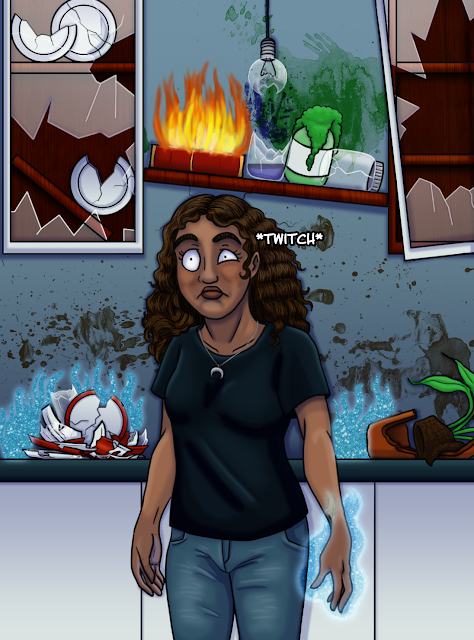
A dark skinned girl looks traumatized in front of a destroyed kitchen. Blue, magical flame surrounds her hand and the broken dishes on the counter.

Thanks, magic!

Love triangles are another tired trope in young adult fiction that I’m sick of seeing. It’s just pointless and needless drama that derails the story. Can’t everyone just be polyamorous and get along? A threesome would clearly solve this problem. It’s especially irritating when one (or both) of the love interests is a mysterious bad boy who appears out of nowhere and seduces the main character, despite them having nothing in common. Just have a one-night stand and get it out of your system, he clearly isn’t relationship material, damn. So many problems in YA fiction could be solved by just sleeping with everyone… and I just realized why I probably shouldn’t be giving advice to teenagers. Okay, forget everything I just said. Love triangles are still stupid though, and when I first learned Labyrinth Lost had one (with a mysterious bad boy no less) I let out one of those long, exasperated groans that makes me sound like a slow-moving zombie that just discovered it’s going to have run after its prey. So, basically me as a zombie. Running is the worst. So are pointless romantic sub-plots.

I’m rolling my eyes letting out a very long, very loud groan. My wife is sitting at a table looking at her tablet and trying to ignore me. She asks “So is it a love triangle again, or are you craving brains?”

THE WORST

Nova, the smug, douchey, “bad boy” brujo who kept flirting with Alex was about as obnoxious as you’d expect, no surprise there. He was all dark and tortured and rude, bleh. But this is where Córdova surprised me. Because Nova’s romantic rival is a South Asian girl named Rishi, Alex’s longtime friend. Okay, so a multiracial, bisexual love triangle, that’s not something you see every day. And it’s not just queer baiting either! The two girls are genuinely romantically interested in each other. Plus, Rishi is so awesome; she’s brave, weird, loyal, funny–exactly the kind of person I’d want to be friends with. When Alex is in trouble she doesn’t even hesitate to dive in and rescue her, because that’s what friends do. My interest was cautiously piqued, but I was still wary. Was this going to turn into a huge drama-filled plot point that derails the story? But again Córdova exceeded my expectations, because the love triangle is barely even there. Yes, Alex ends up with one of them, and yeah, the bickering of the two suitors could be annoying, but Alex’s entire focus is on saving her family, as it should be. Yes, she has crazy teenage hormones and starts lusting after her best friend and the mysterious Nova, but her focus never wavers from the task at hand, and she pushes her romantic impulses to the side. Alex even gets irritated that Nova is wasting so much time flirting and Rishi keeps getting jealous, when there are clearly much bigger fish to fry. I don’t usually get invested in romantic subplots, and I’m almost embarrassed to admit this, but I went full on fan girl and found myself shipping Rishi and Alex the entire time (much to the chagrin of my poor wife who had to deal with my high pitched squees every few minutes). I feel like I need to write Córdova an apology letter for ever doubting her, because she has somehow managed to pull off the least annoying love triangle I’ve ever read in YA fiction. Hell, even Nova got called out for his arrogant dick act, which I was also not expecting. So, Kudos to you Córdova.

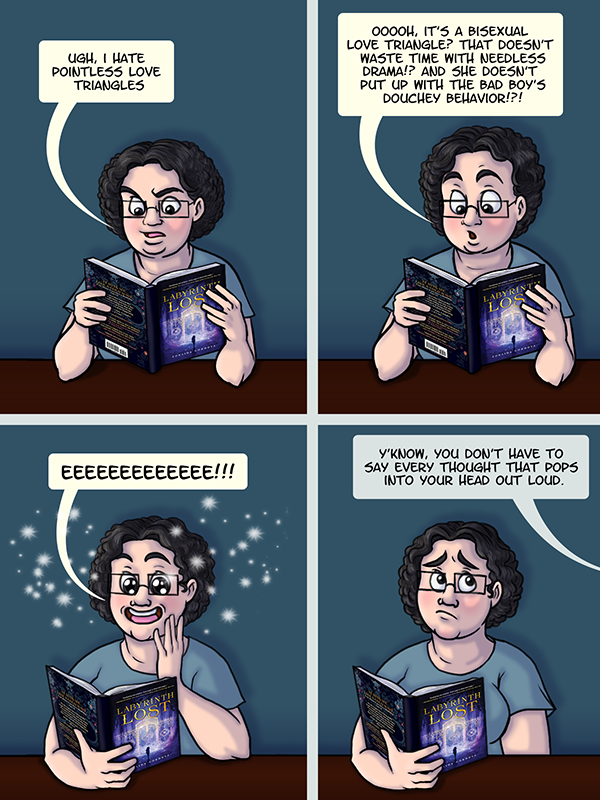
I’m reading Labyrinth Lost, looking annoyed, and comment “Ugh, I hate pointless love triangles.” In the next panel I suddenly look interested and saying “Oooooh, it’s a bisexual love triangle? That doesn’t waste time with needless drama!? And she doesn’t up with the bad boy’s douchey behavior!?!” The third panel shows me squeeing, surrounded by sparkles, with big, shiny eyes. In the final panel, someone yells off screen “Y’know, you don’t have to say every thought that pops into your head out loud”.

A love of triangle actually made me squee for the first time in history.

The whole romantic subplot, if you can even call it that, is thankfully a pretty minor story element, and the story’s main focus is on family and identity. Alex’s relationship with her sisters, mother, aunts and the other women in her family is incredibly well written and touching, and one of my favorite aspects of the book. It’s just so wonderfully refreshing to see a YA novel that focus on the bonds between women and familial love rather than girls fighting over stupid boys. Lula, her beautiful and bossy older sister is great, a force unto herself, overflowing with love and magic, and always ready to take charge. I love Lula. Her younger sister, Rose, is a psychic with the whole creepy child vibe going on, an incredibly clever and intelligent young girl with a sweet tooth and a mischievous streak. She doesn’t get as much page time, as she’s more reserved than her two sisters. And of course Alex’s mother, Carmen, a strong woman and loving parent, holds their little family together. They’re not perfect, and they might bicker, but they’re all fiercely loyal and protective of each other, and Alex’s strong connection with her family is what gives her the strength to journey through Los Lagos, and protects her from the perils of the dark, magical Limbo.

Córdova’s world building is another strong point of the story. Los Lagos is probably tied with Paheli from The Gauntlet for the coolest fantasy world I’ve read about this year. It’s enchantingly creepy, beautiful, and weird.  Interestingly, it reminds me of two other fantasies titled after the Minotaur’s legendary prison, Jim Henson’s Labyrinth and Guillermo del Toro’s Pan’s Labyrinth (with a little bit of the Wizard of Oz thrown in for good measure, even if it breaks the themed naming). The only downside to having a creative world that stands out so much is that the characters seem kind of bland in comparison. That’s not to say any of the characters are poorly written or dull, it’s just hard to hold a candle to the land of Los Lagos with its rivers of ghosts, burning forests, and creepy creatures.

Córdova’s world is inspired by Latin American religions and cultures to create the story’s mythology, magic, and gods. The bilingual bonuses and Latina influences will be fun for anyone familiar with the language and culture, but if you’re new to brujas and brujos keep in mind the ones in Labyrinth Lost resemble actual Brujeria, Santeria, and folk magic practitioners about as much as the wizards and witches in Harry Potter represent real Wiccans. For example, the Deos in the story are similar in many respects to the orixá of Santeria and the Loa form Vodou, but have no “real world” counterparts. Interestingly enough, other witches and magic users from other traditions also exist in the Labyrinth Lost universe, though we never get a chance to see them. Maybe in future Brooklyn Brujas titles.

Navigation

Social Media

Search by Tags

To learn more about the Age Group, Diversity, and Genre tags, click here.

Age Groups

Diversity

Genre

Support the Blog

Search

Links

The Mine by Arnab Ray

The Mine by Arnab Ray

Formats: Print, digital

Publisher: Westland (Indian publisher now owned by Amazon)

Genre: Blood & Guts (Gorn), Psychological Horror, Occult

Audience: Adult/Mature

Diversity: South Asian/Desi/Indian, Disabled character (uses a wheelchair due to partial paralysis, mute/Aphonia)

Takes Place in: Thar Desert, Rajasthan, India

Content Warnings (Highlight to view): Abelism, Bullying, Cannibalism, Child Abuse, Child Death, Child Endangerment, Death, Drug Use/Abuse, Forced Captivity, Illness, Gaslighting, Gore, Kidnapping, Medical Torture/Abuse, Medical Procedures, Mental Illness, Self-Harm, Rape/Sexual Assault, Sexism, Slurs, Slut-Shaming, Stalking, Suicide, Torture, Violence, Xenophobia

Blurb

At a secret mining facility somewhere in the deserts of Rajasthan, an ancient place of worship, with disturbing carvings on its dome, is discovered buried deep inside the earth. Soon the miners find themselves in the grip of terrifying waking nightmares. One tries to mutilate himself. Worse follows.

Five experts are called in to investigate these strange occurrences. Sucked into a nightmare deep underground, they embark on a perilous journey; a journey that will change them forever, bringing them face-to-face with the most shattering truth of them all…

The greatest evil lies deep inside.

Imagine combining Event Horizon with Agatha Christie’s And Then There Were None then mixing in the criminally underrated film Below. Set it in a mine deep below the Great Indian Desert and you’ll get an idea of what you’re in for in Arnab Ray’s horrifying, claustrophobic, sex-filled gore-fest of a novel about five adults and one little girl trapped underground with their guilt.

The Mine starts out with Samar, a rich recluse specializing in industrial security, wallowing in his grief after the disappearance of his daughter and the death of his wife. Yeah, Samar has shit luck. A mysterious man named Arnold Paul (whose name I kept reading as Arnold Palmer) finally bribes convinces Samar to drag his depressed butt out of bed by offering him a large sum of money to go with him and do a sketchy job, the details of which Paul/Palmer won’t reveal. Samar is apparently used to this sort of thing due to his work as a security expert/spy for secret government ops, and figures he wasn’t doing anything important anyway (except moping and sleeping) so he begrudgingly accepts the offer and heads off for the titular mine. As it turns out, greed is a great motivator because Mr. Paul/Palmer has also convinced four other experts to go to the middle of nowhere with a complete stranger, no questions asked.

Joining Samar are Dr. Karan Singh Rathore, a diplomatic and laid back older gentleman who specializes in infectious diseases; Dr. Anjali Menon, a widowed archeologist who brought her disabled daughter, Anya, along; Dr. Akshay More, an arrogant and obnoxious assistant professor in forensic toxicology; and Dr. Preeti Singh, a short-tempered psychologist with a surprising lack of people skills. The group has been brought together to give their expert opinion on a series of deadly accidents that seem to have been caused by the discovery of an ancient, creepy temple the miners are too afraid to go near. A temple that also happens to be covered in explicit carvings of naked women being tortured and killed, because whomever created the damn thing is sexist and gross. If that wasn’t ominous enough, the director of the mine is named Lilith Adams. While it’s fully possible her parents were just uncreative goths from the early 00’s, it’s far more likely that Ms. Adams just picked the most obvious evil pseudonym since Alucard and Lou C. Pher.

At this point, most people would’ve noped the fuck out of there, but Samar and the scientists have clearly never seen a horror movie in their lives and are too wrapped up in their own issues to notice the whole situation has more red flags than a May Day parade in Moscow. The mine could not be more obviously evil if it had “Gateway to Hell” in big florescent lights over the entrance, ominous music playing in the background, and a bunch of demons chilling in the conference room. Then again, these are people who willingly followed a creepy stranger into the middle of nowhere to visit his sketchy underground dungeon (literally, the workers are all criminals and aren’t allowed to leave until their contracts are up) because Paul/Palmer promised them candy/money. Little kids have more street smarts than this group, so I shouldn’t be surprised they’re completely oblivious to danger.

Illustration of a blood-spattered van bearing the name FREE CANDY and a South Asian man thinking

I mean, even I figured out the candy van was a trap after the first 9 or 10 times.

Akshay and Anjali explore the torture-porn temple and discover it depicts ironic punishments attributed to specific sins. Meanwhile, Karan and Preeti talk to the survivors, who share stories that would make Rob Zombie squeamish. Akshay makes light of the situation and acts like a jackass, Anjali does her best to ignore everyone and just do her job, Karan remains calm and reasonable, and Preeti is hostile and short-tempered. Samar checks the security and continues to have no fucks to give beyond a kind of creepy obsession with Anya, who reminds him of his dead daughter. The general consensus among the workers is that they’ve somehow opened a portal to hell and everyone in the mine is going to die horribly as a result of their dark pasts. Needless to say, company morale isn’t great. At this point, everyone finally agrees this place is super creepy and they want to collect their paychecks and GTFO. Alas, in a twist that should come as a surprise to exactly no one, Lilith turns out to be evil, and sets off an explosion that kills all the mine workers and traps the six survivors (Samar, the scientists, and Anjali’s daughter) inside while she laughs manically about the mine’s real resource being fear. Worst. Job. Ever.

Illustration of laughing woman surrounded by a man and woman. The man says

Her name is Lilith, what did you guys expect?

The explosions cause the security systems to engage, sealing the group inside with a series of death traps. Because why wouldn’t you want death traps in an already dangerous mine? On top of everything, an experimental gas that causes super human strength and insanity is being pumped through the A/C, which frankly, feels like overkill to me, but hey, they can run their portal to hell however they want. After their initial panic, presumably followed by the realization that they really should have seen all of this coming, the survivors formulate a plan to navigate the traps and make it to the surface. They’re slightly hindered by the fact they have to trust each other and work together to make it out, and most of them are deceitful, suspicious, assholes, not to mention all the stupid puzzle traps that were apparently inspired by 80s video games. One such puzzle involves trying to obtain acid vials while avoiding motion activated laser and an electrified floor, and if you succeed you’ll be rewarded with a chainsaw, which may be useful later. Unfortunately in this “game” their are no save points or extra lives.

What follows is about what you’d expect for a book about trying to escape from a possibly haunted mine with a bunch of jerks, but the predictability doesn’t make the story any less suspenseful or gripping. But face it, if you’re reading this book, you’re looking for creative deaths, not creative storytellin, and boy, does Ray deliver there. Besides, the true mystery doesn’t lie in their Aeneas-like journey through the mine, but in each character’s backstory, all of which are slowly revealed as they try to escape the subterranean deathtrap. Each of the adults has done something criminal and escaped punishment, and have been struggling with their guilt ever since. The quality of the backstories varies, with some characters (like Akshay and Preeti) getting plenty of focus, while Anjali gets very little characterization beyond “the aloof mom”. So too do their sins seem to be of differing severity. Some of the survivors have committed crimes so awful as to make them irredeemable, while others are more sympathetic and their sins, while still terrible, are still at least partly understandable. This disparity seems a little unfair as it means at least some of the group will potentially suffer a gruesome death (at least according to the carvings in the temple) over something that would normally earn them less than 15 years in prison (at least in the US, not sure about the Indian judicial system). It’s not that their crimes aren’t bad, they just don’t seem to merit a sentence of being reduced to a puddle of bloody viscera.

We never really learn if the mine is truly being controlled by a demonic entity or if the group’s guilt and paranoia (fueled by the hallucinogenic gas) is causing them to attribute bad luck to malicious forces and see things that aren’t there. Samar even suggests that the whole thing is an unethical experiment by the government to test their new gas on subjects no one will miss, as there are far too many coincidences for mere random chance, and the temple may be a fake created to amp up their fear levels. Since none of the characters are able to trust their own senses, making them unreliable narrators, arguments could be made for either scenario, making the story even more spooky and disturbing. Monsters are scary, but they’re even scarier when you can’t even tell if they’re real or simply the imaginary scapegoats of guilt-ridden, paranoid people. Even more frightening, Ray argues, are the depths of human cruelty and depravity, which are explored in each character’s backstory. Though that may just be an excuse to squeeze more gore out of the story.

The Mine does an excellent job balancing itself between psychological horror and splatterpunk. The true scares lie in the book’s creepy atmosphere, suspense, and the characters slowly succumbing to madness; the over-the-top gore is simply dessert. Unfortunately, this otherwise perfect blend of horror comes with as huge helping of misogyny. Yuck. Look, I’m fully willing to admit I’m part of the lowest common denominator who just wants to see heads exploding like overripe cherries and attractive people boning, but that doesn’t mean I like sexism. Unfortunately, more often than not, the three seem to go hand in hand, much to the frustration of female horror fans, and other, more enlightened individuals who just happen to like hot sex and lots of blood. Ray isn’t as bad some other authors out there, the violence is pretty evenly split between the genders and there aren’t any scenes of knife-wielding killers chasing half naked women. He even manages to handle the subject of sexual assault fairly well, choosing to focus more on the problematic culture of victim-blaming and men who feel entitled to women’s bodies rather than the rape itself. But he struggles with creating believable female characters, defining them by their relationships with men, and them victimizing them. Both of the female scientists have backstories that involve abuse and mistreatment at the hands of men, and instead of being written as strong, survivors, they both come off as bitter, man-haters. Apparently Ray subscribes to the theory that in order to be “strong” a woman must act rude, aloof, aggressive, and despise an entire gender, with the exception of that one special man who tames her with his magical penis. Which is why both Anjali and Pretti act like complete jerks, with Pretti especially flying off the handle at every perceived slight (she must be a great psychologist), and basically being awful to everyone except, ironically, Akshay whom she latches onto almost immediately (despite the fact that he’s literally just the worst). Despite all her bluster, Pretti still falls quickly into the role of helpless victim in need of a man’s protection at the first sign of danger. It’s really embarrassing. I guess she can’t help it because she’s an emotional female with a hysterical uterus or some such nonsense. The women in the story are all described as being gorgeous, but only one male character is described as being very attractive, the wholly unlikable Akshay, and that’s only because his appearance is supposed to reinforce how vain and materialistic he is. Many of the women are also incredibly horny, even minor characters, like Tanya the gold-digging nurse, and Ray paradoxically has no problem slut-shaming them for it (apparently enjoying sex is sinful enough to get you murdered by the mine), even though he later demonizes other characters for doing the same thing. Maybe the mine is just super slut shame-y. The unearthed temple certainly implies that someone behind the scenes hates women.

The women in the story seem less like real people and more like a weird combination of straw-feminists and male masturbatory material, with Ray putting way too much emphasis on their appearance, sex drives, and relationships with men. Then of course we have Anya, who, while thankfully not a sex object, is still treated as an object nonetheless. She barely gets any characterization, and doesn’t communicate even through sign language or writing, she’s just a blank slate for Samar to project his weird daughter obsession onto. It’s doubly problematic since Samar seems to use Anya’s disability as an excuse to treat her like a life-sized doll he can love, protect, and turn into his replacement daughter. Because she’s mute he assumes she has nothing to say, and because she doesn’t walk he thinks she’s completely helpless. We don’t even get to learn what she’s thinking, or how she feels about Samar treating her as some sort of second chance, because, unlike the other characters who all get their turn in the spotlight of the limited, third-person narrative, Anya is completely ignored. At least she gets a little bit of a role later on (which I won’t spoil). Miraculously, Lilith Adams is the only female character who is neither a victim, nor a sex fantasy, and is described only as being terrifying, intense, and very much in charge, much like her namesake.

A man kneels in front of a woman in a wheelchair. The man says

This definitely feels like a stranger danger situation.

So the female characters are about as well written as you’d expect from a male author who doesn’t know how women work, and the whole “helpless, sick wheelchair girl” trope is super problematic. It’s not the worst treatment of women I’ve seen in splatterpunk, but I’d still prefer to enjoy my blood and guts without the side of sexism. I mean, I don’t think it’s an unreasonable request. The writing is still pretty good, and it’s definitely the scariest book I’ve read so far this year. The Mine is also one of only a few Indian horror novels I’ve been able to find in English. Whether that’s enough to overshadow the book’s problem areas, however, is up to the individual reader. 

The Ballad of Black Tom by Victor LaValle

The Ballad of Black Tom by Victor LaValle

Formats: Print, audio, digital

Publisher: Tor

Genre: Eldritch, Monster, Historic Horror, Occult, Sci-Fi Horror

Audience: Adult/Mature, Y/A

Diversity: Black characters (African American and Caribbean)

Takes Place in: Harlem, New York City, USA

Content Warnings (Highlight to view): Bullying, Death, Gore, Mental Illness, Medical Procedures, Oppression, Physical Abuse, Police Harassment, Racism, Torture, Verbal/Emotional Abuse, Violence, Xenophobia

Blurb

People move to New York looking for magic and nothing will convince them it isn’t there.
Charles Thomas Tester hustles to put food on the table, keep the roof over his father’s head, from Harlem to Flushing Meadows to Red Hook. He knows what magic a suit can cast, the invisibility a guitar case can provide, and the curse written on his skin that attracts the eye of wealthy white folks and their cops. But when he delivers an occult tome to a reclusive sorceress in the heart of Queens, Tom opens a door to a deeper realm of magic, and earns the attention of things best left sleeping.
A storm that might swallow the world is building in Brooklyn. Will Black Tom live to see it break?

Oh Lovecraft, you were such a great horror writer, but an absolutely terrible human being.

When it comes to Lovecraft, I have some very complicated opinions. I adore the Cthulhu mythos, cosmic horror, and the concept of forbidden knowledge that utterly destroys your sanity, but it’s hard to enjoy his writing when he liberally peppers it with his hatred for anyone who isn’t a WASP. One minute  I’m reading an enjoyable little story about a cosmic abomination and the dark secrets humanity was never meant to know, and the next it’s morphed into some sort of eugenics bullshit. Here’s a small sampling of just some of the bullshit he pulls in his stories: In the Case Of Charles Dexter Ward Lovecraft describes a woman as having “a very repulsive cast of countenance, probably due to a mixture of negro blood,” in Herbert West: Reaminator the black boxer, Buck Robinson, is compared to an ape, in The Rats in the Walls there’s a black cat named N****r Man, The Horror at Red Hook is basically just Lovecraft rambling about how much he hates immigrants and black people who he refers to as a “contagion” with “primitive half-ape savagery”, and in Medusa’s Coil he describes slavery as “a civilization and social order now sadly extinct”. Oh, and let’s not forget that poem. There’s a good reason why Lovecraft’s bust is no longer used for the World Fantasy Award trophy, the guy was a dick.

A drawing of Nnedi Okorafor wearing a dark blue dress, large red and gold earrings, and holding her World Fantasy Award, a bust of H.P. Lovecraft. Okorafor looks uncomfortable while she says “Um, Thanks, I guess? Yeah, I don’t really want this racist’s head on my mantle.”

I tried to draw Nnedi Okorafor, “tried” being the operative word. She says I got it right from the shoulders up though!

Now, before anyone uses the “Lovecraft was just a product of his time” excuse, please consider this: Yes, his active years as a writer were during the incredibly racist segregation era, but not everyone shared his shitty beliefs about people of color and Jews. Mary White OvingtonMoorfield Storey, and William English Walling were all white, but they were also supporters of  civil rights and racial equality during the same period, and even helped found the NAACP with W. E. B. Du Bois. So it’s not like every white person in the 1920s and 1930s was racist. Lovecraft would’ve at least been aware of civil rights due to Guinn v. United States, a landmark case that found racist literacy tests unconstitutional, the National Negro Business League which helped to double the number of black owned businesses, and prominent black lawyer Charles Hamilton Houston, who was fighting for civil rights in court. Hell, even his friends and family criticized the horror writer’s ignorant attitude. Lovecraft’s wife, Sonia Greene, and friend Samuel Loveman were both horrified by Lovecraft’s anti-Semitism and resented him for it. Sonia even wrote, “Whenever we found ourselves in the racially mixed crowds which characterize New York, Howard would become livid with rage… He seemed almost to lose his mind.” When Lovecraft attacked Charles D. Isaacson‘s, article on racial tolerance, In a Minor Key, in his own article titled In a Major Key (where he praised the KKK as “that noble but much maligned of Southerners who saved half our country from destruction”) he managed to piss off not just Isaacson, but his own friend James Ferdinand Morton, both of whom wrote responses attacking Lovecraft’s racism. He knew people thought he was racist, as he’d been called out multiple times and even his wife had pleaded with him to reconsider his beliefs- Lovecraft just chose to be an intolerant jerk.

There are two books. On the left is a book with a red cover written by H.P. Lovecraft. It’s titled “The Horror at Red Hook, or Why Immigrants and Minorities Ruin Everything.” On the right is a green, leather bound book with an image of a brass octopus on the cover. The title, written in gold lettering, is “Lovecraft’s Letters: About How Anyone Who Isn’t Anglo-Saxon Sucks, and Why Eugenics are Super Awesome”.

Probably real Lovecraft titles.

Luckily for us, many talented creators have taken concepts in Lovecraft’s writing and used it to create their own works, so fans can still enjoy Yog-Sothoth, the Deep Ones, and the horrors of forbidden knowledge driving men to madness- without all the bigotry. The Ballad of Black Tom is one of these works, a retelling of  Lovecraft’s incredibly racist The Horror at Red Hook from the point of view of a black man living in Harlem.

For those not familiar with Lovecraft’s original short story, The Horror at Red Hook follows police detective Thomas Malone and his pursuit of forbidden knowledge in the immigrant neighborhood of Red Hook, Brooklyn, or as Lovecraft describes it “a maze of hybrid squalor”. Because the only religions in Lovecraft’s world are either good, Anglo-Saxon Christianity or evil, bad, demon worship, all the brown people are apparently involved with the occult.  Malone is put on a case involving the wealthy and eccentric recluse, Robert Suydam because his relatives want the old man declared mentally unfit so they can have his money. During the course of the investigation Malone discovers that Suydam has been spending time with illegal immigrants and foreigners, which obviously means he’s doing something super evil, like sacrificing white babies to tentacle-faced monsters, because Lovecraft is racist and Malone is an awful detective. Suydam continues to do suspicious things, in Malone’s opinion anyway, like lose weight, work on his personal grooming, and get married. Eventually the whole thing cumulates in a police raid in Redhook, where Malone finds a bunch of creepy shit in Suydam’s basement flat which causes the police detective to lose his sanity points and pass out from sheer terror. Afterwards we discover that the buildings collapsed, killing almost everyone except Malone, who is left with PTSD and batophobia. The rest of the story is just Lovecraft whining about immigrants “ruining” New York and reads like the antiquated 8,000 word equivalent of a Trump tweet. It’s not one of his better stories. So it’s kind of a miracle that LaValle not only manages to write a version of The Horror at Red Hook that’s not just a commentary on racism, but is actually good, while still keeping all the creepiness, mind-fuckery, characters, and plot of the original. Suydam and Thomas Malone both appear as major characters in The Ballad of Black Tom, Malone serving as a deuteragonist for the second half of the story, while Suydam introduces Tommy Tester, the book’s protagonist, to the occult. There are other hidden references to Lovecraft lore throughout the book. The title, Black Tom, is an allusion to the cat from The Rats in the Walls whose name was changed from N***** Man to Black Tom when the story was reprinted in Zest magazine in the 1950s. Toward the end Robert LaValle mentions a man from Rhode Island, living in New York, who may be Lovecraft himself.

LaValle defends the minority population living in Harlem and Redhook that Lovecraft so despised by showing them as the every day folks they are, trying to get by with what little they have. Tommy even expresses disappointment after visiting the Victoria Club, when he learns that it’s not the den of debauchery and sin he had hoped for, but instead old men playing cards and women selling meals they’ve made at home. There are criminals, yes, but that’s to be expected in any impoverished area, and they’re far from a majority of the population. When Tommy discovers Suydam is associating with so many criminals, he’s terrified, and it speaks more to the rich, white man’s character than the immigrants on New York. What Malone discovers in the basement is also been changed from the original, but to reveal more would ruin the amazing ending of Black Tom. Let’s just say LaValle provides his readers with more detail on the horrors the detective discovers, and a much more satisfying ending.

The thing I found the scariest about The Ballad of Black Tom weren’t the fictional monstrosities sleeping at the bottom of the see ready to destroy humanity, it was how much LaValle’s fictionalized world reminded me of our own. The cops’ blatant racism, their harassment of black men who were simply walking down the street, and their willingness to kill at the slightest provocation felt all too familiar, as did the rampant xenophobia and anti-immigration attitudes. The story may be set in the 1920s, but it’s clear that some things still haven’t changed. Tommy’s encounters with the police were enough to give me panic attacks, as I remembered my own family’s terrifying encounters with cops. While I’m pale enough to pass as white, most of my extended family isn’t, and I grew up with horror stories about what happened to black people stalked, shot, raped, and lynched for merely existing. Tommy has learned what every young black person is still being taught: if the police stop you, appear as non-aggressive as possible, be polite, and put up with whatever harassment the cops dish out or you’ll wind up dead. We see this in all his encounters with Malone. Tommy plays dumb, looks downs, and lets them steal his money and insult him to his face without making a comment. At least for the first half of the book.

Tommy Tester starts the story as a good man. He may trick others and take on some not-so-legal work, but he’s trying to take care of his disabled father in a world that’s against him, so it’s not surprising he has to do some questionable things to survive. At least he never actively hurts others and tries to do the right thing when he can, like preventing a witch from getting her hands on forbidden knowledge, which is more than I can say for most of the people Tommy encounters. Racist cops constantly threaten and abuse him, he’s harassed by a bunch of white kids just for walking while black, and white society treats him as less than human. Even Robert Suydam, who claims to admire Tommy and gives him a large sum of money to play guitar in his home, is merely using for his own ends. As it turns out, Suydam is a white man who fetishizes POC cultures, while still viewing himself as superior to the same people he claims he wants to help. There’s a saying “you can only kick a dog so many times before it bites back” and after being attacked, abused, taunted, stolen from, threatened, and finally losing everything to cold and corrupt law enforcement, Tommy Tester realizes he has nothing left to lose and says “fuck it”. And that’s how we start the second half of the story, told from Malone’s point of view, with Tommy, now calling himself “Black Tom,” transforming himself into the most badass, brutal, and terrifying antagonist in order to exact his bloody revenge on Robert Suydam, Thomas Malone, and the xenophobic NYPD. And let me just say, it’s immensely satisfying. Gory, but satisfying.

I abhor violence in real life, and obviously don’t agree with mass slaughter and abuse, no matter how evil the victims are. The real world is more complicated than just good vs. evil, and violence and revenge just beget more of the same. That said, there’s still a violent, pissed off part of me, hurt and furious at the injustice of the world, that wants to see wicked people suffer. Not just get their richly deserved comeuppance, but really, truly suffer in the worst ways imaginable. It’s the bitter part of me that relates to all those Saturday morning cartoon villains of my past who just want to destroy everything, because the world is such a terrible, hateful place that it probably deserves it. This vengeful part of me that becomes more and more hateful every time I read the news was immensely satisfied and soothed to watch Black Tom punish a group of racists who resemble 21st century hate groups a little too closely. It’s the same anger that motivates Killmonger in the Black Panther film.


But, like I said, these are ugly thoughts I would never actually act on or hope to see happen in real life because I know how wrong they are, and I still hold on to the hope that logic and compassion will win out (so FBI, if you’re reading this, I just want to clarify, I’m not actually planning on going on any kind of bloody killing spree). When Tommy, pushed to choose between an eldritch abomination and the hateful people who hurt him again and again, he gives in to revenge and loses part of his humanity, and that’s what makes the story so bitter-sweet. Black Tom may have gotten his revenge, but at the cost of being a good man, something he will have to live with for the rest of his life. He’s compromised his most important value, being the kind of man his father would be proud of, and can no longer look his best friend in the eye. As satisfying as it is to see horrible people suffer a horrible fate, you can’t help but feel bad for Tommy who’s left to wonder if it was really worth it. 

My wife, who is wearing a blue space dress and white, over-the-knee socks has just opened the door to reveal two FBI agents, a light-skinned man, and a dark-skinned woman. My wife has her hands on her and looks irritated. She shouts, “What did you do this time!?!!” I’m in the foreground, carrying a human foot that’s been cut off below the knee. The limb is starting to decay and is wrapped in bandages. I look surprised and guilty at being caught by my wife.

The severed human leg actually has nothing to do with why the Feds are here. Though I’m sure my wife is going to ask about that too. Watch what you say on the internet kids!

Labyrinth Lost by Zoraida Córdova

Labyrinth Lost by Zoraida Córdova

Formats: Print, digital

Publisher: Sourcebooks Fire

Genre: Dark Fantasy, Occult

Audience: Y/A

Diversity: Ecuadorian author, Hispanic/Latinx characters, Puerto Rican characters, South Asian character, Bisexual characters

Takes Place in: New York City, USA

Content Warnings (Highlight to view): Abelism, Animal Death, Body Shaming, Bullying, Child Abuse, Child Endangerment, Death, Forced Captivity, Gaslighting, Gore, Kidnapping, Torture, Violence

Blurb

Nothing says Happy Birthday like summoning the spirits of your dead relatives.

Alex is a bruja, the most powerful witch in a generation…and she hates magic. At her Deathday celebration, Alex performs a spell to rid herself of her power. But it backfires. Her whole family vanishes into thin air, leaving her alone with Nova, a brujo boy she can’t trust. A boy whose intentions are as dark as the strange marks on his skin.

The only way to get her family back is to travel with Nova to Los Lagos, a land in-between, as dark as Limbo and as strange as Wonderland…

Alex is about to celebrate her Deathday, a huge party that’s thrown when a young bruja or brujo first gets their powers. Her entire extended family will be there to help her bind and control her newfound abilities. Everyone seems thrilled, especially her mother and older sister Lula; everyone that is, except for Alex. She views magic as a curse rather than a blessing, so she’s pretty upset when she discovers that, no surprise (it’s Y/A fiction after all), she’s essentially the most powerful bruja they’ve seen in generations, an encantrix whose magic is vast and broad. Most brujas are limited to one or two abilities, like healing or seeing the future, but Alex can pretty much do anything. In a misguided attempt to get rid of her power, she accidentally banishes not only all her living relatives but her dead ancestors as well to the Limbo-like land of Las Lagos. Oops.

Okay, so admittedly the whole powerful chosen one thing does sound kind of Mary Sue-ish, especially the part about not wanting her super special powers. “Oh, poor little main character, you get all these awesome powers, how awful for you!” said no reader ever. Well, Alex has a pretty good reason for hating her magic, and it’s not the typical “Oh, being perfect is so hard~” B.S. You see, magic isn’t some consequence free wish-fulfilling super power, it’s born from sacrifice. Magic drains the user and causes them physical pain. The more powerful the spell, the more you’ll suffer. Healing someone’s else’s headache means you’ll end up with a black eye. A protection spell could cause you to pass out. Some magic can even drain the life force of the user, slowly killing them. Magic is also the reason Alex’s father disappeared, destroying her family. She has to watch her mother grieve and suffer every day, trying to raise three girls on her own.  It traumatized her when she was seven and saw the re-animated corpse of her Aunt Rosaria. Magic killed her pet cat, plagues her with nightmares, and forces her to keep her best friend at arm’s length. So Alex’s aversion to her powers is understandable, I wouldn’t want to use magic either after all that.

A dark skinned girl looks traumatized in front of a destroyed kitchen. Blue, magical flame surrounds her hand and the broken dishes on the counter.

Thanks, magic!

Love triangles are another tired trope in young adult fiction that I’m sick of seeing. It’s just pointless and needless drama that derails the story. Can’t everyone just be polyamorous and get along? A threesome would clearly solve this problem. It’s especially irritating when one (or both) of the love interests is a mysterious bad boy who appears out of nowhere and seduces the main character, despite them having nothing in common. Just have a one-night stand and get it out of your system, he clearly isn’t relationship material, damn. So many problems in YA fiction could be solved by just sleeping with everyone… and I just realized why I probably shouldn’t be giving advice to teenagers. Okay, forget everything I just said. Love triangles are still stupid though, and when I first learned Labyrinth Lost had one (with a mysterious bad boy no less) I let out one of those long, exasperated groans that makes me sound like a slow-moving zombie that just discovered it’s going to have run after its prey. So, basically me as a zombie. Running is the worst. So are pointless romantic sub-plots.

I’m rolling my eyes letting out a very long, very loud groan. My wife is sitting at a table looking at her tablet and trying to ignore me. She asks “So is it a love triangle again, or are you craving brains?”

THE WORST

Nova, the smug, douchey, “bad boy” brujo who kept flirting with Alex was about as obnoxious as you’d expect, no surprise there. He was all dark and tortured and rude, bleh. But this is where Córdova surprised me. Because Nova’s romantic rival is a South Asian girl named Rishi, Alex’s longtime friend. Okay, so a multiracial, bisexual love triangle, that’s not something you see every day. And it’s not just queer baiting either! The two girls are genuinely romantically interested in each other. Plus, Rishi is so awesome; she’s brave, weird, loyal, funny–exactly the kind of person I’d want to be friends with. When Alex is in trouble she doesn’t even hesitate to dive in and rescue her, because that’s what friends do. My interest was cautiously piqued, but I was still wary. Was this going to turn into a huge drama-filled plot point that derails the story? But again Córdova exceeded my expectations, because the love triangle is barely even there. Yes, Alex ends up with one of them, and yeah, the bickering of the two suitors could be annoying, but Alex’s entire focus is on saving her family, as it should be. Yes, she has crazy teenage hormones and starts lusting after her best friend and the mysterious Nova, but her focus never wavers from the task at hand, and she pushes her romantic impulses to the side. Alex even gets irritated that Nova is wasting so much time flirting and Rishi keeps getting jealous, when there are clearly much bigger fish to fry. I don’t usually get invested in romantic subplots, and I’m almost embarrassed to admit this, but I went full on fan girl and found myself shipping Rishi and Alex the entire time (much to the chagrin of my poor wife who had to deal with my high pitched squees every few minutes). I feel like I need to write Córdova an apology letter for ever doubting her, because she has somehow managed to pull off the least annoying love triangle I’ve ever read in YA fiction. Hell, even Nova got called out for his arrogant dick act, which I was also not expecting. So, Kudos to you Córdova.

I’m reading Labyrinth Lost, looking annoyed, and comment “Ugh, I hate pointless love triangles.” In the next panel I suddenly look interested and saying “Oooooh, it’s a bisexual love triangle? That doesn’t waste time with needless drama!? And she doesn’t up with the bad boy’s douchey behavior!?!” The third panel shows me squeeing, surrounded by sparkles, with big, shiny eyes. In the final panel, someone yells off screen “Y’know, you don’t have to say every thought that pops into your head out loud”.

A love of triangle actually made me squee for the first time in history.

The whole romantic subplot, if you can even call it that, is thankfully a pretty minor story element, and the story’s main focus is on family and identity. Alex’s relationship with her sisters, mother, aunts and the other women in her family is incredibly well written and touching, and one of my favorite aspects of the book. It’s just so wonderfully refreshing to see a YA novel that focus on the bonds between women and familial love rather than girls fighting over stupid boys. Lula, her beautiful and bossy older sister is great, a force unto herself, overflowing with love and magic, and always ready to take charge. I love Lula. Her younger sister, Rose, is a psychic with the whole creepy child vibe going on, an incredibly clever and intelligent young girl with a sweet tooth and a mischievous streak. She doesn’t get as much page time, as she’s more reserved than her two sisters. And of course Alex’s mother, Carmen, a strong woman and loving parent, holds their little family together. They’re not perfect, and they might bicker, but they’re all fiercely loyal and protective of each other, and Alex’s strong connection with her family is what gives her the strength to journey through Los Lagos, and protects her from the perils of the dark, magical Limbo.

Córdova’s world building is another strong point of the story. Los Lagos is probably tied with Paheli from The Gauntlet for the coolest fantasy world I’ve read about this year. It’s enchantingly creepy, beautiful, and weird.  Interestingly, it reminds me of two other fantasies titled after the Minotaur’s legendary prison, Jim Henson’s Labyrinth and Guillermo del Toro’s Pan’s Labyrinth (with a little bit of the Wizard of Oz thrown in for good measure, even if it breaks the themed naming). The only downside to having a creative world that stands out so much is that the characters seem kind of bland in comparison. That’s not to say any of the characters are poorly written or dull, it’s just hard to hold a candle to the land of Los Lagos with its rivers of ghosts, burning forests, and creepy creatures.

Córdova’s world is inspired by Latin American religions and cultures to create the story’s mythology, magic, and gods. The bilingual bonuses and Latina influences will be fun for anyone familiar with the language and culture, but if you’re new to brujas and brujos keep in mind the ones in Labyrinth Lost resemble actual Brujeria, Santeria, and folk magic practitioners about as much as the wizards and witches in Harry Potter represent real Wiccans. For example, the Deos in the story are similar in many respects to the orixá of Santeria and the Loa form Vodou, but have no “real world” counterparts. Interestingly enough, other witches and magic users from other traditions also exist in the Labyrinth Lost universe, though we never get a chance to see them. Maybe in future Brooklyn Brujas titles.

Navigation

Social Media

Search by Tags

To learn more about the Age Group, Diversity, and Genre tags, click here.

Age Groups

Diversity

Genre

Support the Blog

Search

Links