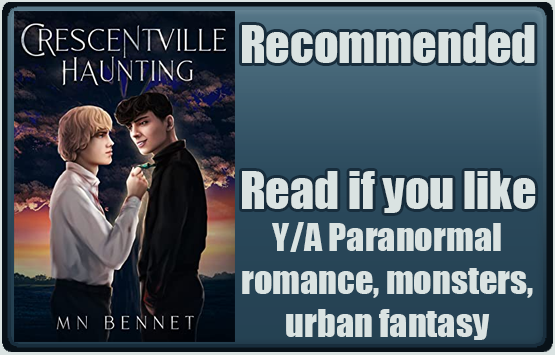
Crescentville Haunting by M.N. Bennet

Crescentville Haunting by M.N. Bennet

Formats: digital

Publisher:  Self published

Genre: Ghosts/Haunting, Monster, Occult, Romance, Vampire, Werewolf, Zombie

Audience: Y/A

Diversity: Bisexual main character, non-binary minor character, Black major character

Takes Place in: LA, California

Content Warnings (Highlight to view): Alcohol Abuse, Cannibalism, Death, Forced Captivity, Gaslighting, Gore, Medical Procedures, Mental Illness, Racism, Sexism, Slurs, Slut-Shaming, Violence, Vomit, Xenophobia

Blurb

Determined to pass junior year, Logan won’t let Henry distract him—much. Logan’s focusing on all things human, which means his swoony vampire ex-boyfriend will have to file his own fangs for a change. When he goes to the school bonfire and runs into Henry, wandering into the woods seems like a great escape. Until he’s bitten by a wicked Crone with some twisted magical munchies.

Logan is certain his ex-free human future is done when he’s dragged off to a scientific institution for study. There, he’s presented with an opportunity to keep his life, family, and future. All he has to do is stick to human ideology, since all things paranormal are illegal. But complications arise when the Crone begins to haunt him and Logan realizes that if he wants to get his life back, he has to navigate his lingering feelings for Henry.

With the Crone set on devouring him and the institution ready to obliterate him for any missteps, Logan must decide between pursuing the human future his family wants—one that he thought he wanted too—or the chance to embrace Henry, even if the world isn’t ready.

I received this product for free in return for providing an honest and unbiased review. I received no other compensation. I am disclosing this in accordance with the Federal Trade Commission’s 16 CFR, Part 255: Guides Concerning the Use of Endorsements and Testimonials in Advertising.

Logan just wants a safe, normal, drama-free junior year, and that means avoiding his vampire ex, Henry, at all costs. Which is easier said than done. Logan may be shy and awkward, but Henry is his complete opposite: confident, outgoing, and suave. When his best friend Kiera (a phantom) drags him to a bonfire party that’s supposed to help Logan relax, he discovers that trouble has a way of following him. Not only is Henry there, but Logan is attacked (for the second time since he first started dating Henry) by a powerful creature, this time a monstrous witch known as the “Crone.” After sustaining a bite from the Crone, Henry’s life changes forever.

Henry and Kiera are known as Vices, a group of monsters including phantoms, witches, vampires, trolls, sirens, and werewolves that are forced to live in the shadows due to public fear and draconian laws. The Crone is a sin, a powerful Vice that feeds on other Vices and can turn humans into undead monstrosities called Hauntings (think zombies and ghouls) with a single bite. After Henry’s attack he’s whisked away by SPU agents (the special police force in charge of catching and neutralizing Sins) to a secure facility designed to treat Hauntings, but to everyone’s surprise he doesn’t transform into a Haunting. It turns out Henry is a rare form of Vice, known as a Viceling, more human than Vice. The lore of Crescentville Haunting can get confusing in places, and there’s a lot of backstory. So much so that I actually checked to see if there was a prequel I had missed. But it’s no worse that any other fantasy novel with rich world building. If you can remember the rules of Quidditch, you can remember the magical classification system Bennet has created.

The characters are relatable and their voices sound authentic. The romance is steamy without being explicit and felt age appropriate for younger teens. It should be noted that while the book contains a paranormal romance, it’s not the central theme of the story. Instead, we focus on Logan’s struggles with his new identity and trying to fit into a human-centric world– an analogy for trying to fit into a heteronormative society when you’re LGBTQIA+. In Monsters in the closet: Homosexuality and the Horror Film Harry M. Benshoff writes “monster is to ‘normality’ as homosexual is to heterosexual.” LGBTQIA+ scholars have long equated queerness with fictional monsters and stories like Crescentville Haunting reclaim the “monstrous queer.” In Bennett’s story, the “homosexual vampire” is the hero rather than the villain, with the humans representing an oppressive heteronormative society and the facility attempting to “cure” Logan of his monstrousness a metaphor for conversion therapy. In addition to romance, the book also has plenty of horror, violence, and suspense, all courtesy of the Crone who continues to haunt Logan after the initial attack.

Overall, this was a fun read with a good world building, a cute relationship, and teens who actually sounded and acted like teens.
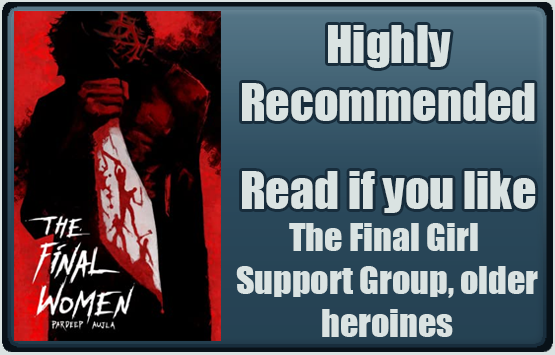
The Final Women by Pardeep Aujla

The Final Women by Pardeep Aujla

Formats: digital

Publisher: Self-Published

Genre: Demon, Killer/Slasher, Occult

Audience: Adult/Mature

Diversity: Black main character, Latina main character, Vietnamese main character, lesbian main character

Takes Place in: type here

Content Warnings (Highlight to view): Alcohol Abuse, Amputation, Bullying, Death, Drug Use/Abuse, Gore, Homophobia, Mental Illness, Racism, Self-Harm, Sexism, Suicide, Verbal/Emotional Abuse, Violence

Blurb

The mass murdering Phantom of Haven Cove is dead. For the one who killed him, however, life has never been the same.

How do you return to normality after facing such a monster? How do you live when consumed by guilt, anger, fear, and denial? How do you connect with others when no one understands what you’ve been through?

But there are others… Final girls of their own Haven Cove massacres. And now, thirty years later, they must all face a new question…

What do you do when the killer returns?

I received this product for free in return for providing an honest and unbiased review. I received no other compensation. I am disclosing this in accordance with the Federal Trade Commission’s 16 CFR, Part 255: Guides Concerning the Use of Endorsements and Testimonials in Advertising.

What happens when final girls grow up? It depends how they deal with the trauma of what happened to them the night they faced off with the masked killer, Silas Crowe. If you’re Nell James, you grow up to become a lonely and agoraphobic author who tries to turn the worst thing that ever happened to her– watching her friends get murdered one by one–into financial gain. If you’re Josie Jedford, you numb your fear with drugs. Or you could become a paranoid survivalist like Ana Gómez who transforms her badly burned body into a living weapon. Even Cassie Phong, who seems to have the perfect life what with her wealthy husband and two children, can’t escape the PTSD she developed the night she faced off with Silas Crowe. Each woman has done her best to put the past behind them, believing Crowe to be dead once and for all. That is until Camp Haven Cove reopens and a new group of teenagers goes missing. Nell realizes that Silas Crowe never died, and never will unless she, and the other three former final girls find a way to deal with him once and for all. Now well into their forties the four final woman team up to put a stop to the killings once and for all.

Slasher heroines are almost exclusively young women: teens and twenty somethings with bare breasts and flat stomachs (they’re always conventionally attractive) enjoying the prime of their lives through sex, drugs and drinking. Any woman above the age of thirty is either a mother or a side character, and if she has a few gray hairs she’s relegated to the role of a frightful hag. But as nostalgia for horror of the 80’s and 90’s breathes new life into horror franchises, Hollywood is doing something new. Instead of rebooting and recasting their heroines, they’re allowing them to grow up from Final Girls into Final Women. Sidney Prescott (Scream), Laurie Strode (Halloween), and Sally Hardesty (The Texas Chainsaw Massacre) all recently reprised their roles in their respective franchises as badass heroines over the age of forty. And as someone who will soon be saying goodbye to my thirties, it’s refreshing to see older women get their time in the slasher spotlight, and that’s one of the things I liked best about The Final Women.  Nell, Josie, Ana, and Cassie are all approaching fifty, but they all get to be the heroes of the story, and I found them much more relatable then horny, drunk teens in the woods. They’re also not written for the male gaze, which is refreshing.

Another thing I liked about the book was Aujla’s realistic depiction of PTSD. None of the women escaped Silas unscathed, they each bear their own physical and mental scars, as one would expect from anyone going up against a slasher. Nell displays avoidance of people and places that remind her of her traumatic event and might trigger a flashback. Cassie and Josie both develop substance abuse problems, alcohol and drugs respectively, a common comorbidity for people with PTSD. Ana is prone to angry outbursts and aggressive behavior and is hypervigilant. All the women struggle with nightmares and flashbacks. It’s refreshing to see a slasher actually deal with mental health and the aftermath of a traumatic event (something we’re starting to see in more recent film sequels). I genuinely cared about all the main characters, something that rarely happens in horror fiction, and I was scared to see any of them get hurt or killed. Aujla just writes them so well! It’s sweet to see these women from different walks of life bond and draw strength from each other.

The Final Women was fun in a way the best 80’s slashers are. Gory, over the top, and wickedly funny. I absolutely devoured it as I found both the story and the characters enthralling. It draws on classic horror tropes while still being wholly unique. If you’re a fan of slashers you’ll definitely want to check this one out. 

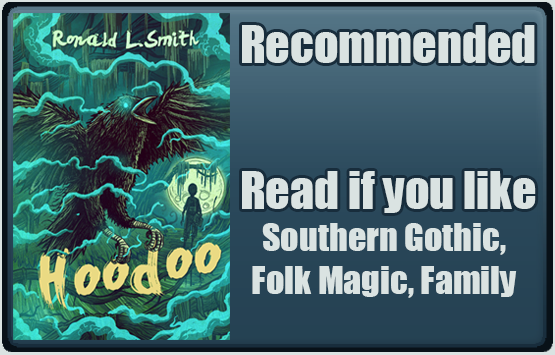
Hoodoo by Ronald L. Smith

Hoodoo by Ronald L. Smith

Formats: Print, audio, digital

Publisher: Clarion Books

Genre: Folk Horror, Historic Horror, Demon, Occult, Myth and Folklore

Audience: Children

Diversity: BIPOC (Black, African American, Caribbean American)

Takes Place in: Alabama, USA

Content Warnings (Highlight to view): Animal Death, Bullying, Child Endangerment, Death, Illness, Racism, Physical Abuse 

Blurb

Twelve-year-old Hoodoo Hatcher was born into a family with a rich tradition of practicing folk magic: hoodoo, as most people call it. But even though his name is Hoodoo, he can’t seem to cast a simple spell.        

Then a mysterious man called the Stranger comes to town, and Hoodoo starts dreaming of the dead rising from their graves. Even worse, he soon learns the Stranger is looking for a boy. Not just any boy. A boy named Hoodoo. The entire town is at risk from the Stranger’s black magic, and only Hoodoo can defeat him. He’ll just need to learn how to conjure first.        

Set amid the swamps, red soil, and sweltering heat of small town Alabama in the 1930s, Hoodoo is infused with a big dose of creepiness leavened with gentle humor.

I really wanted to love this book. I really, really did. The cover art is dark and beautiful, the premise sounded right up my alley, the story is inspired by African-American folklore and oral traditions, the villain is genuinely creepy, the representation of Hoodoo feels authentic rather than sensationalized, and it’s a historical novel with a Black main character that isn’t about oppression and racism *gasp*. I was so hyped up for Hoodoo and ready to fall in love. And I will say, the ideas behind the story are great, I like the characters and I like the concept. The execution? Not so much.

Now Hoodoo  isn’t a bad book by any stretch, and I think part of the issue may have been that this is a story intended for kids, and I probably would’ve loved it a lot more if I were a child. The other problem was that I had incredibly high expectations going in, which would be hard to live up to, and that’s on me. It’s also important to note that my lukewarm feelings toward the story also seem to be in the minority: other reviews I’ve read have all been glowing endorsements, so I’m probably just being a grumpy, nit-picking potato. I still recommend checking it out, especially for young readers who love spooky stuff, it just wasn’t as amazing as I was hoping. I had a lot of issues with Hoodoo  that prevented me from enjoying the book as fully as I desired to.

For one thing, the pacing is all over the place. The villain doesn’t get enough of a buildup before his big reveal, and the ending feels rushed while other scenes dragged on, especially in the beginning. Unnecessary details got more focus than I felt they deserved. It’s a serious bummer when the final showdown between the villain and the hero is only a page or two long and he’s defeated with so much ease. Instead of driving forward, the plot just kind of wandered around aimlessly until it got distracted by something shiny. Characters and ideas were introduced then abandoned, appearing for one or two scenes before vanishing into the plot hole from which they came, never to be heard from again. It’s like Smith had written this long, epic story, but had to cut the book down to fit in a 200-page kids book, and he just randomly chose what to remove in last minute panic.

It’s annoying that otherwise interesting characters are reduced to one-scene wonders, but it’s even more annoying that their sole function is to drop solutions in Hoodoo ‘s lap any time he encounters an obstacle. This greatly minimizes the sense of danger, because every problem seems to get solved (whether for better or worse) almost immediately. Too bad the Fellowship of the Ring didn’t have this kid, it’d probably cut their travel time in half, Sean Bean might still be alive, and Sauron would’ve been taken out with one punch. I get that Deus Ex Machina is par for the course with these kinds of stories, but at least pretend the hero might not make it by building the suspense a little, or making them really work for a solution. It’s hard to feel like there’s anything at stake when a random talking crow or another seemingly random character swoops in to save the day without Hoodoo having to do much on his end. I guess that’s why he keeps stubbornly refusing his family’s help like a jerk, because his magic causes everything to just work out with minimal effort. At least, that’s what I assume it does since it’s never really explained how Hoodoo’s powers work other than some really vague hints.

Hoodoo can also be a pretty vexing narrator. He has a habit of defining random words and then ending his sentence with “If you didn’t know”. I know this is probably the most random, arbitrary nitpick, but while it was only mildly irritating the first half-dozen times, by the third chapter I could barely suppress my urge to scream and punch something every time Hoo Doo felt like he had to explain what Molasses or an Outhouse was, then end the sentence with “if you didn’t know”. I KNOW WHAT AN OUTHOUSE IS GET ON WITH THE STORY BEFORE I THROW YOU IN ONE. I get that the book is for kids, and they may not know what cracklin’ is, but I’m pretty sure most children who are capable of reading a chapter book are also able to perform a basic Google search or use a dictionary. And that’s assuming they can’t just figure out a word from context. I didn’t know what “Squirrel Nut Zippers” were before reading this (ironically the one thing Hoodoo didn’t feel like explaining) but I was still able to discern that he was talking about a sweet and not the swing band based on the context. And then I Googled it and learned that Squirrel Nut Zippers are a vanilla flavored caramel candy mixed with peanuts. So now I know that random bit of trivia and that Hoodoo likes gross candy. Maybe it was an attempt by Smith to make his character sounds more “natural” when he’s talking to the audience, but I felt like the narrative came to a screeching halt every time Hoodoo whipped out his annoying catchphrase. Maybe (probably) I’m just really, easily annoyed but all the “If you didn’t know”s were like nails on a chalkboard and distracted me from trying to enjoy the story.

And while I’m dumping on Hoodoo, here’s something else that made my hackles rise; while talking about his best friend, Bunny, he says “That’s what I liked about her. She wasn’t like the other girls at the schoolhouse. She did everything a boy did and some things even better.” Saying a girl “isn’t like other girls” isn’t an empowering compliment, you just insulted her entire gender and basically told her “wow, you don’t suck like all those other icky girls” in addition to implying that women who are more like men are somehow better. Seriously, don’t try and compliment a woman by putting other women down, or tell her “you’re not like other women, you’re more like a man”. Being masculine or feminine shouldn’t be a compliment or an insult, and people aren’t better or worse by being one or the other. Bunny is a pretty cool character and all, but I could have done without Hoodoo’s sexist comments (which are never called out in the story itself).

Despite all the pacing issues, and the protagonist’s exasperating habit of defining every piece of Soul Food he comes across (I KNOW what grits are, you don’t have to stop the story and tell me!!!!) there was still plenty to enjoy. Namely, that we get a piece of historic fiction with a Black protagonist that isn’t about racism or segregation. *gasp* Look, narratives about how poorly Black people have been treated (and are still treated) in this country are both important and necessary, and something every child should learn about. The ugliness of slavery, segregation, Jim Crow laws, and the history of racism that still exists in this country shouldn’t be glossed over, hidden, or worse, perpetuating the myth of the smiling slave and the benevolent slave owner (looking at you  A Birthday Cake for George Washington, you were published in 2016, you should know better), and I commend schools that teach kids about these issues. But, it’s still problematic when all the books about Black people focus only on segregation, slavery, and sports. Or, as librarian and author Scott Woods puts it, boycotts, buses, and basketball. That’s not all there is to Black culture and Black Americans!

Where are the stories where Black kids just have a fun adventure for the sake of a fun adventure? Where’s the escapist fiction and epic tales with the Black hero? Where are the biographies of black scientistsinventorsartists, and entrepreneurs? I tried to think of all the books with Black protagonists I was assigned in grade school, way back in the 90s (by my white teachers, in my mostly white school, where there were literally so few BIPOC that we all knew each other), and all I could remember reading was Roll of Thunder, Hear My Cry in fourth grade. At first, I thought I just had a faulty memory, since I’m old and forget everything. I asked two of my siblings if they could recall any African American literature from our school days. My sister said “No, but I read Beloved in High School”, and my brother was pretty sure the teacher read the class “some picture book about Jackie Robinson”. So yeah, segregation, slavery and sports.  Apparently making us read one depressing story by a Black author during Black History Month was just enough to alleviate my grade school’s White guilt, and then they could all pat themselves on the back for being so woke.

Kids these days (Wow, I sound old) at least have the We Need Diverse Books campaign, and I’m glad for that. I would’ve killed to read a ghost story or a fairy tale with a Black protagonist when I was a child. And that’s what made me so happy about Hoodoo. It’s probably one of the few works of historical fiction (technically fantasy) I can think of that takes place in the Jim Crow south that isn’t entirely focused on oppression of the book’s characters. Hoodoo isn’t a victim, he’s the story’s hero, and he gets to fight the big, bad monster and save his loved ones. It’s a fun, spooky, escapist story with a character children can admire for his intelligence and bravery rather than athletic ability, and the reader gets to learn about Southern Black culture of the time period. There’s still racism lurking in the background, this is 1930’s Alabama after all, as is evident when Hoodoo and Bunny have to go to the carnival on the “colored folk’s” day, or when Hoodoo’s aunt has to go clean for rich, White people, it’s just not the focus of the story. Smith acknowledges that segregation, lynching, and other horrors were a part of life for Hoodoo and his family, and then he moves on with the plot because they’re so much more than just their oppression. Then we get a story of Hoodoo fighting the forces of evil with magic, learning about his past, and being awesome. This is the book every kid who was stuck with a white-washed reading list wished they could’ve read growing up. Despite all my complaining, I truly hope we haven’t heard the last of Hoodoo Hatcher.

Conquer by Edward M. Erdelac

Conquer by Edward M. Erdelac

Formats: Print, audio, digital

Publisher: Self Published 

Genre: Historic Horror, Monster, Mystery, Myth and Folklore, Occult, Vampire

Audience: Adult/Mature

Diversity: Black/African-American, Hispanic, Trans, Gay

Takes Place in: Harlem, New York, USA

Content Warnings (Highlight to view): Animal Death, Body Shaming, Child Abuse, Death, Drug Use/Abuse, Forced Captivity, Gore, Homophobia, Kidnapping, Necrophilia, Oppression, Pedophilia, Physical Abuse, Police Harassment, Racism, Rape/Sexual Assault, Sexual Abuse, Slurs, Transphobia

Blurb

In 1976 Harlem, JOHN CONQUER, P.I. is the cat you call when your hair stands up…the supernatural brother like no other. From the pages of Occult Detective Quarterly, he’s calm, he’s cool, and now he’s collected in CONQUER.

From Hoodoo doctors and Voodoo Queens,
The cat they call Conquer’s down on the scene!
With a dime on his shin and a pocket of tricks,
A gun in his coat and an eye for the chicks.
Uptown and Downton, Harlem to Brooklyn,
Wherever the brothers find trouble is brewin,’
If you’re swept with a broom, or your tracks have been crossed,
If your mojo is failin’ and all hope is lost,
Call the dude on St. Marks with the shelf fulla books,
‘Cause ain’t no haint or spirit, or evil-eye looks,
Conjured by devils, JAMF’s, or The Man,
Can stop the black magic Big John’s got on hand!

I received this product for free in return for providing an honest and unbiased review. I received no other compensation. I am disclosing this in accordance with the Federal Trade Commission’s 16 CFR, Part 255: Guides Concerning the Use of Endorsements and Testimonials in Advertising.

Conquer is the story of a Black mystical detective named John Conquer (a reference to John the Conqueror) and a homage to 70’s detective fiction and Blaxploitation films. It’s fun, well written, and full of creepiness, including a fetus monster haunting an abandoned subway station and a man shrunk down and boiled alive in a lava lamp. I greatly enjoyed the book, but like most Blaxploitation, it wasn’t without its problems.

It’s important to point out that Erdelac is a White author writing a Black story (something not uncommon in Blaxploitation). I usually prefer to promote “own voices” books, and stories by cishet White men are a rarity on this blog. After all, folks with privilege do not have the best track record when it comes to writing marginalized groups. As Irish author Kit de Waal said, “Don’t dip your pen in someone else’s blood”. Take American Dirt by Jeanine Cummins and The Help by Kathryn Stockett. They’re both terrible for numerous reasons including, but not limited to: not doing enough research, using the White Savior trope, watering down their narratives to make them palatable for White audiences, cultural appropriation, speaking over marginalized voices, etc. That’s not to say White authors shouldn’t write BIPOC characters at all. Not having any diversity in your story can be equally problematic. It just needs to be done carefully and respectfully. Very, very carefully. Yes, I know that can be a fine line to walk, but if an author can research what kind of crops people were growing in 1429 to make their book more accurate, they can research American Indians and people of color. Besides, that’s what hiring sensitivity readers and using resources like Writing with Color is for. Of course, there’s also the problem of White voices being given preferential treatment by publishers and audiences over BIPOC trying to tell their own stories.

To his credit, Erdelac has done an impressive amount of research to make his book feel authentic. John Conquer wears a dime around his ankle for protection and a mojo hand (another name for a mojo bag) for luck. His name is a reference to High John de Conqueror, a Black folk hero with magical abilities. Conquer also has one of the most accurate representations of Vodou I’ve ever seen in fiction. Hollywood “voo doo” is a pet peeve of mine, so I appreciate Erdelac’s dedication to portraying the religion and loa/lwa (the powerful spirits Vodou practitioners worship and serve) accurately. He also doesn’t try to portray an idealized version of 1970s NYC. There’s racism, anti-Semitism, homophobia, and cops and criminals spewing slurs. And while it’s jarring, it does make the story feel more authentic. The police are racist and homophobic and there’s tension between the many communities that make up 1970s New York. John Conquer’s Uncle Silas was disowned by his family for being gay, and when John is asked to solve his murder, he has to confront his own homophobia and transphobia. That doesn’t mean it always works, though. There were definitely a few times I side-eyed and wondered if a certain line really needed to be in there.

My favorite part of the book is Eldelac’s excellent world building. White vampires go up in smoke when exposed to sunlight, while vampires with more melanin are protected from the sun’s rays. Vampirism also halts a corpse’s decay, but all that rot catches up to them when they’re finally killed. Each culture has their own magical practices with distinct rules, and magic doesn’t cross cultural lines. For example, only Vodou practitioners can become zombies, and non-Christian vampires are immune to crosses. Conquer is especially powerful because he’s learned many different traditions and practices, but the catch is that this opens him to a wider variety of spiritual attacks. Street gangs utilize black magic to wage wars with each other. His work is clever, original, and something I could really get into. But…having White authors tell BIPOC stories still feels problematic to me when White authors are still so heavily favored by the publishing industry. I’ve reviewed books by White authors before, but because Conquer is based heavily on Blaxploitation it feels, well, more exploitative than those I’ve reviewed in the past. I’m still going to go ahead and recommend Eldelac’s work because—in the end—it is well written and interesting, but I can also completely understand if some of you want to skip this one.

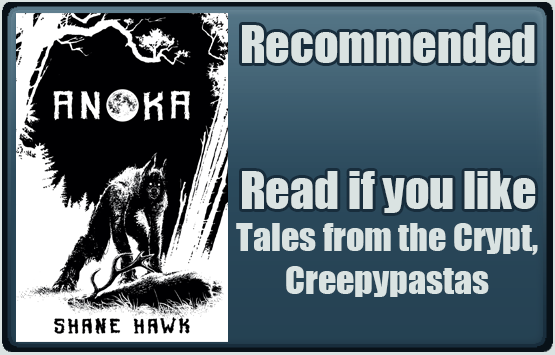
Anoka by Shane Hawk

Anoka by Shane Hawk

Formats: Print, audio, digital

Publisher: Self-Published

Genre: Body Horror, Folk Horror, Monster, Myth and Folklore, Occult, Werewolf

Audience: Adult/Mature

Diversity: Biracial Cheyenne author, Dakota characters, non-binary character

Takes Place in: Anoka, Minnesota, USA

Content Warnings (Highlight to view): Alcohol Abuse, Cannibalism, Child Death, Death, Drug Use/Abuse, Gore, Racism, Rape/Sexual Assault, Self-Harm, Sexual Abuse, Slurs, Suicide, Verbal/Emotional Abuse, Violence

Blurb

Welcome to Anoka, Minnesota, a small city just outside of the Twin Cities dubbed “The Halloween Capital of the World” since 1937. Here before you lie several tales involving bone collectors, pagan witches, werewolves, skeletal bison, and cloned children. It is up to you to decipher between fact and fiction as the author has woven historical facts into his narratives. With his debut horror collection, Cheyenne & Arapaho author Shane Hawk explores themes of family, grief, loneliness, and identity through the lens of indigenous life.

I received this product for free in return for providing an honest and unbiased review. I received no other compensation. I am disclosing this in accordance with the Federal Trade Commission’s 16 CFR, Part 255: Guides Concerning the Use of Endorsements and Testimonials in Advertising.

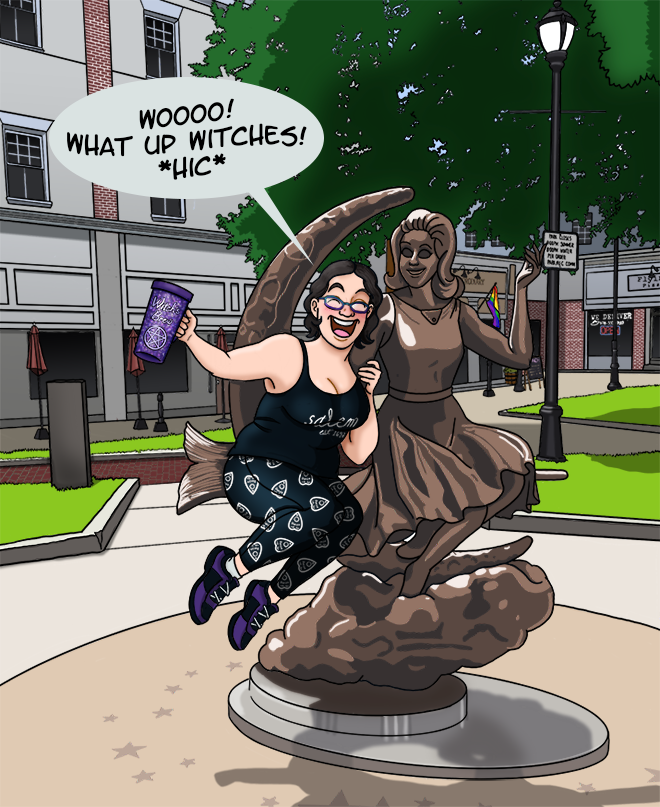
Apparently Anoka, Minnesota is the “Halloween Capital of the World” because they’ve been having giant Halloween parades since 1920. Out of civic pride, I want to argue that Salem is the Halloween Capital and our town is better because we have real witches and Salem Horror Fest and the oldest candy company in America. On the other hand, I would also like tourists to stop blocking the traffic, drunkenly climbing on the witch statue, and crowding my favorite restaurants every October (that’s my job), so maybe it would be better if they all headed to Anoka instead. I don’t think anyone will want to go anywhere near the Minnesota city after reading Shane Hawk’s Indigenous horror anthology of the same name, though. The stories in Anoka are loosely tied together by their location in an alternative version of the town where dark magic and monsters lurk. An evil tome known simply as “the book” and strange green swirls also make multiple appearances throughout the anthology.

A comic of a person hanging off a statue of a witch saying

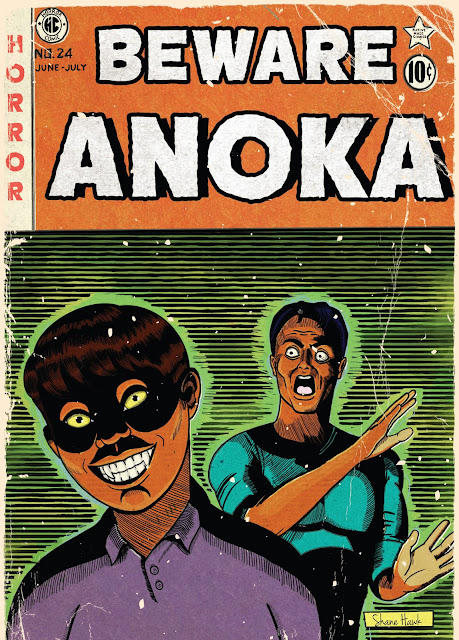
Hawk gives a different and unique voice to each of his characters so every story feels different from the others. His writing reminded me of a talented artist who can draw in multiple styles and shift easily from realism to the simple lines of a cartoon. My favorite thing about his book is how so many of the stories felt like pre-comics code horror anthology comics like Eerie, Black Cat, and The Haunt of Fear or modern-day creepypastas with terrifying twists. Some stories were fun and weird, others tragic reflections of human nature. But all of them were creepy, the kind of creepy that makes you aware of how many noises an old house makes at night or has you shouting out loud at the characters not to go into the room where the monster is waiting.

American Indians tragically have the highest infant mortality rate in the U.S. (again due to trauma, poverty and a lack of adequate healthcare), so much of Hawk’s anthology touches on themes of child death and the trauma that goes with such a great loss. In two stories, Orange and Wounded, the death of a child in the past moves the main characters to do something terrible. Soilborne is a metaphor for the loss of the child-parent connection and how devastating that can be. In Imitate, the protagonist has to rush to save his son, Tate, from an unknown horror that’s taken his form. There’s no way of knowing if Tate is even still alive, and the whole story is exceedingly stressful to read. Honestly, Imitate would have worked just fine as microfiction and Hawk could have easily ended it after the first page or so. But instead, he decides to pile on even more terror by turning it into a suspenseful short story where we’re forced to watch a father slowly lose his mind. It’s definitely one of the anthology’s stronger and spookier tales.

My absolute favorite story in the collection is Dead America about a writer named Chaska whose family is followed by death. This is sadly not uncommon for Native families as generational trauma, poverty, and a lack of adequate healthcare has lead to poor health and high death rates from heart disease, diabetes, and suicide. The story gets its name from Chaska’s hobo nickel which depicts the skull of a dead Indian chief in full headdress on one side and Columbus’ three ships on the other. “When betting a coin offers someone a fifty-fifty chance of winning and losing. The nickel was a metaphor for the predicament of Indian existence: fucked no matter which side the coin landed on” the author explains. He’s about to find out how right he is when Asibikaashi the Spider Woman decides to make the Dakota author suffer for his sins.

This story is SCARY. All of my notes for Dead America consist of “nope, nope, nopeity-nope nope, fuck this, nope.” I’m not someone who’s usually bothered by spiders under normal circumstances. I think they’re kind of cute and I love that they eat any bugs that get into the house, but Chaska’s punishment left me terrified of arachnids. If you have any form of arachnophobia, I can guarantee you’ll be in for some nasty nightmares and might want to skip this story entirely. But if you’re feeling brave, it’s one of the strongest stories in the collection and worth checking out. The story also touches on themes of profiting off the personal stories of others, very similar to how Ward ChurchillAsa Earl Carter, Mary Summer Rain and others pretended to be Native for fame and money.

It’s important to note that in Ojibwe stories Asibikaashi, aka Grandmother Spider, is a benevolent deity and helper of humanity whose spiderweb charms, popularly known as “Dream Catchers“, were woven by women as a form of protection for infants. I couldn’t find any references to her punishing the wicked (of course I couldn’t find many references to her at all that weren’t written by White new agers).

Hawk’s final story, Transformation, is about a non-binary werewolf who hunts for her community and runs into trouble at Anoka’s annual Halloween parade. Having a trans werewolf feels perfect because werewolves are the ideal metaphor for someone with a fluid identity. Sometimes you’re a wolf, others a human, and occasionally you’re something in between, but you’re always a werewolf regardless of what form you take that day. Just because I’m femme one day, it doesn’t negate the fact that I’m non-binary; I’m still an enby when I’m feeling more trans-masculine. Like the story title, werewolves can also represent transition. The wolf can be seen as the true self, hidden under a dull human skin that’s forced to conform to society’s rigid standards. Becoming the wolves gives you the opportunity to experience freedom. If that transformation is unwanted, it can be compared to a menstrual cycle that causes dysphoria each month or unwanted body hair. “Jenny” a transwoman who identifies with werewolves is quoted on the queer horror blog, Gender Terror“The titanic proportion of my body and the hair that I continually fight back terrify me, and makes me the target of many suspicious onlookers. And just like werewolves, I have no control over what my body does. Feeling like a prisoner to how your body changes is a special torment I think a lot of transgender people share with werewolves.” So is it any wonder writers like Hal SchrieveAllison MoonSuzanne Walker,  Ashlynn Barker, and numerous self-published erotic authors like Noah Harris have all explored the idea of a trans werewolf? Heck “were-woman” is slang for someone who “transforms” into a woman at night (though this terminology can be problematic). Hawk’s non-binary werewolf character seemed so cool I was disappointed that their story wasn’t longer. There was so much going on in Transformation it felt like it would’ve worked much better as a novella rather than a short story. Honestly, I’d read a full novel about the nostalgic werewolf, Halloween parades, and Wendigo. That’s my one major complaint about Anoka: it’s too short! The concept was so cool I was disappointed we didn’t get to explore more of Hawk’s alternate universe. I wanted to learn more about The Book and the creepy town filled with dark magic and monsters.

A comic-style illustration of a werewolf wearing underwear made from the trans flag colors.

What impressed me the most about the story collection is how Hawk was able to handle the subjects of child losssexual assaultsubstance abuse and missing and murdered Indigenous women, especially in his story Wounded, in a way that felt respectful rather than exploitative. Anoka is a fun, frightening ride that draws attention to many of the issues plaguing American Indians today, and I hope we’ll get to hear even more stories from the spooky little town in Hawk’s future books.

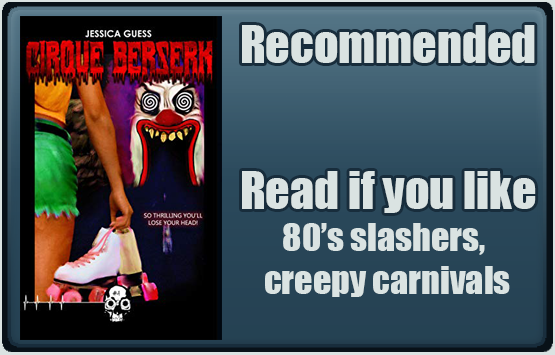
Cirque Berserk by Jessica Guess

Cirque Berserk by Jessica Guess

Formats: Print, digital

Publisher: Unnerving Magazine

Genre: Killer/Slasher, Myth and Folklore, Occult, Demons

Audience: Y/A

Diversity: Black main character and author, Native Oglala Lakota main character, character with syndactyly

Takes Place in: Florida, USA

Content Warnings (Highlight to view): Abelism, Alcohol Abuse, Animal Death, Child Abuse, Death, Forced Captivity, Gore, Kidnapping, Physical Abuse, Racism, Sexual Abuse (Voyeurism), Slurs, Slut-Shaming, Torture, Verbal/Emotional Abuse, Violence 

Blurb

The summer of 1989 brought terror to the town of Shadows Creek, Florida in the form of a massacre at the local carnival, Cirque Berserk. One fateful night, a group of teens killed a dozen people then disappeared into thin air. No one knows why they did it, where they went, or even how many of them there were, but legend has it they still roam the abandoned carnival, looking for blood to spill.

Thirty years later, best friends, Sam and Rochelle, are in the midst of a boring senior trip when they learn about the infamous Cirque Berserk. Seeking one last adventure, they and their friends journey to the nearby Shadows Creek to see if the urban legends about Cirque Berserk are true. But waiting for them beyond the carnival gates is a night of brutality, bloodshed, and betrayal.

Will they make they it out alive, or will the carnival’s past demons extinguish their futures?

I received this product for free in return for providing an honest and unbiased review. I received no other compensation. I am disclosing this in accordance with the Federal Trade Commission’s 16 CFR, Part 255: Guides Concerning the Use of Endorsements and Testimonials in Advertising.

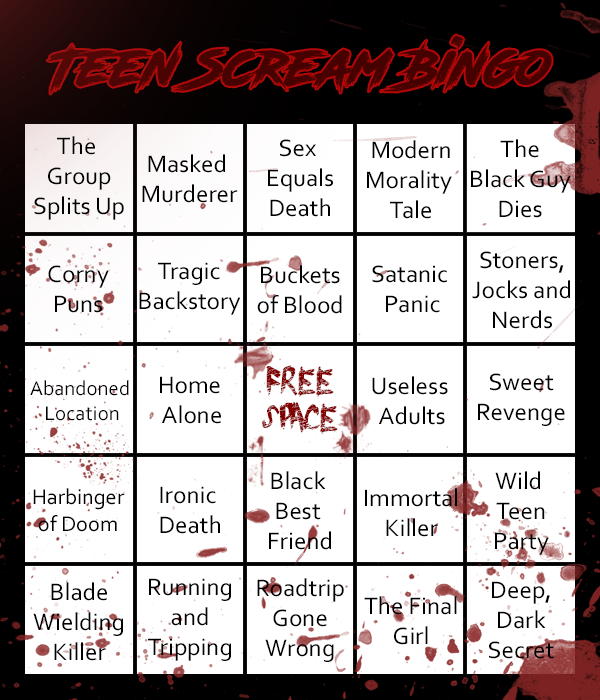
Put on your sequins and neon spandex, grab a New Coke, and turn up that Whitney Houston cassette because it’s time to take a look at Jessica Guess‘s tribute to eighties’ slashers, Cirque Berserk! Guess’s new horror novella is the perfect ode to trashy, B-horror movies of the yuppie decade à la The Funhouse, Evilspeak, and Prom Night. Praised by one of my favorite horror authors, Stephen Graham Jones, Cirque Berserk hits most of the squares on the “teen scream” Bingo card, but still feels fresh and original. Guess has fun playing with the classic slasher clichés while subverting more problematic tropes like the “black best friend” and the “nice guy” being rewarded with a hot girl. She fills her story with plenty of self-aware humor and the kind of affectionate mocking that can only come from a true horror fan, which balances well with the more serious scenes of racism, sexism, and abuse. The result is a fun, nostalgic, carnival ride with a deeply emotional narrative hidden just beneath all the glitter, gore, and a bad-ass Black protagonist.

A black and red bingo card that says "Teen Scream Bingo." The squares include various slasher cliche's like "corny puns," "abandoned location," "Black best friend," and "masked murderer."

The eighties have made a come back in horror recently with popular TV shows (Stranger Things, American Horror Story: 1984), movies (the It reboot, The Final Girls), and novels (Grady Hendrix’s My Best Friend’s Exorcism) all drawing inspiration from the decade that gave rise to the slasher film, and it’s no wonder why. Not only do they have the nostalgia factor going for them as Gen Xers have their midlife crises, but they’ve got a ton of amazing source material to work from. Eighties audiences were blessed with a plethora of classic horror movies: grotesque monsters (The Thing, Aliens, Scanners, American Werewolf in London), final girls who fought back, (Halloween, Nightmare on Elm Street, Hell Raiser, Aliens), self-aware humor (Elvira, Monster Squad, Fright Night) cool, sexy vampires (Lost Boys, Near Dark, The Hunger) and horror franchises (Texas Chainsaw Massacre, Friday the 13th, The Evil Dead) graced the silver screen. Hell, even the remakes were good. Both The Fly and The Thing arguably surpassed their originals.

But what was it about the decade of greed that inspired so many amazing films? To understand eighties horror, you need to understand that the 1980’s were an age of excess, greed, rapid technological advancement, and reactionary conservatism. As late writer/director Stuart Gordan explained in the Shudder documentary In Search of Darkness: A Journey Into Iconic 80’s Horror, “horror thrives when there’s a repressive government” and the Reagan years certainly qualified. Additionally, public uncertainty and fear lead to the genre’s rise in popularity, just as it did during the Great Depression resulting in Universal’s famous Golden Age monsters. Meanwhile, advancements in technology and the increased affordability of personal computers led to some groundbreaking special effects and makeup (The Thing, Scanners, The Fly, American Werewolf in London). This decade was the perfect balance of repression and paranoia for horror films to flourish.

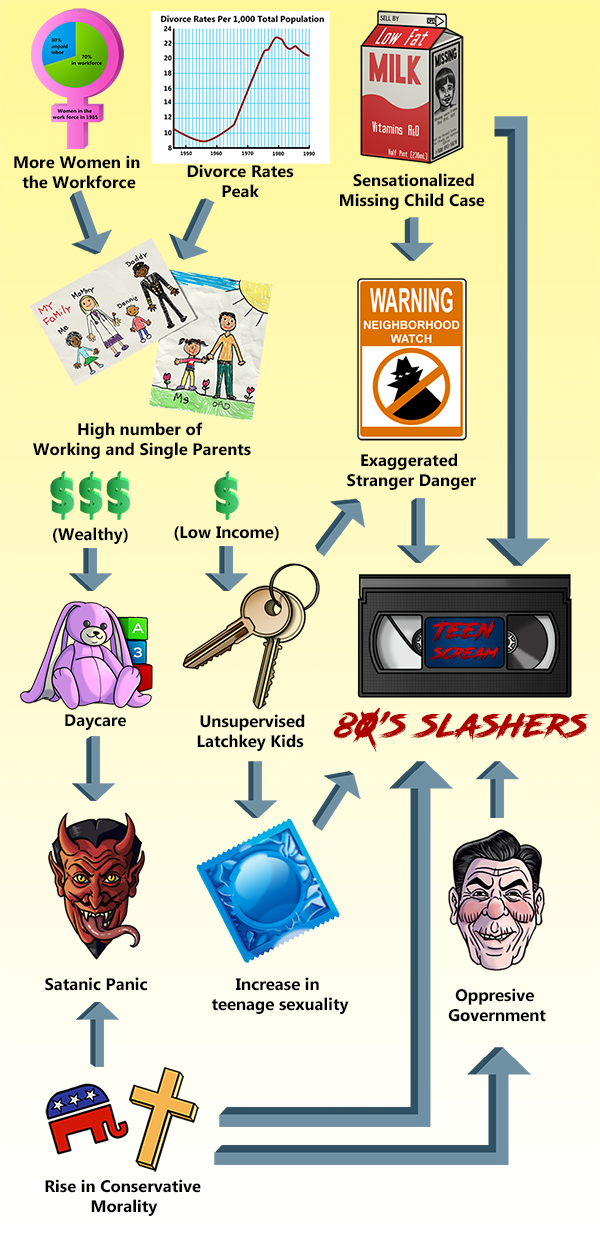
The rise of the “New Right” in the late seventies and eighties brought with it a push to return to “traditional American values” (i.e. being sexist, racist, homophobic, and slut-shaming with impunity). Everywhere you looked, the crack cocaine epidemic was sweeping the nation, AIDS was desolating the population, hardcore porn was easily accessible on video, the rich were getting greedier and richer, and divorce rates had peaked. With more women entering the workforce and an increasing number of newly-single kids were suddenly being left at home unsupervised. The public might have been content with leaving their kids at home, but a generation of ‘suddenly being left unsupervised for long periods of time’ were exposed to a plethora of violence and sex in media. Concern for the latchkey generation was only made worse by the abduction and murder of six-year-old Adam Walsh. The tragic case “created a nation of petrified kids and paranoid parents” who saw danger in every stranger they encountered. The media-fueled mass hysteria eventually led to a rash of Satanic panic.

It was enough to make any God-fearing White conservative clutch their pearls! Rather than blame Reagan for taking away childcare funding and completely botching the response to drugs and AIDS, or recognize that the risk strangers pose to children is minimal at best a vocal group of conservatives decided it was the loss of a nuclear family, declining morals, and demonic media that had left everything such a mess. Even if you didn’t buy into the whole “little Timmy will get murdered by Satanists because his mommy had to rejoin the workforce” school of thought, it was hard to deny the world was pretty scary, what with global warming, Jeffrey Dahmer, the cold war, and deadly invisible illnesses. Why couldn’t we go back to the way they were in the fifties when bad things only happened to minorities and women weren’t constantly going on about equal rights? Back before all teens were watching heavy metal videos on MTV, popping third generation birth control pills, and playing Super Mario Bros on their NES (or whatever they were into back then. Doing whippets maybe? I dunno, I was like 4 at the time). Cue a wave of 1950’s nostalgia and horror films that capitalized on the public’s fear for the safety of unsupervised kids.

A flow chart with images that shows the various events in the 80's that led to the rise in slasher horror as described in the review.

Most slashers followed a basic formula. A group of unsupervised teenagers with poor decision making skills all did “Bad Things TM” until an evil man would show up and kill everyone but the clever, resourceful, virginal hero because they were too pure to be defeated by evil. The story was simple, yet effective — at least in its ability to terrify audiences. I doubt anyone waited for their wedding night because they were afraid Jason would show up for a murderous version of coïtus interruptus. Ironically the conservative adults whose fear and values inspired the horror Renaissance were also its main detractors. Probably because filmmakers were interested in making money, not PSAs about morality, and tits and blood sell. The so-called golden age of slashers began in 1978 with Halloween and ended in 1984 with A Nightmare on Elm Street. Unfortunately sequelitis and low budget direct-to-video horror flicks marked the end of the era, but thankfully schlock could be just as entertaining in all it’s goofy, cheesy glory. When 80’s horror is good, it’s really good, but when it’s bad it’s amazing. And it’s these B-movie slashers that make Cirque Berserk such a fun read. Guess understands that while The Shining may be the Michelin star-winning gourmet meal of eighties horror and the franchise slasher films are the family restaurants with mass appeal, movies like Basket Case and Slumber Party Massacre 2 are greasy fast-food burgers you cram in your maw at 3 A.M. in the CVS parking lot. Yes, they’re terrible for you, and yes you regret it the next day when you wake up with a hangover and smell like dumpster fries, but god damn if those weren’t some delicious fucking burgers. Cirque Berserk is what happens when you have a talented chef prepare those greasy, salty, fast-food burgers. It’s fast, fun, and you won’t be able to put it down until you’ve devoured the whole thing.
Guess cleverly subverts the standard slasher story line while still paying homage to many of its elements. There’s a cast of stereotypical teens whose bad judgement lands them in an abandoned amusement park with a masked killer despite the warnings from the wise old woman at the gas station. There’s stupid teen drama, bad puns, and buckets of blood. Guess even adds a Satanic subplot where a group of disenfranchised teens summon the demon Lilith to grant them wishes, poking fun at Yuppie parents’ unfounded fear that their kids were listening to Stairway to Heaven backwards and using D&D to summon demons. The story is full of self-aware humor, my favorite example of which involves one of the characters pointing out how weird it is that no one is carrying a gun in Florida. Curses and murderous Satan worshipers are well within the realm of possibility, but no one packing heat in a Southern “stand your ground” state is way too weird. Guess manages to give us all this and still make her story genuinely scary. And for what felt like a pretty standard slasher set-up, I was actually caught off guard by a plot twist.

When it comes to her villains, however, Guess dispenses with the usual “irredeemably evil for the heck of it” masked murderers typical in slashers. Instead, she gives us a group of tragic figures who sell their humanity for a chance at freedom. It’s appropriate that the teen killers summoned Lilith to grant them freedom, a figure who chose to become a demon rather than submit to the will of a man. As another famous Abrahamic rebel declares in Paradise Lost “Better to reign in Hell than serve in Heaven.” The Alphabet of Ben Sira describes Lilith as Adam’s first wife, created as his equal. After getting fed up with her husband’s misogyny and bad sex, Liltith decides dick really isn’t worth all this bullshit and flies off into the night, choosing to become a demon rather than submit to male authority. Modern Jewish feminists, such as Judith Plaskow, interpret her as “a female symbol for autonomy, sexual choice, and control of one’s own destiny.” In her midrash, The Coming of Lilith, Plaskow writes “Lilith not only embodies people’s fears of how attraction to others can ruin their marriages, or of how risky childbearing and raising children are, but also represents a woman whom society cannot control—a woman who determines her own sexual partners, who is wild and unkempt, and who does not have the natural consequences of sexual activity, children.” Demon or no, Lilith sounds like my kind of woman.

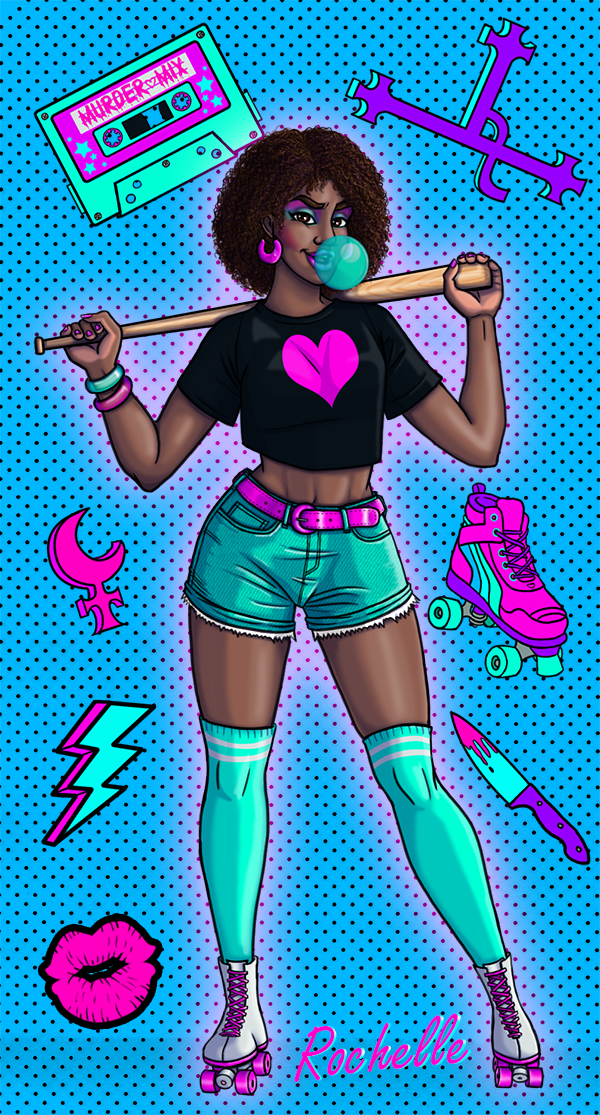
But my absolute favorite part of Cirque Berserk is Guess’ tough-as-nails and whip-smart protagonist, Rochelle, who is anything but your typical final girl. Guess got the name from Rachel True’s character in The Craft, whose frequent erasure from horror conventions and panel discussions Guess even wrote about here. She explains that this was her way of honoring True. “I love The Craft and I got the idea for Cirque Berserk a little after watching Horror Noir and hearing what Rachel said about being typecast as the best friend and always having to say “are you okay” a million different ways. My Rochelle is a response to that.” And I say she’s the perfect response! But what else would you expect from Guess, creator of the Black Girl’s Guide to Horror blog? Cirque Berserk is a novella for Black and Indigenous horror fans who are sick of getting cast as victims, and hero helpers. As Guess states on her website:

“Horror is for everyone, but it doesn’t always feel that way with the lack of representation in the genre. Final Girls? White. Heroes? White. Villains? White. Masters of Horror? Mostly all white. Even those who talk about horror are all for the most part White. [My site] is the answer to the too white, too male, too cis, too straight genre that so many of us love but don’t see much of ourselves in.”

A teenage Black girl with natural hair. She's wearing roller skates, blowing green bubble gum, and has a bat slung over her shoulders. She surrounded by images of roller skates, a bloody knife, symbols for the demon Lilith, and a murder mix tape. The art is colored in pinks, teals, greens, blues, and purples. All colors that were popular in the eighties.

The novella has very few problems. I felt like some of the descriptions were a bit lacking  and Guess has a tendency to “tell” rather than “show.” The word choices could also get repetitive (for example using “said” repeatedly), but these are both fairly minor nitpicks for what’s otherwise a very strong story. I also wish we’d been given a little more time with the victims before they started getting picked off one by one, but I otherwise can’t complain about the novella’s pacing. Building suspense is a great way to make your story scary, but sometimes you want a horror book that gets straight to the killing spree instead of dicking you around for ten gore-free chapters. And Guess knows how to give the reader that instant blood-soaked satisfaction we crave. Her book was the perfect length: long enough to get its point across without letting the story drag. It may not be as fancy or polished as some award-winning, gourmet novel, but who gives a fuck? You know which one you’re going to be craving at 3 AM.

The Lamb Will Slaughter the Lion by Margaret Killjoy

The Lamb Will Slaughter the Lion by Margaret Killjoy

Formats: Print, digital

Publisher: Tor

Genre: Demon, Occult

Audience: Y/A

Diversity: Gay, lesbian, and bisexual characters,Trans character and author, Black character, Latine/Hispanic character, Character with anxiety disorder

Takes Place in: Iowa, USA

Content Warnings (Highlight to view): Animal Death, Forced Captivity, Gore, Oppression, Police Harassment, Mentions of Rape/Sexual Assault and Abuse, Suicide, Violence 

Blurb

Searching for clues about her best friend’s mysterious suicide, Danielle ventures to the squatter, utopian town of Freedom, Iowa, and witnesses a protector spirit — in the form of a blood-red, three-antlered deer — begin to turn on its summoners. She and her new friends have to act fast if they’re going to save the town — or get out alive.

I’ll admit, I really didn’t know much about Anarchism or the squatter/crusty punk/traveler lifestyle (which are all different, but overlap) before picking up The Lamb Will Slaughter the Lion. I had a vague notion that Anarchists didn’t like the government, but I always pictured them as some sort of cishet white boys, oblivious to their own privilege, who would disrupt otherwise peaceful protests by smashing windows and setting things on fire. Heck, if you google Anarchist, one of the synonyms that pops up at the top of the page is “terrorist”. Of course, I started to question my long-held prejudices when I noticed some of my Facebook friends, many of whom are minorities, identified as anarchists. These were people who frequently posted about human rights, non-violence, and green-living – a far cry from the violent images of Anarchists I’d seen in TV shows and movies. It was Margaret Killjoy’s novella that finally familiarized me with the movement and the people in it and encouraged me to do my research.

Killjoy, drawing from her own experience as a travelling Anarchist, created a diverse cast of anti-capitalists punks. The main character, Danielle, suffers from one of the most realistically portrayed anxiety attacks I’ve ever seen in fiction. Her mental illness isn’t glamorized or downplayed, nor is she depicted as a “crazy, weird girl”. She develops a crush on Brynn, a bisexual woman, who offers to snuggle with her in bed, without any sort of pressure or expectation. Vulture, a queer, black, femme trans-man, introduces himself  to Danielle by asking what pronouns she uses. Most of the anarchists depicted in the book are peaceful, only resorting to violence in cases of self-defense, and limiting their minimal criminal activity to squatting in abandoned buildings and shoplifting necessities from big box stores. They’re idealists, but they’re also flawed and human. Some of the younger characters can be heavy handed about declaring how punk/counter culture they are, still too insecure to realize they don’t need to prove anything to anyone. One of the story’s antagonists actually calls someone a poser like it’s the sickest burn in the world. Vulture is obsessed with posting everything to Instagram, while his partner behaves like he’s in some sort of dramatic art film. The characters bicker, disagree, and even get into scuffles, and it all feels incredibly genuine and authentic.

When Danielle first stumbles across the Anarchist commune where her deceased friend, Clay, was living, it seems like an Anarchists Utopia. There’s no capitalism, money, oppressive laws, or ruling bodies. Everyone helps each other out by sharing their food and resources, the town functions on trust alone, and all issues are solved through group consensus with the aid of mediators. There’s also a blood-red demon deer named Uliksi who reanimates dead animals and has a penchant for ripping out hearts. Clay co-founded Freedom with the best of intentions, but the wide-eyed idealist failed to consider the fact that any political system can be corrupted, no matter how perfect it seems. There’s a reason Utopia is based on the Greek “ou topos” which means “no place”. It’s because human nature is inherently flawed, making perfection impossible. Since the Golden Age and the Garden of Eden, somebody is always ruining paradise for everyone else, and the town of Freedom is no exception. In this case, it’s entitled fuckboys who use violence and threats to impose their will on everyone, turning the town from an Anarchist haven to a totalitarian dictatorship. Almost a year before Danielle’s arrival in Freedom, a man named Desmond took over the town, murdered those who disagreed with him, and prevented anyone from leaving. Terrified and desperate, Clay and his friends Rebecca, Anchor, and Doomsday resorted to summoning a demon named Uliski, a three-antlered deer with blood red fur, to stop the want-to-be despot. Most of you are realizing immediately that this plan will inevitably backfire because, much like trying to form a Utopian society, demon summoning never ends well.  Personally, I wouldn’t know because my wife won’t even let me summon a single adorable, little owl even though I’m pretty sure (like 80% sure) it would turn out fine, not that I’m bitter about it or anything. Anyway…. Clay and his crew figure “fuck it, we’ll deal with the consequences later” and let Uliski rip out Desmond’s heart.

First panel: I’m standing in a summoning circle with a long-legged owl demon wearing a crown and boots. My wife is reacting in horror and asking “What are you… did you just summon a demon!?!” 2nd panel: I hug the demon and ask “Can I keep him? He’ll be good! I’ll train him, and him, and feed him souls every day!” 3rd panel: My annoyed wife snaps “No! Put. It. Back.” While I plead “But we love each other! Stolas will be sad if I send him back! Pleaaaase? He’s so polite and smart! He knows all about plants, precious stones, and astronomy.” Stolas turns his head upside down.  4th panel: “Watch!” I shout enthusiastically “Prince Stolas, what star is that outside?” “That is the Sun” Stolas responds. “Good Boy! Such a smart little demon fluffy face!” My wife is not impressed. 5th panel: Stolas explains “Take mistletoe to treat an inflammation of black bile and enhance fertility” while I hug him tightly.  My wife points out “That’s not even remotely correct.”

According to the Ars Goetia, Prince Stolas is Great Prince of Hell who commands twenty-six legions of demons and imparts knowledge on those who summon him. He’s also super cute. Please do not take Mistletoe. It is very toxic.

Instead of fucking off back to the Underworld, or wherever it is endless spirits live, Uliski decides to stick around to continue his mission of hunting the vengeful and hateful who wield power over others, and reanimating animal corpses because he wasn’t already creepy enough already. At first, everyone is so glad that Desmond has been stopped and peace restored, they don’t really question the demon living in their town and even come to revere him. But Clay warns that Uliski will eventually turn on his summoners after one year, which leads us to Danielle’s arrival. She has a rather traumatic welcome after witnessing the bloodthirsty buck rip out Anchor’s heart, encountering a bunch of zombie wildlife, and dealing with town’s crazy drama, but instead of hauling ass out of the Animal Farm version of Dawn of the Dead, she resolves to stay and search for answers behind Clay’s suicide. Meanwhile, Freedom is in an uproar over whether or not their demonic protector should be dismissed, with half the town believing he’s keeping them safe and only kills when it’s justified, and the other half pointing out that murder may not be the best way to keep the peace. Once again, the town seems headed towards a Dystopian nightmare, with Uliski’s remaining summoners afraid for their lives, and a new charming and arrogant young man looking to “save” Freedom by enforcing his will on others.


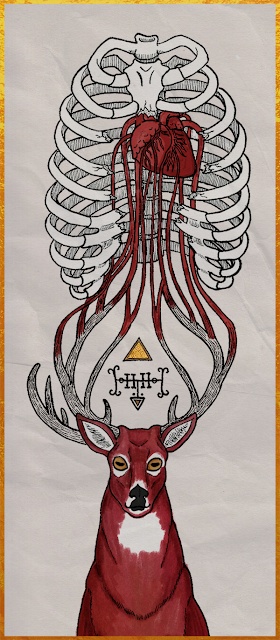
A gold-trimmed pen and ink drawing of a red deer with three antlers, two on the right and one on the left. The prongs of the antlers turn into veins which are connected to a human heart, surrounded by a fractured rib cage. Between the deer's antlers is the sigil for the goetic demon Furfur and the alchemical symbol for fire, painted gold.

Uliski the demon deer

This is a story about how power causes corruption, especially when it’s wielded by violent young men dripping with privilege. While the novella is very pro-Anarchist, Killjoy keeps it from feeling too much like heavy handed propaganda by presenting a balanced view of her socio-political beliefs and chooses realism (well, other than the supernatural elements of course) over romanticism. The town of Freedom is presented as both an ideal and a warning; a community based on equality and cooperation is something to strive for, but, like any system, it can easily be corrupted by selfishness and fear even when everyone has the best of intentions. Hierarchies started to form without anyone realizing, and once those hierarchies were enforced through violence Freedom went from Anarchism to Authoritarianism, much like what happened after the Russian revolution.

As much as I loved The Lamb Will Slaughter the Lion, I felt it would have worked much better as a full-length novel, rather than a novella. The world building, story set up, character development, and ending all seemed too rushed and I was left feeling underwhelmed and longing for more. The concept is so cool, a demon deer turning on its summoners as a revolution slowly brews from with the town, that I wanted to spend more time there and learn about all the characters and what brought them to Freedom. I especially wanted to see more of Danielle and Brynn’s relationship develop. These reasons are why I much prefer the sequel, The Barrow Will Send What It May. By the second book, Killjoy has already established the world and the main players in it and is able to spend more time on developing her characters, building suspense, and giving Danielle and Brynn time to explore their feelings for each other. It’s for these reasons that I strongly suggest reading the two novellas together. The Lamb Will Slaughter the Lion feels incomplete on its own, but works well as the first chapter to an overarching story, and this is why I truly hope we will see many more chapters in the Danielle Cain series. I want to read a full-length novel about a band of Anarchists travelling from town to town solving mysteries and fighting demons, Scooby-Doo and Supernatural style, even if it is separated into several short stories. Killjoy clearly has many more stories to tell, and I look forward to reading them.

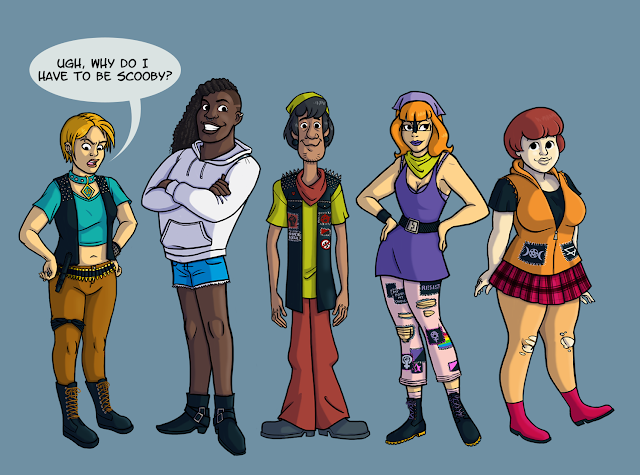
Five people in punk clothing colored to resemble the characters from Scooby-Doo. Furthest to the left is Danielle, a White woman with short, blonde hair. Next is Vulture, a tall, Black trans man with long hair and one half of his head shaved. Thursday, a Latino man in a leather vest is the middle, then Brynn, a White woman with red hair, a tattooed line on her forehead, and glasses. Her pants are covered in lgbtq, anarchist, and feminist patches. On the left is a chubby White woman, Doomsday with bobbed, brown hair.

Left to right are Danielle (as Scooby), Vulture (as Fred), Thursday (as Shaggy), Brynn (as Daphne), and Doomsday (as Velma). Anarchist Mystery Gang!

 
Worship Me by Craig Stewart

Worship Me by Craig Stewart

Formats: Print, audio, digital

Publisher: Hellbound Books

Genre: Blood & Guts (Gorn), Monster, Myth and Folklore, Occult

Audience: Adult/Mature

Diversity: Gay author and gay side character

Takes Place in: USA

Content Warnings (Highlight to view): Animal Death, Body Shaming, Bullying, Child Endangerment, Death, Forced Captivity,  Gaslighting, Gore, Mental Illness (depression), Physical Abuse, Sexual Assault, Self-Harm, Slut-Shaming, Suicidal Ideation, Violence

Blurb

Something is listening to the prayers of St. Paul’s United Church, but it’s not the god they asked for; it’s something much, much older. 

A quiet Sunday service turns into a living hell when this ancient entity descends upon the house of worship and claims the congregation for its own. The terrified churchgoers must now prove their loyalty to their new god by giving it one of their children or in two days time it will return and destroy them all. 

As fear rips the congregation apart, it becomes clear that if they’re to survive this untold horror, the faithful must become the faithless and enter into a battle against God itself. But as time runs out, they discover that true monsters come not from heaven or hell… 
…they come from within.

Please note, I received this product for free in return for providing an honest and unbiased review. I received no other compensation. I am disclosing this in accordance with the Federal Trade Commission’s 16 CFR, Part 255: Guides Concerning the Use of Endorsements and Testimonials in Advertising.

***
 

Worship Me is a nihilistic exploration of morality and faith presented as a gory horror story about a congregation trapped inside their church by a mysterious creature, called the Behemoth. Demanding their reverence, the beast viciously murders any who disobey and gives the group 48 hours to offer up a child sacrifice. With the safety and sanctity of their church destroyed and their beliefs thrown into question, the members of St. Paul’s United Church begin to reveal their true natures. The book boasts a large cast of characters including Dorothy, the church matron who’s desperate to feel needed, Emily, a severe and devout woman who harshly judges others, Susan, a naive and sheltered young woman who wants to save the world, and Chris, a closeted gay teen who desperately wishes his crush would acknowledge their mutual attraction, and the point of view frequently shifts as each character watches their world fall apart. But it’s Angela who comes closest to being the story’s protagonist.

Angela and her son, Alex, have been the center of church gossip ever since her husband, Rick, vanished mysteriously. Seemingly tired of the pity and Emily’s suspicious scorn Angela announces during Sunday service that she’s planning on moving away and starting fresh. That’s when a filthy Rick stumbles into the church. The congregation, who have been praying for his safe return, declares it a miracle. Angela, however, is less than thrilled. While the community sees the couple’s relationship as the perfect romance, high school sweethearts who marry young and went on to have a child, nothing could be further from the truth. Rick is an abusive and violent man who terrorizes his wife, Angela was desperate to escape his cruelty and protect her son, and his time away has made him even worse. While gone, Rick has found a new god, the Behemoth, and has apparently started some sort of Cenobite-type religion that involves torture, murder, self-mutilation, and a very aggressive recruitment strategy. Everything starts to go to hell after that.

At least I assume this is what Scientology is, but with more aliens and domestic espionage.

On the Sunday of Rick’s ill-fated return, the pastor, Don, tells his congregation about the myth of Job, a devout and righteous man whose faith is tested by hardship. For those unfamiliar with the parable, God and Satan aka “the Adversary” (“satan” literally translates to “adversary” so it’s unclear whether this is big S Satan, aka the devil, or just some random angel who’s a jerk) are hanging out in heaven and God is bragging about the super pious and awesome Job. Satan rolls his eyes and points out that Job is only “good” because he knows God blesses the righteous and punishes the wicked. He’s doing it for the rewards, not out of some deep sense of morality. God suggest they test that theory and gives Satan permission to ruin Job’s life by killing his servants and children, taking his wealth, and covering the poor man with boils. Job’s so-called “friends” also subscribe to the theory that bad things only happen to bad people, and proceed to blame the victim by telling the poor man that all his misfortune is his own fault. At this point Job is pretty miserable and wondering what the hell he did to deserve this and demands to know why an all-powerful deity would make the world so chaotic and horrible. Surprisingly God actually responds with something along the lines of “Where the hell were you when I made earth out of literally nothing!? I made a freaking universe and you people don’t even know what electricity is yet. Do you really think your stupid little monkey brain could understand all the complexities that go into running this place? I have all these plans you couldn’t even wrap your brain around, like winning a bet with this guy… never mind, the point is: I’m omnipotent, omniscient, and I work in mysterious ways. Deal with it.” Stunned, Job stammers out “Well, you didn’t really answer my question, like, at all, but you’re really scary and I don’t want an all-powerful deity angry at me so I think I’m just going to go back to being pious and throw in some groveling apologies so you don’t smite me.” God says “Yeah, you do that” and restores Job’s riches and health, and even gives him some new kids (because apparently children were easily replaced like goldfish back then), just so there are no hard feelings. The parable is meant to explain why good people suffer for seemingly no reason, though a more cynical interpretation would be that powerful beings treat mortals as mere pawns in their games and get unreasonably angry when those mortals want to know why they’re acting like jerks. While God is ranting at Job for questioning his betters, the irritable deity starts not-so-humbly bragging about how powerful they are, using the Behemoth as an example. The Behemoth, an enormous, land-dwelling beast, is so powerful that it can only be controlled by God, no mortal could ever hope to defeat it.

“Behold now behemoth, which I made with thee; he eateth grass as an ox.

Lo now, his strength is in his loins, and his force is in the navel of his belly. 
He moveth his tail like a cedar: the sinews of his stones are wrapped together. 
His bones are as strong pieces of brass; his bones are like bars of iron.

He is the chief of the ways of God: he that made him can make his sword to approach unto him.”
(Job 40: 15-19)

No, I don’t know why God spends so much time telling Job about the Behemoth’s giant genitals (“tail” was probably euphemism). Whomever wrote that particular bible story was having a really weird day. Jewish apocrypha describe the Behemoth as a primal creature that represents chaos and will battle with its aquatic and aerial counterparts, the Leviathan and Ziz, on judgement day.

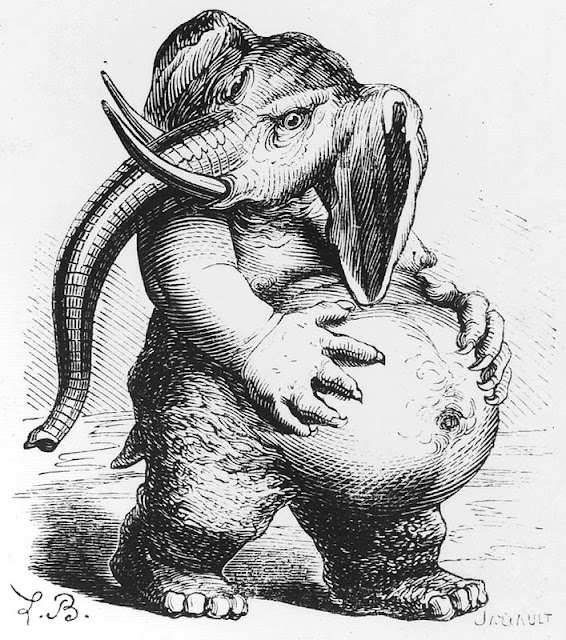
An early 1800s pen and ink sketch of a bipedal demon. It has the head, legs, and tail of elephant and the torso and arms of a a human. The demon is clutching its large, bloated belly with clawed hand and looking over its right shoulder.

The Behemoth as it is depicted in the Dictionnaire Infernal where he is described as ruling over the domain of gluttony. The fictional creature may be based on a hippo or elephant. Young earth creationists and anyone else who failed grade school science think the Behemoth is a dinosaur (it’s not).

Most of the characters in Worship Me believe the Behemoth is either a fallen angel meant to test their faith or a new deity come to save them. But neither assumption is accurate because none of what happens is about any of the humans in the first place. The beast sees itself as the main character of its own story, and the congregation as mere pawns. The beast only seems god-like because humans are a weak and undeveloped species in comparison. Calling the Behemoth a false god or demon would be a gross oversimplification that implies its existence is tied inextricably to humanity. Historian Lynn Townsend White Jr. argued in his famous 1967 paper The Historical Roots of Our Ecologic Crisis “Especially in its Western form, Christianity is the most anthropocentric religion the world has seen. Man shares, in great measure, God’s transcendence of nature.” Abrahamic all but declare humanity’s superiority. In the very first book of the Torah and the Old Testament (Bereishith/Genesis) God essentially tells Adam that he is the most important living thing in the universe. “And God said, Let us make man in our image, after our likeness: and let them have dominion over the fish of the sea, and over the fowl of the air, and over the cattle, and over all the earth, and over every creeping thing that creepeth upon the earth.” (Genesis 1:26) In the Quran, even divine beings are told to bow down before the first human. “And when We told the angels, ‘Prostrate yourselves before Adam!’ they all prostrated themselves, save Iblis, who refused and gloried in his arrogance: and thus he became one of those who deny the truth.” (Surah 2:34) A relic from another time the creature’s morality cannot be defined by human parameters, and has nothing to do with any human religion. The church members, who clearly subscribe to the idea of human exceptionalism, at least in the beginning, simply assume it does.

Unfortunately for the congregations, God never does show up to control the Behemoth. A few people try to stand up to the beast at first, but all are brutally killed for their efforts and the legend of Job offers little comfort to their grieving loved ones. Some of the church members begin to wonder if there is even someone out there listening to their prayers. Even if there is, a hands-off God who lets innocent people suffer and die quickly loses their appeal when the prehistoric monster terrorizing you can promise rewards now. As they become even more frightened and desperate every adult becomes complicit in some form of depraved cruelty, whether they are active participants or merely remain silent and allow it to happen. This begs the question, if you willingly do something unspeakable to save your own skin, is the life you preserved still worth living knowing you will now have to carry the guilt of your crime? Keep in mind such philosophical questions are much easier to answer from the outside, but even the kindest and most moral person can be twisted by pain and fear and grief. While most of the heroic sacrifices made by those the Behemoth killed were merely pointless deaths (they died horribly and all it accomplished was pushing their loved ones to commit monstrous deeds to get them back), the murdered are also the only characters in the book who get to die with a clear conscience. If there is an afterlife, they’ll be the only ones joining Job in paradise.

The threat of death and suffering, especially when made against your children, are certainly excellent motivators when it comes to recruiting the unwilling, though I do have to question the decision making abilities of those members of the congregation tempted by the Behemoth’s promised “rewards”: torture (which Rick seems to be super into) and bringing Evil Dead versions of their murdered loved ones back to life. Why bother to offer a moldy, half-eaten carrot when the stick would suffice? But while no one takes them up on their offer of some old fashioned masochism, a lot of the characters fall for the “I’m going to murder someone you love then give you this evil, busted, half-assed version instead” scam Rick and his beast buddy are running. I don’t care how much you miss your kid, nobody wants a monster that makes the reanimates from Pet Sematary seem kind and cuddly by comparison, even if it does vaguely resemble a mutilated version of little Timmy. If my wife got mauled by monsters then Monkey’s Paw-ed back to life looking like something out of Resident Evil, I’d be reaching for the flamethrower, not agreeing to join some prehistoric beast’s weird torture church. Maybe if the Behemoth agreed to send my undead wife back to the cornfield or wherever I might agree to a little light beast worship, but as it stands his resurrection game needs some serious work.

My wife as a mutilated, living corpse is definitely one of the weirder things I’ve drawn. I showed this drawing to her and now she’s shuffling around the house pretending to be a zombie.

There is one other, much more significant issue I had with the book.
***Content warning for discussion of rape and sexual assault***
Among his many newfound powers, Ricks now possesses the ability to make people sexually attracted to him, whether they want to be or not. This creepy ability is first demonstrated when a heterosexual man finds himself inexplicably lusting after Rick (right before Rick kills and mutilates him). He uses it again on Angela whilst sexually assaulting her, resulting in her arousal during the assault, and the way it’s worded is pretty cringe-y:
“Her body began to revolt against every intellectual, spiritual and personal value she had tried painstakingly to uphold. This man, this creature, this demon, had violated her, beaten her, lied to her, threatened her life and the life of her child, but still her body wanted him. It ached for him, as if it would die without his touch, inside and out… She hated each and every betrayal her body made.”

This is a trope I absolutely loathe with a burning passion. Let me be perfectly clear: some people do experience an erection, lubrication, or even orgasm during a sexual assault, and there’s nothing unusual or shameful about it. It’s a purely physiological response and not an indication of enjoyment or a sign of consent. Unfortunately, the belief that any sign of arousal means the victim “wanted it” is still prevalent (and even used as a defense in court cases) and enforced in fiction like Crown of SwordsThe FountainheadGoldfingerGame of Thrones, and numerous Harlequin romancesFifty Shades of Grey actually inspired at least three different cases of sexual assault because these men couldn’t understand that fantasizing about being ravished isn’t the same thing as wanting to be assaulted (Pro tip: NO ONE wants to be raped). It’s not that people shouldn’t write about rape (The Round House by Louise Erdrich and Speak by Laurie Halse Anderson both do an excellent job dealing with such a difficult topic) or even erotic fantasies of being overpowered. It’s just that with rape culture and world being what it is, authors need to tread very, very carefully when writing about assault. TorApex MagazineWired, the Writing Reddit, and Marie Brennan’s blog all do a great job discussing how to write about sexual violence in fiction.

Worship Me isn’t nearly as bad as the previous examples I listed, Rick is portrayed as a complete monster whom Angela despises and what he does is reprehensible. I don’t think anyone reading that passage is going to think Angela wanted him to assault her, or that it was anything but a violation. But it still could have been handled a lot better and I cringed reading it.
***End of content warning***

Problems aside, Worship Me is still a well-written, and entertaining read. You would think a book where the characters spent the majority of their time trapped within a church reflecting on their personal values would get dull very quickly, but fear not. Action scenes are perfectly placed throughout the story to keep the pace going and the tension high. Even with my ADHD, Worship Me managed to hold my attention throughout the book and I only put it down when I absolutely had to (like when my wife said if I didn’t come do the dishes right now she was making me sleep in the backyard). But it’s the novel’s exploration of faith that makes Worship Me really stand out. I was very fortunate to grow up attending a Congregationalist church part of the United Church of Christ (UCC) with a strong emphasis on humanism, tolerance, science, and social justice, where my sexuality and agnosticism were readily accepted, but many people aren’t so lucky. Even churches that aren’t showing up on a Southern Poverty Law Center watch list can be intolerant towards anyone they see as breaking some obscure Biblical law from Leviticus. When a religion that’s supposed to be about love and compassion is twisted by its followers into an ugly culture of hate, judgement, and hypocrisy it drives people away. But worse than that is when people actually find that kind of message appealing. They’re attracted to the “us vs. the sinners” rhetoric and instead of loving their neighbors or respecting differences, they turn to condemnation and cruelty in a misguided attempt to please an angry god and reap the rewards they feel are promised them. And this is the heart of what makes Worship Me so terrifying. Not the monster outside who may or may not be an old god come to challenge the newer god of Abraham, but the horrible lengths people are driven to when they believe without question. Worship Me isn’t so much anti-religion as it is anti-zealous, unquestioning belief and fear-based worship. There are benefits to religion, it can offer comfort in dark times and encourage charity and compassion and a sense of community. But when the message is never questioned and when its followers lose the ability to judge right or wrong from themselves, that’s when people suffer. Churches will always make me leery. Maybe it’s because some very vocal religious types find both my sexuality and my lack of faith sinful, and are not shy about harassing anyone like me. It could also be that whole bursting into flame and vomiting black bile every time I step onto holy ground thing that happens, who knows. What I do know is the Worship Me has definitely made me think twice about visiting a house of God again, lest it hold some even darker secrets.
The Mine by Arnab Ray

The Mine by Arnab Ray

Formats: Print, digital

Publisher: Westland (Indian publisher now owned by Amazon)

Genre: Blood & Guts (Gorn), Psychological Horror, Occult

Audience: Adult/Mature

Diversity: South Asian/Desi/Indian, Disabled character (uses a wheelchair due to partial paralysis, mute/Aphonia)

Takes Place in: Thar Desert, Rajasthan, India

Content Warnings (Highlight to view): Abelism, Bullying, Cannibalism, Child Abuse, Child Death, Child Endangerment, Death, Drug Use/Abuse, Forced Captivity, Illness, Gaslighting, Gore, Kidnapping, Medical Torture/Abuse, Medical Procedures, Mental Illness, Self-Harm, Rape/Sexual Assault, Sexism, Slurs, Slut-Shaming, Stalking, Suicide, Torture, Violence, Xenophobia

Blurb

At a secret mining facility somewhere in the deserts of Rajasthan, an ancient place of worship, with disturbing carvings on its dome, is discovered buried deep inside the earth. Soon the miners find themselves in the grip of terrifying waking nightmares. One tries to mutilate himself. Worse follows.

Five experts are called in to investigate these strange occurrences. Sucked into a nightmare deep underground, they embark on a perilous journey; a journey that will change them forever, bringing them face-to-face with the most shattering truth of them all…

The greatest evil lies deep inside.

Imagine combining Event Horizon with Agatha Christie’s And Then There Were None then mixing in the criminally underrated film Below. Set it in a mine deep below the Great Indian Desert and you’ll get an idea of what you’re in for in Arnab Ray’s horrifying, claustrophobic, sex-filled gore-fest of a novel about five adults and one little girl trapped underground with their guilt.

The Mine starts out with Samar, a rich recluse specializing in industrial security, wallowing in his grief after the disappearance of his daughter and the death of his wife. Yeah, Samar has shit luck. A mysterious man named Arnold Paul (whose name I kept reading as Arnold Palmer) finally bribes convinces Samar to drag his depressed butt out of bed by offering him a large sum of money to go with him and do a sketchy job, the details of which Paul/Palmer won’t reveal. Samar is apparently used to this sort of thing due to his work as a security expert/spy for secret government ops, and figures he wasn’t doing anything important anyway (except moping and sleeping) so he begrudgingly accepts the offer and heads off for the titular mine. As it turns out, greed is a great motivator because Mr. Paul/Palmer has also convinced four other experts to go to the middle of nowhere with a complete stranger, no questions asked.

Joining Samar are Dr. Karan Singh Rathore, a diplomatic and laid back older gentleman who specializes in infectious diseases; Dr. Anjali Menon, a widowed archeologist who brought her disabled daughter, Anya, along; Dr. Akshay More, an arrogant and obnoxious assistant professor in forensic toxicology; and Dr. Preeti Singh, a short-tempered psychologist with a surprising lack of people skills. The group has been brought together to give their expert opinion on a series of deadly accidents that seem to have been caused by the discovery of an ancient, creepy temple the miners are too afraid to go near. A temple that also happens to be covered in explicit carvings of naked women being tortured and killed, because whomever created the damn thing is sexist and gross. If that wasn’t ominous enough, the director of the mine is named Lilith Adams. While it’s fully possible her parents were just uncreative goths from the early 00’s, it’s far more likely that Ms. Adams just picked the most obvious evil pseudonym since Alucard and Lou C. Pher.

At this point, most people would’ve noped the fuck out of there, but Samar and the scientists have clearly never seen a horror movie in their lives and are too wrapped up in their own issues to notice the whole situation has more red flags than a May Day parade in Moscow. The mine could not be more obviously evil if it had “Gateway to Hell” in big florescent lights over the entrance, ominous music playing in the background, and a bunch of demons chilling in the conference room. Then again, these are people who willingly followed a creepy stranger into the middle of nowhere to visit his sketchy underground dungeon (literally, the workers are all criminals and aren’t allowed to leave until their contracts are up) because Paul/Palmer promised them candy/money. Little kids have more street smarts than this group, so I shouldn’t be surprised they’re completely oblivious to danger.

Illustration of a blood-spattered van bearing the name FREE CANDY and a South Asian man thinking

I mean, even I figured out the candy van was a trap after the first 9 or 10 times.

Akshay and Anjali explore the torture-porn temple and discover it depicts ironic punishments attributed to specific sins. Meanwhile, Karan and Preeti talk to the survivors, who share stories that would make Rob Zombie squeamish. Akshay makes light of the situation and acts like a jackass, Anjali does her best to ignore everyone and just do her job, Karan remains calm and reasonable, and Preeti is hostile and short-tempered. Samar checks the security and continues to have no fucks to give beyond a kind of creepy obsession with Anya, who reminds him of his dead daughter. The general consensus among the workers is that they’ve somehow opened a portal to hell and everyone in the mine is going to die horribly as a result of their dark pasts. Needless to say, company morale isn’t great. At this point, everyone finally agrees this place is super creepy and they want to collect their paychecks and GTFO. Alas, in a twist that should come as a surprise to exactly no one, Lilith turns out to be evil, and sets off an explosion that kills all the mine workers and traps the six survivors (Samar, the scientists, and Anjali’s daughter) inside while she laughs manically about the mine’s real resource being fear. Worst. Job. Ever.

Illustration of laughing woman surrounded by a man and woman. The man says

Her name is Lilith, what did you guys expect?

The explosions cause the security systems to engage, sealing the group inside with a series of death traps. Because why wouldn’t you want death traps in an already dangerous mine? On top of everything, an experimental gas that causes super human strength and insanity is being pumped through the A/C, which frankly, feels like overkill to me, but hey, they can run their portal to hell however they want. After their initial panic, presumably followed by the realization that they really should have seen all of this coming, the survivors formulate a plan to navigate the traps and make it to the surface. They’re slightly hindered by the fact they have to trust each other and work together to make it out, and most of them are deceitful, suspicious, assholes, not to mention all the stupid puzzle traps that were apparently inspired by 80s video games. One such puzzle involves trying to obtain acid vials while avoiding motion activated laser and an electrified floor, and if you succeed you’ll be rewarded with a chainsaw, which may be useful later. Unfortunately in this “game” their are no save points or extra lives.

What follows is about what you’d expect for a book about trying to escape from a possibly haunted mine with a bunch of jerks, but the predictability doesn’t make the story any less suspenseful or gripping. But face it, if you’re reading this book, you’re looking for creative deaths, not creative storytellin, and boy, does Ray deliver there. Besides, the true mystery doesn’t lie in their Aeneas-like journey through the mine, but in each character’s backstory, all of which are slowly revealed as they try to escape the subterranean deathtrap. Each of the adults has done something criminal and escaped punishment, and have been struggling with their guilt ever since. The quality of the backstories varies, with some characters (like Akshay and Preeti) getting plenty of focus, while Anjali gets very little characterization beyond “the aloof mom”. So too do their sins seem to be of differing severity. Some of the survivors have committed crimes so awful as to make them irredeemable, while others are more sympathetic and their sins, while still terrible, are still at least partly understandable. This disparity seems a little unfair as it means at least some of the group will potentially suffer a gruesome death (at least according to the carvings in the temple) over something that would normally earn them less than 15 years in prison (at least in the US, not sure about the Indian judicial system). It’s not that their crimes aren’t bad, they just don’t seem to merit a sentence of being reduced to a puddle of bloody viscera.

We never really learn if the mine is truly being controlled by a demonic entity or if the group’s guilt and paranoia (fueled by the hallucinogenic gas) is causing them to attribute bad luck to malicious forces and see things that aren’t there. Samar even suggests that the whole thing is an unethical experiment by the government to test their new gas on subjects no one will miss, as there are far too many coincidences for mere random chance, and the temple may be a fake created to amp up their fear levels. Since none of the characters are able to trust their own senses, making them unreliable narrators, arguments could be made for either scenario, making the story even more spooky and disturbing. Monsters are scary, but they’re even scarier when you can’t even tell if they’re real or simply the imaginary scapegoats of guilt-ridden, paranoid people. Even more frightening, Ray argues, are the depths of human cruelty and depravity, which are explored in each character’s backstory. Though that may just be an excuse to squeeze more gore out of the story.

The Mine does an excellent job balancing itself between psychological horror and splatterpunk. The true scares lie in the book’s creepy atmosphere, suspense, and the characters slowly succumbing to madness; the over-the-top gore is simply dessert. Unfortunately, this otherwise perfect blend of horror comes with as huge helping of misogyny. Yuck. Look, I’m fully willing to admit I’m part of the lowest common denominator who just wants to see heads exploding like overripe cherries and attractive people boning, but that doesn’t mean I like sexism. Unfortunately, more often than not, the three seem to go hand in hand, much to the frustration of female horror fans, and other, more enlightened individuals who just happen to like hot sex and lots of blood. Ray isn’t as bad some other authors out there, the violence is pretty evenly split between the genders and there aren’t any scenes of knife-wielding killers chasing half naked women. He even manages to handle the subject of sexual assault fairly well, choosing to focus more on the problematic culture of victim-blaming and men who feel entitled to women’s bodies rather than the rape itself. But he struggles with creating believable female characters, defining them by their relationships with men, and them victimizing them. Both of the female scientists have backstories that involve abuse and mistreatment at the hands of men, and instead of being written as strong, survivors, they both come off as bitter, man-haters. Apparently Ray subscribes to the theory that in order to be “strong” a woman must act rude, aloof, aggressive, and despise an entire gender, with the exception of that one special man who tames her with his magical penis. Which is why both Anjali and Pretti act like complete jerks, with Pretti especially flying off the handle at every perceived slight (she must be a great psychologist), and basically being awful to everyone except, ironically, Akshay whom she latches onto almost immediately (despite the fact that he’s literally just the worst). Despite all her bluster, Pretti still falls quickly into the role of helpless victim in need of a man’s protection at the first sign of danger. It’s really embarrassing. I guess she can’t help it because she’s an emotional female with a hysterical uterus or some such nonsense. The women in the story are all described as being gorgeous, but only one male character is described as being very attractive, the wholly unlikable Akshay, and that’s only because his appearance is supposed to reinforce how vain and materialistic he is. Many of the women are also incredibly horny, even minor characters, like Tanya the gold-digging nurse, and Ray paradoxically has no problem slut-shaming them for it (apparently enjoying sex is sinful enough to get you murdered by the mine), even though he later demonizes other characters for doing the same thing. Maybe the mine is just super slut shame-y. The unearthed temple certainly implies that someone behind the scenes hates women.

The women in the story seem less like real people and more like a weird combination of straw-feminists and male masturbatory material, with Ray putting way too much emphasis on their appearance, sex drives, and relationships with men. Then of course we have Anya, who, while thankfully not a sex object, is still treated as an object nonetheless. She barely gets any characterization, and doesn’t communicate even through sign language or writing, she’s just a blank slate for Samar to project his weird daughter obsession onto. It’s doubly problematic since Samar seems to use Anya’s disability as an excuse to treat her like a life-sized doll he can love, protect, and turn into his replacement daughter. Because she’s mute he assumes she has nothing to say, and because she doesn’t walk he thinks she’s completely helpless. We don’t even get to learn what she’s thinking, or how she feels about Samar treating her as some sort of second chance, because, unlike the other characters who all get their turn in the spotlight of the limited, third-person narrative, Anya is completely ignored. At least she gets a little bit of a role later on (which I won’t spoil). Miraculously, Lilith Adams is the only female character who is neither a victim, nor a sex fantasy, and is described only as being terrifying, intense, and very much in charge, much like her namesake.

A man kneels in front of a woman in a wheelchair. The man says

This definitely feels like a stranger danger situation.

So the female characters are about as well written as you’d expect from a male author who doesn’t know how women work, and the whole “helpless, sick wheelchair girl” trope is super problematic. It’s not the worst treatment of women I’ve seen in splatterpunk, but I’d still prefer to enjoy my blood and guts without the side of sexism. I mean, I don’t think it’s an unreasonable request. The writing is still pretty good, and it’s definitely the scariest book I’ve read so far this year. The Mine is also one of only a few Indian horror novels I’ve been able to find in English. Whether that’s enough to overshadow the book’s problem areas, however, is up to the individual reader. 

The Ballad of Black Tom by Victor LaValle

The Ballad of Black Tom by Victor LaValle

Formats: Print, audio, digital

Publisher: Tor

Genre: Eldritch, Monster, Historic Horror, Occult, Sci-Fi Horror

Audience: Adult/Mature, Y/A

Diversity: Black characters (African American and Caribbean)

Takes Place in: Harlem, New York City, USA

Content Warnings (Highlight to view): Bullying, Death, Gore, Mental Illness, Medical Procedures, Oppression, Physical Abuse, Police Harassment, Racism, Torture, Verbal/Emotional Abuse, Violence, Xenophobia

Blurb

People move to New York looking for magic and nothing will convince them it isn’t there.
Charles Thomas Tester hustles to put food on the table, keep the roof over his father’s head, from Harlem to Flushing Meadows to Red Hook. He knows what magic a suit can cast, the invisibility a guitar case can provide, and the curse written on his skin that attracts the eye of wealthy white folks and their cops. But when he delivers an occult tome to a reclusive sorceress in the heart of Queens, Tom opens a door to a deeper realm of magic, and earns the attention of things best left sleeping.
A storm that might swallow the world is building in Brooklyn. Will Black Tom live to see it break?

Oh Lovecraft, you were such a great horror writer, but an absolutely terrible human being.

When it comes to Lovecraft, I have some very complicated opinions. I adore the Cthulhu mythos, cosmic horror, and the concept of forbidden knowledge that utterly destroys your sanity, but it’s hard to enjoy his writing when he liberally peppers it with his hatred for anyone who isn’t a WASP. One minute  I’m reading an enjoyable little story about a cosmic abomination and the dark secrets humanity was never meant to know, and the next it’s morphed into some sort of eugenics bullshit. Here’s a small sampling of just some of the bullshit he pulls in his stories: In the Case Of Charles Dexter Ward Lovecraft describes a woman as having “a very repulsive cast of countenance, probably due to a mixture of negro blood,” in Herbert West: Reaminator the black boxer, Buck Robinson, is compared to an ape, in The Rats in the Walls there’s a black cat named N****r Man, The Horror at Red Hook is basically just Lovecraft rambling about how much he hates immigrants and black people who he refers to as a “contagion” with “primitive half-ape savagery”, and in Medusa’s Coil he describes slavery as “a civilization and social order now sadly extinct”. Oh, and let’s not forget that poem. There’s a good reason why Lovecraft’s bust is no longer used for the World Fantasy Award trophy, the guy was a dick.

A drawing of Nnedi Okorafor wearing a dark blue dress, large red and gold earrings, and holding her World Fantasy Award, a bust of H.P. Lovecraft. Okorafor looks uncomfortable while she says “Um, Thanks, I guess? Yeah, I don’t really want this racist’s head on my mantle.”

I tried to draw Nnedi Okorafor, “tried” being the operative word. She says I got it right from the shoulders up though!

Now, before anyone uses the “Lovecraft was just a product of his time” excuse, please consider this: Yes, his active years as a writer were during the incredibly racist segregation era, but not everyone shared his shitty beliefs about people of color and Jews. Mary White OvingtonMoorfield Storey, and William English Walling were all white, but they were also supporters of  civil rights and racial equality during the same period, and even helped found the NAACP with W. E. B. Du Bois. So it’s not like every white person in the 1920s and 1930s was racist. Lovecraft would’ve at least been aware of civil rights due to Guinn v. United States, a landmark case that found racist literacy tests unconstitutional, the National Negro Business League which helped to double the number of black owned businesses, and prominent black lawyer Charles Hamilton Houston, who was fighting for civil rights in court. Hell, even his friends and family criticized the horror writer’s ignorant attitude. Lovecraft’s wife, Sonia Greene, and friend Samuel Loveman were both horrified by Lovecraft’s anti-Semitism and resented him for it. Sonia even wrote, “Whenever we found ourselves in the racially mixed crowds which characterize New York, Howard would become livid with rage… He seemed almost to lose his mind.” When Lovecraft attacked Charles D. Isaacson‘s, article on racial tolerance, In a Minor Key, in his own article titled In a Major Key (where he praised the KKK as “that noble but much maligned of Southerners who saved half our country from destruction”) he managed to piss off not just Isaacson, but his own friend James Ferdinand Morton, both of whom wrote responses attacking Lovecraft’s racism. He knew people thought he was racist, as he’d been called out multiple times and even his wife had pleaded with him to reconsider his beliefs- Lovecraft just chose to be an intolerant jerk.

There are two books. On the left is a book with a red cover written by H.P. Lovecraft. It’s titled “The Horror at Red Hook, or Why Immigrants and Minorities Ruin Everything.” On the right is a green, leather bound book with an image of a brass octopus on the cover. The title, written in gold lettering, is “Lovecraft’s Letters: About How Anyone Who Isn’t Anglo-Saxon Sucks, and Why Eugenics are Super Awesome”.

Probably real Lovecraft titles.

Luckily for us, many talented creators have taken concepts in Lovecraft’s writing and used it to create their own works, so fans can still enjoy Yog-Sothoth, the Deep Ones, and the horrors of forbidden knowledge driving men to madness- without all the bigotry. The Ballad of Black Tom is one of these works, a retelling of  Lovecraft’s incredibly racist The Horror at Red Hook from the point of view of a black man living in Harlem.

For those not familiar with Lovecraft’s original short story, The Horror at Red Hook follows police detective Thomas Malone and his pursuit of forbidden knowledge in the immigrant neighborhood of Red Hook, Brooklyn, or as Lovecraft describes it “a maze of hybrid squalor”. Because the only religions in Lovecraft’s world are either good, Anglo-Saxon Christianity or evil, bad, demon worship, all the brown people are apparently involved with the occult.  Malone is put on a case involving the wealthy and eccentric recluse, Robert Suydam because his relatives want the old man declared mentally unfit so they can have his money. During the course of the investigation Malone discovers that Suydam has been spending time with illegal immigrants and foreigners, which obviously means he’s doing something super evil, like sacrificing white babies to tentacle-faced monsters, because Lovecraft is racist and Malone is an awful detective. Suydam continues to do suspicious things, in Malone’s opinion anyway, like lose weight, work on his personal grooming, and get married. Eventually the whole thing cumulates in a police raid in Redhook, where Malone finds a bunch of creepy shit in Suydam’s basement flat which causes the police detective to lose his sanity points and pass out from sheer terror. Afterwards we discover that the buildings collapsed, killing almost everyone except Malone, who is left with PTSD and batophobia. The rest of the story is just Lovecraft whining about immigrants “ruining” New York and reads like the antiquated 8,000 word equivalent of a Trump tweet. It’s not one of his better stories. So it’s kind of a miracle that LaValle not only manages to write a version of The Horror at Red Hook that’s not just a commentary on racism, but is actually good, while still keeping all the creepiness, mind-fuckery, characters, and plot of the original. Suydam and Thomas Malone both appear as major characters in The Ballad of Black Tom, Malone serving as a deuteragonist for the second half of the story, while Suydam introduces Tommy Tester, the book’s protagonist, to the occult. There are other hidden references to Lovecraft lore throughout the book. The title, Black Tom, is an allusion to the cat from The Rats in the Walls whose name was changed from N***** Man to Black Tom when the story was reprinted in Zest magazine in the 1950s. Toward the end Robert LaValle mentions a man from Rhode Island, living in New York, who may be Lovecraft himself.

LaValle defends the minority population living in Harlem and Redhook that Lovecraft so despised by showing them as the every day folks they are, trying to get by with what little they have. Tommy even expresses disappointment after visiting the Victoria Club, when he learns that it’s not the den of debauchery and sin he had hoped for, but instead old men playing cards and women selling meals they’ve made at home. There are criminals, yes, but that’s to be expected in any impoverished area, and they’re far from a majority of the population. When Tommy discovers Suydam is associating with so many criminals, he’s terrified, and it speaks more to the rich, white man’s character than the immigrants on New York. What Malone discovers in the basement is also been changed from the original, but to reveal more would ruin the amazing ending of Black Tom. Let’s just say LaValle provides his readers with more detail on the horrors the detective discovers, and a much more satisfying ending.

The thing I found the scariest about The Ballad of Black Tom weren’t the fictional monstrosities sleeping at the bottom of the see ready to destroy humanity, it was how much LaValle’s fictionalized world reminded me of our own. The cops’ blatant racism, their harassment of black men who were simply walking down the street, and their willingness to kill at the slightest provocation felt all too familiar, as did the rampant xenophobia and anti-immigration attitudes. The story may be set in the 1920s, but it’s clear that some things still haven’t changed. Tommy’s encounters with the police were enough to give me panic attacks, as I remembered my own family’s terrifying encounters with cops. While I’m pale enough to pass as white, most of my extended family isn’t, and I grew up with horror stories about what happened to black people stalked, shot, raped, and lynched for merely existing. Tommy has learned what every young black person is still being taught: if the police stop you, appear as non-aggressive as possible, be polite, and put up with whatever harassment the cops dish out or you’ll wind up dead. We see this in all his encounters with Malone. Tommy plays dumb, looks downs, and lets them steal his money and insult him to his face without making a comment. At least for the first half of the book.

Tommy Tester starts the story as a good man. He may trick others and take on some not-so-legal work, but he’s trying to take care of his disabled father in a world that’s against him, so it’s not surprising he has to do some questionable things to survive. At least he never actively hurts others and tries to do the right thing when he can, like preventing a witch from getting her hands on forbidden knowledge, which is more than I can say for most of the people Tommy encounters. Racist cops constantly threaten and abuse him, he’s harassed by a bunch of white kids just for walking while black, and white society treats him as less than human. Even Robert Suydam, who claims to admire Tommy and gives him a large sum of money to play guitar in his home, is merely using for his own ends. As it turns out, Suydam is a white man who fetishizes POC cultures, while still viewing himself as superior to the same people he claims he wants to help. There’s a saying “you can only kick a dog so many times before it bites back” and after being attacked, abused, taunted, stolen from, threatened, and finally losing everything to cold and corrupt law enforcement, Tommy Tester realizes he has nothing left to lose and says “fuck it”. And that’s how we start the second half of the story, told from Malone’s point of view, with Tommy, now calling himself “Black Tom,” transforming himself into the most badass, brutal, and terrifying antagonist in order to exact his bloody revenge on Robert Suydam, Thomas Malone, and the xenophobic NYPD. And let me just say, it’s immensely satisfying. Gory, but satisfying.

I abhor violence in real life, and obviously don’t agree with mass slaughter and abuse, no matter how evil the victims are. The real world is more complicated than just good vs. evil, and violence and revenge just beget more of the same. That said, there’s still a violent, pissed off part of me, hurt and furious at the injustice of the world, that wants to see wicked people suffer. Not just get their richly deserved comeuppance, but really, truly suffer in the worst ways imaginable. It’s the bitter part of me that relates to all those Saturday morning cartoon villains of my past who just want to destroy everything, because the world is such a terrible, hateful place that it probably deserves it. This vengeful part of me that becomes more and more hateful every time I read the news was immensely satisfied and soothed to watch Black Tom punish a group of racists who resemble 21st century hate groups a little too closely. It’s the same anger that motivates Killmonger in the Black Panther film.


But, like I said, these are ugly thoughts I would never actually act on or hope to see happen in real life because I know how wrong they are, and I still hold on to the hope that logic and compassion will win out (so FBI, if you’re reading this, I just want to clarify, I’m not actually planning on going on any kind of bloody killing spree). When Tommy, pushed to choose between an eldritch abomination and the hateful people who hurt him again and again, he gives in to revenge and loses part of his humanity, and that’s what makes the story so bitter-sweet. Black Tom may have gotten his revenge, but at the cost of being a good man, something he will have to live with for the rest of his life. He’s compromised his most important value, being the kind of man his father would be proud of, and can no longer look his best friend in the eye. As satisfying as it is to see horrible people suffer a horrible fate, you can’t help but feel bad for Tommy who’s left to wonder if it was really worth it. 

My wife, who is wearing a blue space dress and white, over-the-knee socks has just opened the door to reveal two FBI agents, a light-skinned man, and a dark-skinned woman. My wife has her hands on her and looks irritated. She shouts, “What did you do this time!?!!” I’m in the foreground, carrying a human foot that’s been cut off below the knee. The limb is starting to decay and is wrapped in bandages. I look surprised and guilty at being caught by my wife.

The severed human leg actually has nothing to do with why the Feds are here. Though I’m sure my wife is going to ask about that too. Watch what you say on the internet kids!

Navigation

Social Media

Search by Tags

To learn more about the Age Group, Diversity, and Genre tags, click here.

Age Groups

Diversity

Genre

Support the Blog

Search

Links

Crescentville Haunting by M.N. Bennet

Crescentville Haunting by M.N. Bennet

Formats: digital

Publisher:  Self published

Genre: Ghosts/Haunting, Monster, Occult, Romance, Vampire, Werewolf, Zombie

Audience: Y/A

Diversity: Bisexual main character, non-binary minor character, Black major character

Takes Place in: LA, California

Content Warnings (Highlight to view): Alcohol Abuse, Cannibalism, Death, Forced Captivity, Gaslighting, Gore, Medical Procedures, Mental Illness, Racism, Sexism, Slurs, Slut-Shaming, Violence, Vomit, Xenophobia

Blurb

Determined to pass junior year, Logan won’t let Henry distract him—much. Logan’s focusing on all things human, which means his swoony vampire ex-boyfriend will have to file his own fangs for a change. When he goes to the school bonfire and runs into Henry, wandering into the woods seems like a great escape. Until he’s bitten by a wicked Crone with some twisted magical munchies.

Logan is certain his ex-free human future is done when he’s dragged off to a scientific institution for study. There, he’s presented with an opportunity to keep his life, family, and future. All he has to do is stick to human ideology, since all things paranormal are illegal. But complications arise when the Crone begins to haunt him and Logan realizes that if he wants to get his life back, he has to navigate his lingering feelings for Henry.

With the Crone set on devouring him and the institution ready to obliterate him for any missteps, Logan must decide between pursuing the human future his family wants—one that he thought he wanted too—or the chance to embrace Henry, even if the world isn’t ready.

I received this product for free in return for providing an honest and unbiased review. I received no other compensation. I am disclosing this in accordance with the Federal Trade Commission’s 16 CFR, Part 255: Guides Concerning the Use of Endorsements and Testimonials in Advertising.

Logan just wants a safe, normal, drama-free junior year, and that means avoiding his vampire ex, Henry, at all costs. Which is easier said than done. Logan may be shy and awkward, but Henry is his complete opposite: confident, outgoing, and suave. When his best friend Kiera (a phantom) drags him to a bonfire party that’s supposed to help Logan relax, he discovers that trouble has a way of following him. Not only is Henry there, but Logan is attacked (for the second time since he first started dating Henry) by a powerful creature, this time a monstrous witch known as the “Crone.” After sustaining a bite from the Crone, Henry’s life changes forever.

Henry and Kiera are known as Vices, a group of monsters including phantoms, witches, vampires, trolls, sirens, and werewolves that are forced to live in the shadows due to public fear and draconian laws. The Crone is a sin, a powerful Vice that feeds on other Vices and can turn humans into undead monstrosities called Hauntings (think zombies and ghouls) with a single bite. After Henry’s attack he’s whisked away by SPU agents (the special police force in charge of catching and neutralizing Sins) to a secure facility designed to treat Hauntings, but to everyone’s surprise he doesn’t transform into a Haunting. It turns out Henry is a rare form of Vice, known as a Viceling, more human than Vice. The lore of Crescentville Haunting can get confusing in places, and there’s a lot of backstory. So much so that I actually checked to see if there was a prequel I had missed. But it’s no worse that any other fantasy novel with rich world building. If you can remember the rules of Quidditch, you can remember the magical classification system Bennet has created.

The characters are relatable and their voices sound authentic. The romance is steamy without being explicit and felt age appropriate for younger teens. It should be noted that while the book contains a paranormal romance, it’s not the central theme of the story. Instead, we focus on Logan’s struggles with his new identity and trying to fit into a human-centric world– an analogy for trying to fit into a heteronormative society when you’re LGBTQIA+. In Monsters in the closet: Homosexuality and the Horror Film Harry M. Benshoff writes “monster is to ‘normality’ as homosexual is to heterosexual.” LGBTQIA+ scholars have long equated queerness with fictional monsters and stories like Crescentville Haunting reclaim the “monstrous queer.” In Bennett’s story, the “homosexual vampire” is the hero rather than the villain, with the humans representing an oppressive heteronormative society and the facility attempting to “cure” Logan of his monstrousness a metaphor for conversion therapy. In addition to romance, the book also has plenty of horror, violence, and suspense, all courtesy of the Crone who continues to haunt Logan after the initial attack.

Overall, this was a fun read with a good world building, a cute relationship, and teens who actually sounded and acted like teens.
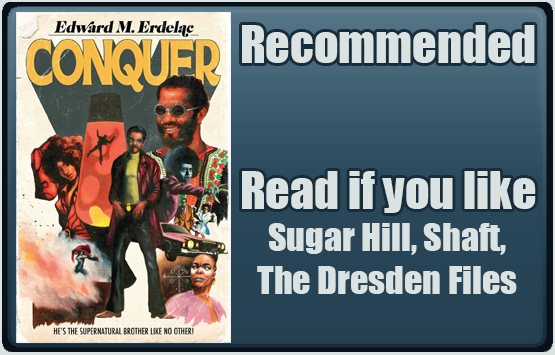
The Final Women by Pardeep Aujla

The Final Women by Pardeep Aujla

Formats: digital

Publisher: Self-Published

Genre: Demon, Killer/Slasher, Occult

Audience: Adult/Mature

Diversity: Black main character, Latina main character, Vietnamese main character, lesbian main character

Takes Place in: type here

Content Warnings (Highlight to view): Alcohol Abuse, Amputation, Bullying, Death, Drug Use/Abuse, Gore, Homophobia, Mental Illness, Racism, Self-Harm, Sexism, Suicide, Verbal/Emotional Abuse, Violence

Blurb

The mass murdering Phantom of Haven Cove is dead. For the one who killed him, however, life has never been the same.

How do you return to normality after facing such a monster? How do you live when consumed by guilt, anger, fear, and denial? How do you connect with others when no one understands what you’ve been through?

But there are others… Final girls of their own Haven Cove massacres. And now, thirty years later, they must all face a new question…

What do you do when the killer returns?

I received this product for free in return for providing an honest and unbiased review. I received no other compensation. I am disclosing this in accordance with the Federal Trade Commission’s 16 CFR, Part 255: Guides Concerning the Use of Endorsements and Testimonials in Advertising.

What happens when final girls grow up? It depends how they deal with the trauma of what happened to them the night they faced off with the masked killer, Silas Crowe. If you’re Nell James, you grow up to become a lonely and agoraphobic author who tries to turn the worst thing that ever happened to her– watching her friends get murdered one by one–into financial gain. If you’re Josie Jedford, you numb your fear with drugs. Or you could become a paranoid survivalist like Ana Gómez who transforms her badly burned body into a living weapon. Even Cassie Phong, who seems to have the perfect life what with her wealthy husband and two children, can’t escape the PTSD she developed the night she faced off with Silas Crowe. Each woman has done her best to put the past behind them, believing Crowe to be dead once and for all. That is until Camp Haven Cove reopens and a new group of teenagers goes missing. Nell realizes that Silas Crowe never died, and never will unless she, and the other three former final girls find a way to deal with him once and for all. Now well into their forties the four final woman team up to put a stop to the killings once and for all.

Slasher heroines are almost exclusively young women: teens and twenty somethings with bare breasts and flat stomachs (they’re always conventionally attractive) enjoying the prime of their lives through sex, drugs and drinking. Any woman above the age of thirty is either a mother or a side character, and if she has a few gray hairs she’s relegated to the role of a frightful hag. But as nostalgia for horror of the 80’s and 90’s breathes new life into horror franchises, Hollywood is doing something new. Instead of rebooting and recasting their heroines, they’re allowing them to grow up from Final Girls into Final Women. Sidney Prescott (Scream), Laurie Strode (Halloween), and Sally Hardesty (The Texas Chainsaw Massacre) all recently reprised their roles in their respective franchises as badass heroines over the age of forty. And as someone who will soon be saying goodbye to my thirties, it’s refreshing to see older women get their time in the slasher spotlight, and that’s one of the things I liked best about The Final Women.  Nell, Josie, Ana, and Cassie are all approaching fifty, but they all get to be the heroes of the story, and I found them much more relatable then horny, drunk teens in the woods. They’re also not written for the male gaze, which is refreshing.

Another thing I liked about the book was Aujla’s realistic depiction of PTSD. None of the women escaped Silas unscathed, they each bear their own physical and mental scars, as one would expect from anyone going up against a slasher. Nell displays avoidance of people and places that remind her of her traumatic event and might trigger a flashback. Cassie and Josie both develop substance abuse problems, alcohol and drugs respectively, a common comorbidity for people with PTSD. Ana is prone to angry outbursts and aggressive behavior and is hypervigilant. All the women struggle with nightmares and flashbacks. It’s refreshing to see a slasher actually deal with mental health and the aftermath of a traumatic event (something we’re starting to see in more recent film sequels). I genuinely cared about all the main characters, something that rarely happens in horror fiction, and I was scared to see any of them get hurt or killed. Aujla just writes them so well! It’s sweet to see these women from different walks of life bond and draw strength from each other.

The Final Women was fun in a way the best 80’s slashers are. Gory, over the top, and wickedly funny. I absolutely devoured it as I found both the story and the characters enthralling. It draws on classic horror tropes while still being wholly unique. If you’re a fan of slashers you’ll definitely want to check this one out. 

Hoodoo by Ronald L. Smith

Hoodoo by Ronald L. Smith

Formats: Print, audio, digital

Publisher: Clarion Books

Genre: Folk Horror, Historic Horror, Demon, Occult, Myth and Folklore

Audience: Children

Diversity: BIPOC (Black, African American, Caribbean American)

Takes Place in: Alabama, USA

Content Warnings (Highlight to view): Animal Death, Bullying, Child Endangerment, Death, Illness, Racism, Physical Abuse 

Blurb

Twelve-year-old Hoodoo Hatcher was born into a family with a rich tradition of practicing folk magic: hoodoo, as most people call it. But even though his name is Hoodoo, he can’t seem to cast a simple spell.        

Then a mysterious man called the Stranger comes to town, and Hoodoo starts dreaming of the dead rising from their graves. Even worse, he soon learns the Stranger is looking for a boy. Not just any boy. A boy named Hoodoo. The entire town is at risk from the Stranger’s black magic, and only Hoodoo can defeat him. He’ll just need to learn how to conjure first.        

Set amid the swamps, red soil, and sweltering heat of small town Alabama in the 1930s, Hoodoo is infused with a big dose of creepiness leavened with gentle humor.

I really wanted to love this book. I really, really did. The cover art is dark and beautiful, the premise sounded right up my alley, the story is inspired by African-American folklore and oral traditions, the villain is genuinely creepy, the representation of Hoodoo feels authentic rather than sensationalized, and it’s a historical novel with a Black main character that isn’t about oppression and racism *gasp*. I was so hyped up for Hoodoo and ready to fall in love. And I will say, the ideas behind the story are great, I like the characters and I like the concept. The execution? Not so much.

Now Hoodoo  isn’t a bad book by any stretch, and I think part of the issue may have been that this is a story intended for kids, and I probably would’ve loved it a lot more if I were a child. The other problem was that I had incredibly high expectations going in, which would be hard to live up to, and that’s on me. It’s also important to note that my lukewarm feelings toward the story also seem to be in the minority: other reviews I’ve read have all been glowing endorsements, so I’m probably just being a grumpy, nit-picking potato. I still recommend checking it out, especially for young readers who love spooky stuff, it just wasn’t as amazing as I was hoping. I had a lot of issues with Hoodoo  that prevented me from enjoying the book as fully as I desired to.

For one thing, the pacing is all over the place. The villain doesn’t get enough of a buildup before his big reveal, and the ending feels rushed while other scenes dragged on, especially in the beginning. Unnecessary details got more focus than I felt they deserved. It’s a serious bummer when the final showdown between the villain and the hero is only a page or two long and he’s defeated with so much ease. Instead of driving forward, the plot just kind of wandered around aimlessly until it got distracted by something shiny. Characters and ideas were introduced then abandoned, appearing for one or two scenes before vanishing into the plot hole from which they came, never to be heard from again. It’s like Smith had written this long, epic story, but had to cut the book down to fit in a 200-page kids book, and he just randomly chose what to remove in last minute panic.

It’s annoying that otherwise interesting characters are reduced to one-scene wonders, but it’s even more annoying that their sole function is to drop solutions in Hoodoo ‘s lap any time he encounters an obstacle. This greatly minimizes the sense of danger, because every problem seems to get solved (whether for better or worse) almost immediately. Too bad the Fellowship of the Ring didn’t have this kid, it’d probably cut their travel time in half, Sean Bean might still be alive, and Sauron would’ve been taken out with one punch. I get that Deus Ex Machina is par for the course with these kinds of stories, but at least pretend the hero might not make it by building the suspense a little, or making them really work for a solution. It’s hard to feel like there’s anything at stake when a random talking crow or another seemingly random character swoops in to save the day without Hoodoo having to do much on his end. I guess that’s why he keeps stubbornly refusing his family’s help like a jerk, because his magic causes everything to just work out with minimal effort. At least, that’s what I assume it does since it’s never really explained how Hoodoo’s powers work other than some really vague hints.

Hoodoo can also be a pretty vexing narrator. He has a habit of defining random words and then ending his sentence with “If you didn’t know”. I know this is probably the most random, arbitrary nitpick, but while it was only mildly irritating the first half-dozen times, by the third chapter I could barely suppress my urge to scream and punch something every time Hoo Doo felt like he had to explain what Molasses or an Outhouse was, then end the sentence with “if you didn’t know”. I KNOW WHAT AN OUTHOUSE IS GET ON WITH THE STORY BEFORE I THROW YOU IN ONE. I get that the book is for kids, and they may not know what cracklin’ is, but I’m pretty sure most children who are capable of reading a chapter book are also able to perform a basic Google search or use a dictionary. And that’s assuming they can’t just figure out a word from context. I didn’t know what “Squirrel Nut Zippers” were before reading this (ironically the one thing Hoodoo didn’t feel like explaining) but I was still able to discern that he was talking about a sweet and not the swing band based on the context. And then I Googled it and learned that Squirrel Nut Zippers are a vanilla flavored caramel candy mixed with peanuts. So now I know that random bit of trivia and that Hoodoo likes gross candy. Maybe it was an attempt by Smith to make his character sounds more “natural” when he’s talking to the audience, but I felt like the narrative came to a screeching halt every time Hoodoo whipped out his annoying catchphrase. Maybe (probably) I’m just really, easily annoyed but all the “If you didn’t know”s were like nails on a chalkboard and distracted me from trying to enjoy the story.

And while I’m dumping on Hoodoo, here’s something else that made my hackles rise; while talking about his best friend, Bunny, he says “That’s what I liked about her. She wasn’t like the other girls at the schoolhouse. She did everything a boy did and some things even better.” Saying a girl “isn’t like other girls” isn’t an empowering compliment, you just insulted her entire gender and basically told her “wow, you don’t suck like all those other icky girls” in addition to implying that women who are more like men are somehow better. Seriously, don’t try and compliment a woman by putting other women down, or tell her “you’re not like other women, you’re more like a man”. Being masculine or feminine shouldn’t be a compliment or an insult, and people aren’t better or worse by being one or the other. Bunny is a pretty cool character and all, but I could have done without Hoodoo’s sexist comments (which are never called out in the story itself).

Despite all the pacing issues, and the protagonist’s exasperating habit of defining every piece of Soul Food he comes across (I KNOW what grits are, you don’t have to stop the story and tell me!!!!) there was still plenty to enjoy. Namely, that we get a piece of historic fiction with a Black protagonist that isn’t about racism or segregation. *gasp* Look, narratives about how poorly Black people have been treated (and are still treated) in this country are both important and necessary, and something every child should learn about. The ugliness of slavery, segregation, Jim Crow laws, and the history of racism that still exists in this country shouldn’t be glossed over, hidden, or worse, perpetuating the myth of the smiling slave and the benevolent slave owner (looking at you  A Birthday Cake for George Washington, you were published in 2016, you should know better), and I commend schools that teach kids about these issues. But, it’s still problematic when all the books about Black people focus only on segregation, slavery, and sports. Or, as librarian and author Scott Woods puts it, boycotts, buses, and basketball. That’s not all there is to Black culture and Black Americans!

Where are the stories where Black kids just have a fun adventure for the sake of a fun adventure? Where’s the escapist fiction and epic tales with the Black hero? Where are the biographies of black scientistsinventorsartists, and entrepreneurs? I tried to think of all the books with Black protagonists I was assigned in grade school, way back in the 90s (by my white teachers, in my mostly white school, where there were literally so few BIPOC that we all knew each other), and all I could remember reading was Roll of Thunder, Hear My Cry in fourth grade. At first, I thought I just had a faulty memory, since I’m old and forget everything. I asked two of my siblings if they could recall any African American literature from our school days. My sister said “No, but I read Beloved in High School”, and my brother was pretty sure the teacher read the class “some picture book about Jackie Robinson”. So yeah, segregation, slavery and sports.  Apparently making us read one depressing story by a Black author during Black History Month was just enough to alleviate my grade school’s White guilt, and then they could all pat themselves on the back for being so woke.

Kids these days (Wow, I sound old) at least have the We Need Diverse Books campaign, and I’m glad for that. I would’ve killed to read a ghost story or a fairy tale with a Black protagonist when I was a child. And that’s what made me so happy about Hoodoo. It’s probably one of the few works of historical fiction (technically fantasy) I can think of that takes place in the Jim Crow south that isn’t entirely focused on oppression of the book’s characters. Hoodoo isn’t a victim, he’s the story’s hero, and he gets to fight the big, bad monster and save his loved ones. It’s a fun, spooky, escapist story with a character children can admire for his intelligence and bravery rather than athletic ability, and the reader gets to learn about Southern Black culture of the time period. There’s still racism lurking in the background, this is 1930’s Alabama after all, as is evident when Hoodoo and Bunny have to go to the carnival on the “colored folk’s” day, or when Hoodoo’s aunt has to go clean for rich, White people, it’s just not the focus of the story. Smith acknowledges that segregation, lynching, and other horrors were a part of life for Hoodoo and his family, and then he moves on with the plot because they’re so much more than just their oppression. Then we get a story of Hoodoo fighting the forces of evil with magic, learning about his past, and being awesome. This is the book every kid who was stuck with a white-washed reading list wished they could’ve read growing up. Despite all my complaining, I truly hope we haven’t heard the last of Hoodoo Hatcher.

Conquer by Edward M. Erdelac

Conquer by Edward M. Erdelac

Formats: Print, audio, digital

Publisher: Self Published 

Genre: Historic Horror, Monster, Mystery, Myth and Folklore, Occult, Vampire

Audience: Adult/Mature

Diversity: Black/African-American, Hispanic, Trans, Gay

Takes Place in: Harlem, New York, USA

Content Warnings (Highlight to view): Animal Death, Body Shaming, Child Abuse, Death, Drug Use/Abuse, Forced Captivity, Gore, Homophobia, Kidnapping, Necrophilia, Oppression, Pedophilia, Physical Abuse, Police Harassment, Racism, Rape/Sexual Assault, Sexual Abuse, Slurs, Transphobia

Blurb

In 1976 Harlem, JOHN CONQUER, P.I. is the cat you call when your hair stands up…the supernatural brother like no other. From the pages of Occult Detective Quarterly, he’s calm, he’s cool, and now he’s collected in CONQUER.

From Hoodoo doctors and Voodoo Queens,
The cat they call Conquer’s down on the scene!
With a dime on his shin and a pocket of tricks,
A gun in his coat and an eye for the chicks.
Uptown and Downton, Harlem to Brooklyn,
Wherever the brothers find trouble is brewin,’
If you’re swept with a broom, or your tracks have been crossed,
If your mojo is failin’ and all hope is lost,
Call the dude on St. Marks with the shelf fulla books,
‘Cause ain’t no haint or spirit, or evil-eye looks,
Conjured by devils, JAMF’s, or The Man,
Can stop the black magic Big John’s got on hand!

I received this product for free in return for providing an honest and unbiased review. I received no other compensation. I am disclosing this in accordance with the Federal Trade Commission’s 16 CFR, Part 255: Guides Concerning the Use of Endorsements and Testimonials in Advertising.

Conquer is the story of a Black mystical detective named John Conquer (a reference to John the Conqueror) and a homage to 70’s detective fiction and Blaxploitation films. It’s fun, well written, and full of creepiness, including a fetus monster haunting an abandoned subway station and a man shrunk down and boiled alive in a lava lamp. I greatly enjoyed the book, but like most Blaxploitation, it wasn’t without its problems.

It’s important to point out that Erdelac is a White author writing a Black story (something not uncommon in Blaxploitation). I usually prefer to promote “own voices” books, and stories by cishet White men are a rarity on this blog. After all, folks with privilege do not have the best track record when it comes to writing marginalized groups. As Irish author Kit de Waal said, “Don’t dip your pen in someone else’s blood”. Take American Dirt by Jeanine Cummins and The Help by Kathryn Stockett. They’re both terrible for numerous reasons including, but not limited to: not doing enough research, using the White Savior trope, watering down their narratives to make them palatable for White audiences, cultural appropriation, speaking over marginalized voices, etc. That’s not to say White authors shouldn’t write BIPOC characters at all. Not having any diversity in your story can be equally problematic. It just needs to be done carefully and respectfully. Very, very carefully. Yes, I know that can be a fine line to walk, but if an author can research what kind of crops people were growing in 1429 to make their book more accurate, they can research American Indians and people of color. Besides, that’s what hiring sensitivity readers and using resources like Writing with Color is for. Of course, there’s also the problem of White voices being given preferential treatment by publishers and audiences over BIPOC trying to tell their own stories.

To his credit, Erdelac has done an impressive amount of research to make his book feel authentic. John Conquer wears a dime around his ankle for protection and a mojo hand (another name for a mojo bag) for luck. His name is a reference to High John de Conqueror, a Black folk hero with magical abilities. Conquer also has one of the most accurate representations of Vodou I’ve ever seen in fiction. Hollywood “voo doo” is a pet peeve of mine, so I appreciate Erdelac’s dedication to portraying the religion and loa/lwa (the powerful spirits Vodou practitioners worship and serve) accurately. He also doesn’t try to portray an idealized version of 1970s NYC. There’s racism, anti-Semitism, homophobia, and cops and criminals spewing slurs. And while it’s jarring, it does make the story feel more authentic. The police are racist and homophobic and there’s tension between the many communities that make up 1970s New York. John Conquer’s Uncle Silas was disowned by his family for being gay, and when John is asked to solve his murder, he has to confront his own homophobia and transphobia. That doesn’t mean it always works, though. There were definitely a few times I side-eyed and wondered if a certain line really needed to be in there.

My favorite part of the book is Eldelac’s excellent world building. White vampires go up in smoke when exposed to sunlight, while vampires with more melanin are protected from the sun’s rays. Vampirism also halts a corpse’s decay, but all that rot catches up to them when they’re finally killed. Each culture has their own magical practices with distinct rules, and magic doesn’t cross cultural lines. For example, only Vodou practitioners can become zombies, and non-Christian vampires are immune to crosses. Conquer is especially powerful because he’s learned many different traditions and practices, but the catch is that this opens him to a wider variety of spiritual attacks. Street gangs utilize black magic to wage wars with each other. His work is clever, original, and something I could really get into. But…having White authors tell BIPOC stories still feels problematic to me when White authors are still so heavily favored by the publishing industry. I’ve reviewed books by White authors before, but because Conquer is based heavily on Blaxploitation it feels, well, more exploitative than those I’ve reviewed in the past. I’m still going to go ahead and recommend Eldelac’s work because—in the end—it is well written and interesting, but I can also completely understand if some of you want to skip this one.

Anoka by Shane Hawk

Anoka by Shane Hawk

Formats: Print, audio, digital

Publisher: Self-Published

Genre: Body Horror, Folk Horror, Monster, Myth and Folklore, Occult, Werewolf

Audience: Adult/Mature

Diversity: Biracial Cheyenne author, Dakota characters, non-binary character

Takes Place in: Anoka, Minnesota, USA

Content Warnings (Highlight to view): Alcohol Abuse, Cannibalism, Child Death, Death, Drug Use/Abuse, Gore, Racism, Rape/Sexual Assault, Self-Harm, Sexual Abuse, Slurs, Suicide, Verbal/Emotional Abuse, Violence

Blurb

Welcome to Anoka, Minnesota, a small city just outside of the Twin Cities dubbed “The Halloween Capital of the World” since 1937. Here before you lie several tales involving bone collectors, pagan witches, werewolves, skeletal bison, and cloned children. It is up to you to decipher between fact and fiction as the author has woven historical facts into his narratives. With his debut horror collection, Cheyenne & Arapaho author Shane Hawk explores themes of family, grief, loneliness, and identity through the lens of indigenous life.

I received this product for free in return for providing an honest and unbiased review. I received no other compensation. I am disclosing this in accordance with the Federal Trade Commission’s 16 CFR, Part 255: Guides Concerning the Use of Endorsements and Testimonials in Advertising.

Apparently Anoka, Minnesota is the “Halloween Capital of the World” because they’ve been having giant Halloween parades since 1920. Out of civic pride, I want to argue that Salem is the Halloween Capital and our town is better because we have real witches and Salem Horror Fest and the oldest candy company in America. On the other hand, I would also like tourists to stop blocking the traffic, drunkenly climbing on the witch statue, and crowding my favorite restaurants every October (that’s my job), so maybe it would be better if they all headed to Anoka instead. I don’t think anyone will want to go anywhere near the Minnesota city after reading Shane Hawk’s Indigenous horror anthology of the same name, though. The stories in Anoka are loosely tied together by their location in an alternative version of the town where dark magic and monsters lurk. An evil tome known simply as “the book” and strange green swirls also make multiple appearances throughout the anthology.

A comic of a person hanging off a statue of a witch saying

Hawk gives a different and unique voice to each of his characters so every story feels different from the others. His writing reminded me of a talented artist who can draw in multiple styles and shift easily from realism to the simple lines of a cartoon. My favorite thing about his book is how so many of the stories felt like pre-comics code horror anthology comics like Eerie, Black Cat, and The Haunt of Fear or modern-day creepypastas with terrifying twists. Some stories were fun and weird, others tragic reflections of human nature. But all of them were creepy, the kind of creepy that makes you aware of how many noises an old house makes at night or has you shouting out loud at the characters not to go into the room where the monster is waiting.

American Indians tragically have the highest infant mortality rate in the U.S. (again due to trauma, poverty and a lack of adequate healthcare), so much of Hawk’s anthology touches on themes of child death and the trauma that goes with such a great loss. In two stories, Orange and Wounded, the death of a child in the past moves the main characters to do something terrible. Soilborne is a metaphor for the loss of the child-parent connection and how devastating that can be. In Imitate, the protagonist has to rush to save his son, Tate, from an unknown horror that’s taken his form. There’s no way of knowing if Tate is even still alive, and the whole story is exceedingly stressful to read. Honestly, Imitate would have worked just fine as microfiction and Hawk could have easily ended it after the first page or so. But instead, he decides to pile on even more terror by turning it into a suspenseful short story where we’re forced to watch a father slowly lose his mind. It’s definitely one of the anthology’s stronger and spookier tales.

My absolute favorite story in the collection is Dead America about a writer named Chaska whose family is followed by death. This is sadly not uncommon for Native families as generational trauma, poverty, and a lack of adequate healthcare has lead to poor health and high death rates from heart disease, diabetes, and suicide. The story gets its name from Chaska’s hobo nickel which depicts the skull of a dead Indian chief in full headdress on one side and Columbus’ three ships on the other. “When betting a coin offers someone a fifty-fifty chance of winning and losing. The nickel was a metaphor for the predicament of Indian existence: fucked no matter which side the coin landed on” the author explains. He’s about to find out how right he is when Asibikaashi the Spider Woman decides to make the Dakota author suffer for his sins.

This story is SCARY. All of my notes for Dead America consist of “nope, nope, nopeity-nope nope, fuck this, nope.” I’m not someone who’s usually bothered by spiders under normal circumstances. I think they’re kind of cute and I love that they eat any bugs that get into the house, but Chaska’s punishment left me terrified of arachnids. If you have any form of arachnophobia, I can guarantee you’ll be in for some nasty nightmares and might want to skip this story entirely. But if you’re feeling brave, it’s one of the strongest stories in the collection and worth checking out. The story also touches on themes of profiting off the personal stories of others, very similar to how Ward ChurchillAsa Earl Carter, Mary Summer Rain and others pretended to be Native for fame and money.

It’s important to note that in Ojibwe stories Asibikaashi, aka Grandmother Spider, is a benevolent deity and helper of humanity whose spiderweb charms, popularly known as “Dream Catchers“, were woven by women as a form of protection for infants. I couldn’t find any references to her punishing the wicked (of course I couldn’t find many references to her at all that weren’t written by White new agers).

Hawk’s final story, Transformation, is about a non-binary werewolf who hunts for her community and runs into trouble at Anoka’s annual Halloween parade. Having a trans werewolf feels perfect because werewolves are the ideal metaphor for someone with a fluid identity. Sometimes you’re a wolf, others a human, and occasionally you’re something in between, but you’re always a werewolf regardless of what form you take that day. Just because I’m femme one day, it doesn’t negate the fact that I’m non-binary; I’m still an enby when I’m feeling more trans-masculine. Like the story title, werewolves can also represent transition. The wolf can be seen as the true self, hidden under a dull human skin that’s forced to conform to society’s rigid standards. Becoming the wolves gives you the opportunity to experience freedom. If that transformation is unwanted, it can be compared to a menstrual cycle that causes dysphoria each month or unwanted body hair. “Jenny” a transwoman who identifies with werewolves is quoted on the queer horror blog, Gender Terror“The titanic proportion of my body and the hair that I continually fight back terrify me, and makes me the target of many suspicious onlookers. And just like werewolves, I have no control over what my body does. Feeling like a prisoner to how your body changes is a special torment I think a lot of transgender people share with werewolves.” So is it any wonder writers like Hal SchrieveAllison MoonSuzanne Walker,  Ashlynn Barker, and numerous self-published erotic authors like Noah Harris have all explored the idea of a trans werewolf? Heck “were-woman” is slang for someone who “transforms” into a woman at night (though this terminology can be problematic). Hawk’s non-binary werewolf character seemed so cool I was disappointed that their story wasn’t longer. There was so much going on in Transformation it felt like it would’ve worked much better as a novella rather than a short story. Honestly, I’d read a full novel about the nostalgic werewolf, Halloween parades, and Wendigo. That’s my one major complaint about Anoka: it’s too short! The concept was so cool I was disappointed we didn’t get to explore more of Hawk’s alternate universe. I wanted to learn more about The Book and the creepy town filled with dark magic and monsters.

A comic-style illustration of a werewolf wearing underwear made from the trans flag colors.

What impressed me the most about the story collection is how Hawk was able to handle the subjects of child losssexual assaultsubstance abuse and missing and murdered Indigenous women, especially in his story Wounded, in a way that felt respectful rather than exploitative. Anoka is a fun, frightening ride that draws attention to many of the issues plaguing American Indians today, and I hope we’ll get to hear even more stories from the spooky little town in Hawk’s future books.

Cirque Berserk by Jessica Guess

Cirque Berserk by Jessica Guess

Formats: Print, digital

Publisher: Unnerving Magazine

Genre: Killer/Slasher, Myth and Folklore, Occult, Demons

Audience: Y/A

Diversity: Black main character and author, Native Oglala Lakota main character, character with syndactyly

Takes Place in: Florida, USA

Content Warnings (Highlight to view): Abelism, Alcohol Abuse, Animal Death, Child Abuse, Death, Forced Captivity, Gore, Kidnapping, Physical Abuse, Racism, Sexual Abuse (Voyeurism), Slurs, Slut-Shaming, Torture, Verbal/Emotional Abuse, Violence 

Blurb

The summer of 1989 brought terror to the town of Shadows Creek, Florida in the form of a massacre at the local carnival, Cirque Berserk. One fateful night, a group of teens killed a dozen people then disappeared into thin air. No one knows why they did it, where they went, or even how many of them there were, but legend has it they still roam the abandoned carnival, looking for blood to spill.

Thirty years later, best friends, Sam and Rochelle, are in the midst of a boring senior trip when they learn about the infamous Cirque Berserk. Seeking one last adventure, they and their friends journey to the nearby Shadows Creek to see if the urban legends about Cirque Berserk are true. But waiting for them beyond the carnival gates is a night of brutality, bloodshed, and betrayal.

Will they make they it out alive, or will the carnival’s past demons extinguish their futures?

I received this product for free in return for providing an honest and unbiased review. I received no other compensation. I am disclosing this in accordance with the Federal Trade Commission’s 16 CFR, Part 255: Guides Concerning the Use of Endorsements and Testimonials in Advertising.

Put on your sequins and neon spandex, grab a New Coke, and turn up that Whitney Houston cassette because it’s time to take a look at Jessica Guess‘s tribute to eighties’ slashers, Cirque Berserk! Guess’s new horror novella is the perfect ode to trashy, B-horror movies of the yuppie decade à la The Funhouse, Evilspeak, and Prom Night. Praised by one of my favorite horror authors, Stephen Graham Jones, Cirque Berserk hits most of the squares on the “teen scream” Bingo card, but still feels fresh and original. Guess has fun playing with the classic slasher clichés while subverting more problematic tropes like the “black best friend” and the “nice guy” being rewarded with a hot girl. She fills her story with plenty of self-aware humor and the kind of affectionate mocking that can only come from a true horror fan, which balances well with the more serious scenes of racism, sexism, and abuse. The result is a fun, nostalgic, carnival ride with a deeply emotional narrative hidden just beneath all the glitter, gore, and a bad-ass Black protagonist.

A black and red bingo card that says "Teen Scream Bingo." The squares include various slasher cliche's like "corny puns," "abandoned location," "Black best friend," and "masked murderer."

The eighties have made a come back in horror recently with popular TV shows (Stranger Things, American Horror Story: 1984), movies (the It reboot, The Final Girls), and novels (Grady Hendrix’s My Best Friend’s Exorcism) all drawing inspiration from the decade that gave rise to the slasher film, and it’s no wonder why. Not only do they have the nostalgia factor going for them as Gen Xers have their midlife crises, but they’ve got a ton of amazing source material to work from. Eighties audiences were blessed with a plethora of classic horror movies: grotesque monsters (The Thing, Aliens, Scanners, American Werewolf in London), final girls who fought back, (Halloween, Nightmare on Elm Street, Hell Raiser, Aliens), self-aware humor (Elvira, Monster Squad, Fright Night) cool, sexy vampires (Lost Boys, Near Dark, The Hunger) and horror franchises (Texas Chainsaw Massacre, Friday the 13th, The Evil Dead) graced the silver screen. Hell, even the remakes were good. Both The Fly and The Thing arguably surpassed their originals.

But what was it about the decade of greed that inspired so many amazing films? To understand eighties horror, you need to understand that the 1980’s were an age of excess, greed, rapid technological advancement, and reactionary conservatism. As late writer/director Stuart Gordan explained in the Shudder documentary In Search of Darkness: A Journey Into Iconic 80’s Horror, “horror thrives when there’s a repressive government” and the Reagan years certainly qualified. Additionally, public uncertainty and fear lead to the genre’s rise in popularity, just as it did during the Great Depression resulting in Universal’s famous Golden Age monsters. Meanwhile, advancements in technology and the increased affordability of personal computers led to some groundbreaking special effects and makeup (The Thing, Scanners, The Fly, American Werewolf in London). This decade was the perfect balance of repression and paranoia for horror films to flourish.

The rise of the “New Right” in the late seventies and eighties brought with it a push to return to “traditional American values” (i.e. being sexist, racist, homophobic, and slut-shaming with impunity). Everywhere you looked, the crack cocaine epidemic was sweeping the nation, AIDS was desolating the population, hardcore porn was easily accessible on video, the rich were getting greedier and richer, and divorce rates had peaked. With more women entering the workforce and an increasing number of newly-single kids were suddenly being left at home unsupervised. The public might have been content with leaving their kids at home, but a generation of ‘suddenly being left unsupervised for long periods of time’ were exposed to a plethora of violence and sex in media. Concern for the latchkey generation was only made worse by the abduction and murder of six-year-old Adam Walsh. The tragic case “created a nation of petrified kids and paranoid parents” who saw danger in every stranger they encountered. The media-fueled mass hysteria eventually led to a rash of Satanic panic.

It was enough to make any God-fearing White conservative clutch their pearls! Rather than blame Reagan for taking away childcare funding and completely botching the response to drugs and AIDS, or recognize that the risk strangers pose to children is minimal at best a vocal group of conservatives decided it was the loss of a nuclear family, declining morals, and demonic media that had left everything such a mess. Even if you didn’t buy into the whole “little Timmy will get murdered by Satanists because his mommy had to rejoin the workforce” school of thought, it was hard to deny the world was pretty scary, what with global warming, Jeffrey Dahmer, the cold war, and deadly invisible illnesses. Why couldn’t we go back to the way they were in the fifties when bad things only happened to minorities and women weren’t constantly going on about equal rights? Back before all teens were watching heavy metal videos on MTV, popping third generation birth control pills, and playing Super Mario Bros on their NES (or whatever they were into back then. Doing whippets maybe? I dunno, I was like 4 at the time). Cue a wave of 1950’s nostalgia and horror films that capitalized on the public’s fear for the safety of unsupervised kids.

A flow chart with images that shows the various events in the 80's that led to the rise in slasher horror as described in the review.

Most slashers followed a basic formula. A group of unsupervised teenagers with poor decision making skills all did “Bad Things TM” until an evil man would show up and kill everyone but the clever, resourceful, virginal hero because they were too pure to be defeated by evil. The story was simple, yet effective — at least in its ability to terrify audiences. I doubt anyone waited for their wedding night because they were afraid Jason would show up for a murderous version of coïtus interruptus. Ironically the conservative adults whose fear and values inspired the horror Renaissance were also its main detractors. Probably because filmmakers were interested in making money, not PSAs about morality, and tits and blood sell. The so-called golden age of slashers began in 1978 with Halloween and ended in 1984 with A Nightmare on Elm Street. Unfortunately sequelitis and low budget direct-to-video horror flicks marked the end of the era, but thankfully schlock could be just as entertaining in all it’s goofy, cheesy glory. When 80’s horror is good, it’s really good, but when it’s bad it’s amazing. And it’s these B-movie slashers that make Cirque Berserk such a fun read. Guess understands that while The Shining may be the Michelin star-winning gourmet meal of eighties horror and the franchise slasher films are the family restaurants with mass appeal, movies like Basket Case and Slumber Party Massacre 2 are greasy fast-food burgers you cram in your maw at 3 A.M. in the CVS parking lot. Yes, they’re terrible for you, and yes you regret it the next day when you wake up with a hangover and smell like dumpster fries, but god damn if those weren’t some delicious fucking burgers. Cirque Berserk is what happens when you have a talented chef prepare those greasy, salty, fast-food burgers. It’s fast, fun, and you won’t be able to put it down until you’ve devoured the whole thing.
Guess cleverly subverts the standard slasher story line while still paying homage to many of its elements. There’s a cast of stereotypical teens whose bad judgement lands them in an abandoned amusement park with a masked killer despite the warnings from the wise old woman at the gas station. There’s stupid teen drama, bad puns, and buckets of blood. Guess even adds a Satanic subplot where a group of disenfranchised teens summon the demon Lilith to grant them wishes, poking fun at Yuppie parents’ unfounded fear that their kids were listening to Stairway to Heaven backwards and using D&D to summon demons. The story is full of self-aware humor, my favorite example of which involves one of the characters pointing out how weird it is that no one is carrying a gun in Florida. Curses and murderous Satan worshipers are well within the realm of possibility, but no one packing heat in a Southern “stand your ground” state is way too weird. Guess manages to give us all this and still make her story genuinely scary. And for what felt like a pretty standard slasher set-up, I was actually caught off guard by a plot twist.

When it comes to her villains, however, Guess dispenses with the usual “irredeemably evil for the heck of it” masked murderers typical in slashers. Instead, she gives us a group of tragic figures who sell their humanity for a chance at freedom. It’s appropriate that the teen killers summoned Lilith to grant them freedom, a figure who chose to become a demon rather than submit to the will of a man. As another famous Abrahamic rebel declares in Paradise Lost “Better to reign in Hell than serve in Heaven.” The Alphabet of Ben Sira describes Lilith as Adam’s first wife, created as his equal. After getting fed up with her husband’s misogyny and bad sex, Liltith decides dick really isn’t worth all this bullshit and flies off into the night, choosing to become a demon rather than submit to male authority. Modern Jewish feminists, such as Judith Plaskow, interpret her as “a female symbol for autonomy, sexual choice, and control of one’s own destiny.” In her midrash, The Coming of Lilith, Plaskow writes “Lilith not only embodies people’s fears of how attraction to others can ruin their marriages, or of how risky childbearing and raising children are, but also represents a woman whom society cannot control—a woman who determines her own sexual partners, who is wild and unkempt, and who does not have the natural consequences of sexual activity, children.” Demon or no, Lilith sounds like my kind of woman.

But my absolute favorite part of Cirque Berserk is Guess’ tough-as-nails and whip-smart protagonist, Rochelle, who is anything but your typical final girl. Guess got the name from Rachel True’s character in The Craft, whose frequent erasure from horror conventions and panel discussions Guess even wrote about here. She explains that this was her way of honoring True. “I love The Craft and I got the idea for Cirque Berserk a little after watching Horror Noir and hearing what Rachel said about being typecast as the best friend and always having to say “are you okay” a million different ways. My Rochelle is a response to that.” And I say she’s the perfect response! But what else would you expect from Guess, creator of the Black Girl’s Guide to Horror blog? Cirque Berserk is a novella for Black and Indigenous horror fans who are sick of getting cast as victims, and hero helpers. As Guess states on her website:

“Horror is for everyone, but it doesn’t always feel that way with the lack of representation in the genre. Final Girls? White. Heroes? White. Villains? White. Masters of Horror? Mostly all white. Even those who talk about horror are all for the most part White. [My site] is the answer to the too white, too male, too cis, too straight genre that so many of us love but don’t see much of ourselves in.”

A teenage Black girl with natural hair. She's wearing roller skates, blowing green bubble gum, and has a bat slung over her shoulders. She surrounded by images of roller skates, a bloody knife, symbols for the demon Lilith, and a murder mix tape. The art is colored in pinks, teals, greens, blues, and purples. All colors that were popular in the eighties.

The novella has very few problems. I felt like some of the descriptions were a bit lacking  and Guess has a tendency to “tell” rather than “show.” The word choices could also get repetitive (for example using “said” repeatedly), but these are both fairly minor nitpicks for what’s otherwise a very strong story. I also wish we’d been given a little more time with the victims before they started getting picked off one by one, but I otherwise can’t complain about the novella’s pacing. Building suspense is a great way to make your story scary, but sometimes you want a horror book that gets straight to the killing spree instead of dicking you around for ten gore-free chapters. And Guess knows how to give the reader that instant blood-soaked satisfaction we crave. Her book was the perfect length: long enough to get its point across without letting the story drag. It may not be as fancy or polished as some award-winning, gourmet novel, but who gives a fuck? You know which one you’re going to be craving at 3 AM.

The Lamb Will Slaughter the Lion by Margaret Killjoy

The Lamb Will Slaughter the Lion by Margaret Killjoy

Formats: Print, digital

Publisher: Tor

Genre: Demon, Occult

Audience: Y/A

Diversity: Gay, lesbian, and bisexual characters,Trans character and author, Black character, Latine/Hispanic character, Character with anxiety disorder

Takes Place in: Iowa, USA

Content Warnings (Highlight to view): Animal Death, Forced Captivity, Gore, Oppression, Police Harassment, Mentions of Rape/Sexual Assault and Abuse, Suicide, Violence 

Blurb

Searching for clues about her best friend’s mysterious suicide, Danielle ventures to the squatter, utopian town of Freedom, Iowa, and witnesses a protector spirit — in the form of a blood-red, three-antlered deer — begin to turn on its summoners. She and her new friends have to act fast if they’re going to save the town — or get out alive.

I’ll admit, I really didn’t know much about Anarchism or the squatter/crusty punk/traveler lifestyle (which are all different, but overlap) before picking up The Lamb Will Slaughter the Lion. I had a vague notion that Anarchists didn’t like the government, but I always pictured them as some sort of cishet white boys, oblivious to their own privilege, who would disrupt otherwise peaceful protests by smashing windows and setting things on fire. Heck, if you google Anarchist, one of the synonyms that pops up at the top of the page is “terrorist”. Of course, I started to question my long-held prejudices when I noticed some of my Facebook friends, many of whom are minorities, identified as anarchists. These were people who frequently posted about human rights, non-violence, and green-living – a far cry from the violent images of Anarchists I’d seen in TV shows and movies. It was Margaret Killjoy’s novella that finally familiarized me with the movement and the people in it and encouraged me to do my research.

Killjoy, drawing from her own experience as a travelling Anarchist, created a diverse cast of anti-capitalists punks. The main character, Danielle, suffers from one of the most realistically portrayed anxiety attacks I’ve ever seen in fiction. Her mental illness isn’t glamorized or downplayed, nor is she depicted as a “crazy, weird girl”. She develops a crush on Brynn, a bisexual woman, who offers to snuggle with her in bed, without any sort of pressure or expectation. Vulture, a queer, black, femme trans-man, introduces himself  to Danielle by asking what pronouns she uses. Most of the anarchists depicted in the book are peaceful, only resorting to violence in cases of self-defense, and limiting their minimal criminal activity to squatting in abandoned buildings and shoplifting necessities from big box stores. They’re idealists, but they’re also flawed and human. Some of the younger characters can be heavy handed about declaring how punk/counter culture they are, still too insecure to realize they don’t need to prove anything to anyone. One of the story’s antagonists actually calls someone a poser like it’s the sickest burn in the world. Vulture is obsessed with posting everything to Instagram, while his partner behaves like he’s in some sort of dramatic art film. The characters bicker, disagree, and even get into scuffles, and it all feels incredibly genuine and authentic.

When Danielle first stumbles across the Anarchist commune where her deceased friend, Clay, was living, it seems like an Anarchists Utopia. There’s no capitalism, money, oppressive laws, or ruling bodies. Everyone helps each other out by sharing their food and resources, the town functions on trust alone, and all issues are solved through group consensus with the aid of mediators. There’s also a blood-red demon deer named Uliksi who reanimates dead animals and has a penchant for ripping out hearts. Clay co-founded Freedom with the best of intentions, but the wide-eyed idealist failed to consider the fact that any political system can be corrupted, no matter how perfect it seems. There’s a reason Utopia is based on the Greek “ou topos” which means “no place”. It’s because human nature is inherently flawed, making perfection impossible. Since the Golden Age and the Garden of Eden, somebody is always ruining paradise for everyone else, and the town of Freedom is no exception. In this case, it’s entitled fuckboys who use violence and threats to impose their will on everyone, turning the town from an Anarchist haven to a totalitarian dictatorship. Almost a year before Danielle’s arrival in Freedom, a man named Desmond took over the town, murdered those who disagreed with him, and prevented anyone from leaving. Terrified and desperate, Clay and his friends Rebecca, Anchor, and Doomsday resorted to summoning a demon named Uliski, a three-antlered deer with blood red fur, to stop the want-to-be despot. Most of you are realizing immediately that this plan will inevitably backfire because, much like trying to form a Utopian society, demon summoning never ends well.  Personally, I wouldn’t know because my wife won’t even let me summon a single adorable, little owl even though I’m pretty sure (like 80% sure) it would turn out fine, not that I’m bitter about it or anything. Anyway…. Clay and his crew figure “fuck it, we’ll deal with the consequences later” and let Uliski rip out Desmond’s heart.

First panel: I’m standing in a summoning circle with a long-legged owl demon wearing a crown and boots. My wife is reacting in horror and asking “What are you… did you just summon a demon!?!” 2nd panel: I hug the demon and ask “Can I keep him? He’ll be good! I’ll train him, and him, and feed him souls every day!” 3rd panel: My annoyed wife snaps “No! Put. It. Back.” While I plead “But we love each other! Stolas will be sad if I send him back! Pleaaaase? He’s so polite and smart! He knows all about plants, precious stones, and astronomy.” Stolas turns his head upside down.  4th panel: “Watch!” I shout enthusiastically “Prince Stolas, what star is that outside?” “That is the Sun” Stolas responds. “Good Boy! Such a smart little demon fluffy face!” My wife is not impressed. 5th panel: Stolas explains “Take mistletoe to treat an inflammation of black bile and enhance fertility” while I hug him tightly.  My wife points out “That’s not even remotely correct.”

According to the Ars Goetia, Prince Stolas is Great Prince of Hell who commands twenty-six legions of demons and imparts knowledge on those who summon him. He’s also super cute. Please do not take Mistletoe. It is very toxic.

Instead of fucking off back to the Underworld, or wherever it is endless spirits live, Uliski decides to stick around to continue his mission of hunting the vengeful and hateful who wield power over others, and reanimating animal corpses because he wasn’t already creepy enough already. At first, everyone is so glad that Desmond has been stopped and peace restored, they don’t really question the demon living in their town and even come to revere him. But Clay warns that Uliski will eventually turn on his summoners after one year, which leads us to Danielle’s arrival. She has a rather traumatic welcome after witnessing the bloodthirsty buck rip out Anchor’s heart, encountering a bunch of zombie wildlife, and dealing with town’s crazy drama, but instead of hauling ass out of the Animal Farm version of Dawn of the Dead, she resolves to stay and search for answers behind Clay’s suicide. Meanwhile, Freedom is in an uproar over whether or not their demonic protector should be dismissed, with half the town believing he’s keeping them safe and only kills when it’s justified, and the other half pointing out that murder may not be the best way to keep the peace. Once again, the town seems headed towards a Dystopian nightmare, with Uliski’s remaining summoners afraid for their lives, and a new charming and arrogant young man looking to “save” Freedom by enforcing his will on others.


A gold-trimmed pen and ink drawing of a red deer with three antlers, two on the right and one on the left. The prongs of the antlers turn into veins which are connected to a human heart, surrounded by a fractured rib cage. Between the deer's antlers is the sigil for the goetic demon Furfur and the alchemical symbol for fire, painted gold.

Uliski the demon deer

This is a story about how power causes corruption, especially when it’s wielded by violent young men dripping with privilege. While the novella is very pro-Anarchist, Killjoy keeps it from feeling too much like heavy handed propaganda by presenting a balanced view of her socio-political beliefs and chooses realism (well, other than the supernatural elements of course) over romanticism. The town of Freedom is presented as both an ideal and a warning; a community based on equality and cooperation is something to strive for, but, like any system, it can easily be corrupted by selfishness and fear even when everyone has the best of intentions. Hierarchies started to form without anyone realizing, and once those hierarchies were enforced through violence Freedom went from Anarchism to Authoritarianism, much like what happened after the Russian revolution.

As much as I loved The Lamb Will Slaughter the Lion, I felt it would have worked much better as a full-length novel, rather than a novella. The world building, story set up, character development, and ending all seemed too rushed and I was left feeling underwhelmed and longing for more. The concept is so cool, a demon deer turning on its summoners as a revolution slowly brews from with the town, that I wanted to spend more time there and learn about all the characters and what brought them to Freedom. I especially wanted to see more of Danielle and Brynn’s relationship develop. These reasons are why I much prefer the sequel, The Barrow Will Send What It May. By the second book, Killjoy has already established the world and the main players in it and is able to spend more time on developing her characters, building suspense, and giving Danielle and Brynn time to explore their feelings for each other. It’s for these reasons that I strongly suggest reading the two novellas together. The Lamb Will Slaughter the Lion feels incomplete on its own, but works well as the first chapter to an overarching story, and this is why I truly hope we will see many more chapters in the Danielle Cain series. I want to read a full-length novel about a band of Anarchists travelling from town to town solving mysteries and fighting demons, Scooby-Doo and Supernatural style, even if it is separated into several short stories. Killjoy clearly has many more stories to tell, and I look forward to reading them.

Five people in punk clothing colored to resemble the characters from Scooby-Doo. Furthest to the left is Danielle, a White woman with short, blonde hair. Next is Vulture, a tall, Black trans man with long hair and one half of his head shaved. Thursday, a Latino man in a leather vest is the middle, then Brynn, a White woman with red hair, a tattooed line on her forehead, and glasses. Her pants are covered in lgbtq, anarchist, and feminist patches. On the left is a chubby White woman, Doomsday with bobbed, brown hair.

Left to right are Danielle (as Scooby), Vulture (as Fred), Thursday (as Shaggy), Brynn (as Daphne), and Doomsday (as Velma). Anarchist Mystery Gang!

 
Worship Me by Craig Stewart

Worship Me by Craig Stewart

Formats: Print, audio, digital

Publisher: Hellbound Books

Genre: Blood & Guts (Gorn), Monster, Myth and Folklore, Occult

Audience: Adult/Mature

Diversity: Gay author and gay side character

Takes Place in: USA

Content Warnings (Highlight to view): Animal Death, Body Shaming, Bullying, Child Endangerment, Death, Forced Captivity,  Gaslighting, Gore, Mental Illness (depression), Physical Abuse, Sexual Assault, Self-Harm, Slut-Shaming, Suicidal Ideation, Violence

Blurb

Something is listening to the prayers of St. Paul’s United Church, but it’s not the god they asked for; it’s something much, much older. 

A quiet Sunday service turns into a living hell when this ancient entity descends upon the house of worship and claims the congregation for its own. The terrified churchgoers must now prove their loyalty to their new god by giving it one of their children or in two days time it will return and destroy them all. 

As fear rips the congregation apart, it becomes clear that if they’re to survive this untold horror, the faithful must become the faithless and enter into a battle against God itself. But as time runs out, they discover that true monsters come not from heaven or hell… 
…they come from within.

Please note, I received this product for free in return for providing an honest and unbiased review. I received no other compensation. I am disclosing this in accordance with the Federal Trade Commission’s 16 CFR, Part 255: Guides Concerning the Use of Endorsements and Testimonials in Advertising.

***
 

Worship Me is a nihilistic exploration of morality and faith presented as a gory horror story about a congregation trapped inside their church by a mysterious creature, called the Behemoth. Demanding their reverence, the beast viciously murders any who disobey and gives the group 48 hours to offer up a child sacrifice. With the safety and sanctity of their church destroyed and their beliefs thrown into question, the members of St. Paul’s United Church begin to reveal their true natures. The book boasts a large cast of characters including Dorothy, the church matron who’s desperate to feel needed, Emily, a severe and devout woman who harshly judges others, Susan, a naive and sheltered young woman who wants to save the world, and Chris, a closeted gay teen who desperately wishes his crush would acknowledge their mutual attraction, and the point of view frequently shifts as each character watches their world fall apart. But it’s Angela who comes closest to being the story’s protagonist.

Angela and her son, Alex, have been the center of church gossip ever since her husband, Rick, vanished mysteriously. Seemingly tired of the pity and Emily’s suspicious scorn Angela announces during Sunday service that she’s planning on moving away and starting fresh. That’s when a filthy Rick stumbles into the church. The congregation, who have been praying for his safe return, declares it a miracle. Angela, however, is less than thrilled. While the community sees the couple’s relationship as the perfect romance, high school sweethearts who marry young and went on to have a child, nothing could be further from the truth. Rick is an abusive and violent man who terrorizes his wife, Angela was desperate to escape his cruelty and protect her son, and his time away has made him even worse. While gone, Rick has found a new god, the Behemoth, and has apparently started some sort of Cenobite-type religion that involves torture, murder, self-mutilation, and a very aggressive recruitment strategy. Everything starts to go to hell after that.

At least I assume this is what Scientology is, but with more aliens and domestic espionage.

On the Sunday of Rick’s ill-fated return, the pastor, Don, tells his congregation about the myth of Job, a devout and righteous man whose faith is tested by hardship. For those unfamiliar with the parable, God and Satan aka “the Adversary” (“satan” literally translates to “adversary” so it’s unclear whether this is big S Satan, aka the devil, or just some random angel who’s a jerk) are hanging out in heaven and God is bragging about the super pious and awesome Job. Satan rolls his eyes and points out that Job is only “good” because he knows God blesses the righteous and punishes the wicked. He’s doing it for the rewards, not out of some deep sense of morality. God suggest they test that theory and gives Satan permission to ruin Job’s life by killing his servants and children, taking his wealth, and covering the poor man with boils. Job’s so-called “friends” also subscribe to the theory that bad things only happen to bad people, and proceed to blame the victim by telling the poor man that all his misfortune is his own fault. At this point Job is pretty miserable and wondering what the hell he did to deserve this and demands to know why an all-powerful deity would make the world so chaotic and horrible. Surprisingly God actually responds with something along the lines of “Where the hell were you when I made earth out of literally nothing!? I made a freaking universe and you people don’t even know what electricity is yet. Do you really think your stupid little monkey brain could understand all the complexities that go into running this place? I have all these plans you couldn’t even wrap your brain around, like winning a bet with this guy… never mind, the point is: I’m omnipotent, omniscient, and I work in mysterious ways. Deal with it.” Stunned, Job stammers out “Well, you didn’t really answer my question, like, at all, but you’re really scary and I don’t want an all-powerful deity angry at me so I think I’m just going to go back to being pious and throw in some groveling apologies so you don’t smite me.” God says “Yeah, you do that” and restores Job’s riches and health, and even gives him some new kids (because apparently children were easily replaced like goldfish back then), just so there are no hard feelings. The parable is meant to explain why good people suffer for seemingly no reason, though a more cynical interpretation would be that powerful beings treat mortals as mere pawns in their games and get unreasonably angry when those mortals want to know why they’re acting like jerks. While God is ranting at Job for questioning his betters, the irritable deity starts not-so-humbly bragging about how powerful they are, using the Behemoth as an example. The Behemoth, an enormous, land-dwelling beast, is so powerful that it can only be controlled by God, no mortal could ever hope to defeat it.

“Behold now behemoth, which I made with thee; he eateth grass as an ox.

Lo now, his strength is in his loins, and his force is in the navel of his belly. 
He moveth his tail like a cedar: the sinews of his stones are wrapped together. 
His bones are as strong pieces of brass; his bones are like bars of iron.

He is the chief of the ways of God: he that made him can make his sword to approach unto him.”
(Job 40: 15-19)

No, I don’t know why God spends so much time telling Job about the Behemoth’s giant genitals (“tail” was probably euphemism). Whomever wrote that particular bible story was having a really weird day. Jewish apocrypha describe the Behemoth as a primal creature that represents chaos and will battle with its aquatic and aerial counterparts, the Leviathan and Ziz, on judgement day.

An early 1800s pen and ink sketch of a bipedal demon. It has the head, legs, and tail of elephant and the torso and arms of a a human. The demon is clutching its large, bloated belly with clawed hand and looking over its right shoulder.

The Behemoth as it is depicted in the Dictionnaire Infernal where he is described as ruling over the domain of gluttony. The fictional creature may be based on a hippo or elephant. Young earth creationists and anyone else who failed grade school science think the Behemoth is a dinosaur (it’s not).

Most of the characters in Worship Me believe the Behemoth is either a fallen angel meant to test their faith or a new deity come to save them. But neither assumption is accurate because none of what happens is about any of the humans in the first place. The beast sees itself as the main character of its own story, and the congregation as mere pawns. The beast only seems god-like because humans are a weak and undeveloped species in comparison. Calling the Behemoth a false god or demon would be a gross oversimplification that implies its existence is tied inextricably to humanity. Historian Lynn Townsend White Jr. argued in his famous 1967 paper The Historical Roots of Our Ecologic Crisis “Especially in its Western form, Christianity is the most anthropocentric religion the world has seen. Man shares, in great measure, God’s transcendence of nature.” Abrahamic all but declare humanity’s superiority. In the very first book of the Torah and the Old Testament (Bereishith/Genesis) God essentially tells Adam that he is the most important living thing in the universe. “And God said, Let us make man in our image, after our likeness: and let them have dominion over the fish of the sea, and over the fowl of the air, and over the cattle, and over all the earth, and over every creeping thing that creepeth upon the earth.” (Genesis 1:26) In the Quran, even divine beings are told to bow down before the first human. “And when We told the angels, ‘Prostrate yourselves before Adam!’ they all prostrated themselves, save Iblis, who refused and gloried in his arrogance: and thus he became one of those who deny the truth.” (Surah 2:34) A relic from another time the creature’s morality cannot be defined by human parameters, and has nothing to do with any human religion. The church members, who clearly subscribe to the idea of human exceptionalism, at least in the beginning, simply assume it does.

Unfortunately for the congregations, God never does show up to control the Behemoth. A few people try to stand up to the beast at first, but all are brutally killed for their efforts and the legend of Job offers little comfort to their grieving loved ones. Some of the church members begin to wonder if there is even someone out there listening to their prayers. Even if there is, a hands-off God who lets innocent people suffer and die quickly loses their appeal when the prehistoric monster terrorizing you can promise rewards now. As they become even more frightened and desperate every adult becomes complicit in some form of depraved cruelty, whether they are active participants or merely remain silent and allow it to happen. This begs the question, if you willingly do something unspeakable to save your own skin, is the life you preserved still worth living knowing you will now have to carry the guilt of your crime? Keep in mind such philosophical questions are much easier to answer from the outside, but even the kindest and most moral person can be twisted by pain and fear and grief. While most of the heroic sacrifices made by those the Behemoth killed were merely pointless deaths (they died horribly and all it accomplished was pushing their loved ones to commit monstrous deeds to get them back), the murdered are also the only characters in the book who get to die with a clear conscience. If there is an afterlife, they’ll be the only ones joining Job in paradise.

The threat of death and suffering, especially when made against your children, are certainly excellent motivators when it comes to recruiting the unwilling, though I do have to question the decision making abilities of those members of the congregation tempted by the Behemoth’s promised “rewards”: torture (which Rick seems to be super into) and bringing Evil Dead versions of their murdered loved ones back to life. Why bother to offer a moldy, half-eaten carrot when the stick would suffice? But while no one takes them up on their offer of some old fashioned masochism, a lot of the characters fall for the “I’m going to murder someone you love then give you this evil, busted, half-assed version instead” scam Rick and his beast buddy are running. I don’t care how much you miss your kid, nobody wants a monster that makes the reanimates from Pet Sematary seem kind and cuddly by comparison, even if it does vaguely resemble a mutilated version of little Timmy. If my wife got mauled by monsters then Monkey’s Paw-ed back to life looking like something out of Resident Evil, I’d be reaching for the flamethrower, not agreeing to join some prehistoric beast’s weird torture church. Maybe if the Behemoth agreed to send my undead wife back to the cornfield or wherever I might agree to a little light beast worship, but as it stands his resurrection game needs some serious work.

My wife as a mutilated, living corpse is definitely one of the weirder things I’ve drawn. I showed this drawing to her and now she’s shuffling around the house pretending to be a zombie.

There is one other, much more significant issue I had with the book.
***Content warning for discussion of rape and sexual assault***
Among his many newfound powers, Ricks now possesses the ability to make people sexually attracted to him, whether they want to be or not. This creepy ability is first demonstrated when a heterosexual man finds himself inexplicably lusting after Rick (right before Rick kills and mutilates him). He uses it again on Angela whilst sexually assaulting her, resulting in her arousal during the assault, and the way it’s worded is pretty cringe-y:
“Her body began to revolt against every intellectual, spiritual and personal value she had tried painstakingly to uphold. This man, this creature, this demon, had violated her, beaten her, lied to her, threatened her life and the life of her child, but still her body wanted him. It ached for him, as if it would die without his touch, inside and out… She hated each and every betrayal her body made.”

This is a trope I absolutely loathe with a burning passion. Let me be perfectly clear: some people do experience an erection, lubrication, or even orgasm during a sexual assault, and there’s nothing unusual or shameful about it. It’s a purely physiological response and not an indication of enjoyment or a sign of consent. Unfortunately, the belief that any sign of arousal means the victim “wanted it” is still prevalent (and even used as a defense in court cases) and enforced in fiction like Crown of SwordsThe FountainheadGoldfingerGame of Thrones, and numerous Harlequin romancesFifty Shades of Grey actually inspired at least three different cases of sexual assault because these men couldn’t understand that fantasizing about being ravished isn’t the same thing as wanting to be assaulted (Pro tip: NO ONE wants to be raped). It’s not that people shouldn’t write about rape (The Round House by Louise Erdrich and Speak by Laurie Halse Anderson both do an excellent job dealing with such a difficult topic) or even erotic fantasies of being overpowered. It’s just that with rape culture and world being what it is, authors need to tread very, very carefully when writing about assault. TorApex MagazineWired, the Writing Reddit, and Marie Brennan’s blog all do a great job discussing how to write about sexual violence in fiction.

Worship Me isn’t nearly as bad as the previous examples I listed, Rick is portrayed as a complete monster whom Angela despises and what he does is reprehensible. I don’t think anyone reading that passage is going to think Angela wanted him to assault her, or that it was anything but a violation. But it still could have been handled a lot better and I cringed reading it.
***End of content warning***

Problems aside, Worship Me is still a well-written, and entertaining read. You would think a book where the characters spent the majority of their time trapped within a church reflecting on their personal values would get dull very quickly, but fear not. Action scenes are perfectly placed throughout the story to keep the pace going and the tension high. Even with my ADHD, Worship Me managed to hold my attention throughout the book and I only put it down when I absolutely had to (like when my wife said if I didn’t come do the dishes right now she was making me sleep in the backyard). But it’s the novel’s exploration of faith that makes Worship Me really stand out. I was very fortunate to grow up attending a Congregationalist church part of the United Church of Christ (UCC) with a strong emphasis on humanism, tolerance, science, and social justice, where my sexuality and agnosticism were readily accepted, but many people aren’t so lucky. Even churches that aren’t showing up on a Southern Poverty Law Center watch list can be intolerant towards anyone they see as breaking some obscure Biblical law from Leviticus. When a religion that’s supposed to be about love and compassion is twisted by its followers into an ugly culture of hate, judgement, and hypocrisy it drives people away. But worse than that is when people actually find that kind of message appealing. They’re attracted to the “us vs. the sinners” rhetoric and instead of loving their neighbors or respecting differences, they turn to condemnation and cruelty in a misguided attempt to please an angry god and reap the rewards they feel are promised them. And this is the heart of what makes Worship Me so terrifying. Not the monster outside who may or may not be an old god come to challenge the newer god of Abraham, but the horrible lengths people are driven to when they believe without question. Worship Me isn’t so much anti-religion as it is anti-zealous, unquestioning belief and fear-based worship. There are benefits to religion, it can offer comfort in dark times and encourage charity and compassion and a sense of community. But when the message is never questioned and when its followers lose the ability to judge right or wrong from themselves, that’s when people suffer. Churches will always make me leery. Maybe it’s because some very vocal religious types find both my sexuality and my lack of faith sinful, and are not shy about harassing anyone like me. It could also be that whole bursting into flame and vomiting black bile every time I step onto holy ground thing that happens, who knows. What I do know is the Worship Me has definitely made me think twice about visiting a house of God again, lest it hold some even darker secrets.
The Mine by Arnab Ray

The Mine by Arnab Ray

Formats: Print, digital

Publisher: Westland (Indian publisher now owned by Amazon)

Genre: Blood & Guts (Gorn), Psychological Horror, Occult

Audience: Adult/Mature

Diversity: South Asian/Desi/Indian, Disabled character (uses a wheelchair due to partial paralysis, mute/Aphonia)

Takes Place in: Thar Desert, Rajasthan, India

Content Warnings (Highlight to view): Abelism, Bullying, Cannibalism, Child Abuse, Child Death, Child Endangerment, Death, Drug Use/Abuse, Forced Captivity, Illness, Gaslighting, Gore, Kidnapping, Medical Torture/Abuse, Medical Procedures, Mental Illness, Self-Harm, Rape/Sexual Assault, Sexism, Slurs, Slut-Shaming, Stalking, Suicide, Torture, Violence, Xenophobia

Blurb

At a secret mining facility somewhere in the deserts of Rajasthan, an ancient place of worship, with disturbing carvings on its dome, is discovered buried deep inside the earth. Soon the miners find themselves in the grip of terrifying waking nightmares. One tries to mutilate himself. Worse follows.

Five experts are called in to investigate these strange occurrences. Sucked into a nightmare deep underground, they embark on a perilous journey; a journey that will change them forever, bringing them face-to-face with the most shattering truth of them all…

The greatest evil lies deep inside.

Imagine combining Event Horizon with Agatha Christie’s And Then There Were None then mixing in the criminally underrated film Below. Set it in a mine deep below the Great Indian Desert and you’ll get an idea of what you’re in for in Arnab Ray’s horrifying, claustrophobic, sex-filled gore-fest of a novel about five adults and one little girl trapped underground with their guilt.

The Mine starts out with Samar, a rich recluse specializing in industrial security, wallowing in his grief after the disappearance of his daughter and the death of his wife. Yeah, Samar has shit luck. A mysterious man named Arnold Paul (whose name I kept reading as Arnold Palmer) finally bribes convinces Samar to drag his depressed butt out of bed by offering him a large sum of money to go with him and do a sketchy job, the details of which Paul/Palmer won’t reveal. Samar is apparently used to this sort of thing due to his work as a security expert/spy for secret government ops, and figures he wasn’t doing anything important anyway (except moping and sleeping) so he begrudgingly accepts the offer and heads off for the titular mine. As it turns out, greed is a great motivator because Mr. Paul/Palmer has also convinced four other experts to go to the middle of nowhere with a complete stranger, no questions asked.

Joining Samar are Dr. Karan Singh Rathore, a diplomatic and laid back older gentleman who specializes in infectious diseases; Dr. Anjali Menon, a widowed archeologist who brought her disabled daughter, Anya, along; Dr. Akshay More, an arrogant and obnoxious assistant professor in forensic toxicology; and Dr. Preeti Singh, a short-tempered psychologist with a surprising lack of people skills. The group has been brought together to give their expert opinion on a series of deadly accidents that seem to have been caused by the discovery of an ancient, creepy temple the miners are too afraid to go near. A temple that also happens to be covered in explicit carvings of naked women being tortured and killed, because whomever created the damn thing is sexist and gross. If that wasn’t ominous enough, the director of the mine is named Lilith Adams. While it’s fully possible her parents were just uncreative goths from the early 00’s, it’s far more likely that Ms. Adams just picked the most obvious evil pseudonym since Alucard and Lou C. Pher.

At this point, most people would’ve noped the fuck out of there, but Samar and the scientists have clearly never seen a horror movie in their lives and are too wrapped up in their own issues to notice the whole situation has more red flags than a May Day parade in Moscow. The mine could not be more obviously evil if it had “Gateway to Hell” in big florescent lights over the entrance, ominous music playing in the background, and a bunch of demons chilling in the conference room. Then again, these are people who willingly followed a creepy stranger into the middle of nowhere to visit his sketchy underground dungeon (literally, the workers are all criminals and aren’t allowed to leave until their contracts are up) because Paul/Palmer promised them candy/money. Little kids have more street smarts than this group, so I shouldn’t be surprised they’re completely oblivious to danger.

Illustration of a blood-spattered van bearing the name FREE CANDY and a South Asian man thinking

I mean, even I figured out the candy van was a trap after the first 9 or 10 times.

Akshay and Anjali explore the torture-porn temple and discover it depicts ironic punishments attributed to specific sins. Meanwhile, Karan and Preeti talk to the survivors, who share stories that would make Rob Zombie squeamish. Akshay makes light of the situation and acts like a jackass, Anjali does her best to ignore everyone and just do her job, Karan remains calm and reasonable, and Preeti is hostile and short-tempered. Samar checks the security and continues to have no fucks to give beyond a kind of creepy obsession with Anya, who reminds him of his dead daughter. The general consensus among the workers is that they’ve somehow opened a portal to hell and everyone in the mine is going to die horribly as a result of their dark pasts. Needless to say, company morale isn’t great. At this point, everyone finally agrees this place is super creepy and they want to collect their paychecks and GTFO. Alas, in a twist that should come as a surprise to exactly no one, Lilith turns out to be evil, and sets off an explosion that kills all the mine workers and traps the six survivors (Samar, the scientists, and Anjali’s daughter) inside while she laughs manically about the mine’s real resource being fear. Worst. Job. Ever.

Illustration of laughing woman surrounded by a man and woman. The man says

Her name is Lilith, what did you guys expect?

The explosions cause the security systems to engage, sealing the group inside with a series of death traps. Because why wouldn’t you want death traps in an already dangerous mine? On top of everything, an experimental gas that causes super human strength and insanity is being pumped through the A/C, which frankly, feels like overkill to me, but hey, they can run their portal to hell however they want. After their initial panic, presumably followed by the realization that they really should have seen all of this coming, the survivors formulate a plan to navigate the traps and make it to the surface. They’re slightly hindered by the fact they have to trust each other and work together to make it out, and most of them are deceitful, suspicious, assholes, not to mention all the stupid puzzle traps that were apparently inspired by 80s video games. One such puzzle involves trying to obtain acid vials while avoiding motion activated laser and an electrified floor, and if you succeed you’ll be rewarded with a chainsaw, which may be useful later. Unfortunately in this “game” their are no save points or extra lives.

What follows is about what you’d expect for a book about trying to escape from a possibly haunted mine with a bunch of jerks, but the predictability doesn’t make the story any less suspenseful or gripping. But face it, if you’re reading this book, you’re looking for creative deaths, not creative storytellin, and boy, does Ray deliver there. Besides, the true mystery doesn’t lie in their Aeneas-like journey through the mine, but in each character’s backstory, all of which are slowly revealed as they try to escape the subterranean deathtrap. Each of the adults has done something criminal and escaped punishment, and have been struggling with their guilt ever since. The quality of the backstories varies, with some characters (like Akshay and Preeti) getting plenty of focus, while Anjali gets very little characterization beyond “the aloof mom”. So too do their sins seem to be of differing severity. Some of the survivors have committed crimes so awful as to make them irredeemable, while others are more sympathetic and their sins, while still terrible, are still at least partly understandable. This disparity seems a little unfair as it means at least some of the group will potentially suffer a gruesome death (at least according to the carvings in the temple) over something that would normally earn them less than 15 years in prison (at least in the US, not sure about the Indian judicial system). It’s not that their crimes aren’t bad, they just don’t seem to merit a sentence of being reduced to a puddle of bloody viscera.

We never really learn if the mine is truly being controlled by a demonic entity or if the group’s guilt and paranoia (fueled by the hallucinogenic gas) is causing them to attribute bad luck to malicious forces and see things that aren’t there. Samar even suggests that the whole thing is an unethical experiment by the government to test their new gas on subjects no one will miss, as there are far too many coincidences for mere random chance, and the temple may be a fake created to amp up their fear levels. Since none of the characters are able to trust their own senses, making them unreliable narrators, arguments could be made for either scenario, making the story even more spooky and disturbing. Monsters are scary, but they’re even scarier when you can’t even tell if they’re real or simply the imaginary scapegoats of guilt-ridden, paranoid people. Even more frightening, Ray argues, are the depths of human cruelty and depravity, which are explored in each character’s backstory. Though that may just be an excuse to squeeze more gore out of the story.

The Mine does an excellent job balancing itself between psychological horror and splatterpunk. The true scares lie in the book’s creepy atmosphere, suspense, and the characters slowly succumbing to madness; the over-the-top gore is simply dessert. Unfortunately, this otherwise perfect blend of horror comes with as huge helping of misogyny. Yuck. Look, I’m fully willing to admit I’m part of the lowest common denominator who just wants to see heads exploding like overripe cherries and attractive people boning, but that doesn’t mean I like sexism. Unfortunately, more often than not, the three seem to go hand in hand, much to the frustration of female horror fans, and other, more enlightened individuals who just happen to like hot sex and lots of blood. Ray isn’t as bad some other authors out there, the violence is pretty evenly split between the genders and there aren’t any scenes of knife-wielding killers chasing half naked women. He even manages to handle the subject of sexual assault fairly well, choosing to focus more on the problematic culture of victim-blaming and men who feel entitled to women’s bodies rather than the rape itself. But he struggles with creating believable female characters, defining them by their relationships with men, and them victimizing them. Both of the female scientists have backstories that involve abuse and mistreatment at the hands of men, and instead of being written as strong, survivors, they both come off as bitter, man-haters. Apparently Ray subscribes to the theory that in order to be “strong” a woman must act rude, aloof, aggressive, and despise an entire gender, with the exception of that one special man who tames her with his magical penis. Which is why both Anjali and Pretti act like complete jerks, with Pretti especially flying off the handle at every perceived slight (she must be a great psychologist), and basically being awful to everyone except, ironically, Akshay whom she latches onto almost immediately (despite the fact that he’s literally just the worst). Despite all her bluster, Pretti still falls quickly into the role of helpless victim in need of a man’s protection at the first sign of danger. It’s really embarrassing. I guess she can’t help it because she’s an emotional female with a hysterical uterus or some such nonsense. The women in the story are all described as being gorgeous, but only one male character is described as being very attractive, the wholly unlikable Akshay, and that’s only because his appearance is supposed to reinforce how vain and materialistic he is. Many of the women are also incredibly horny, even minor characters, like Tanya the gold-digging nurse, and Ray paradoxically has no problem slut-shaming them for it (apparently enjoying sex is sinful enough to get you murdered by the mine), even though he later demonizes other characters for doing the same thing. Maybe the mine is just super slut shame-y. The unearthed temple certainly implies that someone behind the scenes hates women.

The women in the story seem less like real people and more like a weird combination of straw-feminists and male masturbatory material, with Ray putting way too much emphasis on their appearance, sex drives, and relationships with men. Then of course we have Anya, who, while thankfully not a sex object, is still treated as an object nonetheless. She barely gets any characterization, and doesn’t communicate even through sign language or writing, she’s just a blank slate for Samar to project his weird daughter obsession onto. It’s doubly problematic since Samar seems to use Anya’s disability as an excuse to treat her like a life-sized doll he can love, protect, and turn into his replacement daughter. Because she’s mute he assumes she has nothing to say, and because she doesn’t walk he thinks she’s completely helpless. We don’t even get to learn what she’s thinking, or how she feels about Samar treating her as some sort of second chance, because, unlike the other characters who all get their turn in the spotlight of the limited, third-person narrative, Anya is completely ignored. At least she gets a little bit of a role later on (which I won’t spoil). Miraculously, Lilith Adams is the only female character who is neither a victim, nor a sex fantasy, and is described only as being terrifying, intense, and very much in charge, much like her namesake.

A man kneels in front of a woman in a wheelchair. The man says

This definitely feels like a stranger danger situation.

So the female characters are about as well written as you’d expect from a male author who doesn’t know how women work, and the whole “helpless, sick wheelchair girl” trope is super problematic. It’s not the worst treatment of women I’ve seen in splatterpunk, but I’d still prefer to enjoy my blood and guts without the side of sexism. I mean, I don’t think it’s an unreasonable request. The writing is still pretty good, and it’s definitely the scariest book I’ve read so far this year. The Mine is also one of only a few Indian horror novels I’ve been able to find in English. Whether that’s enough to overshadow the book’s problem areas, however, is up to the individual reader. 

The Ballad of Black Tom by Victor LaValle

The Ballad of Black Tom by Victor LaValle

Formats: Print, audio, digital

Publisher: Tor

Genre: Eldritch, Monster, Historic Horror, Occult, Sci-Fi Horror

Audience: Adult/Mature, Y/A

Diversity: Black characters (African American and Caribbean)

Takes Place in: Harlem, New York City, USA

Content Warnings (Highlight to view): Bullying, Death, Gore, Mental Illness, Medical Procedures, Oppression, Physical Abuse, Police Harassment, Racism, Torture, Verbal/Emotional Abuse, Violence, Xenophobia

Blurb

People move to New York looking for magic and nothing will convince them it isn’t there.
Charles Thomas Tester hustles to put food on the table, keep the roof over his father’s head, from Harlem to Flushing Meadows to Red Hook. He knows what magic a suit can cast, the invisibility a guitar case can provide, and the curse written on his skin that attracts the eye of wealthy white folks and their cops. But when he delivers an occult tome to a reclusive sorceress in the heart of Queens, Tom opens a door to a deeper realm of magic, and earns the attention of things best left sleeping.
A storm that might swallow the world is building in Brooklyn. Will Black Tom live to see it break?

Oh Lovecraft, you were such a great horror writer, but an absolutely terrible human being.

When it comes to Lovecraft, I have some very complicated opinions. I adore the Cthulhu mythos, cosmic horror, and the concept of forbidden knowledge that utterly destroys your sanity, but it’s hard to enjoy his writing when he liberally peppers it with his hatred for anyone who isn’t a WASP. One minute  I’m reading an enjoyable little story about a cosmic abomination and the dark secrets humanity was never meant to know, and the next it’s morphed into some sort of eugenics bullshit. Here’s a small sampling of just some of the bullshit he pulls in his stories: In the Case Of Charles Dexter Ward Lovecraft describes a woman as having “a very repulsive cast of countenance, probably due to a mixture of negro blood,” in Herbert West: Reaminator the black boxer, Buck Robinson, is compared to an ape, in The Rats in the Walls there’s a black cat named N****r Man, The Horror at Red Hook is basically just Lovecraft rambling about how much he hates immigrants and black people who he refers to as a “contagion” with “primitive half-ape savagery”, and in Medusa’s Coil he describes slavery as “a civilization and social order now sadly extinct”. Oh, and let’s not forget that poem. There’s a good reason why Lovecraft’s bust is no longer used for the World Fantasy Award trophy, the guy was a dick.

A drawing of Nnedi Okorafor wearing a dark blue dress, large red and gold earrings, and holding her World Fantasy Award, a bust of H.P. Lovecraft. Okorafor looks uncomfortable while she says “Um, Thanks, I guess? Yeah, I don’t really want this racist’s head on my mantle.”

I tried to draw Nnedi Okorafor, “tried” being the operative word. She says I got it right from the shoulders up though!

Now, before anyone uses the “Lovecraft was just a product of his time” excuse, please consider this: Yes, his active years as a writer were during the incredibly racist segregation era, but not everyone shared his shitty beliefs about people of color and Jews. Mary White OvingtonMoorfield Storey, and William English Walling were all white, but they were also supporters of  civil rights and racial equality during the same period, and even helped found the NAACP with W. E. B. Du Bois. So it’s not like every white person in the 1920s and 1930s was racist. Lovecraft would’ve at least been aware of civil rights due to Guinn v. United States, a landmark case that found racist literacy tests unconstitutional, the National Negro Business League which helped to double the number of black owned businesses, and prominent black lawyer Charles Hamilton Houston, who was fighting for civil rights in court. Hell, even his friends and family criticized the horror writer’s ignorant attitude. Lovecraft’s wife, Sonia Greene, and friend Samuel Loveman were both horrified by Lovecraft’s anti-Semitism and resented him for it. Sonia even wrote, “Whenever we found ourselves in the racially mixed crowds which characterize New York, Howard would become livid with rage… He seemed almost to lose his mind.” When Lovecraft attacked Charles D. Isaacson‘s, article on racial tolerance, In a Minor Key, in his own article titled In a Major Key (where he praised the KKK as “that noble but much maligned of Southerners who saved half our country from destruction”) he managed to piss off not just Isaacson, but his own friend James Ferdinand Morton, both of whom wrote responses attacking Lovecraft’s racism. He knew people thought he was racist, as he’d been called out multiple times and even his wife had pleaded with him to reconsider his beliefs- Lovecraft just chose to be an intolerant jerk.

There are two books. On the left is a book with a red cover written by H.P. Lovecraft. It’s titled “The Horror at Red Hook, or Why Immigrants and Minorities Ruin Everything.” On the right is a green, leather bound book with an image of a brass octopus on the cover. The title, written in gold lettering, is “Lovecraft’s Letters: About How Anyone Who Isn’t Anglo-Saxon Sucks, and Why Eugenics are Super Awesome”.

Probably real Lovecraft titles.

Luckily for us, many talented creators have taken concepts in Lovecraft’s writing and used it to create their own works, so fans can still enjoy Yog-Sothoth, the Deep Ones, and the horrors of forbidden knowledge driving men to madness- without all the bigotry. The Ballad of Black Tom is one of these works, a retelling of  Lovecraft’s incredibly racist The Horror at Red Hook from the point of view of a black man living in Harlem.

For those not familiar with Lovecraft’s original short story, The Horror at Red Hook follows police detective Thomas Malone and his pursuit of forbidden knowledge in the immigrant neighborhood of Red Hook, Brooklyn, or as Lovecraft describes it “a maze of hybrid squalor”. Because the only religions in Lovecraft’s world are either good, Anglo-Saxon Christianity or evil, bad, demon worship, all the brown people are apparently involved with the occult.  Malone is put on a case involving the wealthy and eccentric recluse, Robert Suydam because his relatives want the old man declared mentally unfit so they can have his money. During the course of the investigation Malone discovers that Suydam has been spending time with illegal immigrants and foreigners, which obviously means he’s doing something super evil, like sacrificing white babies to tentacle-faced monsters, because Lovecraft is racist and Malone is an awful detective. Suydam continues to do suspicious things, in Malone’s opinion anyway, like lose weight, work on his personal grooming, and get married. Eventually the whole thing cumulates in a police raid in Redhook, where Malone finds a bunch of creepy shit in Suydam’s basement flat which causes the police detective to lose his sanity points and pass out from sheer terror. Afterwards we discover that the buildings collapsed, killing almost everyone except Malone, who is left with PTSD and batophobia. The rest of the story is just Lovecraft whining about immigrants “ruining” New York and reads like the antiquated 8,000 word equivalent of a Trump tweet. It’s not one of his better stories. So it’s kind of a miracle that LaValle not only manages to write a version of The Horror at Red Hook that’s not just a commentary on racism, but is actually good, while still keeping all the creepiness, mind-fuckery, characters, and plot of the original. Suydam and Thomas Malone both appear as major characters in The Ballad of Black Tom, Malone serving as a deuteragonist for the second half of the story, while Suydam introduces Tommy Tester, the book’s protagonist, to the occult. There are other hidden references to Lovecraft lore throughout the book. The title, Black Tom, is an allusion to the cat from The Rats in the Walls whose name was changed from N***** Man to Black Tom when the story was reprinted in Zest magazine in the 1950s. Toward the end Robert LaValle mentions a man from Rhode Island, living in New York, who may be Lovecraft himself.

LaValle defends the minority population living in Harlem and Redhook that Lovecraft so despised by showing them as the every day folks they are, trying to get by with what little they have. Tommy even expresses disappointment after visiting the Victoria Club, when he learns that it’s not the den of debauchery and sin he had hoped for, but instead old men playing cards and women selling meals they’ve made at home. There are criminals, yes, but that’s to be expected in any impoverished area, and they’re far from a majority of the population. When Tommy discovers Suydam is associating with so many criminals, he’s terrified, and it speaks more to the rich, white man’s character than the immigrants on New York. What Malone discovers in the basement is also been changed from the original, but to reveal more would ruin the amazing ending of Black Tom. Let’s just say LaValle provides his readers with more detail on the horrors the detective discovers, and a much more satisfying ending.

The thing I found the scariest about The Ballad of Black Tom weren’t the fictional monstrosities sleeping at the bottom of the see ready to destroy humanity, it was how much LaValle’s fictionalized world reminded me of our own. The cops’ blatant racism, their harassment of black men who were simply walking down the street, and their willingness to kill at the slightest provocation felt all too familiar, as did the rampant xenophobia and anti-immigration attitudes. The story may be set in the 1920s, but it’s clear that some things still haven’t changed. Tommy’s encounters with the police were enough to give me panic attacks, as I remembered my own family’s terrifying encounters with cops. While I’m pale enough to pass as white, most of my extended family isn’t, and I grew up with horror stories about what happened to black people stalked, shot, raped, and lynched for merely existing. Tommy has learned what every young black person is still being taught: if the police stop you, appear as non-aggressive as possible, be polite, and put up with whatever harassment the cops dish out or you’ll wind up dead. We see this in all his encounters with Malone. Tommy plays dumb, looks downs, and lets them steal his money and insult him to his face without making a comment. At least for the first half of the book.

Tommy Tester starts the story as a good man. He may trick others and take on some not-so-legal work, but he’s trying to take care of his disabled father in a world that’s against him, so it’s not surprising he has to do some questionable things to survive. At least he never actively hurts others and tries to do the right thing when he can, like preventing a witch from getting her hands on forbidden knowledge, which is more than I can say for most of the people Tommy encounters. Racist cops constantly threaten and abuse him, he’s harassed by a bunch of white kids just for walking while black, and white society treats him as less than human. Even Robert Suydam, who claims to admire Tommy and gives him a large sum of money to play guitar in his home, is merely using for his own ends. As it turns out, Suydam is a white man who fetishizes POC cultures, while still viewing himself as superior to the same people he claims he wants to help. There’s a saying “you can only kick a dog so many times before it bites back” and after being attacked, abused, taunted, stolen from, threatened, and finally losing everything to cold and corrupt law enforcement, Tommy Tester realizes he has nothing left to lose and says “fuck it”. And that’s how we start the second half of the story, told from Malone’s point of view, with Tommy, now calling himself “Black Tom,” transforming himself into the most badass, brutal, and terrifying antagonist in order to exact his bloody revenge on Robert Suydam, Thomas Malone, and the xenophobic NYPD. And let me just say, it’s immensely satisfying. Gory, but satisfying.

I abhor violence in real life, and obviously don’t agree with mass slaughter and abuse, no matter how evil the victims are. The real world is more complicated than just good vs. evil, and violence and revenge just beget more of the same. That said, there’s still a violent, pissed off part of me, hurt and furious at the injustice of the world, that wants to see wicked people suffer. Not just get their richly deserved comeuppance, but really, truly suffer in the worst ways imaginable. It’s the bitter part of me that relates to all those Saturday morning cartoon villains of my past who just want to destroy everything, because the world is such a terrible, hateful place that it probably deserves it. This vengeful part of me that becomes more and more hateful every time I read the news was immensely satisfied and soothed to watch Black Tom punish a group of racists who resemble 21st century hate groups a little too closely. It’s the same anger that motivates Killmonger in the Black Panther film.


But, like I said, these are ugly thoughts I would never actually act on or hope to see happen in real life because I know how wrong they are, and I still hold on to the hope that logic and compassion will win out (so FBI, if you’re reading this, I just want to clarify, I’m not actually planning on going on any kind of bloody killing spree). When Tommy, pushed to choose between an eldritch abomination and the hateful people who hurt him again and again, he gives in to revenge and loses part of his humanity, and that’s what makes the story so bitter-sweet. Black Tom may have gotten his revenge, but at the cost of being a good man, something he will have to live with for the rest of his life. He’s compromised his most important value, being the kind of man his father would be proud of, and can no longer look his best friend in the eye. As satisfying as it is to see horrible people suffer a horrible fate, you can’t help but feel bad for Tommy who’s left to wonder if it was really worth it. 

My wife, who is wearing a blue space dress and white, over-the-knee socks has just opened the door to reveal two FBI agents, a light-skinned man, and a dark-skinned woman. My wife has her hands on her and looks irritated. She shouts, “What did you do this time!?!!” I’m in the foreground, carrying a human foot that’s been cut off below the knee. The limb is starting to decay and is wrapped in bandages. I look surprised and guilty at being caught by my wife.

The severed human leg actually has nothing to do with why the Feds are here. Though I’m sure my wife is going to ask about that too. Watch what you say on the internet kids!

Navigation

Social Media

Search by Tags

To learn more about the Age Group, Diversity, and Genre tags, click here.

Age Groups

Diversity

Genre

Support the Blog

Search

Links