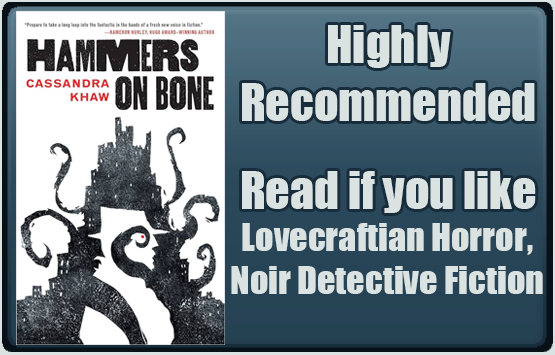
Hammers on Bone by Cassandra Khaw

Hammers on Bone by Cassandra Khaw

Formats: Print, digital

Publisher: Tor

Genre: Body Horror, Eldritch, Monster, Occult, Psychological Horror, Sci-Fi Horror

Audience: Young Adult

Diversity: Queer character (Gay woman), POC characters (Black, Creole woman, unknown POC character), Bisexual author, Malaysian author

Takes Place in: London

Content Warnings (Highlight to view): Alcohol Abuse, Body-Shaming, Bullying, Child Abuse, Child Endangerment, Death, Gore, Pedophilia, Physical Abuse, Racism, Rape/Sexual Assault, Sexism, Sexual Abuse, Slurs, Slut-Shaming, Verbal/Emotional Abuse, Violence

Blurb

John Persons is a private investigator with a distasteful job from an unlikely client. He’s been hired by a ten-year-old to kill the kid’s stepdad, McKinsey. The man in question is abusive, abrasive, and abominable.

He’s also a monster, which makes Persons the perfect thing to hunt him. Over the course of his ancient, arcane existence, he’s hunted gods and demons, and broken them in his teeth.


As Persons investigates the horrible McKinsey, he realizes that he carries something far darker. He’s infected with an alien presence, and he’s spreading that monstrosity far and wide. Luckily Persons is no stranger to the occult, being an ancient and magical intelligence himself. The question is whether the private dick can take down the abusive stepdad without releasing the holds on his own horrifying potential.

During one of my late-night explorations of the internet (when I should have been sleeping but was instead googling all the random thoughts that pop into my head at 2 AM) I stumbled upon the work of Malaysian author Cassandra Khaw, a nerdy, queer woman who writes video games and short horror stories. Instantly intrigued, I purchased one of her novellas, Hammers on Bone, and I have to say, I fell absolutely, head-over-heels in love with Khaw’s writing. Her beautifully crafted stories are full of wonderful words like “penumbra” and “ululation” (one of my favorite Latin derived words), deliciously grotesque descriptions, and unique characters. English is Khaw’s third language, yet she uses it with a mastery that puts even native English speakers to shame. Her writing has a lot of range, too. These Deathless Bones is a feminist fairy tale about a witch getting sweet revenge on her wicked stepson. Rupert Wong, Cannibal Chef is a comedic splatterpunk series, as hilarious as it is gory, about the misadventures of the titular chef who prepares decadent meals of human flesh for gods and ghouls and gets wrapped up in international deity politics. Khaw has even dabbled in chick-lit (while also managing to poke fun at the more problematic elements of the genre) with her book, Bearly a Lady, about a bisexual, plus size wear-bear that works at a faerie-run fashion magazine. Then there’s her Persona Non Grata series. Much like Victor LaValle’s The Ballad of Black Tom, Khaw’s novellas take place in a Lovecraft inspired universe, but she flips the famously racist HP the bird by putting people of color at the forefront and using his creations to address social issues like racism, poverty, and abuse. Both stories feature the private investigator, John Persons, one of the most interesting characters I’ve come across in horror fiction. It’s the first of Person’s two novellas, Hammers on Bone, that I’ll be reviewing here.

Persons speaks and acts like the “hardboiled detective” characters from 1930s pulp magazines, complete with dated American vernacular and machismo, despite living in modern day London. This makes John seem incredibly out of place and occasionally downright ridiculous, like when he describes a little boy running into his arms for a hug as “crashing into me like a Russian gangster’s scarred-over fist.” When he’s not working as a PI, John spends his time saving the world from destruction by Star Spawn and Elder-Things. He’s adept at using magic, smokes cigarettes to dull his inhumanly strong sense of smell, enjoys the cold, and can pick up memories from objects and people through physical contact. He also happens to be a Dead One (though not one of the Great Old Ones, Persons is quick to explain), an otherworldly creature whose true, terrifying form comfortably possesses resides in a human body which he shares with the ghost of its previous inhabitant. I bet that’s why he has the most unimaginative, made-up sounding name ever; it was probably the first thing that popped into his head when he started inhabiting his meat suit.


Persons and his human body have an interesting relationship, more commensal than parasitic. While other Star-Spawn and Elder Things simply take what they want, invading human flesh like a disease and eventually destroying their hosts, Persons tries to minimize damage to his meat suit (he may be immortal and resilient, but his human form still suffers from wear and tear, and he feels pain when it’s damaged), and gives his phantasmal passenger a say in certain decisions. Even though he’s in the driver’s seat, John’s body will still react to its original owner’s thoughts and feelings, independent of him. In one scene, the meat suit becomes aroused by the proximity of a beautiful woman. Persons is aware of “his” body’s quickening pulse and rising temperature (among “other” rising things, heh), and states that the sensation is “not unpleasant”, but he describes the physical reaction with the detached interest of scientist observing a cell under a microscope. He is, after all, still an alien being.

Not much is known about the man whose skin he now wears, except that he’s an older person of color who lived during the interwar period, and gave John his body willingly after being asked. The whole Philip Marlowe / Sam Spade persona Persons adopts to appear more human is as an homage to his meat suit’s original owner. I guess it’s kind of sweet that he does that, in a very weird way, but unfortunately his stubborn refusal to update his dated vocabulary and attitudes, or venture into any genre that isn’t detective noir makes John come off as pretty sexist. He refers to women as “skirts,” “broads,” “dames,” and “birds”, and divides them into victims and femme fatales. This attitude backfires on him spectacularly since, of course, the real world isn’t like his detective novels, and John keeps misjudging the women he interacts with.

What sets the monstrous PI apart from his fellow cosmic entities, besides seeking consent from his body’s original owner, is his fondness for humanity, his dedication to following the law and maintaining order, and his desire for earth to remain more or less the way it is, i.e. not a barren hell-scape inhabited by Eldritch abominations.  Most of the monsters he fights are chaotic evil, infecting and destroying whenever they go, but John Persons is closer to lawful neutral, occasionally leaning towards good. He’s not exactly heroic since, in his words, “Good karma don’t pay the bills,” but Persons does have a strong set of morals. As previously mentioned he’s big on consent and describes the act of possessing a willing host’s body as “better than anything else I’d ever experienced” and feels incredibly guilty when he accidentally reads a woman’s mind after touching her arm. When she becomes understandably angry at the violation, screaming “You don’t take what you’re not given!” John doesn’t try to minimize, excuse, or defend his behavior (even though the intrusion was an accident), he simply apologizes, mortified by what he’s done. He can even show compassion at times, but how much of his altruistic behavior is due to the remaining sentience of his body’s former inhabitant acting as his ghostly conscience is unclear.

It’s his spectral companion who convinces John to take the case of a young boy named Abel, who wants Persons to kill his abusive stepfather. While initially hesitant about committing murder, John is convinced once the boy reveals that his stepfather is a monster, both literally and figuratively, and both Abel and his little brother’s lives are in danger. He might not be a hero, but Persons does seem to genuinely want to help the two boys, even if he claims it’s just because they’re clients. It may be simply because he wants the ghost with whom he cohabitates to stop nagging him, as John is usually pretty indifferent to human suffering on his own, or perhaps it’s because an Old One is involved, and he’d really prefer it not destroy the world. Regardless of the reason, he agrees to help.

In his eagerness to play white knight (or his meat suit’s eagerness) Persons often fails to realize that the “helpless victims” he seeks to rescue are often perfectly able to take care of themselves, like the waitress whose mind he reads. He’s also quick to victim blame the boys’ mother for not leaving, clearly unable to understand the psychological element of abuse or how dangerous it is for a person to try and leave an abusive partner, just making her feel worse than she already does. John struggles when it comes to comforting victims or dealing with their emotions. He claims his lack of skill when it comes to words and feelings is due to being a “man” (or at least inhabiting the body of one), though it’s just as likely it’s because he’s an eldritch abomination, and he’s just been using sexism to avoid learning the nuances of human emotion. While Persons is better at managing his desire to destroy and devour than the other monsters and is able to maintain a detached control over his meat suit’s emotions and baser instincts, he’s not immune to the effects of his human body’s testosterone or his own toxic misogyny. When the PI is feeling especially aggressive his true form starts to writhe beneath his human skin, straining to break free from his epidermis and rip apart the object of his ire. Even his thoughts start to degrade into a sort of violent, inhuman, babble when he gets too riled up. John actually has to fight to keep control of his monstrous body when he first encounters the abusive stepfather, he’s so desperate to disembowel and devour him. His true nature is a stark contrast to the cool and logical detective persona Persons has adopted. I won’t lie, I did enjoy seeing him act all protective of Abel and his little brother. There’s something amusing about what is essentially an immortal abomination that can effortlessly rip a grown man in two, doing something as mundane and sweet as escorting his young client home while carrying the child’s kid brother on his hip. It’s also heartbreaking when you realize the two boys are safer with a literal monster than their step dad, McKinsey (even before he was possessed).

The step-father is a real piece or work, and throughout the story I desperately wanted John to give in to his monstrous instincts and tear the bastard apart, limb by limb. But being a man/monster of the law, Persons won’t do much more than saber-rattle until he has solid proof of McKinsey’s wrong doing, much to Abel’s frustration. The kid would much rather the PI solve things with his fists (teeth, tentacles, claws, and other miscellaneous alien appendages) than waste time talking to witnesses, and I’d certainly be annoyed too if the monster I hired to kill someone wasted time playing detective instead of just eating his target. But Persons did warn Abel that he’s not a killer for hire and wants to do things “by the book”. Unfortunately, like most real monsters, McKinsey excels at hiding his wrong doing and camouflaging his true nature which makes it difficult for John to find a solid lead. People like McKinsey and describe him as a “loving family-man”.  Those who haven’t been completely conned by his act either don’t care he’s a monster (like his boss) or are too terrified to do anything (like his fiancée). None of the adults in the boys’ lives are fulfilling their duty of protecting two vulnerable children. This is where the real horror lies in Khaw’s story– not the eldritch abominations like Shub-Niggurath, or the threats of world destruction, but the all too painful reminder that we so often fail abuse victims. Khaw is tasteful when describing what the two boys go through, and it isn’t played for titillation or described in explicit detail. She only reveals enough to lets us know the two boys in the story are going through something no child should ever have to suffer. I also liked her choice to make the victims male. Far too often male survivors are overlooked, erased, or mocked because society tells us males can’t be victims, even though the CDC states that “More than 1 in 4 men in the United States have experienced rape, physical violence, and/or stalking by an intimate partner in their lifetime” and a study published in the American Journal of Preventive Medicine found that 1 in 6 boys will be sexually abused before the age of 18. As depressing as these statistics are, the situation isn’t completely hopeless, because monsters aren’t invulnerable, even the kind that have been infected by Elder Things. As Person muses towards the end of the book “I don’t remember who said it, but there’s an author out there who once wrote that we don’t need to kill our children’s monsters. Instead, what we need to do is show them that they can be killed.” For those of us who can’t go out an hire a eldritch abomination PI, at least we have RAINN (Rape, Abuse & Incest National Network) and their recommended resources for cases of abuse and sexual assault.

Claustrophilia by Ezra Blake

Claustrophilia by Ezra Blake

Formats: digital

Publisher: Smashwords

Genre: Blood & Guts (Splatterpunk), Body Horror, Killer/Slasher, Psychological Horror, Romance

Audience: Adult/Mature

Diversity: Gay main characters and author, trans male author

Takes Place in: US and Italy

Content Warnings (Highlight to view): Alcohol Abuse, Amputation, Cannibalism, Death, Drug Use/Abuse, Forced Captivity, Gaslighting, Gore, Illness, Kidnapping, Medical Torture/Abuse, Medical Procedures, Mental Illness, Necrophilia, Mentions of Pedophilia, Physical Abuse, Rape/Sexual Assault, Self-Harm, Sexual Abuse, Slurs, Slut-Shaming, Suicide, Torture, Verbal/Emotional Abuse, Violence

Blurb

Christopher Dour’s life was terrible before he was kidnapped. He spent too much time studying the Providence Butcher’s victims and not enough talking to living people. He was erotically obsessed with the idea of murdering Dr. Ivan Skinner, his medical school advisor. I was only a matter of time before he killed someone, possibly himself–but the Providence Butcher had other ideas. After all, the first time should be special, and Chris was going about it all wrong. Now those life-or-death decisions are out of his hands. He’s breaking. What’s worse, Chris has a lot in common with the Butcher. Nobody else has truly cared about him before. When he’s not being tortured, he’s being cherished. If Stockholm syndrome feels like love, then in practice, what’s the difference? Chris can’t maintain his dignity, but can still cling to his shattered moral compass. Or he can let go, submit, and become the unspeakable. At least then he wouldn’t be alone. Prepare to become an accomplice.

The very first page of Claustrophilia gave me a panic attack, and when I finished it, I felt like someone had put my brain in a blender. I swore I’d never force myself to experience something so sick, sadistic, and stressful again.

Well, that promise lasted all of four months and then I reread it. Why would I expose to that filth again? Because I love this book so goddamn much. The writing is amazing. Like, made-a-deal-with-a-dark-force-to-obtain-supernatural-talent amazing (Blake is also an incredibly talented artist, which is just all kinds of unfair). I read the entire thing in one traumatic sitting even though it was 2 AM and I really needed to take a break. It’s sooooooo good, but soooooo fucked up and I’m not sure I should even be admitting to reading it. Hell, just purchasing Claustrophilia will probably put you on some kind of FBI watch-list. Although I’m pretty sure I’m already on there, thanks to my Google search history. Disclaimer: If you are a law enforcement agent I had totally legitimate, non-creepy reasons to look up “at-home lobotomy instructions,” “how to dissolve a body” and “where to buy cursed dolls” even if I can’t think of any right now. Also, some weirdo stole my credit card and bought Claustrophilia. And reviewed it. And then read a bunch of erotic, gay Deep Space Nine fan fiction followed by two-hours of zit-popping videos on Youtube. Someone who wasn’t me.

For the sake of your sanity, I’m going to warn you right now, if you are someone with any kind of triggers, stop right here. I’m serious. Claustrophilia is chock-full of extremely explicit torture (medical, physical, sexual, and psychological), cannibalism, gore, and a super fucked up, abusive relationship. It’s a good book, but it is splatterpunk. So, if that’s not your thing, stay far, far away from this book and most likely this review. But if you have a strong stomach and can handle a scene where a guy fucks another guy’s brain (literally) I’d definitely recommend it. Will/Hannibal shippers, fans of Rotten.com’s Rotten Library (R.I.P.), and extreme horror enthusiasts will all enjoy Claustrophilia.

Admittedly I’m not usually a fan of splatterpunk. I used to enjoy extreme horror, back in my early twenties when I felt like I needed to prove what a badass horror fan I was, but the turtle death scene in Cannibal Holocaust put an end to that phase. I still like fucked up shit, but visceral, graphic violence just isn’t my cup of tea. Plus, I don’t find it particularly scary. I work in a hospital, so I see guts, amputated limbs, and dead bodies all the time; that stuff just doesn’t gross me out. And unfortunately, a lot of splatterpunk also seems to equate to sexualized violence against women handled in the worst way. possible *cough*Richard Laymon*cough* But Blake manages to create a graphic, gory story without the sexism. Most torture porn comes with a heavy dose of misogyny, and with all the real-world examples of abuse, torture, and murder of women by men, it’s kind of hard to enjoy it in fiction. But an erotic exploitation novel between two men doesn’t come with the same baggage (although, obviously, abuse can and does happen in same sex relationships and I’m not trying to minimize that). And cannibal doctor Ivan Skinner is pretty equal opportunity when it comes to his victims so there are no sexist vibes.

Dr. Ivan Skinner is a pretentious asshole sophisticated gentleman who loves fine art, opera, and gourmet food (usually people). He plans on running off to Italy, loves torture and mind games, and is an overall terrible friend. He’s basically a gay Hannibal Lecter. So essentially Hannibal from the Bryan Fuller TV show, but even more sadistic. Chris is an older medical student, struggling with school, work, and a general lack of direction. He falls in love with Ivan, who then tortures Chris mentally, physically, and sexually until his student becomes a murderous psychopath. And don’t worry, Blake doesn’t try to romanticize or glamorize their abusive relationship. This isn’t Twilight or 50 Shades of Gray. He makes clear from the get-go that everything between them is twisted, perverted, and ugly, even if Ivan and Chris sometimes mistake it for something else. While the torture does have shades of BDSM I’d hesitate to call it such because it’s non-consensual, and BDSM is all about explicit consent. It’s utterly fascinating to watch, and yeah, some of the sex scenes are hot, but in the end it’s a repulsive and deeply disturbing relationship where Ivan intentionally traumatizes and brainwashes Chris until he’s entirely dependent on the older man. Not that Ivan would have had to try very hard to push Chris over the edge. The young medical student is already emotionally unstable, possibly a budding serial killer, and being around cadavers all day is sending him spiraling towards a nervous breakdown.

I would just like to state, for the record, if a pathology assistant (which Chris is acting as) had a nervous breakdown it’s far more likely to be the result of dealing with the giant piles of paperwork, frequently missing slides, the dictation software breaking down again, or one of the endless phone calls from physicians who want to know if the results they only just requested are done yet like you’re supposed to drop everything else to focus on them and their nonsense and somehow break the laws of spacetime (but ~heaven forbid~ you point out that you could get to their stuff a lot faster if they stopped calling every five fucking minutes because then you’re the asshole). Look, all I’m saying is if I found out someone went on a killing spree because they got yet another phone call asking why a pathology report wasn’t ready, I’d get it. But working with dead bodies is not that stressful. They just sort of chill and don’t bother you. If you’re stressed out by the dead, you probably don’t belong in medicine.

Anyway, it’s absolutely fascinating to witness Chris’ deteriorating mental state. It’s incredibly stressful, but also offers a sort of sadistic pleasure as you wonder how much more he can stand before he snaps completely. While there is a lot of gore, it’s not the scary part of the story. It’s the suspense and psychological horror that’s terrifying. You keep wondering, “How much worse can it get?” And then it gets worse. So. Much. Worse. I think the last time a story affected me this viscerally was Eric Larocca’s Things Have Gotten Worse Since We Last Spoke. And as a horror reviewer, I’m not easily phased.

I Feed Her to the Beast and the Beast Is Me by Jamison Shea

I Feed Her to the Beast and the Beast Is Me by Jamison Shea

Formats: Print, audio, digital

Publisher: Henry Holt and Co.

Genre: Dark Fantasy, Mystery, Occult, Thriller

Audience: Young Adult

Diversity: Black main character and author, bisexual main character

Takes Place in: Paris, France

Content Warnings (Highlight to view): Body Shaming, Bullying, Death, Racism, Self Harm, Verbal/Emotional Abuse

Blurb

There will be blood.

Ace of Spades meets House of Hollow in this villain origin story.

Laure Mesny is a perfectionist with an axe to grind. Despite being constantly overlooked in the elite and cutthroat world of the Parisian ballet, she will do anything to prove that a Black girl can take center stage. To level the playing field, Laure ventures deep into the depths of the Catacombs and strikes a deal with a pulsating river of blood.

The primordial power Laure gains promises influence and adoration, everything she’s dreamed of and worked toward. With retribution on her mind, she surpasses her bitter and privileged peers, leaving broken bodies behind her on her climb to stardom.

But even as undeniable as she is, Laure is not the only monster around. And her vicious desires make her a perfect target for slaughter. As she descends into madness and the mystifying underworld beneath her, she is faced with the ultimate choice: continue to break herself for scraps of validation or succumb to the darkness that wants her exactly as she is—monstrous heart and all. That is, if the god-killer doesn’t catch her first.

From debut author Jamison Shea comes I Feed Her to the Beast and the Beast Is Me, a slow-burn horror that lifts a veil on the institutions that profit on exclusion and the toll of giving everything to a world that will never love you back.

I received this product for free in return for providing an honest and unbiased review. I received no other compensation. I am disclosing this in accordance with the Federal Trade Commission’s 16 CFR, Part 255: Guides Concerning the Use of Endorsements and Testimonials in Advertising.

I went into I Feed Her to the Beast and the Beast is Me expecting Laure to be an unlikeable female protagonist (something I actually enjoy in a story), but I was not prepared for just how relatable she was. If I ever become a supervillain, my origin story will be me finally getting fed up with all the bigotry and microaggressions I have to deal with every day and deciding to get even, rather than continuing to either educate or ignore the people hurting me. And that’s exactly what Laure does. Can you blame her? Every other ballerina in her company is rich and white, with powerful parents just dripping with privilege. The ballet is cutthroat, with ballerinas actively trying to sabotage each other (dancers often finds glass and tacks in their ballet shoes) and praying for one another’s downfall, and Laure is at a distinct disadvantage. Even though she works the hardest and performs the best of all of them, she’ll always be the Black girl who has to steal to pay for her tights. So, she cheats to level the playing field. Once she does, her talent and hard work is immediately rewarded. And honestly? It’s cathartic to watch Laure stoop to the level of the other ballerinas and their awful parents. It is SO exhausting to always have to be the bigger person in the face of abuse. I may agree with Michelle Obama’s “When they go low, we go high,” but I still don’t like having to “go high” when I would rather be a petty asshole. So, in a purely fictional world? It’s wonderfully satisfying to watch a Black woman choose the role of the villain and get even with all those rich white girls.

Ballet is still one of the least diverse performing arts, fraught with racism that ranges from subtle to overt. This is especially true in Europe. In her book Turning Pointe, Chloe Angyal discusses ballet’s racism problem. She describes an encounter with a racist dance mom and her implied message to her daughter: “[Black dancers are] not really good, but they are allowed to be here. In this space that is rightfully yours, in this art form that is rightfully yours. They’re never as good as the white girls, a sweeping generalization that grants no individuality, no humanity, to any nonwhite dancer. They’re all the same, and they never deserve to be here. But don’t worry. Your excellence is a given. You belong here, while their presence is conditional or even ill-gotten.” I think this quote sums up Laure’s struggles beautifully. The only difference is that these are struggles faced by real dancers.

Even something as simple as buying pointe shoes is no easy task for Black dancers. Most dance garments are traditionally “European pink,” and don’t match darker skin tones. Black ballerinas often have to pancake their shoes in dark foundation to match their skin tone and dye their tutus and tights. It’s only recently that brands like Capezio, Freed of London, and Bloch have offered shoes in darker skin tones. In the book Laure must purchase her own ballet shoes and tights because the ballet will only pay for pink ones. Black bodies are also discriminated against in ballet. In an interview with Sheila Rohan the Black ballet dancer described racism in ballet. “Racism in the ballet arts… meant people would make remarks about the Black ballerinas’ bodies — such as their chests being ‘too busty’ or their thighs being ‘too thick.’” A Black dancer in Berlin was told to lighten her skin with white makeup in order to play a song in Swan Lake. Laure straightens and gels her curly hair into place so she won’t stand out from the other dancers, but is still told she’s too “exotic” for a French ballet by a drunk patron. The controversial ballet La Bayadère was performed in Blackface by Russian dancers (white dancers have also worn stereotypical clothing and makeup to portray Roma and Chinese characters). The same ballet put on by Laure’s company in which she plays a shade.

After being abandoned by both parents, Laure’s only source of support is her best (and only) friend, Coralie, who is… not great. She’s kind and supportive of Laure, yes, but she’s also a subpar ballerina who just assumes she’ll get a spot in Paris’ prestigious ballet due to her famous mother. She’s essentially an entitled slacker and just as oblivious to her privilege as the other rich white girls. Coralie is also a snob, turning her nose up at anything that doesn’t come with a high price tag, which grates on permanently broke Laure’s nerves. Coralie really does seem to love her best friend, but their relationship comes with a power imbalance. So, she does not take it well when that balance of power shifts and Laure starts beating her out for roles. Because she has no one else, Laure is terrified of losing her only friend (as difficult as she can be), that is until she meets the étoile of the ballet, Josephine. Josephine gives her friendship freely without expecting anything in return, and treats Laure as an equal. She introduces Laure to her friends and shows her how she too can become an étoile. Slowly, Laure starts to see what a true friendship is like and begins to pull away from Coralie, although she still refuses to drop her completely and makes excuses for the wealthy girl’s bad behavior. I liked that while Laure does pursue a romance with a man later in the book, the story is mostly focused on her female friendships. It’s also a nice change of pace to see a toxic platonic, non-familial relationship explored. I don’t think enough people talk about how friendships can be abusive and how hard “breaking up” with a friend can be.

Another interesting theme in I Feed Her to the Beast and the Beast is Me is the idea of “perfection.” As a burned-out former “gifted kid” I know what it’s like to be expected to be perfect, then destroy yourself trying to do the impossible and ultimately have a mental breakdown when you realize perfection can never be achieved, and therefore that makes you a “failure.” The ballet expects Laure and her peers to be no less than perfect, and anyone who doesn’t make the cut is thrown aside and forgotten. While Coralie can get by half-assing it because of her mother, Laure must be the best there is to even think of if she wants to compete with the others. And it means giving up everything. This kind of perfectionism is extremely damaging to your mental health. Laure also believes that acceptance and respect from the others is entirely dependent on being perfect, not realizing she deserves respect regardless of her performance.

I Feed Her to the Beast and the Beast is Me is one of those books that I absolutely devoured. It held my attention throughout the story (no small feat when you have ADHD), save for a short part in the middle that felt like it was dragging. But other than that small criticism I can’t think of anything negative to say about this book. It’s a unique setting for a horror story, and a fresh spin on a Faustian bargain narrative. 

Frost Bite by Angela Sylvaine

Frost Bite by Angela Sylvaine

Formats: Print, audio, digital

Publisher: Dark Matter INK

Genre: Sci-Fi Horror

Audience: Young Adult

Diversity: Bisexual main character

Takes Place in: North Dakota, USA

Content Warnings (Highlight to view): Alcohol Abuse, Animal Death, Bullying, Child Abuse, Child Endangerment, Death, Drug Use/Abuse, Forced Captivity, Gaslighting, Gore, Homophobia, Kidnapping, Physical Abuse, Police Harassment, Verbal/Emotional Abuse, Violence

Blurb

Remember the ’90s? Well…the town of Demise, North Dakota doesn’t, and they’re living in the year 1997. That’s because an alien worm hitched a ride on a comet, crash landed in the town’s trailer park, and is now infecting animals with a memory-loss-inducing bite–and right before Christmas! Now it’s up to nineteen-year-old Realene and her best friend Nate to stop the spread and defeat the worms before the entire town loses its mind. The only things standing in the way are their troubled pasts, a doomsday cult, and an army of infected prairie dogs.

I received this product for free in return for providing an honest and unbiased review. I received no other compensation. I am disclosing this in accordance with the Federal Trade Commission’s 16 CFR, Part 255: Guides Concerning the Use of Endorsements and Testimonials in Advertising.

All Realene wants is to get out of Demise, North Dakota and become a doctor. Instead, she’s stuck in a dead-end town she hates with a dead dad and a mother who is slowly succumbing to Alzheimer’s who she has to care for. Realene‘s best friend, Nate, is in a similarly tough spot. His father is an abusive asshole who threw him out as soon as he turned 18 and continues to terrorize Nate’s mother. Because he got busted for selling weed, Nate is now ineligible for finical aid, which he can’t afford college without. It seems both will be trapped in Demise for the rest of their lives.  

And then the meteor strikes. Realene is first on the scene and witnesses the meteorite crack open and leak out a black sludge, which is quickly absorbed into the ground. She contacts the police about the meteorite, but chooses to leave out the part about the black sludge. The next day the strike site is a zoo, with police, military, scientists, newscasters, and locals crawling all over the scene. Most of the town views the meteorite as a reason to celebrate, even going so far as to have special shooting star sales at all the local stores, but the local religious zealot, reverend Zebadiah, sees it as a sign of the end times. And that’s when the prairie dogs start to attack.

Despite being a comedy about alien parasites, the book has some pretty depressing themes. As much as Realene loves her mother, she resents being stuck taking care of her and how it’s holding her back from her dreams. Does she give up her dreams and possibly her future to care for her mother, or does she abandon her best friend and the one family member she has left to try and make life better for herself? What you think Realene should do probably depends where you fall on the scale of individualism to collectivism and how you feel about filial piety. Regardless of the “right” answer it’s a complicated and crappy position to be in and whatever decision she make is going to leave her hurting.

Then there’s Nate’s situation with his abusive dad. I got incredibly frustrated with Nate’s mom and how she would choose her abusive husband over her own son. I understand intellectually that she is a victim. She was physically and emotionally abused first by her husband, and then by reverend Zebadiah. There are a myriad of reasons she might stay, and it’s likely her husband would have killed her if she tried to leave anyway. And I know that Nate’s father is the one at fault, not his mother, who was put in an impossible situation. I’m not upset that she couldn’t protect Nate when she couldn’t even protect herself, that was beyond her control. But the fact that, when given the opportunity, she chooses first her abusive husband and then her abusive reverend over her own son feels like a betrayal. But like Realene’s situation, the situation for Nate’s mother is complicated and there are no easy answers.

This is a book about killer prairie dogs, family, and a doomsday cult that comes with its own ‘90s playlist. And it works so well. The story manages to balance tragedy, horror, humor, and some genuinely heart-warming moments perfectly and in a way that doesn’t feel like you’re jumping from genre to genre. There’s also an orange cat named Pumpkin and I love him (don’t worry, nothing bad happens to him). Frostbite is a fun, heartfelt romp full of suspense and horror movie references. Definitely check it out, unless you love prairie dogs.

The Spirit Bares Its Teeth by Andrew Joseph White

The Spirit Bares Its Teeth by Andrew Joseph White

Formats: Print, audio, digital

Publisher:Peachtree Teen

Genre: Blood & Guts, Body Horror, Ghosts/Haunting, Mystery, Gothic

Audience: Young Adult

Diversity: Neurodiversity (Autism), transgender characters, queer character

Takes Place in: LA, California

Content Warnings (Highlight to view): Abelism, Animal Death, Bullying, Child Abuse, Child Death, Child Endangerment, Death, Forced Captivity, Gaslighting, Gore, Homophobia, Kidnapping, Medical Torture/Abuse, Medical Procedures, Miscarriage, Oppression, Pedophilia, Physical Abuse, Rape/Sexual Assault, Self-Harm, Sexism, Slurs, Slut-Shaming, Torture, Transphobia, Verbal/Emotional Abuse, Victim Blaming, Violence

Blurb

Mors vincit omnia. Death conquers all.

London, 1883. The Veil between the living and dead has thinned. Violet-eyed mediums commune with spirits under the watchful eye of the Royal Speaker Society, and sixteen-year-old Silas Bell would rather rip out his violet eyes than become an obedient Speaker wife. According to Mother, he’ll be married by the end of the year. It doesn’t matter that he’s needed a decade of tutors to hide his autism; that he practices surgery on slaughtered pigs; that he is a boy, not the girl the world insists on seeing.

After a failed attempt to escape an arranged marriage, Silas is diagnosed with Veil sickness—a mysterious disease sending violet-eyed women into madness—and shipped away to Braxton’s Finishing School and Sanitorium. The facility is cold, the instructors merciless, and the students either bloom into eligible wives or disappear. When the ghosts of missing students start begging Silas for help, he decides to reach into Braxton’s innards and expose its guts to the world—if the school doesn’t break him first.

Featuring an autistic trans protagonist in a historical setting, Andrew Joseph White’s much-anticipated sophomore novel does not back down from exposing the violence of the patriarchy and the harm inflicted on trans youth who are forced into conformity.

I received this product for free in return for providing an honest and unbiased review. I received no other compensation. I am disclosing this in accordance with the Federal Trade Commission’s 16 CFR, Part 255: Guides Concerning the Use of Endorsements and Testimonials in Advertising.

Silas is an autistic trans boy living in Victorian London who wants nothing more than to be a surgeon like his brother, George, and his idol James Barry. Unfortunately for Silas, the world still sees him as a young girl with violet eyes.

In White’s alternative history people born with violet eyes are Speakers, those who can open the Veil that separates the living and dead to communicate with ghosts. But only violet-eyed men are permitted to be mediums. It is believed that women who tamper with the Veil will become unstable and a threat to themselves and others. Veil sickness is said to be the result of violet-eyed women coming into contact with the Veil and is blamed for a wide range of symptoms from promiscuity to anger, but is really just the result of women who don’t obediently follow social norms. Thus, England has made it strictly illegal for women to engage in spirit work. After Silas’ failed attempt to run away and live as a man, he is diagnosed with Veil sickness and carted off to Braxton’s Finishing School and Sanitorium to be transformed into an obedient wife. Braxton’s is your typical gothic school filled with sad waifs and dangerous secrets, namely that girls keep disappearing. The headmaster is a creep and his methods for curing young girls are abusive. Despite the danger, Silas is determined to get to the bottom of the mysterious disappearances and find justice for the missing girls.

Violet-eyed women are highly valued as wives who can produce violet-eyed sons and are in high demand among the elite. Silas is no different, and his parents are eager to marry him off to any man with money. If being made to live as a girl weren’t bad enough, the idea of being forced to bear children is even more horrific to Silas. As someone who struggles with Tokophobia myself, I found White’s descriptions of forced pregnancy to be a terrifying and especially disturbing form of body horror. Because of Silas’ obsession with medicine, the entire book is filled with medical body horror. There are detailed descriptions of injuries and surgeries, medical torture, and an at-home c-section/abortion. Personally, I loved all the grossness and the detailed descriptions of anatomy and medical procedures. But The Spirit Bares its Teeth is most definitely not for the squeamish or easily grossed-out. I appreciated that in the afterword White made a point of mentioning that in the real world, it was usually racial minorities who were the subject of medical experimentation (rather than wealthy White women), and then recommended the books Medical Apartheid by Harriet A. Washington and Medical Bondage by Deirdre Cooper Owens for readers to learn more.

I was also happy to see an autistic character written by an autistic author. Stories about Autistic individuals often are told by neurotypical people who characterize autism as “tragic” or as an illness that needs to be cured. In The Spirit Bares its Teeth, neurodiversity is humanized and we see how harmful a lack of acceptance and understanding of autism is. Silas is forced to mask by society, and we see how difficult and harmful masking is to him. He is taught by his tutors to ignore his own needs in favor of acting the way others want. They reinforce the idea that acting “normal” (i.e. neurotypical) is the only way anyone will tolerate him. Silas’ tutors use methods similar to the highly controversial Applied Behavior Analysis (ABA) to force him to behave in a manner they deem appropriate. He is not allowed to flap his hands, pace or cover his ears at loud noises, and is forced into uncomfortable clothing that hurts his skin and to eat food that makes him sick. He is mocked for taking things literally and punished if he can’t sit still and keep quiet. It’s horrible and heartbreaking.

Although I’m not autistic, I do have Attention Deficit Disorder (ADD), a condition which has many overlapping symptoms with autism, including being easily overstimulated by sensory input. I have texture issues and White’s description of the uncomfortable clothing Silas is forced into made my skin itch in sympathy. It sounded like pure hell, and poor Silas can’t even distract himself with stimming so he just has to sit there and endure it. After meeting a non-verbal indentured servant whose autistic traits are much more noticeable, he also acknowledges that his ability to mask gains him certain privileges as he can “pass” as neurotypical (even though he should never have to pass in the first place and doing so is extremely harmful to his wellbeing).

In addition to its positive autism representation, White also does an excellent job portraying the struggles of being a trans person forced to live as their assigned gender. Interestingly, this is the first book with a transgender main character I’ve read where said character isn’t fully out or living as their true gender. Part of the horror of the story is that Silas can’t transition as he’s in an unsupportive and abusive environment. I also found it interesting that Silas is both trans and autistic as there’s an overlap between autism and gender identity/diversity.

The Spirit Bares its Teeth is a suspenseful and deeply disturbing gothic horror story about misogyny, ableism, and how society tries and controls women. I was absolutely glued to this story and could not put it down, no easy feat when my ADD demands constant distraction. Each revelation was more horrifying than the last and by the end I was terrified of what secrets Silas would uncover next. 

The Haunting of Alejandra by V. Castro

The Haunting of Alejandra by V. Castro

Formats: Print, audio, digital

Publisher: Penguin Random House

Genre: Body Horror, Demon, Ghosts/Haunting

Audience: Adult/Mature

Diversity: Chicana characters and author, bisexual main character

Takes Place in: Philadelphia, PA

Content Warnings (Highlight to view): Child Abuse, Child Death, Child Endangerment, Childbirth, Death, Forced Captivity, Gaslighting, Gore, Illness, Miscarriage, Racism, Rape/Sexual Assault, Self-Harm, Suicide, Verbal/Emotional Abuse, Violence, Xenophobia 

Blurb

Alejandra no longer knows who she is. To her husband, she is a wife, and to her children, a mother. To her own adoptive mother, she is a daughter. But they cannot see who Alejandra has become: a woman struggling with a darkness that threatens to consume her.

When Alejandra visits a therapist, she begins exploring her family’s history, starting with the biological mother she never knew. As she goes deeper into the lives of the women in her family, she learns that heartbreak and tragedy are not the only things she has in common with her ancestors.

Because the crying woman was with them, too. She is La Llorona, the vengeful and murderous mother of Mexican legend. And she will not leave until Alejandra follows her mother, her grandmother, and all the women who came before her into the darkness.

But Alejandra has inherited more than just pain. She has inherited the strength and the courage of her foremothers—and she will have to summon everything they have given her to banish La Llorona forever.

The Haunting of Alejandra is about the horrors of being a mother, wife, and woman, and the sacrifices that come with it.

We first meet Alejandra when she’s hiding from her family in the shower, crying and feeling overwhelmed by their many demands. Her husband Matthew is unsupportive and as needy and demanding as her three children. On the rare occasions when Alejandra asks him to help her with the housework, Matthew uses a combination of weaponized incompetence and guilt-tripping to get out of it. He’s made Alejandra move away from her support network in Texas, and the birth mother she’d just reconnected with. He’s also convinced her to quit her job and raise their children full time, meaning she no longer has money of her own. Matthew owns everything, Alejandra’s name isn’t even on the bills. He makes all the decisions for the family; where they live, what they buy, and even where they travel on vacation. If Alejandra’s needs don’t align with what he wants in the moment Matthew will make his displeasure known. She feels like a shadow, barely existing.

Alejandra’s situation will be familiar to many married women. Like most heterosexual couples she takes on the majority of the housework and mental load. Matthew provides little to no help with chores, child raising, or managing the household. This is, sadly, not uncommon as according to the BBC “When it comes to household responsibilities, women perform far more cognitive and emotional labour than men.” Alejandra has been trapped in this pattern since childhood, when, as the eldest daughter, her religious, adoptive parents forced her to do the bulk of the household chores and take care of her younger siblings. They also cut her off from her history and culture, refusing to let her read anything about Mexico that went against their fundamentalist Christian beliefs. Alejandra is surrounded by White people who don’t understand her. When she tries to tell her eldest daughter the story of La Llorona, something to connect her to her heritage, she’s scolded by her daughter’s teacher for telling her child scary stories.

Bar graph showing the roles of men and women in US society.

When Alejandra expresses dissatisfaction with her situation, her concerns aren’t taken seriously. Even when she admits to feeling suicidal she’s met with shame and “I’m sorry you feel that way” from her husband who frequently points out she has everything material she could ever want, so why should she be unhappy? Worse still, something that resembles la Llorona, the ghostly woman from Mexican folklore who drowned her two children, is haunting Alejandra, telling her she’s a terrible mother. Throughout the course of the story we learn that Alejandra is not the only mother the creature has haunted. Each of the women in Alejandra’s matrilineal line had their own struggles with motherhood and a lack of autonomy.  Miscarriage, feeling unworthy of love, carrying an unwanted child, forced marriage, teenage pregnancy, the list goes on. And each woman was haunted by the specter of la Llorona who fed off their pain and sorrow, resulting in generational trauma that goes back centuries.

Eventually Alejandra decides to take back the power her husband, parents, and the monster took from her by getting help. I really appreciated that unlike most fictional characters Alejandra actually has the self-awareness to go to therapy when she realizes how bad things have gotten. Even better, her therapist, Melanie, is competent, and culturally informed. She is a Chicana woman, like Alejandra, who practices both modern psychotherapy as a doctor and traditional medicine as a curandera. She believes Alejandra when the stressed mom tells her that she’s being stalked by some kind of monster and is able to advise her on how to protect herself from the evil sprit and cleanse her home. Melanie helps Alejandra reconnect to the cultural roots her adoptive parents sought to destroy, encouraging her to read up on this history of Chicana women and advising her to build an altar to her ancestors in her home. While we’ve all heard horror stories of bad therapists, I found it refreshing to see a therapist in fiction who’s actually good at her job and not a White man. Having had some incredibly helpful queer therapists myself I know the importance of having culturally competent care, and what a difference it makes when your provider isn’t basing their care on a White, heteronormative, Capitalist model. I loved Melanie, and I wish there were more doctors like her in the world.

Photo of Felicia Cocotzin Ruiz, a modern curandera. Photography by Laura Segall.

Alejandra also reaches out to her birth mother, who may not have been meant to raise a child but is more than ready to provide emotional support to her adult daughter. Melanie teaches her how to call upon the strength of her female ancestors who appear to her in her dreams. With all these strong women standing behind her Alejandra is able to find her own inner strength to stand up to both Matthew and her monster, as she fights to keep the generational curse from passing down to her own daughter. I really loved the theme of women supporting and healing other women. When Alejandra is finally able to ask for help without feeling guilty or like a burden the women in her life are there the minute she needs them. They believe her stories of a monster and are ready to offer their help in whatever for Alejandra needs it.

Overall The Haunting of Alejandra is an emotional and painful, but ultimately rewarding read about women, Mexican culture, and generational trauma. It’s a slow burn horror, and while I usually don’t have the patience for those I was so enraptured with the story that it felt like it flew by. While not a parent myself, I know women who are, and the book rang true of their more difficult experiences with motherhood like feeling overwhelmed and isolated. I’ve been following V. Castro’s books for a while now and I have to say, she just gets better and better with each piece she rights. It’s truly impressive and I can’t wait to read what she writes next.

8:59:29 by Polly Schattel

8:59:29 by Polly Schattel

Formats: Print, digital

Publisher: Trepidatio Publishing

Genre: Demon, Occult

Audience: Adult/Mature

Diversity: Trans author

Content Warnings (Highlight to view): Child Death, Death, Drug Use/Abuse, Gore

Blurb

When a disgruntled adjunct faculty teacher decides to get revenge on the head of her department, she begins a dark (and darkly comic) journey into the cracks between modern society and the secret depravity that lies underneath. She has to navigate the demons of technology, creativity, and Hell itself, but soon she must face the deepest, darkest horror of them all: her own personal failures.

I received this product for free in return for providing an honest and unbiased review. I received no other compensation. I am disclosing this in accordance with the Federal Trade Commission’s 16 CFR, Part 255: Guides Concerning the Use of Endorsements and Testimonials in Advertising.

“Film, of course, is traditionally shown at 24 frames per second, while video’s electronic fields are refreshed at 23.98, 29.97, or even 59.94 times a second… This microscopic slowdown of frames naturally causes a disparity between the measurement of real time and video time… To keep it playing at full speed, there’s a tiny blip in there—two frames every minute get eaten, dropped, overlooked.”

Hetta Salter teaches film studies for non-majors, and she hates it. She hates her low-paying adjunct professor job where she barely makes enough to scrape by, she hates her stultified students, and she especially hates the head of her department, Hensley. Hensley is the very definition of privilege. He’s a White, cishet male who comes from a wealthy background with a perfect family and a perfect home, completely unaware of how lucky he is.  To Hetta, Hensley represents everything that stands in the way of her happiness. If only he were gone she could get a better paying position, better students, a better apartment, and a better life. But then her best student, a townie named Tanner, gives her a way out. He sends her a dark web site called Voodoo Glam where Hetta discovers instructions on creating a video: a video that must filmed on a 1980s camcorder and last exactly 8 minutes, 59 seconds, and 29 frames. Whomever watches the video will be dragged to hell by the demon Andras, a great Marquis of Hell who sows discord among humans and is known to kill his summoners if they’re not extremely careful. What could possibly go wrong?

Hetta is not an entirely likeable character, but neither is she entirely unlikeable. She can be an insufferable film snob, but she’s also a woman from a low-income family who’s been beaten down by the system. Her anger is justified, but it’s also twisting her into a bitter person. At the same time, her anger has also made her sympathetic and willing to fight for those who are marginalized. Not that Hetta recognizes the drawbacks to being angry all the time. She is a villain protagonist who believes herself to be the hero fighting against an unjust world. She is as convinced of her own righteousness as she is of her genius. In short, Hetta is a fascinating character who is both repulsive and relatable. I found myself cheering for her one moment and horrified the next.

Schattel has a razor-sharp wit which she uses to poke fun at film snobs and critique the inequality inherent in academia. An adjunct professor earns between $20,000 and $25,000 annually, according to NPR. That’s less than I made working retail in college. For comparison, notoriously low-paid fast-food workers earn a mean income of $26,060 per year according the Bureau of Labor Statistics. But fast food doesn’t require an advanced degree, whereas being a professor does. Their income is so low that many adjunct professors are on some kind of public assistance. No wonder Hetta is pissed. She probably doesn’t even get benefits. Meanwhile adjunct professors like Hensley earn an annual salary starting at around $80,000 a year and can go as high as $174,000. But even tenured, Hetta would likely earn less than her male counterpart.

While Hetta is at least partially the butt of the joke (she assumes a horror film will be easy to make, ha!) Schattel, a filmmaker herself, also writes 8:59:29 as a love letter to filmmaking. Cleverly combing analog horror with more modern fears like the dark web and social media, Scahttel manages to make the whole “cursed video” plot feel new and unique instead of a Ringu rip-off. 8:59:29 is fun, twisted read perfect for film fans and anyone else who loves a good horror movie.

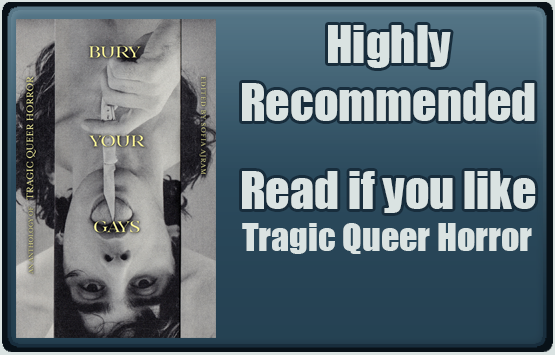
(UN) Bury your Gays by Clinton W. Waters

(UN) Bury your Gays by Clinton W. Waters

Formats: Print, digital

Publisher: self published

Genre: Body Horror, Eldritch, Sci-Fi,  Zombie

Audience: Y/A

Diversity: Gay author and characters

Content Warnings (Highlight to view): Alcohol Abuse, Animal Death, Bullying, Cannibalism, Child Abuse, Child Death, Child Endangerment, Death, Forced Captivity, Homophobia, Kidnapping, Medical Procedures, Physical Abuse, Slurs, Verbal/Emotional Abuse, Violence

Blurb

It’s the late 2000’s. Humphrey West and his best friend Danny are just trying to survive their senior year. Unfortunately, Danny falls short of that goal after a risky rendezvous. But Humphrey has just the thing: a concoction borne of magic and science that is able to bring the dead back to life (at least it’s worked on a bee so far). Against all odds, Danny comes back from the clutches of death.

The Danny that returns is…different. And it’s not just the missing memories. Soon, Humphrey is doing everything in his power to keep his friend alive, but none the wiser to what is happening.

A queering of the Lovecraft classic “Herbert West – Reanimator”, (UN)Bury Your Gays is about blurring the boundaries between life and death, love and obsession, and secrets and lies.

I received this product for free in return for providing an honest and unbiased review. I received no other compensation. I am disclosing this in accordance with the Federal Trade Commission’s 16 CFR, Part 255: Guides Concerning the Use of Endorsements and Testimonials in Advertising.

Considering what a raging bigot H.P. Lovecraft was, it’s always delightful when one of his works is reclaimed by marginalized creators, because you just know it would drive him absolutely batty. On top of being racist, sexist, xenophobic, and antisemitic, Lovecraft was also a homophobe. He discouraged his close friend, a gay man named Robert Hayward Barlow, from writing homoerotic fiction, and his letters condemned homosexuality (though it’s unclear if Lovecraft ever knew the man he appointed as the executor of his literary estate was gay). However, some literary critics speculate that Lovecraft was himself secretly gay or asexual. It certainly wouldn’t be the first time a homophobe would be overcompensating for a sexuality they were secretly ashamed of. It would certainly explain the strangely close friendship between one of Lovecraft’s most popular characters, Herbert West, and the unnamed narrator in Herbert West: Reanimator. Perhaps Lovecraft subconsciously created a male-male relationship that he himself desired.

The original story was first serialized in the pulp magazine Home Brew in 1922 and told the story of Herbert West and his loyal assistant, two medical students at Miskatonic University who experiment with reviving the dead. Their experiments are less than successful as the reanimated corpses become violent and animalistic; one even devours a child. The two share a close relationship, choosing to live together for years, even though the assistant admits to being terrified of his friend. The movie Re-Animator (1985) and its sequel Bride of Re-Animator (1990) furthers the gay subtext between the movie’s main characters Herbert West (Jeffery Combs) and Dan Cain (Bruce Abbot), with West often acting like a jealous lover to Dan. The homoerotic reading of the first two Re-Animator movies is apparently so popular it has over 500 fanfics shipping the two on Archive of our Own.  

(Un) Bury Your Gays is “a queering” of Herbert West: Reanimator that also draws inspiration from the films. (For example, the chemical solution in Waters’ story has a green glow, a movie-specific detail.) The title is a reference both to subverting the Bury Your Gays trope and to the plot itself where a gay character is brought back from the dead and literally “unburied.” The novella tells the story of Herbert West’s great-nephew Humphrey West, and his best friend, Danny Moreland (who takes over the role of the assistant and whose name is a reference to Dan Cain). Danny and Humphrey are best friends, and the only two queer kids in their religious, rural town. While they do love each other, it’s purely platonic and the two aren’t in a romantic relationship. Humphrey remains single while Danny secretly hooks up with the captain of the football team, Judd Thomas, who also happens to be the son of the town pastor and Humphrey’s biggest bully.The trouble starts when Humphrey discovers his great-uncle’s notebook detailing the secret to life after death. Humphrey attempts to use the reanimator solution to bring a dead bee back to life, with the hope that he can somehow use it to fight colony collapse disorder. But the road to hell is paved with good intentions and the solution soon leads to death and the destruction of Danny and Humphrey’s friendship.

Waters does an excellent job mimicking Lovecraft’s original story, both in tone and content, while also making it uniquely his own. Initially appearing to be a sensitive kid, Humphrey is eventually revealed to be every bit as complex as his great-uncle. His desire for revenge causes him to make morally questionable choices, which he rationalizes as trying to protect his best friend. He comes off as cold to others (much like Herbert West), even though he feels things deeply.  It’s an interesting twist to have the reanimator narrate the story, rather than his assistant. We get to hear firsthand what’s going through the mind of the mad scientist, making Humphrey a much more sympathetic character. He clearly loves Danny, and will do anything to protect him, but he takes it too far and becomes obsessive and controlling without even realizing it. When things go too far, Humphrey doesn’t show remorse– much to Danny’s horror. But all Humphrey wants is to keep his friend safe. He genuinely thinks he’s doing the right thing and can’t comprehend why Danny gets upset with him and eventually cuts him out of his life. And because Humphrey’s character is sympathetic, and we know how he feels and thinks, I honestly felt bad for him. It’s a compassion I can’t conjure for either the original Herbert West or the film version, both of whom, while not necessarily evil, are definitely on the lower end of the morality scale.

Overall Water’s queer retelling/sequel to Herbert West: Reanimator is an excellently written, morally gray horror that’s sure to please Lovecraft fans.

Unshod, Cackling, and Naked by Tamika Thompson

Unshod, Cackling, and Naked by Tamika Thompson

Formats: Print, digital

Publisher: Unnerving 

Genre: Apocalypse/Disaster, Killer/Slasher, Sci-Fi Horror, Werebeasts

Audience: Adult/Mature

Diversity: Black main characters and author, lesbian character, Biracial Black/Creek character

Takes Place in: LA, California

Content Warnings (Highlight to view): Alcohol Abuse, Animal Death, Body Shaming, Child Abuse, Child Death, Pedophilia, Police Harassment, Racism, Rape/Sexual Assault, Slurs, Verbal/Emotional Abuse, Violence

Blurb

A beauty pageant veteran appeases her mother by competing for one final crown, only to find herself trapped in a hand-sewn gown that cuts into her flesh. A journalist falls deeply in love with a mysterious woman but discovers his beloved can vanish and reappear hours later in the same spot, as if no time has passed at all. A cash-strapped college student agrees to work in a shop window as a mannequin but quickly learns she’s not free to break her pose. And what happens when the family pet decides it no longer wants to have ‘owners’?

In the grim and often horrific thirteen tales collected here, beauty is violent, and love and hate are the same feeling, laid bare by unbridled obsession. Entering worlds both strange and quotidian, and spanning horror landscapes both speculative and real, asks who among us is worthy of love and who deserves to die?

I received this product for free in return for providing an honest and unbiased review. I received no other compensation. I am disclosing this in accordance with the Federal Trade Commission’s 16 CFR, Part 255: Guides Concerning the Use of Endorsements and Testimonials in Advertising.

I absolutely love horror anthologies, so I was excited to receive Unshod, Cackling, and Naked by Tamika Thompson. Many of the stories in the anthology focus on the balance between humans and nature and the morality of killing, owning, and eating animals. Bridget has Disappeared takes place in a dystopian near-future with disappearing resources which lead to poverty and crime. I Will be Glorious is about coping with loss and a killer tree. The Bats and The Turn are both about diseases that seemingly spread overnight (much like COVID) that cause dogs and bats, respectively, to turn against humans and attack them. The Turn especially focuses on the humanity’s relationship with domesticated animals and describes what would happen if dogs no longer wished to be kept as pets. Similarly, And We Screamed examines humanity’s relationship with livestock, and why we choose to eat some animals and feel entitled to try and control them. It also examines the sanctity of death and dead bodies. I found this story especially interesting because I was probably the exact opposite of the target audience. I eat meat and have several pets. I used to work on a farm with livestock (some of which were being raised for food) as a child, and I volunteered at an animal hospital where I sometimes had to help euthanize sick animals in my teens. In college I majored in biology and had no qualms about dissecting dead animals, including rats and cats (despite being a huge rat and cat lover).

In And We Screamed there’s a scene where the main character refuses to dissect a cat and her classmate points out that it’s messed up because it still has a face. My first thought was “Well, how are you supposed to dissect the eyes if it doesn’t have a face?” (Which turns out to be the teacher’s argument as well.) It was intriguing to be reminded that something I consider routine and mundane was actually horrific for many people, and to see why exactly it was so frightening from their point of view.  I was able to understand and empathize with where the author, and her characters, were coming from, even if I didn’t fully agree with her conclusions. I also recognized the mental disconnect that makes me willing to dissect a rat for science while also dropping over a grand on veterinary bills for a rat I keep as a pet.  Truly a testament to Thompson’s skill as a writer.

My favorite stories in Unshod, Cackling, and Naked were the ones with feminist themes. In I Did it for You a young rape survivor tracks down creepy men and cuts off their small toe, turning them into victims who will have to carry a scar for the rest of their lives, just as she does. She points out to one cop–the one who raped her because he thought she was a prostitute–that losing a toe is nothing like losing your will to live after being sexually assaulted. I always enjoy a good rape revenge story and I appreciated that Thompson makes the sex workers in I Did it for You heroes rather than victims (like they are in most horror), and they feel like real characters rather than stereotypes.  

Mannequin Model is the story from which Unshod, Cackling, and Naked draws its name. In it, a woman acts as a “living doll,” modeling clothing in a store window where she’s objectified and sexually harassed. She’s treated as a literal sex object, with no voice or will, so it’s extremely satisfying when she finally rebels. But my absolute favorite story in the collection is I am Goddess. In it, a woman named Lira wants to convince her husband to pay for face treatments so she can be beautiful. Her marriage to her husband is basically every bad heterosexual relationship you’ve read about on Reddit. Lira works full time and does everything around the house. She pays the mortgage and all the bills out of her paycheck, despite earning the same amount as her husband. Her husband uses his own money to buy himself big-screen TVs and flashy new cars while telling Lira they can’t afford a washer and dryer or a car for her, so she’s stuck doing laundry by hand and taking the bus. He flirts with other women, dismisses her feelings, and ignores her unless he wants sex. But Lira puts up with it with a smile because she has been conditioned her whole like to believe she needs a man to be “complete” and that she’s lucky to have anyone at all considering her appearance. All of Lira’s accomplishments growing up are downplayed until she finds a husband. Her cousin constantly mocks her appearance and makes Lira feel inferior. No wonder she’s trapped in such a toxic relationship. But her husband’s refusal to let her get the one thing she wants, her face treatment, finally pushes Lira over the edge. She finally sees her husband for who he really is, a loser, and all her pent up anger and frustration comes pouring out. She gets even, and it’s glorious. Definitely one of the strongest stories in the collection, in my humble opinion. 

All The Dead Lie Down by Kyrie McCauley

All The Dead Lie Down by Kyrie McCauley

Formats: Print, digital

Publisher: Harper Collins

Genre: Gothic

Audience: Young Adult

Diversity: Lesbian characters, mentally ill character (anxiety disorder)

Takes Place in: Maine, USA

Content Warnings (Highlight to view): Animal Death, Child Death, Child Endangerment, Death, Mental Illness

Blurb

The Haunting of Bly Manor meets House of Salt and Sorrows in award-winning author Kyrie McCauley’s contemporary YA gothic romance about a dark family lineage, the ghosts of grief, and the lines we’ll cross for love.

The Sleeping House was very much awake . . .

Days after a tragedy leaves Marin Blythe alone in the world, she receives a surprising invitation from Alice Lovelace—an acclaimed horror writer and childhood friend of Marin’s mother. Alice offers her a nanny position at Lovelace House, the family’s coastal Maine estate.

Marin accepts and soon finds herself minding Alice’s peculiar girls. Thea buries her dolls one by one, hosting a series of funerals, while Wren does everything in her power to drive Marin away. Then Alice’s eldest daughter returns home unexpectedly. Evie Hallowell is every bit as strange as her younger sisters, and yet Marin is quickly drawn in by Evie’s compelling behavior and ethereal grace.

But as Marin settles in, she can’t escape the anxiety that follows her like a shadow. Dead birds appear in Marin’s room. The children’s pranks escalate. Something dangerous lurks in the woods, leaving mutilated animals in its wake. All is not well at Lovelace House, and Marin must unravel its secrets before they consume her.

 received this product for free in return for providing an honest and unbiased review. I received no other compensation. I am disclosing this in accordance with the Federal Trade Commission’s 16 CFR, Part 255: Guides Concerning the Use of Endorsements and Testimonials in Advertising.

Oh, Kyrie McCauley, you had me at gothic lesbian romance.

As with most gothic novels, the story starts with an impoverished orphan girl named Marin Blythe. Having recently lost her mother in a train crash, Marin is feeling lost and overcome by her anxiety. That’s when a distant friend of her mother’s, Alice Lovelace, reaches out and offers to give her a home in exchange for Marin nannying her two younger daughters, Wren and Thea.

Alice Lovelace is a reclusive horror author who lives in the middle of nowhere with her daughters in a stately manor home that’s slowly sinking into the sea. The house holds many secrets, and even has its own cemetery where generations of Lovelaces have been buried and the youngest daughter, Thea, hold funerals for her dolls. All that’s missing from the desolate home is a forbidden wing (which Marin even cracks a joke about). Despite being set in the presentday, Lovelace house feels trapped in the past due to the lack of electronics and cell signal, making Marin feel all the more isolated. Worst still, Wren and Thea have a penchant for cruel pranks, like leaving the braided hair of their dead ancestors in Marin’s bed.

All the Dead Lie Down is a very pretty book and a love letter to classic Gothic romances. It’s as dark and delicate as the bird skeletons Alice Lovelace keeps around the house. But in some ways the book feels very paint-by-numbers, like McCauley was working off a gothic checklist. It definitely makes the novel atmospheric, but not particularly unique. However, since the book is aimed at young adults who may not yet be familiar with Jane EyreWuthering HeightsThe Turn of the Screw, etc. All the Dead Lie Down is an entertaining and accessible introduction to gothic fiction.

The romance between Marin and Alice’s eldest daughter, Evie, is lovely and sweet. Both girls are approach each other hesitantly, stealing secret kisses in the garden and passing secret notes tied up with ribbon. The plot takes a while to get to the exciting bits, but I didn’t mind the wait, as it gives the reader time to enjoy the suspense and become familiar with the characters and house (arguably a character itself), and to enjoy the gloomy atmosphere. Overall, a cozy and creepy read perfect for a rainy day with a hot cup of tea.

Navigation

Social Media

Search by Tags

To learn more about the Age Group, Diversity, and Genre tags, click here.

Age Groups

Diversity

Genre

Support the Blog

Search

Links

Hammers on Bone by Cassandra Khaw

Hammers on Bone by Cassandra Khaw

Formats: Print, digital

Publisher: Tor

Genre: Body Horror, Eldritch, Monster, Occult, Psychological Horror, Sci-Fi Horror

Audience: Young Adult

Diversity: Queer character (Gay woman), POC characters (Black, Creole woman, unknown POC character), Bisexual author, Malaysian author

Takes Place in: London

Content Warnings (Highlight to view): Alcohol Abuse, Body-Shaming, Bullying, Child Abuse, Child Endangerment, Death, Gore, Pedophilia, Physical Abuse, Racism, Rape/Sexual Assault, Sexism, Sexual Abuse, Slurs, Slut-Shaming, Verbal/Emotional Abuse, Violence

Blurb

John Persons is a private investigator with a distasteful job from an unlikely client. He’s been hired by a ten-year-old to kill the kid’s stepdad, McKinsey. The man in question is abusive, abrasive, and abominable.

He’s also a monster, which makes Persons the perfect thing to hunt him. Over the course of his ancient, arcane existence, he’s hunted gods and demons, and broken them in his teeth.


As Persons investigates the horrible McKinsey, he realizes that he carries something far darker. He’s infected with an alien presence, and he’s spreading that monstrosity far and wide. Luckily Persons is no stranger to the occult, being an ancient and magical intelligence himself. The question is whether the private dick can take down the abusive stepdad without releasing the holds on his own horrifying potential.

During one of my late-night explorations of the internet (when I should have been sleeping but was instead googling all the random thoughts that pop into my head at 2 AM) I stumbled upon the work of Malaysian author Cassandra Khaw, a nerdy, queer woman who writes video games and short horror stories. Instantly intrigued, I purchased one of her novellas, Hammers on Bone, and I have to say, I fell absolutely, head-over-heels in love with Khaw’s writing. Her beautifully crafted stories are full of wonderful words like “penumbra” and “ululation” (one of my favorite Latin derived words), deliciously grotesque descriptions, and unique characters. English is Khaw’s third language, yet she uses it with a mastery that puts even native English speakers to shame. Her writing has a lot of range, too. These Deathless Bones is a feminist fairy tale about a witch getting sweet revenge on her wicked stepson. Rupert Wong, Cannibal Chef is a comedic splatterpunk series, as hilarious as it is gory, about the misadventures of the titular chef who prepares decadent meals of human flesh for gods and ghouls and gets wrapped up in international deity politics. Khaw has even dabbled in chick-lit (while also managing to poke fun at the more problematic elements of the genre) with her book, Bearly a Lady, about a bisexual, plus size wear-bear that works at a faerie-run fashion magazine. Then there’s her Persona Non Grata series. Much like Victor LaValle’s The Ballad of Black Tom, Khaw’s novellas take place in a Lovecraft inspired universe, but she flips the famously racist HP the bird by putting people of color at the forefront and using his creations to address social issues like racism, poverty, and abuse. Both stories feature the private investigator, John Persons, one of the most interesting characters I’ve come across in horror fiction. It’s the first of Person’s two novellas, Hammers on Bone, that I’ll be reviewing here.

Persons speaks and acts like the “hardboiled detective” characters from 1930s pulp magazines, complete with dated American vernacular and machismo, despite living in modern day London. This makes John seem incredibly out of place and occasionally downright ridiculous, like when he describes a little boy running into his arms for a hug as “crashing into me like a Russian gangster’s scarred-over fist.” When he’s not working as a PI, John spends his time saving the world from destruction by Star Spawn and Elder-Things. He’s adept at using magic, smokes cigarettes to dull his inhumanly strong sense of smell, enjoys the cold, and can pick up memories from objects and people through physical contact. He also happens to be a Dead One (though not one of the Great Old Ones, Persons is quick to explain), an otherworldly creature whose true, terrifying form comfortably possesses resides in a human body which he shares with the ghost of its previous inhabitant. I bet that’s why he has the most unimaginative, made-up sounding name ever; it was probably the first thing that popped into his head when he started inhabiting his meat suit.


Persons and his human body have an interesting relationship, more commensal than parasitic. While other Star-Spawn and Elder Things simply take what they want, invading human flesh like a disease and eventually destroying their hosts, Persons tries to minimize damage to his meat suit (he may be immortal and resilient, but his human form still suffers from wear and tear, and he feels pain when it’s damaged), and gives his phantasmal passenger a say in certain decisions. Even though he’s in the driver’s seat, John’s body will still react to its original owner’s thoughts and feelings, independent of him. In one scene, the meat suit becomes aroused by the proximity of a beautiful woman. Persons is aware of “his” body’s quickening pulse and rising temperature (among “other” rising things, heh), and states that the sensation is “not unpleasant”, but he describes the physical reaction with the detached interest of scientist observing a cell under a microscope. He is, after all, still an alien being.

Not much is known about the man whose skin he now wears, except that he’s an older person of color who lived during the interwar period, and gave John his body willingly after being asked. The whole Philip Marlowe / Sam Spade persona Persons adopts to appear more human is as an homage to his meat suit’s original owner. I guess it’s kind of sweet that he does that, in a very weird way, but unfortunately his stubborn refusal to update his dated vocabulary and attitudes, or venture into any genre that isn’t detective noir makes John come off as pretty sexist. He refers to women as “skirts,” “broads,” “dames,” and “birds”, and divides them into victims and femme fatales. This attitude backfires on him spectacularly since, of course, the real world isn’t like his detective novels, and John keeps misjudging the women he interacts with.

What sets the monstrous PI apart from his fellow cosmic entities, besides seeking consent from his body’s original owner, is his fondness for humanity, his dedication to following the law and maintaining order, and his desire for earth to remain more or less the way it is, i.e. not a barren hell-scape inhabited by Eldritch abominations.  Most of the monsters he fights are chaotic evil, infecting and destroying whenever they go, but John Persons is closer to lawful neutral, occasionally leaning towards good. He’s not exactly heroic since, in his words, “Good karma don’t pay the bills,” but Persons does have a strong set of morals. As previously mentioned he’s big on consent and describes the act of possessing a willing host’s body as “better than anything else I’d ever experienced” and feels incredibly guilty when he accidentally reads a woman’s mind after touching her arm. When she becomes understandably angry at the violation, screaming “You don’t take what you’re not given!” John doesn’t try to minimize, excuse, or defend his behavior (even though the intrusion was an accident), he simply apologizes, mortified by what he’s done. He can even show compassion at times, but how much of his altruistic behavior is due to the remaining sentience of his body’s former inhabitant acting as his ghostly conscience is unclear.

It’s his spectral companion who convinces John to take the case of a young boy named Abel, who wants Persons to kill his abusive stepfather. While initially hesitant about committing murder, John is convinced once the boy reveals that his stepfather is a monster, both literally and figuratively, and both Abel and his little brother’s lives are in danger. He might not be a hero, but Persons does seem to genuinely want to help the two boys, even if he claims it’s just because they’re clients. It may be simply because he wants the ghost with whom he cohabitates to stop nagging him, as John is usually pretty indifferent to human suffering on his own, or perhaps it’s because an Old One is involved, and he’d really prefer it not destroy the world. Regardless of the reason, he agrees to help.

In his eagerness to play white knight (or his meat suit’s eagerness) Persons often fails to realize that the “helpless victims” he seeks to rescue are often perfectly able to take care of themselves, like the waitress whose mind he reads. He’s also quick to victim blame the boys’ mother for not leaving, clearly unable to understand the psychological element of abuse or how dangerous it is for a person to try and leave an abusive partner, just making her feel worse than she already does. John struggles when it comes to comforting victims or dealing with their emotions. He claims his lack of skill when it comes to words and feelings is due to being a “man” (or at least inhabiting the body of one), though it’s just as likely it’s because he’s an eldritch abomination, and he’s just been using sexism to avoid learning the nuances of human emotion. While Persons is better at managing his desire to destroy and devour than the other monsters and is able to maintain a detached control over his meat suit’s emotions and baser instincts, he’s not immune to the effects of his human body’s testosterone or his own toxic misogyny. When the PI is feeling especially aggressive his true form starts to writhe beneath his human skin, straining to break free from his epidermis and rip apart the object of his ire. Even his thoughts start to degrade into a sort of violent, inhuman, babble when he gets too riled up. John actually has to fight to keep control of his monstrous body when he first encounters the abusive stepfather, he’s so desperate to disembowel and devour him. His true nature is a stark contrast to the cool and logical detective persona Persons has adopted. I won’t lie, I did enjoy seeing him act all protective of Abel and his little brother. There’s something amusing about what is essentially an immortal abomination that can effortlessly rip a grown man in two, doing something as mundane and sweet as escorting his young client home while carrying the child’s kid brother on his hip. It’s also heartbreaking when you realize the two boys are safer with a literal monster than their step dad, McKinsey (even before he was possessed).

The step-father is a real piece or work, and throughout the story I desperately wanted John to give in to his monstrous instincts and tear the bastard apart, limb by limb. But being a man/monster of the law, Persons won’t do much more than saber-rattle until he has solid proof of McKinsey’s wrong doing, much to Abel’s frustration. The kid would much rather the PI solve things with his fists (teeth, tentacles, claws, and other miscellaneous alien appendages) than waste time talking to witnesses, and I’d certainly be annoyed too if the monster I hired to kill someone wasted time playing detective instead of just eating his target. But Persons did warn Abel that he’s not a killer for hire and wants to do things “by the book”. Unfortunately, like most real monsters, McKinsey excels at hiding his wrong doing and camouflaging his true nature which makes it difficult for John to find a solid lead. People like McKinsey and describe him as a “loving family-man”.  Those who haven’t been completely conned by his act either don’t care he’s a monster (like his boss) or are too terrified to do anything (like his fiancée). None of the adults in the boys’ lives are fulfilling their duty of protecting two vulnerable children. This is where the real horror lies in Khaw’s story– not the eldritch abominations like Shub-Niggurath, or the threats of world destruction, but the all too painful reminder that we so often fail abuse victims. Khaw is tasteful when describing what the two boys go through, and it isn’t played for titillation or described in explicit detail. She only reveals enough to lets us know the two boys in the story are going through something no child should ever have to suffer. I also liked her choice to make the victims male. Far too often male survivors are overlooked, erased, or mocked because society tells us males can’t be victims, even though the CDC states that “More than 1 in 4 men in the United States have experienced rape, physical violence, and/or stalking by an intimate partner in their lifetime” and a study published in the American Journal of Preventive Medicine found that 1 in 6 boys will be sexually abused before the age of 18. As depressing as these statistics are, the situation isn’t completely hopeless, because monsters aren’t invulnerable, even the kind that have been infected by Elder Things. As Person muses towards the end of the book “I don’t remember who said it, but there’s an author out there who once wrote that we don’t need to kill our children’s monsters. Instead, what we need to do is show them that they can be killed.” For those of us who can’t go out an hire a eldritch abomination PI, at least we have RAINN (Rape, Abuse & Incest National Network) and their recommended resources for cases of abuse and sexual assault.

Claustrophilia by Ezra Blake

Claustrophilia by Ezra Blake

Formats: digital

Publisher: Smashwords

Genre: Blood & Guts (Splatterpunk), Body Horror, Killer/Slasher, Psychological Horror, Romance

Audience: Adult/Mature

Diversity: Gay main characters and author, trans male author

Takes Place in: US and Italy

Content Warnings (Highlight to view): Alcohol Abuse, Amputation, Cannibalism, Death, Drug Use/Abuse, Forced Captivity, Gaslighting, Gore, Illness, Kidnapping, Medical Torture/Abuse, Medical Procedures, Mental Illness, Necrophilia, Mentions of Pedophilia, Physical Abuse, Rape/Sexual Assault, Self-Harm, Sexual Abuse, Slurs, Slut-Shaming, Suicide, Torture, Verbal/Emotional Abuse, Violence

Blurb

Christopher Dour’s life was terrible before he was kidnapped. He spent too much time studying the Providence Butcher’s victims and not enough talking to living people. He was erotically obsessed with the idea of murdering Dr. Ivan Skinner, his medical school advisor. I was only a matter of time before he killed someone, possibly himself–but the Providence Butcher had other ideas. After all, the first time should be special, and Chris was going about it all wrong. Now those life-or-death decisions are out of his hands. He’s breaking. What’s worse, Chris has a lot in common with the Butcher. Nobody else has truly cared about him before. When he’s not being tortured, he’s being cherished. If Stockholm syndrome feels like love, then in practice, what’s the difference? Chris can’t maintain his dignity, but can still cling to his shattered moral compass. Or he can let go, submit, and become the unspeakable. At least then he wouldn’t be alone. Prepare to become an accomplice.

The very first page of Claustrophilia gave me a panic attack, and when I finished it, I felt like someone had put my brain in a blender. I swore I’d never force myself to experience something so sick, sadistic, and stressful again.

Well, that promise lasted all of four months and then I reread it. Why would I expose to that filth again? Because I love this book so goddamn much. The writing is amazing. Like, made-a-deal-with-a-dark-force-to-obtain-supernatural-talent amazing (Blake is also an incredibly talented artist, which is just all kinds of unfair). I read the entire thing in one traumatic sitting even though it was 2 AM and I really needed to take a break. It’s sooooooo good, but soooooo fucked up and I’m not sure I should even be admitting to reading it. Hell, just purchasing Claustrophilia will probably put you on some kind of FBI watch-list. Although I’m pretty sure I’m already on there, thanks to my Google search history. Disclaimer: If you are a law enforcement agent I had totally legitimate, non-creepy reasons to look up “at-home lobotomy instructions,” “how to dissolve a body” and “where to buy cursed dolls” even if I can’t think of any right now. Also, some weirdo stole my credit card and bought Claustrophilia. And reviewed it. And then read a bunch of erotic, gay Deep Space Nine fan fiction followed by two-hours of zit-popping videos on Youtube. Someone who wasn’t me.

For the sake of your sanity, I’m going to warn you right now, if you are someone with any kind of triggers, stop right here. I’m serious. Claustrophilia is chock-full of extremely explicit torture (medical, physical, sexual, and psychological), cannibalism, gore, and a super fucked up, abusive relationship. It’s a good book, but it is splatterpunk. So, if that’s not your thing, stay far, far away from this book and most likely this review. But if you have a strong stomach and can handle a scene where a guy fucks another guy’s brain (literally) I’d definitely recommend it. Will/Hannibal shippers, fans of Rotten.com’s Rotten Library (R.I.P.), and extreme horror enthusiasts will all enjoy Claustrophilia.

Admittedly I’m not usually a fan of splatterpunk. I used to enjoy extreme horror, back in my early twenties when I felt like I needed to prove what a badass horror fan I was, but the turtle death scene in Cannibal Holocaust put an end to that phase. I still like fucked up shit, but visceral, graphic violence just isn’t my cup of tea. Plus, I don’t find it particularly scary. I work in a hospital, so I see guts, amputated limbs, and dead bodies all the time; that stuff just doesn’t gross me out. And unfortunately, a lot of splatterpunk also seems to equate to sexualized violence against women handled in the worst way. possible *cough*Richard Laymon*cough* But Blake manages to create a graphic, gory story without the sexism. Most torture porn comes with a heavy dose of misogyny, and with all the real-world examples of abuse, torture, and murder of women by men, it’s kind of hard to enjoy it in fiction. But an erotic exploitation novel between two men doesn’t come with the same baggage (although, obviously, abuse can and does happen in same sex relationships and I’m not trying to minimize that). And cannibal doctor Ivan Skinner is pretty equal opportunity when it comes to his victims so there are no sexist vibes.

Dr. Ivan Skinner is a pretentious asshole sophisticated gentleman who loves fine art, opera, and gourmet food (usually people). He plans on running off to Italy, loves torture and mind games, and is an overall terrible friend. He’s basically a gay Hannibal Lecter. So essentially Hannibal from the Bryan Fuller TV show, but even more sadistic. Chris is an older medical student, struggling with school, work, and a general lack of direction. He falls in love with Ivan, who then tortures Chris mentally, physically, and sexually until his student becomes a murderous psychopath. And don’t worry, Blake doesn’t try to romanticize or glamorize their abusive relationship. This isn’t Twilight or 50 Shades of Gray. He makes clear from the get-go that everything between them is twisted, perverted, and ugly, even if Ivan and Chris sometimes mistake it for something else. While the torture does have shades of BDSM I’d hesitate to call it such because it’s non-consensual, and BDSM is all about explicit consent. It’s utterly fascinating to watch, and yeah, some of the sex scenes are hot, but in the end it’s a repulsive and deeply disturbing relationship where Ivan intentionally traumatizes and brainwashes Chris until he’s entirely dependent on the older man. Not that Ivan would have had to try very hard to push Chris over the edge. The young medical student is already emotionally unstable, possibly a budding serial killer, and being around cadavers all day is sending him spiraling towards a nervous breakdown.

I would just like to state, for the record, if a pathology assistant (which Chris is acting as) had a nervous breakdown it’s far more likely to be the result of dealing with the giant piles of paperwork, frequently missing slides, the dictation software breaking down again, or one of the endless phone calls from physicians who want to know if the results they only just requested are done yet like you’re supposed to drop everything else to focus on them and their nonsense and somehow break the laws of spacetime (but ~heaven forbid~ you point out that you could get to their stuff a lot faster if they stopped calling every five fucking minutes because then you’re the asshole). Look, all I’m saying is if I found out someone went on a killing spree because they got yet another phone call asking why a pathology report wasn’t ready, I’d get it. But working with dead bodies is not that stressful. They just sort of chill and don’t bother you. If you’re stressed out by the dead, you probably don’t belong in medicine.

Anyway, it’s absolutely fascinating to witness Chris’ deteriorating mental state. It’s incredibly stressful, but also offers a sort of sadistic pleasure as you wonder how much more he can stand before he snaps completely. While there is a lot of gore, it’s not the scary part of the story. It’s the suspense and psychological horror that’s terrifying. You keep wondering, “How much worse can it get?” And then it gets worse. So. Much. Worse. I think the last time a story affected me this viscerally was Eric Larocca’s Things Have Gotten Worse Since We Last Spoke. And as a horror reviewer, I’m not easily phased.

I Feed Her to the Beast and the Beast Is Me by Jamison Shea

I Feed Her to the Beast and the Beast Is Me by Jamison Shea

Formats: Print, audio, digital

Publisher: Henry Holt and Co.

Genre: Dark Fantasy, Mystery, Occult, Thriller

Audience: Young Adult

Diversity: Black main character and author, bisexual main character

Takes Place in: Paris, France

Content Warnings (Highlight to view): Body Shaming, Bullying, Death, Racism, Self Harm, Verbal/Emotional Abuse

Blurb

There will be blood.

Ace of Spades meets House of Hollow in this villain origin story.

Laure Mesny is a perfectionist with an axe to grind. Despite being constantly overlooked in the elite and cutthroat world of the Parisian ballet, she will do anything to prove that a Black girl can take center stage. To level the playing field, Laure ventures deep into the depths of the Catacombs and strikes a deal with a pulsating river of blood.

The primordial power Laure gains promises influence and adoration, everything she’s dreamed of and worked toward. With retribution on her mind, she surpasses her bitter and privileged peers, leaving broken bodies behind her on her climb to stardom.

But even as undeniable as she is, Laure is not the only monster around. And her vicious desires make her a perfect target for slaughter. As she descends into madness and the mystifying underworld beneath her, she is faced with the ultimate choice: continue to break herself for scraps of validation or succumb to the darkness that wants her exactly as she is—monstrous heart and all. That is, if the god-killer doesn’t catch her first.

From debut author Jamison Shea comes I Feed Her to the Beast and the Beast Is Me, a slow-burn horror that lifts a veil on the institutions that profit on exclusion and the toll of giving everything to a world that will never love you back.

I received this product for free in return for providing an honest and unbiased review. I received no other compensation. I am disclosing this in accordance with the Federal Trade Commission’s 16 CFR, Part 255: Guides Concerning the Use of Endorsements and Testimonials in Advertising.

I went into I Feed Her to the Beast and the Beast is Me expecting Laure to be an unlikeable female protagonist (something I actually enjoy in a story), but I was not prepared for just how relatable she was. If I ever become a supervillain, my origin story will be me finally getting fed up with all the bigotry and microaggressions I have to deal with every day and deciding to get even, rather than continuing to either educate or ignore the people hurting me. And that’s exactly what Laure does. Can you blame her? Every other ballerina in her company is rich and white, with powerful parents just dripping with privilege. The ballet is cutthroat, with ballerinas actively trying to sabotage each other (dancers often finds glass and tacks in their ballet shoes) and praying for one another’s downfall, and Laure is at a distinct disadvantage. Even though she works the hardest and performs the best of all of them, she’ll always be the Black girl who has to steal to pay for her tights. So, she cheats to level the playing field. Once she does, her talent and hard work is immediately rewarded. And honestly? It’s cathartic to watch Laure stoop to the level of the other ballerinas and their awful parents. It is SO exhausting to always have to be the bigger person in the face of abuse. I may agree with Michelle Obama’s “When they go low, we go high,” but I still don’t like having to “go high” when I would rather be a petty asshole. So, in a purely fictional world? It’s wonderfully satisfying to watch a Black woman choose the role of the villain and get even with all those rich white girls.

Ballet is still one of the least diverse performing arts, fraught with racism that ranges from subtle to overt. This is especially true in Europe. In her book Turning Pointe, Chloe Angyal discusses ballet’s racism problem. She describes an encounter with a racist dance mom and her implied message to her daughter: “[Black dancers are] not really good, but they are allowed to be here. In this space that is rightfully yours, in this art form that is rightfully yours. They’re never as good as the white girls, a sweeping generalization that grants no individuality, no humanity, to any nonwhite dancer. They’re all the same, and they never deserve to be here. But don’t worry. Your excellence is a given. You belong here, while their presence is conditional or even ill-gotten.” I think this quote sums up Laure’s struggles beautifully. The only difference is that these are struggles faced by real dancers.

Even something as simple as buying pointe shoes is no easy task for Black dancers. Most dance garments are traditionally “European pink,” and don’t match darker skin tones. Black ballerinas often have to pancake their shoes in dark foundation to match their skin tone and dye their tutus and tights. It’s only recently that brands like Capezio, Freed of London, and Bloch have offered shoes in darker skin tones. In the book Laure must purchase her own ballet shoes and tights because the ballet will only pay for pink ones. Black bodies are also discriminated against in ballet. In an interview with Sheila Rohan the Black ballet dancer described racism in ballet. “Racism in the ballet arts… meant people would make remarks about the Black ballerinas’ bodies — such as their chests being ‘too busty’ or their thighs being ‘too thick.’” A Black dancer in Berlin was told to lighten her skin with white makeup in order to play a song in Swan Lake. Laure straightens and gels her curly hair into place so she won’t stand out from the other dancers, but is still told she’s too “exotic” for a French ballet by a drunk patron. The controversial ballet La Bayadère was performed in Blackface by Russian dancers (white dancers have also worn stereotypical clothing and makeup to portray Roma and Chinese characters). The same ballet put on by Laure’s company in which she plays a shade.

After being abandoned by both parents, Laure’s only source of support is her best (and only) friend, Coralie, who is… not great. She’s kind and supportive of Laure, yes, but she’s also a subpar ballerina who just assumes she’ll get a spot in Paris’ prestigious ballet due to her famous mother. She’s essentially an entitled slacker and just as oblivious to her privilege as the other rich white girls. Coralie is also a snob, turning her nose up at anything that doesn’t come with a high price tag, which grates on permanently broke Laure’s nerves. Coralie really does seem to love her best friend, but their relationship comes with a power imbalance. So, she does not take it well when that balance of power shifts and Laure starts beating her out for roles. Because she has no one else, Laure is terrified of losing her only friend (as difficult as she can be), that is until she meets the étoile of the ballet, Josephine. Josephine gives her friendship freely without expecting anything in return, and treats Laure as an equal. She introduces Laure to her friends and shows her how she too can become an étoile. Slowly, Laure starts to see what a true friendship is like and begins to pull away from Coralie, although she still refuses to drop her completely and makes excuses for the wealthy girl’s bad behavior. I liked that while Laure does pursue a romance with a man later in the book, the story is mostly focused on her female friendships. It’s also a nice change of pace to see a toxic platonic, non-familial relationship explored. I don’t think enough people talk about how friendships can be abusive and how hard “breaking up” with a friend can be.

Another interesting theme in I Feed Her to the Beast and the Beast is Me is the idea of “perfection.” As a burned-out former “gifted kid” I know what it’s like to be expected to be perfect, then destroy yourself trying to do the impossible and ultimately have a mental breakdown when you realize perfection can never be achieved, and therefore that makes you a “failure.” The ballet expects Laure and her peers to be no less than perfect, and anyone who doesn’t make the cut is thrown aside and forgotten. While Coralie can get by half-assing it because of her mother, Laure must be the best there is to even think of if she wants to compete with the others. And it means giving up everything. This kind of perfectionism is extremely damaging to your mental health. Laure also believes that acceptance and respect from the others is entirely dependent on being perfect, not realizing she deserves respect regardless of her performance.

I Feed Her to the Beast and the Beast is Me is one of those books that I absolutely devoured. It held my attention throughout the story (no small feat when you have ADHD), save for a short part in the middle that felt like it was dragging. But other than that small criticism I can’t think of anything negative to say about this book. It’s a unique setting for a horror story, and a fresh spin on a Faustian bargain narrative. 

Frost Bite by Angela Sylvaine

Frost Bite by Angela Sylvaine

Formats: Print, audio, digital

Publisher: Dark Matter INK

Genre: Sci-Fi Horror

Audience: Young Adult

Diversity: Bisexual main character

Takes Place in: North Dakota, USA

Content Warnings (Highlight to view): Alcohol Abuse, Animal Death, Bullying, Child Abuse, Child Endangerment, Death, Drug Use/Abuse, Forced Captivity, Gaslighting, Gore, Homophobia, Kidnapping, Physical Abuse, Police Harassment, Verbal/Emotional Abuse, Violence

Blurb

Remember the ’90s? Well…the town of Demise, North Dakota doesn’t, and they’re living in the year 1997. That’s because an alien worm hitched a ride on a comet, crash landed in the town’s trailer park, and is now infecting animals with a memory-loss-inducing bite–and right before Christmas! Now it’s up to nineteen-year-old Realene and her best friend Nate to stop the spread and defeat the worms before the entire town loses its mind. The only things standing in the way are their troubled pasts, a doomsday cult, and an army of infected prairie dogs.

I received this product for free in return for providing an honest and unbiased review. I received no other compensation. I am disclosing this in accordance with the Federal Trade Commission’s 16 CFR, Part 255: Guides Concerning the Use of Endorsements and Testimonials in Advertising.

All Realene wants is to get out of Demise, North Dakota and become a doctor. Instead, she’s stuck in a dead-end town she hates with a dead dad and a mother who is slowly succumbing to Alzheimer’s who she has to care for. Realene‘s best friend, Nate, is in a similarly tough spot. His father is an abusive asshole who threw him out as soon as he turned 18 and continues to terrorize Nate’s mother. Because he got busted for selling weed, Nate is now ineligible for finical aid, which he can’t afford college without. It seems both will be trapped in Demise for the rest of their lives.  

And then the meteor strikes. Realene is first on the scene and witnesses the meteorite crack open and leak out a black sludge, which is quickly absorbed into the ground. She contacts the police about the meteorite, but chooses to leave out the part about the black sludge. The next day the strike site is a zoo, with police, military, scientists, newscasters, and locals crawling all over the scene. Most of the town views the meteorite as a reason to celebrate, even going so far as to have special shooting star sales at all the local stores, but the local religious zealot, reverend Zebadiah, sees it as a sign of the end times. And that’s when the prairie dogs start to attack.

Despite being a comedy about alien parasites, the book has some pretty depressing themes. As much as Realene loves her mother, she resents being stuck taking care of her and how it’s holding her back from her dreams. Does she give up her dreams and possibly her future to care for her mother, or does she abandon her best friend and the one family member she has left to try and make life better for herself? What you think Realene should do probably depends where you fall on the scale of individualism to collectivism and how you feel about filial piety. Regardless of the “right” answer it’s a complicated and crappy position to be in and whatever decision she make is going to leave her hurting.

Then there’s Nate’s situation with his abusive dad. I got incredibly frustrated with Nate’s mom and how she would choose her abusive husband over her own son. I understand intellectually that she is a victim. She was physically and emotionally abused first by her husband, and then by reverend Zebadiah. There are a myriad of reasons she might stay, and it’s likely her husband would have killed her if she tried to leave anyway. And I know that Nate’s father is the one at fault, not his mother, who was put in an impossible situation. I’m not upset that she couldn’t protect Nate when she couldn’t even protect herself, that was beyond her control. But the fact that, when given the opportunity, she chooses first her abusive husband and then her abusive reverend over her own son feels like a betrayal. But like Realene’s situation, the situation for Nate’s mother is complicated and there are no easy answers.

This is a book about killer prairie dogs, family, and a doomsday cult that comes with its own ‘90s playlist. And it works so well. The story manages to balance tragedy, horror, humor, and some genuinely heart-warming moments perfectly and in a way that doesn’t feel like you’re jumping from genre to genre. There’s also an orange cat named Pumpkin and I love him (don’t worry, nothing bad happens to him). Frostbite is a fun, heartfelt romp full of suspense and horror movie references. Definitely check it out, unless you love prairie dogs.

The Spirit Bares Its Teeth by Andrew Joseph White

The Spirit Bares Its Teeth by Andrew Joseph White

Formats: Print, audio, digital

Publisher:Peachtree Teen

Genre: Blood & Guts, Body Horror, Ghosts/Haunting, Mystery, Gothic

Audience: Young Adult

Diversity: Neurodiversity (Autism), transgender characters, queer character

Takes Place in: LA, California

Content Warnings (Highlight to view): Abelism, Animal Death, Bullying, Child Abuse, Child Death, Child Endangerment, Death, Forced Captivity, Gaslighting, Gore, Homophobia, Kidnapping, Medical Torture/Abuse, Medical Procedures, Miscarriage, Oppression, Pedophilia, Physical Abuse, Rape/Sexual Assault, Self-Harm, Sexism, Slurs, Slut-Shaming, Torture, Transphobia, Verbal/Emotional Abuse, Victim Blaming, Violence

Blurb

Mors vincit omnia. Death conquers all.

London, 1883. The Veil between the living and dead has thinned. Violet-eyed mediums commune with spirits under the watchful eye of the Royal Speaker Society, and sixteen-year-old Silas Bell would rather rip out his violet eyes than become an obedient Speaker wife. According to Mother, he’ll be married by the end of the year. It doesn’t matter that he’s needed a decade of tutors to hide his autism; that he practices surgery on slaughtered pigs; that he is a boy, not the girl the world insists on seeing.

After a failed attempt to escape an arranged marriage, Silas is diagnosed with Veil sickness—a mysterious disease sending violet-eyed women into madness—and shipped away to Braxton’s Finishing School and Sanitorium. The facility is cold, the instructors merciless, and the students either bloom into eligible wives or disappear. When the ghosts of missing students start begging Silas for help, he decides to reach into Braxton’s innards and expose its guts to the world—if the school doesn’t break him first.

Featuring an autistic trans protagonist in a historical setting, Andrew Joseph White’s much-anticipated sophomore novel does not back down from exposing the violence of the patriarchy and the harm inflicted on trans youth who are forced into conformity.

I received this product for free in return for providing an honest and unbiased review. I received no other compensation. I am disclosing this in accordance with the Federal Trade Commission’s 16 CFR, Part 255: Guides Concerning the Use of Endorsements and Testimonials in Advertising.

Silas is an autistic trans boy living in Victorian London who wants nothing more than to be a surgeon like his brother, George, and his idol James Barry. Unfortunately for Silas, the world still sees him as a young girl with violet eyes.

In White’s alternative history people born with violet eyes are Speakers, those who can open the Veil that separates the living and dead to communicate with ghosts. But only violet-eyed men are permitted to be mediums. It is believed that women who tamper with the Veil will become unstable and a threat to themselves and others. Veil sickness is said to be the result of violet-eyed women coming into contact with the Veil and is blamed for a wide range of symptoms from promiscuity to anger, but is really just the result of women who don’t obediently follow social norms. Thus, England has made it strictly illegal for women to engage in spirit work. After Silas’ failed attempt to run away and live as a man, he is diagnosed with Veil sickness and carted off to Braxton’s Finishing School and Sanitorium to be transformed into an obedient wife. Braxton’s is your typical gothic school filled with sad waifs and dangerous secrets, namely that girls keep disappearing. The headmaster is a creep and his methods for curing young girls are abusive. Despite the danger, Silas is determined to get to the bottom of the mysterious disappearances and find justice for the missing girls.

Violet-eyed women are highly valued as wives who can produce violet-eyed sons and are in high demand among the elite. Silas is no different, and his parents are eager to marry him off to any man with money. If being made to live as a girl weren’t bad enough, the idea of being forced to bear children is even more horrific to Silas. As someone who struggles with Tokophobia myself, I found White’s descriptions of forced pregnancy to be a terrifying and especially disturbing form of body horror. Because of Silas’ obsession with medicine, the entire book is filled with medical body horror. There are detailed descriptions of injuries and surgeries, medical torture, and an at-home c-section/abortion. Personally, I loved all the grossness and the detailed descriptions of anatomy and medical procedures. But The Spirit Bares its Teeth is most definitely not for the squeamish or easily grossed-out. I appreciated that in the afterword White made a point of mentioning that in the real world, it was usually racial minorities who were the subject of medical experimentation (rather than wealthy White women), and then recommended the books Medical Apartheid by Harriet A. Washington and Medical Bondage by Deirdre Cooper Owens for readers to learn more.

I was also happy to see an autistic character written by an autistic author. Stories about Autistic individuals often are told by neurotypical people who characterize autism as “tragic” or as an illness that needs to be cured. In The Spirit Bares its Teeth, neurodiversity is humanized and we see how harmful a lack of acceptance and understanding of autism is. Silas is forced to mask by society, and we see how difficult and harmful masking is to him. He is taught by his tutors to ignore his own needs in favor of acting the way others want. They reinforce the idea that acting “normal” (i.e. neurotypical) is the only way anyone will tolerate him. Silas’ tutors use methods similar to the highly controversial Applied Behavior Analysis (ABA) to force him to behave in a manner they deem appropriate. He is not allowed to flap his hands, pace or cover his ears at loud noises, and is forced into uncomfortable clothing that hurts his skin and to eat food that makes him sick. He is mocked for taking things literally and punished if he can’t sit still and keep quiet. It’s horrible and heartbreaking.

Although I’m not autistic, I do have Attention Deficit Disorder (ADD), a condition which has many overlapping symptoms with autism, including being easily overstimulated by sensory input. I have texture issues and White’s description of the uncomfortable clothing Silas is forced into made my skin itch in sympathy. It sounded like pure hell, and poor Silas can’t even distract himself with stimming so he just has to sit there and endure it. After meeting a non-verbal indentured servant whose autistic traits are much more noticeable, he also acknowledges that his ability to mask gains him certain privileges as he can “pass” as neurotypical (even though he should never have to pass in the first place and doing so is extremely harmful to his wellbeing).

In addition to its positive autism representation, White also does an excellent job portraying the struggles of being a trans person forced to live as their assigned gender. Interestingly, this is the first book with a transgender main character I’ve read where said character isn’t fully out or living as their true gender. Part of the horror of the story is that Silas can’t transition as he’s in an unsupportive and abusive environment. I also found it interesting that Silas is both trans and autistic as there’s an overlap between autism and gender identity/diversity.

The Spirit Bares its Teeth is a suspenseful and deeply disturbing gothic horror story about misogyny, ableism, and how society tries and controls women. I was absolutely glued to this story and could not put it down, no easy feat when my ADD demands constant distraction. Each revelation was more horrifying than the last and by the end I was terrified of what secrets Silas would uncover next. 

The Haunting of Alejandra by V. Castro

The Haunting of Alejandra by V. Castro

Formats: Print, audio, digital

Publisher: Penguin Random House

Genre: Body Horror, Demon, Ghosts/Haunting

Audience: Adult/Mature

Diversity: Chicana characters and author, bisexual main character

Takes Place in: Philadelphia, PA

Content Warnings (Highlight to view): Child Abuse, Child Death, Child Endangerment, Childbirth, Death, Forced Captivity, Gaslighting, Gore, Illness, Miscarriage, Racism, Rape/Sexual Assault, Self-Harm, Suicide, Verbal/Emotional Abuse, Violence, Xenophobia 

Blurb

Alejandra no longer knows who she is. To her husband, she is a wife, and to her children, a mother. To her own adoptive mother, she is a daughter. But they cannot see who Alejandra has become: a woman struggling with a darkness that threatens to consume her.

When Alejandra visits a therapist, she begins exploring her family’s history, starting with the biological mother she never knew. As she goes deeper into the lives of the women in her family, she learns that heartbreak and tragedy are not the only things she has in common with her ancestors.

Because the crying woman was with them, too. She is La Llorona, the vengeful and murderous mother of Mexican legend. And she will not leave until Alejandra follows her mother, her grandmother, and all the women who came before her into the darkness.

But Alejandra has inherited more than just pain. She has inherited the strength and the courage of her foremothers—and she will have to summon everything they have given her to banish La Llorona forever.

The Haunting of Alejandra is about the horrors of being a mother, wife, and woman, and the sacrifices that come with it.

We first meet Alejandra when she’s hiding from her family in the shower, crying and feeling overwhelmed by their many demands. Her husband Matthew is unsupportive and as needy and demanding as her three children. On the rare occasions when Alejandra asks him to help her with the housework, Matthew uses a combination of weaponized incompetence and guilt-tripping to get out of it. He’s made Alejandra move away from her support network in Texas, and the birth mother she’d just reconnected with. He’s also convinced her to quit her job and raise their children full time, meaning she no longer has money of her own. Matthew owns everything, Alejandra’s name isn’t even on the bills. He makes all the decisions for the family; where they live, what they buy, and even where they travel on vacation. If Alejandra’s needs don’t align with what he wants in the moment Matthew will make his displeasure known. She feels like a shadow, barely existing.

Alejandra’s situation will be familiar to many married women. Like most heterosexual couples she takes on the majority of the housework and mental load. Matthew provides little to no help with chores, child raising, or managing the household. This is, sadly, not uncommon as according to the BBC “When it comes to household responsibilities, women perform far more cognitive and emotional labour than men.” Alejandra has been trapped in this pattern since childhood, when, as the eldest daughter, her religious, adoptive parents forced her to do the bulk of the household chores and take care of her younger siblings. They also cut her off from her history and culture, refusing to let her read anything about Mexico that went against their fundamentalist Christian beliefs. Alejandra is surrounded by White people who don’t understand her. When she tries to tell her eldest daughter the story of La Llorona, something to connect her to her heritage, she’s scolded by her daughter’s teacher for telling her child scary stories.

Bar graph showing the roles of men and women in US society.

When Alejandra expresses dissatisfaction with her situation, her concerns aren’t taken seriously. Even when she admits to feeling suicidal she’s met with shame and “I’m sorry you feel that way” from her husband who frequently points out she has everything material she could ever want, so why should she be unhappy? Worse still, something that resembles la Llorona, the ghostly woman from Mexican folklore who drowned her two children, is haunting Alejandra, telling her she’s a terrible mother. Throughout the course of the story we learn that Alejandra is not the only mother the creature has haunted. Each of the women in Alejandra’s matrilineal line had their own struggles with motherhood and a lack of autonomy.  Miscarriage, feeling unworthy of love, carrying an unwanted child, forced marriage, teenage pregnancy, the list goes on. And each woman was haunted by the specter of la Llorona who fed off their pain and sorrow, resulting in generational trauma that goes back centuries.

Eventually Alejandra decides to take back the power her husband, parents, and the monster took from her by getting help. I really appreciated that unlike most fictional characters Alejandra actually has the self-awareness to go to therapy when she realizes how bad things have gotten. Even better, her therapist, Melanie, is competent, and culturally informed. She is a Chicana woman, like Alejandra, who practices both modern psychotherapy as a doctor and traditional medicine as a curandera. She believes Alejandra when the stressed mom tells her that she’s being stalked by some kind of monster and is able to advise her on how to protect herself from the evil sprit and cleanse her home. Melanie helps Alejandra reconnect to the cultural roots her adoptive parents sought to destroy, encouraging her to read up on this history of Chicana women and advising her to build an altar to her ancestors in her home. While we’ve all heard horror stories of bad therapists, I found it refreshing to see a therapist in fiction who’s actually good at her job and not a White man. Having had some incredibly helpful queer therapists myself I know the importance of having culturally competent care, and what a difference it makes when your provider isn’t basing their care on a White, heteronormative, Capitalist model. I loved Melanie, and I wish there were more doctors like her in the world.

Photo of Felicia Cocotzin Ruiz, a modern curandera. Photography by Laura Segall.

Alejandra also reaches out to her birth mother, who may not have been meant to raise a child but is more than ready to provide emotional support to her adult daughter. Melanie teaches her how to call upon the strength of her female ancestors who appear to her in her dreams. With all these strong women standing behind her Alejandra is able to find her own inner strength to stand up to both Matthew and her monster, as she fights to keep the generational curse from passing down to her own daughter. I really loved the theme of women supporting and healing other women. When Alejandra is finally able to ask for help without feeling guilty or like a burden the women in her life are there the minute she needs them. They believe her stories of a monster and are ready to offer their help in whatever for Alejandra needs it.

Overall The Haunting of Alejandra is an emotional and painful, but ultimately rewarding read about women, Mexican culture, and generational trauma. It’s a slow burn horror, and while I usually don’t have the patience for those I was so enraptured with the story that it felt like it flew by. While not a parent myself, I know women who are, and the book rang true of their more difficult experiences with motherhood like feeling overwhelmed and isolated. I’ve been following V. Castro’s books for a while now and I have to say, she just gets better and better with each piece she rights. It’s truly impressive and I can’t wait to read what she writes next.

8:59:29 by Polly Schattel

8:59:29 by Polly Schattel

Formats: Print, digital

Publisher: Trepidatio Publishing

Genre: Demon, Occult

Audience: Adult/Mature

Diversity: Trans author

Content Warnings (Highlight to view): Child Death, Death, Drug Use/Abuse, Gore

Blurb

When a disgruntled adjunct faculty teacher decides to get revenge on the head of her department, she begins a dark (and darkly comic) journey into the cracks between modern society and the secret depravity that lies underneath. She has to navigate the demons of technology, creativity, and Hell itself, but soon she must face the deepest, darkest horror of them all: her own personal failures.

I received this product for free in return for providing an honest and unbiased review. I received no other compensation. I am disclosing this in accordance with the Federal Trade Commission’s 16 CFR, Part 255: Guides Concerning the Use of Endorsements and Testimonials in Advertising.

“Film, of course, is traditionally shown at 24 frames per second, while video’s electronic fields are refreshed at 23.98, 29.97, or even 59.94 times a second… This microscopic slowdown of frames naturally causes a disparity between the measurement of real time and video time… To keep it playing at full speed, there’s a tiny blip in there—two frames every minute get eaten, dropped, overlooked.”

Hetta Salter teaches film studies for non-majors, and she hates it. She hates her low-paying adjunct professor job where she barely makes enough to scrape by, she hates her stultified students, and she especially hates the head of her department, Hensley. Hensley is the very definition of privilege. He’s a White, cishet male who comes from a wealthy background with a perfect family and a perfect home, completely unaware of how lucky he is.  To Hetta, Hensley represents everything that stands in the way of her happiness. If only he were gone she could get a better paying position, better students, a better apartment, and a better life. But then her best student, a townie named Tanner, gives her a way out. He sends her a dark web site called Voodoo Glam where Hetta discovers instructions on creating a video: a video that must filmed on a 1980s camcorder and last exactly 8 minutes, 59 seconds, and 29 frames. Whomever watches the video will be dragged to hell by the demon Andras, a great Marquis of Hell who sows discord among humans and is known to kill his summoners if they’re not extremely careful. What could possibly go wrong?

Hetta is not an entirely likeable character, but neither is she entirely unlikeable. She can be an insufferable film snob, but she’s also a woman from a low-income family who’s been beaten down by the system. Her anger is justified, but it’s also twisting her into a bitter person. At the same time, her anger has also made her sympathetic and willing to fight for those who are marginalized. Not that Hetta recognizes the drawbacks to being angry all the time. She is a villain protagonist who believes herself to be the hero fighting against an unjust world. She is as convinced of her own righteousness as she is of her genius. In short, Hetta is a fascinating character who is both repulsive and relatable. I found myself cheering for her one moment and horrified the next.

Schattel has a razor-sharp wit which she uses to poke fun at film snobs and critique the inequality inherent in academia. An adjunct professor earns between $20,000 and $25,000 annually, according to NPR. That’s less than I made working retail in college. For comparison, notoriously low-paid fast-food workers earn a mean income of $26,060 per year according the Bureau of Labor Statistics. But fast food doesn’t require an advanced degree, whereas being a professor does. Their income is so low that many adjunct professors are on some kind of public assistance. No wonder Hetta is pissed. She probably doesn’t even get benefits. Meanwhile adjunct professors like Hensley earn an annual salary starting at around $80,000 a year and can go as high as $174,000. But even tenured, Hetta would likely earn less than her male counterpart.

While Hetta is at least partially the butt of the joke (she assumes a horror film will be easy to make, ha!) Schattel, a filmmaker herself, also writes 8:59:29 as a love letter to filmmaking. Cleverly combing analog horror with more modern fears like the dark web and social media, Scahttel manages to make the whole “cursed video” plot feel new and unique instead of a Ringu rip-off. 8:59:29 is fun, twisted read perfect for film fans and anyone else who loves a good horror movie.

(UN) Bury your Gays by Clinton W. Waters

(UN) Bury your Gays by Clinton W. Waters

Formats: Print, digital

Publisher: self published

Genre: Body Horror, Eldritch, Sci-Fi,  Zombie

Audience: Y/A

Diversity: Gay author and characters

Content Warnings (Highlight to view): Alcohol Abuse, Animal Death, Bullying, Cannibalism, Child Abuse, Child Death, Child Endangerment, Death, Forced Captivity, Homophobia, Kidnapping, Medical Procedures, Physical Abuse, Slurs, Verbal/Emotional Abuse, Violence

Blurb

It’s the late 2000’s. Humphrey West and his best friend Danny are just trying to survive their senior year. Unfortunately, Danny falls short of that goal after a risky rendezvous. But Humphrey has just the thing: a concoction borne of magic and science that is able to bring the dead back to life (at least it’s worked on a bee so far). Against all odds, Danny comes back from the clutches of death.

The Danny that returns is…different. And it’s not just the missing memories. Soon, Humphrey is doing everything in his power to keep his friend alive, but none the wiser to what is happening.

A queering of the Lovecraft classic “Herbert West – Reanimator”, (UN)Bury Your Gays is about blurring the boundaries between life and death, love and obsession, and secrets and lies.

I received this product for free in return for providing an honest and unbiased review. I received no other compensation. I am disclosing this in accordance with the Federal Trade Commission’s 16 CFR, Part 255: Guides Concerning the Use of Endorsements and Testimonials in Advertising.

Considering what a raging bigot H.P. Lovecraft was, it’s always delightful when one of his works is reclaimed by marginalized creators, because you just know it would drive him absolutely batty. On top of being racist, sexist, xenophobic, and antisemitic, Lovecraft was also a homophobe. He discouraged his close friend, a gay man named Robert Hayward Barlow, from writing homoerotic fiction, and his letters condemned homosexuality (though it’s unclear if Lovecraft ever knew the man he appointed as the executor of his literary estate was gay). However, some literary critics speculate that Lovecraft was himself secretly gay or asexual. It certainly wouldn’t be the first time a homophobe would be overcompensating for a sexuality they were secretly ashamed of. It would certainly explain the strangely close friendship between one of Lovecraft’s most popular characters, Herbert West, and the unnamed narrator in Herbert West: Reanimator. Perhaps Lovecraft subconsciously created a male-male relationship that he himself desired.

The original story was first serialized in the pulp magazine Home Brew in 1922 and told the story of Herbert West and his loyal assistant, two medical students at Miskatonic University who experiment with reviving the dead. Their experiments are less than successful as the reanimated corpses become violent and animalistic; one even devours a child. The two share a close relationship, choosing to live together for years, even though the assistant admits to being terrified of his friend. The movie Re-Animator (1985) and its sequel Bride of Re-Animator (1990) furthers the gay subtext between the movie’s main characters Herbert West (Jeffery Combs) and Dan Cain (Bruce Abbot), with West often acting like a jealous lover to Dan. The homoerotic reading of the first two Re-Animator movies is apparently so popular it has over 500 fanfics shipping the two on Archive of our Own.  

(Un) Bury Your Gays is “a queering” of Herbert West: Reanimator that also draws inspiration from the films. (For example, the chemical solution in Waters’ story has a green glow, a movie-specific detail.) The title is a reference both to subverting the Bury Your Gays trope and to the plot itself where a gay character is brought back from the dead and literally “unburied.” The novella tells the story of Herbert West’s great-nephew Humphrey West, and his best friend, Danny Moreland (who takes over the role of the assistant and whose name is a reference to Dan Cain). Danny and Humphrey are best friends, and the only two queer kids in their religious, rural town. While they do love each other, it’s purely platonic and the two aren’t in a romantic relationship. Humphrey remains single while Danny secretly hooks up with the captain of the football team, Judd Thomas, who also happens to be the son of the town pastor and Humphrey’s biggest bully.The trouble starts when Humphrey discovers his great-uncle’s notebook detailing the secret to life after death. Humphrey attempts to use the reanimator solution to bring a dead bee back to life, with the hope that he can somehow use it to fight colony collapse disorder. But the road to hell is paved with good intentions and the solution soon leads to death and the destruction of Danny and Humphrey’s friendship.

Waters does an excellent job mimicking Lovecraft’s original story, both in tone and content, while also making it uniquely his own. Initially appearing to be a sensitive kid, Humphrey is eventually revealed to be every bit as complex as his great-uncle. His desire for revenge causes him to make morally questionable choices, which he rationalizes as trying to protect his best friend. He comes off as cold to others (much like Herbert West), even though he feels things deeply.  It’s an interesting twist to have the reanimator narrate the story, rather than his assistant. We get to hear firsthand what’s going through the mind of the mad scientist, making Humphrey a much more sympathetic character. He clearly loves Danny, and will do anything to protect him, but he takes it too far and becomes obsessive and controlling without even realizing it. When things go too far, Humphrey doesn’t show remorse– much to Danny’s horror. But all Humphrey wants is to keep his friend safe. He genuinely thinks he’s doing the right thing and can’t comprehend why Danny gets upset with him and eventually cuts him out of his life. And because Humphrey’s character is sympathetic, and we know how he feels and thinks, I honestly felt bad for him. It’s a compassion I can’t conjure for either the original Herbert West or the film version, both of whom, while not necessarily evil, are definitely on the lower end of the morality scale.

Overall Water’s queer retelling/sequel to Herbert West: Reanimator is an excellently written, morally gray horror that’s sure to please Lovecraft fans.

Unshod, Cackling, and Naked by Tamika Thompson

Unshod, Cackling, and Naked by Tamika Thompson

Formats: Print, digital

Publisher: Unnerving 

Genre: Apocalypse/Disaster, Killer/Slasher, Sci-Fi Horror, Werebeasts

Audience: Adult/Mature

Diversity: Black main characters and author, lesbian character, Biracial Black/Creek character

Takes Place in: LA, California

Content Warnings (Highlight to view): Alcohol Abuse, Animal Death, Body Shaming, Child Abuse, Child Death, Pedophilia, Police Harassment, Racism, Rape/Sexual Assault, Slurs, Verbal/Emotional Abuse, Violence

Blurb

A beauty pageant veteran appeases her mother by competing for one final crown, only to find herself trapped in a hand-sewn gown that cuts into her flesh. A journalist falls deeply in love with a mysterious woman but discovers his beloved can vanish and reappear hours later in the same spot, as if no time has passed at all. A cash-strapped college student agrees to work in a shop window as a mannequin but quickly learns she’s not free to break her pose. And what happens when the family pet decides it no longer wants to have ‘owners’?

In the grim and often horrific thirteen tales collected here, beauty is violent, and love and hate are the same feeling, laid bare by unbridled obsession. Entering worlds both strange and quotidian, and spanning horror landscapes both speculative and real, asks who among us is worthy of love and who deserves to die?

I received this product for free in return for providing an honest and unbiased review. I received no other compensation. I am disclosing this in accordance with the Federal Trade Commission’s 16 CFR, Part 255: Guides Concerning the Use of Endorsements and Testimonials in Advertising.

I absolutely love horror anthologies, so I was excited to receive Unshod, Cackling, and Naked by Tamika Thompson. Many of the stories in the anthology focus on the balance between humans and nature and the morality of killing, owning, and eating animals. Bridget has Disappeared takes place in a dystopian near-future with disappearing resources which lead to poverty and crime. I Will be Glorious is about coping with loss and a killer tree. The Bats and The Turn are both about diseases that seemingly spread overnight (much like COVID) that cause dogs and bats, respectively, to turn against humans and attack them. The Turn especially focuses on the humanity’s relationship with domesticated animals and describes what would happen if dogs no longer wished to be kept as pets. Similarly, And We Screamed examines humanity’s relationship with livestock, and why we choose to eat some animals and feel entitled to try and control them. It also examines the sanctity of death and dead bodies. I found this story especially interesting because I was probably the exact opposite of the target audience. I eat meat and have several pets. I used to work on a farm with livestock (some of which were being raised for food) as a child, and I volunteered at an animal hospital where I sometimes had to help euthanize sick animals in my teens. In college I majored in biology and had no qualms about dissecting dead animals, including rats and cats (despite being a huge rat and cat lover).

In And We Screamed there’s a scene where the main character refuses to dissect a cat and her classmate points out that it’s messed up because it still has a face. My first thought was “Well, how are you supposed to dissect the eyes if it doesn’t have a face?” (Which turns out to be the teacher’s argument as well.) It was intriguing to be reminded that something I consider routine and mundane was actually horrific for many people, and to see why exactly it was so frightening from their point of view.  I was able to understand and empathize with where the author, and her characters, were coming from, even if I didn’t fully agree with her conclusions. I also recognized the mental disconnect that makes me willing to dissect a rat for science while also dropping over a grand on veterinary bills for a rat I keep as a pet.  Truly a testament to Thompson’s skill as a writer.

My favorite stories in Unshod, Cackling, and Naked were the ones with feminist themes. In I Did it for You a young rape survivor tracks down creepy men and cuts off their small toe, turning them into victims who will have to carry a scar for the rest of their lives, just as she does. She points out to one cop–the one who raped her because he thought she was a prostitute–that losing a toe is nothing like losing your will to live after being sexually assaulted. I always enjoy a good rape revenge story and I appreciated that Thompson makes the sex workers in I Did it for You heroes rather than victims (like they are in most horror), and they feel like real characters rather than stereotypes.  

Mannequin Model is the story from which Unshod, Cackling, and Naked draws its name. In it, a woman acts as a “living doll,” modeling clothing in a store window where she’s objectified and sexually harassed. She’s treated as a literal sex object, with no voice or will, so it’s extremely satisfying when she finally rebels. But my absolute favorite story in the collection is I am Goddess. In it, a woman named Lira wants to convince her husband to pay for face treatments so she can be beautiful. Her marriage to her husband is basically every bad heterosexual relationship you’ve read about on Reddit. Lira works full time and does everything around the house. She pays the mortgage and all the bills out of her paycheck, despite earning the same amount as her husband. Her husband uses his own money to buy himself big-screen TVs and flashy new cars while telling Lira they can’t afford a washer and dryer or a car for her, so she’s stuck doing laundry by hand and taking the bus. He flirts with other women, dismisses her feelings, and ignores her unless he wants sex. But Lira puts up with it with a smile because she has been conditioned her whole like to believe she needs a man to be “complete” and that she’s lucky to have anyone at all considering her appearance. All of Lira’s accomplishments growing up are downplayed until she finds a husband. Her cousin constantly mocks her appearance and makes Lira feel inferior. No wonder she’s trapped in such a toxic relationship. But her husband’s refusal to let her get the one thing she wants, her face treatment, finally pushes Lira over the edge. She finally sees her husband for who he really is, a loser, and all her pent up anger and frustration comes pouring out. She gets even, and it’s glorious. Definitely one of the strongest stories in the collection, in my humble opinion. 

All The Dead Lie Down by Kyrie McCauley

All The Dead Lie Down by Kyrie McCauley

Formats: Print, digital

Publisher: Harper Collins

Genre: Gothic

Audience: Young Adult

Diversity: Lesbian characters, mentally ill character (anxiety disorder)

Takes Place in: Maine, USA

Content Warnings (Highlight to view): Animal Death, Child Death, Child Endangerment, Death, Mental Illness

Blurb

The Haunting of Bly Manor meets House of Salt and Sorrows in award-winning author Kyrie McCauley’s contemporary YA gothic romance about a dark family lineage, the ghosts of grief, and the lines we’ll cross for love.

The Sleeping House was very much awake . . .

Days after a tragedy leaves Marin Blythe alone in the world, she receives a surprising invitation from Alice Lovelace—an acclaimed horror writer and childhood friend of Marin’s mother. Alice offers her a nanny position at Lovelace House, the family’s coastal Maine estate.

Marin accepts and soon finds herself minding Alice’s peculiar girls. Thea buries her dolls one by one, hosting a series of funerals, while Wren does everything in her power to drive Marin away. Then Alice’s eldest daughter returns home unexpectedly. Evie Hallowell is every bit as strange as her younger sisters, and yet Marin is quickly drawn in by Evie’s compelling behavior and ethereal grace.

But as Marin settles in, she can’t escape the anxiety that follows her like a shadow. Dead birds appear in Marin’s room. The children’s pranks escalate. Something dangerous lurks in the woods, leaving mutilated animals in its wake. All is not well at Lovelace House, and Marin must unravel its secrets before they consume her.

 received this product for free in return for providing an honest and unbiased review. I received no other compensation. I am disclosing this in accordance with the Federal Trade Commission’s 16 CFR, Part 255: Guides Concerning the Use of Endorsements and Testimonials in Advertising.

Oh, Kyrie McCauley, you had me at gothic lesbian romance.

As with most gothic novels, the story starts with an impoverished orphan girl named Marin Blythe. Having recently lost her mother in a train crash, Marin is feeling lost and overcome by her anxiety. That’s when a distant friend of her mother’s, Alice Lovelace, reaches out and offers to give her a home in exchange for Marin nannying her two younger daughters, Wren and Thea.

Alice Lovelace is a reclusive horror author who lives in the middle of nowhere with her daughters in a stately manor home that’s slowly sinking into the sea. The house holds many secrets, and even has its own cemetery where generations of Lovelaces have been buried and the youngest daughter, Thea, hold funerals for her dolls. All that’s missing from the desolate home is a forbidden wing (which Marin even cracks a joke about). Despite being set in the presentday, Lovelace house feels trapped in the past due to the lack of electronics and cell signal, making Marin feel all the more isolated. Worst still, Wren and Thea have a penchant for cruel pranks, like leaving the braided hair of their dead ancestors in Marin’s bed.

All the Dead Lie Down is a very pretty book and a love letter to classic Gothic romances. It’s as dark and delicate as the bird skeletons Alice Lovelace keeps around the house. But in some ways the book feels very paint-by-numbers, like McCauley was working off a gothic checklist. It definitely makes the novel atmospheric, but not particularly unique. However, since the book is aimed at young adults who may not yet be familiar with Jane EyreWuthering HeightsThe Turn of the Screw, etc. All the Dead Lie Down is an entertaining and accessible introduction to gothic fiction.

The romance between Marin and Alice’s eldest daughter, Evie, is lovely and sweet. Both girls are approach each other hesitantly, stealing secret kisses in the garden and passing secret notes tied up with ribbon. The plot takes a while to get to the exciting bits, but I didn’t mind the wait, as it gives the reader time to enjoy the suspense and become familiar with the characters and house (arguably a character itself), and to enjoy the gloomy atmosphere. Overall, a cozy and creepy read perfect for a rainy day with a hot cup of tea.

Navigation

Social Media

Search by Tags

To learn more about the Age Group, Diversity, and Genre tags, click here.

Age Groups

Diversity

Genre

Support the Blog

Search

Links