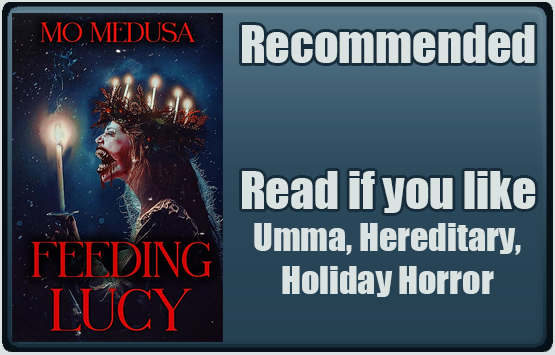
Feeding Lucy by Mo Medusa

Feeding Lucy by Mo Medusa

Formats: Print, digital

Publisher: Crooked Foot Press

Genre: Occult

Audience: Adult/Mature

Diversity: Lesbian main character, queer, non-binary author

Content Warnings (Highlight to view): Alcohol Abuse, Animal Death, Cannibalism, Death, Gore, Gaslighting, Gore, Sexism Verbal/Emotional Abuse, Violence, Vomit 

Blurb

Frankie left home ten years ago, abandoning the tall mountains of her small hometown for the tall buildings of the big city. Desperate for a new life, she was happy to escape her overly-critical mother and the Polish-American customs of her past.

But after a strange caller informs her of her mother’s sudden death, she’s reluctantly drawn back to the mountains for the first time in a decade.

Arriving days before the Scandinavian tradition of Sankta Lucia, the town is aglow with holiday lights and cheer—and the townspeople can’t stop talking about the annual Feast of St. Lucy.

When an unexpected blizzard rolls through, revealing the true nature of the feast—and the evil that resides in the mountains—the darkness of her mother’s past is brought to light once again.

Caught between tradition and terror, Frankie quickly learns that her mother’s overbearing influence won’t be stopped by her death alone.

Taking elements from The Night of the Witches in Polish folklore, and the real tradition of Sankta Lucia, Feeding Lucy is a story of grief, tradition, and the darkness that lives inside of us all.

I received this product for free in return for providing an honest and unbiased review. I received no other compensation. I am disclosing this in accordance with the Federal Trade Commission’s 16 CFR, Part 255: Guides Concerning the Use of Endorsements and Testimonials in Advertising.

Frankie, or Franciska, as her mother calls her, is suffering through an awkward holiday party at her job when she gets the call that her mother has died. Frankie had a complex relationship with her volatile mother, Lucja. The two lived together in an old farmhouse in the middle of nowhere along with Lucja’s ancient, cranky cat, Zula. Growing up, Frankie felt like her mother loved that old cat more than her. She doesn’t expect affection from her mother because it is so rarely given, and eventually stops expecting everything at all. Lucja is both overbearing and withholding as a mother, obsessing over everything her daughter does one moment, then punishing her with the silent treatment the next. Frankie fears disappointing her mother above all else, yet always seems to do so. Lucja judges everything her daughter does, what she wears, and even what she displays in her room. She grows to hate Lucja, and gets away from her the first chance she gets. Frankie moves to the city, gets a job at a magazine, and joins the local queer scene. She goes no contact with her mother and forgets all about her until she gets the call. Frankie has no interest in her mother’s body, or returning to their small town, but the coroner promises her that Lucja left her a “pretty penny” and she’ll need to come back to her hometown if she wants to collect the insurance money.

Franciska is from Kolbe, a town built by immigrants all from the same small village in Poland, whose descendants are determined to keep their traditions alive. To Franciska, it seems more like they can’t let go of the past. One of their most important traditions is Sankta Lucia (Saint Lucy’s Day) a Catholic feast day commemorating the Sicilian saint who was martyred during the Diocletianic Persecution by the Roman Empire. Saint Lucy’s Day is held on December 13th and is viewed as a precursor of Christmas Day. Because the name Lucia is derived from the Latin “lux,” meaning “light,” and her feast day is celebrated during the darkest time of year, Saint Lucy’s Day is considered a “festival of light” meant to drive away the darkness, similar to Diwali or Hannukah. Young girls dress up as Saint Lucy, in a white robe with a red sash and a wreath of candles on their heads. Songs are sung and saffron buns eaten.
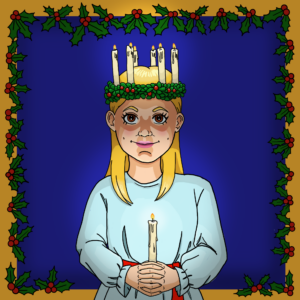
A drawing of a girl with long blond hair and brown eyes wearing a white dress with a red sash. Oh her head is crown of green leaves, red berries, and six white candles. She is holding a seventh candle and it's casting shadows on her face. The picture has a dark blue background with a gold border and holly leaves surrounding the image.

An example of what girls wear for Saint Lucia

Interestingly, Lucia shares her holiday with another Lucy, the Scandinavian Lussi. Lussinatta, or Lussi’s Night is similar to the legend of the Wild Hunt, where Lussi and her band of trolls, witches, and undead spirits would spend the darkest night of the year searching for unsuspecting humans who had stayed out too late or not finished their chores. Those who had not finished spinning yarn or threshing could expect to have their chimneys smashed. Those who were especially unfortunate would be whisked away by Lussi, never to be seen again.

And wouldn’t you know it, Frankie has arrived in Kolbe just in time for the annual Saint Lucy’s feast her mother always organized and the town’s people are very invested in making sure Lucja’s estranged daughter attends the feast (red flag number one). But Frankie just wants to get her inheritance and go back to the city. That is, until she runs into her long-lost love, Stella, working at the coroner’s office. Frankie is so smitten with her former girlfriend that she immediately agrees to stay for Sankta Lucia despite her initial hesitation, and gives Stella a pass for her strange, mercurial behavior (red flag number two). She only briefly wonders how it’s possible that Zula, who was already an old cat when Frankie was a child, is still alive (red flag number three). Even the disturbing visions Frankie starts having during the day, and the horrible nightmares when she sleeps, don’t clue her in to the fact that something is deeply wrong in Kolbe.

I appreciated the depiction of Lucja and Frankie’s dysfunctional relationship. The more we learn, the clearer it becomes that Lucja is emotionally abusive to her daughter, but as is often the case when there’s no physical component, the abuse is not immediately obvious. Lucja uses guilt to manipulate and control her daughter, alternating between coldness and gentle affection. Her love is conditional and young Frankie feels like she has to earn it.

An estranged adult child returning to their small town only to discover the town’s dark secret is one of my favorite horror tropes (seen in such films as Salem’s Lot and Dead Silence), so this was right up my alley. The story has a witchy vibe and a dark, moody atmosphere that makes reading it feel like the calm before the storm (or blizzard in this case). This slow burn horror is perfect for a dark winter’s night.

It’s Only a Game by Kelsea Yu

It’s Only a Game by Kelsea Yu

Formats: Print, audio, digital

Publisher: Bloomsbury YA

Genre: Mystery

Audience: Young Adult

Diversity: Chinese American main character and Taiwanese Chinese author, Black major character, Indian American major character, transgender major character

Takes Place in: Seattle, Washington

Content Warnings (Highlight to view): Bullying, Child Abuse, Child Death, Child Endangerment, Death, Forced Captivity, Gaslighting, Mental Illness, Physical Abuse, Self-Harm, Stalking, Suicide, Transphobia, Verbal/Emotional Abuse, Victim Blaming

Blurb

In this twisty, fast-paced YA thriller, a dangerous game becomes all too real when Marina and her friends are framed for murder.

When Marina Chan ran from her old life, she brought nothing with her-not even her real name. Now she lives in fear of her past being discovered. But when her online gaming team is offered a tour of their favorite game company, Marina can’t resist accepting, even though she knows it might put her fake identity at risk.

Then the creator of the game is murdered during their tour. Whoever killed him plans to frame Marina and her friends for the murder unless they win four rounds of a dangerous game. A game that requires them to lie, trespass, and steal. A game that could destroy everything Marina’s worked so hard to build…. A game that she might not survive.

It’s Only a Game is a story about parental abuse, found family, and video games, all wrapped up in a murder mystery.

The beginning of the book really grabs the reader and makes it clear this is going to be a gripping narrative. At the start, all we know about main character Marina Chan is that she’s a runaway teen living illegally in a Chinese restaurant/game café, and that she must hide her identity from everyone. That means no school, no ID or paper trail, and no letting anyone get too close. The only relationships Marina has are with the owners of Bette’s Battles and Bao, who kindly allow her to live there, and her three online friends: RockSplice (Rock), Dreadnaughty (Dread), and Syldara (Syl). Marina has a MASSIVE crush on Syl. The four of them met through a PC game called Darkitect, a combination MMORPG (short for massively multiplayer online role-playing game) and level designer where Marina plays under the alias Nightmar3 (Night for short).  Their favorite level designer is a mysterious programmer named Cíxĭ (pronounced like tsuh-SHEE), who took her name from an Empress Dowager who ruled China during the late Qing dynasty. I like that Cíxĭ’s name has the accents when Marina says it, indicating that she uses the correct Mandarin inflections, as compared to her non-Chinese friends who pronounce it as Cixi (without the accents).

After beating an especially challenging level she designed, the four gamers score exclusive invites to one of Cíxĭ’s new levels. As thrilled as Marina is at the prospect of playing a new level designed by the elusive programmer, she’s even more excited knowing that tomorrow she’ll be meeting her online friends in real life for the first time on top of getting a tour of getting a tour of Apocalypta Games (the creators of Darkitect). Things couldn’t be better.  Meeting her friends for the first time goes exceptionally well, and Rock, Dread, and Syl immediately accept Marina as one of their own.

Rock is a slender Indian American guy whose parents run security for Apocalypta Games. Dread is a tall, white guy, and the oldest, who interns at Apocalypta. Finally there’s Dread’s cousin, Syl, a gorgeous and glamorous Black girl who’s the girly-girl to Marina’s tomboy. I love that Syl’s character enjoys girly things, like makeup, dresses, heels, and stylish nails, while still being very into video games. While the rise in popularity of Twitch has shown that women who play video games are a diverse group, I remember when feminine gamers were accused of only doing it for male attention, and “real gamer girls” were tomboys. While this stereotype has somewhat changed over the years, women gamers are still subject to a great deal of harassment. But the guys in Marina’s gaming group are completely supportive of the two girls and the friends manage to avoid most of the toxicity in the gaming world.

Two chibi style drawings of Marina (wearing her trademark black hoodie and leggins) and Syl (a girl with her hair in twists wearing a green dress). They are on a blue background that has drawings of different gaming controllers. Underneath it says

Marina and her crush, Syl

The tour is great, with the owner of the company, Ethan Wainwright himself, showing the group around. He even invites Marina to contribute her art to Apocalypta’s quarterly magazine, and offers her and her friends exhibitor badges for PAX West. Originally known as Penny Arcade Expo, PAX West, along with the other PAX conventions, is one of the largest gaming conventions in the US, so this is a HUGE deal. Marina can barely contain her excitement and is having the best day of her life, that is, until she and her friends find the body. What follows is a page-turning murder mystery that tests the limits of Marina’s newfound friendships.

Marina’s mysterious past is slowly revealed over the course of the book. She lived with her overprotective mother, but never knew her father (her mother says he was a “bad man”). We know she must hide who she is, but we’re not sure why. We also discover that Marina suffered from emotional abuse. Trauma from her past has made her private and slow to trust, as her mother made sure Marina was completely dependent on her. The Confucian concept of filial piety (Xiao) an important aspect of Chinese culture, seems to play a role in Marina’s abuse. Chinese American reddit user CauliflowerOk7056 argues in his college essay entitled “Beat Him till the Blood Flows”: How Confucianism and Traditional East Asian Culture Can Enable Child Abuse that, in addition to poverty, a major contributor to  Chinse and Chinse American child abuse is filial piety. In it he states “Sadly, as well-intentioned as Confucius’ ideal may have been, filial piety has its issues that can be exploited to justify child abuse. For one thing, its undue emphasis on strict obedience from children sets a precedent that can provide some leeway for abusive parents.”

However, he is quick to explain that Confucianism in and of itself does not encourage abuse, and even suggest that children hold their parents responsible. Psychotherapist Sam Louie explains “As [Asian American] clients talk about the emotional and/or physical abuse, they will often defend their parents saying something to the effect of, ‘They did the best they could,’ or ‘I knew they still loved me.’ It isn’t until more trust is developed that I can confront their inability to see how abuse can and often does happen within ‘loving’ households and relationships in general.” One of the reasons it takes so long for Marina to recognize her mother’s abuse is because her mother constantly tells her how much she loves her. When Marina asks to go over to a friends’ house, her mother refuses explaining she “loves [Marina] too much”to let her go. Additionally she guilts Marina for wanting friends and successfully isolates her (another hallmark of abuse), asking “Am I not enough for you? Am I so bad that you have to get away from me?”

Asian Americans, especially Asian American immigrants like Marina’s mother, also underutilize mental health services creating a “major mental health disparity” according to entitled Use of Specialty Mental Health Services by Asian Americans With Psychiatric Disorders. While it’s certainly not an excuse, and plenty of mentally ill individuals still make great parents, her mother’s mental health may have also played a role in the way she treated Marina. It’s important to note that, while Marina’s abuse may have cultural elements to it, child abuse is not unique to any one race or culture, and in fact a research study entitled Child Maltreatment Among Asian Americans: Characteristics and Explanatory Framework points out that “The reported rate of child maltreatment among Asian Americans is disproportionately low” compared to other racial and ethnic groups (though this may be partially due to under reporting). When calculating the risks of child abuse, poverty and inequality are leading factors, along with intergenerational trauma, stress, isolation, and a lack of a support system.

Yu puts a lot of emphasis on the importance of building supportive relationships, especially when you don’t have family to rely on. I appreciate that Yu believes that online friendships can be just as important as face-to-face ones. As a millennial, I grew up in the early days of the internet when adults firmly believed everyone online was a predator and forming online friendships was new territory. Yet, despite the warnings from overprotective adults, I still formed meaningful relationships with people I met online.

I met one of my best friends on LiveJournal. I would have never known my wife if she hadn’t joined our friend’s group through Meetup. For a kid who grew up in a small town who had trouble finding others my age with the same niche interests as me, the internet gave me a way to feel less alone, just like it did for Marina. These days 57% of teenagers meet a new friend online, and those relationships can be just as meaningful as face-to-face ones.

While you don’t have to be a gamer to enjoy It’s Only a Game it definitely helps since non-gamers are unlikely to recognize some of the references and terminology, which Yu doesn’t bother to explain or elaborate on (I had to look up what AoE stands for). Most of the action takes place within the world of Darkitect so readers who have never felt the excitement and suspense of playing a video game with fighting elements may not get as much out of those scenes. On the plus side, all the gaming elements are likely to appeal to reluctant readers who prefer World of Warcraft over books.

Splinter by Jasper Hyde

Splinter by Jasper Hyde

Formats: Print, digital

Publisher: The Magnificent Engine

Genre: Folk Horror, Killer/Slasher, Occult, Myth and Folklore, Romance

Audience: Adult/Mature

Diversity: Black main character and author, Filipino British main character, asexual (demisexual) main character and author, bisexual main character, main character with ADHD, Trans masc/Non-binary author

Takes Place in: Sleepy Hollow, NY

Content Warnings (Highlight to view): Ableism, Bullying, Death, Drug Use/Abuse, Medical Procedures, Mental Illness, Police Harassment, Racism, Torture 

Blurb

In a small town hidden behind the hills of New York, things are far from ordinary. As Sleepy Hollow’s youngest Medical Examiner, the pressure intensifies for Dr. Drusilla Van Tassel when the headless bodies of her sister Katrina’s friends start surfacing. Meanwhile, Drusilla’s ex-lover Ichabod Crane returns to town, dredging up feelings better left buried.

Things take a turn for the worst when Drusilla comes face-to-face with the Headless Horseman, who is back to settle old scores – and she and her sister are the perfect targets. Drusilla can repel the horseman with an unknown power, but her sister isn’t so lucky, and she goes missing.

However, when Drusilla discovers Ichabod is a monster hunter, she has no other choice but to turn to him for help. Even if that means working with a man she feels an inexplicable attraction to. Will they find Katrina and banish the headless horseman once and for all?

I received this product for free in return for providing an honest and unbiased review. I received no other compensation. I am disclosing this in accordance with the Federal Trade Commission’s 16 CFR, Part 255: Guides Concerning the Use of Endorsements and Testimonials in Advertising.

If you decide to read Splinter, keep in mind that this story comes from a small, indie publisher and didn’t benefit from a professional editor. There are quite a few grammar errors sprinkled throughout. I didn’t find them particularly distracting, and the quality of the writing was still good, but I know this will bother some readers. I would encourage them to give Splinter a chance anyway, as it really is an enjoyable story and I hope my review will encourage you to check it out.

Dr. Drusilla Van Tassel is our main character, and I kind of love her. She’s an introverted, bisexual, horror fan who just wants to do her job as a medical examiner, and I can relate to that. Her sister Katrina, on the other hand, is outgoing, popular, and prefers her rich, white friends over her own sister. But Drusilla is just as hostile to Katrina, so it’s not your stereotypical mean girl situation. I found it interesting how Drusilla can relax and use AAVE in front of her Black assistant (and former lover) Kyndall, but codeswitches with Katrina like she does around white people. It underlines how “other” Katrina is from her and how uncomfortable Drusilla feels in her own sister’s presence. Although, she does feel guilty for not doing more to support Katrina when her husband Brom died under mysterious circumstances.

One night Drusilla is called in to deal with a murder, and the victim is no other than Denis Carter, Katrina’s close friend. Poor Drusilla just can’t catch a break! At the crime scene, we see firsthand the racism and sexism Drusilla faces on a regular basis from the law enforcement officials she has to work alongside when one rookie cop tries to stop her from entering the crime scene. Despite having graduated Magna Cum Laude from Cornell she still gets treated as a “Black girl playing dress up.”

Then Katrina’s former friend and lover, Ichabod Crane (who I like to imagine looks like Piolo Pascual), shows up out of the blue and starts pestering her for details of the strange murder. Because they ended things badly, she isn’t exactly thrilled to see him. But when another murder takes place, the two are forced to set aside their differences and work together. What follows is a fun, supernatural mystery with a great sex scene. This was the first time in a story I’ve seen someone on the asexual spectrum have sex. Not only are asexual character underrepresented in fiction, but they’re often stereotyped as always being completely sex adverse, which just isn’t true, especially in the case of people who are demisexual like this particular character.

I really appreciate that Hyde not only put the effort into getting Filipino sensitivity readers, but also included their email in the beginning of the story for anyone to reach out to them if they made any mistakes in representation. I wish more authors would do that!

If you were a fan of the Fox tv series Sleepy Hollow that aired from 2013-2017, but hated the way they treated Nicole Beharie and her character, this book is for you. It feels like a remedy to the show without being a fix-it fanfiction. Instead, Splinter gets to be its own thing. It’s a quick, compelling read that sucks you in, helped in no small part by its compelling and complex characters.

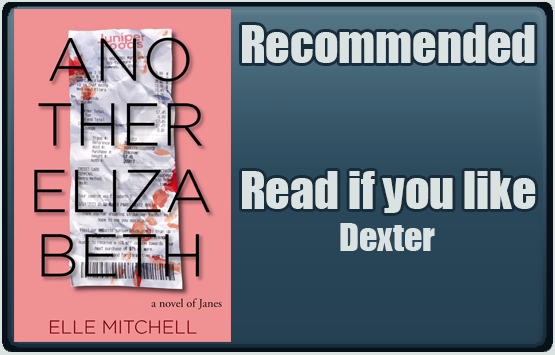
Another Elizabeth by Elle Mitchell

Another Elizabeth by Elle Mitchell

Formats: Print, audio, digital

Publisher: Little Key Press

Genre: Killer/Slasher

Audience: Adult/Mature

Diversity: Main character and authors with hypermobile Ehlers-Danlos Syndrome (hEDS), bisexual main character

Takes Place in: Oregon

Content Warnings (Highlight to view): Ableism, Animal Abuse, Animal Death, Body Shaming, Imagined Cannibalism, Imagined Child Abuse, Imagined Child Death, Death, Forced Captivity, Gaslighting, Mental Illness, Pedophilia, Physical Abuse, Police Harassment, Self-Harm, Slurs, Sexism, Suicide, Verbal/Emotional Abuse, Violence

Blurb

Another Elizabeth is a gripping literary psychological crip horror novel that readers will sink their teeth into. Fans of dark humor and challenging fiction will be thrilled to delve into the mind of a deeply flawed disabled woman with a desire to kill.

Elizabeth’s life is taking a turn.
She has three jobs, a boyfriend that loves her too much, and a recent diagnosis of Hypermobile Ehlers-Danlos Syndrome. She’s coming apart at the seams. Now all she cares about is keeping her promise to her younger self before her body fails her—kill without getting caught.

Will she physically be able to satisfy her urge while maintaining her carefully built façade of normalcy? And if so, will she be able to stop with just one victim?

I received this product for free in return for providing an honest and unbiased review. I received no other compensation. I am disclosing this in accordance with the Federal Trade Commission’s 16 CFR, Part 255: Guides Concerning the Use of Endorsements and Testimonials in Advertising.

Inspiration porn is a real problem when it comes depicting people with disabilities. The term was originally coined by disability activist and comedian Stella Young. As Young puts it in her 2014 TED talk in Sydney, “We’re not real people. We are there to inspire.” She explains that we have been sold the lie that disability is a bad thing, and therefore living with a disability makes you exceptional. One of the reasons I love Another Elizabeth is because I thought of inspiration porn while I was reading it and what the reactions of able-bodied people might be. Elizabeth has Hypermobile Ehlers-Danlos syndrome (hEDS), which, if you’re not familiar, is a genetic condition that causes connective tissue to weaken resulting in hypermobility in the joints and chronic pain. She works at a grocery store called Juno Foods with her boyfriend, teaches ESL classes, and kills people who piss her off.  That’s right, Elizabeth “overcomes” her invisible disability despite struggling with pain and weakness to become a serial killer! How inspirational!

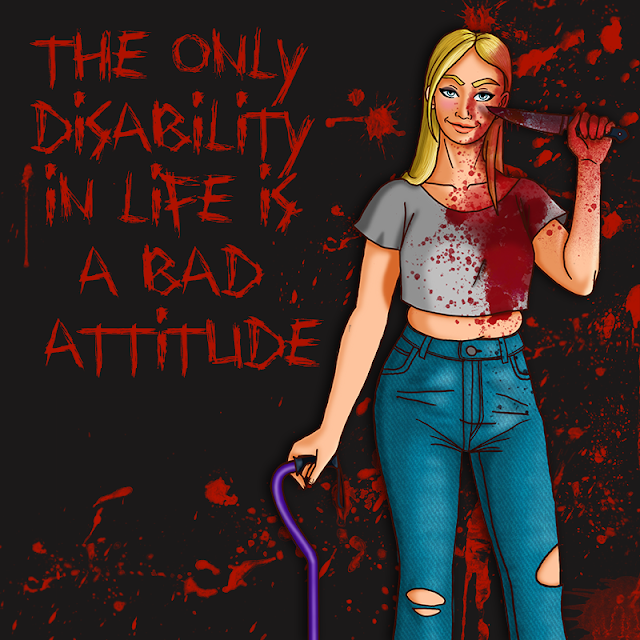
A drawing of Elizabeth wearing a gray T-shirt and jeans and leaning on a purple cane. In her other hand she holds a bloody knife. Her clothing is covered in blood. Behind her is a black, blood spattered background with bloody red lettering that reads "the only disability in life is a bad attitude."

All joking aside, I loved reading a book where the main character has  disability, written by someone with a disability (and not some well-meaning ally) that isn’t meant to inspire non-disabled people or demonize people with disabilities. Elizabeth is a great character. She shows hints of being a sociopath, is an expert manipulator, and often fantasizes about hurting others. When her doctor suggests she start using a cane, Elizabeth immediately wonders if she’ll use it for anything other than bashing people’s brains in. Even innocent things bring out the darkness in Elizabeth. When she sees babies, she imagines how easy it would be to break their fingers, and when she makes candy, she fantasizes about putting poison in it.

Yet she still seems to care about her friend, her ESL students, and her himbo boyfriend on some level, so she’s not completely heartless. Or at least Elizabeth admits she wouldn’t murder any of them. Awwwwww. In fact, she only kills people who she believes deserve it, like an ableist woman who abandoned her family after her husband became paralyzed, an obnoxious coworker, and maybe the odd pedestrian here and there. The fact that she happens to like their teeth is just a bonus. In her free time Elizabeth watches forensics shows and reads true crime novels for inspiration. This means she is meticulous about covering her tracks. I found myself greatly appreciating Elizabeth’s hyper-competence when it came to crime, carefully planning each murder down to the very last detail. Elizabeth is also someone who is usually good at whatever she tries, despite putting little effort into it, and this seems to apply to being a serial killer. Because she can’t physically overpower her victims, Elizabeth gets very creative finding ways to make her murders more accessible.

Villains with disabilities in fiction are often portrayed in a problematic way, at least when written by the non-disabled. They are the monstrous “other,” whose moral corruption manifests physically as disability. Jan Grue, is a Norwegian academic, author and actor (best known for role as Ivar Salvesen in Occupied) who uses a wheelchair. In his Guardian article The Disabled Villain: Why Sensitivity Reading Can’t Kill Off This Ugly Trope Grue writes “This particular trope, wherein a character’s moral and physiological natures mirror each other, is as universal as it is ancient. It is reflected in the philosophy of Plato, in commonplace phrases like ‘a healthy mind in a healthy body,’ and in the foundational texts of the cultural canon. In Buddhist tradition, too, disability has been construed as an impediment to understanding and enlightenment – and even, for some, as a punishment for actions in a past life.”

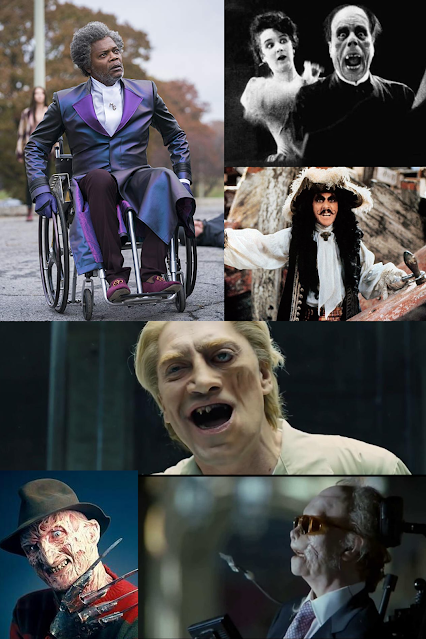
The Take’s video Why the “Disabled Villain” Trope is So Offensive, explains that disability is “used as a metaphor for villainy or moral failing.” In an interview with Den of Geek after the release of Skyfall, producer Michael G. Wilson explains, “It’s very much a Fleming device that he uses throughout the stories – the idea that physical deformity and personality deformity go hand in hand in some of these villains. Sometimes it’s a motivating factor in their life, and what makes them the way they are.” In other words, those with disabilities are assumed to despise their condition because being disabled is undesirable, and they seek to harm the able bodied. Unfortunately, this metaphor can cause real-life harm, as it reinforces the idea that having a disability is “bad” and difference is “scary.” Horror is especially notorious for using the “Evil Cripple” trope, with famous villains like Freddy, Jason, and Leatherface all sporting physical disfigurements. Other famous examples of disabled villains are the Phantom from The Phantom of the Operamultiple James Bond antagonists, Mr. Glass in Unbreakable, Mason Verger from Hannibal, Captain Hook from Peter Pan, Mr. Potter from It’s a Wonderful Life, and Darth Vader from Star Wars.


Mr. Glass from Unbreakable (top left), The Phantom from the Phantom of the Opera (top right), Captain Hook from Hook, Raoul Silva from Skyfall, Freddy Krueger from Nightmare on Elm Street (bottom left), and Mason Verger from Hannibal (bottom right). None of the characters pictured here are portrayed by disabled or disfigured actors.

lizabeth is a villain protagonist with a disability, she’s an incredibly well written, well-rounded character. She’s an evil (or at least morally gray) character who also has a disability, rather than a character who is evil because of a disability. Most importantly, Elizabeth is written in such a way that the audience is rooting for her sociopath self and able to relate to her. (Or at least I was. Who among us hasn’t fantasized about killing awful people?) Usually, villains with disabilities are written in such a way that they feel alien and are frightening in their strangeness, and this is accentuated by their disability or disfigurement.  Instead of seeming scary because of her disability, Elizabeth finds the opposite to be true. People assume she’s helpless: something she uses to her advantage. When suspicion falls on her, Elizabeth plays up her disability, relying on other people’s ableism so they think she’s innocent. It also helps that the author has hEDS herself, so the book is Own Voices and Elizabeth’s character just hits differently.

Because the narration is first person, we get to see Elizabeth’s detached way of looking at the world and her twisted way of thinking. We get an intimate look at her struggles, both keeping her “other life” a secret and trying to kill victims when she’s not as strong as an able-bodied male killer. And of course, we get to learn about her frustration when dealing with her chronic pain and her boyfriend’s annoying abundance of concern for her. He’s convinced that she’s too fragile to function, yet doesn’t have the same concern for her comfort during sex. Side note, I love that Elizabeth gets to have hot sex scenes with her boyfriend. People with disabilities almost never get to have sex in fiction. In fact, outside of Mat Fraser in American Horror Story, George Robinson in Sex Education, and Peter Dinklage in Game of Thrones, I don’t think I’ve ever seen anyone with a disability have sex in popular media (and of course those examples are all white, cisgendered men with conventionally attractive faces).

Another Elizabeth is a fascinating look into a twisted mind with a character that you can’t help but root for despite the fact she’s a serial killer who manipulates others. The story is the perfect length, not so long that it drags but not so short that it feels rushed. The second half of the book is especially exciting and the story is interspersed with bits of dark humor.

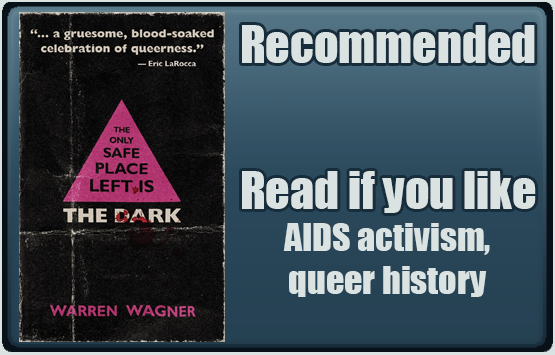
The Only Safe Place Left is the Dark by Warren Wagner

The Only Safe Place Left is the Dark by Warren Wagner

Formats: Print, digital

Publisher: Ghoulish Books

Genre: Apocalypse/Disaster, Zombie

Audience: Adult/Mature

Diversity: Gay man author and main characters, main characters with AIDS

Content Warnings (Highlight to view): Animal Death, Child Death, Death, Drug Use/Abuse, Homophobia, Illness, Medical Procedure, Slurs, Suicide

Blurb

In The Only Safe Place Left is the Dark, an HIV positive gay man must leave the relative safety of his cabin in the woods to brave the zombie apocalypse and find the medication he needs to stay alive.

I received this product for free in return for providing an honest and unbiased review. I received no other compensation. I am disclosing this in accordance with the Federal Trade Commission’s 16 CFR, Part 255: Guides Concerning the Use of Endorsements and Testimonials in Advertising.

I was born during the beginning of the AIDS outbreak, during which my mom lost many of her gay friends. I remember the deep-rooted fear of AIDS that existed during my childhood. In grade school, we attended assemblies about the dangers of AIDS and how it was spread. There were public service ads about AIDS on every TV station. Parents wore red ribbons. As a queer teen I mourned the loss of an entire generation of gay and bisexual men.

One of the doctors I work with through my hospital, a gay man in his eighties who was one of the first physicians to treat AIDS patients, told me about the weekly funerals he attended. No one cared that gay men were dying of a mysterious illness during the conservative Regan administration. Little research was done on the epidemic. This doctor was one of the few who treated AIDS patients back then, using his knowledge of pharmacology to create a treatment regimen through off-label uses of already existing drugs. Of course, he couldn’t openly advertise his services due to the stigma in the medical community, so his patients found him through a whisper network and would visit him under the guise of getting a routine physical.

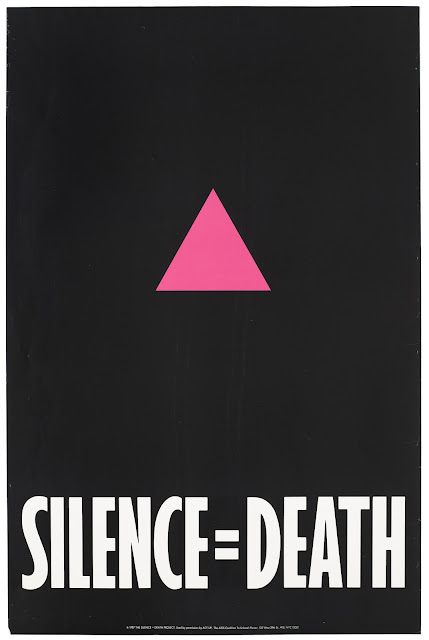
The Only Safe Place Left is the Dark is a unique zombie apocalypse novella about the AIDS epidemic. The cover of book is meant to invoke the iconic Silence=Death AIDS design from the late 1980s (a poster Quinton keeps in his Cabin). The title of the story comes from a quote in the play The Destiny of Me by writer and activist Larry Kramer, who is best known for co-founding the grassroots political group the AIDS Coalition to Unleash Power (ACT UP).  In the first chapter of the book, Wagner references a New York Times article from July 3, 1981 entitled Rare Cancer Seen in 41 Homosexuals. The article discusses an outbreak of Kaposi’s Sarcoma in New York and San Francisco, a form of cancer that can form lesions on the skin and in the mouth. It wasn’t yet known, but this sub-type of KS was caused by the immune suppression from some of the first HIV cases in the country.

A black poster with a pink triangle on it. Underneath is white font that says "Silence = Death"

Wagner’s zombie virus (if it even is a virus) is particularly terrifying because its victims, referred to as “The Afflicted,” are still awake and aware of what’s happening to them and powerless to stop it. They can feel themselves rotting and falling apart, even being eaten by flies. The zombies don’t want to hurt anyone but are completely unable to control their hunger, so they’ll scream warnings to their victims and plead for forgiveness as they tear them apart. Most disturbingly, they’ll beg uninfected humans to kill them. I suspect the Wagner’s zombies are loosely based on AIDS victims, as zombies are often an allegory for infectious disease. In her journal article Attack of the Living Dead Virus: The Metaphor of Contagious Disease in Zombie Movies English professor Cecilia Petretto explains that, “Much of our fear lies within the nature of disease itself… Disease, ugly as death, has its association with evil stemming back to the Black Plague.” What was known about AIDS was largely based on misconception, and AIDS victims were shunned and regarded as dangerous, much like the Hollywood zombies. In 1986, an article published in the Journal of the American Medical Association about AIDS was entitled Night of the Living Dead II: Slow Virus Encephalopathies and AIDS. Dr. Arthur Fournier, who encountered his first AIDS patient in 1979 while working with Miami’s Haitian community, compared the virus to “the zombie curse.” Before the advent of active antiretroviral therapy (ART), an AIDS diagnosis was often a death sentence. In that way AIDS patients were like the living dead, dying but not truly dead as their bodies were slowly destroyed and they wasted away. Wagner even describes them as “Waiting for a cure. Waiting for the end. They weren’t dead yet, but they weren’t alive either. They were zombies.”

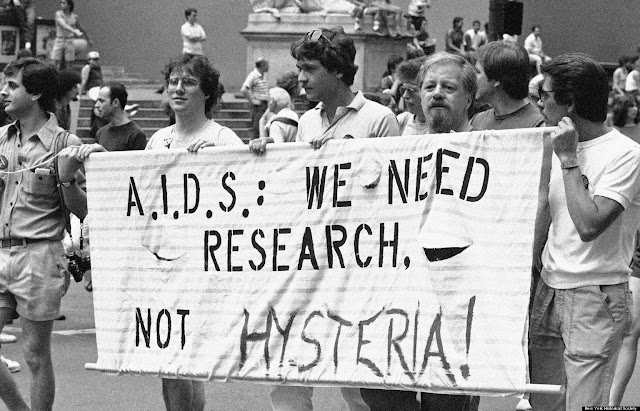
A group advocating AIDS research marches down Fifth Avenue during the 14th annual Lesbian and Gay Pride parade in New York, June 27, 1983. This year’s parade is dedicated to victims of the incurable disease AIDS which primarily afflicts homosexual men. (AP Photo/Mario Suriani)

A group advocating AIDS research marches down Fifth Avenue during the 14th annual Lesbian and Gay Pride parade in New York, June 27, 1983. This year’s parade is dedicated to victims of the incurable disease AIDS which primarily afflicts homosexual men. (AP Photo/Mario Suriani)

Kept alive for 26 years by his antiretroviral medication, Quinton is one of the few humans who survived the zombie apocalypse–survived being the operative word, as he’s not really living, just surviving. He’s all but given up on love and compassion or anything ever getting better. His love for his deceased boyfriend, Frankie, brought him so much pain he’s now become a gruff loner. It’s safe to say Quinton may also be suffering from survivor’s guilt, as both he and his boyfriend were HIV positive but he survived while Frankie died. Worse, Frankie died when Quinton wasn’t there. The story switches between Quinton’s memories of Frankie’s last days and the present.

While out scavenging for more antiretroviral, Quinton meets Billy, a fellow gay man who’s managed to survive the apocalypse and is also HIV positive. But while Quinton has become cold, Billy still openly cares for others, which Quinton sees as a liability. Billy also believes in working together and the importance of community, while Quinton prefers to avoid other people. We learn that one of the reasons Billy has stayed alive so long is because those who are HIV positive are immune to the zombie virus. I thought this was an interesting twist, as outside of The Last of UsCooties, and Blood Quantum I’ve never seen a human with a natural immunity to Zombies in media. AIDS ravages the immune system, yet for some reason protects Quinton and Billy from turning into Afflicted. Being the kind of person who reads science articles about theoretical zombie biology, I did want to know how it all worked, but honestly an explanation isn’t important to the narrative.  

I had a few nitpicks when it came to Billy, a Black character. While he was written well, “Black” was not capitalized when describing him. When referring to race, Black should always be capitalized. Billy was also described as having dreadlocks. As far as I know Billy was not a Rastafarian, therefore his hairstyle should be referred to as locs, not dreadlocks. While these examples are relatively minor issues, it does highlight the importance of doing your research and using sensitivity readers when writing about groups different than your own.

Wagner’s writing is very spartan; there are no grandiloquent descriptions or deep introspections. Instead, he gets his point across without the need for flowery adjectives or metaphors. The only part where this proved an issue for me was when it came to Quinton and Billy’s relationship, which felt very rushed. Otherwise, I appreciated Wagner’s straight-to-the-point style. It’s not often we get a new take on Zombies, but Wagner’s Afflicted managed to add a whole new level of horror to the undead. The history of AIDS is seamlessly interwoven, never forced, throughout the narrative. Wagner uses horror fiction to not only educate readers in a way that feels natural and respectful, but to capture the feelings of despair no doubt felt by many during the AIDS epidemic. The message is clear. Having AIDS may feel bleak, and every day is a fight for survival, but even amongst all the horror there is always love and hope.

Green Fuse Burning by Tiffany Morris

Green Fuse Burning by Tiffany Morris

Formats: Print, digital

Publisher: Stelliform Press

Genre: Body Horror, Eco-Horror

Audience: Adult/Mature

Diversity: Mi’kmaw author and main character, queer main character, bisexual author

Content Warnings (Highlight to view): Animal Death, Death, Gore, Medical Procedures, Suicide, Verbal/Emotional Abuse

Blurb

The debut novella from the Elgin Award winning author of Elegies of Rotting Stars. After the death of her estranged father, artist Rita struggles with grief and regret. There was so much she wanted to ask him-about his childhood, their family, and the Mi’kmaq language and culture from which Rita feels disconnected. But when Rita’s girlfriend Molly forges an artist’s residency application on her behalf, winning Rita a week to paint at an isolated cabin, Rita is both furious and intrigued. The residency is located where her father grew up. On the first night at the cabin, Rita wakes to strange sounds. Was that a body being dragged through the woods? When she questions the locals about the cabin’s history, they are suspicious and unhelpful. Ignoring her unease, Rita gives in to dark visions that emanate from the forest’s lake and the surrounding swamp. She feels its pull, channeling that energy into art like she’s never painted before. But the uncanny visions become more insistent, more intrusive, and Rita discovers that in the swamp’s decay the end of one life is sometimes the beginning of another.

This is a book about grief, nature, and how death transforms. And when you’re finished, you’ll love wetlands and never look at fungi the same way again.

Despite being a landscape artist who relies on nature to make a living, Rita is very separated from it. She’s a germaphobe (due to her mother) who lives in the city with her white girlfriend Maddie. Rita also incorporates inspiration from her cultural heritage, despite being disconnected from that too. She’s barely in contact with the Mi’kmaw family. She only remembers bits of the Mi’kmaw her father taught her, and while she can recognize Gomgwejui’gasit (Suckerfish script), she can’t read it. This makes it difficult for her to talk to other family members when her father dies or receive the same level of community support as her half-brother, who lives on the reservation with the rest of their family. Rita feels alone in her grief because she’s so isolated from her family, with Maddie offering little support. Rita is not able to say goodbye to her father in his home, like she traditionally would, but in a hospital hooked up to machines, which traumatizes her. Rita’s grief over losing her father is so severe that she has PTSD. Morris describes her grief as a devouring green, a chlorophyll feeding and transforming Rita. She feels guilt (not uncommon for someone who’s grieving), afraid she’s not mourning “correctly” and that it’s selfish and impersonal.

Part of Rita’s alienation from nature also means she is not connected to the natural process of death and rebirth, despite feeling like she and the land are both dying, “flailing fish on a drying shore”. Mi’kmaw artist Alan Syliboy, who created an art exhibit that will focus on Mi’kmaw traditions around death, told CBC “…in Mi’kmaw society, death is not covered or hidden. When you’re a child, you’re aware [of it].” Rita, however, is surrounded by Euro-American culture, which rarely interacts with death outside the funeral industrial complex. One of the tenets of the death positivity movement is that hiding death behind closed doors and surrounding it with a  culture of silence  does more harm than good. Another tenet is that death should be handled in a way that “does not do great harm to the environment” and encourages green burials. Historically, both things would have been practiced in most cultures, but the invention of the toxic embalming process took death customs out of the home and created a for-profit industry. If you’re interested in learning more about the history of embalming and the birth of the funeral industry, my sister has made a great video about it here. Today, standard funeral practices such as embalming and cremation are devastating the environment, poisoning the land and air.

The theme of environmental devastation is present throughout the book. It’s the Frog Croaking Moon, Squoljikus (around May), but the heat from climate change makes the loons think it’s summer and Rita can hear their mating calls. The Mi’kmaw names for the months, like the Trees Fully Leafed Moon, no longer match seasonal changes. She describes the heat as “unbearable” and feels like she’s being smothered by it. A history of colonial violence is inexorably linked to the current environmental crisis. Colonizers brought with them industrialization and capitalism, treating nature and its resources as something to be exploited. Indigenous environmental justice addresses both the injustices suffered by Indigenous people and the current climate crisis. Kānaka Maoli (Native Hawaiian) organizer Kaniela Ing wrote “Indigenous communities are disproportionately impacted by the climate crisis because we maintain the closest ties to our natural environment.” He also wrote “Any climate solution would be incomplete without justice at its core. Kānaka Maoli, Native Hawaiians, should be central to the rebuilding and recovery efforts. We should have the authority to manage our lands and resources.”

The water protectors of the Standing Rock Sioux Reservation are probably the best known example of Indigenous environmental justice. There’s also Shiela Watt-Cloutier, an Inuit Indigenous rights activist, and author of the book “Right to be Cold.” In it she writes about how global warming is destroying her home by melting the permafrost and ice caps, and causing unpredictable weather patterns. Dario Kopenawa, a Yanomami leader, combats illegal gold mining and deforestation in the Brazilian Amazon. And Rick O’Rourke, fire and fuels manager of the Yurok Cultural Fire Management Council, uses traditional Yurok knowledge of controlled burns to prevent forest fires in the Klamath mountains of northern California.

Throughout the book nature is described in a way that makes it seem violent and alien, and Rita is shown to be fearful of it (she’s even terrified of harmless moths), with a good dose of body horror mixed in to represent her fear. But as time passes, and Rita feels her body being reclaimed by nature her fear slowly morphs into acceptance. She even considers walking into the forest and disappearing. Morris’ descriptions of Rita’s strong emotions and fears feels like a frenzied fever dream, with the environment becoming a character itself. Her descriptions of grief are powerful and moved me to tears as I remembered my own experiences with grieving. With Green Fuse Burning Morris has created a beautiful, deeply personal story that flows like poetry. 

Carousel by Sarah McKnight

Carousel by Sarah McKnight

Formats: Print, digital

Publisher: Kindle Scribe

Genre: Demon, Occult, Romance

Audience: Young Adult

Diversity: Main characters and author are queer women, main character has anxiety disorder

Takes Place in: LA, California

Content Warnings (Highlight to view): Ableism, Alcohol Abuse, Cannibalism, Child Death, Child Endangerment, Death, Forced Captivity, Gore, Kidnapping, Mental Illness (anxiety), Suicide

Blurb

Ladies and gentlemen, the show is about to begin…

All Laura Fitzpatrick wanted to do was tell her lab partner, Maddie, how she really feels about her, but when a perfect opportunity falls into her lap, Laura does what she does best – chickens out.  

Then, Laura is dared to check out the abandoned carnival grounds outside of town, and she seizes the opportunity to prove to herself and others that she can be brave after all. To her surprise, Maddie isn’t about to let her go alone.

As they explore the eerie property, they’re thrust into an endless night of terror, where danger lurks around every corner. With a century-old mystery waiting to be uncovered, Laura must learn what true bravery means if she hopes to get herself – and Maddie – out of the Plum Creek Carnival alive.

Whatever you do, don’t let the Carnival Man see you…

I received this product for free in return for providing an honest and unbiased review. I received no other compensation. I am disclosing this in accordance with the Federal Trade Commission’s 16 CFR, Part 255: Guides Concerning the Use of Endorsements and Testimonials in Advertising.

Oh Sarah McKnight, you had me at sapphic horror set in a creepy carnival.

Laura is an introverted highschooler riddled with anxiety and self-doubt. Instead of staying home watching horror movies (a girl after my own heart) she forces herself out of her comfort zone and attends a Halloween party hoping to run into her crush, Maddie. Even with her social battery almost completely depleted, Laura ends up staying for a game of Truth or Dare and a chance to confess her feelings. But when she’s dared to make out with Maddie in front of her classmates, Laura chickens out and instead chooses to go to the town’s old, abandoned carnival grounds for her dare. Maddie, a fan of urbex, volunteers to go with her. Will this be Laura’s chance to confess? Well, it’s a horror story, so of course it goes badly. The moment the two share a kiss on the carousel, they’re ripped into a reality outside of time where they, along with the other teens trapped there, are continuously hunted by the enigmatic Carnival Man.

Maddie is Laura’s opposite. She’s outgoing, adventurous, and is perfectly happy to visit a creepy, abandoned park, despite Laura’s misgivings. Interestingly, while initially appearing to be the braver of the two, Maddie is the first to give up when the two girls are trapped in the carnival, and Laura is forced to take charge. Laura does her best to find solutions that will allow them to escape their magical prison, while Maddie does her best to be supportive while not truly believing they’ll ever escape. The other teens trapped there are also hesitant to encourage Laura, as most of them have already lost all hope of escape. Some have even given into their grief and despair which causes them to behave desperately. But despite the odds, and everyone telling her it’s impossible, Laura refuses to give up.

I liked how Laura was terrified but still did what needed to be done, or as she says “feel the fear and do it anyway.” Brave characters conquering their fears are always more relatable than fearless ones. I found Laura’s undying hope endearing rather than irritating, as, despite her optimism, she was still practical and cautious. Her determination was inspiring and I absolutely loved her character growth as the story unfolded. My only complaint is I wish we had gotten to know the other characters a little better so their deaths would have more impact, but this is not uncommon in horror. Luckily, Laura and Maddie were extremely likable and relatable. As an anxiety-ridden, introverted, horror fan myself, it felt like Laura was written just for me. Meanwhile, I found Maddie’s adventurous spirit admirable because I’m often the one egging friends into exploring abandoned locations (and I would totally visit a creepy old carnival if I could). But once they were actually in danger, Maddie turned out to be the more practical of the two, discouraging Laura from taking unnecessary risks.

This was a particularly fun, creepy read. The pacing was perfect; the tension never let up and the story never dragged. The entire experience was like riding one of the carnival’s decrepit roller coasters, even when you weren’t screaming as you sped down a perilous drop or took a bank turn, you felt the dread of going up a lift hill, waiting for the inevitable fall. I read the entire book in one sitting, unable to put it down because I was so desperate to know how the Carnival Man’s prisoners escaped. (Would they escape??) Plus, it had the perfect horror story setting.

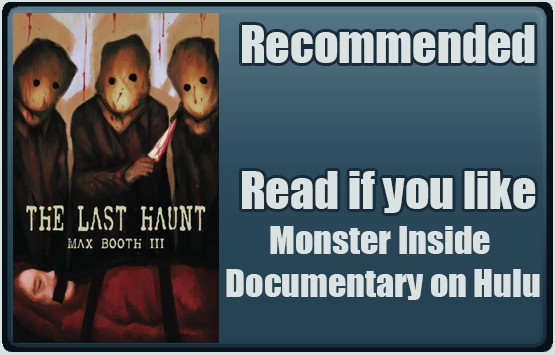
The Last Haunt by Max Booth III

The Last Haunt by Max Booth III

Formats: Print, digital

Publisher: Cemetery Gates Media

Genre: Ghosts/Haunting, Psychological Horror

Audience: Adult/Mature

Diversity: Non-binary author

Takes Place in: Texas

Content Warnings (Highlight to view): Ableism, Animal Death, Death, Forced Captivity, Medical Procedures, Physical Abuse, Racism, Slurs Torture, Verbal/Emotional Abuse, Vomit

Blurb

On the one-year anniversary of a young woman’s tragic death, an extreme haunted house attraction reopened its doors to the public. What happened next would forever traumatize a small Texas town. The Last Haunt is an attempt to make sense of the mysterious brutality that occurred on that fateful Halloween night. Constructed from interviews with the survivors, this oral history is the closest anyone has ever come to documenting the truth behind the McKinley Manor massacre.

I received this product for free in return for providing an honest and unbiased review. I received no other compensation. I am disclosing this in accordance with the Federal Trade Commission’s 16 CFR, Part 255: Guides Concerning the Use of Endorsements and Testimonials in Advertising.

I’m a big fan of haunted houses. I get really into them and let the scare actors do whatever they want to me (tie me up, tickle me, “drill” my teeth, lead me away from the group, etc.). My mother, sister, and I plan an October trip every year and the haunted houses we visit are always my favorite part. But they don’t really scare me. Of course, I don’t really expect them to. I’ve been hardened by horror and I’m difficult to frighten. But that’s okay with me, I still enjoy the creepy atmosphere and it never fails to make me giggle whenever I get startled by a scare actor. I still have fun. But some folks don’t get anything out of typical family-friendly “boo haunts.” They want something more intense. And that’s where “extreme haunts” like Blackout, Stag, and Miasma come in. These haunts are usually 18 and up (many of them contain nudity, sexual situations, and even simulated sexual assault), require a waiver and give you a safe word to use if things get to be too much. Actors are allowed to touch you and even manhandle you. Participants might be dunked in cold water, shocked, or have a bag put over their head, to name a few of the unpleasant experiences to expect.

Gus McKinely loves horror and scaring people. He was a horror fan growing up and his obsession with fear only grew as he became older. As an adult, he used to put on haunted houses for the neighborhood kids with his wife every year. But when an internet troll named Betty Rocksteady (who later becomes his lover and biggest fan) makes fun of his boo haunt, Gus becomes obsessed with creating the scariest haunted house ever. So, he creates McKinley Manor, the scariest and most extreme haunt in the country.

McKinley Manor is a play on McKamey Manor, a real-life extreme haunt put on by Russ McKamey. Several of the details are the same, such as donating a bag of dog food instead of paying an entrance fee, the haunt being year-round, the no-swearing rule, a promised cash reward if you can complete the haunt (which apparently doesn’t really exist), and the lack of a safe word (although McKamey reports he now uses a safe word or phrase). Even Gus McKinely is based on Russ McKamey, with both being former military who now work at Walmart. The biggest similarity to McKamey Manor, of course, is that this haunt isn’t really a haunted house with scare actors, but more of an endurance test where you get waterboarded in some guy’s backyard. Except no one has been killed participating in McKamey Manor.

Booth’s story is about taking something that’s supposed to be fun and twisting it into something ugly. McKinley is no longer interested in creating an enjoyable, scary experience; he just wants a reason to make people suffer. It’s implied he’s always been a bit of a sadist, trying to gross out his dad while he was eating and playing scary pranks on the other ensigns. These were people who didn’t want to be disgusted or scared. And while participants at McKinley Manor do consent to the experience, by not providing a safe word Gus essentially removes their ability to withdraw their consent at any time, meaning he’s just straight up abusing people. And he clearly loves abusing people, no matter what his former employee Zach Chapman, or his obsessive girlfriend, Betty say. In fact, Betty even admits to getting off on the torture herself. She even goes so far as to masturbate to a video of a girl named Jessica (who she refers to as “that bitch”) drowning at the Manor when a waterboarding session goes wrong. Of course, if anyone tries to criticize Gus, including Jessica’s grieving brother, he labels them as “haters” and sends his rabid fans after them. While the story has supernatural elements, it’s Gus and his followers that provide the real scares.

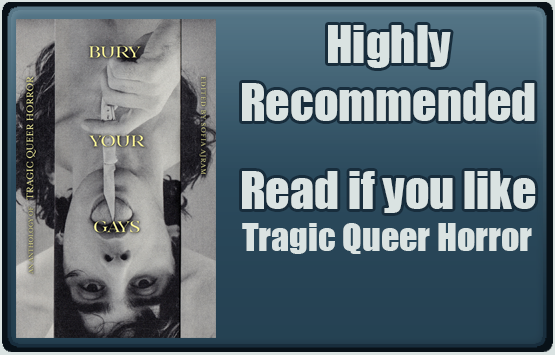
Bury Your Gays: An Anthology of Tragic Queer Horror edited by Sofia Ajram

Bury Your Gays: An Anthology of Tragic Queer Horror edited by Sofia Ajram

Formats: Print, digital

Publisher: Ghoulish Books

Genre: Anthology, Body Horror, Ghosts/Haunting, Killer/Slasher, Monster, Romance

Audience: Adult/Mature

Diversity: Queer and trans authors and characters

Content Warnings (Highlight to view): Alcohol Abuse, Body Shaming, Bullying, Death, Drug Use/Abuse, Eating Disorder, Homophobia, Medical Torture/Abuse, Medical Procedures, Necrophilia, Police Harassment, Rape/Sexual Assault, Slurs, Suicide, Torture, Transphobia, Violence

Blurb

A manifestation of ecstasy, heartache, horror and suffering rendered in feverish lyrical prose. Inside are sixteen new stories by some of the genre’s most visionary queer writers. Young lovers find themselves deliriously lost in an expanding garden labyrinth. The porter of a sentient hotel is haunted within a liminal time loop. A soldier and his abusive commanding officer escape a war in the trenches but discover themselves in an even greater nightmare. Parasites chase each other across time-space in hungry desperation to never be apart. A graduate student with violent tendencies falls into step with a seemingly walking corpse. Featuring stories from Cassandra Khaw, Joe Koch, Gretchen Felker-Martin, Robbie Banfitch, August Clarke, Son M., Jonathan Louis Duckworth, M.V. Pine, Ed Kurtz, LC Von Hessen, Matteo L. Cerilli, November Rush, Meredith Rose, Charlene Adhiambo, Violet, and Thomas Kearnes.

I received this product for free in return for providing an honest and unbiased review. I received no other compensation. I am disclosing this in accordance with the Federal Trade Commission’s 16 CFR, Part 255: Guides Concerning the Use of Endorsements and Testimonials in Advertising.

An exquisite anthology of queer horror that boasts such talented authors as Cassandra Khaw, August Clarke, and Gretchen Felker-Martin, this collection contains something for everyone. In its pages, you’ll find alien fungi, body horror, dark fairytales, undead lovers, and lonely ghosts. Named for the common trope where gay characters often meet with untimely ends in mainstream media, this anthology subverts the trope by putting it in the hands of queer writers.

In Your Honor, I’d Like to Put You in the Shoes of One of Dr. Morehouse’s Thirty Proven Clients by M. V. Pine, a trans woman (although she’s never referred to as such) struggles to find gender-affirming care. It’s the 1970s and she’s been dishonorably discharged from the army for “mental health” reasons. Her family doesn’t support her. She refers to her genitals as “a tumor.” A tumor that’s benign (hence, no doctor will remove it for her) but still mortifying. Because she’d do anything to be rid of it, she becomes an easy mark for Dr. Morehouse, who performs dangerous back-alley vaginoplasties on trans women. His surgical room is dirty and he runs out of anesthesia halfway through the procedure. He doesn’t provide antibiotics or pain medication. But the woman would rather die than go another day living with her “tumor.”

This is a story is about what happens when people don’t have access to safe, gender-affirming care. In 2017 a trans woman known only as “Jane Doe” underwent a back-alley orchiectomy which caused her to lose large amounts of blood. Police arrested James Lowell Pennington, who had performed the procedure without a medical license. Doe defended Pennington stating “Arranging a back-alley surgery was out of pure desperation due to a system that failed me.” Why would someone risk their life for what seems like an elective procedure? A study published in JAMA that followed trans and non-binary youths ages 13 to 20 showed 60% reduction of depression and 73% reduction of suicidality in participants who had initiated puberty blockers and gender-affirming hormones compared to those who had not. Another study published in JAMA on gender-affirming surgeries among 27,715 trans and gender diverse adults showed a 42% reduction in psychological distress and a 44% reduction in suicidal ideation among those who were able to receive gender-affirming surgery compared to those who wanted to but could not. There are many such studies that show similar results. Access to safe, gender-affirming care is quite literally lifesaving and immensely improves quality of life for trans and gender diverse people.

Another story that touches on the desperation many trans people feel just to have access to gender-affirming care is Worth the Dying Shame by Matteo L. Cerilli. In it, trans men are being infected by tainted, counterfiet testosterone with a disease that causes their bodies to decay as if dead (a clear parallel to AIDS). They hide their Body Rot under heavy clothing, dark glasses, and face masks. This causes an already unaccepting public to further turn on trans men. With jobs drying up, friends abandoning them, and doctors no longer willing to prescribe testosterone, the men who are able togo back in the closet. Others are forced to buy their T on the black market since doctors are no longer willing to prescribe the real stuff, which carries an even greater risk of infection. The story follows two trans men who have become infected, Dimeshine and Rictus. Rictus chose to detransition because he can still pass for a girl, but Dimeshine continues to inject T despite the risk of decaying faster. Both turn to the dark web to try and slow their Body Rot, trusting the community more than they do hospitals (understandable considering how often healthcare fails trans people). The two argue over whether Dimeshine’s little brother, Ratty, who is still early in his transition, should use testosterone or not. Dimeshine is firmly against it, worried Ratty might become infected like he was, but Rictus argues that he can’t blame Ratty for wanting to die for something they both would have killed for. These stories are a solemn reminder of what happens when the healthcare system fails LGBTQIA+ patients. As someone who works in healthcare, I held both stories especially heartbreaking.

Surprisingly for a horror anthology, many of the stories were love stories. Editor Sofia Ajram states the collection “was created out of a desire to read stories about tragic queer love. Love that is broken, love that is toxic, and obsessive, and ill-fated. Love that is thwarted, as viewed through the lens of authors who are queer-identifying themselves.” Abusive relationships are too often played off as romantic (think Twilight and Hush Hush), so it’s nice to see those sorts of relationships being shown for what they are, even when the characters themselves can’t recognize it. While horrific in real life, villain protagonists and toxic relationships can be fascinating studies in fiction. I also enjoyed having imperfect, even villainous queer characters whose character faults aren’t tied to their sexuality.

In American Gothic by LC von Hessen, villain protagonist John Smith is a serial killer (although he’d never refer to himself as such since “those guys are losers”) who has an unfortunate habit of murdering his dates. It’s not premeditated, it just seems to happen. But one day, one of his victims, who he dubs “L,” comes back to life. Or rather, he reanimates, as he’s still technically dead. L has no memory of his time alive, so John weaves an ever changing, fictional history of their romance. As L slowly rots away, John falls deeper in love with him. As shown with his past crushes, John is more in love with the fantasy he conjures then the men themselves. L allows him to project his ideal partner on to a blank slate he can fall in love with, like some sort of twisted Pygmalion, whereas living men would frequently reject him for being unemotional or creepy. John is a selfish lover, viewing his partners only by what they can do for him rather than their needs. He stalks and harasses one of his exes to the point they delete all their social media, but John still views himself as the victim and wonders why he didn’t kill his ex. John wants L to live, not for L’s sake, but for his own. He even tells him, “I won’t let you die. You’re not allowed to die unless I want you to die.” His selfishness and obsessiveness reminded me of male stalkers who feel they’re owed something by the object of their affection and can’t understand the word “no.”

This Body is Not Your Home by Son M., Love Like Ours by C M Violet, and Fortune Favors Grief by Cassandra Khaw are also stories of men who kill their lovers. Domestic violence against men is rarely examined. Even though 1 in 10 men will experience intimate partner violence or stalking in their lifetime, DV is usually thought of as a women’s issue only. Research on domestic violence among LGBTQIA+ people is even more sparse, even though gay men experience higher rates of physical violence then straight men. So, it’s refreshing to see stories that focus on intimate partner violence in gay relationships. Some of the stories focus more on mental and emotional abuse rather than physical. Both Sardines by Gretchen Felker-Martin and Zero Tolerance by M. F. Rose deal with queer teenage girls who are bullied. The former is a body horror story about a fat girl struggling with her sexuality and the latter is about cyber bullying. In this case, it’s their non-romantic relationships that are toxic.

Cleodora by August Clarke is a more lighthearted tale that follows the romance between a beautiful sea monster and a sea captain. The Captain discovers the monster and claims her as her bride, naming her Cleodora after a prophetic river nymph (The Captain seems to conflate the nymph Cleodroa with Andromeda, a princess who was offered as a sacrifice to a sea monster and rescued by the Greek hero Perseus). She sees Cleodora as helpless, which may explain why the Captain has no qualms about marrying a monster, happily feeding her new bride live eels and listening to her stories of drowning men. Cleodora feels equally unthreatened, stating “It’s fortunate my true love is a woman, because women do not hurt each other.” Ironic, considering how the story ends. The story feels like the original, darker version of a German fairytale, with hints of selkie wife folklore and siren myths.

Not all the romances involve toxic relationships or unrequited love. Bad Axe by Ed Kurtz is a tragic love story wherein John loses his lover, Eric, to the lake at Bad Axe in Minnesota. They’re never able to recover the body, so John goes back to Bad Axe to drown himself so he can be with Eric again. A touching yet morbid story it shares similarities with the myth of Hero and Leander. Hero, a priestess of Aphrodite, throws herself out of her tower after her lover, Leander, drowns trying to swim to her. The tragedy in Bad Axe is that John and Eric have a beautiful relationship that was tragically taken from them and now John must try and navigate the world through his immense grief. Black Hole, a sci-fi story by November Rush, also centers around a beautiful relationship that’s torn apart, but this time it’s between two parasitic, sentient fungi. Despite not being human, their love is no less pure and real. Lost and Found by Charlene Adhiambo also deals with lovers being united in death, but in this case they didn’t know each other before they died. 

It’s an intense read– many of the stories handle dark themes like transphobic healthcare systems, bullying, drug abuse, suicide and AIDS analogies–but a beautiful one, full of romance and tragedy. Remarkably, each one of the stories in Bury Your Gays is as strong as the last, and I’d be hard pressed to pick a favorite. Some broke my heart, others chilled me to the bone, and yet others were touching in a bittersweet way. But all left a lasting impression.

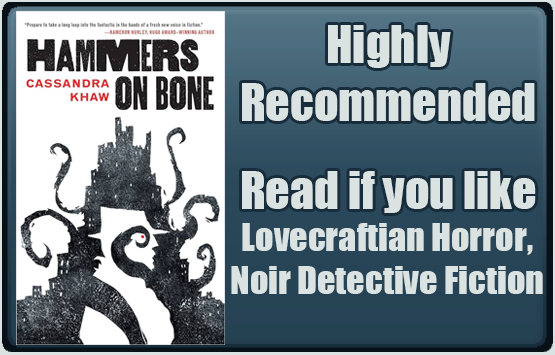
Hammers on Bone by Cassandra Khaw

Hammers on Bone by Cassandra Khaw

Formats: Print, digital

Publisher: Tor

Genre: Body Horror, Eldritch, Monster, Occult, Psychological Horror, Sci-Fi Horror

Audience: Young Adult

Diversity: Queer character (Gay woman), POC characters (Black, Creole woman, unknown POC character), Bisexual author, Malaysian author

Takes Place in: London

Content Warnings (Highlight to view): Alcohol Abuse, Body-Shaming, Bullying, Child Abuse, Child Endangerment, Death, Gore, Pedophilia, Physical Abuse, Racism, Rape/Sexual Assault, Sexism, Sexual Abuse, Slurs, Slut-Shaming, Verbal/Emotional Abuse, Violence

Blurb

John Persons is a private investigator with a distasteful job from an unlikely client. He’s been hired by a ten-year-old to kill the kid’s stepdad, McKinsey. The man in question is abusive, abrasive, and abominable.

He’s also a monster, which makes Persons the perfect thing to hunt him. Over the course of his ancient, arcane existence, he’s hunted gods and demons, and broken them in his teeth.


As Persons investigates the horrible McKinsey, he realizes that he carries something far darker. He’s infected with an alien presence, and he’s spreading that monstrosity far and wide. Luckily Persons is no stranger to the occult, being an ancient and magical intelligence himself. The question is whether the private dick can take down the abusive stepdad without releasing the holds on his own horrifying potential.

During one of my late-night explorations of the internet (when I should have been sleeping but was instead googling all the random thoughts that pop into my head at 2 AM) I stumbled upon the work of Malaysian author Cassandra Khaw, a nerdy, queer woman who writes video games and short horror stories. Instantly intrigued, I purchased one of her novellas, Hammers on Bone, and I have to say, I fell absolutely, head-over-heels in love with Khaw’s writing. Her beautifully crafted stories are full of wonderful words like “penumbra” and “ululation” (one of my favorite Latin derived words), deliciously grotesque descriptions, and unique characters. English is Khaw’s third language, yet she uses it with a mastery that puts even native English speakers to shame. Her writing has a lot of range, too. These Deathless Bones is a feminist fairy tale about a witch getting sweet revenge on her wicked stepson. Rupert Wong, Cannibal Chef is a comedic splatterpunk series, as hilarious as it is gory, about the misadventures of the titular chef who prepares decadent meals of human flesh for gods and ghouls and gets wrapped up in international deity politics. Khaw has even dabbled in chick-lit (while also managing to poke fun at the more problematic elements of the genre) with her book, Bearly a Lady, about a bisexual, plus size wear-bear that works at a faerie-run fashion magazine. Then there’s her Persona Non Grata series. Much like Victor LaValle’s The Ballad of Black Tom, Khaw’s novellas take place in a Lovecraft inspired universe, but she flips the famously racist HP the bird by putting people of color at the forefront and using his creations to address social issues like racism, poverty, and abuse. Both stories feature the private investigator, John Persons, one of the most interesting characters I’ve come across in horror fiction. It’s the first of Person’s two novellas, Hammers on Bone, that I’ll be reviewing here.

Persons speaks and acts like the “hardboiled detective” characters from 1930s pulp magazines, complete with dated American vernacular and machismo, despite living in modern day London. This makes John seem incredibly out of place and occasionally downright ridiculous, like when he describes a little boy running into his arms for a hug as “crashing into me like a Russian gangster’s scarred-over fist.” When he’s not working as a PI, John spends his time saving the world from destruction by Star Spawn and Elder-Things. He’s adept at using magic, smokes cigarettes to dull his inhumanly strong sense of smell, enjoys the cold, and can pick up memories from objects and people through physical contact. He also happens to be a Dead One (though not one of the Great Old Ones, Persons is quick to explain), an otherworldly creature whose true, terrifying form comfortably possesses resides in a human body which he shares with the ghost of its previous inhabitant. I bet that’s why he has the most unimaginative, made-up sounding name ever; it was probably the first thing that popped into his head when he started inhabiting his meat suit.


Persons and his human body have an interesting relationship, more commensal than parasitic. While other Star-Spawn and Elder Things simply take what they want, invading human flesh like a disease and eventually destroying their hosts, Persons tries to minimize damage to his meat suit (he may be immortal and resilient, but his human form still suffers from wear and tear, and he feels pain when it’s damaged), and gives his phantasmal passenger a say in certain decisions. Even though he’s in the driver’s seat, John’s body will still react to its original owner’s thoughts and feelings, independent of him. In one scene, the meat suit becomes aroused by the proximity of a beautiful woman. Persons is aware of “his” body’s quickening pulse and rising temperature (among “other” rising things, heh), and states that the sensation is “not unpleasant”, but he describes the physical reaction with the detached interest of scientist observing a cell under a microscope. He is, after all, still an alien being.

Not much is known about the man whose skin he now wears, except that he’s an older person of color who lived during the interwar period, and gave John his body willingly after being asked. The whole Philip Marlowe / Sam Spade persona Persons adopts to appear more human is as an homage to his meat suit’s original owner. I guess it’s kind of sweet that he does that, in a very weird way, but unfortunately his stubborn refusal to update his dated vocabulary and attitudes, or venture into any genre that isn’t detective noir makes John come off as pretty sexist. He refers to women as “skirts,” “broads,” “dames,” and “birds”, and divides them into victims and femme fatales. This attitude backfires on him spectacularly since, of course, the real world isn’t like his detective novels, and John keeps misjudging the women he interacts with.

What sets the monstrous PI apart from his fellow cosmic entities, besides seeking consent from his body’s original owner, is his fondness for humanity, his dedication to following the law and maintaining order, and his desire for earth to remain more or less the way it is, i.e. not a barren hell-scape inhabited by Eldritch abominations.  Most of the monsters he fights are chaotic evil, infecting and destroying whenever they go, but John Persons is closer to lawful neutral, occasionally leaning towards good. He’s not exactly heroic since, in his words, “Good karma don’t pay the bills,” but Persons does have a strong set of morals. As previously mentioned he’s big on consent and describes the act of possessing a willing host’s body as “better than anything else I’d ever experienced” and feels incredibly guilty when he accidentally reads a woman’s mind after touching her arm. When she becomes understandably angry at the violation, screaming “You don’t take what you’re not given!” John doesn’t try to minimize, excuse, or defend his behavior (even though the intrusion was an accident), he simply apologizes, mortified by what he’s done. He can even show compassion at times, but how much of his altruistic behavior is due to the remaining sentience of his body’s former inhabitant acting as his ghostly conscience is unclear.

It’s his spectral companion who convinces John to take the case of a young boy named Abel, who wants Persons to kill his abusive stepfather. While initially hesitant about committing murder, John is convinced once the boy reveals that his stepfather is a monster, both literally and figuratively, and both Abel and his little brother’s lives are in danger. He might not be a hero, but Persons does seem to genuinely want to help the two boys, even if he claims it’s just because they’re clients. It may be simply because he wants the ghost with whom he cohabitates to stop nagging him, as John is usually pretty indifferent to human suffering on his own, or perhaps it’s because an Old One is involved, and he’d really prefer it not destroy the world. Regardless of the reason, he agrees to help.

In his eagerness to play white knight (or his meat suit’s eagerness) Persons often fails to realize that the “helpless victims” he seeks to rescue are often perfectly able to take care of themselves, like the waitress whose mind he reads. He’s also quick to victim blame the boys’ mother for not leaving, clearly unable to understand the psychological element of abuse or how dangerous it is for a person to try and leave an abusive partner, just making her feel worse than she already does. John struggles when it comes to comforting victims or dealing with their emotions. He claims his lack of skill when it comes to words and feelings is due to being a “man” (or at least inhabiting the body of one), though it’s just as likely it’s because he’s an eldritch abomination, and he’s just been using sexism to avoid learning the nuances of human emotion. While Persons is better at managing his desire to destroy and devour than the other monsters and is able to maintain a detached control over his meat suit’s emotions and baser instincts, he’s not immune to the effects of his human body’s testosterone or his own toxic misogyny. When the PI is feeling especially aggressive his true form starts to writhe beneath his human skin, straining to break free from his epidermis and rip apart the object of his ire. Even his thoughts start to degrade into a sort of violent, inhuman, babble when he gets too riled up. John actually has to fight to keep control of his monstrous body when he first encounters the abusive stepfather, he’s so desperate to disembowel and devour him. His true nature is a stark contrast to the cool and logical detective persona Persons has adopted. I won’t lie, I did enjoy seeing him act all protective of Abel and his little brother. There’s something amusing about what is essentially an immortal abomination that can effortlessly rip a grown man in two, doing something as mundane and sweet as escorting his young client home while carrying the child’s kid brother on his hip. It’s also heartbreaking when you realize the two boys are safer with a literal monster than their step dad, McKinsey (even before he was possessed).

The step-father is a real piece or work, and throughout the story I desperately wanted John to give in to his monstrous instincts and tear the bastard apart, limb by limb. But being a man/monster of the law, Persons won’t do much more than saber-rattle until he has solid proof of McKinsey’s wrong doing, much to Abel’s frustration. The kid would much rather the PI solve things with his fists (teeth, tentacles, claws, and other miscellaneous alien appendages) than waste time talking to witnesses, and I’d certainly be annoyed too if the monster I hired to kill someone wasted time playing detective instead of just eating his target. But Persons did warn Abel that he’s not a killer for hire and wants to do things “by the book”. Unfortunately, like most real monsters, McKinsey excels at hiding his wrong doing and camouflaging his true nature which makes it difficult for John to find a solid lead. People like McKinsey and describe him as a “loving family-man”.  Those who haven’t been completely conned by his act either don’t care he’s a monster (like his boss) or are too terrified to do anything (like his fiancée). None of the adults in the boys’ lives are fulfilling their duty of protecting two vulnerable children. This is where the real horror lies in Khaw’s story– not the eldritch abominations like Shub-Niggurath, or the threats of world destruction, but the all too painful reminder that we so often fail abuse victims. Khaw is tasteful when describing what the two boys go through, and it isn’t played for titillation or described in explicit detail. She only reveals enough to lets us know the two boys in the story are going through something no child should ever have to suffer. I also liked her choice to make the victims male. Far too often male survivors are overlooked, erased, or mocked because society tells us males can’t be victims, even though the CDC states that “More than 1 in 4 men in the United States have experienced rape, physical violence, and/or stalking by an intimate partner in their lifetime” and a study published in the American Journal of Preventive Medicine found that 1 in 6 boys will be sexually abused before the age of 18. As depressing as these statistics are, the situation isn’t completely hopeless, because monsters aren’t invulnerable, even the kind that have been infected by Elder Things. As Person muses towards the end of the book “I don’t remember who said it, but there’s an author out there who once wrote that we don’t need to kill our children’s monsters. Instead, what we need to do is show them that they can be killed.” For those of us who can’t go out an hire a eldritch abomination PI, at least we have RAINN (Rape, Abuse & Incest National Network) and their recommended resources for cases of abuse and sexual assault.

Navigation

Social Media

Search by Tags

To learn more about the Age Group, Diversity, and Genre tags, click here.

Age Groups

Diversity

Genre

Support the Blog

Search

Links

Feeding Lucy by Mo Medusa

Feeding Lucy by Mo Medusa

Formats: Print, digital

Publisher: Crooked Foot Press

Genre: Occult

Audience: Adult/Mature

Diversity: Lesbian main character, queer, non-binary author

Content Warnings (Highlight to view): Alcohol Abuse, Animal Death, Cannibalism, Death, Gore, Gaslighting, Gore, Sexism Verbal/Emotional Abuse, Violence, Vomit 

Blurb

Frankie left home ten years ago, abandoning the tall mountains of her small hometown for the tall buildings of the big city. Desperate for a new life, she was happy to escape her overly-critical mother and the Polish-American customs of her past.

But after a strange caller informs her of her mother’s sudden death, she’s reluctantly drawn back to the mountains for the first time in a decade.

Arriving days before the Scandinavian tradition of Sankta Lucia, the town is aglow with holiday lights and cheer—and the townspeople can’t stop talking about the annual Feast of St. Lucy.

When an unexpected blizzard rolls through, revealing the true nature of the feast—and the evil that resides in the mountains—the darkness of her mother’s past is brought to light once again.

Caught between tradition and terror, Frankie quickly learns that her mother’s overbearing influence won’t be stopped by her death alone.

Taking elements from The Night of the Witches in Polish folklore, and the real tradition of Sankta Lucia, Feeding Lucy is a story of grief, tradition, and the darkness that lives inside of us all.

I received this product for free in return for providing an honest and unbiased review. I received no other compensation. I am disclosing this in accordance with the Federal Trade Commission’s 16 CFR, Part 255: Guides Concerning the Use of Endorsements and Testimonials in Advertising.

Frankie, or Franciska, as her mother calls her, is suffering through an awkward holiday party at her job when she gets the call that her mother has died. Frankie had a complex relationship with her volatile mother, Lucja. The two lived together in an old farmhouse in the middle of nowhere along with Lucja’s ancient, cranky cat, Zula. Growing up, Frankie felt like her mother loved that old cat more than her. She doesn’t expect affection from her mother because it is so rarely given, and eventually stops expecting everything at all. Lucja is both overbearing and withholding as a mother, obsessing over everything her daughter does one moment, then punishing her with the silent treatment the next. Frankie fears disappointing her mother above all else, yet always seems to do so. Lucja judges everything her daughter does, what she wears, and even what she displays in her room. She grows to hate Lucja, and gets away from her the first chance she gets. Frankie moves to the city, gets a job at a magazine, and joins the local queer scene. She goes no contact with her mother and forgets all about her until she gets the call. Frankie has no interest in her mother’s body, or returning to their small town, but the coroner promises her that Lucja left her a “pretty penny” and she’ll need to come back to her hometown if she wants to collect the insurance money.

Franciska is from Kolbe, a town built by immigrants all from the same small village in Poland, whose descendants are determined to keep their traditions alive. To Franciska, it seems more like they can’t let go of the past. One of their most important traditions is Sankta Lucia (Saint Lucy’s Day) a Catholic feast day commemorating the Sicilian saint who was martyred during the Diocletianic Persecution by the Roman Empire. Saint Lucy’s Day is held on December 13th and is viewed as a precursor of Christmas Day. Because the name Lucia is derived from the Latin “lux,” meaning “light,” and her feast day is celebrated during the darkest time of year, Saint Lucy’s Day is considered a “festival of light” meant to drive away the darkness, similar to Diwali or Hannukah. Young girls dress up as Saint Lucy, in a white robe with a red sash and a wreath of candles on their heads. Songs are sung and saffron buns eaten.

A drawing of a girl with long blond hair and brown eyes wearing a white dress with a red sash. Oh her head is crown of green leaves, red berries, and six white candles. She is holding a seventh candle and it's casting shadows on her face. The picture has a dark blue background with a gold border and holly leaves surrounding the image.

An example of what girls wear for Saint Lucia

Interestingly, Lucia shares her holiday with another Lucy, the Scandinavian Lussi. Lussinatta, or Lussi’s Night is similar to the legend of the Wild Hunt, where Lussi and her band of trolls, witches, and undead spirits would spend the darkest night of the year searching for unsuspecting humans who had stayed out too late or not finished their chores. Those who had not finished spinning yarn or threshing could expect to have their chimneys smashed. Those who were especially unfortunate would be whisked away by Lussi, never to be seen again.

And wouldn’t you know it, Frankie has arrived in Kolbe just in time for the annual Saint Lucy’s feast her mother always organized and the town’s people are very invested in making sure Lucja’s estranged daughter attends the feast (red flag number one). But Frankie just wants to get her inheritance and go back to the city. That is, until she runs into her long-lost love, Stella, working at the coroner’s office. Frankie is so smitten with her former girlfriend that she immediately agrees to stay for Sankta Lucia despite her initial hesitation, and gives Stella a pass for her strange, mercurial behavior (red flag number two). She only briefly wonders how it’s possible that Zula, who was already an old cat when Frankie was a child, is still alive (red flag number three). Even the disturbing visions Frankie starts having during the day, and the horrible nightmares when she sleeps, don’t clue her in to the fact that something is deeply wrong in Kolbe.

I appreciated the depiction of Lucja and Frankie’s dysfunctional relationship. The more we learn, the clearer it becomes that Lucja is emotionally abusive to her daughter, but as is often the case when there’s no physical component, the abuse is not immediately obvious. Lucja uses guilt to manipulate and control her daughter, alternating between coldness and gentle affection. Her love is conditional and young Frankie feels like she has to earn it.

An estranged adult child returning to their small town only to discover the town’s dark secret is one of my favorite horror tropes (seen in such films as Salem’s Lot and Dead Silence), so this was right up my alley. The story has a witchy vibe and a dark, moody atmosphere that makes reading it feel like the calm before the storm (or blizzard in this case). This slow burn horror is perfect for a dark winter’s night.
It’s Only a Game by Kelsea Yu

It’s Only a Game by Kelsea Yu

Formats: Print, audio, digital

Publisher: Bloomsbury YA

Genre: Mystery

Audience: Young Adult

Diversity: Chinese American main character and Taiwanese Chinese author, Black major character, Indian American major character, transgender major character

Takes Place in: Seattle, Washington

Content Warnings (Highlight to view): Bullying, Child Abuse, Child Death, Child Endangerment, Death, Forced Captivity, Gaslighting, Mental Illness, Physical Abuse, Self-Harm, Stalking, Suicide, Transphobia, Verbal/Emotional Abuse, Victim Blaming

Blurb

In this twisty, fast-paced YA thriller, a dangerous game becomes all too real when Marina and her friends are framed for murder.

When Marina Chan ran from her old life, she brought nothing with her-not even her real name. Now she lives in fear of her past being discovered. But when her online gaming team is offered a tour of their favorite game company, Marina can’t resist accepting, even though she knows it might put her fake identity at risk.

Then the creator of the game is murdered during their tour. Whoever killed him plans to frame Marina and her friends for the murder unless they win four rounds of a dangerous game. A game that requires them to lie, trespass, and steal. A game that could destroy everything Marina’s worked so hard to build…. A game that she might not survive.

It’s Only a Game is a story about parental abuse, found family, and video games, all wrapped up in a murder mystery.

The beginning of the book really grabs the reader and makes it clear this is going to be a gripping narrative. At the start, all we know about main character Marina Chan is that she’s a runaway teen living illegally in a Chinese restaurant/game café, and that she must hide her identity from everyone. That means no school, no ID or paper trail, and no letting anyone get too close. The only relationships Marina has are with the owners of Bette’s Battles and Bao, who kindly allow her to live there, and her three online friends: RockSplice (Rock), Dreadnaughty (Dread), and Syldara (Syl). Marina has a MASSIVE crush on Syl. The four of them met through a PC game called Darkitect, a combination MMORPG (short for massively multiplayer online role-playing game) and level designer where Marina plays under the alias Nightmar3 (Night for short).  Their favorite level designer is a mysterious programmer named Cíxĭ (pronounced like tsuh-SHEE), who took her name from an Empress Dowager who ruled China during the late Qing dynasty. I like that Cíxĭ’s name has the accents when Marina says it, indicating that she uses the correct Mandarin inflections, as compared to her non-Chinese friends who pronounce it as Cixi (without the accents).

After beating an especially challenging level she designed, the four gamers score exclusive invites to one of Cíxĭ’s new levels. As thrilled as Marina is at the prospect of playing a new level designed by the elusive programmer, she’s even more excited knowing that tomorrow she’ll be meeting her online friends in real life for the first time on top of getting a tour of getting a tour of Apocalypta Games (the creators of Darkitect). Things couldn’t be better.  Meeting her friends for the first time goes exceptionally well, and Rock, Dread, and Syl immediately accept Marina as one of their own.

Rock is a slender Indian American guy whose parents run security for Apocalypta Games. Dread is a tall, white guy, and the oldest, who interns at Apocalypta. Finally there’s Dread’s cousin, Syl, a gorgeous and glamorous Black girl who’s the girly-girl to Marina’s tomboy. I love that Syl’s character enjoys girly things, like makeup, dresses, heels, and stylish nails, while still being very into video games. While the rise in popularity of Twitch has shown that women who play video games are a diverse group, I remember when feminine gamers were accused of only doing it for male attention, and “real gamer girls” were tomboys. While this stereotype has somewhat changed over the years, women gamers are still subject to a great deal of harassment. But the guys in Marina’s gaming group are completely supportive of the two girls and the friends manage to avoid most of the toxicity in the gaming world.

Two chibi style drawings of Marina (wearing her trademark black hoodie and leggins) and Syl (a girl with her hair in twists wearing a green dress). They are on a blue background that has drawings of different gaming controllers. Underneath it says

Marina and her crush, Syl

The tour is great, with the owner of the company, Ethan Wainwright himself, showing the group around. He even invites Marina to contribute her art to Apocalypta’s quarterly magazine, and offers her and her friends exhibitor badges for PAX West. Originally known as Penny Arcade Expo, PAX West, along with the other PAX conventions, is one of the largest gaming conventions in the US, so this is a HUGE deal. Marina can barely contain her excitement and is having the best day of her life, that is, until she and her friends find the body. What follows is a page-turning murder mystery that tests the limits of Marina’s newfound friendships.

Marina’s mysterious past is slowly revealed over the course of the book. She lived with her overprotective mother, but never knew her father (her mother says he was a “bad man”). We know she must hide who she is, but we’re not sure why. We also discover that Marina suffered from emotional abuse. Trauma from her past has made her private and slow to trust, as her mother made sure Marina was completely dependent on her. The Confucian concept of filial piety (Xiao) an important aspect of Chinese culture, seems to play a role in Marina’s abuse. Chinese American reddit user CauliflowerOk7056 argues in his college essay entitled “Beat Him till the Blood Flows”: How Confucianism and Traditional East Asian Culture Can Enable Child Abuse that, in addition to poverty, a major contributor to  Chinse and Chinse American child abuse is filial piety. In it he states “Sadly, as well-intentioned as Confucius’ ideal may have been, filial piety has its issues that can be exploited to justify child abuse. For one thing, its undue emphasis on strict obedience from children sets a precedent that can provide some leeway for abusive parents.”

However, he is quick to explain that Confucianism in and of itself does not encourage abuse, and even suggest that children hold their parents responsible. Psychotherapist Sam Louie explains “As [Asian American] clients talk about the emotional and/or physical abuse, they will often defend their parents saying something to the effect of, ‘They did the best they could,’ or ‘I knew they still loved me.’ It isn’t until more trust is developed that I can confront their inability to see how abuse can and often does happen within ‘loving’ households and relationships in general.” One of the reasons it takes so long for Marina to recognize her mother’s abuse is because her mother constantly tells her how much she loves her. When Marina asks to go over to a friends’ house, her mother refuses explaining she “loves [Marina] too much”to let her go. Additionally she guilts Marina for wanting friends and successfully isolates her (another hallmark of abuse), asking “Am I not enough for you? Am I so bad that you have to get away from me?”

Asian Americans, especially Asian American immigrants like Marina’s mother, also underutilize mental health services creating a “major mental health disparity” according to entitled Use of Specialty Mental Health Services by Asian Americans With Psychiatric Disorders. While it’s certainly not an excuse, and plenty of mentally ill individuals still make great parents, her mother’s mental health may have also played a role in the way she treated Marina. It’s important to note that, while Marina’s abuse may have cultural elements to it, child abuse is not unique to any one race or culture, and in fact a research study entitled Child Maltreatment Among Asian Americans: Characteristics and Explanatory Framework points out that “The reported rate of child maltreatment among Asian Americans is disproportionately low” compared to other racial and ethnic groups (though this may be partially due to under reporting). When calculating the risks of child abuse, poverty and inequality are leading factors, along with intergenerational trauma, stress, isolation, and a lack of a support system.

Yu puts a lot of emphasis on the importance of building supportive relationships, especially when you don’t have family to rely on. I appreciate that Yu believes that online friendships can be just as important as face-to-face ones. As a millennial, I grew up in the early days of the internet when adults firmly believed everyone online was a predator and forming online friendships was new territory. Yet, despite the warnings from overprotective adults, I still formed meaningful relationships with people I met online.

I met one of my best friends on LiveJournal. I would have never known my wife if she hadn’t joined our friend’s group through Meetup. For a kid who grew up in a small town who had trouble finding others my age with the same niche interests as me, the internet gave me a way to feel less alone, just like it did for Marina. These days 57% of teenagers meet a new friend online, and those relationships can be just as meaningful as face-to-face ones.

While you don’t have to be a gamer to enjoy It’s Only a Game it definitely helps since non-gamers are unlikely to recognize some of the references and terminology, which Yu doesn’t bother to explain or elaborate on (I had to look up what AoE stands for). Most of the action takes place within the world of Darkitect so readers who have never felt the excitement and suspense of playing a video game with fighting elements may not get as much out of those scenes. On the plus side, all the gaming elements are likely to appeal to reluctant readers who prefer World of Warcraft over books.

Splinter by Jasper Hyde

Splinter by Jasper Hyde

Formats: Print, digital

Publisher: The Magnificent Engine

Genre: Folk Horror, Killer/Slasher, Occult, Myth and Folklore, Romance

Audience: Adult/Mature

Diversity: Black main character and author, Filipino British main character, asexual (demisexual) main character and author, bisexual main character, main character with ADHD, Trans masc/Non-binary author

Takes Place in: Sleepy Hollow, NY

Content Warnings (Highlight to view): Ableism, Bullying, Death, Drug Use/Abuse, Medical Procedures, Mental Illness, Police Harassment, Racism, Torture 

Blurb

In a small town hidden behind the hills of New York, things are far from ordinary. As Sleepy Hollow’s youngest Medical Examiner, the pressure intensifies for Dr. Drusilla Van Tassel when the headless bodies of her sister Katrina’s friends start surfacing. Meanwhile, Drusilla’s ex-lover Ichabod Crane returns to town, dredging up feelings better left buried.

Things take a turn for the worst when Drusilla comes face-to-face with the Headless Horseman, who is back to settle old scores – and she and her sister are the perfect targets. Drusilla can repel the horseman with an unknown power, but her sister isn’t so lucky, and she goes missing.

However, when Drusilla discovers Ichabod is a monster hunter, she has no other choice but to turn to him for help. Even if that means working with a man she feels an inexplicable attraction to. Will they find Katrina and banish the headless horseman once and for all?

I received this product for free in return for providing an honest and unbiased review. I received no other compensation. I am disclosing this in accordance with the Federal Trade Commission’s 16 CFR, Part 255: Guides Concerning the Use of Endorsements and Testimonials in Advertising.

If you decide to read Splinter, keep in mind that this story comes from a small, indie publisher and didn’t benefit from a professional editor. There are quite a few grammar errors sprinkled throughout. I didn’t find them particularly distracting, and the quality of the writing was still good, but I know this will bother some readers. I would encourage them to give Splinter a chance anyway, as it really is an enjoyable story and I hope my review will encourage you to check it out.

Dr. Drusilla Van Tassel is our main character, and I kind of love her. She’s an introverted, bisexual, horror fan who just wants to do her job as a medical examiner, and I can relate to that. Her sister Katrina, on the other hand, is outgoing, popular, and prefers her rich, white friends over her own sister. But Drusilla is just as hostile to Katrina, so it’s not your stereotypical mean girl situation. I found it interesting how Drusilla can relax and use AAVE in front of her Black assistant (and former lover) Kyndall, but codeswitches with Katrina like she does around white people. It underlines how “other” Katrina is from her and how uncomfortable Drusilla feels in her own sister’s presence. Although, she does feel guilty for not doing more to support Katrina when her husband Brom died under mysterious circumstances.

One night Drusilla is called in to deal with a murder, and the victim is no other than Denis Carter, Katrina’s close friend. Poor Drusilla just can’t catch a break! At the crime scene, we see firsthand the racism and sexism Drusilla faces on a regular basis from the law enforcement officials she has to work alongside when one rookie cop tries to stop her from entering the crime scene. Despite having graduated Magna Cum Laude from Cornell she still gets treated as a “Black girl playing dress up.”

Then Katrina’s former friend and lover, Ichabod Crane (who I like to imagine looks like Piolo Pascual), shows up out of the blue and starts pestering her for details of the strange murder. Because they ended things badly, she isn’t exactly thrilled to see him. But when another murder takes place, the two are forced to set aside their differences and work together. What follows is a fun, supernatural mystery with a great sex scene. This was the first time in a story I’ve seen someone on the asexual spectrum have sex. Not only are asexual character underrepresented in fiction, but they’re often stereotyped as always being completely sex adverse, which just isn’t true, especially in the case of people who are demisexual like this particular character.

I really appreciate that Hyde not only put the effort into getting Filipino sensitivity readers, but also included their email in the beginning of the story for anyone to reach out to them if they made any mistakes in representation. I wish more authors would do that!

If you were a fan of the Fox tv series Sleepy Hollow that aired from 2013-2017, but hated the way they treated Nicole Beharie and her character, this book is for you. It feels like a remedy to the show without being a fix-it fanfiction. Instead, Splinter gets to be its own thing. It’s a quick, compelling read that sucks you in, helped in no small part by its compelling and complex characters.

Another Elizabeth by Elle Mitchell

Another Elizabeth by Elle Mitchell

Formats: Print, audio, digital

Publisher: Little Key Press

Genre: Killer/Slasher

Audience: Adult/Mature

Diversity: Main character and authors with hypermobile Ehlers-Danlos Syndrome (hEDS), bisexual main character

Takes Place in: Oregon

Content Warnings (Highlight to view): Ableism, Animal Abuse, Animal Death, Body Shaming, Imagined Cannibalism, Imagined Child Abuse, Imagined Child Death, Death, Forced Captivity, Gaslighting, Mental Illness, Pedophilia, Physical Abuse, Police Harassment, Self-Harm, Slurs, Sexism, Suicide, Verbal/Emotional Abuse, Violence

Blurb

Another Elizabeth is a gripping literary psychological crip horror novel that readers will sink their teeth into. Fans of dark humor and challenging fiction will be thrilled to delve into the mind of a deeply flawed disabled woman with a desire to kill.

Elizabeth’s life is taking a turn.
She has three jobs, a boyfriend that loves her too much, and a recent diagnosis of Hypermobile Ehlers-Danlos Syndrome. She’s coming apart at the seams. Now all she cares about is keeping her promise to her younger self before her body fails her—kill without getting caught.

Will she physically be able to satisfy her urge while maintaining her carefully built façade of normalcy? And if so, will she be able to stop with just one victim?

I received this product for free in return for providing an honest and unbiased review. I received no other compensation. I am disclosing this in accordance with the Federal Trade Commission’s 16 CFR, Part 255: Guides Concerning the Use of Endorsements and Testimonials in Advertising.

Inspiration porn is a real problem when it comes depicting people with disabilities. The term was originally coined by disability activist and comedian Stella Young. As Young puts it in her 2014 TED talk in Sydney, “We’re not real people. We are there to inspire.” She explains that we have been sold the lie that disability is a bad thing, and therefore living with a disability makes you exceptional. One of the reasons I love Another Elizabeth is because I thought of inspiration porn while I was reading it and what the reactions of able-bodied people might be. Elizabeth has Hypermobile Ehlers-Danlos syndrome (hEDS), which, if you’re not familiar, is a genetic condition that causes connective tissue to weaken resulting in hypermobility in the joints and chronic pain. She works at a grocery store called Juno Foods with her boyfriend, teaches ESL classes, and kills people who piss her off.  That’s right, Elizabeth “overcomes” her invisible disability despite struggling with pain and weakness to become a serial killer! How inspirational!

A drawing of Elizabeth wearing a gray T-shirt and jeans and leaning on a purple cane. In her other hand she holds a bloody knife. Her clothing is covered in blood. Behind her is a black, blood spattered background with bloody red lettering that reads "the only disability in life is a bad attitude."

All joking aside, I loved reading a book where the main character has  disability, written by someone with a disability (and not some well-meaning ally) that isn’t meant to inspire non-disabled people or demonize people with disabilities. Elizabeth is a great character. She shows hints of being a sociopath, is an expert manipulator, and often fantasizes about hurting others. When her doctor suggests she start using a cane, Elizabeth immediately wonders if she’ll use it for anything other than bashing people’s brains in. Even innocent things bring out the darkness in Elizabeth. When she sees babies, she imagines how easy it would be to break their fingers, and when she makes candy, she fantasizes about putting poison in it.

Yet she still seems to care about her friend, her ESL students, and her himbo boyfriend on some level, so she’s not completely heartless. Or at least Elizabeth admits she wouldn’t murder any of them. Awwwwww. In fact, she only kills people who she believes deserve it, like an ableist woman who abandoned her family after her husband became paralyzed, an obnoxious coworker, and maybe the odd pedestrian here and there. The fact that she happens to like their teeth is just a bonus. In her free time Elizabeth watches forensics shows and reads true crime novels for inspiration. This means she is meticulous about covering her tracks. I found myself greatly appreciating Elizabeth’s hyper-competence when it came to crime, carefully planning each murder down to the very last detail. Elizabeth is also someone who is usually good at whatever she tries, despite putting little effort into it, and this seems to apply to being a serial killer. Because she can’t physically overpower her victims, Elizabeth gets very creative finding ways to make her murders more accessible.

Villains with disabilities in fiction are often portrayed in a problematic way, at least when written by the non-disabled. They are the monstrous “other,” whose moral corruption manifests physically as disability. Jan Grue, is a Norwegian academic, author and actor (best known for role as Ivar Salvesen in Occupied) who uses a wheelchair. In his Guardian article The Disabled Villain: Why Sensitivity Reading Can’t Kill Off This Ugly Trope Grue writes “This particular trope, wherein a character’s moral and physiological natures mirror each other, is as universal as it is ancient. It is reflected in the philosophy of Plato, in commonplace phrases like ‘a healthy mind in a healthy body,’ and in the foundational texts of the cultural canon. In Buddhist tradition, too, disability has been construed as an impediment to understanding and enlightenment – and even, for some, as a punishment for actions in a past life.”

The Take’s video Why the “Disabled Villain” Trope is So Offensive, explains that disability is “used as a metaphor for villainy or moral failing.” In an interview with Den of Geek after the release of Skyfall, producer Michael G. Wilson explains, “It’s very much a Fleming device that he uses throughout the stories – the idea that physical deformity and personality deformity go hand in hand in some of these villains. Sometimes it’s a motivating factor in their life, and what makes them the way they are.” In other words, those with disabilities are assumed to despise their condition because being disabled is undesirable, and they seek to harm the able bodied. Unfortunately, this metaphor can cause real-life harm, as it reinforces the idea that having a disability is “bad” and difference is “scary.” Horror is especially notorious for using the “Evil Cripple” trope, with famous villains like Freddy, Jason, and Leatherface all sporting physical disfigurements. Other famous examples of disabled villains are the Phantom from The Phantom of the Operamultiple James Bond antagonists, Mr. Glass in Unbreakable, Mason Verger from Hannibal, Captain Hook from Peter Pan, Mr. Potter from It’s a Wonderful Life, and Darth Vader from Star Wars.


Mr. Glass from Unbreakable (top left), The Phantom from the Phantom of the Opera (top right), Captain Hook from Hook, Raoul Silva from Skyfall, Freddy Krueger from Nightmare on Elm Street (bottom left), and Mason Verger from Hannibal (bottom right). None of the characters pictured here are portrayed by disabled or disfigured actors.

lizabeth is a villain protagonist with a disability, she’s an incredibly well written, well-rounded character. She’s an evil (or at least morally gray) character who also has a disability, rather than a character who is evil because of a disability. Most importantly, Elizabeth is written in such a way that the audience is rooting for her sociopath self and able to relate to her. (Or at least I was. Who among us hasn’t fantasized about killing awful people?) Usually, villains with disabilities are written in such a way that they feel alien and are frightening in their strangeness, and this is accentuated by their disability or disfigurement.  Instead of seeming scary because of her disability, Elizabeth finds the opposite to be true. People assume she’s helpless: something she uses to her advantage. When suspicion falls on her, Elizabeth plays up her disability, relying on other people’s ableism so they think she’s innocent. It also helps that the author has hEDS herself, so the book is Own Voices and Elizabeth’s character just hits differently.

Because the narration is first person, we get to see Elizabeth’s detached way of looking at the world and her twisted way of thinking. We get an intimate look at her struggles, both keeping her “other life” a secret and trying to kill victims when she’s not as strong as an able-bodied male killer. And of course, we get to learn about her frustration when dealing with her chronic pain and her boyfriend’s annoying abundance of concern for her. He’s convinced that she’s too fragile to function, yet doesn’t have the same concern for her comfort during sex. Side note, I love that Elizabeth gets to have hot sex scenes with her boyfriend. People with disabilities almost never get to have sex in fiction. In fact, outside of Mat Fraser in American Horror Story, George Robinson in Sex Education, and Peter Dinklage in Game of Thrones, I don’t think I’ve ever seen anyone with a disability have sex in popular media (and of course those examples are all white, cisgendered men with conventionally attractive faces).

Another Elizabeth is a fascinating look into a twisted mind with a character that you can’t help but root for despite the fact she’s a serial killer who manipulates others. The story is the perfect length, not so long that it drags but not so short that it feels rushed. The second half of the book is especially exciting and the story is interspersed with bits of dark humor.

The Only Safe Place Left is the Dark by Warren Wagner

The Only Safe Place Left is the Dark by Warren Wagner

Formats: Print, digital

Publisher: Ghoulish Books

Genre: Apocalypse/Disaster, Zombie

Audience: Adult/Mature

Diversity: Gay man author and main characters, main characters with AIDS

Content Warnings (Highlight to view): Animal Death, Child Death, Death, Drug Use/Abuse, Homophobia, Illness, Medical Procedure, Slurs, Suicide

Blurb

In The Only Safe Place Left is the Dark, an HIV positive gay man must leave the relative safety of his cabin in the woods to brave the zombie apocalypse and find the medication he needs to stay alive.

I received this product for free in return for providing an honest and unbiased review. I received no other compensation. I am disclosing this in accordance with the Federal Trade Commission’s 16 CFR, Part 255: Guides Concerning the Use of Endorsements and Testimonials in Advertising.

I was born during the beginning of the AIDS outbreak, during which my mom lost many of her gay friends. I remember the deep-rooted fear of AIDS that existed during my childhood. In grade school, we attended assemblies about the dangers of AIDS and how it was spread. There were public service ads about AIDS on every TV station. Parents wore red ribbons. As a queer teen I mourned the loss of an entire generation of gay and bisexual men.

One of the doctors I work with through my hospital, a gay man in his eighties who was one of the first physicians to treat AIDS patients, told me about the weekly funerals he attended. No one cared that gay men were dying of a mysterious illness during the conservative Regan administration. Little research was done on the epidemic. This doctor was one of the few who treated AIDS patients back then, using his knowledge of pharmacology to create a treatment regimen through off-label uses of already existing drugs. Of course, he couldn’t openly advertise his services due to the stigma in the medical community, so his patients found him through a whisper network and would visit him under the guise of getting a routine physical.

The Only Safe Place Left is the Dark is a unique zombie apocalypse novella about the AIDS epidemic. The cover of book is meant to invoke the iconic Silence=Death AIDS design from the late 1980s (a poster Quinton keeps in his Cabin). The title of the story comes from a quote in the play The Destiny of Me by writer and activist Larry Kramer, who is best known for co-founding the grassroots political group the AIDS Coalition to Unleash Power (ACT UP).  In the first chapter of the book, Wagner references a New York Times article from July 3, 1981 entitled Rare Cancer Seen in 41 Homosexuals. The article discusses an outbreak of Kaposi’s Sarcoma in New York and San Francisco, a form of cancer that can form lesions on the skin and in the mouth. It wasn’t yet known, but this sub-type of KS was caused by the immune suppression from some of the first HIV cases in the country.

A black poster with a pink triangle on it. Underneath is white font that says "Silence = Death"

Wagner’s zombie virus (if it even is a virus) is particularly terrifying because its victims, referred to as “The Afflicted,” are still awake and aware of what’s happening to them and powerless to stop it. They can feel themselves rotting and falling apart, even being eaten by flies. The zombies don’t want to hurt anyone but are completely unable to control their hunger, so they’ll scream warnings to their victims and plead for forgiveness as they tear them apart. Most disturbingly, they’ll beg uninfected humans to kill them. I suspect the Wagner’s zombies are loosely based on AIDS victims, as zombies are often an allegory for infectious disease. In her journal article Attack of the Living Dead Virus: The Metaphor of Contagious Disease in Zombie Movies English professor Cecilia Petretto explains that, “Much of our fear lies within the nature of disease itself… Disease, ugly as death, has its association with evil stemming back to the Black Plague.” What was known about AIDS was largely based on misconception, and AIDS victims were shunned and regarded as dangerous, much like the Hollywood zombies. In 1986, an article published in the Journal of the American Medical Association about AIDS was entitled Night of the Living Dead II: Slow Virus Encephalopathies and AIDS. Dr. Arthur Fournier, who encountered his first AIDS patient in 1979 while working with Miami’s Haitian community, compared the virus to “the zombie curse.” Before the advent of active antiretroviral therapy (ART), an AIDS diagnosis was often a death sentence. In that way AIDS patients were like the living dead, dying but not truly dead as their bodies were slowly destroyed and they wasted away. Wagner even describes them as “Waiting for a cure. Waiting for the end. They weren’t dead yet, but they weren’t alive either. They were zombies.”

A group advocating AIDS research marches down Fifth Avenue during the 14th annual Lesbian and Gay Pride parade in New York, June 27, 1983. This year’s parade is dedicated to victims of the incurable disease AIDS which primarily afflicts homosexual men. (AP Photo/Mario Suriani)

A group advocating AIDS research marches down Fifth Avenue during the 14th annual Lesbian and Gay Pride parade in New York, June 27, 1983. This year’s parade is dedicated to victims of the incurable disease AIDS which primarily afflicts homosexual men. (AP Photo/Mario Suriani)

Kept alive for 26 years by his antiretroviral medication, Quinton is one of the few humans who survived the zombie apocalypse–survived being the operative word, as he’s not really living, just surviving. He’s all but given up on love and compassion or anything ever getting better. His love for his deceased boyfriend, Frankie, brought him so much pain he’s now become a gruff loner. It’s safe to say Quinton may also be suffering from survivor’s guilt, as both he and his boyfriend were HIV positive but he survived while Frankie died. Worse, Frankie died when Quinton wasn’t there. The story switches between Quinton’s memories of Frankie’s last days and the present.

While out scavenging for more antiretroviral, Quinton meets Billy, a fellow gay man who’s managed to survive the apocalypse and is also HIV positive. But while Quinton has become cold, Billy still openly cares for others, which Quinton sees as a liability. Billy also believes in working together and the importance of community, while Quinton prefers to avoid other people. We learn that one of the reasons Billy has stayed alive so long is because those who are HIV positive are immune to the zombie virus. I thought this was an interesting twist, as outside of The Last of UsCooties, and Blood Quantum I’ve never seen a human with a natural immunity to Zombies in media. AIDS ravages the immune system, yet for some reason protects Quinton and Billy from turning into Afflicted. Being the kind of person who reads science articles about theoretical zombie biology, I did want to know how it all worked, but honestly an explanation isn’t important to the narrative.  

I had a few nitpicks when it came to Billy, a Black character. While he was written well, “Black” was not capitalized when describing him. When referring to race, Black should always be capitalized. Billy was also described as having dreadlocks. As far as I know Billy was not a Rastafarian, therefore his hairstyle should be referred to as locs, not dreadlocks. While these examples are relatively minor issues, it does highlight the importance of doing your research and using sensitivity readers when writing about groups different than your own.

Wagner’s writing is very spartan; there are no grandiloquent descriptions or deep introspections. Instead, he gets his point across without the need for flowery adjectives or metaphors. The only part where this proved an issue for me was when it came to Quinton and Billy’s relationship, which felt very rushed. Otherwise, I appreciated Wagner’s straight-to-the-point style. It’s not often we get a new take on Zombies, but Wagner’s Afflicted managed to add a whole new level of horror to the undead. The history of AIDS is seamlessly interwoven, never forced, throughout the narrative. Wagner uses horror fiction to not only educate readers in a way that feels natural and respectful, but to capture the feelings of despair no doubt felt by many during the AIDS epidemic. The message is clear. Having AIDS may feel bleak, and every day is a fight for survival, but even amongst all the horror there is always love and hope.

Green Fuse Burning by Tiffany Morris

Green Fuse Burning by Tiffany Morris

Formats: Print, digital

Publisher: Stelliform Press

Genre: Body Horror, Eco-Horror

Audience: Adult/Mature

Diversity: Mi’kmaw author and main character, queer main character, bisexual author

Content Warnings (Highlight to view): Animal Death, Death, Gore, Medical Procedures, Suicide, Verbal/Emotional Abuse

Blurb

The debut novella from the Elgin Award winning author of Elegies of Rotting Stars. After the death of her estranged father, artist Rita struggles with grief and regret. There was so much she wanted to ask him-about his childhood, their family, and the Mi’kmaq language and culture from which Rita feels disconnected. But when Rita’s girlfriend Molly forges an artist’s residency application on her behalf, winning Rita a week to paint at an isolated cabin, Rita is both furious and intrigued. The residency is located where her father grew up. On the first night at the cabin, Rita wakes to strange sounds. Was that a body being dragged through the woods? When she questions the locals about the cabin’s history, they are suspicious and unhelpful. Ignoring her unease, Rita gives in to dark visions that emanate from the forest’s lake and the surrounding swamp. She feels its pull, channeling that energy into art like she’s never painted before. But the uncanny visions become more insistent, more intrusive, and Rita discovers that in the swamp’s decay the end of one life is sometimes the beginning of another.

This is a book about grief, nature, and how death transforms. And when you’re finished, you’ll love wetlands and never look at fungi the same way again.

Despite being a landscape artist who relies on nature to make a living, Rita is very separated from it. She’s a germaphobe (due to her mother) who lives in the city with her white girlfriend Maddie. Rita also incorporates inspiration from her cultural heritage, despite being disconnected from that too. She’s barely in contact with the Mi’kmaw family. She only remembers bits of the Mi’kmaw her father taught her, and while she can recognize Gomgwejui’gasit (Suckerfish script), she can’t read it. This makes it difficult for her to talk to other family members when her father dies or receive the same level of community support as her half-brother, who lives on the reservation with the rest of their family. Rita feels alone in her grief because she’s so isolated from her family, with Maddie offering little support. Rita is not able to say goodbye to her father in his home, like she traditionally would, but in a hospital hooked up to machines, which traumatizes her. Rita’s grief over losing her father is so severe that she has PTSD. Morris describes her grief as a devouring green, a chlorophyll feeding and transforming Rita. She feels guilt (not uncommon for someone who’s grieving), afraid she’s not mourning “correctly” and that it’s selfish and impersonal.

Part of Rita’s alienation from nature also means she is not connected to the natural process of death and rebirth, despite feeling like she and the land are both dying, “flailing fish on a drying shore”. Mi’kmaw artist Alan Syliboy, who created an art exhibit that will focus on Mi’kmaw traditions around death, told CBC “…in Mi’kmaw society, death is not covered or hidden. When you’re a child, you’re aware [of it].” Rita, however, is surrounded by Euro-American culture, which rarely interacts with death outside the funeral industrial complex. One of the tenets of the death positivity movement is that hiding death behind closed doors and surrounding it with a  culture of silence  does more harm than good. Another tenet is that death should be handled in a way that “does not do great harm to the environment” and encourages green burials. Historically, both things would have been practiced in most cultures, but the invention of the toxic embalming process took death customs out of the home and created a for-profit industry. If you’re interested in learning more about the history of embalming and the birth of the funeral industry, my sister has made a great video about it here. Today, standard funeral practices such as embalming and cremation are devastating the environment, poisoning the land and air.

The theme of environmental devastation is present throughout the book. It’s the Frog Croaking Moon, Squoljikus (around May), but the heat from climate change makes the loons think it’s summer and Rita can hear their mating calls. The Mi’kmaw names for the months, like the Trees Fully Leafed Moon, no longer match seasonal changes. She describes the heat as “unbearable” and feels like she’s being smothered by it. A history of colonial violence is inexorably linked to the current environmental crisis. Colonizers brought with them industrialization and capitalism, treating nature and its resources as something to be exploited. Indigenous environmental justice addresses both the injustices suffered by Indigenous people and the current climate crisis. Kānaka Maoli (Native Hawaiian) organizer Kaniela Ing wrote “Indigenous communities are disproportionately impacted by the climate crisis because we maintain the closest ties to our natural environment.” He also wrote “Any climate solution would be incomplete without justice at its core. Kānaka Maoli, Native Hawaiians, should be central to the rebuilding and recovery efforts. We should have the authority to manage our lands and resources.”

The water protectors of the Standing Rock Sioux Reservation are probably the best known example of Indigenous environmental justice. There’s also Shiela Watt-Cloutier, an Inuit Indigenous rights activist, and author of the book “Right to be Cold.” In it she writes about how global warming is destroying her home by melting the permafrost and ice caps, and causing unpredictable weather patterns. Dario Kopenawa, a Yanomami leader, combats illegal gold mining and deforestation in the Brazilian Amazon. And Rick O’Rourke, fire and fuels manager of the Yurok Cultural Fire Management Council, uses traditional Yurok knowledge of controlled burns to prevent forest fires in the Klamath mountains of northern California.

Throughout the book nature is described in a way that makes it seem violent and alien, and Rita is shown to be fearful of it (she’s even terrified of harmless moths), with a good dose of body horror mixed in to represent her fear. But as time passes, and Rita feels her body being reclaimed by nature her fear slowly morphs into acceptance. She even considers walking into the forest and disappearing. Morris’ descriptions of Rita’s strong emotions and fears feels like a frenzied fever dream, with the environment becoming a character itself. Her descriptions of grief are powerful and moved me to tears as I remembered my own experiences with grieving. With Green Fuse Burning Morris has created a beautiful, deeply personal story that flows like poetry. 

Carousel by Sarah McKnight

Carousel by Sarah McKnight

Formats: Print, digital

Publisher: Kindle Scribe

Genre: Demon, Occult, Romance

Audience: Young Adult

Diversity: Main characters and author are queer women, main character has anxiety disorder

Takes Place in: LA, California

Content Warnings (Highlight to view): Ableism, Alcohol Abuse, Cannibalism, Child Death, Child Endangerment, Death, Forced Captivity, Gore, Kidnapping, Mental Illness (anxiety), Suicide

Blurb

Ladies and gentlemen, the show is about to begin…

All Laura Fitzpatrick wanted to do was tell her lab partner, Maddie, how she really feels about her, but when a perfect opportunity falls into her lap, Laura does what she does best – chickens out.  

Then, Laura is dared to check out the abandoned carnival grounds outside of town, and she seizes the opportunity to prove to herself and others that she can be brave after all. To her surprise, Maddie isn’t about to let her go alone.

As they explore the eerie property, they’re thrust into an endless night of terror, where danger lurks around every corner. With a century-old mystery waiting to be uncovered, Laura must learn what true bravery means if she hopes to get herself – and Maddie – out of the Plum Creek Carnival alive.

Whatever you do, don’t let the Carnival Man see you…

I received this product for free in return for providing an honest and unbiased review. I received no other compensation. I am disclosing this in accordance with the Federal Trade Commission’s 16 CFR, Part 255: Guides Concerning the Use of Endorsements and Testimonials in Advertising.

Oh Sarah McKnight, you had me at sapphic horror set in a creepy carnival.

Laura is an introverted highschooler riddled with anxiety and self-doubt. Instead of staying home watching horror movies (a girl after my own heart) she forces herself out of her comfort zone and attends a Halloween party hoping to run into her crush, Maddie. Even with her social battery almost completely depleted, Laura ends up staying for a game of Truth or Dare and a chance to confess her feelings. But when she’s dared to make out with Maddie in front of her classmates, Laura chickens out and instead chooses to go to the town’s old, abandoned carnival grounds for her dare. Maddie, a fan of urbex, volunteers to go with her. Will this be Laura’s chance to confess? Well, it’s a horror story, so of course it goes badly. The moment the two share a kiss on the carousel, they’re ripped into a reality outside of time where they, along with the other teens trapped there, are continuously hunted by the enigmatic Carnival Man.

Maddie is Laura’s opposite. She’s outgoing, adventurous, and is perfectly happy to visit a creepy, abandoned park, despite Laura’s misgivings. Interestingly, while initially appearing to be the braver of the two, Maddie is the first to give up when the two girls are trapped in the carnival, and Laura is forced to take charge. Laura does her best to find solutions that will allow them to escape their magical prison, while Maddie does her best to be supportive while not truly believing they’ll ever escape. The other teens trapped there are also hesitant to encourage Laura, as most of them have already lost all hope of escape. Some have even given into their grief and despair which causes them to behave desperately. But despite the odds, and everyone telling her it’s impossible, Laura refuses to give up.

I liked how Laura was terrified but still did what needed to be done, or as she says “feel the fear and do it anyway.” Brave characters conquering their fears are always more relatable than fearless ones. I found Laura’s undying hope endearing rather than irritating, as, despite her optimism, she was still practical and cautious. Her determination was inspiring and I absolutely loved her character growth as the story unfolded. My only complaint is I wish we had gotten to know the other characters a little better so their deaths would have more impact, but this is not uncommon in horror. Luckily, Laura and Maddie were extremely likable and relatable. As an anxiety-ridden, introverted, horror fan myself, it felt like Laura was written just for me. Meanwhile, I found Maddie’s adventurous spirit admirable because I’m often the one egging friends into exploring abandoned locations (and I would totally visit a creepy old carnival if I could). But once they were actually in danger, Maddie turned out to be the more practical of the two, discouraging Laura from taking unnecessary risks.

This was a particularly fun, creepy read. The pacing was perfect; the tension never let up and the story never dragged. The entire experience was like riding one of the carnival’s decrepit roller coasters, even when you weren’t screaming as you sped down a perilous drop or took a bank turn, you felt the dread of going up a lift hill, waiting for the inevitable fall. I read the entire book in one sitting, unable to put it down because I was so desperate to know how the Carnival Man’s prisoners escaped. (Would they escape??) Plus, it had the perfect horror story setting.

The Last Haunt by Max Booth III

The Last Haunt by Max Booth III

Formats: Print, digital

Publisher: Cemetery Gates Media

Genre: Ghosts/Haunting, Psychological Horror

Audience: Adult/Mature

Diversity: Non-binary author

Takes Place in: Texas

Content Warnings (Highlight to view): Ableism, Animal Death, Death, Forced Captivity, Medical Procedures, Physical Abuse, Racism, Slurs Torture, Verbal/Emotional Abuse, Vomit

Blurb

On the one-year anniversary of a young woman’s tragic death, an extreme haunted house attraction reopened its doors to the public. What happened next would forever traumatize a small Texas town. The Last Haunt is an attempt to make sense of the mysterious brutality that occurred on that fateful Halloween night. Constructed from interviews with the survivors, this oral history is the closest anyone has ever come to documenting the truth behind the McKinley Manor massacre.

I received this product for free in return for providing an honest and unbiased review. I received no other compensation. I am disclosing this in accordance with the Federal Trade Commission’s 16 CFR, Part 255: Guides Concerning the Use of Endorsements and Testimonials in Advertising.

I’m a big fan of haunted houses. I get really into them and let the scare actors do whatever they want to me (tie me up, tickle me, “drill” my teeth, lead me away from the group, etc.). My mother, sister, and I plan an October trip every year and the haunted houses we visit are always my favorite part. But they don’t really scare me. Of course, I don’t really expect them to. I’ve been hardened by horror and I’m difficult to frighten. But that’s okay with me, I still enjoy the creepy atmosphere and it never fails to make me giggle whenever I get startled by a scare actor. I still have fun. But some folks don’t get anything out of typical family-friendly “boo haunts.” They want something more intense. And that’s where “extreme haunts” like Blackout, Stag, and Miasma come in. These haunts are usually 18 and up (many of them contain nudity, sexual situations, and even simulated sexual assault), require a waiver and give you a safe word to use if things get to be too much. Actors are allowed to touch you and even manhandle you. Participants might be dunked in cold water, shocked, or have a bag put over their head, to name a few of the unpleasant experiences to expect.

Gus McKinely loves horror and scaring people. He was a horror fan growing up and his obsession with fear only grew as he became older. As an adult, he used to put on haunted houses for the neighborhood kids with his wife every year. But when an internet troll named Betty Rocksteady (who later becomes his lover and biggest fan) makes fun of his boo haunt, Gus becomes obsessed with creating the scariest haunted house ever. So, he creates McKinley Manor, the scariest and most extreme haunt in the country.

McKinley Manor is a play on McKamey Manor, a real-life extreme haunt put on by Russ McKamey. Several of the details are the same, such as donating a bag of dog food instead of paying an entrance fee, the haunt being year-round, the no-swearing rule, a promised cash reward if you can complete the haunt (which apparently doesn’t really exist), and the lack of a safe word (although McKamey reports he now uses a safe word or phrase). Even Gus McKinely is based on Russ McKamey, with both being former military who now work at Walmart. The biggest similarity to McKamey Manor, of course, is that this haunt isn’t really a haunted house with scare actors, but more of an endurance test where you get waterboarded in some guy’s backyard. Except no one has been killed participating in McKamey Manor.

Booth’s story is about taking something that’s supposed to be fun and twisting it into something ugly. McKinley is no longer interested in creating an enjoyable, scary experience; he just wants a reason to make people suffer. It’s implied he’s always been a bit of a sadist, trying to gross out his dad while he was eating and playing scary pranks on the other ensigns. These were people who didn’t want to be disgusted or scared. And while participants at McKinley Manor do consent to the experience, by not providing a safe word Gus essentially removes their ability to withdraw their consent at any time, meaning he’s just straight up abusing people. And he clearly loves abusing people, no matter what his former employee Zach Chapman, or his obsessive girlfriend, Betty say. In fact, Betty even admits to getting off on the torture herself. She even goes so far as to masturbate to a video of a girl named Jessica (who she refers to as “that bitch”) drowning at the Manor when a waterboarding session goes wrong. Of course, if anyone tries to criticize Gus, including Jessica’s grieving brother, he labels them as “haters” and sends his rabid fans after them. While the story has supernatural elements, it’s Gus and his followers that provide the real scares.

Bury Your Gays: An Anthology of Tragic Queer Horror edited by Sofia Ajram

Bury Your Gays: An Anthology of Tragic Queer Horror edited by Sofia Ajram

Formats: Print, digital

Publisher: Ghoulish Books

Genre: Anthology, Body Horror, Ghosts/Haunting, Killer/Slasher, Monster, Romance

Audience: Adult/Mature

Diversity: Queer and trans authors and characters

Content Warnings (Highlight to view): Alcohol Abuse, Body Shaming, Bullying, Death, Drug Use/Abuse, Eating Disorder, Homophobia, Medical Torture/Abuse, Medical Procedures, Necrophilia, Police Harassment, Rape/Sexual Assault, Slurs, Suicide, Torture, Transphobia, Violence

Blurb

A manifestation of ecstasy, heartache, horror and suffering rendered in feverish lyrical prose. Inside are sixteen new stories by some of the genre’s most visionary queer writers. Young lovers find themselves deliriously lost in an expanding garden labyrinth. The porter of a sentient hotel is haunted within a liminal time loop. A soldier and his abusive commanding officer escape a war in the trenches but discover themselves in an even greater nightmare. Parasites chase each other across time-space in hungry desperation to never be apart. A graduate student with violent tendencies falls into step with a seemingly walking corpse. Featuring stories from Cassandra Khaw, Joe Koch, Gretchen Felker-Martin, Robbie Banfitch, August Clarke, Son M., Jonathan Louis Duckworth, M.V. Pine, Ed Kurtz, LC Von Hessen, Matteo L. Cerilli, November Rush, Meredith Rose, Charlene Adhiambo, Violet, and Thomas Kearnes.

I received this product for free in return for providing an honest and unbiased review. I received no other compensation. I am disclosing this in accordance with the Federal Trade Commission’s 16 CFR, Part 255: Guides Concerning the Use of Endorsements and Testimonials in Advertising.

An exquisite anthology of queer horror that boasts such talented authors as Cassandra Khaw, August Clarke, and Gretchen Felker-Martin, this collection contains something for everyone. In its pages, you’ll find alien fungi, body horror, dark fairytales, undead lovers, and lonely ghosts. Named for the common trope where gay characters often meet with untimely ends in mainstream media, this anthology subverts the trope by putting it in the hands of queer writers.

In Your Honor, I’d Like to Put You in the Shoes of One of Dr. Morehouse’s Thirty Proven Clients by M. V. Pine, a trans woman (although she’s never referred to as such) struggles to find gender-affirming care. It’s the 1970s and she’s been dishonorably discharged from the army for “mental health” reasons. Her family doesn’t support her. She refers to her genitals as “a tumor.” A tumor that’s benign (hence, no doctor will remove it for her) but still mortifying. Because she’d do anything to be rid of it, she becomes an easy mark for Dr. Morehouse, who performs dangerous back-alley vaginoplasties on trans women. His surgical room is dirty and he runs out of anesthesia halfway through the procedure. He doesn’t provide antibiotics or pain medication. But the woman would rather die than go another day living with her “tumor.”

This is a story is about what happens when people don’t have access to safe, gender-affirming care. In 2017 a trans woman known only as “Jane Doe” underwent a back-alley orchiectomy which caused her to lose large amounts of blood. Police arrested James Lowell Pennington, who had performed the procedure without a medical license. Doe defended Pennington stating “Arranging a back-alley surgery was out of pure desperation due to a system that failed me.” Why would someone risk their life for what seems like an elective procedure? A study published in JAMA that followed trans and non-binary youths ages 13 to 20 showed 60% reduction of depression and 73% reduction of suicidality in participants who had initiated puberty blockers and gender-affirming hormones compared to those who had not. Another study published in JAMA on gender-affirming surgeries among 27,715 trans and gender diverse adults showed a 42% reduction in psychological distress and a 44% reduction in suicidal ideation among those who were able to receive gender-affirming surgery compared to those who wanted to but could not. There are many such studies that show similar results. Access to safe, gender-affirming care is quite literally lifesaving and immensely improves quality of life for trans and gender diverse people.

Another story that touches on the desperation many trans people feel just to have access to gender-affirming care is Worth the Dying Shame by Matteo L. Cerilli. In it, trans men are being infected by tainted, counterfiet testosterone with a disease that causes their bodies to decay as if dead (a clear parallel to AIDS). They hide their Body Rot under heavy clothing, dark glasses, and face masks. This causes an already unaccepting public to further turn on trans men. With jobs drying up, friends abandoning them, and doctors no longer willing to prescribe testosterone, the men who are able togo back in the closet. Others are forced to buy their T on the black market since doctors are no longer willing to prescribe the real stuff, which carries an even greater risk of infection. The story follows two trans men who have become infected, Dimeshine and Rictus. Rictus chose to detransition because he can still pass for a girl, but Dimeshine continues to inject T despite the risk of decaying faster. Both turn to the dark web to try and slow their Body Rot, trusting the community more than they do hospitals (understandable considering how often healthcare fails trans people). The two argue over whether Dimeshine’s little brother, Ratty, who is still early in his transition, should use testosterone or not. Dimeshine is firmly against it, worried Ratty might become infected like he was, but Rictus argues that he can’t blame Ratty for wanting to die for something they both would have killed for. These stories are a solemn reminder of what happens when the healthcare system fails LGBTQIA+ patients. As someone who works in healthcare, I held both stories especially heartbreaking.

Surprisingly for a horror anthology, many of the stories were love stories. Editor Sofia Ajram states the collection “was created out of a desire to read stories about tragic queer love. Love that is broken, love that is toxic, and obsessive, and ill-fated. Love that is thwarted, as viewed through the lens of authors who are queer-identifying themselves.” Abusive relationships are too often played off as romantic (think Twilight and Hush Hush), so it’s nice to see those sorts of relationships being shown for what they are, even when the characters themselves can’t recognize it. While horrific in real life, villain protagonists and toxic relationships can be fascinating studies in fiction. I also enjoyed having imperfect, even villainous queer characters whose character faults aren’t tied to their sexuality.

In American Gothic by LC von Hessen, villain protagonist John Smith is a serial killer (although he’d never refer to himself as such since “those guys are losers”) who has an unfortunate habit of murdering his dates. It’s not premeditated, it just seems to happen. But one day, one of his victims, who he dubs “L,” comes back to life. Or rather, he reanimates, as he’s still technically dead. L has no memory of his time alive, so John weaves an ever changing, fictional history of their romance. As L slowly rots away, John falls deeper in love with him. As shown with his past crushes, John is more in love with the fantasy he conjures then the men themselves. L allows him to project his ideal partner on to a blank slate he can fall in love with, like some sort of twisted Pygmalion, whereas living men would frequently reject him for being unemotional or creepy. John is a selfish lover, viewing his partners only by what they can do for him rather than their needs. He stalks and harasses one of his exes to the point they delete all their social media, but John still views himself as the victim and wonders why he didn’t kill his ex. John wants L to live, not for L’s sake, but for his own. He even tells him, “I won’t let you die. You’re not allowed to die unless I want you to die.” His selfishness and obsessiveness reminded me of male stalkers who feel they’re owed something by the object of their affection and can’t understand the word “no.”

This Body is Not Your Home by Son M., Love Like Ours by C M Violet, and Fortune Favors Grief by Cassandra Khaw are also stories of men who kill their lovers. Domestic violence against men is rarely examined. Even though 1 in 10 men will experience intimate partner violence or stalking in their lifetime, DV is usually thought of as a women’s issue only. Research on domestic violence among LGBTQIA+ people is even more sparse, even though gay men experience higher rates of physical violence then straight men. So, it’s refreshing to see stories that focus on intimate partner violence in gay relationships. Some of the stories focus more on mental and emotional abuse rather than physical. Both Sardines by Gretchen Felker-Martin and Zero Tolerance by M. F. Rose deal with queer teenage girls who are bullied. The former is a body horror story about a fat girl struggling with her sexuality and the latter is about cyber bullying. In this case, it’s their non-romantic relationships that are toxic.

Cleodora by August Clarke is a more lighthearted tale that follows the romance between a beautiful sea monster and a sea captain. The Captain discovers the monster and claims her as her bride, naming her Cleodora after a prophetic river nymph (The Captain seems to conflate the nymph Cleodroa with Andromeda, a princess who was offered as a sacrifice to a sea monster and rescued by the Greek hero Perseus). She sees Cleodora as helpless, which may explain why the Captain has no qualms about marrying a monster, happily feeding her new bride live eels and listening to her stories of drowning men. Cleodora feels equally unthreatened, stating “It’s fortunate my true love is a woman, because women do not hurt each other.” Ironic, considering how the story ends. The story feels like the original, darker version of a German fairytale, with hints of selkie wife folklore and siren myths.

Not all the romances involve toxic relationships or unrequited love. Bad Axe by Ed Kurtz is a tragic love story wherein John loses his lover, Eric, to the lake at Bad Axe in Minnesota. They’re never able to recover the body, so John goes back to Bad Axe to drown himself so he can be with Eric again. A touching yet morbid story it shares similarities with the myth of Hero and Leander. Hero, a priestess of Aphrodite, throws herself out of her tower after her lover, Leander, drowns trying to swim to her. The tragedy in Bad Axe is that John and Eric have a beautiful relationship that was tragically taken from them and now John must try and navigate the world through his immense grief. Black Hole, a sci-fi story by November Rush, also centers around a beautiful relationship that’s torn apart, but this time it’s between two parasitic, sentient fungi. Despite not being human, their love is no less pure and real. Lost and Found by Charlene Adhiambo also deals with lovers being united in death, but in this case they didn’t know each other before they died. 

It’s an intense read– many of the stories handle dark themes like transphobic healthcare systems, bullying, drug abuse, suicide and AIDS analogies–but a beautiful one, full of romance and tragedy. Remarkably, each one of the stories in Bury Your Gays is as strong as the last, and I’d be hard pressed to pick a favorite. Some broke my heart, others chilled me to the bone, and yet others were touching in a bittersweet way. But all left a lasting impression.

Hammers on Bone by Cassandra Khaw

Hammers on Bone by Cassandra Khaw

Formats: Print, digital

Publisher: Tor

Genre: Body Horror, Eldritch, Monster, Occult, Psychological Horror, Sci-Fi Horror

Audience: Young Adult

Diversity: Queer character (Gay woman), POC characters (Black, Creole woman, unknown POC character), Bisexual author, Malaysian author

Takes Place in: London

Content Warnings (Highlight to view): Alcohol Abuse, Body-Shaming, Bullying, Child Abuse, Child Endangerment, Death, Gore, Pedophilia, Physical Abuse, Racism, Rape/Sexual Assault, Sexism, Sexual Abuse, Slurs, Slut-Shaming, Verbal/Emotional Abuse, Violence

Blurb

John Persons is a private investigator with a distasteful job from an unlikely client. He’s been hired by a ten-year-old to kill the kid’s stepdad, McKinsey. The man in question is abusive, abrasive, and abominable.

He’s also a monster, which makes Persons the perfect thing to hunt him. Over the course of his ancient, arcane existence, he’s hunted gods and demons, and broken them in his teeth.


As Persons investigates the horrible McKinsey, he realizes that he carries something far darker. He’s infected with an alien presence, and he’s spreading that monstrosity far and wide. Luckily Persons is no stranger to the occult, being an ancient and magical intelligence himself. The question is whether the private dick can take down the abusive stepdad without releasing the holds on his own horrifying potential.

During one of my late-night explorations of the internet (when I should have been sleeping but was instead googling all the random thoughts that pop into my head at 2 AM) I stumbled upon the work of Malaysian author Cassandra Khaw, a nerdy, queer woman who writes video games and short horror stories. Instantly intrigued, I purchased one of her novellas, Hammers on Bone, and I have to say, I fell absolutely, head-over-heels in love with Khaw’s writing. Her beautifully crafted stories are full of wonderful words like “penumbra” and “ululation” (one of my favorite Latin derived words), deliciously grotesque descriptions, and unique characters. English is Khaw’s third language, yet she uses it with a mastery that puts even native English speakers to shame. Her writing has a lot of range, too. These Deathless Bones is a feminist fairy tale about a witch getting sweet revenge on her wicked stepson. Rupert Wong, Cannibal Chef is a comedic splatterpunk series, as hilarious as it is gory, about the misadventures of the titular chef who prepares decadent meals of human flesh for gods and ghouls and gets wrapped up in international deity politics. Khaw has even dabbled in chick-lit (while also managing to poke fun at the more problematic elements of the genre) with her book, Bearly a Lady, about a bisexual, plus size wear-bear that works at a faerie-run fashion magazine. Then there’s her Persona Non Grata series. Much like Victor LaValle’s The Ballad of Black Tom, Khaw’s novellas take place in a Lovecraft inspired universe, but she flips the famously racist HP the bird by putting people of color at the forefront and using his creations to address social issues like racism, poverty, and abuse. Both stories feature the private investigator, John Persons, one of the most interesting characters I’ve come across in horror fiction. It’s the first of Person’s two novellas, Hammers on Bone, that I’ll be reviewing here.

Persons speaks and acts like the “hardboiled detective” characters from 1930s pulp magazines, complete with dated American vernacular and machismo, despite living in modern day London. This makes John seem incredibly out of place and occasionally downright ridiculous, like when he describes a little boy running into his arms for a hug as “crashing into me like a Russian gangster’s scarred-over fist.” When he’s not working as a PI, John spends his time saving the world from destruction by Star Spawn and Elder-Things. He’s adept at using magic, smokes cigarettes to dull his inhumanly strong sense of smell, enjoys the cold, and can pick up memories from objects and people through physical contact. He also happens to be a Dead One (though not one of the Great Old Ones, Persons is quick to explain), an otherworldly creature whose true, terrifying form comfortably possesses resides in a human body which he shares with the ghost of its previous inhabitant. I bet that’s why he has the most unimaginative, made-up sounding name ever; it was probably the first thing that popped into his head when he started inhabiting his meat suit.


Persons and his human body have an interesting relationship, more commensal than parasitic. While other Star-Spawn and Elder Things simply take what they want, invading human flesh like a disease and eventually destroying their hosts, Persons tries to minimize damage to his meat suit (he may be immortal and resilient, but his human form still suffers from wear and tear, and he feels pain when it’s damaged), and gives his phantasmal passenger a say in certain decisions. Even though he’s in the driver’s seat, John’s body will still react to its original owner’s thoughts and feelings, independent of him. In one scene, the meat suit becomes aroused by the proximity of a beautiful woman. Persons is aware of “his” body’s quickening pulse and rising temperature (among “other” rising things, heh), and states that the sensation is “not unpleasant”, but he describes the physical reaction with the detached interest of scientist observing a cell under a microscope. He is, after all, still an alien being.

Not much is known about the man whose skin he now wears, except that he’s an older person of color who lived during the interwar period, and gave John his body willingly after being asked. The whole Philip Marlowe / Sam Spade persona Persons adopts to appear more human is as an homage to his meat suit’s original owner. I guess it’s kind of sweet that he does that, in a very weird way, but unfortunately his stubborn refusal to update his dated vocabulary and attitudes, or venture into any genre that isn’t detective noir makes John come off as pretty sexist. He refers to women as “skirts,” “broads,” “dames,” and “birds”, and divides them into victims and femme fatales. This attitude backfires on him spectacularly since, of course, the real world isn’t like his detective novels, and John keeps misjudging the women he interacts with.

What sets the monstrous PI apart from his fellow cosmic entities, besides seeking consent from his body’s original owner, is his fondness for humanity, his dedication to following the law and maintaining order, and his desire for earth to remain more or less the way it is, i.e. not a barren hell-scape inhabited by Eldritch abominations.  Most of the monsters he fights are chaotic evil, infecting and destroying whenever they go, but John Persons is closer to lawful neutral, occasionally leaning towards good. He’s not exactly heroic since, in his words, “Good karma don’t pay the bills,” but Persons does have a strong set of morals. As previously mentioned he’s big on consent and describes the act of possessing a willing host’s body as “better than anything else I’d ever experienced” and feels incredibly guilty when he accidentally reads a woman’s mind after touching her arm. When she becomes understandably angry at the violation, screaming “You don’t take what you’re not given!” John doesn’t try to minimize, excuse, or defend his behavior (even though the intrusion was an accident), he simply apologizes, mortified by what he’s done. He can even show compassion at times, but how much of his altruistic behavior is due to the remaining sentience of his body’s former inhabitant acting as his ghostly conscience is unclear.

It’s his spectral companion who convinces John to take the case of a young boy named Abel, who wants Persons to kill his abusive stepfather. While initially hesitant about committing murder, John is convinced once the boy reveals that his stepfather is a monster, both literally and figuratively, and both Abel and his little brother’s lives are in danger. He might not be a hero, but Persons does seem to genuinely want to help the two boys, even if he claims it’s just because they’re clients. It may be simply because he wants the ghost with whom he cohabitates to stop nagging him, as John is usually pretty indifferent to human suffering on his own, or perhaps it’s because an Old One is involved, and he’d really prefer it not destroy the world. Regardless of the reason, he agrees to help.

In his eagerness to play white knight (or his meat suit’s eagerness) Persons often fails to realize that the “helpless victims” he seeks to rescue are often perfectly able to take care of themselves, like the waitress whose mind he reads. He’s also quick to victim blame the boys’ mother for not leaving, clearly unable to understand the psychological element of abuse or how dangerous it is for a person to try and leave an abusive partner, just making her feel worse than she already does. John struggles when it comes to comforting victims or dealing with their emotions. He claims his lack of skill when it comes to words and feelings is due to being a “man” (or at least inhabiting the body of one), though it’s just as likely it’s because he’s an eldritch abomination, and he’s just been using sexism to avoid learning the nuances of human emotion. While Persons is better at managing his desire to destroy and devour than the other monsters and is able to maintain a detached control over his meat suit’s emotions and baser instincts, he’s not immune to the effects of his human body’s testosterone or his own toxic misogyny. When the PI is feeling especially aggressive his true form starts to writhe beneath his human skin, straining to break free from his epidermis and rip apart the object of his ire. Even his thoughts start to degrade into a sort of violent, inhuman, babble when he gets too riled up. John actually has to fight to keep control of his monstrous body when he first encounters the abusive stepfather, he’s so desperate to disembowel and devour him. His true nature is a stark contrast to the cool and logical detective persona Persons has adopted. I won’t lie, I did enjoy seeing him act all protective of Abel and his little brother. There’s something amusing about what is essentially an immortal abomination that can effortlessly rip a grown man in two, doing something as mundane and sweet as escorting his young client home while carrying the child’s kid brother on his hip. It’s also heartbreaking when you realize the two boys are safer with a literal monster than their step dad, McKinsey (even before he was possessed).

The step-father is a real piece or work, and throughout the story I desperately wanted John to give in to his monstrous instincts and tear the bastard apart, limb by limb. But being a man/monster of the law, Persons won’t do much more than saber-rattle until he has solid proof of McKinsey’s wrong doing, much to Abel’s frustration. The kid would much rather the PI solve things with his fists (teeth, tentacles, claws, and other miscellaneous alien appendages) than waste time talking to witnesses, and I’d certainly be annoyed too if the monster I hired to kill someone wasted time playing detective instead of just eating his target. But Persons did warn Abel that he’s not a killer for hire and wants to do things “by the book”. Unfortunately, like most real monsters, McKinsey excels at hiding his wrong doing and camouflaging his true nature which makes it difficult for John to find a solid lead. People like McKinsey and describe him as a “loving family-man”.  Those who haven’t been completely conned by his act either don’t care he’s a monster (like his boss) or are too terrified to do anything (like his fiancée). None of the adults in the boys’ lives are fulfilling their duty of protecting two vulnerable children. This is where the real horror lies in Khaw’s story– not the eldritch abominations like Shub-Niggurath, or the threats of world destruction, but the all too painful reminder that we so often fail abuse victims. Khaw is tasteful when describing what the two boys go through, and it isn’t played for titillation or described in explicit detail. She only reveals enough to lets us know the two boys in the story are going through something no child should ever have to suffer. I also liked her choice to make the victims male. Far too often male survivors are overlooked, erased, or mocked because society tells us males can’t be victims, even though the CDC states that “More than 1 in 4 men in the United States have experienced rape, physical violence, and/or stalking by an intimate partner in their lifetime” and a study published in the American Journal of Preventive Medicine found that 1 in 6 boys will be sexually abused before the age of 18. As depressing as these statistics are, the situation isn’t completely hopeless, because monsters aren’t invulnerable, even the kind that have been infected by Elder Things. As Person muses towards the end of the book “I don’t remember who said it, but there’s an author out there who once wrote that we don’t need to kill our children’s monsters. Instead, what we need to do is show them that they can be killed.” For those of us who can’t go out an hire a eldritch abomination PI, at least we have RAINN (Rape, Abuse & Incest National Network) and their recommended resources for cases of abuse and sexual assault.

Navigation

Social Media

Search by Tags

To learn more about the Age Group, Diversity, and Genre tags, click here.

Age Groups

Diversity

Genre

Support the Blog

Search

Links