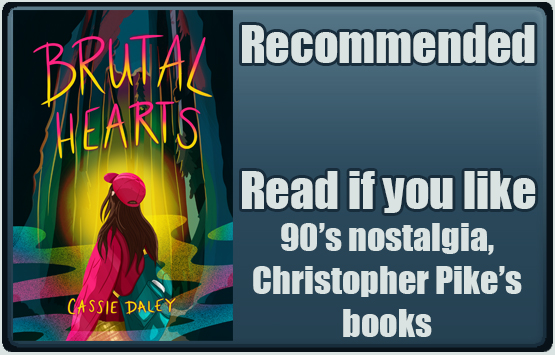
Brutal Hearts by Cassie Daley

Brutal Hearts by Cassie Daley

Formats: Print

Publisher: Self Published

Genre: Killer/Slasher, Monster

Audience: Y/A

Diversity: Autistic character, author is queer and autistic

Takes Place in: type here

Content Warnings (Highlight to view): Cannibalism, Child Death, Death, Gore, Violence

Blurb

It’s 1997 and Leah just can’t seem to catch a break.

A year has passed since her fiancé went missing while hiking alone on a mountain, and she can’t shake the unanswered questions and nightmares Simon left behind.

On the anniversary of his disappearance, Leah and her new girlfriend Josie return to the trail where Simon disappeared with two of their best friends. Armed with incense, tarot cards, crystals, and snacks, the girls have everything they need to complete the Ritual of Closure to help Leah finally say goodbye to Simon, once and for all.

But the trails are hiding something sinister, and it’s been waiting. As night falls around them, the girls find themselves in a deadly game against something vicious and wild that’s made a home for itself on the mountain.

It’s time to find out what really happened to Simon.

The year is 1996: Scream has just been released in theaters, the Macarena is the hottest new dance craze, and seventeen-year-old Leah is deeply in love with her high school sweetheart, Simon. The two have plans to marry after graduation, but that dream is destroyed when Simon goes missing after a hike in the nearby mountains. Volunteers scour the woods for any trace of the missing boy, but it’s like Simon has vanished without a trace.

A year later, Leah is still struggling with her grief and guilt. Her girlfriend, Josie, is doing her best to help Leah through the nightmares and sobbing fits, but nothing seems to help. In a last-ditch effort to give the poor girl some closure, Josie suggests they hike Simon and Leah’s favorite trail to say a final goodbye. Along with Leah’s two best friends, sisters Charlotte and May, the girls set off to perform a Wiccan inspired goodbye ceremony for him. But their beautiful day quickly goes south when something in the woods starts stalking them.

Brutal Hearts is short but gripping story, switching back and froth between the girls being stalked through the woods and the mystery surrounding Simon’s disappearance. I ended up finishing it in one sitting, something I never do even with novellas (ADHD makes it hard for me to focus on a book for too long unless I’m really engaged). I loved all the little nods to 90s aesthetics, from the clothing, to May’s Tamagotchi and the girls’ obsession with all things Wicca. (From Sabrina Spellman to Nancy Downs witches were huge in the 90s, inspiring a renewed interest in Wicca from teenage girls.) Although, it is hard to accept that the 90s were thirty years ago and are now officially nostalgic. Wasn’t it literally just 2000? I think Y2K caused my brain to crash and stop perceiving the passage of time.
I especially liked the addition of the playlists for each character in the back of the book. Leah’s music playlist revolves around being hurt by love. Josie likes grunge. May’s playlist is full of bubblegum pop while the more traditionally pretty and popular Charlotte prefers mainstream music. A fun flashback to 90s teen horror like Fear Street and the works of Christopher Pike (appropriate since Daley also runs the PikeCast) with a healthy dose of urban legends and campfire stories. A perfect read for a hot summer night. 
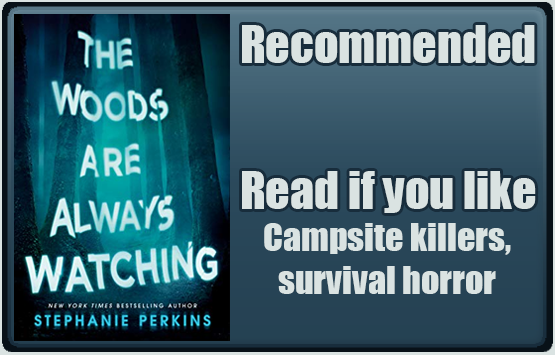
The Woods are Always Watching by Stephanie Perkins

The Woods are Always Watching by Stephanie Perkins

Formats: Print, audio, digital

Publisher: Dutton Books for Young Readers

Genre: Killer/Slasher, Thriller

Audience: Y/A

Diversity: Indian-American Main character

Takes Place in: North Carolina, USA

Content Warnings (Highlight to view):  Amputation, Child Endangerment, Death, Forced Captivity, Gore, Kidnapping, Rape/Sexual Assault, Torture, Violence 

Blurb

Bears aren’t the only predators in these woods.

Best friends Neena and Josie spent high school as outsiders, but at least they had each other. Now, with college and a two-thousand-mile separation looming on the horizon, they have one last chance to be together—a three-day hike deep into the woods of the Pisgah National Forest.

Simmering tensions lead to a detour off the trail and straight into a waking nightmare; and then into something far worse. Something that will test them in horrifying ways.

Camping and horror go together like chocolate and toasted marshmallows. There’s just something about being out in the middle of nowhere with only the light of a bonfire to really prey on those primal fears. In Western tradition, the woods have been a symbol of the dark and unknown for as long as folklore and fairytales have been told: a place where witches, wild beasts, monsters and faeries dwell.

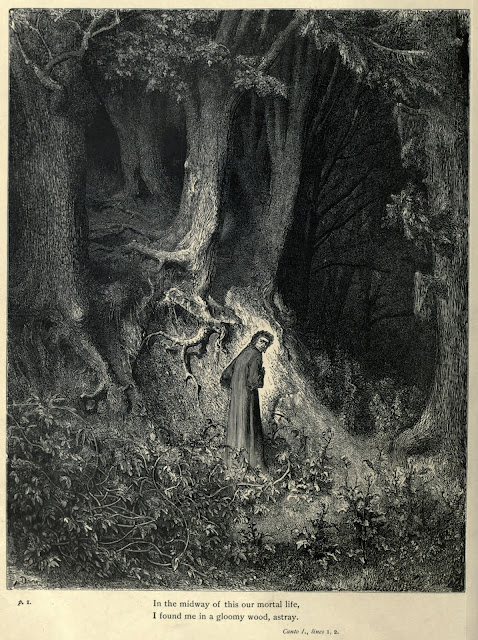
The threat of becoming lost in the forest and falling victim to these creatures is central to many dark tales. In the beginning of the Divine Comedy Dante finds himself wandering in a dark wood, the “selva oscura,” unable to find his way and set upon by a lion, a leopard, and a she-wolf. Little Red Riding Hood encounters a wolf when she wanders off the path (though some interpretations of the fairy tale say the wolf is meant to represent a sexual predator) and Hansel and Gretel stumble upon a witch after losing their way in the woods. In Tam Lin, anyone who wanders into the forest runs the risk of becoming the fae’s blood tithing to hell. The films the Ritual and the Blair Witch both have a group of friends become lost in the woods through supernatural means and then assailed by a Jötunn and the titular witch respectively. But beasts and supernatural beings aren’t the only monsters in the forest. Ordinary humans can be just as —if not more — deadly than wolves and witches. The woods are popular killing grounds for murderers like William Mitchell Hudson (the Texas Campsite Killer) and Herbert MullinIvan Milat was a serial killer who specifically targeted backpackers while Alexander Pichushkin lured dozens of victims to Bitsevski park before murdering them. It’s safe to say the woods can be a dark and dangerous place in both fiction and reality, as best friends Neena and Josie are about to discover in Perkins’ outdoor horror novel The Woods are Always Watching.

Neena Chandrasekhar is a carefree and fun-loving teenage girl, especially compared to her worrywart best friend, Josie Gordon. After the death of her father in a car accident, Josie is scared of the world and often needs Nina to push her to try new things, like camping.  Neither girl is much of an outdoors woman, but going on a solo camping trip is practically a rite of passage in Asheville North Carolina, and with Neena soon leaving for college, the duo decides it’s the perfect way to celebrate their last few days together. They have GPS, printouts of the trails, and Josie’s brother’s camping gear, so what could possibly go wrong? Well, it’s a horror novel, so a lot.

The trip gets off to a rough start with both girls quickly realizing that they may not be physically prepared for such an arduous journey. Their exhaustion soon leads to short tempers and building tension as Josie quickly becomes fed up with Neena’s cavalier attitude towards camping and Neena gets annoyed with her best –friend’s condescending bossiness. Their friendship is further put to the test as the duo discover how ill-prepared they actually are for their hike through the woods and each takes out their frustration on the other. Caught up in their own petty squabbling the pair are dangerously unaware of something watching and waiting for them in the woods until it’s too late.

The Woods are Always Watching is slow to start, focusing on teenage drama and interpersonal conflict for the first chunk of the story, which can feel tedious even if it does offer glimpses into the main characters’ psyches. We don’t meet the actual villains of the story until almost halfway in (although there are hints to their presence early on). But once the action actually does get started, I found I couldn’t put the book down. Perkins is a master of creating atmosphere and suspense and making the forest feel dark and foreboding, especially to two inexperienced girls. The whole book feels like a modern-day fairytale with two naïve young women journeying through the dark woods

So, will you enjoy this particular dark woods story? Well, it’s essentially a young adult version of Deliverance, and the film is a good metric of how much you’ll like this book. Does the idea of being isolated in the woods, and slasher/folk horror terrify you? Then you’ll enjoy Stephanie Perkins’ camping-gone-wrong novel. Evil hillbillies and threats of rape not your thing? Then you’re probably better off skipping this one.

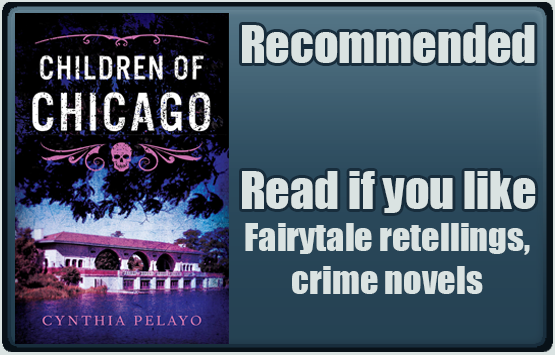
Children of Chicago by Cynthia Pelayo

Children of Chicago by Cynthia Pelayo

Formats: Print, audio, digital

Publisher: Agora

Genre: Dark Fantasy, Demon, Killer/Slasher, Myth and Folklore, Thriller

Audience: Adult/Mature

Diversity: Bisexual main character, Puerto Rican main character and author, Latine characters

Takes Place in: Chicago, IL, USA

Content Warnings (Highlight to view): Alcohol Abuse, Child Death, Death, Forced Captivity, Gaslighting, Illness, Kidnapping, Mental Illness, Physical Abuse, Police Harassment, Suicide, Violence

Blurb

This horrifying retelling of the Pied Piper fairytale set in present-day Chicago is an edge of your seat, chills up the spine, thrill ride. ‪ When Detective Lauren Medina sees the calling card at a murder scene in Chicago’s Humboldt Park neighborhood, she knows the Pied Piper has returned. When another teenager is brutally murdered at the same lagoon where her sister’s body was found floating years before, she is certain that the Pied Piper is not just back, he’s looking for payment he’s owed from her. Lauren’s torn between protecting the city she has sworn to keep safe, and keeping a promise she made long ago with her sister’s murderer. She may have to ruin her life by exposing her secrets and lies to stop the Pied Piper before he collects.

And I chiefly use my charm
On creatures that do people harm,
The mole and toad and newt and viper;
And people call me the Pied Piper.
The Pied Piper of Hamelin by Robert Browning (1812-1889)

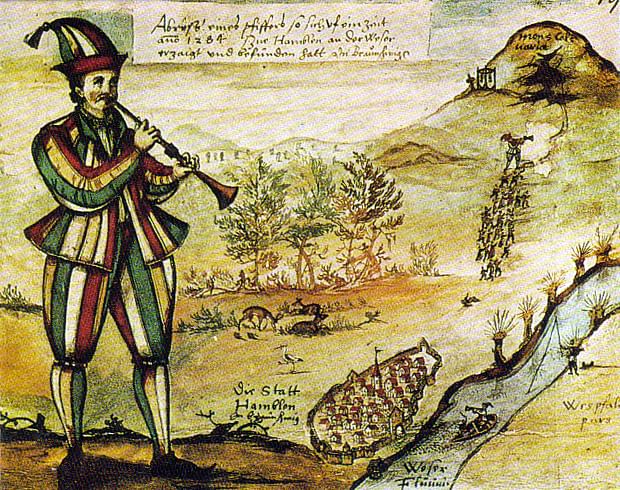
“The Pied Piper of Hamelin”by Augustin von Mörsperg, 1592

My dad was born and raised on the Southside Chicago and will tell anyone who will listen that his birthplace is the best city in the world. My wife, on the other hand, firmly believes Chicago is akin to LA in the ‘90s. When I did finally manage to lure her there with the promise of deep-dish pizza and the Museum of Science and Industry she did admit the Windy City was a pretty cool place and not at scary as she was expecting (even after we stumbled onto an illegal street race). Although the crime rate there is higher than the national average, Chicago is hardly the crime and drug filled dystopia my wife and other outsiders seem to believe it is. In fact, its violent crime rates are far lower than those of Anchorage, Wichita, and Milwaukee. The dangerous reputation may have come from Chicago’s fascinating history of crime, gangsters, and serial killers or even the many tragedies that have befallen the White City in the past. Modern-day boogiemen like the Lipstick Killer, John Wayne Gacy, the Ripper Crew, and Richard Speck all called Chicago their home. The Blue Beard-esque H. H. Holmes built his murder castle in Englewood. The city’s most notorious gangster, Al Capone, has morphed into something of a folk hero and tragedies like the Great Chicago Fire and the Haymarket affair have taken on almost a legendary status. Dark rumors surround the abandoned Edgewater Medical Center. Stories like these have shaped Chicago’s history and how it’s perceived by the rest of the country: a gothic city haunted by the past. But darkness and death aren’t all the city has to offer.

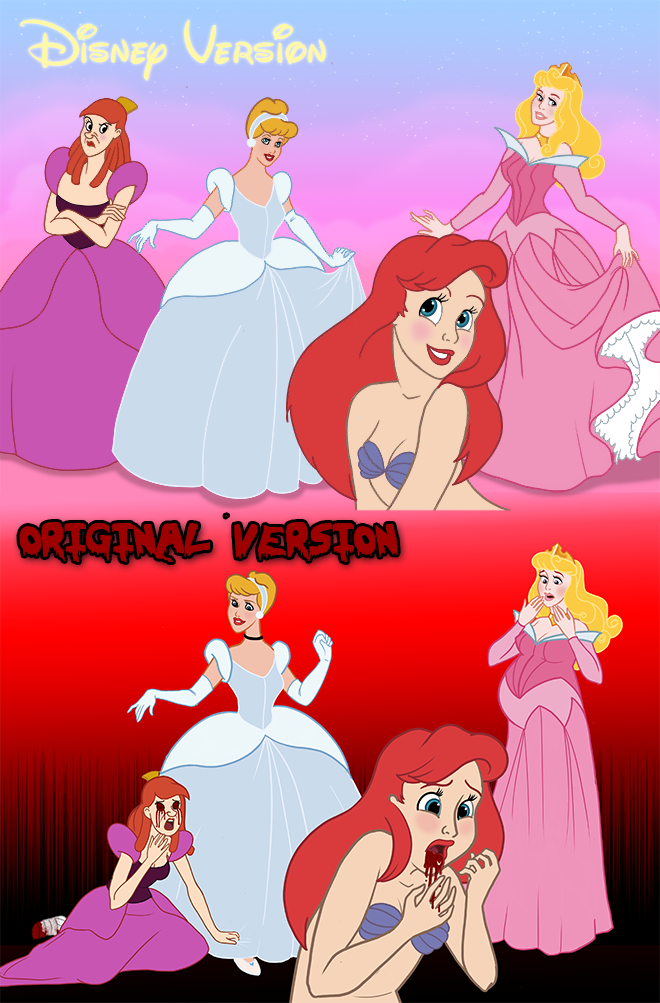
Fairy tales, at least the original versions and not the Disney-fied ones, are often a child’s first introduction to the world of horror. Beautiful and sinister stories full of threats of death and assault, mutilation, hungry wolves, and dark forests have been used to frighten children for generations. Fairy tales are beautiful roses and sharp thorns, poisonous treats, beauty and blood. They also share many of the same elements as gothic fiction. Sometime in the distant past, a helpless woman is placed in a dark and dangerous setting (now a castle instead of a forest), where she is threatened by supernatural forces until rescued by the hero. Orphans and peasant girls are made to suffer before finally coming into riches. Animals no longer speak, but still bring portents of doom. Nature is wild, dangerous, and unpredictable. Both have themes of revenge, isolation, rags to riches, abuse, and women who are under constant threat as the men in her life fight over her body. Bluebeard, and other versions of the Aarne–Thompson type 312 tale, are the perfect example of a gothic fairy tale. In the story a woman leaves her family to marry a mysterious stranger and goes to live in his isolated and lonely castle. But locked away in a castle is a dark and dangerous secret. The wife can go in any room, but one, which contains the bodies of the stranger’s previous, murdered wives.

In the original version of Cinderella, the Little Mermaid, and Sleeping Beauty, the step sisters cut off parts of their feet and birds pecked out their eyes, the mermaid’s tongue was cut out and every step she took on land was agony, and Sleeping Beauty was raped and impregnated with twins by a married king while she slept.

Cynthia Pelayo draws on the city’s history to create her gothic urban fairy tale, Children of Chicago. The city stands in for the dark forest, a vaguely supernatural setting where unwary children disappear and gang members prowl the street like big bad wolves. The book follows recently orphaned Lauren Medina, a deeply troubled police detective hunting a serial killer known only as The Pied Piper– a shadowy boogeyman who preys on children then vanishes into the night. It’s rumored he can be summoned by burning a black candle and speaking a spell in front of a mirror. Throughout the story, Lauren is unstable and brimming over with barely-contained emotion, a staple of any good Gothic tale, as she wrestles with her missing memories of her sister’s death. Lauren breaks the typical female fairy tale mold where women were relegated to witches, wise women, virginal damsels, and evil stepmothers. She’s not exactly evil, but she isn’t pure and heroic either, instead she’s but a rare example of a female Byronic hero intentionally written to be tragic, unlikeable, morally gray, and hiding a dark past, much like the heroes found in gothic horror. In fact, few of the women in the story fall into any of the aforementioned roles. Stepmothers aren’t necessarily evil, even if their angry stepdaughters perceive them as such. Damsels in distress may possess more agency than they seem to, and villainous women can also be victims. I genuinely enjoyed seeing a female character (who wasn’t intended to be liked) embrace her darkness and struggle with her morality. Just as much horror came from Lauren’s psychological trauma and instability as it did from the threat of the supernatural.

While Lauren initially came across as “the young female cop with a dark past and something to prove” trope (aka Jodie Foster in Silence of the Lambs), it soon became clear that unlike Clarice Starling, we’re not necessarily supposed to root for her. And unlike every maverick detective in an ‘80s buddy-cop comedy, Lauren’s flagrant disregard for the rules in order to get her guy aren’t justified, but instead dangerous and unjust. Though, much like police in the real world, she’s able to get away with it. I appreciate that Pelayo avoided turning her crime drama into “copaganda” by making Lauren a protagonist, but not a hero. I admit I used to enjoy shows like Brooklyn 99Lucifer, and Law & Order SVU (yes, I’m old) even though I recognized how incredibly problematic they were. But ever since 2020 I’ve more or less lost my taste for any media that portrays a corrupt system as a heroic force for good, justified in flouting the law. It no longer feels like harmless fantasy when you realize how many people actually believe that cop shows reflect real life and officers only target “bad guys” as oppose to anyone they don’t like (mostly BIPOC, the poor, and the mentally ill). So, reading a crime story where the police weren’t heroes was a relief. In fact, Lauren’s only redeeming quality is that she has a soft spot for troubled teens, ever since the mysterious death of her own sister.

Brimming with references to Chicago’s history, it’s clear that Pelayo loves her home while still recognizing its flaws. In fact, the novel feels just as much a crime story as it does a guide to the dark and fantastical parts of the Windy City. She holds a Master of Fine Arts in Writing from The School of the Art Institute of Chicago and it shows in her writing. Throughout Children of Chicago Pelayo references the original, dark versions of famous and not-so famous fairytales, from Cinderella to the Singing Bone, adding to her own story’s dark atmosphere balancing on the edge of reality and fantasy. Pelayo’s novel is full of missing mothers, an unjust society where the most vulnerable suffer, magic mirrors, plenty of gore, spells, and a moral message. But overall, it’s a subversion of the classic fairy tale formula where the good are rewarded, the evil are punished, and morality is clearly defined. In Children of Chicago the “heroes” are neither pure-hearted nor moral, evil escapes justice while the innocent suffer, and no one is getting a happy ending.

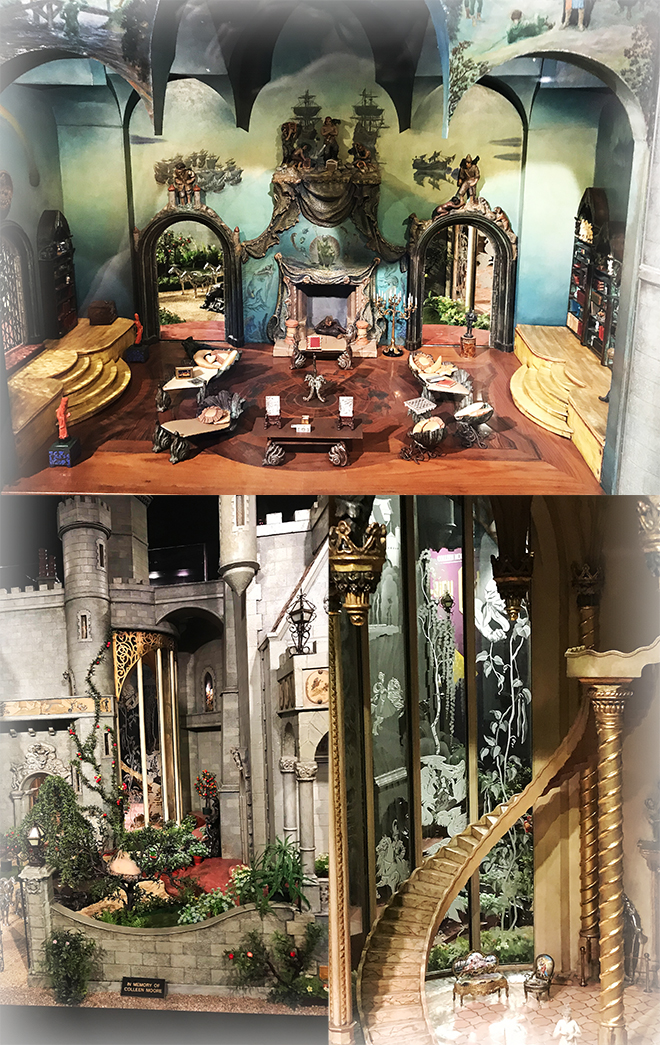
It’s unfortunate that the darkest parts of Chicago’s history have shaped so much of its reputation when the Windy City has so much to offer. As my wife soon discovered on her first visit, the city is full or art, beauty, and wonder. Pelayo doesn’t just show the city’s dark side, she shows its magic as well. “Fairy tales are in our blood as Chicagoans” one of the books characters explains. Walt DisneyL. Frank BaumRay Bradbury, and Gwnedolyn Brooks were all inspired by the city to create their own fairy tales. Colleen Moore created her famous Fairy Castle and donated it to The Chicago Museum of Science and Industry. Children gathered pennies to create the Rock-a-Bye Lady from Eugene Field’s poem. The haunting beauty of the SheddAquarium feels like you’ve stepped into another world. The city even has a secret Little Mermaid inspired bar! It’s this beauty, contrasted with the allure of danger, that makes Chicago as wonderous as any fairytale.

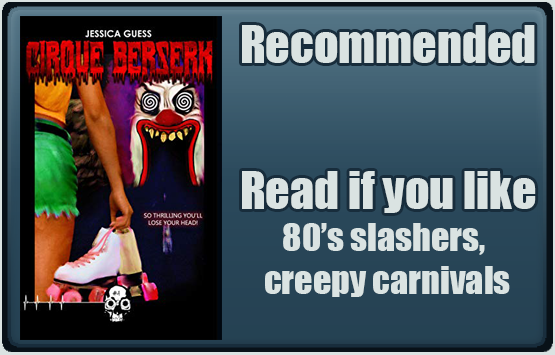
Cirque Berserk by Jessica Guess

Cirque Berserk by Jessica Guess

Formats: Print, digital

Publisher: Unnerving Magazine

Genre: Killer/Slasher, Myth and Folklore, Occult, Demons

Audience: Y/A

Diversity: Black main character and author, Native Oglala Lakota main character, character with syndactyly

Takes Place in: Florida, USA

Content Warnings (Highlight to view): Abelism, Alcohol Abuse, Animal Death, Child Abuse, Death, Forced Captivity, Gore, Kidnapping, Physical Abuse, Racism, Sexual Abuse (Voyeurism), Slurs, Slut-Shaming, Torture, Verbal/Emotional Abuse, Violence 

Blurb

The summer of 1989 brought terror to the town of Shadows Creek, Florida in the form of a massacre at the local carnival, Cirque Berserk. One fateful night, a group of teens killed a dozen people then disappeared into thin air. No one knows why they did it, where they went, or even how many of them there were, but legend has it they still roam the abandoned carnival, looking for blood to spill.

Thirty years later, best friends, Sam and Rochelle, are in the midst of a boring senior trip when they learn about the infamous Cirque Berserk. Seeking one last adventure, they and their friends journey to the nearby Shadows Creek to see if the urban legends about Cirque Berserk are true. But waiting for them beyond the carnival gates is a night of brutality, bloodshed, and betrayal.

Will they make they it out alive, or will the carnival’s past demons extinguish their futures?

I received this product for free in return for providing an honest and unbiased review. I received no other compensation. I am disclosing this in accordance with the Federal Trade Commission’s 16 CFR, Part 255: Guides Concerning the Use of Endorsements and Testimonials in Advertising.

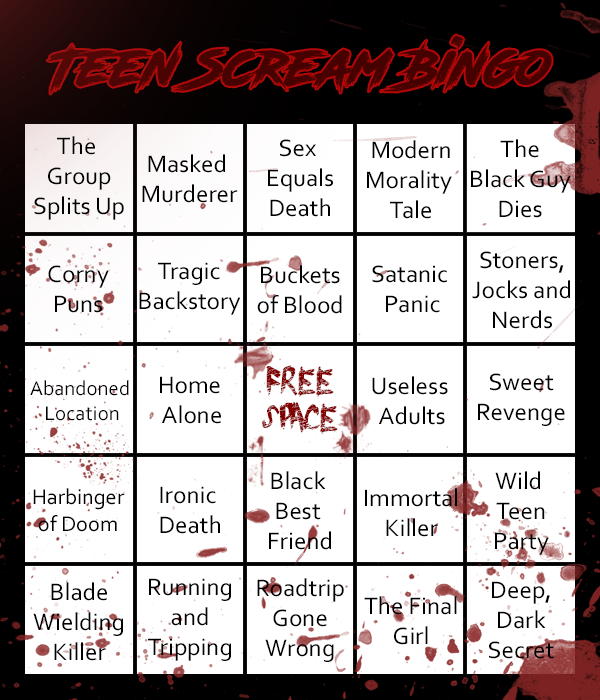
Put on your sequins and neon spandex, grab a New Coke, and turn up that Whitney Houston cassette because it’s time to take a look at Jessica Guess‘s tribute to eighties’ slashers, Cirque Berserk! Guess’s new horror novella is the perfect ode to trashy, B-horror movies of the yuppie decade à la The Funhouse, Evilspeak, and Prom Night. Praised by one of my favorite horror authors, Stephen Graham Jones, Cirque Berserk hits most of the squares on the “teen scream” Bingo card, but still feels fresh and original. Guess has fun playing with the classic slasher clichés while subverting more problematic tropes like the “black best friend” and the “nice guy” being rewarded with a hot girl. She fills her story with plenty of self-aware humor and the kind of affectionate mocking that can only come from a true horror fan, which balances well with the more serious scenes of racism, sexism, and abuse. The result is a fun, nostalgic, carnival ride with a deeply emotional narrative hidden just beneath all the glitter, gore, and a bad-ass Black protagonist.

A black and red bingo card that says "Teen Scream Bingo." The squares include various slasher cliche's like "corny puns," "abandoned location," "Black best friend," and "masked murderer."

The eighties have made a come back in horror recently with popular TV shows (Stranger Things, American Horror Story: 1984), movies (the It reboot, The Final Girls), and novels (Grady Hendrix’s My Best Friend’s Exorcism) all drawing inspiration from the decade that gave rise to the slasher film, and it’s no wonder why. Not only do they have the nostalgia factor going for them as Gen Xers have their midlife crises, but they’ve got a ton of amazing source material to work from. Eighties audiences were blessed with a plethora of classic horror movies: grotesque monsters (The Thing, Aliens, Scanners, American Werewolf in London), final girls who fought back, (Halloween, Nightmare on Elm Street, Hell Raiser, Aliens), self-aware humor (Elvira, Monster Squad, Fright Night) cool, sexy vampires (Lost Boys, Near Dark, The Hunger) and horror franchises (Texas Chainsaw Massacre, Friday the 13th, The Evil Dead) graced the silver screen. Hell, even the remakes were good. Both The Fly and The Thing arguably surpassed their originals.

But what was it about the decade of greed that inspired so many amazing films? To understand eighties horror, you need to understand that the 1980’s were an age of excess, greed, rapid technological advancement, and reactionary conservatism. As late writer/director Stuart Gordan explained in the Shudder documentary In Search of Darkness: A Journey Into Iconic 80’s Horror, “horror thrives when there’s a repressive government” and the Reagan years certainly qualified. Additionally, public uncertainty and fear lead to the genre’s rise in popularity, just as it did during the Great Depression resulting in Universal’s famous Golden Age monsters. Meanwhile, advancements in technology and the increased affordability of personal computers led to some groundbreaking special effects and makeup (The Thing, Scanners, The Fly, American Werewolf in London). This decade was the perfect balance of repression and paranoia for horror films to flourish.

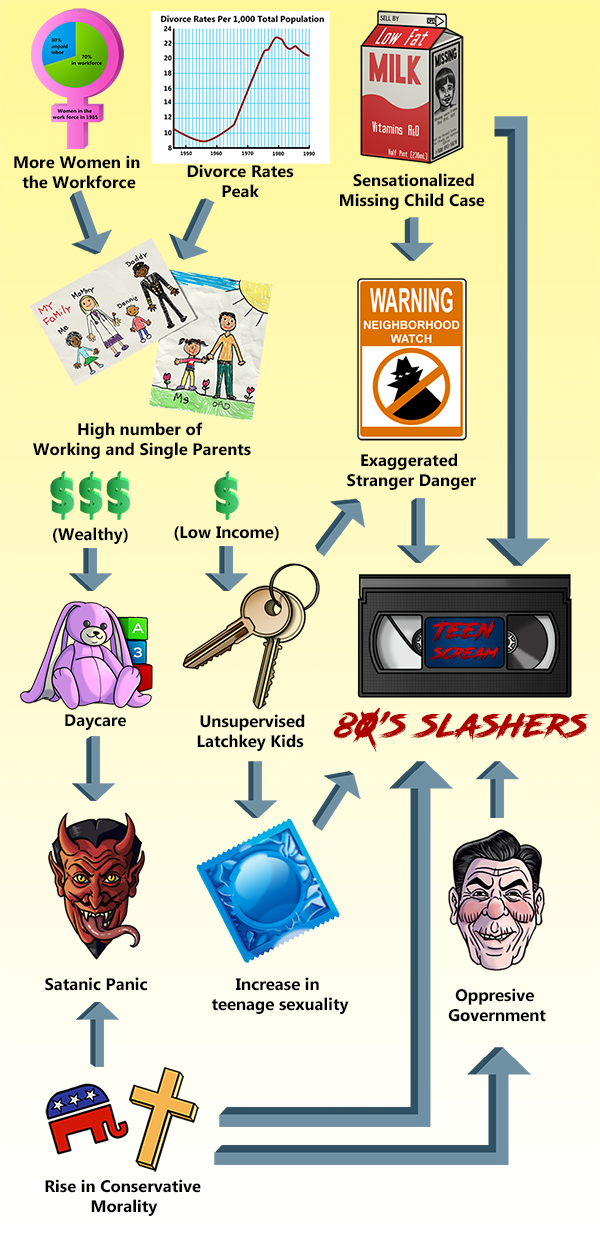
The rise of the “New Right” in the late seventies and eighties brought with it a push to return to “traditional American values” (i.e. being sexist, racist, homophobic, and slut-shaming with impunity). Everywhere you looked, the crack cocaine epidemic was sweeping the nation, AIDS was desolating the population, hardcore porn was easily accessible on video, the rich were getting greedier and richer, and divorce rates had peaked. With more women entering the workforce and an increasing number of newly-single kids were suddenly being left at home unsupervised. The public might have been content with leaving their kids at home, but a generation of ‘suddenly being left unsupervised for long periods of time’ were exposed to a plethora of violence and sex in media. Concern for the latchkey generation was only made worse by the abduction and murder of six-year-old Adam Walsh. The tragic case “created a nation of petrified kids and paranoid parents” who saw danger in every stranger they encountered. The media-fueled mass hysteria eventually led to a rash of Satanic panic.

It was enough to make any God-fearing White conservative clutch their pearls! Rather than blame Reagan for taking away childcare funding and completely botching the response to drugs and AIDS, or recognize that the risk strangers pose to children is minimal at best a vocal group of conservatives decided it was the loss of a nuclear family, declining morals, and demonic media that had left everything such a mess. Even if you didn’t buy into the whole “little Timmy will get murdered by Satanists because his mommy had to rejoin the workforce” school of thought, it was hard to deny the world was pretty scary, what with global warming, Jeffrey Dahmer, the cold war, and deadly invisible illnesses. Why couldn’t we go back to the way they were in the fifties when bad things only happened to minorities and women weren’t constantly going on about equal rights? Back before all teens were watching heavy metal videos on MTV, popping third generation birth control pills, and playing Super Mario Bros on their NES (or whatever they were into back then. Doing whippets maybe? I dunno, I was like 4 at the time). Cue a wave of 1950’s nostalgia and horror films that capitalized on the public’s fear for the safety of unsupervised kids.

A flow chart with images that shows the various events in the 80's that led to the rise in slasher horror as described in the review.

Most slashers followed a basic formula. A group of unsupervised teenagers with poor decision making skills all did “Bad Things TM” until an evil man would show up and kill everyone but the clever, resourceful, virginal hero because they were too pure to be defeated by evil. The story was simple, yet effective — at least in its ability to terrify audiences. I doubt anyone waited for their wedding night because they were afraid Jason would show up for a murderous version of coïtus interruptus. Ironically the conservative adults whose fear and values inspired the horror Renaissance were also its main detractors. Probably because filmmakers were interested in making money, not PSAs about morality, and tits and blood sell. The so-called golden age of slashers began in 1978 with Halloween and ended in 1984 with A Nightmare on Elm Street. Unfortunately sequelitis and low budget direct-to-video horror flicks marked the end of the era, but thankfully schlock could be just as entertaining in all it’s goofy, cheesy glory. When 80’s horror is good, it’s really good, but when it’s bad it’s amazing. And it’s these B-movie slashers that make Cirque Berserk such a fun read. Guess understands that while The Shining may be the Michelin star-winning gourmet meal of eighties horror and the franchise slasher films are the family restaurants with mass appeal, movies like Basket Case and Slumber Party Massacre 2 are greasy fast-food burgers you cram in your maw at 3 A.M. in the CVS parking lot. Yes, they’re terrible for you, and yes you regret it the next day when you wake up with a hangover and smell like dumpster fries, but god damn if those weren’t some delicious fucking burgers. Cirque Berserk is what happens when you have a talented chef prepare those greasy, salty, fast-food burgers. It’s fast, fun, and you won’t be able to put it down until you’ve devoured the whole thing.
Guess cleverly subverts the standard slasher story line while still paying homage to many of its elements. There’s a cast of stereotypical teens whose bad judgement lands them in an abandoned amusement park with a masked killer despite the warnings from the wise old woman at the gas station. There’s stupid teen drama, bad puns, and buckets of blood. Guess even adds a Satanic subplot where a group of disenfranchised teens summon the demon Lilith to grant them wishes, poking fun at Yuppie parents’ unfounded fear that their kids were listening to Stairway to Heaven backwards and using D&D to summon demons. The story is full of self-aware humor, my favorite example of which involves one of the characters pointing out how weird it is that no one is carrying a gun in Florida. Curses and murderous Satan worshipers are well within the realm of possibility, but no one packing heat in a Southern “stand your ground” state is way too weird. Guess manages to give us all this and still make her story genuinely scary. And for what felt like a pretty standard slasher set-up, I was actually caught off guard by a plot twist.

When it comes to her villains, however, Guess dispenses with the usual “irredeemably evil for the heck of it” masked murderers typical in slashers. Instead, she gives us a group of tragic figures who sell their humanity for a chance at freedom. It’s appropriate that the teen killers summoned Lilith to grant them freedom, a figure who chose to become a demon rather than submit to the will of a man. As another famous Abrahamic rebel declares in Paradise Lost “Better to reign in Hell than serve in Heaven.” The Alphabet of Ben Sira describes Lilith as Adam’s first wife, created as his equal. After getting fed up with her husband’s misogyny and bad sex, Liltith decides dick really isn’t worth all this bullshit and flies off into the night, choosing to become a demon rather than submit to male authority. Modern Jewish feminists, such as Judith Plaskow, interpret her as “a female symbol for autonomy, sexual choice, and control of one’s own destiny.” In her midrash, The Coming of Lilith, Plaskow writes “Lilith not only embodies people’s fears of how attraction to others can ruin their marriages, or of how risky childbearing and raising children are, but also represents a woman whom society cannot control—a woman who determines her own sexual partners, who is wild and unkempt, and who does not have the natural consequences of sexual activity, children.” Demon or no, Lilith sounds like my kind of woman.

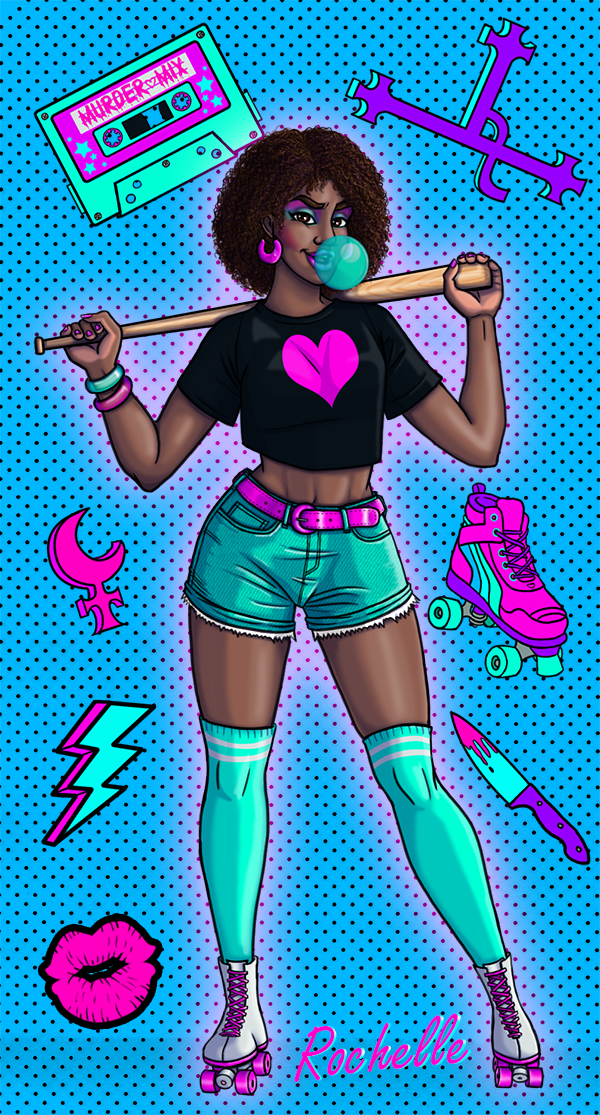
But my absolute favorite part of Cirque Berserk is Guess’ tough-as-nails and whip-smart protagonist, Rochelle, who is anything but your typical final girl. Guess got the name from Rachel True’s character in The Craft, whose frequent erasure from horror conventions and panel discussions Guess even wrote about here. She explains that this was her way of honoring True. “I love The Craft and I got the idea for Cirque Berserk a little after watching Horror Noir and hearing what Rachel said about being typecast as the best friend and always having to say “are you okay” a million different ways. My Rochelle is a response to that.” And I say she’s the perfect response! But what else would you expect from Guess, creator of the Black Girl’s Guide to Horror blog? Cirque Berserk is a novella for Black and Indigenous horror fans who are sick of getting cast as victims, and hero helpers. As Guess states on her website:

“Horror is for everyone, but it doesn’t always feel that way with the lack of representation in the genre. Final Girls? White. Heroes? White. Villains? White. Masters of Horror? Mostly all white. Even those who talk about horror are all for the most part White. [My site] is the answer to the too white, too male, too cis, too straight genre that so many of us love but don’t see much of ourselves in.”

A teenage Black girl with natural hair. She's wearing roller skates, blowing green bubble gum, and has a bat slung over her shoulders. She surrounded by images of roller skates, a bloody knife, symbols for the demon Lilith, and a murder mix tape. The art is colored in pinks, teals, greens, blues, and purples. All colors that were popular in the eighties.

The novella has very few problems. I felt like some of the descriptions were a bit lacking  and Guess has a tendency to “tell” rather than “show.” The word choices could also get repetitive (for example using “said” repeatedly), but these are both fairly minor nitpicks for what’s otherwise a very strong story. I also wish we’d been given a little more time with the victims before they started getting picked off one by one, but I otherwise can’t complain about the novella’s pacing. Building suspense is a great way to make your story scary, but sometimes you want a horror book that gets straight to the killing spree instead of dicking you around for ten gore-free chapters. And Guess knows how to give the reader that instant blood-soaked satisfaction we crave. Her book was the perfect length: long enough to get its point across without letting the story drag. It may not be as fancy or polished as some award-winning, gourmet novel, but who gives a fuck? You know which one you’re going to be craving at 3 AM.

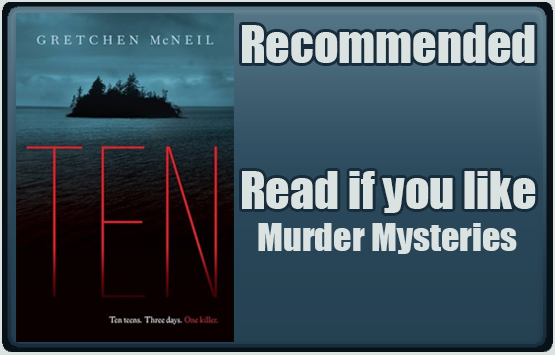
Ten by Gretchen McNeil

Ten by Gretchen McNeil

Formats: Print, audio, digital

Publisher: Harper Collins

Genre: Mystery, Psychological Horror, Killer/Slasher

Audience: Y/A

Diversity: African American character, Japanese American character, Asian American character, Samoan character, Bipolar character

Takes Place in: Seattle, USA

Content Warnings (Highlight to view):  Sexist Language, Abelist Language, Racist Language, Sexism, Mental Illness, Drug Use, Violence, Death

Blurb

SHHHH!
Don’t spread the word!
Three-day weekend. Party at White Rock House on Henry Island.
You do NOT want to miss it.

It was supposed to be the weekend of their lives—an exclusive house party on Henry Island. Best friends Meg and Minnie each have their reasons for being there (which involve T.J., the school’s most eligible bachelor) and look forward to three glorious days of boys, booze and fun-filled luxury.

But what they expect is definitely not what they get, and what starts out as fun turns dark and twisted after the discovery of a DVD with a sinister message: Vengeance is mine.

Suddenly people are dying, and with a storm raging, the teens are cut off from the outside world. No electricity, no phones, no internet, and a ferry that isn’t scheduled to return for two days. As the deaths become more violent and the teens turn on each other, can Meg find the killer before more people die? Or is the killer closer to her than she could ever imagine?

Ten is inspired by Agatha Christie’s bestselling mystery thriller, And Then There Were None, a tale of ten strangers with dark secrets trapped on an island with a killer who terminates them in ironic ways and publicly marks the deaths one by one. McNeil takes Christie’s original concept, sets it in modern times, changes the terrible, unlikeable adults into a bunch of terrible, unlikeable teens, does away with racism, xenophobia, and anti-Semitism, and replaces it with a diverse cast.

Like the original Christie novel, Ten starts off with ten (get it!?!) people gathering on a remote island under false pretenses only to discover that it was all a trick by the killer, who has kindly left them a Ringu-esque DVD (a gramophone record in the original) to inform the victims of their inevitable demises and remind them how shitty they all are (in case you started feeling bad for any of them). At first, no one believes the sketchy murder announcement is legit, at least until they start dropping like flies, and then all hell breaks loose. Both books involve distrust, everyone accusing each other, the fear of knowing there’s a wolf (or possibly wolves) hiding among the sheep, and of course, a party with a body count. Why do so many parties in these kind of stories end up with a bunch of dead guests? Does the Red Death just go around gate crashing every party in the horror genre? Why does every gathering of three or more people that involves alcohol inevitably end in someone’s demise? Being an introverted nerd who would rather gnaw off my own hand than attend most social gatherings, I honestly have no idea what happens at parties, so I’m just going to assume that it’s pretty standard for them to end in either mass murder or demon summoning (and now I wish I went to more parties).

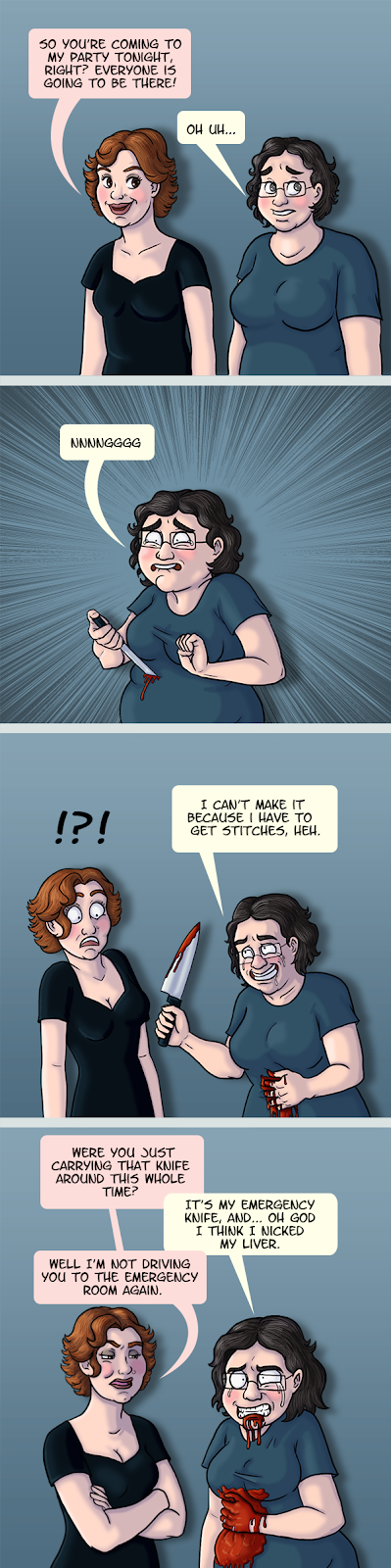
 I’m walking with a red-headed friend who cheerfully asks “So, you’re coming to my party tonight, right? Everyone is going to be there!” Apprehensive, I respond “Oh uh…” then plunge a knife into my stomach. Holding my wound and trying to smile through the pain, I respond to my shocked friend “I can’t make it because I have to go to the ER and get stiches, heh.” Irritated, she asks “Wait, were you just carrying that knife around the whole time?” Bleeding profusely, I mutter “Oh God, I think I nicked my liver.”

A liver laceration is a small price to pay to avoid social interaction.

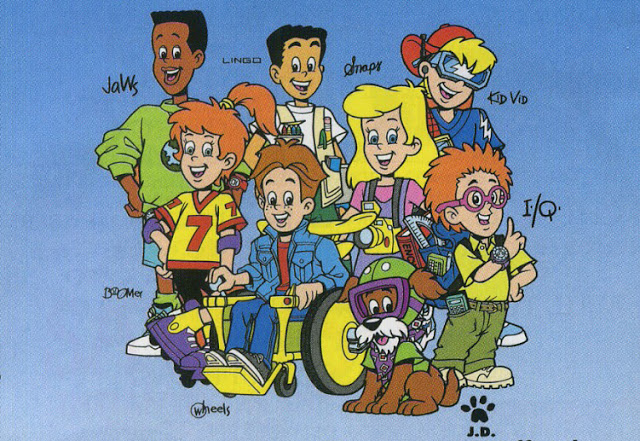
Last, but not least, is the diversity, which pretty much only applies to Ten since Agatha Christie was a racist asshole, so it’s pretty obvious who the winner is here, but let’s go over it anyway. Ten features a fairly diverse cast, with about half the characters being POC, in addition to a character with a fairly realistic depiction of bipolar disorder. Of course, most of the characters don’t get enough of a chance to develop anything close to a personality before they get offed, so they’re all pretty one-dimensional characters. There’s also a “rebellious” East-Asian girl with a rebellious blue streak in her hair, so Ten isn’t completely free of stereotypes either. But at least the diversity is there, even if it sometimes leans more towards “early 90’s kid show” diversity.

A drawing of the members of the “Burger King Kid’s Club”, a multi-ethnic group of fictional children from the 90’s. Their names are written next to them. In the front row are the dog, J.D., and a white boy in a wheel chair named “Wheels.” The second row (from left to right) shows a butch red-headed girl in sports-wear named Boomer, a femme blonde girl named “Snaps”, and a short, white boy named I/Q. The back row depicts JaWs, a black kid, a Hispanic boy named Lingo, and another white boy named “Kid Vid”.

I can just imagine Wheels being like “My name is Jordan, you insensitive, ableist jerks.” Well, at least it’s better than JaWs, his names looks like a typo. Why do none of these children have normal names?! Is their mom Gwyneth Paltrow? And how come the white kids get to be in the front?

So how does the re-imagining stand up to the original classic? In terms of writing, McNeil is a decent-ish author, but there’s just no competing with Agatha “The Queen of Crime” Christie. I mean, Agatha is the world’s best-selling mystery writer (that’s not an exaggeration, she’s actually in the Guinness Book of World Records), while Ten contains the line “The whole thing had been a perfect storm of not awesome.” So yeah…any comparison between the two would be downright unfair. However, it seems like McNeil realizes this, and isn’t trying to outdo her inspiration. Plot-wise, both books have a good mystery, although the original is unbelievably difficult to solve, and requires an extensive epilogue to explain what the hell just happened because the clues are so vague. Even knowing who the killer was on subsequent readings of And Then There Were None, I couldn’t pick up on any hints as to their identity. In fact, I’m not entirely convinced Christie didn’t just randomly pull the ending out of her ass at the last minute, but whatever, at least I couldn’t guess the culprit after a few chapters. Meanwhile Ten gives the reader enough clues to figure out the ending without being super obvious. That is, unless you’ve already read And Then There Were None in which case you’re probably going figure out the killer (or killers) almost instantly. So yeaaaaaaah, sorry about that. The scary parts of Ten are done well, but the rest of the story (especially the beginning) feel forced. All the dialogue is generic teen bickering and cookie cutter conversations about crushes, school, and beer and it only exists as a quick set up before the murder spree starts.

While Christie’s novel is a psychological thriller that focuses heavily on the characters, McNeil’s work leans more towards the classic horror genre, specifically the teenage slasher/cabin in the woods kind. The characters in both stories are awful human beings, which works fine for And Then There Were None, where they’re at least complex and interesting, and we’re more interested in solving the mystery than anyone surviving. The closest thing we have to a primary cast in Christie’s book are Vera the governess, Philip Lombard the solider, Armstrong the doctor, and Blore the private investigator. And it’s still really ambiguous if any of them are the killer until the end. Christie switches the point of view frequently, so her reader becomes just familiar enough with each character to get a basic understanding of their personality, but not so much as to clue them in to the killer’s identity. In Ten we’re given a clear and likeable protagonist to root for, the shy Meg, along with her best friend, Minnie, and their shared love interest, T.J. (ugh, love triangles). This lends itself better to a slasher story where we need at least one character whose safety we fear for, and then a bunch of cannon fodder characters to satisfy the reader’s bloodlust. (Let’s face it, if you’re reading a book like this you’re looking for a body count.) The rest of the cast is one dimensional and just needs to hurry up and die. However, this does add a wrinkle to the whole revenge thing, you can’t very well root for a main character that did something terrible, so we know the killer/killers are either overreacting or there’s been a terrible misunderstanding. It also means we can rule out Meg as the killer (and assume it’s probably not Minnie either), but there are still enough potential killers left over to fuel plenty of paranoia.

Having most of the characters know each other in Ten adds an extra layer of creepiness because no one wants to believe their friend is a murderer, and the killer is quite literally backstabbing people who trusted them. In Christie’s setup, you don’t really care who gets the ax (literally and figuratively) because everyone is awful. Lombard’s an arrogant chauvinist who left a bunch of natives to die because he barely saw them as people, Blore is an overconfident idiot who falsifies evidence, and Dr. Armstrong is a spineless alcoholic who cares more about recognition and his reputation than the patient he killed while he was drunk. The only character who is sort of sympathetic is General MacArthur, and that’s only because his victim was a world class jerk who slept with the guy’s wife, and MacArthur feels genuinely remorseful about sending him on a death mission. And that’s not even including the minor characters and all the reasons they suck. The mystery and the identity of the killer are really the only things that matter in And Then There Were None (okay, and maybe whether or not Vera survives, she’s slightly more likable than her companions), which makes it a captivating read, but not particularly scary.

Because Ten is aimed at teens, McNeil threw in a completely unnecessary love triangle (as is apparently required for any book in Y/A section) because apparently a murder spree wasn’t dramatic enough. To her credit, McNeil makes the clichéd romance slightly less terrible by actually giving Meg a legitimate reason for not wanting to upset Minnie by going after their mutual crush. Minnie suffers from bipolar disorder, and even though she’s finally getting treatment, she’s still prone to making bad decisions while manic, including turning into someone Meg didn’t recognize and lashing out when she found out her best friend was also interested in T.J. Because she’s been friends with Minnie for so long, and the mental illness is a more recent development, Meg still hasn’t quite figured out a balance between an overprotective enabler and a supportive friend when Minnie is having a depressive or manic episode. Because Minnie is still in serious denial about her Bipolar Disorder and tends to minimize the severity of her symptoms Meg also feels responsible for her best friend’s wellbeing and acts like a mother hen. It also doesn’t help that Minnie’s dad has asked Meg to “take care of his daughter” and placed an unfair burden on her unqualified shoulders. As a result, the two girls have developed a toxic, codependent relationship with Meg treating Minnie like she’s some sort of fragile doll who will shatter at the slightest hardship. Honestly their dysfunctional relationship was about 100 times more interesting than their stupid crush on T.J.

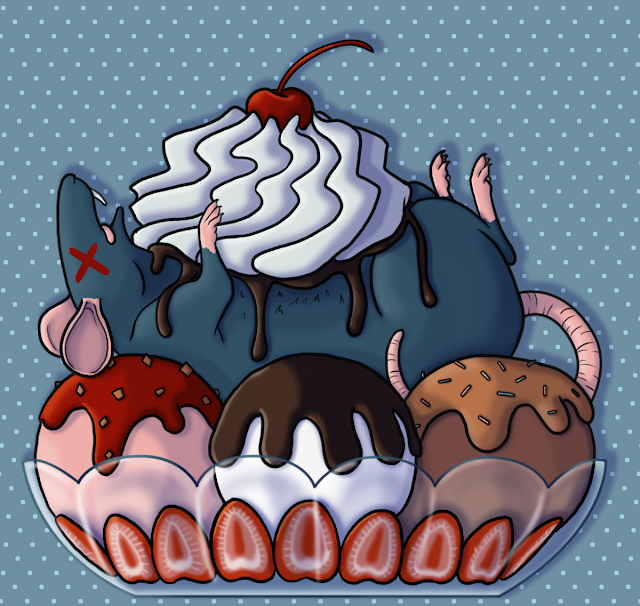
It’s still about five hundred times better than the Christie’s original novel (not that that’s saying much), which, by the way, wasn’t originally called And Then There Were None. The actual title of the novel was considered too racist for American publication, 25 years prior to the Civil Rights Act. That’s right, a country where racial segregation was totally legal was like “Whoa, Agatha, that title’s pretty offensive, don’t you think?” So she can’t even use the “oh well, attitudes were different back then” excuse, (which is a bad excuse anyway) because it was still considered fucking offensive at the time it was published. Mark Twain’s used racial slurs in The Adventures of Huckleberry Finn to make a point about the evils and ugliness of slavery, but the racism, anti-Semitism, and xenophobia in And Then There Were None have literally no reason to be there. Christie, like Lovecraft (who I complain about in detail here), is one of those writers whose obvious talent is often marred by her bigotry, which sucks because her work is otherwise really enjoyable. Of course, that’s like saying “This ice cream sundae is pretty enjoyable, except there’s a dead rat in it.” I mean, you could probably eat around it, but the experience is still going to be severely tainted by a rodent carcass.

A beautiful ice-cream sundae with strawberry, chocolate, and vanilla scoops of ice-cream, fresh sliced strawberries, three different sauce toppings, and bits of nuts and sprinkles sits in a glass dish. Lying on the ice-cream, drizzled with fudge sauce, and topped with whipped cream and a cherry, is a dead rat. The rat is lying on its back, with its little pink feet in the air, its tongue hanging out, and little red “X’s” over its eyes.

I mean, I’d probably still eat it… but I have problems.

These days, there are editions of Christie’s book that have been edited to varying degrees to make the work less jarringly racist (and before anyone starts screaming about censorship, the original, unedited version is still in print too, so you’re free to read whichever version you want), but it’s still super uncomfortable. Even in the edited versions that aren’t dropping the N-word every few pages, the ugly attitude still hangs heavy in the air throughout the story, and it’s difficult to immerse yourself in the mystery with that hanging over you. Plus, none of the anti-Semitism was edited out in the audiobook version I listened to, so I still got to “enjoy” hearing that in the first chapter. Fun! Of course, how many problematic elements you’re willing to put up with before the book becomes irredeemable depends on the individual. I liked… aspects of Christie’s book well enough, but I can understand if someone has zero desire subject themselves to 272 pages (or in my case 6 hours) of bigotry.

So, which book is better? Ten preserves some of the spirit of the original story, but does away with the blatant racism, although it leans more towards slasher horror than suspense. But And Then There Were None is considered a classic for a reason. The quality of the writing is obvious, Christie does an excellent job building the suspense, and the characters are unique and interesting (you could probably write an entire English paper on each of them). Ten isn’t a bad book, but it’s never going to be a literary classic. So, which would I recommend? Well, it really depends what you’re looking for: a fun horror story, or a classic murder mystery (and whether or not you want to deal with Christie’s racism). From a literary perspective, yes, And Then There Were None is the better work (no surprise there). But in terms of straight horror? You’ll probably get a lot more scares from reading Ten. You could always read both, like I did, just make sure to read McNeil’s book first to avoid spoilers.

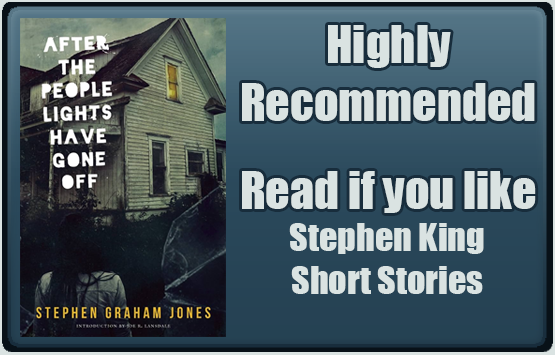
After the People Lights Have Gone Off by Stephen Graham Jones

After the People Lights Have Gone Off by Stephen Graham Jones

Formats: Print, audio, digital

Publisher: Dark House Press

Genre: Monster, Paranormal, Demon, Werewolf, Zombie, Killer/Slasher, Romance, Ghosts/Haunting, Sci-Fi Horror, Psychological Horror, Vampire

Audience: Adult/Mature

Diversity: American Indian (Blackfoot/Niitsitapi), Queer (Gay Men), Disability (Paraplegic)

Takes Place in: USA

Content Warnings (Highlight to view): Animal Death, Child Endangerment, Child Death, Gore, Violence, Death, Torture, Homophobia, Self-Harm, Implied Sexual Assault 

Blurb

The fifteen stories in After the People Lights Have Gone Off by Stephen Graham Jones explore the horrors and fears of the supernatural and the everyday. Included are two original stories, several rarities and out of print narratives, as well as a few “best of the year” inclusions. In “Thirteen,” horrors lurk behind the flickering images on the big screen. “Welcome to the Reptile House” reveals the secrets that hide in our flesh. In “The Black Sleeve of Destiny,” a single sweatshirt leads to unexpectedly dark adventures. And the title story, “After the People Lights Have Gone Off,” is anything but your typical haunted house story.

With an introduction by Edgar Award winner Joe R. Lansdale, and featuring fifteen full-page illustrations by Luke Spooner, After the People Lights Have Gone Off gets under your skin and stays there.

For Native American Heritage Month I’d thought I’d review a collection of short stories by one of horror’s greatest writers, Stephen Graham Jones.

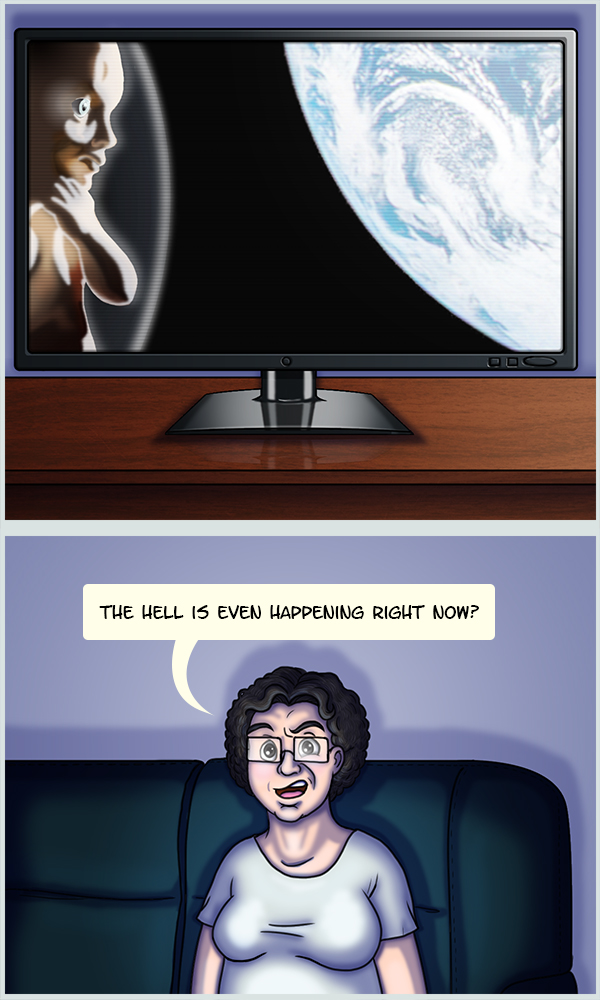
Do you ever find yourself reading this awesome, interesting book, but then you get to the last chapter and go “What the fuck did I just read?” I’m not talking stories with ambiguous endings where it’s left open to interpretation, like in Inception where it’s unclear whether Cobb is still in a dream or not (and then you spend hours arguing about it on the internet), but the ending still makes sense. No, I’m referring to endings that are downright obfuscating (yay, I have a thesaurus!). Endings where you have to skip back to check if you missed some really obvious clue, only to find that no, the story really does end like that, and then you’re left wondering if you’re just not smart (or high) enough to “get it”. For example, 2001: A Space Odyssey. I know it’s this amazing, classic film, but what the hell was up with that giant space baby!?! Did the really obvious metaphor for the birth of humanity just fly over my head or did Kubrick just drop a bunch of LSD? Or both? Seriously WTF? Am I the only person who doesn’t get it?

In the first panel a TV is showing a scene from 2001: A Space Odyssey with a giant, human fetus/star child floating in the void and looking at the planet earth. The second panel reveals me watching the film, bewildered, and asking “The hell is even happening right now?”

In retrospect, I probably shouldn’t have tried watching this movie at 3 AM.

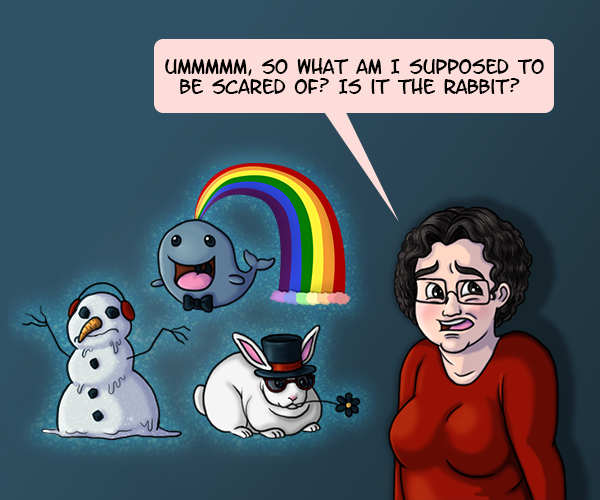
Well, Stephen Graham Jones is a master of the WTF ending. In some ways this works to his advantage, like when it highlights the confusion and mental instability of the narrator, or preys on the reader’s fear of the unknown. Subtle scares can be terrifying when done right, and when Jones gets it right, it works SO WELL, like with Second Chances where the final sentence of the story hits you like a punch in the gut. But Jones makes things too subtle you’re left scratching your head and wondering what you’re supposed to be scared of. It’s like when the creepy music starts playing in a film, you know you’re supposed to feel uneasy because something bad is about to happen, but then, when the final dissonant chord is struck, everything just sort of ends without the payoff of a monster jumping out or even a terrified scream to imply something horrible just happened. Which is, unfortunately, really not that scary. After the People Lights Have Gone Off (the short story, not the book), Uncle, Xebico and Brush Monster all have this problem. Did someone die? Was there a monster? Is the narrator hallucinating? Did anything bad even happen? Am I just not smart enough to get it? It’s especially frustrating when the rest of the story makes sense, like in Xebico, but then the ending just kind of goes off the rails.

A sad, melting snow man with ear muffs, a whale with a bowtie shooting rainbows out of its blowhole, and a rabbit with a flower in its mouth, wearing a top hat and sunglasses are floating in midair and surrounded by sparkles. Looking uncomfortable, I ask, “Ummmm, so what am I supposed to be scared of? Is it the rabbit?”

I’m pretty sure it’s the sketchy looking rabbit.

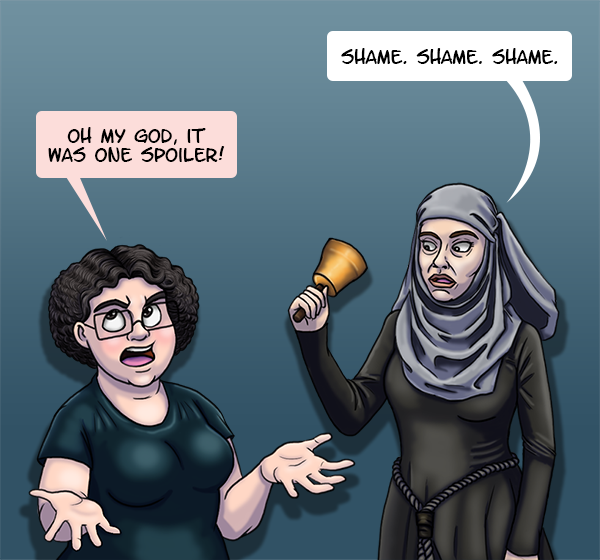
Of course, none of this makes Jones a bad writer. He’s actually incredibly talented, aside from the whole confusing ending thing which is probably due more to me being obtuse than a lack of skill on Jones’ part. Like King, Jones has a real flair for making the mundane fucking terrifying.  For example, The Black Sleeve of Destiny, which is about a Lovecraftian hoodie. That’s right, a hoodie. Well, that and some poor kid’s mild kleptomania spinning out of control until it becomes a full blown obsession, but mostly the evil hoodie that seems to act as a pocket dimension with a mind of its own. There’s also The Spider Box (such a creepy title) about a cardboard fruit box that resurrects the dead.  Somehow Jones managers to cover all the horror staples in his book (demons, ghosts, werewolves, vampires, killers, and zombies) while still making his stories seem fresh and unique. A great example of this is Welcome to the Reptile House, one of the most distinct and creative vampire stories I’ve ever read. In fact, I didn’t even know it was a vampire story when I started reading it, so, uh, sorry for the spoiler.

Septa Unella from Game of Thrones is ringing her bell and chanting “shame, shame, shame”. Annoyed, I snap “Oh my God, it was one spoiler!”

Septa Unella shows up any time someone reveals a spoiler. Or at least, she SHOULD.

But not all the stories in this collection are your traditional tales of horror, some could even be considered love stories. Albeit, really messed up, creepy love stories, but love stories nonetheless. One story is even called This is Love. Jones explores different kinds of relationships in his novel, from lovers and devoted spouses, to childhood crushes, to familial love between siblings, parents and children, and even extended family. Snow Monsters is a heartwarming tale about what a parent will sacrifice for their child, but with a supernatural twist. Doc’s Story, explores the bonds of a struggling family, and is one of the most human stories in the collection, ironic since it’s about werewolves.  In After the People Lights Have Gone Off (again, the short story, not the collection) and The Dead are Not we see examples of the complete devotion married couples have for each other, even when things get difficult and terrifying. Of course, there are also inversions, like Uncle, which is about a couple that has fallen out of love, and the husband’s feelings of guilt for not mourning his wife’s death.

Oh, and a little tip, before picking this book up I strongly recommend checking out Stephen King’s short story The Man in the Black Suit and H. F. Arnold’s The Night Wire (both of which you should read regardless because they’re awesome). Why? Well The Spindly Man is a horror story about a book group discussing King’s famous horror story (how’s that for Inception?), while Xebico is about adapting The Night Wire to the stage. And as cheesy as having a scary short story about another scary short story sounds, they’re both pretty awesome, yet another indicator of Jones’ talent.

Overall, After the People Lights Have Gone Off (this time I am referring to the book) is an amazing anthology by a talented author, as long as you’re okay with stream of consciousness writing and not always understanding what the hell you just read. Or maybe it’s just me, and the rest of you will have some deeper understanding of the stories. Jones’ work definitely makes me feel like I’m the only one at the party not getting the joke.

Camp Carnage by Elliot Arthur Cross & Joshua Winning

Camp Carnage by Elliot Arthur Cross & Joshua Winning

Formats: Print, digital

Publisher: CreateSpace Independent Publishing

Genre: Killer/Slasher, Comedy Horror

Audience: Y/A

Diversity: Gay and Lesbian characters

Takes Place in: Colorado, USA

Content Warnings (Highlight to view): Body Shaming, Bullying, Child Abuse, Child Death, Death, Drug Use/Abuse, Forced Captivity, Gaslighting, Gore, Homophobia, Mental Illness, Racism, Sexism, Slurs, Suicide, Violence, Verbal/Emotional Abuse 

Blurb

In the summer of 1986, Billy Collins is sent to his own personal Hell – summer camp. The remote Camp Genesis offers desperate parents a place to “straighten” out their gay teenagers with the help of the puritanical Katherine Creevey.

Besides the typical horsing around, campfire tales and summer games, the Genesis program forces gay and questioning teens into humiliating gender-based lessons. While Billy wants nothing more than to escape Camp Genesis, he can’t help worrying that something even more sinister is hiding just out of sight.

Unknown to Billy, two campers were murdered three years ago. Just days after Billy and the new campers arrive, people start to go missing, and it’s up to Billy and his new friend Jem to find out what’s really going on. Is a maniac on the loose? Is history repeating itself? One thing’s for sure – at Camp Genesis, you have to fight to survive…

Eid Mubarak! I hope all my Muslim readers have a happy Eid Al-Fitr, and that Ramadan brought you peace and prosperity. In honor of the holiday my next review will feature a book from Salaam Reads a new publishing imprint that focuses on books for Muslim kids and young adults. For now, let’s finish up pride month with a gay camp slasher story.It’s an unfortunate fact of life that the majority of self-published books are bad. Really, REALLY bad. Like, any movie remake with Matthew Broderick in it bad. I get that not all self-published books are mind-numbingly awful, and there are definitely benefits to self-publishing (better royalty rates and creative control) over the traditional model. But for every The Martian there are about a million crappy Dinosaur/Alien Romances with bad grammar and a cover that looks like someone tried to illustrate their bad LSD trip in MS Paint. So I was skeptical when I first picked up Camp Carnage and saw it was *gasp* self-published.

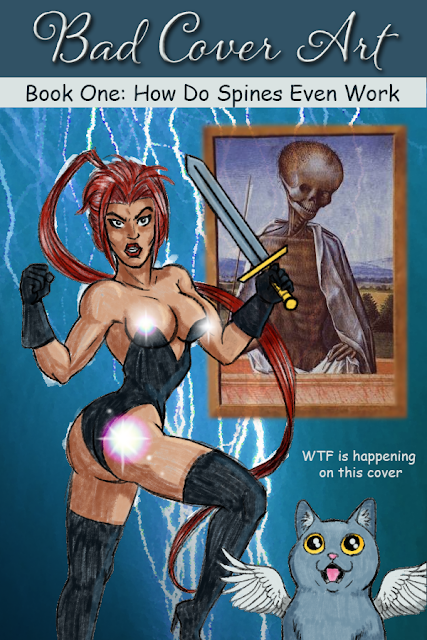
An ugly book cover with the title “Bad cover Art. Book One: How Do Spines Even Work.” None of the fonts match, there’s a medieval painting of a skeleton with blurred edges, a big-eyed cat with wings, and a poorly drawn, anatomically incorrect woman holding a sword. Her hair is in a long ponytail and she’s wearing a revealing, dominatrix-like black outfit that seems to be glued on to her body. Her spine is twisted so both her breasts and butt are facing forward, and have lens flares on them.

It’s like J.J. Abrams and Rob Liefeld made cover art for some bad fanfic.

But it’s actually pretty good! No poorly photoshopped cover, no obvious author self-inserts, the text has been edited for spelling and grammar, and the story is solid and enjoyable. There are still some issues, but overall it’s a fun throwback to campy 80’s horror classics, with a largely queer cast. The characters should be familiar to horror fans, there’s the virginal hero, the hero’s best friend, the mean rival, the love interest, the “cool” best friend, the stoner who acts as the comic relief, the brooding loner, the creepy caretaker, the sole black guy, and the fat kid (yeah… there’s a lot of body-shaming in this book). But in this story, the virginal hero and promiscuous bully, usually female-only roles, are both gay men named Billy and Kyle, respectively. Meanwhile, the handsome, mysterious jock whose attention they’re vying for is still in serious denial about his sexuality, while Billy’s best friend is a bad ass lesbian and probably the toughest person in the camp.  Of course, not everyone sticks to their assigned “role”. Without giving too much away, suffice it to say that literally anyone can die, so don’t get too attached to anyone, and flipping the genders of the “virgin” and the “whore” isn’t the only way Cross and Winning invert horror tropes.

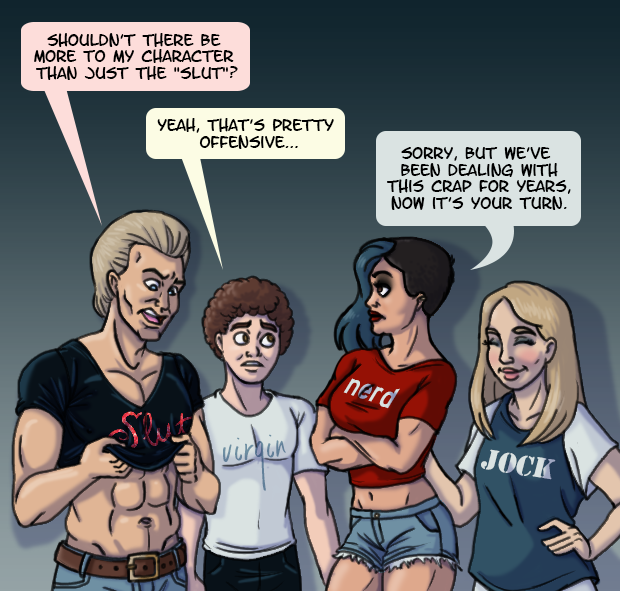
An athletic boy wearing a “Slut” T-shirt looks at his shirt and asks “Shouldn’t there be more to my character than just the ‘slut’?” A scrawny boy wearing a “Virgin” shirt confirms “Yeah, that’s pretty offensive.” A buff girl with a punk haircut and a “Nerd” shirt responds “Sorry, but we’ve been dealing with this crap for years, now it’s your turn.” A blond girl with a “Jock” T-shirt grins behind her friend.

No! Everyone gets one character trait, and that’s it! Now go take your clothes off until you get stabbed.

The rest of the cast is pretty much just there to bring up the body count, so the authors didn’t bother to give them much in the way of personalities. It would have been nice if they were slightly more rounded, or had more than one character trait, but honestly, they’re just cannon fodder, so who really cares. Though it’d be great if the fat kid could have been characterized by something other than his weight (seriously, what is with all the fat shaming!?). I get that many of the characters are stereotypes, but c’mon. Everyone else got to have an actual personality trait as their one defining characteristic, as opposed to a physical attribute! At least the sole black guy got to be the flaming kid, as opposed to a racist caricature.As far as killers go, the murderer isn’t very creative, though they do manage to bump off the majority of the cast without anyone noticing.  Like, to the point where no one finds a dead body until the last few chapters. I’d hope someone in charge would be at least a little more concerned by a number of strange disappearances, but nope. Did people just not give a shit about their children back then? Were teens sent off into the wilderness en masse, and everyone just hoped some of them would make it out alive? I know adults were more laid back about unsupervised kids in the 80’s, but you’d think a child that went missing in the woods for days would at least warrant a phone call.

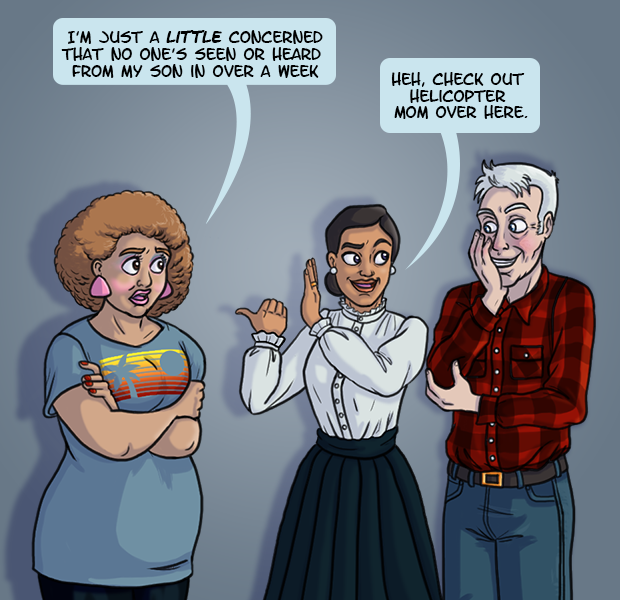
A mom with very curly hair and 80’s makeup and clothing is saying “I’m just a little concerned that no one’s seen or heard from my son in over a week.” A conservatively dressed woman with her hair in a tight bun, and an older man in a plaid shirt are giggling at her. The conservative woman whispers to the man “Heh, check out helicopter mom over here.”

I mean, it’s not like he got murdered in the woods by the camp serial killer. Probably…

Now, obviously you don’t want the victims to figure out they’re being picked off too early in the story. There needs to be time to draw out the suspense, and let the reader get to know the soon-to-be corpses a little better. But let’s face it, if you’re reading slasher horror it’s because you want to see the bodies hit the floor. Any time spent on character development and plot is just making sure you have a nutritious meal before gorging on cake and ice cream. Yeah it’s important, but it’s not the good stuff. And Cross and Winning just waste too much time on boring camp activities when they could’ve been writing about terrified campers trying to escape the killer. Besides, most of the characters are so flat and boring I really don’t want to spend any length of time with them, I just want to see them get murdered in the most gruesome, over-the-top way imaginable.The camp itself is a lot less horrible than I expected a pray-away-the-gay camp to be. Then again, if it were anything like the places you read about on the news, it would be a completely different kind of horror story, and a masked murderer would seem silly and unnecessary in comparison. That’s not to say there wasn’t some pretty disturbing homophobia from the adults trying to “convert” their poor charges. They’re not being electrocutedbeaten, or medically tortured (big trigger warning for those links by the way), but being told who you are is wrong and unnatural is still really damaging. One scene, where one of the camp counselors, Father Norton, has the campers repeat homophobic insults they’ve received and direct them at Kyle, was really upsetting. It was an incredibly dark moment in an otherwise goofy horror story, and much more disturbing than a silly, fictional slasher. I had to go hug my wife after reading that part. But, over all, Camp Carnage is still a fun homage to 80’s Slasher films, with plenty of nods to nerd culture, gore, and humor.

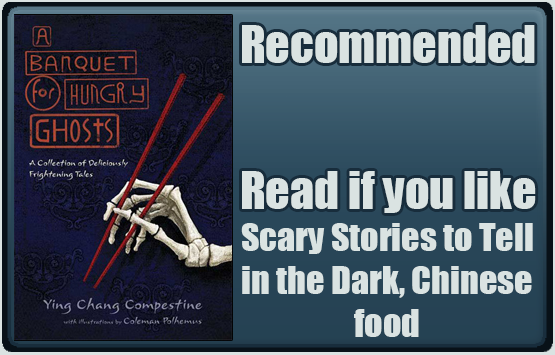
A Banquet for Hungry Ghosts by Ying Chang Compestine

A Banquet for Hungry Ghosts by Ying Chang Compestine

Formats: Print, audio, digital

Publisher: Tumbling Dumpling Media

Genre: Monster, Killer/Slasher, Crime, Ghosts/Haunting, Psychological Horror, Blood & Guts, Historic Horror, Anthology

Audience: Adult/Mature

Diversity: Chinese and Chinese American characters

Takes Place in: China

Content Warnings (Highlight to view): Physical Abuse, Animal Death, Animal Abuse, Child Endangerment, Child Death, Body shaming, Verbal/Emotional Abuse, Cannibalism, Gore, Torture, Medical Torture, Violence, Death

There are many types of Chinese ghosts, including the spirits of deceased loved ones who may bring blessing and good fortune if properly honored, vengeful specters searching for those who wronged them in life, playful and troublesome spooks, and Hungry Ghosts, unhappy spirits with insatiable appetites.  During the seventh month of the Chinese calendar, known as Ghost Month, the gates to hell are open and these spirits are able to cross over to the realm of the living. To avoid hauntings and misfortune, people will leave offerings of food in the hopes of appeasing the Hungry Ghosts who wander the streets at night. If these spirits are pleased with the food offered to them, they may leave the household in peace. But what if the Hungry Ghosts aren’t placated?

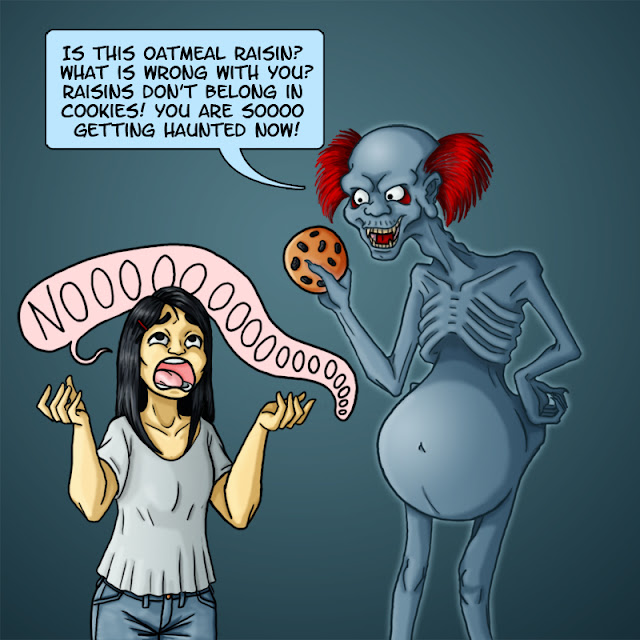
A skeletal-looking Japanese ghost with pale blue skin, flaming red hair, bulging eyes, and a distended belly is glaring at a Chinese woman who gave him a cookie and scolding "Is this Oatmeal Raisin? What is wrong with you? Raisins don't belong in cookies! You are soooo getting haunted now!" The woman yells "Nooooooooooooo!" in comical despair.

He’ll eat garbage, but he draws the line at oatmeal raisin.

He’ll eat garbage, but he draws the line at oatmeal raisin.Author Ying Chang Compestine explores both Chinese cuisine and angry spirits in her book, A Banquet for Hungry Ghosts. Ah, delicious food and gruesome horror, two of my favorite things! Admittedly, not things you’d usually think of combining, but hey, I’m not complaining. Each ghost story is dedicated to a food you might typically find in a traditional Chinese eight course banquet, and includes a recipe at the end. Okay, so maybe those with weaker stomachs may not want to try whipping up a batch of Tea Eggs right after reading about some poor guy getting disemboweled. But I’m the kind of person who can watch surgery videos while eating breakfast, so I wasn’t put off my appetite. If anything, the book made me crave cha siu bao the entire time. Oh, and by the way, the steamed dumpling recipe? Sooooooo good. I’ve got to try making the Jasmine Almond cookies next.

I'm reading "A Banquet for Hungry Ghosts" and exclaim in wonder "Woah, the inn keeper chopped people up and made them into dumplings!?" The next panel shows me biting my lip, looking conflicted, and saying "Damn it, now I want dumplings".

I also get hungry watching Hannibal. Don’t judge me.

In addition to recipes, each chapter also includes an afterword that expands on aspects of Chinese culture and history discussed in the story. There’s information on the rules of Mahjong, Mantis fighting, Qingming (Tomb Sweeping Day), the Cultural Revolution, and even anecdotes from Compestine’s own life growing up in China. Also ablation surgery, arsenic poisoning, and ancient Chinese tombs containing the victims of human sacrifice. Fun, right? Hey, it’s a book of scary stories after all, it’s to be expected. Every country has its share of atrocities from the past and present, and Compestine adds even more horror to her already spooky ghost stories by including some of China’s darker practices, such as illegal organ harvesting from prisoners and corruption at Buddhist monasteries. It’s actually quite clever how Compestine addresses certain Chinese social issues by turning them into ghost stories. At least in fiction, we get the satisfaction of seeing justice done, albeit by Hungry Ghost who enact terrible, and often gruesome vengeance.As horrific as I’ve made the book sound, it is actually intended for children. Like a more educational, Chinese, epicurean version of Scary Stories to Tell in the Darkcomplete with its own gorgeous, creepy, black and white illustrations. I know the blood and guts may be too much for some children (though it’s not much worse than your standard German fairy tale or Roald Dahl story) but the gore is definitely going to appeal to others. Hey, whatever gets them to read, right? Plus, it’s educational, so that’s always good. Even adults will find the stories informative; while reading Banquet for Hungry Ghosts I frequently found myself running off to Google the construction of the Great Wall or Chinese medical practices.Although the overall stories were rich and interesting, the writing could be a little simplistic, which, unfortunately, I felt detracted from the horror and kept me from giving this book the four stars it otherwise would have earned. But, again, it is a kid’s book, and it’s difficult to write something that’s elegant, interesting, and easy to read. Children reading A Banquet for Hungry Ghosts are already going to have enough trouble trying to sound out “Hemorrhagic shock”, no need to make the writing too flowery and complex. So let’s just say I’d give the writing three stars for adults and four stars for kids.My only other complaint is that the author also tended to rely heavily on gore to create scares. Being gross and being scary are two different things, and you can’t just add blood to a story and expect it to be frightening. If that were true, I could just read a medical textbook to give myself nightmares.

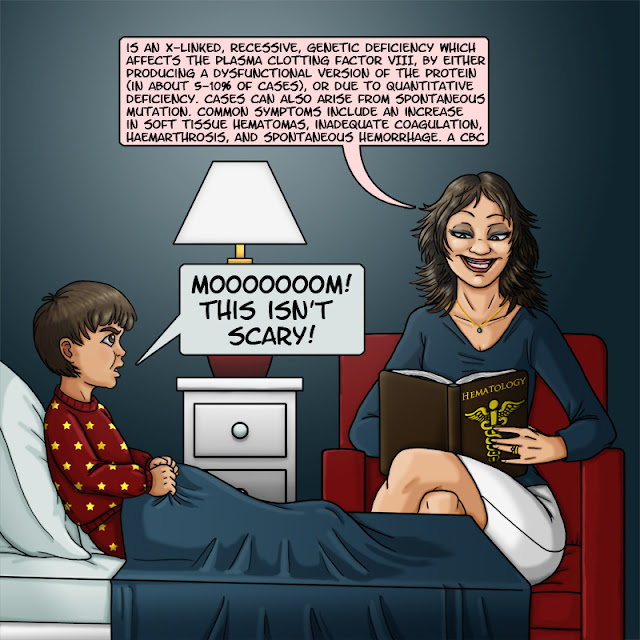
A mother is reading to her son a "bed time story" out of a dull, dry, medical text book. She drones on about "an X-linked, recessive, genetic deficiency which affects the plasma clotting factor VIII, by either producing a dysfunctional version of the protein." Annoyed, the boy responds "Moooom! This isn't scary!"

What are you talking about kid? Hemorrhaging is terrifying.

Like any horror anthology, some stories are much better than others. “Tofu with Chili-Garlic Sauce”,  “Steamed Dumplings”, and “Beef Stew” were all excellent. “Long-Life Noodles” and “Jasmine Almond Cookies”? Not so much. But overall this is still a great book, and the combination of ghost stories, history, and cuisine make a fun and unique combination. A must read for both young horror fans and foodies.

Navigation

Social Media

Search by Tags

To learn more about the Age Group, Diversity, and Genre tags, click here.

Age Groups

Diversity

Genre

Support the Blog

Search

Links

Brutal Hearts by Cassie Daley

Brutal Hearts by Cassie Daley

Formats: Print

Publisher: Self Published

Genre: Killer/Slasher, Monster

Audience: Y/A

Diversity: Autistic character, author is queer and autistic

Takes Place in: type here

Content Warnings (Highlight to view): Cannibalism, Child Death, Death, Gore, Violence

Blurb

It’s 1997 and Leah just can’t seem to catch a break.

A year has passed since her fiancé went missing while hiking alone on a mountain, and she can’t shake the unanswered questions and nightmares Simon left behind.

On the anniversary of his disappearance, Leah and her new girlfriend Josie return to the trail where Simon disappeared with two of their best friends. Armed with incense, tarot cards, crystals, and snacks, the girls have everything they need to complete the Ritual of Closure to help Leah finally say goodbye to Simon, once and for all.

But the trails are hiding something sinister, and it’s been waiting. As night falls around them, the girls find themselves in a deadly game against something vicious and wild that’s made a home for itself on the mountain.

It’s time to find out what really happened to Simon.

The year is 1996: Scream has just been released in theaters, the Macarena is the hottest new dance craze, and seventeen-year-old Leah is deeply in love with her high school sweetheart, Simon. The two have plans to marry after graduation, but that dream is destroyed when Simon goes missing after a hike in the nearby mountains. Volunteers scour the woods for any trace of the missing boy, but it’s like Simon has vanished without a trace.

A year later, Leah is still struggling with her grief and guilt. Her girlfriend, Josie, is doing her best to help Leah through the nightmares and sobbing fits, but nothing seems to help. In a last-ditch effort to give the poor girl some closure, Josie suggests they hike Simon and Leah’s favorite trail to say a final goodbye. Along with Leah’s two best friends, sisters Charlotte and May, the girls set off to perform a Wiccan inspired goodbye ceremony for him. But their beautiful day quickly goes south when something in the woods starts stalking them.

Brutal Hearts is short but gripping story, switching back and froth between the girls being stalked through the woods and the mystery surrounding Simon’s disappearance. I ended up finishing it in one sitting, something I never do even with novellas (ADHD makes it hard for me to focus on a book for too long unless I’m really engaged). I loved all the little nods to 90s aesthetics, from the clothing, to May’s Tamagotchi and the girls’ obsession with all things Wicca. (From Sabrina Spellman to Nancy Downs witches were huge in the 90s, inspiring a renewed interest in Wicca from teenage girls.) Although, it is hard to accept that the 90s were thirty years ago and are now officially nostalgic. Wasn’t it literally just 2000? I think Y2K caused my brain to crash and stop perceiving the passage of time.

I especially liked the addition of the playlists for each character in the back of the book. Leah’s music playlist revolves around being hurt by love. Josie likes grunge. May’s playlist is full of bubblegum pop while the more traditionally pretty and popular Charlotte prefers mainstream music. A fun flashback to 90s teen horror like Fear Street and the works of Christopher Pike (appropriate since Daley also runs the PikeCast) with a healthy dose of urban legends and campfire stories. A perfect read for a hot summer night. 
The Woods are Always Watching by Stephanie Perkins

The Woods are Always Watching by Stephanie Perkins

Formats: Print, audio, digital

Publisher: Dutton Books for Young Readers

Genre: Killer/Slasher, Thriller

Audience: Y/A

Diversity: Indian-American Main character

Takes Place in: North Carolina, USA

Content Warnings (Highlight to view):  Amputation, Child Endangerment, Death, Forced Captivity, Gore, Kidnapping, Rape/Sexual Assault, Torture, Violence 

Blurb

Bears aren’t the only predators in these woods.

Best friends Neena and Josie spent high school as outsiders, but at least they had each other. Now, with college and a two-thousand-mile separation looming on the horizon, they have one last chance to be together—a three-day hike deep into the woods of the Pisgah National Forest.

Simmering tensions lead to a detour off the trail and straight into a waking nightmare; and then into something far worse. Something that will test them in horrifying ways.

Camping and horror go together like chocolate and toasted marshmallows. There’s just something about being out in the middle of nowhere with only the light of a bonfire to really prey on those primal fears. In Western tradition, the woods have been a symbol of the dark and unknown for as long as folklore and fairytales have been told: a place where witches, wild beasts, monsters and faeries dwell.

The threat of becoming lost in the forest and falling victim to these creatures is central to many dark tales. In the beginning of the Divine Comedy Dante finds himself wandering in a dark wood, the “selva oscura,” unable to find his way and set upon by a lion, a leopard, and a she-wolf. Little Red Riding Hood encounters a wolf when she wanders off the path (though some interpretations of the fairy tale say the wolf is meant to represent a sexual predator) and Hansel and Gretel stumble upon a witch after losing their way in the woods. In Tam Lin, anyone who wanders into the forest runs the risk of becoming the fae’s blood tithing to hell. The films the Ritual and the Blair Witch both have a group of friends become lost in the woods through supernatural means and then assailed by a Jötunn and the titular witch respectively. But beasts and supernatural beings aren’t the only monsters in the forest. Ordinary humans can be just as —if not more — deadly than wolves and witches. The woods are popular killing grounds for murderers like William Mitchell Hudson (the Texas Campsite Killer) and Herbert MullinIvan Milat was a serial killer who specifically targeted backpackers while Alexander Pichushkin lured dozens of victims to Bitsevski park before murdering them. It’s safe to say the woods can be a dark and dangerous place in both fiction and reality, as best friends Neena and Josie are about to discover in Perkins’ outdoor horror novel The Woods are Always Watching.

Neena Chandrasekhar is a carefree and fun-loving teenage girl, especially compared to her worrywart best friend, Josie Gordon. After the death of her father in a car accident, Josie is scared of the world and often needs Nina to push her to try new things, like camping.  Neither girl is much of an outdoors woman, but going on a solo camping trip is practically a rite of passage in Asheville North Carolina, and with Neena soon leaving for college, the duo decides it’s the perfect way to celebrate their last few days together. They have GPS, printouts of the trails, and Josie’s brother’s camping gear, so what could possibly go wrong? Well, it’s a horror novel, so a lot.

The trip gets off to a rough start with both girls quickly realizing that they may not be physically prepared for such an arduous journey. Their exhaustion soon leads to short tempers and building tension as Josie quickly becomes fed up with Neena’s cavalier attitude towards camping and Neena gets annoyed with her best –friend’s condescending bossiness. Their friendship is further put to the test as the duo discover how ill-prepared they actually are for their hike through the woods and each takes out their frustration on the other. Caught up in their own petty squabbling the pair are dangerously unaware of something watching and waiting for them in the woods until it’s too late.

The Woods are Always Watching is slow to start, focusing on teenage drama and interpersonal conflict for the first chunk of the story, which can feel tedious even if it does offer glimpses into the main characters’ psyches. We don’t meet the actual villains of the story until almost halfway in (although there are hints to their presence early on). But once the action actually does get started, I found I couldn’t put the book down. Perkins is a master of creating atmosphere and suspense and making the forest feel dark and foreboding, especially to two inexperienced girls. The whole book feels like a modern-day fairytale with two naïve young women journeying through the dark woods

So, will you enjoy this particular dark woods story? Well, it’s essentially a young adult version of Deliverance, and the film is a good metric of how much you’ll like this book. Does the idea of being isolated in the woods, and slasher/folk horror terrify you? Then you’ll enjoy Stephanie Perkins’ camping-gone-wrong novel. Evil hillbillies and threats of rape not your thing? Then you’re probably better off skipping this one.

Children of Chicago by Cynthia Pelayo

Children of Chicago by Cynthia Pelayo

Formats: Print, audio, digital

Publisher: Agora

Genre: Dark Fantasy, Demon, Killer/Slasher, Myth and Folklore, Thriller

Audience: Adult/Mature

Diversity: Bisexual main character, Puerto Rican main character and author, Latine characters

Takes Place in: Chicago, IL, USA

Content Warnings (Highlight to view): Alcohol Abuse, Child Death, Death, Forced Captivity, Gaslighting, Illness, Kidnapping, Mental Illness, Physical Abuse, Police Harassment, Suicide, Violence

Blurb

This horrifying retelling of the Pied Piper fairytale set in present-day Chicago is an edge of your seat, chills up the spine, thrill ride. ‪ When Detective Lauren Medina sees the calling card at a murder scene in Chicago’s Humboldt Park neighborhood, she knows the Pied Piper has returned. When another teenager is brutally murdered at the same lagoon where her sister’s body was found floating years before, she is certain that the Pied Piper is not just back, he’s looking for payment he’s owed from her. Lauren’s torn between protecting the city she has sworn to keep safe, and keeping a promise she made long ago with her sister’s murderer. She may have to ruin her life by exposing her secrets and lies to stop the Pied Piper before he collects.

And I chiefly use my charm
On creatures that do people harm,
The mole and toad and newt and viper;
And people call me the Pied Piper.
The Pied Piper of Hamelin by Robert Browning (1812-1889)

“The Pied Piper of Hamelin”by Augustin von Mörsperg, 1592

My dad was born and raised on the Southside Chicago and will tell anyone who will listen that his birthplace is the best city in the world. My wife, on the other hand, firmly believes Chicago is akin to LA in the ‘90s. When I did finally manage to lure her there with the promise of deep-dish pizza and the Museum of Science and Industry she did admit the Windy City was a pretty cool place and not at scary as she was expecting (even after we stumbled onto an illegal street race). Although the crime rate there is higher than the national average, Chicago is hardly the crime and drug filled dystopia my wife and other outsiders seem to believe it is. In fact, its violent crime rates are far lower than those of Anchorage, Wichita, and Milwaukee. The dangerous reputation may have come from Chicago’s fascinating history of crime, gangsters, and serial killers or even the many tragedies that have befallen the White City in the past. Modern-day boogiemen like the Lipstick Killer, John Wayne Gacy, the Ripper Crew, and Richard Speck all called Chicago their home. The Blue Beard-esque H. H. Holmes built his murder castle in Englewood. The city’s most notorious gangster, Al Capone, has morphed into something of a folk hero and tragedies like the Great Chicago Fire and the Haymarket affair have taken on almost a legendary status. Dark rumors surround the abandoned Edgewater Medical Center. Stories like these have shaped Chicago’s history and how it’s perceived by the rest of the country: a gothic city haunted by the past. But darkness and death aren’t all the city has to offer.

Fairy tales, at least the original versions and not the Disney-fied ones, are often a child’s first introduction to the world of horror. Beautiful and sinister stories full of threats of death and assault, mutilation, hungry wolves, and dark forests have been used to frighten children for generations. Fairy tales are beautiful roses and sharp thorns, poisonous treats, beauty and blood. They also share many of the same elements as gothic fiction. Sometime in the distant past, a helpless woman is placed in a dark and dangerous setting (now a castle instead of a forest), where she is threatened by supernatural forces until rescued by the hero. Orphans and peasant girls are made to suffer before finally coming into riches. Animals no longer speak, but still bring portents of doom. Nature is wild, dangerous, and unpredictable. Both have themes of revenge, isolation, rags to riches, abuse, and women who are under constant threat as the men in her life fight over her body. Bluebeard, and other versions of the Aarne–Thompson type 312 tale, are the perfect example of a gothic fairy tale. In the story a woman leaves her family to marry a mysterious stranger and goes to live in his isolated and lonely castle. But locked away in a castle is a dark and dangerous secret. The wife can go in any room, but one, which contains the bodies of the stranger’s previous, murdered wives.

In the original version of Cinderella, the Little Mermaid, and Sleeping Beauty, the step sisters cut off parts of their feet and birds pecked out their eyes, the mermaid’s tongue was cut out and every step she took on land was agony, and Sleeping Beauty was raped and impregnated with twins by a married king while she slept.

Cynthia Pelayo draws on the city’s history to create her gothic urban fairy tale, Children of Chicago. The city stands in for the dark forest, a vaguely supernatural setting where unwary children disappear and gang members prowl the street like big bad wolves. The book follows recently orphaned Lauren Medina, a deeply troubled police detective hunting a serial killer known only as The Pied Piper– a shadowy boogeyman who preys on children then vanishes into the night. It’s rumored he can be summoned by burning a black candle and speaking a spell in front of a mirror. Throughout the story, Lauren is unstable and brimming over with barely-contained emotion, a staple of any good Gothic tale, as she wrestles with her missing memories of her sister’s death. Lauren breaks the typical female fairy tale mold where women were relegated to witches, wise women, virginal damsels, and evil stepmothers. She’s not exactly evil, but she isn’t pure and heroic either, instead she’s but a rare example of a female Byronic hero intentionally written to be tragic, unlikeable, morally gray, and hiding a dark past, much like the heroes found in gothic horror. In fact, few of the women in the story fall into any of the aforementioned roles. Stepmothers aren’t necessarily evil, even if their angry stepdaughters perceive them as such. Damsels in distress may possess more agency than they seem to, and villainous women can also be victims. I genuinely enjoyed seeing a female character (who wasn’t intended to be liked) embrace her darkness and struggle with her morality. Just as much horror came from Lauren’s psychological trauma and instability as it did from the threat of the supernatural.

While Lauren initially came across as “the young female cop with a dark past and something to prove” trope (aka Jodie Foster in Silence of the Lambs), it soon became clear that unlike Clarice Starling, we’re not necessarily supposed to root for her. And unlike every maverick detective in an ‘80s buddy-cop comedy, Lauren’s flagrant disregard for the rules in order to get her guy aren’t justified, but instead dangerous and unjust. Though, much like police in the real world, she’s able to get away with it. I appreciate that Pelayo avoided turning her crime drama into “copaganda” by making Lauren a protagonist, but not a hero. I admit I used to enjoy shows like Brooklyn 99Lucifer, and Law & Order SVU (yes, I’m old) even though I recognized how incredibly problematic they were. But ever since 2020 I’ve more or less lost my taste for any media that portrays a corrupt system as a heroic force for good, justified in flouting the law. It no longer feels like harmless fantasy when you realize how many people actually believe that cop shows reflect real life and officers only target “bad guys” as oppose to anyone they don’t like (mostly BIPOC, the poor, and the mentally ill). So, reading a crime story where the police weren’t heroes was a relief. In fact, Lauren’s only redeeming quality is that she has a soft spot for troubled teens, ever since the mysterious death of her own sister.

Brimming with references to Chicago’s history, it’s clear that Pelayo loves her home while still recognizing its flaws. In fact, the novel feels just as much a crime story as it does a guide to the dark and fantastical parts of the Windy City. She holds a Master of Fine Arts in Writing from The School of the Art Institute of Chicago and it shows in her writing. Throughout Children of Chicago Pelayo references the original, dark versions of famous and not-so famous fairytales, from Cinderella to the Singing Bone, adding to her own story’s dark atmosphere balancing on the edge of reality and fantasy. Pelayo’s novel is full of missing mothers, an unjust society where the most vulnerable suffer, magic mirrors, plenty of gore, spells, and a moral message. But overall, it’s a subversion of the classic fairy tale formula where the good are rewarded, the evil are punished, and morality is clearly defined. In Children of Chicago the “heroes” are neither pure-hearted nor moral, evil escapes justice while the innocent suffer, and no one is getting a happy ending.

It’s unfortunate that the darkest parts of Chicago’s history have shaped so much of its reputation when the Windy City has so much to offer. As my wife soon discovered on her first visit, the city is full or art, beauty, and wonder. Pelayo doesn’t just show the city’s dark side, she shows its magic as well. “Fairy tales are in our blood as Chicagoans” one of the books characters explains. Walt DisneyL. Frank BaumRay Bradbury, and Gwnedolyn Brooks were all inspired by the city to create their own fairy tales. Colleen Moore created her famous Fairy Castle and donated it to The Chicago Museum of Science and Industry. Children gathered pennies to create the Rock-a-Bye Lady from Eugene Field’s poem. The haunting beauty of the SheddAquarium feels like you’ve stepped into another world. The city even has a secret Little Mermaid inspired bar! It’s this beauty, contrasted with the allure of danger, that makes Chicago as wonderous as any fairytale.

Cirque Berserk by Jessica Guess

Cirque Berserk by Jessica Guess

Formats: Print, digital

Publisher: Unnerving Magazine

Genre: Killer/Slasher, Myth and Folklore, Occult, Demons

Audience: Y/A

Diversity: Black main character and author, Native Oglala Lakota main character, character with syndactyly

Takes Place in: Florida, USA

Content Warnings (Highlight to view): Abelism, Alcohol Abuse, Animal Death, Child Abuse, Death, Forced Captivity, Gore, Kidnapping, Physical Abuse, Racism, Sexual Abuse (Voyeurism), Slurs, Slut-Shaming, Torture, Verbal/Emotional Abuse, Violence 

Blurb

The summer of 1989 brought terror to the town of Shadows Creek, Florida in the form of a massacre at the local carnival, Cirque Berserk. One fateful night, a group of teens killed a dozen people then disappeared into thin air. No one knows why they did it, where they went, or even how many of them there were, but legend has it they still roam the abandoned carnival, looking for blood to spill.

Thirty years later, best friends, Sam and Rochelle, are in the midst of a boring senior trip when they learn about the infamous Cirque Berserk. Seeking one last adventure, they and their friends journey to the nearby Shadows Creek to see if the urban legends about Cirque Berserk are true. But waiting for them beyond the carnival gates is a night of brutality, bloodshed, and betrayal.

Will they make they it out alive, or will the carnival’s past demons extinguish their futures?

I received this product for free in return for providing an honest and unbiased review. I received no other compensation. I am disclosing this in accordance with the Federal Trade Commission’s 16 CFR, Part 255: Guides Concerning the Use of Endorsements and Testimonials in Advertising.

Put on your sequins and neon spandex, grab a New Coke, and turn up that Whitney Houston cassette because it’s time to take a look at Jessica Guess‘s tribute to eighties’ slashers, Cirque Berserk! Guess’s new horror novella is the perfect ode to trashy, B-horror movies of the yuppie decade à la The Funhouse, Evilspeak, and Prom Night. Praised by one of my favorite horror authors, Stephen Graham Jones, Cirque Berserk hits most of the squares on the “teen scream” Bingo card, but still feels fresh and original. Guess has fun playing with the classic slasher clichés while subverting more problematic tropes like the “black best friend” and the “nice guy” being rewarded with a hot girl. She fills her story with plenty of self-aware humor and the kind of affectionate mocking that can only come from a true horror fan, which balances well with the more serious scenes of racism, sexism, and abuse. The result is a fun, nostalgic, carnival ride with a deeply emotional narrative hidden just beneath all the glitter, gore, and a bad-ass Black protagonist.

A black and red bingo card that says "Teen Scream Bingo." The squares include various slasher cliche's like "corny puns," "abandoned location," "Black best friend," and "masked murderer."

The eighties have made a come back in horror recently with popular TV shows (Stranger Things, American Horror Story: 1984), movies (the It reboot, The Final Girls), and novels (Grady Hendrix’s My Best Friend’s Exorcism) all drawing inspiration from the decade that gave rise to the slasher film, and it’s no wonder why. Not only do they have the nostalgia factor going for them as Gen Xers have their midlife crises, but they’ve got a ton of amazing source material to work from. Eighties audiences were blessed with a plethora of classic horror movies: grotesque monsters (The Thing, Aliens, Scanners, American Werewolf in London), final girls who fought back, (Halloween, Nightmare on Elm Street, Hell Raiser, Aliens), self-aware humor (Elvira, Monster Squad, Fright Night) cool, sexy vampires (Lost Boys, Near Dark, The Hunger) and horror franchises (Texas Chainsaw Massacre, Friday the 13th, The Evil Dead) graced the silver screen. Hell, even the remakes were good. Both The Fly and The Thing arguably surpassed their originals.

But what was it about the decade of greed that inspired so many amazing films? To understand eighties horror, you need to understand that the 1980’s were an age of excess, greed, rapid technological advancement, and reactionary conservatism. As late writer/director Stuart Gordan explained in the Shudder documentary In Search of Darkness: A Journey Into Iconic 80’s Horror, “horror thrives when there’s a repressive government” and the Reagan years certainly qualified. Additionally, public uncertainty and fear lead to the genre’s rise in popularity, just as it did during the Great Depression resulting in Universal’s famous Golden Age monsters. Meanwhile, advancements in technology and the increased affordability of personal computers led to some groundbreaking special effects and makeup (The Thing, Scanners, The Fly, American Werewolf in London). This decade was the perfect balance of repression and paranoia for horror films to flourish.

The rise of the “New Right” in the late seventies and eighties brought with it a push to return to “traditional American values” (i.e. being sexist, racist, homophobic, and slut-shaming with impunity). Everywhere you looked, the crack cocaine epidemic was sweeping the nation, AIDS was desolating the population, hardcore porn was easily accessible on video, the rich were getting greedier and richer, and divorce rates had peaked. With more women entering the workforce and an increasing number of newly-single kids were suddenly being left at home unsupervised. The public might have been content with leaving their kids at home, but a generation of ‘suddenly being left unsupervised for long periods of time’ were exposed to a plethora of violence and sex in media. Concern for the latchkey generation was only made worse by the abduction and murder of six-year-old Adam Walsh. The tragic case “created a nation of petrified kids and paranoid parents” who saw danger in every stranger they encountered. The media-fueled mass hysteria eventually led to a rash of Satanic panic.

It was enough to make any God-fearing White conservative clutch their pearls! Rather than blame Reagan for taking away childcare funding and completely botching the response to drugs and AIDS, or recognize that the risk strangers pose to children is minimal at best a vocal group of conservatives decided it was the loss of a nuclear family, declining morals, and demonic media that had left everything such a mess. Even if you didn’t buy into the whole “little Timmy will get murdered by Satanists because his mommy had to rejoin the workforce” school of thought, it was hard to deny the world was pretty scary, what with global warming, Jeffrey Dahmer, the cold war, and deadly invisible illnesses. Why couldn’t we go back to the way they were in the fifties when bad things only happened to minorities and women weren’t constantly going on about equal rights? Back before all teens were watching heavy metal videos on MTV, popping third generation birth control pills, and playing Super Mario Bros on their NES (or whatever they were into back then. Doing whippets maybe? I dunno, I was like 4 at the time). Cue a wave of 1950’s nostalgia and horror films that capitalized on the public’s fear for the safety of unsupervised kids.

A flow chart with images that shows the various events in the 80's that led to the rise in slasher horror as described in the review.

Most slashers followed a basic formula. A group of unsupervised teenagers with poor decision making skills all did “Bad Things TM” until an evil man would show up and kill everyone but the clever, resourceful, virginal hero because they were too pure to be defeated by evil. The story was simple, yet effective — at least in its ability to terrify audiences. I doubt anyone waited for their wedding night because they were afraid Jason would show up for a murderous version of coïtus interruptus. Ironically the conservative adults whose fear and values inspired the horror Renaissance were also its main detractors. Probably because filmmakers were interested in making money, not PSAs about morality, and tits and blood sell. The so-called golden age of slashers began in 1978 with Halloween and ended in 1984 with A Nightmare on Elm Street. Unfortunately sequelitis and low budget direct-to-video horror flicks marked the end of the era, but thankfully schlock could be just as entertaining in all it’s goofy, cheesy glory. When 80’s horror is good, it’s really good, but when it’s bad it’s amazing. And it’s these B-movie slashers that make Cirque Berserk such a fun read. Guess understands that while The Shining may be the Michelin star-winning gourmet meal of eighties horror and the franchise slasher films are the family restaurants with mass appeal, movies like Basket Case and Slumber Party Massacre 2 are greasy fast-food burgers you cram in your maw at 3 A.M. in the CVS parking lot. Yes, they’re terrible for you, and yes you regret it the next day when you wake up with a hangover and smell like dumpster fries, but god damn if those weren’t some delicious fucking burgers. Cirque Berserk is what happens when you have a talented chef prepare those greasy, salty, fast-food burgers. It’s fast, fun, and you won’t be able to put it down until you’ve devoured the whole thing.
Guess cleverly subverts the standard slasher story line while still paying homage to many of its elements. There’s a cast of stereotypical teens whose bad judgement lands them in an abandoned amusement park with a masked killer despite the warnings from the wise old woman at the gas station. There’s stupid teen drama, bad puns, and buckets of blood. Guess even adds a Satanic subplot where a group of disenfranchised teens summon the demon Lilith to grant them wishes, poking fun at Yuppie parents’ unfounded fear that their kids were listening to Stairway to Heaven backwards and using D&D to summon demons. The story is full of self-aware humor, my favorite example of which involves one of the characters pointing out how weird it is that no one is carrying a gun in Florida. Curses and murderous Satan worshipers are well within the realm of possibility, but no one packing heat in a Southern “stand your ground” state is way too weird. Guess manages to give us all this and still make her story genuinely scary. And for what felt like a pretty standard slasher set-up, I was actually caught off guard by a plot twist.

When it comes to her villains, however, Guess dispenses with the usual “irredeemably evil for the heck of it” masked murderers typical in slashers. Instead, she gives us a group of tragic figures who sell their humanity for a chance at freedom. It’s appropriate that the teen killers summoned Lilith to grant them freedom, a figure who chose to become a demon rather than submit to the will of a man. As another famous Abrahamic rebel declares in Paradise Lost “Better to reign in Hell than serve in Heaven.” The Alphabet of Ben Sira describes Lilith as Adam’s first wife, created as his equal. After getting fed up with her husband’s misogyny and bad sex, Liltith decides dick really isn’t worth all this bullshit and flies off into the night, choosing to become a demon rather than submit to male authority. Modern Jewish feminists, such as Judith Plaskow, interpret her as “a female symbol for autonomy, sexual choice, and control of one’s own destiny.” In her midrash, The Coming of Lilith, Plaskow writes “Lilith not only embodies people’s fears of how attraction to others can ruin their marriages, or of how risky childbearing and raising children are, but also represents a woman whom society cannot control—a woman who determines her own sexual partners, who is wild and unkempt, and who does not have the natural consequences of sexual activity, children.” Demon or no, Lilith sounds like my kind of woman.

But my absolute favorite part of Cirque Berserk is Guess’ tough-as-nails and whip-smart protagonist, Rochelle, who is anything but your typical final girl. Guess got the name from Rachel True’s character in The Craft, whose frequent erasure from horror conventions and panel discussions Guess even wrote about here. She explains that this was her way of honoring True. “I love The Craft and I got the idea for Cirque Berserk a little after watching Horror Noir and hearing what Rachel said about being typecast as the best friend and always having to say “are you okay” a million different ways. My Rochelle is a response to that.” And I say she’s the perfect response! But what else would you expect from Guess, creator of the Black Girl’s Guide to Horror blog? Cirque Berserk is a novella for Black and Indigenous horror fans who are sick of getting cast as victims, and hero helpers. As Guess states on her website:

“Horror is for everyone, but it doesn’t always feel that way with the lack of representation in the genre. Final Girls? White. Heroes? White. Villains? White. Masters of Horror? Mostly all white. Even those who talk about horror are all for the most part White. [My site] is the answer to the too white, too male, too cis, too straight genre that so many of us love but don’t see much of ourselves in.”

A teenage Black girl with natural hair. She's wearing roller skates, blowing green bubble gum, and has a bat slung over her shoulders. She surrounded by images of roller skates, a bloody knife, symbols for the demon Lilith, and a murder mix tape. The art is colored in pinks, teals, greens, blues, and purples. All colors that were popular in the eighties.

The novella has very few problems. I felt like some of the descriptions were a bit lacking  and Guess has a tendency to “tell” rather than “show.” The word choices could also get repetitive (for example using “said” repeatedly), but these are both fairly minor nitpicks for what’s otherwise a very strong story. I also wish we’d been given a little more time with the victims before they started getting picked off one by one, but I otherwise can’t complain about the novella’s pacing. Building suspense is a great way to make your story scary, but sometimes you want a horror book that gets straight to the killing spree instead of dicking you around for ten gore-free chapters. And Guess knows how to give the reader that instant blood-soaked satisfaction we crave. Her book was the perfect length: long enough to get its point across without letting the story drag. It may not be as fancy or polished as some award-winning, gourmet novel, but who gives a fuck? You know which one you’re going to be craving at 3 AM.

Ten by Gretchen McNeil

Ten by Gretchen McNeil

Formats: Print, audio, digital

Publisher: Harper Collins

Genre: Mystery, Psychological Horror, Killer/Slasher

Audience: Y/A

Diversity: African American character, Japanese American character, Asian American character, Samoan character, Bipolar character

Takes Place in: Seattle, USA

Content Warnings (Highlight to view):  Sexist Language, Abelist Language, Racist Language, Sexism, Mental Illness, Drug Use, Violence, Death

Blurb

SHHHH!
Don’t spread the word!
Three-day weekend. Party at White Rock House on Henry Island.
You do NOT want to miss it.

It was supposed to be the weekend of their lives—an exclusive house party on Henry Island. Best friends Meg and Minnie each have their reasons for being there (which involve T.J., the school’s most eligible bachelor) and look forward to three glorious days of boys, booze and fun-filled luxury.

But what they expect is definitely not what they get, and what starts out as fun turns dark and twisted after the discovery of a DVD with a sinister message: Vengeance is mine.

Suddenly people are dying, and with a storm raging, the teens are cut off from the outside world. No electricity, no phones, no internet, and a ferry that isn’t scheduled to return for two days. As the deaths become more violent and the teens turn on each other, can Meg find the killer before more people die? Or is the killer closer to her than she could ever imagine?

Ten is inspired by Agatha Christie’s bestselling mystery thriller, And Then There Were None, a tale of ten strangers with dark secrets trapped on an island with a killer who terminates them in ironic ways and publicly marks the deaths one by one. McNeil takes Christie’s original concept, sets it in modern times, changes the terrible, unlikeable adults into a bunch of terrible, unlikeable teens, does away with racism, xenophobia, and anti-Semitism, and replaces it with a diverse cast.

Like the original Christie novel, Ten starts off with ten (get it!?!) people gathering on a remote island under false pretenses only to discover that it was all a trick by the killer, who has kindly left them a Ringu-esque DVD (a gramophone record in the original) to inform the victims of their inevitable demises and remind them how shitty they all are (in case you started feeling bad for any of them). At first, no one believes the sketchy murder announcement is legit, at least until they start dropping like flies, and then all hell breaks loose. Both books involve distrust, everyone accusing each other, the fear of knowing there’s a wolf (or possibly wolves) hiding among the sheep, and of course, a party with a body count. Why do so many parties in these kind of stories end up with a bunch of dead guests? Does the Red Death just go around gate crashing every party in the horror genre? Why does every gathering of three or more people that involves alcohol inevitably end in someone’s demise? Being an introverted nerd who would rather gnaw off my own hand than attend most social gatherings, I honestly have no idea what happens at parties, so I’m just going to assume that it’s pretty standard for them to end in either mass murder or demon summoning (and now I wish I went to more parties).

 I’m walking with a red-headed friend who cheerfully asks “So, you’re coming to my party tonight, right? Everyone is going to be there!” Apprehensive, I respond “Oh uh…” then plunge a knife into my stomach. Holding my wound and trying to smile through the pain, I respond to my shocked friend “I can’t make it because I have to go to the ER and get stiches, heh.” Irritated, she asks “Wait, were you just carrying that knife around the whole time?” Bleeding profusely, I mutter “Oh God, I think I nicked my liver.”

A liver laceration is a small price to pay to avoid social interaction.

Last, but not least, is the diversity, which pretty much only applies to Ten since Agatha Christie was a racist asshole, so it’s pretty obvious who the winner is here, but let’s go over it anyway. Ten features a fairly diverse cast, with about half the characters being POC, in addition to a character with a fairly realistic depiction of bipolar disorder. Of course, most of the characters don’t get enough of a chance to develop anything close to a personality before they get offed, so they’re all pretty one-dimensional characters. There’s also a “rebellious” East-Asian girl with a rebellious blue streak in her hair, so Ten isn’t completely free of stereotypes either. But at least the diversity is there, even if it sometimes leans more towards “early 90’s kid show” diversity.

A drawing of the members of the “Burger King Kid’s Club”, a multi-ethnic group of fictional children from the 90’s. Their names are written next to them. In the front row are the dog, J.D., and a white boy in a wheel chair named “Wheels.” The second row (from left to right) shows a butch red-headed girl in sports-wear named Boomer, a femme blonde girl named “Snaps”, and a short, white boy named I/Q. The back row depicts JaWs, a black kid, a Hispanic boy named Lingo, and another white boy named “Kid Vid”.

I can just imagine Wheels being like “My name is Jordan, you insensitive, ableist jerks.” Well, at least it’s better than JaWs, his names looks like a typo. Why do none of these children have normal names?! Is their mom Gwyneth Paltrow? And how come the white kids get to be in the front?

So how does the re-imagining stand up to the original classic? In terms of writing, McNeil is a decent-ish author, but there’s just no competing with Agatha “The Queen of Crime” Christie. I mean, Agatha is the world’s best-selling mystery writer (that’s not an exaggeration, she’s actually in the Guinness Book of World Records), while Ten contains the line “The whole thing had been a perfect storm of not awesome.” So yeah…any comparison between the two would be downright unfair. However, it seems like McNeil realizes this, and isn’t trying to outdo her inspiration. Plot-wise, both books have a good mystery, although the original is unbelievably difficult to solve, and requires an extensive epilogue to explain what the hell just happened because the clues are so vague. Even knowing who the killer was on subsequent readings of And Then There Were None, I couldn’t pick up on any hints as to their identity. In fact, I’m not entirely convinced Christie didn’t just randomly pull the ending out of her ass at the last minute, but whatever, at least I couldn’t guess the culprit after a few chapters. Meanwhile Ten gives the reader enough clues to figure out the ending without being super obvious. That is, unless you’ve already read And Then There Were None in which case you’re probably going figure out the killer (or killers) almost instantly. So yeaaaaaaah, sorry about that. The scary parts of Ten are done well, but the rest of the story (especially the beginning) feel forced. All the dialogue is generic teen bickering and cookie cutter conversations about crushes, school, and beer and it only exists as a quick set up before the murder spree starts.

While Christie’s novel is a psychological thriller that focuses heavily on the characters, McNeil’s work leans more towards the classic horror genre, specifically the teenage slasher/cabin in the woods kind. The characters in both stories are awful human beings, which works fine for And Then There Were None, where they’re at least complex and interesting, and we’re more interested in solving the mystery than anyone surviving. The closest thing we have to a primary cast in Christie’s book are Vera the governess, Philip Lombard the solider, Armstrong the doctor, and Blore the private investigator. And it’s still really ambiguous if any of them are the killer until the end. Christie switches the point of view frequently, so her reader becomes just familiar enough with each character to get a basic understanding of their personality, but not so much as to clue them in to the killer’s identity. In Ten we’re given a clear and likeable protagonist to root for, the shy Meg, along with her best friend, Minnie, and their shared love interest, T.J. (ugh, love triangles). This lends itself better to a slasher story where we need at least one character whose safety we fear for, and then a bunch of cannon fodder characters to satisfy the reader’s bloodlust. (Let’s face it, if you’re reading a book like this you’re looking for a body count.) The rest of the cast is one dimensional and just needs to hurry up and die. However, this does add a wrinkle to the whole revenge thing, you can’t very well root for a main character that did something terrible, so we know the killer/killers are either overreacting or there’s been a terrible misunderstanding. It also means we can rule out Meg as the killer (and assume it’s probably not Minnie either), but there are still enough potential killers left over to fuel plenty of paranoia.

Having most of the characters know each other in Ten adds an extra layer of creepiness because no one wants to believe their friend is a murderer, and the killer is quite literally backstabbing people who trusted them. In Christie’s setup, you don’t really care who gets the ax (literally and figuratively) because everyone is awful. Lombard’s an arrogant chauvinist who left a bunch of natives to die because he barely saw them as people, Blore is an overconfident idiot who falsifies evidence, and Dr. Armstrong is a spineless alcoholic who cares more about recognition and his reputation than the patient he killed while he was drunk. The only character who is sort of sympathetic is General MacArthur, and that’s only because his victim was a world class jerk who slept with the guy’s wife, and MacArthur feels genuinely remorseful about sending him on a death mission. And that’s not even including the minor characters and all the reasons they suck. The mystery and the identity of the killer are really the only things that matter in And Then There Were None (okay, and maybe whether or not Vera survives, she’s slightly more likable than her companions), which makes it a captivating read, but not particularly scary.

Because Ten is aimed at teens, McNeil threw in a completely unnecessary love triangle (as is apparently required for any book in Y/A section) because apparently a murder spree wasn’t dramatic enough. To her credit, McNeil makes the clichéd romance slightly less terrible by actually giving Meg a legitimate reason for not wanting to upset Minnie by going after their mutual crush. Minnie suffers from bipolar disorder, and even though she’s finally getting treatment, she’s still prone to making bad decisions while manic, including turning into someone Meg didn’t recognize and lashing out when she found out her best friend was also interested in T.J. Because she’s been friends with Minnie for so long, and the mental illness is a more recent development, Meg still hasn’t quite figured out a balance between an overprotective enabler and a supportive friend when Minnie is having a depressive or manic episode. Because Minnie is still in serious denial about her Bipolar Disorder and tends to minimize the severity of her symptoms Meg also feels responsible for her best friend’s wellbeing and acts like a mother hen. It also doesn’t help that Minnie’s dad has asked Meg to “take care of his daughter” and placed an unfair burden on her unqualified shoulders. As a result, the two girls have developed a toxic, codependent relationship with Meg treating Minnie like she’s some sort of fragile doll who will shatter at the slightest hardship. Honestly their dysfunctional relationship was about 100 times more interesting than their stupid crush on T.J.

It’s still about five hundred times better than the Christie’s original novel (not that that’s saying much), which, by the way, wasn’t originally called And Then There Were None. The actual title of the novel was considered too racist for American publication, 25 years prior to the Civil Rights Act. That’s right, a country where racial segregation was totally legal was like “Whoa, Agatha, that title’s pretty offensive, don’t you think?” So she can’t even use the “oh well, attitudes were different back then” excuse, (which is a bad excuse anyway) because it was still considered fucking offensive at the time it was published. Mark Twain’s used racial slurs in The Adventures of Huckleberry Finn to make a point about the evils and ugliness of slavery, but the racism, anti-Semitism, and xenophobia in And Then There Were None have literally no reason to be there. Christie, like Lovecraft (who I complain about in detail here), is one of those writers whose obvious talent is often marred by her bigotry, which sucks because her work is otherwise really enjoyable. Of course, that’s like saying “This ice cream sundae is pretty enjoyable, except there’s a dead rat in it.” I mean, you could probably eat around it, but the experience is still going to be severely tainted by a rodent carcass.

A beautiful ice-cream sundae with strawberry, chocolate, and vanilla scoops of ice-cream, fresh sliced strawberries, three different sauce toppings, and bits of nuts and sprinkles sits in a glass dish. Lying on the ice-cream, drizzled with fudge sauce, and topped with whipped cream and a cherry, is a dead rat. The rat is lying on its back, with its little pink feet in the air, its tongue hanging out, and little red “X’s” over its eyes.

I mean, I’d probably still eat it… but I have problems.

These days, there are editions of Christie’s book that have been edited to varying degrees to make the work less jarringly racist (and before anyone starts screaming about censorship, the original, unedited version is still in print too, so you’re free to read whichever version you want), but it’s still super uncomfortable. Even in the edited versions that aren’t dropping the N-word every few pages, the ugly attitude still hangs heavy in the air throughout the story, and it’s difficult to immerse yourself in the mystery with that hanging over you. Plus, none of the anti-Semitism was edited out in the audiobook version I listened to, so I still got to “enjoy” hearing that in the first chapter. Fun! Of course, how many problematic elements you’re willing to put up with before the book becomes irredeemable depends on the individual. I liked… aspects of Christie’s book well enough, but I can understand if someone has zero desire subject themselves to 272 pages (or in my case 6 hours) of bigotry.

So, which book is better? Ten preserves some of the spirit of the original story, but does away with the blatant racism, although it leans more towards slasher horror than suspense. But And Then There Were None is considered a classic for a reason. The quality of the writing is obvious, Christie does an excellent job building the suspense, and the characters are unique and interesting (you could probably write an entire English paper on each of them). Ten isn’t a bad book, but it’s never going to be a literary classic. So, which would I recommend? Well, it really depends what you’re looking for: a fun horror story, or a classic murder mystery (and whether or not you want to deal with Christie’s racism). From a literary perspective, yes, And Then There Were None is the better work (no surprise there). But in terms of straight horror? You’ll probably get a lot more scares from reading Ten. You could always read both, like I did, just make sure to read McNeil’s book first to avoid spoilers.

After the People Lights Have Gone Off by Stephen Graham Jones

After the People Lights Have Gone Off by Stephen Graham Jones

Formats: Print, audio, digital

Publisher: Dark House Press

Genre: Monster, Paranormal, Demon, Werewolf, Zombie, Killer/Slasher, Romance, Ghosts/Haunting, Sci-Fi Horror, Psychological Horror, Vampire

Audience: Adult/Mature

Diversity: American Indian (Blackfoot/Niitsitapi), Queer (Gay Men), Disability (Paraplegic)

Takes Place in: USA

Content Warnings (Highlight to view): Animal Death, Child Endangerment, Child Death, Gore, Violence, Death, Torture, Homophobia, Self-Harm, Implied Sexual Assault 

Blurb

The fifteen stories in After the People Lights Have Gone Off by Stephen Graham Jones explore the horrors and fears of the supernatural and the everyday. Included are two original stories, several rarities and out of print narratives, as well as a few “best of the year” inclusions. In “Thirteen,” horrors lurk behind the flickering images on the big screen. “Welcome to the Reptile House” reveals the secrets that hide in our flesh. In “The Black Sleeve of Destiny,” a single sweatshirt leads to unexpectedly dark adventures. And the title story, “After the People Lights Have Gone Off,” is anything but your typical haunted house story.

With an introduction by Edgar Award winner Joe R. Lansdale, and featuring fifteen full-page illustrations by Luke Spooner, After the People Lights Have Gone Off gets under your skin and stays there.

For Native American Heritage Month I’d thought I’d review a collection of short stories by one of horror’s greatest writers, Stephen Graham Jones.

Do you ever find yourself reading this awesome, interesting book, but then you get to the last chapter and go “What the fuck did I just read?” I’m not talking stories with ambiguous endings where it’s left open to interpretation, like in Inception where it’s unclear whether Cobb is still in a dream or not (and then you spend hours arguing about it on the internet), but the ending still makes sense. No, I’m referring to endings that are downright obfuscating (yay, I have a thesaurus!). Endings where you have to skip back to check if you missed some really obvious clue, only to find that no, the story really does end like that, and then you’re left wondering if you’re just not smart (or high) enough to “get it”. For example, 2001: A Space Odyssey. I know it’s this amazing, classic film, but what the hell was up with that giant space baby!?! Did the really obvious metaphor for the birth of humanity just fly over my head or did Kubrick just drop a bunch of LSD? Or both? Seriously WTF? Am I the only person who doesn’t get it?

In the first panel a TV is showing a scene from 2001: A Space Odyssey with a giant, human fetus/star child floating in the void and looking at the planet earth. The second panel reveals me watching the film, bewildered, and asking “The hell is even happening right now?”

In retrospect, I probably shouldn’t have tried watching this movie at 3 AM.

Well, Stephen Graham Jones is a master of the WTF ending. In some ways this works to his advantage, like when it highlights the confusion and mental instability of the narrator, or preys on the reader’s fear of the unknown. Subtle scares can be terrifying when done right, and when Jones gets it right, it works SO WELL, like with Second Chances where the final sentence of the story hits you like a punch in the gut. But Jones makes things too subtle you’re left scratching your head and wondering what you’re supposed to be scared of. It’s like when the creepy music starts playing in a film, you know you’re supposed to feel uneasy because something bad is about to happen, but then, when the final dissonant chord is struck, everything just sort of ends without the payoff of a monster jumping out or even a terrified scream to imply something horrible just happened. Which is, unfortunately, really not that scary. After the People Lights Have Gone Off (the short story, not the book), Uncle, Xebico and Brush Monster all have this problem. Did someone die? Was there a monster? Is the narrator hallucinating? Did anything bad even happen? Am I just not smart enough to get it? It’s especially frustrating when the rest of the story makes sense, like in Xebico, but then the ending just kind of goes off the rails.

A sad, melting snow man with ear muffs, a whale with a bowtie shooting rainbows out of its blowhole, and a rabbit with a flower in its mouth, wearing a top hat and sunglasses are floating in midair and surrounded by sparkles. Looking uncomfortable, I ask, “Ummmm, so what am I supposed to be scared of? Is it the rabbit?”

I’m pretty sure it’s the sketchy looking rabbit.

Of course, none of this makes Jones a bad writer. He’s actually incredibly talented, aside from the whole confusing ending thing which is probably due more to me being obtuse than a lack of skill on Jones’ part. Like King, Jones has a real flair for making the mundane fucking terrifying.  For example, The Black Sleeve of Destiny, which is about a Lovecraftian hoodie. That’s right, a hoodie. Well, that and some poor kid’s mild kleptomania spinning out of control until it becomes a full blown obsession, but mostly the evil hoodie that seems to act as a pocket dimension with a mind of its own. There’s also The Spider Box (such a creepy title) about a cardboard fruit box that resurrects the dead.  Somehow Jones managers to cover all the horror staples in his book (demons, ghosts, werewolves, vampires, killers, and zombies) while still making his stories seem fresh and unique. A great example of this is Welcome to the Reptile House, one of the most distinct and creative vampire stories I’ve ever read. In fact, I didn’t even know it was a vampire story when I started reading it, so, uh, sorry for the spoiler.

Septa Unella from Game of Thrones is ringing her bell and chanting “shame, shame, shame”. Annoyed, I snap “Oh my God, it was one spoiler!”

Septa Unella shows up any time someone reveals a spoiler. Or at least, she SHOULD.

But not all the stories in this collection are your traditional tales of horror, some could even be considered love stories. Albeit, really messed up, creepy love stories, but love stories nonetheless. One story is even called This is Love. Jones explores different kinds of relationships in his novel, from lovers and devoted spouses, to childhood crushes, to familial love between siblings, parents and children, and even extended family. Snow Monsters is a heartwarming tale about what a parent will sacrifice for their child, but with a supernatural twist. Doc’s Story, explores the bonds of a struggling family, and is one of the most human stories in the collection, ironic since it’s about werewolves.  In After the People Lights Have Gone Off (again, the short story, not the collection) and The Dead are Not we see examples of the complete devotion married couples have for each other, even when things get difficult and terrifying. Of course, there are also inversions, like Uncle, which is about a couple that has fallen out of love, and the husband’s feelings of guilt for not mourning his wife’s death.

Oh, and a little tip, before picking this book up I strongly recommend checking out Stephen King’s short story The Man in the Black Suit and H. F. Arnold’s The Night Wire (both of which you should read regardless because they’re awesome). Why? Well The Spindly Man is a horror story about a book group discussing King’s famous horror story (how’s that for Inception?), while Xebico is about adapting The Night Wire to the stage. And as cheesy as having a scary short story about another scary short story sounds, they’re both pretty awesome, yet another indicator of Jones’ talent.

Overall, After the People Lights Have Gone Off (this time I am referring to the book) is an amazing anthology by a talented author, as long as you’re okay with stream of consciousness writing and not always understanding what the hell you just read. Or maybe it’s just me, and the rest of you will have some deeper understanding of the stories. Jones’ work definitely makes me feel like I’m the only one at the party not getting the joke.

Camp Carnage by Elliot Arthur Cross & Joshua Winning

Camp Carnage by Elliot Arthur Cross & Joshua Winning

Formats: Print, digital

Publisher: CreateSpace Independent Publishing

Genre: Killer/Slasher, Comedy Horror

Audience: Y/A

Diversity: Gay and Lesbian characters

Takes Place in: Colorado, USA

Content Warnings (Highlight to view): Body Shaming, Bullying, Child Abuse, Child Death, Death, Drug Use/Abuse, Forced Captivity, Gaslighting, Gore, Homophobia, Mental Illness, Racism, Sexism, Slurs, Suicide, Violence, Verbal/Emotional Abuse 

Blurb

In the summer of 1986, Billy Collins is sent to his own personal Hell – summer camp. The remote Camp Genesis offers desperate parents a place to “straighten” out their gay teenagers with the help of the puritanical Katherine Creevey.

Besides the typical horsing around, campfire tales and summer games, the Genesis program forces gay and questioning teens into humiliating gender-based lessons. While Billy wants nothing more than to escape Camp Genesis, he can’t help worrying that something even more sinister is hiding just out of sight.

Unknown to Billy, two campers were murdered three years ago. Just days after Billy and the new campers arrive, people start to go missing, and it’s up to Billy and his new friend Jem to find out what’s really going on. Is a maniac on the loose? Is history repeating itself? One thing’s for sure – at Camp Genesis, you have to fight to survive…

Eid Mubarak! I hope all my Muslim readers have a happy Eid Al-Fitr, and that Ramadan brought you peace and prosperity. In honor of the holiday my next review will feature a book from Salaam Reads a new publishing imprint that focuses on books for Muslim kids and young adults. For now, let’s finish up pride month with a gay camp slasher story.It’s an unfortunate fact of life that the majority of self-published books are bad. Really, REALLY bad. Like, any movie remake with Matthew Broderick in it bad. I get that not all self-published books are mind-numbingly awful, and there are definitely benefits to self-publishing (better royalty rates and creative control) over the traditional model. But for every The Martian there are about a million crappy Dinosaur/Alien Romances with bad grammar and a cover that looks like someone tried to illustrate their bad LSD trip in MS Paint. So I was skeptical when I first picked up Camp Carnage and saw it was *gasp* self-published.

An ugly book cover with the title “Bad cover Art. Book One: How Do Spines Even Work.” None of the fonts match, there’s a medieval painting of a skeleton with blurred edges, a big-eyed cat with wings, and a poorly drawn, anatomically incorrect woman holding a sword. Her hair is in a long ponytail and she’s wearing a revealing, dominatrix-like black outfit that seems to be glued on to her body. Her spine is twisted so both her breasts and butt are facing forward, and have lens flares on them.

It’s like J.J. Abrams and Rob Liefeld made cover art for some bad fanfic.

But it’s actually pretty good! No poorly photoshopped cover, no obvious author self-inserts, the text has been edited for spelling and grammar, and the story is solid and enjoyable. There are still some issues, but overall it’s a fun throwback to campy 80’s horror classics, with a largely queer cast. The characters should be familiar to horror fans, there’s the virginal hero, the hero’s best friend, the mean rival, the love interest, the “cool” best friend, the stoner who acts as the comic relief, the brooding loner, the creepy caretaker, the sole black guy, and the fat kid (yeah… there’s a lot of body-shaming in this book). But in this story, the virginal hero and promiscuous bully, usually female-only roles, are both gay men named Billy and Kyle, respectively. Meanwhile, the handsome, mysterious jock whose attention they’re vying for is still in serious denial about his sexuality, while Billy’s best friend is a bad ass lesbian and probably the toughest person in the camp.  Of course, not everyone sticks to their assigned “role”. Without giving too much away, suffice it to say that literally anyone can die, so don’t get too attached to anyone, and flipping the genders of the “virgin” and the “whore” isn’t the only way Cross and Winning invert horror tropes.

An athletic boy wearing a “Slut” T-shirt looks at his shirt and asks “Shouldn’t there be more to my character than just the ‘slut’?” A scrawny boy wearing a “Virgin” shirt confirms “Yeah, that’s pretty offensive.” A buff girl with a punk haircut and a “Nerd” shirt responds “Sorry, but we’ve been dealing with this crap for years, now it’s your turn.” A blond girl with a “Jock” T-shirt grins behind her friend.

No! Everyone gets one character trait, and that’s it! Now go take your clothes off until you get stabbed.

The rest of the cast is pretty much just there to bring up the body count, so the authors didn’t bother to give them much in the way of personalities. It would have been nice if they were slightly more rounded, or had more than one character trait, but honestly, they’re just cannon fodder, so who really cares. Though it’d be great if the fat kid could have been characterized by something other than his weight (seriously, what is with all the fat shaming!?). I get that many of the characters are stereotypes, but c’mon. Everyone else got to have an actual personality trait as their one defining characteristic, as opposed to a physical attribute! At least the sole black guy got to be the flaming kid, as opposed to a racist caricature.As far as killers go, the murderer isn’t very creative, though they do manage to bump off the majority of the cast without anyone noticing.  Like, to the point where no one finds a dead body until the last few chapters. I’d hope someone in charge would be at least a little more concerned by a number of strange disappearances, but nope. Did people just not give a shit about their children back then? Were teens sent off into the wilderness en masse, and everyone just hoped some of them would make it out alive? I know adults were more laid back about unsupervised kids in the 80’s, but you’d think a child that went missing in the woods for days would at least warrant a phone call.

A mom with very curly hair and 80’s makeup and clothing is saying “I’m just a little concerned that no one’s seen or heard from my son in over a week.” A conservatively dressed woman with her hair in a tight bun, and an older man in a plaid shirt are giggling at her. The conservative woman whispers to the man “Heh, check out helicopter mom over here.”

I mean, it’s not like he got murdered in the woods by the camp serial killer. Probably…

Now, obviously you don’t want the victims to figure out they’re being picked off too early in the story. There needs to be time to draw out the suspense, and let the reader get to know the soon-to-be corpses a little better. But let’s face it, if you’re reading slasher horror it’s because you want to see the bodies hit the floor. Any time spent on character development and plot is just making sure you have a nutritious meal before gorging on cake and ice cream. Yeah it’s important, but it’s not the good stuff. And Cross and Winning just waste too much time on boring camp activities when they could’ve been writing about terrified campers trying to escape the killer. Besides, most of the characters are so flat and boring I really don’t want to spend any length of time with them, I just want to see them get murdered in the most gruesome, over-the-top way imaginable.The camp itself is a lot less horrible than I expected a pray-away-the-gay camp to be. Then again, if it were anything like the places you read about on the news, it would be a completely different kind of horror story, and a masked murderer would seem silly and unnecessary in comparison. That’s not to say there wasn’t some pretty disturbing homophobia from the adults trying to “convert” their poor charges. They’re not being electrocutedbeaten, or medically tortured (big trigger warning for those links by the way), but being told who you are is wrong and unnatural is still really damaging. One scene, where one of the camp counselors, Father Norton, has the campers repeat homophobic insults they’ve received and direct them at Kyle, was really upsetting. It was an incredibly dark moment in an otherwise goofy horror story, and much more disturbing than a silly, fictional slasher. I had to go hug my wife after reading that part. But, over all, Camp Carnage is still a fun homage to 80’s Slasher films, with plenty of nods to nerd culture, gore, and humor.

A Banquet for Hungry Ghosts by Ying Chang Compestine

A Banquet for Hungry Ghosts by Ying Chang Compestine

Formats: Print, audio, digital

Publisher: Tumbling Dumpling Media

Genre: Monster, Killer/Slasher, Crime, Ghosts/Haunting, Psychological Horror, Blood & Guts, Historic Horror, Anthology

Audience: Adult/Mature

Diversity: Chinese and Chinese American characters

Takes Place in: China

Content Warnings (Highlight to view): Physical Abuse, Animal Death, Animal Abuse, Child Endangerment, Child Death, Body shaming, Verbal/Emotional Abuse, Cannibalism, Gore, Torture, Medical Torture, Violence, Death

There are many types of Chinese ghosts, including the spirits of deceased loved ones who may bring blessing and good fortune if properly honored, vengeful specters searching for those who wronged them in life, playful and troublesome spooks, and Hungry Ghosts, unhappy spirits with insatiable appetites.  During the seventh month of the Chinese calendar, known as Ghost Month, the gates to hell are open and these spirits are able to cross over to the realm of the living. To avoid hauntings and misfortune, people will leave offerings of food in the hopes of appeasing the Hungry Ghosts who wander the streets at night. If these spirits are pleased with the food offered to them, they may leave the household in peace. But what if the Hungry Ghosts aren’t placated?

A skeletal-looking Japanese ghost with pale blue skin, flaming red hair, bulging eyes, and a distended belly is glaring at a Chinese woman who gave him a cookie and scolding "Is this Oatmeal Raisin? What is wrong with you? Raisins don't belong in cookies! You are soooo getting haunted now!" The woman yells "Nooooooooooooo!" in comical despair.

He’ll eat garbage, but he draws the line at oatmeal raisin.

He’ll eat garbage, but he draws the line at oatmeal raisin.Author Ying Chang Compestine explores both Chinese cuisine and angry spirits in her book, A Banquet for Hungry Ghosts. Ah, delicious food and gruesome horror, two of my favorite things! Admittedly, not things you’d usually think of combining, but hey, I’m not complaining. Each ghost story is dedicated to a food you might typically find in a traditional Chinese eight course banquet, and includes a recipe at the end. Okay, so maybe those with weaker stomachs may not want to try whipping up a batch of Tea Eggs right after reading about some poor guy getting disemboweled. But I’m the kind of person who can watch surgery videos while eating breakfast, so I wasn’t put off my appetite. If anything, the book made me crave cha siu bao the entire time. Oh, and by the way, the steamed dumpling recipe? Sooooooo good. I’ve got to try making the Jasmine Almond cookies next.

I'm reading "A Banquet for Hungry Ghosts" and exclaim in wonder "Woah, the inn keeper chopped people up and made them into dumplings!?" The next panel shows me biting my lip, looking conflicted, and saying "Damn it, now I want dumplings".

I also get hungry watching Hannibal. Don’t judge me.

In addition to recipes, each chapter also includes an afterword that expands on aspects of Chinese culture and history discussed in the story. There’s information on the rules of Mahjong, Mantis fighting, Qingming (Tomb Sweeping Day), the Cultural Revolution, and even anecdotes from Compestine’s own life growing up in China. Also ablation surgery, arsenic poisoning, and ancient Chinese tombs containing the victims of human sacrifice. Fun, right? Hey, it’s a book of scary stories after all, it’s to be expected. Every country has its share of atrocities from the past and present, and Compestine adds even more horror to her already spooky ghost stories by including some of China’s darker practices, such as illegal organ harvesting from prisoners and corruption at Buddhist monasteries. It’s actually quite clever how Compestine addresses certain Chinese social issues by turning them into ghost stories. At least in fiction, we get the satisfaction of seeing justice done, albeit by Hungry Ghost who enact terrible, and often gruesome vengeance.As horrific as I’ve made the book sound, it is actually intended for children. Like a more educational, Chinese, epicurean version of Scary Stories to Tell in the Darkcomplete with its own gorgeous, creepy, black and white illustrations. I know the blood and guts may be too much for some children (though it’s not much worse than your standard German fairy tale or Roald Dahl story) but the gore is definitely going to appeal to others. Hey, whatever gets them to read, right? Plus, it’s educational, so that’s always good. Even adults will find the stories informative; while reading Banquet for Hungry Ghosts I frequently found myself running off to Google the construction of the Great Wall or Chinese medical practices.Although the overall stories were rich and interesting, the writing could be a little simplistic, which, unfortunately, I felt detracted from the horror and kept me from giving this book the four stars it otherwise would have earned. But, again, it is a kid’s book, and it’s difficult to write something that’s elegant, interesting, and easy to read. Children reading A Banquet for Hungry Ghosts are already going to have enough trouble trying to sound out “Hemorrhagic shock”, no need to make the writing too flowery and complex. So let’s just say I’d give the writing three stars for adults and four stars for kids.My only other complaint is that the author also tended to rely heavily on gore to create scares. Being gross and being scary are two different things, and you can’t just add blood to a story and expect it to be frightening. If that were true, I could just read a medical textbook to give myself nightmares.

A mother is reading to her son a "bed time story" out of a dull, dry, medical text book. She drones on about "an X-linked, recessive, genetic deficiency which affects the plasma clotting factor VIII, by either producing a dysfunctional version of the protein." Annoyed, the boy responds "Moooom! This isn't scary!"

What are you talking about kid? Hemorrhaging is terrifying.

Like any horror anthology, some stories are much better than others. “Tofu with Chili-Garlic Sauce”,  “Steamed Dumplings”, and “Beef Stew” were all excellent. “Long-Life Noodles” and “Jasmine Almond Cookies”? Not so much. But overall this is still a great book, and the combination of ghost stories, history, and cuisine make a fun and unique combination. A must read for both young horror fans and foodies.

Navigation

Social Media

Search by Tags

To learn more about the Age Group, Diversity, and Genre tags, click here.

Age Groups

Diversity

Genre

Support the Blog

Search

Links