The Graveyard Apartment by Mariko Koike, translated by Deborah Boliver Boehm

The Graveyard Apartment by Mariko Koike, translated by Deborah Boliver Boehm

Formats: Print

Publisher: St. Martin’s Press

Genre: Ghosts/Haunting, Thriller

Audience: Adult/Mature

Diversity: Japanese characters

Takes Place in: Japan

Content Warnings (Highlight to view): Animal Death, Child Death, Child Endangerment, Suicide, Verbal/Emotional Abuse, Forced Captivity

Blurb

A terrifying tale of a young family who move into an apartment building next to a graveyard and the horrors that are unleashed upon them.

One of the most popular writers working in Japan today, Mariko Koike is a recognized master of detective fiction and horror writing. Known in particular for her hybrid works that blend these styles with elements of romance, The Graveyard Apartment is arguably Koike’s masterpiece. Originally published in Japan in 1986, Koike’s novel is the suspenseful tale of a young family that believes it has found the perfect home to grow in to, only to realize that the apartment’s idyllic setting harbors the specter of evil and that longer they stay, the more trapped they become.

This tale of a young married couple who are harboring a dark secret is packed with dread and terror, as they and their daughter move into a brand new apartment building built next to a graveyard. As strange and terrifying occurrences begin to pile up, people in the building begin to move out one by one, until the young family is left alone with someone… or something… lurking in the basement. The psychological horror builds moment after moment, scene after scene, culminating with a conclusion that will make you think twice before ever going into a basement again.

Next up for Asian and Pacific American heritage month, is a new translation of Mariko Koike’s popular 1986 horror novel, The Graveyard Apartment.The Graveyard Apartment had a great premise; a married couple and their young daughter move into a haunted apartment near a cemetery and creepy shit keeps happening, but they’re unwilling to move due to their financial situation, societal pressure to appear normal, and the husband’s deep denial that anything is wrong. The book explores their feelings of emptiness and isolation and their struggle with their fears, both mundane and supernatural. But what should have been amazing ended up being very, well, “meh”. So how exactly does one manage to fuck up what should have been a fool proof haunted house formula? 

To be completely fair, much of the awkward writing present in the English version could very well be due to translation problems. But unless the translator of The Graveyard Apartment pulled a 4KIDs Entertainment and just started making up random shit and cutting out half the story, there’s only so much you can blame on her. The problems with the book go far beyond a language barrier issue. The biggest setback is that half the story seems pointless (maybe the translator should have cut some of it out after all). Koike spends more time on random details, like what her main character, Misao, is wearing, than she does on the evil entity haunting the building. There’s even an entire chapter, later on in the book, dedicated to visiting a realtor’s office and looking at new apartments. Can you handle the terror as her husband, Teppei, walks their daughter to school? Shiver as the doomed couple look at rental listings within their budget!
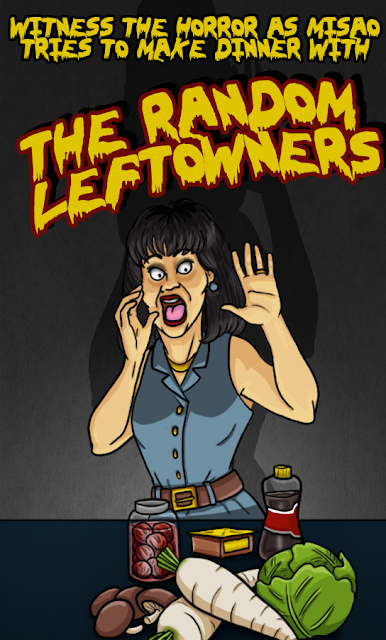
A picture draw in the style of a vintage horror movie posters shows a Japanese woman with poofy, 80’s hair screaming in horror at a random assortment of leftovers (daikon radish, red bean paste, pickled umeboshi plums, lettuce, soy sauce, and mushrooms) in front of her. In creepy looking, dripping, front across the top it says “Witness the horror as Misao tries to make dinner with ‘The Random Leftovers!’

The story takes place in the 80’s so I tried to give her poofy 80’s hair. I was not successful.

And even when Koike does finally get to the creepy stuff, it’s a crapshoot whether or not it actually has anything do with the plot or just more random detailing. For example; early on in the book we discover Teppei’s first wife, Reiko, committed suicide because he was cheating on her with Misao. So you’d think that Reiko’s vengeful spirit would somehow be involved in the plot. Well, you’d be wrong. The suicide backstory serves no purpose other than highlighting what a remorseless dick Teppei is. We also learn that at one point there were plans to build an underground shopping center, but they were abandoned after the initial tunnel was built. So maybe the project disturbed the graves above and angered the spirits? Nope. The project was abandoned because people didn’t want the cemetery relocated, so the graves were pretty much left alone. Actually we never learn why the ghosts (or demons, or monsters, or whatever) are such huge assholes. Usually ghosts haunt the living because they’re pissed off about being murdered or moved, or having a Taco Bell built over their remains, but these entities just like to lock doors, mess with the elevators, and put handprints on the glass, because…. reasons. I dunno, maybe they just really hate whoever does the building maintenance, or they’re a bunch of drunk frat boys.

The comic shows the annoying ghost of a frat boy, sticking out his tongue and waking up another man by screaming “Woooo! Bro, let’s play some beer pong!” The ghost is muscular, holding a Solo cup, and is wearing a Polo shirt with a popped collar, a backwards baseball hat, and a Puka shell necklace. The man he has just woken up is shirtless, with two subcutaneous mastectomy scars on his chest. Irritated, he responds “Can’t you just rattle chains and make the lights flicker like a normal ghost?”

Not so much evil as incredibly irritating.

The story and characters are well written enough, it just isn’t scary. Well, except for the ending, where all the horror gets crammed into the last few chapters of the book. It’s like Koike suddenly went “Shit! I’ve got four chapters left, and the scariest things in the book so far are a creepy basement and being forced to into awkward social situations!” (Granted, awkward social situations are much scarier than any demonic entity). So then the ghosts (or demons, or whatever) go from mildly irritating to eldritch abominations with god damn superpowers and a lust for blood.Oh, and just as the story is starting to get scary and suspenseful? It finishes with a vague, open ending and we STILL don’t know what the fuck is wrong with the building! To top it off, the ending isn’t even part of the actual story, it’s a freaking epilogue! WHAT? There was all this slow buildup up for the most underwhelming payoff ever. Way to get my hopes up, Koike! Look, The Graveyard Apartment isn’t a bad book overall, which is why I didn’t knock it down to “not recommended”, it just doesn’t work as a haunted house story.
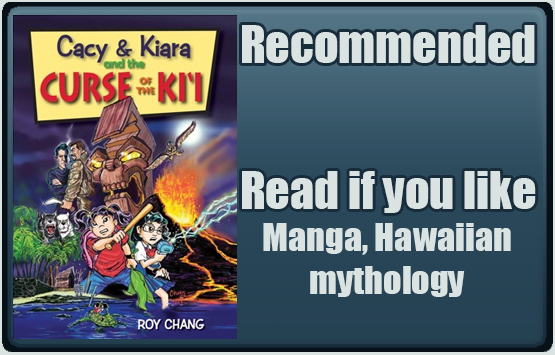
Cacy & Kiara and the Curse of the Ki’i by Roy Chang

Cacy & Kiara and the Curse of the Ki’i by Roy Chang

Formats: Print

Publisher: Beach House

Genre: Ghosts/Haunting, Thriller, Comedy, Myths and Folklore

Audience: Children

Diversity: Asian American characters, Hapa characters, Native Hawaiian characters, Pacific Islander characters, Korean American Characters

Takes Place in: Hawai’i, USA

Content Warnings (Highlight to view): Verbal/Emotional Abuse, Bullying, Animal Death, Child Endangerment, Violence, Death

Blurb

Cacy and Kiara are sixth grade cousins who couldn’t be more different from each other. When their two schools take the same field trip to Hawai‘i Volcanoes National Park, Cacy and Kiara are thrown into an adventure filled with mystery and murder.

In order to save the park–and themselves–from certain destruction, they call upon their family ‘aumäkua (personal gods), receive guidance from the Goddesses Hi‘iaka and Pele, and befriend the inhabitants of a secret Menehune village.


Throughout their adventure, they learn the power of their connection to ancient Hawai‘i and the importance of working together.


Over sixty manga-style illustrations accompany the story adding another layer of action to an already action-packed tale.

Happy Asian-Pacific American Heritage Month! With the recent popularity of Pokemon Sun and Moon, and Disney’s Moana, I figured I’d cover a Polynesian book this time. Luckily, I recently visited the big island of Hawaiʻi* with my wife (we were on our honeymoon, and as a newlywed I have to mention my marriage approximately 50,000 times) and made a stop at Basically Books while in downtown Hilo, because no honeymoon is complete without picking up a few scary stories at the local bookstore!

Of course I had to get something by Glen Grant and Rick Carroll, two of Hawaii’s most prominent horror authors, but I also picked up a children’s chapter book by a local comic artist, Roy Chang, entitled Cacy & Kiara and the Curse of the Ki’i. Although it’s much more of a crime thriller than straight horror, (though it does have its moments, like the ghostly hitchhiker *shudder*), I enjoyed it enough that I wanted to include it on the site. The story stars two 11-year-old cousins, the brave and brash Cacy, and the intelligent, yet aloof Kiara, who stumble upon a crime in progress and accidentally release the curse of a long forgotten idol. Now they’re in a race against time to undo the curse before Pele destroys the island in her anger. Oh, and they’re being chased by an international crime syndicate who wants the idol for themselves, just in case you thought things were too easy. Luckily the girls are aided on their adventure by the Menehuneʻaumākua, and other figures from Hawaiian mythology.

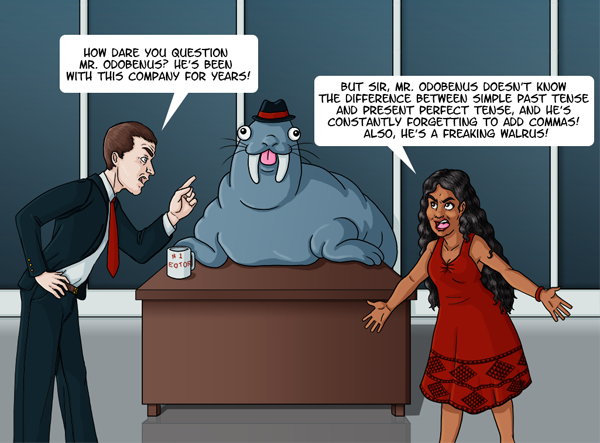
When I first started reading Chang’s book, I thought it was self published. The entire thing was riddled with run-on sentences, awkward phrasing, grammatical errors, and even a few typos. But nope! Cacy & Kiara went through an actual publishing house, which means, presumably, there was some sort of a professional editing process. Though, in this case, “professional editing process” most likely means that they waited until the last minute, panicked, and decided to just run the manuscript through spell check. That, or someone accidentally hired a walrus in a hat and made them an editor. Granted, Beach House is a small publisher, but you’d think that would mean their projects would get more attention and care, not less.

A walrus, wearing a hat, is sitting at a desk with a mug that says “#1 EDTOR” with backwards letters. In front of the walrus two people are arguing. A man in a suit is scolding a Hawaiian woman “How dare you question Mr. Odobenus? He’s been with this company for years! The woman has her arms throw out in frustration and yells back “But sir, Mr. Odobenus doesn’t know the difference between simple past tense and present perfect tense, and he’s constantly forgetting to add commas! Plus, he’s a freaking walrus!”

Yeah, I’m going with the Walrus theory.

Poor editing aside, the book isn’t bad. It’s creative, humorous, and I love the concept behind it. But Chang is clearly a much better artist than author, used to telling his stories through images rather than words. His art is so full of energy and expression that it does a much better job at capturing his creative ideas than the long, awkward, blocks of text he writes. In all honestly, I’d love to see the story done as a graphic novel because the ideas behind it are solid, the action scenes captivating, and the characters of Cacy and Kiara are bursting with energy and life. It’d be interesting to compare his Steampunk comic book series, Highball and Pepe, with Cacy & Kiara and see which one does a better job at telling the story. But, Chang, for the love of all that is holy, please erase your pencil lines! It just makes the art look messy and unfinished. Maybe the editor just published the rough draft instead of waiting for the final product? Because his other artwork doesn’t seem to suffer from the same problem.

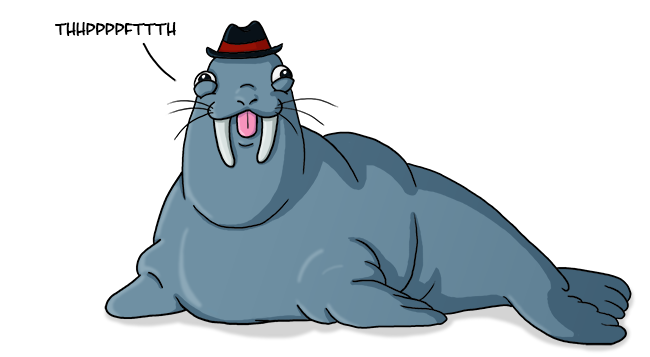
A picture of Mr. Odobenus, the walrus wearing a hat. He has a goofy grin on his face and is blowing a raspberry.

I think we all know who to blame here.

But, when I finally put down my red pen and stopped nitpicking, I really enjoyed the book. About halfway through I got caught up in the action and suspense, and the novel really hit its stride. It made me think of the awesome cartoons from the 80’s – sure the writing was absurd and hackneyed, and the animation was full of errors, but we didn’t care! The action, fun characters, and creativity is what made us love them, and what made such an impression on us as kids. I can just picture Cacy and Kiara teaming up with the Teenage Mutant Ninja Turtles or piloting a nēnē goose mecha. Honestly, the book is intended for kids, and most kids are not going to care about Oxford commas or the flow of dialogue when Kiara’s flying a giant owl and Cacy is trapped in a truck that’s about to explode.

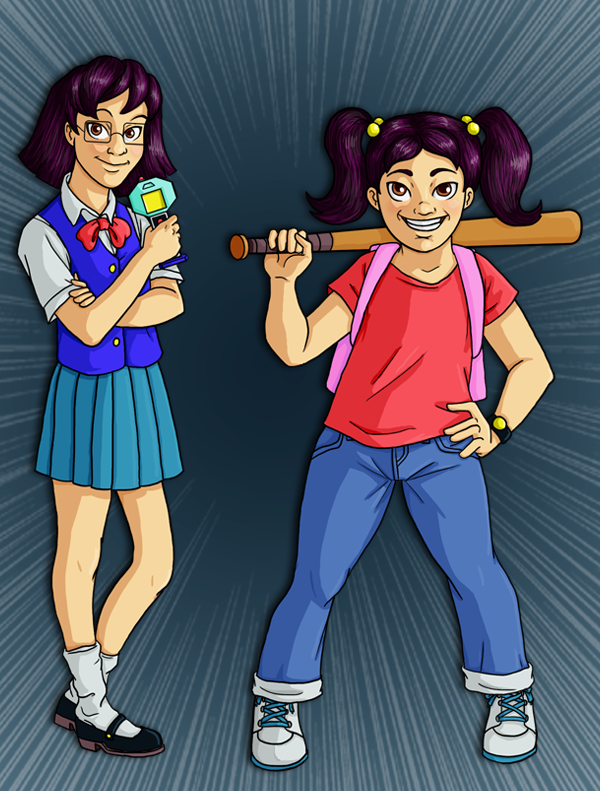
A picture of the two characters from the story, Cacy and Kiara. Cacy, a husky girl with pigtails and a wide grin, is wearing a shirt and jeans, with a pink backpack and a bat swung over her shoulder. Next to Cacy is her slightly taller, slender, bespectacled cousin, Kiara. Kiara’s hair is cut in a bob, and she’s wearing a blue school uniform. Her arms are crossed and she’s holding a strange, remote-control-looking device.

I would so watch this cartoon.

Even better, Chang has made the story educational without being preachy, unlike some of our childhood favorites (looking at you Captain Planet). This would be an awesome book to hand to a kid before a visit to Hawaiʻi Volcanoes National Park, because learning about Hawaiian myths and ecology is a lot more fun when it involves high speed chases and international crime syndicates. There’s even a glossary of terms in the back (though I question why eruption was included but musubi wasn’t). Anyone familiar with the Big Island will be delighted to see references to popular locations such as Ken’s House of Pancakes, the Thurston Lava Tube, the Volcano House, and Pu`uhonua O Hōnaunau (all places I got to visit during my honeymoon). So, if you want to read an awesome adventure story about two spunky, tween girls, while learning about the big island of Hawai’i (and you’re not a huge grammarian) I would definitely recommend this book.

*At the time of writing this I didn’t realize how much tourism is hurting Hawaii, even before Covid and the water shortage, and how most Native Hawaiians don’t want people visiting their illegally occupied land.

A Banquet for Hungry Ghosts by Ying Chang Compestine

A Banquet for Hungry Ghosts by Ying Chang Compestine

Formats: Print, audio, digital

Publisher: Tumbling Dumpling Media

Genre: Monster, Killer/Slasher, Crime, Ghosts/Haunting, Psychological Horror, Blood & Guts, Historic Horror, Anthology

Audience: Adult/Mature

Diversity: Chinese and Chinese American characters

Takes Place in: China

Content Warnings (Highlight to view): Physical Abuse, Animal Death, Animal Abuse, Child Endangerment, Child Death, Body shaming, Verbal/Emotional Abuse, Cannibalism, Gore, Torture, Medical Torture, Violence, Death

There are many types of Chinese ghosts, including the spirits of deceased loved ones who may bring blessing and good fortune if properly honored, vengeful specters searching for those who wronged them in life, playful and troublesome spooks, and Hungry Ghosts, unhappy spirits with insatiable appetites.  During the seventh month of the Chinese calendar, known as Ghost Month, the gates to hell are open and these spirits are able to cross over to the realm of the living. To avoid hauntings and misfortune, people will leave offerings of food in the hopes of appeasing the Hungry Ghosts who wander the streets at night. If these spirits are pleased with the food offered to them, they may leave the household in peace. But what if the Hungry Ghosts aren’t placated?

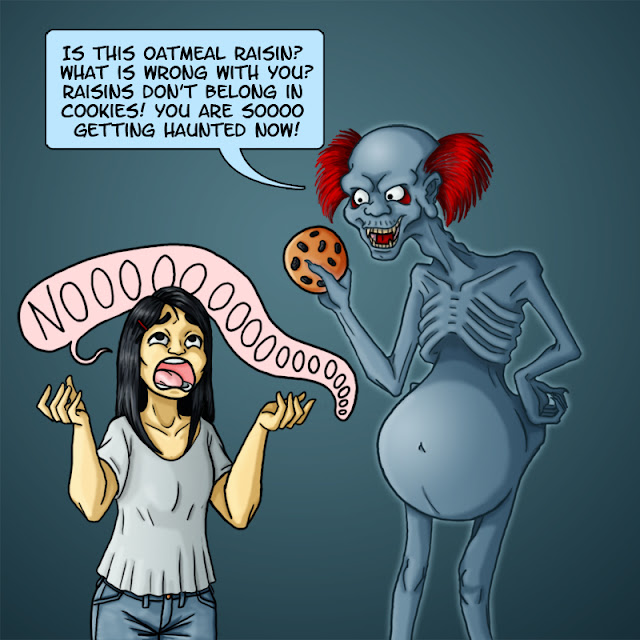
A skeletal-looking Japanese ghost with pale blue skin, flaming red hair, bulging eyes, and a distended belly is glaring at a Chinese woman who gave him a cookie and scolding "Is this Oatmeal Raisin? What is wrong with you? Raisins don't belong in cookies! You are soooo getting haunted now!" The woman yells "Nooooooooooooo!" in comical despair.

He’ll eat garbage, but he draws the line at oatmeal raisin.

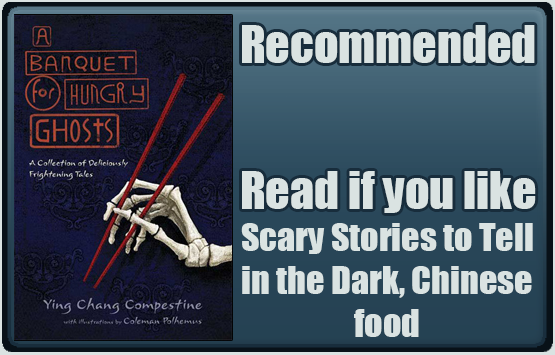
He’ll eat garbage, but he draws the line at oatmeal raisin.Author Ying Chang Compestine explores both Chinese cuisine and angry spirits in her book, A Banquet for Hungry Ghosts. Ah, delicious food and gruesome horror, two of my favorite things! Admittedly, not things you’d usually think of combining, but hey, I’m not complaining. Each ghost story is dedicated to a food you might typically find in a traditional Chinese eight course banquet, and includes a recipe at the end. Okay, so maybe those with weaker stomachs may not want to try whipping up a batch of Tea Eggs right after reading about some poor guy getting disemboweled. But I’m the kind of person who can watch surgery videos while eating breakfast, so I wasn’t put off my appetite. If anything, the book made me crave cha siu bao the entire time. Oh, and by the way, the steamed dumpling recipe? Sooooooo good. I’ve got to try making the Jasmine Almond cookies next.

I'm reading "A Banquet for Hungry Ghosts" and exclaim in wonder "Woah, the inn keeper chopped people up and made them into dumplings!?" The next panel shows me biting my lip, looking conflicted, and saying "Damn it, now I want dumplings".

I also get hungry watching Hannibal. Don’t judge me.

In addition to recipes, each chapter also includes an afterword that expands on aspects of Chinese culture and history discussed in the story. There’s information on the rules of Mahjong, Mantis fighting, Qingming (Tomb Sweeping Day), the Cultural Revolution, and even anecdotes from Compestine’s own life growing up in China. Also ablation surgery, arsenic poisoning, and ancient Chinese tombs containing the victims of human sacrifice. Fun, right? Hey, it’s a book of scary stories after all, it’s to be expected. Every country has its share of atrocities from the past and present, and Compestine adds even more horror to her already spooky ghost stories by including some of China’s darker practices, such as illegal organ harvesting from prisoners and corruption at Buddhist monasteries. It’s actually quite clever how Compestine addresses certain Chinese social issues by turning them into ghost stories. At least in fiction, we get the satisfaction of seeing justice done, albeit by Hungry Ghost who enact terrible, and often gruesome vengeance.As horrific as I’ve made the book sound, it is actually intended for children. Like a more educational, Chinese, epicurean version of Scary Stories to Tell in the Darkcomplete with its own gorgeous, creepy, black and white illustrations. I know the blood and guts may be too much for some children (though it’s not much worse than your standard German fairy tale or Roald Dahl story) but the gore is definitely going to appeal to others. Hey, whatever gets them to read, right? Plus, it’s educational, so that’s always good. Even adults will find the stories informative; while reading Banquet for Hungry Ghosts I frequently found myself running off to Google the construction of the Great Wall or Chinese medical practices.Although the overall stories were rich and interesting, the writing could be a little simplistic, which, unfortunately, I felt detracted from the horror and kept me from giving this book the four stars it otherwise would have earned. But, again, it is a kid’s book, and it’s difficult to write something that’s elegant, interesting, and easy to read. Children reading A Banquet for Hungry Ghosts are already going to have enough trouble trying to sound out “Hemorrhagic shock”, no need to make the writing too flowery and complex. So let’s just say I’d give the writing three stars for adults and four stars for kids.My only other complaint is that the author also tended to rely heavily on gore to create scares. Being gross and being scary are two different things, and you can’t just add blood to a story and expect it to be frightening. If that were true, I could just read a medical textbook to give myself nightmares.

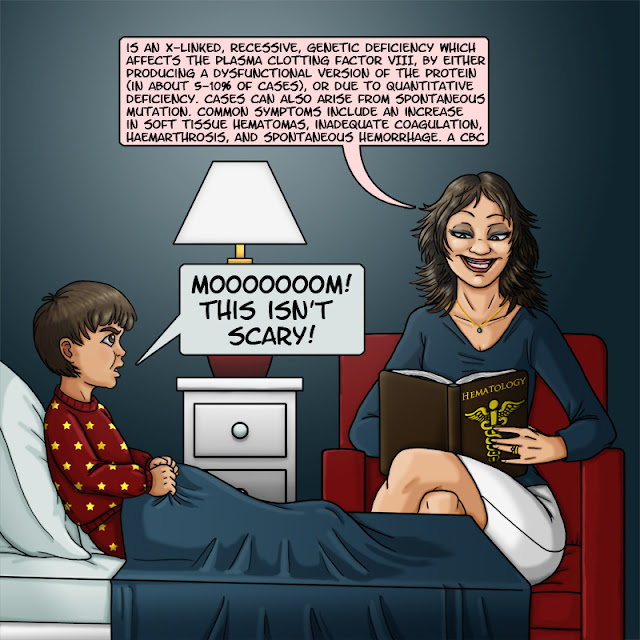
A mother is reading to her son a "bed time story" out of a dull, dry, medical text book. She drones on about "an X-linked, recessive, genetic deficiency which affects the plasma clotting factor VIII, by either producing a dysfunctional version of the protein." Annoyed, the boy responds "Moooom! This isn't scary!"

What are you talking about kid? Hemorrhaging is terrifying.

Like any horror anthology, some stories are much better than others. “Tofu with Chili-Garlic Sauce”,  “Steamed Dumplings”, and “Beef Stew” were all excellent. “Long-Life Noodles” and “Jasmine Almond Cookies”? Not so much. But overall this is still a great book, and the combination of ghost stories, history, and cuisine make a fun and unique combination. A must read for both young horror fans and foodies.

Skeleton Man by Joseph Bruchac

Skeleton Man by Joseph Bruchac

Formats: Print, audio, digital

Publisher: HarperCollins

Genre: Mystery, Thriller, Crime, Monster, Myth and Folklore

Audience: Children

Diversity: American Indian (Mohawk/ Kanien’kehá:ka) characters, Black character

Takes Place in: type here

Content Warnings (Highlight to view):  Child Endangerment, Cannibalism, Gaslighting

Please note, other Natives have brought into question Bruchac’s identity as Abenaki I will leave the review up for now, but can no longer reccomend this book. 

I’m so used to getting my scares from more mature media I often forget how scary “kid friendly” horror fiction can be, and get completely caught off guard. Supposedly terrifying films like JawsThe Blair Witch Project, and Poltergeist have all failed to phase me. But Return to Oz, a PG Disney film, still gives me nightmares. And don’t even get me started on the first time I saw Over the Garden Wall.  

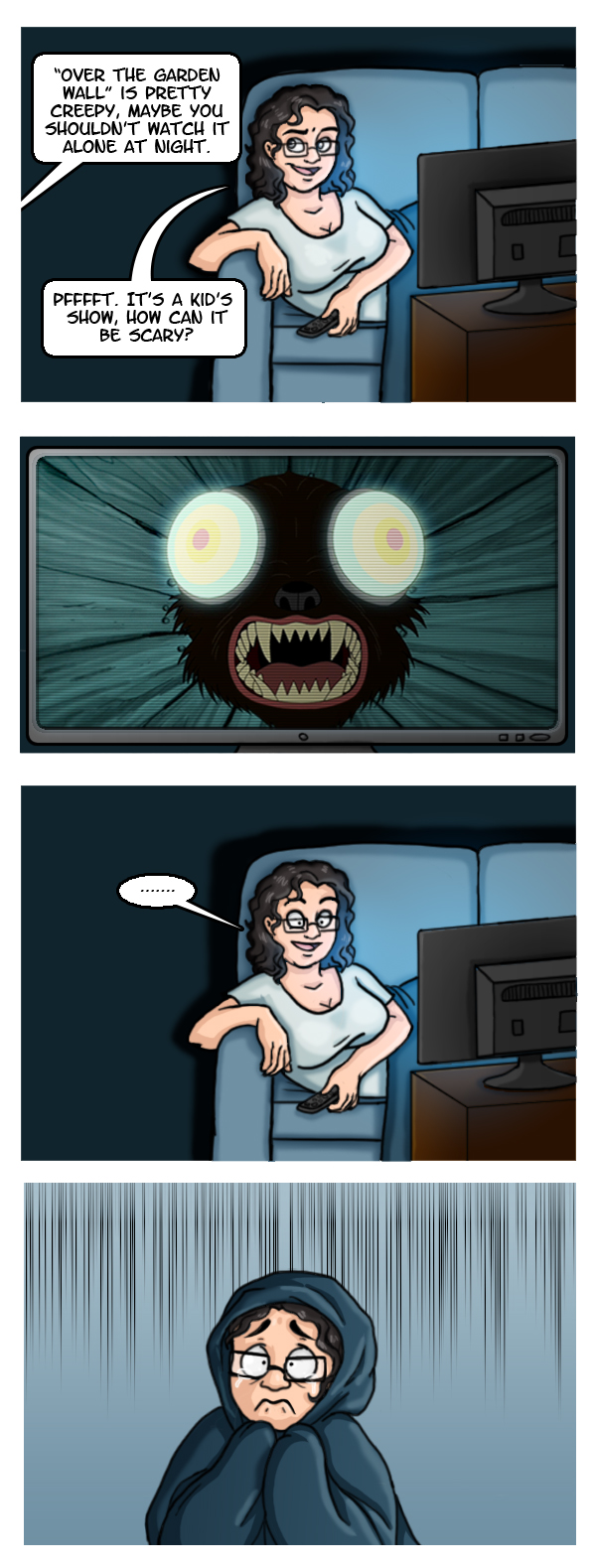
A comic that shows me lying on the couch watching TV. My offscreen friend says 'Over the Garden Wall is pretty creepy, maybe you shouldn't watch it alone at night' to which I respond 'Pfffft. It's a kid's show, how can it be scary?' The next panel shows an image of the TV screen with a scary clip from Over the Garden Wall where a dog-like monster with giant has its face close to the camera. I pause, staring at the screen with a frozen expression. In the next panel I'm hiding under a blanket, terrified, and trying not to cry.

For children!

The problem is, I seem to have selective memory when it come’s to being traumatized by children’s books and television. So of course, when I picked up the young adult book Skeleton Man, by Joseph Bruchach, my first thought wasn’t “Huh, R.L. Stein says this book gave him nightmares, this might actually be scary”. Nope. It was “Tch, kids books can’t frighten me! I’ve seen all the Alien movies!” “And hey” I mused, determined to keep up my string of poor decision making, “I might as well read the whole book at night, during a thunderstorm, when I’m home alone. That seems like a good idea. Yup.”This quick, suspenseful story stars Molly, a clever and resourceful Mohawk girl, who wakes up one day to discover her parents are missing. The police seem to have no leads about their disappearances, and Molly is sent to live with a sinister man who suddenly appears, claiming to be her uncle. Soon, the events in her life begin to parallel an old Mohawk tale about the Skeleton Man, until the legend seems to bleed into reality.While the fantastical elements in the story are creepy, the truly terrifying part was the apathy shown by most of the adults in the story towards Molly’s predicament. They completely disregarded her concerns because of her age, and placed her in a dangerous situation. The sense that she was alone, helpless, and ignored by those who were supposed to help and protect her was realistic enough to make my chest tighten in fear for her. Seriously, who hands a child off to some random stranger without a proper background check?

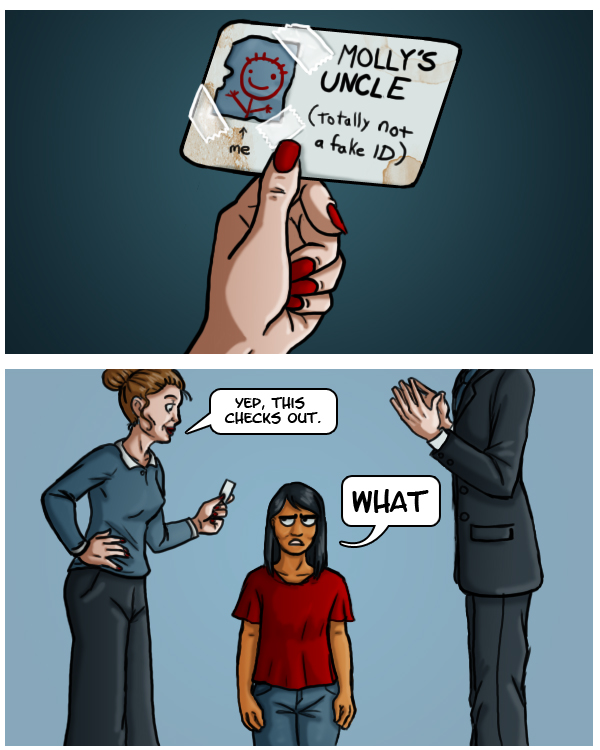
The first panel shows a closeup of a sketchy, clearly forged ID card that has a stick figure drawing taped on instead of a photo. The ID says "Molly's Uncle (totally not fake ID). The social worker examining it cheerfully responds "Yep, this checkes out!" to a creepy man whose face can't be seen. Molly, a young native girl, is unammused and responds with an annoyed "WHAT"

Pretty much what happened.

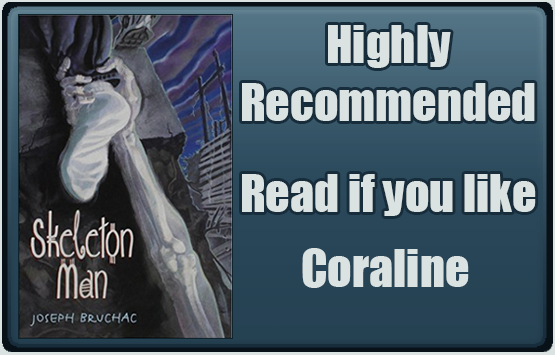
Thankfully, Molly does have one adult who listens her, her teacher, Ms. Shabbas, who provides both guidance and emotional support to the frightened young girl. Just knowing her teacher believes her and is there to help is enough to give Molly the courage to free herself and find her parents.The book reminded me a lot of Neil Gaiman’s Coraline, a creepy and atmospheric children’s story about a brave little girl who saves her parents from a monster. Except in Skeleton Man it’s never clear wether Molly’s monster is magic or mundane. And I like that. It leaves things open to interpretation and it’s a lot creepier if you don’t wether the villain is a creature from myth, or just an evil, greedy man. Either way, it’s a fun, quick, read, perfect for a dark and stormy night. Or in the middle of the day with all the lights on. You know, whichever.

Navigation

Social Media

Search by Tags

To learn more about the Age Group, Diversity, and Genre tags, click here.

Age Groups

Diversity

Genre

Support the Blog

Search

Links

The Graveyard Apartment by Mariko Koike, translated by Deborah Boliver Boehm

The Graveyard Apartment by Mariko Koike, translated by Deborah Boliver Boehm

Formats: Print

Publisher: St. Martin’s Press

Genre: Ghosts/Haunting, Thriller

Audience: Adult/Mature

Diversity: Japanese characters

Takes Place in: Japan

Content Warnings (Highlight to view): Animal Death, Child Death, Child Endangerment, Suicide, Verbal/Emotional Abuse, Forced Captivity

Blurb

A terrifying tale of a young family who move into an apartment building next to a graveyard and the horrors that are unleashed upon them.

One of the most popular writers working in Japan today, Mariko Koike is a recognized master of detective fiction and horror writing. Known in particular for her hybrid works that blend these styles with elements of romance, The Graveyard Apartment is arguably Koike’s masterpiece. Originally published in Japan in 1986, Koike’s novel is the suspenseful tale of a young family that believes it has found the perfect home to grow in to, only to realize that the apartment’s idyllic setting harbors the specter of evil and that longer they stay, the more trapped they become.

This tale of a young married couple who are harboring a dark secret is packed with dread and terror, as they and their daughter move into a brand new apartment building built next to a graveyard. As strange and terrifying occurrences begin to pile up, people in the building begin to move out one by one, until the young family is left alone with someone… or something… lurking in the basement. The psychological horror builds moment after moment, scene after scene, culminating with a conclusion that will make you think twice before ever going into a basement again.

Next up for Asian and Pacific American heritage month, is a new translation of Mariko Koike’s popular 1986 horror novel, The Graveyard Apartment.The Graveyard Apartment had a great premise; a married couple and their young daughter move into a haunted apartment near a cemetery and creepy shit keeps happening, but they’re unwilling to move due to their financial situation, societal pressure to appear normal, and the husband’s deep denial that anything is wrong. The book explores their feelings of emptiness and isolation and their struggle with their fears, both mundane and supernatural. But what should have been amazing ended up being very, well, “meh”. So how exactly does one manage to fuck up what should have been a fool proof haunted house formula? 

To be completely fair, much of the awkward writing present in the English version could very well be due to translation problems. But unless the translator of The Graveyard Apartment pulled a 4KIDs Entertainment and just started making up random shit and cutting out half the story, there’s only so much you can blame on her. The problems with the book go far beyond a language barrier issue. The biggest setback is that half the story seems pointless (maybe the translator should have cut some of it out after all). Koike spends more time on random details, like what her main character, Misao, is wearing, than she does on the evil entity haunting the building. There’s even an entire chapter, later on in the book, dedicated to visiting a realtor’s office and looking at new apartments. Can you handle the terror as her husband, Teppei, walks their daughter to school? Shiver as the doomed couple look at rental listings within their budget!

A picture draw in the style of a vintage horror movie posters shows a Japanese woman with poofy, 80’s hair screaming in horror at a random assortment of leftovers (daikon radish, red bean paste, pickled umeboshi plums, lettuce, soy sauce, and mushrooms) in front of her. In creepy looking, dripping, front across the top it says “Witness the horror as Misao tries to make dinner with ‘The Random Leftovers!’

The story takes place in the 80’s so I tried to give her poofy 80’s hair. I was not successful.

And even when Koike does finally get to the creepy stuff, it’s a crapshoot whether or not it actually has anything do with the plot or just more random detailing. For example; early on in the book we discover Teppei’s first wife, Reiko, committed suicide because he was cheating on her with Misao. So you’d think that Reiko’s vengeful spirit would somehow be involved in the plot. Well, you’d be wrong. The suicide backstory serves no purpose other than highlighting what a remorseless dick Teppei is. We also learn that at one point there were plans to build an underground shopping center, but they were abandoned after the initial tunnel was built. So maybe the project disturbed the graves above and angered the spirits? Nope. The project was abandoned because people didn’t want the cemetery relocated, so the graves were pretty much left alone. Actually we never learn why the ghosts (or demons, or monsters, or whatever) are such huge assholes. Usually ghosts haunt the living because they’re pissed off about being murdered or moved, or having a Taco Bell built over their remains, but these entities just like to lock doors, mess with the elevators, and put handprints on the glass, because…. reasons. I dunno, maybe they just really hate whoever does the building maintenance, or they’re a bunch of drunk frat boys.

The comic shows the annoying ghost of a frat boy, sticking out his tongue and waking up another man by screaming “Woooo! Bro, let’s play some beer pong!” The ghost is muscular, holding a Solo cup, and is wearing a Polo shirt with a popped collar, a backwards baseball hat, and a Puka shell necklace. The man he has just woken up is shirtless, with two subcutaneous mastectomy scars on his chest. Irritated, he responds “Can’t you just rattle chains and make the lights flicker like a normal ghost?”

Not so much evil as incredibly irritating.

The story and characters are well written enough, it just isn’t scary. Well, except for the ending, where all the horror gets crammed into the last few chapters of the book. It’s like Koike suddenly went “Shit! I’ve got four chapters left, and the scariest things in the book so far are a creepy basement and being forced to into awkward social situations!” (Granted, awkward social situations are much scarier than any demonic entity). So then the ghosts (or demons, or whatever) go from mildly irritating to eldritch abominations with god damn superpowers and a lust for blood.Oh, and just as the story is starting to get scary and suspenseful? It finishes with a vague, open ending and we STILL don’t know what the fuck is wrong with the building! To top it off, the ending isn’t even part of the actual story, it’s a freaking epilogue! WHAT? There was all this slow buildup up for the most underwhelming payoff ever. Way to get my hopes up, Koike! Look, The Graveyard Apartment isn’t a bad book overall, which is why I didn’t knock it down to “not recommended”, it just doesn’t work as a haunted house story.
Cacy & Kiara and the Curse of the Ki’i by Roy Chang

Cacy & Kiara and the Curse of the Ki’i by Roy Chang

Formats: Print

Publisher: Beach House

Genre: Ghosts/Haunting, Thriller, Comedy, Myths and Folklore

Audience: Children

Diversity: Asian American characters, Hapa characters, Native Hawaiian characters, Pacific Islander characters, Korean American Characters

Takes Place in: Hawai’i, USA

Content Warnings (Highlight to view): Verbal/Emotional Abuse, Bullying, Animal Death, Child Endangerment, Violence, Death

Blurb

Cacy and Kiara are sixth grade cousins who couldn’t be more different from each other. When their two schools take the same field trip to Hawai‘i Volcanoes National Park, Cacy and Kiara are thrown into an adventure filled with mystery and murder.

In order to save the park–and themselves–from certain destruction, they call upon their family ‘aumäkua (personal gods), receive guidance from the Goddesses Hi‘iaka and Pele, and befriend the inhabitants of a secret Menehune village.


Throughout their adventure, they learn the power of their connection to ancient Hawai‘i and the importance of working together.


Over sixty manga-style illustrations accompany the story adding another layer of action to an already action-packed tale.

Happy Asian-Pacific American Heritage Month! With the recent popularity of Pokemon Sun and Moon, and Disney’s Moana, I figured I’d cover a Polynesian book this time. Luckily, I recently visited the big island of Hawaiʻi* with my wife (we were on our honeymoon, and as a newlywed I have to mention my marriage approximately 50,000 times) and made a stop at Basically Books while in downtown Hilo, because no honeymoon is complete without picking up a few scary stories at the local bookstore!

Of course I had to get something by Glen Grant and Rick Carroll, two of Hawaii’s most prominent horror authors, but I also picked up a children’s chapter book by a local comic artist, Roy Chang, entitled Cacy & Kiara and the Curse of the Ki’i. Although it’s much more of a crime thriller than straight horror, (though it does have its moments, like the ghostly hitchhiker *shudder*), I enjoyed it enough that I wanted to include it on the site. The story stars two 11-year-old cousins, the brave and brash Cacy, and the intelligent, yet aloof Kiara, who stumble upon a crime in progress and accidentally release the curse of a long forgotten idol. Now they’re in a race against time to undo the curse before Pele destroys the island in her anger. Oh, and they’re being chased by an international crime syndicate who wants the idol for themselves, just in case you thought things were too easy. Luckily the girls are aided on their adventure by the Menehuneʻaumākua, and other figures from Hawaiian mythology.

When I first started reading Chang’s book, I thought it was self published. The entire thing was riddled with run-on sentences, awkward phrasing, grammatical errors, and even a few typos. But nope! Cacy & Kiara went through an actual publishing house, which means, presumably, there was some sort of a professional editing process. Though, in this case, “professional editing process” most likely means that they waited until the last minute, panicked, and decided to just run the manuscript through spell check. That, or someone accidentally hired a walrus in a hat and made them an editor. Granted, Beach House is a small publisher, but you’d think that would mean their projects would get more attention and care, not less.

A walrus, wearing a hat, is sitting at a desk with a mug that says “#1 EDTOR” with backwards letters. In front of the walrus two people are arguing. A man in a suit is scolding a Hawaiian woman “How dare you question Mr. Odobenus? He’s been with this company for years! The woman has her arms throw out in frustration and yells back “But sir, Mr. Odobenus doesn’t know the difference between simple past tense and present perfect tense, and he’s constantly forgetting to add commas! Plus, he’s a freaking walrus!”

Yeah, I’m going with the Walrus theory.

Poor editing aside, the book isn’t bad. It’s creative, humorous, and I love the concept behind it. But Chang is clearly a much better artist than author, used to telling his stories through images rather than words. His art is so full of energy and expression that it does a much better job at capturing his creative ideas than the long, awkward, blocks of text he writes. In all honestly, I’d love to see the story done as a graphic novel because the ideas behind it are solid, the action scenes captivating, and the characters of Cacy and Kiara are bursting with energy and life. It’d be interesting to compare his Steampunk comic book series, Highball and Pepe, with Cacy & Kiara and see which one does a better job at telling the story. But, Chang, for the love of all that is holy, please erase your pencil lines! It just makes the art look messy and unfinished. Maybe the editor just published the rough draft instead of waiting for the final product? Because his other artwork doesn’t seem to suffer from the same problem.

A picture of Mr. Odobenus, the walrus wearing a hat. He has a goofy grin on his face and is blowing a raspberry.

I think we all know who to blame here.

But, when I finally put down my red pen and stopped nitpicking, I really enjoyed the book. About halfway through I got caught up in the action and suspense, and the novel really hit its stride. It made me think of the awesome cartoons from the 80’s – sure the writing was absurd and hackneyed, and the animation was full of errors, but we didn’t care! The action, fun characters, and creativity is what made us love them, and what made such an impression on us as kids. I can just picture Cacy and Kiara teaming up with the Teenage Mutant Ninja Turtles or piloting a nēnē goose mecha. Honestly, the book is intended for kids, and most kids are not going to care about Oxford commas or the flow of dialogue when Kiara’s flying a giant owl and Cacy is trapped in a truck that’s about to explode.

A picture of the two characters from the story, Cacy and Kiara. Cacy, a husky girl with pigtails and a wide grin, is wearing a shirt and jeans, with a pink backpack and a bat swung over her shoulder. Next to Cacy is her slightly taller, slender, bespectacled cousin, Kiara. Kiara’s hair is cut in a bob, and she’s wearing a blue school uniform. Her arms are crossed and she’s holding a strange, remote-control-looking device.

I would so watch this cartoon.

Even better, Chang has made the story educational without being preachy, unlike some of our childhood favorites (looking at you Captain Planet). This would be an awesome book to hand to a kid before a visit to Hawaiʻi Volcanoes National Park, because learning about Hawaiian myths and ecology is a lot more fun when it involves high speed chases and international crime syndicates. There’s even a glossary of terms in the back (though I question why eruption was included but musubi wasn’t). Anyone familiar with the Big Island will be delighted to see references to popular locations such as Ken’s House of Pancakes, the Thurston Lava Tube, the Volcano House, and Pu`uhonua O Hōnaunau (all places I got to visit during my honeymoon). So, if you want to read an awesome adventure story about two spunky, tween girls, while learning about the big island of Hawai’i (and you’re not a huge grammarian) I would definitely recommend this book.

*At the time of writing this I didn’t realize how much tourism is hurting Hawaii, even before Covid and the water shortage, and how most Native Hawaiians don’t want people visiting their illegally occupied land.

A Banquet for Hungry Ghosts by Ying Chang Compestine

A Banquet for Hungry Ghosts by Ying Chang Compestine

Formats: Print, audio, digital

Publisher: Tumbling Dumpling Media

Genre: Monster, Killer/Slasher, Crime, Ghosts/Haunting, Psychological Horror, Blood & Guts, Historic Horror, Anthology

Audience: Adult/Mature

Diversity: Chinese and Chinese American characters

Takes Place in: China

Content Warnings (Highlight to view): Physical Abuse, Animal Death, Animal Abuse, Child Endangerment, Child Death, Body shaming, Verbal/Emotional Abuse, Cannibalism, Gore, Torture, Medical Torture, Violence, Death

There are many types of Chinese ghosts, including the spirits of deceased loved ones who may bring blessing and good fortune if properly honored, vengeful specters searching for those who wronged them in life, playful and troublesome spooks, and Hungry Ghosts, unhappy spirits with insatiable appetites.  During the seventh month of the Chinese calendar, known as Ghost Month, the gates to hell are open and these spirits are able to cross over to the realm of the living. To avoid hauntings and misfortune, people will leave offerings of food in the hopes of appeasing the Hungry Ghosts who wander the streets at night. If these spirits are pleased with the food offered to them, they may leave the household in peace. But what if the Hungry Ghosts aren’t placated?

A skeletal-looking Japanese ghost with pale blue skin, flaming red hair, bulging eyes, and a distended belly is glaring at a Chinese woman who gave him a cookie and scolding "Is this Oatmeal Raisin? What is wrong with you? Raisins don't belong in cookies! You are soooo getting haunted now!" The woman yells "Nooooooooooooo!" in comical despair.

He’ll eat garbage, but he draws the line at oatmeal raisin.

He’ll eat garbage, but he draws the line at oatmeal raisin.Author Ying Chang Compestine explores both Chinese cuisine and angry spirits in her book, A Banquet for Hungry Ghosts. Ah, delicious food and gruesome horror, two of my favorite things! Admittedly, not things you’d usually think of combining, but hey, I’m not complaining. Each ghost story is dedicated to a food you might typically find in a traditional Chinese eight course banquet, and includes a recipe at the end. Okay, so maybe those with weaker stomachs may not want to try whipping up a batch of Tea Eggs right after reading about some poor guy getting disemboweled. But I’m the kind of person who can watch surgery videos while eating breakfast, so I wasn’t put off my appetite. If anything, the book made me crave cha siu bao the entire time. Oh, and by the way, the steamed dumpling recipe? Sooooooo good. I’ve got to try making the Jasmine Almond cookies next.

I'm reading "A Banquet for Hungry Ghosts" and exclaim in wonder "Woah, the inn keeper chopped people up and made them into dumplings!?" The next panel shows me biting my lip, looking conflicted, and saying "Damn it, now I want dumplings".

I also get hungry watching Hannibal. Don’t judge me.

In addition to recipes, each chapter also includes an afterword that expands on aspects of Chinese culture and history discussed in the story. There’s information on the rules of Mahjong, Mantis fighting, Qingming (Tomb Sweeping Day), the Cultural Revolution, and even anecdotes from Compestine’s own life growing up in China. Also ablation surgery, arsenic poisoning, and ancient Chinese tombs containing the victims of human sacrifice. Fun, right? Hey, it’s a book of scary stories after all, it’s to be expected. Every country has its share of atrocities from the past and present, and Compestine adds even more horror to her already spooky ghost stories by including some of China’s darker practices, such as illegal organ harvesting from prisoners and corruption at Buddhist monasteries. It’s actually quite clever how Compestine addresses certain Chinese social issues by turning them into ghost stories. At least in fiction, we get the satisfaction of seeing justice done, albeit by Hungry Ghost who enact terrible, and often gruesome vengeance.As horrific as I’ve made the book sound, it is actually intended for children. Like a more educational, Chinese, epicurean version of Scary Stories to Tell in the Darkcomplete with its own gorgeous, creepy, black and white illustrations. I know the blood and guts may be too much for some children (though it’s not much worse than your standard German fairy tale or Roald Dahl story) but the gore is definitely going to appeal to others. Hey, whatever gets them to read, right? Plus, it’s educational, so that’s always good. Even adults will find the stories informative; while reading Banquet for Hungry Ghosts I frequently found myself running off to Google the construction of the Great Wall or Chinese medical practices.Although the overall stories were rich and interesting, the writing could be a little simplistic, which, unfortunately, I felt detracted from the horror and kept me from giving this book the four stars it otherwise would have earned. But, again, it is a kid’s book, and it’s difficult to write something that’s elegant, interesting, and easy to read. Children reading A Banquet for Hungry Ghosts are already going to have enough trouble trying to sound out “Hemorrhagic shock”, no need to make the writing too flowery and complex. So let’s just say I’d give the writing three stars for adults and four stars for kids.My only other complaint is that the author also tended to rely heavily on gore to create scares. Being gross and being scary are two different things, and you can’t just add blood to a story and expect it to be frightening. If that were true, I could just read a medical textbook to give myself nightmares.

A mother is reading to her son a "bed time story" out of a dull, dry, medical text book. She drones on about "an X-linked, recessive, genetic deficiency which affects the plasma clotting factor VIII, by either producing a dysfunctional version of the protein." Annoyed, the boy responds "Moooom! This isn't scary!"

What are you talking about kid? Hemorrhaging is terrifying.

Like any horror anthology, some stories are much better than others. “Tofu with Chili-Garlic Sauce”,  “Steamed Dumplings”, and “Beef Stew” were all excellent. “Long-Life Noodles” and “Jasmine Almond Cookies”? Not so much. But overall this is still a great book, and the combination of ghost stories, history, and cuisine make a fun and unique combination. A must read for both young horror fans and foodies.

Skeleton Man by Joseph Bruchac

Skeleton Man by Joseph Bruchac

Formats: Print, audio, digital

Publisher: HarperCollins

Genre: Mystery, Thriller, Crime, Monster, Myth and Folklore

Audience: Children

Diversity: American Indian (Mohawk/ Kanien’kehá:ka) characters, Black character

Takes Place in: type here

Content Warnings (Highlight to view):  Child Endangerment, Cannibalism, Gaslighting

Please note, other Natives have brought into question Bruchac’s identity as Abenaki I will leave the review up for now, but can no longer reccomend this book. 

I’m so used to getting my scares from more mature media I often forget how scary “kid friendly” horror fiction can be, and get completely caught off guard. Supposedly terrifying films like JawsThe Blair Witch Project, and Poltergeist have all failed to phase me. But Return to Oz, a PG Disney film, still gives me nightmares. And don’t even get me started on the first time I saw Over the Garden Wall.  

A comic that shows me lying on the couch watching TV. My offscreen friend says 'Over the Garden Wall is pretty creepy, maybe you shouldn't watch it alone at night' to which I respond 'Pfffft. It's a kid's show, how can it be scary?' The next panel shows an image of the TV screen with a scary clip from Over the Garden Wall where a dog-like monster with giant has its face close to the camera. I pause, staring at the screen with a frozen expression. In the next panel I'm hiding under a blanket, terrified, and trying not to cry.

For children!

The problem is, I seem to have selective memory when it come’s to being traumatized by children’s books and television. So of course, when I picked up the young adult book Skeleton Man, by Joseph Bruchach, my first thought wasn’t “Huh, R.L. Stein says this book gave him nightmares, this might actually be scary”. Nope. It was “Tch, kids books can’t frighten me! I’ve seen all the Alien movies!” “And hey” I mused, determined to keep up my string of poor decision making, “I might as well read the whole book at night, during a thunderstorm, when I’m home alone. That seems like a good idea. Yup.”This quick, suspenseful story stars Molly, a clever and resourceful Mohawk girl, who wakes up one day to discover her parents are missing. The police seem to have no leads about their disappearances, and Molly is sent to live with a sinister man who suddenly appears, claiming to be her uncle. Soon, the events in her life begin to parallel an old Mohawk tale about the Skeleton Man, until the legend seems to bleed into reality.While the fantastical elements in the story are creepy, the truly terrifying part was the apathy shown by most of the adults in the story towards Molly’s predicament. They completely disregarded her concerns because of her age, and placed her in a dangerous situation. The sense that she was alone, helpless, and ignored by those who were supposed to help and protect her was realistic enough to make my chest tighten in fear for her. Seriously, who hands a child off to some random stranger without a proper background check?

The first panel shows a closeup of a sketchy, clearly forged ID card that has a stick figure drawing taped on instead of a photo. The ID says "Molly's Uncle (totally not fake ID). The social worker examining it cheerfully responds "Yep, this checkes out!" to a creepy man whose face can't be seen. Molly, a young native girl, is unammused and responds with an annoyed "WHAT"

Pretty much what happened.

Thankfully, Molly does have one adult who listens her, her teacher, Ms. Shabbas, who provides both guidance and emotional support to the frightened young girl. Just knowing her teacher believes her and is there to help is enough to give Molly the courage to free herself and find her parents.The book reminded me a lot of Neil Gaiman’s Coraline, a creepy and atmospheric children’s story about a brave little girl who saves her parents from a monster. Except in Skeleton Man it’s never clear wether Molly’s monster is magic or mundane. And I like that. It leaves things open to interpretation and it’s a lot creepier if you don’t wether the villain is a creature from myth, or just an evil, greedy man. Either way, it’s a fun, quick, read, perfect for a dark and stormy night. Or in the middle of the day with all the lights on. You know, whichever.

Navigation

Social Media

Search by Tags

To learn more about the Age Group, Diversity, and Genre tags, click here.

Age Groups

Diversity

Genre

Support the Blog

Search

Links