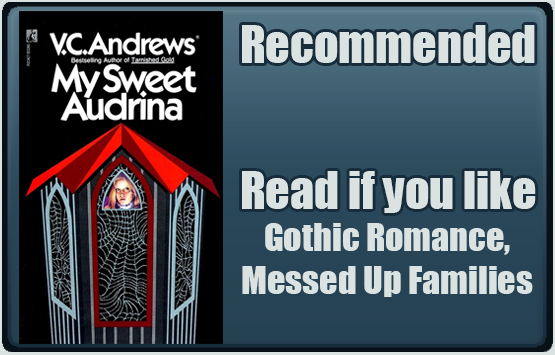
My Sweet Audrina by V.C. Andrews

My Sweet Audrina by V.C. Andrews

Formats: Print, audio, digital

Genre: Gothic Horror, Romance, Thriller

Audience: Adult/Mature

Diversity: Intellectual Disability, Possible Autism, Physical Disability (bilateral above the knee amputee), Chronic Illness (Osteogenesis imperfecta/brittle bone disease), PTSD

Takes Place in: Southern USA

Content Warnings (Highlight to view): Abelism, Alcohol Abuse, Body Shaming, Bullying, Implied Cannibalism, Child Abuse, Child Death, Childbirth, Death, Forced Captivity, Gaslighting,  Illness, Emotional Incest, Medical Torture/Abuse, Miscarriage, Mental Illness, Pedophilia, Physical Abuse, Racism, Rape/Sexual Assault, Implied Self-Harm, Sexism, Sexual Abuse, Slut Shaming, Suicide Attempt, Transphobia, Verbal/Emotional Abuse

Blurb

V.C. Andrews, author of the phenomenally successful Dollanganger series, has created a fascinating new cast of characters in this haunting story of love and deceit, innocence and betrayal, and the suffocating power of parental love.
Audrina Adare wanted so to be as good as her sister. She knew her father could not love her as he loved her sister. Her sister was so special, so perfect — and dead.
Now she will come face to face with the dangerous, terrifying secret that everyone knows. Everyone except…
My Sweet Audrina

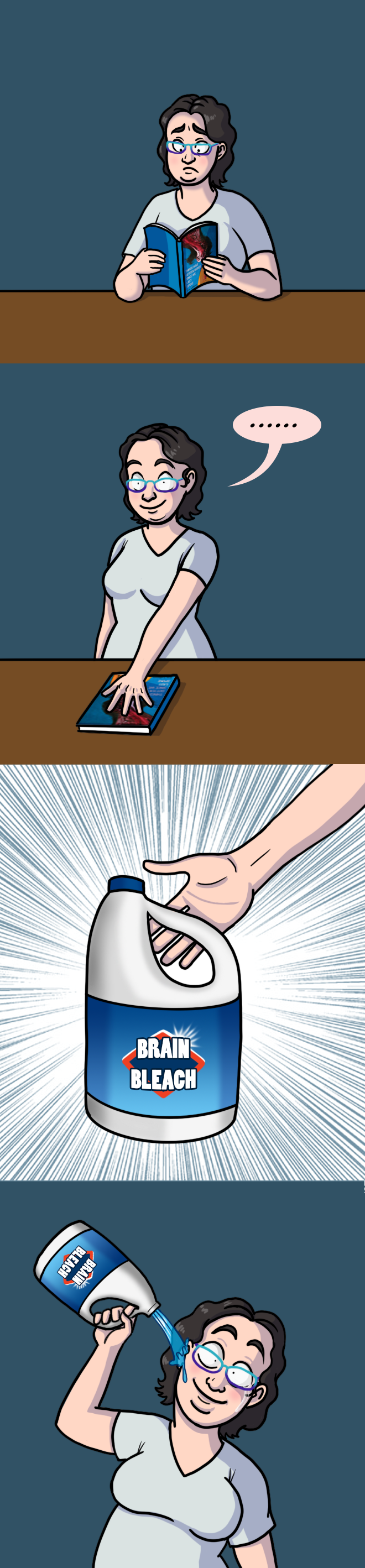
Holy fuck, this book.

I’m curled up, holding my knees to my chest, and looking shell shocked. My right eye is twitching. “WTF” I ask as I stare into the void.

This book is definitely the winner of the OMGWTFBBQ award

If you’re unfamiliar with V. C. Andrews, she wrote gothic horror novels during the eighties about really messed up, toxic, abusive, families that Lifetime loves to turn into terrible made-for-TV movies.  A standard Andrews book usually contains gas lighting, emotional and physical abuse, dark family secrets, and some of the most fucked up relationships ever put to paper that run the gambit from pedophilia to incest. Imagine if all guests on the Jerry Springer show were rich, beautiful, gothic heroines with enough skeletons in their closets to start their own ossuary, and you’ll have an idea of what you’re in for. They’re trash novels, but in the best possible way, written by a talented author who knows her audience is looking to be shocked and horrified, like splatterpunk without the gore. Her stories may be ridiculous and over-the-top at times, but never, ever dull, and of all her fucked up books, My Sweet Audrina is probably her most fucked up. It manages to contain nearly every content warning I have that doesn’t involve blood and gore (although there is a rather grisly scene where a woman miscarries and throws one of the blood clots at her mother in a fit of rage). There’s a brutal child rape, a lot of abuse by a manipulative bastard, everyone messing with Audrina’s mind, and a dead aunt who may or may not have been eaten by cannibals, so be forewarned, My Sweet Audrina is not for the squeamish.

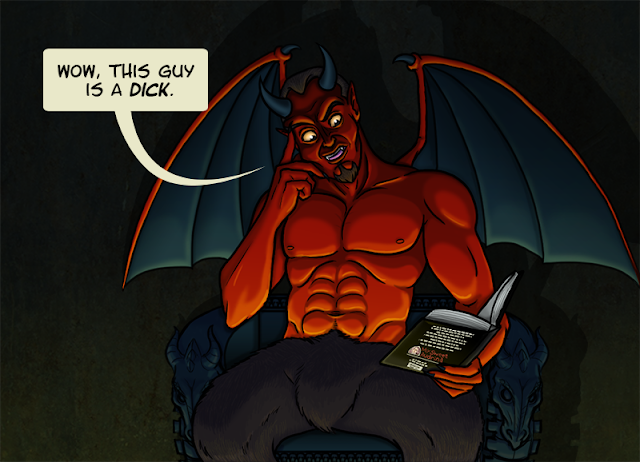
Damian Adere, the family patriarch, is aptly named because the guy is just fucking evil. He’s greedy, immature, vain, sexist, lazy, abusive, controlling, narcissistic, and manages to destroy the lives of every woman he knows while still seeing himself  as the victim because he’s just that fucking self-centered. Yet, he continues to get away with his awful behavior because he’s handsome, charming, and extremely manipulative, which honestly makes him even more frightening. In the first few chapters he comes off as kind of a dick but still likable. His daughter, Audrina, who acts as the book’s narrator, still loves and respects him. But over the course of the story as we witness his true nature, Damian quickly goes from seemingly well-intentioned but misguided, to a full-blown asshole, then finally becomes Satan incarnate. In fact, I’m still not entirely convinced this isn’t some sort of sequel to The Omen where the Anti-Christ kid grows up to become a lazy, whiny, codependent, narcissistic asshat who gets married and lives in a dilapidated mansion that he never lets his daughter leave. Actually, comparing Damian to Satan seems unfair because even the Dark Lord isn’t that big of a flaming dick. I can just imagine the devil reading My Sweet Audrina and being utterly horrified. The other characters, save for our virtuous heroine, Audrina, aren’t a whole lot better, although a lot of their behavior can be more or less attributed to Damian’s abuse.

Satan is leaning back in his creepy dragon chair reading “My Sweet Audrina”. He has red skin, black horns, bat wings, furry goat legs, a goatee, and well-defined abs. The image is dark, and lit from below. Satan has a finger to his temple and comments “Wow, this guy is a DICK” (referring to Damian).

I just assume Satan is ripped

Audrina’s mother, Lucietta, had to give up her dream of becoming a concert pianist to marry Damian (because he didn’t want his wife to make more money than him), and now hides her misery by living in denial and drinking to numb the pain. She frequently lashes out at her sister, Ellsbeth, who has become bitter (again, thanks to Damian) and abusive, neglecting her own daughter, Vera. In turn, Vera has turned into a complete monster before the start of the book because nobody loves her and Damian (whom she sees as her father) constantly treats her like shit and compares her to his “perfect” daughter, Audrina. As horrible as Vera is (and she’s pretty fucking horrible), you can’t help but feel sorry for her. She’s forced to be the whore to Audrina’s virgin, which makes her hate and resents her cousin. She’s so desperate for love and attention that 14-year-old Vera has “sex” with an adult man (everyone acts like it’s consensual sex when it’s very clearly statutory rape), and acts seductively from a young age. Of course none of the adults think “Hey, this isn’t normal behavior for a child, maybe we should get her some help” they just decided “She’s just a slut, oh well, who cares.” Meanwhile Audrina is haunted by memories of a childhood rape, which her father keeps forcing her to remember in a sick attempt to make her “perfect” (I’m not even going to try and explain Damian’s troll logic on this one). He reinforces her role as the virgin by frequently telling his daughter that all men are evil and forcing her to cover up in old fashioned dresses lest she be attacked. Is it any wonder Audrina becomes terrified of sex and disgusted by nudity to the point that she can’t even be intimate with someone she loves without trauma? Of course Damian is totally fine with this because it means she’s less likely to have a relationship with any man that isn’t him. If that makes your skin crawl, well, it should, because even Audrina describes their relationship as being like husband and wife without the sex. Ew. At least there isn’t any actual incest like I was fearing, which is a first for a V C Andrews novel.

Even Lucietta isn’t safe from her husband’s slut shaming, as Damian flies into a rage if her outfits are too revealing and accuses her of flirting with the men at the parties he forces her to host. He wants to show off his pretty wife, but then gets ridiculously jealous when other men think she’s pretty and ends up throwing a tantrum. He loves to be surrounded by women who adore him, but doesn’t want to share, so everyone is essentially trapped in this giant, run down house where Damian can keep an eye on them, isolated from the rest of the world. Like I said, the dude is fucking evil, and doesn’t even realize it. Or maybe he does, but simply doesn’t give a shit. Basically, if there was a drinking game where you had to take a shot every time Damien pulls a dick move, no one would ever finish the book because they’d die from alcohol poisoning after a few chapters.

Now, you’re probably wondering where the diversity comes in. I chose this book because of its representation of disability which, while not ideal (especially in Sylvia’s case), was at least written by an author who herself had a physical disability for most of her life. As a teenager, Andrews developed severe arthritis and underwent multiple spinal surgeries to treat it. Andrews says this was the result of a back injury she sustained from falling on a staircase in high school, while her family claims it was something she was born with. Regardless, the resulting chronic pain required the use of a wheelchair or crutches for most of her life. Andrews lived at home, under the care of her mother, where she completed a four-year correspondence course in art, before starting her career as a writer. Her very first book, Flowers in the Attic, is about four children who are kept in the attic for years by their religious grandmother, and the toll it takes on their mental and physical well-being. Andrews said in a 1985 interview for Faces of Fear that Flowers in the Attic was based on her own feelings of frustration at being trapped at home. While accessibility for people with mobility issues still isn’t great, I can imagine it was even worse when Andrews was growing up, and she died four years prior to the passing of the Americans with Disabilities Act. This theme of feeling “trapped” continues in My Sweet Audrina, where five of the six women in the story have some kind of disability that limits their freedom, which Damien of course takes full advantage of. Even the stairs that may or may not have been the start of Andrews’ chronic pain and limited mobility feature prominently in the book. The Adere house’s staircase essentially goes on a killing spree, offing multiple family members to the point where I have to wonder if the stairs were constructed from the bones of murdered children and cursed relics. Or maybe it’s just haunted by all the ghosts of the people Damien pissed off (which I can only imagine is every person he’s ever met). Andrews’ representation of disability is definitely problematic, but also complex and extremely personal, which is what makes this story worth exploring. It’s one of the few horror novels I’ve been able to find about disability that was actually written by a disabled person.

Vera has brittle bone disease, frequently breaking an arm or leg at the slightest bump. Audrina’s younger sister, Sylvia has autism and/or an intellectual disability (it’s not handled or explained well by Andrews) that requires full time care. Lucietta seems to have a heart disease that limits her activity. Billie, the Adere’s neighbor and one of the few likable characters in the book, is a bilateral amputee following complications from diabetes. Then there’s Audrina, whose untreated PTSD leaves her too terrified to leave her yard, even though she desperately wants to go to school and have friends. Audrina is sort of a Mary Sue for Andrews, what with her violet eyes, magically color changing hair, and extraordinary beauty (seriously, WTF?). They’re both artistic, unable to leave the house, and need to rely heavily on their families to function which causes them great frustration. The depictions of women with disabilities in My Sweet Audrina aren’t particularly progressive, and can even be downright ablest at time (especially when it comes to Sylvia), but the characters are all unique with very different personalities, outlooks, and ways of dealing with their disabilities.

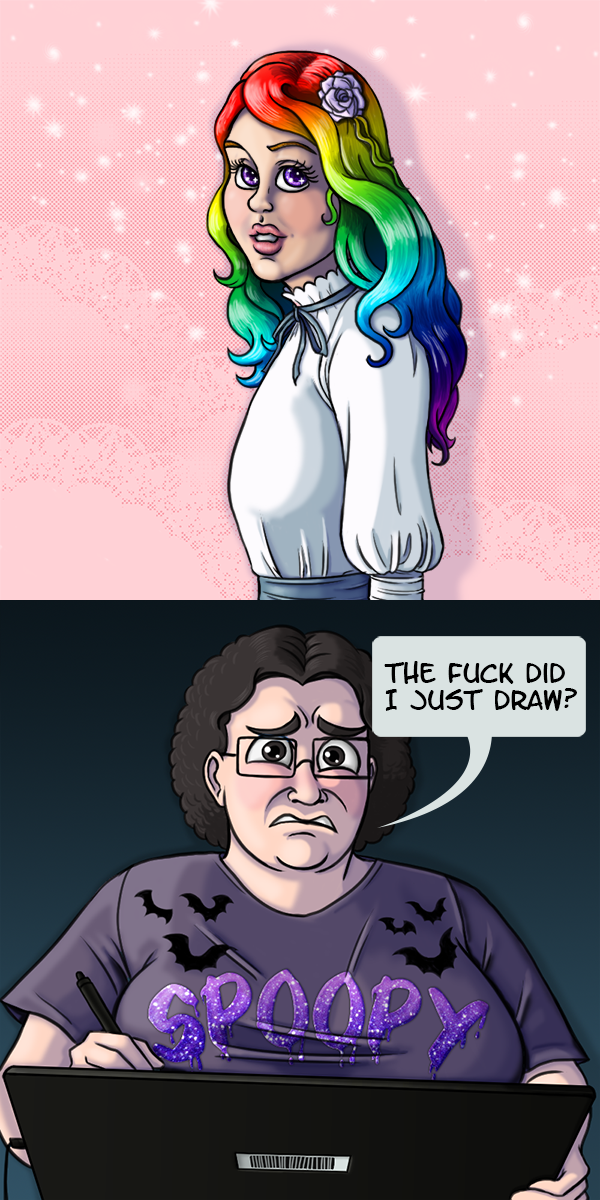
I’m drawing a picture of Audrina. The first panel shows a stereotypically attractive woman in a white, conservative, Victorian dress. She has large, sparkly, violet eyes, and long rainbow hair that starts as red at her scalp, and moves down the spectrum to indigo and violet at the ends of her hair. In the second panel I’m looking at my creation with horror and ask, “The fuck did I just draw?” I’m wearing a purple shirt with bats that says “spoopy” in violet glitter.

What Audrina looks like, presumable. Unrelated, but I wish I had that Spoopy shirt in real life.

Audrina desperately wishes for freedom and is frustrated by her PTSD, but without proper help and treatment she struggles to deal with her trauma (thanks a fucking lot, Damien). She does try to force herself to “get over it” a few times, and it doesn’t go well. Vera, on the other hand, seems proud of her disability, bragging about her delicate bones and teasing Audrina for having “peasant bones”, though it’s most likely an act to make herself feel better. Vera will frequently play up her disability to get out of doing chores, and even purposely hurt herself for attention, even though her mother and Damien seem fairy unconcerned by her injuries. Billie, on the other hand, is ashamed of her residual limbs, and goes to great effort to hide them. Her husband left her after her legs were amputated, and she now sees herself as “damaged” and “unlovable” despite being drop-dead gorgeous and able to function just fine with the use of a wheeled board. Although Billie continues to live her life and seems pretty happy for the most part, she’s still incredibly insecure, making her an easy target for Damien. Finally there’s Sylvia, the youngest Adare daughter, who gets ignored and insulted by pretty much everyone except Audrina, her appointed caretaker. Because why would Damien get actual help when he can just make Audrina play Occupational Therapist for free? And then everyone seems ~shocked~ that Sylvia’s not making much progress when she has a child (who only just started going to school herself) as her teacher. At least Sylvia gets some revenge on her awful family. It’s never outright confirmed, but is strongly implied that she knows more than she lets on and allows people to underestimate her abilities so she can better manipulate them (and occasionally possibly murder them). Part of me really hopes Sylvia is knowingly screwing with everyone as a sort of “fuck you” to her neurotypical family who constantly calls her really ableist slurs and compare her to an animal, because they really fucking deserve it. Now if only she’d arrange for Damien to have a little accident….

My Sweet Audrina is a combination of exploitation horror and chick lit, meant to grab your attention from the first paragraph and brand its shocking subject manner deep into your brain so that years from now you’ll still be thinking “God, that was a fucked up book.” And if you’re wondering why I would inflict this on myself, well, A) Because I’m a horror fan, that’s kind of what I do, and B) It’s just so damn enjoyable. It’s a wonderful guilty pleasure I couldn’t put down until the end, and Andrews is a talented writer who is fully aware of what she’s creating. So what if the story can sometimes read like Soap Opera fan fiction written by a fourteen-year-old?  My Sweet Audrina is especially interesting when viewed as a personal exploration of the author’s feelings of being “trapped’ by her chronic pain and mobility issues.  For fans of tragic heroines, gothic horror, and guilty pleasures, I’d definitely recommend My Sweet Audrina.

Shutter by Courtney Alameda

Shutter by Courtney Alameda

Formats: Print, digital

Publisher: Square Fish Books

Genre: Monster, Ghosts/Haunting, Zombie, Vampires, Blood & Guts, Thriller, Horror, Romance

Audience: Y/A

Diversity: POC (Love interest is part Aboriginal Islander, author is Latina), Disability (PTSD)

Takes Place in: type here

Content Warnings (Highlight to view): Violence, Gore, Child Death, Physical Abuse, Emotional Abuse, Child Abuse, Sexism, Sexual Harassment/Assault, Torture 

Blurb

Lock, stock, and lens, she’s in for one hell of a week.

Micheline Helsing is a tetrachromat-a girl who sees the auras of the undead in a prismatic spectrum. As one of the last descendants of the Van Helsing lineage, she has trained since childhood to destroy monsters both corporeal and spiritual: the corporeal undead go down by the bullet, the spiritual undead by the lens. With an analog SLR camera as her best weapon, Micheline exorcises ghosts by capturing their spiritual energy on film. She’s aided by her crew: Oliver, a techno-whiz and the boy who developed her camera’s technology; Jude, who can predict death; and Ryder, the boy Micheline has known and loved forever.


When a routine ghost hunt goes awry, Micheline and the boys are infected with a curse known as a soulchain. As the ghostly chains spread through their bodies, Micheline learns that if she doesn’t exorcise her entity in seven days or less, she and her friends will die. Now pursued as a renegade agent by her monster-hunting father, Leonard Helsing, she must track and destroy an entity more powerful than anything she’s faced before . . . or die trying.


Shutter by Courtney Alameda is a thrilling horror story laced with an irresistible romance.

As a 90’s kid, I grew up with some truly terrible action films. And I loved them. Mortal KombatWild Wild West, and Total Recall are all proudly displayed on my DVD shelf. So I like to think I’m pretty forgiving when it comes to plots full of holes and cookie-cutter characters, as long as the story itself is fun and entertaining. Keeping that in mind, let’s dive into Shutter, the literary equivalent of a bad action film.

We’ll start with our four, action-cliché, main characters. We’ve got the leader of the good guys, complete with her obligatory tragic backstory, the tough guy who always has her back, the smart guy who’s good with computers but not so great at fighting, and the wise cracking jackass who we’re supposed to like but just comes off as sexist and irritating. They exist to spout “clever” quips at each other, provide exposition at awkward times, and act like bad asses.

Following a standard action movie formula, the hero decides to rush off on her own without backup, and gets suspended by the boss (who’s also her abusive dad). But they go after the bad guy anyway because screw the rules, they’re action heroes! Then there’s lots of cool action scenes, explosions, some TRULY creepy shit, and a love story that gets shoehorned in there.

Okay, so the writing is “meh”, the characters are kind of flat, and the story formulaic as hell, but was it at least exciting and entertaining?  Was their nail biting suspense and horror? I’ll get to that in a minute. First, I need to address some major issues I had with story, the first being its heroine, Micheline.Micheline is a tetrachromat, able to see the invisible “ghost light” given off by the undead. As a direct descendant of Abraham Van Helsing, (because of course she is) she is sworn to protect the world from monsters, and captures and exorcises ghosts on her camera, à la Fatal Frame. Now, I’m going to give the author major props for making the lead a woman, something that doesn’t happen often in the action genre (but is slowly becoming more common). So that’s great. What’s not so great is that Micheline has this really annoying habit of having to prove what a “Strong Female Character TM” she is by running head first into danger, then needing to be rescued by the guys. Apparently nothing says “bad ass” like poor decision making and being a damsel in distress.

Micheline, is wearing her tactical, Hellsing gear and has her hair pulled back in a ponytail. She’s leaping in the air, brandishing a gun in one hand, and a camera in the other while gleefully shouting “Leerrooooy Jenkins!!!!”

Great teamwork there.

I can understand why she might want to prove herself; Micheline is struggling with PTSD and an abusive father, so it would make sense if the story was about her difficulty returning to active duty while suffering from flashbacks. Overcoming something like that is no easy task. But her trauma and strained relationship with her father seem to be their own separate thing, with little to nothing to do with her foolhardy, reckless, and selfish behavior. At least Micheline doesn’t take her grief out on everyone else, like her jerk-ass dad, she just puts their lives in danger by keeping important information from them, making everything about her, and refusing to deal with her issues. So, basically a pretty awful leader. I also got this whole “I’m not like other girls, I’m a cool girl” vibe from Micheline. Throughout the book she kept putting down other women and/or viewing them as competition for her “boys”, which was just sexist and gross. Basically, what could have been a cool, strong, female action hero was ruined by internalized sexism, bad decisions, and needing men to save her all the freaking time.

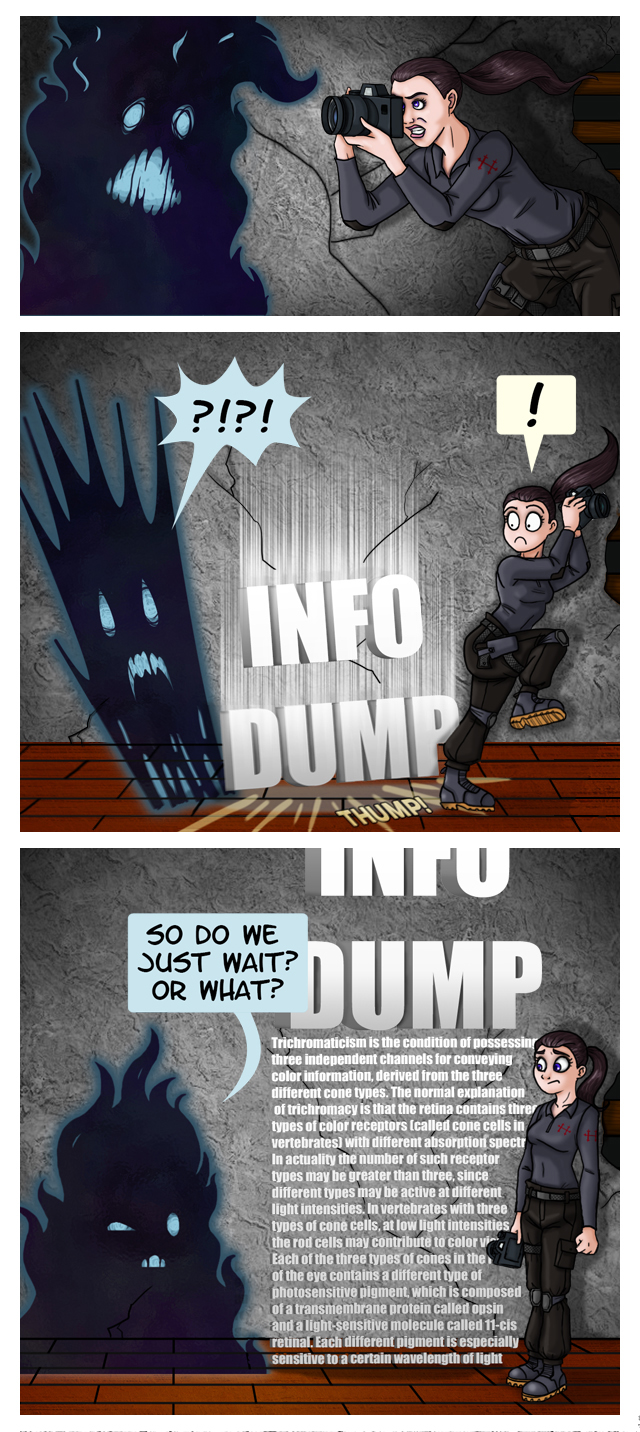
Another huge problem with Shutter was the flow of the action scenes. There is SO MUCH exposition and info dumping, and it keeps interrupting the suspenseful parts of the story. I mean, it’s wonderful how much thought Alameda put into this world, and I was certainly interested in the science behind monster hunting, but I don’t want to read a full page about how a camera works right when Micheline is about to be killed by a ghost. It’d be like pausing the duel scene between Luke and Vader to give a five minute lecture on the technology behind lightsabers. It’s cool and all, but really not the right time, and completely destroys the tension.

Micheline is fighting a shadowy creature with a glowing blue mouth and eyes. In the first panel she’s attempting to take its photo. In the second, both she and the monster jump out of the way in surprise as the words “INFO DUMP” fall from the sky. They both stand there awkwardly as an extensive, verbose paragraph about trichromsticism scrolls by. The shadow monsters asks “So do we just wait, or what?”

Forget the incredibly dramatic fight scene, let’s learn about trichromsticism!

Okay, so now for the moment you’ve been waiting for, was it at least entertaining? Heck yeah it was! The overall story was great, suspenseful, and fun, with some truly terrifying scenes. By the time I got to the second half of the book, I couldn’t put it down! The monsters were incredibly creative and creepy, like something out of Silent Hill, and the horror scenes were spot on. Alameda does an excellent job of building suspense and creating a creepy atmosphere (minus the random info dumps that kill the mood). It’s worth pointing out that this is the author’s debut novel, so it’s understandable that the book has flaws. Even the great Terry Pratchett’s early work was, admittedly, not that great, and he’s one of my favorite authors! So Alameda definitely has time to hone her skills and improve on her characterization and exposition. She’s already great at world building, horror, and action scenes. And honestly, it’s nice to see a horror novel written by a Latina author. The genre is severely lacking in Latine/Latina writers, and the few I know of are mostly men.

Overall, Shutter is a fun, suspenseful read, even with its flaws. If I could just take out the annoying characters, and focus on the plot, the monsters, and the fight scenes, the book would be perfect, like a horror survival game. That’s actually not a bad idea, it could be a cross between Fatal Frame and Resident Evil, where you can just explore abandoned buildings and fight monsters instead of listening to pointless dialogue. At least in a video game I can skip random info dumps.

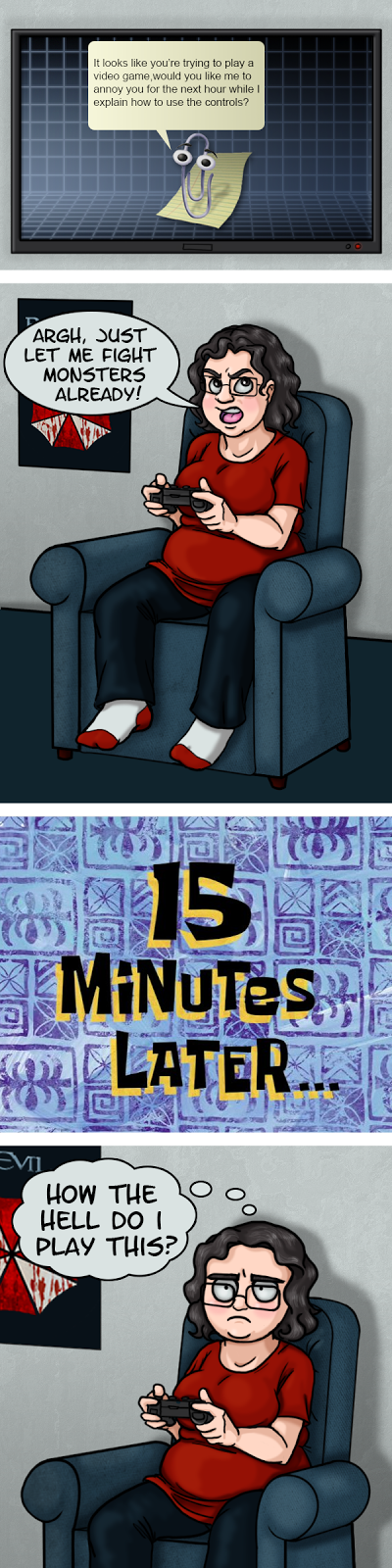
The Microsoft paperclip asks “It looks like you’re trying to play a video game, would you like me to annoy you the next hour while I explain how to use the controls?” Annoyed, I complain “Argh, just let me fight monsters already!” and skip the tutorial. 15 minutes later, I wonder to myself how the hell I’m supposed to play this game.

I just imagine all annoying video game tutorials as being done by either Navi or the Microsoft Paperclip.

I just imagine all annoying video game tutorials as being done by either Navi or the Microsoft Paperclip.

Bleeding Earth by Kaitlin Ward

Bleeding Earth by Kaitlin Ward

Formats: Print, digital

Publisher: Adaptive Studios

Genre: Blood & Guts, Apocalypse/Disaster, Psychological Horror, Romance

Audience: Y/A

Diversity: Lesbian characters, Hispanic/Latine character

Takes Place in: New Hampshire, USA

Content Warnings (Highlight to view): Alcohol Abuse, Bullying, Child Abuse, Child Death, Child Endangerment, Death, Forced Captivity, Gore, Homophobia, Mental Illness, Racism, Suicide, Verbal/Emotional Abuse, Violence

Blurb

Between Mother Nature and human nature, disasters are inevitable. 

Lea was in a cemetery when the earth started bleeding. Within twenty-four hours, the blood made international news. All over the world, blood oozed out of the ground, even through the concrete, even in the water. Then the earth started growing hair and bones.
Lea wishes she could ignore the blood. She wishes she could spend time with her new girlfriend, Aracely, in public, if only Aracely wasn’t so afraid of her father. Lea wants to be a regular teen again, but the blood has made her a prisoner in her own home. Fear for her social life turns into fear for her sanity, and Lea must save herself and her girlfriend however she can.

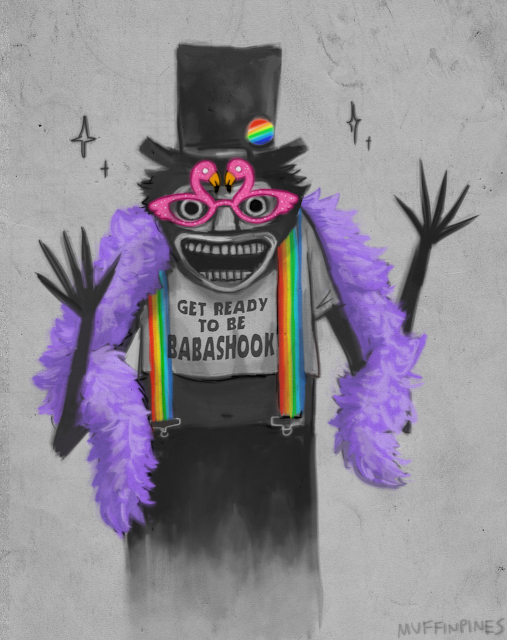
Happy Pride month! Here’s something fun for queer horror fans, after Netflix accidently featured the Australian indie horror film, The Babadook, on their LGBT movie page, the titular creature has quickly become a Pride meme and it’s wonderful. If you haven’t seen the film, it’s awesome, go watch it.

A tall, dark, creepy creature with long fingers and a white face is wearing a top hat with a rainbow button, rainbow suspenders, a purple feather boa, sparkly pink flamingo glasses, and a belly shirt that says “Get Ready to be Babashook.”

Artwork by Muffin Pines at http://muffinpines.tumblr.com/

For June I’ll be reviewing two horror stories with queer characters, the first of which is Bleeding Earth. And oh man, did this book mess me up good. I was expecting a gory, end of the world sort of book, and instead I got a heartbreaking survival story about love, family, and humanity (yes I know how cheesy that sounds, shut up). It gave me so much anxiety, and so many emotions, and I’m still trying to process what the hell I just read. But I know it was good. It was really freaking good. And there was so much blood. Blood, and bones, and hair. I love blood. And bones. Not wads of hair though, I have my limits.

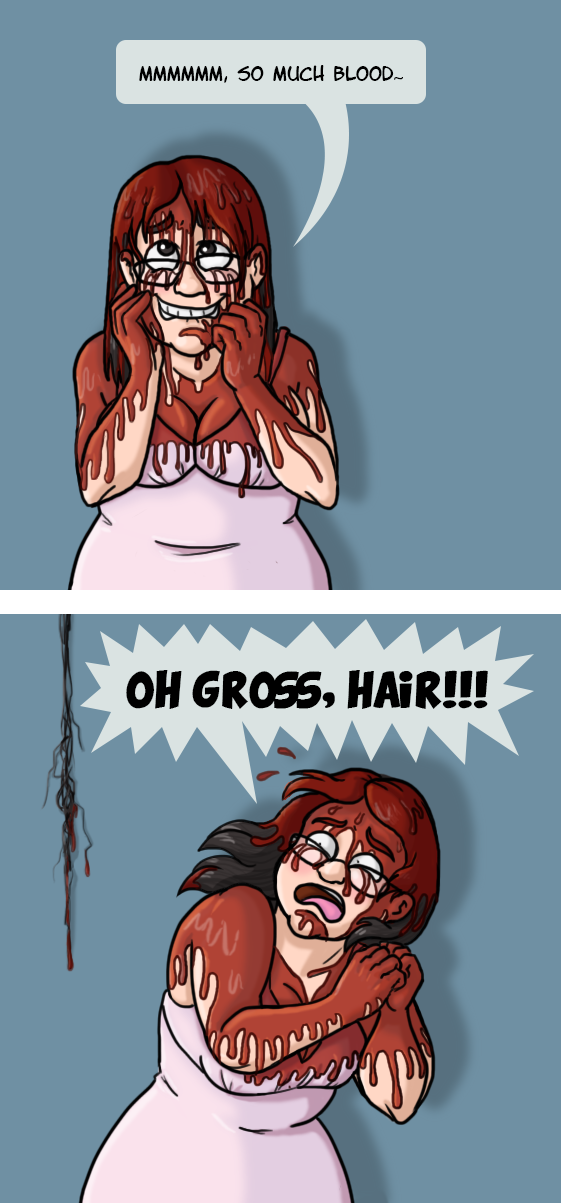
In the first caption I’m wearing a light pink dress and covered in blood. I’m clearly enjoying the blood dripping through my hair and down my shoulders because I’m smearing it on my ecstatic face while sighing “Mmmmmm, So much blood.” In the next panel I’m screaming “OH GROSS, HAIR!”  in disgust and pulling away from a wad of bloody hair I’ve just noticed.

I was going for a “Carrie at the Prom” kind of look.

Lea, the novel’s protagonist and narrator, is enjoying the blossoming relationship she shares with her girlfriend, Aracely, when the blood first appears. Now, normally teen romances in dystopias and apocalyptic fiction seems tacked on and out of place. I mean, who worries about crushes when their life is on the line? But in Bleeding Earth, it works beautifully. Surrounded by chaos and despair, Lea wants to hold onto one of the few good things she has left to keep her going, because no one knows how long they have left. The girls are still in their honeymoon phase, so everything still feels wonderful and new, a sharp contrast to the reality around them. When Lea starts experiencing night terrors and hallucinations from stress and isolation, talking to her girlfriend on the phone is the only thing that helps her. And when she wants to give up, it’s Aracely that keeps her going. And I just can’t bring myself to begrudge her that one little bit of happiness. Who wouldn’t want to spend time with someone who makes you feel safe and lets you forget your problems for a while? It gave my cold, little heart all the feels.The scariest thing about Bleeding Earth isn’t the blood, hair, and bones seeping up from the ground. It’s the feeling of isolation, uncertainty, and powerlessness. At least with zombies, aliens, and diseases there’s always something you can do, a safe zone to flee to, a cure, an end in sight. But with the blood there’s nowhere to escape, no way to fight back, and no stopping the blood. No one knows what’s causing it, or if it will ever end. There are no answers or explanations to soothe the scared populace. And while I normally hate it when a story doesn’t give me an explanation, here it actually works. It’s so much more frightening when you don’t know what’s happening, and there’s literally nothing you can do about it. Will things get better? Is this the end of the world? Did humanity piss off the earth so much it’s finally rejecting them? Even at the start of the bleeding, when everyone is still doing their best to “keep calm and carry on,” fear is already causing people to take desperate actions. Lea’s mom obsessively measures their water and screams at her friends when they drink some, her father nails boards over all the windows so they’re in complete darkness, a man attacks Aracely with a bone over a breathing mask, and some jerks at an Apocalypse party try to get an inebriated girl to drink the blood. It starts with fights over tampons in the grocery store, then looting Home Depot, to violence and riots, and it only gets worse from there. Much, MUCH worse.Now, I know poor decision making seems to be a staple of Y/A fiction (one that annoys me to no end), but here, it makes sense. Everyone is absolutely terrified, struggling with isolation and the horror of what’s happening around them, while still trying their damnedest to pretend like everything is going to be fine. And scared, stressed people do not behave in a rational manner. At various points the teenagers in the story become so desperate for normalcy and human contact they’re willing to brave the blood and all its dangers just to be together. Is this a good idea? No, absolutely not. But is it understandable? Completely. Humans are social creatures, so much so that isolation can actually be deadly. And here’s the original research to back it up. I’m an introvert who prefers a quiet night at home, and even I felt stressed and nauseous when poor Lea described being trapped in her boarded up home for weeks on end, with little to no outside communication. Honestly, if I had to go through a bloodpocalypse, I probably would’ve snapped after a few hours indoors and gone blood hydroplaning (hemiaplaning?) in a stolen car while throwing human skulls at pedestrians. And that’s speaking as someone who willingly goes for days without human contact, I can’t imagine what a non-homebody extrovert would go through. So kudos to Lea for keeping it together as long as she did! If you’re probably going to die anyway, it’s better to die among friends and go out with a bang.

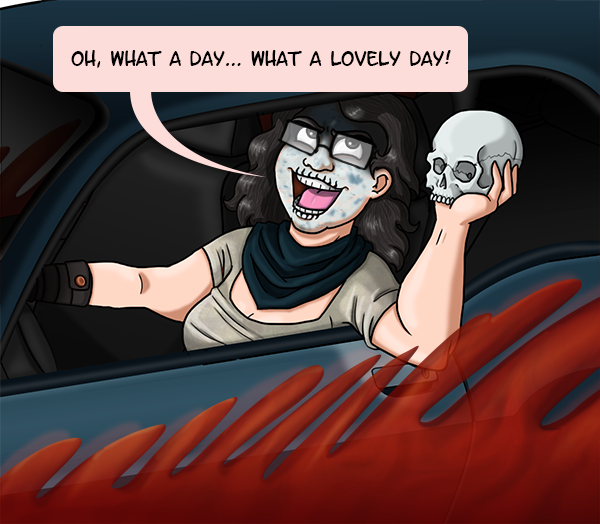
A close up of me driving a car through blood while leaning out the window. I’m holding a human skull out the window while waves of blood are being splashed up by the car. I’m dressed like one of the War Boys from Mad Max: Fury Road, with corpse pain covering my face. I gleefully shout “Oh what a day… What a lovely day!”

I showed this drawing to my wife, and now I’m not allowed to drive her car.

While I really enjoyed Bleeding Earth, it did have some problems that got to me, and kept me from giving it the full five stars. Like Lea’s dad. He learns that the mom has become unhinged, and Lea fears for their safety, but instead of going to help his wife and child, he tells his frightened daughter to get her unstable mom, slip through the looters and people willing to kill for water, and come to him. So of course a ton of horrible things happen because Lea can’t get her sick mother to leave the house, and her dad is apparently too lazy to drive the 40 minutes to help her. Like, I get they need everyone they can get to keep the power going, but for fuck’s sake man, you can take an hour to go rescue your wife and daughter. He’s just so frustratingly blasé about the whole thing. And then there were a bunch of weird little plot points that didn’t go anywhere. Like Lea’s hallucinations. Ingesting the blood is discovered to cause hallucinations, night terrors, lost time, and mental breaks. Lea starts to have horrible nightmares, imagining blood in the house, but it’s unclear if it’s an effect from the blood or the isolation. While she does spend part of the book questioning her sanity, and it’s definitely stressful and unsettling, it doesn’t really go anywhere. Was she infected by the blood? Yeah, we never get an answer for that one either.

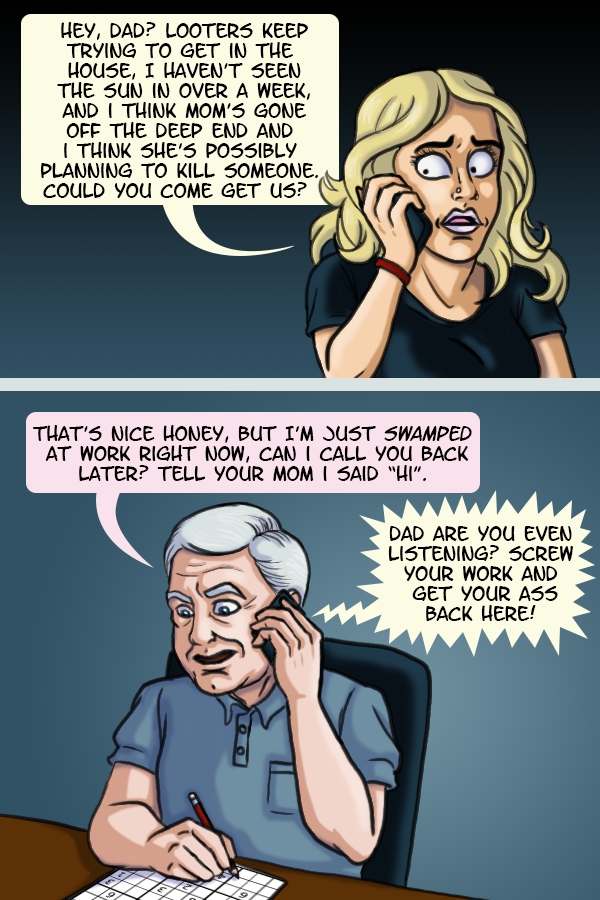
A frightened teen is on the phone with her dad. “Hey, dad? Looters keep trying to get in the house, I haven’t seen the sun in over a week, and I think mom’s gone off the deep end and she’s possibly planning to kill someone. Could you come get us?” Her dad is seen doing Sudoku in his office and tells her “That’s nice honey, but I’m just swamped at work right now, can I call you back later? Tell your mom I said “Hi”. “Dad are you even listening!? Screw your work and get your ass back here!”

Hey, Sudoku IS work!

The lack of explanations will be a major turn off for a lot of readers, and I can understand that. But honestly, I didn’t feel like it was needed, because that really isn’t the point of the story. This isn’t a sci-fi novel with an omniscient narrator about a world-wide disaster. This is Lea’s story. It’s about her fears, her loneliness, her confusion, and her crush on Aracely. She’s terrified and frustrated because she doesn’t know what will happen, her parents can’t reassure her, and she just wants to be able to take comfort in something. It’s a sweet, sad story of survival, isolation, and just trying to enjoy a simple teen crush in a world that’s gone to hell.

The Drowning Girl by Caitlín R. Kiernan

The Drowning Girl by Caitlín R. Kiernan

Formats: Print, audio, digital

Publisher: Penguin

Genre: Monster, Werewolf, Romance, Ghosts/Haunting, Psychological Horror, Mystery

Audience: Adult/Mature

Diversity: Lesbian characters, trans character, mentally ill character

Takes Place in: Northeastern USA

Content Warnings (Highlight to view): Mental Illness, Self-Harm, Mentions of Transphobia, Suicide, Emotional Abuse 

Please note, I found out recently that Caitlín R. Kiernan has expressed racist and Zionist views on Twitter, explored here. I will leave the reivew up for now, but can no longer reccomend her books.

The Drowning Girl is a beautifully written, psychological horror novel about a young woman, Imp, whose schizophrenia is making it difficult for her to determine the nature of the mysterious woman haunting her. Is she a siren using her charm to lure Imp to disaster? A werewolf? A human stalker who can blur the lines of reality? Imp struggles to sort out the truth before she loses herself. Queer romance, myths, and art combine to create this award winning novel.

So did I like it? Well……. Sort of?

In theory I should have loved it. It takes place on my home turf of New England, the main character is a queer artist (like me!), she’s dating an incredibly well written trans character, the story has a creepy mystery, gorgeous imagery, and one of the best representations of mental illness I’ve ever read. But I struggled to get through the Drowning Girl. I’d pick it up, read a chapter, and then forget about it for a month. I don’t know why I didn’t devour this book as quickly as I do others, there wasn’t really anything I disliked about it, and it wasn’t boring, but it just didn’t seem to capture my attention. It reminded me of one of those award winning art films that critics love and you have to sit through in college film classes. There’s nothing bad about it per se, but you’d still rather be watching Bad Boys II, or some other equally ridiculous action flick.

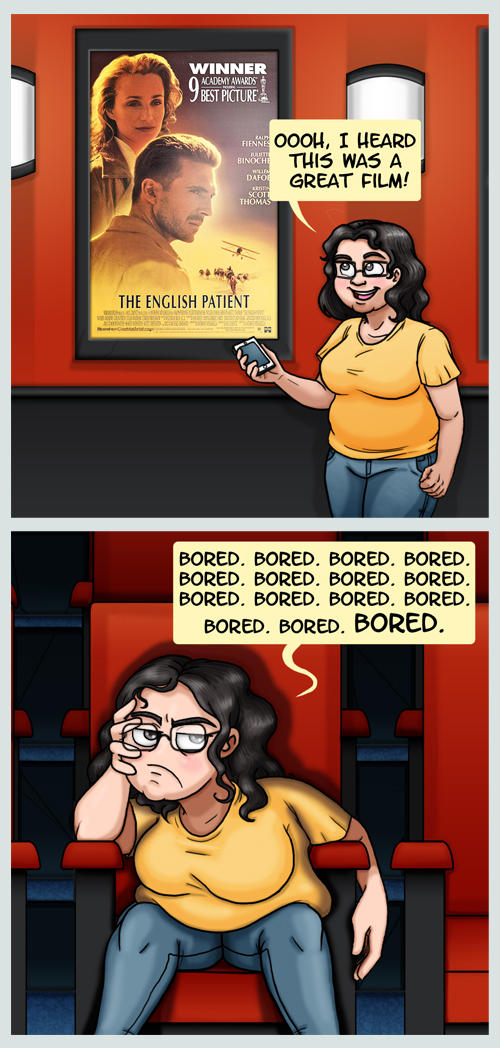
In the first panel I'm in the hallway of a movie theater looking at a poster for "The English Patient" and saying "Oooh, I heard this was a great film!" In the next panel I'm in the theater looking completely disinterested, and repeating "bored, bored, bored, bored" over and over as I suffer through the movie.

Ugh, I should’ve just watched Sharknado again.

Maybe I’m just not sophisticated enough to appreciate the non-linear, stream of conciseness (i.e. all over the place) writing, or perhaps I’m too clueless to fully comprehend the subtly and symbolism of the story. But I found it really jarring to have Imp describe her girlfriend, Abalyn, play Kingdom Hearts one minute, and then have a poetic, jumbled passage full of fairy tale metaphors the next. And I get it, the writing style is intended to represent Imp’s mental illness by showing the disorganization of her thought process, the random associations she makes where none exist, and her difficulty remembering what’s real and what’s imagined. But that doesn’t always make for an enjoyable read.

I guess I’m just incredibly picky when it comes to “artsy” prose and magical realism. When it works, it works well, but when it doesn’t, it just becomes a confusing, irritating erratic mess, and with the Drowning Girl it was kind of a crap shoot.

I'm floating upside down in blue space, surrounded by dreamlike imagery of a crow wearing a cloak, a close-up of a crescent moon, a wolf's skull, pills, a crab, and a mermaid with pale, corpse-like skin. The mermaid's human half is intact but her fish half is nothing but bone. Her organs hang out of her human torso. I look confused and mutter

WTF is going on? Did I take expired cold medicine again?

Since I’m starting to feel bad for picking on this book so much (and it’s by no means a bad book), I want to address one of the things I did really like about the story, how Imp’s mental illness was treated. It wasn’t romanticized, it was just a part of her that could make her life more challenging, but not horrible. Medication made her illness manageable, but didn’t make it disappear entirely, and she was able to continue working, date, hang out with friends, pursue hobbies, and lived on her own. She would go through rough patches, some she could handle on her own, and some she couldn’t. Her therapist was supportive, without telling Imp what to do. Overall, I felt like it was a very realistic depiction of a woman with a mental illness, which is rather uncommon in fiction where the mentally ill are usually written as either asylum inmates, criminals, or manic pixie dream girls.

Overall, I really, really wanted to love this one. It had all the right ingredients, rave reviews, a talented author, but the final result was disappointing, at least for me. It wasn’t bad, but I just couldn’t bring myself to give it a “highly recommended”. That doesn’t mean other people won’t find this book amazing, and I strongly encourage others, especially those with more sophisticated taste than mine, to give it a read. Because you may love it. Or you may find it “meh”, but at least you won’t regret reading it.

Navigation

Social Media

Search by Tags

To learn more about the Age Group, Diversity, and Genre tags, click here.

Age Groups

Diversity

Genre

Support the Blog

Search

Links

My Sweet Audrina by V.C. Andrews

My Sweet Audrina by V.C. Andrews

Formats: Print, audio, digital

Genre: Gothic Horror, Romance, Thriller

Audience: Adult/Mature

Diversity: Intellectual Disability, Possible Autism, Physical Disability (bilateral above the knee amputee), Chronic Illness (Osteogenesis imperfecta/brittle bone disease), PTSD

Takes Place in: Southern USA

Content Warnings (Highlight to view): Abelism, Alcohol Abuse, Body Shaming, Bullying, Implied Cannibalism, Child Abuse, Child Death, Childbirth, Death, Forced Captivity, Gaslighting,  Illness, Emotional Incest, Medical Torture/Abuse, Miscarriage, Mental Illness, Pedophilia, Physical Abuse, Racism, Rape/Sexual Assault, Implied Self-Harm, Sexism, Sexual Abuse, Slut Shaming, Suicide Attempt, Transphobia, Verbal/Emotional Abuse

Blurb

V.C. Andrews, author of the phenomenally successful Dollanganger series, has created a fascinating new cast of characters in this haunting story of love and deceit, innocence and betrayal, and the suffocating power of parental love.
Audrina Adare wanted so to be as good as her sister. She knew her father could not love her as he loved her sister. Her sister was so special, so perfect — and dead.
Now she will come face to face with the dangerous, terrifying secret that everyone knows. Everyone except…
My Sweet Audrina

Holy fuck, this book.

I’m curled up, holding my knees to my chest, and looking shell shocked. My right eye is twitching. “WTF” I ask as I stare into the void.

This book is definitely the winner of the OMGWTFBBQ award

If you’re unfamiliar with V. C. Andrews, she wrote gothic horror novels during the eighties about really messed up, toxic, abusive, families that Lifetime loves to turn into terrible made-for-TV movies.  A standard Andrews book usually contains gas lighting, emotional and physical abuse, dark family secrets, and some of the most fucked up relationships ever put to paper that run the gambit from pedophilia to incest. Imagine if all guests on the Jerry Springer show were rich, beautiful, gothic heroines with enough skeletons in their closets to start their own ossuary, and you’ll have an idea of what you’re in for. They’re trash novels, but in the best possible way, written by a talented author who knows her audience is looking to be shocked and horrified, like splatterpunk without the gore. Her stories may be ridiculous and over-the-top at times, but never, ever dull, and of all her fucked up books, My Sweet Audrina is probably her most fucked up. It manages to contain nearly every content warning I have that doesn’t involve blood and gore (although there is a rather grisly scene where a woman miscarries and throws one of the blood clots at her mother in a fit of rage). There’s a brutal child rape, a lot of abuse by a manipulative bastard, everyone messing with Audrina’s mind, and a dead aunt who may or may not have been eaten by cannibals, so be forewarned, My Sweet Audrina is not for the squeamish.

Damian Adere, the family patriarch, is aptly named because the guy is just fucking evil. He’s greedy, immature, vain, sexist, lazy, abusive, controlling, narcissistic, and manages to destroy the lives of every woman he knows while still seeing himself  as the victim because he’s just that fucking self-centered. Yet, he continues to get away with his awful behavior because he’s handsome, charming, and extremely manipulative, which honestly makes him even more frightening. In the first few chapters he comes off as kind of a dick but still likable. His daughter, Audrina, who acts as the book’s narrator, still loves and respects him. But over the course of the story as we witness his true nature, Damian quickly goes from seemingly well-intentioned but misguided, to a full-blown asshole, then finally becomes Satan incarnate. In fact, I’m still not entirely convinced this isn’t some sort of sequel to The Omen where the Anti-Christ kid grows up to become a lazy, whiny, codependent, narcissistic asshat who gets married and lives in a dilapidated mansion that he never lets his daughter leave. Actually, comparing Damian to Satan seems unfair because even the Dark Lord isn’t that big of a flaming dick. I can just imagine the devil reading My Sweet Audrina and being utterly horrified. The other characters, save for our virtuous heroine, Audrina, aren’t a whole lot better, although a lot of their behavior can be more or less attributed to Damian’s abuse.

Satan is leaning back in his creepy dragon chair reading “My Sweet Audrina”. He has red skin, black horns, bat wings, furry goat legs, a goatee, and well-defined abs. The image is dark, and lit from below. Satan has a finger to his temple and comments “Wow, this guy is a DICK” (referring to Damian).

I just assume Satan is ripped

Audrina’s mother, Lucietta, had to give up her dream of becoming a concert pianist to marry Damian (because he didn’t want his wife to make more money than him), and now hides her misery by living in denial and drinking to numb the pain. She frequently lashes out at her sister, Ellsbeth, who has become bitter (again, thanks to Damian) and abusive, neglecting her own daughter, Vera. In turn, Vera has turned into a complete monster before the start of the book because nobody loves her and Damian (whom she sees as her father) constantly treats her like shit and compares her to his “perfect” daughter, Audrina. As horrible as Vera is (and she’s pretty fucking horrible), you can’t help but feel sorry for her. She’s forced to be the whore to Audrina’s virgin, which makes her hate and resents her cousin. She’s so desperate for love and attention that 14-year-old Vera has “sex” with an adult man (everyone acts like it’s consensual sex when it’s very clearly statutory rape), and acts seductively from a young age. Of course none of the adults think “Hey, this isn’t normal behavior for a child, maybe we should get her some help” they just decided “She’s just a slut, oh well, who cares.” Meanwhile Audrina is haunted by memories of a childhood rape, which her father keeps forcing her to remember in a sick attempt to make her “perfect” (I’m not even going to try and explain Damian’s troll logic on this one). He reinforces her role as the virgin by frequently telling his daughter that all men are evil and forcing her to cover up in old fashioned dresses lest she be attacked. Is it any wonder Audrina becomes terrified of sex and disgusted by nudity to the point that she can’t even be intimate with someone she loves without trauma? Of course Damian is totally fine with this because it means she’s less likely to have a relationship with any man that isn’t him. If that makes your skin crawl, well, it should, because even Audrina describes their relationship as being like husband and wife without the sex. Ew. At least there isn’t any actual incest like I was fearing, which is a first for a V C Andrews novel.

Even Lucietta isn’t safe from her husband’s slut shaming, as Damian flies into a rage if her outfits are too revealing and accuses her of flirting with the men at the parties he forces her to host. He wants to show off his pretty wife, but then gets ridiculously jealous when other men think she’s pretty and ends up throwing a tantrum. He loves to be surrounded by women who adore him, but doesn’t want to share, so everyone is essentially trapped in this giant, run down house where Damian can keep an eye on them, isolated from the rest of the world. Like I said, the dude is fucking evil, and doesn’t even realize it. Or maybe he does, but simply doesn’t give a shit. Basically, if there was a drinking game where you had to take a shot every time Damien pulls a dick move, no one would ever finish the book because they’d die from alcohol poisoning after a few chapters.

Now, you’re probably wondering where the diversity comes in. I chose this book because of its representation of disability which, while not ideal (especially in Sylvia’s case), was at least written by an author who herself had a physical disability for most of her life. As a teenager, Andrews developed severe arthritis and underwent multiple spinal surgeries to treat it. Andrews says this was the result of a back injury she sustained from falling on a staircase in high school, while her family claims it was something she was born with. Regardless, the resulting chronic pain required the use of a wheelchair or crutches for most of her life. Andrews lived at home, under the care of her mother, where she completed a four-year correspondence course in art, before starting her career as a writer. Her very first book, Flowers in the Attic, is about four children who are kept in the attic for years by their religious grandmother, and the toll it takes on their mental and physical well-being. Andrews said in a 1985 interview for Faces of Fear that Flowers in the Attic was based on her own feelings of frustration at being trapped at home. While accessibility for people with mobility issues still isn’t great, I can imagine it was even worse when Andrews was growing up, and she died four years prior to the passing of the Americans with Disabilities Act. This theme of feeling “trapped” continues in My Sweet Audrina, where five of the six women in the story have some kind of disability that limits their freedom, which Damien of course takes full advantage of. Even the stairs that may or may not have been the start of Andrews’ chronic pain and limited mobility feature prominently in the book. The Adere house’s staircase essentially goes on a killing spree, offing multiple family members to the point where I have to wonder if the stairs were constructed from the bones of murdered children and cursed relics. Or maybe it’s just haunted by all the ghosts of the people Damien pissed off (which I can only imagine is every person he’s ever met). Andrews’ representation of disability is definitely problematic, but also complex and extremely personal, which is what makes this story worth exploring. It’s one of the few horror novels I’ve been able to find about disability that was actually written by a disabled person.

Vera has brittle bone disease, frequently breaking an arm or leg at the slightest bump. Audrina’s younger sister, Sylvia has autism and/or an intellectual disability (it’s not handled or explained well by Andrews) that requires full time care. Lucietta seems to have a heart disease that limits her activity. Billie, the Adere’s neighbor and one of the few likable characters in the book, is a bilateral amputee following complications from diabetes. Then there’s Audrina, whose untreated PTSD leaves her too terrified to leave her yard, even though she desperately wants to go to school and have friends. Audrina is sort of a Mary Sue for Andrews, what with her violet eyes, magically color changing hair, and extraordinary beauty (seriously, WTF?). They’re both artistic, unable to leave the house, and need to rely heavily on their families to function which causes them great frustration. The depictions of women with disabilities in My Sweet Audrina aren’t particularly progressive, and can even be downright ablest at time (especially when it comes to Sylvia), but the characters are all unique with very different personalities, outlooks, and ways of dealing with their disabilities.

I’m drawing a picture of Audrina. The first panel shows a stereotypically attractive woman in a white, conservative, Victorian dress. She has large, sparkly, violet eyes, and long rainbow hair that starts as red at her scalp, and moves down the spectrum to indigo and violet at the ends of her hair. In the second panel I’m looking at my creation with horror and ask, “The fuck did I just draw?” I’m wearing a purple shirt with bats that says “spoopy” in violet glitter.

What Audrina looks like, presumable. Unrelated, but I wish I had that Spoopy shirt in real life.

Audrina desperately wishes for freedom and is frustrated by her PTSD, but without proper help and treatment she struggles to deal with her trauma (thanks a fucking lot, Damien). She does try to force herself to “get over it” a few times, and it doesn’t go well. Vera, on the other hand, seems proud of her disability, bragging about her delicate bones and teasing Audrina for having “peasant bones”, though it’s most likely an act to make herself feel better. Vera will frequently play up her disability to get out of doing chores, and even purposely hurt herself for attention, even though her mother and Damien seem fairy unconcerned by her injuries. Billie, on the other hand, is ashamed of her residual limbs, and goes to great effort to hide them. Her husband left her after her legs were amputated, and she now sees herself as “damaged” and “unlovable” despite being drop-dead gorgeous and able to function just fine with the use of a wheeled board. Although Billie continues to live her life and seems pretty happy for the most part, she’s still incredibly insecure, making her an easy target for Damien. Finally there’s Sylvia, the youngest Adare daughter, who gets ignored and insulted by pretty much everyone except Audrina, her appointed caretaker. Because why would Damien get actual help when he can just make Audrina play Occupational Therapist for free? And then everyone seems ~shocked~ that Sylvia’s not making much progress when she has a child (who only just started going to school herself) as her teacher. At least Sylvia gets some revenge on her awful family. It’s never outright confirmed, but is strongly implied that she knows more than she lets on and allows people to underestimate her abilities so she can better manipulate them (and occasionally possibly murder them). Part of me really hopes Sylvia is knowingly screwing with everyone as a sort of “fuck you” to her neurotypical family who constantly calls her really ableist slurs and compare her to an animal, because they really fucking deserve it. Now if only she’d arrange for Damien to have a little accident….

My Sweet Audrina is a combination of exploitation horror and chick lit, meant to grab your attention from the first paragraph and brand its shocking subject manner deep into your brain so that years from now you’ll still be thinking “God, that was a fucked up book.” And if you’re wondering why I would inflict this on myself, well, A) Because I’m a horror fan, that’s kind of what I do, and B) It’s just so damn enjoyable. It’s a wonderful guilty pleasure I couldn’t put down until the end, and Andrews is a talented writer who is fully aware of what she’s creating. So what if the story can sometimes read like Soap Opera fan fiction written by a fourteen-year-old?  My Sweet Audrina is especially interesting when viewed as a personal exploration of the author’s feelings of being “trapped’ by her chronic pain and mobility issues.  For fans of tragic heroines, gothic horror, and guilty pleasures, I’d definitely recommend My Sweet Audrina.

Shutter by Courtney Alameda

Shutter by Courtney Alameda

Formats: Print, digital

Publisher: Square Fish Books

Genre: Monster, Ghosts/Haunting, Zombie, Vampires, Blood & Guts, Thriller, Horror, Romance

Audience: Y/A

Diversity: POC (Love interest is part Aboriginal Islander, author is Latina), Disability (PTSD)

Takes Place in: type here

Content Warnings (Highlight to view): Violence, Gore, Child Death, Physical Abuse, Emotional Abuse, Child Abuse, Sexism, Sexual Harassment/Assault, Torture 

Blurb

Lock, stock, and lens, she’s in for one hell of a week.

Micheline Helsing is a tetrachromat-a girl who sees the auras of the undead in a prismatic spectrum. As one of the last descendants of the Van Helsing lineage, she has trained since childhood to destroy monsters both corporeal and spiritual: the corporeal undead go down by the bullet, the spiritual undead by the lens. With an analog SLR camera as her best weapon, Micheline exorcises ghosts by capturing their spiritual energy on film. She’s aided by her crew: Oliver, a techno-whiz and the boy who developed her camera’s technology; Jude, who can predict death; and Ryder, the boy Micheline has known and loved forever.


When a routine ghost hunt goes awry, Micheline and the boys are infected with a curse known as a soulchain. As the ghostly chains spread through their bodies, Micheline learns that if she doesn’t exorcise her entity in seven days or less, she and her friends will die. Now pursued as a renegade agent by her monster-hunting father, Leonard Helsing, she must track and destroy an entity more powerful than anything she’s faced before . . . or die trying.


Shutter by Courtney Alameda is a thrilling horror story laced with an irresistible romance.

As a 90’s kid, I grew up with some truly terrible action films. And I loved them. Mortal KombatWild Wild West, and Total Recall are all proudly displayed on my DVD shelf. So I like to think I’m pretty forgiving when it comes to plots full of holes and cookie-cutter characters, as long as the story itself is fun and entertaining. Keeping that in mind, let’s dive into Shutter, the literary equivalent of a bad action film.

We’ll start with our four, action-cliché, main characters. We’ve got the leader of the good guys, complete with her obligatory tragic backstory, the tough guy who always has her back, the smart guy who’s good with computers but not so great at fighting, and the wise cracking jackass who we’re supposed to like but just comes off as sexist and irritating. They exist to spout “clever” quips at each other, provide exposition at awkward times, and act like bad asses.

Following a standard action movie formula, the hero decides to rush off on her own without backup, and gets suspended by the boss (who’s also her abusive dad). But they go after the bad guy anyway because screw the rules, they’re action heroes! Then there’s lots of cool action scenes, explosions, some TRULY creepy shit, and a love story that gets shoehorned in there.

Okay, so the writing is “meh”, the characters are kind of flat, and the story formulaic as hell, but was it at least exciting and entertaining?  Was their nail biting suspense and horror? I’ll get to that in a minute. First, I need to address some major issues I had with story, the first being its heroine, Micheline.Micheline is a tetrachromat, able to see the invisible “ghost light” given off by the undead. As a direct descendant of Abraham Van Helsing, (because of course she is) she is sworn to protect the world from monsters, and captures and exorcises ghosts on her camera, à la Fatal Frame. Now, I’m going to give the author major props for making the lead a woman, something that doesn’t happen often in the action genre (but is slowly becoming more common). So that’s great. What’s not so great is that Micheline has this really annoying habit of having to prove what a “Strong Female Character TM” she is by running head first into danger, then needing to be rescued by the guys. Apparently nothing says “bad ass” like poor decision making and being a damsel in distress.

Micheline, is wearing her tactical, Hellsing gear and has her hair pulled back in a ponytail. She’s leaping in the air, brandishing a gun in one hand, and a camera in the other while gleefully shouting “Leerrooooy Jenkins!!!!”

Great teamwork there.

I can understand why she might want to prove herself; Micheline is struggling with PTSD and an abusive father, so it would make sense if the story was about her difficulty returning to active duty while suffering from flashbacks. Overcoming something like that is no easy task. But her trauma and strained relationship with her father seem to be their own separate thing, with little to nothing to do with her foolhardy, reckless, and selfish behavior. At least Micheline doesn’t take her grief out on everyone else, like her jerk-ass dad, she just puts their lives in danger by keeping important information from them, making everything about her, and refusing to deal with her issues. So, basically a pretty awful leader. I also got this whole “I’m not like other girls, I’m a cool girl” vibe from Micheline. Throughout the book she kept putting down other women and/or viewing them as competition for her “boys”, which was just sexist and gross. Basically, what could have been a cool, strong, female action hero was ruined by internalized sexism, bad decisions, and needing men to save her all the freaking time.

Another huge problem with Shutter was the flow of the action scenes. There is SO MUCH exposition and info dumping, and it keeps interrupting the suspenseful parts of the story. I mean, it’s wonderful how much thought Alameda put into this world, and I was certainly interested in the science behind monster hunting, but I don’t want to read a full page about how a camera works right when Micheline is about to be killed by a ghost. It’d be like pausing the duel scene between Luke and Vader to give a five minute lecture on the technology behind lightsabers. It’s cool and all, but really not the right time, and completely destroys the tension.

Micheline is fighting a shadowy creature with a glowing blue mouth and eyes. In the first panel she’s attempting to take its photo. In the second, both she and the monster jump out of the way in surprise as the words “INFO DUMP” fall from the sky. They both stand there awkwardly as an extensive, verbose paragraph about trichromsticism scrolls by. The shadow monsters asks “So do we just wait, or what?”

Forget the incredibly dramatic fight scene, let’s learn about trichromsticism!

Okay, so now for the moment you’ve been waiting for, was it at least entertaining? Heck yeah it was! The overall story was great, suspenseful, and fun, with some truly terrifying scenes. By the time I got to the second half of the book, I couldn’t put it down! The monsters were incredibly creative and creepy, like something out of Silent Hill, and the horror scenes were spot on. Alameda does an excellent job of building suspense and creating a creepy atmosphere (minus the random info dumps that kill the mood). It’s worth pointing out that this is the author’s debut novel, so it’s understandable that the book has flaws. Even the great Terry Pratchett’s early work was, admittedly, not that great, and he’s one of my favorite authors! So Alameda definitely has time to hone her skills and improve on her characterization and exposition. She’s already great at world building, horror, and action scenes. And honestly, it’s nice to see a horror novel written by a Latina author. The genre is severely lacking in Latine/Latina writers, and the few I know of are mostly men.

Overall, Shutter is a fun, suspenseful read, even with its flaws. If I could just take out the annoying characters, and focus on the plot, the monsters, and the fight scenes, the book would be perfect, like a horror survival game. That’s actually not a bad idea, it could be a cross between Fatal Frame and Resident Evil, where you can just explore abandoned buildings and fight monsters instead of listening to pointless dialogue. At least in a video game I can skip random info dumps.

The Microsoft paperclip asks “It looks like you’re trying to play a video game, would you like me to annoy you the next hour while I explain how to use the controls?” Annoyed, I complain “Argh, just let me fight monsters already!” and skip the tutorial. 15 minutes later, I wonder to myself how the hell I’m supposed to play this game.

I just imagine all annoying video game tutorials as being done by either Navi or the Microsoft Paperclip.

I just imagine all annoying video game tutorials as being done by either Navi or the Microsoft Paperclip.

Bleeding Earth by Kaitlin Ward

Bleeding Earth by Kaitlin Ward

Formats: Print, digital

Publisher: Adaptive Studios

Genre: Blood & Guts, Apocalypse/Disaster, Psychological Horror, Romance

Audience: Y/A

Diversity: Lesbian characters, Hispanic/Latine character

Takes Place in: New Hampshire, USA

Content Warnings (Highlight to view): Alcohol Abuse, Bullying, Child Abuse, Child Death, Child Endangerment, Death, Forced Captivity, Gore, Homophobia, Mental Illness, Racism, Suicide, Verbal/Emotional Abuse, Violence

Blurb

Between Mother Nature and human nature, disasters are inevitable. 

Lea was in a cemetery when the earth started bleeding. Within twenty-four hours, the blood made international news. All over the world, blood oozed out of the ground, even through the concrete, even in the water. Then the earth started growing hair and bones.
Lea wishes she could ignore the blood. She wishes she could spend time with her new girlfriend, Aracely, in public, if only Aracely wasn’t so afraid of her father. Lea wants to be a regular teen again, but the blood has made her a prisoner in her own home. Fear for her social life turns into fear for her sanity, and Lea must save herself and her girlfriend however she can.

Happy Pride month! Here’s something fun for queer horror fans, after Netflix accidently featured the Australian indie horror film, The Babadook, on their LGBT movie page, the titular creature has quickly become a Pride meme and it’s wonderful. If you haven’t seen the film, it’s awesome, go watch it.

A tall, dark, creepy creature with long fingers and a white face is wearing a top hat with a rainbow button, rainbow suspenders, a purple feather boa, sparkly pink flamingo glasses, and a belly shirt that says “Get Ready to be Babashook.”

Artwork by Muffin Pines at http://muffinpines.tumblr.com/

For June I’ll be reviewing two horror stories with queer characters, the first of which is Bleeding Earth. And oh man, did this book mess me up good. I was expecting a gory, end of the world sort of book, and instead I got a heartbreaking survival story about love, family, and humanity (yes I know how cheesy that sounds, shut up). It gave me so much anxiety, and so many emotions, and I’m still trying to process what the hell I just read. But I know it was good. It was really freaking good. And there was so much blood. Blood, and bones, and hair. I love blood. And bones. Not wads of hair though, I have my limits.

In the first caption I’m wearing a light pink dress and covered in blood. I’m clearly enjoying the blood dripping through my hair and down my shoulders because I’m smearing it on my ecstatic face while sighing “Mmmmmm, So much blood.” In the next panel I’m screaming “OH GROSS, HAIR!”  in disgust and pulling away from a wad of bloody hair I’ve just noticed.

I was going for a “Carrie at the Prom” kind of look.

Lea, the novel’s protagonist and narrator, is enjoying the blossoming relationship she shares with her girlfriend, Aracely, when the blood first appears. Now, normally teen romances in dystopias and apocalyptic fiction seems tacked on and out of place. I mean, who worries about crushes when their life is on the line? But in Bleeding Earth, it works beautifully. Surrounded by chaos and despair, Lea wants to hold onto one of the few good things she has left to keep her going, because no one knows how long they have left. The girls are still in their honeymoon phase, so everything still feels wonderful and new, a sharp contrast to the reality around them. When Lea starts experiencing night terrors and hallucinations from stress and isolation, talking to her girlfriend on the phone is the only thing that helps her. And when she wants to give up, it’s Aracely that keeps her going. And I just can’t bring myself to begrudge her that one little bit of happiness. Who wouldn’t want to spend time with someone who makes you feel safe and lets you forget your problems for a while? It gave my cold, little heart all the feels.The scariest thing about Bleeding Earth isn’t the blood, hair, and bones seeping up from the ground. It’s the feeling of isolation, uncertainty, and powerlessness. At least with zombies, aliens, and diseases there’s always something you can do, a safe zone to flee to, a cure, an end in sight. But with the blood there’s nowhere to escape, no way to fight back, and no stopping the blood. No one knows what’s causing it, or if it will ever end. There are no answers or explanations to soothe the scared populace. And while I normally hate it when a story doesn’t give me an explanation, here it actually works. It’s so much more frightening when you don’t know what’s happening, and there’s literally nothing you can do about it. Will things get better? Is this the end of the world? Did humanity piss off the earth so much it’s finally rejecting them? Even at the start of the bleeding, when everyone is still doing their best to “keep calm and carry on,” fear is already causing people to take desperate actions. Lea’s mom obsessively measures their water and screams at her friends when they drink some, her father nails boards over all the windows so they’re in complete darkness, a man attacks Aracely with a bone over a breathing mask, and some jerks at an Apocalypse party try to get an inebriated girl to drink the blood. It starts with fights over tampons in the grocery store, then looting Home Depot, to violence and riots, and it only gets worse from there. Much, MUCH worse.Now, I know poor decision making seems to be a staple of Y/A fiction (one that annoys me to no end), but here, it makes sense. Everyone is absolutely terrified, struggling with isolation and the horror of what’s happening around them, while still trying their damnedest to pretend like everything is going to be fine. And scared, stressed people do not behave in a rational manner. At various points the teenagers in the story become so desperate for normalcy and human contact they’re willing to brave the blood and all its dangers just to be together. Is this a good idea? No, absolutely not. But is it understandable? Completely. Humans are social creatures, so much so that isolation can actually be deadly. And here’s the original research to back it up. I’m an introvert who prefers a quiet night at home, and even I felt stressed and nauseous when poor Lea described being trapped in her boarded up home for weeks on end, with little to no outside communication. Honestly, if I had to go through a bloodpocalypse, I probably would’ve snapped after a few hours indoors and gone blood hydroplaning (hemiaplaning?) in a stolen car while throwing human skulls at pedestrians. And that’s speaking as someone who willingly goes for days without human contact, I can’t imagine what a non-homebody extrovert would go through. So kudos to Lea for keeping it together as long as she did! If you’re probably going to die anyway, it’s better to die among friends and go out with a bang.

A close up of me driving a car through blood while leaning out the window. I’m holding a human skull out the window while waves of blood are being splashed up by the car. I’m dressed like one of the War Boys from Mad Max: Fury Road, with corpse pain covering my face. I gleefully shout “Oh what a day… What a lovely day!”

I showed this drawing to my wife, and now I’m not allowed to drive her car.

While I really enjoyed Bleeding Earth, it did have some problems that got to me, and kept me from giving it the full five stars. Like Lea’s dad. He learns that the mom has become unhinged, and Lea fears for their safety, but instead of going to help his wife and child, he tells his frightened daughter to get her unstable mom, slip through the looters and people willing to kill for water, and come to him. So of course a ton of horrible things happen because Lea can’t get her sick mother to leave the house, and her dad is apparently too lazy to drive the 40 minutes to help her. Like, I get they need everyone they can get to keep the power going, but for fuck’s sake man, you can take an hour to go rescue your wife and daughter. He’s just so frustratingly blasé about the whole thing. And then there were a bunch of weird little plot points that didn’t go anywhere. Like Lea’s hallucinations. Ingesting the blood is discovered to cause hallucinations, night terrors, lost time, and mental breaks. Lea starts to have horrible nightmares, imagining blood in the house, but it’s unclear if it’s an effect from the blood or the isolation. While she does spend part of the book questioning her sanity, and it’s definitely stressful and unsettling, it doesn’t really go anywhere. Was she infected by the blood? Yeah, we never get an answer for that one either.

A frightened teen is on the phone with her dad. “Hey, dad? Looters keep trying to get in the house, I haven’t seen the sun in over a week, and I think mom’s gone off the deep end and she’s possibly planning to kill someone. Could you come get us?” Her dad is seen doing Sudoku in his office and tells her “That’s nice honey, but I’m just swamped at work right now, can I call you back later? Tell your mom I said “Hi”. “Dad are you even listening!? Screw your work and get your ass back here!”

Hey, Sudoku IS work!

The lack of explanations will be a major turn off for a lot of readers, and I can understand that. But honestly, I didn’t feel like it was needed, because that really isn’t the point of the story. This isn’t a sci-fi novel with an omniscient narrator about a world-wide disaster. This is Lea’s story. It’s about her fears, her loneliness, her confusion, and her crush on Aracely. She’s terrified and frustrated because she doesn’t know what will happen, her parents can’t reassure her, and she just wants to be able to take comfort in something. It’s a sweet, sad story of survival, isolation, and just trying to enjoy a simple teen crush in a world that’s gone to hell.

The Drowning Girl by Caitlín R. Kiernan

The Drowning Girl by Caitlín R. Kiernan

Formats: Print, audio, digital

Publisher: Penguin

Genre: Monster, Werewolf, Romance, Ghosts/Haunting, Psychological Horror, Mystery

Audience: Adult/Mature

Diversity: Lesbian characters, trans character, mentally ill character

Takes Place in: Northeastern USA

Content Warnings (Highlight to view): Mental Illness, Self-Harm, Mentions of Transphobia, Suicide, Emotional Abuse 

Please note, I found out recently that Caitlín R. Kiernan has expressed racist and Zionist views on Twitter, explored here. I will leave the reivew up for now, but can no longer reccomend her books.

The Drowning Girl is a beautifully written, psychological horror novel about a young woman, Imp, whose schizophrenia is making it difficult for her to determine the nature of the mysterious woman haunting her. Is she a siren using her charm to lure Imp to disaster? A werewolf? A human stalker who can blur the lines of reality? Imp struggles to sort out the truth before she loses herself. Queer romance, myths, and art combine to create this award winning novel.

So did I like it? Well……. Sort of?

In theory I should have loved it. It takes place on my home turf of New England, the main character is a queer artist (like me!), she’s dating an incredibly well written trans character, the story has a creepy mystery, gorgeous imagery, and one of the best representations of mental illness I’ve ever read. But I struggled to get through the Drowning Girl. I’d pick it up, read a chapter, and then forget about it for a month. I don’t know why I didn’t devour this book as quickly as I do others, there wasn’t really anything I disliked about it, and it wasn’t boring, but it just didn’t seem to capture my attention. It reminded me of one of those award winning art films that critics love and you have to sit through in college film classes. There’s nothing bad about it per se, but you’d still rather be watching Bad Boys II, or some other equally ridiculous action flick.

In the first panel I'm in the hallway of a movie theater looking at a poster for "The English Patient" and saying "Oooh, I heard this was a great film!" In the next panel I'm in the theater looking completely disinterested, and repeating "bored, bored, bored, bored" over and over as I suffer through the movie.

Ugh, I should’ve just watched Sharknado again.

Maybe I’m just not sophisticated enough to appreciate the non-linear, stream of conciseness (i.e. all over the place) writing, or perhaps I’m too clueless to fully comprehend the subtly and symbolism of the story. But I found it really jarring to have Imp describe her girlfriend, Abalyn, play Kingdom Hearts one minute, and then have a poetic, jumbled passage full of fairy tale metaphors the next. And I get it, the writing style is intended to represent Imp’s mental illness by showing the disorganization of her thought process, the random associations she makes where none exist, and her difficulty remembering what’s real and what’s imagined. But that doesn’t always make for an enjoyable read.

I guess I’m just incredibly picky when it comes to “artsy” prose and magical realism. When it works, it works well, but when it doesn’t, it just becomes a confusing, irritating erratic mess, and with the Drowning Girl it was kind of a crap shoot.

I'm floating upside down in blue space, surrounded by dreamlike imagery of a crow wearing a cloak, a close-up of a crescent moon, a wolf's skull, pills, a crab, and a mermaid with pale, corpse-like skin. The mermaid's human half is intact but her fish half is nothing but bone. Her organs hang out of her human torso. I look confused and mutter

WTF is going on? Did I take expired cold medicine again?

Since I’m starting to feel bad for picking on this book so much (and it’s by no means a bad book), I want to address one of the things I did really like about the story, how Imp’s mental illness was treated. It wasn’t romanticized, it was just a part of her that could make her life more challenging, but not horrible. Medication made her illness manageable, but didn’t make it disappear entirely, and she was able to continue working, date, hang out with friends, pursue hobbies, and lived on her own. She would go through rough patches, some she could handle on her own, and some she couldn’t. Her therapist was supportive, without telling Imp what to do. Overall, I felt like it was a very realistic depiction of a woman with a mental illness, which is rather uncommon in fiction where the mentally ill are usually written as either asylum inmates, criminals, or manic pixie dream girls.

Overall, I really, really wanted to love this one. It had all the right ingredients, rave reviews, a talented author, but the final result was disappointing, at least for me. It wasn’t bad, but I just couldn’t bring myself to give it a “highly recommended”. That doesn’t mean other people won’t find this book amazing, and I strongly encourage others, especially those with more sophisticated taste than mine, to give it a read. Because you may love it. Or you may find it “meh”, but at least you won’t regret reading it.

Navigation

Social Media

Search by Tags

To learn more about the Age Group, Diversity, and Genre tags, click here.

Age Groups

Diversity

Genre

Support the Blog

Search

Links