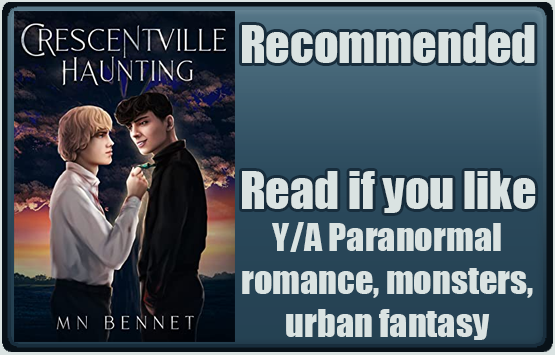
Crescentville Haunting by M.N. Bennet

Crescentville Haunting by M.N. Bennet

Formats: digital

Publisher:  Self published

Genre: Ghosts/Haunting, Monster, Occult, Romance, Vampire, Werewolf, Zombie

Audience: Y/A

Diversity: Bisexual main character, non-binary minor character, Black major character

Takes Place in: LA, California

Content Warnings (Highlight to view): Alcohol Abuse, Cannibalism, Death, Forced Captivity, Gaslighting, Gore, Medical Procedures, Mental Illness, Racism, Sexism, Slurs, Slut-Shaming, Violence, Vomit, Xenophobia

Blurb

Determined to pass junior year, Logan won’t let Henry distract him—much. Logan’s focusing on all things human, which means his swoony vampire ex-boyfriend will have to file his own fangs for a change. When he goes to the school bonfire and runs into Henry, wandering into the woods seems like a great escape. Until he’s bitten by a wicked Crone with some twisted magical munchies.

Logan is certain his ex-free human future is done when he’s dragged off to a scientific institution for study. There, he’s presented with an opportunity to keep his life, family, and future. All he has to do is stick to human ideology, since all things paranormal are illegal. But complications arise when the Crone begins to haunt him and Logan realizes that if he wants to get his life back, he has to navigate his lingering feelings for Henry.

With the Crone set on devouring him and the institution ready to obliterate him for any missteps, Logan must decide between pursuing the human future his family wants—one that he thought he wanted too—or the chance to embrace Henry, even if the world isn’t ready.

I received this product for free in return for providing an honest and unbiased review. I received no other compensation. I am disclosing this in accordance with the Federal Trade Commission’s 16 CFR, Part 255: Guides Concerning the Use of Endorsements and Testimonials in Advertising.

Logan just wants a safe, normal, drama-free junior year, and that means avoiding his vampire ex, Henry, at all costs. Which is easier said than done. Logan may be shy and awkward, but Henry is his complete opposite: confident, outgoing, and suave. When his best friend Kiera (a phantom) drags him to a bonfire party that’s supposed to help Logan relax, he discovers that trouble has a way of following him. Not only is Henry there, but Logan is attacked (for the second time since he first started dating Henry) by a powerful creature, this time a monstrous witch known as the “Crone.” After sustaining a bite from the Crone, Henry’s life changes forever.

Henry and Kiera are known as Vices, a group of monsters including phantoms, witches, vampires, trolls, sirens, and werewolves that are forced to live in the shadows due to public fear and draconian laws. The Crone is a sin, a powerful Vice that feeds on other Vices and can turn humans into undead monstrosities called Hauntings (think zombies and ghouls) with a single bite. After Henry’s attack he’s whisked away by SPU agents (the special police force in charge of catching and neutralizing Sins) to a secure facility designed to treat Hauntings, but to everyone’s surprise he doesn’t transform into a Haunting. It turns out Henry is a rare form of Vice, known as a Viceling, more human than Vice. The lore of Crescentville Haunting can get confusing in places, and there’s a lot of backstory. So much so that I actually checked to see if there was a prequel I had missed. But it’s no worse that any other fantasy novel with rich world building. If you can remember the rules of Quidditch, you can remember the magical classification system Bennet has created.

The characters are relatable and their voices sound authentic. The romance is steamy without being explicit and felt age appropriate for younger teens. It should be noted that while the book contains a paranormal romance, it’s not the central theme of the story. Instead, we focus on Logan’s struggles with his new identity and trying to fit into a human-centric world– an analogy for trying to fit into a heteronormative society when you’re LGBTQIA+. In Monsters in the closet: Homosexuality and the Horror Film Harry M. Benshoff writes “monster is to ‘normality’ as homosexual is to heterosexual.” LGBTQIA+ scholars have long equated queerness with fictional monsters and stories like Crescentville Haunting reclaim the “monstrous queer.” In Bennett’s story, the “homosexual vampire” is the hero rather than the villain, with the humans representing an oppressive heteronormative society and the facility attempting to “cure” Logan of his monstrousness a metaphor for conversion therapy. In addition to romance, the book also has plenty of horror, violence, and suspense, all courtesy of the Crone who continues to haunt Logan after the initial attack.

Overall, this was a fun read with a good world building, a cute relationship, and teens who actually sounded and acted like teens.
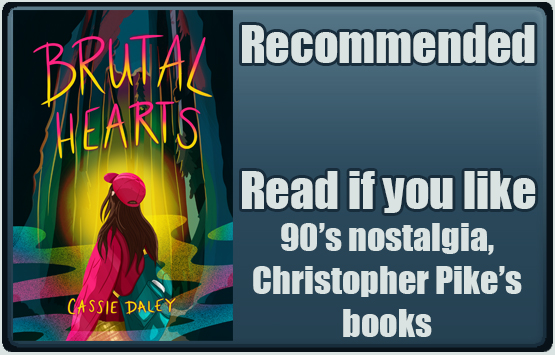
Brutal Hearts by Cassie Daley

Brutal Hearts by Cassie Daley

Formats: Print

Publisher: Self Published

Genre: Killer/Slasher, Monster

Audience: Y/A

Diversity: Autistic character, author is queer and autistic

Takes Place in: type here

Content Warnings (Highlight to view): Cannibalism, Child Death, Death, Gore, Violence

Blurb

It’s 1997 and Leah just can’t seem to catch a break.

A year has passed since her fiancé went missing while hiking alone on a mountain, and she can’t shake the unanswered questions and nightmares Simon left behind.

On the anniversary of his disappearance, Leah and her new girlfriend Josie return to the trail where Simon disappeared with two of their best friends. Armed with incense, tarot cards, crystals, and snacks, the girls have everything they need to complete the Ritual of Closure to help Leah finally say goodbye to Simon, once and for all.

But the trails are hiding something sinister, and it’s been waiting. As night falls around them, the girls find themselves in a deadly game against something vicious and wild that’s made a home for itself on the mountain.

It’s time to find out what really happened to Simon.

The year is 1996: Scream has just been released in theaters, the Macarena is the hottest new dance craze, and seventeen-year-old Leah is deeply in love with her high school sweetheart, Simon. The two have plans to marry after graduation, but that dream is destroyed when Simon goes missing after a hike in the nearby mountains. Volunteers scour the woods for any trace of the missing boy, but it’s like Simon has vanished without a trace.

A year later, Leah is still struggling with her grief and guilt. Her girlfriend, Josie, is doing her best to help Leah through the nightmares and sobbing fits, but nothing seems to help. In a last-ditch effort to give the poor girl some closure, Josie suggests they hike Simon and Leah’s favorite trail to say a final goodbye. Along with Leah’s two best friends, sisters Charlotte and May, the girls set off to perform a Wiccan inspired goodbye ceremony for him. But their beautiful day quickly goes south when something in the woods starts stalking them.

Brutal Hearts is short but gripping story, switching back and froth between the girls being stalked through the woods and the mystery surrounding Simon’s disappearance. I ended up finishing it in one sitting, something I never do even with novellas (ADHD makes it hard for me to focus on a book for too long unless I’m really engaged). I loved all the little nods to 90s aesthetics, from the clothing, to May’s Tamagotchi and the girls’ obsession with all things Wicca. (From Sabrina Spellman to Nancy Downs witches were huge in the 90s, inspiring a renewed interest in Wicca from teenage girls.) Although, it is hard to accept that the 90s were thirty years ago and are now officially nostalgic. Wasn’t it literally just 2000? I think Y2K caused my brain to crash and stop perceiving the passage of time.

I especially liked the addition of the playlists for each character in the back of the book. Leah’s music playlist revolves around being hurt by love. Josie likes grunge. May’s playlist is full of bubblegum pop while the more traditionally pretty and popular Charlotte prefers mainstream music. A fun flashback to 90s teen horror like Fear Street and the works of Christopher Pike (appropriate since Daley also runs the PikeCast) with a healthy dose of urban legends and campfire stories. A perfect read for a hot summer night. 

Manhunt by Gretchen Felker-Martin

Manhunt by Gretchen Felker-Martin

Formats: Print, audio, digital

Publisher: Tor Nightfire

Genre: Apocalypse/Disaster, Monster

Audience: Adult/Mature

Diversity: Trans author and characters, queer characters, Native character

Takes Place in: northeastern USA

Content Warnings (Highlight to view): Animal Death, Body Shaming, Cannibalism,  Child Death, Childbirth, Death, Drug Use/Abuse, Eating Disorder, Forced Captivity, Gore, Illness, Kidnapping, Medical Procedures, Oppression, Rape/Sexual Assault, Self-Harm, Slurs, Torture, Transphobia, Verbal/Emotional Abuse, Violence

Blurb

Y: The Last Man meets The Girl With All the Gifts in Gretchen Felker-Martin’s Manhunt, an explosive post-apocalyptic novel that follows trans women and men on a grotesque journey of survival.

Beth and Fran spend their days traveling the ravaged New England coast, hunting feral men and harvesting their organs in a gruesome effort to ensure they’ll never face the same fate.

Robbie lives by his gun and one hard-learned motto: other people aren’t safe.

After a brutal accident entwines the three of them, this found family of survivors must navigate murderous TERFs, a sociopathic billionaire bunker brat, and awkward relationship dynamics―all while outrunning packs of feral men, and their own demons.

Manhunt is a timely, powerful response to every gender-based apocalypse story that failed to consider the existence of transgender and non-binary people, from a powerful new voice in horror.

 received this product for free in return for providing an honest and unbiased review. I received no other compensation. I am disclosing this in accordance with the Federal Trade Commission’s 16 CFR, Part 255: Guides Concerning the Use of Endorsements and Testimonials in Advertising.

Have you ever wondered what happens to trans people in sex-based apocalypses like those in Y: The Last Man or Ōoku: The Inner Chambers? Gretchen Felker-Martin sets out to answer exactly that in her post-apocalypse splatterpunk novel Manhunt.

The T-rex virus transforms anyone with high levels of testosterone—mostly cis-men—into cannibalistic, sex-crazed monsters. Emboldened by the end of the world, a group of TERFs (trans-exclusionary radical “feminists”) have formed their own militia where they hunt and kill any trans women they find. It may seem like a group of militant TERFs is an exaggeration, but it feels like less of a stretch when you consider there’s already a high rate of violence against trans people. In 2021 alone, at least 56 trans and gender non-conforming people were murdered in the US. Transphobic hate crimes have quadrupled over the last five years in the UK. These fake feminists are also more fascist adjacent than they’d like to admit. As Judith Butler accurately pointed out, TERFs “have allied with rightwing attacks on gender” and “The anti-gender ideology is one of the dominant strains of fascism in our times. So, the TERFs will not be part of the contemporary struggle against fascism.” TERFs Lily Cade and Bev Jo Von Dohre have even called for the death of trans women. The fact that trans women in Manhunt can transform into monsters if they don’t have access to anti-androgen medication gives the TERFs exactly the excuse they’ve been waiting for to go from hateful rhetoric to actually destroying that which they hate most (never mind that cis-women with PCOS or congenital adrenal hyperplasia can also transform into feral beasts).

Not only do trans women have to avoid getting killed by the monstrous men, but also running into the militant TERFs who have seized control of most of the northeast. Fran and Beth are two such transwomen trying to survive in the new world, catching feral men and harvesting their testicles for their friend Indy to extract estradiol from. After running afoul of a militant group of TERFs and almost being killed by men, Fran and Beth meet a sharp-shooting trans man named Robbie, who they take on their journey with them. The trio return to Indy’s house with their testicle trophies where they learn she’s been offered a job by a spoiled rich girl who controls a luxurious bunker. But the promises of comfort the bunker offers may hide a deadly truth.

While I personally enjoyed this book, it won’t be for everyone. It is splatterpunk, after all. That means there’s lots of brutal violence (including a cis woman having her uterus cut out of her), gross content (testicle eating), and graphic sex. Everyone in Manhunt is super horny, sometimes at wildly inappropriate times, so Beth, Fran, Indy, and Robbie do a lot of fucking. The sex is hot, sometimes gross, and other times both hot and gross, much like real sex. It was nice to have sex scenes centered around trans pleasure rather than the cis-male gaze. Of course, the graphic description of genitalia might be triggering for some people who experience gender dysphoria, so be aware of that. Speaking of hot sex, a captain in the TERF army named Ramona is sleeping with a non-binary prostitute named Feather. One reviewer claimed this is unrealistic but I have to disagree. A lot of chasers are happy to sleep with trans people but won’t do anything to defend their rights or even stand up for them. Too many people with trans partners see their relationship as a shameful secret to be kept, and Ramona is no different. She’s too much of a coward to do the right thing and just goes along with the TERF army because it’s what’s easy.

Splatterpunk is very hit or miss for me, as many extreme horror books can cross over into misogynistic violence. Manhunt manages to avoid this trap, even though most of the book’s violence is against women (as all the characters, aside from Robbie, are women). Perhaps because it’s other women committing the violence, but I didn’t get that gross feeling I usually do when reading splatterpunk authored by cis men. Even the sexual assault scene didn’t feel gratuitous and was handled well. I also loved how flawed the protagonists are. Some people mistakenly assume LGBTQIA+ characters need to be perfect for it to be considered a “good” portrayal. I believe realistic is preferable to perfect, and I like my queer characters to have character flaws who sometimes do and say problematic things. Both Beth and Fran feel very human. Beth is reckless and insecure; Fran has both passing and class privilege and can sometimes be selfish. Neither of them are bad people, just realistically flawed.

My only complaint about the book (and granted, it’s minor) is that there are so many descriptions of Indi’s fat body. The way she’s described isn’t quite fatphobic, but it did make me feel uncomfortable that there was so much focus on it. I can understand that Indy is dealing with a lot of internalized fatphobia and insecurity, so it makes sense that her character would spend a lot of time focusing on her size and the limitations that come with it. When the story is told from a third-person point of view, there’s no reason for Indy’s weight to be described in such detail, especially since no one else’s body gets that much description or scrutiny. At least she’s never described as gross or unattractive, and Indi even gets to be sexually desirable, which is rare for fat characters outside of fetish porn. It was refreshing to see fat people having passionate sex scenes just like their skinny counterparts. Like I said, it’s a minor complaint and could absolutely be my own hypersensitivity.

Reading this book is like having your brain put in a blender. It’s wild, gross, horny, disgusting, tragic, and hilarious all whipped together into an extreme horror smoothie. In other words, I LOVED it. You have to be at least somewhat familiar with trans culture to fully appreciate the story, which I thought was awesome. There’s also just something extremely satisfying about trans women killing fascist TERFs: not something I’d advocate in real life, but it’s fun and cathartic in fiction. Unsurprisingly, this made a bunch of real-life TERFs very angry. They didn’t like being portrayed as bigoted assholes just because of their bigoted asshole-ish behavior and tried to review bomb Manhunt…which should just make you want to read it more.

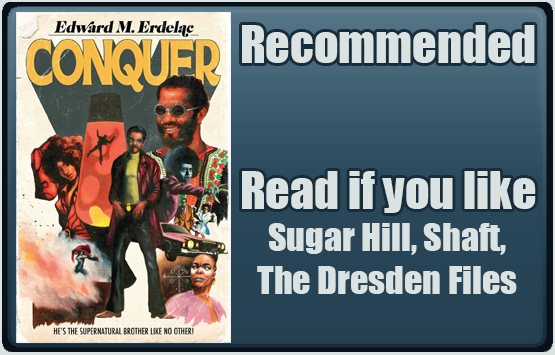
Conquer by Edward M. Erdelac

Conquer by Edward M. Erdelac

Formats: Print, audio, digital

Publisher: Self Published 

Genre: Historic Horror, Monster, Mystery, Myth and Folklore, Occult, Vampire

Audience: Adult/Mature

Diversity: Black/African-American, Hispanic, Trans, Gay

Takes Place in: Harlem, New York, USA

Content Warnings (Highlight to view): Animal Death, Body Shaming, Child Abuse, Death, Drug Use/Abuse, Forced Captivity, Gore, Homophobia, Kidnapping, Necrophilia, Oppression, Pedophilia, Physical Abuse, Police Harassment, Racism, Rape/Sexual Assault, Sexual Abuse, Slurs, Transphobia

Blurb

In 1976 Harlem, JOHN CONQUER, P.I. is the cat you call when your hair stands up…the supernatural brother like no other. From the pages of Occult Detective Quarterly, he’s calm, he’s cool, and now he’s collected in CONQUER.

From Hoodoo doctors and Voodoo Queens,
The cat they call Conquer’s down on the scene!
With a dime on his shin and a pocket of tricks,
A gun in his coat and an eye for the chicks.
Uptown and Downton, Harlem to Brooklyn,
Wherever the brothers find trouble is brewin,’
If you’re swept with a broom, or your tracks have been crossed,
If your mojo is failin’ and all hope is lost,
Call the dude on St. Marks with the shelf fulla books,
‘Cause ain’t no haint or spirit, or evil-eye looks,
Conjured by devils, JAMF’s, or The Man,
Can stop the black magic Big John’s got on hand!

I received this product for free in return for providing an honest and unbiased review. I received no other compensation. I am disclosing this in accordance with the Federal Trade Commission’s 16 CFR, Part 255: Guides Concerning the Use of Endorsements and Testimonials in Advertising.

Conquer is the story of a Black mystical detective named John Conquer (a reference to John the Conqueror) and a homage to 70’s detective fiction and Blaxploitation films. It’s fun, well written, and full of creepiness, including a fetus monster haunting an abandoned subway station and a man shrunk down and boiled alive in a lava lamp. I greatly enjoyed the book, but like most Blaxploitation, it wasn’t without its problems.

It’s important to point out that Erdelac is a White author writing a Black story (something not uncommon in Blaxploitation). I usually prefer to promote “own voices” books, and stories by cishet White men are a rarity on this blog. After all, folks with privilege do not have the best track record when it comes to writing marginalized groups. As Irish author Kit de Waal said, “Don’t dip your pen in someone else’s blood”. Take American Dirt by Jeanine Cummins and The Help by Kathryn Stockett. They’re both terrible for numerous reasons including, but not limited to: not doing enough research, using the White Savior trope, watering down their narratives to make them palatable for White audiences, cultural appropriation, speaking over marginalized voices, etc. That’s not to say White authors shouldn’t write BIPOC characters at all. Not having any diversity in your story can be equally problematic. It just needs to be done carefully and respectfully. Very, very carefully. Yes, I know that can be a fine line to walk, but if an author can research what kind of crops people were growing in 1429 to make their book more accurate, they can research American Indians and people of color. Besides, that’s what hiring sensitivity readers and using resources like Writing with Color is for. Of course, there’s also the problem of White voices being given preferential treatment by publishers and audiences over BIPOC trying to tell their own stories.

To his credit, Erdelac has done an impressive amount of research to make his book feel authentic. John Conquer wears a dime around his ankle for protection and a mojo hand (another name for a mojo bag) for luck. His name is a reference to High John de Conqueror, a Black folk hero with magical abilities. Conquer also has one of the most accurate representations of Vodou I’ve ever seen in fiction. Hollywood “voo doo” is a pet peeve of mine, so I appreciate Erdelac’s dedication to portraying the religion and loa/lwa (the powerful spirits Vodou practitioners worship and serve) accurately. He also doesn’t try to portray an idealized version of 1970s NYC. There’s racism, anti-Semitism, homophobia, and cops and criminals spewing slurs. And while it’s jarring, it does make the story feel more authentic. The police are racist and homophobic and there’s tension between the many communities that make up 1970s New York. John Conquer’s Uncle Silas was disowned by his family for being gay, and when John is asked to solve his murder, he has to confront his own homophobia and transphobia. That doesn’t mean it always works, though. There were definitely a few times I side-eyed and wondered if a certain line really needed to be in there.

My favorite part of the book is Eldelac’s excellent world building. White vampires go up in smoke when exposed to sunlight, while vampires with more melanin are protected from the sun’s rays. Vampirism also halts a corpse’s decay, but all that rot catches up to them when they’re finally killed. Each culture has their own magical practices with distinct rules, and magic doesn’t cross cultural lines. For example, only Vodou practitioners can become zombies, and non-Christian vampires are immune to crosses. Conquer is especially powerful because he’s learned many different traditions and practices, but the catch is that this opens him to a wider variety of spiritual attacks. Street gangs utilize black magic to wage wars with each other. His work is clever, original, and something I could really get into. But…having White authors tell BIPOC stories still feels problematic to me when White authors are still so heavily favored by the publishing industry. I’ve reviewed books by White authors before, but because Conquer is based heavily on Blaxploitation it feels, well, more exploitative than those I’ve reviewed in the past. I’m still going to go ahead and recommend Eldelac’s work because—in the end—it is well written and interesting, but I can also completely understand if some of you want to skip this one.

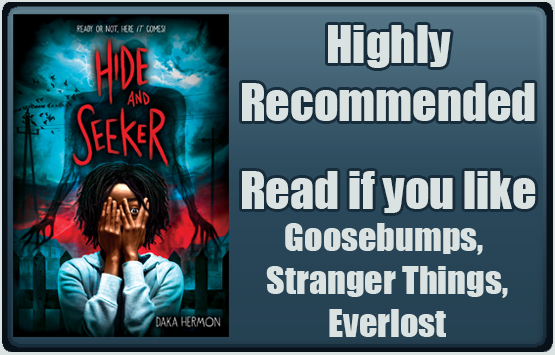
Hide and Seeker by Daka Hermon

Hide and Seeker by Daka Hermon

Formats: Print, audio, digital

Publisher: Scholastic 

Genre: Demon, Monster, Psychological Horror

Audience: Children

Diversity: Black author and characters

Takes Place in: Tennessee, USA

Content Warnings (Highlight to view): Child Abuse, Child Endangerment, Death, Forced Captivity, Gaslighting, Police Harassment 

Blurb

One of our most iconic childhood games receives a creepy twist as it becomes the gateway to a nightmare world.

I went up the hill, the hill was muddy, stomped my toe and made it bloody, should I wash it? Justin knows that something is wrong with his best friend. Zee went missing for a year. And when he came back, he was . . . different. Nobody knows what happened to him. At Zee’s welcome home party, Justin and the neighborhood crew play Hide and Seek. But it goes wrong. Very wrong. One by one, everyone who plays the game disappears, pulled into a world of nightmares come to life. Justin and his friends realize this horrible place is where Zee had been trapped. All they can do now is hide from the Seeker.

You’d think I’d eventually learn that kid’s media can be just as scary as horror aimed at adults. After all, Over the Garden Wall, Coraline, and Skeleton Man all managed to scar me permanently. And yet, I went into Hide and Seeker foolishly assuming that it would be tame in comparison to my usual horror fare. Well, boy was I wrong. This book was INTENSE. I mean, just look at that cover! Suddenly I was a child again, hiding under the covers from the monsters in the darkness but still unable to put the book down despite the nightmares I knew it would cause. I haven’t had a good scare like that in a while and it was absolutely wonderful. 

Over the Garden Wall — nightmare fuel for the whole family!


Jason is coping with the death of his mother and the disappearance of his best friend, Zee. Despite support from his sister and counselor he still struggles to accept her death and deal with his panic attacks (major kudos to Hermon for portraying an accurate depiction of panic attacks and anxiety). Then Zee reappears suddenly, covered in scars and speaking in riddles about a monster called the Seeker. What should be a joyous occasion quickly turns sour when children in the neighborhood start to disappear after a game of hide & seek. Jason and his friends Lyric and Nia soon learn that the kids were whisked away by the demonic Seeker to a place beyond their worst nightmares, and it looks like they’re next.

Of our trio of heroes, I’d have to say Nia is my favorite. She’s clever, rational, and despite her photographic memory and love of trivia she struggles with schoolwork. It was a nice change of pace to see the token “smart kid” suck at test taking and homework, a reminder that schoolwork is not an accurate measure of intelligence and ingenuity, and learning disabilities don’t mean you’re stupid. Nia uses her wits to help the kids out of more than one scrape and pushes her friends to be their best. She also knows enough about horror movie tropes to advise against splitting up the group. Nia is awesome. Not that Lyric or Jason are slouches. They’re fiercely loyal to each other, and it’s incredibly heartwarming. Even at their worst moments, the kids stick together and support their friends. 

This is the perfect book for kids who love Goosebumps and Stranger Things but are still too young for Stephen King and R-rated Slashers. Hermon is amazing at creating atmosphere and building terror without relying on blood and gore (there are minor injuries though, like bug stings, burns, and minor cuts). Her dialogue conveys the intensity of the situation without swearing. By implying Nowhere is a place where all your greatest fears become real and leaves its victims traumatized and covered in scars, our imaginations are able to come up with the worst possible scenarios. Not that Hermon leaves everything up to the reader’s imagination: there are plenty of giant bugs, living dolls, needles, and rat-snake hybrids to convey how truly terrifying Nowhere is.

Justin faces a lot of scary things, but racists and systemic oppression aren’t among them. It was nice to have a middle-grade book with a Black hero that didn’t deal with racism. Black folks already have to deal with racism All. The. Time. We deserve escapist stories where Black kids get to exist without having to worry about discrimination. Nic Stone, author of Dear Martin put it best in her article for Cosmopolitan:

“…I can’t help but wonder how different the world would look if we’d all grown up seeing Black people do the stuff White people did in books. Going on adventures. Saving the day. Falling in love. Solving mysteries. Dealing with a broken heart. Getting caught up in a riveting love triangle. Taking down oppressive regimes. (I mean, HELLO, a bunch of farm animals took down a dictatorial pig in a book that’s been on middle school curriculum lists for decades. Yet Black people can’t survive the first book in a dystopia trilogy?) What if we’d seen Black people in books just being human?”

The closest the book gets to dealing with racism is when the kids get harassed by a police officer while riding their bikes though a nice neighborhood. Ironically, it’s the one White kid in the group that hates cops the most due to his father being sent to prison for a crime he didn’t commit, and he warns the others not to ask the police for help. And it’s such a nice change to see Black kids fighting make-believe monsters rather than real ones.

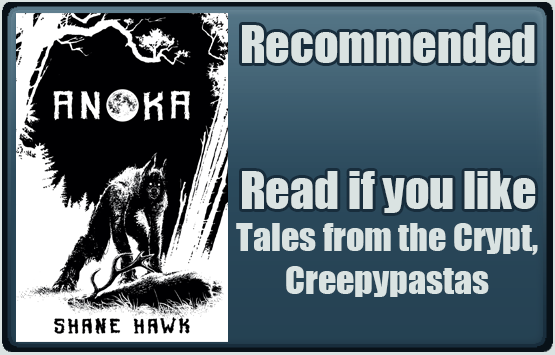
Anoka by Shane Hawk

Anoka by Shane Hawk

Formats: Print, audio, digital

Publisher: Self-Published

Genre: Body Horror, Folk Horror, Monster, Myth and Folklore, Occult, Werewolf

Audience: Adult/Mature

Diversity: Biracial Cheyenne author, Dakota characters, non-binary character

Takes Place in: Anoka, Minnesota, USA

Content Warnings (Highlight to view): Alcohol Abuse, Cannibalism, Child Death, Death, Drug Use/Abuse, Gore, Racism, Rape/Sexual Assault, Self-Harm, Sexual Abuse, Slurs, Suicide, Verbal/Emotional Abuse, Violence

Blurb

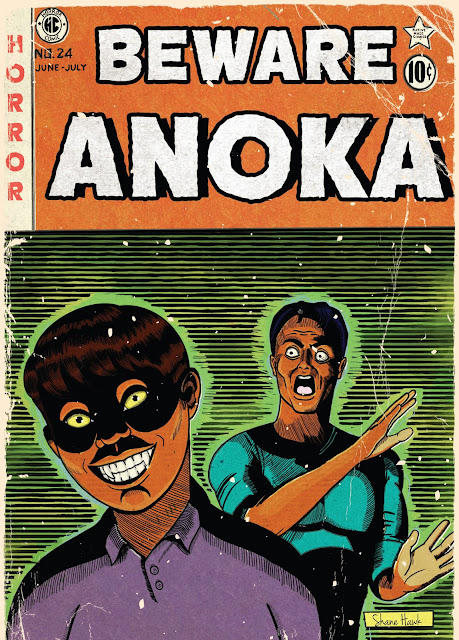
Welcome to Anoka, Minnesota, a small city just outside of the Twin Cities dubbed “The Halloween Capital of the World” since 1937. Here before you lie several tales involving bone collectors, pagan witches, werewolves, skeletal bison, and cloned children. It is up to you to decipher between fact and fiction as the author has woven historical facts into his narratives. With his debut horror collection, Cheyenne & Arapaho author Shane Hawk explores themes of family, grief, loneliness, and identity through the lens of indigenous life.

I received this product for free in return for providing an honest and unbiased review. I received no other compensation. I am disclosing this in accordance with the Federal Trade Commission’s 16 CFR, Part 255: Guides Concerning the Use of Endorsements and Testimonials in Advertising.

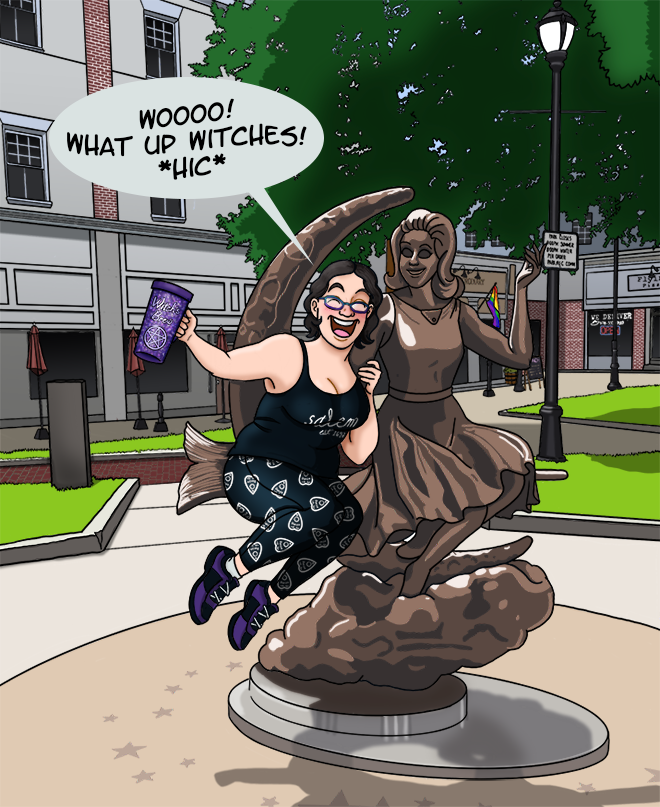
Apparently Anoka, Minnesota is the “Halloween Capital of the World” because they’ve been having giant Halloween parades since 1920. Out of civic pride, I want to argue that Salem is the Halloween Capital and our town is better because we have real witches and Salem Horror Fest and the oldest candy company in America. On the other hand, I would also like tourists to stop blocking the traffic, drunkenly climbing on the witch statue, and crowding my favorite restaurants every October (that’s my job), so maybe it would be better if they all headed to Anoka instead. I don’t think anyone will want to go anywhere near the Minnesota city after reading Shane Hawk’s Indigenous horror anthology of the same name, though. The stories in Anoka are loosely tied together by their location in an alternative version of the town where dark magic and monsters lurk. An evil tome known simply as “the book” and strange green swirls also make multiple appearances throughout the anthology.

A comic of a person hanging off a statue of a witch saying

Hawk gives a different and unique voice to each of his characters so every story feels different from the others. His writing reminded me of a talented artist who can draw in multiple styles and shift easily from realism to the simple lines of a cartoon. My favorite thing about his book is how so many of the stories felt like pre-comics code horror anthology comics like Eerie, Black Cat, and The Haunt of Fear or modern-day creepypastas with terrifying twists. Some stories were fun and weird, others tragic reflections of human nature. But all of them were creepy, the kind of creepy that makes you aware of how many noises an old house makes at night or has you shouting out loud at the characters not to go into the room where the monster is waiting.

American Indians tragically have the highest infant mortality rate in the U.S. (again due to trauma, poverty and a lack of adequate healthcare), so much of Hawk’s anthology touches on themes of child death and the trauma that goes with such a great loss. In two stories, Orange and Wounded, the death of a child in the past moves the main characters to do something terrible. Soilborne is a metaphor for the loss of the child-parent connection and how devastating that can be. In Imitate, the protagonist has to rush to save his son, Tate, from an unknown horror that’s taken his form. There’s no way of knowing if Tate is even still alive, and the whole story is exceedingly stressful to read. Honestly, Imitate would have worked just fine as microfiction and Hawk could have easily ended it after the first page or so. But instead, he decides to pile on even more terror by turning it into a suspenseful short story where we’re forced to watch a father slowly lose his mind. It’s definitely one of the anthology’s stronger and spookier tales.

My absolute favorite story in the collection is Dead America about a writer named Chaska whose family is followed by death. This is sadly not uncommon for Native families as generational trauma, poverty, and a lack of adequate healthcare has lead to poor health and high death rates from heart disease, diabetes, and suicide. The story gets its name from Chaska’s hobo nickel which depicts the skull of a dead Indian chief in full headdress on one side and Columbus’ three ships on the other. “When betting a coin offers someone a fifty-fifty chance of winning and losing. The nickel was a metaphor for the predicament of Indian existence: fucked no matter which side the coin landed on” the author explains. He’s about to find out how right he is when Asibikaashi the Spider Woman decides to make the Dakota author suffer for his sins.

This story is SCARY. All of my notes for Dead America consist of “nope, nope, nopeity-nope nope, fuck this, nope.” I’m not someone who’s usually bothered by spiders under normal circumstances. I think they’re kind of cute and I love that they eat any bugs that get into the house, but Chaska’s punishment left me terrified of arachnids. If you have any form of arachnophobia, I can guarantee you’ll be in for some nasty nightmares and might want to skip this story entirely. But if you’re feeling brave, it’s one of the strongest stories in the collection and worth checking out. The story also touches on themes of profiting off the personal stories of others, very similar to how Ward ChurchillAsa Earl Carter, Mary Summer Rain and others pretended to be Native for fame and money.

It’s important to note that in Ojibwe stories Asibikaashi, aka Grandmother Spider, is a benevolent deity and helper of humanity whose spiderweb charms, popularly known as “Dream Catchers“, were woven by women as a form of protection for infants. I couldn’t find any references to her punishing the wicked (of course I couldn’t find many references to her at all that weren’t written by White new agers).

Hawk’s final story, Transformation, is about a non-binary werewolf who hunts for her community and runs into trouble at Anoka’s annual Halloween parade. Having a trans werewolf feels perfect because werewolves are the ideal metaphor for someone with a fluid identity. Sometimes you’re a wolf, others a human, and occasionally you’re something in between, but you’re always a werewolf regardless of what form you take that day. Just because I’m femme one day, it doesn’t negate the fact that I’m non-binary; I’m still an enby when I’m feeling more trans-masculine. Like the story title, werewolves can also represent transition. The wolf can be seen as the true self, hidden under a dull human skin that’s forced to conform to society’s rigid standards. Becoming the wolves gives you the opportunity to experience freedom. If that transformation is unwanted, it can be compared to a menstrual cycle that causes dysphoria each month or unwanted body hair. “Jenny” a transwoman who identifies with werewolves is quoted on the queer horror blog, Gender Terror“The titanic proportion of my body and the hair that I continually fight back terrify me, and makes me the target of many suspicious onlookers. And just like werewolves, I have no control over what my body does. Feeling like a prisoner to how your body changes is a special torment I think a lot of transgender people share with werewolves.” So is it any wonder writers like Hal SchrieveAllison MoonSuzanne Walker,  Ashlynn Barker, and numerous self-published erotic authors like Noah Harris have all explored the idea of a trans werewolf? Heck “were-woman” is slang for someone who “transforms” into a woman at night (though this terminology can be problematic). Hawk’s non-binary werewolf character seemed so cool I was disappointed that their story wasn’t longer. There was so much going on in Transformation it felt like it would’ve worked much better as a novella rather than a short story. Honestly, I’d read a full novel about the nostalgic werewolf, Halloween parades, and Wendigo. That’s my one major complaint about Anoka: it’s too short! The concept was so cool I was disappointed we didn’t get to explore more of Hawk’s alternate universe. I wanted to learn more about The Book and the creepy town filled with dark magic and monsters.

A comic-style illustration of a werewolf wearing underwear made from the trans flag colors.

What impressed me the most about the story collection is how Hawk was able to handle the subjects of child losssexual assaultsubstance abuse and missing and murdered Indigenous women, especially in his story Wounded, in a way that felt respectful rather than exploitative. Anoka is a fun, frightening ride that draws attention to many of the issues plaguing American Indians today, and I hope we’ll get to hear even more stories from the spooky little town in Hawk’s future books.

The Luminous Dead by Caitlin Starling

The Luminous Dead by Caitlin Starling

Formats: Print, audio, digital

Publisher: Harper Voyager

Genre: Psychological Horror, Sci-Fi Horror, Thriller

Audience: Adult/Mature

Diversity: Lesbian/queer characters and author, Biracial Black character 

Takes Place in: another planet

Content Warnings (Highlight to view): Death, Drug Use/Abuse, Forced Captivity, Gaslighting, Medical Torture/Abuse, Medical Procedures, Mental Illness,  Self-Harm, Attempted Suicide, Verbal/Emotional Abuse

Blurb

“This claustrophobic, horror-leaning tour de force is highly recommended for fans of Jeff VanderMeer’s Annihilation and Andy Weir’s The Martian.” — Publishers Weekly (starred review)
***

A thrilling, atmospheric debut with the intensive drive of The Martian and Gravity and the creeping dread of Annihilation, in which a caver on a foreign planet finds herself on a terrifying psychological and emotional journey for survival.

When Gyre Price lied her way into this expedition, she thought she’d be mapping mineral deposits, and that her biggest problems would be cave collapses and gear malfunctions. She also thought that the fat paycheck—enough to get her off-planet and on the trail of her mother—meant she’d get a skilled surface team, monitoring her suit and environment, keeping her safe. Keeping her sane.

Instead, she got Em.
Em sees nothing wrong with controlling Gyre’s body with drugs or withholding critical information to “ensure the smooth operation” of her expedition. Em knows all about Gyre’s falsified credentials, and has no qualms using them as a leash—and a lash. And Em has secrets, too . . .
As Gyre descends, little inconsistencies—missing supplies, unexpected changes in the route, and, worst of all, shifts in Em’s motivations—drive her out of her depths. Lost and disoriented, Gyre finds her sense of control giving way to paranoia and anger. On her own in this mysterious, deadly place, surrounded by darkness and the unknown, Gyre must overcome more than just the dangerous terrain and the Tunneler which calls underground its home if she wants to make it out alive—she must confront the ghosts in her own head.

But how come she can’t shake the feeling she’s being followed?

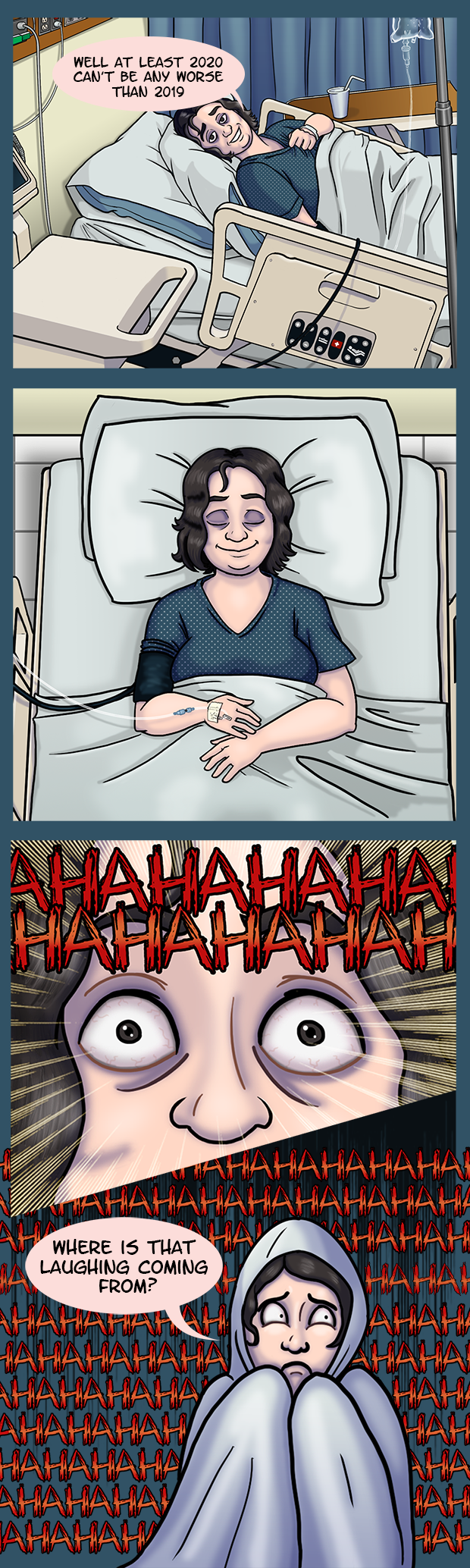
The Luminous Dead is a survival horror story with only two characters, one location, and no antagonist. It’s also one of the most stressful horror stories I’ve ever read. Starling is a master of playing with the reader’s paranoia, building up the suspense and atmosphere until you’re jumping at every sound and shadow. Ironically, The Luminous Dead also managed to calm me down considerably when I was dealing with my own stressful situation (horror is great for anxiety): spending the night in the ER awaiting an emergency cholecystectomy (after my wife told me it was nothing and we weren’t spending $4,000 at the ER just because I had stomach cramps that were probably just from drinking milk, and why hadn’t I just taken the Lactaid tablets she bought me). After managing to survive a severely infected gallbladder, I assumed that 2020 could only be uphill from there. Poor, naïve past me.  

In the first panel I'm lying in a hospital bed looking worn out. "Well at least 2020 can't be any worse than 2019." I say. In the second panel I'm sleeping peacfully, when suddenly I'm woken up in the third panel by evil laughter. In the 4th panel the demonic laughing continues while I hide under the blankets and ask "Where is that laughing coming from?"

Well at least none of my organs exploded in 2020, so there’s that…

In the future, humanity has spread out across the stars, but sadly it’s not the socialist utopia dreamed of in Star Trek. Gyre lives on a barren, back-water mining planet where poverty is rampant and the only escape is to take a job as a caver for wealthy mining companies. It’s not a pleasant job. On top of spending days or even weeks in a self-contained suit with little human interaction, breathing recycled air, and being fed through a stomach stoma, these subterranean explorers have to contend with falls, cave-ins, and underground flooding. Worst of all are the Tunnelers – giant alien worms that burrow through solid stone. Not many cavers survive, but those who do can expect a huge payout. In Gyre’s case, it’s enough to get her off-world to find the mother who abandoned her as a child. Desperate, uncertified, and inexperienced, she accepts an especially sketchy caving job that doesn’t ask too many questions. It’s not until Gyre has already begun her descent into the subterranean labyrinth she’s been hired to explore that she discovers she may have made a grave mistake. Instead of having an entire team topside to monitor her vitals, feed her info, and watch her while she sleeps, which is the standard, she has only one woman, Em. Cold, efficient, controlling, and stingy with details, Em is not above obfuscating data and manipulating her cavers to get the job done. Not exactly someone you want to trust with your life. Em seems to genuinely want to protect Gyre even if her methods are questionable, but that hardly excuses the lying and manipulation which only serve to exacerbate the young caver’s trust issues. Not that Gyre is much better. Her desperation means she’s willing to make some morally questionable decisions, and her stubbornness leads to her making bad ones.

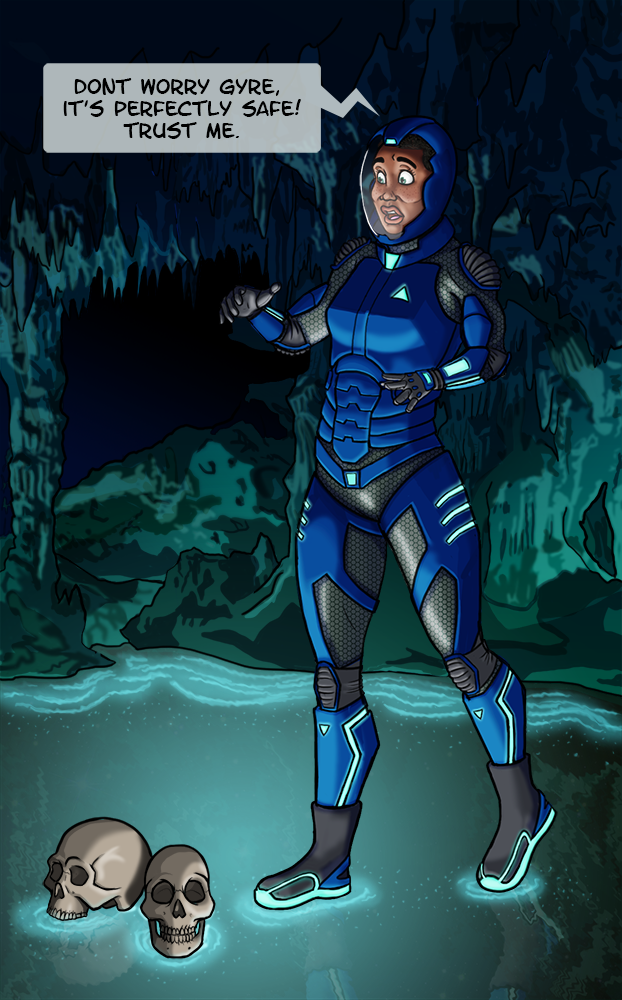
A drawing of Gyre in her suit. She's in the cave and is looking at two skulls on the ground, horrified. Em is on the intercom saying "Don't worry Gyre, it's perfectly safe. Trust me!"

The background is from a cave in the Dominican Republic I visited back in February 2020. There weren’t any skulls in it though. *sigh* I miss travel.

As if paranoia, isolation, and giant monsters aren’t scary enough, Starling adds another twist: there may or may not be something sinister going on in the cave as Gyre’s senses start to play tricks on her. Maybe it’s another one of Em’s deceptions. For most of the book, you’re genuinely unsure of where the biggest threat is coming from: the cave, Em, or Gyre’s own mindknowing she’s all alone in the dark unknown (or is she?) with only one less-than-trustworthy guide. Although Gyre never fully trusts Em, the two begin to form a distrustful, dysfunctional relationship over time as they reveal and struggle with past traumas. And yes, their trauma bond is just as maladjusted as it sounds. It’s both fascinating and horrifying to watch these two deeply flawed, fucked up people grow closer. Part of me was rooting for Gyre and Em because, when everything is awful, people deserve every bit of happiness they can get. But the more rational part of me was horrified. Shared suffering does not mean two people will be compatible and without trust issues, and on top of Em’s willingness to put Gyre in danger, there are the hallmarks of a toxic relationship. To Starling’s credit, she doesn’t try to create an idealized romance, or even imply that their bond is healthy like certain romance books that will remain nameless tend to do *cough*Twilight*cough*. Instead she aims to create two realistic, flawed characters who are doing their best in a bad situation. I’m a huge fan of antiheroes and morally gray characters in fiction (in real life they’re just assholes) because they’re rarely bland or boring, and Gyre and Em are anything but dull. Watching a caver with trust issues put her life in the hands of a woman who lies just makes the story all the more suspenseful.

Part of the reason Gyre acts the way she does is because she grew up in survival mode. Living in a barren, capitalist hellhole will do that to a person. Like any good work of science fiction, The Luminous Dead uses fictional characters in a fictional setting to draw attention to some very real-world ethical dilemmas. In this case, it’s the exploitation of the poor and vulnerable in a Capitalist society. Dubbed 3K jobs in Japan (kitanai, kiken, kitsui or dirty, dangerous, and difficult in English) this sort of work has traditionally been given to immigrants, migrant workers, and other vulnerable populations who have few options available to earn a living and are less likely to complain about unsafe working environments. Dangerous jobs that require specialized skills and training, such as construction and steel working jobs, pay better salaries and are more likely to be OSHA compliant, but rarely pay enough to offset the risk. Sex work can be a 3K job that pays well, but leaves sex workers open to arrest, abuse, and disease without legal protections in place. While workers aren’t being forced into these jobs per se (as opposed to victims of trafficking, domestic servitude, debt bondage, and other forms of slavery) they’re not usually done by people who have other options available. In The Luminous Dead, caver jobs are only ever taken by those in poverty (the wealthy would never risk their lives doing such dangerous work) and no one continues caving after they’ve made enough to escape. So is it really a choice when you’re between Scylla and Charybdis?

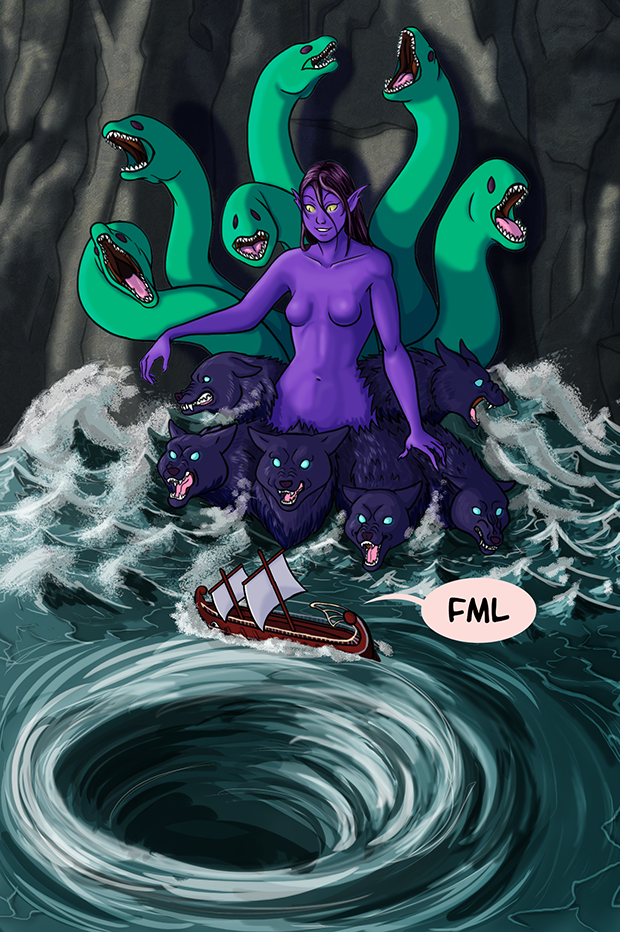
A drawing of Odysseus' ship passing between Scylla (a monstrous woman with six dog's heads around her waist and six serpents head's with shark's teeth coming out of her back) and Charybdis (a giant whirlpool). Someone on the ship is saying "FML".

Scylla wasn’t that big but she’s also not real so I can draw her however I want lol

I can’t describe much more of the plot, as spoilers would ruin the suspense Starling worked so hard to create, but suffice it to say that The Luminous Dead is, at its core, about the trauma of losing a mother, whether from abandonment or death, and how anger and grief can destroy you. If you love isolation horror, definitely pick up a copy of your own.

Worship Me by Craig Stewart

Worship Me by Craig Stewart

Formats: Print, audio, digital

Publisher: Hellbound Books

Genre: Blood & Guts (Gorn), Monster, Myth and Folklore, Occult

Audience: Adult/Mature

Diversity: Gay author and gay side character

Takes Place in: USA

Content Warnings (Highlight to view): Animal Death, Body Shaming, Bullying, Child Endangerment, Death, Forced Captivity,  Gaslighting, Gore, Mental Illness (depression), Physical Abuse, Sexual Assault, Self-Harm, Slut-Shaming, Suicidal Ideation, Violence

Blurb

Something is listening to the prayers of St. Paul’s United Church, but it’s not the god they asked for; it’s something much, much older. 

A quiet Sunday service turns into a living hell when this ancient entity descends upon the house of worship and claims the congregation for its own. The terrified churchgoers must now prove their loyalty to their new god by giving it one of their children or in two days time it will return and destroy them all. 

As fear rips the congregation apart, it becomes clear that if they’re to survive this untold horror, the faithful must become the faithless and enter into a battle against God itself. But as time runs out, they discover that true monsters come not from heaven or hell… 
…they come from within.

Please note, I received this product for free in return for providing an honest and unbiased review. I received no other compensation. I am disclosing this in accordance with the Federal Trade Commission’s 16 CFR, Part 255: Guides Concerning the Use of Endorsements and Testimonials in Advertising.

***
 

Worship Me is a nihilistic exploration of morality and faith presented as a gory horror story about a congregation trapped inside their church by a mysterious creature, called the Behemoth. Demanding their reverence, the beast viciously murders any who disobey and gives the group 48 hours to offer up a child sacrifice. With the safety and sanctity of their church destroyed and their beliefs thrown into question, the members of St. Paul’s United Church begin to reveal their true natures. The book boasts a large cast of characters including Dorothy, the church matron who’s desperate to feel needed, Emily, a severe and devout woman who harshly judges others, Susan, a naive and sheltered young woman who wants to save the world, and Chris, a closeted gay teen who desperately wishes his crush would acknowledge their mutual attraction, and the point of view frequently shifts as each character watches their world fall apart. But it’s Angela who comes closest to being the story’s protagonist.

Angela and her son, Alex, have been the center of church gossip ever since her husband, Rick, vanished mysteriously. Seemingly tired of the pity and Emily’s suspicious scorn Angela announces during Sunday service that she’s planning on moving away and starting fresh. That’s when a filthy Rick stumbles into the church. The congregation, who have been praying for his safe return, declares it a miracle. Angela, however, is less than thrilled. While the community sees the couple’s relationship as the perfect romance, high school sweethearts who marry young and went on to have a child, nothing could be further from the truth. Rick is an abusive and violent man who terrorizes his wife, Angela was desperate to escape his cruelty and protect her son, and his time away has made him even worse. While gone, Rick has found a new god, the Behemoth, and has apparently started some sort of Cenobite-type religion that involves torture, murder, self-mutilation, and a very aggressive recruitment strategy. Everything starts to go to hell after that.

At least I assume this is what Scientology is, but with more aliens and domestic espionage.

On the Sunday of Rick’s ill-fated return, the pastor, Don, tells his congregation about the myth of Job, a devout and righteous man whose faith is tested by hardship. For those unfamiliar with the parable, God and Satan aka “the Adversary” (“satan” literally translates to “adversary” so it’s unclear whether this is big S Satan, aka the devil, or just some random angel who’s a jerk) are hanging out in heaven and God is bragging about the super pious and awesome Job. Satan rolls his eyes and points out that Job is only “good” because he knows God blesses the righteous and punishes the wicked. He’s doing it for the rewards, not out of some deep sense of morality. God suggest they test that theory and gives Satan permission to ruin Job’s life by killing his servants and children, taking his wealth, and covering the poor man with boils. Job’s so-called “friends” also subscribe to the theory that bad things only happen to bad people, and proceed to blame the victim by telling the poor man that all his misfortune is his own fault. At this point Job is pretty miserable and wondering what the hell he did to deserve this and demands to know why an all-powerful deity would make the world so chaotic and horrible. Surprisingly God actually responds with something along the lines of “Where the hell were you when I made earth out of literally nothing!? I made a freaking universe and you people don’t even know what electricity is yet. Do you really think your stupid little monkey brain could understand all the complexities that go into running this place? I have all these plans you couldn’t even wrap your brain around, like winning a bet with this guy… never mind, the point is: I’m omnipotent, omniscient, and I work in mysterious ways. Deal with it.” Stunned, Job stammers out “Well, you didn’t really answer my question, like, at all, but you’re really scary and I don’t want an all-powerful deity angry at me so I think I’m just going to go back to being pious and throw in some groveling apologies so you don’t smite me.” God says “Yeah, you do that” and restores Job’s riches and health, and even gives him some new kids (because apparently children were easily replaced like goldfish back then), just so there are no hard feelings. The parable is meant to explain why good people suffer for seemingly no reason, though a more cynical interpretation would be that powerful beings treat mortals as mere pawns in their games and get unreasonably angry when those mortals want to know why they’re acting like jerks. While God is ranting at Job for questioning his betters, the irritable deity starts not-so-humbly bragging about how powerful they are, using the Behemoth as an example. The Behemoth, an enormous, land-dwelling beast, is so powerful that it can only be controlled by God, no mortal could ever hope to defeat it.

“Behold now behemoth, which I made with thee; he eateth grass as an ox.

Lo now, his strength is in his loins, and his force is in the navel of his belly. 
He moveth his tail like a cedar: the sinews of his stones are wrapped together. 
His bones are as strong pieces of brass; his bones are like bars of iron.

He is the chief of the ways of God: he that made him can make his sword to approach unto him.”
(Job 40: 15-19)

No, I don’t know why God spends so much time telling Job about the Behemoth’s giant genitals (“tail” was probably euphemism). Whomever wrote that particular bible story was having a really weird day. Jewish apocrypha describe the Behemoth as a primal creature that represents chaos and will battle with its aquatic and aerial counterparts, the Leviathan and Ziz, on judgement day.

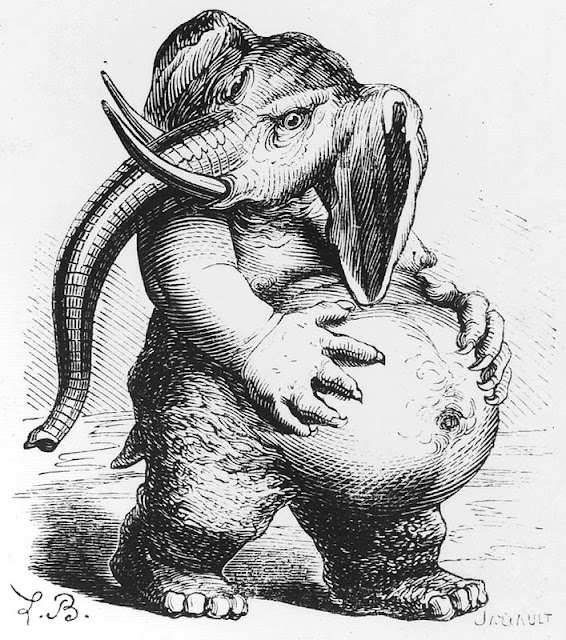
An early 1800s pen and ink sketch of a bipedal demon. It has the head, legs, and tail of elephant and the torso and arms of a a human. The demon is clutching its large, bloated belly with clawed hand and looking over its right shoulder.

The Behemoth as it is depicted in the Dictionnaire Infernal where he is described as ruling over the domain of gluttony. The fictional creature may be based on a hippo or elephant. Young earth creationists and anyone else who failed grade school science think the Behemoth is a dinosaur (it’s not).

Most of the characters in Worship Me believe the Behemoth is either a fallen angel meant to test their faith or a new deity come to save them. But neither assumption is accurate because none of what happens is about any of the humans in the first place. The beast sees itself as the main character of its own story, and the congregation as mere pawns. The beast only seems god-like because humans are a weak and undeveloped species in comparison. Calling the Behemoth a false god or demon would be a gross oversimplification that implies its existence is tied inextricably to humanity. Historian Lynn Townsend White Jr. argued in his famous 1967 paper The Historical Roots of Our Ecologic Crisis “Especially in its Western form, Christianity is the most anthropocentric religion the world has seen. Man shares, in great measure, God’s transcendence of nature.” Abrahamic all but declare humanity’s superiority. In the very first book of the Torah and the Old Testament (Bereishith/Genesis) God essentially tells Adam that he is the most important living thing in the universe. “And God said, Let us make man in our image, after our likeness: and let them have dominion over the fish of the sea, and over the fowl of the air, and over the cattle, and over all the earth, and over every creeping thing that creepeth upon the earth.” (Genesis 1:26) In the Quran, even divine beings are told to bow down before the first human. “And when We told the angels, ‘Prostrate yourselves before Adam!’ they all prostrated themselves, save Iblis, who refused and gloried in his arrogance: and thus he became one of those who deny the truth.” (Surah 2:34) A relic from another time the creature’s morality cannot be defined by human parameters, and has nothing to do with any human religion. The church members, who clearly subscribe to the idea of human exceptionalism, at least in the beginning, simply assume it does.

Unfortunately for the congregations, God never does show up to control the Behemoth. A few people try to stand up to the beast at first, but all are brutally killed for their efforts and the legend of Job offers little comfort to their grieving loved ones. Some of the church members begin to wonder if there is even someone out there listening to their prayers. Even if there is, a hands-off God who lets innocent people suffer and die quickly loses their appeal when the prehistoric monster terrorizing you can promise rewards now. As they become even more frightened and desperate every adult becomes complicit in some form of depraved cruelty, whether they are active participants or merely remain silent and allow it to happen. This begs the question, if you willingly do something unspeakable to save your own skin, is the life you preserved still worth living knowing you will now have to carry the guilt of your crime? Keep in mind such philosophical questions are much easier to answer from the outside, but even the kindest and most moral person can be twisted by pain and fear and grief. While most of the heroic sacrifices made by those the Behemoth killed were merely pointless deaths (they died horribly and all it accomplished was pushing their loved ones to commit monstrous deeds to get them back), the murdered are also the only characters in the book who get to die with a clear conscience. If there is an afterlife, they’ll be the only ones joining Job in paradise.

The threat of death and suffering, especially when made against your children, are certainly excellent motivators when it comes to recruiting the unwilling, though I do have to question the decision making abilities of those members of the congregation tempted by the Behemoth’s promised “rewards”: torture (which Rick seems to be super into) and bringing Evil Dead versions of their murdered loved ones back to life. Why bother to offer a moldy, half-eaten carrot when the stick would suffice? But while no one takes them up on their offer of some old fashioned masochism, a lot of the characters fall for the “I’m going to murder someone you love then give you this evil, busted, half-assed version instead” scam Rick and his beast buddy are running. I don’t care how much you miss your kid, nobody wants a monster that makes the reanimates from Pet Sematary seem kind and cuddly by comparison, even if it does vaguely resemble a mutilated version of little Timmy. If my wife got mauled by monsters then Monkey’s Paw-ed back to life looking like something out of Resident Evil, I’d be reaching for the flamethrower, not agreeing to join some prehistoric beast’s weird torture church. Maybe if the Behemoth agreed to send my undead wife back to the cornfield or wherever I might agree to a little light beast worship, but as it stands his resurrection game needs some serious work.

My wife as a mutilated, living corpse is definitely one of the weirder things I’ve drawn. I showed this drawing to her and now she’s shuffling around the house pretending to be a zombie.

There is one other, much more significant issue I had with the book.
***Content warning for discussion of rape and sexual assault***
Among his many newfound powers, Ricks now possesses the ability to make people sexually attracted to him, whether they want to be or not. This creepy ability is first demonstrated when a heterosexual man finds himself inexplicably lusting after Rick (right before Rick kills and mutilates him). He uses it again on Angela whilst sexually assaulting her, resulting in her arousal during the assault, and the way it’s worded is pretty cringe-y:
“Her body began to revolt against every intellectual, spiritual and personal value she had tried painstakingly to uphold. This man, this creature, this demon, had violated her, beaten her, lied to her, threatened her life and the life of her child, but still her body wanted him. It ached for him, as if it would die without his touch, inside and out… She hated each and every betrayal her body made.”

This is a trope I absolutely loathe with a burning passion. Let me be perfectly clear: some people do experience an erection, lubrication, or even orgasm during a sexual assault, and there’s nothing unusual or shameful about it. It’s a purely physiological response and not an indication of enjoyment or a sign of consent. Unfortunately, the belief that any sign of arousal means the victim “wanted it” is still prevalent (and even used as a defense in court cases) and enforced in fiction like Crown of SwordsThe FountainheadGoldfingerGame of Thrones, and numerous Harlequin romancesFifty Shades of Grey actually inspired at least three different cases of sexual assault because these men couldn’t understand that fantasizing about being ravished isn’t the same thing as wanting to be assaulted (Pro tip: NO ONE wants to be raped). It’s not that people shouldn’t write about rape (The Round House by Louise Erdrich and Speak by Laurie Halse Anderson both do an excellent job dealing with such a difficult topic) or even erotic fantasies of being overpowered. It’s just that with rape culture and world being what it is, authors need to tread very, very carefully when writing about assault. TorApex MagazineWired, the Writing Reddit, and Marie Brennan’s blog all do a great job discussing how to write about sexual violence in fiction.

Worship Me isn’t nearly as bad as the previous examples I listed, Rick is portrayed as a complete monster whom Angela despises and what he does is reprehensible. I don’t think anyone reading that passage is going to think Angela wanted him to assault her, or that it was anything but a violation. But it still could have been handled a lot better and I cringed reading it.
***End of content warning***

Problems aside, Worship Me is still a well-written, and entertaining read. You would think a book where the characters spent the majority of their time trapped within a church reflecting on their personal values would get dull very quickly, but fear not. Action scenes are perfectly placed throughout the story to keep the pace going and the tension high. Even with my ADHD, Worship Me managed to hold my attention throughout the book and I only put it down when I absolutely had to (like when my wife said if I didn’t come do the dishes right now she was making me sleep in the backyard). But it’s the novel’s exploration of faith that makes Worship Me really stand out. I was very fortunate to grow up attending a Congregationalist church part of the United Church of Christ (UCC) with a strong emphasis on humanism, tolerance, science, and social justice, where my sexuality and agnosticism were readily accepted, but many people aren’t so lucky. Even churches that aren’t showing up on a Southern Poverty Law Center watch list can be intolerant towards anyone they see as breaking some obscure Biblical law from Leviticus. When a religion that’s supposed to be about love and compassion is twisted by its followers into an ugly culture of hate, judgement, and hypocrisy it drives people away. But worse than that is when people actually find that kind of message appealing. They’re attracted to the “us vs. the sinners” rhetoric and instead of loving their neighbors or respecting differences, they turn to condemnation and cruelty in a misguided attempt to please an angry god and reap the rewards they feel are promised them. And this is the heart of what makes Worship Me so terrifying. Not the monster outside who may or may not be an old god come to challenge the newer god of Abraham, but the horrible lengths people are driven to when they believe without question. Worship Me isn’t so much anti-religion as it is anti-zealous, unquestioning belief and fear-based worship. There are benefits to religion, it can offer comfort in dark times and encourage charity and compassion and a sense of community. But when the message is never questioned and when its followers lose the ability to judge right or wrong from themselves, that’s when people suffer. Churches will always make me leery. Maybe it’s because some very vocal religious types find both my sexuality and my lack of faith sinful, and are not shy about harassing anyone like me. It could also be that whole bursting into flame and vomiting black bile every time I step onto holy ground thing that happens, who knows. What I do know is the Worship Me has definitely made me think twice about visiting a house of God again, lest it hold some even darker secrets.
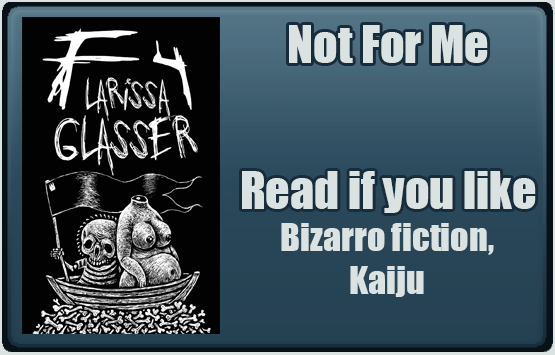
F4 by Larissa Glasser

F4 by Larissa Glasser

Formats: Print, digital

Publisher: Eraser Head Press

Genre: Blood & Guts, Body Horror, Monster, Sci-Fi Horror

Audience: Adult/Mature

Diversity: Trans women, Bisexual women, Queer women

Takes Place in: North Atlantic ocean

Content Warnings (Highlight to view):  Bullying, Drug Use/Abuse, Death,  Forced Captivity, Gore, Homophobia, Kidnapping, Mention of Medical Procedures, Police Harassment, Rape/Sexual Assault, Sexism, Slurs, Stalking, Suicide, Transphobia, Verbal/Emotional Abuse, Violence 

Blurb

A cruise ship on the back of a sleeping kaiju. A transgender bartender trying to come terms with who she is. A rift in dimensions known as The Sway. A cruel captain. A storm of turmoil, insanity and magic is coming together and taking the ship deep into the unknown. What will Carol the bartender learn in this maddening non-place that changes bodies and minds alike into bizarre terrors? What is the sleeping monster who holds up the ship trying to tell her? What do Carol’s fractured sense of self and a community of internet trolls have to do with the sudden pull of The Sway?

Please note: This review was written before I was out as genderqueer. In the review I refer to myself as not being part of the trans/non-binary community. This inaccurate. 

The horror genre is not generally kind to trans-women, frequently depicting them as serial killers and/or sexual deviants. Hell, fiction in general doesn’t treat trans people well, forcing them into a victim role and focusing on their angst and dysphoria. So you can imagine how unbelievably excited I was when I learned that Eraserhead Press was publishing a horror story about a bad ass trans woman who fights monsters and alt-right trolls. Even better, it was being written by a trans woman! Glasser is  a librarian from Boston which makes her five-hundred times cooler in my eyes (I love librarians, they’re like keepers of secret knowledge and they know everything). The reviews for F4 have so far been unanimously positive, the premise sounded weird and awesome, and it promised representation rarely found in the horror genre. F4 was like everything I had wished for and I could not pre-order it fast enough.

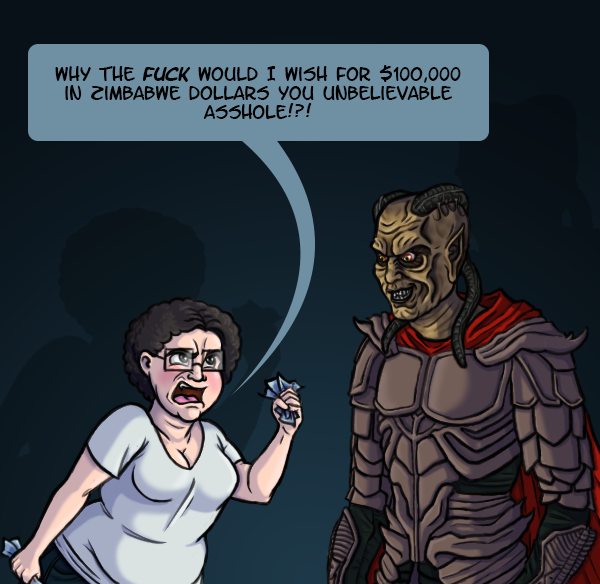
Well, apparently whatever jinni decided to grant my wish for an awesome trans-lady horror story written by a trans person was one of those dick bag jinn who likes to pull that Monkey’s Paw shit, because I haven’t been this disappointed since I first saw Star Wars Episode One after months of hype.


I’m clutching handfuls of blue bills and angrily screaming at the Djinn from the Wishmaster film series who is looking please with himself. I yell “Why the FUCK would I wish for $100,000 in Zimbabwe dollars you unbelievable asshole!?!”

I guess I’m just lucky the Djinn didn’t give me $10,000 in pennies that fell from the sky and crushed me to death.

Carol, the main character of the story, is a trans-woman who works as a bartender on the Finasteride, a cruise ship built on the back of the F4. This name does not, in fact, come from one of those computer function keys that no one ever uses for anything (except maybe the F5 key), but instead refers to the last of four kaiju that mysteriously appeared on earth and fucked up a bunch of stuff. Okay, so far so good. Then, all of a sudden, everyone on board starts turning into eldritch abominations… and thus begins a confusing clusterfuck of unexplained randomness. The transformations may or may not have something to do with a dimensional rift called the Sway, which isn’t mentioned prior to everything going to hell, is never fully explained, and may or may not be common knowledge in the book’s world.  Carol’s creepy boss and his even creepier buddy are behind everything, because they want to sail into the Sway, but their motivation is never explained beyond some vague lust for power. Well, if it works for Saturday morning cartoon villains I guess it’s fine. There’s also a wizard who lives in the Sway and can control the Kaiju, who we’ve also never heard of before and who also isn’t really explained. Again, it’s really unclear whether this is common knowledge or not, or if the Sway is actually just some giant, extra-dimensional plot hole and we’re just expected to go with it. The weirdest part is that even though the wizard controls the kaiju, he isn’t evil despite his giant beasts killing millions of people. One of them even destroyed New York City looking for Carol (why though!?!), but fuck all those victims, I guess? Why is no one horrified by all this? Oh, and apparently Carol’s penis is some sort of magical flesh key or something, I don’t even know. Maybe her penis’ magic is why she gets erections constantly (and won’t shut up about it), despite having had an orchidectomy. Usually, having your testicles removed or going on testosterone blockers causes penis-having folk to have very few spontaneous erections (and some stop getting erections all together) so it seems really odd that Carol keeps getting constant danger boners (which would be an awesome band name) but I’m hardly an expert, so whatever.

In addition to her bartending duties, Carol also makes sex videos on the side with her friend Chole, another transwoman whom she’s slightly obsessed with. Carol’s wait staff of trans women, or “lady dicks” as she calls them, also make extra cash “servicing” the passengers of the Finasteride. This is the part that made me feel really weird. Frequently when trans people appear in fiction, it’s as some sort of sex worker, and they’re being written by cis folk who have little understanding of, or respect for both trans women or sex workers. It’s such a cliché that cops will actually harass trans women on the street because they assume they’re prostitutes. So having the majority of the trans women in a story do some sort of sex work felt problematic, especially since most of the clients appeared to consider them a fetish rather than real people. It certainly doesn’t help that Carol doesn’t even seem to like doing web-cam work, and is only tolerating it because Chole pressured her into making porn. I enjoy naked people having sexy fun times as much as the next person, especially when those people are queer and/or non-binary, and one of the things that originally drew me to F4 was the promise of erotica with trans-ladies. But when the participants are being pressured, exploited, or fetishized, porn is just gross. F4 felt more like the later. The sex scenes aren’t even arousing. One involves a toothless dude drooling in Carol’s ass crack as she feels uncomfortable and wishes it were over. Ick. Chole also gets sexually assaulted by one of the kaiju’s parasites in a really uncomfortable scene (which I think was supposed to be humorous?) and Carol does exactly jack and shit to help her friend. Maybe weird, unappealing sex is a staple of bizarro fiction, but trans women are disrespected enough in the porn industry, I was really hoping it wouldn’t happen here too.

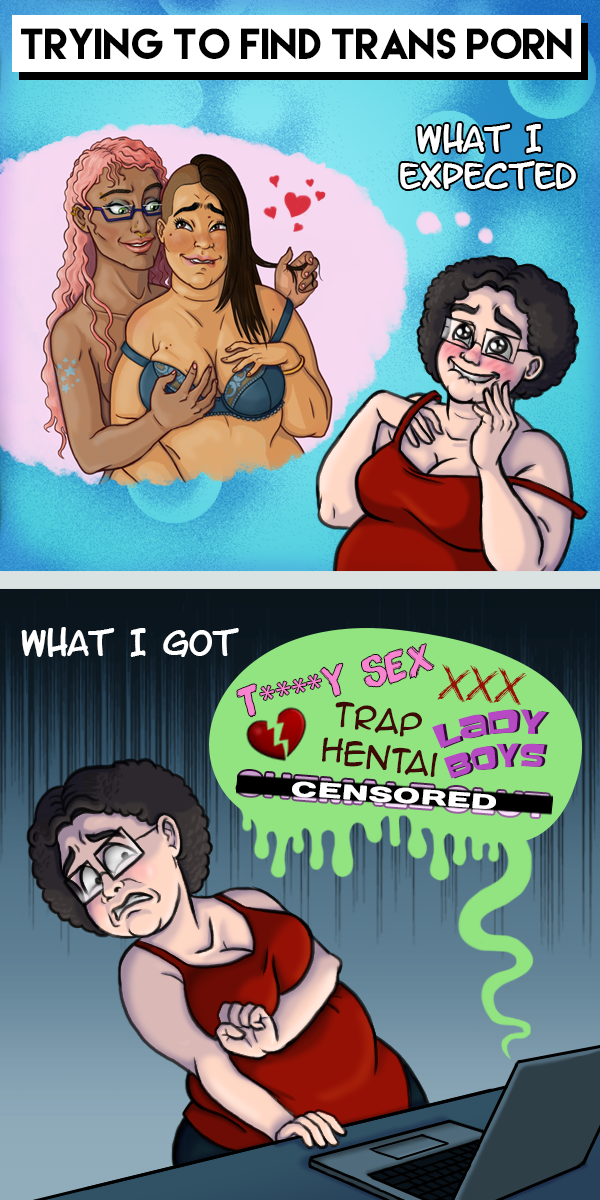
The comic is titled “Trying to find trans porn.” The first panel says, “what I expected” and depicts me blushing and looking aroused while I imagine two women of color, one of whom is plus-sized, in an intimate situation looking lovingly at each color. The second panels says, “What I got” and shows me recoiling in horror and disgust from my laptop. A toxic green speech bubble reveals what is written on the screen, and is full of transphobic language like “Tr***y Sex”, “Trap Hentai”, and “Lady boys”.

F4 isn’t like the terrible, transphobic porn you might find online, but it’s not particularly good erotica either.

My confusion regarding the story line made it difficult to focus on the book (as did the frequent mention of dicks), and I probably would’ve given up on it completely if not for part two, the saving grace of F4. Part two is proof that Glasser really is a talented author. Instead of getting a bunch of random nonsense throw at us we get an intriguing and suspenseful, but straight forward story of Carol’s life prior to the Finasteride. Her character suddenly feels relatable. She’s dating a loser she can’t seem to dump, living in the middle of nowhere, and trying to figure out what to do with her life. Carol witnesses a murder, and tries to do the right thing by reporting it to the cops. But since no good deed goes unpunished, she finds herself in the media spot light after becoming a key witness in the murder case, and becomes a victim of an online hate campaign by a bunch of transphobic trolls. Part 2 is great! It’s intriguing, suspenseful, we finally get some explanations about what’s going on, and of course Glasser had to go and ruin it by making part 3 even more random and confusing. This just made me hate the rest of the book even more because I now knew I could’ve been enjoying a well-written story about a trans woman vs. a bunch of internet trolls, and dealing with the dilemma of being punished for doing the right thing. But instead I had to put up with awkward sex, magical girl dicks, and a series of loosely connected plot holes. So I became bitter and sulkily rushed through the third part of the story, desperate to find some of the magic from Part 2. The only thing that redeemed part 3 was Carol killing the two entitled dudebros who fucked everyone over for more power, one of whom was the leader of the internet trolls who ruined her life. That was immensely satisfying.

So yeah, I really didn’t like this book. Of course, I’m not trans (well, I am, but I wasn’t out when I first wrote this), so it’s possible my privilege was preventing me from recognizing the appeal of F4. All the reviews I had read online were overwhelming positive, so what was I missing? Was it just not intended for me? So I went to my friend, Ashley Rogers (who you may remember from the Oddity post), for help. I figured since she’s an author herself, a trans sensitivity reader, and a trans rights activist she’d be able to offer some valuable insight. Although Ashley is currently busy working on SCOWL: Fight for your Rights, a subversive, queer-focused, stage combat piece (I designed the logo so I have to shamelessly pimp the project), she was kind enough to take some time out of her busy schedule to share her opinion with me. I also asked her to explain what Glasser meant when she kept talking about “hatching eggs”, but Ashley didn’t know either, nor did any of the other trans and non-binary people I asked, and I eventually had to resort to Reddit and Urban Dictionary.

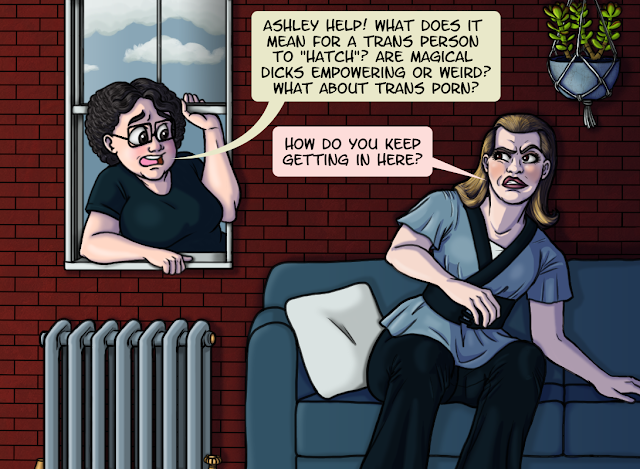
I’m climbing through the window of my friend, Ashley Roger’s, apartment (presumably having broken in). “Ashley help! What does it mean for a trans person to “hatch”? Are magical dicks empowering or weird? What about trans porn?” I ask. Ashley, a tall woman with a fashionable blue top, blond-streaked, shoulder length hair, and expertly done make-up, is sitting on the couch and leaning away from me, looking annoyed. “How do you keep getting in here?” she demands.

It turns out “eggs” refer to closeted trans folk still struggling with their identity who have not yet come into their own.

Ashley had the following to say:

First a disclaimer: Trans/n-b folk can and should be able to tell whatever stories we want.  I love bizarre and spooky material, and I want trans folk to succeed, and regardless of my feelings on this novel I am excited to see more from Larissa Glasser…
Buuuuuuuut…

My main criticism is that the piece doesn’t seem to know what it wants or who it’s written for. F4 intends to shock (evidenced by the material referenced in the piece such as Cannibal Holocaust and The Human Centipede) but it falls short of living up to those expectations.  We don’t live in the uncomfortable moments and grotesque situations long enough to care.  At most we’re left with a sense of “ok… That’s fucked up,” but then we move on to something else before we have a chance to feel unsettled.

Part two feels like a completely different (and subjectively better) novel entirely.  I was gripped by the backstory and it had a great flow, and some of the concepts are really cool (Hell, it’s about turning a Kaiju into a cruise liner!!), but as a trans woman I couldn’t help but be bored by how often Carol popped a boner in the face of danger.  One of the positive critiques I’ve seen from other trans women is that it’s a story that isn’t about a trans character who’s sad, angry, and depressed about surgical transition/dysphoria but the way the author focuses on Carol’s anatomy and overly sexual descriptions rather than creating the atmosphere distracts from the story and intriguingly bizarre concept of the piece in the same way these other pieces focus on the tragedy porn that gets written about our physical transition struggles.  If this book was all part two I would be writing a very different statement but… I wish it were either more shocking in execution or more approachable in material, but as it stands it sits in limbo of both.

I won’t lie, I feel genuinely guilty about not liking F4. I mean, everyone else loves it, and I want to be supportive of trans and non-binary folk in a cis-centric genre, but I just could not enjoy the story. I had no idea what was going on half the time, a lot of it just seemed to be weird for the sake of weirdness and contributed nothing to the story, and, the sex scenes felt more gross and exploitative than sexy and empowering. I liked the ideas behind F4, but the execution left a lot to be desired. Glasser clearly has talent as a writer, as is evident from part 2 of the story, so maybe I just don’t like bizzaro horror, I don’t know.  At the very least I can say it’s like nothing I’ve ever read before. In the mean time, I’m going to stick to reading Nerve Endings when I’m in the mood for some well written trans erotica.

The Ballad of Black Tom by Victor LaValle

The Ballad of Black Tom by Victor LaValle

Formats: Print, audio, digital

Publisher: Tor

Genre: Eldritch, Monster, Historic Horror, Occult, Sci-Fi Horror

Audience: Adult/Mature, Y/A

Diversity: Black characters (African American and Caribbean)

Takes Place in: Harlem, New York City, USA

Content Warnings (Highlight to view): Bullying, Death, Gore, Mental Illness, Medical Procedures, Oppression, Physical Abuse, Police Harassment, Racism, Torture, Verbal/Emotional Abuse, Violence, Xenophobia

Blurb

People move to New York looking for magic and nothing will convince them it isn’t there.
Charles Thomas Tester hustles to put food on the table, keep the roof over his father’s head, from Harlem to Flushing Meadows to Red Hook. He knows what magic a suit can cast, the invisibility a guitar case can provide, and the curse written on his skin that attracts the eye of wealthy white folks and their cops. But when he delivers an occult tome to a reclusive sorceress in the heart of Queens, Tom opens a door to a deeper realm of magic, and earns the attention of things best left sleeping.
A storm that might swallow the world is building in Brooklyn. Will Black Tom live to see it break?

Oh Lovecraft, you were such a great horror writer, but an absolutely terrible human being.

When it comes to Lovecraft, I have some very complicated opinions. I adore the Cthulhu mythos, cosmic horror, and the concept of forbidden knowledge that utterly destroys your sanity, but it’s hard to enjoy his writing when he liberally peppers it with his hatred for anyone who isn’t a WASP. One minute  I’m reading an enjoyable little story about a cosmic abomination and the dark secrets humanity was never meant to know, and the next it’s morphed into some sort of eugenics bullshit. Here’s a small sampling of just some of the bullshit he pulls in his stories: In the Case Of Charles Dexter Ward Lovecraft describes a woman as having “a very repulsive cast of countenance, probably due to a mixture of negro blood,” in Herbert West: Reaminator the black boxer, Buck Robinson, is compared to an ape, in The Rats in the Walls there’s a black cat named N****r Man, The Horror at Red Hook is basically just Lovecraft rambling about how much he hates immigrants and black people who he refers to as a “contagion” with “primitive half-ape savagery”, and in Medusa’s Coil he describes slavery as “a civilization and social order now sadly extinct”. Oh, and let’s not forget that poem. There’s a good reason why Lovecraft’s bust is no longer used for the World Fantasy Award trophy, the guy was a dick.

A drawing of Nnedi Okorafor wearing a dark blue dress, large red and gold earrings, and holding her World Fantasy Award, a bust of H.P. Lovecraft. Okorafor looks uncomfortable while she says “Um, Thanks, I guess? Yeah, I don’t really want this racist’s head on my mantle.”

I tried to draw Nnedi Okorafor, “tried” being the operative word. She says I got it right from the shoulders up though!

Now, before anyone uses the “Lovecraft was just a product of his time” excuse, please consider this: Yes, his active years as a writer were during the incredibly racist segregation era, but not everyone shared his shitty beliefs about people of color and Jews. Mary White OvingtonMoorfield Storey, and William English Walling were all white, but they were also supporters of  civil rights and racial equality during the same period, and even helped found the NAACP with W. E. B. Du Bois. So it’s not like every white person in the 1920s and 1930s was racist. Lovecraft would’ve at least been aware of civil rights due to Guinn v. United States, a landmark case that found racist literacy tests unconstitutional, the National Negro Business League which helped to double the number of black owned businesses, and prominent black lawyer Charles Hamilton Houston, who was fighting for civil rights in court. Hell, even his friends and family criticized the horror writer’s ignorant attitude. Lovecraft’s wife, Sonia Greene, and friend Samuel Loveman were both horrified by Lovecraft’s anti-Semitism and resented him for it. Sonia even wrote, “Whenever we found ourselves in the racially mixed crowds which characterize New York, Howard would become livid with rage… He seemed almost to lose his mind.” When Lovecraft attacked Charles D. Isaacson‘s, article on racial tolerance, In a Minor Key, in his own article titled In a Major Key (where he praised the KKK as “that noble but much maligned of Southerners who saved half our country from destruction”) he managed to piss off not just Isaacson, but his own friend James Ferdinand Morton, both of whom wrote responses attacking Lovecraft’s racism. He knew people thought he was racist, as he’d been called out multiple times and even his wife had pleaded with him to reconsider his beliefs- Lovecraft just chose to be an intolerant jerk.

There are two books. On the left is a book with a red cover written by H.P. Lovecraft. It’s titled “The Horror at Red Hook, or Why Immigrants and Minorities Ruin Everything.” On the right is a green, leather bound book with an image of a brass octopus on the cover. The title, written in gold lettering, is “Lovecraft’s Letters: About How Anyone Who Isn’t Anglo-Saxon Sucks, and Why Eugenics are Super Awesome”.

Probably real Lovecraft titles.

Luckily for us, many talented creators have taken concepts in Lovecraft’s writing and used it to create their own works, so fans can still enjoy Yog-Sothoth, the Deep Ones, and the horrors of forbidden knowledge driving men to madness- without all the bigotry. The Ballad of Black Tom is one of these works, a retelling of  Lovecraft’s incredibly racist The Horror at Red Hook from the point of view of a black man living in Harlem.

For those not familiar with Lovecraft’s original short story, The Horror at Red Hook follows police detective Thomas Malone and his pursuit of forbidden knowledge in the immigrant neighborhood of Red Hook, Brooklyn, or as Lovecraft describes it “a maze of hybrid squalor”. Because the only religions in Lovecraft’s world are either good, Anglo-Saxon Christianity or evil, bad, demon worship, all the brown people are apparently involved with the occult.  Malone is put on a case involving the wealthy and eccentric recluse, Robert Suydam because his relatives want the old man declared mentally unfit so they can have his money. During the course of the investigation Malone discovers that Suydam has been spending time with illegal immigrants and foreigners, which obviously means he’s doing something super evil, like sacrificing white babies to tentacle-faced monsters, because Lovecraft is racist and Malone is an awful detective. Suydam continues to do suspicious things, in Malone’s opinion anyway, like lose weight, work on his personal grooming, and get married. Eventually the whole thing cumulates in a police raid in Redhook, where Malone finds a bunch of creepy shit in Suydam’s basement flat which causes the police detective to lose his sanity points and pass out from sheer terror. Afterwards we discover that the buildings collapsed, killing almost everyone except Malone, who is left with PTSD and batophobia. The rest of the story is just Lovecraft whining about immigrants “ruining” New York and reads like the antiquated 8,000 word equivalent of a Trump tweet. It’s not one of his better stories. So it’s kind of a miracle that LaValle not only manages to write a version of The Horror at Red Hook that’s not just a commentary on racism, but is actually good, while still keeping all the creepiness, mind-fuckery, characters, and plot of the original. Suydam and Thomas Malone both appear as major characters in The Ballad of Black Tom, Malone serving as a deuteragonist for the second half of the story, while Suydam introduces Tommy Tester, the book’s protagonist, to the occult. There are other hidden references to Lovecraft lore throughout the book. The title, Black Tom, is an allusion to the cat from The Rats in the Walls whose name was changed from N***** Man to Black Tom when the story was reprinted in Zest magazine in the 1950s. Toward the end Robert LaValle mentions a man from Rhode Island, living in New York, who may be Lovecraft himself.

LaValle defends the minority population living in Harlem and Redhook that Lovecraft so despised by showing them as the every day folks they are, trying to get by with what little they have. Tommy even expresses disappointment after visiting the Victoria Club, when he learns that it’s not the den of debauchery and sin he had hoped for, but instead old men playing cards and women selling meals they’ve made at home. There are criminals, yes, but that’s to be expected in any impoverished area, and they’re far from a majority of the population. When Tommy discovers Suydam is associating with so many criminals, he’s terrified, and it speaks more to the rich, white man’s character than the immigrants on New York. What Malone discovers in the basement is also been changed from the original, but to reveal more would ruin the amazing ending of Black Tom. Let’s just say LaValle provides his readers with more detail on the horrors the detective discovers, and a much more satisfying ending.

The thing I found the scariest about The Ballad of Black Tom weren’t the fictional monstrosities sleeping at the bottom of the see ready to destroy humanity, it was how much LaValle’s fictionalized world reminded me of our own. The cops’ blatant racism, their harassment of black men who were simply walking down the street, and their willingness to kill at the slightest provocation felt all too familiar, as did the rampant xenophobia and anti-immigration attitudes. The story may be set in the 1920s, but it’s clear that some things still haven’t changed. Tommy’s encounters with the police were enough to give me panic attacks, as I remembered my own family’s terrifying encounters with cops. While I’m pale enough to pass as white, most of my extended family isn’t, and I grew up with horror stories about what happened to black people stalked, shot, raped, and lynched for merely existing. Tommy has learned what every young black person is still being taught: if the police stop you, appear as non-aggressive as possible, be polite, and put up with whatever harassment the cops dish out or you’ll wind up dead. We see this in all his encounters with Malone. Tommy plays dumb, looks downs, and lets them steal his money and insult him to his face without making a comment. At least for the first half of the book.

Tommy Tester starts the story as a good man. He may trick others and take on some not-so-legal work, but he’s trying to take care of his disabled father in a world that’s against him, so it’s not surprising he has to do some questionable things to survive. At least he never actively hurts others and tries to do the right thing when he can, like preventing a witch from getting her hands on forbidden knowledge, which is more than I can say for most of the people Tommy encounters. Racist cops constantly threaten and abuse him, he’s harassed by a bunch of white kids just for walking while black, and white society treats him as less than human. Even Robert Suydam, who claims to admire Tommy and gives him a large sum of money to play guitar in his home, is merely using for his own ends. As it turns out, Suydam is a white man who fetishizes POC cultures, while still viewing himself as superior to the same people he claims he wants to help. There’s a saying “you can only kick a dog so many times before it bites back” and after being attacked, abused, taunted, stolen from, threatened, and finally losing everything to cold and corrupt law enforcement, Tommy Tester realizes he has nothing left to lose and says “fuck it”. And that’s how we start the second half of the story, told from Malone’s point of view, with Tommy, now calling himself “Black Tom,” transforming himself into the most badass, brutal, and terrifying antagonist in order to exact his bloody revenge on Robert Suydam, Thomas Malone, and the xenophobic NYPD. And let me just say, it’s immensely satisfying. Gory, but satisfying.

I abhor violence in real life, and obviously don’t agree with mass slaughter and abuse, no matter how evil the victims are. The real world is more complicated than just good vs. evil, and violence and revenge just beget more of the same. That said, there’s still a violent, pissed off part of me, hurt and furious at the injustice of the world, that wants to see wicked people suffer. Not just get their richly deserved comeuppance, but really, truly suffer in the worst ways imaginable. It’s the bitter part of me that relates to all those Saturday morning cartoon villains of my past who just want to destroy everything, because the world is such a terrible, hateful place that it probably deserves it. This vengeful part of me that becomes more and more hateful every time I read the news was immensely satisfied and soothed to watch Black Tom punish a group of racists who resemble 21st century hate groups a little too closely. It’s the same anger that motivates Killmonger in the Black Panther film.


But, like I said, these are ugly thoughts I would never actually act on or hope to see happen in real life because I know how wrong they are, and I still hold on to the hope that logic and compassion will win out (so FBI, if you’re reading this, I just want to clarify, I’m not actually planning on going on any kind of bloody killing spree). When Tommy, pushed to choose between an eldritch abomination and the hateful people who hurt him again and again, he gives in to revenge and loses part of his humanity, and that’s what makes the story so bitter-sweet. Black Tom may have gotten his revenge, but at the cost of being a good man, something he will have to live with for the rest of his life. He’s compromised his most important value, being the kind of man his father would be proud of, and can no longer look his best friend in the eye. As satisfying as it is to see horrible people suffer a horrible fate, you can’t help but feel bad for Tommy who’s left to wonder if it was really worth it. 

My wife, who is wearing a blue space dress and white, over-the-knee socks has just opened the door to reveal two FBI agents, a light-skinned man, and a dark-skinned woman. My wife has her hands on her and looks irritated. She shouts, “What did you do this time!?!!” I’m in the foreground, carrying a human foot that’s been cut off below the knee. The limb is starting to decay and is wrapped in bandages. I look surprised and guilty at being caught by my wife.

The severed human leg actually has nothing to do with why the Feds are here. Though I’m sure my wife is going to ask about that too. Watch what you say on the internet kids!

Navigation

Social Media

Search by Tags

To learn more about the Age Group, Diversity, and Genre tags, click here.

Age Groups

Diversity

Genre

Support the Blog

Search

Links

Crescentville Haunting by M.N. Bennet

Crescentville Haunting by M.N. Bennet

Formats: digital

Publisher:  Self published

Genre: Ghosts/Haunting, Monster, Occult, Romance, Vampire, Werewolf, Zombie

Audience: Y/A

Diversity: Bisexual main character, non-binary minor character, Black major character

Takes Place in: LA, California

Content Warnings (Highlight to view): Alcohol Abuse, Cannibalism, Death, Forced Captivity, Gaslighting, Gore, Medical Procedures, Mental Illness, Racism, Sexism, Slurs, Slut-Shaming, Violence, Vomit, Xenophobia

Blurb

Determined to pass junior year, Logan won’t let Henry distract him—much. Logan’s focusing on all things human, which means his swoony vampire ex-boyfriend will have to file his own fangs for a change. When he goes to the school bonfire and runs into Henry, wandering into the woods seems like a great escape. Until he’s bitten by a wicked Crone with some twisted magical munchies.

Logan is certain his ex-free human future is done when he’s dragged off to a scientific institution for study. There, he’s presented with an opportunity to keep his life, family, and future. All he has to do is stick to human ideology, since all things paranormal are illegal. But complications arise when the Crone begins to haunt him and Logan realizes that if he wants to get his life back, he has to navigate his lingering feelings for Henry.

With the Crone set on devouring him and the institution ready to obliterate him for any missteps, Logan must decide between pursuing the human future his family wants—one that he thought he wanted too—or the chance to embrace Henry, even if the world isn’t ready.

I received this product for free in return for providing an honest and unbiased review. I received no other compensation. I am disclosing this in accordance with the Federal Trade Commission’s 16 CFR, Part 255: Guides Concerning the Use of Endorsements and Testimonials in Advertising.

Logan just wants a safe, normal, drama-free junior year, and that means avoiding his vampire ex, Henry, at all costs. Which is easier said than done. Logan may be shy and awkward, but Henry is his complete opposite: confident, outgoing, and suave. When his best friend Kiera (a phantom) drags him to a bonfire party that’s supposed to help Logan relax, he discovers that trouble has a way of following him. Not only is Henry there, but Logan is attacked (for the second time since he first started dating Henry) by a powerful creature, this time a monstrous witch known as the “Crone.” After sustaining a bite from the Crone, Henry’s life changes forever.

Henry and Kiera are known as Vices, a group of monsters including phantoms, witches, vampires, trolls, sirens, and werewolves that are forced to live in the shadows due to public fear and draconian laws. The Crone is a sin, a powerful Vice that feeds on other Vices and can turn humans into undead monstrosities called Hauntings (think zombies and ghouls) with a single bite. After Henry’s attack he’s whisked away by SPU agents (the special police force in charge of catching and neutralizing Sins) to a secure facility designed to treat Hauntings, but to everyone’s surprise he doesn’t transform into a Haunting. It turns out Henry is a rare form of Vice, known as a Viceling, more human than Vice. The lore of Crescentville Haunting can get confusing in places, and there’s a lot of backstory. So much so that I actually checked to see if there was a prequel I had missed. But it’s no worse that any other fantasy novel with rich world building. If you can remember the rules of Quidditch, you can remember the magical classification system Bennet has created.

The characters are relatable and their voices sound authentic. The romance is steamy without being explicit and felt age appropriate for younger teens. It should be noted that while the book contains a paranormal romance, it’s not the central theme of the story. Instead, we focus on Logan’s struggles with his new identity and trying to fit into a human-centric world– an analogy for trying to fit into a heteronormative society when you’re LGBTQIA+. In Monsters in the closet: Homosexuality and the Horror Film Harry M. Benshoff writes “monster is to ‘normality’ as homosexual is to heterosexual.” LGBTQIA+ scholars have long equated queerness with fictional monsters and stories like Crescentville Haunting reclaim the “monstrous queer.” In Bennett’s story, the “homosexual vampire” is the hero rather than the villain, with the humans representing an oppressive heteronormative society and the facility attempting to “cure” Logan of his monstrousness a metaphor for conversion therapy. In addition to romance, the book also has plenty of horror, violence, and suspense, all courtesy of the Crone who continues to haunt Logan after the initial attack.

Overall, this was a fun read with a good world building, a cute relationship, and teens who actually sounded and acted like teens.
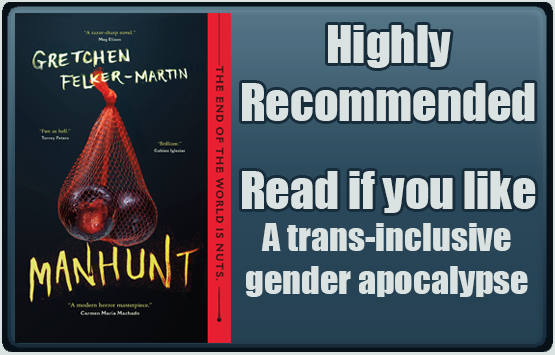
Brutal Hearts by Cassie Daley

Brutal Hearts by Cassie Daley

Formats: Print

Publisher: Self Published

Genre: Killer/Slasher, Monster

Audience: Y/A

Diversity: Autistic character, author is queer and autistic

Takes Place in: type here

Content Warnings (Highlight to view): Cannibalism, Child Death, Death, Gore, Violence

Blurb

It’s 1997 and Leah just can’t seem to catch a break.

A year has passed since her fiancé went missing while hiking alone on a mountain, and she can’t shake the unanswered questions and nightmares Simon left behind.

On the anniversary of his disappearance, Leah and her new girlfriend Josie return to the trail where Simon disappeared with two of their best friends. Armed with incense, tarot cards, crystals, and snacks, the girls have everything they need to complete the Ritual of Closure to help Leah finally say goodbye to Simon, once and for all.

But the trails are hiding something sinister, and it’s been waiting. As night falls around them, the girls find themselves in a deadly game against something vicious and wild that’s made a home for itself on the mountain.

It’s time to find out what really happened to Simon.

The year is 1996: Scream has just been released in theaters, the Macarena is the hottest new dance craze, and seventeen-year-old Leah is deeply in love with her high school sweetheart, Simon. The two have plans to marry after graduation, but that dream is destroyed when Simon goes missing after a hike in the nearby mountains. Volunteers scour the woods for any trace of the missing boy, but it’s like Simon has vanished without a trace.

A year later, Leah is still struggling with her grief and guilt. Her girlfriend, Josie, is doing her best to help Leah through the nightmares and sobbing fits, but nothing seems to help. In a last-ditch effort to give the poor girl some closure, Josie suggests they hike Simon and Leah’s favorite trail to say a final goodbye. Along with Leah’s two best friends, sisters Charlotte and May, the girls set off to perform a Wiccan inspired goodbye ceremony for him. But their beautiful day quickly goes south when something in the woods starts stalking them.

Brutal Hearts is short but gripping story, switching back and froth between the girls being stalked through the woods and the mystery surrounding Simon’s disappearance. I ended up finishing it in one sitting, something I never do even with novellas (ADHD makes it hard for me to focus on a book for too long unless I’m really engaged). I loved all the little nods to 90s aesthetics, from the clothing, to May’s Tamagotchi and the girls’ obsession with all things Wicca. (From Sabrina Spellman to Nancy Downs witches were huge in the 90s, inspiring a renewed interest in Wicca from teenage girls.) Although, it is hard to accept that the 90s were thirty years ago and are now officially nostalgic. Wasn’t it literally just 2000? I think Y2K caused my brain to crash and stop perceiving the passage of time.

I especially liked the addition of the playlists for each character in the back of the book. Leah’s music playlist revolves around being hurt by love. Josie likes grunge. May’s playlist is full of bubblegum pop while the more traditionally pretty and popular Charlotte prefers mainstream music. A fun flashback to 90s teen horror like Fear Street and the works of Christopher Pike (appropriate since Daley also runs the PikeCast) with a healthy dose of urban legends and campfire stories. A perfect read for a hot summer night. 

Manhunt by Gretchen Felker-Martin

Manhunt by Gretchen Felker-Martin

Formats: Print, audio, digital

Publisher: Tor Nightfire

Genre: Apocalypse/Disaster, Monster

Audience: Adult/Mature

Diversity: Trans author and characters, queer characters, Native character

Takes Place in: northeastern USA

Content Warnings (Highlight to view): Animal Death, Body Shaming, Cannibalism,  Child Death, Childbirth, Death, Drug Use/Abuse, Eating Disorder, Forced Captivity, Gore, Illness, Kidnapping, Medical Procedures, Oppression, Rape/Sexual Assault, Self-Harm, Slurs, Torture, Transphobia, Verbal/Emotional Abuse, Violence

Blurb

Y: The Last Man meets The Girl With All the Gifts in Gretchen Felker-Martin’s Manhunt, an explosive post-apocalyptic novel that follows trans women and men on a grotesque journey of survival.

Beth and Fran spend their days traveling the ravaged New England coast, hunting feral men and harvesting their organs in a gruesome effort to ensure they’ll never face the same fate.

Robbie lives by his gun and one hard-learned motto: other people aren’t safe.

After a brutal accident entwines the three of them, this found family of survivors must navigate murderous TERFs, a sociopathic billionaire bunker brat, and awkward relationship dynamics―all while outrunning packs of feral men, and their own demons.

Manhunt is a timely, powerful response to every gender-based apocalypse story that failed to consider the existence of transgender and non-binary people, from a powerful new voice in horror.

 received this product for free in return for providing an honest and unbiased review. I received no other compensation. I am disclosing this in accordance with the Federal Trade Commission’s 16 CFR, Part 255: Guides Concerning the Use of Endorsements and Testimonials in Advertising.

Have you ever wondered what happens to trans people in sex-based apocalypses like those in Y: The Last Man or Ōoku: The Inner Chambers? Gretchen Felker-Martin sets out to answer exactly that in her post-apocalypse splatterpunk novel Manhunt.

The T-rex virus transforms anyone with high levels of testosterone—mostly cis-men—into cannibalistic, sex-crazed monsters. Emboldened by the end of the world, a group of TERFs (trans-exclusionary radical “feminists”) have formed their own militia where they hunt and kill any trans women they find. It may seem like a group of militant TERFs is an exaggeration, but it feels like less of a stretch when you consider there’s already a high rate of violence against trans people. In 2021 alone, at least 56 trans and gender non-conforming people were murdered in the US. Transphobic hate crimes have quadrupled over the last five years in the UK. These fake feminists are also more fascist adjacent than they’d like to admit. As Judith Butler accurately pointed out, TERFs “have allied with rightwing attacks on gender” and “The anti-gender ideology is one of the dominant strains of fascism in our times. So, the TERFs will not be part of the contemporary struggle against fascism.” TERFs Lily Cade and Bev Jo Von Dohre have even called for the death of trans women. The fact that trans women in Manhunt can transform into monsters if they don’t have access to anti-androgen medication gives the TERFs exactly the excuse they’ve been waiting for to go from hateful rhetoric to actually destroying that which they hate most (never mind that cis-women with PCOS or congenital adrenal hyperplasia can also transform into feral beasts).

Not only do trans women have to avoid getting killed by the monstrous men, but also running into the militant TERFs who have seized control of most of the northeast. Fran and Beth are two such transwomen trying to survive in the new world, catching feral men and harvesting their testicles for their friend Indy to extract estradiol from. After running afoul of a militant group of TERFs and almost being killed by men, Fran and Beth meet a sharp-shooting trans man named Robbie, who they take on their journey with them. The trio return to Indy’s house with their testicle trophies where they learn she’s been offered a job by a spoiled rich girl who controls a luxurious bunker. But the promises of comfort the bunker offers may hide a deadly truth.

While I personally enjoyed this book, it won’t be for everyone. It is splatterpunk, after all. That means there’s lots of brutal violence (including a cis woman having her uterus cut out of her), gross content (testicle eating), and graphic sex. Everyone in Manhunt is super horny, sometimes at wildly inappropriate times, so Beth, Fran, Indy, and Robbie do a lot of fucking. The sex is hot, sometimes gross, and other times both hot and gross, much like real sex. It was nice to have sex scenes centered around trans pleasure rather than the cis-male gaze. Of course, the graphic description of genitalia might be triggering for some people who experience gender dysphoria, so be aware of that. Speaking of hot sex, a captain in the TERF army named Ramona is sleeping with a non-binary prostitute named Feather. One reviewer claimed this is unrealistic but I have to disagree. A lot of chasers are happy to sleep with trans people but won’t do anything to defend their rights or even stand up for them. Too many people with trans partners see their relationship as a shameful secret to be kept, and Ramona is no different. She’s too much of a coward to do the right thing and just goes along with the TERF army because it’s what’s easy.

Splatterpunk is very hit or miss for me, as many extreme horror books can cross over into misogynistic violence. Manhunt manages to avoid this trap, even though most of the book’s violence is against women (as all the characters, aside from Robbie, are women). Perhaps because it’s other women committing the violence, but I didn’t get that gross feeling I usually do when reading splatterpunk authored by cis men. Even the sexual assault scene didn’t feel gratuitous and was handled well. I also loved how flawed the protagonists are. Some people mistakenly assume LGBTQIA+ characters need to be perfect for it to be considered a “good” portrayal. I believe realistic is preferable to perfect, and I like my queer characters to have character flaws who sometimes do and say problematic things. Both Beth and Fran feel very human. Beth is reckless and insecure; Fran has both passing and class privilege and can sometimes be selfish. Neither of them are bad people, just realistically flawed.

My only complaint about the book (and granted, it’s minor) is that there are so many descriptions of Indi’s fat body. The way she’s described isn’t quite fatphobic, but it did make me feel uncomfortable that there was so much focus on it. I can understand that Indy is dealing with a lot of internalized fatphobia and insecurity, so it makes sense that her character would spend a lot of time focusing on her size and the limitations that come with it. When the story is told from a third-person point of view, there’s no reason for Indy’s weight to be described in such detail, especially since no one else’s body gets that much description or scrutiny. At least she’s never described as gross or unattractive, and Indi even gets to be sexually desirable, which is rare for fat characters outside of fetish porn. It was refreshing to see fat people having passionate sex scenes just like their skinny counterparts. Like I said, it’s a minor complaint and could absolutely be my own hypersensitivity.

Reading this book is like having your brain put in a blender. It’s wild, gross, horny, disgusting, tragic, and hilarious all whipped together into an extreme horror smoothie. In other words, I LOVED it. You have to be at least somewhat familiar with trans culture to fully appreciate the story, which I thought was awesome. There’s also just something extremely satisfying about trans women killing fascist TERFs: not something I’d advocate in real life, but it’s fun and cathartic in fiction. Unsurprisingly, this made a bunch of real-life TERFs very angry. They didn’t like being portrayed as bigoted assholes just because of their bigoted asshole-ish behavior and tried to review bomb Manhunt…which should just make you want to read it more.

Conquer by Edward M. Erdelac

Conquer by Edward M. Erdelac

Formats: Print, audio, digital

Publisher: Self Published 

Genre: Historic Horror, Monster, Mystery, Myth and Folklore, Occult, Vampire

Audience: Adult/Mature

Diversity: Black/African-American, Hispanic, Trans, Gay

Takes Place in: Harlem, New York, USA

Content Warnings (Highlight to view): Animal Death, Body Shaming, Child Abuse, Death, Drug Use/Abuse, Forced Captivity, Gore, Homophobia, Kidnapping, Necrophilia, Oppression, Pedophilia, Physical Abuse, Police Harassment, Racism, Rape/Sexual Assault, Sexual Abuse, Slurs, Transphobia

Blurb

In 1976 Harlem, JOHN CONQUER, P.I. is the cat you call when your hair stands up…the supernatural brother like no other. From the pages of Occult Detective Quarterly, he’s calm, he’s cool, and now he’s collected in CONQUER.

From Hoodoo doctors and Voodoo Queens,
The cat they call Conquer’s down on the scene!
With a dime on his shin and a pocket of tricks,
A gun in his coat and an eye for the chicks.
Uptown and Downton, Harlem to Brooklyn,
Wherever the brothers find trouble is brewin,’
If you’re swept with a broom, or your tracks have been crossed,
If your mojo is failin’ and all hope is lost,
Call the dude on St. Marks with the shelf fulla books,
‘Cause ain’t no haint or spirit, or evil-eye looks,
Conjured by devils, JAMF’s, or The Man,
Can stop the black magic Big John’s got on hand!

I received this product for free in return for providing an honest and unbiased review. I received no other compensation. I am disclosing this in accordance with the Federal Trade Commission’s 16 CFR, Part 255: Guides Concerning the Use of Endorsements and Testimonials in Advertising.

Conquer is the story of a Black mystical detective named John Conquer (a reference to John the Conqueror) and a homage to 70’s detective fiction and Blaxploitation films. It’s fun, well written, and full of creepiness, including a fetus monster haunting an abandoned subway station and a man shrunk down and boiled alive in a lava lamp. I greatly enjoyed the book, but like most Blaxploitation, it wasn’t without its problems.

It’s important to point out that Erdelac is a White author writing a Black story (something not uncommon in Blaxploitation). I usually prefer to promote “own voices” books, and stories by cishet White men are a rarity on this blog. After all, folks with privilege do not have the best track record when it comes to writing marginalized groups. As Irish author Kit de Waal said, “Don’t dip your pen in someone else’s blood”. Take American Dirt by Jeanine Cummins and The Help by Kathryn Stockett. They’re both terrible for numerous reasons including, but not limited to: not doing enough research, using the White Savior trope, watering down their narratives to make them palatable for White audiences, cultural appropriation, speaking over marginalized voices, etc. That’s not to say White authors shouldn’t write BIPOC characters at all. Not having any diversity in your story can be equally problematic. It just needs to be done carefully and respectfully. Very, very carefully. Yes, I know that can be a fine line to walk, but if an author can research what kind of crops people were growing in 1429 to make their book more accurate, they can research American Indians and people of color. Besides, that’s what hiring sensitivity readers and using resources like Writing with Color is for. Of course, there’s also the problem of White voices being given preferential treatment by publishers and audiences over BIPOC trying to tell their own stories.

To his credit, Erdelac has done an impressive amount of research to make his book feel authentic. John Conquer wears a dime around his ankle for protection and a mojo hand (another name for a mojo bag) for luck. His name is a reference to High John de Conqueror, a Black folk hero with magical abilities. Conquer also has one of the most accurate representations of Vodou I’ve ever seen in fiction. Hollywood “voo doo” is a pet peeve of mine, so I appreciate Erdelac’s dedication to portraying the religion and loa/lwa (the powerful spirits Vodou practitioners worship and serve) accurately. He also doesn’t try to portray an idealized version of 1970s NYC. There’s racism, anti-Semitism, homophobia, and cops and criminals spewing slurs. And while it’s jarring, it does make the story feel more authentic. The police are racist and homophobic and there’s tension between the many communities that make up 1970s New York. John Conquer’s Uncle Silas was disowned by his family for being gay, and when John is asked to solve his murder, he has to confront his own homophobia and transphobia. That doesn’t mean it always works, though. There were definitely a few times I side-eyed and wondered if a certain line really needed to be in there.

My favorite part of the book is Eldelac’s excellent world building. White vampires go up in smoke when exposed to sunlight, while vampires with more melanin are protected from the sun’s rays. Vampirism also halts a corpse’s decay, but all that rot catches up to them when they’re finally killed. Each culture has their own magical practices with distinct rules, and magic doesn’t cross cultural lines. For example, only Vodou practitioners can become zombies, and non-Christian vampires are immune to crosses. Conquer is especially powerful because he’s learned many different traditions and practices, but the catch is that this opens him to a wider variety of spiritual attacks. Street gangs utilize black magic to wage wars with each other. His work is clever, original, and something I could really get into. But…having White authors tell BIPOC stories still feels problematic to me when White authors are still so heavily favored by the publishing industry. I’ve reviewed books by White authors before, but because Conquer is based heavily on Blaxploitation it feels, well, more exploitative than those I’ve reviewed in the past. I’m still going to go ahead and recommend Eldelac’s work because—in the end—it is well written and interesting, but I can also completely understand if some of you want to skip this one.

Hide and Seeker by Daka Hermon

Hide and Seeker by Daka Hermon

Formats: Print, audio, digital

Publisher: Scholastic 

Genre: Demon, Monster, Psychological Horror

Audience: Children

Diversity: Black author and characters

Takes Place in: Tennessee, USA

Content Warnings (Highlight to view): Child Abuse, Child Endangerment, Death, Forced Captivity, Gaslighting, Police Harassment 

Blurb

One of our most iconic childhood games receives a creepy twist as it becomes the gateway to a nightmare world.

I went up the hill, the hill was muddy, stomped my toe and made it bloody, should I wash it? Justin knows that something is wrong with his best friend. Zee went missing for a year. And when he came back, he was . . . different. Nobody knows what happened to him. At Zee’s welcome home party, Justin and the neighborhood crew play Hide and Seek. But it goes wrong. Very wrong. One by one, everyone who plays the game disappears, pulled into a world of nightmares come to life. Justin and his friends realize this horrible place is where Zee had been trapped. All they can do now is hide from the Seeker.

You’d think I’d eventually learn that kid’s media can be just as scary as horror aimed at adults. After all, Over the Garden Wall, Coraline, and Skeleton Man all managed to scar me permanently. And yet, I went into Hide and Seeker foolishly assuming that it would be tame in comparison to my usual horror fare. Well, boy was I wrong. This book was INTENSE. I mean, just look at that cover! Suddenly I was a child again, hiding under the covers from the monsters in the darkness but still unable to put the book down despite the nightmares I knew it would cause. I haven’t had a good scare like that in a while and it was absolutely wonderful. 

Over the Garden Wall — nightmare fuel for the whole family!


Jason is coping with the death of his mother and the disappearance of his best friend, Zee. Despite support from his sister and counselor he still struggles to accept her death and deal with his panic attacks (major kudos to Hermon for portraying an accurate depiction of panic attacks and anxiety). Then Zee reappears suddenly, covered in scars and speaking in riddles about a monster called the Seeker. What should be a joyous occasion quickly turns sour when children in the neighborhood start to disappear after a game of hide & seek. Jason and his friends Lyric and Nia soon learn that the kids were whisked away by the demonic Seeker to a place beyond their worst nightmares, and it looks like they’re next.

Of our trio of heroes, I’d have to say Nia is my favorite. She’s clever, rational, and despite her photographic memory and love of trivia she struggles with schoolwork. It was a nice change of pace to see the token “smart kid” suck at test taking and homework, a reminder that schoolwork is not an accurate measure of intelligence and ingenuity, and learning disabilities don’t mean you’re stupid. Nia uses her wits to help the kids out of more than one scrape and pushes her friends to be their best. She also knows enough about horror movie tropes to advise against splitting up the group. Nia is awesome. Not that Lyric or Jason are slouches. They’re fiercely loyal to each other, and it’s incredibly heartwarming. Even at their worst moments, the kids stick together and support their friends. 

This is the perfect book for kids who love Goosebumps and Stranger Things but are still too young for Stephen King and R-rated Slashers. Hermon is amazing at creating atmosphere and building terror without relying on blood and gore (there are minor injuries though, like bug stings, burns, and minor cuts). Her dialogue conveys the intensity of the situation without swearing. By implying Nowhere is a place where all your greatest fears become real and leaves its victims traumatized and covered in scars, our imaginations are able to come up with the worst possible scenarios. Not that Hermon leaves everything up to the reader’s imagination: there are plenty of giant bugs, living dolls, needles, and rat-snake hybrids to convey how truly terrifying Nowhere is.

Justin faces a lot of scary things, but racists and systemic oppression aren’t among them. It was nice to have a middle-grade book with a Black hero that didn’t deal with racism. Black folks already have to deal with racism All. The. Time. We deserve escapist stories where Black kids get to exist without having to worry about discrimination. Nic Stone, author of Dear Martin put it best in her article for Cosmopolitan:

“…I can’t help but wonder how different the world would look if we’d all grown up seeing Black people do the stuff White people did in books. Going on adventures. Saving the day. Falling in love. Solving mysteries. Dealing with a broken heart. Getting caught up in a riveting love triangle. Taking down oppressive regimes. (I mean, HELLO, a bunch of farm animals took down a dictatorial pig in a book that’s been on middle school curriculum lists for decades. Yet Black people can’t survive the first book in a dystopia trilogy?) What if we’d seen Black people in books just being human?”

The closest the book gets to dealing with racism is when the kids get harassed by a police officer while riding their bikes though a nice neighborhood. Ironically, it’s the one White kid in the group that hates cops the most due to his father being sent to prison for a crime he didn’t commit, and he warns the others not to ask the police for help. And it’s such a nice change to see Black kids fighting make-believe monsters rather than real ones.

Anoka by Shane Hawk

Anoka by Shane Hawk

Formats: Print, audio, digital

Publisher: Self-Published

Genre: Body Horror, Folk Horror, Monster, Myth and Folklore, Occult, Werewolf

Audience: Adult/Mature

Diversity: Biracial Cheyenne author, Dakota characters, non-binary character

Takes Place in: Anoka, Minnesota, USA

Content Warnings (Highlight to view): Alcohol Abuse, Cannibalism, Child Death, Death, Drug Use/Abuse, Gore, Racism, Rape/Sexual Assault, Self-Harm, Sexual Abuse, Slurs, Suicide, Verbal/Emotional Abuse, Violence

Blurb

Welcome to Anoka, Minnesota, a small city just outside of the Twin Cities dubbed “The Halloween Capital of the World” since 1937. Here before you lie several tales involving bone collectors, pagan witches, werewolves, skeletal bison, and cloned children. It is up to you to decipher between fact and fiction as the author has woven historical facts into his narratives. With his debut horror collection, Cheyenne & Arapaho author Shane Hawk explores themes of family, grief, loneliness, and identity through the lens of indigenous life.

I received this product for free in return for providing an honest and unbiased review. I received no other compensation. I am disclosing this in accordance with the Federal Trade Commission’s 16 CFR, Part 255: Guides Concerning the Use of Endorsements and Testimonials in Advertising.

Apparently Anoka, Minnesota is the “Halloween Capital of the World” because they’ve been having giant Halloween parades since 1920. Out of civic pride, I want to argue that Salem is the Halloween Capital and our town is better because we have real witches and Salem Horror Fest and the oldest candy company in America. On the other hand, I would also like tourists to stop blocking the traffic, drunkenly climbing on the witch statue, and crowding my favorite restaurants every October (that’s my job), so maybe it would be better if they all headed to Anoka instead. I don’t think anyone will want to go anywhere near the Minnesota city after reading Shane Hawk’s Indigenous horror anthology of the same name, though. The stories in Anoka are loosely tied together by their location in an alternative version of the town where dark magic and monsters lurk. An evil tome known simply as “the book” and strange green swirls also make multiple appearances throughout the anthology.

A comic of a person hanging off a statue of a witch saying

Hawk gives a different and unique voice to each of his characters so every story feels different from the others. His writing reminded me of a talented artist who can draw in multiple styles and shift easily from realism to the simple lines of a cartoon. My favorite thing about his book is how so many of the stories felt like pre-comics code horror anthology comics like Eerie, Black Cat, and The Haunt of Fear or modern-day creepypastas with terrifying twists. Some stories were fun and weird, others tragic reflections of human nature. But all of them were creepy, the kind of creepy that makes you aware of how many noises an old house makes at night or has you shouting out loud at the characters not to go into the room where the monster is waiting.

American Indians tragically have the highest infant mortality rate in the U.S. (again due to trauma, poverty and a lack of adequate healthcare), so much of Hawk’s anthology touches on themes of child death and the trauma that goes with such a great loss. In two stories, Orange and Wounded, the death of a child in the past moves the main characters to do something terrible. Soilborne is a metaphor for the loss of the child-parent connection and how devastating that can be. In Imitate, the protagonist has to rush to save his son, Tate, from an unknown horror that’s taken his form. There’s no way of knowing if Tate is even still alive, and the whole story is exceedingly stressful to read. Honestly, Imitate would have worked just fine as microfiction and Hawk could have easily ended it after the first page or so. But instead, he decides to pile on even more terror by turning it into a suspenseful short story where we’re forced to watch a father slowly lose his mind. It’s definitely one of the anthology’s stronger and spookier tales.

My absolute favorite story in the collection is Dead America about a writer named Chaska whose family is followed by death. This is sadly not uncommon for Native families as generational trauma, poverty, and a lack of adequate healthcare has lead to poor health and high death rates from heart disease, diabetes, and suicide. The story gets its name from Chaska’s hobo nickel which depicts the skull of a dead Indian chief in full headdress on one side and Columbus’ three ships on the other. “When betting a coin offers someone a fifty-fifty chance of winning and losing. The nickel was a metaphor for the predicament of Indian existence: fucked no matter which side the coin landed on” the author explains. He’s about to find out how right he is when Asibikaashi the Spider Woman decides to make the Dakota author suffer for his sins.

This story is SCARY. All of my notes for Dead America consist of “nope, nope, nopeity-nope nope, fuck this, nope.” I’m not someone who’s usually bothered by spiders under normal circumstances. I think they’re kind of cute and I love that they eat any bugs that get into the house, but Chaska’s punishment left me terrified of arachnids. If you have any form of arachnophobia, I can guarantee you’ll be in for some nasty nightmares and might want to skip this story entirely. But if you’re feeling brave, it’s one of the strongest stories in the collection and worth checking out. The story also touches on themes of profiting off the personal stories of others, very similar to how Ward ChurchillAsa Earl Carter, Mary Summer Rain and others pretended to be Native for fame and money.

It’s important to note that in Ojibwe stories Asibikaashi, aka Grandmother Spider, is a benevolent deity and helper of humanity whose spiderweb charms, popularly known as “Dream Catchers“, were woven by women as a form of protection for infants. I couldn’t find any references to her punishing the wicked (of course I couldn’t find many references to her at all that weren’t written by White new agers).

Hawk’s final story, Transformation, is about a non-binary werewolf who hunts for her community and runs into trouble at Anoka’s annual Halloween parade. Having a trans werewolf feels perfect because werewolves are the ideal metaphor for someone with a fluid identity. Sometimes you’re a wolf, others a human, and occasionally you’re something in between, but you’re always a werewolf regardless of what form you take that day. Just because I’m femme one day, it doesn’t negate the fact that I’m non-binary; I’m still an enby when I’m feeling more trans-masculine. Like the story title, werewolves can also represent transition. The wolf can be seen as the true self, hidden under a dull human skin that’s forced to conform to society’s rigid standards. Becoming the wolves gives you the opportunity to experience freedom. If that transformation is unwanted, it can be compared to a menstrual cycle that causes dysphoria each month or unwanted body hair. “Jenny” a transwoman who identifies with werewolves is quoted on the queer horror blog, Gender Terror“The titanic proportion of my body and the hair that I continually fight back terrify me, and makes me the target of many suspicious onlookers. And just like werewolves, I have no control over what my body does. Feeling like a prisoner to how your body changes is a special torment I think a lot of transgender people share with werewolves.” So is it any wonder writers like Hal SchrieveAllison MoonSuzanne Walker,  Ashlynn Barker, and numerous self-published erotic authors like Noah Harris have all explored the idea of a trans werewolf? Heck “were-woman” is slang for someone who “transforms” into a woman at night (though this terminology can be problematic). Hawk’s non-binary werewolf character seemed so cool I was disappointed that their story wasn’t longer. There was so much going on in Transformation it felt like it would’ve worked much better as a novella rather than a short story. Honestly, I’d read a full novel about the nostalgic werewolf, Halloween parades, and Wendigo. That’s my one major complaint about Anoka: it’s too short! The concept was so cool I was disappointed we didn’t get to explore more of Hawk’s alternate universe. I wanted to learn more about The Book and the creepy town filled with dark magic and monsters.

A comic-style illustration of a werewolf wearing underwear made from the trans flag colors.

What impressed me the most about the story collection is how Hawk was able to handle the subjects of child losssexual assaultsubstance abuse and missing and murdered Indigenous women, especially in his story Wounded, in a way that felt respectful rather than exploitative. Anoka is a fun, frightening ride that draws attention to many of the issues plaguing American Indians today, and I hope we’ll get to hear even more stories from the spooky little town in Hawk’s future books.

The Luminous Dead by Caitlin Starling

The Luminous Dead by Caitlin Starling

Formats: Print, audio, digital

Publisher: Harper Voyager

Genre: Psychological Horror, Sci-Fi Horror, Thriller

Audience: Adult/Mature

Diversity: Lesbian/queer characters and author, Biracial Black character 

Takes Place in: another planet

Content Warnings (Highlight to view): Death, Drug Use/Abuse, Forced Captivity, Gaslighting, Medical Torture/Abuse, Medical Procedures, Mental Illness,  Self-Harm, Attempted Suicide, Verbal/Emotional Abuse

Blurb

“This claustrophobic, horror-leaning tour de force is highly recommended for fans of Jeff VanderMeer’s Annihilation and Andy Weir’s The Martian.” — Publishers Weekly (starred review)
***

A thrilling, atmospheric debut with the intensive drive of The Martian and Gravity and the creeping dread of Annihilation, in which a caver on a foreign planet finds herself on a terrifying psychological and emotional journey for survival.

When Gyre Price lied her way into this expedition, she thought she’d be mapping mineral deposits, and that her biggest problems would be cave collapses and gear malfunctions. She also thought that the fat paycheck—enough to get her off-planet and on the trail of her mother—meant she’d get a skilled surface team, monitoring her suit and environment, keeping her safe. Keeping her sane.

Instead, she got Em.
Em sees nothing wrong with controlling Gyre’s body with drugs or withholding critical information to “ensure the smooth operation” of her expedition. Em knows all about Gyre’s falsified credentials, and has no qualms using them as a leash—and a lash. And Em has secrets, too . . .
As Gyre descends, little inconsistencies—missing supplies, unexpected changes in the route, and, worst of all, shifts in Em’s motivations—drive her out of her depths. Lost and disoriented, Gyre finds her sense of control giving way to paranoia and anger. On her own in this mysterious, deadly place, surrounded by darkness and the unknown, Gyre must overcome more than just the dangerous terrain and the Tunneler which calls underground its home if she wants to make it out alive—she must confront the ghosts in her own head.

But how come she can’t shake the feeling she’s being followed?

The Luminous Dead is a survival horror story with only two characters, one location, and no antagonist. It’s also one of the most stressful horror stories I’ve ever read. Starling is a master of playing with the reader’s paranoia, building up the suspense and atmosphere until you’re jumping at every sound and shadow. Ironically, The Luminous Dead also managed to calm me down considerably when I was dealing with my own stressful situation (horror is great for anxiety): spending the night in the ER awaiting an emergency cholecystectomy (after my wife told me it was nothing and we weren’t spending $4,000 at the ER just because I had stomach cramps that were probably just from drinking milk, and why hadn’t I just taken the Lactaid tablets she bought me). After managing to survive a severely infected gallbladder, I assumed that 2020 could only be uphill from there. Poor, naïve past me.  

In the first panel I'm lying in a hospital bed looking worn out. "Well at least 2020 can't be any worse than 2019." I say. In the second panel I'm sleeping peacfully, when suddenly I'm woken up in the third panel by evil laughter. In the 4th panel the demonic laughing continues while I hide under the blankets and ask "Where is that laughing coming from?"

Well at least none of my organs exploded in 2020, so there’s that…

In the future, humanity has spread out across the stars, but sadly it’s not the socialist utopia dreamed of in Star Trek. Gyre lives on a barren, back-water mining planet where poverty is rampant and the only escape is to take a job as a caver for wealthy mining companies. It’s not a pleasant job. On top of spending days or even weeks in a self-contained suit with little human interaction, breathing recycled air, and being fed through a stomach stoma, these subterranean explorers have to contend with falls, cave-ins, and underground flooding. Worst of all are the Tunnelers – giant alien worms that burrow through solid stone. Not many cavers survive, but those who do can expect a huge payout. In Gyre’s case, it’s enough to get her off-world to find the mother who abandoned her as a child. Desperate, uncertified, and inexperienced, she accepts an especially sketchy caving job that doesn’t ask too many questions. It’s not until Gyre has already begun her descent into the subterranean labyrinth she’s been hired to explore that she discovers she may have made a grave mistake. Instead of having an entire team topside to monitor her vitals, feed her info, and watch her while she sleeps, which is the standard, she has only one woman, Em. Cold, efficient, controlling, and stingy with details, Em is not above obfuscating data and manipulating her cavers to get the job done. Not exactly someone you want to trust with your life. Em seems to genuinely want to protect Gyre even if her methods are questionable, but that hardly excuses the lying and manipulation which only serve to exacerbate the young caver’s trust issues. Not that Gyre is much better. Her desperation means she’s willing to make some morally questionable decisions, and her stubbornness leads to her making bad ones.

A drawing of Gyre in her suit. She's in the cave and is looking at two skulls on the ground, horrified. Em is on the intercom saying "Don't worry Gyre, it's perfectly safe. Trust me!"

The background is from a cave in the Dominican Republic I visited back in February 2020. There weren’t any skulls in it though. *sigh* I miss travel.

As if paranoia, isolation, and giant monsters aren’t scary enough, Starling adds another twist: there may or may not be something sinister going on in the cave as Gyre’s senses start to play tricks on her. Maybe it’s another one of Em’s deceptions. For most of the book, you’re genuinely unsure of where the biggest threat is coming from: the cave, Em, or Gyre’s own mindknowing she’s all alone in the dark unknown (or is she?) with only one less-than-trustworthy guide. Although Gyre never fully trusts Em, the two begin to form a distrustful, dysfunctional relationship over time as they reveal and struggle with past traumas. And yes, their trauma bond is just as maladjusted as it sounds. It’s both fascinating and horrifying to watch these two deeply flawed, fucked up people grow closer. Part of me was rooting for Gyre and Em because, when everything is awful, people deserve every bit of happiness they can get. But the more rational part of me was horrified. Shared suffering does not mean two people will be compatible and without trust issues, and on top of Em’s willingness to put Gyre in danger, there are the hallmarks of a toxic relationship. To Starling’s credit, she doesn’t try to create an idealized romance, or even imply that their bond is healthy like certain romance books that will remain nameless tend to do *cough*Twilight*cough*. Instead she aims to create two realistic, flawed characters who are doing their best in a bad situation. I’m a huge fan of antiheroes and morally gray characters in fiction (in real life they’re just assholes) because they’re rarely bland or boring, and Gyre and Em are anything but dull. Watching a caver with trust issues put her life in the hands of a woman who lies just makes the story all the more suspenseful.

Part of the reason Gyre acts the way she does is because she grew up in survival mode. Living in a barren, capitalist hellhole will do that to a person. Like any good work of science fiction, The Luminous Dead uses fictional characters in a fictional setting to draw attention to some very real-world ethical dilemmas. In this case, it’s the exploitation of the poor and vulnerable in a Capitalist society. Dubbed 3K jobs in Japan (kitanai, kiken, kitsui or dirty, dangerous, and difficult in English) this sort of work has traditionally been given to immigrants, migrant workers, and other vulnerable populations who have few options available to earn a living and are less likely to complain about unsafe working environments. Dangerous jobs that require specialized skills and training, such as construction and steel working jobs, pay better salaries and are more likely to be OSHA compliant, but rarely pay enough to offset the risk. Sex work can be a 3K job that pays well, but leaves sex workers open to arrest, abuse, and disease without legal protections in place. While workers aren’t being forced into these jobs per se (as opposed to victims of trafficking, domestic servitude, debt bondage, and other forms of slavery) they’re not usually done by people who have other options available. In The Luminous Dead, caver jobs are only ever taken by those in poverty (the wealthy would never risk their lives doing such dangerous work) and no one continues caving after they’ve made enough to escape. So is it really a choice when you’re between Scylla and Charybdis?

A drawing of Odysseus' ship passing between Scylla (a monstrous woman with six dog's heads around her waist and six serpents head's with shark's teeth coming out of her back) and Charybdis (a giant whirlpool). Someone on the ship is saying "FML".

Scylla wasn’t that big but she’s also not real so I can draw her however I want lol

I can’t describe much more of the plot, as spoilers would ruin the suspense Starling worked so hard to create, but suffice it to say that The Luminous Dead is, at its core, about the trauma of losing a mother, whether from abandonment or death, and how anger and grief can destroy you. If you love isolation horror, definitely pick up a copy of your own.

Worship Me by Craig Stewart

Worship Me by Craig Stewart

Formats: Print, audio, digital

Publisher: Hellbound Books

Genre: Blood & Guts (Gorn), Monster, Myth and Folklore, Occult

Audience: Adult/Mature

Diversity: Gay author and gay side character

Takes Place in: USA

Content Warnings (Highlight to view): Animal Death, Body Shaming, Bullying, Child Endangerment, Death, Forced Captivity,  Gaslighting, Gore, Mental Illness (depression), Physical Abuse, Sexual Assault, Self-Harm, Slut-Shaming, Suicidal Ideation, Violence

Blurb

Something is listening to the prayers of St. Paul’s United Church, but it’s not the god they asked for; it’s something much, much older. 

A quiet Sunday service turns into a living hell when this ancient entity descends upon the house of worship and claims the congregation for its own. The terrified churchgoers must now prove their loyalty to their new god by giving it one of their children or in two days time it will return and destroy them all. 

As fear rips the congregation apart, it becomes clear that if they’re to survive this untold horror, the faithful must become the faithless and enter into a battle against God itself. But as time runs out, they discover that true monsters come not from heaven or hell… 
…they come from within.

Please note, I received this product for free in return for providing an honest and unbiased review. I received no other compensation. I am disclosing this in accordance with the Federal Trade Commission’s 16 CFR, Part 255: Guides Concerning the Use of Endorsements and Testimonials in Advertising.

***
 

Worship Me is a nihilistic exploration of morality and faith presented as a gory horror story about a congregation trapped inside their church by a mysterious creature, called the Behemoth. Demanding their reverence, the beast viciously murders any who disobey and gives the group 48 hours to offer up a child sacrifice. With the safety and sanctity of their church destroyed and their beliefs thrown into question, the members of St. Paul’s United Church begin to reveal their true natures. The book boasts a large cast of characters including Dorothy, the church matron who’s desperate to feel needed, Emily, a severe and devout woman who harshly judges others, Susan, a naive and sheltered young woman who wants to save the world, and Chris, a closeted gay teen who desperately wishes his crush would acknowledge their mutual attraction, and the point of view frequently shifts as each character watches their world fall apart. But it’s Angela who comes closest to being the story’s protagonist.

Angela and her son, Alex, have been the center of church gossip ever since her husband, Rick, vanished mysteriously. Seemingly tired of the pity and Emily’s suspicious scorn Angela announces during Sunday service that she’s planning on moving away and starting fresh. That’s when a filthy Rick stumbles into the church. The congregation, who have been praying for his safe return, declares it a miracle. Angela, however, is less than thrilled. While the community sees the couple’s relationship as the perfect romance, high school sweethearts who marry young and went on to have a child, nothing could be further from the truth. Rick is an abusive and violent man who terrorizes his wife, Angela was desperate to escape his cruelty and protect her son, and his time away has made him even worse. While gone, Rick has found a new god, the Behemoth, and has apparently started some sort of Cenobite-type religion that involves torture, murder, self-mutilation, and a very aggressive recruitment strategy. Everything starts to go to hell after that.

At least I assume this is what Scientology is, but with more aliens and domestic espionage.

On the Sunday of Rick’s ill-fated return, the pastor, Don, tells his congregation about the myth of Job, a devout and righteous man whose faith is tested by hardship. For those unfamiliar with the parable, God and Satan aka “the Adversary” (“satan” literally translates to “adversary” so it’s unclear whether this is big S Satan, aka the devil, or just some random angel who’s a jerk) are hanging out in heaven and God is bragging about the super pious and awesome Job. Satan rolls his eyes and points out that Job is only “good” because he knows God blesses the righteous and punishes the wicked. He’s doing it for the rewards, not out of some deep sense of morality. God suggest they test that theory and gives Satan permission to ruin Job’s life by killing his servants and children, taking his wealth, and covering the poor man with boils. Job’s so-called “friends” also subscribe to the theory that bad things only happen to bad people, and proceed to blame the victim by telling the poor man that all his misfortune is his own fault. At this point Job is pretty miserable and wondering what the hell he did to deserve this and demands to know why an all-powerful deity would make the world so chaotic and horrible. Surprisingly God actually responds with something along the lines of “Where the hell were you when I made earth out of literally nothing!? I made a freaking universe and you people don’t even know what electricity is yet. Do you really think your stupid little monkey brain could understand all the complexities that go into running this place? I have all these plans you couldn’t even wrap your brain around, like winning a bet with this guy… never mind, the point is: I’m omnipotent, omniscient, and I work in mysterious ways. Deal with it.” Stunned, Job stammers out “Well, you didn’t really answer my question, like, at all, but you’re really scary and I don’t want an all-powerful deity angry at me so I think I’m just going to go back to being pious and throw in some groveling apologies so you don’t smite me.” God says “Yeah, you do that” and restores Job’s riches and health, and even gives him some new kids (because apparently children were easily replaced like goldfish back then), just so there are no hard feelings. The parable is meant to explain why good people suffer for seemingly no reason, though a more cynical interpretation would be that powerful beings treat mortals as mere pawns in their games and get unreasonably angry when those mortals want to know why they’re acting like jerks. While God is ranting at Job for questioning his betters, the irritable deity starts not-so-humbly bragging about how powerful they are, using the Behemoth as an example. The Behemoth, an enormous, land-dwelling beast, is so powerful that it can only be controlled by God, no mortal could ever hope to defeat it.

“Behold now behemoth, which I made with thee; he eateth grass as an ox.

Lo now, his strength is in his loins, and his force is in the navel of his belly. 
He moveth his tail like a cedar: the sinews of his stones are wrapped together. 
His bones are as strong pieces of brass; his bones are like bars of iron.

He is the chief of the ways of God: he that made him can make his sword to approach unto him.”
(Job 40: 15-19)

No, I don’t know why God spends so much time telling Job about the Behemoth’s giant genitals (“tail” was probably euphemism). Whomever wrote that particular bible story was having a really weird day. Jewish apocrypha describe the Behemoth as a primal creature that represents chaos and will battle with its aquatic and aerial counterparts, the Leviathan and Ziz, on judgement day.

An early 1800s pen and ink sketch of a bipedal demon. It has the head, legs, and tail of elephant and the torso and arms of a a human. The demon is clutching its large, bloated belly with clawed hand and looking over its right shoulder.

The Behemoth as it is depicted in the Dictionnaire Infernal where he is described as ruling over the domain of gluttony. The fictional creature may be based on a hippo or elephant. Young earth creationists and anyone else who failed grade school science think the Behemoth is a dinosaur (it’s not).

Most of the characters in Worship Me believe the Behemoth is either a fallen angel meant to test their faith or a new deity come to save them. But neither assumption is accurate because none of what happens is about any of the humans in the first place. The beast sees itself as the main character of its own story, and the congregation as mere pawns. The beast only seems god-like because humans are a weak and undeveloped species in comparison. Calling the Behemoth a false god or demon would be a gross oversimplification that implies its existence is tied inextricably to humanity. Historian Lynn Townsend White Jr. argued in his famous 1967 paper The Historical Roots of Our Ecologic Crisis “Especially in its Western form, Christianity is the most anthropocentric religion the world has seen. Man shares, in great measure, God’s transcendence of nature.” Abrahamic all but declare humanity’s superiority. In the very first book of the Torah and the Old Testament (Bereishith/Genesis) God essentially tells Adam that he is the most important living thing in the universe. “And God said, Let us make man in our image, after our likeness: and let them have dominion over the fish of the sea, and over the fowl of the air, and over the cattle, and over all the earth, and over every creeping thing that creepeth upon the earth.” (Genesis 1:26) In the Quran, even divine beings are told to bow down before the first human. “And when We told the angels, ‘Prostrate yourselves before Adam!’ they all prostrated themselves, save Iblis, who refused and gloried in his arrogance: and thus he became one of those who deny the truth.” (Surah 2:34) A relic from another time the creature’s morality cannot be defined by human parameters, and has nothing to do with any human religion. The church members, who clearly subscribe to the idea of human exceptionalism, at least in the beginning, simply assume it does.

Unfortunately for the congregations, God never does show up to control the Behemoth. A few people try to stand up to the beast at first, but all are brutally killed for their efforts and the legend of Job offers little comfort to their grieving loved ones. Some of the church members begin to wonder if there is even someone out there listening to their prayers. Even if there is, a hands-off God who lets innocent people suffer and die quickly loses their appeal when the prehistoric monster terrorizing you can promise rewards now. As they become even more frightened and desperate every adult becomes complicit in some form of depraved cruelty, whether they are active participants or merely remain silent and allow it to happen. This begs the question, if you willingly do something unspeakable to save your own skin, is the life you preserved still worth living knowing you will now have to carry the guilt of your crime? Keep in mind such philosophical questions are much easier to answer from the outside, but even the kindest and most moral person can be twisted by pain and fear and grief. While most of the heroic sacrifices made by those the Behemoth killed were merely pointless deaths (they died horribly and all it accomplished was pushing their loved ones to commit monstrous deeds to get them back), the murdered are also the only characters in the book who get to die with a clear conscience. If there is an afterlife, they’ll be the only ones joining Job in paradise.

The threat of death and suffering, especially when made against your children, are certainly excellent motivators when it comes to recruiting the unwilling, though I do have to question the decision making abilities of those members of the congregation tempted by the Behemoth’s promised “rewards”: torture (which Rick seems to be super into) and bringing Evil Dead versions of their murdered loved ones back to life. Why bother to offer a moldy, half-eaten carrot when the stick would suffice? But while no one takes them up on their offer of some old fashioned masochism, a lot of the characters fall for the “I’m going to murder someone you love then give you this evil, busted, half-assed version instead” scam Rick and his beast buddy are running. I don’t care how much you miss your kid, nobody wants a monster that makes the reanimates from Pet Sematary seem kind and cuddly by comparison, even if it does vaguely resemble a mutilated version of little Timmy. If my wife got mauled by monsters then Monkey’s Paw-ed back to life looking like something out of Resident Evil, I’d be reaching for the flamethrower, not agreeing to join some prehistoric beast’s weird torture church. Maybe if the Behemoth agreed to send my undead wife back to the cornfield or wherever I might agree to a little light beast worship, but as it stands his resurrection game needs some serious work.

My wife as a mutilated, living corpse is definitely one of the weirder things I’ve drawn. I showed this drawing to her and now she’s shuffling around the house pretending to be a zombie.

There is one other, much more significant issue I had with the book.
***Content warning for discussion of rape and sexual assault***
Among his many newfound powers, Ricks now possesses the ability to make people sexually attracted to him, whether they want to be or not. This creepy ability is first demonstrated when a heterosexual man finds himself inexplicably lusting after Rick (right before Rick kills and mutilates him). He uses it again on Angela whilst sexually assaulting her, resulting in her arousal during the assault, and the way it’s worded is pretty cringe-y:
“Her body began to revolt against every intellectual, spiritual and personal value she had tried painstakingly to uphold. This man, this creature, this demon, had violated her, beaten her, lied to her, threatened her life and the life of her child, but still her body wanted him. It ached for him, as if it would die without his touch, inside and out… She hated each and every betrayal her body made.”

This is a trope I absolutely loathe with a burning passion. Let me be perfectly clear: some people do experience an erection, lubrication, or even orgasm during a sexual assault, and there’s nothing unusual or shameful about it. It’s a purely physiological response and not an indication of enjoyment or a sign of consent. Unfortunately, the belief that any sign of arousal means the victim “wanted it” is still prevalent (and even used as a defense in court cases) and enforced in fiction like Crown of SwordsThe FountainheadGoldfingerGame of Thrones, and numerous Harlequin romancesFifty Shades of Grey actually inspired at least three different cases of sexual assault because these men couldn’t understand that fantasizing about being ravished isn’t the same thing as wanting to be assaulted (Pro tip: NO ONE wants to be raped). It’s not that people shouldn’t write about rape (The Round House by Louise Erdrich and Speak by Laurie Halse Anderson both do an excellent job dealing with such a difficult topic) or even erotic fantasies of being overpowered. It’s just that with rape culture and world being what it is, authors need to tread very, very carefully when writing about assault. TorApex MagazineWired, the Writing Reddit, and Marie Brennan’s blog all do a great job discussing how to write about sexual violence in fiction.

Worship Me isn’t nearly as bad as the previous examples I listed, Rick is portrayed as a complete monster whom Angela despises and what he does is reprehensible. I don’t think anyone reading that passage is going to think Angela wanted him to assault her, or that it was anything but a violation. But it still could have been handled a lot better and I cringed reading it.
***End of content warning***

Problems aside, Worship Me is still a well-written, and entertaining read. You would think a book where the characters spent the majority of their time trapped within a church reflecting on their personal values would get dull very quickly, but fear not. Action scenes are perfectly placed throughout the story to keep the pace going and the tension high. Even with my ADHD, Worship Me managed to hold my attention throughout the book and I only put it down when I absolutely had to (like when my wife said if I didn’t come do the dishes right now she was making me sleep in the backyard). But it’s the novel’s exploration of faith that makes Worship Me really stand out. I was very fortunate to grow up attending a Congregationalist church part of the United Church of Christ (UCC) with a strong emphasis on humanism, tolerance, science, and social justice, where my sexuality and agnosticism were readily accepted, but many people aren’t so lucky. Even churches that aren’t showing up on a Southern Poverty Law Center watch list can be intolerant towards anyone they see as breaking some obscure Biblical law from Leviticus. When a religion that’s supposed to be about love and compassion is twisted by its followers into an ugly culture of hate, judgement, and hypocrisy it drives people away. But worse than that is when people actually find that kind of message appealing. They’re attracted to the “us vs. the sinners” rhetoric and instead of loving their neighbors or respecting differences, they turn to condemnation and cruelty in a misguided attempt to please an angry god and reap the rewards they feel are promised them. And this is the heart of what makes Worship Me so terrifying. Not the monster outside who may or may not be an old god come to challenge the newer god of Abraham, but the horrible lengths people are driven to when they believe without question. Worship Me isn’t so much anti-religion as it is anti-zealous, unquestioning belief and fear-based worship. There are benefits to religion, it can offer comfort in dark times and encourage charity and compassion and a sense of community. But when the message is never questioned and when its followers lose the ability to judge right or wrong from themselves, that’s when people suffer. Churches will always make me leery. Maybe it’s because some very vocal religious types find both my sexuality and my lack of faith sinful, and are not shy about harassing anyone like me. It could also be that whole bursting into flame and vomiting black bile every time I step onto holy ground thing that happens, who knows. What I do know is the Worship Me has definitely made me think twice about visiting a house of God again, lest it hold some even darker secrets.
F4 by Larissa Glasser

F4 by Larissa Glasser

Formats: Print, digital

Publisher: Eraser Head Press

Genre: Blood & Guts, Body Horror, Monster, Sci-Fi Horror

Audience: Adult/Mature

Diversity: Trans women, Bisexual women, Queer women

Takes Place in: North Atlantic ocean

Content Warnings (Highlight to view):  Bullying, Drug Use/Abuse, Death,  Forced Captivity, Gore, Homophobia, Kidnapping, Mention of Medical Procedures, Police Harassment, Rape/Sexual Assault, Sexism, Slurs, Stalking, Suicide, Transphobia, Verbal/Emotional Abuse, Violence 

Blurb

A cruise ship on the back of a sleeping kaiju. A transgender bartender trying to come terms with who she is. A rift in dimensions known as The Sway. A cruel captain. A storm of turmoil, insanity and magic is coming together and taking the ship deep into the unknown. What will Carol the bartender learn in this maddening non-place that changes bodies and minds alike into bizarre terrors? What is the sleeping monster who holds up the ship trying to tell her? What do Carol’s fractured sense of self and a community of internet trolls have to do with the sudden pull of The Sway?

Please note: This review was written before I was out as genderqueer. In the review I refer to myself as not being part of the trans/non-binary community. This inaccurate. 

The horror genre is not generally kind to trans-women, frequently depicting them as serial killers and/or sexual deviants. Hell, fiction in general doesn’t treat trans people well, forcing them into a victim role and focusing on their angst and dysphoria. So you can imagine how unbelievably excited I was when I learned that Eraserhead Press was publishing a horror story about a bad ass trans woman who fights monsters and alt-right trolls. Even better, it was being written by a trans woman! Glasser is  a librarian from Boston which makes her five-hundred times cooler in my eyes (I love librarians, they’re like keepers of secret knowledge and they know everything). The reviews for F4 have so far been unanimously positive, the premise sounded weird and awesome, and it promised representation rarely found in the horror genre. F4 was like everything I had wished for and I could not pre-order it fast enough.

Well, apparently whatever jinni decided to grant my wish for an awesome trans-lady horror story written by a trans person was one of those dick bag jinn who likes to pull that Monkey’s Paw shit, because I haven’t been this disappointed since I first saw Star Wars Episode One after months of hype.


I’m clutching handfuls of blue bills and angrily screaming at the Djinn from the Wishmaster film series who is looking please with himself. I yell “Why the FUCK would I wish for $100,000 in Zimbabwe dollars you unbelievable asshole!?!”

I guess I’m just lucky the Djinn didn’t give me $10,000 in pennies that fell from the sky and crushed me to death.

Carol, the main character of the story, is a trans-woman who works as a bartender on the Finasteride, a cruise ship built on the back of the F4. This name does not, in fact, come from one of those computer function keys that no one ever uses for anything (except maybe the F5 key), but instead refers to the last of four kaiju that mysteriously appeared on earth and fucked up a bunch of stuff. Okay, so far so good. Then, all of a sudden, everyone on board starts turning into eldritch abominations… and thus begins a confusing clusterfuck of unexplained randomness. The transformations may or may not have something to do with a dimensional rift called the Sway, which isn’t mentioned prior to everything going to hell, is never fully explained, and may or may not be common knowledge in the book’s world.  Carol’s creepy boss and his even creepier buddy are behind everything, because they want to sail into the Sway, but their motivation is never explained beyond some vague lust for power. Well, if it works for Saturday morning cartoon villains I guess it’s fine. There’s also a wizard who lives in the Sway and can control the Kaiju, who we’ve also never heard of before and who also isn’t really explained. Again, it’s really unclear whether this is common knowledge or not, or if the Sway is actually just some giant, extra-dimensional plot hole and we’re just expected to go with it. The weirdest part is that even though the wizard controls the kaiju, he isn’t evil despite his giant beasts killing millions of people. One of them even destroyed New York City looking for Carol (why though!?!), but fuck all those victims, I guess? Why is no one horrified by all this? Oh, and apparently Carol’s penis is some sort of magical flesh key or something, I don’t even know. Maybe her penis’ magic is why she gets erections constantly (and won’t shut up about it), despite having had an orchidectomy. Usually, having your testicles removed or going on testosterone blockers causes penis-having folk to have very few spontaneous erections (and some stop getting erections all together) so it seems really odd that Carol keeps getting constant danger boners (which would be an awesome band name) but I’m hardly an expert, so whatever.

In addition to her bartending duties, Carol also makes sex videos on the side with her friend Chole, another transwoman whom she’s slightly obsessed with. Carol’s wait staff of trans women, or “lady dicks” as she calls them, also make extra cash “servicing” the passengers of the Finasteride. This is the part that made me feel really weird. Frequently when trans people appear in fiction, it’s as some sort of sex worker, and they’re being written by cis folk who have little understanding of, or respect for both trans women or sex workers. It’s such a cliché that cops will actually harass trans women on the street because they assume they’re prostitutes. So having the majority of the trans women in a story do some sort of sex work felt problematic, especially since most of the clients appeared to consider them a fetish rather than real people. It certainly doesn’t help that Carol doesn’t even seem to like doing web-cam work, and is only tolerating it because Chole pressured her into making porn. I enjoy naked people having sexy fun times as much as the next person, especially when those people are queer and/or non-binary, and one of the things that originally drew me to F4 was the promise of erotica with trans-ladies. But when the participants are being pressured, exploited, or fetishized, porn is just gross. F4 felt more like the later. The sex scenes aren’t even arousing. One involves a toothless dude drooling in Carol’s ass crack as she feels uncomfortable and wishes it were over. Ick. Chole also gets sexually assaulted by one of the kaiju’s parasites in a really uncomfortable scene (which I think was supposed to be humorous?) and Carol does exactly jack and shit to help her friend. Maybe weird, unappealing sex is a staple of bizarro fiction, but trans women are disrespected enough in the porn industry, I was really hoping it wouldn’t happen here too.

The comic is titled “Trying to find trans porn.” The first panel says, “what I expected” and depicts me blushing and looking aroused while I imagine two women of color, one of whom is plus-sized, in an intimate situation looking lovingly at each color. The second panels says, “What I got” and shows me recoiling in horror and disgust from my laptop. A toxic green speech bubble reveals what is written on the screen, and is full of transphobic language like “Tr***y Sex”, “Trap Hentai”, and “Lady boys”.

F4 isn’t like the terrible, transphobic porn you might find online, but it’s not particularly good erotica either.

My confusion regarding the story line made it difficult to focus on the book (as did the frequent mention of dicks), and I probably would’ve given up on it completely if not for part two, the saving grace of F4. Part two is proof that Glasser really is a talented author. Instead of getting a bunch of random nonsense throw at us we get an intriguing and suspenseful, but straight forward story of Carol’s life prior to the Finasteride. Her character suddenly feels relatable. She’s dating a loser she can’t seem to dump, living in the middle of nowhere, and trying to figure out what to do with her life. Carol witnesses a murder, and tries to do the right thing by reporting it to the cops. But since no good deed goes unpunished, she finds herself in the media spot light after becoming a key witness in the murder case, and becomes a victim of an online hate campaign by a bunch of transphobic trolls. Part 2 is great! It’s intriguing, suspenseful, we finally get some explanations about what’s going on, and of course Glasser had to go and ruin it by making part 3 even more random and confusing. This just made me hate the rest of the book even more because I now knew I could’ve been enjoying a well-written story about a trans woman vs. a bunch of internet trolls, and dealing with the dilemma of being punished for doing the right thing. But instead I had to put up with awkward sex, magical girl dicks, and a series of loosely connected plot holes. So I became bitter and sulkily rushed through the third part of the story, desperate to find some of the magic from Part 2. The only thing that redeemed part 3 was Carol killing the two entitled dudebros who fucked everyone over for more power, one of whom was the leader of the internet trolls who ruined her life. That was immensely satisfying.

So yeah, I really didn’t like this book. Of course, I’m not trans (well, I am, but I wasn’t out when I first wrote this), so it’s possible my privilege was preventing me from recognizing the appeal of F4. All the reviews I had read online were overwhelming positive, so what was I missing? Was it just not intended for me? So I went to my friend, Ashley Rogers (who you may remember from the Oddity post), for help. I figured since she’s an author herself, a trans sensitivity reader, and a trans rights activist she’d be able to offer some valuable insight. Although Ashley is currently busy working on SCOWL: Fight for your Rights, a subversive, queer-focused, stage combat piece (I designed the logo so I have to shamelessly pimp the project), she was kind enough to take some time out of her busy schedule to share her opinion with me. I also asked her to explain what Glasser meant when she kept talking about “hatching eggs”, but Ashley didn’t know either, nor did any of the other trans and non-binary people I asked, and I eventually had to resort to Reddit and Urban Dictionary.

I’m climbing through the window of my friend, Ashley Roger’s, apartment (presumably having broken in). “Ashley help! What does it mean for a trans person to “hatch”? Are magical dicks empowering or weird? What about trans porn?” I ask. Ashley, a tall woman with a fashionable blue top, blond-streaked, shoulder length hair, and expertly done make-up, is sitting on the couch and leaning away from me, looking annoyed. “How do you keep getting in here?” she demands.

It turns out “eggs” refer to closeted trans folk still struggling with their identity who have not yet come into their own.

Ashley had the following to say:

First a disclaimer: Trans/n-b folk can and should be able to tell whatever stories we want.  I love bizarre and spooky material, and I want trans folk to succeed, and regardless of my feelings on this novel I am excited to see more from Larissa Glasser…
Buuuuuuuut…

My main criticism is that the piece doesn’t seem to know what it wants or who it’s written for. F4 intends to shock (evidenced by the material referenced in the piece such as Cannibal Holocaust and The Human Centipede) but it falls short of living up to those expectations.  We don’t live in the uncomfortable moments and grotesque situations long enough to care.  At most we’re left with a sense of “ok… That’s fucked up,” but then we move on to something else before we have a chance to feel unsettled.

Part two feels like a completely different (and subjectively better) novel entirely.  I was gripped by the backstory and it had a great flow, and some of the concepts are really cool (Hell, it’s about turning a Kaiju into a cruise liner!!), but as a trans woman I couldn’t help but be bored by how often Carol popped a boner in the face of danger.  One of the positive critiques I’ve seen from other trans women is that it’s a story that isn’t about a trans character who’s sad, angry, and depressed about surgical transition/dysphoria but the way the author focuses on Carol’s anatomy and overly sexual descriptions rather than creating the atmosphere distracts from the story and intriguingly bizarre concept of the piece in the same way these other pieces focus on the tragedy porn that gets written about our physical transition struggles.  If this book was all part two I would be writing a very different statement but… I wish it were either more shocking in execution or more approachable in material, but as it stands it sits in limbo of both.

I won’t lie, I feel genuinely guilty about not liking F4. I mean, everyone else loves it, and I want to be supportive of trans and non-binary folk in a cis-centric genre, but I just could not enjoy the story. I had no idea what was going on half the time, a lot of it just seemed to be weird for the sake of weirdness and contributed nothing to the story, and, the sex scenes felt more gross and exploitative than sexy and empowering. I liked the ideas behind F4, but the execution left a lot to be desired. Glasser clearly has talent as a writer, as is evident from part 2 of the story, so maybe I just don’t like bizzaro horror, I don’t know.  At the very least I can say it’s like nothing I’ve ever read before. In the mean time, I’m going to stick to reading Nerve Endings when I’m in the mood for some well written trans erotica.

The Ballad of Black Tom by Victor LaValle

The Ballad of Black Tom by Victor LaValle

Formats: Print, audio, digital

Publisher: Tor

Genre: Eldritch, Monster, Historic Horror, Occult, Sci-Fi Horror

Audience: Adult/Mature, Y/A

Diversity: Black characters (African American and Caribbean)

Takes Place in: Harlem, New York City, USA

Content Warnings (Highlight to view): Bullying, Death, Gore, Mental Illness, Medical Procedures, Oppression, Physical Abuse, Police Harassment, Racism, Torture, Verbal/Emotional Abuse, Violence, Xenophobia

Blurb

People move to New York looking for magic and nothing will convince them it isn’t there.
Charles Thomas Tester hustles to put food on the table, keep the roof over his father’s head, from Harlem to Flushing Meadows to Red Hook. He knows what magic a suit can cast, the invisibility a guitar case can provide, and the curse written on his skin that attracts the eye of wealthy white folks and their cops. But when he delivers an occult tome to a reclusive sorceress in the heart of Queens, Tom opens a door to a deeper realm of magic, and earns the attention of things best left sleeping.
A storm that might swallow the world is building in Brooklyn. Will Black Tom live to see it break?

Oh Lovecraft, you were such a great horror writer, but an absolutely terrible human being.

When it comes to Lovecraft, I have some very complicated opinions. I adore the Cthulhu mythos, cosmic horror, and the concept of forbidden knowledge that utterly destroys your sanity, but it’s hard to enjoy his writing when he liberally peppers it with his hatred for anyone who isn’t a WASP. One minute  I’m reading an enjoyable little story about a cosmic abomination and the dark secrets humanity was never meant to know, and the next it’s morphed into some sort of eugenics bullshit. Here’s a small sampling of just some of the bullshit he pulls in his stories: In the Case Of Charles Dexter Ward Lovecraft describes a woman as having “a very repulsive cast of countenance, probably due to a mixture of negro blood,” in Herbert West: Reaminator the black boxer, Buck Robinson, is compared to an ape, in The Rats in the Walls there’s a black cat named N****r Man, The Horror at Red Hook is basically just Lovecraft rambling about how much he hates immigrants and black people who he refers to as a “contagion” with “primitive half-ape savagery”, and in Medusa’s Coil he describes slavery as “a civilization and social order now sadly extinct”. Oh, and let’s not forget that poem. There’s a good reason why Lovecraft’s bust is no longer used for the World Fantasy Award trophy, the guy was a dick.

A drawing of Nnedi Okorafor wearing a dark blue dress, large red and gold earrings, and holding her World Fantasy Award, a bust of H.P. Lovecraft. Okorafor looks uncomfortable while she says “Um, Thanks, I guess? Yeah, I don’t really want this racist’s head on my mantle.”

I tried to draw Nnedi Okorafor, “tried” being the operative word. She says I got it right from the shoulders up though!

Now, before anyone uses the “Lovecraft was just a product of his time” excuse, please consider this: Yes, his active years as a writer were during the incredibly racist segregation era, but not everyone shared his shitty beliefs about people of color and Jews. Mary White OvingtonMoorfield Storey, and William English Walling were all white, but they were also supporters of  civil rights and racial equality during the same period, and even helped found the NAACP with W. E. B. Du Bois. So it’s not like every white person in the 1920s and 1930s was racist. Lovecraft would’ve at least been aware of civil rights due to Guinn v. United States, a landmark case that found racist literacy tests unconstitutional, the National Negro Business League which helped to double the number of black owned businesses, and prominent black lawyer Charles Hamilton Houston, who was fighting for civil rights in court. Hell, even his friends and family criticized the horror writer’s ignorant attitude. Lovecraft’s wife, Sonia Greene, and friend Samuel Loveman were both horrified by Lovecraft’s anti-Semitism and resented him for it. Sonia even wrote, “Whenever we found ourselves in the racially mixed crowds which characterize New York, Howard would become livid with rage… He seemed almost to lose his mind.” When Lovecraft attacked Charles D. Isaacson‘s, article on racial tolerance, In a Minor Key, in his own article titled In a Major Key (where he praised the KKK as “that noble but much maligned of Southerners who saved half our country from destruction”) he managed to piss off not just Isaacson, but his own friend James Ferdinand Morton, both of whom wrote responses attacking Lovecraft’s racism. He knew people thought he was racist, as he’d been called out multiple times and even his wife had pleaded with him to reconsider his beliefs- Lovecraft just chose to be an intolerant jerk.

There are two books. On the left is a book with a red cover written by H.P. Lovecraft. It’s titled “The Horror at Red Hook, or Why Immigrants and Minorities Ruin Everything.” On the right is a green, leather bound book with an image of a brass octopus on the cover. The title, written in gold lettering, is “Lovecraft’s Letters: About How Anyone Who Isn’t Anglo-Saxon Sucks, and Why Eugenics are Super Awesome”.

Probably real Lovecraft titles.

Luckily for us, many talented creators have taken concepts in Lovecraft’s writing and used it to create their own works, so fans can still enjoy Yog-Sothoth, the Deep Ones, and the horrors of forbidden knowledge driving men to madness- without all the bigotry. The Ballad of Black Tom is one of these works, a retelling of  Lovecraft’s incredibly racist The Horror at Red Hook from the point of view of a black man living in Harlem.

For those not familiar with Lovecraft’s original short story, The Horror at Red Hook follows police detective Thomas Malone and his pursuit of forbidden knowledge in the immigrant neighborhood of Red Hook, Brooklyn, or as Lovecraft describes it “a maze of hybrid squalor”. Because the only religions in Lovecraft’s world are either good, Anglo-Saxon Christianity or evil, bad, demon worship, all the brown people are apparently involved with the occult.  Malone is put on a case involving the wealthy and eccentric recluse, Robert Suydam because his relatives want the old man declared mentally unfit so they can have his money. During the course of the investigation Malone discovers that Suydam has been spending time with illegal immigrants and foreigners, which obviously means he’s doing something super evil, like sacrificing white babies to tentacle-faced monsters, because Lovecraft is racist and Malone is an awful detective. Suydam continues to do suspicious things, in Malone’s opinion anyway, like lose weight, work on his personal grooming, and get married. Eventually the whole thing cumulates in a police raid in Redhook, where Malone finds a bunch of creepy shit in Suydam’s basement flat which causes the police detective to lose his sanity points and pass out from sheer terror. Afterwards we discover that the buildings collapsed, killing almost everyone except Malone, who is left with PTSD and batophobia. The rest of the story is just Lovecraft whining about immigrants “ruining” New York and reads like the antiquated 8,000 word equivalent of a Trump tweet. It’s not one of his better stories. So it’s kind of a miracle that LaValle not only manages to write a version of The Horror at Red Hook that’s not just a commentary on racism, but is actually good, while still keeping all the creepiness, mind-fuckery, characters, and plot of the original. Suydam and Thomas Malone both appear as major characters in The Ballad of Black Tom, Malone serving as a deuteragonist for the second half of the story, while Suydam introduces Tommy Tester, the book’s protagonist, to the occult. There are other hidden references to Lovecraft lore throughout the book. The title, Black Tom, is an allusion to the cat from The Rats in the Walls whose name was changed from N***** Man to Black Tom when the story was reprinted in Zest magazine in the 1950s. Toward the end Robert LaValle mentions a man from Rhode Island, living in New York, who may be Lovecraft himself.

LaValle defends the minority population living in Harlem and Redhook that Lovecraft so despised by showing them as the every day folks they are, trying to get by with what little they have. Tommy even expresses disappointment after visiting the Victoria Club, when he learns that it’s not the den of debauchery and sin he had hoped for, but instead old men playing cards and women selling meals they’ve made at home. There are criminals, yes, but that’s to be expected in any impoverished area, and they’re far from a majority of the population. When Tommy discovers Suydam is associating with so many criminals, he’s terrified, and it speaks more to the rich, white man’s character than the immigrants on New York. What Malone discovers in the basement is also been changed from the original, but to reveal more would ruin the amazing ending of Black Tom. Let’s just say LaValle provides his readers with more detail on the horrors the detective discovers, and a much more satisfying ending.

The thing I found the scariest about The Ballad of Black Tom weren’t the fictional monstrosities sleeping at the bottom of the see ready to destroy humanity, it was how much LaValle’s fictionalized world reminded me of our own. The cops’ blatant racism, their harassment of black men who were simply walking down the street, and their willingness to kill at the slightest provocation felt all too familiar, as did the rampant xenophobia and anti-immigration attitudes. The story may be set in the 1920s, but it’s clear that some things still haven’t changed. Tommy’s encounters with the police were enough to give me panic attacks, as I remembered my own family’s terrifying encounters with cops. While I’m pale enough to pass as white, most of my extended family isn’t, and I grew up with horror stories about what happened to black people stalked, shot, raped, and lynched for merely existing. Tommy has learned what every young black person is still being taught: if the police stop you, appear as non-aggressive as possible, be polite, and put up with whatever harassment the cops dish out or you’ll wind up dead. We see this in all his encounters with Malone. Tommy plays dumb, looks downs, and lets them steal his money and insult him to his face without making a comment. At least for the first half of the book.

Tommy Tester starts the story as a good man. He may trick others and take on some not-so-legal work, but he’s trying to take care of his disabled father in a world that’s against him, so it’s not surprising he has to do some questionable things to survive. At least he never actively hurts others and tries to do the right thing when he can, like preventing a witch from getting her hands on forbidden knowledge, which is more than I can say for most of the people Tommy encounters. Racist cops constantly threaten and abuse him, he’s harassed by a bunch of white kids just for walking while black, and white society treats him as less than human. Even Robert Suydam, who claims to admire Tommy and gives him a large sum of money to play guitar in his home, is merely using for his own ends. As it turns out, Suydam is a white man who fetishizes POC cultures, while still viewing himself as superior to the same people he claims he wants to help. There’s a saying “you can only kick a dog so many times before it bites back” and after being attacked, abused, taunted, stolen from, threatened, and finally losing everything to cold and corrupt law enforcement, Tommy Tester realizes he has nothing left to lose and says “fuck it”. And that’s how we start the second half of the story, told from Malone’s point of view, with Tommy, now calling himself “Black Tom,” transforming himself into the most badass, brutal, and terrifying antagonist in order to exact his bloody revenge on Robert Suydam, Thomas Malone, and the xenophobic NYPD. And let me just say, it’s immensely satisfying. Gory, but satisfying.

I abhor violence in real life, and obviously don’t agree with mass slaughter and abuse, no matter how evil the victims are. The real world is more complicated than just good vs. evil, and violence and revenge just beget more of the same. That said, there’s still a violent, pissed off part of me, hurt and furious at the injustice of the world, that wants to see wicked people suffer. Not just get their richly deserved comeuppance, but really, truly suffer in the worst ways imaginable. It’s the bitter part of me that relates to all those Saturday morning cartoon villains of my past who just want to destroy everything, because the world is such a terrible, hateful place that it probably deserves it. This vengeful part of me that becomes more and more hateful every time I read the news was immensely satisfied and soothed to watch Black Tom punish a group of racists who resemble 21st century hate groups a little too closely. It’s the same anger that motivates Killmonger in the Black Panther film.


But, like I said, these are ugly thoughts I would never actually act on or hope to see happen in real life because I know how wrong they are, and I still hold on to the hope that logic and compassion will win out (so FBI, if you’re reading this, I just want to clarify, I’m not actually planning on going on any kind of bloody killing spree). When Tommy, pushed to choose between an eldritch abomination and the hateful people who hurt him again and again, he gives in to revenge and loses part of his humanity, and that’s what makes the story so bitter-sweet. Black Tom may have gotten his revenge, but at the cost of being a good man, something he will have to live with for the rest of his life. He’s compromised his most important value, being the kind of man his father would be proud of, and can no longer look his best friend in the eye. As satisfying as it is to see horrible people suffer a horrible fate, you can’t help but feel bad for Tommy who’s left to wonder if it was really worth it. 

My wife, who is wearing a blue space dress and white, over-the-knee socks has just opened the door to reveal two FBI agents, a light-skinned man, and a dark-skinned woman. My wife has her hands on her and looks irritated. She shouts, “What did you do this time!?!!” I’m in the foreground, carrying a human foot that’s been cut off below the knee. The limb is starting to decay and is wrapped in bandages. I look surprised and guilty at being caught by my wife.

The severed human leg actually has nothing to do with why the Feds are here. Though I’m sure my wife is going to ask about that too. Watch what you say on the internet kids!

Navigation

Social Media

Search by Tags

To learn more about the Age Group, Diversity, and Genre tags, click here.

Age Groups

Diversity

Genre

Support the Blog

Search

Links