The Lamb Will Slaughter the Lion by Margaret Killjoy

The Lamb Will Slaughter the Lion by Margaret Killjoy

Formats: Print, digital

Publisher: Tor

Genre: Demon, Occult

Audience: Y/A

Diversity: Gay, lesbian, and bisexual characters,Trans character and author, Black character, Latine/Hispanic character, Character with anxiety disorder

Takes Place in: Iowa, USA

Content Warnings (Highlight to view): Animal Death, Forced Captivity, Gore, Oppression, Police Harassment, Mentions of Rape/Sexual Assault and Abuse, Suicide, Violence 

Blurb

Searching for clues about her best friend’s mysterious suicide, Danielle ventures to the squatter, utopian town of Freedom, Iowa, and witnesses a protector spirit — in the form of a blood-red, three-antlered deer — begin to turn on its summoners. She and her new friends have to act fast if they’re going to save the town — or get out alive.

I’ll admit, I really didn’t know much about Anarchism or the squatter/crusty punk/traveler lifestyle (which are all different, but overlap) before picking up The Lamb Will Slaughter the Lion. I had a vague notion that Anarchists didn’t like the government, but I always pictured them as some sort of cishet white boys, oblivious to their own privilege, who would disrupt otherwise peaceful protests by smashing windows and setting things on fire. Heck, if you google Anarchist, one of the synonyms that pops up at the top of the page is “terrorist”. Of course, I started to question my long-held prejudices when I noticed some of my Facebook friends, many of whom are minorities, identified as anarchists. These were people who frequently posted about human rights, non-violence, and green-living – a far cry from the violent images of Anarchists I’d seen in TV shows and movies. It was Margaret Killjoy’s novella that finally familiarized me with the movement and the people in it and encouraged me to do my research.

Killjoy, drawing from her own experience as a travelling Anarchist, created a diverse cast of anti-capitalists punks. The main character, Danielle, suffers from one of the most realistically portrayed anxiety attacks I’ve ever seen in fiction. Her mental illness isn’t glamorized or downplayed, nor is she depicted as a “crazy, weird girl”. She develops a crush on Brynn, a bisexual woman, who offers to snuggle with her in bed, without any sort of pressure or expectation. Vulture, a queer, black, femme trans-man, introduces himself  to Danielle by asking what pronouns she uses. Most of the anarchists depicted in the book are peaceful, only resorting to violence in cases of self-defense, and limiting their minimal criminal activity to squatting in abandoned buildings and shoplifting necessities from big box stores. They’re idealists, but they’re also flawed and human. Some of the younger characters can be heavy handed about declaring how punk/counter culture they are, still too insecure to realize they don’t need to prove anything to anyone. One of the story’s antagonists actually calls someone a poser like it’s the sickest burn in the world. Vulture is obsessed with posting everything to Instagram, while his partner behaves like he’s in some sort of dramatic art film. The characters bicker, disagree, and even get into scuffles, and it all feels incredibly genuine and authentic.

When Danielle first stumbles across the Anarchist commune where her deceased friend, Clay, was living, it seems like an Anarchists Utopia. There’s no capitalism, money, oppressive laws, or ruling bodies. Everyone helps each other out by sharing their food and resources, the town functions on trust alone, and all issues are solved through group consensus with the aid of mediators. There’s also a blood-red demon deer named Uliksi who reanimates dead animals and has a penchant for ripping out hearts. Clay co-founded Freedom with the best of intentions, but the wide-eyed idealist failed to consider the fact that any political system can be corrupted, no matter how perfect it seems. There’s a reason Utopia is based on the Greek “ou topos” which means “no place”. It’s because human nature is inherently flawed, making perfection impossible. Since the Golden Age and the Garden of Eden, somebody is always ruining paradise for everyone else, and the town of Freedom is no exception. In this case, it’s entitled fuckboys who use violence and threats to impose their will on everyone, turning the town from an Anarchist haven to a totalitarian dictatorship. Almost a year before Danielle’s arrival in Freedom, a man named Desmond took over the town, murdered those who disagreed with him, and prevented anyone from leaving. Terrified and desperate, Clay and his friends Rebecca, Anchor, and Doomsday resorted to summoning a demon named Uliski, a three-antlered deer with blood red fur, to stop the want-to-be despot. Most of you are realizing immediately that this plan will inevitably backfire because, much like trying to form a Utopian society, demon summoning never ends well.  Personally, I wouldn’t know because my wife won’t even let me summon a single adorable, little owl even though I’m pretty sure (like 80% sure) it would turn out fine, not that I’m bitter about it or anything. Anyway…. Clay and his crew figure “fuck it, we’ll deal with the consequences later” and let Uliski rip out Desmond’s heart.

First panel: I’m standing in a summoning circle with a long-legged owl demon wearing a crown and boots. My wife is reacting in horror and asking “What are you… did you just summon a demon!?!” 2nd panel: I hug the demon and ask “Can I keep him? He’ll be good! I’ll train him, and him, and feed him souls every day!” 3rd panel: My annoyed wife snaps “No! Put. It. Back.” While I plead “But we love each other! Stolas will be sad if I send him back! Pleaaaase? He’s so polite and smart! He knows all about plants, precious stones, and astronomy.” Stolas turns his head upside down.  4th panel: “Watch!” I shout enthusiastically “Prince Stolas, what star is that outside?” “That is the Sun” Stolas responds. “Good Boy! Such a smart little demon fluffy face!” My wife is not impressed. 5th panel: Stolas explains “Take mistletoe to treat an inflammation of black bile and enhance fertility” while I hug him tightly.  My wife points out “That’s not even remotely correct.”

According to the Ars Goetia, Prince Stolas is Great Prince of Hell who commands twenty-six legions of demons and imparts knowledge on those who summon him. He’s also super cute. Please do not take Mistletoe. It is very toxic.

Instead of fucking off back to the Underworld, or wherever it is endless spirits live, Uliski decides to stick around to continue his mission of hunting the vengeful and hateful who wield power over others, and reanimating animal corpses because he wasn’t already creepy enough already. At first, everyone is so glad that Desmond has been stopped and peace restored, they don’t really question the demon living in their town and even come to revere him. But Clay warns that Uliski will eventually turn on his summoners after one year, which leads us to Danielle’s arrival. She has a rather traumatic welcome after witnessing the bloodthirsty buck rip out Anchor’s heart, encountering a bunch of zombie wildlife, and dealing with town’s crazy drama, but instead of hauling ass out of the Animal Farm version of Dawn of the Dead, she resolves to stay and search for answers behind Clay’s suicide. Meanwhile, Freedom is in an uproar over whether or not their demonic protector should be dismissed, with half the town believing he’s keeping them safe and only kills when it’s justified, and the other half pointing out that murder may not be the best way to keep the peace. Once again, the town seems headed towards a Dystopian nightmare, with Uliski’s remaining summoners afraid for their lives, and a new charming and arrogant young man looking to “save” Freedom by enforcing his will on others.


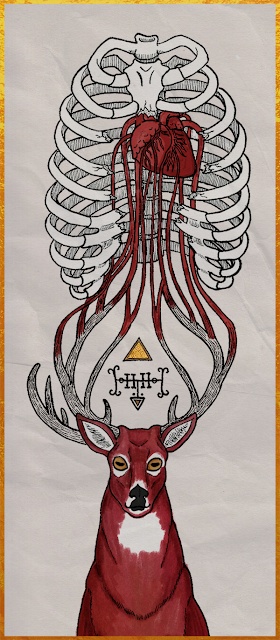
A gold-trimmed pen and ink drawing of a red deer with three antlers, two on the right and one on the left. The prongs of the antlers turn into veins which are connected to a human heart, surrounded by a fractured rib cage. Between the deer's antlers is the sigil for the goetic demon Furfur and the alchemical symbol for fire, painted gold.

Uliski the demon deer

This is a story about how power causes corruption, especially when it’s wielded by violent young men dripping with privilege. While the novella is very pro-Anarchist, Killjoy keeps it from feeling too much like heavy handed propaganda by presenting a balanced view of her socio-political beliefs and chooses realism (well, other than the supernatural elements of course) over romanticism. The town of Freedom is presented as both an ideal and a warning; a community based on equality and cooperation is something to strive for, but, like any system, it can easily be corrupted by selfishness and fear even when everyone has the best of intentions. Hierarchies started to form without anyone realizing, and once those hierarchies were enforced through violence Freedom went from Anarchism to Authoritarianism, much like what happened after the Russian revolution.

As much as I loved The Lamb Will Slaughter the Lion, I felt it would have worked much better as a full-length novel, rather than a novella. The world building, story set up, character development, and ending all seemed too rushed and I was left feeling underwhelmed and longing for more. The concept is so cool, a demon deer turning on its summoners as a revolution slowly brews from with the town, that I wanted to spend more time there and learn about all the characters and what brought them to Freedom. I especially wanted to see more of Danielle and Brynn’s relationship develop. These reasons are why I much prefer the sequel, The Barrow Will Send What It May. By the second book, Killjoy has already established the world and the main players in it and is able to spend more time on developing her characters, building suspense, and giving Danielle and Brynn time to explore their feelings for each other. It’s for these reasons that I strongly suggest reading the two novellas together. The Lamb Will Slaughter the Lion feels incomplete on its own, but works well as the first chapter to an overarching story, and this is why I truly hope we will see many more chapters in the Danielle Cain series. I want to read a full-length novel about a band of Anarchists travelling from town to town solving mysteries and fighting demons, Scooby-Doo and Supernatural style, even if it is separated into several short stories. Killjoy clearly has many more stories to tell, and I look forward to reading them.

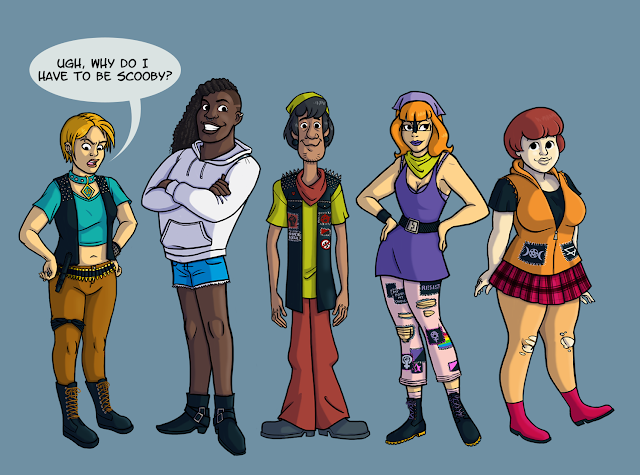
Five people in punk clothing colored to resemble the characters from Scooby-Doo. Furthest to the left is Danielle, a White woman with short, blonde hair. Next is Vulture, a tall, Black trans man with long hair and one half of his head shaved. Thursday, a Latino man in a leather vest is the middle, then Brynn, a White woman with red hair, a tattooed line on her forehead, and glasses. Her pants are covered in lgbtq, anarchist, and feminist patches. On the left is a chubby White woman, Doomsday with bobbed, brown hair.

Left to right are Danielle (as Scooby), Vulture (as Fred), Thursday (as Shaggy), Brynn (as Daphne), and Doomsday (as Velma). Anarchist Mystery Gang!

 
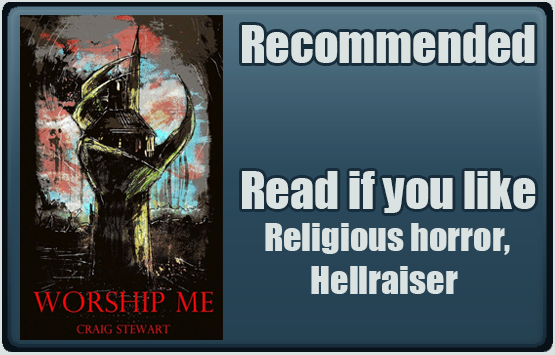
Worship Me by Craig Stewart

Worship Me by Craig Stewart

Formats: Print, audio, digital

Publisher: Hellbound Books

Genre: Blood & Guts (Gorn), Monster, Myth and Folklore, Occult

Audience: Adult/Mature

Diversity: Gay author and gay side character

Takes Place in: USA

Content Warnings (Highlight to view): Animal Death, Body Shaming, Bullying, Child Endangerment, Death, Forced Captivity,  Gaslighting, Gore, Mental Illness (depression), Physical Abuse, Sexual Assault, Self-Harm, Slut-Shaming, Suicidal Ideation, Violence

Blurb

Something is listening to the prayers of St. Paul’s United Church, but it’s not the god they asked for; it’s something much, much older. 

A quiet Sunday service turns into a living hell when this ancient entity descends upon the house of worship and claims the congregation for its own. The terrified churchgoers must now prove their loyalty to their new god by giving it one of their children or in two days time it will return and destroy them all. 

As fear rips the congregation apart, it becomes clear that if they’re to survive this untold horror, the faithful must become the faithless and enter into a battle against God itself. But as time runs out, they discover that true monsters come not from heaven or hell… 
…they come from within.

Please note, I received this product for free in return for providing an honest and unbiased review. I received no other compensation. I am disclosing this in accordance with the Federal Trade Commission’s 16 CFR, Part 255: Guides Concerning the Use of Endorsements and Testimonials in Advertising.

***
 

Worship Me is a nihilistic exploration of morality and faith presented as a gory horror story about a congregation trapped inside their church by a mysterious creature, called the Behemoth. Demanding their reverence, the beast viciously murders any who disobey and gives the group 48 hours to offer up a child sacrifice. With the safety and sanctity of their church destroyed and their beliefs thrown into question, the members of St. Paul’s United Church begin to reveal their true natures. The book boasts a large cast of characters including Dorothy, the church matron who’s desperate to feel needed, Emily, a severe and devout woman who harshly judges others, Susan, a naive and sheltered young woman who wants to save the world, and Chris, a closeted gay teen who desperately wishes his crush would acknowledge their mutual attraction, and the point of view frequently shifts as each character watches their world fall apart. But it’s Angela who comes closest to being the story’s protagonist.

Angela and her son, Alex, have been the center of church gossip ever since her husband, Rick, vanished mysteriously. Seemingly tired of the pity and Emily’s suspicious scorn Angela announces during Sunday service that she’s planning on moving away and starting fresh. That’s when a filthy Rick stumbles into the church. The congregation, who have been praying for his safe return, declares it a miracle. Angela, however, is less than thrilled. While the community sees the couple’s relationship as the perfect romance, high school sweethearts who marry young and went on to have a child, nothing could be further from the truth. Rick is an abusive and violent man who terrorizes his wife, Angela was desperate to escape his cruelty and protect her son, and his time away has made him even worse. While gone, Rick has found a new god, the Behemoth, and has apparently started some sort of Cenobite-type religion that involves torture, murder, self-mutilation, and a very aggressive recruitment strategy. Everything starts to go to hell after that.

At least I assume this is what Scientology is, but with more aliens and domestic espionage.

On the Sunday of Rick’s ill-fated return, the pastor, Don, tells his congregation about the myth of Job, a devout and righteous man whose faith is tested by hardship. For those unfamiliar with the parable, God and Satan aka “the Adversary” (“satan” literally translates to “adversary” so it’s unclear whether this is big S Satan, aka the devil, or just some random angel who’s a jerk) are hanging out in heaven and God is bragging about the super pious and awesome Job. Satan rolls his eyes and points out that Job is only “good” because he knows God blesses the righteous and punishes the wicked. He’s doing it for the rewards, not out of some deep sense of morality. God suggest they test that theory and gives Satan permission to ruin Job’s life by killing his servants and children, taking his wealth, and covering the poor man with boils. Job’s so-called “friends” also subscribe to the theory that bad things only happen to bad people, and proceed to blame the victim by telling the poor man that all his misfortune is his own fault. At this point Job is pretty miserable and wondering what the hell he did to deserve this and demands to know why an all-powerful deity would make the world so chaotic and horrible. Surprisingly God actually responds with something along the lines of “Where the hell were you when I made earth out of literally nothing!? I made a freaking universe and you people don’t even know what electricity is yet. Do you really think your stupid little monkey brain could understand all the complexities that go into running this place? I have all these plans you couldn’t even wrap your brain around, like winning a bet with this guy… never mind, the point is: I’m omnipotent, omniscient, and I work in mysterious ways. Deal with it.” Stunned, Job stammers out “Well, you didn’t really answer my question, like, at all, but you’re really scary and I don’t want an all-powerful deity angry at me so I think I’m just going to go back to being pious and throw in some groveling apologies so you don’t smite me.” God says “Yeah, you do that” and restores Job’s riches and health, and even gives him some new kids (because apparently children were easily replaced like goldfish back then), just so there are no hard feelings. The parable is meant to explain why good people suffer for seemingly no reason, though a more cynical interpretation would be that powerful beings treat mortals as mere pawns in their games and get unreasonably angry when those mortals want to know why they’re acting like jerks. While God is ranting at Job for questioning his betters, the irritable deity starts not-so-humbly bragging about how powerful they are, using the Behemoth as an example. The Behemoth, an enormous, land-dwelling beast, is so powerful that it can only be controlled by God, no mortal could ever hope to defeat it.

“Behold now behemoth, which I made with thee; he eateth grass as an ox.

Lo now, his strength is in his loins, and his force is in the navel of his belly. 
He moveth his tail like a cedar: the sinews of his stones are wrapped together. 
His bones are as strong pieces of brass; his bones are like bars of iron.

He is the chief of the ways of God: he that made him can make his sword to approach unto him.”
(Job 40: 15-19)

No, I don’t know why God spends so much time telling Job about the Behemoth’s giant genitals (“tail” was probably euphemism). Whomever wrote that particular bible story was having a really weird day. Jewish apocrypha describe the Behemoth as a primal creature that represents chaos and will battle with its aquatic and aerial counterparts, the Leviathan and Ziz, on judgement day.

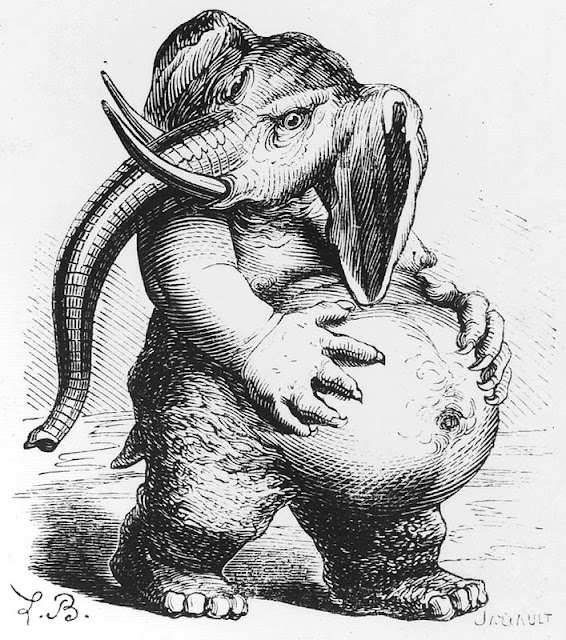
An early 1800s pen and ink sketch of a bipedal demon. It has the head, legs, and tail of elephant and the torso and arms of a a human. The demon is clutching its large, bloated belly with clawed hand and looking over its right shoulder.

The Behemoth as it is depicted in the Dictionnaire Infernal where he is described as ruling over the domain of gluttony. The fictional creature may be based on a hippo or elephant. Young earth creationists and anyone else who failed grade school science think the Behemoth is a dinosaur (it’s not).

Most of the characters in Worship Me believe the Behemoth is either a fallen angel meant to test their faith or a new deity come to save them. But neither assumption is accurate because none of what happens is about any of the humans in the first place. The beast sees itself as the main character of its own story, and the congregation as mere pawns. The beast only seems god-like because humans are a weak and undeveloped species in comparison. Calling the Behemoth a false god or demon would be a gross oversimplification that implies its existence is tied inextricably to humanity. Historian Lynn Townsend White Jr. argued in his famous 1967 paper The Historical Roots of Our Ecologic Crisis “Especially in its Western form, Christianity is the most anthropocentric religion the world has seen. Man shares, in great measure, God’s transcendence of nature.” Abrahamic all but declare humanity’s superiority. In the very first book of the Torah and the Old Testament (Bereishith/Genesis) God essentially tells Adam that he is the most important living thing in the universe. “And God said, Let us make man in our image, after our likeness: and let them have dominion over the fish of the sea, and over the fowl of the air, and over the cattle, and over all the earth, and over every creeping thing that creepeth upon the earth.” (Genesis 1:26) In the Quran, even divine beings are told to bow down before the first human. “And when We told the angels, ‘Prostrate yourselves before Adam!’ they all prostrated themselves, save Iblis, who refused and gloried in his arrogance: and thus he became one of those who deny the truth.” (Surah 2:34) A relic from another time the creature’s morality cannot be defined by human parameters, and has nothing to do with any human religion. The church members, who clearly subscribe to the idea of human exceptionalism, at least in the beginning, simply assume it does.

Unfortunately for the congregations, God never does show up to control the Behemoth. A few people try to stand up to the beast at first, but all are brutally killed for their efforts and the legend of Job offers little comfort to their grieving loved ones. Some of the church members begin to wonder if there is even someone out there listening to their prayers. Even if there is, a hands-off God who lets innocent people suffer and die quickly loses their appeal when the prehistoric monster terrorizing you can promise rewards now. As they become even more frightened and desperate every adult becomes complicit in some form of depraved cruelty, whether they are active participants or merely remain silent and allow it to happen. This begs the question, if you willingly do something unspeakable to save your own skin, is the life you preserved still worth living knowing you will now have to carry the guilt of your crime? Keep in mind such philosophical questions are much easier to answer from the outside, but even the kindest and most moral person can be twisted by pain and fear and grief. While most of the heroic sacrifices made by those the Behemoth killed were merely pointless deaths (they died horribly and all it accomplished was pushing their loved ones to commit monstrous deeds to get them back), the murdered are also the only characters in the book who get to die with a clear conscience. If there is an afterlife, they’ll be the only ones joining Job in paradise.

The threat of death and suffering, especially when made against your children, are certainly excellent motivators when it comes to recruiting the unwilling, though I do have to question the decision making abilities of those members of the congregation tempted by the Behemoth’s promised “rewards”: torture (which Rick seems to be super into) and bringing Evil Dead versions of their murdered loved ones back to life. Why bother to offer a moldy, half-eaten carrot when the stick would suffice? But while no one takes them up on their offer of some old fashioned masochism, a lot of the characters fall for the “I’m going to murder someone you love then give you this evil, busted, half-assed version instead” scam Rick and his beast buddy are running. I don’t care how much you miss your kid, nobody wants a monster that makes the reanimates from Pet Sematary seem kind and cuddly by comparison, even if it does vaguely resemble a mutilated version of little Timmy. If my wife got mauled by monsters then Monkey’s Paw-ed back to life looking like something out of Resident Evil, I’d be reaching for the flamethrower, not agreeing to join some prehistoric beast’s weird torture church. Maybe if the Behemoth agreed to send my undead wife back to the cornfield or wherever I might agree to a little light beast worship, but as it stands his resurrection game needs some serious work.

My wife as a mutilated, living corpse is definitely one of the weirder things I’ve drawn. I showed this drawing to her and now she’s shuffling around the house pretending to be a zombie.

There is one other, much more significant issue I had with the book.
***Content warning for discussion of rape and sexual assault***
Among his many newfound powers, Ricks now possesses the ability to make people sexually attracted to him, whether they want to be or not. This creepy ability is first demonstrated when a heterosexual man finds himself inexplicably lusting after Rick (right before Rick kills and mutilates him). He uses it again on Angela whilst sexually assaulting her, resulting in her arousal during the assault, and the way it’s worded is pretty cringe-y:
“Her body began to revolt against every intellectual, spiritual and personal value she had tried painstakingly to uphold. This man, this creature, this demon, had violated her, beaten her, lied to her, threatened her life and the life of her child, but still her body wanted him. It ached for him, as if it would die without his touch, inside and out… She hated each and every betrayal her body made.”

This is a trope I absolutely loathe with a burning passion. Let me be perfectly clear: some people do experience an erection, lubrication, or even orgasm during a sexual assault, and there’s nothing unusual or shameful about it. It’s a purely physiological response and not an indication of enjoyment or a sign of consent. Unfortunately, the belief that any sign of arousal means the victim “wanted it” is still prevalent (and even used as a defense in court cases) and enforced in fiction like Crown of SwordsThe FountainheadGoldfingerGame of Thrones, and numerous Harlequin romancesFifty Shades of Grey actually inspired at least three different cases of sexual assault because these men couldn’t understand that fantasizing about being ravished isn’t the same thing as wanting to be assaulted (Pro tip: NO ONE wants to be raped). It’s not that people shouldn’t write about rape (The Round House by Louise Erdrich and Speak by Laurie Halse Anderson both do an excellent job dealing with such a difficult topic) or even erotic fantasies of being overpowered. It’s just that with rape culture and world being what it is, authors need to tread very, very carefully when writing about assault. TorApex MagazineWired, the Writing Reddit, and Marie Brennan’s blog all do a great job discussing how to write about sexual violence in fiction.

Worship Me isn’t nearly as bad as the previous examples I listed, Rick is portrayed as a complete monster whom Angela despises and what he does is reprehensible. I don’t think anyone reading that passage is going to think Angela wanted him to assault her, or that it was anything but a violation. But it still could have been handled a lot better and I cringed reading it.
***End of content warning***

Problems aside, Worship Me is still a well-written, and entertaining read. You would think a book where the characters spent the majority of their time trapped within a church reflecting on their personal values would get dull very quickly, but fear not. Action scenes are perfectly placed throughout the story to keep the pace going and the tension high. Even with my ADHD, Worship Me managed to hold my attention throughout the book and I only put it down when I absolutely had to (like when my wife said if I didn’t come do the dishes right now she was making me sleep in the backyard). But it’s the novel’s exploration of faith that makes Worship Me really stand out. I was very fortunate to grow up attending a Congregationalist church part of the United Church of Christ (UCC) with a strong emphasis on humanism, tolerance, science, and social justice, where my sexuality and agnosticism were readily accepted, but many people aren’t so lucky. Even churches that aren’t showing up on a Southern Poverty Law Center watch list can be intolerant towards anyone they see as breaking some obscure Biblical law from Leviticus. When a religion that’s supposed to be about love and compassion is twisted by its followers into an ugly culture of hate, judgement, and hypocrisy it drives people away. But worse than that is when people actually find that kind of message appealing. They’re attracted to the “us vs. the sinners” rhetoric and instead of loving their neighbors or respecting differences, they turn to condemnation and cruelty in a misguided attempt to please an angry god and reap the rewards they feel are promised them. And this is the heart of what makes Worship Me so terrifying. Not the monster outside who may or may not be an old god come to challenge the newer god of Abraham, but the horrible lengths people are driven to when they believe without question. Worship Me isn’t so much anti-religion as it is anti-zealous, unquestioning belief and fear-based worship. There are benefits to religion, it can offer comfort in dark times and encourage charity and compassion and a sense of community. But when the message is never questioned and when its followers lose the ability to judge right or wrong from themselves, that’s when people suffer. Churches will always make me leery. Maybe it’s because some very vocal religious types find both my sexuality and my lack of faith sinful, and are not shy about harassing anyone like me. It could also be that whole bursting into flame and vomiting black bile every time I step onto holy ground thing that happens, who knows. What I do know is the Worship Me has definitely made me think twice about visiting a house of God again, lest it hold some even darker secrets.
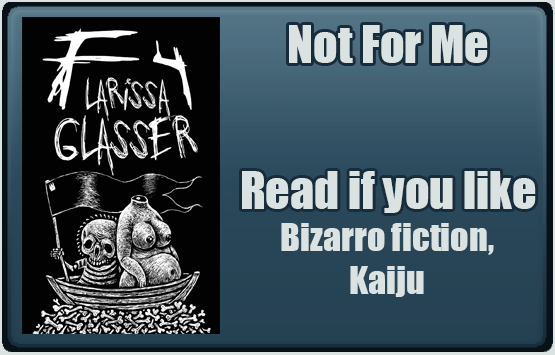
F4 by Larissa Glasser

F4 by Larissa Glasser

Formats: Print, digital

Publisher: Eraser Head Press

Genre: Blood & Guts, Body Horror, Monster, Sci-Fi Horror

Audience: Adult/Mature

Diversity: Trans women, Bisexual women, Queer women

Takes Place in: North Atlantic ocean

Content Warnings (Highlight to view):  Bullying, Drug Use/Abuse, Death,  Forced Captivity, Gore, Homophobia, Kidnapping, Mention of Medical Procedures, Police Harassment, Rape/Sexual Assault, Sexism, Slurs, Stalking, Suicide, Transphobia, Verbal/Emotional Abuse, Violence 

Blurb

A cruise ship on the back of a sleeping kaiju. A transgender bartender trying to come terms with who she is. A rift in dimensions known as The Sway. A cruel captain. A storm of turmoil, insanity and magic is coming together and taking the ship deep into the unknown. What will Carol the bartender learn in this maddening non-place that changes bodies and minds alike into bizarre terrors? What is the sleeping monster who holds up the ship trying to tell her? What do Carol’s fractured sense of self and a community of internet trolls have to do with the sudden pull of The Sway?

Please note: This review was written before I was out as genderqueer. In the review I refer to myself as not being part of the trans/non-binary community. This inaccurate. 

The horror genre is not generally kind to trans-women, frequently depicting them as serial killers and/or sexual deviants. Hell, fiction in general doesn’t treat trans people well, forcing them into a victim role and focusing on their angst and dysphoria. So you can imagine how unbelievably excited I was when I learned that Eraserhead Press was publishing a horror story about a bad ass trans woman who fights monsters and alt-right trolls. Even better, it was being written by a trans woman! Glasser is  a librarian from Boston which makes her five-hundred times cooler in my eyes (I love librarians, they’re like keepers of secret knowledge and they know everything). The reviews for F4 have so far been unanimously positive, the premise sounded weird and awesome, and it promised representation rarely found in the horror genre. F4 was like everything I had wished for and I could not pre-order it fast enough.

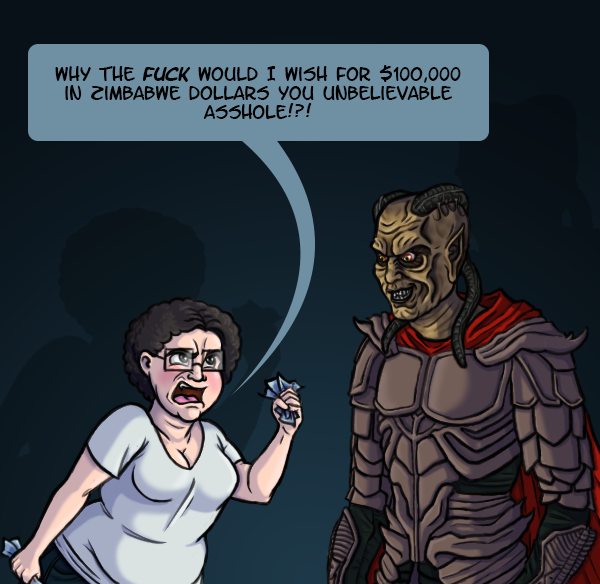
Well, apparently whatever jinni decided to grant my wish for an awesome trans-lady horror story written by a trans person was one of those dick bag jinn who likes to pull that Monkey’s Paw shit, because I haven’t been this disappointed since I first saw Star Wars Episode One after months of hype.


I’m clutching handfuls of blue bills and angrily screaming at the Djinn from the Wishmaster film series who is looking please with himself. I yell “Why the FUCK would I wish for $100,000 in Zimbabwe dollars you unbelievable asshole!?!”

I guess I’m just lucky the Djinn didn’t give me $10,000 in pennies that fell from the sky and crushed me to death.

Carol, the main character of the story, is a trans-woman who works as a bartender on the Finasteride, a cruise ship built on the back of the F4. This name does not, in fact, come from one of those computer function keys that no one ever uses for anything (except maybe the F5 key), but instead refers to the last of four kaiju that mysteriously appeared on earth and fucked up a bunch of stuff. Okay, so far so good. Then, all of a sudden, everyone on board starts turning into eldritch abominations… and thus begins a confusing clusterfuck of unexplained randomness. The transformations may or may not have something to do with a dimensional rift called the Sway, which isn’t mentioned prior to everything going to hell, is never fully explained, and may or may not be common knowledge in the book’s world.  Carol’s creepy boss and his even creepier buddy are behind everything, because they want to sail into the Sway, but their motivation is never explained beyond some vague lust for power. Well, if it works for Saturday morning cartoon villains I guess it’s fine. There’s also a wizard who lives in the Sway and can control the Kaiju, who we’ve also never heard of before and who also isn’t really explained. Again, it’s really unclear whether this is common knowledge or not, or if the Sway is actually just some giant, extra-dimensional plot hole and we’re just expected to go with it. The weirdest part is that even though the wizard controls the kaiju, he isn’t evil despite his giant beasts killing millions of people. One of them even destroyed New York City looking for Carol (why though!?!), but fuck all those victims, I guess? Why is no one horrified by all this? Oh, and apparently Carol’s penis is some sort of magical flesh key or something, I don’t even know. Maybe her penis’ magic is why she gets erections constantly (and won’t shut up about it), despite having had an orchidectomy. Usually, having your testicles removed or going on testosterone blockers causes penis-having folk to have very few spontaneous erections (and some stop getting erections all together) so it seems really odd that Carol keeps getting constant danger boners (which would be an awesome band name) but I’m hardly an expert, so whatever.

In addition to her bartending duties, Carol also makes sex videos on the side with her friend Chole, another transwoman whom she’s slightly obsessed with. Carol’s wait staff of trans women, or “lady dicks” as she calls them, also make extra cash “servicing” the passengers of the Finasteride. This is the part that made me feel really weird. Frequently when trans people appear in fiction, it’s as some sort of sex worker, and they’re being written by cis folk who have little understanding of, or respect for both trans women or sex workers. It’s such a cliché that cops will actually harass trans women on the street because they assume they’re prostitutes. So having the majority of the trans women in a story do some sort of sex work felt problematic, especially since most of the clients appeared to consider them a fetish rather than real people. It certainly doesn’t help that Carol doesn’t even seem to like doing web-cam work, and is only tolerating it because Chole pressured her into making porn. I enjoy naked people having sexy fun times as much as the next person, especially when those people are queer and/or non-binary, and one of the things that originally drew me to F4 was the promise of erotica with trans-ladies. But when the participants are being pressured, exploited, or fetishized, porn is just gross. F4 felt more like the later. The sex scenes aren’t even arousing. One involves a toothless dude drooling in Carol’s ass crack as she feels uncomfortable and wishes it were over. Ick. Chole also gets sexually assaulted by one of the kaiju’s parasites in a really uncomfortable scene (which I think was supposed to be humorous?) and Carol does exactly jack and shit to help her friend. Maybe weird, unappealing sex is a staple of bizarro fiction, but trans women are disrespected enough in the porn industry, I was really hoping it wouldn’t happen here too.

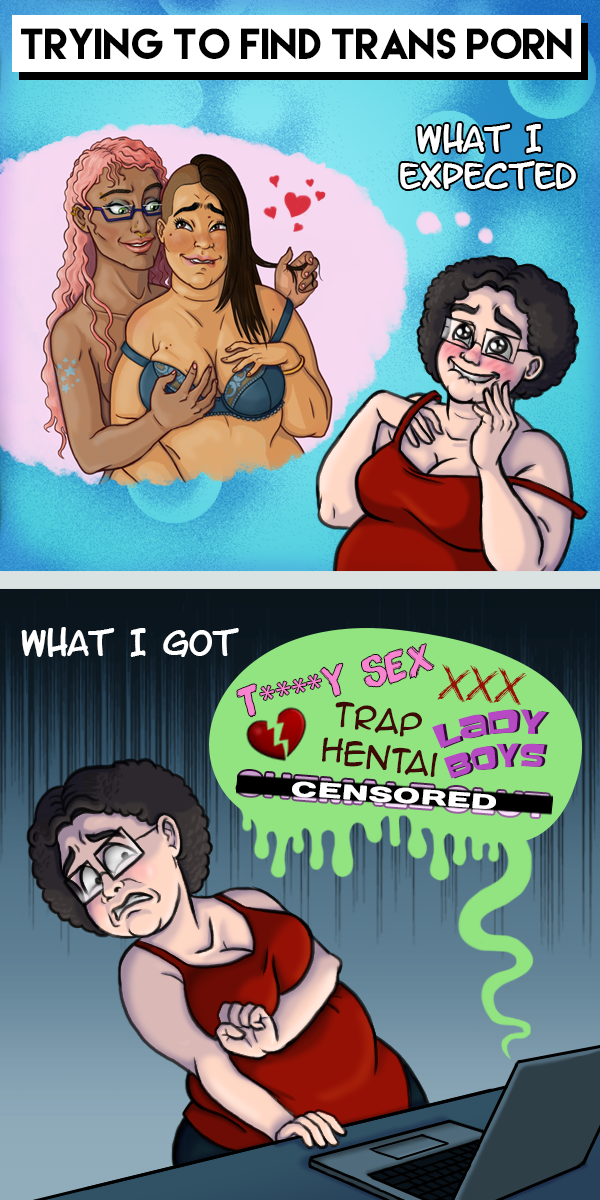
The comic is titled “Trying to find trans porn.” The first panel says, “what I expected” and depicts me blushing and looking aroused while I imagine two women of color, one of whom is plus-sized, in an intimate situation looking lovingly at each color. The second panels says, “What I got” and shows me recoiling in horror and disgust from my laptop. A toxic green speech bubble reveals what is written on the screen, and is full of transphobic language like “Tr***y Sex”, “Trap Hentai”, and “Lady boys”.

F4 isn’t like the terrible, transphobic porn you might find online, but it’s not particularly good erotica either.

My confusion regarding the story line made it difficult to focus on the book (as did the frequent mention of dicks), and I probably would’ve given up on it completely if not for part two, the saving grace of F4. Part two is proof that Glasser really is a talented author. Instead of getting a bunch of random nonsense throw at us we get an intriguing and suspenseful, but straight forward story of Carol’s life prior to the Finasteride. Her character suddenly feels relatable. She’s dating a loser she can’t seem to dump, living in the middle of nowhere, and trying to figure out what to do with her life. Carol witnesses a murder, and tries to do the right thing by reporting it to the cops. But since no good deed goes unpunished, she finds herself in the media spot light after becoming a key witness in the murder case, and becomes a victim of an online hate campaign by a bunch of transphobic trolls. Part 2 is great! It’s intriguing, suspenseful, we finally get some explanations about what’s going on, and of course Glasser had to go and ruin it by making part 3 even more random and confusing. This just made me hate the rest of the book even more because I now knew I could’ve been enjoying a well-written story about a trans woman vs. a bunch of internet trolls, and dealing with the dilemma of being punished for doing the right thing. But instead I had to put up with awkward sex, magical girl dicks, and a series of loosely connected plot holes. So I became bitter and sulkily rushed through the third part of the story, desperate to find some of the magic from Part 2. The only thing that redeemed part 3 was Carol killing the two entitled dudebros who fucked everyone over for more power, one of whom was the leader of the internet trolls who ruined her life. That was immensely satisfying.

So yeah, I really didn’t like this book. Of course, I’m not trans (well, I am, but I wasn’t out when I first wrote this), so it’s possible my privilege was preventing me from recognizing the appeal of F4. All the reviews I had read online were overwhelming positive, so what was I missing? Was it just not intended for me? So I went to my friend, Ashley Rogers (who you may remember from the Oddity post), for help. I figured since she’s an author herself, a trans sensitivity reader, and a trans rights activist she’d be able to offer some valuable insight. Although Ashley is currently busy working on SCOWL: Fight for your Rights, a subversive, queer-focused, stage combat piece (I designed the logo so I have to shamelessly pimp the project), she was kind enough to take some time out of her busy schedule to share her opinion with me. I also asked her to explain what Glasser meant when she kept talking about “hatching eggs”, but Ashley didn’t know either, nor did any of the other trans and non-binary people I asked, and I eventually had to resort to Reddit and Urban Dictionary.

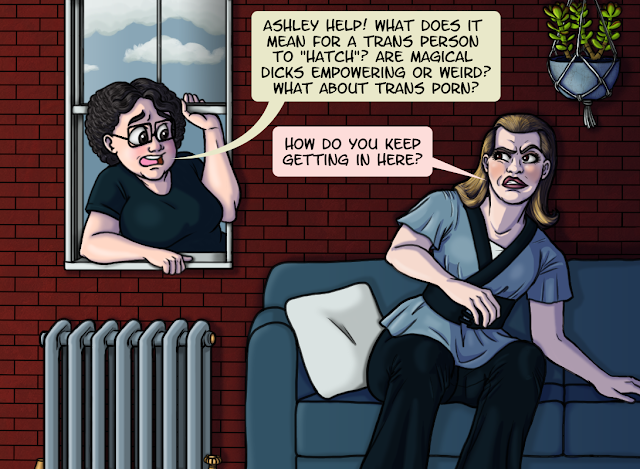
I’m climbing through the window of my friend, Ashley Roger’s, apartment (presumably having broken in). “Ashley help! What does it mean for a trans person to “hatch”? Are magical dicks empowering or weird? What about trans porn?” I ask. Ashley, a tall woman with a fashionable blue top, blond-streaked, shoulder length hair, and expertly done make-up, is sitting on the couch and leaning away from me, looking annoyed. “How do you keep getting in here?” she demands.

It turns out “eggs” refer to closeted trans folk still struggling with their identity who have not yet come into their own.

Ashley had the following to say:

First a disclaimer: Trans/n-b folk can and should be able to tell whatever stories we want.  I love bizarre and spooky material, and I want trans folk to succeed, and regardless of my feelings on this novel I am excited to see more from Larissa Glasser…
Buuuuuuuut…

My main criticism is that the piece doesn’t seem to know what it wants or who it’s written for. F4 intends to shock (evidenced by the material referenced in the piece such as Cannibal Holocaust and The Human Centipede) but it falls short of living up to those expectations.  We don’t live in the uncomfortable moments and grotesque situations long enough to care.  At most we’re left with a sense of “ok… That’s fucked up,” but then we move on to something else before we have a chance to feel unsettled.

Part two feels like a completely different (and subjectively better) novel entirely.  I was gripped by the backstory and it had a great flow, and some of the concepts are really cool (Hell, it’s about turning a Kaiju into a cruise liner!!), but as a trans woman I couldn’t help but be bored by how often Carol popped a boner in the face of danger.  One of the positive critiques I’ve seen from other trans women is that it’s a story that isn’t about a trans character who’s sad, angry, and depressed about surgical transition/dysphoria but the way the author focuses on Carol’s anatomy and overly sexual descriptions rather than creating the atmosphere distracts from the story and intriguingly bizarre concept of the piece in the same way these other pieces focus on the tragedy porn that gets written about our physical transition struggles.  If this book was all part two I would be writing a very different statement but… I wish it were either more shocking in execution or more approachable in material, but as it stands it sits in limbo of both.

I won’t lie, I feel genuinely guilty about not liking F4. I mean, everyone else loves it, and I want to be supportive of trans and non-binary folk in a cis-centric genre, but I just could not enjoy the story. I had no idea what was going on half the time, a lot of it just seemed to be weird for the sake of weirdness and contributed nothing to the story, and, the sex scenes felt more gross and exploitative than sexy and empowering. I liked the ideas behind F4, but the execution left a lot to be desired. Glasser clearly has talent as a writer, as is evident from part 2 of the story, so maybe I just don’t like bizzaro horror, I don’t know.  At the very least I can say it’s like nothing I’ve ever read before. In the mean time, I’m going to stick to reading Nerve Endings when I’m in the mood for some well written trans erotica.

Labyrinth Lost by Zoraida Córdova

Labyrinth Lost by Zoraida Córdova

Formats: Print, digital

Publisher: Sourcebooks Fire

Genre: Dark Fantasy, Occult

Audience: Y/A

Diversity: Ecuadorian author, Hispanic/Latinx characters, Puerto Rican characters, South Asian character, Bisexual characters

Takes Place in: New York City, USA

Content Warnings (Highlight to view): Abelism, Animal Death, Body Shaming, Bullying, Child Abuse, Child Endangerment, Death, Forced Captivity, Gaslighting, Gore, Kidnapping, Torture, Violence

Blurb

Nothing says Happy Birthday like summoning the spirits of your dead relatives.

Alex is a bruja, the most powerful witch in a generation…and she hates magic. At her Deathday celebration, Alex performs a spell to rid herself of her power. But it backfires. Her whole family vanishes into thin air, leaving her alone with Nova, a brujo boy she can’t trust. A boy whose intentions are as dark as the strange marks on his skin.

The only way to get her family back is to travel with Nova to Los Lagos, a land in-between, as dark as Limbo and as strange as Wonderland…

Alex is about to celebrate her Deathday, a huge party that’s thrown when a young bruja or brujo first gets their powers. Her entire extended family will be there to help her bind and control her newfound abilities. Everyone seems thrilled, especially her mother and older sister Lula; everyone that is, except for Alex. She views magic as a curse rather than a blessing, so she’s pretty upset when she discovers that, no surprise (it’s Y/A fiction after all), she’s essentially the most powerful bruja they’ve seen in generations, an encantrix whose magic is vast and broad. Most brujas are limited to one or two abilities, like healing or seeing the future, but Alex can pretty much do anything. In a misguided attempt to get rid of her power, she accidentally banishes not only all her living relatives but her dead ancestors as well to the Limbo-like land of Las Lagos. Oops.

Okay, so admittedly the whole powerful chosen one thing does sound kind of Mary Sue-ish, especially the part about not wanting her super special powers. “Oh, poor little main character, you get all these awesome powers, how awful for you!” said no reader ever. Well, Alex has a pretty good reason for hating her magic, and it’s not the typical “Oh, being perfect is so hard~” B.S. You see, magic isn’t some consequence free wish-fulfilling super power, it’s born from sacrifice. Magic drains the user and causes them physical pain. The more powerful the spell, the more you’ll suffer. Healing someone’s else’s headache means you’ll end up with a black eye. A protection spell could cause you to pass out. Some magic can even drain the life force of the user, slowly killing them. Magic is also the reason Alex’s father disappeared, destroying her family. She has to watch her mother grieve and suffer every day, trying to raise three girls on her own.  It traumatized her when she was seven and saw the re-animated corpse of her Aunt Rosaria. Magic killed her pet cat, plagues her with nightmares, and forces her to keep her best friend at arm’s length. So Alex’s aversion to her powers is understandable, I wouldn’t want to use magic either after all that.

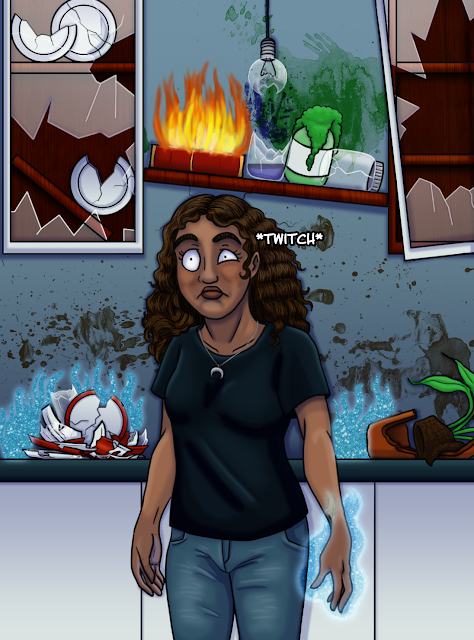
A dark skinned girl looks traumatized in front of a destroyed kitchen. Blue, magical flame surrounds her hand and the broken dishes on the counter.

Thanks, magic!

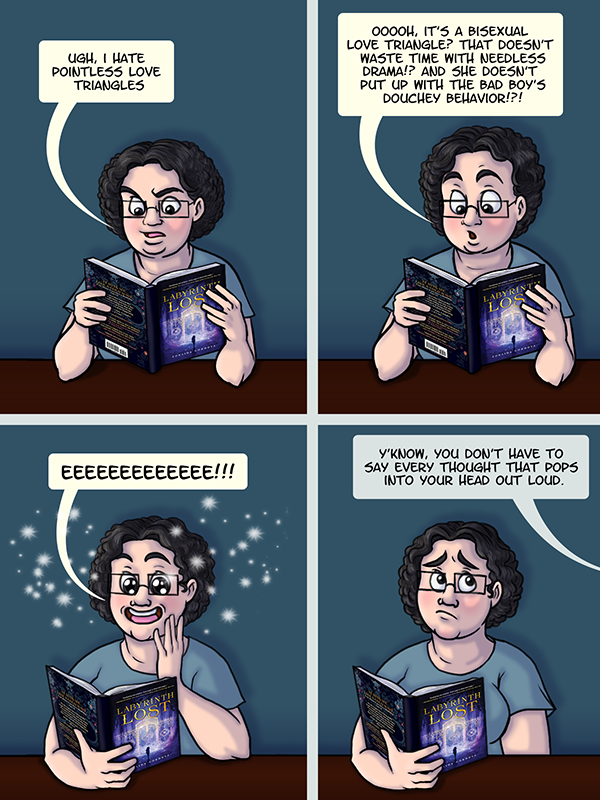
Love triangles are another tired trope in young adult fiction that I’m sick of seeing. It’s just pointless and needless drama that derails the story. Can’t everyone just be polyamorous and get along? A threesome would clearly solve this problem. It’s especially irritating when one (or both) of the love interests is a mysterious bad boy who appears out of nowhere and seduces the main character, despite them having nothing in common. Just have a one-night stand and get it out of your system, he clearly isn’t relationship material, damn. So many problems in YA fiction could be solved by just sleeping with everyone… and I just realized why I probably shouldn’t be giving advice to teenagers. Okay, forget everything I just said. Love triangles are still stupid though, and when I first learned Labyrinth Lost had one (with a mysterious bad boy no less) I let out one of those long, exasperated groans that makes me sound like a slow-moving zombie that just discovered it’s going to have run after its prey. So, basically me as a zombie. Running is the worst. So are pointless romantic sub-plots.

I’m rolling my eyes letting out a very long, very loud groan. My wife is sitting at a table looking at her tablet and trying to ignore me. She asks “So is it a love triangle again, or are you craving brains?”

THE WORST

Nova, the smug, douchey, “bad boy” brujo who kept flirting with Alex was about as obnoxious as you’d expect, no surprise there. He was all dark and tortured and rude, bleh. But this is where Córdova surprised me. Because Nova’s romantic rival is a South Asian girl named Rishi, Alex’s longtime friend. Okay, so a multiracial, bisexual love triangle, that’s not something you see every day. And it’s not just queer baiting either! The two girls are genuinely romantically interested in each other. Plus, Rishi is so awesome; she’s brave, weird, loyal, funny–exactly the kind of person I’d want to be friends with. When Alex is in trouble she doesn’t even hesitate to dive in and rescue her, because that’s what friends do. My interest was cautiously piqued, but I was still wary. Was this going to turn into a huge drama-filled plot point that derails the story? But again Córdova exceeded my expectations, because the love triangle is barely even there. Yes, Alex ends up with one of them, and yeah, the bickering of the two suitors could be annoying, but Alex’s entire focus is on saving her family, as it should be. Yes, she has crazy teenage hormones and starts lusting after her best friend and the mysterious Nova, but her focus never wavers from the task at hand, and she pushes her romantic impulses to the side. Alex even gets irritated that Nova is wasting so much time flirting and Rishi keeps getting jealous, when there are clearly much bigger fish to fry. I don’t usually get invested in romantic subplots, and I’m almost embarrassed to admit this, but I went full on fan girl and found myself shipping Rishi and Alex the entire time (much to the chagrin of my poor wife who had to deal with my high pitched squees every few minutes). I feel like I need to write Córdova an apology letter for ever doubting her, because she has somehow managed to pull off the least annoying love triangle I’ve ever read in YA fiction. Hell, even Nova got called out for his arrogant dick act, which I was also not expecting. So, Kudos to you Córdova.

I’m reading Labyrinth Lost, looking annoyed, and comment “Ugh, I hate pointless love triangles.” In the next panel I suddenly look interested and saying “Oooooh, it’s a bisexual love triangle? That doesn’t waste time with needless drama!? And she doesn’t up with the bad boy’s douchey behavior!?!” The third panel shows me squeeing, surrounded by sparkles, with big, shiny eyes. In the final panel, someone yells off screen “Y’know, you don’t have to say every thought that pops into your head out loud”.

A love of triangle actually made me squee for the first time in history.

The whole romantic subplot, if you can even call it that, is thankfully a pretty minor story element, and the story’s main focus is on family and identity. Alex’s relationship with her sisters, mother, aunts and the other women in her family is incredibly well written and touching, and one of my favorite aspects of the book. It’s just so wonderfully refreshing to see a YA novel that focus on the bonds between women and familial love rather than girls fighting over stupid boys. Lula, her beautiful and bossy older sister is great, a force unto herself, overflowing with love and magic, and always ready to take charge. I love Lula. Her younger sister, Rose, is a psychic with the whole creepy child vibe going on, an incredibly clever and intelligent young girl with a sweet tooth and a mischievous streak. She doesn’t get as much page time, as she’s more reserved than her two sisters. And of course Alex’s mother, Carmen, a strong woman and loving parent, holds their little family together. They’re not perfect, and they might bicker, but they’re all fiercely loyal and protective of each other, and Alex’s strong connection with her family is what gives her the strength to journey through Los Lagos, and protects her from the perils of the dark, magical Limbo.

Córdova’s world building is another strong point of the story. Los Lagos is probably tied with Paheli from The Gauntlet for the coolest fantasy world I’ve read about this year. It’s enchantingly creepy, beautiful, and weird.  Interestingly, it reminds me of two other fantasies titled after the Minotaur’s legendary prison, Jim Henson’s Labyrinth and Guillermo del Toro’s Pan’s Labyrinth (with a little bit of the Wizard of Oz thrown in for good measure, even if it breaks the themed naming). The only downside to having a creative world that stands out so much is that the characters seem kind of bland in comparison. That’s not to say any of the characters are poorly written or dull, it’s just hard to hold a candle to the land of Los Lagos with its rivers of ghosts, burning forests, and creepy creatures.

Córdova’s world is inspired by Latin American religions and cultures to create the story’s mythology, magic, and gods. The bilingual bonuses and Latina influences will be fun for anyone familiar with the language and culture, but if you’re new to brujas and brujos keep in mind the ones in Labyrinth Lost resemble actual Brujeria, Santeria, and folk magic practitioners about as much as the wizards and witches in Harry Potter represent real Wiccans. For example, the Deos in the story are similar in many respects to the orixá of Santeria and the Loa form Vodou, but have no “real world” counterparts. Interestingly enough, other witches and magic users from other traditions also exist in the Labyrinth Lost universe, though we never get a chance to see them. Maybe in future Brooklyn Brujas titles.

Shutter by Courtney Alameda

Shutter by Courtney Alameda

Formats: Print, digital

Publisher: Square Fish Books

Genre: Monster, Ghosts/Haunting, Zombie, Vampires, Blood & Guts, Thriller, Horror, Romance

Audience: Y/A

Diversity: POC (Love interest is part Aboriginal Islander, author is Latina), Disability (PTSD)

Takes Place in: type here

Content Warnings (Highlight to view): Violence, Gore, Child Death, Physical Abuse, Emotional Abuse, Child Abuse, Sexism, Sexual Harassment/Assault, Torture 

Blurb

Lock, stock, and lens, she’s in for one hell of a week.

Micheline Helsing is a tetrachromat-a girl who sees the auras of the undead in a prismatic spectrum. As one of the last descendants of the Van Helsing lineage, she has trained since childhood to destroy monsters both corporeal and spiritual: the corporeal undead go down by the bullet, the spiritual undead by the lens. With an analog SLR camera as her best weapon, Micheline exorcises ghosts by capturing their spiritual energy on film. She’s aided by her crew: Oliver, a techno-whiz and the boy who developed her camera’s technology; Jude, who can predict death; and Ryder, the boy Micheline has known and loved forever.


When a routine ghost hunt goes awry, Micheline and the boys are infected with a curse known as a soulchain. As the ghostly chains spread through their bodies, Micheline learns that if she doesn’t exorcise her entity in seven days or less, she and her friends will die. Now pursued as a renegade agent by her monster-hunting father, Leonard Helsing, she must track and destroy an entity more powerful than anything she’s faced before . . . or die trying.


Shutter by Courtney Alameda is a thrilling horror story laced with an irresistible romance.

As a 90’s kid, I grew up with some truly terrible action films. And I loved them. Mortal KombatWild Wild West, and Total Recall are all proudly displayed on my DVD shelf. So I like to think I’m pretty forgiving when it comes to plots full of holes and cookie-cutter characters, as long as the story itself is fun and entertaining. Keeping that in mind, let’s dive into Shutter, the literary equivalent of a bad action film.

We’ll start with our four, action-cliché, main characters. We’ve got the leader of the good guys, complete with her obligatory tragic backstory, the tough guy who always has her back, the smart guy who’s good with computers but not so great at fighting, and the wise cracking jackass who we’re supposed to like but just comes off as sexist and irritating. They exist to spout “clever” quips at each other, provide exposition at awkward times, and act like bad asses.

Following a standard action movie formula, the hero decides to rush off on her own without backup, and gets suspended by the boss (who’s also her abusive dad). But they go after the bad guy anyway because screw the rules, they’re action heroes! Then there’s lots of cool action scenes, explosions, some TRULY creepy shit, and a love story that gets shoehorned in there.

Okay, so the writing is “meh”, the characters are kind of flat, and the story formulaic as hell, but was it at least exciting and entertaining?  Was their nail biting suspense and horror? I’ll get to that in a minute. First, I need to address some major issues I had with story, the first being its heroine, Micheline.Micheline is a tetrachromat, able to see the invisible “ghost light” given off by the undead. As a direct descendant of Abraham Van Helsing, (because of course she is) she is sworn to protect the world from monsters, and captures and exorcises ghosts on her camera, à la Fatal Frame. Now, I’m going to give the author major props for making the lead a woman, something that doesn’t happen often in the action genre (but is slowly becoming more common). So that’s great. What’s not so great is that Micheline has this really annoying habit of having to prove what a “Strong Female Character TM” she is by running head first into danger, then needing to be rescued by the guys. Apparently nothing says “bad ass” like poor decision making and being a damsel in distress.

Micheline, is wearing her tactical, Hellsing gear and has her hair pulled back in a ponytail. She’s leaping in the air, brandishing a gun in one hand, and a camera in the other while gleefully shouting “Leerrooooy Jenkins!!!!”

Great teamwork there.

I can understand why she might want to prove herself; Micheline is struggling with PTSD and an abusive father, so it would make sense if the story was about her difficulty returning to active duty while suffering from flashbacks. Overcoming something like that is no easy task. But her trauma and strained relationship with her father seem to be their own separate thing, with little to nothing to do with her foolhardy, reckless, and selfish behavior. At least Micheline doesn’t take her grief out on everyone else, like her jerk-ass dad, she just puts their lives in danger by keeping important information from them, making everything about her, and refusing to deal with her issues. So, basically a pretty awful leader. I also got this whole “I’m not like other girls, I’m a cool girl” vibe from Micheline. Throughout the book she kept putting down other women and/or viewing them as competition for her “boys”, which was just sexist and gross. Basically, what could have been a cool, strong, female action hero was ruined by internalized sexism, bad decisions, and needing men to save her all the freaking time.

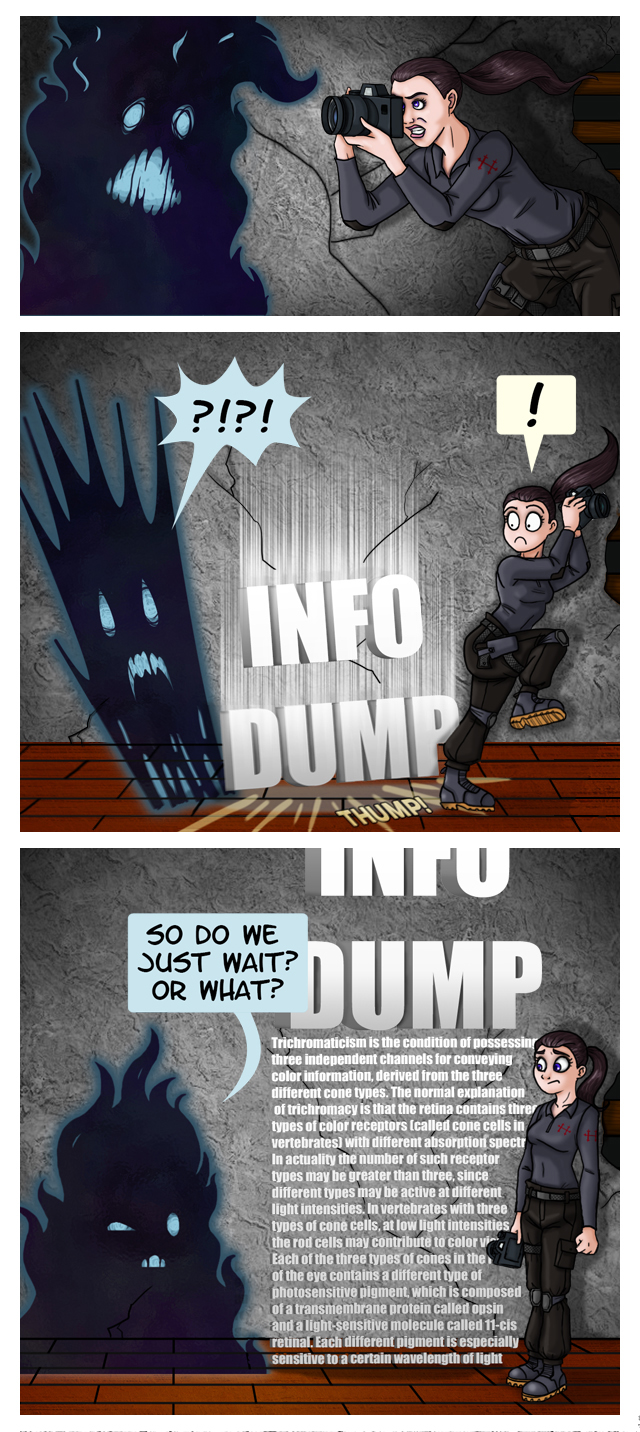
Another huge problem with Shutter was the flow of the action scenes. There is SO MUCH exposition and info dumping, and it keeps interrupting the suspenseful parts of the story. I mean, it’s wonderful how much thought Alameda put into this world, and I was certainly interested in the science behind monster hunting, but I don’t want to read a full page about how a camera works right when Micheline is about to be killed by a ghost. It’d be like pausing the duel scene between Luke and Vader to give a five minute lecture on the technology behind lightsabers. It’s cool and all, but really not the right time, and completely destroys the tension.

Micheline is fighting a shadowy creature with a glowing blue mouth and eyes. In the first panel she’s attempting to take its photo. In the second, both she and the monster jump out of the way in surprise as the words “INFO DUMP” fall from the sky. They both stand there awkwardly as an extensive, verbose paragraph about trichromsticism scrolls by. The shadow monsters asks “So do we just wait, or what?”

Forget the incredibly dramatic fight scene, let’s learn about trichromsticism!

Okay, so now for the moment you’ve been waiting for, was it at least entertaining? Heck yeah it was! The overall story was great, suspenseful, and fun, with some truly terrifying scenes. By the time I got to the second half of the book, I couldn’t put it down! The monsters were incredibly creative and creepy, like something out of Silent Hill, and the horror scenes were spot on. Alameda does an excellent job of building suspense and creating a creepy atmosphere (minus the random info dumps that kill the mood). It’s worth pointing out that this is the author’s debut novel, so it’s understandable that the book has flaws. Even the great Terry Pratchett’s early work was, admittedly, not that great, and he’s one of my favorite authors! So Alameda definitely has time to hone her skills and improve on her characterization and exposition. She’s already great at world building, horror, and action scenes. And honestly, it’s nice to see a horror novel written by a Latina author. The genre is severely lacking in Latine/Latina writers, and the few I know of are mostly men.

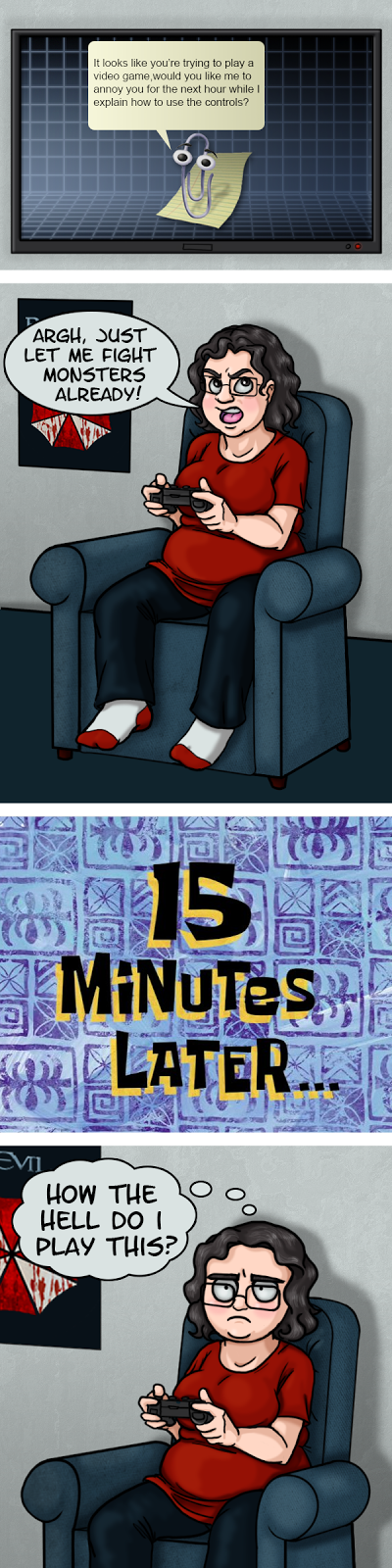
Overall, Shutter is a fun, suspenseful read, even with its flaws. If I could just take out the annoying characters, and focus on the plot, the monsters, and the fight scenes, the book would be perfect, like a horror survival game. That’s actually not a bad idea, it could be a cross between Fatal Frame and Resident Evil, where you can just explore abandoned buildings and fight monsters instead of listening to pointless dialogue. At least in a video game I can skip random info dumps.

The Microsoft paperclip asks “It looks like you’re trying to play a video game, would you like me to annoy you the next hour while I explain how to use the controls?” Annoyed, I complain “Argh, just let me fight monsters already!” and skip the tutorial. 15 minutes later, I wonder to myself how the hell I’m supposed to play this game.

I just imagine all annoying video game tutorials as being done by either Navi or the Microsoft Paperclip.

I just imagine all annoying video game tutorials as being done by either Navi or the Microsoft Paperclip.

Oddity by Ashley Lauren Rogers

Genre: Body Horror, Historic Horror, Sci-Fi Horror

Audience: Y/A

Diversity: Trans characters

Content Warnings (Highlight to view): Abelism, Forced Captivity, Gaslighting, Gore, Illness, Medical Procedures, Transphobia/Misgendering, Violence

Blurb

A “Gender Specialist” is brought into a secret Victorian–Era medical facility deep within the earth to unravel the mystery of a series of murders and body mutilations which have taken place. As he meets the sole survivor and begins to unravel the mystery as his claustrophobic paranoia begins to overtake him the specialist finds it hard to believe anything he’s told.

So, full disclosure, this isn’t so much a review as it is an unpaid promotion for my friend’s new play Oddity, and I’ve only read the script, not seen the play itself. But fear not, this isn’t one of those situations where I felt pressured to pay compliments for the sake of our friendship, both because Ashley is an incredibly talented writer and I love reading her stuff, and because I’m an asshole who will let my friends know exactly what I think in the least tactful way imaginable. Which is probably why no one ever asks for my opinion…

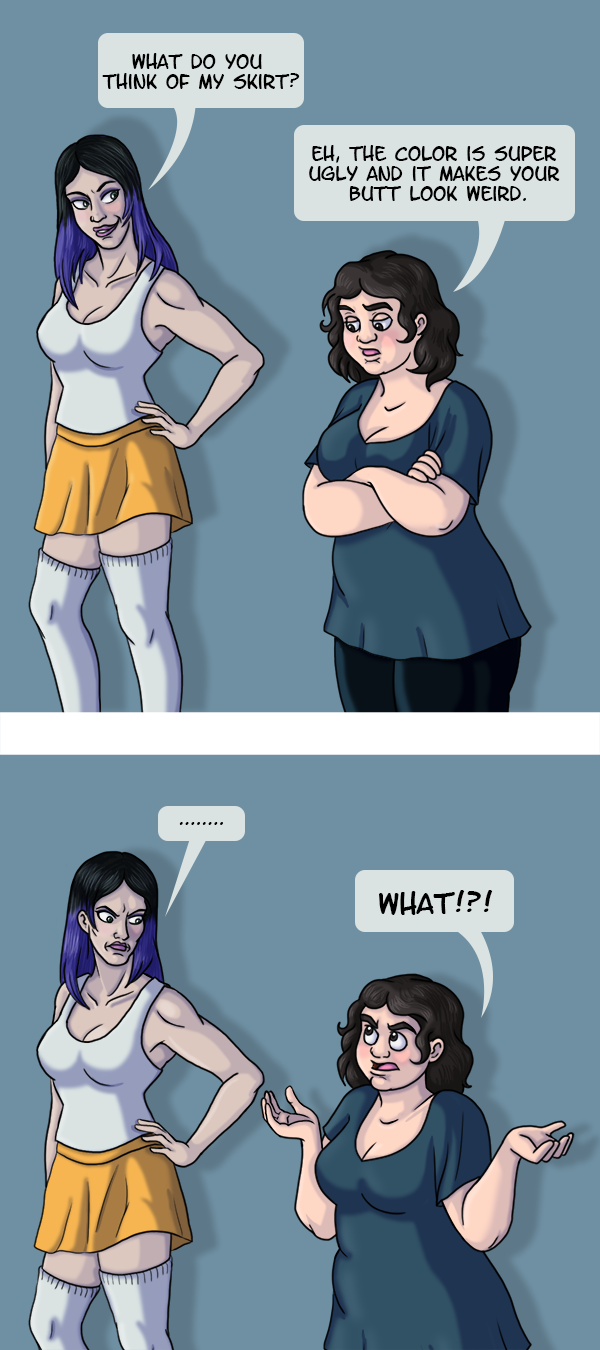
My wife watched me draw this and wanted to know why I put her in such an ugly skirt. “It’s for the review honey!”

Anyway, like I said, Ashley is a talented writer who has written for CosmopolitanThe Mary Sue, SFWA, and John Scalzi Blog. And for you other writers out there looking to diversify your work, she also developed a workshop for writing trans and nonbinary narratives available on WritingTheOther.com. She’s also the one who introduced me to Rick and Morty and has fantastic hair. Neither of those things has anything to do with her writing, she just has excellent taste.

 
Ashley’s new play, Oddity, is part of the Trans Theatre Fest at The Brick in Brooklyn. It’s a creepy, suspenseful, psychological body horror play about gender that includes: flashbacks to a carnival freak show, a subterranean steampunkesque facility à la Jules Verne, and monster crabs (the crustacean kind, not the pubic lice kind).
 
 The plays starts with terrified screams and the professor (who’s never given a name) violently awakens to a doctor trying to push mysterious pills on him, a soldier “guarding” his room who won’t use his correct pronouns or let him out for “classified” reasons, and the discovery that he’s been losing time. His concerns are dismissed, his questions ignored, and he’s consistently told to calm down. The professor is experiencing classic gaslighting, and here’s the brilliant bit: between the dreams, flashbacks, lies, discrepancies, seemingly out-of-place items, and all around weird occurrences, it’s difficult to determine what’s real and what isn’t, mirroring the professor’s paranoia. At parts, I found myself frustrated because I couldn’t figure out what was going on, and unnerved by the overall feeling of “wrongness”. The body horror was pretty scary in and of itself, but it was the gaslighting that was truly terrifying. But fear not, everything makes sense in the end.
 
In fact, the ending was probably my favorite part. When everything finally falls into place it hits you like a punch to the gut, and I couldn’t help yelling out a few expletives in surprise (much to the annoyance of my napping cat). This was literally my reaction while reading the play: “Hmmm, okay, that’s creepy. Wait, what the…WHAT? WTF!?!!? Oh god oh god oh god, no no no no no no. Wait… but then that means… OMG. HOLY SHIT. SHIT. SHIT. WTF.” So yeah, good job Ashley, I actually yelled out loud at my computer screen after finishing your play.
 
And that was just the script. I can’t even imagine how I’d react to the actual performance, with actors Kelsey Jefferson Barrett, Kitty Mortland, Sam Lopresti, Aliyah Hakim, and Samantha Elizabeth Turlington, and directed by Ariel Mahler. So if you’d enjoy a creepy mindfuck of a play about trans people, by trans people, check out Oddity at the Brick theater (579 Metropolitan Ave, Brooklyn NY) on the following dates:
 
Thursday, July 20 @ 9:20pm
Saturday, July 22 @ 2pm
Monday, July 24 @ 9pm
 
Tickets are only $20.00 and you can purchase them here:
Camp Carnage by Elliot Arthur Cross & Joshua Winning

Camp Carnage by Elliot Arthur Cross & Joshua Winning

Formats: Print, digital

Publisher: CreateSpace Independent Publishing

Genre: Killer/Slasher, Comedy Horror

Audience: Y/A

Diversity: Gay and Lesbian characters

Takes Place in: Colorado, USA

Content Warnings (Highlight to view): Body Shaming, Bullying, Child Abuse, Child Death, Death, Drug Use/Abuse, Forced Captivity, Gaslighting, Gore, Homophobia, Mental Illness, Racism, Sexism, Slurs, Suicide, Violence, Verbal/Emotional Abuse 

Blurb

In the summer of 1986, Billy Collins is sent to his own personal Hell – summer camp. The remote Camp Genesis offers desperate parents a place to “straighten” out their gay teenagers with the help of the puritanical Katherine Creevey.

Besides the typical horsing around, campfire tales and summer games, the Genesis program forces gay and questioning teens into humiliating gender-based lessons. While Billy wants nothing more than to escape Camp Genesis, he can’t help worrying that something even more sinister is hiding just out of sight.

Unknown to Billy, two campers were murdered three years ago. Just days after Billy and the new campers arrive, people start to go missing, and it’s up to Billy and his new friend Jem to find out what’s really going on. Is a maniac on the loose? Is history repeating itself? One thing’s for sure – at Camp Genesis, you have to fight to survive…

Eid Mubarak! I hope all my Muslim readers have a happy Eid Al-Fitr, and that Ramadan brought you peace and prosperity. In honor of the holiday my next review will feature a book from Salaam Reads a new publishing imprint that focuses on books for Muslim kids and young adults. For now, let’s finish up pride month with a gay camp slasher story.It’s an unfortunate fact of life that the majority of self-published books are bad. Really, REALLY bad. Like, any movie remake with Matthew Broderick in it bad. I get that not all self-published books are mind-numbingly awful, and there are definitely benefits to self-publishing (better royalty rates and creative control) over the traditional model. But for every The Martian there are about a million crappy Dinosaur/Alien Romances with bad grammar and a cover that looks like someone tried to illustrate their bad LSD trip in MS Paint. So I was skeptical when I first picked up Camp Carnage and saw it was *gasp* self-published.

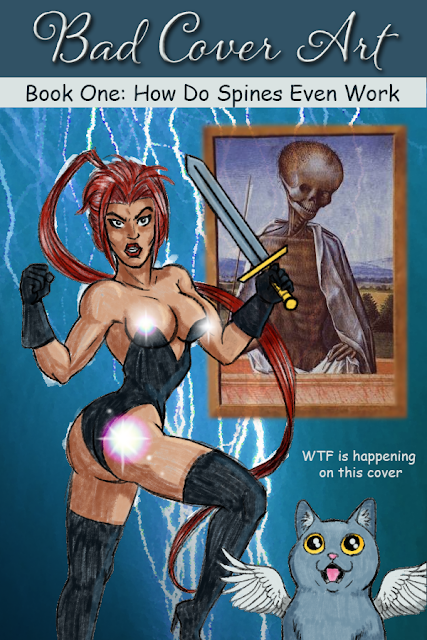
An ugly book cover with the title “Bad cover Art. Book One: How Do Spines Even Work.” None of the fonts match, there’s a medieval painting of a skeleton with blurred edges, a big-eyed cat with wings, and a poorly drawn, anatomically incorrect woman holding a sword. Her hair is in a long ponytail and she’s wearing a revealing, dominatrix-like black outfit that seems to be glued on to her body. Her spine is twisted so both her breasts and butt are facing forward, and have lens flares on them.

It’s like J.J. Abrams and Rob Liefeld made cover art for some bad fanfic.

But it’s actually pretty good! No poorly photoshopped cover, no obvious author self-inserts, the text has been edited for spelling and grammar, and the story is solid and enjoyable. There are still some issues, but overall it’s a fun throwback to campy 80’s horror classics, with a largely queer cast. The characters should be familiar to horror fans, there’s the virginal hero, the hero’s best friend, the mean rival, the love interest, the “cool” best friend, the stoner who acts as the comic relief, the brooding loner, the creepy caretaker, the sole black guy, and the fat kid (yeah… there’s a lot of body-shaming in this book). But in this story, the virginal hero and promiscuous bully, usually female-only roles, are both gay men named Billy and Kyle, respectively. Meanwhile, the handsome, mysterious jock whose attention they’re vying for is still in serious denial about his sexuality, while Billy’s best friend is a bad ass lesbian and probably the toughest person in the camp.  Of course, not everyone sticks to their assigned “role”. Without giving too much away, suffice it to say that literally anyone can die, so don’t get too attached to anyone, and flipping the genders of the “virgin” and the “whore” isn’t the only way Cross and Winning invert horror tropes.

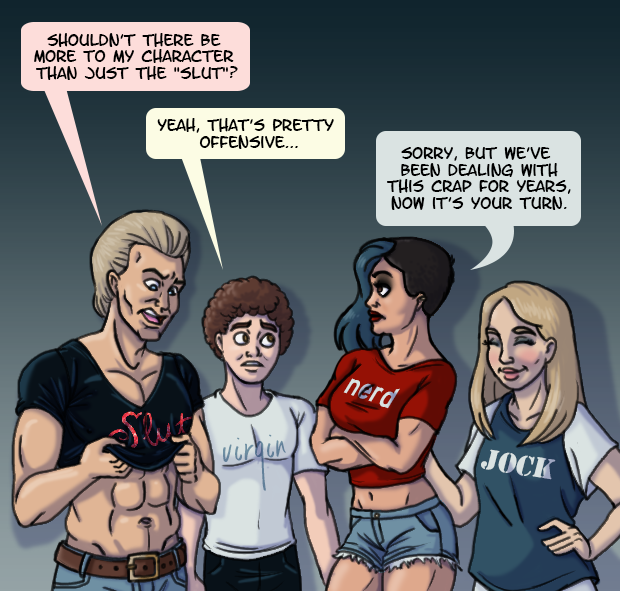
An athletic boy wearing a “Slut” T-shirt looks at his shirt and asks “Shouldn’t there be more to my character than just the ‘slut’?” A scrawny boy wearing a “Virgin” shirt confirms “Yeah, that’s pretty offensive.” A buff girl with a punk haircut and a “Nerd” shirt responds “Sorry, but we’ve been dealing with this crap for years, now it’s your turn.” A blond girl with a “Jock” T-shirt grins behind her friend.

No! Everyone gets one character trait, and that’s it! Now go take your clothes off until you get stabbed.

The rest of the cast is pretty much just there to bring up the body count, so the authors didn’t bother to give them much in the way of personalities. It would have been nice if they were slightly more rounded, or had more than one character trait, but honestly, they’re just cannon fodder, so who really cares. Though it’d be great if the fat kid could have been characterized by something other than his weight (seriously, what is with all the fat shaming!?). I get that many of the characters are stereotypes, but c’mon. Everyone else got to have an actual personality trait as their one defining characteristic, as opposed to a physical attribute! At least the sole black guy got to be the flaming kid, as opposed to a racist caricature.As far as killers go, the murderer isn’t very creative, though they do manage to bump off the majority of the cast without anyone noticing.  Like, to the point where no one finds a dead body until the last few chapters. I’d hope someone in charge would be at least a little more concerned by a number of strange disappearances, but nope. Did people just not give a shit about their children back then? Were teens sent off into the wilderness en masse, and everyone just hoped some of them would make it out alive? I know adults were more laid back about unsupervised kids in the 80’s, but you’d think a child that went missing in the woods for days would at least warrant a phone call.

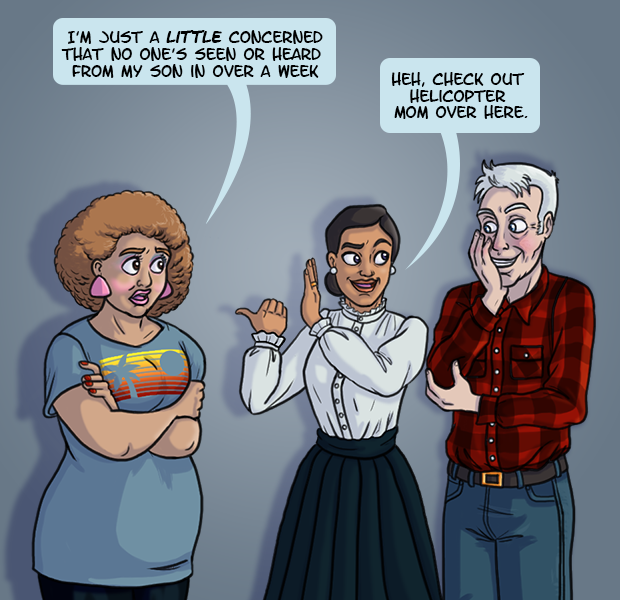
A mom with very curly hair and 80’s makeup and clothing is saying “I’m just a little concerned that no one’s seen or heard from my son in over a week.” A conservatively dressed woman with her hair in a tight bun, and an older man in a plaid shirt are giggling at her. The conservative woman whispers to the man “Heh, check out helicopter mom over here.”

I mean, it’s not like he got murdered in the woods by the camp serial killer. Probably…

Now, obviously you don’t want the victims to figure out they’re being picked off too early in the story. There needs to be time to draw out the suspense, and let the reader get to know the soon-to-be corpses a little better. But let’s face it, if you’re reading slasher horror it’s because you want to see the bodies hit the floor. Any time spent on character development and plot is just making sure you have a nutritious meal before gorging on cake and ice cream. Yeah it’s important, but it’s not the good stuff. And Cross and Winning just waste too much time on boring camp activities when they could’ve been writing about terrified campers trying to escape the killer. Besides, most of the characters are so flat and boring I really don’t want to spend any length of time with them, I just want to see them get murdered in the most gruesome, over-the-top way imaginable.The camp itself is a lot less horrible than I expected a pray-away-the-gay camp to be. Then again, if it were anything like the places you read about on the news, it would be a completely different kind of horror story, and a masked murderer would seem silly and unnecessary in comparison. That’s not to say there wasn’t some pretty disturbing homophobia from the adults trying to “convert” their poor charges. They’re not being electrocutedbeaten, or medically tortured (big trigger warning for those links by the way), but being told who you are is wrong and unnatural is still really damaging. One scene, where one of the camp counselors, Father Norton, has the campers repeat homophobic insults they’ve received and direct them at Kyle, was really upsetting. It was an incredibly dark moment in an otherwise goofy horror story, and much more disturbing than a silly, fictional slasher. I had to go hug my wife after reading that part. But, over all, Camp Carnage is still a fun homage to 80’s Slasher films, with plenty of nods to nerd culture, gore, and humor.

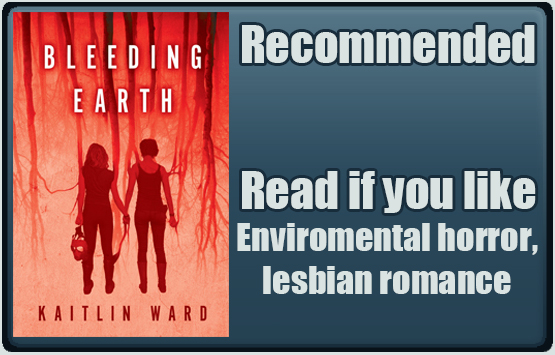
Bleeding Earth by Kaitlin Ward

Bleeding Earth by Kaitlin Ward

Formats: Print, digital

Publisher: Adaptive Studios

Genre: Blood & Guts, Apocalypse/Disaster, Psychological Horror, Romance

Audience: Y/A

Diversity: Lesbian characters, Hispanic/Latine character

Takes Place in: New Hampshire, USA

Content Warnings (Highlight to view): Alcohol Abuse, Bullying, Child Abuse, Child Death, Child Endangerment, Death, Forced Captivity, Gore, Homophobia, Mental Illness, Racism, Suicide, Verbal/Emotional Abuse, Violence

Blurb

Between Mother Nature and human nature, disasters are inevitable. 

Lea was in a cemetery when the earth started bleeding. Within twenty-four hours, the blood made international news. All over the world, blood oozed out of the ground, even through the concrete, even in the water. Then the earth started growing hair and bones.
Lea wishes she could ignore the blood. She wishes she could spend time with her new girlfriend, Aracely, in public, if only Aracely wasn’t so afraid of her father. Lea wants to be a regular teen again, but the blood has made her a prisoner in her own home. Fear for her social life turns into fear for her sanity, and Lea must save herself and her girlfriend however she can.

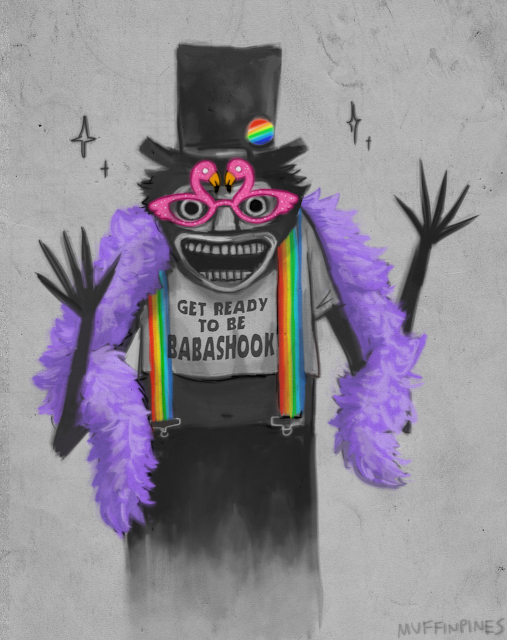
Happy Pride month! Here’s something fun for queer horror fans, after Netflix accidently featured the Australian indie horror film, The Babadook, on their LGBT movie page, the titular creature has quickly become a Pride meme and it’s wonderful. If you haven’t seen the film, it’s awesome, go watch it.

A tall, dark, creepy creature with long fingers and a white face is wearing a top hat with a rainbow button, rainbow suspenders, a purple feather boa, sparkly pink flamingo glasses, and a belly shirt that says “Get Ready to be Babashook.”

Artwork by Muffin Pines at http://muffinpines.tumblr.com/

For June I’ll be reviewing two horror stories with queer characters, the first of which is Bleeding Earth. And oh man, did this book mess me up good. I was expecting a gory, end of the world sort of book, and instead I got a heartbreaking survival story about love, family, and humanity (yes I know how cheesy that sounds, shut up). It gave me so much anxiety, and so many emotions, and I’m still trying to process what the hell I just read. But I know it was good. It was really freaking good. And there was so much blood. Blood, and bones, and hair. I love blood. And bones. Not wads of hair though, I have my limits.

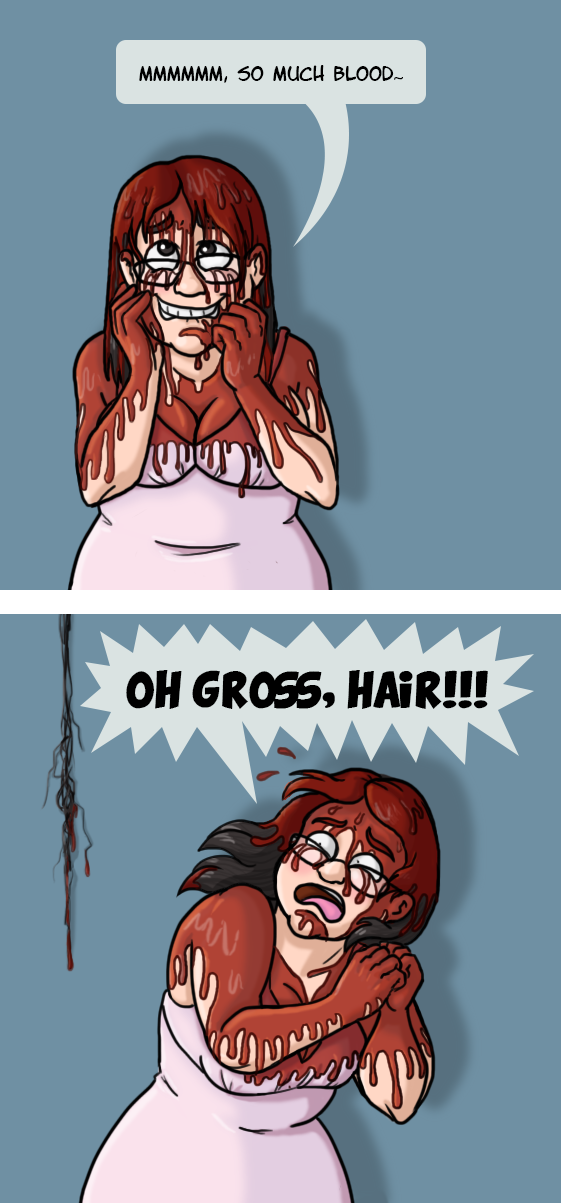
In the first caption I’m wearing a light pink dress and covered in blood. I’m clearly enjoying the blood dripping through my hair and down my shoulders because I’m smearing it on my ecstatic face while sighing “Mmmmmm, So much blood.” In the next panel I’m screaming “OH GROSS, HAIR!”  in disgust and pulling away from a wad of bloody hair I’ve just noticed.

I was going for a “Carrie at the Prom” kind of look.

Lea, the novel’s protagonist and narrator, is enjoying the blossoming relationship she shares with her girlfriend, Aracely, when the blood first appears. Now, normally teen romances in dystopias and apocalyptic fiction seems tacked on and out of place. I mean, who worries about crushes when their life is on the line? But in Bleeding Earth, it works beautifully. Surrounded by chaos and despair, Lea wants to hold onto one of the few good things she has left to keep her going, because no one knows how long they have left. The girls are still in their honeymoon phase, so everything still feels wonderful and new, a sharp contrast to the reality around them. When Lea starts experiencing night terrors and hallucinations from stress and isolation, talking to her girlfriend on the phone is the only thing that helps her. And when she wants to give up, it’s Aracely that keeps her going. And I just can’t bring myself to begrudge her that one little bit of happiness. Who wouldn’t want to spend time with someone who makes you feel safe and lets you forget your problems for a while? It gave my cold, little heart all the feels.The scariest thing about Bleeding Earth isn’t the blood, hair, and bones seeping up from the ground. It’s the feeling of isolation, uncertainty, and powerlessness. At least with zombies, aliens, and diseases there’s always something you can do, a safe zone to flee to, a cure, an end in sight. But with the blood there’s nowhere to escape, no way to fight back, and no stopping the blood. No one knows what’s causing it, or if it will ever end. There are no answers or explanations to soothe the scared populace. And while I normally hate it when a story doesn’t give me an explanation, here it actually works. It’s so much more frightening when you don’t know what’s happening, and there’s literally nothing you can do about it. Will things get better? Is this the end of the world? Did humanity piss off the earth so much it’s finally rejecting them? Even at the start of the bleeding, when everyone is still doing their best to “keep calm and carry on,” fear is already causing people to take desperate actions. Lea’s mom obsessively measures their water and screams at her friends when they drink some, her father nails boards over all the windows so they’re in complete darkness, a man attacks Aracely with a bone over a breathing mask, and some jerks at an Apocalypse party try to get an inebriated girl to drink the blood. It starts with fights over tampons in the grocery store, then looting Home Depot, to violence and riots, and it only gets worse from there. Much, MUCH worse.Now, I know poor decision making seems to be a staple of Y/A fiction (one that annoys me to no end), but here, it makes sense. Everyone is absolutely terrified, struggling with isolation and the horror of what’s happening around them, while still trying their damnedest to pretend like everything is going to be fine. And scared, stressed people do not behave in a rational manner. At various points the teenagers in the story become so desperate for normalcy and human contact they’re willing to brave the blood and all its dangers just to be together. Is this a good idea? No, absolutely not. But is it understandable? Completely. Humans are social creatures, so much so that isolation can actually be deadly. And here’s the original research to back it up. I’m an introvert who prefers a quiet night at home, and even I felt stressed and nauseous when poor Lea described being trapped in her boarded up home for weeks on end, with little to no outside communication. Honestly, if I had to go through a bloodpocalypse, I probably would’ve snapped after a few hours indoors and gone blood hydroplaning (hemiaplaning?) in a stolen car while throwing human skulls at pedestrians. And that’s speaking as someone who willingly goes for days without human contact, I can’t imagine what a non-homebody extrovert would go through. So kudos to Lea for keeping it together as long as she did! If you’re probably going to die anyway, it’s better to die among friends and go out with a bang.

A close up of me driving a car through blood while leaning out the window. I’m holding a human skull out the window while waves of blood are being splashed up by the car. I’m dressed like one of the War Boys from Mad Max: Fury Road, with corpse pain covering my face. I gleefully shout “Oh what a day… What a lovely day!”

I showed this drawing to my wife, and now I’m not allowed to drive her car.

While I really enjoyed Bleeding Earth, it did have some problems that got to me, and kept me from giving it the full five stars. Like Lea’s dad. He learns that the mom has become unhinged, and Lea fears for their safety, but instead of going to help his wife and child, he tells his frightened daughter to get her unstable mom, slip through the looters and people willing to kill for water, and come to him. So of course a ton of horrible things happen because Lea can’t get her sick mother to leave the house, and her dad is apparently too lazy to drive the 40 minutes to help her. Like, I get they need everyone they can get to keep the power going, but for fuck’s sake man, you can take an hour to go rescue your wife and daughter. He’s just so frustratingly blasé about the whole thing. And then there were a bunch of weird little plot points that didn’t go anywhere. Like Lea’s hallucinations. Ingesting the blood is discovered to cause hallucinations, night terrors, lost time, and mental breaks. Lea starts to have horrible nightmares, imagining blood in the house, but it’s unclear if it’s an effect from the blood or the isolation. While she does spend part of the book questioning her sanity, and it’s definitely stressful and unsettling, it doesn’t really go anywhere. Was she infected by the blood? Yeah, we never get an answer for that one either.

A frightened teen is on the phone with her dad. “Hey, dad? Looters keep trying to get in the house, I haven’t seen the sun in over a week, and I think mom’s gone off the deep end and she’s possibly planning to kill someone. Could you come get us?” Her dad is seen doing Sudoku in his office and tells her “That’s nice honey, but I’m just swamped at work right now, can I call you back later? Tell your mom I said “Hi”. “Dad are you even listening!? Screw your work and get your ass back here!”

Hey, Sudoku IS work!

The lack of explanations will be a major turn off for a lot of readers, and I can understand that. But honestly, I didn’t feel like it was needed, because that really isn’t the point of the story. This isn’t a sci-fi novel with an omniscient narrator about a world-wide disaster. This is Lea’s story. It’s about her fears, her loneliness, her confusion, and her crush on Aracely. She’s terrified and frustrated because she doesn’t know what will happen, her parents can’t reassure her, and she just wants to be able to take comfort in something. It’s a sweet, sad story of survival, isolation, and just trying to enjoy a simple teen crush in a world that’s gone to hell.

The Drowning Girl by Caitlín R. Kiernan

The Drowning Girl by Caitlín R. Kiernan

Formats: Print, audio, digital

Publisher: Penguin

Genre: Monster, Werewolf, Romance, Ghosts/Haunting, Psychological Horror, Mystery

Audience: Adult/Mature

Diversity: Lesbian characters, trans character, mentally ill character

Takes Place in: Northeastern USA

Content Warnings (Highlight to view): Mental Illness, Self-Harm, Mentions of Transphobia, Suicide, Emotional Abuse 

Please note, I found out recently that Caitlín R. Kiernan has expressed racist and Zionist views on Twitter, explored here. I will leave the reivew up for now, but can no longer reccomend her books.

The Drowning Girl is a beautifully written, psychological horror novel about a young woman, Imp, whose schizophrenia is making it difficult for her to determine the nature of the mysterious woman haunting her. Is she a siren using her charm to lure Imp to disaster? A werewolf? A human stalker who can blur the lines of reality? Imp struggles to sort out the truth before she loses herself. Queer romance, myths, and art combine to create this award winning novel.

So did I like it? Well……. Sort of?

In theory I should have loved it. It takes place on my home turf of New England, the main character is a queer artist (like me!), she’s dating an incredibly well written trans character, the story has a creepy mystery, gorgeous imagery, and one of the best representations of mental illness I’ve ever read. But I struggled to get through the Drowning Girl. I’d pick it up, read a chapter, and then forget about it for a month. I don’t know why I didn’t devour this book as quickly as I do others, there wasn’t really anything I disliked about it, and it wasn’t boring, but it just didn’t seem to capture my attention. It reminded me of one of those award winning art films that critics love and you have to sit through in college film classes. There’s nothing bad about it per se, but you’d still rather be watching Bad Boys II, or some other equally ridiculous action flick.

In the first panel I'm in the hallway of a movie theater looking at a poster for "The English Patient" and saying "Oooh, I heard this was a great film!" In the next panel I'm in the theater looking completely disinterested, and repeating "bored, bored, bored, bored" over and over as I suffer through the movie.

Ugh, I should’ve just watched Sharknado again.

Maybe I’m just not sophisticated enough to appreciate the non-linear, stream of conciseness (i.e. all over the place) writing, or perhaps I’m too clueless to fully comprehend the subtly and symbolism of the story. But I found it really jarring to have Imp describe her girlfriend, Abalyn, play Kingdom Hearts one minute, and then have a poetic, jumbled passage full of fairy tale metaphors the next. And I get it, the writing style is intended to represent Imp’s mental illness by showing the disorganization of her thought process, the random associations she makes where none exist, and her difficulty remembering what’s real and what’s imagined. But that doesn’t always make for an enjoyable read.

I guess I’m just incredibly picky when it comes to “artsy” prose and magical realism. When it works, it works well, but when it doesn’t, it just becomes a confusing, irritating erratic mess, and with the Drowning Girl it was kind of a crap shoot.

I'm floating upside down in blue space, surrounded by dreamlike imagery of a crow wearing a cloak, a close-up of a crescent moon, a wolf's skull, pills, a crab, and a mermaid with pale, corpse-like skin. The mermaid's human half is intact but her fish half is nothing but bone. Her organs hang out of her human torso. I look confused and mutter

WTF is going on? Did I take expired cold medicine again?

Since I’m starting to feel bad for picking on this book so much (and it’s by no means a bad book), I want to address one of the things I did really like about the story, how Imp’s mental illness was treated. It wasn’t romanticized, it was just a part of her that could make her life more challenging, but not horrible. Medication made her illness manageable, but didn’t make it disappear entirely, and she was able to continue working, date, hang out with friends, pursue hobbies, and lived on her own. She would go through rough patches, some she could handle on her own, and some she couldn’t. Her therapist was supportive, without telling Imp what to do. Overall, I felt like it was a very realistic depiction of a woman with a mental illness, which is rather uncommon in fiction where the mentally ill are usually written as either asylum inmates, criminals, or manic pixie dream girls.

Overall, I really, really wanted to love this one. It had all the right ingredients, rave reviews, a talented author, but the final result was disappointing, at least for me. It wasn’t bad, but I just couldn’t bring myself to give it a “highly recommended”. That doesn’t mean other people won’t find this book amazing, and I strongly encourage others, especially those with more sophisticated taste than mine, to give it a read. Because you may love it. Or you may find it “meh”, but at least you won’t regret reading it.

Navigation

Social Media

Search by Tags

To learn more about the Age Group, Diversity, and Genre tags, click here.

Age Groups

Diversity

Genre

Support the Blog

Search

Links

The Lamb Will Slaughter the Lion by Margaret Killjoy

The Lamb Will Slaughter the Lion by Margaret Killjoy

Formats: Print, digital

Publisher: Tor

Genre: Demon, Occult

Audience: Y/A

Diversity: Gay, lesbian, and bisexual characters,Trans character and author, Black character, Latine/Hispanic character, Character with anxiety disorder

Takes Place in: Iowa, USA

Content Warnings (Highlight to view): Animal Death, Forced Captivity, Gore, Oppression, Police Harassment, Mentions of Rape/Sexual Assault and Abuse, Suicide, Violence 

Blurb

Searching for clues about her best friend’s mysterious suicide, Danielle ventures to the squatter, utopian town of Freedom, Iowa, and witnesses a protector spirit — in the form of a blood-red, three-antlered deer — begin to turn on its summoners. She and her new friends have to act fast if they’re going to save the town — or get out alive.

I’ll admit, I really didn’t know much about Anarchism or the squatter/crusty punk/traveler lifestyle (which are all different, but overlap) before picking up The Lamb Will Slaughter the Lion. I had a vague notion that Anarchists didn’t like the government, but I always pictured them as some sort of cishet white boys, oblivious to their own privilege, who would disrupt otherwise peaceful protests by smashing windows and setting things on fire. Heck, if you google Anarchist, one of the synonyms that pops up at the top of the page is “terrorist”. Of course, I started to question my long-held prejudices when I noticed some of my Facebook friends, many of whom are minorities, identified as anarchists. These were people who frequently posted about human rights, non-violence, and green-living – a far cry from the violent images of Anarchists I’d seen in TV shows and movies. It was Margaret Killjoy’s novella that finally familiarized me with the movement and the people in it and encouraged me to do my research.

Killjoy, drawing from her own experience as a travelling Anarchist, created a diverse cast of anti-capitalists punks. The main character, Danielle, suffers from one of the most realistically portrayed anxiety attacks I’ve ever seen in fiction. Her mental illness isn’t glamorized or downplayed, nor is she depicted as a “crazy, weird girl”. She develops a crush on Brynn, a bisexual woman, who offers to snuggle with her in bed, without any sort of pressure or expectation. Vulture, a queer, black, femme trans-man, introduces himself  to Danielle by asking what pronouns she uses. Most of the anarchists depicted in the book are peaceful, only resorting to violence in cases of self-defense, and limiting their minimal criminal activity to squatting in abandoned buildings and shoplifting necessities from big box stores. They’re idealists, but they’re also flawed and human. Some of the younger characters can be heavy handed about declaring how punk/counter culture they are, still too insecure to realize they don’t need to prove anything to anyone. One of the story’s antagonists actually calls someone a poser like it’s the sickest burn in the world. Vulture is obsessed with posting everything to Instagram, while his partner behaves like he’s in some sort of dramatic art film. The characters bicker, disagree, and even get into scuffles, and it all feels incredibly genuine and authentic.

When Danielle first stumbles across the Anarchist commune where her deceased friend, Clay, was living, it seems like an Anarchists Utopia. There’s no capitalism, money, oppressive laws, or ruling bodies. Everyone helps each other out by sharing their food and resources, the town functions on trust alone, and all issues are solved through group consensus with the aid of mediators. There’s also a blood-red demon deer named Uliksi who reanimates dead animals and has a penchant for ripping out hearts. Clay co-founded Freedom with the best of intentions, but the wide-eyed idealist failed to consider the fact that any political system can be corrupted, no matter how perfect it seems. There’s a reason Utopia is based on the Greek “ou topos” which means “no place”. It’s because human nature is inherently flawed, making perfection impossible. Since the Golden Age and the Garden of Eden, somebody is always ruining paradise for everyone else, and the town of Freedom is no exception. In this case, it’s entitled fuckboys who use violence and threats to impose their will on everyone, turning the town from an Anarchist haven to a totalitarian dictatorship. Almost a year before Danielle’s arrival in Freedom, a man named Desmond took over the town, murdered those who disagreed with him, and prevented anyone from leaving. Terrified and desperate, Clay and his friends Rebecca, Anchor, and Doomsday resorted to summoning a demon named Uliski, a three-antlered deer with blood red fur, to stop the want-to-be despot. Most of you are realizing immediately that this plan will inevitably backfire because, much like trying to form a Utopian society, demon summoning never ends well.  Personally, I wouldn’t know because my wife won’t even let me summon a single adorable, little owl even though I’m pretty sure (like 80% sure) it would turn out fine, not that I’m bitter about it or anything. Anyway…. Clay and his crew figure “fuck it, we’ll deal with the consequences later” and let Uliski rip out Desmond’s heart.

First panel: I’m standing in a summoning circle with a long-legged owl demon wearing a crown and boots. My wife is reacting in horror and asking “What are you… did you just summon a demon!?!” 2nd panel: I hug the demon and ask “Can I keep him? He’ll be good! I’ll train him, and him, and feed him souls every day!” 3rd panel: My annoyed wife snaps “No! Put. It. Back.” While I plead “But we love each other! Stolas will be sad if I send him back! Pleaaaase? He’s so polite and smart! He knows all about plants, precious stones, and astronomy.” Stolas turns his head upside down.  4th panel: “Watch!” I shout enthusiastically “Prince Stolas, what star is that outside?” “That is the Sun” Stolas responds. “Good Boy! Such a smart little demon fluffy face!” My wife is not impressed. 5th panel: Stolas explains “Take mistletoe to treat an inflammation of black bile and enhance fertility” while I hug him tightly.  My wife points out “That’s not even remotely correct.”

According to the Ars Goetia, Prince Stolas is Great Prince of Hell who commands twenty-six legions of demons and imparts knowledge on those who summon him. He’s also super cute. Please do not take Mistletoe. It is very toxic.

Instead of fucking off back to the Underworld, or wherever it is endless spirits live, Uliski decides to stick around to continue his mission of hunting the vengeful and hateful who wield power over others, and reanimating animal corpses because he wasn’t already creepy enough already. At first, everyone is so glad that Desmond has been stopped and peace restored, they don’t really question the demon living in their town and even come to revere him. But Clay warns that Uliski will eventually turn on his summoners after one year, which leads us to Danielle’s arrival. She has a rather traumatic welcome after witnessing the bloodthirsty buck rip out Anchor’s heart, encountering a bunch of zombie wildlife, and dealing with town’s crazy drama, but instead of hauling ass out of the Animal Farm version of Dawn of the Dead, she resolves to stay and search for answers behind Clay’s suicide. Meanwhile, Freedom is in an uproar over whether or not their demonic protector should be dismissed, with half the town believing he’s keeping them safe and only kills when it’s justified, and the other half pointing out that murder may not be the best way to keep the peace. Once again, the town seems headed towards a Dystopian nightmare, with Uliski’s remaining summoners afraid for their lives, and a new charming and arrogant young man looking to “save” Freedom by enforcing his will on others.


A gold-trimmed pen and ink drawing of a red deer with three antlers, two on the right and one on the left. The prongs of the antlers turn into veins which are connected to a human heart, surrounded by a fractured rib cage. Between the deer's antlers is the sigil for the goetic demon Furfur and the alchemical symbol for fire, painted gold.

Uliski the demon deer

This is a story about how power causes corruption, especially when it’s wielded by violent young men dripping with privilege. While the novella is very pro-Anarchist, Killjoy keeps it from feeling too much like heavy handed propaganda by presenting a balanced view of her socio-political beliefs and chooses realism (well, other than the supernatural elements of course) over romanticism. The town of Freedom is presented as both an ideal and a warning; a community based on equality and cooperation is something to strive for, but, like any system, it can easily be corrupted by selfishness and fear even when everyone has the best of intentions. Hierarchies started to form without anyone realizing, and once those hierarchies were enforced through violence Freedom went from Anarchism to Authoritarianism, much like what happened after the Russian revolution.

As much as I loved The Lamb Will Slaughter the Lion, I felt it would have worked much better as a full-length novel, rather than a novella. The world building, story set up, character development, and ending all seemed too rushed and I was left feeling underwhelmed and longing for more. The concept is so cool, a demon deer turning on its summoners as a revolution slowly brews from with the town, that I wanted to spend more time there and learn about all the characters and what brought them to Freedom. I especially wanted to see more of Danielle and Brynn’s relationship develop. These reasons are why I much prefer the sequel, The Barrow Will Send What It May. By the second book, Killjoy has already established the world and the main players in it and is able to spend more time on developing her characters, building suspense, and giving Danielle and Brynn time to explore their feelings for each other. It’s for these reasons that I strongly suggest reading the two novellas together. The Lamb Will Slaughter the Lion feels incomplete on its own, but works well as the first chapter to an overarching story, and this is why I truly hope we will see many more chapters in the Danielle Cain series. I want to read a full-length novel about a band of Anarchists travelling from town to town solving mysteries and fighting demons, Scooby-Doo and Supernatural style, even if it is separated into several short stories. Killjoy clearly has many more stories to tell, and I look forward to reading them.

Five people in punk clothing colored to resemble the characters from Scooby-Doo. Furthest to the left is Danielle, a White woman with short, blonde hair. Next is Vulture, a tall, Black trans man with long hair and one half of his head shaved. Thursday, a Latino man in a leather vest is the middle, then Brynn, a White woman with red hair, a tattooed line on her forehead, and glasses. Her pants are covered in lgbtq, anarchist, and feminist patches. On the left is a chubby White woman, Doomsday with bobbed, brown hair.

Left to right are Danielle (as Scooby), Vulture (as Fred), Thursday (as Shaggy), Brynn (as Daphne), and Doomsday (as Velma). Anarchist Mystery Gang!

 
Worship Me by Craig Stewart

Worship Me by Craig Stewart

Formats: Print, audio, digital

Publisher: Hellbound Books

Genre: Blood & Guts (Gorn), Monster, Myth and Folklore, Occult

Audience: Adult/Mature

Diversity: Gay author and gay side character

Takes Place in: USA

Content Warnings (Highlight to view): Animal Death, Body Shaming, Bullying, Child Endangerment, Death, Forced Captivity,  Gaslighting, Gore, Mental Illness (depression), Physical Abuse, Sexual Assault, Self-Harm, Slut-Shaming, Suicidal Ideation, Violence

Blurb

Something is listening to the prayers of St. Paul’s United Church, but it’s not the god they asked for; it’s something much, much older. 

A quiet Sunday service turns into a living hell when this ancient entity descends upon the house of worship and claims the congregation for its own. The terrified churchgoers must now prove their loyalty to their new god by giving it one of their children or in two days time it will return and destroy them all. 

As fear rips the congregation apart, it becomes clear that if they’re to survive this untold horror, the faithful must become the faithless and enter into a battle against God itself. But as time runs out, they discover that true monsters come not from heaven or hell… 
…they come from within.

Please note, I received this product for free in return for providing an honest and unbiased review. I received no other compensation. I am disclosing this in accordance with the Federal Trade Commission’s 16 CFR, Part 255: Guides Concerning the Use of Endorsements and Testimonials in Advertising.

***
 

Worship Me is a nihilistic exploration of morality and faith presented as a gory horror story about a congregation trapped inside their church by a mysterious creature, called the Behemoth. Demanding their reverence, the beast viciously murders any who disobey and gives the group 48 hours to offer up a child sacrifice. With the safety and sanctity of their church destroyed and their beliefs thrown into question, the members of St. Paul’s United Church begin to reveal their true natures. The book boasts a large cast of characters including Dorothy, the church matron who’s desperate to feel needed, Emily, a severe and devout woman who harshly judges others, Susan, a naive and sheltered young woman who wants to save the world, and Chris, a closeted gay teen who desperately wishes his crush would acknowledge their mutual attraction, and the point of view frequently shifts as each character watches their world fall apart. But it’s Angela who comes closest to being the story’s protagonist.

Angela and her son, Alex, have been the center of church gossip ever since her husband, Rick, vanished mysteriously. Seemingly tired of the pity and Emily’s suspicious scorn Angela announces during Sunday service that she’s planning on moving away and starting fresh. That’s when a filthy Rick stumbles into the church. The congregation, who have been praying for his safe return, declares it a miracle. Angela, however, is less than thrilled. While the community sees the couple’s relationship as the perfect romance, high school sweethearts who marry young and went on to have a child, nothing could be further from the truth. Rick is an abusive and violent man who terrorizes his wife, Angela was desperate to escape his cruelty and protect her son, and his time away has made him even worse. While gone, Rick has found a new god, the Behemoth, and has apparently started some sort of Cenobite-type religion that involves torture, murder, self-mutilation, and a very aggressive recruitment strategy. Everything starts to go to hell after that.

At least I assume this is what Scientology is, but with more aliens and domestic espionage.

On the Sunday of Rick’s ill-fated return, the pastor, Don, tells his congregation about the myth of Job, a devout and righteous man whose faith is tested by hardship. For those unfamiliar with the parable, God and Satan aka “the Adversary” (“satan” literally translates to “adversary” so it’s unclear whether this is big S Satan, aka the devil, or just some random angel who’s a jerk) are hanging out in heaven and God is bragging about the super pious and awesome Job. Satan rolls his eyes and points out that Job is only “good” because he knows God blesses the righteous and punishes the wicked. He’s doing it for the rewards, not out of some deep sense of morality. God suggest they test that theory and gives Satan permission to ruin Job’s life by killing his servants and children, taking his wealth, and covering the poor man with boils. Job’s so-called “friends” also subscribe to the theory that bad things only happen to bad people, and proceed to blame the victim by telling the poor man that all his misfortune is his own fault. At this point Job is pretty miserable and wondering what the hell he did to deserve this and demands to know why an all-powerful deity would make the world so chaotic and horrible. Surprisingly God actually responds with something along the lines of “Where the hell were you when I made earth out of literally nothing!? I made a freaking universe and you people don’t even know what electricity is yet. Do you really think your stupid little monkey brain could understand all the complexities that go into running this place? I have all these plans you couldn’t even wrap your brain around, like winning a bet with this guy… never mind, the point is: I’m omnipotent, omniscient, and I work in mysterious ways. Deal with it.” Stunned, Job stammers out “Well, you didn’t really answer my question, like, at all, but you’re really scary and I don’t want an all-powerful deity angry at me so I think I’m just going to go back to being pious and throw in some groveling apologies so you don’t smite me.” God says “Yeah, you do that” and restores Job’s riches and health, and even gives him some new kids (because apparently children were easily replaced like goldfish back then), just so there are no hard feelings. The parable is meant to explain why good people suffer for seemingly no reason, though a more cynical interpretation would be that powerful beings treat mortals as mere pawns in their games and get unreasonably angry when those mortals want to know why they’re acting like jerks. While God is ranting at Job for questioning his betters, the irritable deity starts not-so-humbly bragging about how powerful they are, using the Behemoth as an example. The Behemoth, an enormous, land-dwelling beast, is so powerful that it can only be controlled by God, no mortal could ever hope to defeat it.

“Behold now behemoth, which I made with thee; he eateth grass as an ox.

Lo now, his strength is in his loins, and his force is in the navel of his belly. 
He moveth his tail like a cedar: the sinews of his stones are wrapped together. 
His bones are as strong pieces of brass; his bones are like bars of iron.

He is the chief of the ways of God: he that made him can make his sword to approach unto him.”
(Job 40: 15-19)

No, I don’t know why God spends so much time telling Job about the Behemoth’s giant genitals (“tail” was probably euphemism). Whomever wrote that particular bible story was having a really weird day. Jewish apocrypha describe the Behemoth as a primal creature that represents chaos and will battle with its aquatic and aerial counterparts, the Leviathan and Ziz, on judgement day.

An early 1800s pen and ink sketch of a bipedal demon. It has the head, legs, and tail of elephant and the torso and arms of a a human. The demon is clutching its large, bloated belly with clawed hand and looking over its right shoulder.

The Behemoth as it is depicted in the Dictionnaire Infernal where he is described as ruling over the domain of gluttony. The fictional creature may be based on a hippo or elephant. Young earth creationists and anyone else who failed grade school science think the Behemoth is a dinosaur (it’s not).

Most of the characters in Worship Me believe the Behemoth is either a fallen angel meant to test their faith or a new deity come to save them. But neither assumption is accurate because none of what happens is about any of the humans in the first place. The beast sees itself as the main character of its own story, and the congregation as mere pawns. The beast only seems god-like because humans are a weak and undeveloped species in comparison. Calling the Behemoth a false god or demon would be a gross oversimplification that implies its existence is tied inextricably to humanity. Historian Lynn Townsend White Jr. argued in his famous 1967 paper The Historical Roots of Our Ecologic Crisis “Especially in its Western form, Christianity is the most anthropocentric religion the world has seen. Man shares, in great measure, God’s transcendence of nature.” Abrahamic all but declare humanity’s superiority. In the very first book of the Torah and the Old Testament (Bereishith/Genesis) God essentially tells Adam that he is the most important living thing in the universe. “And God said, Let us make man in our image, after our likeness: and let them have dominion over the fish of the sea, and over the fowl of the air, and over the cattle, and over all the earth, and over every creeping thing that creepeth upon the earth.” (Genesis 1:26) In the Quran, even divine beings are told to bow down before the first human. “And when We told the angels, ‘Prostrate yourselves before Adam!’ they all prostrated themselves, save Iblis, who refused and gloried in his arrogance: and thus he became one of those who deny the truth.” (Surah 2:34) A relic from another time the creature’s morality cannot be defined by human parameters, and has nothing to do with any human religion. The church members, who clearly subscribe to the idea of human exceptionalism, at least in the beginning, simply assume it does.

Unfortunately for the congregations, God never does show up to control the Behemoth. A few people try to stand up to the beast at first, but all are brutally killed for their efforts and the legend of Job offers little comfort to their grieving loved ones. Some of the church members begin to wonder if there is even someone out there listening to their prayers. Even if there is, a hands-off God who lets innocent people suffer and die quickly loses their appeal when the prehistoric monster terrorizing you can promise rewards now. As they become even more frightened and desperate every adult becomes complicit in some form of depraved cruelty, whether they are active participants or merely remain silent and allow it to happen. This begs the question, if you willingly do something unspeakable to save your own skin, is the life you preserved still worth living knowing you will now have to carry the guilt of your crime? Keep in mind such philosophical questions are much easier to answer from the outside, but even the kindest and most moral person can be twisted by pain and fear and grief. While most of the heroic sacrifices made by those the Behemoth killed were merely pointless deaths (they died horribly and all it accomplished was pushing their loved ones to commit monstrous deeds to get them back), the murdered are also the only characters in the book who get to die with a clear conscience. If there is an afterlife, they’ll be the only ones joining Job in paradise.

The threat of death and suffering, especially when made against your children, are certainly excellent motivators when it comes to recruiting the unwilling, though I do have to question the decision making abilities of those members of the congregation tempted by the Behemoth’s promised “rewards”: torture (which Rick seems to be super into) and bringing Evil Dead versions of their murdered loved ones back to life. Why bother to offer a moldy, half-eaten carrot when the stick would suffice? But while no one takes them up on their offer of some old fashioned masochism, a lot of the characters fall for the “I’m going to murder someone you love then give you this evil, busted, half-assed version instead” scam Rick and his beast buddy are running. I don’t care how much you miss your kid, nobody wants a monster that makes the reanimates from Pet Sematary seem kind and cuddly by comparison, even if it does vaguely resemble a mutilated version of little Timmy. If my wife got mauled by monsters then Monkey’s Paw-ed back to life looking like something out of Resident Evil, I’d be reaching for the flamethrower, not agreeing to join some prehistoric beast’s weird torture church. Maybe if the Behemoth agreed to send my undead wife back to the cornfield or wherever I might agree to a little light beast worship, but as it stands his resurrection game needs some serious work.

My wife as a mutilated, living corpse is definitely one of the weirder things I’ve drawn. I showed this drawing to her and now she’s shuffling around the house pretending to be a zombie.

There is one other, much more significant issue I had with the book.
***Content warning for discussion of rape and sexual assault***
Among his many newfound powers, Ricks now possesses the ability to make people sexually attracted to him, whether they want to be or not. This creepy ability is first demonstrated when a heterosexual man finds himself inexplicably lusting after Rick (right before Rick kills and mutilates him). He uses it again on Angela whilst sexually assaulting her, resulting in her arousal during the assault, and the way it’s worded is pretty cringe-y:
“Her body began to revolt against every intellectual, spiritual and personal value she had tried painstakingly to uphold. This man, this creature, this demon, had violated her, beaten her, lied to her, threatened her life and the life of her child, but still her body wanted him. It ached for him, as if it would die without his touch, inside and out… She hated each and every betrayal her body made.”

This is a trope I absolutely loathe with a burning passion. Let me be perfectly clear: some people do experience an erection, lubrication, or even orgasm during a sexual assault, and there’s nothing unusual or shameful about it. It’s a purely physiological response and not an indication of enjoyment or a sign of consent. Unfortunately, the belief that any sign of arousal means the victim “wanted it” is still prevalent (and even used as a defense in court cases) and enforced in fiction like Crown of SwordsThe FountainheadGoldfingerGame of Thrones, and numerous Harlequin romancesFifty Shades of Grey actually inspired at least three different cases of sexual assault because these men couldn’t understand that fantasizing about being ravished isn’t the same thing as wanting to be assaulted (Pro tip: NO ONE wants to be raped). It’s not that people shouldn’t write about rape (The Round House by Louise Erdrich and Speak by Laurie Halse Anderson both do an excellent job dealing with such a difficult topic) or even erotic fantasies of being overpowered. It’s just that with rape culture and world being what it is, authors need to tread very, very carefully when writing about assault. TorApex MagazineWired, the Writing Reddit, and Marie Brennan’s blog all do a great job discussing how to write about sexual violence in fiction.

Worship Me isn’t nearly as bad as the previous examples I listed, Rick is portrayed as a complete monster whom Angela despises and what he does is reprehensible. I don’t think anyone reading that passage is going to think Angela wanted him to assault her, or that it was anything but a violation. But it still could have been handled a lot better and I cringed reading it.
***End of content warning***

Problems aside, Worship Me is still a well-written, and entertaining read. You would think a book where the characters spent the majority of their time trapped within a church reflecting on their personal values would get dull very quickly, but fear not. Action scenes are perfectly placed throughout the story to keep the pace going and the tension high. Even with my ADHD, Worship Me managed to hold my attention throughout the book and I only put it down when I absolutely had to (like when my wife said if I didn’t come do the dishes right now she was making me sleep in the backyard). But it’s the novel’s exploration of faith that makes Worship Me really stand out. I was very fortunate to grow up attending a Congregationalist church part of the United Church of Christ (UCC) with a strong emphasis on humanism, tolerance, science, and social justice, where my sexuality and agnosticism were readily accepted, but many people aren’t so lucky. Even churches that aren’t showing up on a Southern Poverty Law Center watch list can be intolerant towards anyone they see as breaking some obscure Biblical law from Leviticus. When a religion that’s supposed to be about love and compassion is twisted by its followers into an ugly culture of hate, judgement, and hypocrisy it drives people away. But worse than that is when people actually find that kind of message appealing. They’re attracted to the “us vs. the sinners” rhetoric and instead of loving their neighbors or respecting differences, they turn to condemnation and cruelty in a misguided attempt to please an angry god and reap the rewards they feel are promised them. And this is the heart of what makes Worship Me so terrifying. Not the monster outside who may or may not be an old god come to challenge the newer god of Abraham, but the horrible lengths people are driven to when they believe without question. Worship Me isn’t so much anti-religion as it is anti-zealous, unquestioning belief and fear-based worship. There are benefits to religion, it can offer comfort in dark times and encourage charity and compassion and a sense of community. But when the message is never questioned and when its followers lose the ability to judge right or wrong from themselves, that’s when people suffer. Churches will always make me leery. Maybe it’s because some very vocal religious types find both my sexuality and my lack of faith sinful, and are not shy about harassing anyone like me. It could also be that whole bursting into flame and vomiting black bile every time I step onto holy ground thing that happens, who knows. What I do know is the Worship Me has definitely made me think twice about visiting a house of God again, lest it hold some even darker secrets.
F4 by Larissa Glasser

F4 by Larissa Glasser

Formats: Print, digital

Publisher: Eraser Head Press

Genre: Blood & Guts, Body Horror, Monster, Sci-Fi Horror

Audience: Adult/Mature

Diversity: Trans women, Bisexual women, Queer women

Takes Place in: North Atlantic ocean

Content Warnings (Highlight to view):  Bullying, Drug Use/Abuse, Death,  Forced Captivity, Gore, Homophobia, Kidnapping, Mention of Medical Procedures, Police Harassment, Rape/Sexual Assault, Sexism, Slurs, Stalking, Suicide, Transphobia, Verbal/Emotional Abuse, Violence 

Blurb

A cruise ship on the back of a sleeping kaiju. A transgender bartender trying to come terms with who she is. A rift in dimensions known as The Sway. A cruel captain. A storm of turmoil, insanity and magic is coming together and taking the ship deep into the unknown. What will Carol the bartender learn in this maddening non-place that changes bodies and minds alike into bizarre terrors? What is the sleeping monster who holds up the ship trying to tell her? What do Carol’s fractured sense of self and a community of internet trolls have to do with the sudden pull of The Sway?

Please note: This review was written before I was out as genderqueer. In the review I refer to myself as not being part of the trans/non-binary community. This inaccurate. 

The horror genre is not generally kind to trans-women, frequently depicting them as serial killers and/or sexual deviants. Hell, fiction in general doesn’t treat trans people well, forcing them into a victim role and focusing on their angst and dysphoria. So you can imagine how unbelievably excited I was when I learned that Eraserhead Press was publishing a horror story about a bad ass trans woman who fights monsters and alt-right trolls. Even better, it was being written by a trans woman! Glasser is  a librarian from Boston which makes her five-hundred times cooler in my eyes (I love librarians, they’re like keepers of secret knowledge and they know everything). The reviews for F4 have so far been unanimously positive, the premise sounded weird and awesome, and it promised representation rarely found in the horror genre. F4 was like everything I had wished for and I could not pre-order it fast enough.

Well, apparently whatever jinni decided to grant my wish for an awesome trans-lady horror story written by a trans person was one of those dick bag jinn who likes to pull that Monkey’s Paw shit, because I haven’t been this disappointed since I first saw Star Wars Episode One after months of hype.


I’m clutching handfuls of blue bills and angrily screaming at the Djinn from the Wishmaster film series who is looking please with himself. I yell “Why the FUCK would I wish for $100,000 in Zimbabwe dollars you unbelievable asshole!?!”

I guess I’m just lucky the Djinn didn’t give me $10,000 in pennies that fell from the sky and crushed me to death.

Carol, the main character of the story, is a trans-woman who works as a bartender on the Finasteride, a cruise ship built on the back of the F4. This name does not, in fact, come from one of those computer function keys that no one ever uses for anything (except maybe the F5 key), but instead refers to the last of four kaiju that mysteriously appeared on earth and fucked up a bunch of stuff. Okay, so far so good. Then, all of a sudden, everyone on board starts turning into eldritch abominations… and thus begins a confusing clusterfuck of unexplained randomness. The transformations may or may not have something to do with a dimensional rift called the Sway, which isn’t mentioned prior to everything going to hell, is never fully explained, and may or may not be common knowledge in the book’s world.  Carol’s creepy boss and his even creepier buddy are behind everything, because they want to sail into the Sway, but their motivation is never explained beyond some vague lust for power. Well, if it works for Saturday morning cartoon villains I guess it’s fine. There’s also a wizard who lives in the Sway and can control the Kaiju, who we’ve also never heard of before and who also isn’t really explained. Again, it’s really unclear whether this is common knowledge or not, or if the Sway is actually just some giant, extra-dimensional plot hole and we’re just expected to go with it. The weirdest part is that even though the wizard controls the kaiju, he isn’t evil despite his giant beasts killing millions of people. One of them even destroyed New York City looking for Carol (why though!?!), but fuck all those victims, I guess? Why is no one horrified by all this? Oh, and apparently Carol’s penis is some sort of magical flesh key or something, I don’t even know. Maybe her penis’ magic is why she gets erections constantly (and won’t shut up about it), despite having had an orchidectomy. Usually, having your testicles removed or going on testosterone blockers causes penis-having folk to have very few spontaneous erections (and some stop getting erections all together) so it seems really odd that Carol keeps getting constant danger boners (which would be an awesome band name) but I’m hardly an expert, so whatever.

In addition to her bartending duties, Carol also makes sex videos on the side with her friend Chole, another transwoman whom she’s slightly obsessed with. Carol’s wait staff of trans women, or “lady dicks” as she calls them, also make extra cash “servicing” the passengers of the Finasteride. This is the part that made me feel really weird. Frequently when trans people appear in fiction, it’s as some sort of sex worker, and they’re being written by cis folk who have little understanding of, or respect for both trans women or sex workers. It’s such a cliché that cops will actually harass trans women on the street because they assume they’re prostitutes. So having the majority of the trans women in a story do some sort of sex work felt problematic, especially since most of the clients appeared to consider them a fetish rather than real people. It certainly doesn’t help that Carol doesn’t even seem to like doing web-cam work, and is only tolerating it because Chole pressured her into making porn. I enjoy naked people having sexy fun times as much as the next person, especially when those people are queer and/or non-binary, and one of the things that originally drew me to F4 was the promise of erotica with trans-ladies. But when the participants are being pressured, exploited, or fetishized, porn is just gross. F4 felt more like the later. The sex scenes aren’t even arousing. One involves a toothless dude drooling in Carol’s ass crack as she feels uncomfortable and wishes it were over. Ick. Chole also gets sexually assaulted by one of the kaiju’s parasites in a really uncomfortable scene (which I think was supposed to be humorous?) and Carol does exactly jack and shit to help her friend. Maybe weird, unappealing sex is a staple of bizarro fiction, but trans women are disrespected enough in the porn industry, I was really hoping it wouldn’t happen here too.

The comic is titled “Trying to find trans porn.” The first panel says, “what I expected” and depicts me blushing and looking aroused while I imagine two women of color, one of whom is plus-sized, in an intimate situation looking lovingly at each color. The second panels says, “What I got” and shows me recoiling in horror and disgust from my laptop. A toxic green speech bubble reveals what is written on the screen, and is full of transphobic language like “Tr***y Sex”, “Trap Hentai”, and “Lady boys”.

F4 isn’t like the terrible, transphobic porn you might find online, but it’s not particularly good erotica either.

My confusion regarding the story line made it difficult to focus on the book (as did the frequent mention of dicks), and I probably would’ve given up on it completely if not for part two, the saving grace of F4. Part two is proof that Glasser really is a talented author. Instead of getting a bunch of random nonsense throw at us we get an intriguing and suspenseful, but straight forward story of Carol’s life prior to the Finasteride. Her character suddenly feels relatable. She’s dating a loser she can’t seem to dump, living in the middle of nowhere, and trying to figure out what to do with her life. Carol witnesses a murder, and tries to do the right thing by reporting it to the cops. But since no good deed goes unpunished, she finds herself in the media spot light after becoming a key witness in the murder case, and becomes a victim of an online hate campaign by a bunch of transphobic trolls. Part 2 is great! It’s intriguing, suspenseful, we finally get some explanations about what’s going on, and of course Glasser had to go and ruin it by making part 3 even more random and confusing. This just made me hate the rest of the book even more because I now knew I could’ve been enjoying a well-written story about a trans woman vs. a bunch of internet trolls, and dealing with the dilemma of being punished for doing the right thing. But instead I had to put up with awkward sex, magical girl dicks, and a series of loosely connected plot holes. So I became bitter and sulkily rushed through the third part of the story, desperate to find some of the magic from Part 2. The only thing that redeemed part 3 was Carol killing the two entitled dudebros who fucked everyone over for more power, one of whom was the leader of the internet trolls who ruined her life. That was immensely satisfying.

So yeah, I really didn’t like this book. Of course, I’m not trans (well, I am, but I wasn’t out when I first wrote this), so it’s possible my privilege was preventing me from recognizing the appeal of F4. All the reviews I had read online were overwhelming positive, so what was I missing? Was it just not intended for me? So I went to my friend, Ashley Rogers (who you may remember from the Oddity post), for help. I figured since she’s an author herself, a trans sensitivity reader, and a trans rights activist she’d be able to offer some valuable insight. Although Ashley is currently busy working on SCOWL: Fight for your Rights, a subversive, queer-focused, stage combat piece (I designed the logo so I have to shamelessly pimp the project), she was kind enough to take some time out of her busy schedule to share her opinion with me. I also asked her to explain what Glasser meant when she kept talking about “hatching eggs”, but Ashley didn’t know either, nor did any of the other trans and non-binary people I asked, and I eventually had to resort to Reddit and Urban Dictionary.

I’m climbing through the window of my friend, Ashley Roger’s, apartment (presumably having broken in). “Ashley help! What does it mean for a trans person to “hatch”? Are magical dicks empowering or weird? What about trans porn?” I ask. Ashley, a tall woman with a fashionable blue top, blond-streaked, shoulder length hair, and expertly done make-up, is sitting on the couch and leaning away from me, looking annoyed. “How do you keep getting in here?” she demands.

It turns out “eggs” refer to closeted trans folk still struggling with their identity who have not yet come into their own.

Ashley had the following to say:

First a disclaimer: Trans/n-b folk can and should be able to tell whatever stories we want.  I love bizarre and spooky material, and I want trans folk to succeed, and regardless of my feelings on this novel I am excited to see more from Larissa Glasser…
Buuuuuuuut…

My main criticism is that the piece doesn’t seem to know what it wants or who it’s written for. F4 intends to shock (evidenced by the material referenced in the piece such as Cannibal Holocaust and The Human Centipede) but it falls short of living up to those expectations.  We don’t live in the uncomfortable moments and grotesque situations long enough to care.  At most we’re left with a sense of “ok… That’s fucked up,” but then we move on to something else before we have a chance to feel unsettled.

Part two feels like a completely different (and subjectively better) novel entirely.  I was gripped by the backstory and it had a great flow, and some of the concepts are really cool (Hell, it’s about turning a Kaiju into a cruise liner!!), but as a trans woman I couldn’t help but be bored by how often Carol popped a boner in the face of danger.  One of the positive critiques I’ve seen from other trans women is that it’s a story that isn’t about a trans character who’s sad, angry, and depressed about surgical transition/dysphoria but the way the author focuses on Carol’s anatomy and overly sexual descriptions rather than creating the atmosphere distracts from the story and intriguingly bizarre concept of the piece in the same way these other pieces focus on the tragedy porn that gets written about our physical transition struggles.  If this book was all part two I would be writing a very different statement but… I wish it were either more shocking in execution or more approachable in material, but as it stands it sits in limbo of both.

I won’t lie, I feel genuinely guilty about not liking F4. I mean, everyone else loves it, and I want to be supportive of trans and non-binary folk in a cis-centric genre, but I just could not enjoy the story. I had no idea what was going on half the time, a lot of it just seemed to be weird for the sake of weirdness and contributed nothing to the story, and, the sex scenes felt more gross and exploitative than sexy and empowering. I liked the ideas behind F4, but the execution left a lot to be desired. Glasser clearly has talent as a writer, as is evident from part 2 of the story, so maybe I just don’t like bizzaro horror, I don’t know.  At the very least I can say it’s like nothing I’ve ever read before. In the mean time, I’m going to stick to reading Nerve Endings when I’m in the mood for some well written trans erotica.

Labyrinth Lost by Zoraida Córdova

Labyrinth Lost by Zoraida Córdova

Formats: Print, digital

Publisher: Sourcebooks Fire

Genre: Dark Fantasy, Occult

Audience: Y/A

Diversity: Ecuadorian author, Hispanic/Latinx characters, Puerto Rican characters, South Asian character, Bisexual characters

Takes Place in: New York City, USA

Content Warnings (Highlight to view): Abelism, Animal Death, Body Shaming, Bullying, Child Abuse, Child Endangerment, Death, Forced Captivity, Gaslighting, Gore, Kidnapping, Torture, Violence

Blurb

Nothing says Happy Birthday like summoning the spirits of your dead relatives.

Alex is a bruja, the most powerful witch in a generation…and she hates magic. At her Deathday celebration, Alex performs a spell to rid herself of her power. But it backfires. Her whole family vanishes into thin air, leaving her alone with Nova, a brujo boy she can’t trust. A boy whose intentions are as dark as the strange marks on his skin.

The only way to get her family back is to travel with Nova to Los Lagos, a land in-between, as dark as Limbo and as strange as Wonderland…

Alex is about to celebrate her Deathday, a huge party that’s thrown when a young bruja or brujo first gets their powers. Her entire extended family will be there to help her bind and control her newfound abilities. Everyone seems thrilled, especially her mother and older sister Lula; everyone that is, except for Alex. She views magic as a curse rather than a blessing, so she’s pretty upset when she discovers that, no surprise (it’s Y/A fiction after all), she’s essentially the most powerful bruja they’ve seen in generations, an encantrix whose magic is vast and broad. Most brujas are limited to one or two abilities, like healing or seeing the future, but Alex can pretty much do anything. In a misguided attempt to get rid of her power, she accidentally banishes not only all her living relatives but her dead ancestors as well to the Limbo-like land of Las Lagos. Oops.

Okay, so admittedly the whole powerful chosen one thing does sound kind of Mary Sue-ish, especially the part about not wanting her super special powers. “Oh, poor little main character, you get all these awesome powers, how awful for you!” said no reader ever. Well, Alex has a pretty good reason for hating her magic, and it’s not the typical “Oh, being perfect is so hard~” B.S. You see, magic isn’t some consequence free wish-fulfilling super power, it’s born from sacrifice. Magic drains the user and causes them physical pain. The more powerful the spell, the more you’ll suffer. Healing someone’s else’s headache means you’ll end up with a black eye. A protection spell could cause you to pass out. Some magic can even drain the life force of the user, slowly killing them. Magic is also the reason Alex’s father disappeared, destroying her family. She has to watch her mother grieve and suffer every day, trying to raise three girls on her own.  It traumatized her when she was seven and saw the re-animated corpse of her Aunt Rosaria. Magic killed her pet cat, plagues her with nightmares, and forces her to keep her best friend at arm’s length. So Alex’s aversion to her powers is understandable, I wouldn’t want to use magic either after all that.

A dark skinned girl looks traumatized in front of a destroyed kitchen. Blue, magical flame surrounds her hand and the broken dishes on the counter.

Thanks, magic!

Love triangles are another tired trope in young adult fiction that I’m sick of seeing. It’s just pointless and needless drama that derails the story. Can’t everyone just be polyamorous and get along? A threesome would clearly solve this problem. It’s especially irritating when one (or both) of the love interests is a mysterious bad boy who appears out of nowhere and seduces the main character, despite them having nothing in common. Just have a one-night stand and get it out of your system, he clearly isn’t relationship material, damn. So many problems in YA fiction could be solved by just sleeping with everyone… and I just realized why I probably shouldn’t be giving advice to teenagers. Okay, forget everything I just said. Love triangles are still stupid though, and when I first learned Labyrinth Lost had one (with a mysterious bad boy no less) I let out one of those long, exasperated groans that makes me sound like a slow-moving zombie that just discovered it’s going to have run after its prey. So, basically me as a zombie. Running is the worst. So are pointless romantic sub-plots.

I’m rolling my eyes letting out a very long, very loud groan. My wife is sitting at a table looking at her tablet and trying to ignore me. She asks “So is it a love triangle again, or are you craving brains?”

THE WORST

Nova, the smug, douchey, “bad boy” brujo who kept flirting with Alex was about as obnoxious as you’d expect, no surprise there. He was all dark and tortured and rude, bleh. But this is where Córdova surprised me. Because Nova’s romantic rival is a South Asian girl named Rishi, Alex’s longtime friend. Okay, so a multiracial, bisexual love triangle, that’s not something you see every day. And it’s not just queer baiting either! The two girls are genuinely romantically interested in each other. Plus, Rishi is so awesome; she’s brave, weird, loyal, funny–exactly the kind of person I’d want to be friends with. When Alex is in trouble she doesn’t even hesitate to dive in and rescue her, because that’s what friends do. My interest was cautiously piqued, but I was still wary. Was this going to turn into a huge drama-filled plot point that derails the story? But again Córdova exceeded my expectations, because the love triangle is barely even there. Yes, Alex ends up with one of them, and yeah, the bickering of the two suitors could be annoying, but Alex’s entire focus is on saving her family, as it should be. Yes, she has crazy teenage hormones and starts lusting after her best friend and the mysterious Nova, but her focus never wavers from the task at hand, and she pushes her romantic impulses to the side. Alex even gets irritated that Nova is wasting so much time flirting and Rishi keeps getting jealous, when there are clearly much bigger fish to fry. I don’t usually get invested in romantic subplots, and I’m almost embarrassed to admit this, but I went full on fan girl and found myself shipping Rishi and Alex the entire time (much to the chagrin of my poor wife who had to deal with my high pitched squees every few minutes). I feel like I need to write Córdova an apology letter for ever doubting her, because she has somehow managed to pull off the least annoying love triangle I’ve ever read in YA fiction. Hell, even Nova got called out for his arrogant dick act, which I was also not expecting. So, Kudos to you Córdova.

I’m reading Labyrinth Lost, looking annoyed, and comment “Ugh, I hate pointless love triangles.” In the next panel I suddenly look interested and saying “Oooooh, it’s a bisexual love triangle? That doesn’t waste time with needless drama!? And she doesn’t up with the bad boy’s douchey behavior!?!” The third panel shows me squeeing, surrounded by sparkles, with big, shiny eyes. In the final panel, someone yells off screen “Y’know, you don’t have to say every thought that pops into your head out loud”.

A love of triangle actually made me squee for the first time in history.

The whole romantic subplot, if you can even call it that, is thankfully a pretty minor story element, and the story’s main focus is on family and identity. Alex’s relationship with her sisters, mother, aunts and the other women in her family is incredibly well written and touching, and one of my favorite aspects of the book. It’s just so wonderfully refreshing to see a YA novel that focus on the bonds between women and familial love rather than girls fighting over stupid boys. Lula, her beautiful and bossy older sister is great, a force unto herself, overflowing with love and magic, and always ready to take charge. I love Lula. Her younger sister, Rose, is a psychic with the whole creepy child vibe going on, an incredibly clever and intelligent young girl with a sweet tooth and a mischievous streak. She doesn’t get as much page time, as she’s more reserved than her two sisters. And of course Alex’s mother, Carmen, a strong woman and loving parent, holds their little family together. They’re not perfect, and they might bicker, but they’re all fiercely loyal and protective of each other, and Alex’s strong connection with her family is what gives her the strength to journey through Los Lagos, and protects her from the perils of the dark, magical Limbo.

Córdova’s world building is another strong point of the story. Los Lagos is probably tied with Paheli from The Gauntlet for the coolest fantasy world I’ve read about this year. It’s enchantingly creepy, beautiful, and weird.  Interestingly, it reminds me of two other fantasies titled after the Minotaur’s legendary prison, Jim Henson’s Labyrinth and Guillermo del Toro’s Pan’s Labyrinth (with a little bit of the Wizard of Oz thrown in for good measure, even if it breaks the themed naming). The only downside to having a creative world that stands out so much is that the characters seem kind of bland in comparison. That’s not to say any of the characters are poorly written or dull, it’s just hard to hold a candle to the land of Los Lagos with its rivers of ghosts, burning forests, and creepy creatures.

Córdova’s world is inspired by Latin American religions and cultures to create the story’s mythology, magic, and gods. The bilingual bonuses and Latina influences will be fun for anyone familiar with the language and culture, but if you’re new to brujas and brujos keep in mind the ones in Labyrinth Lost resemble actual Brujeria, Santeria, and folk magic practitioners about as much as the wizards and witches in Harry Potter represent real Wiccans. For example, the Deos in the story are similar in many respects to the orixá of Santeria and the Loa form Vodou, but have no “real world” counterparts. Interestingly enough, other witches and magic users from other traditions also exist in the Labyrinth Lost universe, though we never get a chance to see them. Maybe in future Brooklyn Brujas titles.

Shutter by Courtney Alameda

Shutter by Courtney Alameda

Formats: Print, digital

Publisher: Square Fish Books

Genre: Monster, Ghosts/Haunting, Zombie, Vampires, Blood & Guts, Thriller, Horror, Romance

Audience: Y/A

Diversity: POC (Love interest is part Aboriginal Islander, author is Latina), Disability (PTSD)

Takes Place in: type here

Content Warnings (Highlight to view): Violence, Gore, Child Death, Physical Abuse, Emotional Abuse, Child Abuse, Sexism, Sexual Harassment/Assault, Torture 

Blurb

Lock, stock, and lens, she’s in for one hell of a week.

Micheline Helsing is a tetrachromat-a girl who sees the auras of the undead in a prismatic spectrum. As one of the last descendants of the Van Helsing lineage, she has trained since childhood to destroy monsters both corporeal and spiritual: the corporeal undead go down by the bullet, the spiritual undead by the lens. With an analog SLR camera as her best weapon, Micheline exorcises ghosts by capturing their spiritual energy on film. She’s aided by her crew: Oliver, a techno-whiz and the boy who developed her camera’s technology; Jude, who can predict death; and Ryder, the boy Micheline has known and loved forever.


When a routine ghost hunt goes awry, Micheline and the boys are infected with a curse known as a soulchain. As the ghostly chains spread through their bodies, Micheline learns that if she doesn’t exorcise her entity in seven days or less, she and her friends will die. Now pursued as a renegade agent by her monster-hunting father, Leonard Helsing, she must track and destroy an entity more powerful than anything she’s faced before . . . or die trying.


Shutter by Courtney Alameda is a thrilling horror story laced with an irresistible romance.

As a 90’s kid, I grew up with some truly terrible action films. And I loved them. Mortal KombatWild Wild West, and Total Recall are all proudly displayed on my DVD shelf. So I like to think I’m pretty forgiving when it comes to plots full of holes and cookie-cutter characters, as long as the story itself is fun and entertaining. Keeping that in mind, let’s dive into Shutter, the literary equivalent of a bad action film.

We’ll start with our four, action-cliché, main characters. We’ve got the leader of the good guys, complete with her obligatory tragic backstory, the tough guy who always has her back, the smart guy who’s good with computers but not so great at fighting, and the wise cracking jackass who we’re supposed to like but just comes off as sexist and irritating. They exist to spout “clever” quips at each other, provide exposition at awkward times, and act like bad asses.

Following a standard action movie formula, the hero decides to rush off on her own without backup, and gets suspended by the boss (who’s also her abusive dad). But they go after the bad guy anyway because screw the rules, they’re action heroes! Then there’s lots of cool action scenes, explosions, some TRULY creepy shit, and a love story that gets shoehorned in there.

Okay, so the writing is “meh”, the characters are kind of flat, and the story formulaic as hell, but was it at least exciting and entertaining?  Was their nail biting suspense and horror? I’ll get to that in a minute. First, I need to address some major issues I had with story, the first being its heroine, Micheline.Micheline is a tetrachromat, able to see the invisible “ghost light” given off by the undead. As a direct descendant of Abraham Van Helsing, (because of course she is) she is sworn to protect the world from monsters, and captures and exorcises ghosts on her camera, à la Fatal Frame. Now, I’m going to give the author major props for making the lead a woman, something that doesn’t happen often in the action genre (but is slowly becoming more common). So that’s great. What’s not so great is that Micheline has this really annoying habit of having to prove what a “Strong Female Character TM” she is by running head first into danger, then needing to be rescued by the guys. Apparently nothing says “bad ass” like poor decision making and being a damsel in distress.

Micheline, is wearing her tactical, Hellsing gear and has her hair pulled back in a ponytail. She’s leaping in the air, brandishing a gun in one hand, and a camera in the other while gleefully shouting “Leerrooooy Jenkins!!!!”

Great teamwork there.

I can understand why she might want to prove herself; Micheline is struggling with PTSD and an abusive father, so it would make sense if the story was about her difficulty returning to active duty while suffering from flashbacks. Overcoming something like that is no easy task. But her trauma and strained relationship with her father seem to be their own separate thing, with little to nothing to do with her foolhardy, reckless, and selfish behavior. At least Micheline doesn’t take her grief out on everyone else, like her jerk-ass dad, she just puts their lives in danger by keeping important information from them, making everything about her, and refusing to deal with her issues. So, basically a pretty awful leader. I also got this whole “I’m not like other girls, I’m a cool girl” vibe from Micheline. Throughout the book she kept putting down other women and/or viewing them as competition for her “boys”, which was just sexist and gross. Basically, what could have been a cool, strong, female action hero was ruined by internalized sexism, bad decisions, and needing men to save her all the freaking time.

Another huge problem with Shutter was the flow of the action scenes. There is SO MUCH exposition and info dumping, and it keeps interrupting the suspenseful parts of the story. I mean, it’s wonderful how much thought Alameda put into this world, and I was certainly interested in the science behind monster hunting, but I don’t want to read a full page about how a camera works right when Micheline is about to be killed by a ghost. It’d be like pausing the duel scene between Luke and Vader to give a five minute lecture on the technology behind lightsabers. It’s cool and all, but really not the right time, and completely destroys the tension.

Micheline is fighting a shadowy creature with a glowing blue mouth and eyes. In the first panel she’s attempting to take its photo. In the second, both she and the monster jump out of the way in surprise as the words “INFO DUMP” fall from the sky. They both stand there awkwardly as an extensive, verbose paragraph about trichromsticism scrolls by. The shadow monsters asks “So do we just wait, or what?”

Forget the incredibly dramatic fight scene, let’s learn about trichromsticism!

Okay, so now for the moment you’ve been waiting for, was it at least entertaining? Heck yeah it was! The overall story was great, suspenseful, and fun, with some truly terrifying scenes. By the time I got to the second half of the book, I couldn’t put it down! The monsters were incredibly creative and creepy, like something out of Silent Hill, and the horror scenes were spot on. Alameda does an excellent job of building suspense and creating a creepy atmosphere (minus the random info dumps that kill the mood). It’s worth pointing out that this is the author’s debut novel, so it’s understandable that the book has flaws. Even the great Terry Pratchett’s early work was, admittedly, not that great, and he’s one of my favorite authors! So Alameda definitely has time to hone her skills and improve on her characterization and exposition. She’s already great at world building, horror, and action scenes. And honestly, it’s nice to see a horror novel written by a Latina author. The genre is severely lacking in Latine/Latina writers, and the few I know of are mostly men.

Overall, Shutter is a fun, suspenseful read, even with its flaws. If I could just take out the annoying characters, and focus on the plot, the monsters, and the fight scenes, the book would be perfect, like a horror survival game. That’s actually not a bad idea, it could be a cross between Fatal Frame and Resident Evil, where you can just explore abandoned buildings and fight monsters instead of listening to pointless dialogue. At least in a video game I can skip random info dumps.

The Microsoft paperclip asks “It looks like you’re trying to play a video game, would you like me to annoy you the next hour while I explain how to use the controls?” Annoyed, I complain “Argh, just let me fight monsters already!” and skip the tutorial. 15 minutes later, I wonder to myself how the hell I’m supposed to play this game.

I just imagine all annoying video game tutorials as being done by either Navi or the Microsoft Paperclip.

I just imagine all annoying video game tutorials as being done by either Navi or the Microsoft Paperclip.

Oddity by Ashley Lauren Rogers

Genre: Body Horror, Historic Horror, Sci-Fi Horror

Audience: Y/A

Diversity: Trans characters

Content Warnings (Highlight to view): Abelism, Forced Captivity, Gaslighting, Gore, Illness, Medical Procedures, Transphobia/Misgendering, Violence

Blurb

A “Gender Specialist” is brought into a secret Victorian–Era medical facility deep within the earth to unravel the mystery of a series of murders and body mutilations which have taken place. As he meets the sole survivor and begins to unravel the mystery as his claustrophobic paranoia begins to overtake him the specialist finds it hard to believe anything he’s told.

So, full disclosure, this isn’t so much a review as it is an unpaid promotion for my friend’s new play Oddity, and I’ve only read the script, not seen the play itself. But fear not, this isn’t one of those situations where I felt pressured to pay compliments for the sake of our friendship, both because Ashley is an incredibly talented writer and I love reading her stuff, and because I’m an asshole who will let my friends know exactly what I think in the least tactful way imaginable. Which is probably why no one ever asks for my opinion…

My wife watched me draw this and wanted to know why I put her in such an ugly skirt. “It’s for the review honey!”

Anyway, like I said, Ashley is a talented writer who has written for CosmopolitanThe Mary Sue, SFWA, and John Scalzi Blog. And for you other writers out there looking to diversify your work, she also developed a workshop for writing trans and nonbinary narratives available on WritingTheOther.com. She’s also the one who introduced me to Rick and Morty and has fantastic hair. Neither of those things has anything to do with her writing, she just has excellent taste.

 
Ashley’s new play, Oddity, is part of the Trans Theatre Fest at The Brick in Brooklyn. It’s a creepy, suspenseful, psychological body horror play about gender that includes: flashbacks to a carnival freak show, a subterranean steampunkesque facility à la Jules Verne, and monster crabs (the crustacean kind, not the pubic lice kind).
 
 The plays starts with terrified screams and the professor (who’s never given a name) violently awakens to a doctor trying to push mysterious pills on him, a soldier “guarding” his room who won’t use his correct pronouns or let him out for “classified” reasons, and the discovery that he’s been losing time. His concerns are dismissed, his questions ignored, and he’s consistently told to calm down. The professor is experiencing classic gaslighting, and here’s the brilliant bit: between the dreams, flashbacks, lies, discrepancies, seemingly out-of-place items, and all around weird occurrences, it’s difficult to determine what’s real and what isn’t, mirroring the professor’s paranoia. At parts, I found myself frustrated because I couldn’t figure out what was going on, and unnerved by the overall feeling of “wrongness”. The body horror was pretty scary in and of itself, but it was the gaslighting that was truly terrifying. But fear not, everything makes sense in the end.
 
In fact, the ending was probably my favorite part. When everything finally falls into place it hits you like a punch to the gut, and I couldn’t help yelling out a few expletives in surprise (much to the annoyance of my napping cat). This was literally my reaction while reading the play: “Hmmm, okay, that’s creepy. Wait, what the…WHAT? WTF!?!!? Oh god oh god oh god, no no no no no no. Wait… but then that means… OMG. HOLY SHIT. SHIT. SHIT. WTF.” So yeah, good job Ashley, I actually yelled out loud at my computer screen after finishing your play.
 
And that was just the script. I can’t even imagine how I’d react to the actual performance, with actors Kelsey Jefferson Barrett, Kitty Mortland, Sam Lopresti, Aliyah Hakim, and Samantha Elizabeth Turlington, and directed by Ariel Mahler. So if you’d enjoy a creepy mindfuck of a play about trans people, by trans people, check out Oddity at the Brick theater (579 Metropolitan Ave, Brooklyn NY) on the following dates:
 
Thursday, July 20 @ 9:20pm
Saturday, July 22 @ 2pm
Monday, July 24 @ 9pm
 
Tickets are only $20.00 and you can purchase them here:
Camp Carnage by Elliot Arthur Cross & Joshua Winning

Camp Carnage by Elliot Arthur Cross & Joshua Winning

Formats: Print, digital

Publisher: CreateSpace Independent Publishing

Genre: Killer/Slasher, Comedy Horror

Audience: Y/A

Diversity: Gay and Lesbian characters

Takes Place in: Colorado, USA

Content Warnings (Highlight to view): Body Shaming, Bullying, Child Abuse, Child Death, Death, Drug Use/Abuse, Forced Captivity, Gaslighting, Gore, Homophobia, Mental Illness, Racism, Sexism, Slurs, Suicide, Violence, Verbal/Emotional Abuse 

Blurb

In the summer of 1986, Billy Collins is sent to his own personal Hell – summer camp. The remote Camp Genesis offers desperate parents a place to “straighten” out their gay teenagers with the help of the puritanical Katherine Creevey.

Besides the typical horsing around, campfire tales and summer games, the Genesis program forces gay and questioning teens into humiliating gender-based lessons. While Billy wants nothing more than to escape Camp Genesis, he can’t help worrying that something even more sinister is hiding just out of sight.

Unknown to Billy, two campers were murdered three years ago. Just days after Billy and the new campers arrive, people start to go missing, and it’s up to Billy and his new friend Jem to find out what’s really going on. Is a maniac on the loose? Is history repeating itself? One thing’s for sure – at Camp Genesis, you have to fight to survive…

Eid Mubarak! I hope all my Muslim readers have a happy Eid Al-Fitr, and that Ramadan brought you peace and prosperity. In honor of the holiday my next review will feature a book from Salaam Reads a new publishing imprint that focuses on books for Muslim kids and young adults. For now, let’s finish up pride month with a gay camp slasher story.It’s an unfortunate fact of life that the majority of self-published books are bad. Really, REALLY bad. Like, any movie remake with Matthew Broderick in it bad. I get that not all self-published books are mind-numbingly awful, and there are definitely benefits to self-publishing (better royalty rates and creative control) over the traditional model. But for every The Martian there are about a million crappy Dinosaur/Alien Romances with bad grammar and a cover that looks like someone tried to illustrate their bad LSD trip in MS Paint. So I was skeptical when I first picked up Camp Carnage and saw it was *gasp* self-published.

An ugly book cover with the title “Bad cover Art. Book One: How Do Spines Even Work.” None of the fonts match, there’s a medieval painting of a skeleton with blurred edges, a big-eyed cat with wings, and a poorly drawn, anatomically incorrect woman holding a sword. Her hair is in a long ponytail and she’s wearing a revealing, dominatrix-like black outfit that seems to be glued on to her body. Her spine is twisted so both her breasts and butt are facing forward, and have lens flares on them.

It’s like J.J. Abrams and Rob Liefeld made cover art for some bad fanfic.

But it’s actually pretty good! No poorly photoshopped cover, no obvious author self-inserts, the text has been edited for spelling and grammar, and the story is solid and enjoyable. There are still some issues, but overall it’s a fun throwback to campy 80’s horror classics, with a largely queer cast. The characters should be familiar to horror fans, there’s the virginal hero, the hero’s best friend, the mean rival, the love interest, the “cool” best friend, the stoner who acts as the comic relief, the brooding loner, the creepy caretaker, the sole black guy, and the fat kid (yeah… there’s a lot of body-shaming in this book). But in this story, the virginal hero and promiscuous bully, usually female-only roles, are both gay men named Billy and Kyle, respectively. Meanwhile, the handsome, mysterious jock whose attention they’re vying for is still in serious denial about his sexuality, while Billy’s best friend is a bad ass lesbian and probably the toughest person in the camp.  Of course, not everyone sticks to their assigned “role”. Without giving too much away, suffice it to say that literally anyone can die, so don’t get too attached to anyone, and flipping the genders of the “virgin” and the “whore” isn’t the only way Cross and Winning invert horror tropes.

An athletic boy wearing a “Slut” T-shirt looks at his shirt and asks “Shouldn’t there be more to my character than just the ‘slut’?” A scrawny boy wearing a “Virgin” shirt confirms “Yeah, that’s pretty offensive.” A buff girl with a punk haircut and a “Nerd” shirt responds “Sorry, but we’ve been dealing with this crap for years, now it’s your turn.” A blond girl with a “Jock” T-shirt grins behind her friend.

No! Everyone gets one character trait, and that’s it! Now go take your clothes off until you get stabbed.

The rest of the cast is pretty much just there to bring up the body count, so the authors didn’t bother to give them much in the way of personalities. It would have been nice if they were slightly more rounded, or had more than one character trait, but honestly, they’re just cannon fodder, so who really cares. Though it’d be great if the fat kid could have been characterized by something other than his weight (seriously, what is with all the fat shaming!?). I get that many of the characters are stereotypes, but c’mon. Everyone else got to have an actual personality trait as their one defining characteristic, as opposed to a physical attribute! At least the sole black guy got to be the flaming kid, as opposed to a racist caricature.As far as killers go, the murderer isn’t very creative, though they do manage to bump off the majority of the cast without anyone noticing.  Like, to the point where no one finds a dead body until the last few chapters. I’d hope someone in charge would be at least a little more concerned by a number of strange disappearances, but nope. Did people just not give a shit about their children back then? Were teens sent off into the wilderness en masse, and everyone just hoped some of them would make it out alive? I know adults were more laid back about unsupervised kids in the 80’s, but you’d think a child that went missing in the woods for days would at least warrant a phone call.

A mom with very curly hair and 80’s makeup and clothing is saying “I’m just a little concerned that no one’s seen or heard from my son in over a week.” A conservatively dressed woman with her hair in a tight bun, and an older man in a plaid shirt are giggling at her. The conservative woman whispers to the man “Heh, check out helicopter mom over here.”

I mean, it’s not like he got murdered in the woods by the camp serial killer. Probably…

Now, obviously you don’t want the victims to figure out they’re being picked off too early in the story. There needs to be time to draw out the suspense, and let the reader get to know the soon-to-be corpses a little better. But let’s face it, if you’re reading slasher horror it’s because you want to see the bodies hit the floor. Any time spent on character development and plot is just making sure you have a nutritious meal before gorging on cake and ice cream. Yeah it’s important, but it’s not the good stuff. And Cross and Winning just waste too much time on boring camp activities when they could’ve been writing about terrified campers trying to escape the killer. Besides, most of the characters are so flat and boring I really don’t want to spend any length of time with them, I just want to see them get murdered in the most gruesome, over-the-top way imaginable.The camp itself is a lot less horrible than I expected a pray-away-the-gay camp to be. Then again, if it were anything like the places you read about on the news, it would be a completely different kind of horror story, and a masked murderer would seem silly and unnecessary in comparison. That’s not to say there wasn’t some pretty disturbing homophobia from the adults trying to “convert” their poor charges. They’re not being electrocutedbeaten, or medically tortured (big trigger warning for those links by the way), but being told who you are is wrong and unnatural is still really damaging. One scene, where one of the camp counselors, Father Norton, has the campers repeat homophobic insults they’ve received and direct them at Kyle, was really upsetting. It was an incredibly dark moment in an otherwise goofy horror story, and much more disturbing than a silly, fictional slasher. I had to go hug my wife after reading that part. But, over all, Camp Carnage is still a fun homage to 80’s Slasher films, with plenty of nods to nerd culture, gore, and humor.

Bleeding Earth by Kaitlin Ward

Bleeding Earth by Kaitlin Ward

Formats: Print, digital

Publisher: Adaptive Studios

Genre: Blood & Guts, Apocalypse/Disaster, Psychological Horror, Romance

Audience: Y/A

Diversity: Lesbian characters, Hispanic/Latine character

Takes Place in: New Hampshire, USA

Content Warnings (Highlight to view): Alcohol Abuse, Bullying, Child Abuse, Child Death, Child Endangerment, Death, Forced Captivity, Gore, Homophobia, Mental Illness, Racism, Suicide, Verbal/Emotional Abuse, Violence

Blurb

Between Mother Nature and human nature, disasters are inevitable. 

Lea was in a cemetery when the earth started bleeding. Within twenty-four hours, the blood made international news. All over the world, blood oozed out of the ground, even through the concrete, even in the water. Then the earth started growing hair and bones.
Lea wishes she could ignore the blood. She wishes she could spend time with her new girlfriend, Aracely, in public, if only Aracely wasn’t so afraid of her father. Lea wants to be a regular teen again, but the blood has made her a prisoner in her own home. Fear for her social life turns into fear for her sanity, and Lea must save herself and her girlfriend however she can.

Happy Pride month! Here’s something fun for queer horror fans, after Netflix accidently featured the Australian indie horror film, The Babadook, on their LGBT movie page, the titular creature has quickly become a Pride meme and it’s wonderful. If you haven’t seen the film, it’s awesome, go watch it.

A tall, dark, creepy creature with long fingers and a white face is wearing a top hat with a rainbow button, rainbow suspenders, a purple feather boa, sparkly pink flamingo glasses, and a belly shirt that says “Get Ready to be Babashook.”

Artwork by Muffin Pines at http://muffinpines.tumblr.com/

For June I’ll be reviewing two horror stories with queer characters, the first of which is Bleeding Earth. And oh man, did this book mess me up good. I was expecting a gory, end of the world sort of book, and instead I got a heartbreaking survival story about love, family, and humanity (yes I know how cheesy that sounds, shut up). It gave me so much anxiety, and so many emotions, and I’m still trying to process what the hell I just read. But I know it was good. It was really freaking good. And there was so much blood. Blood, and bones, and hair. I love blood. And bones. Not wads of hair though, I have my limits.

In the first caption I’m wearing a light pink dress and covered in blood. I’m clearly enjoying the blood dripping through my hair and down my shoulders because I’m smearing it on my ecstatic face while sighing “Mmmmmm, So much blood.” In the next panel I’m screaming “OH GROSS, HAIR!”  in disgust and pulling away from a wad of bloody hair I’ve just noticed.

I was going for a “Carrie at the Prom” kind of look.

Lea, the novel’s protagonist and narrator, is enjoying the blossoming relationship she shares with her girlfriend, Aracely, when the blood first appears. Now, normally teen romances in dystopias and apocalyptic fiction seems tacked on and out of place. I mean, who worries about crushes when their life is on the line? But in Bleeding Earth, it works beautifully. Surrounded by chaos and despair, Lea wants to hold onto one of the few good things she has left to keep her going, because no one knows how long they have left. The girls are still in their honeymoon phase, so everything still feels wonderful and new, a sharp contrast to the reality around them. When Lea starts experiencing night terrors and hallucinations from stress and isolation, talking to her girlfriend on the phone is the only thing that helps her. And when she wants to give up, it’s Aracely that keeps her going. And I just can’t bring myself to begrudge her that one little bit of happiness. Who wouldn’t want to spend time with someone who makes you feel safe and lets you forget your problems for a while? It gave my cold, little heart all the feels.The scariest thing about Bleeding Earth isn’t the blood, hair, and bones seeping up from the ground. It’s the feeling of isolation, uncertainty, and powerlessness. At least with zombies, aliens, and diseases there’s always something you can do, a safe zone to flee to, a cure, an end in sight. But with the blood there’s nowhere to escape, no way to fight back, and no stopping the blood. No one knows what’s causing it, or if it will ever end. There are no answers or explanations to soothe the scared populace. And while I normally hate it when a story doesn’t give me an explanation, here it actually works. It’s so much more frightening when you don’t know what’s happening, and there’s literally nothing you can do about it. Will things get better? Is this the end of the world? Did humanity piss off the earth so much it’s finally rejecting them? Even at the start of the bleeding, when everyone is still doing their best to “keep calm and carry on,” fear is already causing people to take desperate actions. Lea’s mom obsessively measures their water and screams at her friends when they drink some, her father nails boards over all the windows so they’re in complete darkness, a man attacks Aracely with a bone over a breathing mask, and some jerks at an Apocalypse party try to get an inebriated girl to drink the blood. It starts with fights over tampons in the grocery store, then looting Home Depot, to violence and riots, and it only gets worse from there. Much, MUCH worse.Now, I know poor decision making seems to be a staple of Y/A fiction (one that annoys me to no end), but here, it makes sense. Everyone is absolutely terrified, struggling with isolation and the horror of what’s happening around them, while still trying their damnedest to pretend like everything is going to be fine. And scared, stressed people do not behave in a rational manner. At various points the teenagers in the story become so desperate for normalcy and human contact they’re willing to brave the blood and all its dangers just to be together. Is this a good idea? No, absolutely not. But is it understandable? Completely. Humans are social creatures, so much so that isolation can actually be deadly. And here’s the original research to back it up. I’m an introvert who prefers a quiet night at home, and even I felt stressed and nauseous when poor Lea described being trapped in her boarded up home for weeks on end, with little to no outside communication. Honestly, if I had to go through a bloodpocalypse, I probably would’ve snapped after a few hours indoors and gone blood hydroplaning (hemiaplaning?) in a stolen car while throwing human skulls at pedestrians. And that’s speaking as someone who willingly goes for days without human contact, I can’t imagine what a non-homebody extrovert would go through. So kudos to Lea for keeping it together as long as she did! If you’re probably going to die anyway, it’s better to die among friends and go out with a bang.

A close up of me driving a car through blood while leaning out the window. I’m holding a human skull out the window while waves of blood are being splashed up by the car. I’m dressed like one of the War Boys from Mad Max: Fury Road, with corpse pain covering my face. I gleefully shout “Oh what a day… What a lovely day!”

I showed this drawing to my wife, and now I’m not allowed to drive her car.

While I really enjoyed Bleeding Earth, it did have some problems that got to me, and kept me from giving it the full five stars. Like Lea’s dad. He learns that the mom has become unhinged, and Lea fears for their safety, but instead of going to help his wife and child, he tells his frightened daughter to get her unstable mom, slip through the looters and people willing to kill for water, and come to him. So of course a ton of horrible things happen because Lea can’t get her sick mother to leave the house, and her dad is apparently too lazy to drive the 40 minutes to help her. Like, I get they need everyone they can get to keep the power going, but for fuck’s sake man, you can take an hour to go rescue your wife and daughter. He’s just so frustratingly blasé about the whole thing. And then there were a bunch of weird little plot points that didn’t go anywhere. Like Lea’s hallucinations. Ingesting the blood is discovered to cause hallucinations, night terrors, lost time, and mental breaks. Lea starts to have horrible nightmares, imagining blood in the house, but it’s unclear if it’s an effect from the blood or the isolation. While she does spend part of the book questioning her sanity, and it’s definitely stressful and unsettling, it doesn’t really go anywhere. Was she infected by the blood? Yeah, we never get an answer for that one either.

A frightened teen is on the phone with her dad. “Hey, dad? Looters keep trying to get in the house, I haven’t seen the sun in over a week, and I think mom’s gone off the deep end and she’s possibly planning to kill someone. Could you come get us?” Her dad is seen doing Sudoku in his office and tells her “That’s nice honey, but I’m just swamped at work right now, can I call you back later? Tell your mom I said “Hi”. “Dad are you even listening!? Screw your work and get your ass back here!”

Hey, Sudoku IS work!

The lack of explanations will be a major turn off for a lot of readers, and I can understand that. But honestly, I didn’t feel like it was needed, because that really isn’t the point of the story. This isn’t a sci-fi novel with an omniscient narrator about a world-wide disaster. This is Lea’s story. It’s about her fears, her loneliness, her confusion, and her crush on Aracely. She’s terrified and frustrated because she doesn’t know what will happen, her parents can’t reassure her, and she just wants to be able to take comfort in something. It’s a sweet, sad story of survival, isolation, and just trying to enjoy a simple teen crush in a world that’s gone to hell.

The Drowning Girl by Caitlín R. Kiernan

The Drowning Girl by Caitlín R. Kiernan

Formats: Print, audio, digital

Publisher: Penguin

Genre: Monster, Werewolf, Romance, Ghosts/Haunting, Psychological Horror, Mystery

Audience: Adult/Mature

Diversity: Lesbian characters, trans character, mentally ill character

Takes Place in: Northeastern USA

Content Warnings (Highlight to view): Mental Illness, Self-Harm, Mentions of Transphobia, Suicide, Emotional Abuse 

Please note, I found out recently that Caitlín R. Kiernan has expressed racist and Zionist views on Twitter, explored here. I will leave the reivew up for now, but can no longer reccomend her books.

The Drowning Girl is a beautifully written, psychological horror novel about a young woman, Imp, whose schizophrenia is making it difficult for her to determine the nature of the mysterious woman haunting her. Is she a siren using her charm to lure Imp to disaster? A werewolf? A human stalker who can blur the lines of reality? Imp struggles to sort out the truth before she loses herself. Queer romance, myths, and art combine to create this award winning novel.

So did I like it? Well……. Sort of?

In theory I should have loved it. It takes place on my home turf of New England, the main character is a queer artist (like me!), she’s dating an incredibly well written trans character, the story has a creepy mystery, gorgeous imagery, and one of the best representations of mental illness I’ve ever read. But I struggled to get through the Drowning Girl. I’d pick it up, read a chapter, and then forget about it for a month. I don’t know why I didn’t devour this book as quickly as I do others, there wasn’t really anything I disliked about it, and it wasn’t boring, but it just didn’t seem to capture my attention. It reminded me of one of those award winning art films that critics love and you have to sit through in college film classes. There’s nothing bad about it per se, but you’d still rather be watching Bad Boys II, or some other equally ridiculous action flick.

In the first panel I'm in the hallway of a movie theater looking at a poster for "The English Patient" and saying "Oooh, I heard this was a great film!" In the next panel I'm in the theater looking completely disinterested, and repeating "bored, bored, bored, bored" over and over as I suffer through the movie.

Ugh, I should’ve just watched Sharknado again.

Maybe I’m just not sophisticated enough to appreciate the non-linear, stream of conciseness (i.e. all over the place) writing, or perhaps I’m too clueless to fully comprehend the subtly and symbolism of the story. But I found it really jarring to have Imp describe her girlfriend, Abalyn, play Kingdom Hearts one minute, and then have a poetic, jumbled passage full of fairy tale metaphors the next. And I get it, the writing style is intended to represent Imp’s mental illness by showing the disorganization of her thought process, the random associations she makes where none exist, and her difficulty remembering what’s real and what’s imagined. But that doesn’t always make for an enjoyable read.

I guess I’m just incredibly picky when it comes to “artsy” prose and magical realism. When it works, it works well, but when it doesn’t, it just becomes a confusing, irritating erratic mess, and with the Drowning Girl it was kind of a crap shoot.

I'm floating upside down in blue space, surrounded by dreamlike imagery of a crow wearing a cloak, a close-up of a crescent moon, a wolf's skull, pills, a crab, and a mermaid with pale, corpse-like skin. The mermaid's human half is intact but her fish half is nothing but bone. Her organs hang out of her human torso. I look confused and mutter

WTF is going on? Did I take expired cold medicine again?

Since I’m starting to feel bad for picking on this book so much (and it’s by no means a bad book), I want to address one of the things I did really like about the story, how Imp’s mental illness was treated. It wasn’t romanticized, it was just a part of her that could make her life more challenging, but not horrible. Medication made her illness manageable, but didn’t make it disappear entirely, and she was able to continue working, date, hang out with friends, pursue hobbies, and lived on her own. She would go through rough patches, some she could handle on her own, and some she couldn’t. Her therapist was supportive, without telling Imp what to do. Overall, I felt like it was a very realistic depiction of a woman with a mental illness, which is rather uncommon in fiction where the mentally ill are usually written as either asylum inmates, criminals, or manic pixie dream girls.

Overall, I really, really wanted to love this one. It had all the right ingredients, rave reviews, a talented author, but the final result was disappointing, at least for me. It wasn’t bad, but I just couldn’t bring myself to give it a “highly recommended”. That doesn’t mean other people won’t find this book amazing, and I strongly encourage others, especially those with more sophisticated taste than mine, to give it a read. Because you may love it. Or you may find it “meh”, but at least you won’t regret reading it.

Navigation

Social Media

Search by Tags

To learn more about the Age Group, Diversity, and Genre tags, click here.

Age Groups

Diversity

Genre

Support the Blog

Search

Links