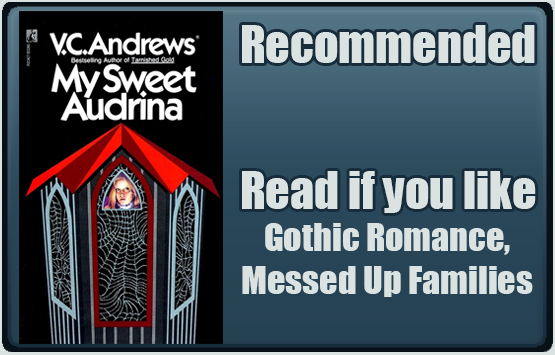
My Sweet Audrina by V.C. Andrews

My Sweet Audrina by V.C. Andrews

Formats: Print, audio, digital

Genre: Gothic Horror, Romance, Thriller

Audience: Adult/Mature

Diversity: Intellectual Disability, Possible Autism, Physical Disability (bilateral above the knee amputee), Chronic Illness (Osteogenesis imperfecta/brittle bone disease), PTSD

Takes Place in: Southern USA

Content Warnings (Highlight to view): Abelism, Alcohol Abuse, Body Shaming, Bullying, Implied Cannibalism, Child Abuse, Child Death, Childbirth, Death, Forced Captivity, Gaslighting,  Illness, Emotional Incest, Medical Torture/Abuse, Miscarriage, Mental Illness, Pedophilia, Physical Abuse, Racism, Rape/Sexual Assault, Implied Self-Harm, Sexism, Sexual Abuse, Slut Shaming, Suicide Attempt, Transphobia, Verbal/Emotional Abuse

Blurb

V.C. Andrews, author of the phenomenally successful Dollanganger series, has created a fascinating new cast of characters in this haunting story of love and deceit, innocence and betrayal, and the suffocating power of parental love.
Audrina Adare wanted so to be as good as her sister. She knew her father could not love her as he loved her sister. Her sister was so special, so perfect — and dead.
Now she will come face to face with the dangerous, terrifying secret that everyone knows. Everyone except…
My Sweet Audrina

Holy fuck, this book.

I’m curled up, holding my knees to my chest, and looking shell shocked. My right eye is twitching. “WTF” I ask as I stare into the void.

This book is definitely the winner of the OMGWTFBBQ award

If you’re unfamiliar with V. C. Andrews, she wrote gothic horror novels during the eighties about really messed up, toxic, abusive, families that Lifetime loves to turn into terrible made-for-TV movies.  A standard Andrews book usually contains gas lighting, emotional and physical abuse, dark family secrets, and some of the most fucked up relationships ever put to paper that run the gambit from pedophilia to incest. Imagine if all guests on the Jerry Springer show were rich, beautiful, gothic heroines with enough skeletons in their closets to start their own ossuary, and you’ll have an idea of what you’re in for. They’re trash novels, but in the best possible way, written by a talented author who knows her audience is looking to be shocked and horrified, like splatterpunk without the gore. Her stories may be ridiculous and over-the-top at times, but never, ever dull, and of all her fucked up books, My Sweet Audrina is probably her most fucked up. It manages to contain nearly every content warning I have that doesn’t involve blood and gore (although there is a rather grisly scene where a woman miscarries and throws one of the blood clots at her mother in a fit of rage). There’s a brutal child rape, a lot of abuse by a manipulative bastard, everyone messing with Audrina’s mind, and a dead aunt who may or may not have been eaten by cannibals, so be forewarned, My Sweet Audrina is not for the squeamish.

Damian Adere, the family patriarch, is aptly named because the guy is just fucking evil. He’s greedy, immature, vain, sexist, lazy, abusive, controlling, narcissistic, and manages to destroy the lives of every woman he knows while still seeing himself  as the victim because he’s just that fucking self-centered. Yet, he continues to get away with his awful behavior because he’s handsome, charming, and extremely manipulative, which honestly makes him even more frightening. In the first few chapters he comes off as kind of a dick but still likable. His daughter, Audrina, who acts as the book’s narrator, still loves and respects him. But over the course of the story as we witness his true nature, Damian quickly goes from seemingly well-intentioned but misguided, to a full-blown asshole, then finally becomes Satan incarnate. In fact, I’m still not entirely convinced this isn’t some sort of sequel to The Omen where the Anti-Christ kid grows up to become a lazy, whiny, codependent, narcissistic asshat who gets married and lives in a dilapidated mansion that he never lets his daughter leave. Actually, comparing Damian to Satan seems unfair because even the Dark Lord isn’t that big of a flaming dick. I can just imagine the devil reading My Sweet Audrina and being utterly horrified. The other characters, save for our virtuous heroine, Audrina, aren’t a whole lot better, although a lot of their behavior can be more or less attributed to Damian’s abuse.
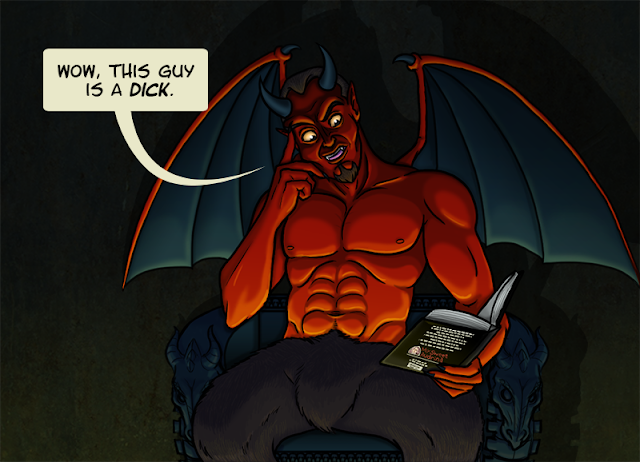
Satan is leaning back in his creepy dragon chair reading “My Sweet Audrina”. He has red skin, black horns, bat wings, furry goat legs, a goatee, and well-defined abs. The image is dark, and lit from below. Satan has a finger to his temple and comments “Wow, this guy is a DICK” (referring to Damian).

I just assume Satan is ripped

Audrina’s mother, Lucietta, had to give up her dream of becoming a concert pianist to marry Damian (because he didn’t want his wife to make more money than him), and now hides her misery by living in denial and drinking to numb the pain. She frequently lashes out at her sister, Ellsbeth, who has become bitter (again, thanks to Damian) and abusive, neglecting her own daughter, Vera. In turn, Vera has turned into a complete monster before the start of the book because nobody loves her and Damian (whom she sees as her father) constantly treats her like shit and compares her to his “perfect” daughter, Audrina. As horrible as Vera is (and she’s pretty fucking horrible), you can’t help but feel sorry for her. She’s forced to be the whore to Audrina’s virgin, which makes her hate and resents her cousin. She’s so desperate for love and attention that 14-year-old Vera has “sex” with an adult man (everyone acts like it’s consensual sex when it’s very clearly statutory rape), and acts seductively from a young age. Of course none of the adults think “Hey, this isn’t normal behavior for a child, maybe we should get her some help” they just decided “She’s just a slut, oh well, who cares.” Meanwhile Audrina is haunted by memories of a childhood rape, which her father keeps forcing her to remember in a sick attempt to make her “perfect” (I’m not even going to try and explain Damian’s troll logic on this one). He reinforces her role as the virgin by frequently telling his daughter that all men are evil and forcing her to cover up in old fashioned dresses lest she be attacked. Is it any wonder Audrina becomes terrified of sex and disgusted by nudity to the point that she can’t even be intimate with someone she loves without trauma? Of course Damian is totally fine with this because it means she’s less likely to have a relationship with any man that isn’t him. If that makes your skin crawl, well, it should, because even Audrina describes their relationship as being like husband and wife without the sex. Ew. At least there isn’t any actual incest like I was fearing, which is a first for a V C Andrews novel.

Even Lucietta isn’t safe from her husband’s slut shaming, as Damian flies into a rage if her outfits are too revealing and accuses her of flirting with the men at the parties he forces her to host. He wants to show off his pretty wife, but then gets ridiculously jealous when other men think she’s pretty and ends up throwing a tantrum. He loves to be surrounded by women who adore him, but doesn’t want to share, so everyone is essentially trapped in this giant, run down house where Damian can keep an eye on them, isolated from the rest of the world. Like I said, the dude is fucking evil, and doesn’t even realize it. Or maybe he does, but simply doesn’t give a shit. Basically, if there was a drinking game where you had to take a shot every time Damien pulls a dick move, no one would ever finish the book because they’d die from alcohol poisoning after a few chapters.

Now, you’re probably wondering where the diversity comes in. I chose this book because of its representation of disability which, while not ideal (especially in Sylvia’s case), was at least written by an author who herself had a physical disability for most of her life. As a teenager, Andrews developed severe arthritis and underwent multiple spinal surgeries to treat it. Andrews says this was the result of a back injury she sustained from falling on a staircase in high school, while her family claims it was something she was born with. Regardless, the resulting chronic pain required the use of a wheelchair or crutches for most of her life. Andrews lived at home, under the care of her mother, where she completed a four-year correspondence course in art, before starting her career as a writer. Her very first book, Flowers in the Attic, is about four children who are kept in the attic for years by their religious grandmother, and the toll it takes on their mental and physical well-being. Andrews said in a 1985 interview for Faces of Fear that Flowers in the Attic was based on her own feelings of frustration at being trapped at home. While accessibility for people with mobility issues still isn’t great, I can imagine it was even worse when Andrews was growing up, and she died four years prior to the passing of the Americans with Disabilities Act. This theme of feeling “trapped” continues in My Sweet Audrina, where five of the six women in the story have some kind of disability that limits their freedom, which Damien of course takes full advantage of. Even the stairs that may or may not have been the start of Andrews’ chronic pain and limited mobility feature prominently in the book. The Adere house’s staircase essentially goes on a killing spree, offing multiple family members to the point where I have to wonder if the stairs were constructed from the bones of murdered children and cursed relics. Or maybe it’s just haunted by all the ghosts of the people Damien pissed off (which I can only imagine is every person he’s ever met). Andrews’ representation of disability is definitely problematic, but also complex and extremely personal, which is what makes this story worth exploring. It’s one of the few horror novels I’ve been able to find about disability that was actually written by a disabled person.

Vera has brittle bone disease, frequently breaking an arm or leg at the slightest bump. Audrina’s younger sister, Sylvia has autism and/or an intellectual disability (it’s not handled or explained well by Andrews) that requires full time care. Lucietta seems to have a heart disease that limits her activity. Billie, the Adere’s neighbor and one of the few likable characters in the book, is a bilateral amputee following complications from diabetes. Then there’s Audrina, whose untreated PTSD leaves her too terrified to leave her yard, even though she desperately wants to go to school and have friends. Audrina is sort of a Mary Sue for Andrews, what with her violet eyes, magically color changing hair, and extraordinary beauty (seriously, WTF?). They’re both artistic, unable to leave the house, and need to rely heavily on their families to function which causes them great frustration. The depictions of women with disabilities in My Sweet Audrina aren’t particularly progressive, and can even be downright ablest at time (especially when it comes to Sylvia), but the characters are all unique with very different personalities, outlooks, and ways of dealing with their disabilities.
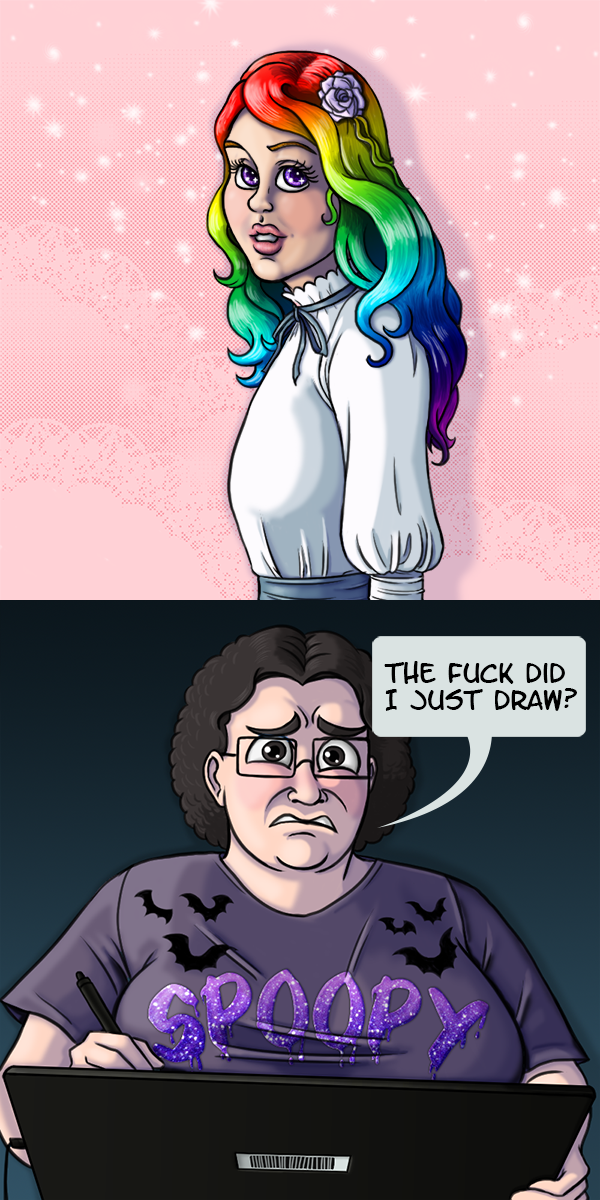
I’m drawing a picture of Audrina. The first panel shows a stereotypically attractive woman in a white, conservative, Victorian dress. She has large, sparkly, violet eyes, and long rainbow hair that starts as red at her scalp, and moves down the spectrum to indigo and violet at the ends of her hair. In the second panel I’m looking at my creation with horror and ask, “The fuck did I just draw?” I’m wearing a purple shirt with bats that says “spoopy” in violet glitter.

What Audrina looks like, presumable. Unrelated, but I wish I had that Spoopy shirt in real life.

Audrina desperately wishes for freedom and is frustrated by her PTSD, but without proper help and treatment she struggles to deal with her trauma (thanks a fucking lot, Damien). She does try to force herself to “get over it” a few times, and it doesn’t go well. Vera, on the other hand, seems proud of her disability, bragging about her delicate bones and teasing Audrina for having “peasant bones”, though it’s most likely an act to make herself feel better. Vera will frequently play up her disability to get out of doing chores, and even purposely hurt herself for attention, even though her mother and Damien seem fairy unconcerned by her injuries. Billie, on the other hand, is ashamed of her residual limbs, and goes to great effort to hide them. Her husband left her after her legs were amputated, and she now sees herself as “damaged” and “unlovable” despite being drop-dead gorgeous and able to function just fine with the use of a wheeled board. Although Billie continues to live her life and seems pretty happy for the most part, she’s still incredibly insecure, making her an easy target for Damien. Finally there’s Sylvia, the youngest Adare daughter, who gets ignored and insulted by pretty much everyone except Audrina, her appointed caretaker. Because why would Damien get actual help when he can just make Audrina play Occupational Therapist for free? And then everyone seems ~shocked~ that Sylvia’s not making much progress when she has a child (who only just started going to school herself) as her teacher. At least Sylvia gets some revenge on her awful family. It’s never outright confirmed, but is strongly implied that she knows more than she lets on and allows people to underestimate her abilities so she can better manipulate them (and occasionally possibly murder them). Part of me really hopes Sylvia is knowingly screwing with everyone as a sort of “fuck you” to her neurotypical family who constantly calls her really ableist slurs and compare her to an animal, because they really fucking deserve it. Now if only she’d arrange for Damien to have a little accident….

My Sweet Audrina is a combination of exploitation horror and chick lit, meant to grab your attention from the first paragraph and brand its shocking subject manner deep into your brain so that years from now you’ll still be thinking “God, that was a fucked up book.” And if you’re wondering why I would inflict this on myself, well, A) Because I’m a horror fan, that’s kind of what I do, and B) It’s just so damn enjoyable. It’s a wonderful guilty pleasure I couldn’t put down until the end, and Andrews is a talented writer who is fully aware of what she’s creating. So what if the story can sometimes read like Soap Opera fan fiction written by a fourteen-year-old?  My Sweet Audrina is especially interesting when viewed as a personal exploration of the author’s feelings of being “trapped’ by her chronic pain and mobility issues.  For fans of tragic heroines, gothic horror, and guilty pleasures, I’d definitely recommend My Sweet Audrina.
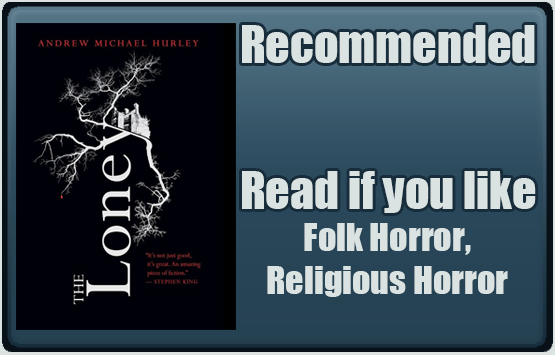
The Loney by Andrew Michael Hurley

The Loney by Andrew Michael Hurley

Formats: Print, audio, digital

Publisher: Houghton Mifflin Harcourt

Genre: Gothic, Folk Horror, Psychological Horror, Mystery

Audience: Adult/Mature

Diversity: Disability (Speech Disorder – muteness, Cognitive/Learning Disability, PTSD)

Takes Place in: Lancashire, UK

Content Warnings (Highlight to view): Abelism, Alcohol Abuse, Animal Death, Bullying, Child Abuse, Child Death, Child Endangerment, Death, Racism, Forced Captivity, Gaslighting, Gore, Homophobia, Illness, Medical Torture/Abuse, Medical Procedures, Mental Illness, Physical Abuse, Racism, Slurs, Suicide, Verbal/Emotional Abuse, Violence

Blurb

When the remains of a young child are discovered during a winter storm on a stretch of the bleak Lancashire coastline known as the Loney, a man named Smith is forced to confront the terrifying and mysterious events that occurred forty years earlier when he visited the place as a boy. At that time, his devoutly Catholic mother was determined to find healing for Hanny, his disabled older brother. And so the family, along with members of their parish, embarked on an Easter pilgrimage to an ancient shrine.

But not all of the locals were pleased to see visitors in the area. And when the two brothers found their lives entangling with a glamorous couple staying at a nearby house, they became involved in more troubling rites. Smith feels he is the only one to know the truth, and he must bear the burden of his knowledge, no matter what the cost. Proclaimed a “modern classic” by the Sunday Telegraph (UK), The Loney marks the arrival of an important new voice in fiction.

Autumn is normally considered the season for all things horror, due to holidays like Samhain, All Hallows’ Eve/Halloween, and the Day of the Dead in Europe and the Americas, but the other seasons have their own share of scary stories and traditions. Summer is perfect for slasher flicks, spooky stories by the campfire, and the Ghost Festival is celebrated in East and Southeast Asia. The long, dark nights of winter inspired the Victorians to tell ghost stories and Algonquin-speaking people associated the season with the cannibalistic monsters. But spring, generally associated with new life, rebirth, flowers, and cute baby animals in the Northern Hemisphere, is the odd one out. Other than Bram Stoker’s famous short story, Dracula’s Guest, which takes place on Walpurgis NightThe Loney is the probably the only scary story I’ve ever read set during the Spring.

The first image is of a Jack-o-Lantern on a bed of autumn leaves, surrounded by candles, marigolds, soul cakes, and a sugar skull. It says “creepy”. Next is a snowy night in a pine forest, with a full moon and a wendigo that says “scary”. The third says “spooky” and depicts an offering of oranges, joss paper, incense and red candles, with little ghost is surrounded by Hitodama. The final image is of two birds snuggling on a spring day with butterflies and cherry blossoms. It says, “Not really that scary.”

I mean, I guess if you’re scared of flowers and baby animals Spring might be scary….

The Loney was written by an English Teacher, and boy does it show. It’s overflowing with symbolism, deeply complicated characters, religious imagery, and all the other stuff that gets pretentious professors all hot and bothered. This is the kind of book that lends itself well to long, dry, dissertations about death and rebirth, or some other equally clichéd thesis, like how everything is a metaphor for sex. Not that any of this is bad, mind you, just don’t expect a classic horror story so much as a coming-of-age character exploration set in a gloomy, shit hole town that leaves you feeling creeped out and disturbed. There’s a lot more focus on the environment and characters than there is on the actual story (or lack thereof). It reminds me of one of those artsy games with no plot or clear goals where you just wander around and explore the gorgeous environment, like The Path (the game,  not the TV series). Which, again, isn’t a bad thing if you’re into walking simulators, but I miss having a three act story structure, and a build up of suspense. So my reaction to The Loney was along the lines of “bored, bored, bored, do something already, wow that’s creepy, damn these people are messed up, bored, bored, is something going to happen now or what, so borrrreeed, stop talking for fuck’s sake, bored, HOLY SHIT WTF OMG, oh, well I guess that’s the end.” And then I was left wondering what the fuck I had just read.

While the pointless milling about can get tedious (really, REALLY tedious), it’s still an entertaining and creepy book. I wouldn’t exactly call it horror, since The Loney isn’t scary per se, but it is definitely disturbing. There are still a few of the standard horror “shock value” scenes you’d expect, y’know, the kind where any person with common sense would take it as an obvious sign to turn the fuck around because it’s clear they just stumbled into some Blair Witch, demonic serial killer, Eldritch abomination crap? But most of the creepiness comes from the irrational religious fervor of the adults (except, ironically, the priest), and their disturbing obsession with “curing” the unnamed protagonist’s disabled brother, Hanny. Not for his own benefit, since he seems perfectly happy as is, and could probably function on his own just fine if given a chance, but as part of some selfish desire to see a miracle and be closer to God.

Now here’s the thing about being a disabled person in horror fiction, you can come in one of three flavors. You can either be a victim (Audrey Hepburn in Wait Until Dark, the mute woman in The Tingler, Mark from Friday the 13th Part 2), the “psycho” (pretty much every movie killer ever, because mental illness apparently makes you evil), or some sort of disabled version of the “magical negro” trope (the little girl from the Langoliers, “Duddits” from Dreamcatcher, Tom Cullen from The Stand, and every other disabled person in a Steven King novel). But Hanny doesn’t seem to fall into any of these groups. He’s certainly not helpless, a monster, or “magical”, despite what those around him may think. For example, late in the book Hanny manages to uncover and successfully load a rifle (despite having little to no experience doing so), sneak out of the house by muffling his foot steps on a blanket and bribing the dog with treats, then find his way across dangerous terrain in the middle of the night. And when the narrator tries to follow him? He ends up almost drowning, and Hanny has to save his pathetic butt. Hell, I can barely find the bathroom in my own house without turning the light on, much less load a gun in the dark and go for a night hike in the English equivalent of Lovecraft country. But despite being able to do things military personnel take months to learn, Hanny is still considered “helpless” by those around him because he has a learning disability and doesn’t communicate in a way anyone else has bothered to learn. And he CAN communicate. Hanny is clearly shown using hand gestures and objects to try and communicate his emotions and desires, but is mostly ignored by everyone, save his brother, who apparently can’t wrap their brains around the concept of non-verbal communication. The priest, probably the only moral, well adjusted adult in the whole story, is also the only person to question if Hanny even wants to be cured. Like, he would literally have been fine if someone had just thought to equip him with an Alternative and Augmentative Commination system. But no, they want a miracle, they want Hanny to give it to them, screw what he wants or needs. And that’s pretty much how everything goes to shit. Because most of the characters in the story can’t seem to comprehend that anyone outside their narrow view of normal could possible be happy. The narrator describes how determined his mother and her church buddies are to reject anyone different, like a fundamentalist Catholic version of Mean Girls.

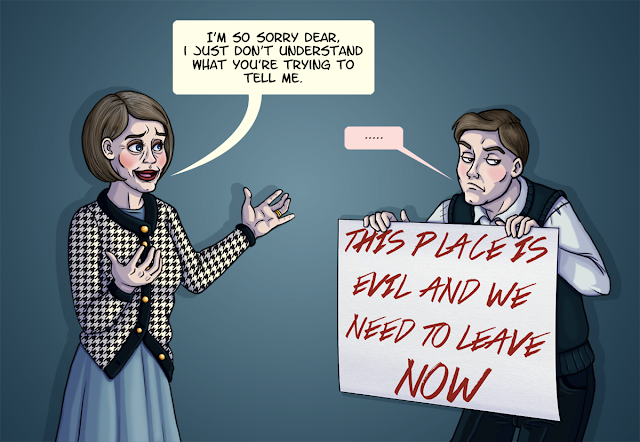
An older, WASP-y woman in a houndstooth jacket is talking to her son (Hanny), who is wearing a sweater-vest and holding up a sign that says, “This place is evil and we need to leave NOW”. His mother is smiling indulgently and says, “I’m so sorry dear, I just don’t understand what you’re trying to tell me.” Hanny looks annoyed and is rolling his eyes.

Hanny has to put up with so much crap from his neurotypical family

So often in fiction “curing” a disability is automatically seen as a good thing, because it’s just assumed that being able-bodied and neurotypical is the only way to have a happy, fulfilling life. And if a disabled person does seem happy? Then they’re considered some sort of inspirational martyr for the able-bodied to admire. Obviously this attitude is really freaking ableist and arrogant, as numerous disability advocates have pointed out. If a person with a disability would prefer to be rid of it, that’s an extremely personal decision, and not one intended to serve as a happy ending for the able-bodied and neurotypical. Basically, assuming everyone with a disability feels the same way about it is pretty shitty, as is acting like they can’t make their own decisions. And that’s what makes The Loney different, it’s not a typical “oh, the poor disabled person was cured by a miracle, now they can be happy!” fairy tail. Instead it’s a gothic horror story about how fucked up that attitude is, and how trying to “fix” someone without their knowledge or consent so they can serve as an inspirational story is seriously messed up. Of course, in this case it’s taken to an extreme where the parent’s misguided stubbornness results in the death, misery, and despair of a lot of people. Hanny makes it out more or less okay (albeit now suffering from some serious guilt he doesn’t understand), with his oblivious parents none the wiser, but the narrator becomes an unstable wreck with PTSD who stalks his brother until Hanny forces him in therapy. Essentially, The Loney is the antithesis of inspiration porn (yes, the link is safe for work, chill).

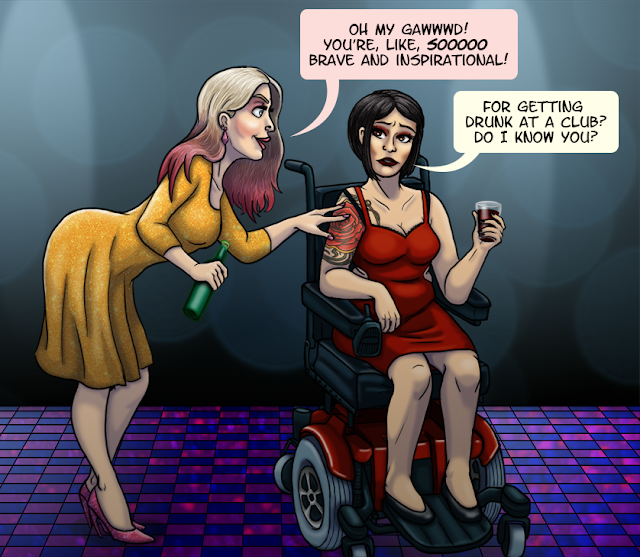
Two women are in a night club. A white woman in a glittery gold dress and blonde hair dyed pink at the bottom, is bending over to speak to an Asian woman in a motorized wheel chair. The woman in the wheel chair has goth makeup, a large tattoo of a red rose on her right arm, and is wearing a sexy red dress. The woman in gold tells the woman in red “Oh my gawwwwd? You’re, like, soooo brave and inspirtational!” The woman in red looks confused and asks “For getting drunk at a club? Do I know you?”

It’s actually because she ate two jumbo orders of nachos by herself, now that is truly inspirational. I should point out I have no idea what people wear at clubs, so one of them is a semi-goth chick, and the other looks like Jem.

The plot still drags though. Like, a lot. And Hurley uses the word “said” too much. Replied, snapped, exclaimed, responded, mused, just pick a different freaking word! Seriously, you’re an English teacher, use your thesaurus.  But while it wasn’t quite my cup of tea, I can still recommend it to people looking for a rich, gloomy story full of atmosphere and some truly messed up characters.

Navigation

Social Media

Search by Tags

To learn more about the Age Group, Diversity, and Genre tags, click here.

Age Groups

Diversity

Genre

Support the Blog

Search

Links

My Sweet Audrina by V.C. Andrews

My Sweet Audrina by V.C. Andrews

Formats: Print, audio, digital

Genre: Gothic Horror, Romance, Thriller

Audience: Adult/Mature

Diversity: Intellectual Disability, Possible Autism, Physical Disability (bilateral above the knee amputee), Chronic Illness (Osteogenesis imperfecta/brittle bone disease), PTSD

Takes Place in: Southern USA

Content Warnings (Highlight to view): Abelism, Alcohol Abuse, Body Shaming, Bullying, Implied Cannibalism, Child Abuse, Child Death, Childbirth, Death, Forced Captivity, Gaslighting,  Illness, Emotional Incest, Medical Torture/Abuse, Miscarriage, Mental Illness, Pedophilia, Physical Abuse, Racism, Rape/Sexual Assault, Implied Self-Harm, Sexism, Sexual Abuse, Slut Shaming, Suicide Attempt, Transphobia, Verbal/Emotional Abuse

Blurb

V.C. Andrews, author of the phenomenally successful Dollanganger series, has created a fascinating new cast of characters in this haunting story of love and deceit, innocence and betrayal, and the suffocating power of parental love.
Audrina Adare wanted so to be as good as her sister. She knew her father could not love her as he loved her sister. Her sister was so special, so perfect — and dead.
Now she will come face to face with the dangerous, terrifying secret that everyone knows. Everyone except…
My Sweet Audrina

Holy fuck, this book.

I’m curled up, holding my knees to my chest, and looking shell shocked. My right eye is twitching. “WTF” I ask as I stare into the void.

This book is definitely the winner of the OMGWTFBBQ award

If you’re unfamiliar with V. C. Andrews, she wrote gothic horror novels during the eighties about really messed up, toxic, abusive, families that Lifetime loves to turn into terrible made-for-TV movies.  A standard Andrews book usually contains gas lighting, emotional and physical abuse, dark family secrets, and some of the most fucked up relationships ever put to paper that run the gambit from pedophilia to incest. Imagine if all guests on the Jerry Springer show were rich, beautiful, gothic heroines with enough skeletons in their closets to start their own ossuary, and you’ll have an idea of what you’re in for. They’re trash novels, but in the best possible way, written by a talented author who knows her audience is looking to be shocked and horrified, like splatterpunk without the gore. Her stories may be ridiculous and over-the-top at times, but never, ever dull, and of all her fucked up books, My Sweet Audrina is probably her most fucked up. It manages to contain nearly every content warning I have that doesn’t involve blood and gore (although there is a rather grisly scene where a woman miscarries and throws one of the blood clots at her mother in a fit of rage). There’s a brutal child rape, a lot of abuse by a manipulative bastard, everyone messing with Audrina’s mind, and a dead aunt who may or may not have been eaten by cannibals, so be forewarned, My Sweet Audrina is not for the squeamish.

Damian Adere, the family patriarch, is aptly named because the guy is just fucking evil. He’s greedy, immature, vain, sexist, lazy, abusive, controlling, narcissistic, and manages to destroy the lives of every woman he knows while still seeing himself  as the victim because he’s just that fucking self-centered. Yet, he continues to get away with his awful behavior because he’s handsome, charming, and extremely manipulative, which honestly makes him even more frightening. In the first few chapters he comes off as kind of a dick but still likable. His daughter, Audrina, who acts as the book’s narrator, still loves and respects him. But over the course of the story as we witness his true nature, Damian quickly goes from seemingly well-intentioned but misguided, to a full-blown asshole, then finally becomes Satan incarnate. In fact, I’m still not entirely convinced this isn’t some sort of sequel to The Omen where the Anti-Christ kid grows up to become a lazy, whiny, codependent, narcissistic asshat who gets married and lives in a dilapidated mansion that he never lets his daughter leave. Actually, comparing Damian to Satan seems unfair because even the Dark Lord isn’t that big of a flaming dick. I can just imagine the devil reading My Sweet Audrina and being utterly horrified. The other characters, save for our virtuous heroine, Audrina, aren’t a whole lot better, although a lot of their behavior can be more or less attributed to Damian’s abuse.

Satan is leaning back in his creepy dragon chair reading “My Sweet Audrina”. He has red skin, black horns, bat wings, furry goat legs, a goatee, and well-defined abs. The image is dark, and lit from below. Satan has a finger to his temple and comments “Wow, this guy is a DICK” (referring to Damian).

I just assume Satan is ripped

Audrina’s mother, Lucietta, had to give up her dream of becoming a concert pianist to marry Damian (because he didn’t want his wife to make more money than him), and now hides her misery by living in denial and drinking to numb the pain. She frequently lashes out at her sister, Ellsbeth, who has become bitter (again, thanks to Damian) and abusive, neglecting her own daughter, Vera. In turn, Vera has turned into a complete monster before the start of the book because nobody loves her and Damian (whom she sees as her father) constantly treats her like shit and compares her to his “perfect” daughter, Audrina. As horrible as Vera is (and she’s pretty fucking horrible), you can’t help but feel sorry for her. She’s forced to be the whore to Audrina’s virgin, which makes her hate and resents her cousin. She’s so desperate for love and attention that 14-year-old Vera has “sex” with an adult man (everyone acts like it’s consensual sex when it’s very clearly statutory rape), and acts seductively from a young age. Of course none of the adults think “Hey, this isn’t normal behavior for a child, maybe we should get her some help” they just decided “She’s just a slut, oh well, who cares.” Meanwhile Audrina is haunted by memories of a childhood rape, which her father keeps forcing her to remember in a sick attempt to make her “perfect” (I’m not even going to try and explain Damian’s troll logic on this one). He reinforces her role as the virgin by frequently telling his daughter that all men are evil and forcing her to cover up in old fashioned dresses lest she be attacked. Is it any wonder Audrina becomes terrified of sex and disgusted by nudity to the point that she can’t even be intimate with someone she loves without trauma? Of course Damian is totally fine with this because it means she’s less likely to have a relationship with any man that isn’t him. If that makes your skin crawl, well, it should, because even Audrina describes their relationship as being like husband and wife without the sex. Ew. At least there isn’t any actual incest like I was fearing, which is a first for a V C Andrews novel.

Even Lucietta isn’t safe from her husband’s slut shaming, as Damian flies into a rage if her outfits are too revealing and accuses her of flirting with the men at the parties he forces her to host. He wants to show off his pretty wife, but then gets ridiculously jealous when other men think she’s pretty and ends up throwing a tantrum. He loves to be surrounded by women who adore him, but doesn’t want to share, so everyone is essentially trapped in this giant, run down house where Damian can keep an eye on them, isolated from the rest of the world. Like I said, the dude is fucking evil, and doesn’t even realize it. Or maybe he does, but simply doesn’t give a shit. Basically, if there was a drinking game where you had to take a shot every time Damien pulls a dick move, no one would ever finish the book because they’d die from alcohol poisoning after a few chapters.

Now, you’re probably wondering where the diversity comes in. I chose this book because of its representation of disability which, while not ideal (especially in Sylvia’s case), was at least written by an author who herself had a physical disability for most of her life. As a teenager, Andrews developed severe arthritis and underwent multiple spinal surgeries to treat it. Andrews says this was the result of a back injury she sustained from falling on a staircase in high school, while her family claims it was something she was born with. Regardless, the resulting chronic pain required the use of a wheelchair or crutches for most of her life. Andrews lived at home, under the care of her mother, where she completed a four-year correspondence course in art, before starting her career as a writer. Her very first book, Flowers in the Attic, is about four children who are kept in the attic for years by their religious grandmother, and the toll it takes on their mental and physical well-being. Andrews said in a 1985 interview for Faces of Fear that Flowers in the Attic was based on her own feelings of frustration at being trapped at home. While accessibility for people with mobility issues still isn’t great, I can imagine it was even worse when Andrews was growing up, and she died four years prior to the passing of the Americans with Disabilities Act. This theme of feeling “trapped” continues in My Sweet Audrina, where five of the six women in the story have some kind of disability that limits their freedom, which Damien of course takes full advantage of. Even the stairs that may or may not have been the start of Andrews’ chronic pain and limited mobility feature prominently in the book. The Adere house’s staircase essentially goes on a killing spree, offing multiple family members to the point where I have to wonder if the stairs were constructed from the bones of murdered children and cursed relics. Or maybe it’s just haunted by all the ghosts of the people Damien pissed off (which I can only imagine is every person he’s ever met). Andrews’ representation of disability is definitely problematic, but also complex and extremely personal, which is what makes this story worth exploring. It’s one of the few horror novels I’ve been able to find about disability that was actually written by a disabled person.

Vera has brittle bone disease, frequently breaking an arm or leg at the slightest bump. Audrina’s younger sister, Sylvia has autism and/or an intellectual disability (it’s not handled or explained well by Andrews) that requires full time care. Lucietta seems to have a heart disease that limits her activity. Billie, the Adere’s neighbor and one of the few likable characters in the book, is a bilateral amputee following complications from diabetes. Then there’s Audrina, whose untreated PTSD leaves her too terrified to leave her yard, even though she desperately wants to go to school and have friends. Audrina is sort of a Mary Sue for Andrews, what with her violet eyes, magically color changing hair, and extraordinary beauty (seriously, WTF?). They’re both artistic, unable to leave the house, and need to rely heavily on their families to function which causes them great frustration. The depictions of women with disabilities in My Sweet Audrina aren’t particularly progressive, and can even be downright ablest at time (especially when it comes to Sylvia), but the characters are all unique with very different personalities, outlooks, and ways of dealing with their disabilities.

I’m drawing a picture of Audrina. The first panel shows a stereotypically attractive woman in a white, conservative, Victorian dress. She has large, sparkly, violet eyes, and long rainbow hair that starts as red at her scalp, and moves down the spectrum to indigo and violet at the ends of her hair. In the second panel I’m looking at my creation with horror and ask, “The fuck did I just draw?” I’m wearing a purple shirt with bats that says “spoopy” in violet glitter.

What Audrina looks like, presumable. Unrelated, but I wish I had that Spoopy shirt in real life.

Audrina desperately wishes for freedom and is frustrated by her PTSD, but without proper help and treatment she struggles to deal with her trauma (thanks a fucking lot, Damien). She does try to force herself to “get over it” a few times, and it doesn’t go well. Vera, on the other hand, seems proud of her disability, bragging about her delicate bones and teasing Audrina for having “peasant bones”, though it’s most likely an act to make herself feel better. Vera will frequently play up her disability to get out of doing chores, and even purposely hurt herself for attention, even though her mother and Damien seem fairy unconcerned by her injuries. Billie, on the other hand, is ashamed of her residual limbs, and goes to great effort to hide them. Her husband left her after her legs were amputated, and she now sees herself as “damaged” and “unlovable” despite being drop-dead gorgeous and able to function just fine with the use of a wheeled board. Although Billie continues to live her life and seems pretty happy for the most part, she’s still incredibly insecure, making her an easy target for Damien. Finally there’s Sylvia, the youngest Adare daughter, who gets ignored and insulted by pretty much everyone except Audrina, her appointed caretaker. Because why would Damien get actual help when he can just make Audrina play Occupational Therapist for free? And then everyone seems ~shocked~ that Sylvia’s not making much progress when she has a child (who only just started going to school herself) as her teacher. At least Sylvia gets some revenge on her awful family. It’s never outright confirmed, but is strongly implied that she knows more than she lets on and allows people to underestimate her abilities so she can better manipulate them (and occasionally possibly murder them). Part of me really hopes Sylvia is knowingly screwing with everyone as a sort of “fuck you” to her neurotypical family who constantly calls her really ableist slurs and compare her to an animal, because they really fucking deserve it. Now if only she’d arrange for Damien to have a little accident….

My Sweet Audrina is a combination of exploitation horror and chick lit, meant to grab your attention from the first paragraph and brand its shocking subject manner deep into your brain so that years from now you’ll still be thinking “God, that was a fucked up book.” And if you’re wondering why I would inflict this on myself, well, A) Because I’m a horror fan, that’s kind of what I do, and B) It’s just so damn enjoyable. It’s a wonderful guilty pleasure I couldn’t put down until the end, and Andrews is a talented writer who is fully aware of what she’s creating. So what if the story can sometimes read like Soap Opera fan fiction written by a fourteen-year-old?  My Sweet Audrina is especially interesting when viewed as a personal exploration of the author’s feelings of being “trapped’ by her chronic pain and mobility issues.  For fans of tragic heroines, gothic horror, and guilty pleasures, I’d definitely recommend My Sweet Audrina.
The Loney by Andrew Michael Hurley

The Loney by Andrew Michael Hurley

Formats: Print, audio, digital

Publisher: Houghton Mifflin Harcourt

Genre: Gothic, Folk Horror, Psychological Horror, Mystery

Audience: Adult/Mature

Diversity: Disability (Speech Disorder – muteness, Cognitive/Learning Disability, PTSD)

Takes Place in: Lancashire, UK

Content Warnings (Highlight to view): Abelism, Alcohol Abuse, Animal Death, Bullying, Child Abuse, Child Death, Child Endangerment, Death, Racism, Forced Captivity, Gaslighting, Gore, Homophobia, Illness, Medical Torture/Abuse, Medical Procedures, Mental Illness, Physical Abuse, Racism, Slurs, Suicide, Verbal/Emotional Abuse, Violence

Blurb

When the remains of a young child are discovered during a winter storm on a stretch of the bleak Lancashire coastline known as the Loney, a man named Smith is forced to confront the terrifying and mysterious events that occurred forty years earlier when he visited the place as a boy. At that time, his devoutly Catholic mother was determined to find healing for Hanny, his disabled older brother. And so the family, along with members of their parish, embarked on an Easter pilgrimage to an ancient shrine.

But not all of the locals were pleased to see visitors in the area. And when the two brothers found their lives entangling with a glamorous couple staying at a nearby house, they became involved in more troubling rites. Smith feels he is the only one to know the truth, and he must bear the burden of his knowledge, no matter what the cost. Proclaimed a “modern classic” by the Sunday Telegraph (UK), The Loney marks the arrival of an important new voice in fiction.

Autumn is normally considered the season for all things horror, due to holidays like Samhain, All Hallows’ Eve/Halloween, and the Day of the Dead in Europe and the Americas, but the other seasons have their own share of scary stories and traditions. Summer is perfect for slasher flicks, spooky stories by the campfire, and the Ghost Festival is celebrated in East and Southeast Asia. The long, dark nights of winter inspired the Victorians to tell ghost stories and Algonquin-speaking people associated the season with the cannibalistic monsters. But spring, generally associated with new life, rebirth, flowers, and cute baby animals in the Northern Hemisphere, is the odd one out. Other than Bram Stoker’s famous short story, Dracula’s Guest, which takes place on Walpurgis NightThe Loney is the probably the only scary story I’ve ever read set during the Spring.

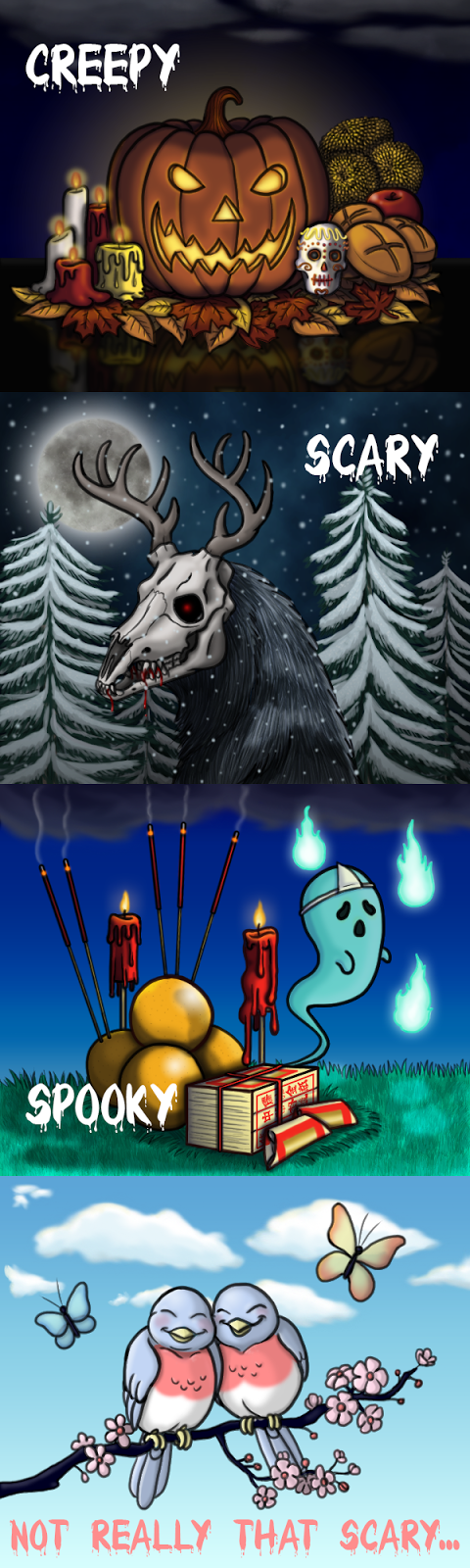
The first image is of a Jack-o-Lantern on a bed of autumn leaves, surrounded by candles, marigolds, soul cakes, and a sugar skull. It says “creepy”. Next is a snowy night in a pine forest, with a full moon and a wendigo that says “scary”. The third says “spooky” and depicts an offering of oranges, joss paper, incense and red candles, with little ghost is surrounded by Hitodama. The final image is of two birds snuggling on a spring day with butterflies and cherry blossoms. It says, “Not really that scary.”

I mean, I guess if you’re scared of flowers and baby animals Spring might be scary….

The Loney was written by an English Teacher, and boy does it show. It’s overflowing with symbolism, deeply complicated characters, religious imagery, and all the other stuff that gets pretentious professors all hot and bothered. This is the kind of book that lends itself well to long, dry, dissertations about death and rebirth, or some other equally clichéd thesis, like how everything is a metaphor for sex. Not that any of this is bad, mind you, just don’t expect a classic horror story so much as a coming-of-age character exploration set in a gloomy, shit hole town that leaves you feeling creeped out and disturbed. There’s a lot more focus on the environment and characters than there is on the actual story (or lack thereof). It reminds me of one of those artsy games with no plot or clear goals where you just wander around and explore the gorgeous environment, like The Path (the game,  not the TV series). Which, again, isn’t a bad thing if you’re into walking simulators, but I miss having a three act story structure, and a build up of suspense. So my reaction to The Loney was along the lines of “bored, bored, bored, do something already, wow that’s creepy, damn these people are messed up, bored, bored, is something going to happen now or what, so borrrreeed, stop talking for fuck’s sake, bored, HOLY SHIT WTF OMG, oh, well I guess that’s the end.” And then I was left wondering what the fuck I had just read.

While the pointless milling about can get tedious (really, REALLY tedious), it’s still an entertaining and creepy book. I wouldn’t exactly call it horror, since The Loney isn’t scary per se, but it is definitely disturbing. There are still a few of the standard horror “shock value” scenes you’d expect, y’know, the kind where any person with common sense would take it as an obvious sign to turn the fuck around because it’s clear they just stumbled into some Blair Witch, demonic serial killer, Eldritch abomination crap? But most of the creepiness comes from the irrational religious fervor of the adults (except, ironically, the priest), and their disturbing obsession with “curing” the unnamed protagonist’s disabled brother, Hanny. Not for his own benefit, since he seems perfectly happy as is, and could probably function on his own just fine if given a chance, but as part of some selfish desire to see a miracle and be closer to God.

Now here’s the thing about being a disabled person in horror fiction, you can come in one of three flavors. You can either be a victim (Audrey Hepburn in Wait Until Dark, the mute woman in The Tingler, Mark from Friday the 13th Part 2), the “psycho” (pretty much every movie killer ever, because mental illness apparently makes you evil), or some sort of disabled version of the “magical negro” trope (the little girl from the Langoliers, “Duddits” from Dreamcatcher, Tom Cullen from The Stand, and every other disabled person in a Steven King novel). But Hanny doesn’t seem to fall into any of these groups. He’s certainly not helpless, a monster, or “magical”, despite what those around him may think. For example, late in the book Hanny manages to uncover and successfully load a rifle (despite having little to no experience doing so), sneak out of the house by muffling his foot steps on a blanket and bribing the dog with treats, then find his way across dangerous terrain in the middle of the night. And when the narrator tries to follow him? He ends up almost drowning, and Hanny has to save his pathetic butt. Hell, I can barely find the bathroom in my own house without turning the light on, much less load a gun in the dark and go for a night hike in the English equivalent of Lovecraft country. But despite being able to do things military personnel take months to learn, Hanny is still considered “helpless” by those around him because he has a learning disability and doesn’t communicate in a way anyone else has bothered to learn. And he CAN communicate. Hanny is clearly shown using hand gestures and objects to try and communicate his emotions and desires, but is mostly ignored by everyone, save his brother, who apparently can’t wrap their brains around the concept of non-verbal communication. The priest, probably the only moral, well adjusted adult in the whole story, is also the only person to question if Hanny even wants to be cured. Like, he would literally have been fine if someone had just thought to equip him with an Alternative and Augmentative Commination system. But no, they want a miracle, they want Hanny to give it to them, screw what he wants or needs. And that’s pretty much how everything goes to shit. Because most of the characters in the story can’t seem to comprehend that anyone outside their narrow view of normal could possible be happy. The narrator describes how determined his mother and her church buddies are to reject anyone different, like a fundamentalist Catholic version of Mean Girls.

An older, WASP-y woman in a houndstooth jacket is talking to her son (Hanny), who is wearing a sweater-vest and holding up a sign that says, “This place is evil and we need to leave NOW”. His mother is smiling indulgently and says, “I’m so sorry dear, I just don’t understand what you’re trying to tell me.” Hanny looks annoyed and is rolling his eyes.

Hanny has to put up with so much crap from his neurotypical family

So often in fiction “curing” a disability is automatically seen as a good thing, because it’s just assumed that being able-bodied and neurotypical is the only way to have a happy, fulfilling life. And if a disabled person does seem happy? Then they’re considered some sort of inspirational martyr for the able-bodied to admire. Obviously this attitude is really freaking ableist and arrogant, as numerous disability advocates have pointed out. If a person with a disability would prefer to be rid of it, that’s an extremely personal decision, and not one intended to serve as a happy ending for the able-bodied and neurotypical. Basically, assuming everyone with a disability feels the same way about it is pretty shitty, as is acting like they can’t make their own decisions. And that’s what makes The Loney different, it’s not a typical “oh, the poor disabled person was cured by a miracle, now they can be happy!” fairy tail. Instead it’s a gothic horror story about how fucked up that attitude is, and how trying to “fix” someone without their knowledge or consent so they can serve as an inspirational story is seriously messed up. Of course, in this case it’s taken to an extreme where the parent’s misguided stubbornness results in the death, misery, and despair of a lot of people. Hanny makes it out more or less okay (albeit now suffering from some serious guilt he doesn’t understand), with his oblivious parents none the wiser, but the narrator becomes an unstable wreck with PTSD who stalks his brother until Hanny forces him in therapy. Essentially, The Loney is the antithesis of inspiration porn (yes, the link is safe for work, chill).

Two women are in a night club. A white woman in a glittery gold dress and blonde hair dyed pink at the bottom, is bending over to speak to an Asian woman in a motorized wheel chair. The woman in the wheel chair has goth makeup, a large tattoo of a red rose on her right arm, and is wearing a sexy red dress. The woman in gold tells the woman in red “Oh my gawwwwd? You’re, like, soooo brave and inspirtational!” The woman in red looks confused and asks “For getting drunk at a club? Do I know you?”

It’s actually because she ate two jumbo orders of nachos by herself, now that is truly inspirational. I should point out I have no idea what people wear at clubs, so one of them is a semi-goth chick, and the other looks like Jem.

The plot still drags though. Like, a lot. And Hurley uses the word “said” too much. Replied, snapped, exclaimed, responded, mused, just pick a different freaking word! Seriously, you’re an English teacher, use your thesaurus.  But while it wasn’t quite my cup of tea, I can still recommend it to people looking for a rich, gloomy story full of atmosphere and some truly messed up characters.

Navigation

Social Media

Search by Tags

To learn more about the Age Group, Diversity, and Genre tags, click here.

Age Groups

Diversity

Genre

Support the Blog

Search

Links