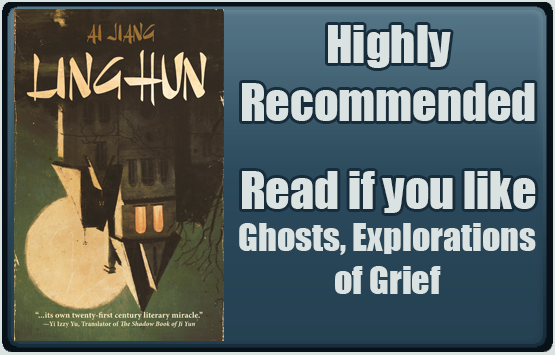
Linghun by Ai Jiang

Linghun by Ai Jiang

Formats: Print, digital

Publisher: Dark Matter Ink

Genre: Ghosts/Haunting, Gothic

Audience: Y/A

Diversity: Chinese-Canadian main characters, non-binary side character

Takes Place in: Canada

Content Warnings (Highlight to view): Child Abuse, Child Death, Death, Illness, Racism, Sexism,Verbal/Emotional Abuse 

Blurb

WELCOME HOME.

Follow Wenqi, Liam, and Mrs. in this modern gothic ghost story by Chinese-Canadian writer and immigrant, Ai Jiang. LINGHUN is set in the mysterious town of HOME, a place where the dead live again as spirits, conjured by the grief-sick population that refuses to let go.

I received this product for free in return for providing an honest and unbiased review. I received no other compensation. I am disclosing this in accordance with the Federal Trade Commission’s 16 CFR, Part 255: Guides Concerning the Use of Endorsements and Testimonials in Advertising.

In most horror, haunted houses are something to be avoided at all costs. Characters who find themselves in a haunted home will do anything to escape. But in HOME, an exclusive community in Canada that’s trapped in the past, people will do anything, even kill, to purchase a haunted house. Instead of being feared or encouraged to move on, the ghosts of dead loved ones that haunt the houses in HOME are welcomed into the family. Living in HOME (which stands for Homecoming of Missing Entities) means never having to say goodbye to someone who dies, and never moving on. The novella is divided up between the perspectives of three characters, Wenqi, whose story is told in the first person, Liam in the third person, and Linghun in the second.

Wenqi has always lived under her older brother’s shadow, even more so since he died. She is neglected by her parents, especially her mother, who can’t move past the tragic death of their golden child. Unfortunately, like many countries, sexism and a preference for sons is still an issue in China. PhD student Xueqing Zhang, who studies gender inequality, wrote in an article for the South China Morning Post:

 “In China, a son is seen as insurance for continuing the family line, and the preference has persisted through the years, even as urbanization and economic development has brought many social changes to the nation. For the girls who are born, gender bias continues to overshadow their lives as they grow up.” 

As a daughter, Wenqi is valued less by her parents than her brother was and she has to live every day knowing they wish she had died instead of him. Her life is uprooted when her parents are able to purchase a house in HOME in the hopes of summoning the spirit of their dead son.

Linghun is an elderly woman who lives across the street from Wenqi’s family in HOME, and is the only resident whose house isn’t haunted. A mail order bride from a poor farming family in China, she is sold to a Canadian man who wants an exotic “china doll” instead of a wife. And because Linghun’s family is unable to support her, she has no choice but to become her late husband’s ideal woman, someone, quiet, beautiful, and obedient. In their paper titled The Ancient Origins of Chinese Traditional Female Gender Role : A Historical Review from Pre-Qin Dynasty to Han Dynasty authors Cheng Chen and Qin Bo state “for most women, even their names were not necessary. They were called someone’s daughter when unmarried, and called someone’s wife when married.” This clearly demonstrated by Linghun who is known only as “Mrs.” to her neighbors, and named Linghun by her husband who dislikes her real name. Throughout the story, she is known only by her aliases and her true name is never revealed until the very end when she finally becomes her own person, rather than a wife or daughter. Linghun is Mandarin for soul, or spirit, appropriate as the old woman becomes little more than a ghost herself, haunting her house instead of her dead husband.

Just as Linghun and Wenqi are both examples of how women and girls can be undervalued in Chinese culture, Liam and Wenqi demonstrate what it’s like to be a victim of neglect. Liam is what’s known as a lingerer, a person who has chosen (or in this case his parents have chosen) to live on the streets of HOME waiting desperately for a house to become available. Desperate to see the baby girl that was never born, Liam’s parents gave up everything to live as lingerers. They sit on the lawns of other people’s homes all day simply waiting. They eat gray slop from a truck and sleep on the ground. His parents push Liam to befriend Wenqi so they can get her house and otherwise ignore him.

In HOME, everyone is so trapped in the past that even the school seems to be 40 years out of date. Distractions, like computers, cellphones, and TVs are limited so residents can focus on the dead. Their lives have completely halted over someone who’s no longer there. Life cannot be sacred in a place where death is meaningless. The residents have more in common with the shades that wander aimlessly in their homes than the living. And most disturbingly of all, this is considered a highly coveted position to be in. People will willingly become homeless just waiting for the chance at a house. It’s like the worst parts of grief are being encouraged instead of processed in a healthy way. Like everyone, I’ve lost loved ones whom I desperately wish I could see again. But not enough to give up my entire life, nor would I want anyone I care about to do that for me. The hardest part to process for me was seeing the parents in the story neglect their living children for their dead ones. It was both infuriating and heartbreaking. Wenqi and Liam are treated as a means to get their dead siblings back and nothing more.

Linghun is a brilliant exploration of neglect, sexism, and the complexities of grief. Heartbreaking and disturbing, this novella is not your typical horror story, but HOME, to me, is more terrifying that any ghost. It’s not their reverence for the dead or their desire to see their loved ones again that disturbs me, in fact both those things are normal and highly relatable, but residents of HOME’s inability to move on.

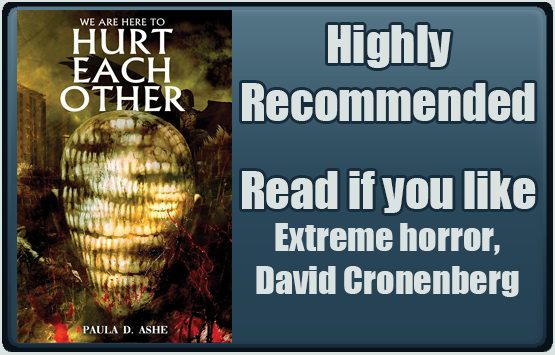
We Are Here to Hurt Each Other by Paula D. Ashe

We Are Here to Hurt Each Other by Paula D. Ashe

Formats: Print, digital

Publisher: Nictitating Books

Genre: Body Horror, Killer/Slasher, Occult, Psychological Horror

Audience: Adult/Mature

Diversity: Queer, Black author and characters

Takes Place in: Ohio

Content Warnings (Highlight to view): Child Abuse, Child Death, Child Endangerment, Death, Drug Use/Abuse, Illness, Incest, Kidnapping, Necrophilia, Mental Illness, Pedophilia, Racism, Rape/Sexual Assault, Self-Harm, Slut-Shaming, Torture, Violence

Blurb

With these twelve stories Paula D. Ashe takes you into a dark and bloody world where nothing is sacred and no one is safe. A landscape of urban decay and human degradation, this collection finds the psychic pressure points of us all, and giddily squeezes. Try to run, try to hide, but there is no escape: we are here to hurt each other.

I received this product for free in return for providing an honest and unbiased review. I received no other compensation. I am disclosing this in accordance with the Federal Trade Commission’s 16 CFR, Part 255: Guides Concerning the Use of Endorsements and Testimonials in Advertising.

If you’ve ever thought “Gee, I’m feeling too mentally and emotionally healthy. I should read something so disturbing and intense my therapist will finally be able to pay off their student loans from all the sessions I’m going to need,” then look no further then Paula D. Ashe’s We Are Here to Hurt Each Other. This horror is extreme. Ashe explores such taboo topics as incest, child abuse, child murders, self-harm, and religious extremism without flinching, yet it never feels like she’s making light of the subject matter. It’s extreme horror that never feels exploitative.

Interestingly, Ashe’s stories are very light on the gore (with a few exceptions). I’ve always found extreme horror that relies too much on blood and guts to be boring (blame my ultraviolent horror phase in college for making me jaded), so it was one of the things I particularly liked about the book. There are also very few examples of the supernatural in this anthology, and no supernatural antagonists. All the villains are very much human. Ashe’s work focuses on psychological horror, the terrifying in the mundane, and the terrible things the average human is capable of. What if you found out your own child was a monster? And not the furry or fanged kind, but the regular old terrible human kind? What if, to cope with abuse, you became the abuser without even realizing? What if you would do absolutely anything to keep the one you love? Ashe takes these simple, awful questions and gives us the terrifying answer, sometimes in a variety of ways. Bereft and Because you Watched, both deal with adult children dealing with their histories of extreme abuse and culpable siblings, but are two very different stories.

The stories are extremely well written, and I was impressed how each character had such a distinct voice. No two stories sound the same, but they all share Ashe’s poetic talent. We are Here to Hurt Each Other is a gripping and deeply unsettling anthology; Ashe’s skill shines through in each story, though I found Exile in ExtremisThe Mother of All Monsters, and Because you Watched to be my personal favorites. The first is an epistolary story about a drug so powerful it is said to bring back the dead and with references to the classic horror anthology The King in Yellow by Robert W. Chambers. The second is about the relationship between a mother and her son while a series of child murders take place. And the last is about the strained relationship between siblings who have witnessed the abuse of their youngest sister at the hands of their cruel parents.

We Are Here to Hurt Each Other is not an easy read, but it is an excellent one. Despite their depravity the stories are still hauntingly beautiful. You’ll find this anthology sitting with you long after you put it down.

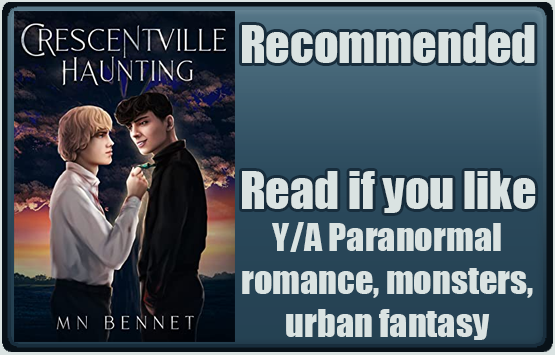
Crescentville Haunting by M.N. Bennet

Crescentville Haunting by M.N. Bennet

Formats: digital

Publisher:  Self published

Genre: Ghosts/Haunting, Monster, Occult, Romance, Vampire, Werewolf, Zombie

Audience: Y/A

Diversity: Bisexual main character, non-binary minor character, Black major character

Takes Place in: LA, California

Content Warnings (Highlight to view): Alcohol Abuse, Cannibalism, Death, Forced Captivity, Gaslighting, Gore, Medical Procedures, Mental Illness, Racism, Sexism, Slurs, Slut-Shaming, Violence, Vomit, Xenophobia

Blurb

Determined to pass junior year, Logan won’t let Henry distract him—much. Logan’s focusing on all things human, which means his swoony vampire ex-boyfriend will have to file his own fangs for a change. When he goes to the school bonfire and runs into Henry, wandering into the woods seems like a great escape. Until he’s bitten by a wicked Crone with some twisted magical munchies.

Logan is certain his ex-free human future is done when he’s dragged off to a scientific institution for study. There, he’s presented with an opportunity to keep his life, family, and future. All he has to do is stick to human ideology, since all things paranormal are illegal. But complications arise when the Crone begins to haunt him and Logan realizes that if he wants to get his life back, he has to navigate his lingering feelings for Henry.

With the Crone set on devouring him and the institution ready to obliterate him for any missteps, Logan must decide between pursuing the human future his family wants—one that he thought he wanted too—or the chance to embrace Henry, even if the world isn’t ready.

I received this product for free in return for providing an honest and unbiased review. I received no other compensation. I am disclosing this in accordance with the Federal Trade Commission’s 16 CFR, Part 255: Guides Concerning the Use of Endorsements and Testimonials in Advertising.

Logan just wants a safe, normal, drama-free junior year, and that means avoiding his vampire ex, Henry, at all costs. Which is easier said than done. Logan may be shy and awkward, but Henry is his complete opposite: confident, outgoing, and suave. When his best friend Kiera (a phantom) drags him to a bonfire party that’s supposed to help Logan relax, he discovers that trouble has a way of following him. Not only is Henry there, but Logan is attacked (for the second time since he first started dating Henry) by a powerful creature, this time a monstrous witch known as the “Crone.” After sustaining a bite from the Crone, Henry’s life changes forever.

Henry and Kiera are known as Vices, a group of monsters including phantoms, witches, vampires, trolls, sirens, and werewolves that are forced to live in the shadows due to public fear and draconian laws. The Crone is a sin, a powerful Vice that feeds on other Vices and can turn humans into undead monstrosities called Hauntings (think zombies and ghouls) with a single bite. After Henry’s attack he’s whisked away by SPU agents (the special police force in charge of catching and neutralizing Sins) to a secure facility designed to treat Hauntings, but to everyone’s surprise he doesn’t transform into a Haunting. It turns out Henry is a rare form of Vice, known as a Viceling, more human than Vice. The lore of Crescentville Haunting can get confusing in places, and there’s a lot of backstory. So much so that I actually checked to see if there was a prequel I had missed. But it’s no worse that any other fantasy novel with rich world building. If you can remember the rules of Quidditch, you can remember the magical classification system Bennet has created.

The characters are relatable and their voices sound authentic. The romance is steamy without being explicit and felt age appropriate for younger teens. It should be noted that while the book contains a paranormal romance, it’s not the central theme of the story. Instead, we focus on Logan’s struggles with his new identity and trying to fit into a human-centric world– an analogy for trying to fit into a heteronormative society when you’re LGBTQIA+. In Monsters in the closet: Homosexuality and the Horror Film Harry M. Benshoff writes “monster is to ‘normality’ as homosexual is to heterosexual.” LGBTQIA+ scholars have long equated queerness with fictional monsters and stories like Crescentville Haunting reclaim the “monstrous queer.” In Bennett’s story, the “homosexual vampire” is the hero rather than the villain, with the humans representing an oppressive heteronormative society and the facility attempting to “cure” Logan of his monstrousness a metaphor for conversion therapy. In addition to romance, the book also has plenty of horror, violence, and suspense, all courtesy of the Crone who continues to haunt Logan after the initial attack.

Overall, this was a fun read with a good world building, a cute relationship, and teens who actually sounded and acted like teens.

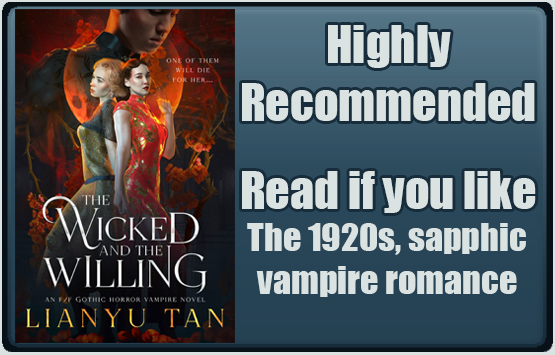
The Wicked and the Willing by Lianyu Tan

The Wicked and the Willing by Lianyu Tan

Formats: Print, audio, digital

Publisher: Shattered Scepter Press

Genre: Historic Horror, Vampire

Audience: Adult/Mature

Diversity: Lesbian, Malay, Chinese

Takes Place in: Singapore

Content Warnings (Highlight to view): Cannibalism, Child Abuse, Child Endangerment, Death, Drug Use/Abuse, Forced Captivity, Gaslighting, Gore, Kidnapping, Medical Torture/Abuse, Oppression, Pedophilia, Physical Abuse, Racism, Rape/Sexual Assault, Self-Harm, Sexism, Slut-Shaming, Suicide, Torture, Verbal/Emotional Abuse, Victim Blaming, Violence

Blurb

Love demands sacrifice. Her blood. Her body. Even her life.

Singapore, 1927.

Verity Edevane needs blood.

And not just anyone’s blood. She craves the sweet, salty rush from a young woman’s veins, the heady swirl of desire mixed with fealty—such a rarity in this foreign colony. It’s a lot to ask. But doesn’t she deserve the best?

Gean Choo needs money.

Mrs. Edevane makes her an offer Gean Choo can’t refuse. But who is her strange, alluring new mistress? What is she? And what will Gean Choo sacrifice to earn her love?

Po Lam needs absolution.

After decades of faithfully serving Mrs. Edevane, Po Lam can no longer excuse a life of bondage and murder. She needs a fresh start. A clean conscience. More than anything, she needs to save Gean Choo from a love that will destroy them all.

I received this product for free in return for providing an honest and unbiased review. I received no other compensation. I am disclosing this in accordance with the Federal Trade Commission’s 16 CFR, Part 255: Guides Concerning the Use of Endorsements and Testimonials in Advertising.

The Wicked and the Willing is a dark, supernatural romance set in Singapore in the late 1920s while it was still the Straits Settlements and under British control. The story revolves around three women: Gean Choo, Verity, and Po Lam. Gean Choo, is a young Chinese woman with no family who takes a job working for a wealthy White woman. She quickly falls in love with her employer, a beautiful, but dangerous vampire named Verity Edevane. Po Lam is Verity’s head servant, a strong and formal woman who also develops a soft spot for Gean Choo. Although, while Po Lam uses she/her pronouns, she dresses as a man and is gender non-conforming. It’s unclear if she’s very butch or if her gender is fluid. But without enough evidence to the contrary, I’m going to assume she identifies as a butch woman for the purpose of this review. Each chapter is told from a different woman’s point of view and follows the turbulent romance between Gean Choo and Verity. Po Lam struggles with whether to interfere and warn Gean Choo that she’s playing with fire, or to remain an obedient servant and stay out of it. The story touches on the power dynamics of race, age, wealth, and gender. We see this in the relationships between Verity and her servants, Verity and the Vampire leader Kalon, and the women with society.

Verity may give Gean Choo permission to use her given name, but theirs is still an imbalanced relationship. As her wealthy mistress and as a White woman, Verity holds all the power over her servants, making it difficult(if not impossible) for Gean Choo to turn down any of her requests, even when she’s uncomfortable. As an impoverished, unmarried orphan, options are for employment are limited and Gean Choo is desperate to protect her cushy position in the vampire’s household. So, while on the surface it may appear as though the two women are both willingly engaging in sadomasochism (and in the hands of a less talented writer this would certainly be the case), it’s clear that there is an issue of consent. Does Gean Choo let her mistress push her past her comfort limits because that’s what she wants as a submissive, or because she’s afraid of losing her job? Tan skillfully presents their bond as unhealthy, but alluring enough for a girl with rose-tinted glasses to miss the red flags without romanticizing it. Verity is a monster, but she hides it behind charm and extravagant displays of affection, a common trait of abusers during the “calm” or “honeymoon” stage of the abuse cycle. Contrast this with more problematic romance books like Twilightwhere an abusive relationship is passed off as romantic.

Gean Choo’s race also plays a role in their power imbalance. Verity clearly sees her as an “exotic” sexual fantasy she needs to rescue, instead of a real person. She treats her like a “China doll,” dressing her up and styling her hair, and can’t even be bothered to pronounce her name correctly.Iinstead, she calls her “Pearl” (the second charter in Gean Choo’s name is 珠 which is Hokkien for Pearl). There are similarities to the relationship in Miss Saigon, Madama Butterfly (on which Miss Saigon is based), The World of Suzie Wong, and other orientalist works of fiction, where a young, innocent (but also hypersexualized) Asian woman is taken advantage of by a White foreigner. Tan reclaims the trope by making Gean Choo a complex character who’s stronger than she thinks and uses this as another aspect of their relationship’s dysfunction. She also shows how harmful it is by having Verity literally prey on Asian women (mostly sex workers) who she views as disposable, a view shared by the British who prey on the countries they colonize. Despite all Verity’s power as a vampire and a rich White woman, she is still a second-class citizen in the eyes of society because of her gender and is forced to submit to the will of the sadistic vampire leader, Kalon.

Overall, I greatly enjoyed Tan’s violent, sexy, historical “romance.” There was plenty of gratuitous sex and violence, non-White lesbians, and commentary about colonization and abusive relationships. What I found particularly unique was Tan giving the reader two different options for the ending, one happy and one tragic depending on which romance the reader chooses for Gean Choo to embrace. Overall, the book is beautifully written. Tan has a very impressive and extensive vocabulary which she used to weave the narrative, which she manages to do without ever being sesquipedalian or descending into purple prose. I’d recommend this book to anyone who likes period horror or vampire romances where the vampire’s monstrosity is never downplayed. 

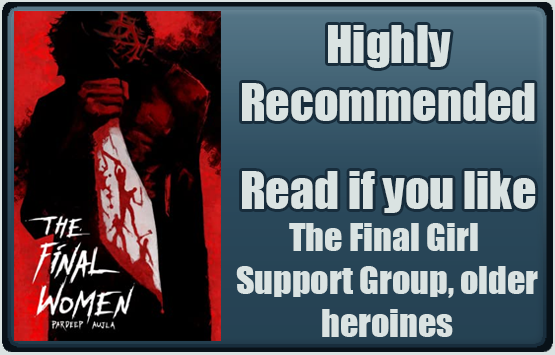
The Final Women by Pardeep Aujla

The Final Women by Pardeep Aujla

Formats: digital

Publisher: Self-Published

Genre: Demon, Killer/Slasher, Occult

Audience: Adult/Mature

Diversity: Black main character, Latina main character, Vietnamese main character, lesbian main character

Takes Place in: type here

Content Warnings (Highlight to view): Alcohol Abuse, Amputation, Bullying, Death, Drug Use/Abuse, Gore, Homophobia, Mental Illness, Racism, Self-Harm, Sexism, Suicide, Verbal/Emotional Abuse, Violence

Blurb

The mass murdering Phantom of Haven Cove is dead. For the one who killed him, however, life has never been the same.

How do you return to normality after facing such a monster? How do you live when consumed by guilt, anger, fear, and denial? How do you connect with others when no one understands what you’ve been through?

But there are others… Final girls of their own Haven Cove massacres. And now, thirty years later, they must all face a new question…

What do you do when the killer returns?

I received this product for free in return for providing an honest and unbiased review. I received no other compensation. I am disclosing this in accordance with the Federal Trade Commission’s 16 CFR, Part 255: Guides Concerning the Use of Endorsements and Testimonials in Advertising.

What happens when final girls grow up? It depends how they deal with the trauma of what happened to them the night they faced off with the masked killer, Silas Crowe. If you’re Nell James, you grow up to become a lonely and agoraphobic author who tries to turn the worst thing that ever happened to her– watching her friends get murdered one by one–into financial gain. If you’re Josie Jedford, you numb your fear with drugs. Or you could become a paranoid survivalist like Ana Gómez who transforms her badly burned body into a living weapon. Even Cassie Phong, who seems to have the perfect life what with her wealthy husband and two children, can’t escape the PTSD she developed the night she faced off with Silas Crowe. Each woman has done her best to put the past behind them, believing Crowe to be dead once and for all. That is until Camp Haven Cove reopens and a new group of teenagers goes missing. Nell realizes that Silas Crowe never died, and never will unless she, and the other three former final girls find a way to deal with him once and for all. Now well into their forties the four final woman team up to put a stop to the killings once and for all.

Slasher heroines are almost exclusively young women: teens and twenty somethings with bare breasts and flat stomachs (they’re always conventionally attractive) enjoying the prime of their lives through sex, drugs and drinking. Any woman above the age of thirty is either a mother or a side character, and if she has a few gray hairs she’s relegated to the role of a frightful hag. But as nostalgia for horror of the 80’s and 90’s breathes new life into horror franchises, Hollywood is doing something new. Instead of rebooting and recasting their heroines, they’re allowing them to grow up from Final Girls into Final Women. Sidney Prescott (Scream), Laurie Strode (Halloween), and Sally Hardesty (The Texas Chainsaw Massacre) all recently reprised their roles in their respective franchises as badass heroines over the age of forty. And as someone who will soon be saying goodbye to my thirties, it’s refreshing to see older women get their time in the slasher spotlight, and that’s one of the things I liked best about The Final Women.  Nell, Josie, Ana, and Cassie are all approaching fifty, but they all get to be the heroes of the story, and I found them much more relatable then horny, drunk teens in the woods. They’re also not written for the male gaze, which is refreshing.

Another thing I liked about the book was Aujla’s realistic depiction of PTSD. None of the women escaped Silas unscathed, they each bear their own physical and mental scars, as one would expect from anyone going up against a slasher. Nell displays avoidance of people and places that remind her of her traumatic event and might trigger a flashback. Cassie and Josie both develop substance abuse problems, alcohol and drugs respectively, a common comorbidity for people with PTSD. Ana is prone to angry outbursts and aggressive behavior and is hypervigilant. All the women struggle with nightmares and flashbacks. It’s refreshing to see a slasher actually deal with mental health and the aftermath of a traumatic event (something we’re starting to see in more recent film sequels). I genuinely cared about all the main characters, something that rarely happens in horror fiction, and I was scared to see any of them get hurt or killed. Aujla just writes them so well! It’s sweet to see these women from different walks of life bond and draw strength from each other.

The Final Women was fun in a way the best 80’s slashers are. Gory, over the top, and wickedly funny. I absolutely devoured it as I found both the story and the characters enthralling. It draws on classic horror tropes while still being wholly unique. If you’re a fan of slashers you’ll definitely want to check this one out. 

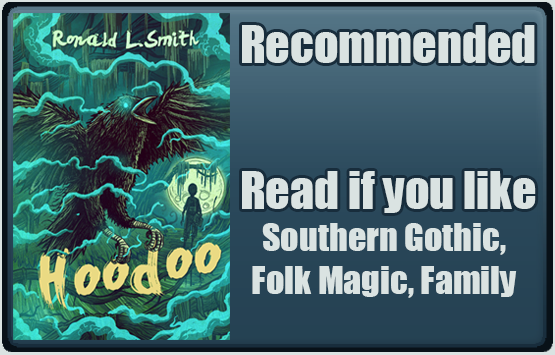
Hoodoo by Ronald L. Smith

Hoodoo by Ronald L. Smith

Formats: Print, audio, digital

Publisher: Clarion Books

Genre: Folk Horror, Historic Horror, Demon, Occult, Myth and Folklore

Audience: Children

Diversity: BIPOC (Black, African American, Caribbean American)

Takes Place in: Alabama, USA

Content Warnings (Highlight to view): Animal Death, Bullying, Child Endangerment, Death, Illness, Racism, Physical Abuse 

Blurb

Twelve-year-old Hoodoo Hatcher was born into a family with a rich tradition of practicing folk magic: hoodoo, as most people call it. But even though his name is Hoodoo, he can’t seem to cast a simple spell.        

Then a mysterious man called the Stranger comes to town, and Hoodoo starts dreaming of the dead rising from their graves. Even worse, he soon learns the Stranger is looking for a boy. Not just any boy. A boy named Hoodoo. The entire town is at risk from the Stranger’s black magic, and only Hoodoo can defeat him. He’ll just need to learn how to conjure first.        

Set amid the swamps, red soil, and sweltering heat of small town Alabama in the 1930s, Hoodoo is infused with a big dose of creepiness leavened with gentle humor.

I really wanted to love this book. I really, really did. The cover art is dark and beautiful, the premise sounded right up my alley, the story is inspired by African-American folklore and oral traditions, the villain is genuinely creepy, the representation of Hoodoo feels authentic rather than sensationalized, and it’s a historical novel with a Black main character that isn’t about oppression and racism *gasp*. I was so hyped up for Hoodoo and ready to fall in love. And I will say, the ideas behind the story are great, I like the characters and I like the concept. The execution? Not so much.

Now Hoodoo  isn’t a bad book by any stretch, and I think part of the issue may have been that this is a story intended for kids, and I probably would’ve loved it a lot more if I were a child. The other problem was that I had incredibly high expectations going in, which would be hard to live up to, and that’s on me. It’s also important to note that my lukewarm feelings toward the story also seem to be in the minority: other reviews I’ve read have all been glowing endorsements, so I’m probably just being a grumpy, nit-picking potato. I still recommend checking it out, especially for young readers who love spooky stuff, it just wasn’t as amazing as I was hoping. I had a lot of issues with Hoodoo  that prevented me from enjoying the book as fully as I desired to.

For one thing, the pacing is all over the place. The villain doesn’t get enough of a buildup before his big reveal, and the ending feels rushed while other scenes dragged on, especially in the beginning. Unnecessary details got more focus than I felt they deserved. It’s a serious bummer when the final showdown between the villain and the hero is only a page or two long and he’s defeated with so much ease. Instead of driving forward, the plot just kind of wandered around aimlessly until it got distracted by something shiny. Characters and ideas were introduced then abandoned, appearing for one or two scenes before vanishing into the plot hole from which they came, never to be heard from again. It’s like Smith had written this long, epic story, but had to cut the book down to fit in a 200-page kids book, and he just randomly chose what to remove in last minute panic.

It’s annoying that otherwise interesting characters are reduced to one-scene wonders, but it’s even more annoying that their sole function is to drop solutions in Hoodoo ‘s lap any time he encounters an obstacle. This greatly minimizes the sense of danger, because every problem seems to get solved (whether for better or worse) almost immediately. Too bad the Fellowship of the Ring didn’t have this kid, it’d probably cut their travel time in half, Sean Bean might still be alive, and Sauron would’ve been taken out with one punch. I get that Deus Ex Machina is par for the course with these kinds of stories, but at least pretend the hero might not make it by building the suspense a little, or making them really work for a solution. It’s hard to feel like there’s anything at stake when a random talking crow or another seemingly random character swoops in to save the day without Hoodoo having to do much on his end. I guess that’s why he keeps stubbornly refusing his family’s help like a jerk, because his magic causes everything to just work out with minimal effort. At least, that’s what I assume it does since it’s never really explained how Hoodoo’s powers work other than some really vague hints.

Hoodoo can also be a pretty vexing narrator. He has a habit of defining random words and then ending his sentence with “If you didn’t know”. I know this is probably the most random, arbitrary nitpick, but while it was only mildly irritating the first half-dozen times, by the third chapter I could barely suppress my urge to scream and punch something every time Hoo Doo felt like he had to explain what Molasses or an Outhouse was, then end the sentence with “if you didn’t know”. I KNOW WHAT AN OUTHOUSE IS GET ON WITH THE STORY BEFORE I THROW YOU IN ONE. I get that the book is for kids, and they may not know what cracklin’ is, but I’m pretty sure most children who are capable of reading a chapter book are also able to perform a basic Google search or use a dictionary. And that’s assuming they can’t just figure out a word from context. I didn’t know what “Squirrel Nut Zippers” were before reading this (ironically the one thing Hoodoo didn’t feel like explaining) but I was still able to discern that he was talking about a sweet and not the swing band based on the context. And then I Googled it and learned that Squirrel Nut Zippers are a vanilla flavored caramel candy mixed with peanuts. So now I know that random bit of trivia and that Hoodoo likes gross candy. Maybe it was an attempt by Smith to make his character sounds more “natural” when he’s talking to the audience, but I felt like the narrative came to a screeching halt every time Hoodoo whipped out his annoying catchphrase. Maybe (probably) I’m just really, easily annoyed but all the “If you didn’t know”s were like nails on a chalkboard and distracted me from trying to enjoy the story.

And while I’m dumping on Hoodoo, here’s something else that made my hackles rise; while talking about his best friend, Bunny, he says “That’s what I liked about her. She wasn’t like the other girls at the schoolhouse. She did everything a boy did and some things even better.” Saying a girl “isn’t like other girls” isn’t an empowering compliment, you just insulted her entire gender and basically told her “wow, you don’t suck like all those other icky girls” in addition to implying that women who are more like men are somehow better. Seriously, don’t try and compliment a woman by putting other women down, or tell her “you’re not like other women, you’re more like a man”. Being masculine or feminine shouldn’t be a compliment or an insult, and people aren’t better or worse by being one or the other. Bunny is a pretty cool character and all, but I could have done without Hoodoo’s sexist comments (which are never called out in the story itself).

Despite all the pacing issues, and the protagonist’s exasperating habit of defining every piece of Soul Food he comes across (I KNOW what grits are, you don’t have to stop the story and tell me!!!!) there was still plenty to enjoy. Namely, that we get a piece of historic fiction with a Black protagonist that isn’t about racism or segregation. *gasp* Look, narratives about how poorly Black people have been treated (and are still treated) in this country are both important and necessary, and something every child should learn about. The ugliness of slavery, segregation, Jim Crow laws, and the history of racism that still exists in this country shouldn’t be glossed over, hidden, or worse, perpetuating the myth of the smiling slave and the benevolent slave owner (looking at you  A Birthday Cake for George Washington, you were published in 2016, you should know better), and I commend schools that teach kids about these issues. But, it’s still problematic when all the books about Black people focus only on segregation, slavery, and sports. Or, as librarian and author Scott Woods puts it, boycotts, buses, and basketball. That’s not all there is to Black culture and Black Americans!

Where are the stories where Black kids just have a fun adventure for the sake of a fun adventure? Where’s the escapist fiction and epic tales with the Black hero? Where are the biographies of black scientistsinventorsartists, and entrepreneurs? I tried to think of all the books with Black protagonists I was assigned in grade school, way back in the 90s (by my white teachers, in my mostly white school, where there were literally so few BIPOC that we all knew each other), and all I could remember reading was Roll of Thunder, Hear My Cry in fourth grade. At first, I thought I just had a faulty memory, since I’m old and forget everything. I asked two of my siblings if they could recall any African American literature from our school days. My sister said “No, but I read Beloved in High School”, and my brother was pretty sure the teacher read the class “some picture book about Jackie Robinson”. So yeah, segregation, slavery and sports.  Apparently making us read one depressing story by a Black author during Black History Month was just enough to alleviate my grade school’s White guilt, and then they could all pat themselves on the back for being so woke.

Kids these days (Wow, I sound old) at least have the We Need Diverse Books campaign, and I’m glad for that. I would’ve killed to read a ghost story or a fairy tale with a Black protagonist when I was a child. And that’s what made me so happy about Hoodoo. It’s probably one of the few works of historical fiction (technically fantasy) I can think of that takes place in the Jim Crow south that isn’t entirely focused on oppression of the book’s characters. Hoodoo isn’t a victim, he’s the story’s hero, and he gets to fight the big, bad monster and save his loved ones. It’s a fun, spooky, escapist story with a character children can admire for his intelligence and bravery rather than athletic ability, and the reader gets to learn about Southern Black culture of the time period. There’s still racism lurking in the background, this is 1930’s Alabama after all, as is evident when Hoodoo and Bunny have to go to the carnival on the “colored folk’s” day, or when Hoodoo’s aunt has to go clean for rich, White people, it’s just not the focus of the story. Smith acknowledges that segregation, lynching, and other horrors were a part of life for Hoodoo and his family, and then he moves on with the plot because they’re so much more than just their oppression. Then we get a story of Hoodoo fighting the forces of evil with magic, learning about his past, and being awesome. This is the book every kid who was stuck with a white-washed reading list wished they could’ve read growing up. Despite all my complaining, I truly hope we haven’t heard the last of Hoodoo Hatcher.

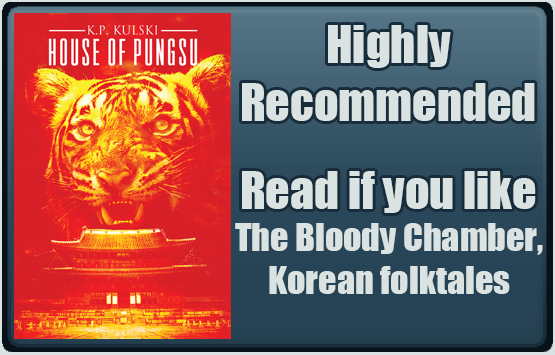
House of Pungsu by K.P. Kulski

House of Pungsu by K.P. Kulski

Formats: Print, digital

Publisher: Bizarro Pulp Press

Genre: Dark Fantasy, Ghosts/Haunting, Gothic

Audience: Adult/Mature

Diversity: Korean-American author, Korean characters

Takes Place in: Korea

Content Warnings (Highlight to view): Child Death, Death, Sexism, Verbal/Emotional Abuse

Blurb

“As sharp as broken pottery and as delicate as a peony petal, House of Pungsu is the story my spirit hungered for. K.P. Kulski shifts rice paper doors to reveal the darkest truth.”—Lee Murray, USA Today bestselling author and four-time Bram Stoker Award® winner.

No one knows what’s beyond the walls of the Joseon-era palace that never seems to decay, a sprawling complex where daughter, mother, and grandmother are the only inhabitants. Why is her bed-bound grandmother locked in her room each night, and what exactly is behind the locked doors of the palace pavilions and halls? When daughter unexpectedly begins to menstruate, she is tormented with dreams that drive her to find answers.

Following the Korean folk story of “A Tiger’s Whisker,” HOUSE OF PUNGSU is a feminist meditation on women’s inner identity and the struggle to rediscover it.

I received this product for free in return for providing an honest and unbiased review. I received no other compensation. I am disclosing this in accordance with the Federal Trade Commission’s 16 CFR, Part 255: Guides Concerning the Use of Endorsements and Testimonials in Advertising.

 
House of Pungsu is a dark, feminist fairy tale about a young woman finding her own identity and power. It is the story of three women–daughter, mother, and grandmother–living in an uninhabited palace in Joseon where time stands still and nothing changes. None of the women have names and are only defined by their roles in relation to each other. Grandmother, mother, and daughter reflect the triple goddess archetype (the maiden, the mother, and the crone) or the three stages of growth. Ironic since they are trapped in a world where time doesn’t move, and the maiden is unable to become the mother. That is, until Daughter experiences her first period and time slowly begins to affect the palace again. Rain falls once more and the fruit on the trees begins to rot.

Daughter does not remember her real name or her past, only that she is someone’s daughter. She is full of barely contained rebellious spirit and hope for the future, but she is bound by duty to be obedient and quiet, a “tame tiger.”  “Their lives an animal within me that growls… a wild thing that wants to bite its tether yet I do nothing to free it. Instead, I stand very still, say little, and wait for the fury to subside.” Mother is bitter and pessimistic, though still hopes her daughter can one day leave the palace while still believing it impossible. It’s implied she was once the wife of an emperor and not allowed her own hopes, dreams, and aspirations beyond pleasing her husband and bearing his children. Daughter believes that grandmother is confined to her bed, just as she and mother are confined to the palace, but mother has to lock grandmother in at night, and someone locks the other side of the door. At night, growling and commotion can be heard from the bedroom. It seems grandmother is not as helpless or trapped as she seems, a wild tiger locked up for the safety of mother and daughter. 

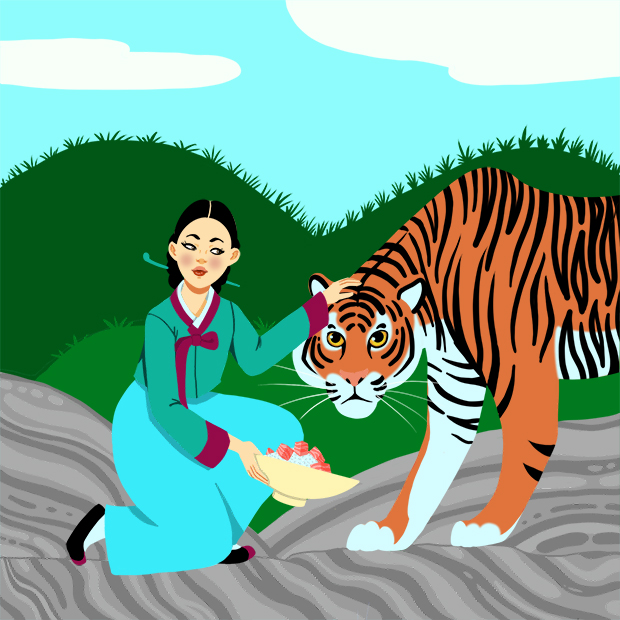
A drawing of a woman in a hanbok serving a bowl of meat and rice to a tiger

The tiger motif is repeated throughout the book, as tigers are strongly associated with Korea and found repeatedly throughout Korean folklore. Kulski draws inspiration from one such folktale, The Tiger’s Whisker, a folktale about living with someone who suffers from PTSD. It emphasizes the diligence and patience you must have when working with someone with complex trauma. While on its surface the story seems to be a heartwarming tale of helping a loved one, Kulski notes that the burden is put on the wife to help her husband and have patience when he’s angry and abusive. The wife exists only to help her husband and is expected to suffer with him. In many versions of the tale, she is not even given her own name. And so Kulski creates her own ending, instead focusing on the wife overcoming the fear of the tiger and the husband that once held her back. She asks the question, “What would happen if you released the full ferocity of the tiger rather than tame it?”

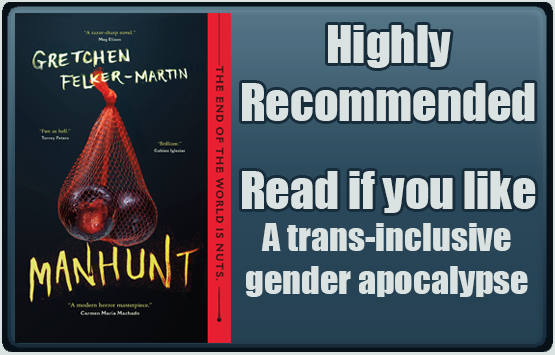
Manhunt by Gretchen Felker-Martin

Manhunt by Gretchen Felker-Martin

Formats: Print, audio, digital

Publisher: Tor Nightfire

Genre: Apocalypse/Disaster, Monster

Audience: Adult/Mature

Diversity: Trans author and characters, queer characters, Native character

Takes Place in: northeastern USA

Content Warnings (Highlight to view): Animal Death, Body Shaming, Cannibalism,  Child Death, Childbirth, Death, Drug Use/Abuse, Eating Disorder, Forced Captivity, Gore, Illness, Kidnapping, Medical Procedures, Oppression, Rape/Sexual Assault, Self-Harm, Slurs, Torture, Transphobia, Verbal/Emotional Abuse, Violence

Blurb

Y: The Last Man meets The Girl With All the Gifts in Gretchen Felker-Martin’s Manhunt, an explosive post-apocalyptic novel that follows trans women and men on a grotesque journey of survival.

Beth and Fran spend their days traveling the ravaged New England coast, hunting feral men and harvesting their organs in a gruesome effort to ensure they’ll never face the same fate.

Robbie lives by his gun and one hard-learned motto: other people aren’t safe.

After a brutal accident entwines the three of them, this found family of survivors must navigate murderous TERFs, a sociopathic billionaire bunker brat, and awkward relationship dynamics―all while outrunning packs of feral men, and their own demons.

Manhunt is a timely, powerful response to every gender-based apocalypse story that failed to consider the existence of transgender and non-binary people, from a powerful new voice in horror.

 received this product for free in return for providing an honest and unbiased review. I received no other compensation. I am disclosing this in accordance with the Federal Trade Commission’s 16 CFR, Part 255: Guides Concerning the Use of Endorsements and Testimonials in Advertising.

Have you ever wondered what happens to trans people in sex-based apocalypses like those in Y: The Last Man or Ōoku: The Inner Chambers? Gretchen Felker-Martin sets out to answer exactly that in her post-apocalypse splatterpunk novel Manhunt.

The T-rex virus transforms anyone with high levels of testosterone—mostly cis-men—into cannibalistic, sex-crazed monsters. Emboldened by the end of the world, a group of TERFs (trans-exclusionary radical “feminists”) have formed their own militia where they hunt and kill any trans women they find. It may seem like a group of militant TERFs is an exaggeration, but it feels like less of a stretch when you consider there’s already a high rate of violence against trans people. In 2021 alone, at least 56 trans and gender non-conforming people were murdered in the US. Transphobic hate crimes have quadrupled over the last five years in the UK. These fake feminists are also more fascist adjacent than they’d like to admit. As Judith Butler accurately pointed out, TERFs “have allied with rightwing attacks on gender” and “The anti-gender ideology is one of the dominant strains of fascism in our times. So, the TERFs will not be part of the contemporary struggle against fascism.” TERFs Lily Cade and Bev Jo Von Dohre have even called for the death of trans women. The fact that trans women in Manhunt can transform into monsters if they don’t have access to anti-androgen medication gives the TERFs exactly the excuse they’ve been waiting for to go from hateful rhetoric to actually destroying that which they hate most (never mind that cis-women with PCOS or congenital adrenal hyperplasia can also transform into feral beasts).

Not only do trans women have to avoid getting killed by the monstrous men, but also running into the militant TERFs who have seized control of most of the northeast. Fran and Beth are two such transwomen trying to survive in the new world, catching feral men and harvesting their testicles for their friend Indy to extract estradiol from. After running afoul of a militant group of TERFs and almost being killed by men, Fran and Beth meet a sharp-shooting trans man named Robbie, who they take on their journey with them. The trio return to Indy’s house with their testicle trophies where they learn she’s been offered a job by a spoiled rich girl who controls a luxurious bunker. But the promises of comfort the bunker offers may hide a deadly truth.

While I personally enjoyed this book, it won’t be for everyone. It is splatterpunk, after all. That means there’s lots of brutal violence (including a cis woman having her uterus cut out of her), gross content (testicle eating), and graphic sex. Everyone in Manhunt is super horny, sometimes at wildly inappropriate times, so Beth, Fran, Indy, and Robbie do a lot of fucking. The sex is hot, sometimes gross, and other times both hot and gross, much like real sex. It was nice to have sex scenes centered around trans pleasure rather than the cis-male gaze. Of course, the graphic description of genitalia might be triggering for some people who experience gender dysphoria, so be aware of that. Speaking of hot sex, a captain in the TERF army named Ramona is sleeping with a non-binary prostitute named Feather. One reviewer claimed this is unrealistic but I have to disagree. A lot of chasers are happy to sleep with trans people but won’t do anything to defend their rights or even stand up for them. Too many people with trans partners see their relationship as a shameful secret to be kept, and Ramona is no different. She’s too much of a coward to do the right thing and just goes along with the TERF army because it’s what’s easy.

Splatterpunk is very hit or miss for me, as many extreme horror books can cross over into misogynistic violence. Manhunt manages to avoid this trap, even though most of the book’s violence is against women (as all the characters, aside from Robbie, are women). Perhaps because it’s other women committing the violence, but I didn’t get that gross feeling I usually do when reading splatterpunk authored by cis men. Even the sexual assault scene didn’t feel gratuitous and was handled well. I also loved how flawed the protagonists are. Some people mistakenly assume LGBTQIA+ characters need to be perfect for it to be considered a “good” portrayal. I believe realistic is preferable to perfect, and I like my queer characters to have character flaws who sometimes do and say problematic things. Both Beth and Fran feel very human. Beth is reckless and insecure; Fran has both passing and class privilege and can sometimes be selfish. Neither of them are bad people, just realistically flawed.

My only complaint about the book (and granted, it’s minor) is that there are so many descriptions of Indi’s fat body. The way she’s described isn’t quite fatphobic, but it did make me feel uncomfortable that there was so much focus on it. I can understand that Indy is dealing with a lot of internalized fatphobia and insecurity, so it makes sense that her character would spend a lot of time focusing on her size and the limitations that come with it. When the story is told from a third-person point of view, there’s no reason for Indy’s weight to be described in such detail, especially since no one else’s body gets that much description or scrutiny. At least she’s never described as gross or unattractive, and Indi even gets to be sexually desirable, which is rare for fat characters outside of fetish porn. It was refreshing to see fat people having passionate sex scenes just like their skinny counterparts. Like I said, it’s a minor complaint and could absolutely be my own hypersensitivity.

Reading this book is like having your brain put in a blender. It’s wild, gross, horny, disgusting, tragic, and hilarious all whipped together into an extreme horror smoothie. In other words, I LOVED it. You have to be at least somewhat familiar with trans culture to fully appreciate the story, which I thought was awesome. There’s also just something extremely satisfying about trans women killing fascist TERFs: not something I’d advocate in real life, but it’s fun and cathartic in fiction. Unsurprisingly, this made a bunch of real-life TERFs very angry. They didn’t like being portrayed as bigoted assholes just because of their bigoted asshole-ish behavior and tried to review bomb Manhunt…which should just make you want to read it more.

Conquer by Edward M. Erdelac

Conquer by Edward M. Erdelac

Formats: Print, audio, digital

Publisher: Self Published 

Genre: Historic Horror, Monster, Mystery, Myth and Folklore, Occult, Vampire

Audience: Adult/Mature

Diversity: Black/African-American, Hispanic, Trans, Gay

Takes Place in: Harlem, New York, USA

Content Warnings (Highlight to view): Animal Death, Body Shaming, Child Abuse, Death, Drug Use/Abuse, Forced Captivity, Gore, Homophobia, Kidnapping, Necrophilia, Oppression, Pedophilia, Physical Abuse, Police Harassment, Racism, Rape/Sexual Assault, Sexual Abuse, Slurs, Transphobia

Blurb

In 1976 Harlem, JOHN CONQUER, P.I. is the cat you call when your hair stands up…the supernatural brother like no other. From the pages of Occult Detective Quarterly, he’s calm, he’s cool, and now he’s collected in CONQUER.

From Hoodoo doctors and Voodoo Queens,
The cat they call Conquer’s down on the scene!
With a dime on his shin and a pocket of tricks,
A gun in his coat and an eye for the chicks.
Uptown and Downton, Harlem to Brooklyn,
Wherever the brothers find trouble is brewin,’
If you’re swept with a broom, or your tracks have been crossed,
If your mojo is failin’ and all hope is lost,
Call the dude on St. Marks with the shelf fulla books,
‘Cause ain’t no haint or spirit, or evil-eye looks,
Conjured by devils, JAMF’s, or The Man,
Can stop the black magic Big John’s got on hand!

I received this product for free in return for providing an honest and unbiased review. I received no other compensation. I am disclosing this in accordance with the Federal Trade Commission’s 16 CFR, Part 255: Guides Concerning the Use of Endorsements and Testimonials in Advertising.

Conquer is the story of a Black mystical detective named John Conquer (a reference to John the Conqueror) and a homage to 70’s detective fiction and Blaxploitation films. It’s fun, well written, and full of creepiness, including a fetus monster haunting an abandoned subway station and a man shrunk down and boiled alive in a lava lamp. I greatly enjoyed the book, but like most Blaxploitation, it wasn’t without its problems.

It’s important to point out that Erdelac is a White author writing a Black story (something not uncommon in Blaxploitation). I usually prefer to promote “own voices” books, and stories by cishet White men are a rarity on this blog. After all, folks with privilege do not have the best track record when it comes to writing marginalized groups. As Irish author Kit de Waal said, “Don’t dip your pen in someone else’s blood”. Take American Dirt by Jeanine Cummins and The Help by Kathryn Stockett. They’re both terrible for numerous reasons including, but not limited to: not doing enough research, using the White Savior trope, watering down their narratives to make them palatable for White audiences, cultural appropriation, speaking over marginalized voices, etc. That’s not to say White authors shouldn’t write BIPOC characters at all. Not having any diversity in your story can be equally problematic. It just needs to be done carefully and respectfully. Very, very carefully. Yes, I know that can be a fine line to walk, but if an author can research what kind of crops people were growing in 1429 to make their book more accurate, they can research American Indians and people of color. Besides, that’s what hiring sensitivity readers and using resources like Writing with Color is for. Of course, there’s also the problem of White voices being given preferential treatment by publishers and audiences over BIPOC trying to tell their own stories.

To his credit, Erdelac has done an impressive amount of research to make his book feel authentic. John Conquer wears a dime around his ankle for protection and a mojo hand (another name for a mojo bag) for luck. His name is a reference to High John de Conqueror, a Black folk hero with magical abilities. Conquer also has one of the most accurate representations of Vodou I’ve ever seen in fiction. Hollywood “voo doo” is a pet peeve of mine, so I appreciate Erdelac’s dedication to portraying the religion and loa/lwa (the powerful spirits Vodou practitioners worship and serve) accurately. He also doesn’t try to portray an idealized version of 1970s NYC. There’s racism, anti-Semitism, homophobia, and cops and criminals spewing slurs. And while it’s jarring, it does make the story feel more authentic. The police are racist and homophobic and there’s tension between the many communities that make up 1970s New York. John Conquer’s Uncle Silas was disowned by his family for being gay, and when John is asked to solve his murder, he has to confront his own homophobia and transphobia. That doesn’t mean it always works, though. There were definitely a few times I side-eyed and wondered if a certain line really needed to be in there.

My favorite part of the book is Eldelac’s excellent world building. White vampires go up in smoke when exposed to sunlight, while vampires with more melanin are protected from the sun’s rays. Vampirism also halts a corpse’s decay, but all that rot catches up to them when they’re finally killed. Each culture has their own magical practices with distinct rules, and magic doesn’t cross cultural lines. For example, only Vodou practitioners can become zombies, and non-Christian vampires are immune to crosses. Conquer is especially powerful because he’s learned many different traditions and practices, but the catch is that this opens him to a wider variety of spiritual attacks. Street gangs utilize black magic to wage wars with each other. His work is clever, original, and something I could really get into. But…having White authors tell BIPOC stories still feels problematic to me when White authors are still so heavily favored by the publishing industry. I’ve reviewed books by White authors before, but because Conquer is based heavily on Blaxploitation it feels, well, more exploitative than those I’ve reviewed in the past. I’m still going to go ahead and recommend Eldelac’s work because—in the end—it is well written and interesting, but I can also completely understand if some of you want to skip this one.

Grievers by Adrienne Maree Brown

Grievers by Adrienne Maree Brown

Formats: Print, digital

Publisher: AK Press

Genre: Apocalypse/Disaster

Audience: Adult/Mature

Diversity: Black/African-American, Lesbian

Takes Place in: Detroit, MI, USA

Content Warnings (Highlight to view): Death, Drug Use/Abuse, Illness, Medical Procedures

Blurb

Dune’s mother is patient zero of a mysterious illness that stops people in their tracks—in mid-sentence, mid-action, mid-life—casting them into a nonresponsive state from which no one recovers. Dune must navigate poverty and the loss of her mother as Detroit’s hospitals, morgues, and graveyards begin to overflow. As the quarantined city slowly empties of life, she investigates what caused the plague, and what might end it, following in the footsteps of her late researcher father, who has a physical model of Detroit’s history and losses set up in their basement. She dusts it off and begins tracking the sick and dying, discovering patterns, finding comrades in curiosity, conspiracies for the fertile ground of the city, and the unexpected magic that emerges when the debt of grief is cleared.

I received this product for free in return for providing an honest and unbiased review. I received no other compensation. I am disclosing this in accordance with the Federal Trade Commission’s 16 CFR, Part 255: Guides Concerning the Use of Endorsements and Testimonials in Advertising.

“Grief was an amalgamation of absence narratives layered over each other”

Death positivity is the philosophy that death and grief should be spoken of openly and that treating the subject as taboo does more harm than good. It encourages people to learn about end-of-life care, make plans for their own deaths, be involved in the care of their dead loved ones, and explore their curiosity and feelings surrounding death. In a way, Grievers is a death-positive book. The story explores what it’s like to lose the people you love, care for the dying, prepare for death, and the mourning process. Most horror skims over the death of its characters, their lives nothing more than cheap fodder for the reader’s entertainment. But in Grievers, you feel the weight of every death.

A mysterious illness is sweeping Detroit and killing its Black population. Dubbed “H8”, it leaves its victims frozen in place with grief-stricken faces. A social justice activist named Kama is the first to contract the disease. Unable to afford a hospital, Dune, Kama’s only child, cares for her mother at home by feeding her, changing her, and keeping her as comfortable as she can. Dune, distrustful of the system that failed them, decides to cremate her mother herself when Kama finally passes. Dune’s act of cremating her own mother (although not something I would recommend as it’s neither safe nor legal) is described as “sacred work,” a ritual that allows her to be close to her mother one last time.

Death rituals, whether religious or secular, perform a necessary function in the grieving process. In his research on grieving rituals Michael I. Norton, a professor at Harvard Business School, discovered the following:

“Despite the variance in the form that rituals take… a common psychological mechanism underlies their effectiveness: a restoration of feelings of control that losses impair. Indeed, people who suffer losses often report feeling out of control and actively try to regain control when they feel it slipping away; feeling in control, in turn, is associated with increased well-being, physical health, and coping ability.” [1]

In the story, a group of traditional Chinese medicine practitioners perform grieving rituals believing that this will protect them from H8, a disease, they theorize, that targets the lungs where grief is held. Dune performs grief rituals to help overcome the immense sense of loss she’s experiencing. The first is cremating her mother in her backyard. The second is “telling” her dead father that her mother has passed. The third, and most important, is creating a record of everyone who has fallen ill and marking their locations with pins on her father’s model of Detroit. The last project gives her something to do, a way of combatting her sense of helplessness as the world falls apart around her. After slipping into a deep depression and shutting herself away, collecting data on the infected gives Dune a new sense of purpose and feeling of control. She organizes her data onto index cards and files them away, creating order out of chaos.

The way Brown represents grief is both beautiful and heartbreaking. Dune isolates herself from the world, too depressed to even plan a memorial service for her mother. She physically carries the weight of her grief as she gains weight during her depression. Eventually, Dune finds ways to cope with her grief. In addition to the rituals providing her with a sense of control, Dune also focuses on survival and caring for her elderly grandmother, Mama Vivian. She harvests produce from community gardens and cans them for the winter. She changes, feeds, and sings to her grandmother. She eventually reaches out to one of her mother’s activist friends for emotional support. It’s not always easy. Dune blows up at a volunteer food distributor without really knowing why, other than just needing someone to lash out at. She dips back into a depression when other people she cares about die. But she keeps surviving, and slowly things start to improve. Brown describes the feeling of slowly emerging from a deep depression perfectly: “Dune was beginning to feel aware of her own aliveness again – not quite a desire to live, just a growing, surprising awareness that she was not dead.” While this may not sound like much, it’s still a step forward in Dune’s path to healing and an improvement from the beginning of the story when “the detritus of grief became Dune’s comfort.” As someone who suffers from clinical depression themselves, I can say that just feeling alive again is such a huge step forward. At the same time, her father’s model, now thick with markers, is starting to sprout little green shoots: new life that has started to grow in the basement against all odds.

A year defined by a pandemic and protests, 2020 was especially difficult for Black Americans. Black communities were hit especially hard by Covid-19, and our anger and frustration with a racist system reached a boiling point with the murder of George Floyd by a White police officer. Grievers may be fiction, but it captures the very real feelings of pain and loss the Black community has been feeling recently. The H8 virus is a metaphor for both Covid and the pain caused by racism. “Hate” is literally killing Black people by destroying them emotionally and no one seems to be able to quell the spread of the disease. Like Covid, everyone knows someone who died from the virus. The city seems to shut down overnight as the wealthy flee and hospitals are overwhelmed.

Grievers does not follow a standard three arch story structure. There’s no antagonist to overcome, no climax, or satisfying resolution. If you’re looking for traditional storytelling, then this book isn’t for you. If you want a beautiful, heartbreaking, death-positive horror story that focuses on one woman’s battle with grief and just trying to survive a pandemic that feels all too familiar, I highly recommend Grievers.

[1] From the Journal of Experimental Psychology

Navigation

Social Media

Search by Tags

To learn more about the Age Group, Diversity, and Genre tags, click here.

Age Groups

Diversity

Genre

Support the Blog

Search

Links

Linghun by Ai Jiang

Linghun by Ai Jiang

Formats: Print, digital

Publisher: Dark Matter Ink

Genre: Ghosts/Haunting, Gothic

Audience: Y/A

Diversity: Chinese-Canadian main characters, non-binary side character

Takes Place in: Canada

Content Warnings (Highlight to view): Child Abuse, Child Death, Death, Illness, Racism, Sexism,Verbal/Emotional Abuse 

Blurb

WELCOME HOME.

Follow Wenqi, Liam, and Mrs. in this modern gothic ghost story by Chinese-Canadian writer and immigrant, Ai Jiang. LINGHUN is set in the mysterious town of HOME, a place where the dead live again as spirits, conjured by the grief-sick population that refuses to let go.

I received this product for free in return for providing an honest and unbiased review. I received no other compensation. I am disclosing this in accordance with the Federal Trade Commission’s 16 CFR, Part 255: Guides Concerning the Use of Endorsements and Testimonials in Advertising.

In most horror, haunted houses are something to be avoided at all costs. Characters who find themselves in a haunted home will do anything to escape. But in HOME, an exclusive community in Canada that’s trapped in the past, people will do anything, even kill, to purchase a haunted house. Instead of being feared or encouraged to move on, the ghosts of dead loved ones that haunt the houses in HOME are welcomed into the family. Living in HOME (which stands for Homecoming of Missing Entities) means never having to say goodbye to someone who dies, and never moving on. The novella is divided up between the perspectives of three characters, Wenqi, whose story is told in the first person, Liam in the third person, and Linghun in the second.

Wenqi has always lived under her older brother’s shadow, even more so since he died. She is neglected by her parents, especially her mother, who can’t move past the tragic death of their golden child. Unfortunately, like many countries, sexism and a preference for sons is still an issue in China. PhD student Xueqing Zhang, who studies gender inequality, wrote in an article for the South China Morning Post:

 “In China, a son is seen as insurance for continuing the family line, and the preference has persisted through the years, even as urbanization and economic development has brought many social changes to the nation. For the girls who are born, gender bias continues to overshadow their lives as they grow up.” 

As a daughter, Wenqi is valued less by her parents than her brother was and she has to live every day knowing they wish she had died instead of him. Her life is uprooted when her parents are able to purchase a house in HOME in the hopes of summoning the spirit of their dead son.

Linghun is an elderly woman who lives across the street from Wenqi’s family in HOME, and is the only resident whose house isn’t haunted. A mail order bride from a poor farming family in China, she is sold to a Canadian man who wants an exotic “china doll” instead of a wife. And because Linghun’s family is unable to support her, she has no choice but to become her late husband’s ideal woman, someone, quiet, beautiful, and obedient. In their paper titled The Ancient Origins of Chinese Traditional Female Gender Role : A Historical Review from Pre-Qin Dynasty to Han Dynasty authors Cheng Chen and Qin Bo state “for most women, even their names were not necessary. They were called someone’s daughter when unmarried, and called someone’s wife when married.” This clearly demonstrated by Linghun who is known only as “Mrs.” to her neighbors, and named Linghun by her husband who dislikes her real name. Throughout the story, she is known only by her aliases and her true name is never revealed until the very end when she finally becomes her own person, rather than a wife or daughter. Linghun is Mandarin for soul, or spirit, appropriate as the old woman becomes little more than a ghost herself, haunting her house instead of her dead husband.

Just as Linghun and Wenqi are both examples of how women and girls can be undervalued in Chinese culture, Liam and Wenqi demonstrate what it’s like to be a victim of neglect. Liam is what’s known as a lingerer, a person who has chosen (or in this case his parents have chosen) to live on the streets of HOME waiting desperately for a house to become available. Desperate to see the baby girl that was never born, Liam’s parents gave up everything to live as lingerers. They sit on the lawns of other people’s homes all day simply waiting. They eat gray slop from a truck and sleep on the ground. His parents push Liam to befriend Wenqi so they can get her house and otherwise ignore him.

In HOME, everyone is so trapped in the past that even the school seems to be 40 years out of date. Distractions, like computers, cellphones, and TVs are limited so residents can focus on the dead. Their lives have completely halted over someone who’s no longer there. Life cannot be sacred in a place where death is meaningless. The residents have more in common with the shades that wander aimlessly in their homes than the living. And most disturbingly of all, this is considered a highly coveted position to be in. People will willingly become homeless just waiting for the chance at a house. It’s like the worst parts of grief are being encouraged instead of processed in a healthy way. Like everyone, I’ve lost loved ones whom I desperately wish I could see again. But not enough to give up my entire life, nor would I want anyone I care about to do that for me. The hardest part to process for me was seeing the parents in the story neglect their living children for their dead ones. It was both infuriating and heartbreaking. Wenqi and Liam are treated as a means to get their dead siblings back and nothing more.

Linghun is a brilliant exploration of neglect, sexism, and the complexities of grief. Heartbreaking and disturbing, this novella is not your typical horror story, but HOME, to me, is more terrifying that any ghost. It’s not their reverence for the dead or their desire to see their loved ones again that disturbs me, in fact both those things are normal and highly relatable, but residents of HOME’s inability to move on.

We Are Here to Hurt Each Other by Paula D. Ashe

We Are Here to Hurt Each Other by Paula D. Ashe

Formats: Print, digital

Publisher: Nictitating Books

Genre: Body Horror, Killer/Slasher, Occult, Psychological Horror

Audience: Adult/Mature

Diversity: Queer, Black author and characters

Takes Place in: Ohio

Content Warnings (Highlight to view): Child Abuse, Child Death, Child Endangerment, Death, Drug Use/Abuse, Illness, Incest, Kidnapping, Necrophilia, Mental Illness, Pedophilia, Racism, Rape/Sexual Assault, Self-Harm, Slut-Shaming, Torture, Violence

Blurb

With these twelve stories Paula D. Ashe takes you into a dark and bloody world where nothing is sacred and no one is safe. A landscape of urban decay and human degradation, this collection finds the psychic pressure points of us all, and giddily squeezes. Try to run, try to hide, but there is no escape: we are here to hurt each other.

I received this product for free in return for providing an honest and unbiased review. I received no other compensation. I am disclosing this in accordance with the Federal Trade Commission’s 16 CFR, Part 255: Guides Concerning the Use of Endorsements and Testimonials in Advertising.

If you’ve ever thought “Gee, I’m feeling too mentally and emotionally healthy. I should read something so disturbing and intense my therapist will finally be able to pay off their student loans from all the sessions I’m going to need,” then look no further then Paula D. Ashe’s We Are Here to Hurt Each Other. This horror is extreme. Ashe explores such taboo topics as incest, child abuse, child murders, self-harm, and religious extremism without flinching, yet it never feels like she’s making light of the subject matter. It’s extreme horror that never feels exploitative.

Interestingly, Ashe’s stories are very light on the gore (with a few exceptions). I’ve always found extreme horror that relies too much on blood and guts to be boring (blame my ultraviolent horror phase in college for making me jaded), so it was one of the things I particularly liked about the book. There are also very few examples of the supernatural in this anthology, and no supernatural antagonists. All the villains are very much human. Ashe’s work focuses on psychological horror, the terrifying in the mundane, and the terrible things the average human is capable of. What if you found out your own child was a monster? And not the furry or fanged kind, but the regular old terrible human kind? What if, to cope with abuse, you became the abuser without even realizing? What if you would do absolutely anything to keep the one you love? Ashe takes these simple, awful questions and gives us the terrifying answer, sometimes in a variety of ways. Bereft and Because you Watched, both deal with adult children dealing with their histories of extreme abuse and culpable siblings, but are two very different stories.

The stories are extremely well written, and I was impressed how each character had such a distinct voice. No two stories sound the same, but they all share Ashe’s poetic talent. We are Here to Hurt Each Other is a gripping and deeply unsettling anthology; Ashe’s skill shines through in each story, though I found Exile in ExtremisThe Mother of All Monsters, and Because you Watched to be my personal favorites. The first is an epistolary story about a drug so powerful it is said to bring back the dead and with references to the classic horror anthology The King in Yellow by Robert W. Chambers. The second is about the relationship between a mother and her son while a series of child murders take place. And the last is about the strained relationship between siblings who have witnessed the abuse of their youngest sister at the hands of their cruel parents.

We Are Here to Hurt Each Other is not an easy read, but it is an excellent one. Despite their depravity the stories are still hauntingly beautiful. You’ll find this anthology sitting with you long after you put it down.

Crescentville Haunting by M.N. Bennet

Crescentville Haunting by M.N. Bennet

Formats: digital

Publisher:  Self published

Genre: Ghosts/Haunting, Monster, Occult, Romance, Vampire, Werewolf, Zombie

Audience: Y/A

Diversity: Bisexual main character, non-binary minor character, Black major character

Takes Place in: LA, California

Content Warnings (Highlight to view): Alcohol Abuse, Cannibalism, Death, Forced Captivity, Gaslighting, Gore, Medical Procedures, Mental Illness, Racism, Sexism, Slurs, Slut-Shaming, Violence, Vomit, Xenophobia

Blurb

Determined to pass junior year, Logan won’t let Henry distract him—much. Logan’s focusing on all things human, which means his swoony vampire ex-boyfriend will have to file his own fangs for a change. When he goes to the school bonfire and runs into Henry, wandering into the woods seems like a great escape. Until he’s bitten by a wicked Crone with some twisted magical munchies.

Logan is certain his ex-free human future is done when he’s dragged off to a scientific institution for study. There, he’s presented with an opportunity to keep his life, family, and future. All he has to do is stick to human ideology, since all things paranormal are illegal. But complications arise when the Crone begins to haunt him and Logan realizes that if he wants to get his life back, he has to navigate his lingering feelings for Henry.

With the Crone set on devouring him and the institution ready to obliterate him for any missteps, Logan must decide between pursuing the human future his family wants—one that he thought he wanted too—or the chance to embrace Henry, even if the world isn’t ready.

I received this product for free in return for providing an honest and unbiased review. I received no other compensation. I am disclosing this in accordance with the Federal Trade Commission’s 16 CFR, Part 255: Guides Concerning the Use of Endorsements and Testimonials in Advertising.

Logan just wants a safe, normal, drama-free junior year, and that means avoiding his vampire ex, Henry, at all costs. Which is easier said than done. Logan may be shy and awkward, but Henry is his complete opposite: confident, outgoing, and suave. When his best friend Kiera (a phantom) drags him to a bonfire party that’s supposed to help Logan relax, he discovers that trouble has a way of following him. Not only is Henry there, but Logan is attacked (for the second time since he first started dating Henry) by a powerful creature, this time a monstrous witch known as the “Crone.” After sustaining a bite from the Crone, Henry’s life changes forever.

Henry and Kiera are known as Vices, a group of monsters including phantoms, witches, vampires, trolls, sirens, and werewolves that are forced to live in the shadows due to public fear and draconian laws. The Crone is a sin, a powerful Vice that feeds on other Vices and can turn humans into undead monstrosities called Hauntings (think zombies and ghouls) with a single bite. After Henry’s attack he’s whisked away by SPU agents (the special police force in charge of catching and neutralizing Sins) to a secure facility designed to treat Hauntings, but to everyone’s surprise he doesn’t transform into a Haunting. It turns out Henry is a rare form of Vice, known as a Viceling, more human than Vice. The lore of Crescentville Haunting can get confusing in places, and there’s a lot of backstory. So much so that I actually checked to see if there was a prequel I had missed. But it’s no worse that any other fantasy novel with rich world building. If you can remember the rules of Quidditch, you can remember the magical classification system Bennet has created.

The characters are relatable and their voices sound authentic. The romance is steamy without being explicit and felt age appropriate for younger teens. It should be noted that while the book contains a paranormal romance, it’s not the central theme of the story. Instead, we focus on Logan’s struggles with his new identity and trying to fit into a human-centric world– an analogy for trying to fit into a heteronormative society when you’re LGBTQIA+. In Monsters in the closet: Homosexuality and the Horror Film Harry M. Benshoff writes “monster is to ‘normality’ as homosexual is to heterosexual.” LGBTQIA+ scholars have long equated queerness with fictional monsters and stories like Crescentville Haunting reclaim the “monstrous queer.” In Bennett’s story, the “homosexual vampire” is the hero rather than the villain, with the humans representing an oppressive heteronormative society and the facility attempting to “cure” Logan of his monstrousness a metaphor for conversion therapy. In addition to romance, the book also has plenty of horror, violence, and suspense, all courtesy of the Crone who continues to haunt Logan after the initial attack.

Overall, this was a fun read with a good world building, a cute relationship, and teens who actually sounded and acted like teens.

The Wicked and the Willing by Lianyu Tan

The Wicked and the Willing by Lianyu Tan

Formats: Print, audio, digital

Publisher: Shattered Scepter Press

Genre: Historic Horror, Vampire

Audience: Adult/Mature

Diversity: Lesbian, Malay, Chinese

Takes Place in: Singapore

Content Warnings (Highlight to view): Cannibalism, Child Abuse, Child Endangerment, Death, Drug Use/Abuse, Forced Captivity, Gaslighting, Gore, Kidnapping, Medical Torture/Abuse, Oppression, Pedophilia, Physical Abuse, Racism, Rape/Sexual Assault, Self-Harm, Sexism, Slut-Shaming, Suicide, Torture, Verbal/Emotional Abuse, Victim Blaming, Violence

Blurb

Love demands sacrifice. Her blood. Her body. Even her life.

Singapore, 1927.

Verity Edevane needs blood.

And not just anyone’s blood. She craves the sweet, salty rush from a young woman’s veins, the heady swirl of desire mixed with fealty—such a rarity in this foreign colony. It’s a lot to ask. But doesn’t she deserve the best?

Gean Choo needs money.

Mrs. Edevane makes her an offer Gean Choo can’t refuse. But who is her strange, alluring new mistress? What is she? And what will Gean Choo sacrifice to earn her love?

Po Lam needs absolution.

After decades of faithfully serving Mrs. Edevane, Po Lam can no longer excuse a life of bondage and murder. She needs a fresh start. A clean conscience. More than anything, she needs to save Gean Choo from a love that will destroy them all.

I received this product for free in return for providing an honest and unbiased review. I received no other compensation. I am disclosing this in accordance with the Federal Trade Commission’s 16 CFR, Part 255: Guides Concerning the Use of Endorsements and Testimonials in Advertising.

The Wicked and the Willing is a dark, supernatural romance set in Singapore in the late 1920s while it was still the Straits Settlements and under British control. The story revolves around three women: Gean Choo, Verity, and Po Lam. Gean Choo, is a young Chinese woman with no family who takes a job working for a wealthy White woman. She quickly falls in love with her employer, a beautiful, but dangerous vampire named Verity Edevane. Po Lam is Verity’s head servant, a strong and formal woman who also develops a soft spot for Gean Choo. Although, while Po Lam uses she/her pronouns, she dresses as a man and is gender non-conforming. It’s unclear if she’s very butch or if her gender is fluid. But without enough evidence to the contrary, I’m going to assume she identifies as a butch woman for the purpose of this review. Each chapter is told from a different woman’s point of view and follows the turbulent romance between Gean Choo and Verity. Po Lam struggles with whether to interfere and warn Gean Choo that she’s playing with fire, or to remain an obedient servant and stay out of it. The story touches on the power dynamics of race, age, wealth, and gender. We see this in the relationships between Verity and her servants, Verity and the Vampire leader Kalon, and the women with society.

Verity may give Gean Choo permission to use her given name, but theirs is still an imbalanced relationship. As her wealthy mistress and as a White woman, Verity holds all the power over her servants, making it difficult(if not impossible) for Gean Choo to turn down any of her requests, even when she’s uncomfortable. As an impoverished, unmarried orphan, options are for employment are limited and Gean Choo is desperate to protect her cushy position in the vampire’s household. So, while on the surface it may appear as though the two women are both willingly engaging in sadomasochism (and in the hands of a less talented writer this would certainly be the case), it’s clear that there is an issue of consent. Does Gean Choo let her mistress push her past her comfort limits because that’s what she wants as a submissive, or because she’s afraid of losing her job? Tan skillfully presents their bond as unhealthy, but alluring enough for a girl with rose-tinted glasses to miss the red flags without romanticizing it. Verity is a monster, but she hides it behind charm and extravagant displays of affection, a common trait of abusers during the “calm” or “honeymoon” stage of the abuse cycle. Contrast this with more problematic romance books like Twilightwhere an abusive relationship is passed off as romantic.

Gean Choo’s race also plays a role in their power imbalance. Verity clearly sees her as an “exotic” sexual fantasy she needs to rescue, instead of a real person. She treats her like a “China doll,” dressing her up and styling her hair, and can’t even be bothered to pronounce her name correctly.Iinstead, she calls her “Pearl” (the second charter in Gean Choo’s name is 珠 which is Hokkien for Pearl). There are similarities to the relationship in Miss Saigon, Madama Butterfly (on which Miss Saigon is based), The World of Suzie Wong, and other orientalist works of fiction, where a young, innocent (but also hypersexualized) Asian woman is taken advantage of by a White foreigner. Tan reclaims the trope by making Gean Choo a complex character who’s stronger than she thinks and uses this as another aspect of their relationship’s dysfunction. She also shows how harmful it is by having Verity literally prey on Asian women (mostly sex workers) who she views as disposable, a view shared by the British who prey on the countries they colonize. Despite all Verity’s power as a vampire and a rich White woman, she is still a second-class citizen in the eyes of society because of her gender and is forced to submit to the will of the sadistic vampire leader, Kalon.

Overall, I greatly enjoyed Tan’s violent, sexy, historical “romance.” There was plenty of gratuitous sex and violence, non-White lesbians, and commentary about colonization and abusive relationships. What I found particularly unique was Tan giving the reader two different options for the ending, one happy and one tragic depending on which romance the reader chooses for Gean Choo to embrace. Overall, the book is beautifully written. Tan has a very impressive and extensive vocabulary which she used to weave the narrative, which she manages to do without ever being sesquipedalian or descending into purple prose. I’d recommend this book to anyone who likes period horror or vampire romances where the vampire’s monstrosity is never downplayed. 

The Final Women by Pardeep Aujla

The Final Women by Pardeep Aujla

Formats: digital

Publisher: Self-Published

Genre: Demon, Killer/Slasher, Occult

Audience: Adult/Mature

Diversity: Black main character, Latina main character, Vietnamese main character, lesbian main character

Takes Place in: type here

Content Warnings (Highlight to view): Alcohol Abuse, Amputation, Bullying, Death, Drug Use/Abuse, Gore, Homophobia, Mental Illness, Racism, Self-Harm, Sexism, Suicide, Verbal/Emotional Abuse, Violence

Blurb

The mass murdering Phantom of Haven Cove is dead. For the one who killed him, however, life has never been the same.

How do you return to normality after facing such a monster? How do you live when consumed by guilt, anger, fear, and denial? How do you connect with others when no one understands what you’ve been through?

But there are others… Final girls of their own Haven Cove massacres. And now, thirty years later, they must all face a new question…

What do you do when the killer returns?

I received this product for free in return for providing an honest and unbiased review. I received no other compensation. I am disclosing this in accordance with the Federal Trade Commission’s 16 CFR, Part 255: Guides Concerning the Use of Endorsements and Testimonials in Advertising.

What happens when final girls grow up? It depends how they deal with the trauma of what happened to them the night they faced off with the masked killer, Silas Crowe. If you’re Nell James, you grow up to become a lonely and agoraphobic author who tries to turn the worst thing that ever happened to her– watching her friends get murdered one by one–into financial gain. If you’re Josie Jedford, you numb your fear with drugs. Or you could become a paranoid survivalist like Ana Gómez who transforms her badly burned body into a living weapon. Even Cassie Phong, who seems to have the perfect life what with her wealthy husband and two children, can’t escape the PTSD she developed the night she faced off with Silas Crowe. Each woman has done her best to put the past behind them, believing Crowe to be dead once and for all. That is until Camp Haven Cove reopens and a new group of teenagers goes missing. Nell realizes that Silas Crowe never died, and never will unless she, and the other three former final girls find a way to deal with him once and for all. Now well into their forties the four final woman team up to put a stop to the killings once and for all.

Slasher heroines are almost exclusively young women: teens and twenty somethings with bare breasts and flat stomachs (they’re always conventionally attractive) enjoying the prime of their lives through sex, drugs and drinking. Any woman above the age of thirty is either a mother or a side character, and if she has a few gray hairs she’s relegated to the role of a frightful hag. But as nostalgia for horror of the 80’s and 90’s breathes new life into horror franchises, Hollywood is doing something new. Instead of rebooting and recasting their heroines, they’re allowing them to grow up from Final Girls into Final Women. Sidney Prescott (Scream), Laurie Strode (Halloween), and Sally Hardesty (The Texas Chainsaw Massacre) all recently reprised their roles in their respective franchises as badass heroines over the age of forty. And as someone who will soon be saying goodbye to my thirties, it’s refreshing to see older women get their time in the slasher spotlight, and that’s one of the things I liked best about The Final Women.  Nell, Josie, Ana, and Cassie are all approaching fifty, but they all get to be the heroes of the story, and I found them much more relatable then horny, drunk teens in the woods. They’re also not written for the male gaze, which is refreshing.

Another thing I liked about the book was Aujla’s realistic depiction of PTSD. None of the women escaped Silas unscathed, they each bear their own physical and mental scars, as one would expect from anyone going up against a slasher. Nell displays avoidance of people and places that remind her of her traumatic event and might trigger a flashback. Cassie and Josie both develop substance abuse problems, alcohol and drugs respectively, a common comorbidity for people with PTSD. Ana is prone to angry outbursts and aggressive behavior and is hypervigilant. All the women struggle with nightmares and flashbacks. It’s refreshing to see a slasher actually deal with mental health and the aftermath of a traumatic event (something we’re starting to see in more recent film sequels). I genuinely cared about all the main characters, something that rarely happens in horror fiction, and I was scared to see any of them get hurt or killed. Aujla just writes them so well! It’s sweet to see these women from different walks of life bond and draw strength from each other.

The Final Women was fun in a way the best 80’s slashers are. Gory, over the top, and wickedly funny. I absolutely devoured it as I found both the story and the characters enthralling. It draws on classic horror tropes while still being wholly unique. If you’re a fan of slashers you’ll definitely want to check this one out. 

Hoodoo by Ronald L. Smith

Hoodoo by Ronald L. Smith

Formats: Print, audio, digital

Publisher: Clarion Books

Genre: Folk Horror, Historic Horror, Demon, Occult, Myth and Folklore

Audience: Children

Diversity: BIPOC (Black, African American, Caribbean American)

Takes Place in: Alabama, USA

Content Warnings (Highlight to view): Animal Death, Bullying, Child Endangerment, Death, Illness, Racism, Physical Abuse 

Blurb

Twelve-year-old Hoodoo Hatcher was born into a family with a rich tradition of practicing folk magic: hoodoo, as most people call it. But even though his name is Hoodoo, he can’t seem to cast a simple spell.        

Then a mysterious man called the Stranger comes to town, and Hoodoo starts dreaming of the dead rising from their graves. Even worse, he soon learns the Stranger is looking for a boy. Not just any boy. A boy named Hoodoo. The entire town is at risk from the Stranger’s black magic, and only Hoodoo can defeat him. He’ll just need to learn how to conjure first.        

Set amid the swamps, red soil, and sweltering heat of small town Alabama in the 1930s, Hoodoo is infused with a big dose of creepiness leavened with gentle humor.

I really wanted to love this book. I really, really did. The cover art is dark and beautiful, the premise sounded right up my alley, the story is inspired by African-American folklore and oral traditions, the villain is genuinely creepy, the representation of Hoodoo feels authentic rather than sensationalized, and it’s a historical novel with a Black main character that isn’t about oppression and racism *gasp*. I was so hyped up for Hoodoo and ready to fall in love. And I will say, the ideas behind the story are great, I like the characters and I like the concept. The execution? Not so much.

Now Hoodoo  isn’t a bad book by any stretch, and I think part of the issue may have been that this is a story intended for kids, and I probably would’ve loved it a lot more if I were a child. The other problem was that I had incredibly high expectations going in, which would be hard to live up to, and that’s on me. It’s also important to note that my lukewarm feelings toward the story also seem to be in the minority: other reviews I’ve read have all been glowing endorsements, so I’m probably just being a grumpy, nit-picking potato. I still recommend checking it out, especially for young readers who love spooky stuff, it just wasn’t as amazing as I was hoping. I had a lot of issues with Hoodoo  that prevented me from enjoying the book as fully as I desired to.

For one thing, the pacing is all over the place. The villain doesn’t get enough of a buildup before his big reveal, and the ending feels rushed while other scenes dragged on, especially in the beginning. Unnecessary details got more focus than I felt they deserved. It’s a serious bummer when the final showdown between the villain and the hero is only a page or two long and he’s defeated with so much ease. Instead of driving forward, the plot just kind of wandered around aimlessly until it got distracted by something shiny. Characters and ideas were introduced then abandoned, appearing for one or two scenes before vanishing into the plot hole from which they came, never to be heard from again. It’s like Smith had written this long, epic story, but had to cut the book down to fit in a 200-page kids book, and he just randomly chose what to remove in last minute panic.

It’s annoying that otherwise interesting characters are reduced to one-scene wonders, but it’s even more annoying that their sole function is to drop solutions in Hoodoo ‘s lap any time he encounters an obstacle. This greatly minimizes the sense of danger, because every problem seems to get solved (whether for better or worse) almost immediately. Too bad the Fellowship of the Ring didn’t have this kid, it’d probably cut their travel time in half, Sean Bean might still be alive, and Sauron would’ve been taken out with one punch. I get that Deus Ex Machina is par for the course with these kinds of stories, but at least pretend the hero might not make it by building the suspense a little, or making them really work for a solution. It’s hard to feel like there’s anything at stake when a random talking crow or another seemingly random character swoops in to save the day without Hoodoo having to do much on his end. I guess that’s why he keeps stubbornly refusing his family’s help like a jerk, because his magic causes everything to just work out with minimal effort. At least, that’s what I assume it does since it’s never really explained how Hoodoo’s powers work other than some really vague hints.

Hoodoo can also be a pretty vexing narrator. He has a habit of defining random words and then ending his sentence with “If you didn’t know”. I know this is probably the most random, arbitrary nitpick, but while it was only mildly irritating the first half-dozen times, by the third chapter I could barely suppress my urge to scream and punch something every time Hoo Doo felt like he had to explain what Molasses or an Outhouse was, then end the sentence with “if you didn’t know”. I KNOW WHAT AN OUTHOUSE IS GET ON WITH THE STORY BEFORE I THROW YOU IN ONE. I get that the book is for kids, and they may not know what cracklin’ is, but I’m pretty sure most children who are capable of reading a chapter book are also able to perform a basic Google search or use a dictionary. And that’s assuming they can’t just figure out a word from context. I didn’t know what “Squirrel Nut Zippers” were before reading this (ironically the one thing Hoodoo didn’t feel like explaining) but I was still able to discern that he was talking about a sweet and not the swing band based on the context. And then I Googled it and learned that Squirrel Nut Zippers are a vanilla flavored caramel candy mixed with peanuts. So now I know that random bit of trivia and that Hoodoo likes gross candy. Maybe it was an attempt by Smith to make his character sounds more “natural” when he’s talking to the audience, but I felt like the narrative came to a screeching halt every time Hoodoo whipped out his annoying catchphrase. Maybe (probably) I’m just really, easily annoyed but all the “If you didn’t know”s were like nails on a chalkboard and distracted me from trying to enjoy the story.

And while I’m dumping on Hoodoo, here’s something else that made my hackles rise; while talking about his best friend, Bunny, he says “That’s what I liked about her. She wasn’t like the other girls at the schoolhouse. She did everything a boy did and some things even better.” Saying a girl “isn’t like other girls” isn’t an empowering compliment, you just insulted her entire gender and basically told her “wow, you don’t suck like all those other icky girls” in addition to implying that women who are more like men are somehow better. Seriously, don’t try and compliment a woman by putting other women down, or tell her “you’re not like other women, you’re more like a man”. Being masculine or feminine shouldn’t be a compliment or an insult, and people aren’t better or worse by being one or the other. Bunny is a pretty cool character and all, but I could have done without Hoodoo’s sexist comments (which are never called out in the story itself).

Despite all the pacing issues, and the protagonist’s exasperating habit of defining every piece of Soul Food he comes across (I KNOW what grits are, you don’t have to stop the story and tell me!!!!) there was still plenty to enjoy. Namely, that we get a piece of historic fiction with a Black protagonist that isn’t about racism or segregation. *gasp* Look, narratives about how poorly Black people have been treated (and are still treated) in this country are both important and necessary, and something every child should learn about. The ugliness of slavery, segregation, Jim Crow laws, and the history of racism that still exists in this country shouldn’t be glossed over, hidden, or worse, perpetuating the myth of the smiling slave and the benevolent slave owner (looking at you  A Birthday Cake for George Washington, you were published in 2016, you should know better), and I commend schools that teach kids about these issues. But, it’s still problematic when all the books about Black people focus only on segregation, slavery, and sports. Or, as librarian and author Scott Woods puts it, boycotts, buses, and basketball. That’s not all there is to Black culture and Black Americans!

Where are the stories where Black kids just have a fun adventure for the sake of a fun adventure? Where’s the escapist fiction and epic tales with the Black hero? Where are the biographies of black scientistsinventorsartists, and entrepreneurs? I tried to think of all the books with Black protagonists I was assigned in grade school, way back in the 90s (by my white teachers, in my mostly white school, where there were literally so few BIPOC that we all knew each other), and all I could remember reading was Roll of Thunder, Hear My Cry in fourth grade. At first, I thought I just had a faulty memory, since I’m old and forget everything. I asked two of my siblings if they could recall any African American literature from our school days. My sister said “No, but I read Beloved in High School”, and my brother was pretty sure the teacher read the class “some picture book about Jackie Robinson”. So yeah, segregation, slavery and sports.  Apparently making us read one depressing story by a Black author during Black History Month was just enough to alleviate my grade school’s White guilt, and then they could all pat themselves on the back for being so woke.

Kids these days (Wow, I sound old) at least have the We Need Diverse Books campaign, and I’m glad for that. I would’ve killed to read a ghost story or a fairy tale with a Black protagonist when I was a child. And that’s what made me so happy about Hoodoo. It’s probably one of the few works of historical fiction (technically fantasy) I can think of that takes place in the Jim Crow south that isn’t entirely focused on oppression of the book’s characters. Hoodoo isn’t a victim, he’s the story’s hero, and he gets to fight the big, bad monster and save his loved ones. It’s a fun, spooky, escapist story with a character children can admire for his intelligence and bravery rather than athletic ability, and the reader gets to learn about Southern Black culture of the time period. There’s still racism lurking in the background, this is 1930’s Alabama after all, as is evident when Hoodoo and Bunny have to go to the carnival on the “colored folk’s” day, or when Hoodoo’s aunt has to go clean for rich, White people, it’s just not the focus of the story. Smith acknowledges that segregation, lynching, and other horrors were a part of life for Hoodoo and his family, and then he moves on with the plot because they’re so much more than just their oppression. Then we get a story of Hoodoo fighting the forces of evil with magic, learning about his past, and being awesome. This is the book every kid who was stuck with a white-washed reading list wished they could’ve read growing up. Despite all my complaining, I truly hope we haven’t heard the last of Hoodoo Hatcher.

House of Pungsu by K.P. Kulski

House of Pungsu by K.P. Kulski

Formats: Print, digital

Publisher: Bizarro Pulp Press

Genre: Dark Fantasy, Ghosts/Haunting, Gothic

Audience: Adult/Mature

Diversity: Korean-American author, Korean characters

Takes Place in: Korea

Content Warnings (Highlight to view): Child Death, Death, Sexism, Verbal/Emotional Abuse

Blurb

“As sharp as broken pottery and as delicate as a peony petal, House of Pungsu is the story my spirit hungered for. K.P. Kulski shifts rice paper doors to reveal the darkest truth.”—Lee Murray, USA Today bestselling author and four-time Bram Stoker Award® winner.

No one knows what’s beyond the walls of the Joseon-era palace that never seems to decay, a sprawling complex where daughter, mother, and grandmother are the only inhabitants. Why is her bed-bound grandmother locked in her room each night, and what exactly is behind the locked doors of the palace pavilions and halls? When daughter unexpectedly begins to menstruate, she is tormented with dreams that drive her to find answers.

Following the Korean folk story of “A Tiger’s Whisker,” HOUSE OF PUNGSU is a feminist meditation on women’s inner identity and the struggle to rediscover it.

I received this product for free in return for providing an honest and unbiased review. I received no other compensation. I am disclosing this in accordance with the Federal Trade Commission’s 16 CFR, Part 255: Guides Concerning the Use of Endorsements and Testimonials in Advertising.

 
House of Pungsu is a dark, feminist fairy tale about a young woman finding her own identity and power. It is the story of three women–daughter, mother, and grandmother–living in an uninhabited palace in Joseon where time stands still and nothing changes. None of the women have names and are only defined by their roles in relation to each other. Grandmother, mother, and daughter reflect the triple goddess archetype (the maiden, the mother, and the crone) or the three stages of growth. Ironic since they are trapped in a world where time doesn’t move, and the maiden is unable to become the mother. That is, until Daughter experiences her first period and time slowly begins to affect the palace again. Rain falls once more and the fruit on the trees begins to rot.

Daughter does not remember her real name or her past, only that she is someone’s daughter. She is full of barely contained rebellious spirit and hope for the future, but she is bound by duty to be obedient and quiet, a “tame tiger.”  “Their lives an animal within me that growls… a wild thing that wants to bite its tether yet I do nothing to free it. Instead, I stand very still, say little, and wait for the fury to subside.” Mother is bitter and pessimistic, though still hopes her daughter can one day leave the palace while still believing it impossible. It’s implied she was once the wife of an emperor and not allowed her own hopes, dreams, and aspirations beyond pleasing her husband and bearing his children. Daughter believes that grandmother is confined to her bed, just as she and mother are confined to the palace, but mother has to lock grandmother in at night, and someone locks the other side of the door. At night, growling and commotion can be heard from the bedroom. It seems grandmother is not as helpless or trapped as she seems, a wild tiger locked up for the safety of mother and daughter. 

A drawing of a woman in a hanbok serving a bowl of meat and rice to a tiger

The tiger motif is repeated throughout the book, as tigers are strongly associated with Korea and found repeatedly throughout Korean folklore. Kulski draws inspiration from one such folktale, The Tiger’s Whisker, a folktale about living with someone who suffers from PTSD. It emphasizes the diligence and patience you must have when working with someone with complex trauma. While on its surface the story seems to be a heartwarming tale of helping a loved one, Kulski notes that the burden is put on the wife to help her husband and have patience when he’s angry and abusive. The wife exists only to help her husband and is expected to suffer with him. In many versions of the tale, she is not even given her own name. And so Kulski creates her own ending, instead focusing on the wife overcoming the fear of the tiger and the husband that once held her back. She asks the question, “What would happen if you released the full ferocity of the tiger rather than tame it?”

Manhunt by Gretchen Felker-Martin

Manhunt by Gretchen Felker-Martin

Formats: Print, audio, digital

Publisher: Tor Nightfire

Genre: Apocalypse/Disaster, Monster

Audience: Adult/Mature

Diversity: Trans author and characters, queer characters, Native character

Takes Place in: northeastern USA

Content Warnings (Highlight to view): Animal Death, Body Shaming, Cannibalism,  Child Death, Childbirth, Death, Drug Use/Abuse, Eating Disorder, Forced Captivity, Gore, Illness, Kidnapping, Medical Procedures, Oppression, Rape/Sexual Assault, Self-Harm, Slurs, Torture, Transphobia, Verbal/Emotional Abuse, Violence

Blurb

Y: The Last Man meets The Girl With All the Gifts in Gretchen Felker-Martin’s Manhunt, an explosive post-apocalyptic novel that follows trans women and men on a grotesque journey of survival.

Beth and Fran spend their days traveling the ravaged New England coast, hunting feral men and harvesting their organs in a gruesome effort to ensure they’ll never face the same fate.

Robbie lives by his gun and one hard-learned motto: other people aren’t safe.

After a brutal accident entwines the three of them, this found family of survivors must navigate murderous TERFs, a sociopathic billionaire bunker brat, and awkward relationship dynamics―all while outrunning packs of feral men, and their own demons.

Manhunt is a timely, powerful response to every gender-based apocalypse story that failed to consider the existence of transgender and non-binary people, from a powerful new voice in horror.

 received this product for free in return for providing an honest and unbiased review. I received no other compensation. I am disclosing this in accordance with the Federal Trade Commission’s 16 CFR, Part 255: Guides Concerning the Use of Endorsements and Testimonials in Advertising.

Have you ever wondered what happens to trans people in sex-based apocalypses like those in Y: The Last Man or Ōoku: The Inner Chambers? Gretchen Felker-Martin sets out to answer exactly that in her post-apocalypse splatterpunk novel Manhunt.

The T-rex virus transforms anyone with high levels of testosterone—mostly cis-men—into cannibalistic, sex-crazed monsters. Emboldened by the end of the world, a group of TERFs (trans-exclusionary radical “feminists”) have formed their own militia where they hunt and kill any trans women they find. It may seem like a group of militant TERFs is an exaggeration, but it feels like less of a stretch when you consider there’s already a high rate of violence against trans people. In 2021 alone, at least 56 trans and gender non-conforming people were murdered in the US. Transphobic hate crimes have quadrupled over the last five years in the UK. These fake feminists are also more fascist adjacent than they’d like to admit. As Judith Butler accurately pointed out, TERFs “have allied with rightwing attacks on gender” and “The anti-gender ideology is one of the dominant strains of fascism in our times. So, the TERFs will not be part of the contemporary struggle against fascism.” TERFs Lily Cade and Bev Jo Von Dohre have even called for the death of trans women. The fact that trans women in Manhunt can transform into monsters if they don’t have access to anti-androgen medication gives the TERFs exactly the excuse they’ve been waiting for to go from hateful rhetoric to actually destroying that which they hate most (never mind that cis-women with PCOS or congenital adrenal hyperplasia can also transform into feral beasts).

Not only do trans women have to avoid getting killed by the monstrous men, but also running into the militant TERFs who have seized control of most of the northeast. Fran and Beth are two such transwomen trying to survive in the new world, catching feral men and harvesting their testicles for their friend Indy to extract estradiol from. After running afoul of a militant group of TERFs and almost being killed by men, Fran and Beth meet a sharp-shooting trans man named Robbie, who they take on their journey with them. The trio return to Indy’s house with their testicle trophies where they learn she’s been offered a job by a spoiled rich girl who controls a luxurious bunker. But the promises of comfort the bunker offers may hide a deadly truth.

While I personally enjoyed this book, it won’t be for everyone. It is splatterpunk, after all. That means there’s lots of brutal violence (including a cis woman having her uterus cut out of her), gross content (testicle eating), and graphic sex. Everyone in Manhunt is super horny, sometimes at wildly inappropriate times, so Beth, Fran, Indy, and Robbie do a lot of fucking. The sex is hot, sometimes gross, and other times both hot and gross, much like real sex. It was nice to have sex scenes centered around trans pleasure rather than the cis-male gaze. Of course, the graphic description of genitalia might be triggering for some people who experience gender dysphoria, so be aware of that. Speaking of hot sex, a captain in the TERF army named Ramona is sleeping with a non-binary prostitute named Feather. One reviewer claimed this is unrealistic but I have to disagree. A lot of chasers are happy to sleep with trans people but won’t do anything to defend their rights or even stand up for them. Too many people with trans partners see their relationship as a shameful secret to be kept, and Ramona is no different. She’s too much of a coward to do the right thing and just goes along with the TERF army because it’s what’s easy.

Splatterpunk is very hit or miss for me, as many extreme horror books can cross over into misogynistic violence. Manhunt manages to avoid this trap, even though most of the book’s violence is against women (as all the characters, aside from Robbie, are women). Perhaps because it’s other women committing the violence, but I didn’t get that gross feeling I usually do when reading splatterpunk authored by cis men. Even the sexual assault scene didn’t feel gratuitous and was handled well. I also loved how flawed the protagonists are. Some people mistakenly assume LGBTQIA+ characters need to be perfect for it to be considered a “good” portrayal. I believe realistic is preferable to perfect, and I like my queer characters to have character flaws who sometimes do and say problematic things. Both Beth and Fran feel very human. Beth is reckless and insecure; Fran has both passing and class privilege and can sometimes be selfish. Neither of them are bad people, just realistically flawed.

My only complaint about the book (and granted, it’s minor) is that there are so many descriptions of Indi’s fat body. The way she’s described isn’t quite fatphobic, but it did make me feel uncomfortable that there was so much focus on it. I can understand that Indy is dealing with a lot of internalized fatphobia and insecurity, so it makes sense that her character would spend a lot of time focusing on her size and the limitations that come with it. When the story is told from a third-person point of view, there’s no reason for Indy’s weight to be described in such detail, especially since no one else’s body gets that much description or scrutiny. At least she’s never described as gross or unattractive, and Indi even gets to be sexually desirable, which is rare for fat characters outside of fetish porn. It was refreshing to see fat people having passionate sex scenes just like their skinny counterparts. Like I said, it’s a minor complaint and could absolutely be my own hypersensitivity.

Reading this book is like having your brain put in a blender. It’s wild, gross, horny, disgusting, tragic, and hilarious all whipped together into an extreme horror smoothie. In other words, I LOVED it. You have to be at least somewhat familiar with trans culture to fully appreciate the story, which I thought was awesome. There’s also just something extremely satisfying about trans women killing fascist TERFs: not something I’d advocate in real life, but it’s fun and cathartic in fiction. Unsurprisingly, this made a bunch of real-life TERFs very angry. They didn’t like being portrayed as bigoted assholes just because of their bigoted asshole-ish behavior and tried to review bomb Manhunt…which should just make you want to read it more.

Conquer by Edward M. Erdelac

Conquer by Edward M. Erdelac

Formats: Print, audio, digital

Publisher: Self Published 

Genre: Historic Horror, Monster, Mystery, Myth and Folklore, Occult, Vampire

Audience: Adult/Mature

Diversity: Black/African-American, Hispanic, Trans, Gay

Takes Place in: Harlem, New York, USA

Content Warnings (Highlight to view): Animal Death, Body Shaming, Child Abuse, Death, Drug Use/Abuse, Forced Captivity, Gore, Homophobia, Kidnapping, Necrophilia, Oppression, Pedophilia, Physical Abuse, Police Harassment, Racism, Rape/Sexual Assault, Sexual Abuse, Slurs, Transphobia

Blurb

In 1976 Harlem, JOHN CONQUER, P.I. is the cat you call when your hair stands up…the supernatural brother like no other. From the pages of Occult Detective Quarterly, he’s calm, he’s cool, and now he’s collected in CONQUER.

From Hoodoo doctors and Voodoo Queens,
The cat they call Conquer’s down on the scene!
With a dime on his shin and a pocket of tricks,
A gun in his coat and an eye for the chicks.
Uptown and Downton, Harlem to Brooklyn,
Wherever the brothers find trouble is brewin,’
If you’re swept with a broom, or your tracks have been crossed,
If your mojo is failin’ and all hope is lost,
Call the dude on St. Marks with the shelf fulla books,
‘Cause ain’t no haint or spirit, or evil-eye looks,
Conjured by devils, JAMF’s, or The Man,
Can stop the black magic Big John’s got on hand!

I received this product for free in return for providing an honest and unbiased review. I received no other compensation. I am disclosing this in accordance with the Federal Trade Commission’s 16 CFR, Part 255: Guides Concerning the Use of Endorsements and Testimonials in Advertising.

Conquer is the story of a Black mystical detective named John Conquer (a reference to John the Conqueror) and a homage to 70’s detective fiction and Blaxploitation films. It’s fun, well written, and full of creepiness, including a fetus monster haunting an abandoned subway station and a man shrunk down and boiled alive in a lava lamp. I greatly enjoyed the book, but like most Blaxploitation, it wasn’t without its problems.

It’s important to point out that Erdelac is a White author writing a Black story (something not uncommon in Blaxploitation). I usually prefer to promote “own voices” books, and stories by cishet White men are a rarity on this blog. After all, folks with privilege do not have the best track record when it comes to writing marginalized groups. As Irish author Kit de Waal said, “Don’t dip your pen in someone else’s blood”. Take American Dirt by Jeanine Cummins and The Help by Kathryn Stockett. They’re both terrible for numerous reasons including, but not limited to: not doing enough research, using the White Savior trope, watering down their narratives to make them palatable for White audiences, cultural appropriation, speaking over marginalized voices, etc. That’s not to say White authors shouldn’t write BIPOC characters at all. Not having any diversity in your story can be equally problematic. It just needs to be done carefully and respectfully. Very, very carefully. Yes, I know that can be a fine line to walk, but if an author can research what kind of crops people were growing in 1429 to make their book more accurate, they can research American Indians and people of color. Besides, that’s what hiring sensitivity readers and using resources like Writing with Color is for. Of course, there’s also the problem of White voices being given preferential treatment by publishers and audiences over BIPOC trying to tell their own stories.

To his credit, Erdelac has done an impressive amount of research to make his book feel authentic. John Conquer wears a dime around his ankle for protection and a mojo hand (another name for a mojo bag) for luck. His name is a reference to High John de Conqueror, a Black folk hero with magical abilities. Conquer also has one of the most accurate representations of Vodou I’ve ever seen in fiction. Hollywood “voo doo” is a pet peeve of mine, so I appreciate Erdelac’s dedication to portraying the religion and loa/lwa (the powerful spirits Vodou practitioners worship and serve) accurately. He also doesn’t try to portray an idealized version of 1970s NYC. There’s racism, anti-Semitism, homophobia, and cops and criminals spewing slurs. And while it’s jarring, it does make the story feel more authentic. The police are racist and homophobic and there’s tension between the many communities that make up 1970s New York. John Conquer’s Uncle Silas was disowned by his family for being gay, and when John is asked to solve his murder, he has to confront his own homophobia and transphobia. That doesn’t mean it always works, though. There were definitely a few times I side-eyed and wondered if a certain line really needed to be in there.

My favorite part of the book is Eldelac’s excellent world building. White vampires go up in smoke when exposed to sunlight, while vampires with more melanin are protected from the sun’s rays. Vampirism also halts a corpse’s decay, but all that rot catches up to them when they’re finally killed. Each culture has their own magical practices with distinct rules, and magic doesn’t cross cultural lines. For example, only Vodou practitioners can become zombies, and non-Christian vampires are immune to crosses. Conquer is especially powerful because he’s learned many different traditions and practices, but the catch is that this opens him to a wider variety of spiritual attacks. Street gangs utilize black magic to wage wars with each other. His work is clever, original, and something I could really get into. But…having White authors tell BIPOC stories still feels problematic to me when White authors are still so heavily favored by the publishing industry. I’ve reviewed books by White authors before, but because Conquer is based heavily on Blaxploitation it feels, well, more exploitative than those I’ve reviewed in the past. I’m still going to go ahead and recommend Eldelac’s work because—in the end—it is well written and interesting, but I can also completely understand if some of you want to skip this one.

Grievers by Adrienne Maree Brown

Grievers by Adrienne Maree Brown

Formats: Print, digital

Publisher: AK Press

Genre: Apocalypse/Disaster

Audience: Adult/Mature

Diversity: Black/African-American, Lesbian

Takes Place in: Detroit, MI, USA

Content Warnings (Highlight to view): Death, Drug Use/Abuse, Illness, Medical Procedures

Blurb

Dune’s mother is patient zero of a mysterious illness that stops people in their tracks—in mid-sentence, mid-action, mid-life—casting them into a nonresponsive state from which no one recovers. Dune must navigate poverty and the loss of her mother as Detroit’s hospitals, morgues, and graveyards begin to overflow. As the quarantined city slowly empties of life, she investigates what caused the plague, and what might end it, following in the footsteps of her late researcher father, who has a physical model of Detroit’s history and losses set up in their basement. She dusts it off and begins tracking the sick and dying, discovering patterns, finding comrades in curiosity, conspiracies for the fertile ground of the city, and the unexpected magic that emerges when the debt of grief is cleared.

I received this product for free in return for providing an honest and unbiased review. I received no other compensation. I am disclosing this in accordance with the Federal Trade Commission’s 16 CFR, Part 255: Guides Concerning the Use of Endorsements and Testimonials in Advertising.

“Grief was an amalgamation of absence narratives layered over each other”

Death positivity is the philosophy that death and grief should be spoken of openly and that treating the subject as taboo does more harm than good. It encourages people to learn about end-of-life care, make plans for their own deaths, be involved in the care of their dead loved ones, and explore their curiosity and feelings surrounding death. In a way, Grievers is a death-positive book. The story explores what it’s like to lose the people you love, care for the dying, prepare for death, and the mourning process. Most horror skims over the death of its characters, their lives nothing more than cheap fodder for the reader’s entertainment. But in Grievers, you feel the weight of every death.

A mysterious illness is sweeping Detroit and killing its Black population. Dubbed “H8”, it leaves its victims frozen in place with grief-stricken faces. A social justice activist named Kama is the first to contract the disease. Unable to afford a hospital, Dune, Kama’s only child, cares for her mother at home by feeding her, changing her, and keeping her as comfortable as she can. Dune, distrustful of the system that failed them, decides to cremate her mother herself when Kama finally passes. Dune’s act of cremating her own mother (although not something I would recommend as it’s neither safe nor legal) is described as “sacred work,” a ritual that allows her to be close to her mother one last time.

Death rituals, whether religious or secular, perform a necessary function in the grieving process. In his research on grieving rituals Michael I. Norton, a professor at Harvard Business School, discovered the following:

“Despite the variance in the form that rituals take… a common psychological mechanism underlies their effectiveness: a restoration of feelings of control that losses impair. Indeed, people who suffer losses often report feeling out of control and actively try to regain control when they feel it slipping away; feeling in control, in turn, is associated with increased well-being, physical health, and coping ability.” [1]

In the story, a group of traditional Chinese medicine practitioners perform grieving rituals believing that this will protect them from H8, a disease, they theorize, that targets the lungs where grief is held. Dune performs grief rituals to help overcome the immense sense of loss she’s experiencing. The first is cremating her mother in her backyard. The second is “telling” her dead father that her mother has passed. The third, and most important, is creating a record of everyone who has fallen ill and marking their locations with pins on her father’s model of Detroit. The last project gives her something to do, a way of combatting her sense of helplessness as the world falls apart around her. After slipping into a deep depression and shutting herself away, collecting data on the infected gives Dune a new sense of purpose and feeling of control. She organizes her data onto index cards and files them away, creating order out of chaos.

The way Brown represents grief is both beautiful and heartbreaking. Dune isolates herself from the world, too depressed to even plan a memorial service for her mother. She physically carries the weight of her grief as she gains weight during her depression. Eventually, Dune finds ways to cope with her grief. In addition to the rituals providing her with a sense of control, Dune also focuses on survival and caring for her elderly grandmother, Mama Vivian. She harvests produce from community gardens and cans them for the winter. She changes, feeds, and sings to her grandmother. She eventually reaches out to one of her mother’s activist friends for emotional support. It’s not always easy. Dune blows up at a volunteer food distributor without really knowing why, other than just needing someone to lash out at. She dips back into a depression when other people she cares about die. But she keeps surviving, and slowly things start to improve. Brown describes the feeling of slowly emerging from a deep depression perfectly: “Dune was beginning to feel aware of her own aliveness again – not quite a desire to live, just a growing, surprising awareness that she was not dead.” While this may not sound like much, it’s still a step forward in Dune’s path to healing and an improvement from the beginning of the story when “the detritus of grief became Dune’s comfort.” As someone who suffers from clinical depression themselves, I can say that just feeling alive again is such a huge step forward. At the same time, her father’s model, now thick with markers, is starting to sprout little green shoots: new life that has started to grow in the basement against all odds.

A year defined by a pandemic and protests, 2020 was especially difficult for Black Americans. Black communities were hit especially hard by Covid-19, and our anger and frustration with a racist system reached a boiling point with the murder of George Floyd by a White police officer. Grievers may be fiction, but it captures the very real feelings of pain and loss the Black community has been feeling recently. The H8 virus is a metaphor for both Covid and the pain caused by racism. “Hate” is literally killing Black people by destroying them emotionally and no one seems to be able to quell the spread of the disease. Like Covid, everyone knows someone who died from the virus. The city seems to shut down overnight as the wealthy flee and hospitals are overwhelmed.

Grievers does not follow a standard three arch story structure. There’s no antagonist to overcome, no climax, or satisfying resolution. If you’re looking for traditional storytelling, then this book isn’t for you. If you want a beautiful, heartbreaking, death-positive horror story that focuses on one woman’s battle with grief and just trying to survive a pandemic that feels all too familiar, I highly recommend Grievers.

[1] From the Journal of Experimental Psychology

Navigation

Social Media

Search by Tags

To learn more about the Age Group, Diversity, and Genre tags, click here.

Age Groups

Diversity

Genre

Support the Blog

Search

Links