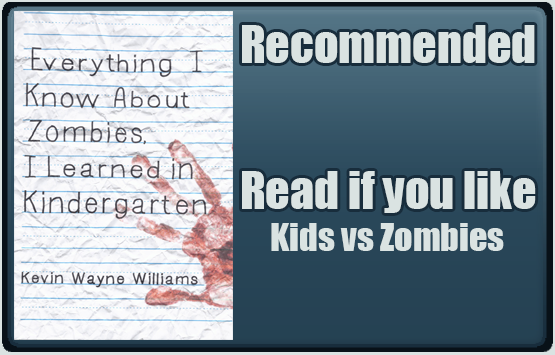
Everything I Know About Zombies I Learned in Kindergarten by Kevin Wayne Williams

Everything I Know About Zombies I Learned in Kindergarten by Kevin Wayne Williams

Formats: Print, digital

Publisher: Mott Haven Books

Genre: Apocalypse/Disaster, Blood & Guts, Zombie

Audience: Adult/Mature

Diversity: Black/African American/Caribbean American characters, Trinidad, Jamacian, Hispanic/Latinx characters

Takes Place in: New York City, USA

Content Warnings (Highlight to view): Abelism, Animal Abuse, Animal Death, Body Shaming, Bullying, Cannibalism, Child Death, Child Endangerment, Death, Drug Use/Abuse, Forced Captivity, Gore,  Medical Procedures, Miscarriage, Racism, Rape/Sexual Assault, Slurs, Suicide, Violence

Blurb

Finalist for Foreword Reviews’ IndieFab Novel of the Year for Multicultural fiction and Horror. Even before the apocalypse, nine-year-old Letitia Johnson’s life had never been simple. Shuttled from foster home to foster home in the impoverished neighborhood of Mott Haven, it was all she could do to keep track of her little sister. When the apocalypse came, she tried to keep her sister’s kindergarten safe by locking them all in a tiny school bathroom, hiding while they waited for a rescue that never came. For five days, they hid. They hid while their teachers were being eaten, while their classmates were being killed. They hid while the Bronx was being evacuated. Now, there’s no one left to help them. There’s no place left to hide. It’s just her, one ax, twelve kindergarteners, twelve garden stakes, and a will to live.

While the cast of this novel is primarily children, the book is intended for adults and contains material unsuitable for younger readers.

When it comes to horror, kids come in two types. Either they’re sweet, innocent, completely helpless victims the protagonist needs to protect at all costs, or they’re evil little bastards that will send you into the cornfield, control you with their telepathic powers, or just straight up murder you because they’re the spawn ofSatan. The children in Everything I Know About Zombies I Learned in Kindergarten somehow land right dab in the middle of the victim/villain scale. They’re neither helpless nor innocent after being forced to go through things no child should go through, nor are they actively malicious, only killing for survival. They also don’t seem to possess the immunity to handle situations that most children do in horror stories. Kids get eaten by Zombies, shot, torn apart, and baby zombies get spiked in the head. So if you can’t stomach minors getting killed in fiction, I recommend staying far, far away from this book.

 Letitia, the nine-year-old protagonist, is easily the most competent, clever, and practical character in the book, organizing her little sister’s kindergartners into a unit of efficient zombie killers and quickly picking up survival skills. Growing up with a drug addicted mom, Letitia is used to taking charge and picking up adults’ slack, in addition to becoming wary of the world at a young age. In the early chapters, they try to look for the childrens’ parents, eager to be rid of such a heavy responsibility, only to discover their dickbag guardians all evacuated without them. (Who the hell just leaves their kid behind during a disaster? You’d think they’d at least make some effort to save them, damn.) The adult survivors actually pose more of a threat than the zombies (or cucos, as the children call them), their greed and despair claiming far more lives than the undead do. It’s weird, even though the children are far from innocent, having become skilled killers, the adults are the ones who’ve become morally bankrupt. The few who do manage to hold on to their optimism and naivety don’t last long, foolishly trusting the wrong people or refusing to admit the world, and the rules, have changed. The kids might be depressingly cynical and violent now, but they’re merely adapting to their new reality, and are much more practical than their grown counterparts. It’s no wonder the adults are so unnerved by them.
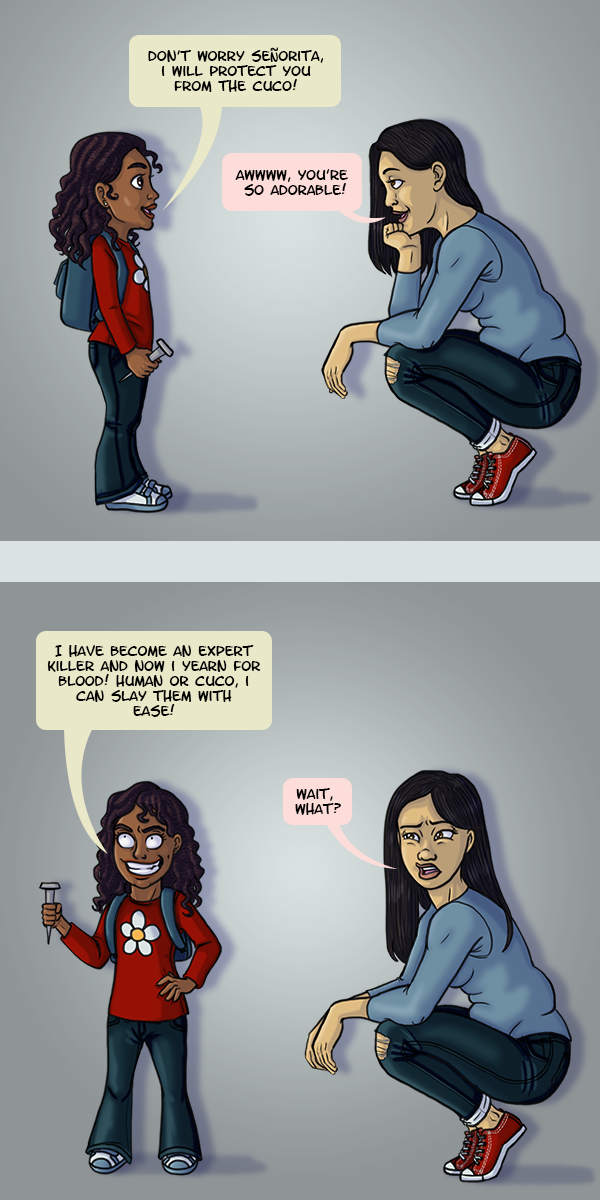
In the top panel, a little girl holding a spike is telling a grown woman “Don’t worry Señorita, I will protect you from the cuco!” The woman, bemused, responds “Awwww, you’re so adorable!” In the next panel the little girl brandishes her spike with a crazed grin and responds “I have become an expert killer and now I yearn for blood! Human or cuco, I can slay them with ease!” The woman, confused and concerned, asks “Wait, what?”

Some of the kids enjoy killing a little too much.

I was expecting the children being eaten by the undead to be the most disturbing part, until the book turned out to be about the death of innocence, and children being forced to adapt to a situation no child should ever go through. It’s one thing to read about fantastical monsters like Zombies attacking a bunch of helpless kids, but quite another when they’re dying from gun violence, or growing up in crushing poverty. In the first, the situation is pure fiction, no real child is ever going to be attacked by the undead, and you can feel safe in that knowledge. But it hits close to home when it comes to real world problems. Even if the children in the story are fictional, you know millions of real kids out there right now who are surrounded by abuse, violence, and probably living without basic necessities, and that’s super depressing. So basically, it’s a story about how kids with rough lives can’t rely on adults (because they’re either malicious, incompetent, or ignorant) and have to take charge of their own safety and survival, which probably would’ve ended up happening with or without undead hordes overtaking the city. I know zombie apocalypse stories are generally bleak, but damn.

 The zombies in the story are pretty much your typical Romero zombies, slow-moving and stupid, and not too difficult to kill as long as there aren’t a lot of them and their brains are destroyed, a feat which the children usually accomplish by stabbing them in the eye with garden stakes. Unfortunately, everyone becomes zombified upon death, regardless of how they die, so the undead multiply even if they can’t bite anyone. Letitia quickly figures out that the zombies are attracted to movement and sound, and is smart enough to stick to quiet, secluded areas, while the adults continue to attract the undead with the buzz of their emergency generators and gun fire (because the adults are somehow less competent than grade schoolers, another reason Letitia avoids them).

 Unfortunately for me, most of the book is dedicated to the practically of surviving in an abandoned New York City, wandering around and looting mini-marts for supplies…which made for less than stimulating reading. I’m going to admit right now, I don’t like camping or fishing, or any form of “roughing it,” and I don’t like reading about it, either. I’m pretty sure I’d die if I went for more than 40 minutes without WiFi.  So I’ve long ago accepted the fact that I would probably be the first person to die in a zombie apocalypse type situation due to my dependence on modern conveniences and comfort, and I’m okay with that. I’m sure some people will find all the survivor type stuff super interesting, as is evident from Discovery Channel’s programming, but I was hoping for way more suspense and undead violence, and less foraging and guinea pig farming. Speaking of which, there’s a decent amount of animal death too, apparently Zombies like to eat puppies as much as they like to eat little kids.
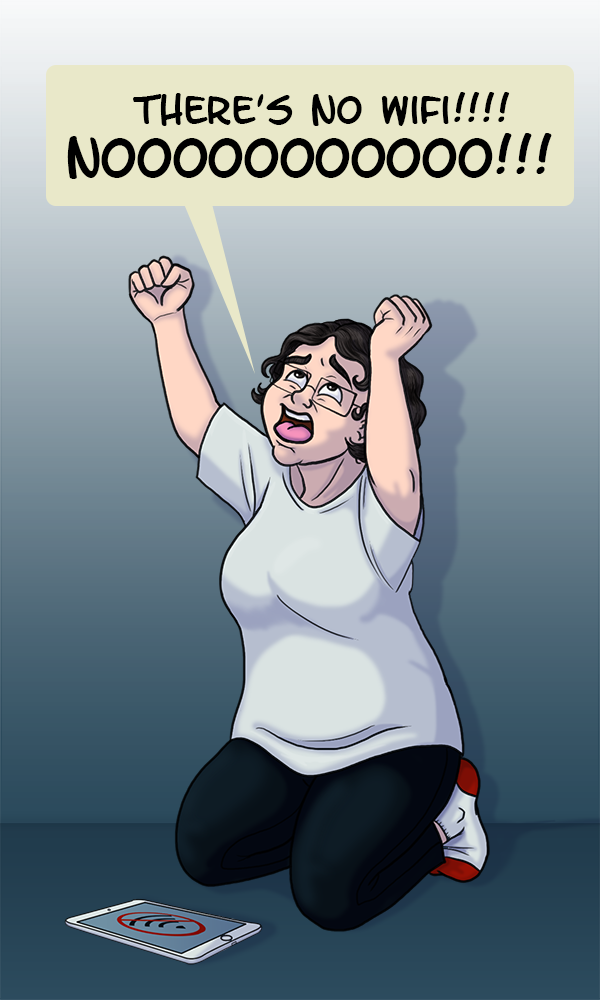
I’m on my knees, fists raised above my head, screaming at the sky in despair “There’s no Wi-Fi! Noooooooooooooooooooo!” A tablet lies in front of me displaying a large “no Wi-Fi” symbol on the screen.

I would not last long in an Apocalypse, or even a dead zone. How did I even function back in the 80’s?

Stepping away from the story for a moment, I feel it’s worth mentioning that while this book was a finalist for a multicultural fiction award, and has a very diverse cast, it was written by a white guy. Obviously, I prefer Own Voices books, but I’ve reviewed non-minority authors writing about minority characters on here before, and I probably wouldn’t even be mentioning the author’s race except for one thing that was bothering me. For the most part Williams does do a pretty decent job at representing a very racially diverse cast, and has clearly put a lot of effort into making the children’s voices seem authentic. But the way the protagonist, Letitia, spoke came off as iffy to me, and I found myself side-eyeing like I always do when white people try to replicate the slang and speech patterns used by people of color within their communities. Now, it’s totally possible Letitia is completely accurate to how Caribbean children speak, and I’m just super ignorant. It’s just as possible Williams was trying to portray the way an average nine-year-old speaks, and Letitia’s ethnicity had nothing to do with it. I mean, I have no idea what children are supposed to sound like, and my mom was a grammar obsessed English major so I probably sounded like an overly-formal weirdo at that age. (No one says “to whom are you referring” or “may I please”, when they’re in Kindergarten mom, GOD.) I honestly don’t know, so I’m afraid I’m going to have to leave that distinction to someone more qualified. And if I am jumping to conclusions, well, blame it on all the racist pidgin I’ve heard spouted by characters like Long Duk Dong and the Crows from Dumbo (did you know the main crow’s name is Jim? Damn, Disney…) over the years making me super wary.
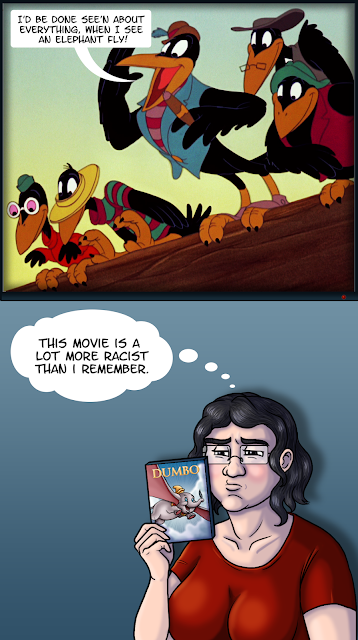
In the top panel, a TV screen displays an image of the five crows from Disney’s Dumbo. The leader shouts “I’d be done see’n about everything, when I see an elephant fly!” In the second panel I’m squinting suspiciously at the Dumbo DVD case thinking “This movie is a lot more racist than I remember.”

Seriously, Jim Crow! WTF were you thinking Disney!?! At least they’re not as bad as Sunflower from Fantasia.

Everything I Know About Zombies I Learned in Kindergarten definitely has flaws, most of the adults (and a few of the kids) get so little characterization it’s hard to figure out who’s who, the action scenes are confusing, and Williams spends way too much time on boring minutiae, but it’s still an enjoyable read. The horror is less the gory, run away from the monster kind like I was expecting, and more a slow building horror at the nature of humanity and how adults kind of suck.

The Graveyard Apartment by Mariko Koike, translated by Deborah Boliver Boehm

The Graveyard Apartment by Mariko Koike, translated by Deborah Boliver Boehm

Formats: Print

Publisher: St. Martin’s Press

Genre: Ghosts/Haunting, Thriller

Audience: Adult/Mature

Diversity: Japanese characters

Takes Place in: Japan

Content Warnings (Highlight to view): Animal Death, Child Death, Child Endangerment, Suicide, Verbal/Emotional Abuse, Forced Captivity

Blurb

A terrifying tale of a young family who move into an apartment building next to a graveyard and the horrors that are unleashed upon them.

One of the most popular writers working in Japan today, Mariko Koike is a recognized master of detective fiction and horror writing. Known in particular for her hybrid works that blend these styles with elements of romance, The Graveyard Apartment is arguably Koike’s masterpiece. Originally published in Japan in 1986, Koike’s novel is the suspenseful tale of a young family that believes it has found the perfect home to grow in to, only to realize that the apartment’s idyllic setting harbors the specter of evil and that longer they stay, the more trapped they become.

This tale of a young married couple who are harboring a dark secret is packed with dread and terror, as they and their daughter move into a brand new apartment building built next to a graveyard. As strange and terrifying occurrences begin to pile up, people in the building begin to move out one by one, until the young family is left alone with someone… or something… lurking in the basement. The psychological horror builds moment after moment, scene after scene, culminating with a conclusion that will make you think twice before ever going into a basement again.

Next up for Asian and Pacific American heritage month, is a new translation of Mariko Koike’s popular 1986 horror novel, The Graveyard Apartment.The Graveyard Apartment had a great premise; a married couple and their young daughter move into a haunted apartment near a cemetery and creepy shit keeps happening, but they’re unwilling to move due to their financial situation, societal pressure to appear normal, and the husband’s deep denial that anything is wrong. The book explores their feelings of emptiness and isolation and their struggle with their fears, both mundane and supernatural. But what should have been amazing ended up being very, well, “meh”. So how exactly does one manage to fuck up what should have been a fool proof haunted house formula? 

To be completely fair, much of the awkward writing present in the English version could very well be due to translation problems. But unless the translator of The Graveyard Apartment pulled a 4KIDs Entertainment and just started making up random shit and cutting out half the story, there’s only so much you can blame on her. The problems with the book go far beyond a language barrier issue. The biggest setback is that half the story seems pointless (maybe the translator should have cut some of it out after all). Koike spends more time on random details, like what her main character, Misao, is wearing, than she does on the evil entity haunting the building. There’s even an entire chapter, later on in the book, dedicated to visiting a realtor’s office and looking at new apartments. Can you handle the terror as her husband, Teppei, walks their daughter to school? Shiver as the doomed couple look at rental listings within their budget!

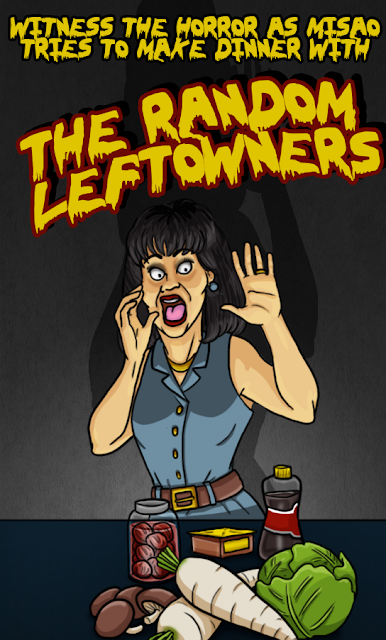
A picture draw in the style of a vintage horror movie posters shows a Japanese woman with poofy, 80’s hair screaming in horror at a random assortment of leftovers (daikon radish, red bean paste, pickled umeboshi plums, lettuce, soy sauce, and mushrooms) in front of her. In creepy looking, dripping, front across the top it says “Witness the horror as Misao tries to make dinner with ‘The Random Leftovers!’

The story takes place in the 80’s so I tried to give her poofy 80’s hair. I was not successful.

And even when Koike does finally get to the creepy stuff, it’s a crapshoot whether or not it actually has anything do with the plot or just more random detailing. For example; early on in the book we discover Teppei’s first wife, Reiko, committed suicide because he was cheating on her with Misao. So you’d think that Reiko’s vengeful spirit would somehow be involved in the plot. Well, you’d be wrong. The suicide backstory serves no purpose other than highlighting what a remorseless dick Teppei is. We also learn that at one point there were plans to build an underground shopping center, but they were abandoned after the initial tunnel was built. So maybe the project disturbed the graves above and angered the spirits? Nope. The project was abandoned because people didn’t want the cemetery relocated, so the graves were pretty much left alone. Actually we never learn why the ghosts (or demons, or monsters, or whatever) are such huge assholes. Usually ghosts haunt the living because they’re pissed off about being murdered or moved, or having a Taco Bell built over their remains, but these entities just like to lock doors, mess with the elevators, and put handprints on the glass, because…. reasons. I dunno, maybe they just really hate whoever does the building maintenance, or they’re a bunch of drunk frat boys.

The comic shows the annoying ghost of a frat boy, sticking out his tongue and waking up another man by screaming “Woooo! Bro, let’s play some beer pong!” The ghost is muscular, holding a Solo cup, and is wearing a Polo shirt with a popped collar, a backwards baseball hat, and a Puka shell necklace. The man he has just woken up is shirtless, with two subcutaneous mastectomy scars on his chest. Irritated, he responds “Can’t you just rattle chains and make the lights flicker like a normal ghost?”

Not so much evil as incredibly irritating.

The story and characters are well written enough, it just isn’t scary. Well, except for the ending, where all the horror gets crammed into the last few chapters of the book. It’s like Koike suddenly went “Shit! I’ve got four chapters left, and the scariest things in the book so far are a creepy basement and being forced to into awkward social situations!” (Granted, awkward social situations are much scarier than any demonic entity). So then the ghosts (or demons, or whatever) go from mildly irritating to eldritch abominations with god damn superpowers and a lust for blood.Oh, and just as the story is starting to get scary and suspenseful? It finishes with a vague, open ending and we STILL don’t know what the fuck is wrong with the building! To top it off, the ending isn’t even part of the actual story, it’s a freaking epilogue! WHAT? There was all this slow buildup up for the most underwhelming payoff ever. Way to get my hopes up, Koike! Look, The Graveyard Apartment isn’t a bad book overall, which is why I didn’t knock it down to “not recommended”, it just doesn’t work as a haunted house story.

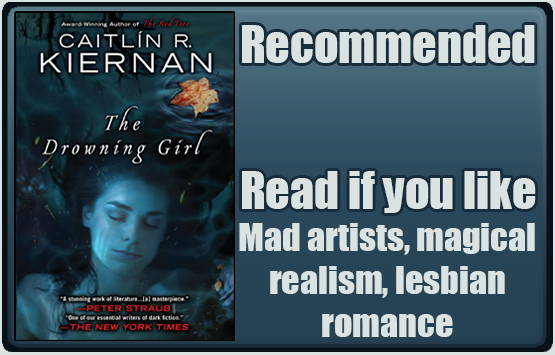
The Drowning Girl by Caitlín R. Kiernan

The Drowning Girl by Caitlín R. Kiernan

Formats: Print, audio, digital

Publisher: Penguin

Genre: Monster, Werewolf, Romance, Ghosts/Haunting, Psychological Horror, Mystery

Audience: Adult/Mature

Diversity: Lesbian characters, trans character, mentally ill character

Takes Place in: Northeastern USA

Content Warnings (Highlight to view): Mental Illness, Self-Harm, Mentions of Transphobia, Suicide, Emotional Abuse 

Please note, I found out recently that Caitlín R. Kiernan has expressed racist and Zionist views on Twitter, explored here. I will leave the reivew up for now, but can no longer reccomend her books.

The Drowning Girl is a beautifully written, psychological horror novel about a young woman, Imp, whose schizophrenia is making it difficult for her to determine the nature of the mysterious woman haunting her. Is she a siren using her charm to lure Imp to disaster? A werewolf? A human stalker who can blur the lines of reality? Imp struggles to sort out the truth before she loses herself. Queer romance, myths, and art combine to create this award winning novel.

So did I like it? Well……. Sort of?

In theory I should have loved it. It takes place on my home turf of New England, the main character is a queer artist (like me!), she’s dating an incredibly well written trans character, the story has a creepy mystery, gorgeous imagery, and one of the best representations of mental illness I’ve ever read. But I struggled to get through the Drowning Girl. I’d pick it up, read a chapter, and then forget about it for a month. I don’t know why I didn’t devour this book as quickly as I do others, there wasn’t really anything I disliked about it, and it wasn’t boring, but it just didn’t seem to capture my attention. It reminded me of one of those award winning art films that critics love and you have to sit through in college film classes. There’s nothing bad about it per se, but you’d still rather be watching Bad Boys II, or some other equally ridiculous action flick.

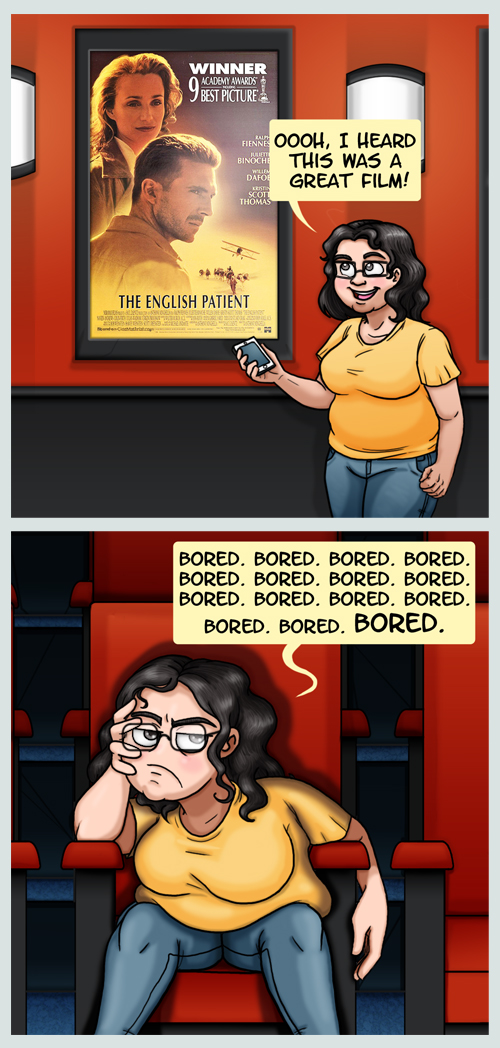
In the first panel I'm in the hallway of a movie theater looking at a poster for "The English Patient" and saying "Oooh, I heard this was a great film!" In the next panel I'm in the theater looking completely disinterested, and repeating "bored, bored, bored, bored" over and over as I suffer through the movie.

Ugh, I should’ve just watched Sharknado again.

Maybe I’m just not sophisticated enough to appreciate the non-linear, stream of conciseness (i.e. all over the place) writing, or perhaps I’m too clueless to fully comprehend the subtly and symbolism of the story. But I found it really jarring to have Imp describe her girlfriend, Abalyn, play Kingdom Hearts one minute, and then have a poetic, jumbled passage full of fairy tale metaphors the next. And I get it, the writing style is intended to represent Imp’s mental illness by showing the disorganization of her thought process, the random associations she makes where none exist, and her difficulty remembering what’s real and what’s imagined. But that doesn’t always make for an enjoyable read.

I guess I’m just incredibly picky when it comes to “artsy” prose and magical realism. When it works, it works well, but when it doesn’t, it just becomes a confusing, irritating erratic mess, and with the Drowning Girl it was kind of a crap shoot.

I'm floating upside down in blue space, surrounded by dreamlike imagery of a crow wearing a cloak, a close-up of a crescent moon, a wolf's skull, pills, a crab, and a mermaid with pale, corpse-like skin. The mermaid's human half is intact but her fish half is nothing but bone. Her organs hang out of her human torso. I look confused and mutter

WTF is going on? Did I take expired cold medicine again?

Since I’m starting to feel bad for picking on this book so much (and it’s by no means a bad book), I want to address one of the things I did really like about the story, how Imp’s mental illness was treated. It wasn’t romanticized, it was just a part of her that could make her life more challenging, but not horrible. Medication made her illness manageable, but didn’t make it disappear entirely, and she was able to continue working, date, hang out with friends, pursue hobbies, and lived on her own. She would go through rough patches, some she could handle on her own, and some she couldn’t. Her therapist was supportive, without telling Imp what to do. Overall, I felt like it was a very realistic depiction of a woman with a mental illness, which is rather uncommon in fiction where the mentally ill are usually written as either asylum inmates, criminals, or manic pixie dream girls.

Overall, I really, really wanted to love this one. It had all the right ingredients, rave reviews, a talented author, but the final result was disappointing, at least for me. It wasn’t bad, but I just couldn’t bring myself to give it a “highly recommended”. That doesn’t mean other people won’t find this book amazing, and I strongly encourage others, especially those with more sophisticated taste than mine, to give it a read. Because you may love it. Or you may find it “meh”, but at least you won’t regret reading it.

Navigation

Social Media

Search by Tags

To learn more about the Age Group, Diversity, and Genre tags, click here.

Age Groups

Diversity

Genre

Support the Blog

Search

Links

Everything I Know About Zombies I Learned in Kindergarten by Kevin Wayne Williams

Everything I Know About Zombies I Learned in Kindergarten by Kevin Wayne Williams

Formats: Print, digital

Publisher: Mott Haven Books

Genre: Apocalypse/Disaster, Blood & Guts, Zombie

Audience: Adult/Mature

Diversity: Black/African American/Caribbean American characters, Trinidad, Jamacian, Hispanic/Latinx characters

Takes Place in: New York City, USA

Content Warnings (Highlight to view): Abelism, Animal Abuse, Animal Death, Body Shaming, Bullying, Cannibalism, Child Death, Child Endangerment, Death, Drug Use/Abuse, Forced Captivity, Gore,  Medical Procedures, Miscarriage, Racism, Rape/Sexual Assault, Slurs, Suicide, Violence

Blurb

Finalist for Foreword Reviews’ IndieFab Novel of the Year for Multicultural fiction and Horror. Even before the apocalypse, nine-year-old Letitia Johnson’s life had never been simple. Shuttled from foster home to foster home in the impoverished neighborhood of Mott Haven, it was all she could do to keep track of her little sister. When the apocalypse came, she tried to keep her sister’s kindergarten safe by locking them all in a tiny school bathroom, hiding while they waited for a rescue that never came. For five days, they hid. They hid while their teachers were being eaten, while their classmates were being killed. They hid while the Bronx was being evacuated. Now, there’s no one left to help them. There’s no place left to hide. It’s just her, one ax, twelve kindergarteners, twelve garden stakes, and a will to live.

While the cast of this novel is primarily children, the book is intended for adults and contains material unsuitable for younger readers.

When it comes to horror, kids come in two types. Either they’re sweet, innocent, completely helpless victims the protagonist needs to protect at all costs, or they’re evil little bastards that will send you into the cornfield, control you with their telepathic powers, or just straight up murder you because they’re the spawn ofSatan. The children in Everything I Know About Zombies I Learned in Kindergarten somehow land right dab in the middle of the victim/villain scale. They’re neither helpless nor innocent after being forced to go through things no child should go through, nor are they actively malicious, only killing for survival. They also don’t seem to possess the immunity to handle situations that most children do in horror stories. Kids get eaten by Zombies, shot, torn apart, and baby zombies get spiked in the head. So if you can’t stomach minors getting killed in fiction, I recommend staying far, far away from this book.

 Letitia, the nine-year-old protagonist, is easily the most competent, clever, and practical character in the book, organizing her little sister’s kindergartners into a unit of efficient zombie killers and quickly picking up survival skills. Growing up with a drug addicted mom, Letitia is used to taking charge and picking up adults’ slack, in addition to becoming wary of the world at a young age. In the early chapters, they try to look for the childrens’ parents, eager to be rid of such a heavy responsibility, only to discover their dickbag guardians all evacuated without them. (Who the hell just leaves their kid behind during a disaster? You’d think they’d at least make some effort to save them, damn.) The adult survivors actually pose more of a threat than the zombies (or cucos, as the children call them), their greed and despair claiming far more lives than the undead do. It’s weird, even though the children are far from innocent, having become skilled killers, the adults are the ones who’ve become morally bankrupt. The few who do manage to hold on to their optimism and naivety don’t last long, foolishly trusting the wrong people or refusing to admit the world, and the rules, have changed. The kids might be depressingly cynical and violent now, but they’re merely adapting to their new reality, and are much more practical than their grown counterparts. It’s no wonder the adults are so unnerved by them.

In the top panel, a little girl holding a spike is telling a grown woman “Don’t worry Señorita, I will protect you from the cuco!” The woman, bemused, responds “Awwww, you’re so adorable!” In the next panel the little girl brandishes her spike with a crazed grin and responds “I have become an expert killer and now I yearn for blood! Human or cuco, I can slay them with ease!” The woman, confused and concerned, asks “Wait, what?”

Some of the kids enjoy killing a little too much.

I was expecting the children being eaten by the undead to be the most disturbing part, until the book turned out to be about the death of innocence, and children being forced to adapt to a situation no child should ever go through. It’s one thing to read about fantastical monsters like Zombies attacking a bunch of helpless kids, but quite another when they’re dying from gun violence, or growing up in crushing poverty. In the first, the situation is pure fiction, no real child is ever going to be attacked by the undead, and you can feel safe in that knowledge. But it hits close to home when it comes to real world problems. Even if the children in the story are fictional, you know millions of real kids out there right now who are surrounded by abuse, violence, and probably living without basic necessities, and that’s super depressing. So basically, it’s a story about how kids with rough lives can’t rely on adults (because they’re either malicious, incompetent, or ignorant) and have to take charge of their own safety and survival, which probably would’ve ended up happening with or without undead hordes overtaking the city. I know zombie apocalypse stories are generally bleak, but damn.

 The zombies in the story are pretty much your typical Romero zombies, slow-moving and stupid, and not too difficult to kill as long as there aren’t a lot of them and their brains are destroyed, a feat which the children usually accomplish by stabbing them in the eye with garden stakes. Unfortunately, everyone becomes zombified upon death, regardless of how they die, so the undead multiply even if they can’t bite anyone. Letitia quickly figures out that the zombies are attracted to movement and sound, and is smart enough to stick to quiet, secluded areas, while the adults continue to attract the undead with the buzz of their emergency generators and gun fire (because the adults are somehow less competent than grade schoolers, another reason Letitia avoids them).

 Unfortunately for me, most of the book is dedicated to the practically of surviving in an abandoned New York City, wandering around and looting mini-marts for supplies…which made for less than stimulating reading. I’m going to admit right now, I don’t like camping or fishing, or any form of “roughing it,” and I don’t like reading about it, either. I’m pretty sure I’d die if I went for more than 40 minutes without WiFi.  So I’ve long ago accepted the fact that I would probably be the first person to die in a zombie apocalypse type situation due to my dependence on modern conveniences and comfort, and I’m okay with that. I’m sure some people will find all the survivor type stuff super interesting, as is evident from Discovery Channel’s programming, but I was hoping for way more suspense and undead violence, and less foraging and guinea pig farming. Speaking of which, there’s a decent amount of animal death too, apparently Zombies like to eat puppies as much as they like to eat little kids.

I’m on my knees, fists raised above my head, screaming at the sky in despair “There’s no Wi-Fi! Noooooooooooooooooooo!” A tablet lies in front of me displaying a large “no Wi-Fi” symbol on the screen.

I would not last long in an Apocalypse, or even a dead zone. How did I even function back in the 80’s?

Stepping away from the story for a moment, I feel it’s worth mentioning that while this book was a finalist for a multicultural fiction award, and has a very diverse cast, it was written by a white guy. Obviously, I prefer Own Voices books, but I’ve reviewed non-minority authors writing about minority characters on here before, and I probably wouldn’t even be mentioning the author’s race except for one thing that was bothering me. For the most part Williams does do a pretty decent job at representing a very racially diverse cast, and has clearly put a lot of effort into making the children’s voices seem authentic. But the way the protagonist, Letitia, spoke came off as iffy to me, and I found myself side-eyeing like I always do when white people try to replicate the slang and speech patterns used by people of color within their communities. Now, it’s totally possible Letitia is completely accurate to how Caribbean children speak, and I’m just super ignorant. It’s just as possible Williams was trying to portray the way an average nine-year-old speaks, and Letitia’s ethnicity had nothing to do with it. I mean, I have no idea what children are supposed to sound like, and my mom was a grammar obsessed English major so I probably sounded like an overly-formal weirdo at that age. (No one says “to whom are you referring” or “may I please”, when they’re in Kindergarten mom, GOD.) I honestly don’t know, so I’m afraid I’m going to have to leave that distinction to someone more qualified. And if I am jumping to conclusions, well, blame it on all the racist pidgin I’ve heard spouted by characters like Long Duk Dong and the Crows from Dumbo (did you know the main crow’s name is Jim? Damn, Disney…) over the years making me super wary.

In the top panel, a TV screen displays an image of the five crows from Disney’s Dumbo. The leader shouts “I’d be done see’n about everything, when I see an elephant fly!” In the second panel I’m squinting suspiciously at the Dumbo DVD case thinking “This movie is a lot more racist than I remember.”

Seriously, Jim Crow! WTF were you thinking Disney!?! At least they’re not as bad as Sunflower from Fantasia.

Everything I Know About Zombies I Learned in Kindergarten definitely has flaws, most of the adults (and a few of the kids) get so little characterization it’s hard to figure out who’s who, the action scenes are confusing, and Williams spends way too much time on boring minutiae, but it’s still an enjoyable read. The horror is less the gory, run away from the monster kind like I was expecting, and more a slow building horror at the nature of humanity and how adults kind of suck.

The Graveyard Apartment by Mariko Koike, translated by Deborah Boliver Boehm

The Graveyard Apartment by Mariko Koike, translated by Deborah Boliver Boehm

Formats: Print

Publisher: St. Martin’s Press

Genre: Ghosts/Haunting, Thriller

Audience: Adult/Mature

Diversity: Japanese characters

Takes Place in: Japan

Content Warnings (Highlight to view): Animal Death, Child Death, Child Endangerment, Suicide, Verbal/Emotional Abuse, Forced Captivity

Blurb

A terrifying tale of a young family who move into an apartment building next to a graveyard and the horrors that are unleashed upon them.

One of the most popular writers working in Japan today, Mariko Koike is a recognized master of detective fiction and horror writing. Known in particular for her hybrid works that blend these styles with elements of romance, The Graveyard Apartment is arguably Koike’s masterpiece. Originally published in Japan in 1986, Koike’s novel is the suspenseful tale of a young family that believes it has found the perfect home to grow in to, only to realize that the apartment’s idyllic setting harbors the specter of evil and that longer they stay, the more trapped they become.

This tale of a young married couple who are harboring a dark secret is packed with dread and terror, as they and their daughter move into a brand new apartment building built next to a graveyard. As strange and terrifying occurrences begin to pile up, people in the building begin to move out one by one, until the young family is left alone with someone… or something… lurking in the basement. The psychological horror builds moment after moment, scene after scene, culminating with a conclusion that will make you think twice before ever going into a basement again.

Next up for Asian and Pacific American heritage month, is a new translation of Mariko Koike’s popular 1986 horror novel, The Graveyard Apartment.The Graveyard Apartment had a great premise; a married couple and their young daughter move into a haunted apartment near a cemetery and creepy shit keeps happening, but they’re unwilling to move due to their financial situation, societal pressure to appear normal, and the husband’s deep denial that anything is wrong. The book explores their feelings of emptiness and isolation and their struggle with their fears, both mundane and supernatural. But what should have been amazing ended up being very, well, “meh”. So how exactly does one manage to fuck up what should have been a fool proof haunted house formula? 

To be completely fair, much of the awkward writing present in the English version could very well be due to translation problems. But unless the translator of The Graveyard Apartment pulled a 4KIDs Entertainment and just started making up random shit and cutting out half the story, there’s only so much you can blame on her. The problems with the book go far beyond a language barrier issue. The biggest setback is that half the story seems pointless (maybe the translator should have cut some of it out after all). Koike spends more time on random details, like what her main character, Misao, is wearing, than she does on the evil entity haunting the building. There’s even an entire chapter, later on in the book, dedicated to visiting a realtor’s office and looking at new apartments. Can you handle the terror as her husband, Teppei, walks their daughter to school? Shiver as the doomed couple look at rental listings within their budget!

A picture draw in the style of a vintage horror movie posters shows a Japanese woman with poofy, 80’s hair screaming in horror at a random assortment of leftovers (daikon radish, red bean paste, pickled umeboshi plums, lettuce, soy sauce, and mushrooms) in front of her. In creepy looking, dripping, front across the top it says “Witness the horror as Misao tries to make dinner with ‘The Random Leftovers!’

The story takes place in the 80’s so I tried to give her poofy 80’s hair. I was not successful.

And even when Koike does finally get to the creepy stuff, it’s a crapshoot whether or not it actually has anything do with the plot or just more random detailing. For example; early on in the book we discover Teppei’s first wife, Reiko, committed suicide because he was cheating on her with Misao. So you’d think that Reiko’s vengeful spirit would somehow be involved in the plot. Well, you’d be wrong. The suicide backstory serves no purpose other than highlighting what a remorseless dick Teppei is. We also learn that at one point there were plans to build an underground shopping center, but they were abandoned after the initial tunnel was built. So maybe the project disturbed the graves above and angered the spirits? Nope. The project was abandoned because people didn’t want the cemetery relocated, so the graves were pretty much left alone. Actually we never learn why the ghosts (or demons, or monsters, or whatever) are such huge assholes. Usually ghosts haunt the living because they’re pissed off about being murdered or moved, or having a Taco Bell built over their remains, but these entities just like to lock doors, mess with the elevators, and put handprints on the glass, because…. reasons. I dunno, maybe they just really hate whoever does the building maintenance, or they’re a bunch of drunk frat boys.

The comic shows the annoying ghost of a frat boy, sticking out his tongue and waking up another man by screaming “Woooo! Bro, let’s play some beer pong!” The ghost is muscular, holding a Solo cup, and is wearing a Polo shirt with a popped collar, a backwards baseball hat, and a Puka shell necklace. The man he has just woken up is shirtless, with two subcutaneous mastectomy scars on his chest. Irritated, he responds “Can’t you just rattle chains and make the lights flicker like a normal ghost?”

Not so much evil as incredibly irritating.

The story and characters are well written enough, it just isn’t scary. Well, except for the ending, where all the horror gets crammed into the last few chapters of the book. It’s like Koike suddenly went “Shit! I’ve got four chapters left, and the scariest things in the book so far are a creepy basement and being forced to into awkward social situations!” (Granted, awkward social situations are much scarier than any demonic entity). So then the ghosts (or demons, or whatever) go from mildly irritating to eldritch abominations with god damn superpowers and a lust for blood.Oh, and just as the story is starting to get scary and suspenseful? It finishes with a vague, open ending and we STILL don’t know what the fuck is wrong with the building! To top it off, the ending isn’t even part of the actual story, it’s a freaking epilogue! WHAT? There was all this slow buildup up for the most underwhelming payoff ever. Way to get my hopes up, Koike! Look, The Graveyard Apartment isn’t a bad book overall, which is why I didn’t knock it down to “not recommended”, it just doesn’t work as a haunted house story.

The Drowning Girl by Caitlín R. Kiernan

The Drowning Girl by Caitlín R. Kiernan

Formats: Print, audio, digital

Publisher: Penguin

Genre: Monster, Werewolf, Romance, Ghosts/Haunting, Psychological Horror, Mystery

Audience: Adult/Mature

Diversity: Lesbian characters, trans character, mentally ill character

Takes Place in: Northeastern USA

Content Warnings (Highlight to view): Mental Illness, Self-Harm, Mentions of Transphobia, Suicide, Emotional Abuse 

Please note, I found out recently that Caitlín R. Kiernan has expressed racist and Zionist views on Twitter, explored here. I will leave the reivew up for now, but can no longer reccomend her books.

The Drowning Girl is a beautifully written, psychological horror novel about a young woman, Imp, whose schizophrenia is making it difficult for her to determine the nature of the mysterious woman haunting her. Is she a siren using her charm to lure Imp to disaster? A werewolf? A human stalker who can blur the lines of reality? Imp struggles to sort out the truth before she loses herself. Queer romance, myths, and art combine to create this award winning novel.

So did I like it? Well……. Sort of?

In theory I should have loved it. It takes place on my home turf of New England, the main character is a queer artist (like me!), she’s dating an incredibly well written trans character, the story has a creepy mystery, gorgeous imagery, and one of the best representations of mental illness I’ve ever read. But I struggled to get through the Drowning Girl. I’d pick it up, read a chapter, and then forget about it for a month. I don’t know why I didn’t devour this book as quickly as I do others, there wasn’t really anything I disliked about it, and it wasn’t boring, but it just didn’t seem to capture my attention. It reminded me of one of those award winning art films that critics love and you have to sit through in college film classes. There’s nothing bad about it per se, but you’d still rather be watching Bad Boys II, or some other equally ridiculous action flick.

In the first panel I'm in the hallway of a movie theater looking at a poster for "The English Patient" and saying "Oooh, I heard this was a great film!" In the next panel I'm in the theater looking completely disinterested, and repeating "bored, bored, bored, bored" over and over as I suffer through the movie.

Ugh, I should’ve just watched Sharknado again.

Maybe I’m just not sophisticated enough to appreciate the non-linear, stream of conciseness (i.e. all over the place) writing, or perhaps I’m too clueless to fully comprehend the subtly and symbolism of the story. But I found it really jarring to have Imp describe her girlfriend, Abalyn, play Kingdom Hearts one minute, and then have a poetic, jumbled passage full of fairy tale metaphors the next. And I get it, the writing style is intended to represent Imp’s mental illness by showing the disorganization of her thought process, the random associations she makes where none exist, and her difficulty remembering what’s real and what’s imagined. But that doesn’t always make for an enjoyable read.

I guess I’m just incredibly picky when it comes to “artsy” prose and magical realism. When it works, it works well, but when it doesn’t, it just becomes a confusing, irritating erratic mess, and with the Drowning Girl it was kind of a crap shoot.

I'm floating upside down in blue space, surrounded by dreamlike imagery of a crow wearing a cloak, a close-up of a crescent moon, a wolf's skull, pills, a crab, and a mermaid with pale, corpse-like skin. The mermaid's human half is intact but her fish half is nothing but bone. Her organs hang out of her human torso. I look confused and mutter

WTF is going on? Did I take expired cold medicine again?

Since I’m starting to feel bad for picking on this book so much (and it’s by no means a bad book), I want to address one of the things I did really like about the story, how Imp’s mental illness was treated. It wasn’t romanticized, it was just a part of her that could make her life more challenging, but not horrible. Medication made her illness manageable, but didn’t make it disappear entirely, and she was able to continue working, date, hang out with friends, pursue hobbies, and lived on her own. She would go through rough patches, some she could handle on her own, and some she couldn’t. Her therapist was supportive, without telling Imp what to do. Overall, I felt like it was a very realistic depiction of a woman with a mental illness, which is rather uncommon in fiction where the mentally ill are usually written as either asylum inmates, criminals, or manic pixie dream girls.

Overall, I really, really wanted to love this one. It had all the right ingredients, rave reviews, a talented author, but the final result was disappointing, at least for me. It wasn’t bad, but I just couldn’t bring myself to give it a “highly recommended”. That doesn’t mean other people won’t find this book amazing, and I strongly encourage others, especially those with more sophisticated taste than mine, to give it a read. Because you may love it. Or you may find it “meh”, but at least you won’t regret reading it.

Navigation

Social Media

Search by Tags

To learn more about the Age Group, Diversity, and Genre tags, click here.

Age Groups

Diversity

Genre

Support the Blog

Search

Links