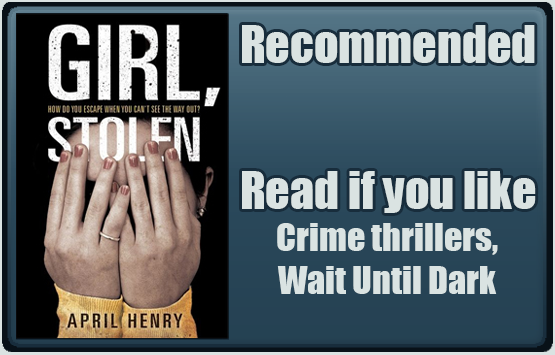
Girl, Stolen by April Henry

Girl, Stolen by April Henry

Formats: Print, audio, digital

Genre: Thriller

Audience: Y/A

Diversity: Disability (Vision Impairment, Cognitive, Learning Disability)

Takes Place in: Oregon, USA

Content Warnings (Highlight to view):  Abelism, Alcohol Abuse, Animal Abuse, Animal Death, Bullying, Child Abuse, Death, Drug Use/Abuse, Forced Captivity, Gaslighting, Illness, Medical Procedures, Physical Abuse, Mentions of Rape/Sexual, Slurs, Verbal/Emotional Abuse, Violence

Blurb

Sixteen-year-old Cheyenne Wilder is sleeping in the back of the car while her step mom fills a prescription for antibiotics. Before Cheyenne realizes what’s happening, the car is being stolen.

Griffin hadn’t meant to kidnap Cheyenne and once he finds out that not only does she have pneumonia, but that she’s blind, he really doesn’t know what to do. When his dad finds out that Cheyenne’s father is the president of a powerful corporation, everything changes–now there’s a reason to keep her.

How will Cheyenne survive this nightmare?

As you can probably guess, Cheyenne is not having a good day. Though her kidnapper’s, Griffin, isn’t going much better. The story alternates between the points of view of these two main characters, as they anxiously stumble their way through a bad situation. Cheyenne, who has been blind for about three years following a car accident, describes her world in sounds, smells, and sensations. Sick, feverish, and stranded without her guide dog and cane, she does her best to outwit her captors and survive her terrifying ordeal. Meanwhile, Griffin, who’s almost as panicked as Cheyenne, struggles between listening to his conscience and obeying his abusive, criminal father. You can sense his denial, born from years of abuse, his desperation for love and acceptance, and the fear that’s holding him back. The two characters, both trapped in terrible situations, form an unlikely bond as they nervously wait for Griffin’s father to make a decision.

Not having any sort of severe visual impairment myself (other than my corrective lenses), I can’t say how accurate April Henry’s depiction of a blind/low vision person is. But Cheyenne’s disability does seem to be well pretty researched, as far as I can tell anyway. For example, Cheyenne still has some of her peripheral vision in one eye, a nice touch since about 85% of legally blind people have at least some light and/or form perception, and complete blindness is relatively rare. And the description of how a guide dog and its owner work together sounded pretty accurate, at least from what I’ve read. She doesn’t fall victim to any of the common blindness tropes either. Then there’s this reviewer, who is herself blind, and says the portrayal of Cheyenne’s visual impairment is pretty spot on, and relatable. So there you go.
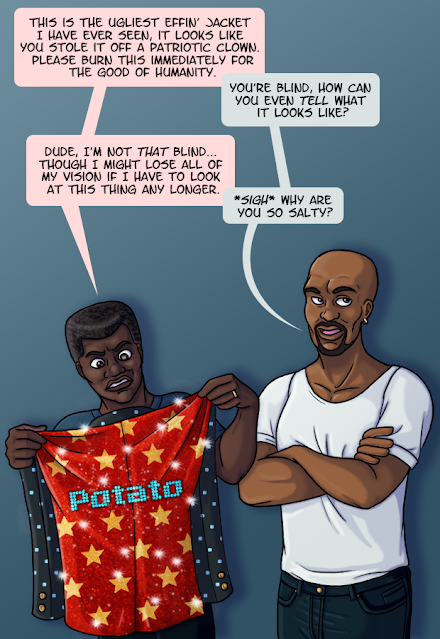
A blind/low vision man examining a hideous jacket and tells his friend “this is the ugliest effin’ jacket I have ever seen, it looks like you stole it off a patriotic clown. Please burn this immediately for the good of humanity.” Annoyed, his friend responds “You’re blind, how can you even tell what it looks like?” “Dude, I’m not that blind, though I might lose all of my vision if I have to look at this thing any longer.” “Why are you so salty?”

He’s salty because people keep accusing him of “faking” his blindness just because he can sort of see things six inches from his face with one of his eyes.

Henry could have easily made her heroine a broken bird that readers pitied, or turned the story into inspiration porn, but she doesn’t. Instead, Cheyenne is characterized as a young woman who went through a traumatic event, which understandably caused her to grieve, and then has to adapt to a completely different way of interacting with the world which is challenging, but certainly not anything extraordinary. Cheyenne works with her therapist and teachers to pull herself out of her depression and learn a new skill set, all without becoming a “feel good” story for sighted readers. She isn’t sweet and chipper about it either, our heroine gets frustrated, feels sorry for herself, lashes out, and gets grumpy. She’s allowed to be a flawed person, instead of some sort of blind saint who forgives the ableists. Although she now relies much more on sound, smell, and touch to function, her senses are the same as before, Cheyenne just learns to pay more attention to them, as oppose to getting magically heightened senses that turn her into a ninja. And yes, Cheyenne is feeling weak and helpless after being kidnapped, but this is due to being severely ill with pneumonia, not her low vision. And even sick and terrified, she’s still a tough, resourceful character.
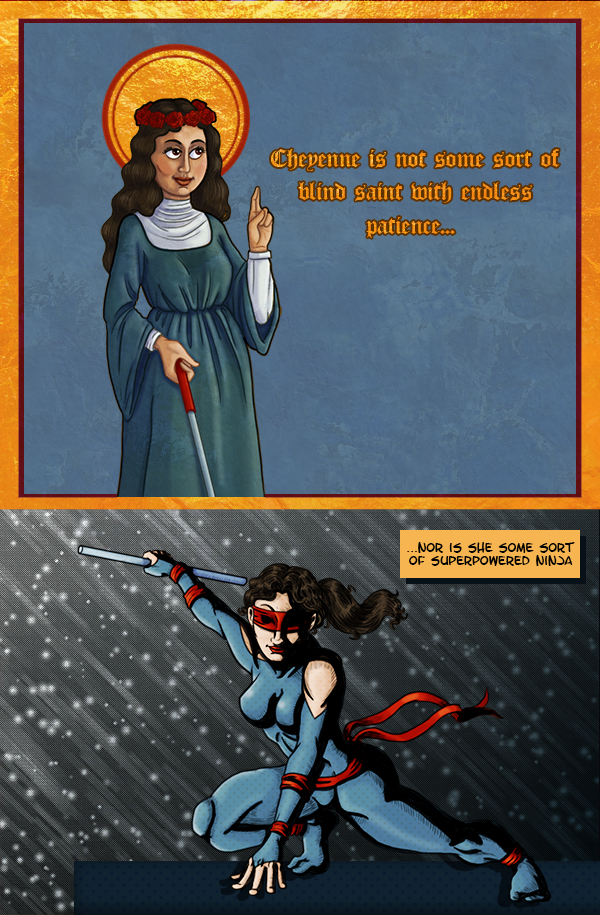
Speaking of blind ninjas, did you know Daredevil and the Teenage Mutant Ninja Turtles share an origin story? It has nothing to do with Girl, Stolen, it’s just cool.

Griffin, meanwhile, is complex and interesting. You can’t help but feel bad for the guy, even if Cheyenne isn’t in a position to be sympathetic, and Henry doesn’t try to excuse his actions by invoking pity in the reader (Henry never tries to get you to feel sorry for the characters, she just presents the facts of their lives). Poor Griffin’s mom left when he was young, his dad is an abusive alcoholic who forces him into a life of crime, and he has basically zero support system. We find out later that he’s Dyslexic, though unaware of it, and was forced to drop out of school because he struggles with reading. It’s an interesting contrast to Cheyenne, who comes from a wealthy background and goes to a private school that’s able to accommodate her. After her accident she had private nurses who cared for her in her home. Her father sent her to a special program where she learned how to function independently without her vision. They’re able to afford a guide dog so Cheyenne can get around. Ideally, all people with disabilities would have the same access to accommodations that Cheyenne does, but unfortunately that’s simply not the case, especially for people with low incomes or living in poverty. Griffin is one of those kids who slips through the cracks. He was never tested for Dyslexia, and his teachers and father apparently wrote him off, he gets zero help with his reading skills and is forced to drop out of school, believing his only option in life is to be a criminal like his father. Although Henry isn’t heavy handed about it, she makes clear what a world of difference it makes when people have access to proper accommodations, a constant source of frustration for anyone with a disability. Seriously, go on any disability website, and you will see a legion of posts about the daily frustration and obstacles that able-bodied and neurotypical people don’t even notice, not to mention the constant struggles with health insurance and trying to get accommodations approved at school and work.
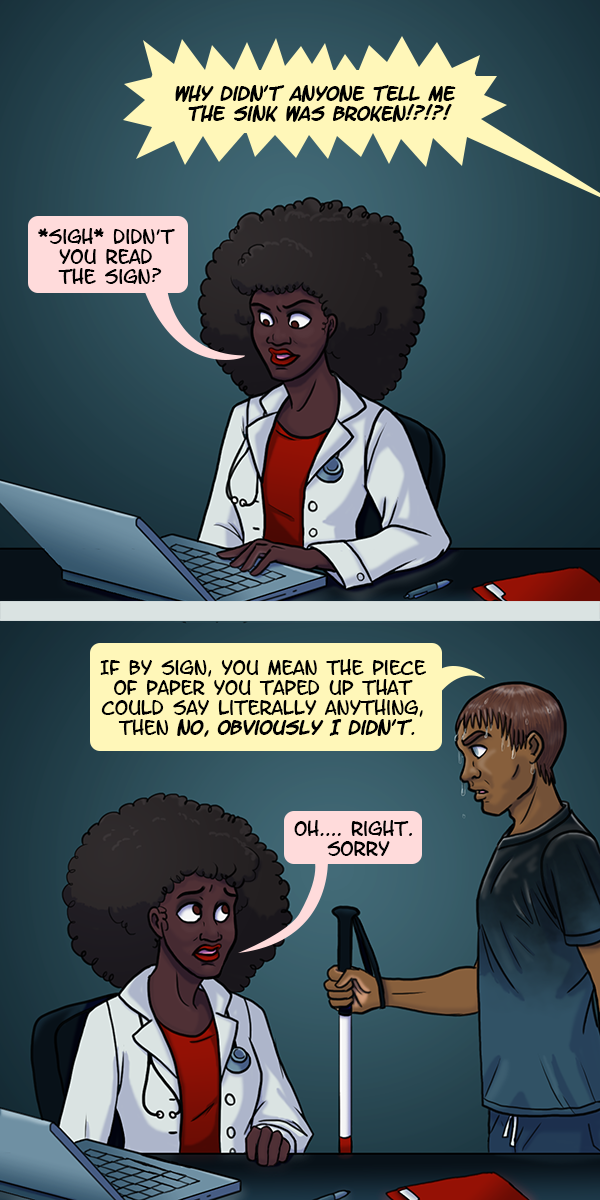
In the first panel, a doctor is looking at her laptop when she hears a nurse yell off screen “Why didn’t anyone tell me the sink was broken!?!?!” Irritated, she responds, “*sigh* didn’t you read the sign?” In the second panel we see the nurse, who is blind and holding a cane, soaking wet from the malfunctioning sink. He snaps “If by sign, you mean the piece of paper you taped up that could say literally anything, then NO, OBVIOUSLY I DIDN’T.” Sheepish, the doctor says “Oh.... right. Sorry.”

Other pet peeves of the visually impaired include the little stickers on fruit and people who ask them to guess who they are by their voice. Seriously, don’t do that.

As for the story itself, it’s definitely a thriller, and a well written one. I couldn’t put Girl, Stolen down and ended up finishing it in only a few sittings (and that’s only because I was interrupted by annoying grown up responsibilities). Yeah, I know I haven’t gone over the writing that much, but honestly, I can’t really get into the plot without also going into spoiler territory, and part of what makes this story so great is the suspense. Of course, there are still a few flaws. Usually Henry is able to blend the backstory of the characters smoothly into the story, but it does get bogged down by random info dumps in a few places. I like when I learn new things from books, but not when they’re awkwardly shoehorned in. You don’t need to stop the story to explain what vehicle identification numbers are, I could have just Googled “VIN” if I didn’t know.  Nor do we need a completely unnecessary explanation of what the Nike company is. In fact, why even bother using a real company in your book if you then have to explain what they do? Thankfully these instances are few and far between. The two main characters were interesting and well written, but everyone else was pretty bland, especially Griffin’s one-dimensional, evil father. 


Oh, and for any readers who are visually impaired, the audiobook narrator, Kate Rudd does a pretty good job, though she does seem to struggle with male voices (some of them sound pretty silly), which can be distracting during a suspenseful scene. But for the most part it’s well acted; Cheyenne sounds great, and Rudd really makes the listener feel the tension. A sequel, Count all her Bones, came out this past May.
Oddity by Ashley Lauren Rogers

Genre: Body Horror, Historic Horror, Sci-Fi Horror

Audience: Y/A

Diversity: Trans characters

Content Warnings (Highlight to view): Abelism, Forced Captivity, Gaslighting, Gore, Illness, Medical Procedures, Transphobia/Misgendering, Violence

Blurb

A “Gender Specialist” is brought into a secret Victorian–Era medical facility deep within the earth to unravel the mystery of a series of murders and body mutilations which have taken place. As he meets the sole survivor and begins to unravel the mystery as his claustrophobic paranoia begins to overtake him the specialist finds it hard to believe anything he’s told.

So, full disclosure, this isn’t so much a review as it is an unpaid promotion for my friend’s new play Oddity, and I’ve only read the script, not seen the play itself. But fear not, this isn’t one of those situations where I felt pressured to pay compliments for the sake of our friendship, both because Ashley is an incredibly talented writer and I love reading her stuff, and because I’m an asshole who will let my friends know exactly what I think in the least tactful way imaginable. Which is probably why no one ever asks for my opinion…

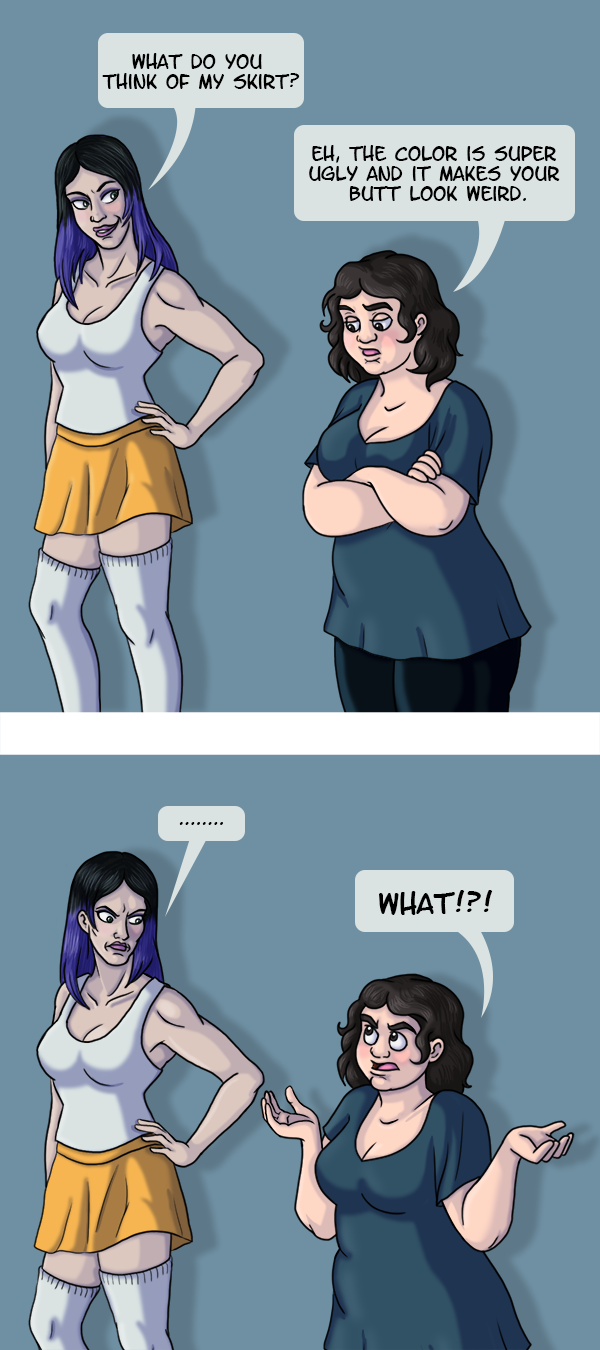
My wife watched me draw this and wanted to know why I put her in such an ugly skirt. “It’s for the review honey!”

Anyway, like I said, Ashley is a talented writer who has written for CosmopolitanThe Mary Sue, SFWA, and John Scalzi Blog. And for you other writers out there looking to diversify your work, she also developed a workshop for writing trans and nonbinary narratives available on WritingTheOther.com. She’s also the one who introduced me to Rick and Morty and has fantastic hair. Neither of those things has anything to do with her writing, she just has excellent taste.

 
Ashley’s new play, Oddity, is part of the Trans Theatre Fest at The Brick in Brooklyn. It’s a creepy, suspenseful, psychological body horror play about gender that includes: flashbacks to a carnival freak show, a subterranean steampunkesque facility à la Jules Verne, and monster crabs (the crustacean kind, not the pubic lice kind).
 
 The plays starts with terrified screams and the professor (who’s never given a name) violently awakens to a doctor trying to push mysterious pills on him, a soldier “guarding” his room who won’t use his correct pronouns or let him out for “classified” reasons, and the discovery that he’s been losing time. His concerns are dismissed, his questions ignored, and he’s consistently told to calm down. The professor is experiencing classic gaslighting, and here’s the brilliant bit: between the dreams, flashbacks, lies, discrepancies, seemingly out-of-place items, and all around weird occurrences, it’s difficult to determine what’s real and what isn’t, mirroring the professor’s paranoia. At parts, I found myself frustrated because I couldn’t figure out what was going on, and unnerved by the overall feeling of “wrongness”. The body horror was pretty scary in and of itself, but it was the gaslighting that was truly terrifying. But fear not, everything makes sense in the end.
 
In fact, the ending was probably my favorite part. When everything finally falls into place it hits you like a punch to the gut, and I couldn’t help yelling out a few expletives in surprise (much to the annoyance of my napping cat). This was literally my reaction while reading the play: “Hmmm, okay, that’s creepy. Wait, what the…WHAT? WTF!?!!? Oh god oh god oh god, no no no no no no. Wait… but then that means… OMG. HOLY SHIT. SHIT. SHIT. WTF.” So yeah, good job Ashley, I actually yelled out loud at my computer screen after finishing your play.
 
And that was just the script. I can’t even imagine how I’d react to the actual performance, with actors Kelsey Jefferson Barrett, Kitty Mortland, Sam Lopresti, Aliyah Hakim, and Samantha Elizabeth Turlington, and directed by Ariel Mahler. So if you’d enjoy a creepy mindfuck of a play about trans people, by trans people, check out Oddity at the Brick theater (579 Metropolitan Ave, Brooklyn NY) on the following dates:
 
Thursday, July 20 @ 9:20pm
Saturday, July 22 @ 2pm
Monday, July 24 @ 9pm
 
Tickets are only $20.00 and you can purchase them here:
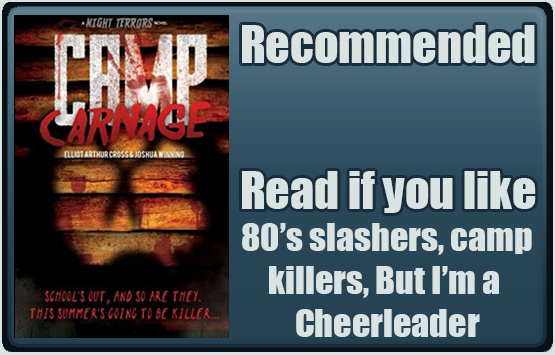
Camp Carnage by Elliot Arthur Cross & Joshua Winning

Camp Carnage by Elliot Arthur Cross & Joshua Winning

Formats: Print, digital

Publisher: CreateSpace Independent Publishing

Genre: Killer/Slasher, Comedy Horror

Audience: Y/A

Diversity: Gay and Lesbian characters

Takes Place in: Colorado, USA

Content Warnings (Highlight to view): Body Shaming, Bullying, Child Abuse, Child Death, Death, Drug Use/Abuse, Forced Captivity, Gaslighting, Gore, Homophobia, Mental Illness, Racism, Sexism, Slurs, Suicide, Violence, Verbal/Emotional Abuse 

Blurb

In the summer of 1986, Billy Collins is sent to his own personal Hell – summer camp. The remote Camp Genesis offers desperate parents a place to “straighten” out their gay teenagers with the help of the puritanical Katherine Creevey.

Besides the typical horsing around, campfire tales and summer games, the Genesis program forces gay and questioning teens into humiliating gender-based lessons. While Billy wants nothing more than to escape Camp Genesis, he can’t help worrying that something even more sinister is hiding just out of sight.

Unknown to Billy, two campers were murdered three years ago. Just days after Billy and the new campers arrive, people start to go missing, and it’s up to Billy and his new friend Jem to find out what’s really going on. Is a maniac on the loose? Is history repeating itself? One thing’s for sure – at Camp Genesis, you have to fight to survive…

Eid Mubarak! I hope all my Muslim readers have a happy Eid Al-Fitr, and that Ramadan brought you peace and prosperity. In honor of the holiday my next review will feature a book from Salaam Reads a new publishing imprint that focuses on books for Muslim kids and young adults. For now, let’s finish up pride month with a gay camp slasher story.It’s an unfortunate fact of life that the majority of self-published books are bad. Really, REALLY bad. Like, any movie remake with Matthew Broderick in it bad. I get that not all self-published books are mind-numbingly awful, and there are definitely benefits to self-publishing (better royalty rates and creative control) over the traditional model. But for every The Martian there are about a million crappy Dinosaur/Alien Romances with bad grammar and a cover that looks like someone tried to illustrate their bad LSD trip in MS Paint. So I was skeptical when I first picked up Camp Carnage and saw it was *gasp* self-published.

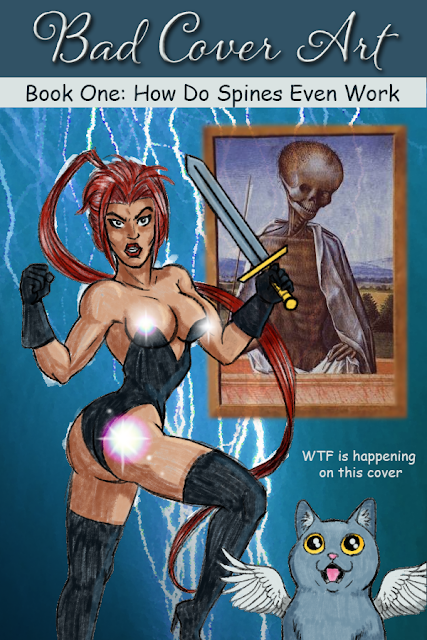
An ugly book cover with the title “Bad cover Art. Book One: How Do Spines Even Work.” None of the fonts match, there’s a medieval painting of a skeleton with blurred edges, a big-eyed cat with wings, and a poorly drawn, anatomically incorrect woman holding a sword. Her hair is in a long ponytail and she’s wearing a revealing, dominatrix-like black outfit that seems to be glued on to her body. Her spine is twisted so both her breasts and butt are facing forward, and have lens flares on them.

It’s like J.J. Abrams and Rob Liefeld made cover art for some bad fanfic.

But it’s actually pretty good! No poorly photoshopped cover, no obvious author self-inserts, the text has been edited for spelling and grammar, and the story is solid and enjoyable. There are still some issues, but overall it’s a fun throwback to campy 80’s horror classics, with a largely queer cast. The characters should be familiar to horror fans, there’s the virginal hero, the hero’s best friend, the mean rival, the love interest, the “cool” best friend, the stoner who acts as the comic relief, the brooding loner, the creepy caretaker, the sole black guy, and the fat kid (yeah… there’s a lot of body-shaming in this book). But in this story, the virginal hero and promiscuous bully, usually female-only roles, are both gay men named Billy and Kyle, respectively. Meanwhile, the handsome, mysterious jock whose attention they’re vying for is still in serious denial about his sexuality, while Billy’s best friend is a bad ass lesbian and probably the toughest person in the camp.  Of course, not everyone sticks to their assigned “role”. Without giving too much away, suffice it to say that literally anyone can die, so don’t get too attached to anyone, and flipping the genders of the “virgin” and the “whore” isn’t the only way Cross and Winning invert horror tropes.

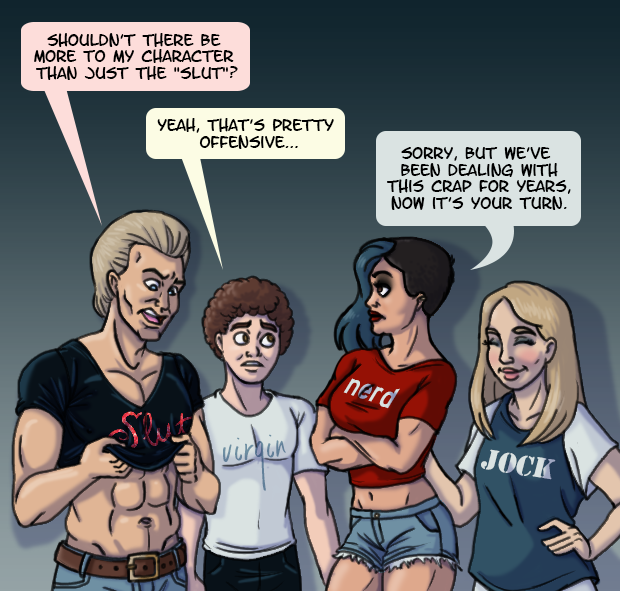
An athletic boy wearing a “Slut” T-shirt looks at his shirt and asks “Shouldn’t there be more to my character than just the ‘slut’?” A scrawny boy wearing a “Virgin” shirt confirms “Yeah, that’s pretty offensive.” A buff girl with a punk haircut and a “Nerd” shirt responds “Sorry, but we’ve been dealing with this crap for years, now it’s your turn.” A blond girl with a “Jock” T-shirt grins behind her friend.

No! Everyone gets one character trait, and that’s it! Now go take your clothes off until you get stabbed.

The rest of the cast is pretty much just there to bring up the body count, so the authors didn’t bother to give them much in the way of personalities. It would have been nice if they were slightly more rounded, or had more than one character trait, but honestly, they’re just cannon fodder, so who really cares. Though it’d be great if the fat kid could have been characterized by something other than his weight (seriously, what is with all the fat shaming!?). I get that many of the characters are stereotypes, but c’mon. Everyone else got to have an actual personality trait as their one defining characteristic, as opposed to a physical attribute! At least the sole black guy got to be the flaming kid, as opposed to a racist caricature.As far as killers go, the murderer isn’t very creative, though they do manage to bump off the majority of the cast without anyone noticing.  Like, to the point where no one finds a dead body until the last few chapters. I’d hope someone in charge would be at least a little more concerned by a number of strange disappearances, but nope. Did people just not give a shit about their children back then? Were teens sent off into the wilderness en masse, and everyone just hoped some of them would make it out alive? I know adults were more laid back about unsupervised kids in the 80’s, but you’d think a child that went missing in the woods for days would at least warrant a phone call.

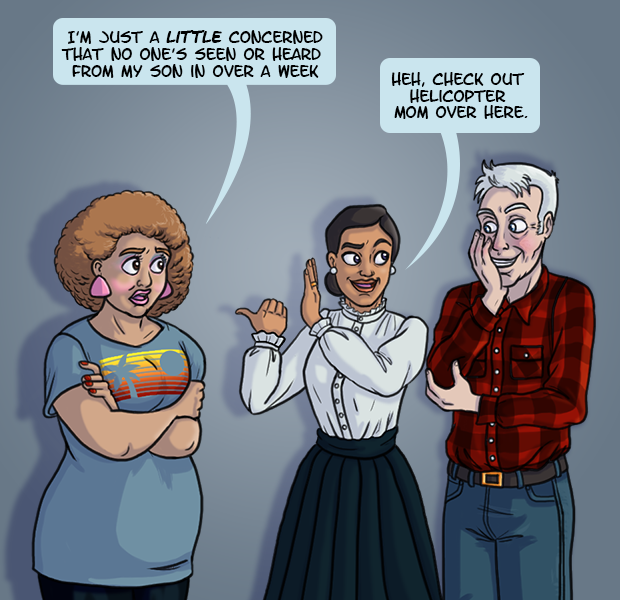
A mom with very curly hair and 80’s makeup and clothing is saying “I’m just a little concerned that no one’s seen or heard from my son in over a week.” A conservatively dressed woman with her hair in a tight bun, and an older man in a plaid shirt are giggling at her. The conservative woman whispers to the man “Heh, check out helicopter mom over here.”

I mean, it’s not like he got murdered in the woods by the camp serial killer. Probably…

Now, obviously you don’t want the victims to figure out they’re being picked off too early in the story. There needs to be time to draw out the suspense, and let the reader get to know the soon-to-be corpses a little better. But let’s face it, if you’re reading slasher horror it’s because you want to see the bodies hit the floor. Any time spent on character development and plot is just making sure you have a nutritious meal before gorging on cake and ice cream. Yeah it’s important, but it’s not the good stuff. And Cross and Winning just waste too much time on boring camp activities when they could’ve been writing about terrified campers trying to escape the killer. Besides, most of the characters are so flat and boring I really don’t want to spend any length of time with them, I just want to see them get murdered in the most gruesome, over-the-top way imaginable.The camp itself is a lot less horrible than I expected a pray-away-the-gay camp to be. Then again, if it were anything like the places you read about on the news, it would be a completely different kind of horror story, and a masked murderer would seem silly and unnecessary in comparison. That’s not to say there wasn’t some pretty disturbing homophobia from the adults trying to “convert” their poor charges. They’re not being electrocutedbeaten, or medically tortured (big trigger warning for those links by the way), but being told who you are is wrong and unnatural is still really damaging. One scene, where one of the camp counselors, Father Norton, has the campers repeat homophobic insults they’ve received and direct them at Kyle, was really upsetting. It was an incredibly dark moment in an otherwise goofy horror story, and much more disturbing than a silly, fictional slasher. I had to go hug my wife after reading that part. But, over all, Camp Carnage is still a fun homage to 80’s Slasher films, with plenty of nods to nerd culture, gore, and humor.

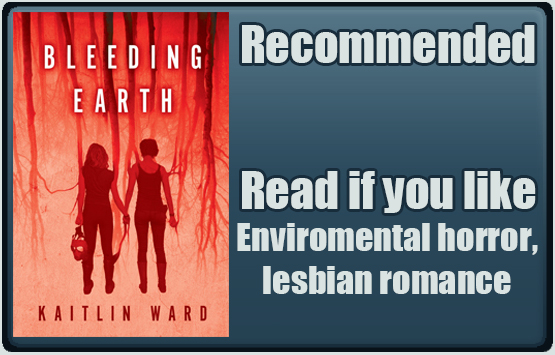
Bleeding Earth by Kaitlin Ward

Bleeding Earth by Kaitlin Ward

Formats: Print, digital

Publisher: Adaptive Studios

Genre: Blood & Guts, Apocalypse/Disaster, Psychological Horror, Romance

Audience: Y/A

Diversity: Lesbian characters, Hispanic/Latine character

Takes Place in: New Hampshire, USA

Content Warnings (Highlight to view): Alcohol Abuse, Bullying, Child Abuse, Child Death, Child Endangerment, Death, Forced Captivity, Gore, Homophobia, Mental Illness, Racism, Suicide, Verbal/Emotional Abuse, Violence

Blurb

Between Mother Nature and human nature, disasters are inevitable. 

Lea was in a cemetery when the earth started bleeding. Within twenty-four hours, the blood made international news. All over the world, blood oozed out of the ground, even through the concrete, even in the water. Then the earth started growing hair and bones.
Lea wishes she could ignore the blood. She wishes she could spend time with her new girlfriend, Aracely, in public, if only Aracely wasn’t so afraid of her father. Lea wants to be a regular teen again, but the blood has made her a prisoner in her own home. Fear for her social life turns into fear for her sanity, and Lea must save herself and her girlfriend however she can.

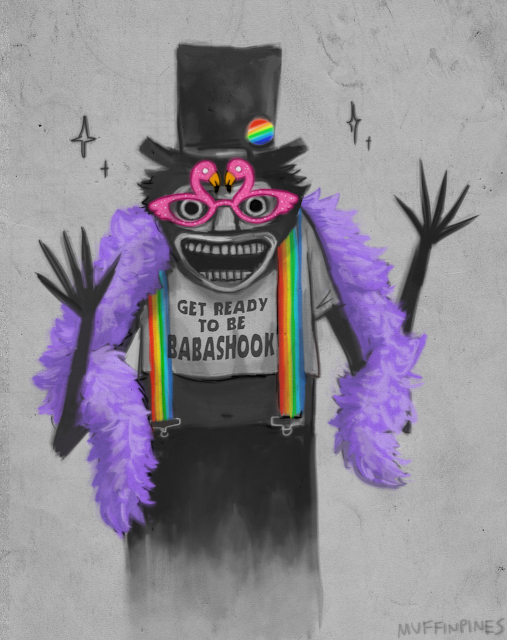
Happy Pride month! Here’s something fun for queer horror fans, after Netflix accidently featured the Australian indie horror film, The Babadook, on their LGBT movie page, the titular creature has quickly become a Pride meme and it’s wonderful. If you haven’t seen the film, it’s awesome, go watch it.

A tall, dark, creepy creature with long fingers and a white face is wearing a top hat with a rainbow button, rainbow suspenders, a purple feather boa, sparkly pink flamingo glasses, and a belly shirt that says “Get Ready to be Babashook.”

Artwork by Muffin Pines at http://muffinpines.tumblr.com/

For June I’ll be reviewing two horror stories with queer characters, the first of which is Bleeding Earth. And oh man, did this book mess me up good. I was expecting a gory, end of the world sort of book, and instead I got a heartbreaking survival story about love, family, and humanity (yes I know how cheesy that sounds, shut up). It gave me so much anxiety, and so many emotions, and I’m still trying to process what the hell I just read. But I know it was good. It was really freaking good. And there was so much blood. Blood, and bones, and hair. I love blood. And bones. Not wads of hair though, I have my limits.

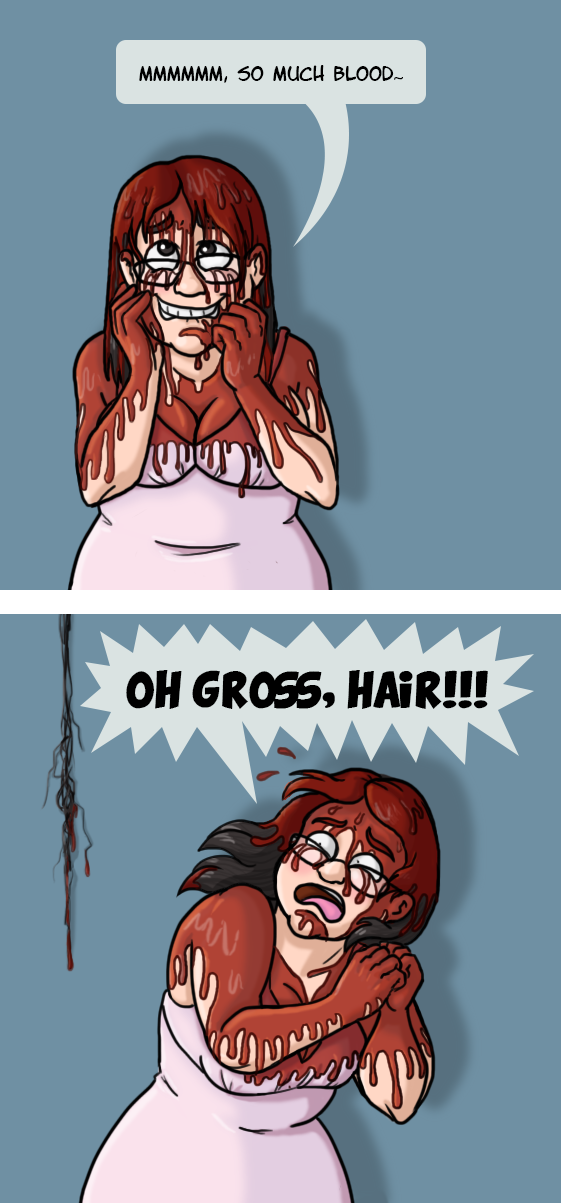
In the first caption I’m wearing a light pink dress and covered in blood. I’m clearly enjoying the blood dripping through my hair and down my shoulders because I’m smearing it on my ecstatic face while sighing “Mmmmmm, So much blood.” In the next panel I’m screaming “OH GROSS, HAIR!”  in disgust and pulling away from a wad of bloody hair I’ve just noticed.

I was going for a “Carrie at the Prom” kind of look.

Lea, the novel’s protagonist and narrator, is enjoying the blossoming relationship she shares with her girlfriend, Aracely, when the blood first appears. Now, normally teen romances in dystopias and apocalyptic fiction seems tacked on and out of place. I mean, who worries about crushes when their life is on the line? But in Bleeding Earth, it works beautifully. Surrounded by chaos and despair, Lea wants to hold onto one of the few good things she has left to keep her going, because no one knows how long they have left. The girls are still in their honeymoon phase, so everything still feels wonderful and new, a sharp contrast to the reality around them. When Lea starts experiencing night terrors and hallucinations from stress and isolation, talking to her girlfriend on the phone is the only thing that helps her. And when she wants to give up, it’s Aracely that keeps her going. And I just can’t bring myself to begrudge her that one little bit of happiness. Who wouldn’t want to spend time with someone who makes you feel safe and lets you forget your problems for a while? It gave my cold, little heart all the feels.The scariest thing about Bleeding Earth isn’t the blood, hair, and bones seeping up from the ground. It’s the feeling of isolation, uncertainty, and powerlessness. At least with zombies, aliens, and diseases there’s always something you can do, a safe zone to flee to, a cure, an end in sight. But with the blood there’s nowhere to escape, no way to fight back, and no stopping the blood. No one knows what’s causing it, or if it will ever end. There are no answers or explanations to soothe the scared populace. And while I normally hate it when a story doesn’t give me an explanation, here it actually works. It’s so much more frightening when you don’t know what’s happening, and there’s literally nothing you can do about it. Will things get better? Is this the end of the world? Did humanity piss off the earth so much it’s finally rejecting them? Even at the start of the bleeding, when everyone is still doing their best to “keep calm and carry on,” fear is already causing people to take desperate actions. Lea’s mom obsessively measures their water and screams at her friends when they drink some, her father nails boards over all the windows so they’re in complete darkness, a man attacks Aracely with a bone over a breathing mask, and some jerks at an Apocalypse party try to get an inebriated girl to drink the blood. It starts with fights over tampons in the grocery store, then looting Home Depot, to violence and riots, and it only gets worse from there. Much, MUCH worse.Now, I know poor decision making seems to be a staple of Y/A fiction (one that annoys me to no end), but here, it makes sense. Everyone is absolutely terrified, struggling with isolation and the horror of what’s happening around them, while still trying their damnedest to pretend like everything is going to be fine. And scared, stressed people do not behave in a rational manner. At various points the teenagers in the story become so desperate for normalcy and human contact they’re willing to brave the blood and all its dangers just to be together. Is this a good idea? No, absolutely not. But is it understandable? Completely. Humans are social creatures, so much so that isolation can actually be deadly. And here’s the original research to back it up. I’m an introvert who prefers a quiet night at home, and even I felt stressed and nauseous when poor Lea described being trapped in her boarded up home for weeks on end, with little to no outside communication. Honestly, if I had to go through a bloodpocalypse, I probably would’ve snapped after a few hours indoors and gone blood hydroplaning (hemiaplaning?) in a stolen car while throwing human skulls at pedestrians. And that’s speaking as someone who willingly goes for days without human contact, I can’t imagine what a non-homebody extrovert would go through. So kudos to Lea for keeping it together as long as she did! If you’re probably going to die anyway, it’s better to die among friends and go out with a bang.

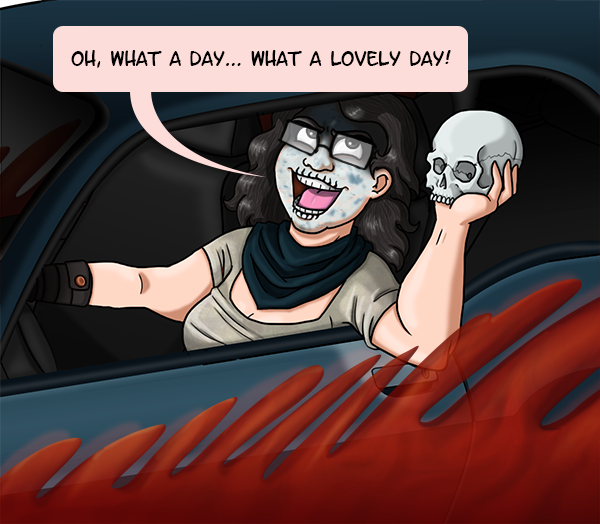
A close up of me driving a car through blood while leaning out the window. I’m holding a human skull out the window while waves of blood are being splashed up by the car. I’m dressed like one of the War Boys from Mad Max: Fury Road, with corpse pain covering my face. I gleefully shout “Oh what a day… What a lovely day!”

I showed this drawing to my wife, and now I’m not allowed to drive her car.

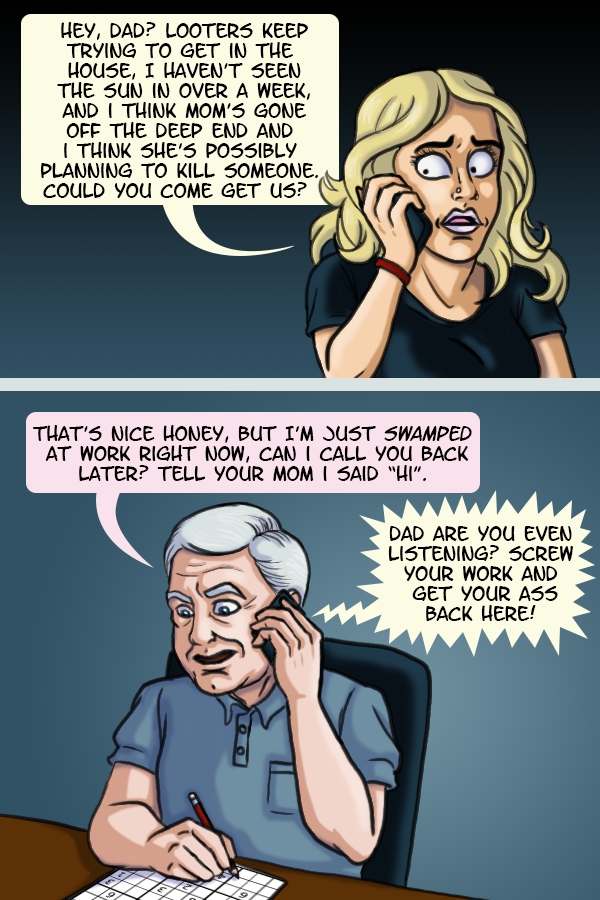
While I really enjoyed Bleeding Earth, it did have some problems that got to me, and kept me from giving it the full five stars. Like Lea’s dad. He learns that the mom has become unhinged, and Lea fears for their safety, but instead of going to help his wife and child, he tells his frightened daughter to get her unstable mom, slip through the looters and people willing to kill for water, and come to him. So of course a ton of horrible things happen because Lea can’t get her sick mother to leave the house, and her dad is apparently too lazy to drive the 40 minutes to help her. Like, I get they need everyone they can get to keep the power going, but for fuck’s sake man, you can take an hour to go rescue your wife and daughter. He’s just so frustratingly blasé about the whole thing. And then there were a bunch of weird little plot points that didn’t go anywhere. Like Lea’s hallucinations. Ingesting the blood is discovered to cause hallucinations, night terrors, lost time, and mental breaks. Lea starts to have horrible nightmares, imagining blood in the house, but it’s unclear if it’s an effect from the blood or the isolation. While she does spend part of the book questioning her sanity, and it’s definitely stressful and unsettling, it doesn’t really go anywhere. Was she infected by the blood? Yeah, we never get an answer for that one either.

A frightened teen is on the phone with her dad. “Hey, dad? Looters keep trying to get in the house, I haven’t seen the sun in over a week, and I think mom’s gone off the deep end and she’s possibly planning to kill someone. Could you come get us?” Her dad is seen doing Sudoku in his office and tells her “That’s nice honey, but I’m just swamped at work right now, can I call you back later? Tell your mom I said “Hi”. “Dad are you even listening!? Screw your work and get your ass back here!”

Hey, Sudoku IS work!

The lack of explanations will be a major turn off for a lot of readers, and I can understand that. But honestly, I didn’t feel like it was needed, because that really isn’t the point of the story. This isn’t a sci-fi novel with an omniscient narrator about a world-wide disaster. This is Lea’s story. It’s about her fears, her loneliness, her confusion, and her crush on Aracely. She’s terrified and frustrated because she doesn’t know what will happen, her parents can’t reassure her, and she just wants to be able to take comfort in something. It’s a sweet, sad story of survival, isolation, and just trying to enjoy a simple teen crush in a world that’s gone to hell.

Navigation

Social Media

Search by Tags

To learn more about the Age Group, Diversity, and Genre tags, click here.

Age Groups

Diversity

Genre

Support the Blog

Search

Links

Girl, Stolen by April Henry

Girl, Stolen by April Henry

Formats: Print, audio, digital

Genre: Thriller

Audience: Y/A

Diversity: Disability (Vision Impairment, Cognitive, Learning Disability)

Takes Place in: Oregon, USA

Content Warnings (Highlight to view):  Abelism, Alcohol Abuse, Animal Abuse, Animal Death, Bullying, Child Abuse, Death, Drug Use/Abuse, Forced Captivity, Gaslighting, Illness, Medical Procedures, Physical Abuse, Mentions of Rape/Sexual, Slurs, Verbal/Emotional Abuse, Violence

Blurb

Sixteen-year-old Cheyenne Wilder is sleeping in the back of the car while her step mom fills a prescription for antibiotics. Before Cheyenne realizes what’s happening, the car is being stolen.

Griffin hadn’t meant to kidnap Cheyenne and once he finds out that not only does she have pneumonia, but that she’s blind, he really doesn’t know what to do. When his dad finds out that Cheyenne’s father is the president of a powerful corporation, everything changes–now there’s a reason to keep her.

How will Cheyenne survive this nightmare?

As you can probably guess, Cheyenne is not having a good day. Though her kidnapper’s, Griffin, isn’t going much better. The story alternates between the points of view of these two main characters, as they anxiously stumble their way through a bad situation. Cheyenne, who has been blind for about three years following a car accident, describes her world in sounds, smells, and sensations. Sick, feverish, and stranded without her guide dog and cane, she does her best to outwit her captors and survive her terrifying ordeal. Meanwhile, Griffin, who’s almost as panicked as Cheyenne, struggles between listening to his conscience and obeying his abusive, criminal father. You can sense his denial, born from years of abuse, his desperation for love and acceptance, and the fear that’s holding him back. The two characters, both trapped in terrible situations, form an unlikely bond as they nervously wait for Griffin’s father to make a decision.

Not having any sort of severe visual impairment myself (other than my corrective lenses), I can’t say how accurate April Henry’s depiction of a blind/low vision person is. But Cheyenne’s disability does seem to be well pretty researched, as far as I can tell anyway. For example, Cheyenne still has some of her peripheral vision in one eye, a nice touch since about 85% of legally blind people have at least some light and/or form perception, and complete blindness is relatively rare. And the description of how a guide dog and its owner work together sounded pretty accurate, at least from what I’ve read. She doesn’t fall victim to any of the common blindness tropes either. Then there’s this reviewer, who is herself blind, and says the portrayal of Cheyenne’s visual impairment is pretty spot on, and relatable. So there you go.

A blind/low vision man examining a hideous jacket and tells his friend “this is the ugliest effin’ jacket I have ever seen, it looks like you stole it off a patriotic clown. Please burn this immediately for the good of humanity.” Annoyed, his friend responds “You’re blind, how can you even tell what it looks like?” “Dude, I’m not that blind, though I might lose all of my vision if I have to look at this thing any longer.” “Why are you so salty?”

He’s salty because people keep accusing him of “faking” his blindness just because he can sort of see things six inches from his face with one of his eyes.

Henry could have easily made her heroine a broken bird that readers pitied, or turned the story into inspiration porn, but she doesn’t. Instead, Cheyenne is characterized as a young woman who went through a traumatic event, which understandably caused her to grieve, and then has to adapt to a completely different way of interacting with the world which is challenging, but certainly not anything extraordinary. Cheyenne works with her therapist and teachers to pull herself out of her depression and learn a new skill set, all without becoming a “feel good” story for sighted readers. She isn’t sweet and chipper about it either, our heroine gets frustrated, feels sorry for herself, lashes out, and gets grumpy. She’s allowed to be a flawed person, instead of some sort of blind saint who forgives the ableists. Although she now relies much more on sound, smell, and touch to function, her senses are the same as before, Cheyenne just learns to pay more attention to them, as oppose to getting magically heightened senses that turn her into a ninja. And yes, Cheyenne is feeling weak and helpless after being kidnapped, but this is due to being severely ill with pneumonia, not her low vision. And even sick and terrified, she’s still a tough, resourceful character.

Speaking of blind ninjas, did you know Daredevil and the Teenage Mutant Ninja Turtles share an origin story? It has nothing to do with Girl, Stolen, it’s just cool.

Griffin, meanwhile, is complex and interesting. You can’t help but feel bad for the guy, even if Cheyenne isn’t in a position to be sympathetic, and Henry doesn’t try to excuse his actions by invoking pity in the reader (Henry never tries to get you to feel sorry for the characters, she just presents the facts of their lives). Poor Griffin’s mom left when he was young, his dad is an abusive alcoholic who forces him into a life of crime, and he has basically zero support system. We find out later that he’s Dyslexic, though unaware of it, and was forced to drop out of school because he struggles with reading. It’s an interesting contrast to Cheyenne, who comes from a wealthy background and goes to a private school that’s able to accommodate her. After her accident she had private nurses who cared for her in her home. Her father sent her to a special program where she learned how to function independently without her vision. They’re able to afford a guide dog so Cheyenne can get around. Ideally, all people with disabilities would have the same access to accommodations that Cheyenne does, but unfortunately that’s simply not the case, especially for people with low incomes or living in poverty. Griffin is one of those kids who slips through the cracks. He was never tested for Dyslexia, and his teachers and father apparently wrote him off, he gets zero help with his reading skills and is forced to drop out of school, believing his only option in life is to be a criminal like his father. Although Henry isn’t heavy handed about it, she makes clear what a world of difference it makes when people have access to proper accommodations, a constant source of frustration for anyone with a disability. Seriously, go on any disability website, and you will see a legion of posts about the daily frustration and obstacles that able-bodied and neurotypical people don’t even notice, not to mention the constant struggles with health insurance and trying to get accommodations approved at school and work.

In the first panel, a doctor is looking at her laptop when she hears a nurse yell off screen “Why didn’t anyone tell me the sink was broken!?!?!” Irritated, she responds, “*sigh* didn’t you read the sign?” In the second panel we see the nurse, who is blind and holding a cane, soaking wet from the malfunctioning sink. He snaps “If by sign, you mean the piece of paper you taped up that could say literally anything, then NO, OBVIOUSLY I DIDN’T.” Sheepish, the doctor says “Oh.... right. Sorry.”

Other pet peeves of the visually impaired include the little stickers on fruit and people who ask them to guess who they are by their voice. Seriously, don’t do that.

As for the story itself, it’s definitely a thriller, and a well written one. I couldn’t put Girl, Stolen down and ended up finishing it in only a few sittings (and that’s only because I was interrupted by annoying grown up responsibilities). Yeah, I know I haven’t gone over the writing that much, but honestly, I can’t really get into the plot without also going into spoiler territory, and part of what makes this story so great is the suspense. Of course, there are still a few flaws. Usually Henry is able to blend the backstory of the characters smoothly into the story, but it does get bogged down by random info dumps in a few places. I like when I learn new things from books, but not when they’re awkwardly shoehorned in. You don’t need to stop the story to explain what vehicle identification numbers are, I could have just Googled “VIN” if I didn’t know.  Nor do we need a completely unnecessary explanation of what the Nike company is. In fact, why even bother using a real company in your book if you then have to explain what they do? Thankfully these instances are few and far between. The two main characters were interesting and well written, but everyone else was pretty bland, especially Griffin’s one-dimensional, evil father. 


Oh, and for any readers who are visually impaired, the audiobook narrator, Kate Rudd does a pretty good job, though she does seem to struggle with male voices (some of them sound pretty silly), which can be distracting during a suspenseful scene. But for the most part it’s well acted; Cheyenne sounds great, and Rudd really makes the listener feel the tension. A sequel, Count all her Bones, came out this past May.
Oddity by Ashley Lauren Rogers

Genre: Body Horror, Historic Horror, Sci-Fi Horror

Audience: Y/A

Diversity: Trans characters

Content Warnings (Highlight to view): Abelism, Forced Captivity, Gaslighting, Gore, Illness, Medical Procedures, Transphobia/Misgendering, Violence

Blurb

A “Gender Specialist” is brought into a secret Victorian–Era medical facility deep within the earth to unravel the mystery of a series of murders and body mutilations which have taken place. As he meets the sole survivor and begins to unravel the mystery as his claustrophobic paranoia begins to overtake him the specialist finds it hard to believe anything he’s told.

So, full disclosure, this isn’t so much a review as it is an unpaid promotion for my friend’s new play Oddity, and I’ve only read the script, not seen the play itself. But fear not, this isn’t one of those situations where I felt pressured to pay compliments for the sake of our friendship, both because Ashley is an incredibly talented writer and I love reading her stuff, and because I’m an asshole who will let my friends know exactly what I think in the least tactful way imaginable. Which is probably why no one ever asks for my opinion…

My wife watched me draw this and wanted to know why I put her in such an ugly skirt. “It’s for the review honey!”

Anyway, like I said, Ashley is a talented writer who has written for CosmopolitanThe Mary Sue, SFWA, and John Scalzi Blog. And for you other writers out there looking to diversify your work, she also developed a workshop for writing trans and nonbinary narratives available on WritingTheOther.com. She’s also the one who introduced me to Rick and Morty and has fantastic hair. Neither of those things has anything to do with her writing, she just has excellent taste.

 
Ashley’s new play, Oddity, is part of the Trans Theatre Fest at The Brick in Brooklyn. It’s a creepy, suspenseful, psychological body horror play about gender that includes: flashbacks to a carnival freak show, a subterranean steampunkesque facility à la Jules Verne, and monster crabs (the crustacean kind, not the pubic lice kind).
 
 The plays starts with terrified screams and the professor (who’s never given a name) violently awakens to a doctor trying to push mysterious pills on him, a soldier “guarding” his room who won’t use his correct pronouns or let him out for “classified” reasons, and the discovery that he’s been losing time. His concerns are dismissed, his questions ignored, and he’s consistently told to calm down. The professor is experiencing classic gaslighting, and here’s the brilliant bit: between the dreams, flashbacks, lies, discrepancies, seemingly out-of-place items, and all around weird occurrences, it’s difficult to determine what’s real and what isn’t, mirroring the professor’s paranoia. At parts, I found myself frustrated because I couldn’t figure out what was going on, and unnerved by the overall feeling of “wrongness”. The body horror was pretty scary in and of itself, but it was the gaslighting that was truly terrifying. But fear not, everything makes sense in the end.
 
In fact, the ending was probably my favorite part. When everything finally falls into place it hits you like a punch to the gut, and I couldn’t help yelling out a few expletives in surprise (much to the annoyance of my napping cat). This was literally my reaction while reading the play: “Hmmm, okay, that’s creepy. Wait, what the…WHAT? WTF!?!!? Oh god oh god oh god, no no no no no no. Wait… but then that means… OMG. HOLY SHIT. SHIT. SHIT. WTF.” So yeah, good job Ashley, I actually yelled out loud at my computer screen after finishing your play.
 
And that was just the script. I can’t even imagine how I’d react to the actual performance, with actors Kelsey Jefferson Barrett, Kitty Mortland, Sam Lopresti, Aliyah Hakim, and Samantha Elizabeth Turlington, and directed by Ariel Mahler. So if you’d enjoy a creepy mindfuck of a play about trans people, by trans people, check out Oddity at the Brick theater (579 Metropolitan Ave, Brooklyn NY) on the following dates:
 
Thursday, July 20 @ 9:20pm
Saturday, July 22 @ 2pm
Monday, July 24 @ 9pm
 
Tickets are only $20.00 and you can purchase them here:
Camp Carnage by Elliot Arthur Cross & Joshua Winning

Camp Carnage by Elliot Arthur Cross & Joshua Winning

Formats: Print, digital

Publisher: CreateSpace Independent Publishing

Genre: Killer/Slasher, Comedy Horror

Audience: Y/A

Diversity: Gay and Lesbian characters

Takes Place in: Colorado, USA

Content Warnings (Highlight to view): Body Shaming, Bullying, Child Abuse, Child Death, Death, Drug Use/Abuse, Forced Captivity, Gaslighting, Gore, Homophobia, Mental Illness, Racism, Sexism, Slurs, Suicide, Violence, Verbal/Emotional Abuse 

Blurb

In the summer of 1986, Billy Collins is sent to his own personal Hell – summer camp. The remote Camp Genesis offers desperate parents a place to “straighten” out their gay teenagers with the help of the puritanical Katherine Creevey.

Besides the typical horsing around, campfire tales and summer games, the Genesis program forces gay and questioning teens into humiliating gender-based lessons. While Billy wants nothing more than to escape Camp Genesis, he can’t help worrying that something even more sinister is hiding just out of sight.

Unknown to Billy, two campers were murdered three years ago. Just days after Billy and the new campers arrive, people start to go missing, and it’s up to Billy and his new friend Jem to find out what’s really going on. Is a maniac on the loose? Is history repeating itself? One thing’s for sure – at Camp Genesis, you have to fight to survive…

Eid Mubarak! I hope all my Muslim readers have a happy Eid Al-Fitr, and that Ramadan brought you peace and prosperity. In honor of the holiday my next review will feature a book from Salaam Reads a new publishing imprint that focuses on books for Muslim kids and young adults. For now, let’s finish up pride month with a gay camp slasher story.It’s an unfortunate fact of life that the majority of self-published books are bad. Really, REALLY bad. Like, any movie remake with Matthew Broderick in it bad. I get that not all self-published books are mind-numbingly awful, and there are definitely benefits to self-publishing (better royalty rates and creative control) over the traditional model. But for every The Martian there are about a million crappy Dinosaur/Alien Romances with bad grammar and a cover that looks like someone tried to illustrate their bad LSD trip in MS Paint. So I was skeptical when I first picked up Camp Carnage and saw it was *gasp* self-published.

An ugly book cover with the title “Bad cover Art. Book One: How Do Spines Even Work.” None of the fonts match, there’s a medieval painting of a skeleton with blurred edges, a big-eyed cat with wings, and a poorly drawn, anatomically incorrect woman holding a sword. Her hair is in a long ponytail and she’s wearing a revealing, dominatrix-like black outfit that seems to be glued on to her body. Her spine is twisted so both her breasts and butt are facing forward, and have lens flares on them.

It’s like J.J. Abrams and Rob Liefeld made cover art for some bad fanfic.

But it’s actually pretty good! No poorly photoshopped cover, no obvious author self-inserts, the text has been edited for spelling and grammar, and the story is solid and enjoyable. There are still some issues, but overall it’s a fun throwback to campy 80’s horror classics, with a largely queer cast. The characters should be familiar to horror fans, there’s the virginal hero, the hero’s best friend, the mean rival, the love interest, the “cool” best friend, the stoner who acts as the comic relief, the brooding loner, the creepy caretaker, the sole black guy, and the fat kid (yeah… there’s a lot of body-shaming in this book). But in this story, the virginal hero and promiscuous bully, usually female-only roles, are both gay men named Billy and Kyle, respectively. Meanwhile, the handsome, mysterious jock whose attention they’re vying for is still in serious denial about his sexuality, while Billy’s best friend is a bad ass lesbian and probably the toughest person in the camp.  Of course, not everyone sticks to their assigned “role”. Without giving too much away, suffice it to say that literally anyone can die, so don’t get too attached to anyone, and flipping the genders of the “virgin” and the “whore” isn’t the only way Cross and Winning invert horror tropes.

An athletic boy wearing a “Slut” T-shirt looks at his shirt and asks “Shouldn’t there be more to my character than just the ‘slut’?” A scrawny boy wearing a “Virgin” shirt confirms “Yeah, that’s pretty offensive.” A buff girl with a punk haircut and a “Nerd” shirt responds “Sorry, but we’ve been dealing with this crap for years, now it’s your turn.” A blond girl with a “Jock” T-shirt grins behind her friend.

No! Everyone gets one character trait, and that’s it! Now go take your clothes off until you get stabbed.

The rest of the cast is pretty much just there to bring up the body count, so the authors didn’t bother to give them much in the way of personalities. It would have been nice if they were slightly more rounded, or had more than one character trait, but honestly, they’re just cannon fodder, so who really cares. Though it’d be great if the fat kid could have been characterized by something other than his weight (seriously, what is with all the fat shaming!?). I get that many of the characters are stereotypes, but c’mon. Everyone else got to have an actual personality trait as their one defining characteristic, as opposed to a physical attribute! At least the sole black guy got to be the flaming kid, as opposed to a racist caricature.As far as killers go, the murderer isn’t very creative, though they do manage to bump off the majority of the cast without anyone noticing.  Like, to the point where no one finds a dead body until the last few chapters. I’d hope someone in charge would be at least a little more concerned by a number of strange disappearances, but nope. Did people just not give a shit about their children back then? Were teens sent off into the wilderness en masse, and everyone just hoped some of them would make it out alive? I know adults were more laid back about unsupervised kids in the 80’s, but you’d think a child that went missing in the woods for days would at least warrant a phone call.

A mom with very curly hair and 80’s makeup and clothing is saying “I’m just a little concerned that no one’s seen or heard from my son in over a week.” A conservatively dressed woman with her hair in a tight bun, and an older man in a plaid shirt are giggling at her. The conservative woman whispers to the man “Heh, check out helicopter mom over here.”

I mean, it’s not like he got murdered in the woods by the camp serial killer. Probably…

Now, obviously you don’t want the victims to figure out they’re being picked off too early in the story. There needs to be time to draw out the suspense, and let the reader get to know the soon-to-be corpses a little better. But let’s face it, if you’re reading slasher horror it’s because you want to see the bodies hit the floor. Any time spent on character development and plot is just making sure you have a nutritious meal before gorging on cake and ice cream. Yeah it’s important, but it’s not the good stuff. And Cross and Winning just waste too much time on boring camp activities when they could’ve been writing about terrified campers trying to escape the killer. Besides, most of the characters are so flat and boring I really don’t want to spend any length of time with them, I just want to see them get murdered in the most gruesome, over-the-top way imaginable.The camp itself is a lot less horrible than I expected a pray-away-the-gay camp to be. Then again, if it were anything like the places you read about on the news, it would be a completely different kind of horror story, and a masked murderer would seem silly and unnecessary in comparison. That’s not to say there wasn’t some pretty disturbing homophobia from the adults trying to “convert” their poor charges. They’re not being electrocutedbeaten, or medically tortured (big trigger warning for those links by the way), but being told who you are is wrong and unnatural is still really damaging. One scene, where one of the camp counselors, Father Norton, has the campers repeat homophobic insults they’ve received and direct them at Kyle, was really upsetting. It was an incredibly dark moment in an otherwise goofy horror story, and much more disturbing than a silly, fictional slasher. I had to go hug my wife after reading that part. But, over all, Camp Carnage is still a fun homage to 80’s Slasher films, with plenty of nods to nerd culture, gore, and humor.

Bleeding Earth by Kaitlin Ward

Bleeding Earth by Kaitlin Ward

Formats: Print, digital

Publisher: Adaptive Studios

Genre: Blood & Guts, Apocalypse/Disaster, Psychological Horror, Romance

Audience: Y/A

Diversity: Lesbian characters, Hispanic/Latine character

Takes Place in: New Hampshire, USA

Content Warnings (Highlight to view): Alcohol Abuse, Bullying, Child Abuse, Child Death, Child Endangerment, Death, Forced Captivity, Gore, Homophobia, Mental Illness, Racism, Suicide, Verbal/Emotional Abuse, Violence

Blurb

Between Mother Nature and human nature, disasters are inevitable. 

Lea was in a cemetery when the earth started bleeding. Within twenty-four hours, the blood made international news. All over the world, blood oozed out of the ground, even through the concrete, even in the water. Then the earth started growing hair and bones.
Lea wishes she could ignore the blood. She wishes she could spend time with her new girlfriend, Aracely, in public, if only Aracely wasn’t so afraid of her father. Lea wants to be a regular teen again, but the blood has made her a prisoner in her own home. Fear for her social life turns into fear for her sanity, and Lea must save herself and her girlfriend however she can.

Happy Pride month! Here’s something fun for queer horror fans, after Netflix accidently featured the Australian indie horror film, The Babadook, on their LGBT movie page, the titular creature has quickly become a Pride meme and it’s wonderful. If you haven’t seen the film, it’s awesome, go watch it.

A tall, dark, creepy creature with long fingers and a white face is wearing a top hat with a rainbow button, rainbow suspenders, a purple feather boa, sparkly pink flamingo glasses, and a belly shirt that says “Get Ready to be Babashook.”

Artwork by Muffin Pines at http://muffinpines.tumblr.com/

For June I’ll be reviewing two horror stories with queer characters, the first of which is Bleeding Earth. And oh man, did this book mess me up good. I was expecting a gory, end of the world sort of book, and instead I got a heartbreaking survival story about love, family, and humanity (yes I know how cheesy that sounds, shut up). It gave me so much anxiety, and so many emotions, and I’m still trying to process what the hell I just read. But I know it was good. It was really freaking good. And there was so much blood. Blood, and bones, and hair. I love blood. And bones. Not wads of hair though, I have my limits.

In the first caption I’m wearing a light pink dress and covered in blood. I’m clearly enjoying the blood dripping through my hair and down my shoulders because I’m smearing it on my ecstatic face while sighing “Mmmmmm, So much blood.” In the next panel I’m screaming “OH GROSS, HAIR!”  in disgust and pulling away from a wad of bloody hair I’ve just noticed.

I was going for a “Carrie at the Prom” kind of look.

Lea, the novel’s protagonist and narrator, is enjoying the blossoming relationship she shares with her girlfriend, Aracely, when the blood first appears. Now, normally teen romances in dystopias and apocalyptic fiction seems tacked on and out of place. I mean, who worries about crushes when their life is on the line? But in Bleeding Earth, it works beautifully. Surrounded by chaos and despair, Lea wants to hold onto one of the few good things she has left to keep her going, because no one knows how long they have left. The girls are still in their honeymoon phase, so everything still feels wonderful and new, a sharp contrast to the reality around them. When Lea starts experiencing night terrors and hallucinations from stress and isolation, talking to her girlfriend on the phone is the only thing that helps her. And when she wants to give up, it’s Aracely that keeps her going. And I just can’t bring myself to begrudge her that one little bit of happiness. Who wouldn’t want to spend time with someone who makes you feel safe and lets you forget your problems for a while? It gave my cold, little heart all the feels.The scariest thing about Bleeding Earth isn’t the blood, hair, and bones seeping up from the ground. It’s the feeling of isolation, uncertainty, and powerlessness. At least with zombies, aliens, and diseases there’s always something you can do, a safe zone to flee to, a cure, an end in sight. But with the blood there’s nowhere to escape, no way to fight back, and no stopping the blood. No one knows what’s causing it, or if it will ever end. There are no answers or explanations to soothe the scared populace. And while I normally hate it when a story doesn’t give me an explanation, here it actually works. It’s so much more frightening when you don’t know what’s happening, and there’s literally nothing you can do about it. Will things get better? Is this the end of the world? Did humanity piss off the earth so much it’s finally rejecting them? Even at the start of the bleeding, when everyone is still doing their best to “keep calm and carry on,” fear is already causing people to take desperate actions. Lea’s mom obsessively measures their water and screams at her friends when they drink some, her father nails boards over all the windows so they’re in complete darkness, a man attacks Aracely with a bone over a breathing mask, and some jerks at an Apocalypse party try to get an inebriated girl to drink the blood. It starts with fights over tampons in the grocery store, then looting Home Depot, to violence and riots, and it only gets worse from there. Much, MUCH worse.Now, I know poor decision making seems to be a staple of Y/A fiction (one that annoys me to no end), but here, it makes sense. Everyone is absolutely terrified, struggling with isolation and the horror of what’s happening around them, while still trying their damnedest to pretend like everything is going to be fine. And scared, stressed people do not behave in a rational manner. At various points the teenagers in the story become so desperate for normalcy and human contact they’re willing to brave the blood and all its dangers just to be together. Is this a good idea? No, absolutely not. But is it understandable? Completely. Humans are social creatures, so much so that isolation can actually be deadly. And here’s the original research to back it up. I’m an introvert who prefers a quiet night at home, and even I felt stressed and nauseous when poor Lea described being trapped in her boarded up home for weeks on end, with little to no outside communication. Honestly, if I had to go through a bloodpocalypse, I probably would’ve snapped after a few hours indoors and gone blood hydroplaning (hemiaplaning?) in a stolen car while throwing human skulls at pedestrians. And that’s speaking as someone who willingly goes for days without human contact, I can’t imagine what a non-homebody extrovert would go through. So kudos to Lea for keeping it together as long as she did! If you’re probably going to die anyway, it’s better to die among friends and go out with a bang.

A close up of me driving a car through blood while leaning out the window. I’m holding a human skull out the window while waves of blood are being splashed up by the car. I’m dressed like one of the War Boys from Mad Max: Fury Road, with corpse pain covering my face. I gleefully shout “Oh what a day… What a lovely day!”

I showed this drawing to my wife, and now I’m not allowed to drive her car.

While I really enjoyed Bleeding Earth, it did have some problems that got to me, and kept me from giving it the full five stars. Like Lea’s dad. He learns that the mom has become unhinged, and Lea fears for their safety, but instead of going to help his wife and child, he tells his frightened daughter to get her unstable mom, slip through the looters and people willing to kill for water, and come to him. So of course a ton of horrible things happen because Lea can’t get her sick mother to leave the house, and her dad is apparently too lazy to drive the 40 minutes to help her. Like, I get they need everyone they can get to keep the power going, but for fuck’s sake man, you can take an hour to go rescue your wife and daughter. He’s just so frustratingly blasé about the whole thing. And then there were a bunch of weird little plot points that didn’t go anywhere. Like Lea’s hallucinations. Ingesting the blood is discovered to cause hallucinations, night terrors, lost time, and mental breaks. Lea starts to have horrible nightmares, imagining blood in the house, but it’s unclear if it’s an effect from the blood or the isolation. While she does spend part of the book questioning her sanity, and it’s definitely stressful and unsettling, it doesn’t really go anywhere. Was she infected by the blood? Yeah, we never get an answer for that one either.

A frightened teen is on the phone with her dad. “Hey, dad? Looters keep trying to get in the house, I haven’t seen the sun in over a week, and I think mom’s gone off the deep end and she’s possibly planning to kill someone. Could you come get us?” Her dad is seen doing Sudoku in his office and tells her “That’s nice honey, but I’m just swamped at work right now, can I call you back later? Tell your mom I said “Hi”. “Dad are you even listening!? Screw your work and get your ass back here!”

Hey, Sudoku IS work!

The lack of explanations will be a major turn off for a lot of readers, and I can understand that. But honestly, I didn’t feel like it was needed, because that really isn’t the point of the story. This isn’t a sci-fi novel with an omniscient narrator about a world-wide disaster. This is Lea’s story. It’s about her fears, her loneliness, her confusion, and her crush on Aracely. She’s terrified and frustrated because she doesn’t know what will happen, her parents can’t reassure her, and she just wants to be able to take comfort in something. It’s a sweet, sad story of survival, isolation, and just trying to enjoy a simple teen crush in a world that’s gone to hell.

Navigation

Social Media

Search by Tags

To learn more about the Age Group, Diversity, and Genre tags, click here.

Age Groups

Diversity

Genre

Support the Blog

Search

Links