Girl, Stolen by April Henry

Girl, Stolen by April Henry

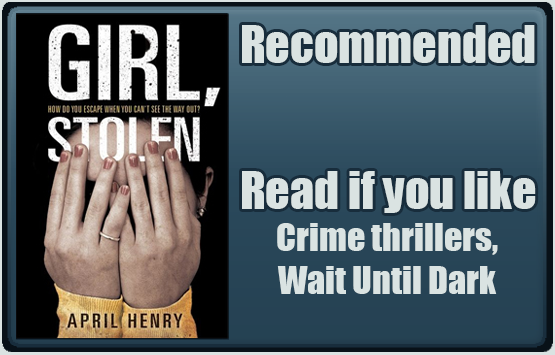
Formats: Print, audio, digital

Genre: Thriller

Audience: Y/A

Diversity: Disability (Vision Impairment, Cognitive, Learning Disability)

Takes Place in: Oregon, USA

Content Warnings (Highlight to view):  Abelism, Alcohol Abuse, Animal Abuse, Animal Death, Bullying, Child Abuse, Death, Drug Use/Abuse, Forced Captivity, Gaslighting, Illness, Medical Procedures, Physical Abuse, Mentions of Rape/Sexual, Slurs, Verbal/Emotional Abuse, Violence

Blurb

Sixteen-year-old Cheyenne Wilder is sleeping in the back of the car while her step mom fills a prescription for antibiotics. Before Cheyenne realizes what’s happening, the car is being stolen.

Griffin hadn’t meant to kidnap Cheyenne and once he finds out that not only does she have pneumonia, but that she’s blind, he really doesn’t know what to do. When his dad finds out that Cheyenne’s father is the president of a powerful corporation, everything changes–now there’s a reason to keep her.

How will Cheyenne survive this nightmare?

As you can probably guess, Cheyenne is not having a good day. Though her kidnapper’s, Griffin, isn’t going much better. The story alternates between the points of view of these two main characters, as they anxiously stumble their way through a bad situation. Cheyenne, who has been blind for about three years following a car accident, describes her world in sounds, smells, and sensations. Sick, feverish, and stranded without her guide dog and cane, she does her best to outwit her captors and survive her terrifying ordeal. Meanwhile, Griffin, who’s almost as panicked as Cheyenne, struggles between listening to his conscience and obeying his abusive, criminal father. You can sense his denial, born from years of abuse, his desperation for love and acceptance, and the fear that’s holding him back. The two characters, both trapped in terrible situations, form an unlikely bond as they nervously wait for Griffin’s father to make a decision.

Not having any sort of severe visual impairment myself (other than my corrective lenses), I can’t say how accurate April Henry’s depiction of a blind/low vision person is. But Cheyenne’s disability does seem to be well pretty researched, as far as I can tell anyway. For example, Cheyenne still has some of her peripheral vision in one eye, a nice touch since about 85% of legally blind people have at least some light and/or form perception, and complete blindness is relatively rare. And the description of how a guide dog and its owner work together sounded pretty accurate, at least from what I’ve read. She doesn’t fall victim to any of the common blindness tropes either. Then there’s this reviewer, who is herself blind, and says the portrayal of Cheyenne’s visual impairment is pretty spot on, and relatable. So there you go.

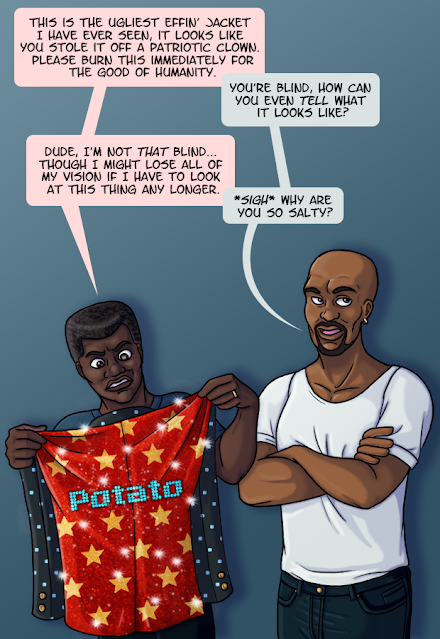
A blind/low vision man examining a hideous jacket and tells his friend “this is the ugliest effin’ jacket I have ever seen, it looks like you stole it off a patriotic clown. Please burn this immediately for the good of humanity.” Annoyed, his friend responds “You’re blind, how can you even tell what it looks like?” “Dude, I’m not that blind, though I might lose all of my vision if I have to look at this thing any longer.” “Why are you so salty?”

He’s salty because people keep accusing him of “faking” his blindness just because he can sort of see things six inches from his face with one of his eyes.

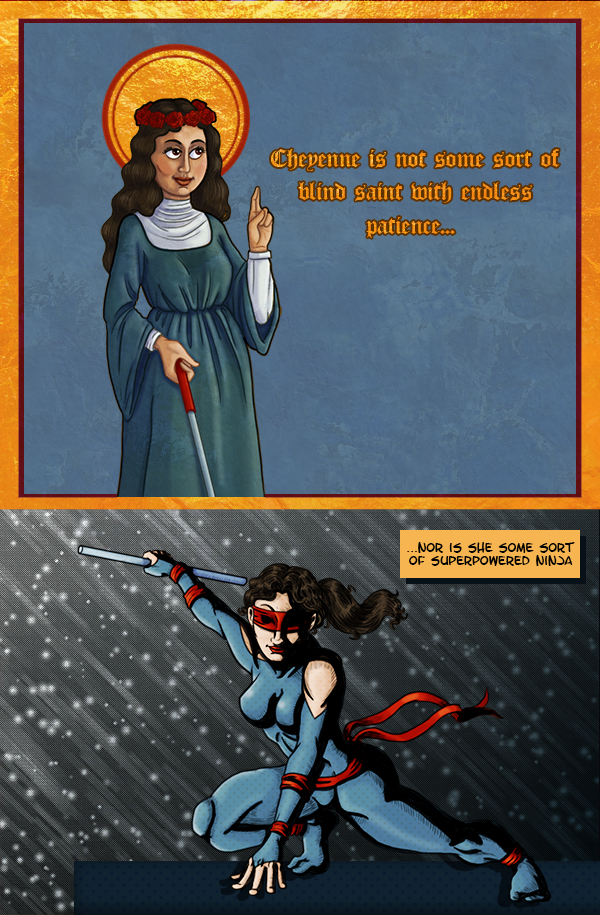
Henry could have easily made her heroine a broken bird that readers pitied, or turned the story into inspiration porn, but she doesn’t. Instead, Cheyenne is characterized as a young woman who went through a traumatic event, which understandably caused her to grieve, and then has to adapt to a completely different way of interacting with the world which is challenging, but certainly not anything extraordinary. Cheyenne works with her therapist and teachers to pull herself out of her depression and learn a new skill set, all without becoming a “feel good” story for sighted readers. She isn’t sweet and chipper about it either, our heroine gets frustrated, feels sorry for herself, lashes out, and gets grumpy. She’s allowed to be a flawed person, instead of some sort of blind saint who forgives the ableists. Although she now relies much more on sound, smell, and touch to function, her senses are the same as before, Cheyenne just learns to pay more attention to them, as oppose to getting magically heightened senses that turn her into a ninja. And yes, Cheyenne is feeling weak and helpless after being kidnapped, but this is due to being severely ill with pneumonia, not her low vision. And even sick and terrified, she’s still a tough, resourceful character.

Speaking of blind ninjas, did you know Daredevil and the Teenage Mutant Ninja Turtles share an origin story? It has nothing to do with Girl, Stolen, it’s just cool.

Griffin, meanwhile, is complex and interesting. You can’t help but feel bad for the guy, even if Cheyenne isn’t in a position to be sympathetic, and Henry doesn’t try to excuse his actions by invoking pity in the reader (Henry never tries to get you to feel sorry for the characters, she just presents the facts of their lives). Poor Griffin’s mom left when he was young, his dad is an abusive alcoholic who forces him into a life of crime, and he has basically zero support system. We find out later that he’s Dyslexic, though unaware of it, and was forced to drop out of school because he struggles with reading. It’s an interesting contrast to Cheyenne, who comes from a wealthy background and goes to a private school that’s able to accommodate her. After her accident she had private nurses who cared for her in her home. Her father sent her to a special program where she learned how to function independently without her vision. They’re able to afford a guide dog so Cheyenne can get around. Ideally, all people with disabilities would have the same access to accommodations that Cheyenne does, but unfortunately that’s simply not the case, especially for people with low incomes or living in poverty. Griffin is one of those kids who slips through the cracks. He was never tested for Dyslexia, and his teachers and father apparently wrote him off, he gets zero help with his reading skills and is forced to drop out of school, believing his only option in life is to be a criminal like his father. Although Henry isn’t heavy handed about it, she makes clear what a world of difference it makes when people have access to proper accommodations, a constant source of frustration for anyone with a disability. Seriously, go on any disability website, and you will see a legion of posts about the daily frustration and obstacles that able-bodied and neurotypical people don’t even notice, not to mention the constant struggles with health insurance and trying to get accommodations approved at school and work.

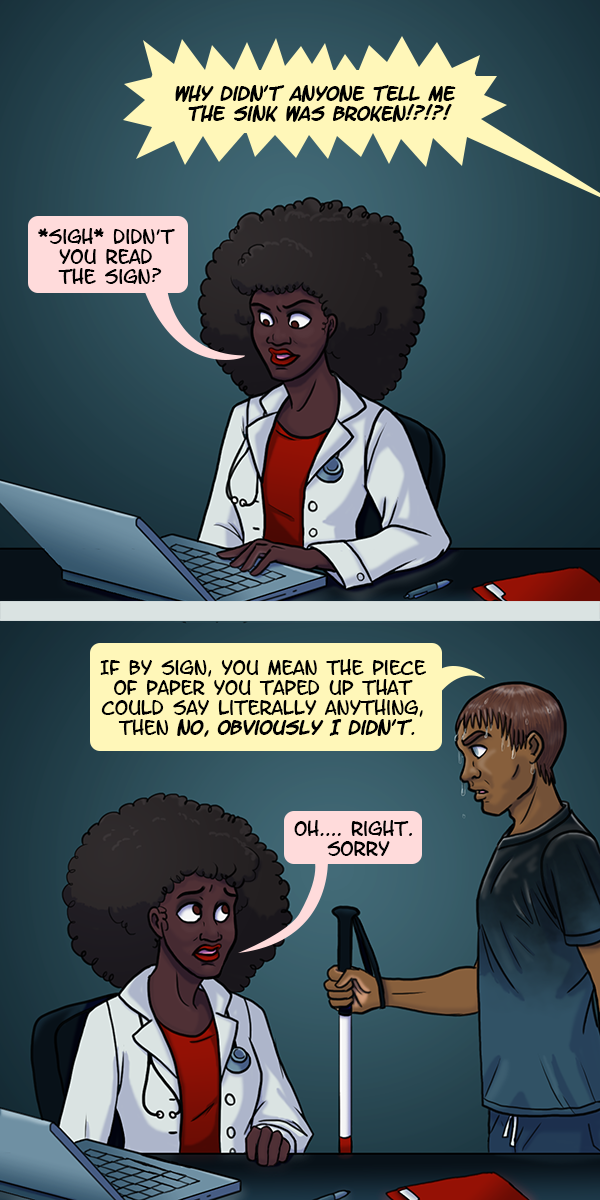
In the first panel, a doctor is looking at her laptop when she hears a nurse yell off screen “Why didn’t anyone tell me the sink was broken!?!?!” Irritated, she responds, “*sigh* didn’t you read the sign?” In the second panel we see the nurse, who is blind and holding a cane, soaking wet from the malfunctioning sink. He snaps “If by sign, you mean the piece of paper you taped up that could say literally anything, then NO, OBVIOUSLY I DIDN’T.” Sheepish, the doctor says “Oh.... right. Sorry.”

Other pet peeves of the visually impaired include the little stickers on fruit and people who ask them to guess who they are by their voice. Seriously, don’t do that.

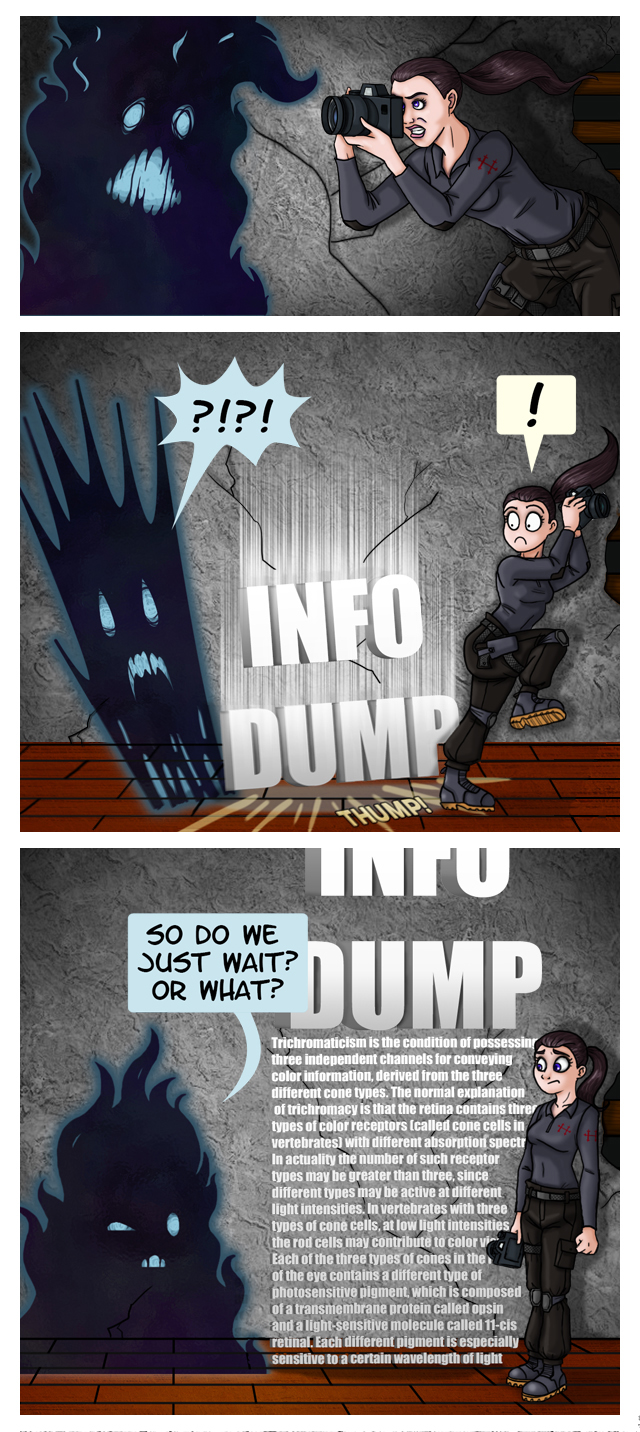
As for the story itself, it’s definitely a thriller, and a well written one. I couldn’t put Girl, Stolen down and ended up finishing it in only a few sittings (and that’s only because I was interrupted by annoying grown up responsibilities). Yeah, I know I haven’t gone over the writing that much, but honestly, I can’t really get into the plot without also going into spoiler territory, and part of what makes this story so great is the suspense. Of course, there are still a few flaws. Usually Henry is able to blend the backstory of the characters smoothly into the story, but it does get bogged down by random info dumps in a few places. I like when I learn new things from books, but not when they’re awkwardly shoehorned in. You don’t need to stop the story to explain what vehicle identification numbers are, I could have just Googled “VIN” if I didn’t know.  Nor do we need a completely unnecessary explanation of what the Nike company is. In fact, why even bother using a real company in your book if you then have to explain what they do? Thankfully these instances are few and far between. The two main characters were interesting and well written, but everyone else was pretty bland, especially Griffin’s one-dimensional, evil father. 


Oh, and for any readers who are visually impaired, the audiobook narrator, Kate Rudd does a pretty good job, though she does seem to struggle with male voices (some of them sound pretty silly), which can be distracting during a suspenseful scene. But for the most part it’s well acted; Cheyenne sounds great, and Rudd really makes the listener feel the tension. A sequel, Count all her Bones, came out this past May.

The Drowning Girl by Caitlín R. Kiernan

The Drowning Girl by Caitlín R. Kiernan

Formats: Print, audio, digital

Publisher: Penguin

Genre: Monster, Werewolf, Romance, Ghosts/Haunting, Psychological Horror, Mystery

Audience: Adult/Mature

Diversity: Lesbian characters, trans character, mentally ill character

Takes Place in: Northeastern USA

Content Warnings (Highlight to view): Mental Illness, Self-Harm, Mentions of Transphobia, Suicide, Emotional Abuse 

Please note, I found out recently that Caitlín R. Kiernan has expressed racist and Zionist views on Twitter, explored here. I will leave the reivew up for now, but can no longer reccomend her books.

The Drowning Girl is a beautifully written, psychological horror novel about a young woman, Imp, whose schizophrenia is making it difficult for her to determine the nature of the mysterious woman haunting her. Is she a siren using her charm to lure Imp to disaster? A werewolf? A human stalker who can blur the lines of reality? Imp struggles to sort out the truth before she loses herself. Queer romance, myths, and art combine to create this award winning novel.

So did I like it? Well……. Sort of?

In theory I should have loved it. It takes place on my home turf of New England, the main character is a queer artist (like me!), she’s dating an incredibly well written trans character, the story has a creepy mystery, gorgeous imagery, and one of the best representations of mental illness I’ve ever read. But I struggled to get through the Drowning Girl. I’d pick it up, read a chapter, and then forget about it for a month. I don’t know why I didn’t devour this book as quickly as I do others, there wasn’t really anything I disliked about it, and it wasn’t boring, but it just didn’t seem to capture my attention. It reminded me of one of those award winning art films that critics love and you have to sit through in college film classes. There’s nothing bad about it per se, but you’d still rather be watching Bad Boys II, or some other equally ridiculous action flick.

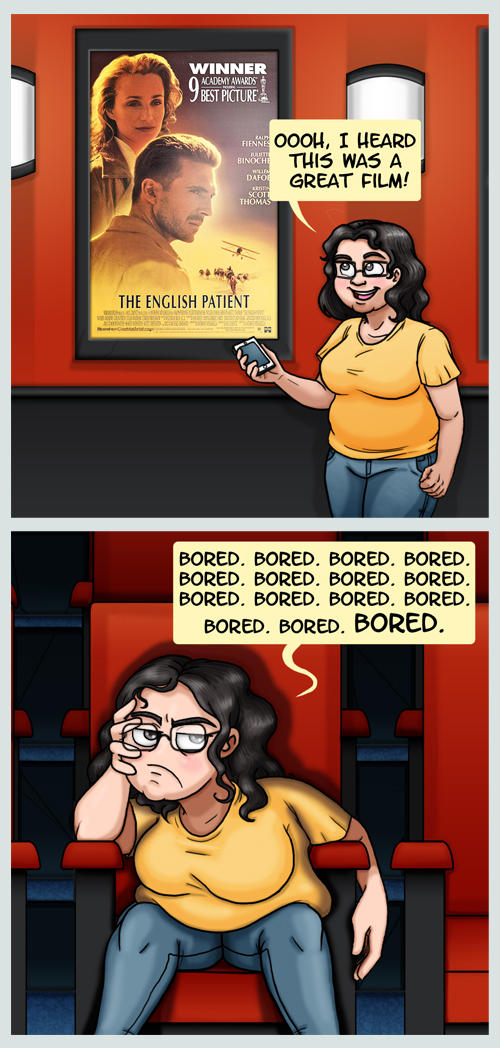
In the first panel I'm in the hallway of a movie theater looking at a poster for "The English Patient" and saying "Oooh, I heard this was a great film!" In the next panel I'm in the theater looking completely disinterested, and repeating "bored, bored, bored, bored" over and over as I suffer through the movie.

Ugh, I should’ve just watched Sharknado again.

Maybe I’m just not sophisticated enough to appreciate the non-linear, stream of conciseness (i.e. all over the place) writing, or perhaps I’m too clueless to fully comprehend the subtly and symbolism of the story. But I found it really jarring to have Imp describe her girlfriend, Abalyn, play Kingdom Hearts one minute, and then have a poetic, jumbled passage full of fairy tale metaphors the next. And I get it, the writing style is intended to represent Imp’s mental illness by showing the disorganization of her thought process, the random associations she makes where none exist, and her difficulty remembering what’s real and what’s imagined. But that doesn’t always make for an enjoyable read.

I guess I’m just incredibly picky when it comes to “artsy” prose and magical realism. When it works, it works well, but when it doesn’t, it just becomes a confusing, irritating erratic mess, and with the Drowning Girl it was kind of a crap shoot.

I'm floating upside down in blue space, surrounded by dreamlike imagery of a crow wearing a cloak, a close-up of a crescent moon, a wolf's skull, pills, a crab, and a mermaid with pale, corpse-like skin. The mermaid's human half is intact but her fish half is nothing but bone. Her organs hang out of her human torso. I look confused and mutter

WTF is going on? Did I take expired cold medicine again?

Since I’m starting to feel bad for picking on this book so much (and it’s by no means a bad book), I want to address one of the things I did really like about the story, how Imp’s mental illness was treated. It wasn’t romanticized, it was just a part of her that could make her life more challenging, but not horrible. Medication made her illness manageable, but didn’t make it disappear entirely, and she was able to continue working, date, hang out with friends, pursue hobbies, and lived on her own. She would go through rough patches, some she could handle on her own, and some she couldn’t. Her therapist was supportive, without telling Imp what to do. Overall, I felt like it was a very realistic depiction of a woman with a mental illness, which is rather uncommon in fiction where the mentally ill are usually written as either asylum inmates, criminals, or manic pixie dream girls.

Overall, I really, really wanted to love this one. It had all the right ingredients, rave reviews, a talented author, but the final result was disappointing, at least for me. It wasn’t bad, but I just couldn’t bring myself to give it a “highly recommended”. That doesn’t mean other people won’t find this book amazing, and I strongly encourage others, especially those with more sophisticated taste than mine, to give it a read. Because you may love it. Or you may find it “meh”, but at least you won’t regret reading it.

Navigation

Social Media

Search by Tags

To learn more about the Age Group, Diversity, and Genre tags, click here.

Age Groups

Diversity

Genre

Support the Blog

Search

Links

Girl, Stolen by April Henry

Girl, Stolen by April Henry

Formats: Print, audio, digital

Genre: Thriller

Audience: Y/A

Diversity: Disability (Vision Impairment, Cognitive, Learning Disability)

Takes Place in: Oregon, USA

Content Warnings (Highlight to view):  Abelism, Alcohol Abuse, Animal Abuse, Animal Death, Bullying, Child Abuse, Death, Drug Use/Abuse, Forced Captivity, Gaslighting, Illness, Medical Procedures, Physical Abuse, Mentions of Rape/Sexual, Slurs, Verbal/Emotional Abuse, Violence

Blurb

Sixteen-year-old Cheyenne Wilder is sleeping in the back of the car while her step mom fills a prescription for antibiotics. Before Cheyenne realizes what’s happening, the car is being stolen.

Griffin hadn’t meant to kidnap Cheyenne and once he finds out that not only does she have pneumonia, but that she’s blind, he really doesn’t know what to do. When his dad finds out that Cheyenne’s father is the president of a powerful corporation, everything changes–now there’s a reason to keep her.

How will Cheyenne survive this nightmare?

As you can probably guess, Cheyenne is not having a good day. Though her kidnapper’s, Griffin, isn’t going much better. The story alternates between the points of view of these two main characters, as they anxiously stumble their way through a bad situation. Cheyenne, who has been blind for about three years following a car accident, describes her world in sounds, smells, and sensations. Sick, feverish, and stranded without her guide dog and cane, she does her best to outwit her captors and survive her terrifying ordeal. Meanwhile, Griffin, who’s almost as panicked as Cheyenne, struggles between listening to his conscience and obeying his abusive, criminal father. You can sense his denial, born from years of abuse, his desperation for love and acceptance, and the fear that’s holding him back. The two characters, both trapped in terrible situations, form an unlikely bond as they nervously wait for Griffin’s father to make a decision.

Not having any sort of severe visual impairment myself (other than my corrective lenses), I can’t say how accurate April Henry’s depiction of a blind/low vision person is. But Cheyenne’s disability does seem to be well pretty researched, as far as I can tell anyway. For example, Cheyenne still has some of her peripheral vision in one eye, a nice touch since about 85% of legally blind people have at least some light and/or form perception, and complete blindness is relatively rare. And the description of how a guide dog and its owner work together sounded pretty accurate, at least from what I’ve read. She doesn’t fall victim to any of the common blindness tropes either. Then there’s this reviewer, who is herself blind, and says the portrayal of Cheyenne’s visual impairment is pretty spot on, and relatable. So there you go.

A blind/low vision man examining a hideous jacket and tells his friend “this is the ugliest effin’ jacket I have ever seen, it looks like you stole it off a patriotic clown. Please burn this immediately for the good of humanity.” Annoyed, his friend responds “You’re blind, how can you even tell what it looks like?” “Dude, I’m not that blind, though I might lose all of my vision if I have to look at this thing any longer.” “Why are you so salty?”

He’s salty because people keep accusing him of “faking” his blindness just because he can sort of see things six inches from his face with one of his eyes.

Henry could have easily made her heroine a broken bird that readers pitied, or turned the story into inspiration porn, but she doesn’t. Instead, Cheyenne is characterized as a young woman who went through a traumatic event, which understandably caused her to grieve, and then has to adapt to a completely different way of interacting with the world which is challenging, but certainly not anything extraordinary. Cheyenne works with her therapist and teachers to pull herself out of her depression and learn a new skill set, all without becoming a “feel good” story for sighted readers. She isn’t sweet and chipper about it either, our heroine gets frustrated, feels sorry for herself, lashes out, and gets grumpy. She’s allowed to be a flawed person, instead of some sort of blind saint who forgives the ableists. Although she now relies much more on sound, smell, and touch to function, her senses are the same as before, Cheyenne just learns to pay more attention to them, as oppose to getting magically heightened senses that turn her into a ninja. And yes, Cheyenne is feeling weak and helpless after being kidnapped, but this is due to being severely ill with pneumonia, not her low vision. And even sick and terrified, she’s still a tough, resourceful character.

Speaking of blind ninjas, did you know Daredevil and the Teenage Mutant Ninja Turtles share an origin story? It has nothing to do with Girl, Stolen, it’s just cool.

Griffin, meanwhile, is complex and interesting. You can’t help but feel bad for the guy, even if Cheyenne isn’t in a position to be sympathetic, and Henry doesn’t try to excuse his actions by invoking pity in the reader (Henry never tries to get you to feel sorry for the characters, she just presents the facts of their lives). Poor Griffin’s mom left when he was young, his dad is an abusive alcoholic who forces him into a life of crime, and he has basically zero support system. We find out later that he’s Dyslexic, though unaware of it, and was forced to drop out of school because he struggles with reading. It’s an interesting contrast to Cheyenne, who comes from a wealthy background and goes to a private school that’s able to accommodate her. After her accident she had private nurses who cared for her in her home. Her father sent her to a special program where she learned how to function independently without her vision. They’re able to afford a guide dog so Cheyenne can get around. Ideally, all people with disabilities would have the same access to accommodations that Cheyenne does, but unfortunately that’s simply not the case, especially for people with low incomes or living in poverty. Griffin is one of those kids who slips through the cracks. He was never tested for Dyslexia, and his teachers and father apparently wrote him off, he gets zero help with his reading skills and is forced to drop out of school, believing his only option in life is to be a criminal like his father. Although Henry isn’t heavy handed about it, she makes clear what a world of difference it makes when people have access to proper accommodations, a constant source of frustration for anyone with a disability. Seriously, go on any disability website, and you will see a legion of posts about the daily frustration and obstacles that able-bodied and neurotypical people don’t even notice, not to mention the constant struggles with health insurance and trying to get accommodations approved at school and work.

In the first panel, a doctor is looking at her laptop when she hears a nurse yell off screen “Why didn’t anyone tell me the sink was broken!?!?!” Irritated, she responds, “*sigh* didn’t you read the sign?” In the second panel we see the nurse, who is blind and holding a cane, soaking wet from the malfunctioning sink. He snaps “If by sign, you mean the piece of paper you taped up that could say literally anything, then NO, OBVIOUSLY I DIDN’T.” Sheepish, the doctor says “Oh.... right. Sorry.”

Other pet peeves of the visually impaired include the little stickers on fruit and people who ask them to guess who they are by their voice. Seriously, don’t do that.

As for the story itself, it’s definitely a thriller, and a well written one. I couldn’t put Girl, Stolen down and ended up finishing it in only a few sittings (and that’s only because I was interrupted by annoying grown up responsibilities). Yeah, I know I haven’t gone over the writing that much, but honestly, I can’t really get into the plot without also going into spoiler territory, and part of what makes this story so great is the suspense. Of course, there are still a few flaws. Usually Henry is able to blend the backstory of the characters smoothly into the story, but it does get bogged down by random info dumps in a few places. I like when I learn new things from books, but not when they’re awkwardly shoehorned in. You don’t need to stop the story to explain what vehicle identification numbers are, I could have just Googled “VIN” if I didn’t know.  Nor do we need a completely unnecessary explanation of what the Nike company is. In fact, why even bother using a real company in your book if you then have to explain what they do? Thankfully these instances are few and far between. The two main characters were interesting and well written, but everyone else was pretty bland, especially Griffin’s one-dimensional, evil father. 


Oh, and for any readers who are visually impaired, the audiobook narrator, Kate Rudd does a pretty good job, though she does seem to struggle with male voices (some of them sound pretty silly), which can be distracting during a suspenseful scene. But for the most part it’s well acted; Cheyenne sounds great, and Rudd really makes the listener feel the tension. A sequel, Count all her Bones, came out this past May.

The Drowning Girl by Caitlín R. Kiernan

The Drowning Girl by Caitlín R. Kiernan

Formats: Print, audio, digital

Publisher: Penguin

Genre: Monster, Werewolf, Romance, Ghosts/Haunting, Psychological Horror, Mystery

Audience: Adult/Mature

Diversity: Lesbian characters, trans character, mentally ill character

Takes Place in: Northeastern USA

Content Warnings (Highlight to view): Mental Illness, Self-Harm, Mentions of Transphobia, Suicide, Emotional Abuse 

Please note, I found out recently that Caitlín R. Kiernan has expressed racist and Zionist views on Twitter, explored here. I will leave the reivew up for now, but can no longer reccomend her books.

The Drowning Girl is a beautifully written, psychological horror novel about a young woman, Imp, whose schizophrenia is making it difficult for her to determine the nature of the mysterious woman haunting her. Is she a siren using her charm to lure Imp to disaster? A werewolf? A human stalker who can blur the lines of reality? Imp struggles to sort out the truth before she loses herself. Queer romance, myths, and art combine to create this award winning novel.

So did I like it? Well……. Sort of?

In theory I should have loved it. It takes place on my home turf of New England, the main character is a queer artist (like me!), she’s dating an incredibly well written trans character, the story has a creepy mystery, gorgeous imagery, and one of the best representations of mental illness I’ve ever read. But I struggled to get through the Drowning Girl. I’d pick it up, read a chapter, and then forget about it for a month. I don’t know why I didn’t devour this book as quickly as I do others, there wasn’t really anything I disliked about it, and it wasn’t boring, but it just didn’t seem to capture my attention. It reminded me of one of those award winning art films that critics love and you have to sit through in college film classes. There’s nothing bad about it per se, but you’d still rather be watching Bad Boys II, or some other equally ridiculous action flick.

In the first panel I'm in the hallway of a movie theater looking at a poster for "The English Patient" and saying "Oooh, I heard this was a great film!" In the next panel I'm in the theater looking completely disinterested, and repeating "bored, bored, bored, bored" over and over as I suffer through the movie.

Ugh, I should’ve just watched Sharknado again.

Maybe I’m just not sophisticated enough to appreciate the non-linear, stream of conciseness (i.e. all over the place) writing, or perhaps I’m too clueless to fully comprehend the subtly and symbolism of the story. But I found it really jarring to have Imp describe her girlfriend, Abalyn, play Kingdom Hearts one minute, and then have a poetic, jumbled passage full of fairy tale metaphors the next. And I get it, the writing style is intended to represent Imp’s mental illness by showing the disorganization of her thought process, the random associations she makes where none exist, and her difficulty remembering what’s real and what’s imagined. But that doesn’t always make for an enjoyable read.

I guess I’m just incredibly picky when it comes to “artsy” prose and magical realism. When it works, it works well, but when it doesn’t, it just becomes a confusing, irritating erratic mess, and with the Drowning Girl it was kind of a crap shoot.

I'm floating upside down in blue space, surrounded by dreamlike imagery of a crow wearing a cloak, a close-up of a crescent moon, a wolf's skull, pills, a crab, and a mermaid with pale, corpse-like skin. The mermaid's human half is intact but her fish half is nothing but bone. Her organs hang out of her human torso. I look confused and mutter

WTF is going on? Did I take expired cold medicine again?

Since I’m starting to feel bad for picking on this book so much (and it’s by no means a bad book), I want to address one of the things I did really like about the story, how Imp’s mental illness was treated. It wasn’t romanticized, it was just a part of her that could make her life more challenging, but not horrible. Medication made her illness manageable, but didn’t make it disappear entirely, and she was able to continue working, date, hang out with friends, pursue hobbies, and lived on her own. She would go through rough patches, some she could handle on her own, and some she couldn’t. Her therapist was supportive, without telling Imp what to do. Overall, I felt like it was a very realistic depiction of a woman with a mental illness, which is rather uncommon in fiction where the mentally ill are usually written as either asylum inmates, criminals, or manic pixie dream girls.

Overall, I really, really wanted to love this one. It had all the right ingredients, rave reviews, a talented author, but the final result was disappointing, at least for me. It wasn’t bad, but I just couldn’t bring myself to give it a “highly recommended”. That doesn’t mean other people won’t find this book amazing, and I strongly encourage others, especially those with more sophisticated taste than mine, to give it a read. Because you may love it. Or you may find it “meh”, but at least you won’t regret reading it.

Navigation

Social Media

Search by Tags

To learn more about the Age Group, Diversity, and Genre tags, click here.

Age Groups

Diversity

Genre

Support the Blog

Search

Links