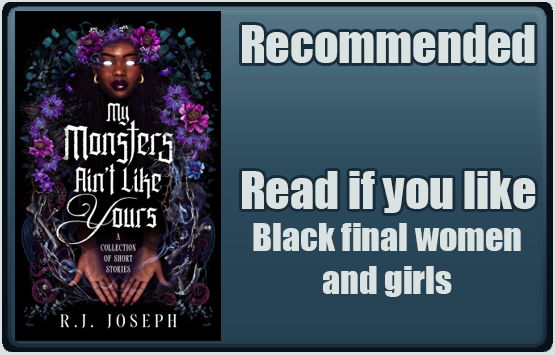
Formats: Print, audio, digital
Publisher: Quill & Crow Publishing House
Genre: Eldritch Horror, Folk Horror, Ghosts/Haunting, Historic Horror, Monster, Zombie
Audience: Adult
Diversity: Black, African/American characters and author, queer and bisexual characters
Takes Place in: Texas
Content Warnings (Highlight to view): Animal Abuse, Animal Death, Body Shaming, Cannibalism, Child Abuse, Child Death, Child Endangerment, Childbirth, Death, Drug Use/Abuse, Forced Captivity, Incest, Miscarriage, Oppression, Pedophilia, Physical Abuse, Racism, Rape/Sexual Assault, Sexism, Sexual Abuse, Slut-Shaming, Suicide, Torture, Verbal/Emotional Abuse, Violence, Vomit
Blurb
At its core, the horror genre is an effective vehicle for exploring human behavior. From within its terrifying boundaries, and lack thereof, we can examine monstrosity. We can determine how monsters are labeled, analyze the actions of those deemed monstrous, and prophesy the impacts this labeling and actions have on the world around us.
Monsters are personal. Monsters are universal. These facts create an intriguing juxtaposition where the things deemed monstrous or frightening can be shaped by personal experiences, while also representing many aspects of the human condition; our fears are much more similar than dissimilar. This means my monsters are absolutely like yours: they are our collective nightmares.
My Monsters Ain’t Like Yours reflects this irony through Black feminist intersectional horror at its rawest.
I received this product for free in return for providing an honest and unbiased review. I received no other compensation. I am disclosing this in accordance with the Federal Trade Commission’s 16 CFR, Part 255: Guides Concerning the Use of Endorsements and Testimonials in Advertising.
While many of the monsters in the collection are supernatural (Suffer the Little Children, The Crazy with Daisy, Higher Education, Something Wicked Came for Me, Welcome, Skinny Minnie, Sweet Sunday Supper Smile, etc.) the most terrifying ones are the human monsters (Regrets Never Die, The Collector, Sweet Sunday Supper Smile, Her Heart’s Desire, No Tricks Only Treats, The Preying Family, Sad, Spooky Sally, etc.). Interestingly, some of the supernatural monsters are friendly and helpful creatures/spirits who protect the protagonists from other monsters, both literal and figurative. Humans, after all, are much worse than some imagined creature. Then there are the metaphorical “monsters” of grief, loneliness, and trauma that haunt the protagonists.
There are a lot of bad heterosexual relationships in the anthology. These range from Where the Horizon Kisses the Sky in which the husband is neglectful, Endless Possibilities where he’s a selfish loser, to Her Heart’s Desire where he’s outright abusive towards his wife. In all these stories the wife yearns for something better and uses supernatural means to get it, with varying degrees of success. In The Badly Terrible, Absolute Worst she doesn’t even get that chance. But queer relationships, like in The Crazy with Daisy and Witness Bearer, are shown in a more positive light. A report by the Institute for Women’s Policy Research and the National Domestic Worker’s Alliance states that “More than 40 percent of Black women experience physical violence by an intimate partner during their lifetimes (41.2 percent), compared with 31.5 percent of all women.” And a study published in the Lancet reported that Black women are also nearly six times as likely to be murdered than white women. Thankfully there are resources like Ujima that support Black women who are in domestic violence situations, even as the justice system continues to fail them.
In Endless Possibilities and Her Heart’s Desire the wife herself becomes a monster to escape her bad marriage, and in the latter, get revenge on her horrible husband. Then there’s Tanita in The Collector, a serial killer who murders for the fun of it. There’s something incredibly satisfying about women embracing their monstrosity and rage, especially Black women. Those with marginalized identities are often cast as monsters in other people’s stories so why not reclaim the title? I especially like that feminine monstrosity in Endless Possibilities and Her Heart’s Desire is not tied to sexuality. While I appreciate women like Tanita reclaiming their sexuality and using it to seduce and murder men à la Jennifer’s Body (2009) and The Hunger (1983) sometimes it feels like the majority of female monsters are temptresses ( leading men to their death. And it can start to get a little old.
Can’t they just be horrible and violent without wanting to have sex with their victim? Plus, there’s the unfortunate implication that women who have sex on their own terms are evil and they go against the natural order of things by overpowering men. So, I appreciated that Joseph gave us some nice variety. The book even has monstrous children (#GIRLMOM and Suffer the Little Children) though in both cases the children are embraced by the main character rather than shunned for the monstrosity.
Sweet Sunday Supper Smile and No Tricks Only Treats are stories containing child abuse, though the abusers get their comeuppance in both. Then there’s Sad, Spooky Sally which is especially disturbing, so much so that it comes with its own set of content warnings before the chapter, rather than in the index. It’s an absolutely heart-breaking story with a bittersweet ending and one of my favorites in the collection. But it’s also very triggering, so make sure you check out those content warnings before reading it. The same goes for Regrets Never Die and Witness Bearer. They’re both very dark, with the latter being about a girl who can see the worst things a person has ever done. She witnesses some truly awful memories, so I appreciate that Joseph included content warnings for all the stories in the book’s index.
Those who Teach Pay Knowledge Forward stood out in the collection, as it was sweet rather than scary, A ghost story where the ghosts aren’t the source of fear. It also had a nice message about helping to educate the next generation so they can succeed. I love how so many of the Black women in the collection are intelligent and well educated, ranging from college students (The Collector) and graduate students (Whole New World), to teachers (Those Who Teach Pay Knowledge Forward) and college professors (Grand Opening, Higher Education, Something Wicked Came for Me). The young woman in Important Things is sent on an all expenses paid trip to Palm Springs for a symposium because she excels in her high school classes. In 1995 14% of Black women between 25 to 34 held a bachelor’s degree compared to 38% in 2024 according to the Pew Research Center.
There are so many great stories in the collection, I’d be pressed to pick a favorite, though I did especially enjoy Regrets Never Die, #GIRLMOM, Endless Possibilities, Those Who Teach Pay Knowledge Forward, and Something Wicked Came for Me. While Black women and children’s trauma is a reoccurring theme of My Monsters Ain’t Like Yours, it’s not the only focus of the anthology. If every story were about Black trauma and abuse, it honestly may have been too much for me. Instead, Joseph includes a bunch of fun, spooky stories to offset the heavier stuff so the collection never feels too dark and depressing. Instead, we get a nice balance.
I really liked this because while horror is a great way to process trauma, Black horror shouldn’t be pigeonholed into stories of Black pain. I love Get Out (2017), it’s one of my favorite films, but if that was the only kind of Black horror story told by Hollywood, it would start to feel like the suffering of Black people was being fetishized for entertainment. There’s a reason why Peele’s next two films, Us (2019) and Nope (2022) aren’t rooted in Black trauma. So, while there are plenty of stories about abuse, bad relationships, and the general mistreatment of Black women and children, there are also enough tales about living mannequins, small fanged creatures, and ghosts to offer the reader a breather.



0 Comments