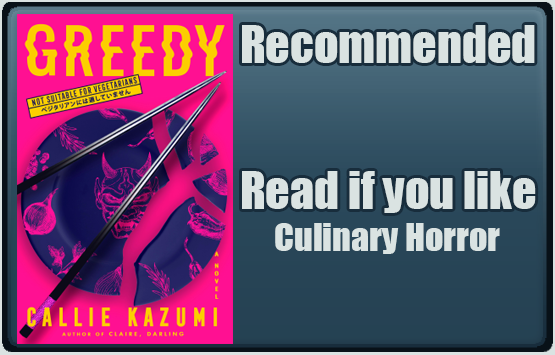
Formats: Print, audio, digital
Publisher: Bantam
Genre: Psychological Horror
Audience: Adult
Diversity: Multiracial (hafu) Japanese-British author and major character, Japanese minor characters
Takes Place in: Japan
Content Warnings (Highlight to view): Alcohol Abuse, Animal Death, Body Shaming, Bullying, Cannibalism, Child Death, Death, Drug Use/Abuse, Eating Disorder, Suicide, Violence, Vomit
Blurb
Ed accepts the job. He hasnʼt earned any Michelin stars, but he knows his way around a kitchen. Leaving his life in Tokyo behind, he departs for an opulent estate in the mountains owned by the enigmatic and reclusive Hazeline Yamamoto, a disgraced socialite with a predatorʼs smile and an exacting palate. Hazelineʼs world is one of taste, connoisseurship, and experimentation—she is a certified gourmand. But when you can afford filet mignon for every meal, you begin to seek out the strange and forbidden.
The closer Ed gets to Hazeline and the brighter future that she promises—if he remains loyal—the nearer he is to realizing the chilling truth about her altruism. In this shadow world of unimaginable wealth, there are worse monsters than two-bit gangsters. The wind blowing through Hazeline’s home carries the sound of screaming, and Ed finds himself feeding all kinds of beasts.
Perfect for fans of Parasite and The Menu—enticing as a starter, meaty as a main dish, and full of satisfying just-desserts—Greedy is a suspenseful poison-pen note to classism and an ode to Japanese cuisine, a horror-tinged thriller unsuitable for vegetarians but full of shocking delights for every reader.
I received this product for free in return for providing an honest and unbiased review. I received no other compensation. I am disclosing this in accordance with the Federal Trade Commission’s 16 CFR, Part 255: Guides Concerning the Use of Endorsements and Testimonials in Advertising.
Food-centric horror always makes me hungry, and this one had me craving meat. There’s a reason the cover warns it’s not safe for vegetarians.
Ed is a British ex-pat living in Japan with his Japanese wife, Sayuri, and their young daughter, Kaori. After traveling to Japan and falling head over heels for Sayuri, he lands a sales job at an English-speaking company. Unfortunately, COVID hits the company hard, and Ed gets laid off. Instead of job hunting, he starts spending the day at pachinko parlors and soon becomes addicted to the rush of gambling. Now Ed has wasted their savings, developed a significant gambling debt, and gotten involved with the yakuza, all of which he hides from his wife. He knows Sayuri will never forgive him if she finds out, but his lack of a job and the financial strain on their family is already causing marital tension. Desperate for money, Ed finally spots a job ad in the newspaper which may be the answer to his prayers. A high-profile businesswoman needs a discreet personal chef and is willing to pay one million yen a day (around $6,345 USD) to the right person. While not officially trained in the culinary arts, Ed spent time working as a sous chef at a few terrible restaurant chains in England and his wife has taught him to cook Japanese dishes, so he figures he can bullshit his way through an interview.
I liked how Ed is a flawed yet sympathetic character. His addiction was presented not as a moral failing (that would be Ed’s decision to lie to his wife), but as an illness. Most forms of gambling are illegal in Japan, but gambling addiction is still a huge problem, especially after COVID-19 when more people turned to overseas online gambling. Currently, it’s estimated that there are about 1.97 million people in Japan who actively use online casinos. Some even take yami baito or “dark part-time jobs” to pay for their gambling debt. These jobs, often advertised online, promise lots of quick cash for seemingly easy tasks, but don’t mention they require illegal activities. You would think that Ed would be concerned that this too good to be true job as a personal chef might actually be a yami baito, but as we quickly learn, Ed tends to ignore clear warning signs.
*trigger warning for discussions of body size and eating disorders*
It turns out the high-profile business woman is none other than Hazeline Yamamoto, a wealthy recluse and the widow of billionaire Botan Yamamoto. Ed is surprised by how Western Hazeline is, rejecting both restraint and conformity, things typically valued in Japanese society. She tells Ed about being growing up hāfu in Japan, a term used to describe people who have one Japanese parent and one non-Japanese parent. Like the author, who is the daughter of a Japanese mother born and raised in Brazil and a Scottish and Columbian father, both Hazeline Yamamoto and Ed’s daughter have one Japanese parent and one non-Japanese parent. In Hazeline’s case her mother was a British model and her father a Japanese businessman. On top of the struggles of being mixed race in a homogenous society, Hazeline was also bigger than her Japanese classmates. She was bullied for being “chubby” and not fitting into Japanese clothing, despite not being overweight by western standards.
In Japan, less than 40% of adults are considered overweight, and Japan has one of the lowest obesity rates in the world, most likely due to walkable cities and the traditional Japanese diet being so healthy. The average size for a Japanese woman is 1.58 m (5’2”) and 55.3 kg (122 lbs) according to World Data, while women in the UK are on average 1.64 m (5’4”) and 73.6 kg (162 lbs).
On the flip side, over 10% of Japanese women are underweight, and for women in their twenties, one in five are underweight. Hazeline felt so pressured to be thin that, in order to fit in, she became anorexic. There’s unfortunately a lot of stigma surrounding eating disorders in Japan and a lack of support for those who have them.
But after her husband died, Hazeline realized she was sick and tired of being hungry all the time and living as a hermit meant there was no one to care about Hazeline’s body. She tells Ed that the only joy she had left is from the food she consumes. “What use is dying skinny and hungry? When I join Lucifer, I shall be plump and happy, and I can’t bring myself to give a damn what anyone thinks about it.” And that’s where Ed comes in.
*end trigger warning*
Hazeline wants Ed to prepare her exquisite, inventive meals. As Hazeline puts it “I don’t eat to survive, I eat to savor. It should always be worth it, every mouthful a justification for my body.” She especially loves meat and tells Ed “…a meal without meat is merely a side dish.” When Ed serves her duck with plum jam as part of his interview, Hazeline very proudly tells him how she killed and gutted it herself. Kazumi touches on the Burakumin during her story, a historically “outcaste” or “untouchable” social class, occupying the lowest level of the feudal Japanese social hierarchy.
The Burakumin are those descended from people employed in occupations considered taboo by orthodox Shintō and Buddhism beliefs about not killing living things or touching the dead. So, undertakers, executioners, leatherworkers, and, of course, butchers. Discrimination against those who work as butchers continues in Japan to this day. So, it’s weird that Hazeline has a philosophy that it’s good practice to kill your meals yourself. As the final step of his interview Ed must slaughter a chicken for food.
I didn’t like that the Japanese words were italicized. When non-English words are italicized, I feel it labels them as “exotic” and other. Editor Natalia Iwanek goes into detail about why italicizing non-English words is problematic here. I suspect, however, that this was the editor’s decision rather than the author’s. There is a glossary in the back of the book of Japanese words used in the book, which is helpful as Kazumi doesn’t have to interrupt the flow of the story to explain the words to an English-speaking audience who may not be familiar with what an izakaya is or what majide means.
It’s pretty evident what the “big reveal” of the book is early on, and most readers will quickly figure out what Ed is trying so hard to deny. Somehow, that makes it even more suspenseful because you KNOW what’s going to happen, but that doesn’t stop you from praying it won’t. It’s horrible, like watching a car crash in slow motion. You’re screaming at Ed to figure it out and get out of there, but he keeps dismissing the very apparent red flags. Even though there wasn’t any obvious horror until the end of the book, and not much on-page violence, my anxiety levels were through the roof, dreading what was coming. Greedy is a book that I absolutely devoured (pun intended).




0 Comments