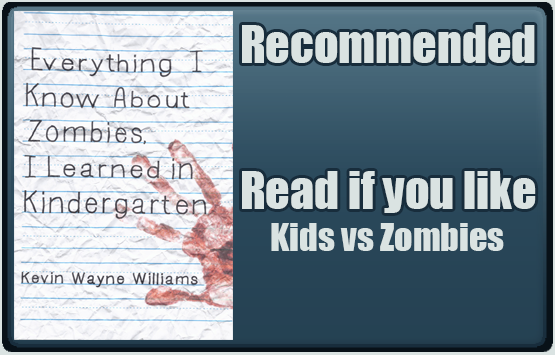
Everything I Know About Zombies I Learned in Kindergarten by Kevin Wayne Williams

Everything I Know About Zombies I Learned in Kindergarten by Kevin Wayne Williams

Formats: Print, digital

Publisher: Mott Haven Books

Genre: Apocalypse/Disaster, Blood & Guts, Zombie

Audience: Adult/Mature

Diversity: Black/African American/Caribbean American characters, Trinidad, Jamacian, Hispanic/Latinx characters

Takes Place in: New York City, USA

Content Warnings (Highlight to view): Abelism, Animal Abuse, Animal Death, Body Shaming, Bullying, Cannibalism, Child Death, Child Endangerment, Death, Drug Use/Abuse, Forced Captivity, Gore,  Medical Procedures, Miscarriage, Racism, Rape/Sexual Assault, Slurs, Suicide, Violence

Blurb

Finalist for Foreword Reviews’ IndieFab Novel of the Year for Multicultural fiction and Horror. Even before the apocalypse, nine-year-old Letitia Johnson’s life had never been simple. Shuttled from foster home to foster home in the impoverished neighborhood of Mott Haven, it was all she could do to keep track of her little sister. When the apocalypse came, she tried to keep her sister’s kindergarten safe by locking them all in a tiny school bathroom, hiding while they waited for a rescue that never came. For five days, they hid. They hid while their teachers were being eaten, while their classmates were being killed. They hid while the Bronx was being evacuated. Now, there’s no one left to help them. There’s no place left to hide. It’s just her, one ax, twelve kindergarteners, twelve garden stakes, and a will to live.

While the cast of this novel is primarily children, the book is intended for adults and contains material unsuitable for younger readers.

When it comes to horror, kids come in two types. Either they’re sweet, innocent, completely helpless victims the protagonist needs to protect at all costs, or they’re evil little bastards that will send you into the cornfield, control you with their telepathic powers, or just straight up murder you because they’re the spawn ofSatan. The children in Everything I Know About Zombies I Learned in Kindergarten somehow land right dab in the middle of the victim/villain scale. They’re neither helpless nor innocent after being forced to go through things no child should go through, nor are they actively malicious, only killing for survival. They also don’t seem to possess the immunity to handle situations that most children do in horror stories. Kids get eaten by Zombies, shot, torn apart, and baby zombies get spiked in the head. So if you can’t stomach minors getting killed in fiction, I recommend staying far, far away from this book.

 Letitia, the nine-year-old protagonist, is easily the most competent, clever, and practical character in the book, organizing her little sister’s kindergartners into a unit of efficient zombie killers and quickly picking up survival skills. Growing up with a drug addicted mom, Letitia is used to taking charge and picking up adults’ slack, in addition to becoming wary of the world at a young age. In the early chapters, they try to look for the childrens’ parents, eager to be rid of such a heavy responsibility, only to discover their dickbag guardians all evacuated without them. (Who the hell just leaves their kid behind during a disaster? You’d think they’d at least make some effort to save them, damn.) The adult survivors actually pose more of a threat than the zombies (or cucos, as the children call them), their greed and despair claiming far more lives than the undead do. It’s weird, even though the children are far from innocent, having become skilled killers, the adults are the ones who’ve become morally bankrupt. The few who do manage to hold on to their optimism and naivety don’t last long, foolishly trusting the wrong people or refusing to admit the world, and the rules, have changed. The kids might be depressingly cynical and violent now, but they’re merely adapting to their new reality, and are much more practical than their grown counterparts. It’s no wonder the adults are so unnerved by them.
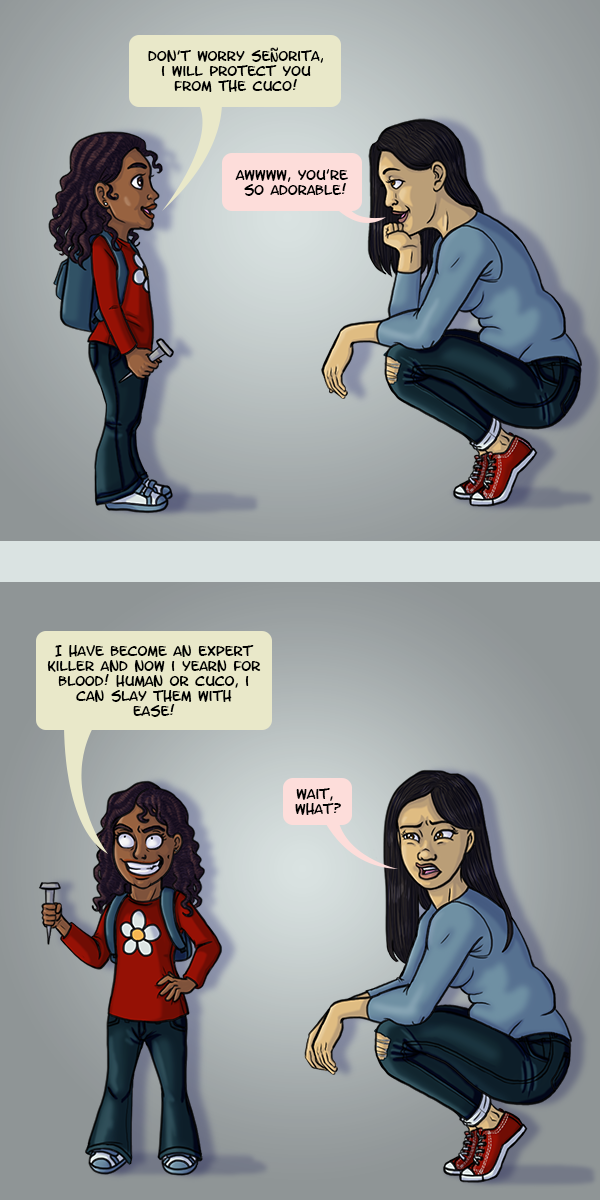
In the top panel, a little girl holding a spike is telling a grown woman “Don’t worry Señorita, I will protect you from the cuco!” The woman, bemused, responds “Awwww, you’re so adorable!” In the next panel the little girl brandishes her spike with a crazed grin and responds “I have become an expert killer and now I yearn for blood! Human or cuco, I can slay them with ease!” The woman, confused and concerned, asks “Wait, what?”

Some of the kids enjoy killing a little too much.

I was expecting the children being eaten by the undead to be the most disturbing part, until the book turned out to be about the death of innocence, and children being forced to adapt to a situation no child should ever go through. It’s one thing to read about fantastical monsters like Zombies attacking a bunch of helpless kids, but quite another when they’re dying from gun violence, or growing up in crushing poverty. In the first, the situation is pure fiction, no real child is ever going to be attacked by the undead, and you can feel safe in that knowledge. But it hits close to home when it comes to real world problems. Even if the children in the story are fictional, you know millions of real kids out there right now who are surrounded by abuse, violence, and probably living without basic necessities, and that’s super depressing. So basically, it’s a story about how kids with rough lives can’t rely on adults (because they’re either malicious, incompetent, or ignorant) and have to take charge of their own safety and survival, which probably would’ve ended up happening with or without undead hordes overtaking the city. I know zombie apocalypse stories are generally bleak, but damn.

 The zombies in the story are pretty much your typical Romero zombies, slow-moving and stupid, and not too difficult to kill as long as there aren’t a lot of them and their brains are destroyed, a feat which the children usually accomplish by stabbing them in the eye with garden stakes. Unfortunately, everyone becomes zombified upon death, regardless of how they die, so the undead multiply even if they can’t bite anyone. Letitia quickly figures out that the zombies are attracted to movement and sound, and is smart enough to stick to quiet, secluded areas, while the adults continue to attract the undead with the buzz of their emergency generators and gun fire (because the adults are somehow less competent than grade schoolers, another reason Letitia avoids them).

 Unfortunately for me, most of the book is dedicated to the practically of surviving in an abandoned New York City, wandering around and looting mini-marts for supplies…which made for less than stimulating reading. I’m going to admit right now, I don’t like camping or fishing, or any form of “roughing it,” and I don’t like reading about it, either. I’m pretty sure I’d die if I went for more than 40 minutes without WiFi.  So I’ve long ago accepted the fact that I would probably be the first person to die in a zombie apocalypse type situation due to my dependence on modern conveniences and comfort, and I’m okay with that. I’m sure some people will find all the survivor type stuff super interesting, as is evident from Discovery Channel’s programming, but I was hoping for way more suspense and undead violence, and less foraging and guinea pig farming. Speaking of which, there’s a decent amount of animal death too, apparently Zombies like to eat puppies as much as they like to eat little kids.
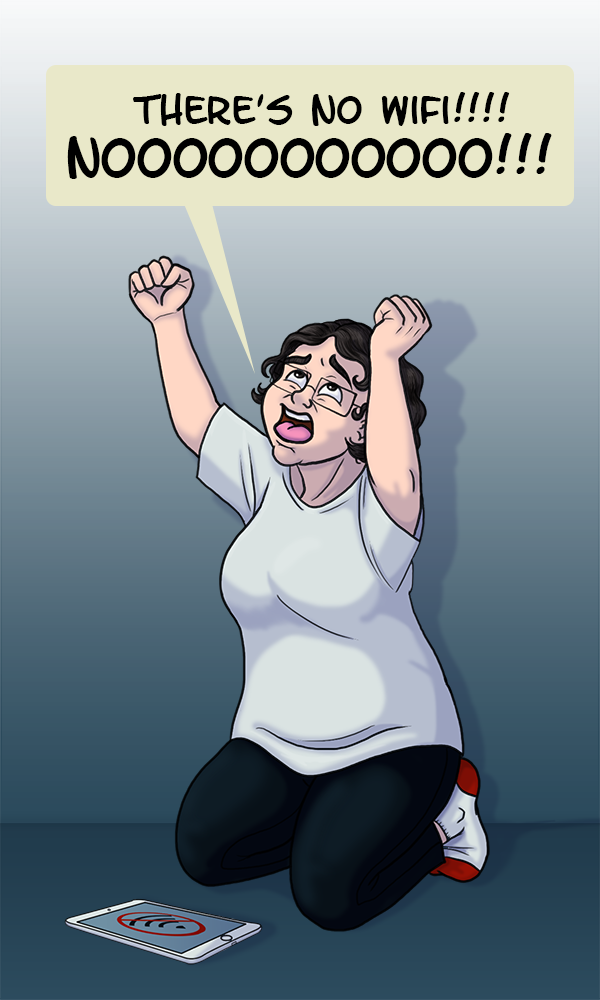
I’m on my knees, fists raised above my head, screaming at the sky in despair “There’s no Wi-Fi! Noooooooooooooooooooo!” A tablet lies in front of me displaying a large “no Wi-Fi” symbol on the screen.

I would not last long in an Apocalypse, or even a dead zone. How did I even function back in the 80’s?

Stepping away from the story for a moment, I feel it’s worth mentioning that while this book was a finalist for a multicultural fiction award, and has a very diverse cast, it was written by a white guy. Obviously, I prefer Own Voices books, but I’ve reviewed non-minority authors writing about minority characters on here before, and I probably wouldn’t even be mentioning the author’s race except for one thing that was bothering me. For the most part Williams does do a pretty decent job at representing a very racially diverse cast, and has clearly put a lot of effort into making the children’s voices seem authentic. But the way the protagonist, Letitia, spoke came off as iffy to me, and I found myself side-eyeing like I always do when white people try to replicate the slang and speech patterns used by people of color within their communities. Now, it’s totally possible Letitia is completely accurate to how Caribbean children speak, and I’m just super ignorant. It’s just as possible Williams was trying to portray the way an average nine-year-old speaks, and Letitia’s ethnicity had nothing to do with it. I mean, I have no idea what children are supposed to sound like, and my mom was a grammar obsessed English major so I probably sounded like an overly-formal weirdo at that age. (No one says “to whom are you referring” or “may I please”, when they’re in Kindergarten mom, GOD.) I honestly don’t know, so I’m afraid I’m going to have to leave that distinction to someone more qualified. And if I am jumping to conclusions, well, blame it on all the racist pidgin I’ve heard spouted by characters like Long Duk Dong and the Crows from Dumbo (did you know the main crow’s name is Jim? Damn, Disney…) over the years making me super wary.
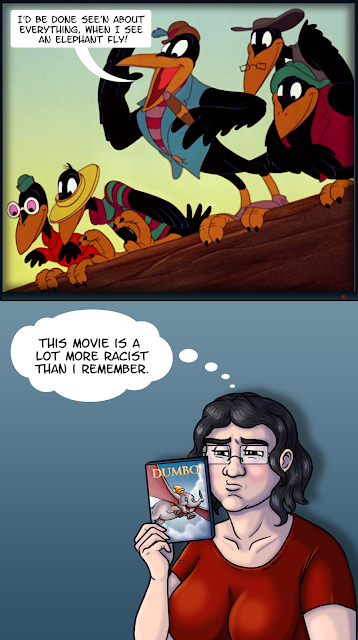
In the top panel, a TV screen displays an image of the five crows from Disney’s Dumbo. The leader shouts “I’d be done see’n about everything, when I see an elephant fly!” In the second panel I’m squinting suspiciously at the Dumbo DVD case thinking “This movie is a lot more racist than I remember.”

Seriously, Jim Crow! WTF were you thinking Disney!?! At least they’re not as bad as Sunflower from Fantasia.

Everything I Know About Zombies I Learned in Kindergarten definitely has flaws, most of the adults (and a few of the kids) get so little characterization it’s hard to figure out who’s who, the action scenes are confusing, and Williams spends way too much time on boring minutiae, but it’s still an enjoyable read. The horror is less the gory, run away from the monster kind like I was expecting, and more a slow building horror at the nature of humanity and how adults kind of suck.
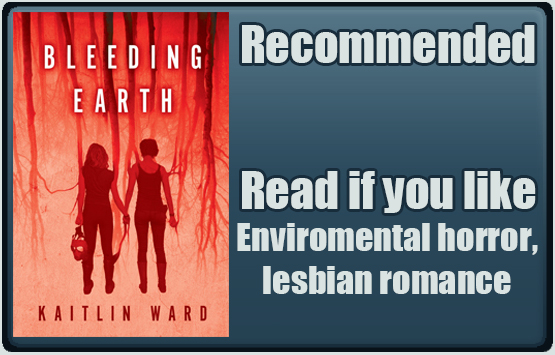
Bleeding Earth by Kaitlin Ward

Bleeding Earth by Kaitlin Ward

Formats: Print, digital

Publisher: Adaptive Studios

Genre: Blood & Guts, Apocalypse/Disaster, Psychological Horror, Romance

Audience: Y/A

Diversity: Lesbian characters, Hispanic/Latine character

Takes Place in: New Hampshire, USA

Content Warnings (Highlight to view): Alcohol Abuse, Bullying, Child Abuse, Child Death, Child Endangerment, Death, Forced Captivity, Gore, Homophobia, Mental Illness, Racism, Suicide, Verbal/Emotional Abuse, Violence

Blurb

Between Mother Nature and human nature, disasters are inevitable. 

Lea was in a cemetery when the earth started bleeding. Within twenty-four hours, the blood made international news. All over the world, blood oozed out of the ground, even through the concrete, even in the water. Then the earth started growing hair and bones.
Lea wishes she could ignore the blood. She wishes she could spend time with her new girlfriend, Aracely, in public, if only Aracely wasn’t so afraid of her father. Lea wants to be a regular teen again, but the blood has made her a prisoner in her own home. Fear for her social life turns into fear for her sanity, and Lea must save herself and her girlfriend however she can.

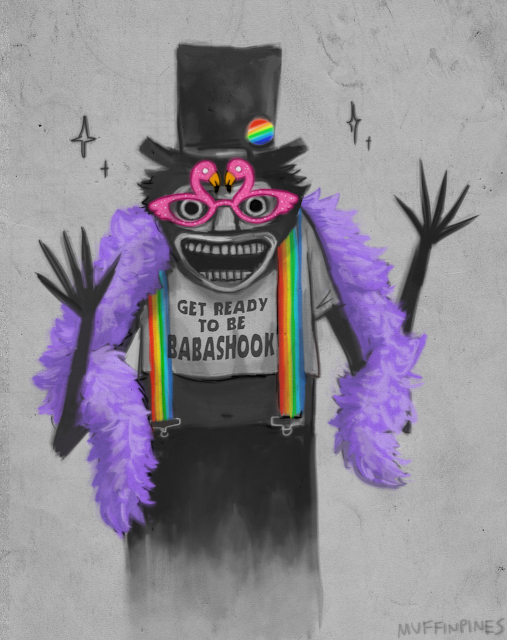
Happy Pride month! Here’s something fun for queer horror fans, after Netflix accidently featured the Australian indie horror film, The Babadook, on their LGBT movie page, the titular creature has quickly become a Pride meme and it’s wonderful. If you haven’t seen the film, it’s awesome, go watch it.

A tall, dark, creepy creature with long fingers and a white face is wearing a top hat with a rainbow button, rainbow suspenders, a purple feather boa, sparkly pink flamingo glasses, and a belly shirt that says “Get Ready to be Babashook.”

Artwork by Muffin Pines at http://muffinpines.tumblr.com/

For June I’ll be reviewing two horror stories with queer characters, the first of which is Bleeding Earth. And oh man, did this book mess me up good. I was expecting a gory, end of the world sort of book, and instead I got a heartbreaking survival story about love, family, and humanity (yes I know how cheesy that sounds, shut up). It gave me so much anxiety, and so many emotions, and I’m still trying to process what the hell I just read. But I know it was good. It was really freaking good. And there was so much blood. Blood, and bones, and hair. I love blood. And bones. Not wads of hair though, I have my limits.

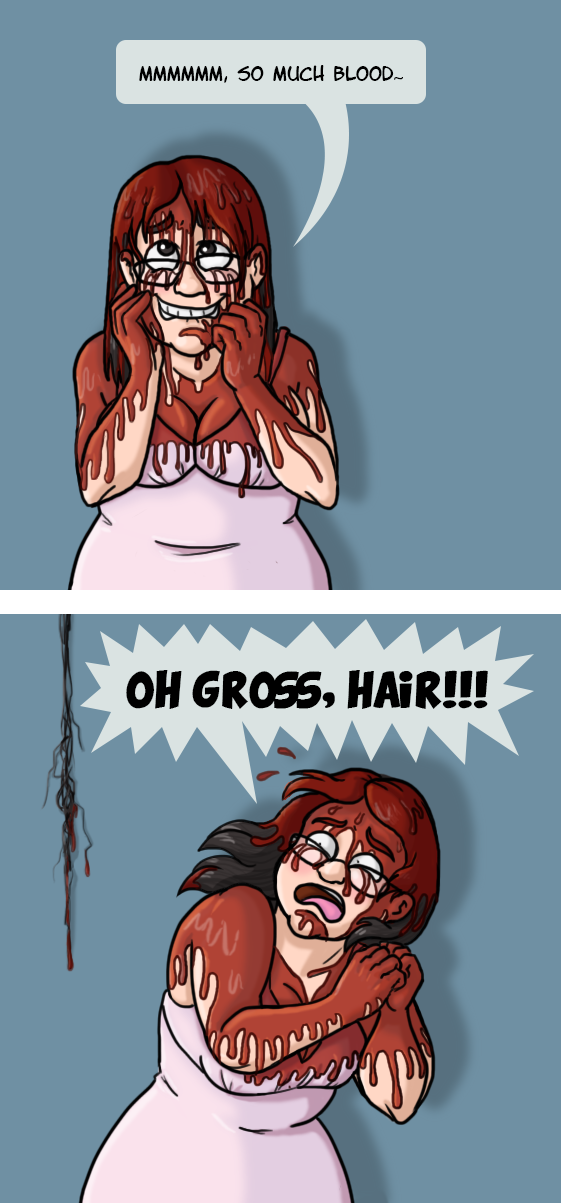
In the first caption I’m wearing a light pink dress and covered in blood. I’m clearly enjoying the blood dripping through my hair and down my shoulders because I’m smearing it on my ecstatic face while sighing “Mmmmmm, So much blood.” In the next panel I’m screaming “OH GROSS, HAIR!”  in disgust and pulling away from a wad of bloody hair I’ve just noticed.

I was going for a “Carrie at the Prom” kind of look.

Lea, the novel’s protagonist and narrator, is enjoying the blossoming relationship she shares with her girlfriend, Aracely, when the blood first appears. Now, normally teen romances in dystopias and apocalyptic fiction seems tacked on and out of place. I mean, who worries about crushes when their life is on the line? But in Bleeding Earth, it works beautifully. Surrounded by chaos and despair, Lea wants to hold onto one of the few good things she has left to keep her going, because no one knows how long they have left. The girls are still in their honeymoon phase, so everything still feels wonderful and new, a sharp contrast to the reality around them. When Lea starts experiencing night terrors and hallucinations from stress and isolation, talking to her girlfriend on the phone is the only thing that helps her. And when she wants to give up, it’s Aracely that keeps her going. And I just can’t bring myself to begrudge her that one little bit of happiness. Who wouldn’t want to spend time with someone who makes you feel safe and lets you forget your problems for a while? It gave my cold, little heart all the feels.The scariest thing about Bleeding Earth isn’t the blood, hair, and bones seeping up from the ground. It’s the feeling of isolation, uncertainty, and powerlessness. At least with zombies, aliens, and diseases there’s always something you can do, a safe zone to flee to, a cure, an end in sight. But with the blood there’s nowhere to escape, no way to fight back, and no stopping the blood. No one knows what’s causing it, or if it will ever end. There are no answers or explanations to soothe the scared populace. And while I normally hate it when a story doesn’t give me an explanation, here it actually works. It’s so much more frightening when you don’t know what’s happening, and there’s literally nothing you can do about it. Will things get better? Is this the end of the world? Did humanity piss off the earth so much it’s finally rejecting them? Even at the start of the bleeding, when everyone is still doing their best to “keep calm and carry on,” fear is already causing people to take desperate actions. Lea’s mom obsessively measures their water and screams at her friends when they drink some, her father nails boards over all the windows so they’re in complete darkness, a man attacks Aracely with a bone over a breathing mask, and some jerks at an Apocalypse party try to get an inebriated girl to drink the blood. It starts with fights over tampons in the grocery store, then looting Home Depot, to violence and riots, and it only gets worse from there. Much, MUCH worse.Now, I know poor decision making seems to be a staple of Y/A fiction (one that annoys me to no end), but here, it makes sense. Everyone is absolutely terrified, struggling with isolation and the horror of what’s happening around them, while still trying their damnedest to pretend like everything is going to be fine. And scared, stressed people do not behave in a rational manner. At various points the teenagers in the story become so desperate for normalcy and human contact they’re willing to brave the blood and all its dangers just to be together. Is this a good idea? No, absolutely not. But is it understandable? Completely. Humans are social creatures, so much so that isolation can actually be deadly. And here’s the original research to back it up. I’m an introvert who prefers a quiet night at home, and even I felt stressed and nauseous when poor Lea described being trapped in her boarded up home for weeks on end, with little to no outside communication. Honestly, if I had to go through a bloodpocalypse, I probably would’ve snapped after a few hours indoors and gone blood hydroplaning (hemiaplaning?) in a stolen car while throwing human skulls at pedestrians. And that’s speaking as someone who willingly goes for days without human contact, I can’t imagine what a non-homebody extrovert would go through. So kudos to Lea for keeping it together as long as she did! If you’re probably going to die anyway, it’s better to die among friends and go out with a bang.

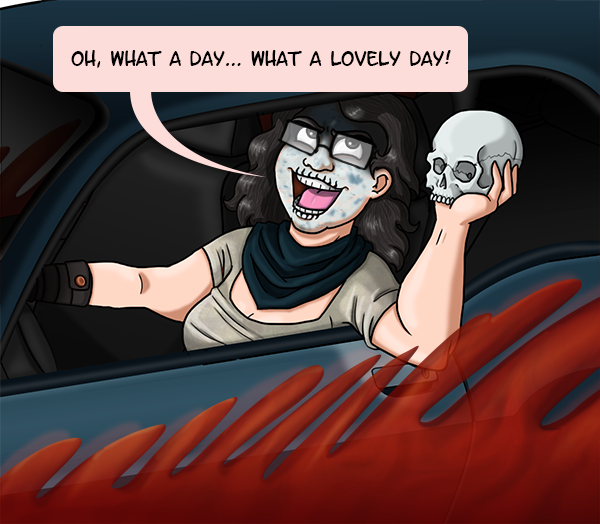
A close up of me driving a car through blood while leaning out the window. I’m holding a human skull out the window while waves of blood are being splashed up by the car. I’m dressed like one of the War Boys from Mad Max: Fury Road, with corpse pain covering my face. I gleefully shout “Oh what a day… What a lovely day!”

I showed this drawing to my wife, and now I’m not allowed to drive her car.

While I really enjoyed Bleeding Earth, it did have some problems that got to me, and kept me from giving it the full five stars. Like Lea’s dad. He learns that the mom has become unhinged, and Lea fears for their safety, but instead of going to help his wife and child, he tells his frightened daughter to get her unstable mom, slip through the looters and people willing to kill for water, and come to him. So of course a ton of horrible things happen because Lea can’t get her sick mother to leave the house, and her dad is apparently too lazy to drive the 40 minutes to help her. Like, I get they need everyone they can get to keep the power going, but for fuck’s sake man, you can take an hour to go rescue your wife and daughter. He’s just so frustratingly blasĂ© about the whole thing. And then there were a bunch of weird little plot points that didn’t go anywhere. Like Lea’s hallucinations. Ingesting the blood is discovered to cause hallucinations, night terrors, lost time, and mental breaks. Lea starts to have horrible nightmares, imagining blood in the house, but it’s unclear if it’s an effect from the blood or the isolation. While she does spend part of the book questioning her sanity, and it’s definitely stressful and unsettling, it doesn’t really go anywhere. Was she infected by the blood? Yeah, we never get an answer for that one either.

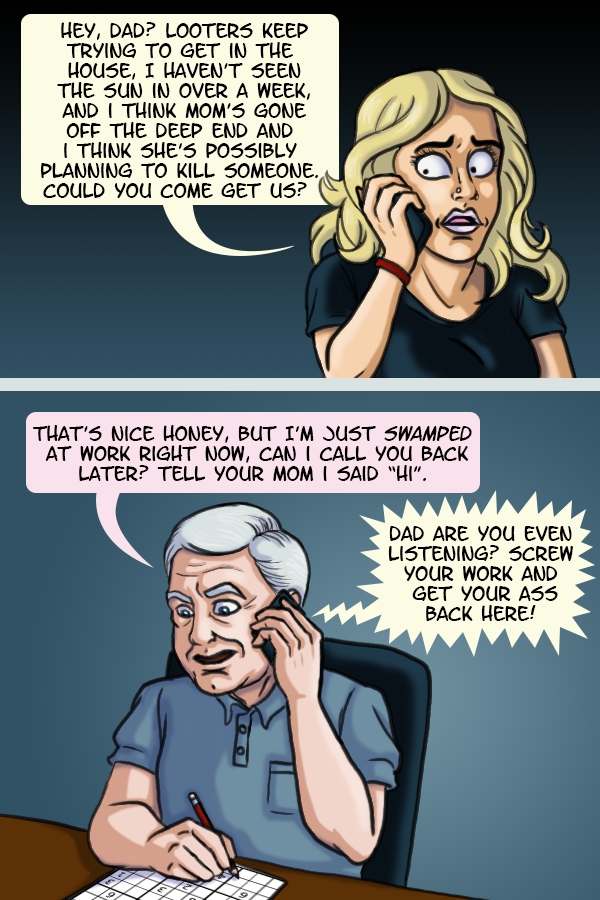
A frightened teen is on the phone with her dad. “Hey, dad? Looters keep trying to get in the house, I haven’t seen the sun in over a week, and I think mom’s gone off the deep end and she’s possibly planning to kill someone. Could you come get us?” Her dad is seen doing Sudoku in his office and tells her “That’s nice honey, but I’m just swamped at work right now, can I call you back later? Tell your mom I said “Hi”. “Dad are you even listening!? Screw your work and get your ass back here!”

Hey, Sudoku IS work!

The lack of explanations will be a major turn off for a lot of readers, and I can understand that. But honestly, I didn’t feel like it was needed, because that really isn’t the point of the story. This isn’t a sci-fi novel with an omniscient narrator about a world-wide disaster. This is Lea’s story. It’s about her fears, her loneliness, her confusion, and her crush on Aracely. She’s terrified and frustrated because she doesn’t know what will happen, her parents can’t reassure her, and she just wants to be able to take comfort in something. It’s a sweet, sad story of survival, isolation, and just trying to enjoy a simple teen crush in a world that’s gone to hell.

A Banquet for Hungry Ghosts by Ying Chang Compestine

A Banquet for Hungry Ghosts by Ying Chang Compestine

Formats: Print, audio, digital

Publisher: Tumbling Dumpling Media

Genre: Monster, Killer/Slasher, Crime, Ghosts/Haunting, Psychological Horror, Blood & Guts, Historic Horror, Anthology

Audience: Adult/Mature

Diversity: Chinese and Chinese American characters

Takes Place in: China

Content Warnings (Highlight to view): Physical Abuse, Animal Death, Animal Abuse, Child Endangerment, Child Death, Body shaming, Verbal/Emotional Abuse, Cannibalism, Gore, Torture, Medical Torture, Violence, Death

There are many types of Chinese ghosts, including the spirits of deceased loved ones who may bring blessing and good fortune if properly honored, vengeful specters searching for those who wronged them in life, playful and troublesome spooks, and Hungry Ghosts, unhappy spirits with insatiable appetites.  During the seventh month of the Chinese calendar, known as Ghost Month, the gates to hell are open and these spirits are able to cross over to the realm of the living. To avoid hauntings and misfortune, people will leave offerings of food in the hopes of appeasing the Hungry Ghosts who wander the streets at night. If these spirits are pleased with the food offered to them, they may leave the household in peace. But what if the Hungry Ghosts aren’t placated?

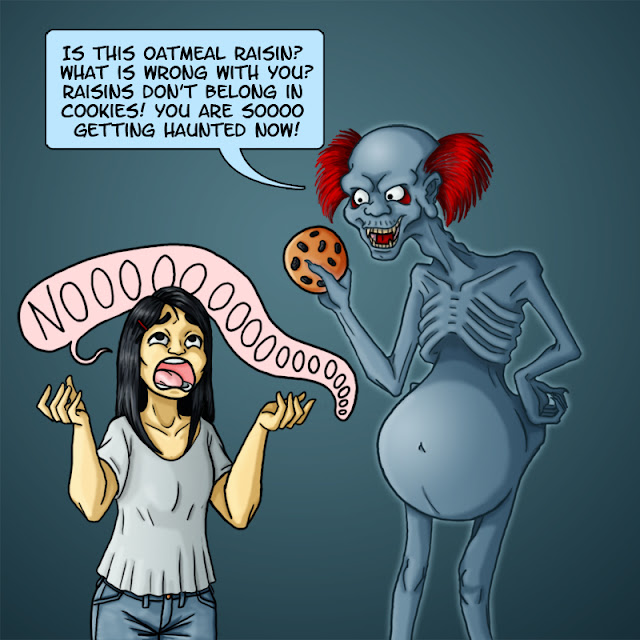
A skeletal-looking Japanese ghost with pale blue skin, flaming red hair, bulging eyes, and a distended belly is glaring at a Chinese woman who gave him a cookie and scolding "Is this Oatmeal Raisin? What is wrong with you? Raisins don't belong in cookies! You are soooo getting haunted now!" The woman yells "Nooooooooooooo!" in comical despair.

He’ll eat garbage, but he draws the line at oatmeal raisin.

He’ll eat garbage, but he draws the line at oatmeal raisin.Author Ying Chang Compestine explores both Chinese cuisine and angry spirits in her book, A Banquet for Hungry Ghosts. Ah, delicious food and gruesome horror, two of my favorite things! Admittedly, not things you’d usually think of combining, but hey, I’m not complaining. Each ghost story is dedicated to a food you might typically find in a traditional Chinese eight course banquet, and includes a recipe at the end. Okay, so maybe those with weaker stomachs may not want to try whipping up a batch of Tea Eggs right after reading about some poor guy getting disemboweled. But I’m the kind of person who can watch surgery videos while eating breakfast, so I wasn’t put off my appetite. If anything, the book made me crave cha siu bao the entire time. Oh, and by the way, the steamed dumpling recipe? Sooooooo good. I’ve got to try making the Jasmine Almond cookies next.

I'm reading "A Banquet for Hungry Ghosts" and exclaim in wonder "Woah, the inn keeper chopped people up and made them into dumplings!?" The next panel shows me biting my lip, looking conflicted, and saying "Damn it, now I want dumplings".

I also get hungry watching Hannibal. Don’t judge me.

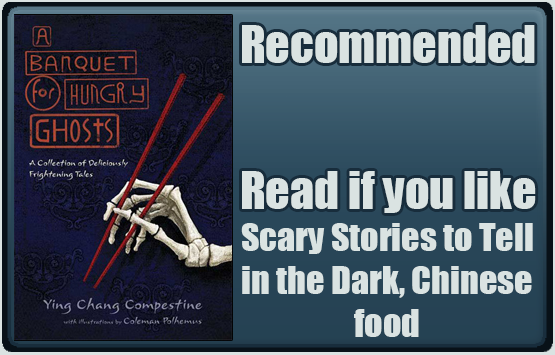
In addition to recipes, each chapter also includes an afterword that expands on aspects of Chinese culture and history discussed in the story. There’s information on the rules of Mahjong, Mantis fighting, Qingming (Tomb Sweeping Day), the Cultural Revolution, and even anecdotes from Compestine’s own life growing up in China. Also ablation surgery, arsenic poisoning, and ancient Chinese tombs containing the victims of human sacrifice. Fun, right? Hey, it’s a book of scary stories after all, it’s to be expected. Every country has its share of atrocities from the past and present, and Compestine adds even more horror to her already spooky ghost stories by including some of China’s darker practices, such as illegal organ harvesting from prisoners and corruption at Buddhist monasteries. It’s actually quite clever how Compestine addresses certain Chinese social issues by turning them into ghost stories. At least in fiction, we get the satisfaction of seeing justice done, albeit by Hungry Ghost who enact terrible, and often gruesome vengeance.As horrific as I’ve made the book sound, it is actually intended for children. Like a more educational, Chinese, epicurean version of Scary Stories to Tell in the Dark, complete with its own gorgeous, creepy, black and white illustrations. I know the blood and guts may be too much for some children (though it’s not much worse than your standard German fairy tale or Roald Dahl story) but the gore is definitely going to appeal to others. Hey, whatever gets them to read, right? Plus, it’s educational, so that’s always good. Even adults will find the stories informative; while reading Banquet for Hungry Ghosts I frequently found myself running off to Google the construction of the Great Wall or Chinese medical practices.Although the overall stories were rich and interesting, the writing could be a little simplistic, which, unfortunately, I felt detracted from the horror and kept me from giving this book the four stars it otherwise would have earned. But, again, it is a kid’s book, and it’s difficult to write something that’s elegant, interesting, and easy to read. Children reading A Banquet for Hungry Ghosts are already going to have enough trouble trying to sound out “Hemorrhagic shock”, no need to make the writing too flowery and complex. So let’s just say I’d give the writing three stars for adults and four stars for kids.My only other complaint is that the author also tended to rely heavily on gore to create scares. Being gross and being scary are two different things, and you can’t just add blood to a story and expect it to be frightening. If that were true, I could just read a medical textbook to give myself nightmares.

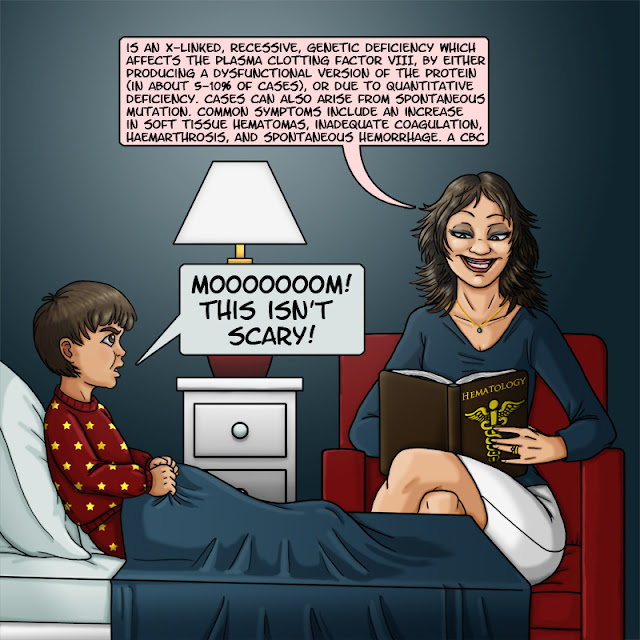
A mother is reading to her son a "bed time story" out of a dull, dry, medical text book. She drones on about "an X-linked, recessive, genetic deficiency which affects the plasma clotting factor VIII, by either producing a dysfunctional version of the protein." Annoyed, the boy responds "Moooom! This isn't scary!"

What are you talking about kid? Hemorrhaging is terrifying.

Like any horror anthology, some stories are much better than others. “Tofu with Chili-Garlic Sauce”,  “Steamed Dumplings”, and “Beef Stew” were all excellent. “Long-Life Noodles” and “Jasmine Almond Cookies”? Not so much. But overall this is still a great book, and the combination of ghost stories, history, and cuisine make a fun and unique combination. A must read for both young horror fans and foodies.

Navigation

Social Media

Search by Tags

To learn more about the Age Group, Diversity, and Genre tags, click here.

Age Groups

Diversity

Genre

Support the Blog

Search

Links

Everything I Know About Zombies I Learned in Kindergarten by Kevin Wayne Williams

Everything I Know About Zombies I Learned in Kindergarten by Kevin Wayne Williams

Formats: Print, digital

Publisher: Mott Haven Books

Genre: Apocalypse/Disaster, Blood & Guts, Zombie

Audience: Adult/Mature

Diversity: Black/African American/Caribbean American characters, Trinidad, Jamacian, Hispanic/Latinx characters

Takes Place in: New York City, USA

Content Warnings (Highlight to view): Abelism, Animal Abuse, Animal Death, Body Shaming, Bullying, Cannibalism, Child Death, Child Endangerment, Death, Drug Use/Abuse, Forced Captivity, Gore,  Medical Procedures, Miscarriage, Racism, Rape/Sexual Assault, Slurs, Suicide, Violence

Blurb

Finalist for Foreword Reviews’ IndieFab Novel of the Year for Multicultural fiction and Horror. Even before the apocalypse, nine-year-old Letitia Johnson’s life had never been simple. Shuttled from foster home to foster home in the impoverished neighborhood of Mott Haven, it was all she could do to keep track of her little sister. When the apocalypse came, she tried to keep her sister’s kindergarten safe by locking them all in a tiny school bathroom, hiding while they waited for a rescue that never came. For five days, they hid. They hid while their teachers were being eaten, while their classmates were being killed. They hid while the Bronx was being evacuated. Now, there’s no one left to help them. There’s no place left to hide. It’s just her, one ax, twelve kindergarteners, twelve garden stakes, and a will to live.

While the cast of this novel is primarily children, the book is intended for adults and contains material unsuitable for younger readers.

When it comes to horror, kids come in two types. Either they’re sweet, innocent, completely helpless victims the protagonist needs to protect at all costs, or they’re evil little bastards that will send you into the cornfield, control you with their telepathic powers, or just straight up murder you because they’re the spawn ofSatan. The children in Everything I Know About Zombies I Learned in Kindergarten somehow land right dab in the middle of the victim/villain scale. They’re neither helpless nor innocent after being forced to go through things no child should go through, nor are they actively malicious, only killing for survival. They also don’t seem to possess the immunity to handle situations that most children do in horror stories. Kids get eaten by Zombies, shot, torn apart, and baby zombies get spiked in the head. So if you can’t stomach minors getting killed in fiction, I recommend staying far, far away from this book.

 Letitia, the nine-year-old protagonist, is easily the most competent, clever, and practical character in the book, organizing her little sister’s kindergartners into a unit of efficient zombie killers and quickly picking up survival skills. Growing up with a drug addicted mom, Letitia is used to taking charge and picking up adults’ slack, in addition to becoming wary of the world at a young age. In the early chapters, they try to look for the childrens’ parents, eager to be rid of such a heavy responsibility, only to discover their dickbag guardians all evacuated without them. (Who the hell just leaves their kid behind during a disaster? You’d think they’d at least make some effort to save them, damn.) The adult survivors actually pose more of a threat than the zombies (or cucos, as the children call them), their greed and despair claiming far more lives than the undead do. It’s weird, even though the children are far from innocent, having become skilled killers, the adults are the ones who’ve become morally bankrupt. The few who do manage to hold on to their optimism and naivety don’t last long, foolishly trusting the wrong people or refusing to admit the world, and the rules, have changed. The kids might be depressingly cynical and violent now, but they’re merely adapting to their new reality, and are much more practical than their grown counterparts. It’s no wonder the adults are so unnerved by them.

In the top panel, a little girl holding a spike is telling a grown woman “Don’t worry Señorita, I will protect you from the cuco!” The woman, bemused, responds “Awwww, you’re so adorable!” In the next panel the little girl brandishes her spike with a crazed grin and responds “I have become an expert killer and now I yearn for blood! Human or cuco, I can slay them with ease!” The woman, confused and concerned, asks “Wait, what?”

Some of the kids enjoy killing a little too much.

I was expecting the children being eaten by the undead to be the most disturbing part, until the book turned out to be about the death of innocence, and children being forced to adapt to a situation no child should ever go through. It’s one thing to read about fantastical monsters like Zombies attacking a bunch of helpless kids, but quite another when they’re dying from gun violence, or growing up in crushing poverty. In the first, the situation is pure fiction, no real child is ever going to be attacked by the undead, and you can feel safe in that knowledge. But it hits close to home when it comes to real world problems. Even if the children in the story are fictional, you know millions of real kids out there right now who are surrounded by abuse, violence, and probably living without basic necessities, and that’s super depressing. So basically, it’s a story about how kids with rough lives can’t rely on adults (because they’re either malicious, incompetent, or ignorant) and have to take charge of their own safety and survival, which probably would’ve ended up happening with or without undead hordes overtaking the city. I know zombie apocalypse stories are generally bleak, but damn.

 The zombies in the story are pretty much your typical Romero zombies, slow-moving and stupid, and not too difficult to kill as long as there aren’t a lot of them and their brains are destroyed, a feat which the children usually accomplish by stabbing them in the eye with garden stakes. Unfortunately, everyone becomes zombified upon death, regardless of how they die, so the undead multiply even if they can’t bite anyone. Letitia quickly figures out that the zombies are attracted to movement and sound, and is smart enough to stick to quiet, secluded areas, while the adults continue to attract the undead with the buzz of their emergency generators and gun fire (because the adults are somehow less competent than grade schoolers, another reason Letitia avoids them).

 Unfortunately for me, most of the book is dedicated to the practically of surviving in an abandoned New York City, wandering around and looting mini-marts for supplies…which made for less than stimulating reading. I’m going to admit right now, I don’t like camping or fishing, or any form of “roughing it,” and I don’t like reading about it, either. I’m pretty sure I’d die if I went for more than 40 minutes without WiFi.  So I’ve long ago accepted the fact that I would probably be the first person to die in a zombie apocalypse type situation due to my dependence on modern conveniences and comfort, and I’m okay with that. I’m sure some people will find all the survivor type stuff super interesting, as is evident from Discovery Channel’s programming, but I was hoping for way more suspense and undead violence, and less foraging and guinea pig farming. Speaking of which, there’s a decent amount of animal death too, apparently Zombies like to eat puppies as much as they like to eat little kids.

I’m on my knees, fists raised above my head, screaming at the sky in despair “There’s no Wi-Fi! Noooooooooooooooooooo!” A tablet lies in front of me displaying a large “no Wi-Fi” symbol on the screen.

I would not last long in an Apocalypse, or even a dead zone. How did I even function back in the 80’s?

Stepping away from the story for a moment, I feel it’s worth mentioning that while this book was a finalist for a multicultural fiction award, and has a very diverse cast, it was written by a white guy. Obviously, I prefer Own Voices books, but I’ve reviewed non-minority authors writing about minority characters on here before, and I probably wouldn’t even be mentioning the author’s race except for one thing that was bothering me. For the most part Williams does do a pretty decent job at representing a very racially diverse cast, and has clearly put a lot of effort into making the children’s voices seem authentic. But the way the protagonist, Letitia, spoke came off as iffy to me, and I found myself side-eyeing like I always do when white people try to replicate the slang and speech patterns used by people of color within their communities. Now, it’s totally possible Letitia is completely accurate to how Caribbean children speak, and I’m just super ignorant. It’s just as possible Williams was trying to portray the way an average nine-year-old speaks, and Letitia’s ethnicity had nothing to do with it. I mean, I have no idea what children are supposed to sound like, and my mom was a grammar obsessed English major so I probably sounded like an overly-formal weirdo at that age. (No one says “to whom are you referring” or “may I please”, when they’re in Kindergarten mom, GOD.) I honestly don’t know, so I’m afraid I’m going to have to leave that distinction to someone more qualified. And if I am jumping to conclusions, well, blame it on all the racist pidgin I’ve heard spouted by characters like Long Duk Dong and the Crows from Dumbo (did you know the main crow’s name is Jim? Damn, Disney…) over the years making me super wary.

In the top panel, a TV screen displays an image of the five crows from Disney’s Dumbo. The leader shouts “I’d be done see’n about everything, when I see an elephant fly!” In the second panel I’m squinting suspiciously at the Dumbo DVD case thinking “This movie is a lot more racist than I remember.”

Seriously, Jim Crow! WTF were you thinking Disney!?! At least they’re not as bad as Sunflower from Fantasia.

Everything I Know About Zombies I Learned in Kindergarten definitely has flaws, most of the adults (and a few of the kids) get so little characterization it’s hard to figure out who’s who, the action scenes are confusing, and Williams spends way too much time on boring minutiae, but it’s still an enjoyable read. The horror is less the gory, run away from the monster kind like I was expecting, and more a slow building horror at the nature of humanity and how adults kind of suck.
Bleeding Earth by Kaitlin Ward

Bleeding Earth by Kaitlin Ward

Formats: Print, digital

Publisher: Adaptive Studios

Genre: Blood & Guts, Apocalypse/Disaster, Psychological Horror, Romance

Audience: Y/A

Diversity: Lesbian characters, Hispanic/Latine character

Takes Place in: New Hampshire, USA

Content Warnings (Highlight to view): Alcohol Abuse, Bullying, Child Abuse, Child Death, Child Endangerment, Death, Forced Captivity, Gore, Homophobia, Mental Illness, Racism, Suicide, Verbal/Emotional Abuse, Violence

Blurb

Between Mother Nature and human nature, disasters are inevitable. 

Lea was in a cemetery when the earth started bleeding. Within twenty-four hours, the blood made international news. All over the world, blood oozed out of the ground, even through the concrete, even in the water. Then the earth started growing hair and bones.
Lea wishes she could ignore the blood. She wishes she could spend time with her new girlfriend, Aracely, in public, if only Aracely wasn’t so afraid of her father. Lea wants to be a regular teen again, but the blood has made her a prisoner in her own home. Fear for her social life turns into fear for her sanity, and Lea must save herself and her girlfriend however she can.

Happy Pride month! Here’s something fun for queer horror fans, after Netflix accidently featured the Australian indie horror film, The Babadook, on their LGBT movie page, the titular creature has quickly become a Pride meme and it’s wonderful. If you haven’t seen the film, it’s awesome, go watch it.

A tall, dark, creepy creature with long fingers and a white face is wearing a top hat with a rainbow button, rainbow suspenders, a purple feather boa, sparkly pink flamingo glasses, and a belly shirt that says “Get Ready to be Babashook.”

Artwork by Muffin Pines at http://muffinpines.tumblr.com/

For June I’ll be reviewing two horror stories with queer characters, the first of which is Bleeding Earth. And oh man, did this book mess me up good. I was expecting a gory, end of the world sort of book, and instead I got a heartbreaking survival story about love, family, and humanity (yes I know how cheesy that sounds, shut up). It gave me so much anxiety, and so many emotions, and I’m still trying to process what the hell I just read. But I know it was good. It was really freaking good. And there was so much blood. Blood, and bones, and hair. I love blood. And bones. Not wads of hair though, I have my limits.

In the first caption I’m wearing a light pink dress and covered in blood. I’m clearly enjoying the blood dripping through my hair and down my shoulders because I’m smearing it on my ecstatic face while sighing “Mmmmmm, So much blood.” In the next panel I’m screaming “OH GROSS, HAIR!”  in disgust and pulling away from a wad of bloody hair I’ve just noticed.

I was going for a “Carrie at the Prom” kind of look.

Lea, the novel’s protagonist and narrator, is enjoying the blossoming relationship she shares with her girlfriend, Aracely, when the blood first appears. Now, normally teen romances in dystopias and apocalyptic fiction seems tacked on and out of place. I mean, who worries about crushes when their life is on the line? But in Bleeding Earth, it works beautifully. Surrounded by chaos and despair, Lea wants to hold onto one of the few good things she has left to keep her going, because no one knows how long they have left. The girls are still in their honeymoon phase, so everything still feels wonderful and new, a sharp contrast to the reality around them. When Lea starts experiencing night terrors and hallucinations from stress and isolation, talking to her girlfriend on the phone is the only thing that helps her. And when she wants to give up, it’s Aracely that keeps her going. And I just can’t bring myself to begrudge her that one little bit of happiness. Who wouldn’t want to spend time with someone who makes you feel safe and lets you forget your problems for a while? It gave my cold, little heart all the feels.The scariest thing about Bleeding Earth isn’t the blood, hair, and bones seeping up from the ground. It’s the feeling of isolation, uncertainty, and powerlessness. At least with zombies, aliens, and diseases there’s always something you can do, a safe zone to flee to, a cure, an end in sight. But with the blood there’s nowhere to escape, no way to fight back, and no stopping the blood. No one knows what’s causing it, or if it will ever end. There are no answers or explanations to soothe the scared populace. And while I normally hate it when a story doesn’t give me an explanation, here it actually works. It’s so much more frightening when you don’t know what’s happening, and there’s literally nothing you can do about it. Will things get better? Is this the end of the world? Did humanity piss off the earth so much it’s finally rejecting them? Even at the start of the bleeding, when everyone is still doing their best to “keep calm and carry on,” fear is already causing people to take desperate actions. Lea’s mom obsessively measures their water and screams at her friends when they drink some, her father nails boards over all the windows so they’re in complete darkness, a man attacks Aracely with a bone over a breathing mask, and some jerks at an Apocalypse party try to get an inebriated girl to drink the blood. It starts with fights over tampons in the grocery store, then looting Home Depot, to violence and riots, and it only gets worse from there. Much, MUCH worse.Now, I know poor decision making seems to be a staple of Y/A fiction (one that annoys me to no end), but here, it makes sense. Everyone is absolutely terrified, struggling with isolation and the horror of what’s happening around them, while still trying their damnedest to pretend like everything is going to be fine. And scared, stressed people do not behave in a rational manner. At various points the teenagers in the story become so desperate for normalcy and human contact they’re willing to brave the blood and all its dangers just to be together. Is this a good idea? No, absolutely not. But is it understandable? Completely. Humans are social creatures, so much so that isolation can actually be deadly. And here’s the original research to back it up. I’m an introvert who prefers a quiet night at home, and even I felt stressed and nauseous when poor Lea described being trapped in her boarded up home for weeks on end, with little to no outside communication. Honestly, if I had to go through a bloodpocalypse, I probably would’ve snapped after a few hours indoors and gone blood hydroplaning (hemiaplaning?) in a stolen car while throwing human skulls at pedestrians. And that’s speaking as someone who willingly goes for days without human contact, I can’t imagine what a non-homebody extrovert would go through. So kudos to Lea for keeping it together as long as she did! If you’re probably going to die anyway, it’s better to die among friends and go out with a bang.

A close up of me driving a car through blood while leaning out the window. I’m holding a human skull out the window while waves of blood are being splashed up by the car. I’m dressed like one of the War Boys from Mad Max: Fury Road, with corpse pain covering my face. I gleefully shout “Oh what a day… What a lovely day!”

I showed this drawing to my wife, and now I’m not allowed to drive her car.

While I really enjoyed Bleeding Earth, it did have some problems that got to me, and kept me from giving it the full five stars. Like Lea’s dad. He learns that the mom has become unhinged, and Lea fears for their safety, but instead of going to help his wife and child, he tells his frightened daughter to get her unstable mom, slip through the looters and people willing to kill for water, and come to him. So of course a ton of horrible things happen because Lea can’t get her sick mother to leave the house, and her dad is apparently too lazy to drive the 40 minutes to help her. Like, I get they need everyone they can get to keep the power going, but for fuck’s sake man, you can take an hour to go rescue your wife and daughter. He’s just so frustratingly blasĂ© about the whole thing. And then there were a bunch of weird little plot points that didn’t go anywhere. Like Lea’s hallucinations. Ingesting the blood is discovered to cause hallucinations, night terrors, lost time, and mental breaks. Lea starts to have horrible nightmares, imagining blood in the house, but it’s unclear if it’s an effect from the blood or the isolation. While she does spend part of the book questioning her sanity, and it’s definitely stressful and unsettling, it doesn’t really go anywhere. Was she infected by the blood? Yeah, we never get an answer for that one either.

A frightened teen is on the phone with her dad. “Hey, dad? Looters keep trying to get in the house, I haven’t seen the sun in over a week, and I think mom’s gone off the deep end and she’s possibly planning to kill someone. Could you come get us?” Her dad is seen doing Sudoku in his office and tells her “That’s nice honey, but I’m just swamped at work right now, can I call you back later? Tell your mom I said “Hi”. “Dad are you even listening!? Screw your work and get your ass back here!”

Hey, Sudoku IS work!

The lack of explanations will be a major turn off for a lot of readers, and I can understand that. But honestly, I didn’t feel like it was needed, because that really isn’t the point of the story. This isn’t a sci-fi novel with an omniscient narrator about a world-wide disaster. This is Lea’s story. It’s about her fears, her loneliness, her confusion, and her crush on Aracely. She’s terrified and frustrated because she doesn’t know what will happen, her parents can’t reassure her, and she just wants to be able to take comfort in something. It’s a sweet, sad story of survival, isolation, and just trying to enjoy a simple teen crush in a world that’s gone to hell.

A Banquet for Hungry Ghosts by Ying Chang Compestine

A Banquet for Hungry Ghosts by Ying Chang Compestine

Formats: Print, audio, digital

Publisher: Tumbling Dumpling Media

Genre: Monster, Killer/Slasher, Crime, Ghosts/Haunting, Psychological Horror, Blood & Guts, Historic Horror, Anthology

Audience: Adult/Mature

Diversity: Chinese and Chinese American characters

Takes Place in: China

Content Warnings (Highlight to view): Physical Abuse, Animal Death, Animal Abuse, Child Endangerment, Child Death, Body shaming, Verbal/Emotional Abuse, Cannibalism, Gore, Torture, Medical Torture, Violence, Death

There are many types of Chinese ghosts, including the spirits of deceased loved ones who may bring blessing and good fortune if properly honored, vengeful specters searching for those who wronged them in life, playful and troublesome spooks, and Hungry Ghosts, unhappy spirits with insatiable appetites.  During the seventh month of the Chinese calendar, known as Ghost Month, the gates to hell are open and these spirits are able to cross over to the realm of the living. To avoid hauntings and misfortune, people will leave offerings of food in the hopes of appeasing the Hungry Ghosts who wander the streets at night. If these spirits are pleased with the food offered to them, they may leave the household in peace. But what if the Hungry Ghosts aren’t placated?

A skeletal-looking Japanese ghost with pale blue skin, flaming red hair, bulging eyes, and a distended belly is glaring at a Chinese woman who gave him a cookie and scolding "Is this Oatmeal Raisin? What is wrong with you? Raisins don't belong in cookies! You are soooo getting haunted now!" The woman yells "Nooooooooooooo!" in comical despair.

He’ll eat garbage, but he draws the line at oatmeal raisin.

He’ll eat garbage, but he draws the line at oatmeal raisin.Author Ying Chang Compestine explores both Chinese cuisine and angry spirits in her book, A Banquet for Hungry Ghosts. Ah, delicious food and gruesome horror, two of my favorite things! Admittedly, not things you’d usually think of combining, but hey, I’m not complaining. Each ghost story is dedicated to a food you might typically find in a traditional Chinese eight course banquet, and includes a recipe at the end. Okay, so maybe those with weaker stomachs may not want to try whipping up a batch of Tea Eggs right after reading about some poor guy getting disemboweled. But I’m the kind of person who can watch surgery videos while eating breakfast, so I wasn’t put off my appetite. If anything, the book made me crave cha siu bao the entire time. Oh, and by the way, the steamed dumpling recipe? Sooooooo good. I’ve got to try making the Jasmine Almond cookies next.

I'm reading "A Banquet for Hungry Ghosts" and exclaim in wonder "Woah, the inn keeper chopped people up and made them into dumplings!?" The next panel shows me biting my lip, looking conflicted, and saying "Damn it, now I want dumplings".

I also get hungry watching Hannibal. Don’t judge me.

In addition to recipes, each chapter also includes an afterword that expands on aspects of Chinese culture and history discussed in the story. There’s information on the rules of Mahjong, Mantis fighting, Qingming (Tomb Sweeping Day), the Cultural Revolution, and even anecdotes from Compestine’s own life growing up in China. Also ablation surgery, arsenic poisoning, and ancient Chinese tombs containing the victims of human sacrifice. Fun, right? Hey, it’s a book of scary stories after all, it’s to be expected. Every country has its share of atrocities from the past and present, and Compestine adds even more horror to her already spooky ghost stories by including some of China’s darker practices, such as illegal organ harvesting from prisoners and corruption at Buddhist monasteries. It’s actually quite clever how Compestine addresses certain Chinese social issues by turning them into ghost stories. At least in fiction, we get the satisfaction of seeing justice done, albeit by Hungry Ghost who enact terrible, and often gruesome vengeance.As horrific as I’ve made the book sound, it is actually intended for children. Like a more educational, Chinese, epicurean version of Scary Stories to Tell in the Dark, complete with its own gorgeous, creepy, black and white illustrations. I know the blood and guts may be too much for some children (though it’s not much worse than your standard German fairy tale or Roald Dahl story) but the gore is definitely going to appeal to others. Hey, whatever gets them to read, right? Plus, it’s educational, so that’s always good. Even adults will find the stories informative; while reading Banquet for Hungry Ghosts I frequently found myself running off to Google the construction of the Great Wall or Chinese medical practices.Although the overall stories were rich and interesting, the writing could be a little simplistic, which, unfortunately, I felt detracted from the horror and kept me from giving this book the four stars it otherwise would have earned. But, again, it is a kid’s book, and it’s difficult to write something that’s elegant, interesting, and easy to read. Children reading A Banquet for Hungry Ghosts are already going to have enough trouble trying to sound out “Hemorrhagic shock”, no need to make the writing too flowery and complex. So let’s just say I’d give the writing three stars for adults and four stars for kids.My only other complaint is that the author also tended to rely heavily on gore to create scares. Being gross and being scary are two different things, and you can’t just add blood to a story and expect it to be frightening. If that were true, I could just read a medical textbook to give myself nightmares.

A mother is reading to her son a "bed time story" out of a dull, dry, medical text book. She drones on about "an X-linked, recessive, genetic deficiency which affects the plasma clotting factor VIII, by either producing a dysfunctional version of the protein." Annoyed, the boy responds "Moooom! This isn't scary!"

What are you talking about kid? Hemorrhaging is terrifying.

Like any horror anthology, some stories are much better than others. “Tofu with Chili-Garlic Sauce”,  “Steamed Dumplings”, and “Beef Stew” were all excellent. “Long-Life Noodles” and “Jasmine Almond Cookies”? Not so much. But overall this is still a great book, and the combination of ghost stories, history, and cuisine make a fun and unique combination. A must read for both young horror fans and foodies.

Navigation

Social Media

Search by Tags

To learn more about the Age Group, Diversity, and Genre tags, click here.

Age Groups

Diversity

Genre

Support the Blog

Search

Links