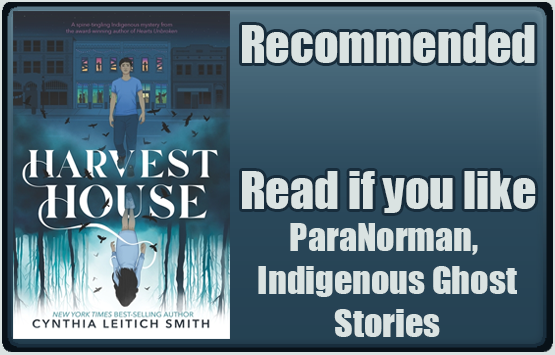
Formats: Print, audio, digital
Publisher: Candlewick Press
Genre: Ghosts/Haunting
Audience: Young Adults
Diversity: Muscogee main character and side character, Biracial Indigenous Latine major character, Bisexual major character, Ojibwe side character
Takes Place in: Kansas
Content Warnings (Highlight to view): Bullying, Death, Police Harassment, Racism, Stalking
Blurb
Deftly leading readers to the literary crossroads of contemporary realism and haunting mystery, Cynthia Leitich Smith revisits the world of her American Indian Youth Literature Award winner Hearts Unbroken. Halloween is near, and Hughie Wolfe is volunteering at a new rural attraction: Harvest House. He’s excited to take part in the fun, spooky show—until he learns that an actor playing the vengeful spirit of an “Indian maiden,” a ghost inspired by local legend, will headline. Folklore aside, unusual things have been happening at night at the crossroads near Harvest House. A creepy man is stalking teenage girls and young women, particularly Indigenous women; dogs are fretful and on edge; and wild animals are behaving strangely. While Hughie weighs how and when to speak up about the bigoted legend, he and his friends begin to investigate the crossroads and whether it might be haunted after all. As Moon rises on All Hallow’s Eve, will they be able to protect themselves and their community? Gripping and evocative, Harvest House showcases a versatile storyteller at her spooky, unsettling best.
Being one of the few Native kids in a mostly white high school can be tough. Hughie, a Muscogee teen in a suburban Kansas town is no stranger to anti-Native racism. Last year Hughie, a huge theater nerd, turned down the role of the Tin Man in his school’s production of the Wizard of Oz to protest L. Frank Baum’s anti-Native views (Baum advocated for the genocide of American Indians). But Hughie is excited for their fall semester play, especially since he and his fellow thespian AJ have been pushing the theater/English teacher Mrs. Q to put on a play by “somebody with melanin.” Sadly Hughie’s hopes of landing a lead role are crushed when Ms. Q says a fall production just isn’t in their budget for this year (but of course the school could afford new Jumbotrons for the sports games).
Although Hughie is feeling bummed about the play, things aren’t all bad. His crush, an Ojibwe girl named Marie, likes him back, he has a new best friend in Sam Rodríguez, and Sam has invited him to put his theater skills to work on a haunted house. The haunted house, dubbed Harvest House, is a fundraiser for one of Sam’s mom’s friends, a woman named Ms. Fischer who’s drowning in medical debt. Things finally seem to be going well when Ms. Fischer drops a bombshell. The grand finale of the haunted house will be an “Indian burial ground” and she wants Hughie and Sam to play Indians. YIKES. And as if that wasn’t bad enough, Ms. Fischer found a (non-Native) girl to play the “Indian maiden” who haunts the crossroads. Hughie is understandably horrified, especially since the death of Indigenous women and girls isn’t something to make light of. But now he’s stuck with a dilemma: does he leave after giving Ms. Fischer his word to stay? Does he try and convinced her to change things? Or does he grin and bear it? It’s an uncomfortable position for a kid to be in. Little does Hughie know that there actually is a Native woman haunting the crossroads outside Harvest House, and she takes the news even less well. The Ghost, named Celeste (her name is really all she can remember) tries to protect other women at the Crossroads from the mysterious “Bad Man” who seems to be targeting Native women.
If you’re unfamiliar with the hashtag #MMIWG2S it means Missing and Murdered Indigenous Women, Girls, and Two-Spirit People. Native women have one of the highest rates of homicide in the US. The CDC reports that murder is the third-leading cause of death among Native women. Non-Natives commit about 88% of the violent crimes against Native women on tribal lands, but most of these women never see their assailants brought to justice due to federal laws and jurisdiction issues. Pocahontas, also known as Matoaka, was the one of the first MMIWG2S. She was kidnapped and forced to marry one of her captors, then forcibly converted to Christianity and made to give up her culture. Yet her tragic story has been romanticized, most notably by Disney.
Pocahontas has long been portrayed by colonizers as an “Indian Princess.” She has also been intentionally sexualized. In 2017, controversial singer and songwriter Nicki Minaj posted a highly sexualized image of Disney’s version of Pocahontas (link NSFW) on her Instagram. The costume company Dream Girl used to make a sexualized “Native costume” they dubbed “Pocahottie.” While the costume is thankfully no longer in production, similar costumes are still being sold and worn. In the book #NotYourPrincess, in her essay entitled “We are Not a Costume”, journalist Ka’nhehsí:io Deer (Kanien’kehá:ka) writes about the problems with Indian Princess costumes. “…many of [these costumes] also objectify, victimize, and romanticize Indigenous women and girls as exotic other.” Amnesty International states that “Racist and sexist stereotypes lead perpetrators to believe that they can get away with committing acts of violence against Indigenous women and girls.” In Harvest House, the owner of a restaurant at the crossroads prints a story on his October menus about the Native crossroads ghost where he describes her as a “beautiful, exotic Indian maiden.” In death Celeste is exoticized like Matoaka and turned into a stereotype, a story for colonizers to consume. As Celeste puts it “Our enemies take our land and our lives, and then they take our life stories—what’s left of us when we’re gone—and corrupt them. Is there no limit to their greed or selfishness or lies?”
Racism, like the objectification and sexualization of Native women, hurts Native people, even when it’s not done with malice. I like how Smith makes clear that anyone can say or do racist things, not just cross-burning, hood-wearing racists. Ms. Fischer is being racist. She doesn’t seem like a bad person, but her actions still hurt Hughie. He decides that when he talks to her about it that he “would be forthright in a way that left space for listening,” which is very generous of him. Then again, he wants to make sure Ms. Fischer actually listens. Hughie would be well within his rights to chew her out, but unfortunately people are less likely to listen when you yell at them, even when it’s justified. In Austin Channing Brown’s book, I’m Still Here: Black Dignity in a World Made for Whiteness, she writes the following paragraph:
“I don’t know where this belief comes from, but I do know it has consequences. When you believe niceness disproves the presence of racism, it’s easy to start believing bigotry is rare, and that the label racist should be applied only to mean-spirited, intentional acts of discrimination. The problem with this framework—besides being a gross misunderstanding of how racism operates in systems and structures enabled by nice people—is that it obligates me to be nice in return, rather than truthful. I am expected to come closer to the racists. Be nicer to them. Coddle them.”
Brown’s point is proven correct by the negative Goodreads comments on her book which accuse her of being “too angry” and “too mean” to white people (though I was happy to note most of the reviews were positive). Ms. Fischer is a nice person, and her intentions aren’t bad. She doesn’t hate Native people. But she is racist.
There’s a reason Hughie always mentions his Indigenous heritage early in conversations with potential new friends as a litmus test to see if they’re bigoted or not, and if he should bother investing in a relationship. Marginalized people need to prioritize their safety and mental health over the feelings of bigots and it’s exhausting wasting energy on a relationship with someone who will inevitably hurt you, then demand you teach them what they did wrong. At one point, Ms. Fischer makes a crack about two of the volunteers being queer and Sam feels bad for not saying anything.
But it can be hard to speak up, especially when you’re a member of that marginalized group (Sam is bisexual) and you feel like you’re constantly having to speak up. Hughie points out it’s okay to pick your battles, an important message for marginalized kids. It’s not your job to constantly educate people, especially adults (which is why it’s so important for allies to speak up). Cricket is an example of what good allyship should look like. When Cricket dismissively says that all girls have to worry about creeps during a conversation about the dangers Native women face she immediately catches herself and apologizes. Cricket messes up, but she’s making an effort to learn about colonialism and be better. She works to prove herself as a friend. She’s not perfect but she’s putting in the time and effort, which Hughie appreciates.
Later in the book, Hughie’s Prairie Band Potawatomi classmate, Sophie, gets mad at him for participating in Harvest House and calls him an “Uncle Tomahawk” (the Native version of an Uncle Tom). She was impressed when he boycotted the Wizard of Oz play and is now disappointed he’s apparently giving Harvest House a pass. I like how Smith points out that Natives aren’t going to agree on everything, as they aren’t a monolith, nor do all Natives look the same. When Ms. Fischer comments about finding them “cheap black wigs” so they look like “real Indians” (when Hughie is an actual Native!) she thinks of Natives as people who exist only in the past and looked a certain way, as if all Native people are a homogenous group instead of hundreds of different tribes and Native nations. This is why I loved the diversity of Smith’s characters. Hughie keeps his hair short rather than long. Sam and his sister, Ximena, are biracial Indigenous Latinés. Rain, Hughie’s cousin, is light skinned with light brown hair. And one of Hughie’s friends from another school, Queen, is a Black Seminole girl. I was very happy at Smith’s inclusion of a Black Native, since there can be Anti-Blackness* within the Native community.
I will let readers know now, this horror story is very light on the horror (with the exception of the very real-world horror for Indigenous women, girls, and two-spirit people).Think more spoopy fall vibes than scary. Harvest House is perfect for older tweens and young teens looking for something with Halloween vibes but aren’t huge fans of horror, or are looking to ease into the genre slowly. Basically, it’s a horror story you recommend to people who don’t like horror. So don’t go in expecting Goosebumps or Scary Stories to Tell in the Dark. And that’s fine! I review a wide range of horror stories for all different tastes. The book is for young adults, but for me, it seemed to lean younger than most YA books I’ve read (which generally seem to be geared older teens). There’s a little bit of mild swearing, an explanation of how someone was murdered, and a brief mention of sex offenders, but nothing the 12-14 range can’t handle.
I found the book very educational, for both Native and non-Native kids. Anyone who is BIPOC will relate to Hughie’s dilemma of whether to call out racism or not, and white kids can benefit from learning about allyship. Non-Natives will learn about anti-Native stereotypes and allyship, and Native kids can enjoy seeing a variety of different Indigenous people represented on page. Fans of Smith’s other works, like Rain Is Not My Indian Name and Hearts Unbroken will be excited to see Rain (Hughie’s cousin) and Lousie (Hughie’s older sister) again.
I personally enjoyed learning words in Mvskoke like “Hvtvm cehecares” which means “I will see you again” (Smith provides a handy glossary of at the end). I was surprised to discover how incredibly anti-Native and awful L. Frank Baum was, and will definitely never look at the Wizard of Oz the same way again. I liked I like how Smith specifies when a character is white (instead of just making whiteness the default, even in a majority white town), and how strong all the Native women and girls in the book were. But most of all, I loved the message that things won’t always turn out perfectly.
Sometimes, you just have to focus on what you can change and know change can take time. This is also something I learned from my queer, neurodiverse, Black therapist when I was spiraling out over the state of the world, and I think it’s a good message for anyone looking to avoid burnout (because you can’t help anyone in that state).
Hughie isn’t going to singlehandedly solve anti-Native racism or stop violence against Native women, girls, and two-spirit people overnight. But he can take a stand in his largely white community, like he did when he turned down the role of the Tin Man. We see Hughie support local Native artists at the Indian Arts and Crafts Co-Op, show up for his friends when they need emotional support, do volunteer work in the community, and look into the disappearance of a young Native woman, all great ways to create a positive impact.
*Because Kayla Shaggy defends author Rebecca Roanhorse in her article, I thought it only fair to also address why many Native people are upset with the author. Essentially, there are concerns about Roanhorse sharing aspects of Diné culture not meant to be shared. As I am not Native myself, it is not my place to comment on the controversy, but I did think it was important to make readers aware of it.




0 Comments