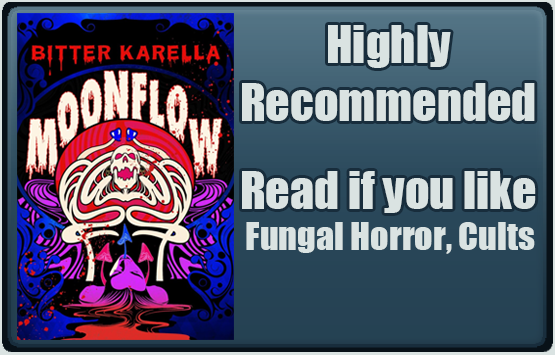
Publisher: Run for It
Genre: Blood & Guts (Gorn), Eco Horror, Eldritch Horror, Myth and Folklore
Audience: Adult
Diversity: Trans main character and author, queer/lesbian major characters
Takes Place in: California
Content Warnings (Highlight to view): Animal Abuse, Child Abuse, Child Death, Child Endangerment, Childbirth, Death, Drug Use/Abuse, Gore, Incest, Medical Torture/Abuse, Mental Illness, Physical Abuse, Police Harassment, Racism, Rape/Sexual Assault, Sexism, Sexual Abuse, Slurs, Slut-Shaming, Transphobia, Violence, Vomit
Blurb
How do I even begin to describe this fucked up, queer, psychedelic, gross, erotic, satirical, disturbing, fungal horror story that I sped through because I couldn’t put it down? Every free minute I had was dedicated to reading Moonflow. And I have ADHD; I can never focus on one thing for long unless I’m super interested. But I hyper-fixated on Karella’s weird ass masterpiece of a novel. As a splatterpunk story, the writing is intentionally over the top and there’s a ton of weird, gross stuff going on. There’s lots of violence and fucking and it’s crude and funny as hell, but also deeply tragic. I personally loved it, but I know splatterpunk is not everyone’s cup of tea and some readers are going to be off put by the sex and violence. I love how trans the book is; eggs, muffing, dead names, TERFs, and chasers are all mentioned. The main character, Sarah, reminded me a lot of myself. She’s fat, trans, and a science nerd who could use a boost of self-confidence and went on three dates with her girlfriend before realizing they were dates. She also really loves her cat, Herman, and most of her desire to earn more money is so she can afford nice things for him, like the wet food he likes.
Sarah was forced to drop out of college due to depression and dysphoria, but at least she can still put the mycology skills she learned there to good use. Sarah grows psychedelic mushrooms for Madeline, a hot trans woman who delas drugs at house parties and is always surrounded by admirers. Madeline invites Sarah to another one of her sordid house parties where Sarah offers her a batch of freshly grown Fire Imps (all the mushrooms in the book are fictional). Unfortunately, Madeline isn’t interested, claiming they’re “last season” and “gauche.” She tells Sarah about a mushroom called The King’s Breakfast that she wants instead. Despite lacking the blue coloration that indicates a high concentration of psilocybin, the King’s Breakfast is strong and (even better) it’s impossible to have a bad trip on it. Even Sarah, who hates getting high around other people, enjoys her experience with the King’s Breakfast, hallucinating a beautiful nature goddess. Madeline asks Sarah to go into the Pamogo forest to collect some spores to grow. Desperate for money, Sarah agrees. Madeline has “a very old and dear and trusted friend” who will act as her guide in theforest.
It turns out the “trusted friend” is Andy, and Sarah immediately pegs him as a doofus. He’s the kind of guy who describes himself as “an ally,” despite it being a term others bestow upon you and not something you can claim. He complains about her selling mushrooms–a free natural resource– because of Capitalism, while ignoring the fact that Sarah is in desperate need of money and how, as a trans college dropout, she can’t just “get a job.” Despite his objections, Andy still guides Sarah through the Pamago forest, using the dead bodies of hikers lost in the forest as morbid trail markers (as everything else in the forest seems to move). Andy always has some sort of logical explanation for the weird things that happen in the Pamogo. Compasses don’t work because of electromagnetic storms. Raccoon bones end up in piles because the trees create a wind tunnel. The mushrooms move as if alive due to acidity in the soil.
Meanwhile, in a town near the Pamogo forest, two women named Skillet and the Hell Slut are watching an innocent looking girl enter the only bar in town. The Hell Slut correctly guesses that she’s a runaway escaping her pimp and saves her from a frat boy harasser outside the bar. After the Hell Slut kicks the guy’s ass, Skillet convinces the girl to go with them to meet their leader “Mother Moonflow.” If you think that sounds like the name of a cult leader, you’d be 100% correct.
Skillet and the Hell Slut belong to a lesbian separatist cult nested in the heart of the Pamogo forest, living off the land. They worship the Green Lady, a nature goddess who resides in Pamogo forest. She was formerly the consort of the Lord of the Forest, a male fertility and nature God with antlers, who she now protects her followers from (or so Mother Moonflow says). Both deities are reminiscent of the Wiccan Mother Goddess and the Horned God. The followers of the Green Lady seem to have similar (though less extreme) beliefs as women who practice Dianic Wicca. The founder of Dianic Wicca, Zsuzsanna Budapest, is also a huge TERF who, despite claiming to be a radical feminist, reduces women to their reproductive organs. Mother Moonflow is similarly obsessed with genitals, she and her group call anyone with a penis a phallic Alec. There are also vaginas painted on everything.
I liked the book’s criticism of a certain type of radical feminism, the kind practiced by TERFs like Z. Budapest. By claiming men (and anyone else with a penis because they reduce gender to genitals) are inherently violent, it means they don’t think men can change this part of their nature. This is an issue because it lets men off the hook for their actions.They can’t help raping/abusing/murdering because they’re men. It’s the same sexist attitude as “boys will be boys,” a sort of twisted, reverse victim blaming. These are also the kind of people who will brush aside sexual assault and violence committed by women. Even though Andy is an idiot, he is right about one thing. Trying to get rid of either the masculine or feminine throws off the balance of nature. Mushrooms are a perfect example of this, as most are hermaphroditic. In other words they contain both “male” and “female” sexual traits, capable of both fertilizing and being fertilized (some mushrooms also have thousands of different sexes).
There’s a lot of focus on Sarah and the Hell Slut being fat and their large bodies are frequently described, more so than the non-fat bodies of other characters, with the exception of Mother Moonflow’s comically large tits. Skillet is clearly a chubby chaser, she loves fondling the Hell Slut’s tummy folds and asks Sarah how much she weighs. She does get called out on it, thank God, but it still felt like Skillet gets away with being very gross. I’m guessing all the focus on Sarah and the Hell Slut’s bodies is because fat people are so often uncomfortable with their bodies (and make other people uncomfortable) from living in a fatphobic society. I loved that two of the main characters were fat women, but as a fatty myself, I felt like all the focus on their bodies was too much, and it admittedly made me uncomfortable.
Each chapter begins with either a quote from Lazarus Sloane’s diary (a man who tried and failed to build a sawmill in the Pamago forest) or Sarah’s mushroom guidebook for the Pamago by a man named T. F. Greengarb. Each gets increasingly unhinged as the story progresses. Sloane is clearly losing his grip on reality as more and more of his workmen start to disappear. Greengarb’s mushroom descriptions also start getting really weird. Early on, he writes about mushrooms like the Candy Cap, said to taste like maple syrup, but later in the book he describes the oily black Fox Candle that tastes like “children’s fear.” I thought this was a nice, creepy touch.
This was a weird read, which usually I’m not a fan of. In this case, I felt it worked well.




I loved this book, too!